Core Components
The components of the CobaltCore stack, organized by layer. Each entry links to the reference page that documents it in depth; the way the layers fit together is described on the Architecture page.
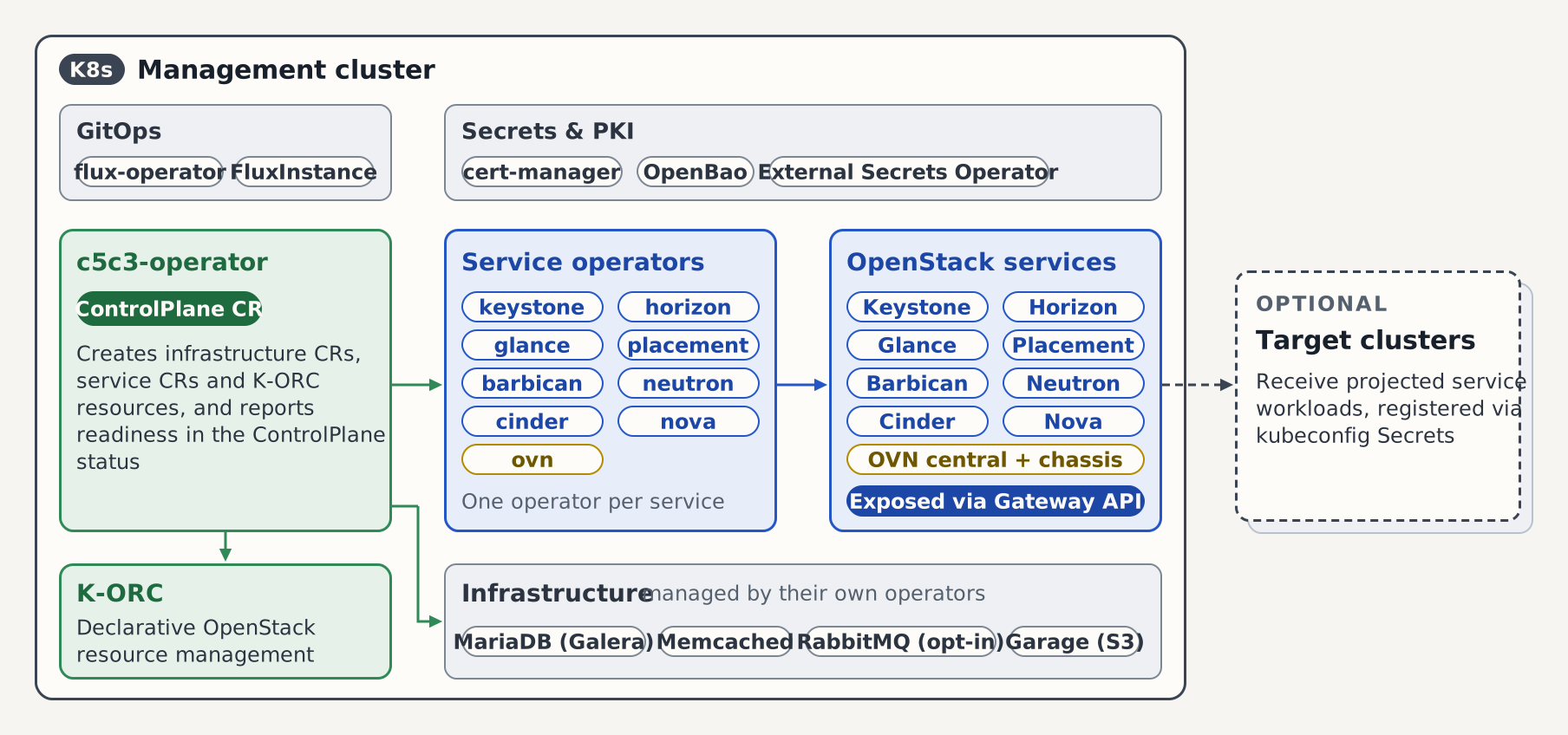
The figure shows where the components of the first five sections sit on the management cluster.
Orchestration
The c5c3-operator (operators/c5c3/) owns the top of the stack. It reconciles a ControlPlane CR into infrastructure CRs, service CRs, and K-ORC resources, and aggregates their readiness.
| CRD | API group | Description |
|---|---|---|
ControlPlane | c5c3.io/v1alpha1 | Top-level resource for a whole control plane: infrastructure, services, identity plane (CRD reference) |
CredentialRotation | c5c3.io/v1alpha1 | Rotates the admin application credential (reconciler reference) |
SecretAggregate | c5c3.io/v1alpha1 | Aggregates secrets from multiple sources into one consumer Secret |
KeystoneService | c5c3.io/v1alpha1 | Registers one service against a ControlPlane's identity plane: catalog entry and service account, from the service's own namespace (CRD reference) |
KeystoneUser | c5c3.io/v1alpha1 | Orders one Keystone user from a namespace a ControlPlane assigns, on the management cluster or a target cluster, and delivers its credentials as a Secret beside the order (CRD reference) |
KeystoneProject | c5c3.io/v1alpha1 | Orders one Keystone project in the ControlPlane's admin domain from an assigned namespace (CRD reference) |
KeystoneRoleAssignment | c5c3.io/v1alpha1 | Orders one role, on the namespace's role allowlist, for an ordered user on an ordered project (CRD reference) |
KeystoneCatalogEntry | c5c3.io/v1alpha1 | Orders one catalog entry, a service row and its endpoints, from an assigned namespace that admits catalog entries (CRD reference) |
KeystoneApplicationCredential | c5c3.io/v1alpha1 | Orders one application credential for an ordered user on an ordered project, rotates it on a schedule, and delivers it as a Secret beside the order (CRD reference) |
MariaDBDatabase | c5c3.io/v1alpha1 | Orders one database on the ControlPlane's shared MariaDB from an assigned namespace, with a user the OpenBao database engine issues and replaces every day, and delivers its credential as a Secret beside the order (CRD reference) |
RabbitMQVhost | c5c3.io/v1alpha1 | Orders one vhost and a user on the ControlPlane's managed message bus from an assigned namespace, rotates the user on a schedule, and delivers the credentials as a Secret beside the order (CRD reference) |
Service operators
One operator per OpenStack service (operators/<service>/), all built on the scaffolding the Keystone operator establishes and all following the API-group convention <service>.openstack.c5c3.io.
| Operator | CRDs | Service | Reference |
|---|---|---|---|
| keystone-operator | Keystone, KeystoneIdentityBackend | Identity | Overview |
| glance-operator | Glance, GlanceBackend | Image | Overview |
| placement-operator | Placement | Resource tracking | Overview |
| horizon-operator | Horizon | Dashboard | Overview |
| barbican-operator | Barbican, BarbicanSecretStore | Key management | Overview |
| ovn-operator | OVNCentral, OVNChassis | SDN control plane and chassis | Overview |
| neutron-operator | Neutron, NeutronMetadataAgent | Networking | Overview |
| cinder-operator | Cinder, CinderBackend, CinderBackupBackend | Block storage | Overview |
| nova-operator | Nova | Compute control plane | Overview |
The ovn-operator is the exception to the one-operator-per-service rule. It manages no OpenStack service of its own; it owns the OVN and Open vSwitch layer that the Neutron ML2/OVN driver programs.
OpenStack resource management
K-ORC, the upstream OpenStack Resource Controller (API group openstack.k-orc.cloud), manages Keystone resources declaratively: domains, projects, users, application credentials, regions, catalog services, and endpoints. It is applied by a Flux Kustomization rather than a HelmRelease, and the c5c3-operator drives its CRs for the admin application credential, the service accounts, and the catalog. See K-ORC in the infrastructure manifests.
Infrastructure stack
The HelmReleases under deploy/flux-system/ install the backing services the control plane depends on. Their configuration and the CRs built on top are documented per component in Infrastructure Manifests:
- cert-manager — the base layer of the dependency graph; issues webhook and endpoint TLS certificates (section).
- mariadb-operator with a Galera
MariaDBCR as the shared database backend (section). - memcached-operator with a
MemcachedCR for token and content caching (section). - rabbitmq-cluster-operator serving the
RabbitmqClusterCRD behind a ControlPlane's opt-in shared message bus (section). - garage-operator with a
GarageCR providing the S3 object store that backs Glance multi-store (section). - openbao-operator and the OpenBao proving instance, the secret store for the whole stack (section, bootstrap).
- External Secrets Operator (ESO) syncing secrets between OpenBao and the cluster in both directions (section).
- prometheus-operator CRDs so operators can ship
ServiceMonitorresources without a full monitoring stack (section).
GitOps
The flux-operator manages FluxCD through a FluxInstance CR that syncs deploy/flux-system/ from Git. HelmRelease ordering is expressed as dependsOn edges with cert-manager at the base. See FluxInstance and the dependency order.
Observability and test infrastructure
Every operator exports Prometheus metrics (Keystone Operator Metrics is the reference set). The remaining pieces ship only with the kind overlay (deploy/kind/) for development and CI:
- kube-prometheus-stack and metrics-server for local metrics, and Chaos Mesh driving the chaos e2e suites — all opt-in addons documented in Infrastructure Manifests — Kind Overlay Demo Addons.
- dizzy, the load/chaos stack around victoria-metrics, used by dizzy chaos testing.
- Envoy Gateway as the demo Gateway API implementation (
deploy/kind/base/); production overlays bring their own Gateway controller. - The Tempest image (
images/tempest/) executed by the Tempest test infrastructure.
Planned components
Components from the original C5C3 architecture document without an implementation in this repository are sketched under Future: the Hypervisor Cluster, the Storage Cluster, and a dedicated Management Cluster. The not-yet-onboarded OpenStack services are listed on the Architecture page.