How-to: Enable Glance Image Conversion
An image reaches the store in whatever format its publisher chose, and every consumer of it inherits that choice. A store on Ceph/RBD clones a raw image copy-on-write and pays a full flatten per boot for anything else, so a qcow2 cloud image downloaded from a distribution mirror costs that flatten again and again. spec.importPlugins.conversion moves the work to the import: qemu-img rewrites the image once, on its way in, and every later boot reads the format the store wants. This guide turns the plugin on, imports a real cloud image through it, and covers what the conversion costs in staging space.
Prerequisites
Devstack
This guide is written against the Quick Start (ControlPlane) devstack. Stand it up first:
KIND_HOST_PORT=8443 WITH_CONTROLPLANE=true make deploy-infraFollow that tutorial through to its final Verify step, so the projected controlplane-glance Glance child is Ready in the openstack namespace, its default S3 store is attached, and the image API answers on https://glance.127-0-0-1.nip.io:8443. Every resource name below is one that devstack produces.
- The
OS_*environment variables from the tutorial's token-issue step, so theopenstackclient reaches the ControlPlane's Keystone. - Outbound connectivity from the cluster to the mirror the import below fetches from. It is an HTTPS URL on port 443, which is what the operator's default import filter allows; see Filter web-download Image Imports.
Which uploads the plugin reaches
Conversion is a stage of the interoperable image import, so it applies to POST /v2/images/{id}/import and to nothing else. Three consequences follow:
- A plain
PUT /v2/images/{id}/fileupload bypasses the plugin. Whoever uploads that way decides the format, so a deployment that depends on conversion has to keep that path out of its policy. - Glance skips the plugins for the
copy-imagemethod, which moves an image already held in one store into another. glance-directis not among the import methods this operator enables.
What is left is the web-download import the walkthrough below uses.
Enable it
The plugin selection is a ControlPlane knob, projected onto the Glance child. The presence of the conversion sub-block is the switch, so an empty block runs it at the operator default output format, raw:
kubectl patch controlplane controlplane -n openstack --type merge \
  -p '{"spec":{"services":{"glance":{"importPlugins":{"conversion":{}}}}}}'
kubectl rollout status deploy/controlplane-glance -n openstack
Set outputFormat explicitly for anything else; the accepted values are raw, qcow2, and vmdk, and admission rejects the rest.
Set the plugins on the ControlPlane, never on the projected child
The controlplane-glance Glance CR is projected by the c5c3-operator, so a spec.importPlugins you patch onto the child is reverted on the next reconcile. The projection is unconditional in the other direction too: clearing services.glance.importPlugins on the ControlPlane removes the child's field, which takes the plugin back off on the next rollout and is how you revert this guide.
Read back what the pods actually mounted. The plugin list and the plugin's own section are separate keys in the rendered config:
kubectl get cm -n openstack "$(kubectl get deploy controlplane-glance -n openstack \
  -o 'jsonpath={.spec.template.spec.volumes[?(@.name=="config")].configMap.name}')" \
  -o 'jsonpath={.data.glance-api\.conf}' | grep -A1 -E '^\[(image_conversion|image_import_opts)\]$'
[image_conversion]
output_format = raw
--
[image_import_opts]
image_import_plugins = [image_conversion]The list is what enables the plugin at all; image_import_plugins = [] is the state before this patch and after the revert. Confirm the service is healthy again on the ControlPlane's per-service condition, which answers a narrower question than its aggregate Ready:
kubectl get controlplane controlplane -n openstack \
  -o jsonpath='{.status.conditions[?(@.type=="GlanceReady")].status}{" "}{.status.conditions[?(@.type=="GlanceReady")].reason}{"\n"}'
Import an image and watch the format change
With the OS_* variables exported, create an image record that declares the format the mirror publishes, then import into it:
openstack --insecure image create --disk-format qcow2 --container-format bare \
  conversion-demo
openstack --insecure image import --method web-download \
  --uri https://cloud.debian.org/images/cloud/bookworm/latest/debian-12-genericcloud-amd64.qcow2 \
  conversion-demo
The import call returns at once and the API pod fetches the image in the background. Wait for the record to go active:
for _ in $(seq 120); do
  [ "$(openstack --insecure image show conversion-demo -f value -c status)" = active ] && break
  sleep 5
done
openstack --insecure image show conversion-demo -f value -c status
The record was created as qcow2. Glance rewrote the staged file before it reached the S3 store and updated the image accordingly:
openstack --insecure image show conversion-demo -f value -c disk_formatrawThe plugin runs qemu-img info on the staged file first and qemu-img convert only when the format it finds differs from outputFormat, so importing an image that already matches costs one qemu-img info call. That binary comes from the qemu-utils package the operator's Glance image ships.
A conversion that fails takes its import task down with it and leaves the API serving. The record stays out of active, and the plugin's own error is in the API log:
kubectl logs -n openstack deploy/controlplane-glance -c glance-api --tail=50Clean up:
openstack --insecure image delete conversion-demoWhat the conversion costs in staging
Every import lands on the API pod's node-local staging area before the data reaches the store, and a conversion adds a second file next to the first: the source and the converted result coexist there until the source is deleted. One import can therefore draw about twice the image size from the spec.staging budget, which the devstack leaves at the operator default of 10Gi per scratch volume.
The figure shows the path of such an import as B. The second file of a conversion lands on the volume staging, beside the first.
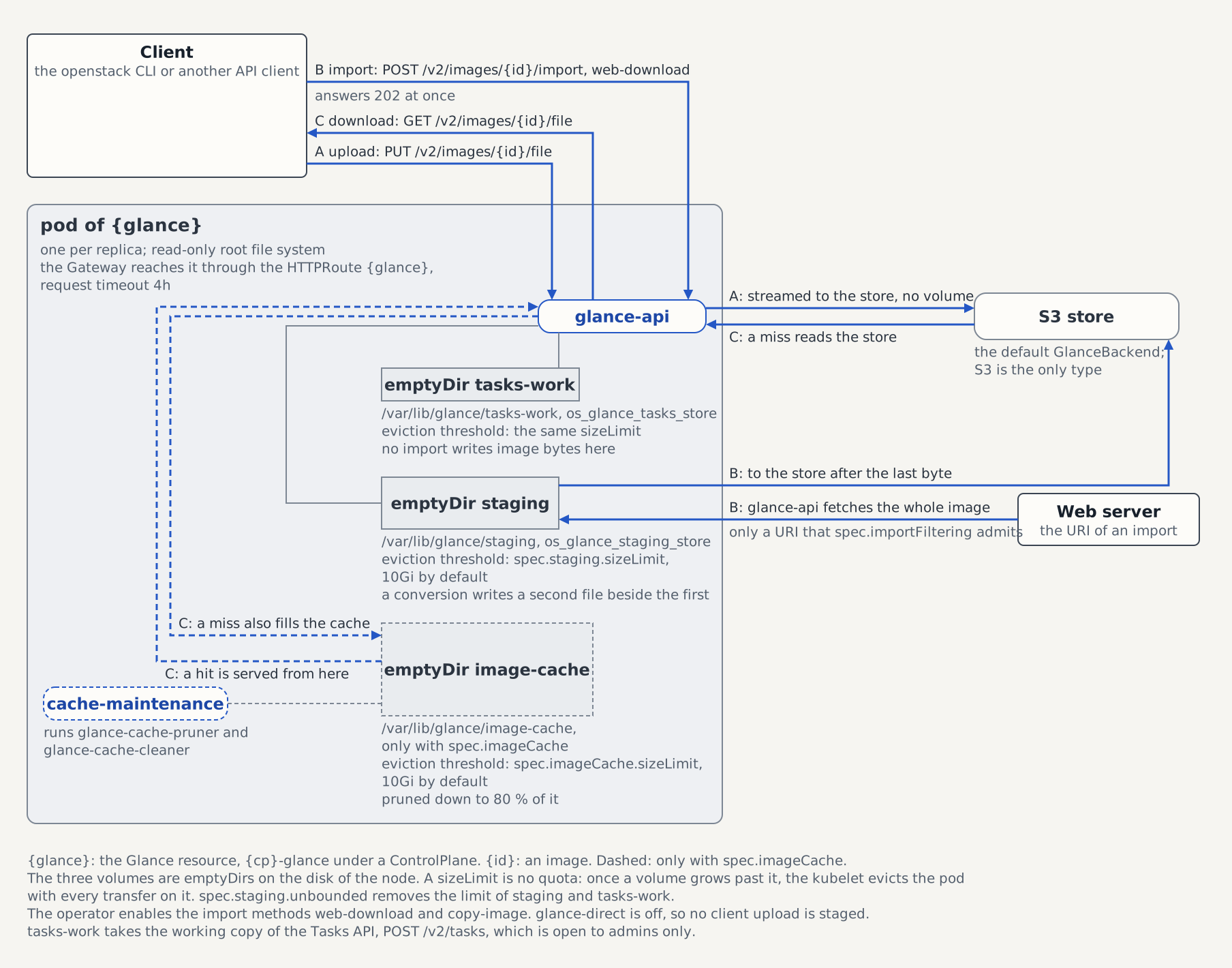
Size that budget against what the conversion produces rather than against what travels over the wire. A raw result is the image's full virtual size, and a sparse qcow2 download hides that number: a few hundred megabytes on the mirror can be several gigabytes on the staging volume. The bound is an eviction threshold the kubelet enforces, so an import that crosses it evicts the glance-api pod and takes every in-flight import on that replica with it. See StagingSpec for what that bound does and does not guarantee, and Large Image Uploads through the Gateway for the other half of the same budget.
Turn the plugin off again
Clear the block on the ControlPlane:
kubectl patch controlplane controlplane -n openstack --type merge \
  -p '{"spec":{"services":{"glance":{"importPlugins":null}}}}'
kubectl rollout status deploy/controlplane-glance -n openstack
The next render writes image_import_plugins = [] and drops the [image_conversion] section, which the read-back command above shows once the new ConfigMap is mounted. Images converted while the plugin was on stay as they are: the conversion happened at import time and nothing reverses it.
Standalone Glance, without a ControlPlane
Without a ControlPlane nothing projects the Glance child, so the same block sits on the Glance CR you own:
apiVersion: glance.openstack.c5c3.io/v1alpha1
kind: Glance
metadata:
  name: glance
  namespace: openstack
spec:
  importPlugins:
    conversion:
      outputFormat: raw
Everything else in this guide is unchanged: the operator resolves an empty outputFormat to raw at render time, writes the two keys into glance-api.conf, and rolls the Deployment once per change. Removing the block again disables the plugin on the next rollout.
See also
- Glance CRD API Reference — the full
ImportPluginsSpeccontract, the two sibling plugins (decompressionandinjectMetadata), the fixed plugin order, and the fourextraConfigkeys this block owns. - ControlPlane CRD API Reference —
services.glance.importPluginsand the rest of the projected Glance surface. - Filter web-download Image Imports — the filter every import URI passes before the plugin ever sees a byte.
- Large Image Uploads through the Gateway — the staging bound a conversion draws twice from.
Tested by
The rendered plugin list in the operator's fixed order, the non-default output format, the qemu-img binary and the lhafile Python module the plugins need at import time, and the revert above (clearing the block, then watching the config converge back to an empty list with neither per-plugin section left behind) are asserted end-to-end on the CI e2e kind cluster by this chainsaw suite:
chainsaw test --test-dir tests/e2e/glance/import-plugins