Attach a SAML Federation Backend to Keystone
This guide walks through federating a running Keystone with a SAML 2.0 identity provider using the KeystoneIdentityBackend CRD: supply the IdP metadata, apply one CR, watch the conditions converge, export the generated service-provider (SP) metadata, register it at the IdP out of band, and verify a federated user can log in. The worked example uses Keycloak — the same IdP the mirroring e2e suite (Tested by) deploys — so every value is adaptable to a kind cluster.
SAML reuses almost all of the OIDC federation machinery: the same federation sidecar (which now also ships mod_auth_mellon), the same content-hashed federation Secret, and the same dedicated backend controller that provisions the Keystone identity provider, mapping, and protocol. When a SAML backend attaches, the operator generates mod_auth_mellon configuration into the sidecar alongside mod_auth_openidc; the two coexist, so a Keystone can serve OIDC and SAML backends at once.
For the full field reference, see the KeystoneIdentityBackend CRD API Reference.
Prerequisites
Devstack
This guide is written against the Quick Start devstack. Stand it up first:
KIND_HOST_PORT=8443 make deploy-infraFollow that tutorial through to its final Verify step, so a Keystone CR named keystone is Ready in the openstack namespace. Every resource name in the examples below is one that devstack produces.
- A SAML identity provider whose EntityDescriptor metadata is available inline, as a Secret, or by URL.
- A federation proxy image. The managed ControlPlane path projects
ghcr.io/c5c3/keystone-federation-proxyautomatically; standalone Keystone installations setspec.federation.proxyImagethemselves. Without it, federation backends stay pending with aFederationProxyImageMissingWarning — no hidden default is assumed. - Service users stay SQL-backed. Federated users are ephemeral shadow users; OpenStack service accounts and the bootstrap admin remain in the SQL-backed
Defaultdomain, which the CRD hard-rejects federating. - At most one SAML backend per Keystone.
mod_auth_mellon's SP configuration projects onto a shared/v3parent Location, so the validating webhook rejects a second SAML backend on the same Keystone.
Step 1 — Supply the IdP metadata
Pick exactly one of the three sources for spec.saml.idpMetadata:
secretRef— a Secret carrying the EntityDescriptor XML under the fixed data keyidp-metadata.xml:bashcurl -s https://idp.example.com/realms/cobaltcore/protocol/saml/descriptor \ -o idp-metadata.xml kubectl create secret generic corp-saml-idp-metadata \ --from-file=idp-metadata.xml=idp-metadata.xmlinline— paste the raw EntityDescriptor XML into the CR (the operator validates itsentityIDagainstspec.saml.idpEntityIDat admission).url— the operator fetches the document through the same hardened, SSRF-guarded client the OIDC path uses. By default that client refuses to dial any non-public address; to fetch metadata from a trusted in-cluster SAML IdP, allowlist its CIDR through the same operator-levelfederation.metadataAllowCidrschart value (--federation-metadata-allow-cidrsflag) described under OIDC discovery against an in-cluster IdP.
Step 2 — Configure the SP certificate (optional)
By default the operator generates a self-signed SP keypair once (stored in the stable-named <keystone>-saml-sp Secret) and never rotates it — regeneration would invalidate the IdP-side registration. IdPs pin the SP certificate from the SP metadata, where self-signed is standard.
To supply your own certificate (for example, one issued by cert-manager), reference a kubernetes.io/tls-shaped Secret (fixed keys tls.crt / tls.key):
spec:
  saml:
    sp:
      certificateSecretRef:
        name: corp-saml-sp-cert
Step 3 — Configure the proxy image (standalone installations)
Set spec.federation.proxyImage on the Keystone CR if it is not already projected by a managed ControlPlane:
spec:
  federation:
    proxyImage:
      repository: ghcr.io/c5c3/keystone-federation-proxy
      digest: sha256:<64-hex-digest>   # pin by immutable digest, never a mutable tag
The sidecar terminates SAML on the authentication path, so pin it by immutable digest rather than a tag. latest re-pulls on every restart (its default pullPolicy is Always), so a silently re-published image would land unreviewed in the auth path with no version to roll back to. The proxy image is released under the base-image scheme (:latest and per-commit :<sha>, not the spec.openStackRelease cadence), so resolve the digest of the build you intend to run and pin that:
docker buildx imagetools inspect ghcr.io/c5c3/keystone-federation-proxy:latest \
  --format '{{.Manifest.Digest}}'
Step 4 — Apply the backend CR
apiVersion: keystone.openstack.c5c3.io/v1alpha1
kind: KeystoneIdentityBackend
metadata:
  name: corp-saml
spec:
  keystoneRef:
    name: keystone
  domain:
    name: cobaltcore-saml
    mode: Manage
    deletionPolicy: Delete
  type: SAML
  saml:
    idpEntityID: https://idp.example.com/realms/cobaltcore
    identityProviderName: corp-saml
    idpMetadata:
      secretRef:
        name: corp-saml-idp-metadata
    forwardAttributes:
    - username
  mappings:
  - remote:
    - type: HTTP_MELLON_IDP
      anyOneOf:
      - https://idp.example.com/realms/cobaltcore
    - type: HTTP_MELLON_USERNAME
    local:
    - user:
        name: "{0}"
      group:
        name: federated-users
        domain:
          name: cobaltcore-saml
  groups:
  - name: federated-users
    roleAssignments:
    - role: member
      domain: true
Attribute forwarding and the HTTP_MELLON_<ATTR> convention
spec.saml.forwardAttributes lists SAML assertion attribute names the proxy forwards to Keystone as MELLON-<attr> request headers. Two attributes are always forwarded (MELLON-IDP and MELLON-NAME-ID); the rest come from your list.
The attribute names are case-sensitive and forwarded verbatim, but the HTTP header hop uppercases them: an assertion attribute username arrives at Keystone as the WSGI environ key HTTP_MELLON_USERNAME. Your mapping rules must reference the uppercased spelling — a mapping remote type of HTTP_MELLON_username silently matches nothing. See the troubleshooting table below.
Step 5 — Watch the conditions converge
kubectl get keystoneidentitybackend corp-saml \
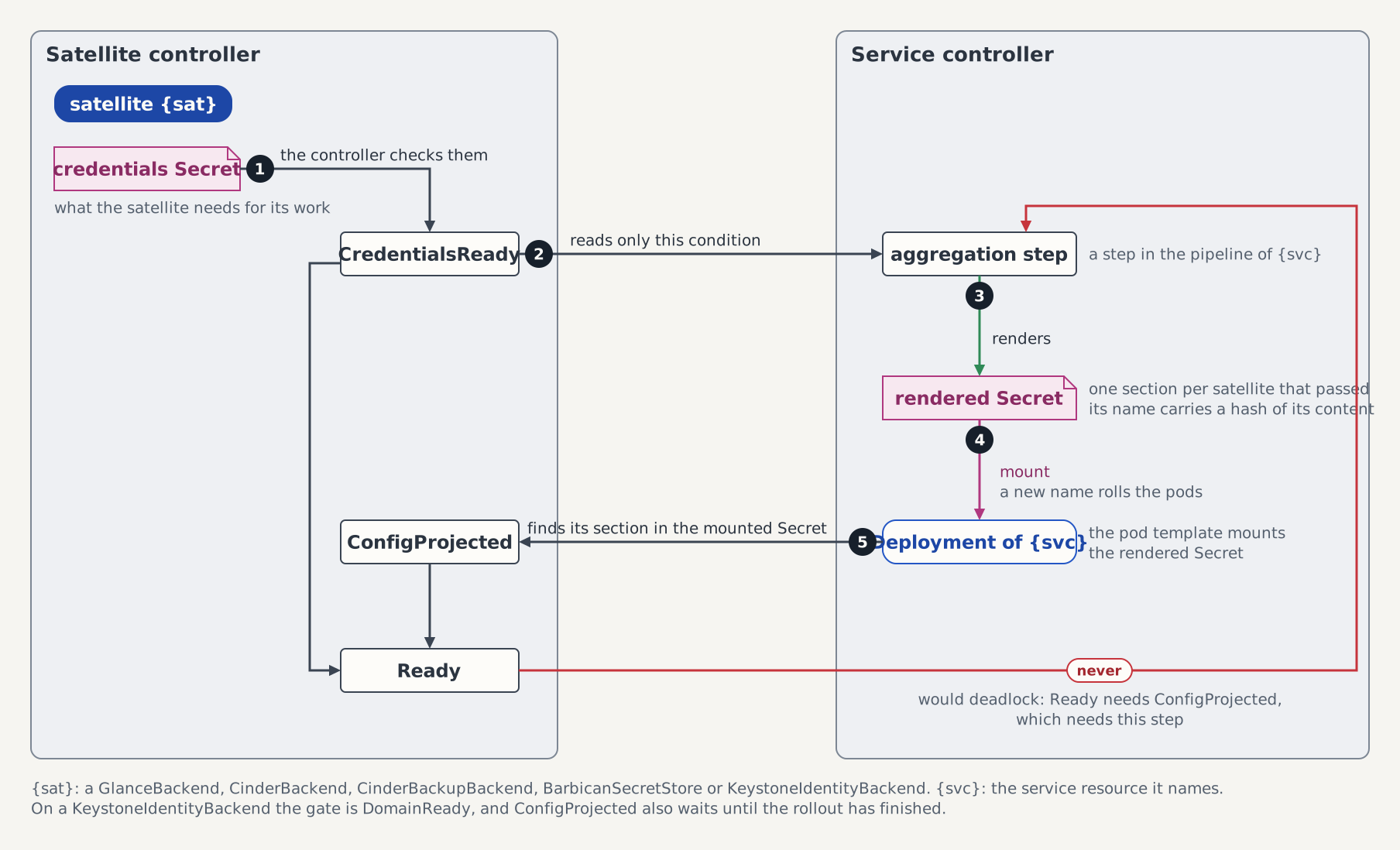
-o jsonpath='{range .status.conditions[*]}{.type}={.status} ({.reason}){"\n"}{end}'DomainReady, FederationObjectsReady, MappingsReady, ConfigProjected, and the aggregate Ready all reach True.
The figure shows that order for every satellite kind. Its gate, CredentialsReady, is DomainReady on an identity backend. The handshake lists the five steps and what differs per kind.
Step 6 — Export the SP metadata and register it at the IdP
Once the SP material resolves, the operator writes the SP metadata to a stable-named Secret (also surfaced on the backend status as samlSPMetadataSecretName):
kubectl get keystoneidentitybackend corp-saml \
  -o jsonpath='{.status.samlSPMetadataSecretName}'
kubectl get secret keystone-saml-sp-metadata \
  -o jsonpath='{.data.sp-metadata\.xml}' | base64 -d
Register that SP metadata with your IdP out of band (in Keycloak: create a SAML client, import the SP metadata, and confirm the client's clientId equals the SP entityID from the Secret). The export is written once the backend renders, and a backend whose IdP metadata does not resolve is skipped. Supply the IdP metadata first, then register the SP.
Step 7 — Log in via WebSSO
Point the dashboard's WebSSO choice at the per-IdP path
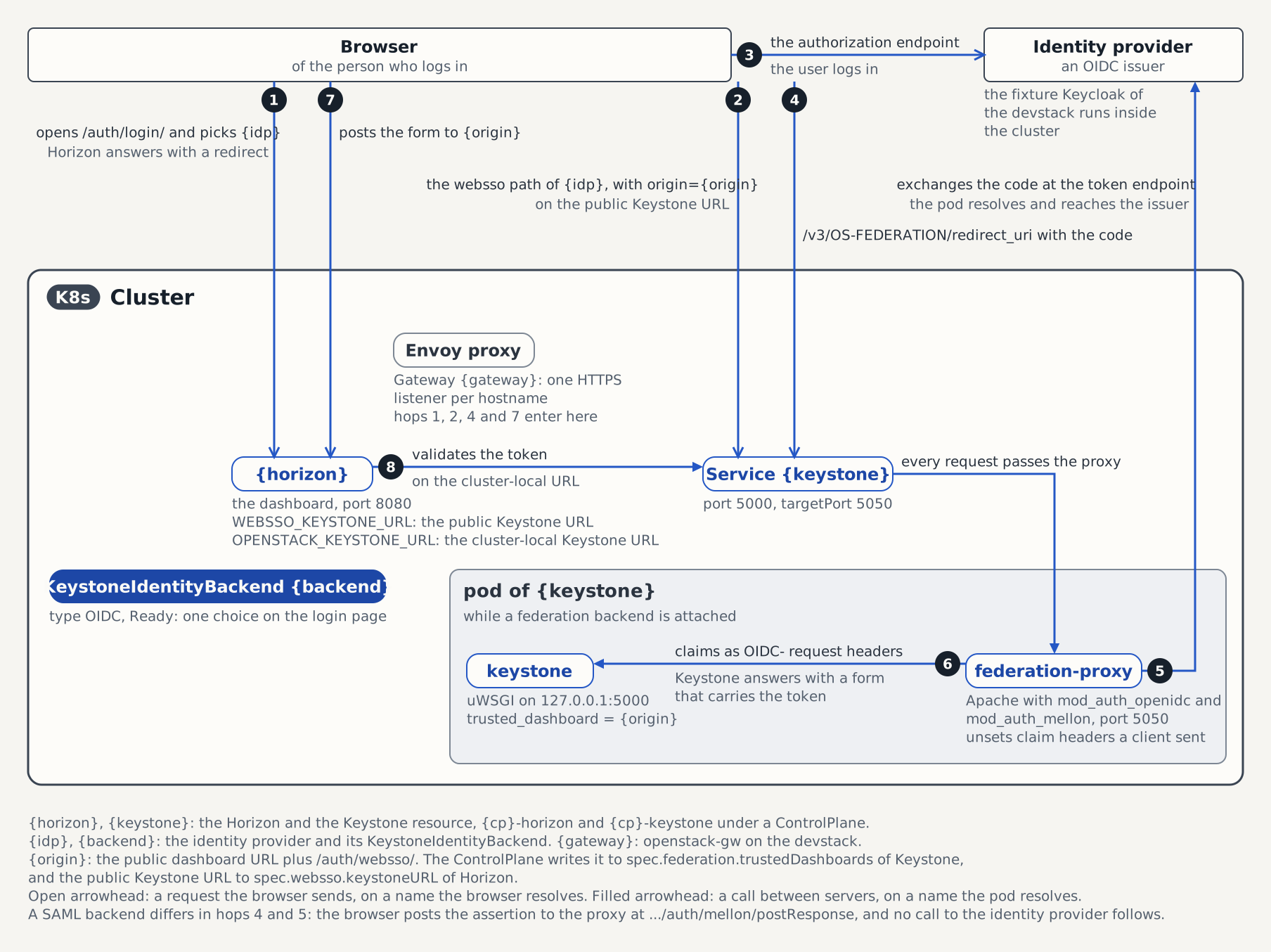
/v3/auth/OS-FEDERATION/identity_providers/<identityProviderName>/protocols/mapped/webssoThe proxy redirects the browser to the IdP, the IdP posts the signed assertion back to <endpoint>/postResponse, and mod_auth_mellon establishes the session and forwards the mapped attributes to Keystone.
The figure draws the login for an OIDC backend. A SAML login differs in hops 4 and 5: the browser posts the assertion to the proxy, and no call from the proxy to the identity provider follows. The hops of a login lists all eight.
Coexistence with OIDC
A Keystone can carry OIDC and SAML backends at once. Both modules render into one proxy.conf on one sidecar: mod_auth_openidc serves the OIDC Locations and mod_auth_mellon serves the SAML Locations. The identity-provider name must be unique across every federation backend of one Keystone (webhook-enforced).
Deleting a backend
Deleting the CR removes the Keystone federation objects (protocol → mapping → identity provider) unconditionally, applies the domain deletion policy, and deletes the SP-metadata export Secret once no SAML backend remains. Detaching the last federation backend restores the plain uWSGI-only pod.
Limitations
- One SAML backend per Keystone (webhook-enforced). Multi-IdP SAML would need
mod_auth_mellon's IdP-discovery machinery and is out of scope. - No CLI / ECP flow. SAML Web-SSO is browser-mediated; there is no bearer-token equivalent to the OIDC introspection path.
Security considerations
- Header stripping. The proxy strips every spoofable
MELLON-*header (both dash and underscore spellings) before authentication, so an in-cluster client cannot forge a federated identity past the module. The forwarded values are set from the genuine assertion in the late phase, overwriting any forged inbound header. - Address check disabled.
MellonSubjectConfirmationDataAddressCheckisOffbecause behind the sidecar/gateway the assertion'sSubjectConfirmationDataaddress never matches the client's source IP. - SP key. The generated SP key lives in the content-hashed federation Secret at mode
0400alongside the other federation material.
Troubleshooting
| Symptom | Likely cause |
|---|---|
| Mapped user has empty attributes | The mapping remote type does not match the uppercased header spelling — use HTTP_MELLON_<ATTR> (uppercase), not the assertion's original case. |
MappingsReady=False, reason NoMappingRules | spec.mappings is empty; Keystone requires at least one mapping rule before the protocol can be provisioned. |
Backend stays pending, FederationProxyImageMissing | spec.federation.proxyImage is not set on the Keystone CR. |
| Second SAML backend rejected at admission | At most one SAML backend per Keystone is supported. |
| IdP rejects the AuthnRequest | The SP was not registered, or its clientId/entityID at the IdP does not match the exported SP entityID. |
Tested by
Attaching the SAML backend, watching the conditions converge, and exporting the SP metadata are asserted on the CI e2e kind cluster by this chainsaw suite. It runs no WebSSO login: the SAML round trip through a browser is left to a check by hand.
chainsaw test --test-dir tests/e2e/keystone/saml-federationThe backend CR the suite applies
The suite isolates its Keystone instance from the parallel suite pool, so its backend CR name (keycloak-saml) and keystoneRef (keystone-saml) differ from the corp-saml / keystone names used in the walkthrough above.
apiVersion: keystone.openstack.c5c3.io/v1alpha1
kind: KeystoneIdentityBackend
metadata:
  name: keycloak-saml
  namespace: openstack
spec:
  keystoneRef:
    name: keystone-saml
  domain:
    name: cobaltcore-saml
    mode: Manage
    deletionPolicy: Delete
    description: Keycloak cobaltcore-saml realm
  type: SAML
  saml:
    idpEntityID: http://keycloak-saml.openstack:8080/realms/cobaltcore-saml
    identityProviderName: keycloak-saml
    idpMetadata:
      secretRef:
        name: keycloak-saml-idp-metadata
    forwardAttributes:
    - username
  mappings:
  - remote:
    - type: HTTP_MELLON_IDP
      anyOneOf:
      - http://keycloak-saml.openstack:8080/realms/cobaltcore-saml
    - type: HTTP_MELLON_USERNAME
    local:
    # {0} is the first value-producing remote: the HTTP_MELLON_IDP rule carries
    # anyOneOf, so Keystone treats it as a pure condition and never adds it to
    # the positional direct-map tuple — HTTP_MELLON_USERNAME is the only value,
    # at index 0.
    - user:
        name: "{0}"
      group:
        name: federated-users
        domain:
          name: cobaltcore-saml
  groups:
  - name: federated-users
    description: Federated Keycloak cobaltcore-saml users
    roleAssignments:
    - role: member
      domain: true