How-to: Attach an External OpenBao to Barbican
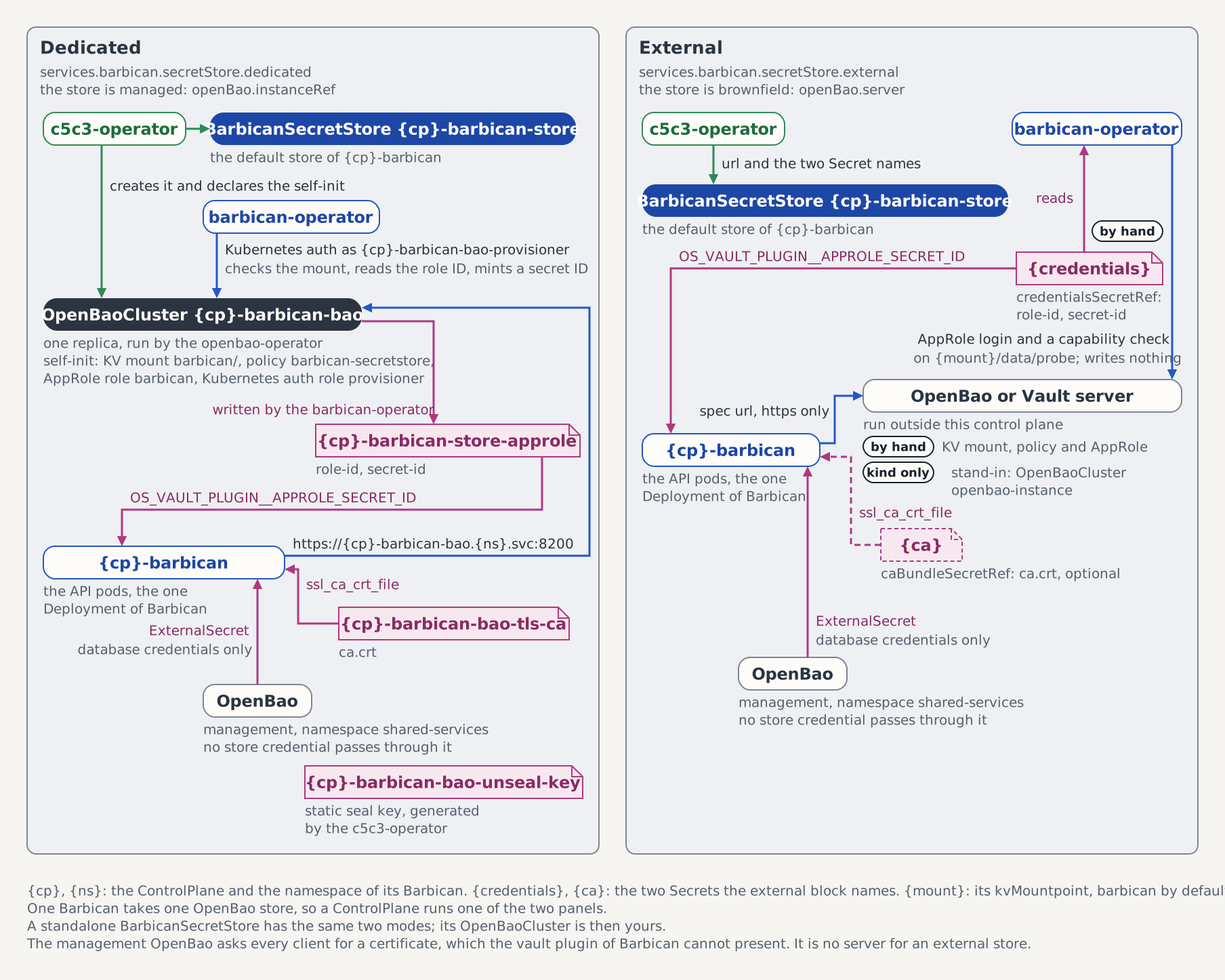
This guide attaches the Key Manager service to an OpenBao or HashiCorp Vault server that already exists, run and hardened outside this control plane. It is the production shape of the service: the operator reads two Secrets, verifies the credentials in them, and renders the store configuration. It creates no mount, no policy, and no AppRole on your server, and it never writes to it.
That read-only posture is what turns the rest of this page into a contract. The server side has to be provisioned out of band, in a specific shape, before a ControlPlane referencing it can converge. Sections 1 and 2 below are that shape; sections 3 to 5 attach the service to it on the devstack.
The right panel of the figure shows this mode. The left panel is the mode of Run Barbican on a Dedicated OpenBao. The management OpenBao of the devstack stands in both and is the server of neither.
Prerequisites
Devstack
This guide is written against the Quick Start (ControlPlane) devstack. Stand it up first:
KIND_HOST_PORT=8443 WITH_CONTROLPLANE=true make deploy-infraFollow that tutorial through to its final Verify step, so a ControlPlane CR named controlplane is Ready in the openstack namespace. That devstack also brings up the proving OpenBaoCluster openbao-instance in openstack, which stands in below for the server you already run.
- An OpenBao or HashiCorp Vault server reachable from the cluster over
https://. Plain HTTP is rejected at admission: the role ID, the secret ID, and every secret Barbican stores travel that URL. On the devstack the stand-in ishttps://openbao-instance.openstack.svc:8200. - A token with write access to that server, for the provisioning in section 1. The operator never has one.
jqonPATHfor the condition readouts in section 5.
Not the shared management OpenBao
The devstack's other OpenBao, the management instance in the shared-services namespace, is not a candidate. It requires client certificates on every connection, and castellan's vault plugin authenticates with an AppRole and a CA bundle only, with no way to present one. Attaching to it produces a connection reset that looks like an unreachable server. Use a server that accepts AppRole logins, which on this devstack is openbao-instance.
1. What the server must carry
Three things, provisioned by you.
A KV v2 mount. castellan's vault plugin speaks KV version 2 and nothing else, so a version 1 mount is not usable. kvMountpoint defaults to barbican, which matches a mount enabled as bao secrets enable -path=barbican -version=2 kv. A server that keeps its secrets on the stock secret/ mount names it explicitly instead.
A policy scoping an identity to that mount. This is the policy the delivered bootstrap writes, and it is the exact grant the operator probes for (deploy/openbao/policies/barbican-secretstore.hcl):
path "barbican/data/*" {
  capabilities = ["create", "read", "update", "delete", "list"]
}

path "barbican/metadata/*" {
  capabilities = ["create", "read", "update", "list"]
}
The absence of delete on metadata/* is deliberate. In KV v2 a delete on the metadata path permanently destroys every version of a secret along with its metadata, which is the only in-store recovery path tenant key material has. The delete castellan issues goes through data/, where it is a recoverable soft delete. On a mount other than barbican, substitute the mount path in both blocks.
An AppRole carrying that policy. The shape the bootstrap writes (deploy/openbao/bootstrap/setup-auth.sh):
bao write auth/approle/role/barbican \
  token_policies=barbican-secretstore \
  token_ttl=1h \
  token_max_ttl=4h \
  secret_id_ttl=720h
secret_id_num_uses is left unset on purpose. castellan re-logs in whenever its cached token ages out after token_ttl, so a use cap would expire the credential mid-operation rather than bound it. That leaves secret_id_ttl as the only bound on a leaked secret ID, and 30 days as a fuse on the credential in use: the plugin holds one process-global AppRole session, so an expired secret ID surfaces as every secret-store operation failing at once. Nothing re-mints it for a store in this mode. The re-mint procedure, under the AppRole Auth heading of the OpenBao Bootstrap reference, is the control: it reads the stable role ID, mints a replacement secret ID straight into the Secret, and destroys the accessor of the one it replaced.
2. The two Secrets
The operator resolves both by name in the namespace the Barbican service is placed in, and their data keys are fixed by contract rather than selectable per CR.
| Secret | Data keys | Required |
|---|---|---|
| credentials | role-id, secret-id | yes |
| CA bundle | ca.crt | only when the server's certificate is not already trusted by the pods' system store |
On the devstack, the e2e suite's helper mints a secret ID against the proving instance and writes both Secrets for you. It is the stand-in for the out-of-band provisioning a real attachment assumes:
tests/e2e/barbican/approle-credentials.sh openstackIt logs in to openbao-instance through its Kubernetes auth method as the openbao-instance-provisioner ServiceAccount, reads the barbican AppRole's role ID, mints a secret ID, and writes barbican-brownfield-approle (role ID and secret ID) plus openbao-instance-ca (the trust bundle) into the namespace it is given. Against a real server, create the same two Secrets by hand from the credentials your operators issued.
3. Declare the Barbican service
On a devstack built from the tutorial, services.barbican is already declared with secretStore: {dedicated: {}}, so this edit replaces the dedicated block with the external one. A ControlPlane that does not declare the service yet adds the whole block:
kubectl edit controlplane controlplane -n openstackspec:
services:
barbican:
secretStore:
external:
url: https://openbao-instance.openstack.svc:8200
credentialsSecretRef:
name: barbican-brownfield-approle
caBundleSecretRef:
name: openbao-instance-ca
# kvMountpoint defaults to "barbican"; a stock secret/ mount sets it
# explicitly. Get it right the first time (see below).
sizing:
barbican:
api:
replicas: 1On a ControlPlane that already ran the dedicated mode, this edit changes the store's mode, a field the BarbicanSecretStore CRD freezes. The reconciler answers that by deleting controlplane-barbican-store and recreating it against the external server on the next pass, and reports BarbicanReady=False with reason RecreatingBarbicanSecretStore in between. The dedicated instance controlplane-barbican-bao is left in place: nothing in the switch tears it down, and the c5c3-operator only removes it when services.barbican is dropped under both deletion annotations. It keeps running, with the material Barbican wrote through the old store, until you delete it by hand. What that deletion destroys is spelled out in step 6 of Run Barbican on a Dedicated OpenBao.
external and dedicated are mutually exclusive, and a block naming neither is rejected at admission. Two fields are worth setting deliberately:
kvMountpointis frozen on the projected store: secret material written under one mount is not reachable under another, so theBarbicanSecretStoreCRD refuses the update rather than re-pointing a live store at material it cannot read. Changing it on the ControlPlane makes the reconciler delete the store and recreate it on the next pass, and everything written under the old mount stays where it is.namespacescopes every request to an OpenBao or Vault namespace, the enterprise-style multi-tenancy header. It exists only in this mode: a dedicated instance is provisioned at the root namespace. The operator sends it on its own login and capability probe too, so a store whose AppRole lives in a namespace it does not name reportsInvalidCredentialsagainst credentials that are correct.
4. Onboard the barbican database-engine tenant
On the managed shared database the Barbican DB credential is engine-issued, and setup-database-tenant.sh provisions an engine connection and role only for the services the ControlPlane declares. It reads the live spec on every run, so a tenant setup that ran before services.barbican was declared provisioned no Barbican pair. Re-run it in that case; the config and role writes are upserts, so a repeat on an already-onboarded ControlPlane refreshes the pair in place:
export BAO_TOKEN=$(kubectl get secret openbao-init-keys -n shared-services \
  -o jsonpath='{.data.init-output}' | base64 -d | jq -r '.root_token')
deploy/openbao/bootstrap/setup-database-tenant.sh openstack controlplane
unset BAO_TOKEN
This is the management OpenBao's database engine, unrelated to the server the secret store points at. The two are separate concerns: one issues the MySQL user Barbican's metadata schema is reached with, the other holds the secret material.
5. Watch the store validate
Watch the service's own condition, BarbicanReady, rather than the ControlPlane-wide Ready, which also covers every other service:
kubectl wait controlplane/controlplane -n openstack \
  --for=condition=BarbicanReady --timeout=15m
The store CR the ControlPlane projects carries the detail:
kubectl get barbicansecretstore controlplane-barbican-store -n openstack \
  -o jsonpath='{range .status.conditions[*]}{.type}{"\t"}{.status}{"\t"}{.reason}{"\n"}{end}'
Two conditions, not three. CredentialsReady reports the login and the capability probe; ConfigProjected reports that the rendered barbican.conf in the running Deployment carries this store's section. ProvisioningReady is removed rather than reported False: it belongs to a store the operator provisions, and reporting it here would claim a step that never ran.
The figure shows the order the two conditions turn True in, and The handshake lists its five steps with what differs per kind.
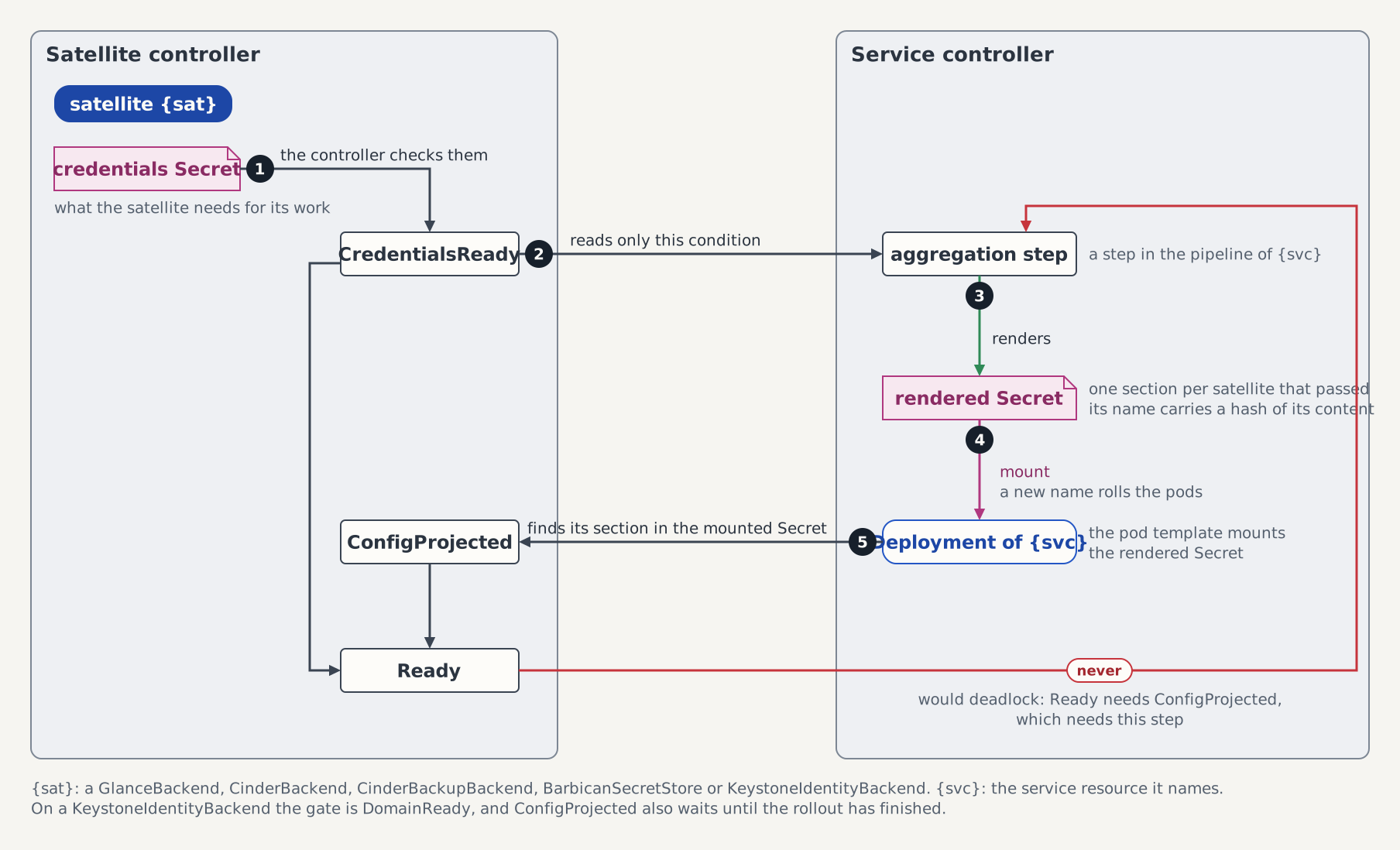
CredentialsReady=True/CredentialsAvailable means the operator logged in with the referenced role ID and secret ID and confirmed, through sys/capabilities-self on <mount>/data/probe, that the policy grants all five of create, read, update, delete, and list. The probe path is never written to. The check re-runs every 15 minutes, so a secret ID that expires under a running deployment surfaces on the store's status rather than only in the API's error rate.
HashiCorp Vault
A Vault server attaches through the same fields, and the projected store keeps type: OpenBao. The type selects Barbican's vault_plugin, which speaks the plain Vault HTTP API that OpenBao stays compatible with, so the two servers are interchangeable from Barbican's side and do not warrant a second enum value.
Troubleshooting
Every reason below sits on CredentialsReady on the controlplane-barbican-store CR.
| Reason | Cause | What to do |
|---|---|---|
WaitingForCredentials | A referenced Secret is absent, or carries an empty role-id, secret-id, or ca.crt. Routine while GitOps ordering settles. | Create the Secret, or fill the missing key. The message names the Secret and the key. |
InvalidCredentials | The server rejected the login. The secret ID expired or was destroyed, the role ID belongs to a different AppRole, or the AppRole lives in an OpenBao namespace namespace does not name. | Re-mint the secret ID into the credentials Secret, or correct the namespace. |
InsufficientCapabilities | The login succeeded and the policy behind the AppRole does not grant all five capabilities on <mount>/data/*. The message names the ones missing. | Apply the policy from section 1, with the mount path substituted. |
OpenBaoUnreachable | The server did not answer, or the client could not be built: DNS, a dropped connection, an expired or wrong CA bundle. A NetworkPolicy that does not admit the operator produces a timeout here rather than a refusal. | Check the URL and the bundle in ca.crt, then the egress and ingress policies between barbican-system and the server. |
Standalone Barbican, without a ControlPlane
Without a ControlPlane you own the BarbicanSecretStore directly, and the same two Secrets are resolved in its own namespace. The names below are ones you choose; none of the controlplane- names from the walkthrough above applies here.
apiVersion: barbican.openstack.c5c3.io/v1alpha1
kind: BarbicanSecretStore
metadata:
  name: barbican-store
  namespace: openstack
spec:
  barbicanRef:
    name: barbican
  type: OpenBao
  isDefault: true
  openBao:
    server:
      url: https://openbao.example.com:8200
      credentialsSecretRef:
        name: barbican-approle
      caBundleSecretRef:
        name: barbican-openbao-ca
    kvMountpoint: secret
    namespace: platform/openstack
server and instanceRef are the two store modes, and the mode is frozen after creation for the reason kvMountpoint is: switching between them re-points the plugin at a different server, where the material written through the old one does not exist. The store attaches to a Barbican that does not have to exist yet; a dangling barbicanRef surfaces as Ready=False and resolves when the CR appears. See the BarbicanSecretStore CRD API Reference for the full field surface.
See also
- BarbicanSecretStore CRD — both store modes, the credential contract, and the condition catalog.
- OpenBao Bootstrap reference — the AppRole role, its policy, and the secret-ID re-mint procedure.
- Run Barbican on a Dedicated OpenBao — the self-service mode, for a cluster with no server to attach to.
- Barbican Controller Events — the events the store controller emits alongside these conditions.
Tested by
The read-only attachment this guide describes (the two Secrets, the login and capability probe, the absent ProvisioningReady, and the rendered [vault_plugin] section pointing at the configured URL and the mounted CA bundle) is asserted on the live CI e2e kind cluster by this suite:
chainsaw test --test-dir tests/e2e/barbican/secretstore-brownfieldThe store CR the secretstore-brownfield suite applies
The suite isolates its Barbican from the parallel suite pool, so its CR names are the suite's isolation identifiers (Barbican barbican-store-brownfield, store barbican-store-brownfield-store) rather than the controlplane-barbican names the walkthrough above uses. The server, the two Secrets, and the default kvMountpoint are the ones from sections 2 and 3.
apiVersion: barbican.openstack.c5c3.io/v1alpha1
kind: BarbicanSecretStore
metadata:
  name: barbican-store-brownfield-store
  namespace: openstack
spec:
  barbicanRef:
    name: barbican-store-brownfield
  type: OpenBao
  isDefault: true
  openBao:
    server:
      url: https://openbao-instance.openstack.svc:8200
      caBundleSecretRef:
        name: openbao-instance-ca
      credentialsSecretRef:
        name: barbican-brownfield-approle