How-to: Create a Provider Network
A provider network puts instances on a segment that already exists outside OpenStack. Two halves have to meet for that: every chassis node needs a local Open vSwitch bridge for the physical network, and Neutron needs a network whose type is flat and whose physical network names that mapping.
This guide adds the mapping to the controlplane-chassis chassis of the ControlPlane devstack, creates the network and a port through the Neutron API, and claims the port on the node the way a hypervisor would.
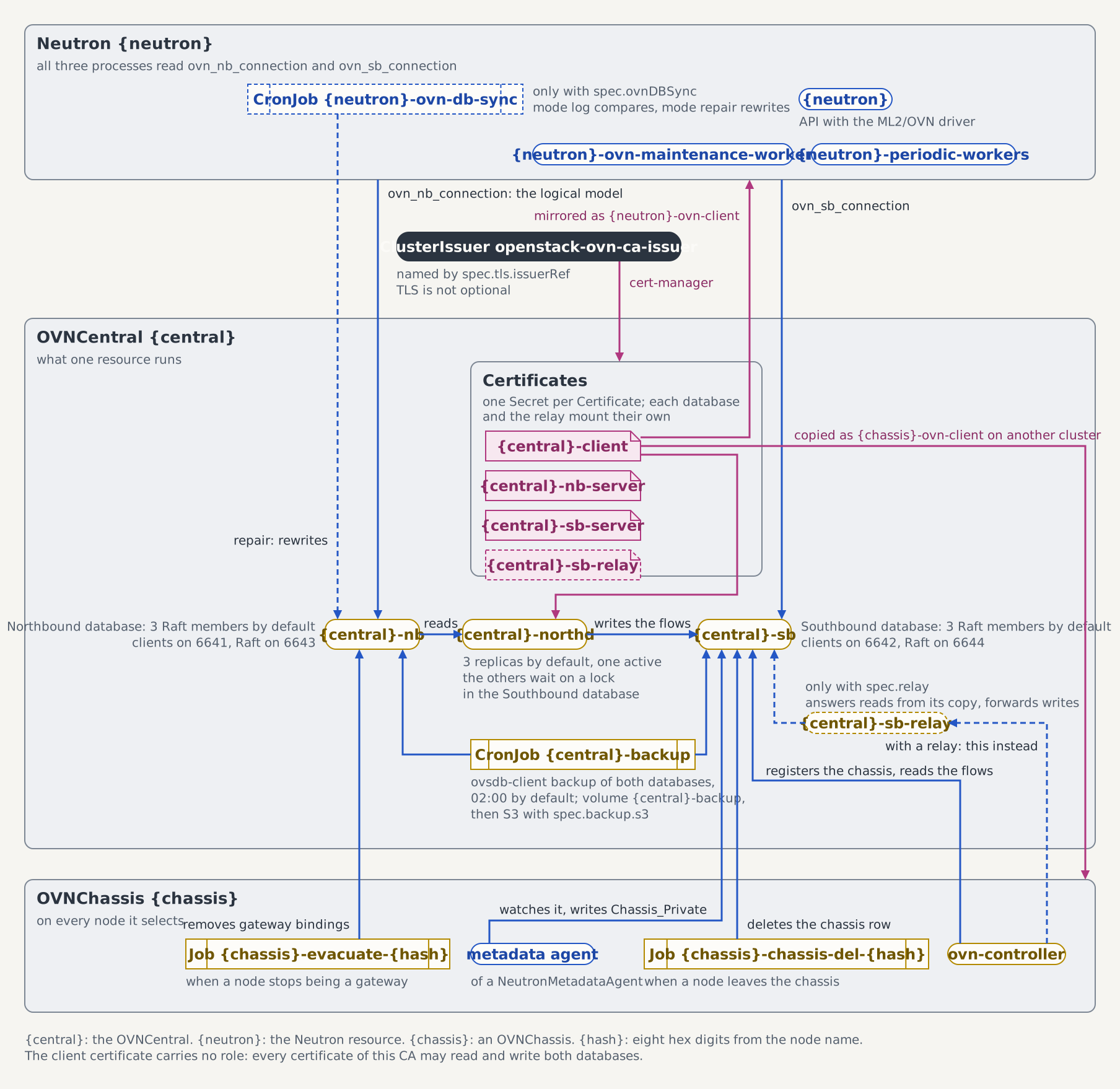
The figure shows the path this guide exercises: Neutron writes the network and the port into the Northbound database, northd compiles them, and ovn-controller on the node claims the port in the Southbound database.
Prerequisites
Devstack
This guide is written against the Quick Start (ControlPlane) devstack. Stand it up first:
KIND_HOST_PORT=8443 WITH_CONTROLPLANE=true WITH_OVN_KERNEL_MODULES=true make deploy-infraFollow that tutorial through to the Create a first network check in its Step 7, so the ControlPlane controlplane serves the network API and the OVNCentral controlplane-ovn is Ready in the openstack namespace.
- A chassis on the node, as Label a Node as a Compute or Network Node leaves it: the node carries
openstack.c5c3.io/chassis=trueand theOVNChassiscontrolplane-chassisreportsReadywith one entry instatus.nodes. - The
OS_*variables the quick start exports in its Step 7, still in the shell you run theopenstackcommands from. Every call below carries--insecure, because the gateway listener presents a self-signed certificate.
Steps
1. Map the physical network onto a local bridge
The label guide's manifest carries no spec.bridgeMappings, so a merge patch writes the whole list:
kubectl patch ovnchassis controlplane-chassis -n openstack --type merge \
  -p '{"spec":{"bridgeMappings":[{"physicalNetwork":"physnet1","bridge":"br-ex"}]}}'
Nothing projects an OVNChassis. The ControlPlane references an OVNCentral and stops there, so this CR is yours and the mapping stands until you change it.
The operator renders the list into the node's own Open vSwitch database and creates each named bridge with ovs-vsctl --may-exist add-br. Read both back:
kubectl exec ds/controlplane-chassis-ovs -n openstack -c ovsdb-server -- \
  ovs-vsctl get open . external_ids:ovn-bridge-mappings
kubectl exec ds/controlplane-chassis-ovs -n openstack -c ovsdb-server -- \
  ovs-vsctl br-exists br-ex
The first prints "physnet1:br-ex", quotes included. The second prints nothing and exits 0. Check the bridge as well as the mapping: ovn-controller attaches patch ports to a bridge but never creates one, so a mapping pointing at a missing bridge drops every packet on that physical network while the CR and the mapping still read correctly.
On a kind node br-ex has no uplink. Nothing leaves the host, which is why the checks below stop at the port binding rather than at a ping.
2. Create the network and its subnet
openstack --insecure network create \
  --provider-network-type flat --provider-physical-network physnet1 provider
openstack --insecure subnet create --network provider \
  --subnet-range 198.51.100.0/24 --no-dhcp provider-subnet
--provider-physical-network takes the same name as the mapping's physicalNetwork; a value with no mapping behind it yields a network no chassis can reach. The range is the RFC 5737 documentation block, so it collides with nothing on your host. --no-dhcp leaves address assignment on the physical segment, where a provider network usually already has a DHCP server; Neutron still allocates each port a fixed address out of the subnet.
3. Create a port and bind it to the node
NODE="$(kubectl get nodes -l openstack.c5c3.io/chassis=true -o jsonpath='{.items[0].metadata.name}')"
openstack --insecure port create --network provider --host "$NODE" smoke0
openstack --insecure port show smoke0 -c binding_vif_type -f value
Expect ovs. --host sets binding:host_id, and the ML2/OVN mechanism driver binds the port to the chassis registered under that hostname. A port created without a host stays unbound, and binding_vif_type reports unbound.
4. Claim the port on the integration bridge
An instance would be plugged in by its hypervisor. With no instance to start, put an internal interface on br-int and tag it with the port's id, which is the part of the plug that OVN reacts to:
PORT_ID=$(openstack --insecure port show smoke0 -f value -c id)
kubectl exec ds/controlplane-chassis-ovs -n openstack -c ovsdb-server -- \
  ovs-vsctl --may-exist add-port br-int smoke0 \
  -- set Interface smoke0 type=internal external_ids:iface-id=$PORT_ID
ovn-controller looks a logical port up by the iface-id it finds on an interface of br-int. Once it matches, it writes its own chassis into the Southbound Port_Binding row, and Neutron reports the port ACTIVE as soon as that row names a chassis:
for _ in $(seq 30); do
  [ "$(openstack --insecure port show smoke0 -c status -f value)" = ACTIVE ] && break
  sleep 2
done
openstack --insecure port show smoke0 -c status -f value
The interface is type=internal because nothing has to carry traffic through it. The binding is the assertion.
5. Clean up
Remove the interface before the port, so ovn-controller never holds a claim on a logical port that is gone:
kubectl exec ds/controlplane-chassis-ovs -n openstack -c ovsdb-server -- \
  ovs-vsctl --if-exists del-port br-int smoke0
openstack --insecure port delete smoke0
openstack --insecure subnet delete provider-subnet
openstack --insecure network delete provider
The bridge mapping outlives them. Drop it with kubectl patch ovnchassis controlplane-chassis -n openstack --type json -p '[{"op":"remove","path":"/spec/bridgeMappings"}]' to leave the node as the label guide left it.
Toward a BGP fabric
Flat is the only provider type on offer here. The rendered ml2_conf.ini carries type_drivers = geneve,flat with flat_networks = *, so a VLAN provider network has no type driver to resolve against, and the native OVN dynamic-routing path the fabric work builds on does not take VLAN provider networks either.
Gateway nodes are picked out by the second label of the chassis contract, openstack.c5c3.io/gateway=true, which the label guide sets and which makes a chassis eligible to host a distributed router's gateway port. That selection is what the route announcements will be anchored on. The page describing the fabric contract arrives with that work.
See also
- OVNChassis CRD:
spec.bridgeMappingsand the node contract the mapping is rendered into. - Label a Node as a Compute or Network Node: the two labels and the registration this guide builds on.
- Neutron CRD: the network service the
openstackcommands above address.
Tested by
The flow above mirrors the following end-to-end suite, which labels the node, applies a chassis carrying the mapping, writes the provider switch into the Northbound database, announces a port on br-int, and reads the Southbound binding back:
chainsaw test --test-dir tests/e2e/neutron/provider-network-smokeThe suite proves the bridge mapping on the node and the Southbound binding of the port; it runs none of the openstack commands and asserts no ACTIVE status, because its leg carries no Keystone and writes the logical model straight into the Northbound database.
The OVNChassis the suite applies
The suite shares the openstack namespace with every other neutron suite, so its CRs are isolation-named (neutron-provider-chassis against the central neutron-provider-ovn) where the walkthrough above uses the controlplane-chassis and controlplane-ovn names the devstack produces. The mapping is the same one Step 1 patches in.
apiVersion: ovn.openstack.c5c3.io/v1alpha1
kind: OVNChassis
metadata:
  name: neutron-provider-chassis
  namespace: openstack
spec:
  centralRef:
    name: neutron-provider-ovn
  nodeSelector:
    openstack.c5c3.io/chassis: "true"
  bridgeMappings:
  - physicalNetwork: physnet1
    bridge: br-ex