Nova Reconciler Architecture
The Nova controller runs the shared table-driven pipeline (internal/common/reconcile) with twelve sequential sub-reconcilers and a parallel group of seven. Every step is instrumented under the nova_operator metrics prefix, and the first step to return a non-zero result or an error short-circuits the chain. Conditions and the requeue are persisted on every exit path through the shared status skeleton.
Two Prometheus vectors cover the pipeline (nova_operator_reconcile_duration_seconds, nova_operator_reconcile_errors_total, the latter labelled by sub_reconciler and condition_type). Two per-CR collector pairs cover the Jobs: nova_operator_db_sync_total and nova_operator_db_sync_duration_seconds for the schema migrations and the three upgrade phases, and nova_operator_db_archive_* for the recurring archive. Each pair is labelled by nova and namespace, and the counters carry the terminal result. The Grafana dashboard operators/nova/dashboards/nova-operator.json reads them under the uid nova-operator.
Two controllers run in the binary. The pipeline below reconciles the Nova kind; the NovaCompute controller runs the second kind, a node pool of a compute cluster, on a pipeline of its own, and shares the instrumenter and the metric vectors with it.
Pipeline
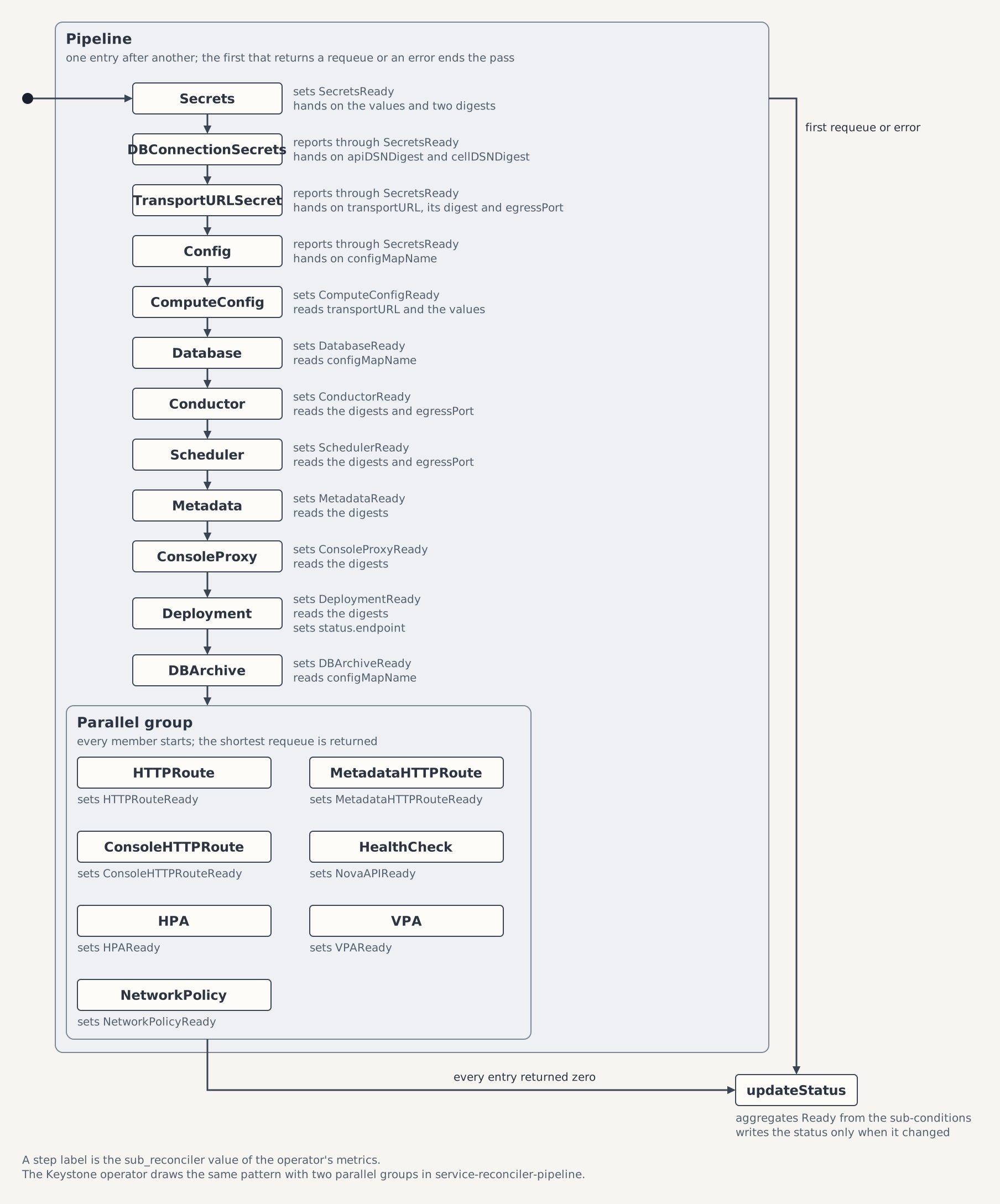
The figure draws the pattern the Keystone operator set: a lane of steps that ends the pass at the first requeue or error, and a group whose members all run. Reconciliation Flow describes that pattern in full. The table lists what each step does.
| Step | What it does | Condition |
|---|---|---|
| Secrets | Gates on the selected secret store (spec.secretStoreRef, default openbao-cluster-store), then on the two database credential Secrets, the service-user password, the metadata shared secret, and, on a TLS bus, the broker CA bundle; reads the three values the later steps need and digests two of them. A metadata shared secret whose key exists but is empty waits like a missing one: nova would verify instance signatures against an empty key | SecretsReady |
| DBConnectionSecrets | Materializes both pymysql DSNs into {name}-api-db-connection and {name}-db-connection and digests each. The nova_api half runs first and returns on its own requeue, so a cell Secret is never derived while the nova_api credentials are missing | SecretsReady |
| TransportURLSecret | Materializes the rabbit:// URL into {name}-transport-url, digests it, and resolves the broker port the NetworkPolicy member opens and the two bus workloads probe. A brownfield URL without an explicit port or with an IPv6 literal host sets SecretsReady False with the reason TransportURLRejected before the derived Secret is written, so a restarting pod keeps the last accepted URL: nova expands the cell mapping's {hostname}:{port} template from it | SecretsReady |
| Config | Renders nova.conf and the four role overlays (plus logging.ini under json logging) into an immutable content-addressed ConfigMap, and maintains the informational ExtraConfigHealthy condition. A section carrying a control character is not re-rendered: the step returns the artefacts the live API Deployment currently mounts, so the running pods keep their last-good config. Failures report through SecretsReady with the reason ConfigError | SecretsReady |
| ComputeConfig | Applies {name}-compute-config, the contract a compute node joins on, and stamps status.computeConfigSecretRef. It runs here because four of its keys are values the three steps above read. A fragment carrying a control character is not written: the published Secret stays as it was and the condition goes False. While spec.remoteCompute is set it also reads the external transport URL and applies {name}-remote-compute-config, stamping status.remoteComputeConfigSecretRef; a missing Secret or key waits as WaitingForRemoteTransportURL without halting the pipeline, and a remote Secret published earlier stays as it was. Without the block it deletes a remote Secret this Nova controls and clears the reference. The condition goes True once both contracts are in the state the spec asks for | ComputeConfigReady |
| Database | Provisions both schemas and cell0, gates the requested release against the installed one, runs the migration Jobs, and promotes installedRelease; a release bump instead runs the expand-migrate-contract flow | DatabaseReady |
| Conductor | Ensures the {name}-conductor Deployment. No Service, no PodDisruptionBudget, no autoscaling: the conductor takes its work off the bus | ConductorReady |
| Scheduler | Ensures the {name}-scheduler Deployment, under the same contract | SchedulerReady |
| Metadata | Ensures the {name}-metadata Deployment and its Service on port 8775 | MetadataReady |
| ConsoleProxy | Ensures the {name}-novncproxy Deployment and its Service on port 6080, or deletes both when the proxy is switched off | ConsoleProxyReady |
| Deployment | Ensures the API Deployment, its Service (port 8774) and the PDB, and stamps status.endpoint. Mid-upgrade it flips the RollingUpdate phase to Contracting once every role has converged | DeploymentReady |
| DBArchive | Projects the {name}-db-archive CronJob and reports the newest terminal run it spawned. It runs before the parallel group, not inside it: all it needs is the rendered config the Config step produced | DBArchiveReady |
| HTTPRoute | Full spec.gateway lifecycle; reflects the Gateway's Accepted condition | HTTPRouteReady |
| MetadataHTTPRoute | The same for spec.metadata.gateway | MetadataHTTPRouteReady |
| ConsoleHTTPRoute | The same for spec.consoleProxy.gateway. A disabled proxy is handled as an absent block: the route is deleted in the same pass that deletes the proxy | ConsoleHTTPRouteReady |
| HealthCheck | HTTP GET of the cluster-local API root through the shared TTL probe cache. The compute API ships no /healthcheck route, so /, the version document it answers without a token, is what a 2xx is read off | NovaAPIReady |
| HPA | Creates and deletes the HorizontalPodAutoscaler of the API Deployment | HPAReady |
| VPA | reconcileVPA applies or removes the VerticalPodAutoscalers of the API, metadata, scheduler, conductor and console-proxy Deployments through the shared VPA flow | VPAReady |
| NetworkPolicy | Creates and deletes the NetworkPolicy (auto-derived egress, including the broker port) and, while the console proxy is enabled, the {name}-novncproxy policy opening the proxy's VNC egress; refuses an empty ingress list (fail-closed) | NetworkPolicyReady |
DBConnectionSecrets, TransportURLSecret and Config reuse SecretsReady rather than a dedicated ConfigReady condition: all three produce artefacts that gate the same downstream graph, so a distinct sub_reconciler label on the error counter disambiguates them during triage while the status contract stays minimal.
The four workload steps behind the Database step run in pipeline order, and that order is what a release upgrade rolls in: conductor, scheduler, metadata, console proxy, then the API. Outside an upgrade none of the four short-circuits on a workload that is still starting: each sets its condition and returns a zero result, so a metadata API mid-rollout does not keep the API step from running, and the Owns(Deployment) watch re-enqueues the CR as the rollout progresses.
The seven members of the parallel group have no inter-dependency. Each operates on its own copy of the CR and sets exactly one condition, and the group merges the conditions back before the status write.
Conditions
The aggregate Ready is True (reason AllReady) exactly when all sixteen sub-conditions are True; otherwise False (NotAllReady). ExtraConfigHealthy is kept outside the aggregate: it reports on an overlay the user owns and must not depool a Nova whose API serves fine.
| Type | True reasons | False reasons |
|---|---|---|
SecretsReady | SecretsAvailable | TargetClusterUnavailable, SecretStoreNotReady, ClusterSecretStoreUnsupported, WaitingForDBCredentials, WaitingForServiceUserCredentials, WaitingForMetadataSharedSecret, MetadataSharedSecretEmpty, WaitingForMessagingCA, WaitingForMessagingCredentials, TransportURLRejected, ConfigError |
ComputeConfigReady | ComputeConfigPublished | ComputeConfigError, WaitingForRemoteTransportURL |
DatabaseReady | DatabaseSynced | ClusterNotReady, WaitingForDatabase, WaitingForConfig, ImageReleaseMismatch, DBSyncFailed, DBSyncInProgress, VersionParseError, DowngradeNotSupported, UpgradePathInvalid, UpgradeTargetChanged, ExpandInProgress, MigrateInProgress, UpgradeRollingUpdate, ContractInProgress, ExpandFailed, MigrateFailed, ContractFailed |
ConductorReady | ConductorReady | WaitingForConductor |
SchedulerReady | SchedulerReady | WaitingForScheduler |
MetadataReady | MetadataReady | WaitingForMetadata |
ConsoleProxyReady | ConsoleProxyReady, ConsoleProxyDisabled | WaitingForConsoleProxy |
DeploymentReady | DeploymentReady | WaitingForDeployment |
DBArchiveReady | DBArchiveScheduled, DBArchiveSuspended | DBArchiveJobFailed |
NovaAPIReady | APIHealthy | APIUnhealthy, EndpointNotReady, HealthCheckTimeout, ConnectionFailed, HealthCheckFailed |
HPAReady | HPAReady, HPANotRequired | errors propagate |
VPAReady | VPAReady, VPANotRequired | VPANotInstalled, CapabilityProbeFailed, VPAError |
NetworkPolicyReady | NetworkPolicyReady, NetworkPolicyNotRequired | errors propagate |
HTTPRouteReady | HTTPRouteAccepted, HTTPRouteNotRequired | HTTPRouteNotAccepted, GatewayAPINotInstalled, CapabilityProbeFailed |
MetadataHTTPRouteReady | the same vocabulary | the same vocabulary |
ConsoleHTTPRouteReady | the same vocabulary | the same vocabulary |
ExtraConfigHealthy | NoOwnedKeysOverridden | OwnedKeysOverridden |
Two True reasons describe an absence. ConsoleProxyDisabled says spec.consoleProxy.enabled is false, which is a posture: the API serves and instances boot, they are only offered no console. DBArchiveSuspended is the second: a paused archive is an operator's decision, so the condition stays True while the metric simply stops incrementing. The three route conditions add a third shape, HTTPRouteNotRequired, for a gateway block that is not set.
TargetClusterUnavailable is set ahead of every sub-reconciler, when spec.targetClusterRef names a target cluster that is not registered or no longer resolves. The CR requeues after 15 seconds and acquires no finalizer, and nothing is created on any cluster. See Target Clusters.
Database
The Database step runs the shared provisioning flow twice, once per block: the nova_api schema under the instance name {name}-api, then the cell schema under the bare {name}. Each pass gates on its MariaDB cluster, ensures the Database, User and Grant in managed mode, and sizes the SQL user's max_user_connections for the CR's own topology, because the mariadb-operator default of 10 is exceeded by the default topology before a single request is served.
cell0 travels as an additional schema of the cell block, not as a block of its own. {database}_cell0 gets a Database CR and, in Static mode, a second Grant on the same user, in the order primary Database, additional Database, User with primary Grant, additional Grant, so a grant is never applied before its schema and its user exist. One user for both is the point: nova-manage maps cell0 with the credentials it already runs with, and nova-api reads cell0 on every instance list, so a separate user would turn a routine list into an error.
The step then waits for a rendered config, because the migration Jobs mount the config ConfigMap as their whole config directory and an empty name would render a volume the API server rejects (DatabaseReady=False, reason WaitingForConfig).
Before either path advances release tracking, the step compares a tag-pinned spec.image against spec.openStackRelease. The two fields are separate on purpose, so that a digest-pinned image still resolves a schema, and nothing else enforces that they agree: an image whose tag names a different release would run the wrong nova-manage binary against a schema already at its own head, and the phase Jobs would exit 0 as no-ops while installedRelease was promoted to a release the pods do not run. A mismatch sets DatabaseReady=False under ImageReleaseMismatch and requeues. A digest-pinned image and an unparseable tag carry no comparable release and are left to the explicit spec.openStackRelease declaration; a patch suffix such as 2026.1-p1 still matches 2026.1.
The cells sequence
Steady state is a single {name}-db-sync Job. It migrates both schemas and maps the cells in one pass, which is why there is no separate schema-check Job and SchemaDriftDetected never fires for Nova. Eight commands run under /bin/sh -eu -c, chained on success:
nova-manage api_db syncmigrates thenova_apischema.nova-manage cell_v2 map_cell0 --database_connection '<template>'maps the holding pen. It runs before the cell schema is migrated, becausenova-managereads the cell map to find the schema.nova-manage cell_v2 list_cellslists what is mapped. The table is captured before it is read, so a failed listing stops the script instead of reading as an empty table, which would create the duplicate cell the guard exists to prevent.awk -F'|' …, the guard. It succeeds when a row's name iscell1or its database connection names the cell schema, compared on the URL path with the query stripped. A secondcreate_cellwith the same templates neither fails nor updates the existing row: nova compares the stored, expanded URLs against the templates, never finds them equal, and maps a second cell, and from then on an instance boots into whichever of the two the scheduler was handed. The guard reads whole fields rather than grepping the table, because the expanded URLs carry the user, the host and the vhost, any of which may containcell1as a word; and the schema match keeps a brownfield cell mapped under another name from being mapped a second time.nova-manage cell_v2 create_cell --name cell1 --transport-url '<template>' --database_connection '<template>'runs only when the guard found no such cell.nova-manage db syncmigrates the cell schema, against a cell the API can already address.nova-manage cell_v2 list_cellsruns once more, captured the same way, and is piped intoawk -F'|' …which turns the ASCII table into one<name>=<uuid>line per cell and writes it to/dev/termination-log. A failed final listing fails the Job rather than completing it with an empty report.
Both the transport URL and the database connection travel as templates ({scheme}://{username}:{password}@{hostname}:{port}/…) that nova expands from the connection the Job already runs with, so the operator never assembles a URL carrying a password. The cell schema is the only part that differs per cell, and it is interpolated into a single-quoted shell word; neither name can carry a quote, because the shared provisioning flow enforces ^[A-Za-z0-9_]{1,64}$ on the primary schema and on cell0's derived name before anything is applied.
The termination log is what status.cells is built from. nova generates a cell's UUID at map time, and a per-cell nova-manage cell_v2 command addresses the cell by UUID, so the report is the only place those identifiers can be read back from. The message is read off the Job's pod that succeeded, because a Job runs each retry as a pod of its own and a failed attempt wrote no report; a Job without a succeeded pod is read off its newest one. Only pods carrying the Job's UID count, so a pod that an earlier Job of the same name left behind is never read. The pods are listed through the uncached API reader of the cluster that holds them: the operator reads one pod's message once per Job and never watches pods, and a read through the cached client would start an informer over every pod of the cluster that the operator's RBAC does not allow to watch. Every line is matched against ^([A-Za-z0-9_-]+)=([0-9a-f-]{36})$, so stray nova-manage output on the same stream is dropped instead of being published as a cell. A report the operator cannot read leaves status.cells as it is and emits a Normal CellsReportUnavailable event: the cells are mapped either way, and dropping a published UUID would be worse than reporting a stale one. installedRelease is promoted on Job success.
Release upgrade
A spec.openStackRelease bump with the image in lockstep dispatches to the shared expand-migrate-contract flow (internal/common/database), the same phase machine Keystone and Cinder run. The step validates the path against installedRelease and rejects a downgrade or a non-sequential jump (VersionParseError, DowngradeNotSupported, UpgradePathInvalid), then walks four phases. Nova splits the work differently from the phase names.
| Phase | What runs | Job |
|---|---|---|
Expanding | nova-status upgrade check, then nova-manage api_db sync and nova-manage db sync. Both migrations are additive, and the old release keeps running against the widened schema | {name}-db-expand |
Migrating | nova-manage cell_v2 list_cells. Nova has no migrate verb of its own, so the phase is a read that proves the new code can address the nova_api schema the expand phase just migrated | {name}-db-migrate |
RollingUpdate | No Job. The conductor, the scheduler, the metadata API, the console proxy and the API roll onto the new image, in that order, because that is the order the pipeline ensures them in | |
Contracting | nova-manage db online_data_migrations --max-count 1000 in a loop, the backfill the new schema needs, which the completed rollout makes safe; first for the cell schema, then for cell0 | {name}-db-contract |
Both phase scripts read an exit code as a severity rather than as a success flag, the contract loop runs a second time against cell0, and the flip from RollingUpdate to Contracting waits on every rendered role, not on the API alone. After the contract phase, promoting installedRelease rolls the four non-API roles once more through the nova.c5c3.io/installed-release annotation. The operator-facing walkthrough of the flow, with the exit codes, the cell0 pass, the flip gate, the second roll and the abort recipe, is Nova Upgrade Flow.
DBArchive
The DBArchive step projects the {name}-db-archive CronJob on every pass with the settings effectiveDBArchive resolves, and takes its run visibility from the Jobs the CronJob spawned instead of from the CronJob object. It lists the Jobs carrying this archive's labels, keeps the ones the CronJob controls, and reports on the newest that reached a terminal state.
A run is a loop of batches. Each batch is nova-manage db archive_deleted_rows --all-cells --max_rows "$MAX_ROWS", with --before <date> --task-log appended only while RETENTION_DAYS is set. The date is computed in the script with date -u -d "-${RETENTION_DAYS} days" +%Y-%m-%d, and the argument is left unquoted on purpose so an unset window adds no argument at all rather than an empty one. --task-log travels with the date and only with it: task_log rows are never soft-deleted, so without a date the flag would move the current audit period out from under the os-instance_usage_audit_log API. The run passes neither --purge, which would empty the shadow tables the archive promises to keep, nor --until-complete.
archive_deleted_rows answers with a severity: 0 means nothing was archived, 1 means rows were, 2 means the row cap was invalid, 3 means no API database connection was configured, and 4 means --before could not be parsed. The loop starts another batch after a 1, pausing SLEEP seconds first, and stops on a 0, on anything above 1, or once its 3000-second budget is spent; test "$rc" -le 1 then fails the Job only when the last batch failed. The loop is the script's rather than nova-manage's own --until-complete, which runs until the backlog is empty however long that takes: on a neglected database that outlasts the active deadline below and fails every run. The budget stops starting batches ten minutes before the deadline, so a batch in flight is never killed half done, and the next run continues where this one stopped.
The pod runs with fsGroup set to the openstack GID, like the long-lived workloads. The database TLS files are projected at mode 0400, and without the group owning them nova-manage could not read the client key it connects with.
ConcurrencyPolicy: Forbid keeps a run that outlasts its interval from being overtaken by the next firing, which is what a first pass over a long backlog invites: two archives moving the same rows contend on the same tables, and on Galera the later write-set fails certification. activeDeadlineSeconds: 3600 catches a run that wedges instead of failing, an unschedulable pod or a nova-manage blocked on a database lock. Either reaches a terminal Failed state within the hour and surfaces as DBArchiveReady=False under DBArchiveJobFailed with a matching Warning event. A later successful run flips it back to True.
The suspend arm outranks the failed arm. A suspended CronJob spawns no successor to supersede a failed run, so the failed Job stays the newest terminal one for good (the default failedJobsHistoryLimit retains it), and a JobFailed arm that won here would pin DBArchiveReady False, and with it the aggregate Ready, until someone deleted the Job by hand. The failure is still named in the suspended condition's message; it is just not the state the CR is in.
See DBArchiveSpec for the settings and the defaults they resolve to.
Requeue semantics
| Interval | Constant | Used by |
|---|---|---|
| 1s | RequeueNextPass | After a finalizer add, and after the RollingUpdate to Contracting flip |
| 10s | RequeueDeploymentPolling | API Deployment readiness polling, the rollout wait of every workload step during an upgrade, and the wait for a Gateway to report Accepted |
| 15s | RequeueSecretPolling | The secret-store and credential gates, both derived DB-connection steps, the transport-URL step, and an unresolvable target cluster |
| 30s | RequeueDatabaseWait | The MariaDB gate of both blocks, the db-sync wait, the config wait, and the finalizer's cleanup wait |
| 30s | RequeueUpgradeWait | The expand, migrate and contract phase Jobs |
| 10s / 30s TTL | health-check retry, probe cache | A failed probe of the API root retries; a passing one is reused within the TTL |
Watches and indexes
The Nova controller Owns its Deployment, Service, ConfigMap, Secret, PodDisruptionBudget, HorizontalPodAutoscaler, NetworkPolicy, Job and CronJob. The CronJob is in that list for its status.active: the list changes as each spawned run starts and finishes, which is what wakes the reconcile that refreshes DBArchiveReady. The HTTPRoute joins the set only when the Gateway API CRD is installed on the management cluster; otherwise a gateway block surfaces HTTPRouteReady=False / GatewayAPINotInstalled instead of crashing the controller. The CR's own watch filters status-only updates, so a status write does not re-wake the controller. A CR that names a target cluster has the same children watched once more on the clusters it can project onto, by ownership label rather than by owner reference, because an owner reference does not cross a cluster boundary.
Beyond the owned set it watches:
- Secrets, mapped to the Nova CRs that reference them by name through the
spec.secretRefs.namefield index or own them through an owner reference. The index holds the deduplicated union of every Secret name a CR references: both database credentials, the service-user password, the metadata shared secret, the CA bundle and client certificate of each database block whosetlsis enabled, the brownfieldspec.messaging.secretRef, the broker CA bundle, andspec.remoteCompute.transportURLSecretRefwhile that block is set. A disabled TLS block contributes nothing, so a name is indexed only while the connection actually reads it. The owner-reference leg is what reaches the derived Secrets, which ESO does not own. - MariaDB clusters, through one leg carrying both
clusterReffields: a Nova is enqueued when either block names the cluster the event came from, and once rather than twice when both name the same one. - Both the cluster-scoped
ClusterSecretStoreand the namespacedSecretStorea Nova can select, so a store-backend outage reflects inSecretsReady. TheClusterSecretStoreleg is not registered when the operator runs with--namespace.
The Secret index is registered on the local field indexer, never on the fleet: it indexes a CR kind, which exists on the management cluster alone, and registering it on the fleet would fail the engagement of every target cluster.
Rotation and deletion
Credential rotation happens at the OpenBao source. Both DSNs, the service-user password, the transport URL and the metadata shared secret are all environment-delivered, so a restart is required for a rotation to take effect. The credential steps digest each value into a pod-template annotation (nova.c5c3.io/api-db-connection-hash, nova.c5c3.io/db-connection-hash, nova.c5c3.io/authtoken-hash, nova.c5c3.io/transport-url-hash and, on the metadata pods, nova.c5c3.io/metadata-secret-hash), so a changed digest rolls the workloads that carry it. Each is stamped only while it is non-empty, so a pass that stopped at a credential gate leaves the annotation alone instead of clearing it and rolling every pod.
Deletion runs the nova.openstack.c5c3.io/finalizer. It issues Delete on the MariaDB Database/User/Grant CRs of both schemas before the owner-ref chain disappears, under the names they were provisioned with: the nova_api block under {name}-api, the cell block under {name}, with cell0 reached through the cell key as an additional schema, so it has no key of its own. Whether anything was still live is observed before the Delete is issued, because a Delete flips the deletion timestamp and a post-Delete check would always report none-live and release immediately. While either schema still had a live CR the finalizer is held for one more pass and a FinalizingDatabase event is emitted; once neither does, DatabaseFinalized is emitted, the per-CR metrics are dropped (metrics.DeleteForNova), the health-probe cache entry is evicted, and the finalizer is released.
A CR that names a target cluster carries a second finalizer. After the named MariaDB cleanup, a label-selected sweep deletes everything the CR projected onto that cluster: the Deployments, Services, ConfigMaps, Secrets, Jobs, the CronJob, the PodDisruptionBudget, the HorizontalPodAutoscaler, the NetworkPolicy, the HTTPRoutes and the three MariaDB kinds. The sweep runs after the named cleanup, never before it, because that flow waits one pass on the CRs it deletes by name and a sweep running first would delete them out from under it. A cluster that has not resolved for the whole abandon window (five minutes) is the exception: its children cannot be reached, a RemoteChildrenAbandoned Warning names what stays behind, and the finalizer is released so the CR leaves etcd instead of hanging in Terminating.
Every other owned resource is namespace-scoped with a controller owner reference, so Kubernetes garbage collection reclaims it.
NovaCompute
A NovaCompute runs nova-compute on one node pool. Its controller (novacompute_controller.go, recorder novacompute-controller) runs eight sequential steps under the same nova_operator instrumenter. Each owns one condition, and the aggregate Ready is True only when all eight are. ExtraConfigHealthy stays out of it, as it does for the Nova.
NovaCompute pipeline
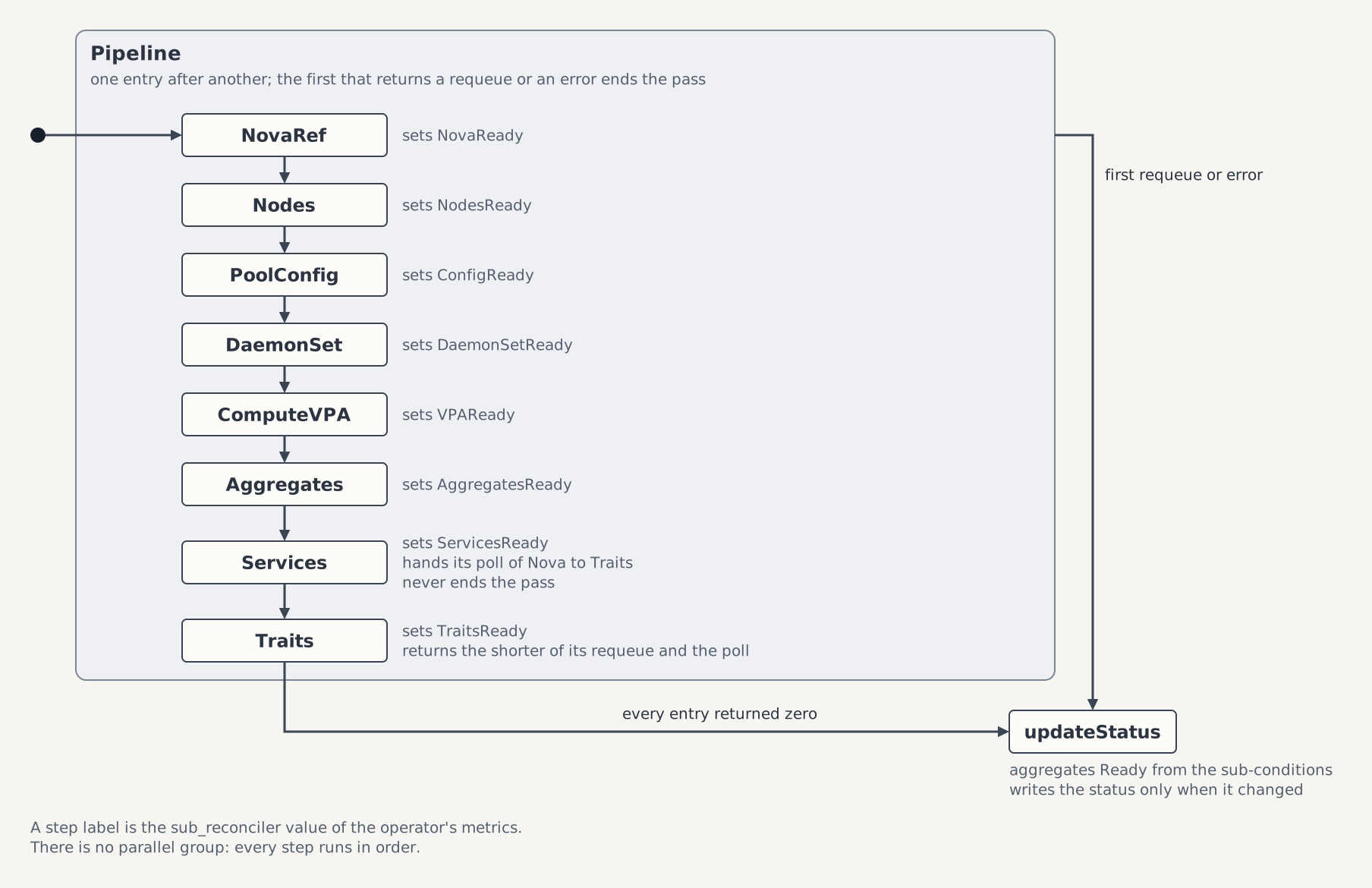
The figure draws the steps in call order. The table lists what each one does.
| Step | Function | Condition |
|---|---|---|
NovaRef | reconcileNovaComputeNova | NovaReady |
Nodes | reconcileNovaComputeNodes | NodesReady |
PoolConfig | reconcileNovaComputeConfig | ConfigReady |
DaemonSet | reconcileNovaComputeDaemonSet | DaemonSetReady |
ComputeVPA | reconcileVPA | VPAReady |
Aggregates | reconcileNovaComputeAggregates | AggregatesReady |
Services | reconcileNovaComputeServices | ServicesReady |
Traits | reconcileNovaComputeTraits | TraitsReady |
A step that sets its condition False for a reason that is not a wait on an input returns a zero result, so the later steps still run: NoMatchingNodes, NodeConflict, DaemonSetProgressing, NodesWithoutZone and AggregateZoneMismatch. An empty selection therefore still drains the nodes the pool held, and so does a rollout one NotReady node keeps from finishing. The Services step always returns its periodic poll of Nova, which would end the pipeline, so it hands the poll to the Traits step: Traits runs after it and returns the shorter of the two requeues. The computeapi client the last three steps call Keystone, Nova and Placement through is built once per pass, so a pass requests one token.
Every CR carries the finalizer nova.openstack.c5c3.io/compute-drain, and a CR naming a target cluster carries the remote-children finalizer too. Both go on before the pipeline runs.
reconcileNovaComputeNova
Reads the Nova spec.novaRef names in the CR's namespace, on the management cluster. In order it waits for the Nova (NovaNotFound), its installed release (WaitingForInstalledRelease), its published contract (ComputeConfigNotPublished), its cluster (TargetClusterUnavailable) and its service-user password (WaitingForServiceUserSecret), each requeued after 15 seconds. The password is read on the cluster the Nova is placed on, and a placed Nova is called through that cluster's service proxy. The step hands the later ones the effective image, spec.image or ghcr.io/c5c3/nova-compute:<status.installedRelease>, the contract Secret name, and the Keystone and Nova URLs with the service user's credentials.
reconcileNovaComputeNodes
Lists the selected Nodes through an uncached reader (the target cluster's own, or the manager's API reader for a local pool), so no cluster-wide Node informer starts on an install whose RBAC is namespace-scoped. It reads their metadata only: a node's name and labels are all the rules use. A deleting pool lists nothing. Held nodes the list no longer returns are read one by one, and a gone node counts as leaving. The rivals are the other NovaComputes of the same Nova on the same cluster, found through the spec.novaRef.name field index. The phase rules are listed on the CRD page. A new conflict records a Warning NodeConflict event once. A 403 reports NodesForbidden and requeues after 15 seconds; any other read error is NodeListError and returns the error.
reconcileNovaComputeConfig
Reads the contract Secret <nova>-compute-config in the CR's namespace on the pool's cluster, waits for it (WaitingForComputeConfig) and for its three keys (ComputeConfigIncomplete), renders compute-pool.conf with spec.extraConfig merged over it into an immutable {name}-config-<hash> ConfigMap, prunes the history to the three newest, and hashes the Secret's key/value pairs for the pod template.
reconcileNovaComputeDaemonSet
Builds the node affinity from the selector and the nodes the Nodes step excluded and held, and applies {name}-nova-compute. With no affinity term (a deleting pool holding no Draining node) it deletes the DaemonSet it owns instead, which releases the last pod. It mirrors desiredNumberScheduled and numberReady, reports DaemonSetProgressing while a rollout is in flight without stopping the pipeline, and stamps status.installedImage once every node runs a ready pod.
reconcileNovaComputeAggregates
Lists the host aggregates, ensures one per zone of the pool's Pending and Active nodes and, while the pool is not being deleted, tenant_filter_tests, and marks what it creates with c5c3.io:nova=<namespace>/<nova>; an aggregate it could not mark is deleted again. The set of aggregates still needed is the union over every NovaCompute of the Nova that is not being deleted, on any cluster; a pass that skipped the Nodes step lists those NovaComputes itself (NovaComputeListError when that fails). A marked aggregate outside the set is deleted once it holds no host, unless it carries metadata beyond the marker and its availability zone, which keeps it and records a Warning AggregateKept. From the list it already read, the step then reports every Active node in no aggregate of its zone under NodesOutsideZoneAggregate and keeps AggregatesReady True. A failed call reports ComputeAPIError and requeues after 30 seconds without an error. Only a completed pass lets a deleting pool release its finalizer.
reconcileNovaComputeServices
Lists the nova-compute services once, at microversion 2.69, and fails the pass with ComputeAPIError when a cell did not answer, since its hosts would otherwise read as serviceless and empty. While a Pending node has a registered service, it also reads the mapped hosts from GET /os-hypervisors/detail at microversion 2.88, which leaves out a host without a host mapping. A failed read keeps those nodes Pending and is reported as a ComputeAPIError after the walk, so the other nodes still move. It then walks the nodes: Pending and Active follow the registration, and a registered Pending node turns Active only once its host is mapped, while an Active node is not checked again. Draining disables an enabled service once and counts the servers on the host, and Releasing waits until no pod of the pool runs on the node and then deletes the service, or drops the entry with no call under a handover or when the service is already gone. The pods are listed once per pass: on the node for a single Releasing node, and for the whole pool when there are more. When the walk leaves a registered node unmapped, ensureHostDiscovery (reconcile_novacompute_hostdiscovery.go) runs the Nova's host discovery Job <nova>-discover-hosts on the Nova's cluster: it creates the Job when none exists, leaves a running one alone, and deletes one that finished more than 30 seconds ago so the next pass creates a fresh one. ServicesReady then reports WaitingForHostMapping with the Job's state, and a failed Kubernetes call or a refused claim reports HostDiscoveryError, logs the error and requeues without it, so the other nodes keep their poll instead of the controller's growing backoff. Its requeue is the periodic poll of Nova: the shortest interval any node needs at entry or at exit.
reconcileNovaComputeTraits
Keeps the custom Placement traits of the pool's hosts (reconcile_novacompute_traits.go). A Pending or Active node is managed while its desired list (spec.traits merged with its spec.hostTraits entry) or its status.nodes[].traits record is not empty; a deleting pool manages none. With no managed node and no status.createdTraits the step sets NoTraitsDeclared and makes no call. Otherwise, in order:
- A managed node whose Node carries
nova.openstack.cloud.sap/custom-traits, which the Nodes step reads from the Node metadata it lists, is neither read nor written. - The step gets each other managed node's
kvm.cloud.sap/v1Hypervisorby name through the uncached reader of the pool's cluster, unstructured. A cluster without the kind reportsHypervisorOperatorNotInstalled, a 403HypervisorsForbidden, and a missing Hypervisor puts the node underNodesWithoutHypervisorwhile the others go on. - Every trait a read node desires but its
status.traitsdoes not list yet getsPUT /traits/{name}at Placement microversion 1.6. A 201 adds it tostatus.createdTraitswith a Normal eventTraitCreated. A failed create writes no Hypervisor in that pass. - A Hypervisor whose
spec.customTraitsdiffers from the desired list gets a JSON merge patch with the list, sorted, under the field ownercobaltcore-operator. The node's record becomes theCUSTOM_subset ofstatus.traitstogether with the list written. - A created trait that no NovaCompute of the Nova that is not being deleted declares is deleted once no NovaCompute of the Nova records it on a node (
TraitDeleted). A 409 from Placement drops it from the list withTraitKept. A deleting pool drops a trait another pool still declares withTraitKept, so its teardown does not wait on that pool. The NovaComputes come from the Nodes step, or on a pass that skipped it from the one list the Aggregates and Traits steps share (NovaComputeListError).
The step polls every 30 seconds while a node waits on the hypervisor operator, while a created trait waits for its last carrier, and after any False reason: the Node watch misses annotation edits, and nothing watches Hypervisors.
Requeue and teardown
| Interval | Constant | Used by |
|---|---|---|
| 1s | RequeueNextPass | After a finalizer add |
| 10s | RequeueComputeReleasePolling | A Releasing node, and a node dropped in this pass |
| 10s | RequeueDeploymentPolling | An aggregate created concurrently |
| 10s | RequeueHostDiscoveryPolling | A registered node whose host is not mapped yet |
| 15s | RequeueSecretPolling | The waits of NovaReady, ConfigReady, NodesForbidden, and an unresolvable target |
| 30s | RequeueComputeDrainPolling | A Draining or Pending node, the retry after a failed Keystone, Nova or Placement call, and the Traits step's polls |
| 60s | RequeueComputeServicePolling | A pool whose nodes are all settled |
A deleting pool runs the pipeline with every held node leaving until a pass that began with no node held completed the aggregates step and left no created trait. The pass that releases the last node therefore keeps the finalizers: deleting the service empties the aggregates the host sat in after its Aggregates step ran. Once the pool holds no node, only the NovaRef, Aggregates and Traits steps run, so a pass from a stale copy of the CR cannot recreate what the sweep removed. A Placement call that keeps failing holds the finalizer the way a failed Nova call does. When the Nova is gone, or the target cluster was abandoned, that part is skipped. Then the ControlPlane's contract mirror and the hypervisor operator's auth mirror are reaped when no other pool of the Nova on the cluster is live or still drains a node, the remote children (the DaemonSet, the ConfigMaps and the opt-in VerticalPodAutoscaler) are swept, and the finalizers are released. A pool drains only while it carries the drain finalizer and the Nova exists. The reap comes first, so a pool whose drain finalizer was removed by hand still holds openstack.c5c3.io/remote-children while it runs, and a failed reap is retried.
Watches
The NovaCompute controller watches its CRs (status-only updates filtered) and Owns its DaemonSet and ConfigMaps, locally and, by ownership label, on the target clusters. Beyond that:
- a Nova wakes its pools through the
spec.novaRef.nameindex on a spec change and on a change to the two status fields a pool waits on, the installed release and the published contract; - a NovaCompute wakes the other pools of the same Nova on a spec change, the start of its deletion, or a change in which nodes it holds, in which phase and zone, so a node one of them takes or releases re-evaluates the conflicts of the rest;
- the Secret
<nova>-compute-configwakes the pools of<nova>, on the management cluster and on the target clusters; - a Node label change on a target cluster wakes the pools placed there that select the node or hold it. There is no local Node leg: its informer cannot sync on a namespace-scoped install, and the pool's poll picks up a relabel.