RabbitMQVhost Reconciler Architecture
Reference documentation for the RabbitMQVhostReconciler. It owns the RabbitMQVhost lifecycle and is the single writer of its status: the teardown finalizer, the Vhost CR and the user generations on the managed bus, the OpenBao backup, the Secret delivered beside the order, and the VhostReady / DeliveryReady / Ready conditions.
It serves orders on the management cluster and on target clusters the way the KeystoneUser reconciler does: a request carries the cluster the order was seen on, and the reconciler reads and writes the order, its status, its finalizer and its delivered Secret through that cluster's client. Everything else it creates lives in the ControlPlane's namespace on the management cluster, beside the RabbitmqCluster.
It adds no broker client and no OpenBao client. The RabbitMQ Messaging Topology Operator creates the vhost, the users and the permissions on the broker from the Vhost, User and Permission CRs the reconciler writes, with the admin credential the RabbitmqCluster reports. ESO pushes the credentials to OpenBao through the secret store of the ControlPlane's namespace. The reconciler reads nothing from Keystone, so it has no admin-credential gate, and it records no Events, for the reason the KeystoneUser reconciler gives.
For the field-level contracts see RabbitMQVhost CRD API Reference.
Controller Registration
if err := (&controller.RabbitMQVhostReconciler{
    Client:                  mgr.GetClient(),
    Scheme:                  mgr.GetScheme(),
    Resolver:                mcMgr,
    MaxConcurrentReconciles: opts.MaxConcurrentReconciles,
}).SetupWithManager(mcMgr); err != nil { ... }
Client is the management cluster's client and Resolver the multicluster manager, as for the Keystone order kinds. Now is the clock the schedule reads; it is nil in production, which means time.Now, and the unit tests set it. SetupWithManager delegates to setupWithOptions, so the integration suites register the same watches with SkipNameValidation.
The cluster-agnostic machinery (child naming and ownership, the admission gates, the pass result, the teardown and the label mapping) is the shared scaffold in keystoneorder.go. See The shared scaffold. The three topology kinds are addressed unstructured through internal/common/messaging/topology.go, as the RabbitmqCluster is, so the operator takes no Go-module dependency on the topology operator.
Before the watches it registers one field indexer, on the local manager's indexer only, for the reason the KeystoneUser reconciler gives:
| Index | Key | Extractor |
|---|---|---|
RabbitMQVhostControlPlaneRefIndexKey (spec.controlPlaneRef) | the resolved <namespace>/<name> of the reference | rabbitMQVhostControlPlaneRefExtractor |
Watches
| Resource | Watch | Clusters | Effect |
|---|---|---|---|
RabbitMQVhost | For() | management, and every engaged target cluster that serves the kind | Filtered by watch.CRUpdatePredicate(). The request carries the event's cluster |
Secret | Owns() | the same | The delivered Secret beside the order |
Secret, PushSecret | Watches() | management | Mapped back to the order by the three ownership labels (orderChildRequests). The cluster label becomes the request's cluster |
Vhost, User, Permission (rabbitmq.com/v1beta1) | Watches() | management | The same mapping, registered for each kind the discovery probe finds served. The topology operator reporting a child Ready, or letting go of a deleted one, brings the order back |
ControlPlane | Watches() | management | Index-backed fan-out (controlPlaneToRabbitMQVhostsMapper), filtered by orderControlPlanePredicate() |
The topology operator is optional infrastructure a Keystone-only install never carries. Its three kinds are listed in optionalWatchObjects, and setupWithOptions probes discovery (probeOptionalWatches) and skips the watch of a kind the management cluster does not serve, so the operator starts on such a cluster. The ControlPlane controller registers the crdWatchGate over the same list, which restarts the process once a missing kind appears. See the presence probe.
No ControlPlane watch reaches an order on a target cluster. Such an order is reconciled again every 10 minutes (orderRefreshAfter), which is how a published messaging endpoint reaches it.
RBAC
On the management cluster the ClusterRole gains the order verbs and the write verbs on the three topology kinds:
// +kubebuilder:rbac:groups=c5c3.io,resources=rabbitmqvhosts,verbs=get;list;watch;update;patch
// +kubebuilder:rbac:groups=c5c3.io,resources=rabbitmqvhosts/status,verbs=get;update;patch
// +kubebuilder:rbac:groups=c5c3.io,resources=rabbitmqvhosts/finalizers,verbs=update
// +kubebuilder:rbac:groups=rabbitmq.com,resources=vhosts;users;permissions,verbs=get;list;watch;create;update;patch;delete
It never creates or deletes an order. The Secrets and PushSecrets it writes in the ControlPlane's namespace, and its reads of the ControlPlane and the RabbitmqCluster, are granted by the ControlPlane's marker block. It never reads the broker's admin credential beyond the default-user Secret the ControlPlane's bus resolution reads already.
On a target cluster the target-cluster-access chart grants the same order verbs and Secret write in each assigned namespace, and read on the order kind in each placed namespace. See Assigned namespaces.
Reconciliation Flow
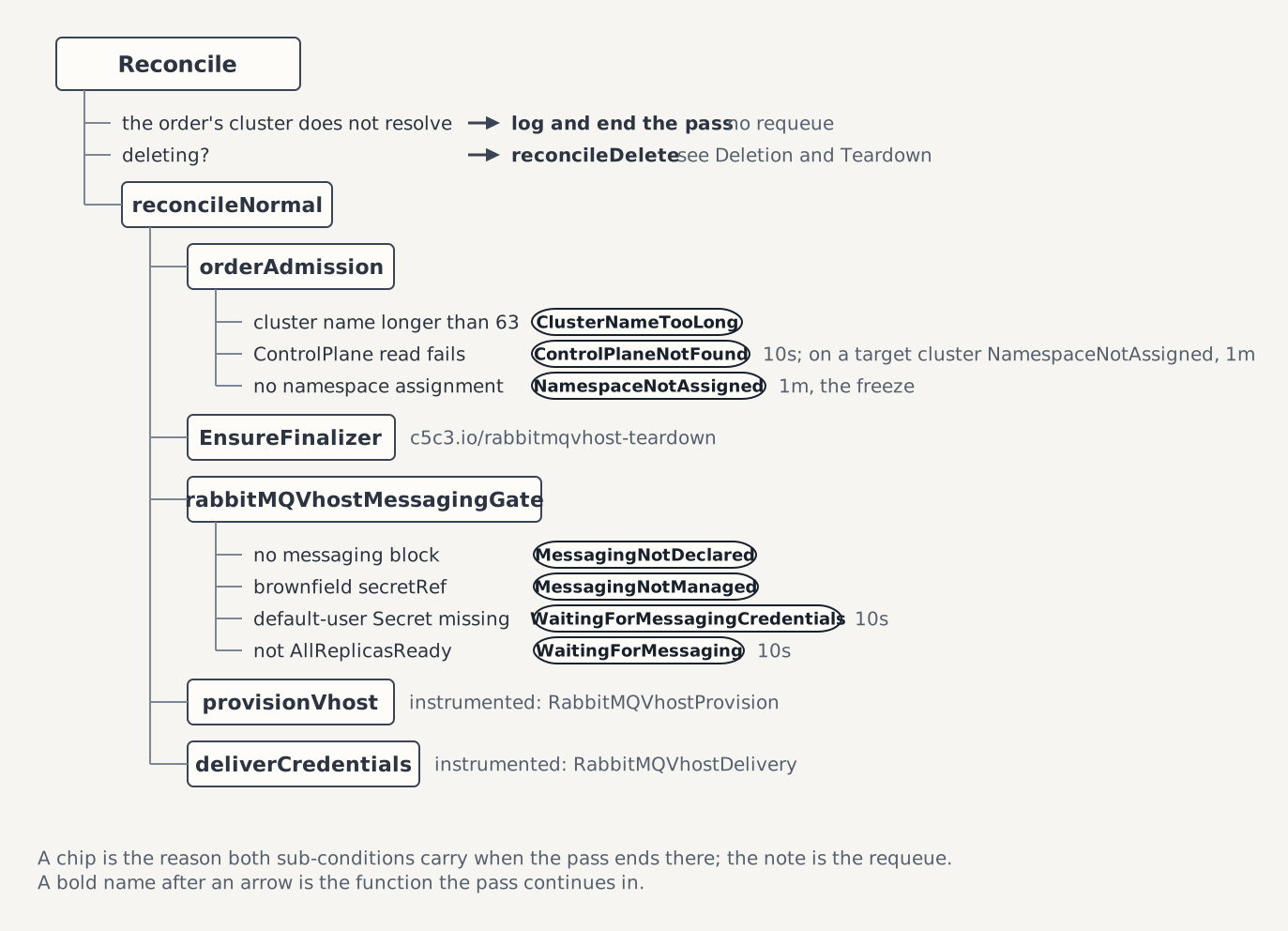
The admission gates and the freeze are the scaffold's, as for every order kind. The messaging gate writes both sub-conditions. A refusal only a ControlPlane edit lifts asks for no requeue of its own; the pass result turns it into the 10-minute refresh. The gate reads the broker's in-cluster host and port off the default-user Secret the RabbitmqCluster names (messaging.ResolveTransportURL); no condition ever quotes the URL, because it carries the admin password.
When the provision step has no live user yet, DeliveryReady reads WaitingForPassword and the delivery is skipped. The pass result is the shorter of the legs' requeue, which carries the rotation timers, and the scaffold's: a converged order on the management cluster waits for its timer or an event, and every other order comes back after 10 minutes at the latest.
Vhost provisioning
provisionVhost writes VhostReady:
- The secret store of the ControlPlane's namespace has to be ready, or the password could not be backed up (
SecretStoreNotReady). - The Vhost CR
<prefix>vhostis applied on every pass, withspec.namethe derived vhost,spec.deletionPolicythe order's policy in the topology operator's spelling (retain,delete) and theRabbitmqClusterasrabbitmqClusterReference, so a changed policy reaches it. A cluster that serves no Vhost kind readsTopologyOperatorNotInstalledand comes back after 10 minutes. A Vhost of that name the order did not create is refused withVhostErrorand no requeue. The topology operator'sFailedCreateOrUpdatereadsVhostFailedwith its message; until it reports the Vhost Ready at its current generation the step readsWaitingForVhost. - The order's Users, Permissions and password Secrets are listed by its labels and keyed by generation.
vhostDesiredGenerationdecides the generation the pass works toward: the declared one before the first user is live, a User above the live generation as a rotation in flight, or a new rotation when the schedule is due, a higher generation is declared, or the live generation lost its password, its User or its Permission. No rotation starts while a grace period runs. Every generation that is neither live, wanted, nor in its grace period is deleted. - To create generation N, the password Secret
<prefix>password-v<N>is written withusername<vhost>-v<N>, a 43-characterpasswordgenerated once, and the labelrabbitmq.com/topology-operator: "true", which the topology operator's webhook requires on an imported Secret. The User<prefix>user-v<N>imports it, and the Permission<prefix>permission-v<N>grants.*three times on the vhost once the User is Ready: the broker refuses permissions for a user it does not hold yet. While either is not Ready the first generation readsWaitingForUser; a later one keepsVhostReadyatVhostProvisioned, because the delivered user stays valid. A broker refusal readsVhostFailed. Once both are Ready status switches:passwordGeneration,usernameandlastRotation, and for a rotationpreviousPasswordGenerationandpreviousPasswordDeleteAt. - Once
previousPasswordDeleteAthas passed, the superseded Permission and User are deleted. On the pass that no longer lists the User, its password Secret goes and the twoprevious*fields are cleared. status.nextRotationislastRotationplus the interval, or absent with the schedule off, and the step asks to come back at the earlier of it and the end of the grace period.
A converged pass reads the ControlPlane, the RabbitmqCluster and its default-user Secret, applies the Vhost, and lists the Users, the Permissions and the Secrets. The topology kinds are read from the API server directly, since the operator's client caches no unstructured kind.
Credential delivery
deliverCredentials writes DeliveryReady:
- The broker address is resolved for the order's cluster (
rabbitMQVhostEndpoint): the in-cluster host and port on the management cluster, the ControlPlane'spublishedMessagingEndpointelsewhere. Without one the step reportsMessagingNotPublishedand writes nothing; a published value without a port between 1 and 65535 readsDeliveryError. - The password of the live generation is read from
<prefix>password-v<N>(WaitingForPasswordwhile it is not there). - The transport URL
rabbit://<user>:<password>@<host>:<port>/<vhost>is built (messaging.BuildTransportURLForVhost), and the source Secret<prefix>sourcegets it with the five other keys. - The PushSecret
<prefix>backuppushes the source toopenstack/rabbitmq/<controlplane namespace>/<prefix without the trailing dash>/credentialsthrough the namespace's own store, withdeletionPolicy: Delete. A changed transport URL sets a hash annotation on it and records the PushSecret'sstatus.syncedResourceVersion, so the step waits for a push of the current credentials (BackupNotSynced), as the KeystoneUser delivery does. - The Secret
<name>-credentialsis applied beside the order with a controller owner reference to it. A live Secret of that name the order does not own is refused (DeliveryRefused), read from the order cluster's API server. - Once the apply response carries the current password,
status.host,status.port,status.secretNameandstatus.secretKeysare set andDeliveryReadyreadsDelivered.
The apply in step 5 is the repair: Server-Side Apply with forced ownership gives the operator's field manager the six keys it applies.
Child Naming and Placement
| Object | Name | Namespace | Cluster | Ownership |
|---|---|---|---|---|
| Vhost CR | <prefix>vhost | ControlPlane's | management | labels |
| Password Secret, per generation | <prefix>password-v<N> | ControlPlane's | management | labels |
| User CR, per generation | <prefix>user-v<N> | ControlPlane's | management | labels |
| Permission CR, per generation | <prefix>permission-v<N> | ControlPlane's | management | labels |
| Source Secret | <prefix>source | ControlPlane's | management | labels |
| PushSecret | <prefix>backup | ControlPlane's | management | labels |
| Delivered Secret | <name>-credentials | the order's | the order's | controller owner reference |
<prefix> is <name>-<first 8 hex of sha256(<cluster>/<namespace>/<name>)>-vhost-, and the vhost on the broker is the prefix without its -vhost- tail. The labels are c5c3.io/rabbitmqvhost-name, c5c3.io/rabbitmqvhost-namespace and c5c3.io/rabbitmqvhost-cluster, the last empty for the management cluster. An object in the ControlPlane's namespace is the order's child only when it carries all three labels and the prefix.
Deletion and Teardown
reconcileDelete runs orderTeardown with the c5c3.io/rabbitmqvhost-teardown finalizer, without consulting the assignment, so a frozen order tears down too. Nothing references a RabbitMQVhost, so there is no hold. sweepRabbitMQVhostChildren issues the deletes in this order, in the resolved controlPlaneRef namespace:
- the PushSecret, whose
deletionPolicyhas ESO remove the OpenBao path, - every Permission,
- every User, whose topology-operator finalizer removes the user from the broker,
- the Vhost, after a merge patch has written the order's current
deletionPolicyonto it (a Vhost already being deleted keeps its own); the topology operator removes the vhost from the broker underdeleteand leaves it underretain, - every password Secret, then the source Secret,
and then the delivered Secret through the order's cluster client. Each topology kind is one list; a cluster that serves none of a kind holds none of it. With the ControlPlane present the finalizer is held while any child is still listed, and the pass requeues after 10 seconds. With the ControlPlane gone the deletes are issued and the finalizer is released at once; the topology operator removes a CR whose RabbitmqCluster is gone without reaching the broker.
Metrics Instrumentation
Both steps run through the package-scope instrumenter, as for the Keystone order kinds:
sub_reconciler | condition_type |
|---|---|
RabbitMQVhostProvision | VhostReady |
RabbitMQVhostDelivery | DeliveryReady |
TestSubReconcilerConditionTypes_RabbitMQVhostLegs pins the two entries, and the drift guard TestSubReconcilerConditionTypesCoversAllNames accepts a value from rabbitMQVhostSubConditionTypes.
Testing
| Layer | Location |
|---|---|
| Gates, freeze, mappers, teardown | operators/c5c3/internal/controller/rabbitmqvhost_controller_test.go |
| Vhost provisioning and rotation | operators/c5c3/internal/controller/rabbitmqvhost_provision_test.go |
| Credential delivery | operators/c5c3/internal/controller/rabbitmqvhost_delivery_test.go |
| The topology builders and readers, the vhost transport URL | internal/common/messaging/topology_test.go, messaging_test.go |
| CRD schema | TestIntegration_RabbitMQVhost_SchemaValidation in integration_test.go |
| An order on a target cluster | TestIntegration_Multicluster_ControlPlanePlacement in multicluster_integration_test.go |
| Startup without the topology kinds | TestRabbitMQVhostSetup_StartsWithoutTopologyCRDs in setupwithmanager_integration_test.go |
| End to end | tests/e2e/c5c3/messaging/ |
| Admission rejection corpus | tests/e2e/c5c3/invalid-rabbitmqvhost-cr/ |
The unit tests drive a fake client per cluster and report the topology children Ready by hand. The envtest suites install the three topology kinds as schema without a controller, except the startup test, which leaves them out. The end-to-end suite is where the order meets the topology operator, the broker, OpenBao and ESO. See ControlPlane E2E Test Suites.