How-to: Migrate Nova DB to Dynamic Credentials
This guide takes a managed-mode ControlPlane from long-lived static Nova database credentials to dynamic, engine-issued credentials, without database downtime. It is the operator-facing side of the OpenBao MariaDB database secrets engine wired for the two Nova service DB users.
Nova is the one service with two databases. The nova_api schema holds the cell map, the flavors and the instance mappings; the cell schema nova holds the instances, with its nova_cell0 twin reached by the same user. Each takes a credential chain of its own, and this guide moves both.
What changes
Before: each Nova DB password is a long-lived value materialised from an OpenBao KV path into a Secret of its own. Nothing seeds those paths, so on the static branch an operator writes them and rotates them by hand.
Chain KV path Secret SQL user nova_apiopenstack/nova/openstack/controlplane/api-dbcontrolplane-nova-api-db-credentialscontrolplane-nova-apicell openstack/nova/openstack/controlplane/dbcontrolplane-nova-db-credentialscontrolplane-novaAfter: the c5c3 operator projects two
VaultDynamicSecretgenerators, one per chain, that read short-lived credentials from the OpenBao database engine. The External Secrets Operator re-issues a fresh lease before the previous one expires and materialises the current username and password into the same two Secrets. No long-lived static Nova DB password remains at rest.Chain Auth role ServiceAccount Creds path Engine grant nova_apinova-api-dbnova-api-db-credsdatabase/mariadb/creds/nova-api-openstackALL PRIVILEGESonnova_apicell nova-cell-dbnova-cell-db-credsdatabase/mariadb/creds/nova-cell-openstackALL PRIVILEGESonnovaandnova_cell0
The openstack suffix of both creds paths is the Nova service namespace, the ControlPlane's own namespace unless Nova runs in a dedicated one. The engine issues an ephemeral MySQL user per lease (for example v-kube-...) and drops it at lease end.
One field decides the mode for both chains: services.nova.databaseCredentialsMode on the ControlPlane, or the shared spec.infrastructure.database.credentialsMode when that is empty. The Nova CRD rejects a child whose apiDatabase and database carry different modes, so the two chains always switch together.
The first figure shows one chain. Nova has two, and the tables above name the objects of each.
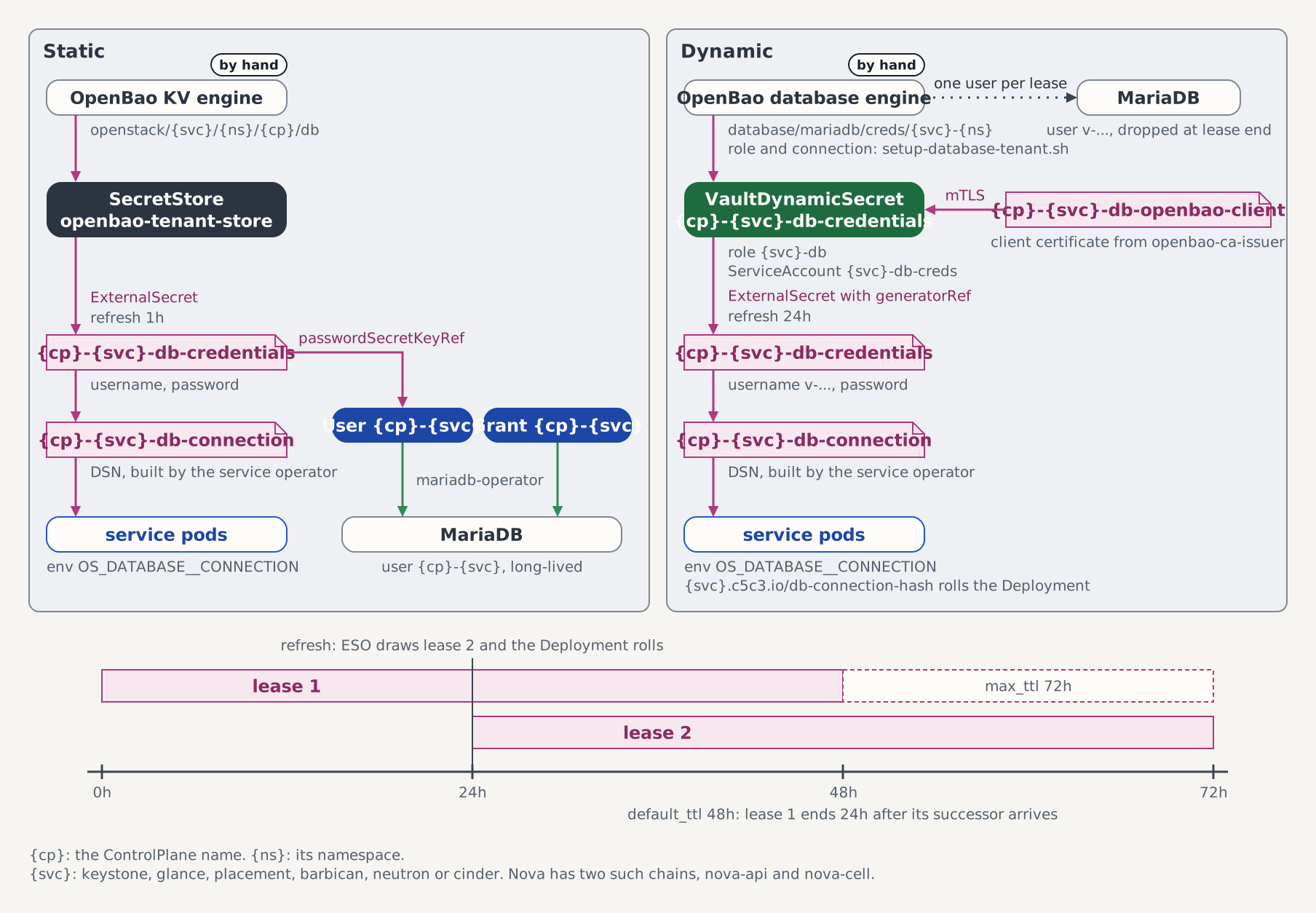
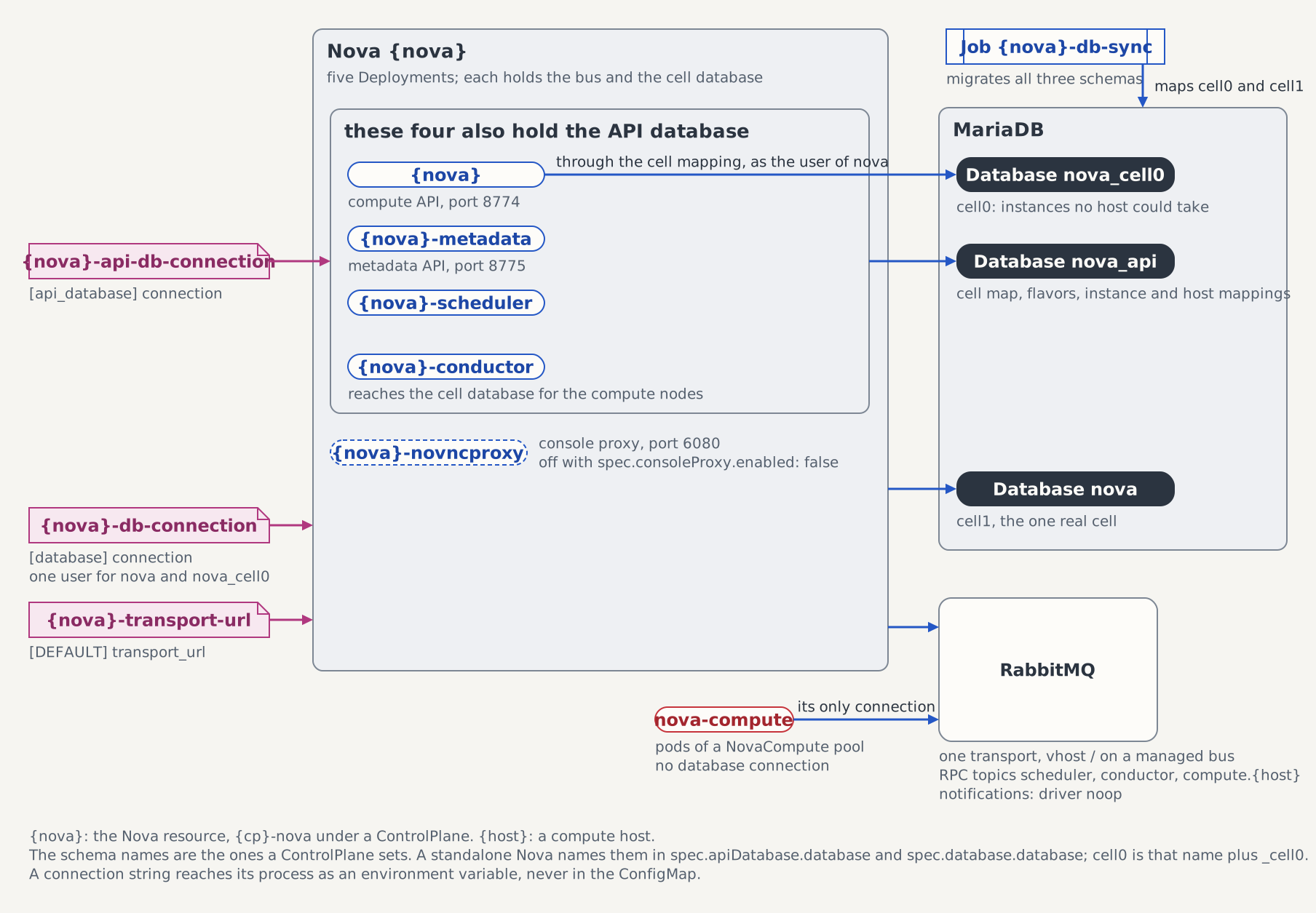
The second figure shows which process holds which of the two connections. The migration changes where the credentials behind them come from, and none of these edges.
Prerequisites
Devstack
This guide is written against the Quick Start (ControlPlane) devstack. Stand it up first:
KIND_HOST_PORT=8443 WITH_CONTROLPLANE=true make deploy-infraFollow that tutorial through the nova block of Step 4, the onboarding of Step 5 and the Boot a first server catalog check in Step 7, so the projected controlplane-nova child is Ready in openstack. Every resource name in the examples below is one that devstack produces.
On that devstack Nova already runs on dynamic credentials, because the tutorial's Step 5 onboarded both engine roles. To walk the migration there, stage the static mode first with step 3 below, then cut over with step 4.
Set the credential mode on the ControlPlane, never on the projected child
The controlplane-nova Nova CR is projected by the c5c3-operator, so a credentialsMode you edit on the child by hand is reverted on the next reconcile. Change services.nova on the ControlPlane CR and let the operator project it down; the commands below only read the child.
- The ControlPlane declares
spec.services.novaon the managed shared database. A Nova that declares a dedicated database underservices.nova.dedicatedBackingServicesisStatic-only, and the webhook rejectsdatabaseCredentialsMode: Dynamicon it. - The OpenBao
databasesecrets engine is mounted atdatabase/mariadb(thesetup-secret-engines.shbootstrap step). A greenfield cluster already has it; on a brownfield cluster, re-apply the bootstrap scripts (step 1). - cert-manager and its
openbao-ca-issuerClusterIssuer are installed. They issue the two per-ControlPlane mTLS client certificates the generators present to the OpenBao listener. - The External Secrets Operator can request ServiceAccount tokens (
serviceaccounts/tokencreate), so each generator can authenticate to OpenBao as its own ServiceAccount.
Migration steps
1. Re-apply the OpenBao bootstrap on brownfield clusters
The database engine mount, the nova-api-db and nova-cell-db Kubernetes-auth roles, and the nova-api-db-dynamic and nova-cell-db-dynamic policies are written by the idempotent bootstrap scripts. Re-apply them so a cluster provisioned before Nova was onboarded picks them up:
# From the repo root, with BAO_TOKEN exported (the OpenBao root token).
bash deploy/openbao/bootstrap/setup-secret-engines.sh
bash deploy/openbao/bootstrap/setup-auth.sh
bash deploy/openbao/bootstrap/setup-policies.sh
make deploy-infra runs these for you on a fresh kind cluster.
Each role binds its fixed ServiceAccount name in any namespace, and each policy templates the readable path to the caller's own service-account namespace. The two names are what keep the chains apart: a token minted for nova-api-db-creds reads the nova-api- creds path and never the nova-cell- one, and neither reads another service's path.
2. Onboard the per-tenant database-engine roles
The engine roles for a tenant exist only once its MariaDB is Ready and setup-database-tenant.sh has configured the connections and roles against it:
export BAO_TOKEN=$(kubectl get secret openbao-init-keys -n shared-services \
  -o jsonpath='{.data.init-output}' | base64 -d | jq -r '.root_token')
bash deploy/openbao/bootstrap/setup-database-tenant.sh openstack controlplane
unset BAO_TOKEN
When the ControlPlane declares spec.services.nova on the shared managed database, the script provisions two Nova legs:
database/mariadb/config/nova-api-openstackanddatabase/mariadb/roles/nova-api-openstack, the role that issues short-lived users onnova_api.database/mariadb/config/nova-cell-openstackanddatabase/mariadb/roles/nova-cell-openstack, the role that issues short-lived users onnovaandnova_cell0.
Both roles default to default_ttl 48h and max_ttl 72h; override them with DB_CREDS_DEFAULT_TTL / DB_CREDS_MAX_TTL. The script reads the live ControlPlane spec on every run and skips a service the CR does not declare, so run it again after adding the nova block to a ControlPlane that was onboarded without one.
3. (Optional) Stage the cutover with databaseCredentialsMode: Static
Dynamic is the default effective mode for a managed ControlPlane on the shared database. To keep Nova on static credentials while the other services already run Dynamic, pin the per-service override so the blast radius stays on Nova.
Nothing seeds the static KV paths, so seed both before you switch the mode. The username of each must be the name of the SQL user the nova operator provisions for that schema in Static mode. Enter each password at the prompt, so it stays out of your shell history and off the command line (password=- reads it from stdin):
# Inside the OpenBao pod, or with a bao client configured for it.
printf 'nova_api DB password: '
IFS= read -r -s PW
printf '\n'
printf '%s' "$PW" | bao kv put kv-v2/openstack/nova/openstack/controlplane/api-db \
  username=controlplane-nova-api password=-
printf 'cell DB password: '
IFS= read -r -s PW
printf '\n'
printf '%s' "$PW" | bao kv put kv-v2/openstack/nova/openstack/controlplane/db \
  username=controlplane-nova password=-
unset PW
The two passwords are values you choose. In Static mode the nova operator provisions the MariaDB User and Grant pairs controlplane-nova-api (on nova_api) and controlplane-nova (on nova), plus the Grant controlplane-nova-nova-cell0 that gives the cell user nova_cell0. Then switch the mode:
kubectl patch controlplane controlplane -n openstack --type merge \
  -p '{"spec":{"services":{"nova":{"databaseCredentialsMode":"Static"}}}}'
The switch reaches the child at once, possibly before ESO has re-synced the two Secrets from the KV paths, and the nova operator creates each User with the password its Secret holds at that moment. mariadb-operator does not watch that Secret, so it keeps that password until something makes it reconcile the User again. Wait until both Secrets carry the static usernames, then touch both User CRs so mariadb-operator applies the password the Secrets hold now:
ok=1
for user in controlplane-nova-api controlplane-nova; do
  for i in $(seq 60); do
    [ "$(kubectl get secret "$user-db-credentials" -n openstack \
      -o jsonpath='{.data.username}' | base64 -d)" = "$user" ] && break
    if [ "$i" -eq 60 ]; then
      ok=
      echo "$user-db-credentials does not carry $user after 5m: check its ExternalSecret" >&2
    fi
    sleep 5
  done
done
[ -n "$ok" ] &&
  kubectl wait user/controlplane-nova-api user/controlplane-nova -n openstack \
    --for=condition=Ready --timeout=5m &&
  kubectl annotate user controlplane-nova-api controlplane-nova -n openstack \
    --overwrite "password-resync=$(date +%s)"
Every change to a User makes mariadb-operator reconcile it, and every reconcile sets the SQL user's password from the Secret again, so the annotation changes nothing where the password was already right.
If a Secret never carries its static username, the block prints which one and touches neither User: the Secret still holds the engine-issued password, and a resync would apply that password again. Fix the ExternalSecret it names, usually a KV path that does not match your ControlPlane's name or a store policy that denies the read, then run the block again.
The shared spec.infrastructure.database.credentialsMode: Static opts out ControlPlane-wide instead; the per-service override scopes the opt-out to Nova. Remove the override (or set it to Dynamic) to cut over.
4. Cut over and observe
Remove the override:
kubectl patch controlplane controlplane -n openstack --type merge \
  -p '{"spec":{"services":{"nova":{"databaseCredentialsMode":null}}}}'
On the next reconcile the c5c3 operator projects both generators, their ServiceAccounts and client Certificates, and both ExternalSecrets switch to drawing from their generator. On a cluster that ran the static path, delete the two materialised Secrets once, so ESO re-materialises them from the generators immediately instead of at the next refresh:
kubectl delete secret controlplane-nova-api-db-credentials \
  controlplane-nova-db-credentials -n openstack
You do not have to get this right for Nova to stay up. The c5c3 operator does not project credentialsMode: Dynamic onto the child until both ExternalSecrets report Ready and both Secrets carry an engine-issued username. It checks the nova_api chain first, because the cell mappings are registered in that schema, so NovaReady reads False under WaitingForNovaAPIDBCredential and then under WaitingForNovaCellDBCredential until each chain has delivered:
kubectl get controlplane controlplane -n openstack \
  -o jsonpath='{.status.conditions[?(@.type=="NovaReady")].reason}{"\n"}'
The message names the creds path the chain waits on, or the stale static username it found. A ControlPlane stuck on the path message has not been onboarded; re-run step 2. One stuck on the username message is waiting for the sync the Secret deletion above shortcuts.
Once NovaReady is True, both database blocks of the child read Dynamic:
kubectl get nova controlplane-nova -n openstack \
  -o jsonpath='{.spec.apiDatabase.credentialsMode} {.spec.database.credentialsMode}{"\n"}'
The command prints Dynamic Dynamic. Watch for:
- Both ExternalSecrets,
controlplane-nova-api-db-credentialsandcontrolplane-nova-db-credentials, changing from staticdata[].remoteReftodataFrom[].sourceRef.generatorRef(kindVaultDynamicSecret). - The materialised Secrets'
usernamebecoming engine-issued logins rather thancontrolplane-nova-apiandcontrolplane-nova. - A rollout of all five Nova Deployments:
controlplane-nova,controlplane-nova-metadata,controlplane-nova-scheduler,controlplane-nova-conductorandcontrolplane-nova-novncproxy. The nova operator stamps thenova.c5c3.io/api-db-connection-hashandnova.c5c3.io/db-connection-hashpod-template annotations on every workload, so a changed credential rolls all of them. Both DSNs travel in environment variables, which only take effect on a pod restart.
The cell mappings stay as they were. They hold templates that carry no credential, and every process expands them with the connection it now runs with, so the cutover needs no nova-manage cell_v2 update_cell. Confirm it with the plain list_cells (never --verbose, which prints the passwords):
kubectl exec -n openstack deploy/controlplane-nova-conductor -c conductor -- \
  nova-manage --config-dir /etc/nova/nova.conf.d cell_v2 list_cells
kubectl get nova controlplane-nova -n openstack -o jsonpath='{.status.cells}{"\n"}'
The two UUIDs in the table are the ones status.cells reported before the cutover.
5. Retire the static credentials
Once the ControlPlane reports NovaReady=True on the dynamic path:
Delete the leftover static MariaDB
UserandGrantCRs. They carry the long-livedcontrolplane-nova-apiandcontrolplane-novalogins the engine no longer uses. Leave theDatabaseCRs of the same names alone: they are the schemas.bashkubectl delete user controlplane-nova-api controlplane-nova \ -n openstack --ignore-not-found kubectl delete grant controlplane-nova-api controlplane-nova \ controlplane-nova-nova-cell0 -n openstack --ignore-not-foundRemove the retired static KV secrets, if step 3 ever seeded them:
bash# Inside the OpenBao pod, or with a bao client configured for it. bao kv metadata delete kv-v2/openstack/nova/openstack/controlplane/api-db bao kv metadata delete kv-v2/openstack/nova/openstack/controlplane/db
Rollback
To revert to static credentials, follow step 3 in its order: re-seed both KV paths, set the mode back to Static (the per-service spec.services.nova.databaseCredentialsMode override, or the shared spec.infrastructure.database.credentialsMode), and wait for the static usernames before you touch the User CRs. The Static-mode reconcile re-creates the two User/Grant pairs and the cell0 Grant, and all five Deployments roll back onto the static DSNs. The two generators, their ServiceAccounts and their Certificates are torn down with the switch.
Operational considerations
- Every Nova role restarts on every rotation. Both DSNs are consumed through environment variables, so a rotated engine credential only takes effect on a pod restart, and all five Deployments roll each time either ExternalSecret re-issues a credential. On the quick-start devstack each runs one replica, so each role is briefly down per roll; the scheduler and the conductor drain their RPC server for up to 200 seconds before they stop. The defaults keep the churn bounded: the 24h refresh interval holds it to at most once a day per chain, while the 48h
default_ttlleaves a 24h gap in which to roll the pods before the previous, still-in-use lease is revoked. - Auth-token TTL bounds the lease. OpenBao revokes a dynamic-secret lease together with the auth token that minted it, so the effective credential lifetime is
min(lease TTL, minting token TTL). Thenova-api-dbandnova-cell-dbauth roles therefore pintoken_ttlandtoken_max_ttlto 72h, theDB_CREDS_MAX_TTLdefault. When raisingDB_CREDS_*beyond that, raise both roles' TTLs in lockstep. - No per-user connection cap on the dynamic path. In Static mode the nova operator sizes each MariaDB
User'smax_user_connectionsfor the CR's topology. The engine'sCREATE USERsets no cap, so once Nova runs on engine-issued logins the server's ownmax_connectionsis the only bound. - The archive CronJob rides both credentials.
controlplane-nova-db-archiverunsnova-manage db archive_deleted_rows --all-cellswith the same two DSNs the workloads carry, read at pod start from the derived Secrets the nova operator re-renders from each engine-issued credential. A run that starts between a revocation and that re-render fails and archives nothing; the next run continues where it stopped. - Revocation semantics: revoking a lease runs
DROP USER, which rejects new connections. Already-open sessions of a dropped user may persist until they disconnect. - ESO or OpenBao outage longer than the lease: the materialised credentials expire before a refresh lands. Running pods keep pooled connections, but new connections fail until ESO recovers. This surfaces through the child's own
DatabaseReadyand, ControlPlane-side, asNovaReady=False.
See also
- OpenBao Bootstrap reference: engines, auth roles, policies, and secret paths.
- ControlPlane CRD API Reference:
services.nova.databaseCredentialsModeand theNovaReadyreasons. - Nova Cells: why the cell mappings carry no credential.
- Migrate Cinder DB to Dynamic Credentials: the sibling migration for a single-database service.
Tested by
The dynamic, engine-issued credentials this guide migrates to are asserted on the live CI e2e kind cluster by the chainsaw suite below. Its compute link waits for NovaReady, reads both database blocks of the projected child back as Dynamic, and checks for each chain that the ExternalSecret draws from a VaultDynamicSecret generator and carries no static spec.data refs, that the generator reads database/mariadb/creds/nova-api-<namespace> or database/mariadb/creds/nova-cell-<namespace>, that the nova-api-db-creds or nova-cell-db-creds ServiceAccount exists, and that the materialised username is neither empty nor the schema name.
chainsaw test --test-dir tests/e2e/c5c3/full-controlplane-keystone