KeystoneUser Reconciler Architecture
Reference documentation for the KeystoneUserReconciler. It owns the KeystoneUser lifecycle and is the single writer of its status: the teardown finalizer, the K-ORC User and its password generations, the OpenBao backup, the Secret delivered beside the order, and the UserReady / DeliveryReady / Ready conditions.
It is the one reconciler in the c5c3-operator whose CR may live on a target cluster. A request carries the cluster the order was seen on, and the reconciler reads and writes the order, its status, its finalizer and its delivered Secret through that cluster's client. Everything else it creates lives in the ControlPlane's namespace on the management cluster, where K-ORC reads the admin credential.
It adds no identity-API client and no OpenBao client. K-ORC creates the user, and ESO pushes the password to OpenBao through the secret store of the ControlPlane's namespace.
It records no Events. The management cluster's recorder would write them into a namespace of the wrong cluster for an order on a target cluster, so the conditions carry everything.
For the field-level contracts see KeystoneUser CRD API Reference. The account path it reuses is the KeystoneService one, described in KeystoneService Reconciler Architecture.
Controller Registration
if err := (&controller.KeystoneUserReconciler{
    Client:                  mgr.GetClient(),
    Scheme:                  mgr.GetScheme(),
    Resolver:                mcMgr,
    MaxConcurrentReconciles: opts.MaxConcurrentReconciles,
}).SetupWithManager(mcMgr); err != nil { ... }
Client is the management cluster's client. Resolver is the multicluster manager, which resolves a request's cluster name to that cluster's client; the empty name is the management cluster. SetupWithManager delegates to setupWithOptions, so the integration suites register the same watches with SkipNameValidation. The Now field is the clock the password schedule reads. main.go leaves it nil, so the reconciler reads time.Now; the unit tests set a fixed one.
The cluster-agnostic machinery (child naming and ownership, the admission gates, the pass result, the teardown and the label mapping) lives in keystoneorder.go, which the reconcilers of the further order kinds share. keystoneuser_controller.go keeps its keystoneUser* names as delegates. See The shared scaffold.
Before the watches it registers one field indexer, on the local manager's indexer only: with a provider configured the multicluster indexer would register against every target cluster too, and one without the kind would fail its engagement.
| Index | Key | Extractor |
|---|---|---|
KeystoneUserControlPlaneRefIndexKey (spec.controlPlaneRef) | the resolved <namespace>/<name> of the reference | keystoneUserControlPlaneRefExtractor |
Watches
| Resource | Watch | Clusters | Effect |
|---|---|---|---|
KeystoneUser | For() | management, and every engaged target cluster that serves the kind | Filtered by watch.CRUpdatePredicate(). The request carries the event's cluster |
Secret | Owns() | the same | The delivered Secret beside the order. An edit or a deletion brings the order back with the event's cluster |
K-ORC User, Secret, PushSecret | Watches() | management | Mapped back to the order by the three ownership labels (orderChildRequests). The cluster label becomes the request's cluster |
KeystoneRoleAssignment | Watches() | management, and every engaged target cluster that serves the kind | The user an assignment names as userRef, on the assignment's cluster (keystoneUserReferenceRequests), so an assignment leaving wakes a held teardown. Filtered by watch.CRUpdatePredicate() |
ControlPlane | Watches() | management | Index-backed fan-out (controlPlaneToKeystoneUsersMapper) to the orders on the management cluster that reference it. Filtered by orderControlPlanePredicate(): an update passes on a spec change, a deletion, or a flip of AdminCredentialReady, the one status condition the gates read |
The order watch on a target cluster carries the ClusterServesKind filter. A cluster that does not serve the kind is engaged for every other watch and skipped for this one; a CRD installed later is watched once the cluster is engaged again, which a change of its registration Secret triggers.
No ControlPlane watch reaches an order on a target cluster. Such an order is reconciled again every 10 minutes (orderRefreshAfter), which is how a publication or an admin-domain edit reaches it.
RBAC
On the management cluster the ClusterRole gains the order verbs:
// +kubebuilder:rbac:groups=c5c3.io,resources=keystoneusers,verbs=get;list;watch;update;patch
// +kubebuilder:rbac:groups=c5c3.io,resources=keystoneusers/status,verbs=get;update;patch
// +kubebuilder:rbac:groups=c5c3.io,resources=keystoneusers/finalizers,verbs=update
// +kubebuilder:rbac:groups=c5c3.io,resources=keystoneroleassignments,verbs=get;list;watch
The last marker is for the teardown hold. It never creates or deletes an order. The kinds it writes in the ControlPlane's namespace (K-ORC Users, Secrets, PushSecrets) and the ControlPlane reads are granted by the ControlPlane's marker block.
On a target cluster the target-cluster-access chart grants the same order verbs and Secret write in each assigned namespace, and read on the order kind in each placed namespace, because the order watch lists every namespace of the registration. See Assigned namespaces.
Reconciliation Flow
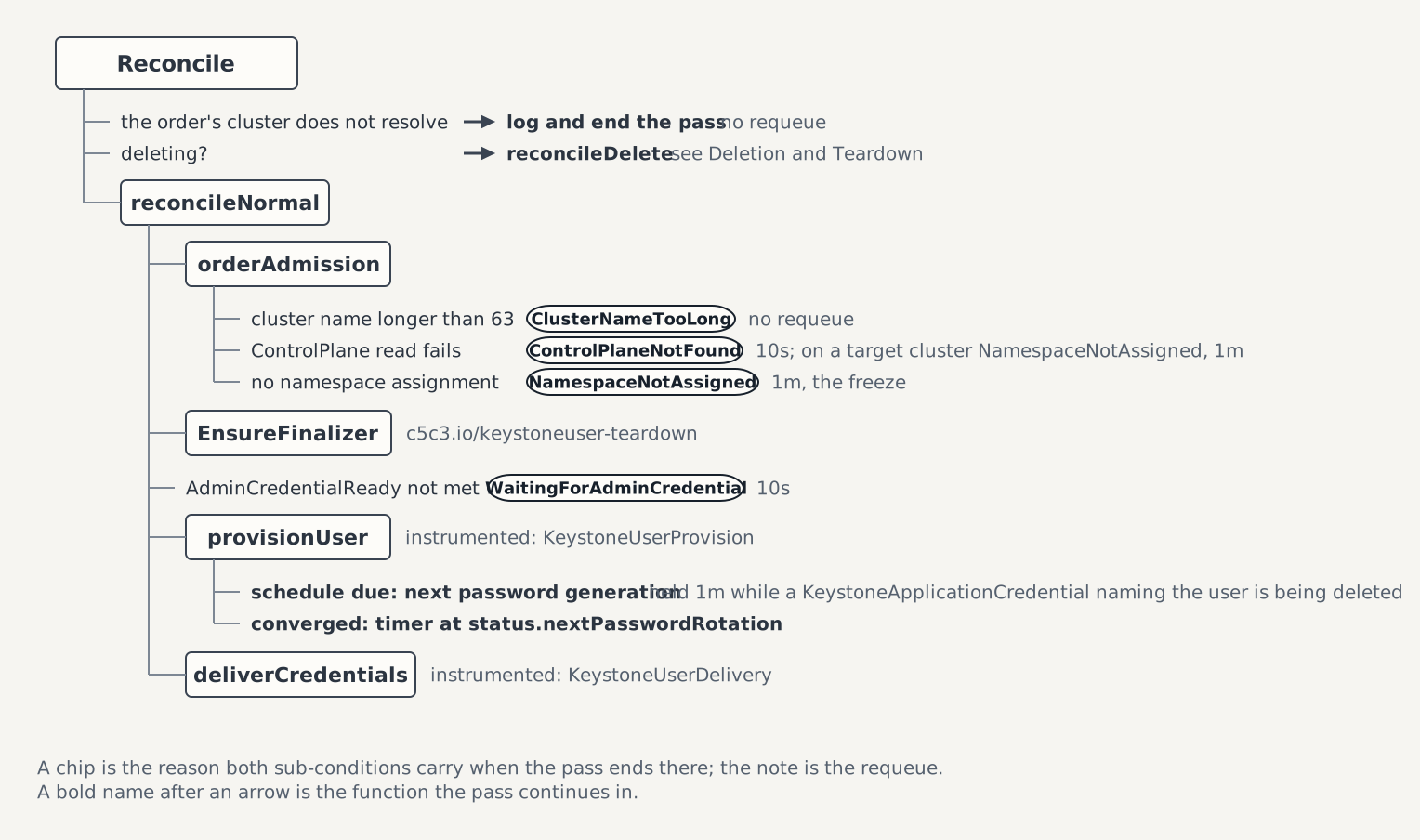
A request whose cluster does not resolve names a cluster deregistered between the event and the pass. Nothing can be read there, so the pass logs the cluster and ends without an error.
The assignment gate is the freeze: without an entry for the order's namespace on its cluster, both conditions read NamespaceNotAssigned and the pass returns before anything in the ControlPlane's namespace is read or written. Nothing is provisioned, delivered, repaired or swept, and the status the order already has stays. The finalizer is installed only past this gate: an order the operator does not serve has nothing to tear down, and in a namespace that is not assigned on a target cluster the operator is not granted the update.
The cluster's name is a label value on every child, so an order on a cluster registered under a name longer than 63 characters is refused first. A missing ControlPlane reads as NamespaceNotAssigned for an order on a target cluster, with the message a ControlPlane without the assignment writes, so the reason does not tell an owner there which ControlPlanes exist.
When the provision step has not converged, DeliveryReady reads WaitingForServiceAccounts and the delivery is skipped. The pass keeps the shorter of the two steps' requeues, which carry the password timer and the one-minute wait of a held rotation. A delivered order on the management cluster then waits for its timer or an event. Every other order comes back after 10 minutes at the latest, which covers the target clusters and the refusals no watch lifts.
User provisioning
provisionUser writes UserReady in six steps:
- A user name that folds, as Keystone compares names, to one the ControlPlane creates in its admin domain itself is refused with
ServiceAccountCollisionand never provisioned: its admin user, and every built-in service account (keystoneUserReservedNames), whether or not that service is enabled. - The secret store of the ControlPlane's namespace has to be ready, or the password could not be backed up (
SecretStoreNotReady). - A short-lived unmanaged User import (
<prefix>user-probe) decides whether a user of that name exists in the admin domain. An existing one is refused withServiceAccountCollisionand never taken over; an order has no adopt. The probe is dropped once the managed User exists. - The password schedule is due once the reconciler's clock reaches
status.lastPasswordRotationplusspec.rotation.interval. Only then does the pass list the KeystoneApplicationCredentials in the order's namespace, through the order's cluster client. One that names the user and is being deleted holds the rotation; otherwise the scheduled generation isstatus.passwordGenerationplus one. - The managed User
<prefix>useris created in the admin domain with no default project, pointing at the password Secret<prefix>password-v<N>of the higher of the declared and the scheduled generation. - Once K-ORC reports the User Available with that Secret applied,
status.userIDandstatus.passwordGenerationare set andUserReadyreadsUserProvisioned. A held rotation adds the credential orders it waits for to the message.
spec.passwordGeneration and the schedule drive the generation. A value above the current one writes the new password Secret and points the User at it; K-ORC applies a password only when that reference changes. The superseded Secret is deleted once K-ORC reports the new one applied, and a value below the current one never rolls the password back. A stored zero reads as 1. A raised spec.passwordGeneration is never held, and interval: 0s turns the schedule off.
status.lastPasswordRotation is set from the reconciler's clock on the pass that points the User at a new password, and again on the pass that sees a new generation applied or finds no time recorded. The second write keeps a rotation whose first status write was lost from starting another one, and anchors both a fresh order and one created before the schedule existed. status.nextPasswordRotation follows on every pass that reaches the User, and a converged pass returns the time until it. A held rotation comes back after a minute; a change of the credential order it waits for wakes it sooner.
A latched transport error on the User is cleared first, so K-ORC retries; any other terminal error reads ServiceAccountsFailed. Against an External-mode ControlPlane a wait is replaced by the classified K-ORC failure.
Credential delivery
deliverCredentials writes DeliveryReady:
- The auth URL is resolved for the order's cluster. Off Keystone's cluster that is the published endpoint; without one the step reports
KeystoneNotPublishedand writes nothing. - The password of the current generation is read from
<prefix>password-v<N>. - The source Secret
<prefix>sourcegets theclouds.yamlwithout project keys, the password and the individual auth fields. - The PushSecret
<prefix>backuppushes it toopenstack/keystone/<controlplane namespace>/<prefix without the trailing dash>/service-accounts/credentialsthrough the namespace's own store, withdeletionPolicy: Delete. A changed document sets a hash annotation on it, so ESO pushes at once, and records the PushSecret'sstatus.syncedResourceVersionbeside it. ESO moves that field only after a successful push, so the step waits forReadyand for a value other than the recorded one (BackupNotSynced).Readyalone would still readTruefrom the push of the previous password. - The Secret
<name>-credentialsis applied beside the order with a controller owner reference to it. A live Secret of that name the order does not own is refused (DeliveryRefused). On a target cluster that check reads the cluster's API server, not its cache. - The apply response is checked. Once its
passwordmatches,status.secretNameandstatus.secretKeysare set andDeliveryReadyreadsDelivered.
The apply in step 5 is the repair. Server-Side Apply with forced ownership gives the operator's field manager the two keys it applies, so an edited key is rewritten on the event the edit raises, a deleted Secret is applied again, and a key another field manager adds stays.
Child Naming and Placement
| Object | Name | Namespace | Cluster | Ownership |
|---|---|---|---|---|
| Managed K-ORC User | <prefix>user | ControlPlane's | management | labels |
| Collision probe | <prefix>user-probe | ControlPlane's | management | labels |
| Password Secret, per generation | <prefix>password-v<N> | ControlPlane's | management | labels |
| Source Secret | <prefix>source | ControlPlane's | management | labels |
| PushSecret | <prefix>backup | ControlPlane's | management | labels |
| Delivered Secret | <name>-credentials | the order's | the order's | controller owner reference |
<prefix> is <name>-<first 8 hex of sha256(<cluster>/<namespace>/<name>)>-user-. The labels are c5c3.io/keystoneuser-name, c5c3.io/keystoneuser-namespace and c5c3.io/keystoneuser-cluster, the last empty for the management cluster.
An object in the ControlPlane's namespace is the order's child only when it carries all three labels and the prefix. Neither test alone is enough: the namespace holds the plane's own children and those of every KeystoneService and every other order. The operator refuses to overwrite a live object of a child's name that is not the order's child.
Deletion and Teardown
reconcileDelete first lists the KeystoneRoleAssignments in the order's namespace through the order's cluster client (referencingRoleAssignments). While one names the order as its userRef, UserReady reads ReferencedByRoleAssignments naming them, nothing is deleted, and the pass requeues after a minute. K-ORC guards a User with a finalizer while a RoleAssignment references it, so the sweep would wedge.
It then lists the KeystoneApplicationCredentials the same way (referencingApplicationCredentials). While one names the order as its userRef, UserReady reads ReferencedByApplicationCredentials naming them, and the pass deletes nothing and requeues after a minute: deleting the user deletes its credentials in Keystone, and K-ORC could no longer delete them. The KeystoneApplicationCredential watch wakes the held teardown when one goes.
Past the hold, orderTeardown runs the c5c3.io/keystoneuser-teardown finalizer without consulting the assignment, so a frozen order tears down too. It issues the deletes in this order, in the resolved controlPlaneRef namespace:
- the PushSecret, whose
deletionPolicyhas ESO remove the OpenBao path, - the managed User, whose K-ORC finalizer deletes the Keystone user,
- the probe,
- every password Secret,
- the source Secret,
and then the delivered Secret through the order's cluster client.
With the ControlPlane present the finalizer is held while any of them is still listed, and the pass requeues after 10 seconds. With the ControlPlane gone the deletes are issued and the finalizer is released at once, because K-ORC has no credential left to reach Keystone with.
An order whose target cluster was deregistered cannot be read, so it is never torn down, and its children stay labelled in the ControlPlane's namespace. See Deletion Semantics for the command that removes them.
Metrics Instrumentation
Both steps run through the package-scope instrumenter the ControlPlane reconciler shares, so they observe the c5c3_operator_reconcile_duration_seconds{sub_reconciler=…} histogram and the c5c3_operator_reconcile_errors_total{sub_reconciler=…,condition_type=…} counter.
sub_reconciler | condition_type |
|---|---|
KeystoneUserProvision | UserReady |
KeystoneUserDelivery | DeliveryReady |
The names carry the kind as a prefix, as the KeystoneService entries do. The drift guard TestSubReconcilerConditionTypesCoversAllNames accepts a value from keystoneUserSubConditionTypes, and TestInstrumenterInstrument_KeystoneUserLabelPairs proves neither name falls back to condition_type=UNKNOWN.
Testing
| Layer | Location |
|---|---|
| Gates, freeze, mappers, teardown, the hold | operators/c5c3/internal/controller/keystoneuser_controller_test.go |
| The shared scaffold | operators/c5c3/internal/controller/keystoneorder_test.go |
| User provisioning | operators/c5c3/internal/controller/keystoneuser_provision_test.go |
| The password schedule, the hold and the anchor | keystoneuser_provision_test.go, and the timer of a converged pass in keystoneuser_controller_test.go |
| Credential delivery | operators/c5c3/internal/controller/keystoneuser_delivery_test.go |
The unscoped clouds.yaml | operators/c5c3/internal/controller/korc_cloudsyaml_test.go |
| CRD schema | TestIntegration_KeystoneUser_SchemaValidation in integration_test.go |
| An order on a target cluster | TestIntegration_Multicluster_ControlPlanePlacement in multicluster_integration_test.go |
| End to end | tests/e2e/c5c3/keystone-user/ |
| Admission rejection corpus | tests/e2e/c5c3/invalid-keystoneuser-cr/ |
The unit tests drive a fake client per cluster. The multicluster envtest runs two API servers, creates the order on the target and checks where each object appears; it carries K-ORC and ESO as schema without a controller, so the end-to-end suite is where the order meets Keystone, OpenBao and ESO. See ControlPlane E2E Test Suites.