Kubernetes-Interacting Packages
Reference documentation for the internal/common/ packages that interact with the Kubernetes API server. These packages provide reconciler building blocks for managing external operator CRDs (MariaDB, External Secrets Operator, cert-manager) and core Kubernetes resources (Deployments, Services, Jobs, CronJobs, ConfigMaps).
All packages share these conventions:
- Idempotent create-or-update via Server-Side Apply —
Ensure*functions apply the desired object through the genericapply.EnsureObjecthelper, which uses Server-Side Apply under the fixed field managercobaltcore-operator. The field manager owns only the fields the builder sets, so server-defaulted fields the builder omits are never claimed or overwritten and a converged object is applied without a write. The apply is wrapped inretry.RetryOnConflict, so a benign field-manager conflict is absorbed as an internal retry rather than surfacing as condition noise. - Owner references —
controllerutil.SetControllerReferenceis called on every apply (not only on create) so the resource is garbage-collected when the owning CR is deleted and the reference is re-enforced if it drifts. - Readiness reporting — Functions that create resources return
(bool, error), wheretruemeans the resource is ready andfalsemeans it exists but is not yet ready. - Error wrapping — All errors include context via
fmt.Errorfwith%wforerrors.Is/errors.Ascompatibility.
Import Paths
| Package | Import Path |
|---|---|
apply | github.com/c5c3/cobaltcore/internal/common/apply |
config | github.com/c5c3/cobaltcore/internal/common/config |
database | github.com/c5c3/cobaltcore/internal/common/database |
deployment | github.com/c5c3/cobaltcore/internal/common/deployment |
job | github.com/c5c3/cobaltcore/internal/common/job |
policy | github.com/c5c3/cobaltcore/internal/common/policy |
satellite | github.com/c5c3/cobaltcore/internal/common/satellite |
secrets | github.com/c5c3/cobaltcore/internal/common/secrets |
tls | github.com/c5c3/cobaltcore/internal/common/tls |
External CRD Dependencies
These packages import typed Go structs from external operator modules:
| Operator | Go Module | API Version | Types Used |
|---|---|---|---|
| mariadb-operator | github.com/mariadb-operator/mariadb-operator | v1alpha1 | Database, User, Grant |
| External Secrets Operator | github.com/external-secrets/external-secrets | v1 (ExternalSecret, ClusterSecretStore), v1alpha1 (PushSecret) | ExternalSecret, PushSecret |
| cert-manager | github.com/cert-manager/cert-manager | v1 | Certificate |
Note: The PushSecret API is
v1alpha1(unstable). Its schema may change in future ESO releases. Pin the ESO module version ingo.modto avoid breakage.
Package: apply
Provides the generic Server-Side Apply create-or-update primitive that backs the Ensure* family.
EnsureObject
func EnsureObject[T client.Object](
    ctx context.Context,
    c client.Client,
    scheme *runtime.Scheme,
    owner client.Object,
    obj T,
    fieldManager string,
) error
Creates or updates obj via Server-Side Apply under fieldManager and sets owner as the controller reference.
Behavior:
- Sets the controller owner reference and stamps the object's GVK (objects built in-code carry an empty
TypeMeta, which Server-Side Apply requires). - Applies the object with
client.FieldOwner(fieldManager)andclient.ForceOwnership, wrapped inretry.RetryOnConflictso a benign field-manager conflict is retried internally rather than surfaced. - The field manager owns only the fields the builder sets, so server-defaulted fields the builder omits are never claimed and a converged object is applied without a write.
- Decodes the server response back into
obj, so callers may read fresh status (e.g. readiness) without an extraGet.
Field manager: the package exports apply.FieldManager ("cobaltcore-operator"), the stable field-manager name shared by all Ensure* helpers.
Package: config
Implements the INI configuration rendering pipeline for CobaltCore operators. The CreateImmutableConfigMap function provides Kubernetes-interacting config management.
CreateImmutableConfigMap
func CreateImmutableConfigMap(
    ctx context.Context,
    c client.Client,
    scheme *runtime.Scheme,
    owner client.Object,
    baseName, namespace string,
    data map[string]string,
) (string, error)
Creates an immutable ConfigMap with a content-hash suffix appended to the base name. The hash ensures that configuration changes result in new ConfigMap names, triggering pod restarts when the ConfigMap is referenced in a Deployment's volume spec.
Parameters:
| Name | Type | Description |
|---|---|---|
ctx | context.Context | Request context |
c | client.Client | Kubernetes API client |
scheme | *runtime.Scheme | Scheme for owner reference resolution |
owner | client.Object | Owning CR for garbage collection |
baseName | string | Base name for the ConfigMap (hash is appended as -<hash>) |
namespace | string | Namespace for the ConfigMap |
data | map[string]string | ConfigMap data entries |
Returns:
| Value | Description |
|---|---|
string | Actual ConfigMap name including the 8-character SHA256 hash suffix |
error | Non-nil on owner reference or API server failure |
Behavior:
- Computes a deterministic SHA256 hash from sorted
datakeys and values. - Truncates the hash to 8 hex characters and appends it as
baseName-<hash>. - Sets
Immutable: trueon the ConfigMap. - Sets a controller owner reference on the ConfigMap.
- If a ConfigMap with the same name already exists (
AlreadyExistserror), returns the name without error (idempotent). - Same data always produces the same hash (deterministic).
- Different data always produces a different hash.
Example:
name, err := config.CreateImmutableConfigMap(ctx, client, scheme, owner,
    "keystone-config", "openstack",
    map[string]string{"keystone.conf": renderedINI},
)
// name == "keystone-config-a1b2c3d4"
PruneImmutableConfigMaps
func PruneImmutableConfigMaps(
    ctx context.Context,
    c client.Client,
    owner client.Object,
    baseName, namespace, currentName string,
    retain int,
) error
Deletes stale immutable ConfigMaps that were previously created by CreateImmutableConfigMap, retaining the newest retain historical ConfigMaps (by CreationTimestamp) plus the currently active one identified by currentName. This prevents unbounded accumulation of immutable ConfigMaps across reconcile cycles.
Parameters:
| Name | Type | Description |
|---|---|---|
ctx | context.Context | Request context |
c | client.Client | Kubernetes API client |
owner | client.Object | Owning CR — only ConfigMaps with a controller owner reference matching this object's UID are considered |
baseName | string | Base name prefix for candidate ConfigMaps (matches baseName-*) |
namespace | string | Namespace to list ConfigMaps in |
currentName | string | Name of the currently active ConfigMap (never deleted, even with retain=0) |
retain | int | Number of historical ConfigMaps to keep beyond the current one |
Returns:
| Value | Description |
|---|---|
error | Non-nil on list or delete failure; nil on success or when no pruning is needed |
Algorithm:
- Lists ConfigMaps matching the
cobaltcore.c5c3.io/config-baselabel in the namespace. - Filters to ConfigMaps matching the
baseName + "-"prefix. - Excludes the ConfigMap named
currentName(the active one). - Excludes ConfigMaps without a controller owner reference matching
owner.GetUID(). - Sorts remaining candidates by
CreationTimestampdescending (newest first). - If the number of candidates is less than or equal to
retain, returnsnil(no-op). - Deletes candidates from index
retainonwards (oldest first). - Logs each deletion at info level for auditability.
Idempotency and concurrency safety:
- Uses
client.IgnoreNotFound()on delete operations, so a ConfigMap deleted between the list and delete calls does not cause an error. - Calling the function twice with the same state produces the same result.
- Does not use optimistic locking — concurrent reconcile goroutines may both attempt to delete the same ConfigMap, but
IgnoreNotFoundmakes this safe.
Filtering rules:
| ConfigMap State | Included in Candidates? |
|---|---|
Name matches baseName-* prefix, owned by owner | Yes |
Name equals currentName | No (always excluded) |
Name does not match baseName-* prefix | No |
| No owner reference | No |
Owner reference UID does not match owner | No |
Edge cases:
| Scenario | Result |
|---|---|
| No historical ConfigMaps exist | No-op, returns nil |
Fewer historical ConfigMaps than retain | No-op, returns nil |
retain=0 | All historical ConfigMaps deleted, only currentName survives |
| ConfigMap deleted between list and delete | NotFound silently ignored |
Overlapping prefix (e.g., test-config- vs test-config-extra-) | Strict baseName + "-" prefix prevents false matches |
Pre-existing ConfigMaps without cobaltcore.c5c3.io/config-base label | Not pruned — invisible to server-side selector. Bounded in number and GC'd on CR deletion via owner reference. |
Example:
// After creating a new ConfigMap, prune old ones keeping 3 historical:
err := config.PruneImmutableConfigMaps(ctx, client, keystoneCR,
    "keystone-config", "openstack", "keystone-config-a1b2c3d4", 3,
)
// With 5 historical ConfigMaps, the 2 oldest are deleted, 3 newest + current remain.
Package: database
Manages MariaDB database resources for CobaltCore operators. Uses typed structs from github.com/mariadb-operator/mariadb-operator/api/v1alpha1.
EnsureDatabase
func EnsureDatabase(
    ctx context.Context,
    c client.Client,
    scheme *runtime.Scheme,
    owner client.Object,
    db *mariadbv1alpha1.Database,
) (bool, error)
Creates or updates a MariaDB Database CR.
Returns: (true, nil) when the Database has a Ready condition with status True; (false, nil) when it exists but is not yet ready; (false, error) on failure.
Behavior:
- Applies the desired Database via
apply.EnsureObject(Server-Side Apply); the field manager owns only the fields the builder sets, so server defaults on omitted fields (for examplemaxUserConnectionson a User whose provision params leave it unsized) are preserved and a converged Database is not rewritten. - Readiness is determined by the package-internal
isDatabaseReadyhelper on the server-fresh apply response.
EnsureDatabaseUser
func EnsureDatabaseUser(
    ctx context.Context,
    c client.Client,
    scheme *runtime.Scheme,
    owner client.Object,
    user *mariadbv1alpha1.User,
    grant *mariadbv1alpha1.Grant,
) (bool, error)
Creates or updates a MariaDB User CR and a Grant CR in a single call.
Returns: (true, nil) when both User and Grant have Ready conditions with status True; (false, nil) when either is not yet ready; (false, error) on failure.
Behavior:
- Processes User first, then Grant. If User creation/update fails, Grant is not attempted.
- Both resources receive controller owner references.
- Readiness of the User and Grant is determined by the package-internal
isUserReadyandisGrantReadyhelpers.
Package: deployment
Manages Kubernetes Deployments and Services for CobaltCore operators.
EnsureDeployment
func EnsureDeployment(
    ctx context.Context,
    c client.Client,
    scheme *runtime.Scheme,
    owner client.Object,
    deploy *appsv1.Deployment,
) (bool, error)
Creates or updates a Deployment.
Returns: (true, nil) when all replicas are available; (false, nil) when the Deployment exists but is not yet ready; (false, error) on failure.
Behavior:
- Applies the desired Deployment via
apply.EnsureObject(Server-Side Apply); a converged Deployment is not rewritten on every reconcile. - Retains a pre-apply
Getonly to delete-and-recreate on an immutable-selector change and to preserve the HPA-owned replica count whenspec.deployment.replicasis left nil. - Readiness is determined by
IsDeploymentReadyon the server-fresh apply response.
EnsureService
func EnsureService(
    ctx context.Context,
    c client.Client,
    scheme *runtime.Scheme,
    owner client.Object,
    svc *corev1.Service,
) error
Creates or updates a Service. Does not report readiness (Services are ready immediately).
Behavior:
- Applies the desired Service via
apply.EnsureObject(Server-Side Apply). The builder leaves server-assigned fields (ClusterIP,ClusterIPs,IPFamilies,NodePort) unset, so the field manager never owns them and the API server keeps the values it assigned — no hand-rolled preservation is needed. - Retains a pre-apply
Getonly to fail fast when the caller explicitly sets one of those immutable fields to a conflicting value.
IsDeploymentReady
func IsDeploymentReady(deploy *appsv1.Deployment) boolPure function. Returns true when both conditions are met:
deploy.Status.ReadyReplicas >= *deploy.Spec.Replicas(defaults to 1 ifSpec.Replicasis nil).- The Deployment has an
Availablecondition with statusTrue.
Edge cases:
| Scenario | Result |
|---|---|
Spec.Replicas is nil | Defaults to 1 |
No Available condition | false |
ReadyReplicas < desired | false |
ReadyReplicas >= desired and Available=True | true |
Package: job
Manages Kubernetes Jobs and CronJobs for CobaltCore operators.
RunJob
func RunJob(
    ctx context.Context,
    c client.Client,
    scheme *runtime.Scheme,
    owner client.Object,
    job *batchv1.Job,
) (bool, error)
Creates a Job if it does not already exist and reports completion status.
Returns: (true, nil) when the Job has a Complete condition with status True and its re-run key is unchanged; (false, nil) when the Job exists but is still running, or was deleted and re-created because its re-run key changed; (false, error) wrapping ErrJobFailed when the Job has permanently failed (e.g. exceeded backoffLimit) and its re-run key is unchanged; (false, error) on unexpected API failures.
Behavior:
- If the Job does not exist: creates it with a controller owner reference, returns
(false, nil)(newly created Jobs are never immediately complete). - If the Job already exists: checks completion via the package-internal
isJobCompletehelper and permanent failure viaisJobFailed. A completed or permanently failed Job whose stored re-run key (thecobaltcore.c5c3.io/pod-spec-hashannotation) no longer matches the desired pod template is deleted (background propagation) and re-created — so a Job that failed under a since-fixed spec (new container image, corrected ConfigMap, rotated password) re-runs instead of wedging. A permanently failed Job whose re-run key is unchanged returns an error wrappingErrJobFailedto prevent infinite requeue loops. Jobs are never updated in place. - Reconcilers should call
RunJobon each reconciliation loop. The function is idempotent: calling it when the Job already exists and is complete returns(true, nil)without side effects.
EnsureCronJob
func EnsureCronJob(
    ctx context.Context,
    c client.Client,
    scheme *runtime.Scheme,
    owner client.Object,
    cronJob *batchv1.CronJob,
) error
Creates or updates a CronJob with a controller owner reference.
Behavior:
- Applies the desired CronJob via
apply.EnsureObject(Server-Side Apply); a converged CronJob is not rewritten, and spec changes take effect on the next scheduled run.
The Job completion and permanent-failure checks (isJobComplete / isJobFailed) are package-internal helpers consumed by RunJob.
Package: policy
Provides pure functions for OpenStack oslo.policy rule rendering, merging, and validation. The LoadPolicyFromConfigMap function reads policy from Kubernetes ConfigMaps.
LoadPolicyFromConfigMap
func LoadPolicyFromConfigMap(
    ctx context.Context,
    c client.Client,
    key client.ObjectKey,
) (map[string]string, error)
Reads a ConfigMap by namespace/name and extracts the policy.yaml key as a map[string]string of oslo.policy rules.
Parameters:
| Name | Type | Description |
|---|---|---|
ctx | context.Context | Request context |
c | client.Client | Kubernetes API client |
key | client.ObjectKey | Namespace and name of the ConfigMap |
Returns:
| Value | Description |
|---|---|
map[string]string | Parsed policy rules (action → rule expression) |
error | Non-nil when ConfigMap is missing, key is absent, or YAML is invalid |
Error conditions:
| Condition | Error |
|---|---|
| ConfigMap does not exist | Wrapped API server error (compatible with apierrors.IsNotFound) |
policy.yaml key absent | ConfigMap <key> does not contain key "policy.yaml" |
| Invalid YAML content | parsing policy.yaml from ConfigMap <key>: <parse error> |
Example:
rules, err := policy.LoadPolicyFromConfigMap(ctx, client,
    types.NamespacedName{Namespace: "openstack", Name: "keystone-policy"},
)
// rules == map[string]string{"identity:get_user": "role:admin", ...}
Package: satellite
Holds the mechanics shared by the satellite-CRD controllers and by the parent reconcilers that aggregate them. A satellite CR is a namespaced configuration CR attached to a parent service CR by name, and it observes its own effect through the Deployment the parent runs. GlanceBackend, CinderBackend and BarbicanSecretStore consume resolve, observe and collect. CinderBackupBackend consumes resolve, collect and the volume lookup, and KeystoneIdentityBackend the volume lookup alone.
The condition vocabulary, the messages, the events and the requeue intervals stay in the operator. Each helper either hands a decision back for the operator to stamp, or takes the condition texts as parameters.
The handshake
A satellite and its parent settle in five steps. The figure draws them, and its numbers are the steps below.
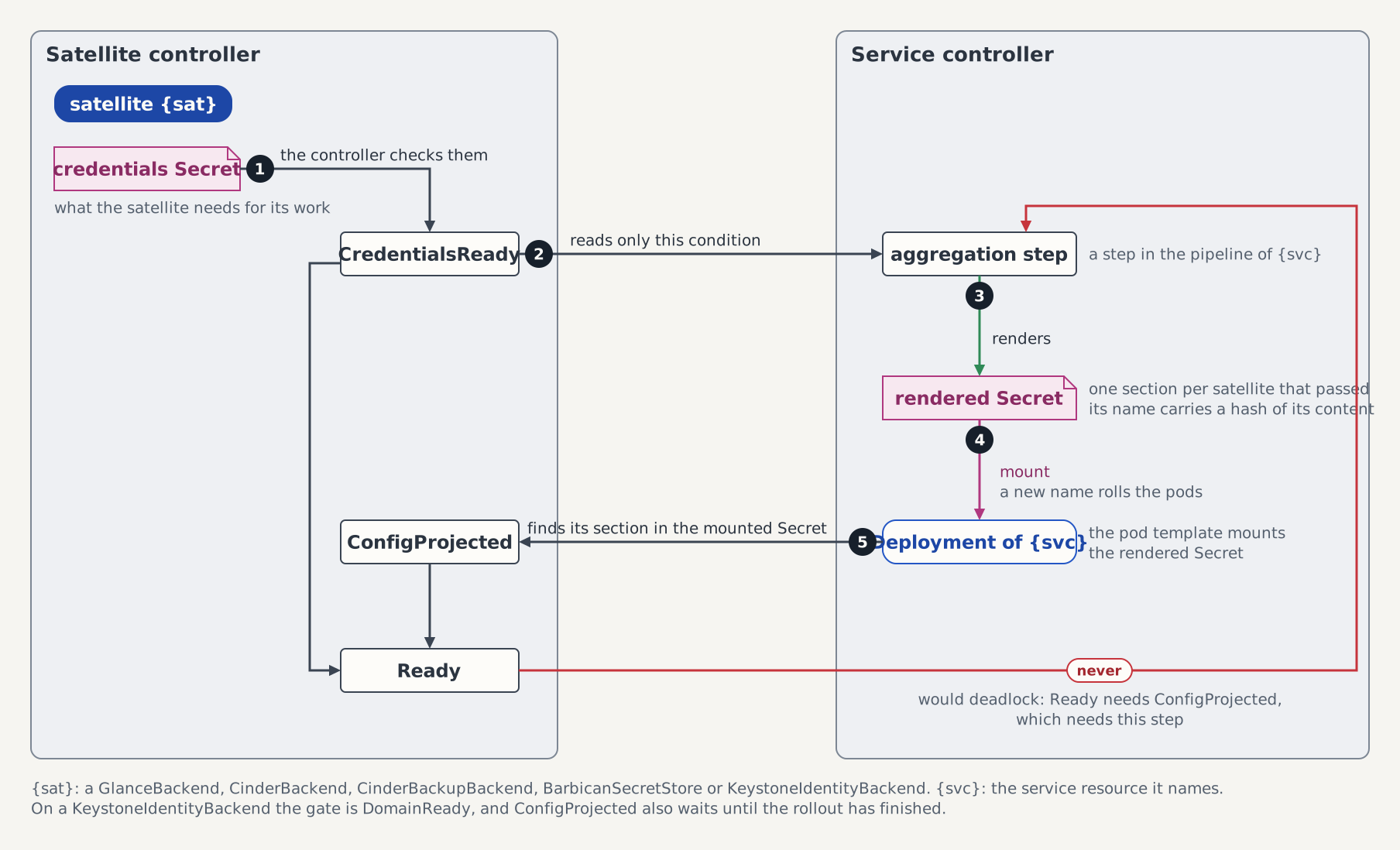
- The satellite controller resolves the parent the satellite names, checks what the satellite needs, and sets the gate condition on the satellite:
CredentialsReady. - The aggregation step in the parent's pipeline lists the satellites that name the parent and reads that one condition of each. A satellite whose gate is not
Trueis skipped, and the pipeline goes on. - The step renders one section per satellite that passed into a Secret whose name carries a hash of its content.
- The pod template of the parent's Deployment mounts that Secret. A new Secret name is a new pod template, so the pods roll.
- The satellite controller reads the pod template, follows the volume to the Secret, and finds its own section there. It sets
ConfigProjected, and the aggregateReadyfollows once both conditions areTrue.
The step never reads a satellite's Ready. Ready needs ConfigProjected, and ConfigProjected turns True only after the step has projected the satellite, so a step that waited for Ready would wait for itself. Another controller may gate on Ready: the c5c3-operator does, for the websso choices it projects onto Horizon.
No status field of the parent carries the projection. The Deployment and the Secret are the evidence, and while ConfigProjected is False the satellite controller polls for it every 15 seconds, every 30 on a BarbicanSecretStore.
| Kind | Gate the step reads | What the gate needs | Rendered into | Workload | Evidence for ConfigProjected |
|---|---|---|---|---|---|
GlanceBackend | CredentialsReady | The Secret of spec.s3.credentialsSecretRef with both S3 keys | Key backends.conf of the Secret {glance}-backends-{hash} | Deployment {glance} | The header [{name}] in the mounted Secret |
CinderBackend | CredentialsReady | Nothing for NFS, where it is True/CredentialsNotRequired once the parent resolves; the Secret of spec.rbd.keySecretRef carrying a non-empty base64 userKey for RBD | The Secret {cinder}-backend-{name}-{hash}, one per backend | Deployment {cinder}-volume-{name}, one per backend | The header [{name}] in the key backend.conf |
CinderBackupBackend | CredentialsReady | Nothing for NFS, where it is True/CredentialsNotRequired once the parent resolves; the Secret of spec.rbd.keySecretRef carrying a non-empty base64 userKey for RBD | Key backup.conf of a Secret named after the backend | Deployment {cinder}-backup | The name of the Secret its backup volume references. The content is not read |
BarbicanSecretStore | CredentialsReady | The credentials Secret and a login the OpenBao server accepts. A store the operator provisions sets ProvisioningReady first, and the step does not read that | The section [secretstore:{name}] of barbican.conf in the Secret {barbican}-config-{hash} | Deployment {barbican} | The section header in the mounted Secret |
KeystoneIdentityBackend | DomainReady | The Keystone API answering, the admin password Secret, and the domain created or adopted | keystone.{domain}.conf in the Secret {keystone}-domains-{hash}; the OIDC and SAML documents in {keystone}-federation-{hash} | Deployment {keystone} | The data key in the mounted Secret, and the rollout finished |
KeystoneIdentityBackend is the exception by design. Its gate needs the Keystone API, so the parent's Deployment already runs when step 1 passes, and its ConfigProjected has a third state, WaitingForRollout.
ResolveParentChildren
func ResolveParentChildren(
    ctx context.Context,
    p ResolveParams,
) (children client.Client, result ctrl.Result, err error)
Returns the client a satellite's observations belong on, after reading its parent and resolving the cluster that parent targets.
Behavior:
ResolveParams.Clientreads the parent on the management cluster intoParentatParentKey;ParentKindnames the kind in the error text.TargetClusterRefthen reads the ref offParent, andResolverlooks the cluster up. A nil resolver keeps everything local. Conditions land in the satellite's ownConditionsslice atGeneration.- A non-
NotFoundGet on the parent returns a nil client andfetching parent <kind> <key>: <cause>. - A parent that does not exist sets
GateConditionTypetoFalsewithWaitingForParentReasonandWaitingForParentMessage, and requeues afterRequeueAfter. There is no fallback to the local client: the parent'stargetClusterRefis what decides which cluster the satellite's credentials and observations belong on, so a local guess would read the wrong cluster for the whole window between a GitOps apply landing the satellite and the same apply landing its parent. - The projection demotion is opt-in. With
ProjectionConditionTypeset, a missing parent also flips that condition toFalseunderProjectionDemotionReasonandProjectionDemotionMessage, but only where it currently standsTrue. An empty type demotes nothing, and an absent or alreadyFalsecondition is left untouched, so a satellite that has not converged yet keeps the condition absent. - A target cluster that does not resolve sets
GateConditionTypetoFalseunder the sharedmulticluster.TargetClusterUnavailablereason with the resolver's error text, and requeues afterRequeueAfter. - On success the children client is non-nil and the result is the zero
ctrl.Result. A nil children client means the caller returnsresultanderras they are.
SecretNameForVolume
func SecretNameForVolume(spec *corev1.PodSpec, volumeName string) stringPure function. Returns the name of the Secret a pod-spec volume mounts.
Behavior:
- Returns
""for a nilspecand for a volume name absent fromspec.Volumes. - The scan stops at the first name match. A ConfigMap- or emptyDir-backed volume of the searched name yields
""and the walk does not continue to the next volume that happens to carry a Secret.
SectionPresent
func SectionPresent(rendered []byte, header string) boolPure function. Reports whether rendered carries header as a whole line.
Behavior:
- The token is bounded on the left by the start of the data or a newline, and on the right by a newline (LF or CR) or the end of the data.
- The boundary check rules out substring collisions: a section
[name2]does not satisfy a lookup for[name], and a header appearing inside an option value does not either. - The scan resumes past a hit the boundary check rejected, so a later whole-line occurrence still matches.
SectionProjected
func SectionProjected(
    ctx context.Context,
    p ObserveParams,
) (bool, error)
Reports whether a satellite's section reached the config file the parent's Deployment mounts.
Behavior:
ObserveParams.Childrenreads the Deployment atDeploymentKey, then the Secret that the pod volume namedVolumeNamemounts, in the Deployment's namespace.SectionHeader(for example[store]) is looked up in that Secret'sDataKey.- A
NotFoundanywhere on the chain is(false, nil): a missing Deployment, a missing or non-Secret volume, a missing Secret and an absent data key all read as an authoritative "not projected yet". - A non-
NotFoundGet failure is wrapped asfetching Deployment <key>: <cause>orfetching projection Secret <key>: <cause>. - Consumers keep their own parent re-read ahead of this call, and their
observeConfigProjectedwrappers own the condition reasons, the messages and the requeue intervals.
Collect
func Collect[T any, PT interface {
    *T
    client.Object
}](p CollectParams[T, PT]) Collection[T, PT]
Turns a parent's list of attached satellites into one pass's view of them.
Behavior:
CollectParams.Itemsis the caller's indexed List result, in any order. A List type holding values, asGlanceBackendList.Itemsdoes, becomes a pointer slice by appending&list.Items[i]over the index.Gatedecides which items may be projected;GlanceBackendpassesCredentialsReady == True. A nil gate passes everything.IsDefaultmarks the parent's default, and a nil function means the parent has no default rule.Collection.Attachedholds the items carrying no deletion timestamp, sorted by name.Gatedis the subset that passes the gate andDefaultCandidatesthe gated itemsIsDefaultmarks, both in that same order.Collection.Validreports whether the default rule holds: no rule at all, or one gated candidate. It is a decision, and the parent stamps its own condition type with its own reason and message from it.- A deleting satellite drops out here, so the pass de-projects it without waiting for the object to go.
- Sorting by name is what keeps the rendered config, and with it its content hash, stable across passes.
- The function returns no error and never touches the API. Everything it needs is on the objects the caller listed, and the pointers it hands back alias them.
Package: secrets
Manages External Secrets Operator resources and Kubernetes Secrets for CobaltCore operators. Uses typed structs from github.com/external-secrets/external-secrets.
WaitForExternalSecret
func WaitForExternalSecret(
    ctx context.Context,
    c client.Client,
    key client.ObjectKey,
) (exists, ready bool, err error)
Checks whether the ExternalSecret identified by key exists and has a Ready condition with status True (the ESO ExternalSecretReady condition type).
Returns (tri-state):
(false, false, nil)— the ExternalSecret was not found.(true, false, nil)— it exists but has not synced yet (noReady=True).(true, true, nil)— it exists and is Ready.(false, false, err)— an unexpected client failure.
Behavior:
- This is a point-in-time check, not a blocking wait. Reconcilers should call it on each reconciliation loop and requeue while
readyisfalse. - The separate
existsreturn lets callers surface a clearer status — "ExternalSecret not found yet" versus "waiting for ESO to sync" — instead of collapsing both into a single not-ready signal. - Uses the ESO
ExternalSecretReadycondition type constant, not a raw string.
IsSecretReady
func IsSecretReady(
    ctx context.Context,
    c client.Client,
    key client.ObjectKey,
    expectedKeys ...string,
) (bool, error)
Checks whether a Kubernetes Secret exists at the given key and, when expectedKeys are provided, verifies that all specified keys are present in the Secret's .Data field.
Returns: (true, nil) if the Secret exists and contains all expected keys; (false, nil) if not found or missing expected keys; (false, error) on unexpected API failures.
Behavior:
- A
NotFounderror is treated as a normal condition ((false, nil)), not a failure. - When no
expectedKeysare provided, only checks for Secret existence. - When
expectedKeysare provided, returns(false, nil)if any key is absent fromSecret.Data.
GetSecretValue
func GetSecretValue(
    ctx context.Context,
    c client.Client,
    key client.ObjectKey,
    dataKey string,
) (string, error)
Retrieves and decodes the value of a specific data key from a Secret.
Parameters:
| Name | Type | Description |
|---|---|---|
key | client.ObjectKey | Namespace and name of the Secret |
dataKey | string | Key within Secret.Data to retrieve |
Returns: The decoded string value, or an error if the Secret or key is not found.
Error conditions:
| Condition | Error |
|---|---|
| Secret does not exist | Wrapped API server error |
Key not in Secret.Data | Wraps ErrKeyNotFound: key not found in Secret: key "<dataKey>" in Secret <namespace>/<name> — test with errors.Is(err, secrets.ErrKeyNotFound) |
EnsurePushSecret
func EnsurePushSecret(
    ctx context.Context,
    c client.Client,
    scheme *runtime.Scheme,
    owner client.Object,
    ps *esov1alpha1.PushSecret,
) error
Creates or updates a PushSecret CR with a controller owner reference.
Behavior:
- Applies the desired PushSecret via
apply.EnsureObject(Server-Side Apply). The field manager owns only the fields the builder sets, so the server defaults onupdatePolicyandrefreshIntervalare preserved and a converged PushSecret is not rewritten — ESO is not woken to re-push an unchanged credential. - Uses the ESO
v1alpha1PushSecret API (unstable — see External CRD Dependencies).
Per-CR secret store selection
These helpers back the optional per-CR spec.secretStoreRef: each CR routes its ExternalSecrets and PushSecrets through the store it selects (a cluster-scoped ClusterSecretStore, default openbao-cluster-store, or a namespaced SecretStore), while the IsClusterSecretStoreReady / OpenBaoClusterStoreName primitives above remain.
EffectiveStoreRef(ref *commonv1.SecretStoreRefSpec) commonv1.SecretStoreRefSpec— resolves a nil or empty-kind ref to the shared cluster store{ClusterSecretStore, openbao-cluster-store}, so a CR that omits the field behaves as before.IsStoreRefReady(ctx, c, ref commonv1.SecretStoreRefSpec, namespace string) (bool, error)— reports store readiness, dispatching on kind: a cluster store is looked up by name, a namespaced store innamespace; an unknown kind returns an error.IsSecretStoreReady(ctx, c, name, namespace string) (bool, error)— the namespaced twin ofIsClusterSecretStoreReady, checking aSecretStore'sReadycondition.GateStoreReady(ctx, c, ref, namespace string, namespaceScoped bool, conds *[]metav1.Condition, generation int64, conditionType string) (bool, error)— store-ref-aware readiness gate; on a not-ready store it sets aSecretStoreNotReadycondition whose message names the store kind and name ("%s %q is not ready; upstream secret backend unreachable") and returns(false, nil). WithnamespaceScopedset, a ref of kindClusterSecretStoreis refused without any client call: the condition gets reasonReasonClusterSecretStoreUnsupported(ClusterSecretStoreUnsupported) and the message"ClusterSecretStore %q cannot be read by a namespace-scoped operator; set spec.secretStoreRef to a SecretStore in namespace %q", and the gate returns(false, nil).AddStoreWatches(b *mcbuilder.Builder, scheme *runtime.Scheme, targets multicluster.TargetClusterFunc, namespaceScoped bool, c client.Reader, mapper func(client.Reader, commonv1.SecretStoreRefKind) handler.MapFunc) (*mcbuilder.Builder, error)— adds themulticluster.AddInputWatchlegs for the stores a CR can select:ClusterSecretStoreunlessnamespaceScoped, thenSecretStore, each mapped throughmapper(c, kind). A nilmapperreturns the errorsecrets: store watch mapper must not be nil; anAddInputWatcherror (resolving input kind for remote watch: …) is returned unchanged. Both return a nil builder.ESOSecretStoreRef(ref commonv1.SecretStoreRefSpec) esov1.SecretStoreRef— builds the ESO ExternalSecret store ref from a resolved store reference.PushSecretStoreRefs(ref commonv1.SecretStoreRefSpec) []esov1alpha1.PushSecretStoreRef— builds the single-element ESO PushSecret store-ref slice from a resolved store reference.
Package: tls
Manages TLS certificates and secrets for CobaltCore operators. Uses typed structs from github.com/cert-manager/cert-manager/pkg/apis/certmanager/v1.
EnsureCertificate
func EnsureCertificate(
    ctx context.Context,
    c client.Client,
    scheme *runtime.Scheme,
    owner client.Object,
    cert *certmanagerv1.Certificate,
) (bool, error)
Creates or updates a cert-manager Certificate CR.
Returns: (true, nil) when the Certificate has a Ready condition with status True; (false, nil) when it exists but is not yet ready; (false, error) on failure.
Behavior:
- On create: sets controller owner reference, creates the resource, returns
(false, nil). - On update: overwrites
existing.Specwith the provided spec. - Readiness is determined by the package-internal
isCertificateReadyhelper on the existing resource. - cert-manager creates a Secret with the TLS certificate once the Certificate is ready.
Cross-Package Dependencies
These internal/common packages are independent of each other; reconcilers compose them directly (for example a Keystone sub-reconciler calls job.RunJob and database.EnsureDatabase side by side).
Reconciler Integration Pattern
A reconciler calls these packages from the steps of its pipeline. The figure shows the pipeline of the Keystone operator, and the table names the functions of this page each of its steps calls.
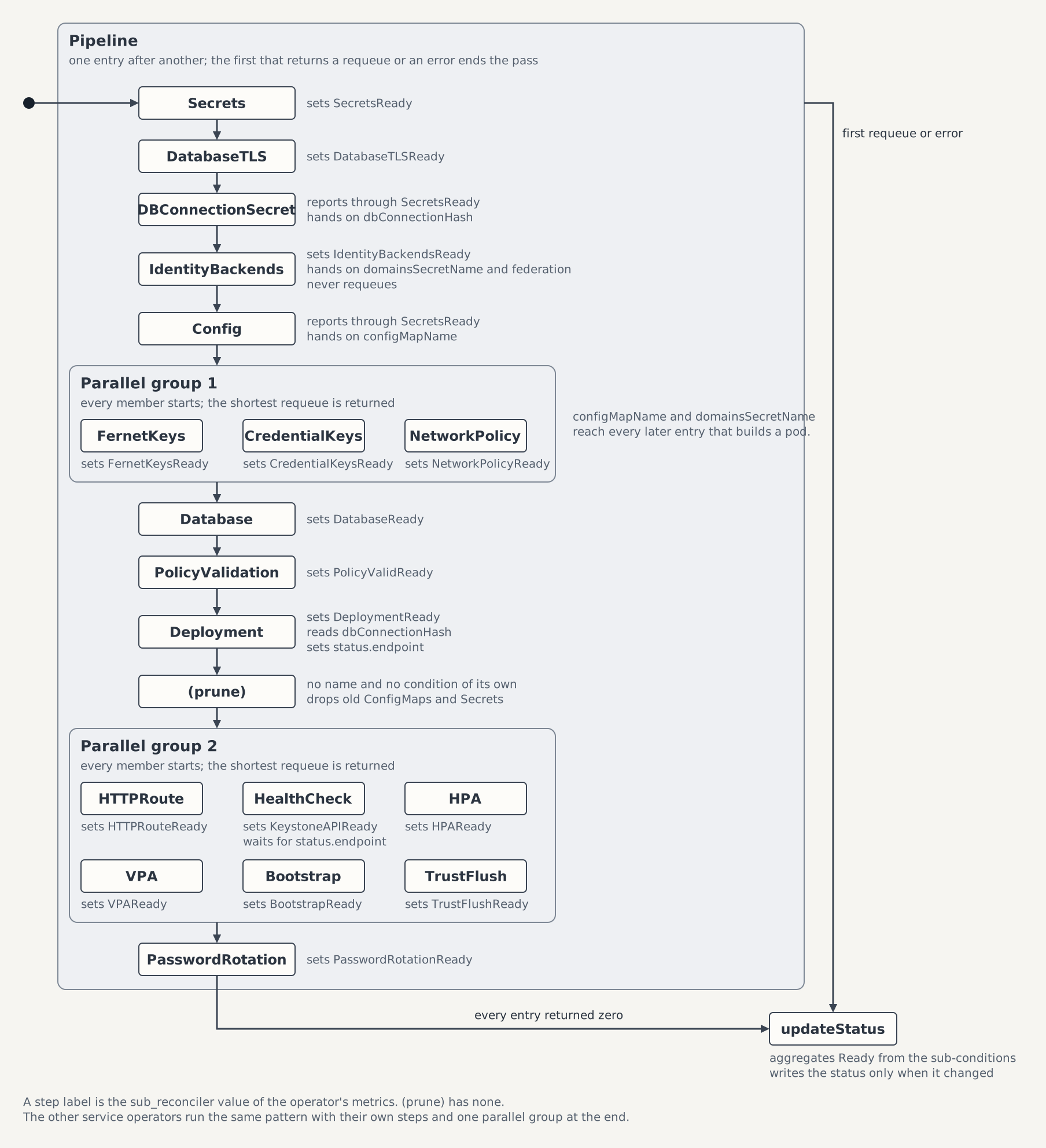
| Step | Functions of this page it calls |
|---|---|
DatabaseTLS | tls.EnsureCertificate |
IdentityBackends | secrets.GetSecretValue, satellite.SecretNameForVolume |
Config | policy.LoadPolicyFromConfigMap, config.CreateImmutableConfigMap |
FernetKeys, CredentialKeys | config.CreateImmutableConfigMap, job.EnsureCronJob, secrets.EnsurePushSecret |
PolicyValidation | job.RunJob |
Deployment | deployment.EnsureDeployment, deployment.EnsureService |
(prune) | config.PruneImmutableConfigMaps |
Bootstrap | secrets.GetSecretValue |
TrustFlush | job.EnsureCronJob |
PasswordRotation | config.CreateImmutableConfigMap, config.PruneImmutableConfigMaps, job.EnsureCronJob, secrets.EnsurePushSecret |
The steps the table leaves out call shared flows this page does not describe, such as database.ReconcileProvision, database.ReconcileSyncJobs and deployment.ReconcileHPA. A step returns a ctrl.Result and an error. The pipeline moves on when the result is zero and the error is nil; otherwise the pass ends, and the status is still written.