How-to: Enable Keystone Database TLS/mTLS
This guide walks an operator through opting a control plane's Keystone into encrypted, mutually-authenticated connections to MariaDB/MaxScale. On a ControlPlane deployment the knob lives on the ControlPlane CR (spec.infrastructure.database.tls); the c5c3-operator projects the whole database block — including tls — onto the projected controlplane-keystone child. When enabled, the keystone-operator provisions a cert-manager Certificate from the shared OpenStack DB CA, mounts the resulting keypair into every Keystone workload that opens a database connection, and appends the ssl_* parameters to the database DSN so the live transport is TLS-protected.
For the authoritative field reference, see DatabaseTLSSpec in the Keystone CRD reference and InfrastructureSpec in the ControlPlane CRD reference. For the underlying MariaDB and CA issuer manifests, see OpenStack DB CA Issuer and MariaDB Galera Cluster.
Prerequisites
Devstack
This guide is written against the Quick Start (ControlPlane) devstack. Stand it up first:
KIND_HOST_PORT=8443 WITH_CONTROLPLANE=true make deploy-infraFollow that tutorial through to its final Verify step, so a ControlPlane CR named controlplane is Ready in the openstack namespace and its projected controlplane-keystone Keystone child is running. Every resource name in the examples below is one that devstack produces.
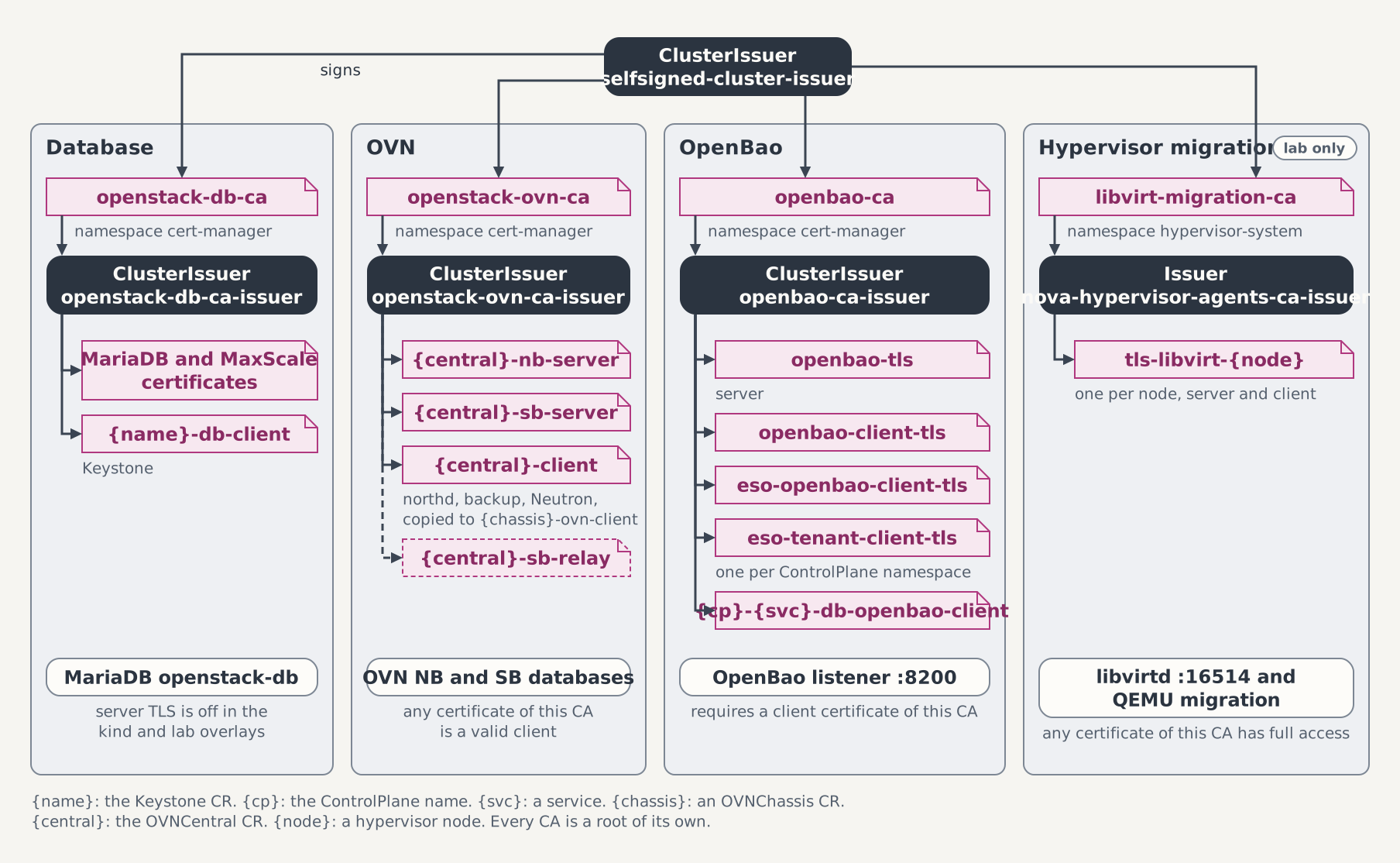
The certificates of this guide belong to the Database trust domain of the figure. {name} is controlplane-keystone here.
cert-manager installed. The chart from
deploy/flux-system/releases/cert-manager.yamlprovides thecert-manager.io/v1CRDs (Certificate,Issuer,ClusterIssuer). Confirm the controller is healthy:bashkubectl -n cert-manager get podsopenstack-db-ca-issuerClusterIssuer Ready. The dedicated DB CA is declared indeploy/flux-system/infrastructure/db-ca-issuer.yaml.hack/deploy-infra.shapplies it in Phase 2. Verify:bashkubectl get clusterissuer openstack-db-ca-issuer \ -o jsonpath='{.status.conditions[?(@.type=="Ready")].status}'Expected:
True.A MariaDB that offers server-side TLS. Client-side DB TLS only works against a server that speaks it. On the managed ControlPlane devstack the c5c3-operator provisions the
openstack-dbMariaDB from a minimal spec and leaves server-side TLS/issuerRefs unset — DB-server hardening is a platform-team concern outside the aggregate's knowledge (see the DECISION onreconcileInfrastructureinoperators/c5c3/internal/controller/reconcile_infrastructure.go). So before enabling client DB TLS on a ControlPlane, run a MariaDB withspec.tls.enabled=true(and, for the plaintext-rejection check below,required=true) — either harden the managed MariaDB out-of-band or pointspec.infrastructure.databaseat a brownfield MariaDB that already enables TLS via the sameopenstack-db-ca-issuer. Confirm the cluster is healthy:bashkubectl -n openstack get mariadb openstack-dbExpected:
STATUS=Ready.Do not enable
verify-fullagainst a plaintext MariaDBEnabling
verify-fullclient TLS against a MariaDB that offers no server TLS breaks the connection — the child Keystone reportsDatabaseReady=False. The kind overlay of the Quick Start devstacks turns server TLS off onopenstack-db(deploy/kind/infrastructure/kustomization.yaml); the production manifestdeploy/flux-system/infrastructure/mariadb.yamlsetsspec.tls.enabled=trueandrequired=true. The standalone flow at the end of this guide needs a TLS-enabled MariaDB as well.keystone-operator running. Either via the Helm release in
deploy/flux-system/releases/keystone-operator.yamlor a locally built image deployed withhack/ci-deploy-operator.sh. The operator's RBAC must include thecert-manager.io/certificatesrule; the chart's ClusterRole carries it by default.The
controlplaneControlPlane CR you own. Thetlsblock is an optional pointer onspec.infrastructure.database(anilvalue preserves the previous plaintext behavior), and it is not frozen by the ControlPlane immutability webhook, so flipping it on is a no-mutation patch on a live control plane.
Steps
1. Patch the ControlPlane CR with a spec.infrastructure.database.tls block
Set the tls block on the ControlPlane CR's shared database, not on the projected Keystone child. The reconciler deep-copies the whole spec.infrastructure.database block — tls included — onto controlplane-keystone on every reconcile. The minimal TLS-enabled block uses mode: verify-full (the strongest mode — verifies the server certificate chain AND that the server hostname matches the certificate identity). In managed mode, the keystone-operator provisions the Secret controlplane-keystone-db-client carrying ca.crt, tls.crt, and tls.key, so a single reference satisfies both caBundleSecretRef and clientCertSecretRef:
spec:
  infrastructure:
    database:
      clusterRef:
        name: openstack-db
      database: keystone
      secretRef:
        name: keystone-db
      tls:
        mode: verify-full
        caBundleSecretRef:
          name: controlplane-keystone-db-client
        clientCertSecretRef:
          name: controlplane-keystone-db-client
Apply via patch:
kubectl -n openstack patch controlplane controlplane --type merge --patch '
spec:
  infrastructure:
    database:
      tls:
        mode: verify-full
        caBundleSecretRef:
          name: controlplane-keystone-db-client
        clientCertSecretRef:
          name: controlplane-keystone-db-client
'
Do not patch spec.database.tls on the projected child
Setting spec.database.tls on the controlplane-keystone Keystone CR directly is reverted on the next reconcile: the c5c3-operator re-asserts the entirespec.database block from spec.infrastructure.database, so any tls you write on the child that is not present on the ControlPlane CR is deep-copied away. Always set tls on the ControlPlane CR.
The keystone-operator's mutating webhook does not materialize the tls block on the child when it is absent — TLS is strictly opt-in. When tls is present with an empty mode, the webhook materializes mode: "require" as the documented baseline (a present block means "on"). Set mode: disabled to keep the block and its certificate references while turning TLS off.
2. Wait for the operator to issue the client Certificate
reconcileDatabaseTLS on the child creates a cert-manager Certificate named controlplane-keystone-db-client with issuerRef = openstack-db-ca-issuer (ClusterIssuer). cert-manager writes the resulting keypair into a Secret of the same name. The reconciler reports progress via the DatabaseTLSReady status condition on the child:
| Condition reason | Meaning |
|---|---|
NotRequired | tls is nil, its mode is empty, or its mode is disabled — plaintext connection. |
CertificatePending | Managed mode; cert-manager has not yet issued the leaf. |
CertificateIssued | Managed mode; client keypair ready and mounted. |
ExternallyManaged | Brownfield mode (spec.infrastructure.database.host set) — the client keypair must be supplied out-of-band. |
Verification
1. DatabaseTLSReady=True with reason=CertificateIssued
kubectl -n openstack get keystone controlplane-keystone \
  -o jsonpath='{range .status.conditions[?(@.type=="DatabaseTLSReady")]}{.status} {.reason} {.message}{"\n"}{end}'
Expected: True CertificateIssued Database client Certificate "controlplane-keystone-db-client" issued into Secret "controlplane-keystone-db-client".
The Secret should carry the three keys cert-manager writes:
kubectl -n openstack get secret controlplane-keystone-db-client \
  -o go-template='{{range $k, $_ := .data}}{{$k}}{{"\n"}}{{end}}'
Expected: ca.crt, tls.crt, tls.key.
2. The live connection is encrypted (Ssl_cipher non-empty)
Exec into a running Keystone Pod and ask MariaDB to report the cipher in use for this very session. The Keystone container has pymysql installed (it is the MySQL driver pinned by openstack/requirements) and the db-tls volume mounted at /etc/keystone/db-tls/, so we can parse the same OS_DATABASE__CONNECTION DSN the API uses and dial directly:
POD=$(kubectl -n openstack get pods \
  -l app.kubernetes.io/instance=controlplane-keystone,app.kubernetes.io/name=keystone \
  -o jsonpath='{.items[0].metadata.name}')

kubectl -n openstack exec "$POD" -c keystone -- python3 -c '
import os, ssl, pymysql
from urllib.parse import urlparse, parse_qs
url = urlparse(os.environ["OS_DATABASE__CONNECTION"])
qs = parse_qs(url.query)
ssl_kwargs = {}
if "ssl_ca" in qs:    ssl_kwargs["ca"] = qs["ssl_ca"][0]
if "ssl_cert" in qs:  ssl_kwargs["cert"] = qs["ssl_cert"][0]
if "ssl_key" in qs:   ssl_kwargs["key"] = qs["ssl_key"][0]
if ssl_kwargs:
    ssl_kwargs["verify_mode"] = ssl.CERT_REQUIRED if qs.get("ssl_verify_cert", ["false"])[0].lower() == "true" else ssl.CERT_NONE
    ssl_kwargs["check_hostname"] = qs.get("ssl_verify_identity", ["false"])[0].lower() == "true"
kw = dict(host=url.hostname, port=url.port or 3306,
          user=url.username, password=url.password,
          database=url.path.lstrip("/"))
if ssl_kwargs: kw["ssl"] = ssl_kwargs
conn = pymysql.connect(**kw)
with conn.cursor() as cur:
    cur.execute("SHOW STATUS LIKE %s", ("Ssl_cipher",))
    row = cur.fetchone()
    print(row[1] if row else "")
conn.close()
'
Expected: a non-empty TLS cipher name (e.g., TLS_AES_256_GCM_SHA384). An empty value means the live connection is not encrypted — re-check DatabaseTLSReady and confirm the MariaDB CR has spec.tls.required=true (see prerequisite 3).
3. Plaintext connections are rejected by MariaDB
This check requires the MariaDB from prerequisite 3 to set spec.tls.required=true, so any connection that does not negotiate TLS is rejected at the transport layer before authentication. The probe/probe credentials below are bogus — they are never checked, because the server rejects the plaintext handshake before it reaches authentication. Probe from inside the Keystone Pod by omitting the ssl= kwarg:
kubectl -n openstack exec "$POD" -c keystone -- python3 -c '
import pymysql
try:
    pymysql.connect(host="openstack-db.openstack.svc", port=3306,
                    user="probe", password="probe",
                    database="keystone", connect_timeout=10)
    print("PLAINTEXT_ACCEPTED")
except Exception as exc:
    print("PLAINTEXT_REJECTED:", type(exc).__name__, exc)
'
Expected: PLAINTEXT_REJECTED: … from the server's TLS-required enforcement.
Disabling
WARNING — data-plane outage if you skip the MariaDB step. If the MariaDB serving the control plane ships with
spec.tls.required=true, disabling TLS on the Keystone side only will brick the deployment: MariaDB rejects every plaintext handshake at the transport layer, so Keystone cannot connect to the database. Before applying the ControlPlane patch below, setspec.tls.required=false(or fully disable TLS) on the MariaDB CR — updating MariaDB is out of scope of this guide but is a prerequisite for a working plaintext deployment.
To revert to plaintext without uninstalling the operator, drop the tls block from the ControlPlane CR. The reconciler then deep-copies a nil tls onto the child and the keystone-operator's mutating webhook never re-materializes it, so the absence is persistent:
kubectl -n openstack patch controlplane controlplane --type json --patch '[
  {"op": "remove", "path": "/spec/infrastructure/database/tls"}
]'
The child's DatabaseTLSReady condition transitions to True with reason=NotRequired, the operator deletes the managed controlplane-keystone-db-client Certificate (so cert-manager stops renewing it), cert-manager then garbage-collects the issued Secret via the Certificate owner-reference cascade, and subsequent connections fall back to plaintext TCP — but only succeed if MariaDB's spec.tls.required is also turned off (see warning above).
Standalone Keystone, without a ControlPlane
On the Quick Start / Quick Start (Extended) devstacks a standalone Keystone CR named keystone runs with no ControlPlane projecting it, and the shared openstack-db MariaDB of the kind overlay runs without server TLS. Enable spec.tls on it first, by removing the tls patch from the kind overlay or by using a MariaDB that enables TLS through openstack-db-ca-issuer. Then set the tls block on the Keystone CR's own spec.database:
kubectl -n openstack patch keystone keystone --type merge --patch '
spec:
  database:
    tls:
      mode: verify-full
      caBundleSecretRef:
        name: keystone-db-client
      clientCertSecretRef:
        name: keystone-db-client
'
The names map as follows; substitute them in every command above:
| ControlPlane devstack | Standalone devstack |
|---|---|
CR controlplane (patch spec.infrastructure.database.tls) | CR keystone (patch spec.database.tls) |
child controlplane-keystone | CR keystone |
Certificate / Secret controlplane-keystone-db-client | keystone-db-client |
pod selector app.kubernetes.io/instance=controlplane-keystone | app.kubernetes.io/instance=keystone |
To disable, drop the tls block from the Keystone CR:
kubectl -n openstack patch keystone keystone --type json --patch '[
  {"op": "remove", "path": "/spec/database/tls"}
]'
The tests/e2e/keystone/database-tls/ chainsaw suite pins the keystone-operator mechanics through this standalone flow.
See also
- Keystone CRD — DatabaseTLSSpec — authoritative field reference.
- Keystone CRD — Mode → connect-args mapping — DSN parameters per mode.
- ControlPlane CRD — InfrastructureSpec — the
spec.infrastructure.databaseblock the reconciler projects. - Infrastructure Manifests — OpenStack DB CA Issuer — CA keypair and ClusterIssuer.
- Infrastructure Manifests — MariaDB Galera Cluster — server-side TLS configuration.
tests/e2e/keystone/database-tls/— chainsaw E2E suite.
Tested by
The canonical check pins all three verifications above — DatabaseTLSReady=True, the encrypted live connection, and the plaintext rejection — against a standalone Keystone CR on a cluster whose openstack-db sets spec.tls.enabled=true. Where the overlay turns TLS off, as on the kind devstack, the suite prints SKIP and exits 0.
chainsaw test --test-dir tests/e2e/keystone/database-tlsThe suite is also listed in the E2E inventory of the Keystone CRD reference.