KeystoneService CRD API Reference
Reference documentation for the KeystoneService Custom Resource Definition. One CR registers one service against the identity plane of a ControlPlane via spec.controlPlaneRef, and carries up to two independent blocks:
spec.catalog— the service's catalog entry: a service row (type and name) plus at most one endpoint row per interface.spec.account— the service's Keystone account: a user with an operator-generated, OpenBao-backed, rotatable password, its project, and the roles bound to it. The credentials are delivered as a Secret in the CR's own namespace.
At least one block must be set. The CR is mode-independent: the same declaration works against a Managed and an External (brownfield) ControlPlane, because the operator projects K-ORC resources instead of talking to the identity API itself.
A KeystoneService may live in a namespace the ControlPlane does not own, which is what lets a team register a service the control plane does not manage. That crosses a privilege boundary, so the ControlPlane has to consent: see Namespace consent. For the control loop, the collision probes, and the teardown ordering, see KeystoneService Reconciler Architecture.
API Group and Version
| Field | Value |
|---|---|
| Group | c5c3.io |
| Version | v1alpha1 |
| Kind | KeystoneService |
| List Kind | KeystoneServiceList |
| Scope | Namespaced |
Scheme registration: the init() function in keystoneservice_types.go registers both Kinds with the shared SchemeBuilder, so AddToScheme covers ControlPlane, CredentialRotation, SecretAggregate, and KeystoneService alike.
kubectl get keystoneservice prints four columns:
| Column | Source |
|---|---|
Ready | .status.conditions[?(@.type=='Ready')].status |
ControlPlane | .spec.controlPlaneRef.name |
Type | .spec.catalog.serviceType |
Age | .metadata.creationTimestamp |
Example
A registration in the ControlPlane's own namespace declaring both blocks. The user name and the catalog service name are left to default to metadata.name; controlPlaneRef.namespace is left unset, so the CR resolves the plane in its own namespace.
apiVersion: c5c3.io/v1alpha1
kind: KeystoneService
metadata:
  name: workflow
  namespace: openstack
spec:
  controlPlaneRef:
    name: cp
  catalog:
    serviceType: workflow
    endpoints:
    - interface: public
      url: "https://workflow-api.example.com:8989/v2"
    - interface: internal
      url: "http://workflow-api.openstack.svc.cluster.local:8989/v2"
  account:
    project:
      name: service-workflow
      create: true
    roles:
    - service
This registers a workflow catalog entry with two endpoint rows, creates the project service-workflow and the user workflow in the control plane's admin domain, binds the service role to that user on that project, and materializes the account's credentials into the Secret workflow-credentials in namespace openstack.
Spec
KeystoneServiceSpec
A spec-level CEL rule (has(self.catalog) || has(self.account)) rejects a CR that declares neither block: it describes nothing a reconciler could act on. The rule lives in the schema, so it binds even when the webhook is unavailable.
| Field | Type | Required | Default | Description |
|---|---|---|---|---|
controlPlaneRef | ControlPlaneRefSpec | Yes | — | The ControlPlane whose identity plane this service registers against. |
catalog | KeystoneServiceCatalogSpec | No | — | The catalog entry to register. |
account | KeystoneServiceAccountSpec | No | — | The Keystone account to provision, delivered into this CR's namespace. |
ControlPlaneRefSpec
| Field | Type | Required | Default | Description |
|---|---|---|---|---|
name | string | Yes | — | Name of the ControlPlane CR (MinLength=1). Immutable (CEL transition rule). Every child this CR projects authenticates through the referenced plane's admin credential, so re-pointing a live registration would strand the Keystone user, project, and catalog row it already created on the old plane, owned by nothing. Delete and re-create the CR instead. |
namespace | string | No | the CR's own namespace | Namespace of the ControlPlane CR (RFC-1123 label, ≤ 63). Immutable, enforced by the validating webhook rather than CEL: an empty value means the CR's own namespace, and a CEL rule on a spec field cannot read metadata.namespace to resolve it. Setting an explicit value naming the namespace the CR already resolved to is admitted, since it changes nothing. |
The referenced ControlPlane does not have to exist at admission time. GitOps may apply the registration before the plane; a dangling reference surfaces as ControlPlaneNotFound on every declared block, with Ready=False/NotAllReady, not as an admission error.
KeystoneServiceCatalogSpec
| Field | Type | Required | Default | Description |
|---|---|---|---|---|
serviceType | string | Yes | — | OpenStack service type, e.g. image or compute. Lowercase DNS-1123 label (pattern ^[a-z0-9]([-a-z0-9]*[a-z0-9])?$, ≤ 63) because it is embedded verbatim in the child K-ORC CR names. identity is rejected: that catalog row is ControlPlane-owned in both modes (created in Managed, imported in External). Immutable — see why the identity fields freeze. |
serviceName | string | No | metadata.name | Overrides the advertised catalog service name (pattern ^[^,]+$, ≤ 255, mirroring K-ORC's OpenStackName). The fallback is the CR's own name, not K-ORC's default: K-ORC would advertise the child CR's name, which carries an operator-generated uniqueness suffix. Immutable, compared by effective value — see below. |
adopt | bool | No | false | Consent to take over a pre-existing catalog service row of this type and name. See Collision and adoption. Mutable. |
endpoints | []KeystoneServiceEndpointSpec | No | — | Endpoint rows for this entry, at most one per interface (listType=map keyed on interface, so the API server rejects a duplicate). An entry with no endpoints registers the service row alone. |
KeystoneServiceEndpointSpec
| Field | Type | Required | Description |
|---|---|---|---|
interface | public | internal | admin | Yes | The catalog interface this endpoint is published under. Keys the listType=map list. |
url | string | Yes | The URL registered in the catalog. Pattern ^https?://[^\s/]+, ≤ 1024 bytes, mirroring K-ORC's own EndpointResourceSpec.URL cap so a URL admitted here can never be rejected downstream. |
Registering an endpoint row never connects to it, so the URL may point at a service that is not running yet.
After a url edit, K-ORC resources that call the service keep using the old URL until K-ORC's cached client expires, half the token lifetime after its login. K-ORC has the restart that picks up the new URL at once.
Every endpoint row is registered in the referenced ControlPlane's spec.region, so a client that sets region_name finds it. A row cannot be placed in any other region, and endpoint groups are not expressible: K-ORC has no EndpointGroup kind, an upstream gap tracked as a follow-up on #846.
KeystoneServiceAccountSpec
The CR supplies the two handles this block does not carry itself: metadata.name keys the child resources and the consumer Secret, and the CR's own namespace is the delivery namespace.
| Field | Type | Required | Default | Description |
|---|---|---|---|---|
userName | string | No | metadata.name | The OpenStack user managed in Keystone (pattern ^[^,]+$, ≤ 255, mirroring K-ORC's OpenStackName). The defaulting webhook materializes the fallback onto the stored object. Immutable, compared by effective value. |
domainName | string | No | the ControlPlane's admin domain | The domain the user and project live in (pattern ^[^,]+$, ≤ 255). The fallback resolves to spec.korc.adminCredential.domainName on the referenced plane. Immutable, compared as declared: resolving the fallback needs the referenced ControlPlane, which admission cannot read, so setting an explicit value is rejected even where it names that same domain. |
adopt | bool | No | false | Consent to take over a pre-existing Keystone user of this name, including a password takeover. See Collision and adoption. Mutable. |
project | ServiceAccountProjectSpec | Yes | — | The project the service user is associated with, referenced or created. |
roles | []string | No | — | Role names bound to the user on the project (≤ 32 entries, each ^[^,]+$ and ≤ 255). Each becomes one unmanaged K-ORC Role import (Keystone roles are global, so a role is referenced by name and never created or deleted) plus one managed RoleAssignment. A role that does not exist in Keystone never resolves, and the account holds at AccountReady=False/WaitingForServiceAccounts naming it. |
rotation | ServiceAccountRotationSpec | No | {mode: Manual} | How the account's password is rotated. |
ServiceAccountProjectSpec
Shared with the ControlPlane API. Both leaves are frozen after creation by CEL rules on spec.account.project, because the shared type carries no freeze of its own.
| Field | Type | Required | Default | Description |
|---|---|---|---|---|
name | string | Yes | — | The OpenStack project name (pattern ^[^,]+$, ≤ 255, mirroring K-ORC's KeystoneName). Immutable: re-pointing it would leave the role assignments the registration minted behind on the old project. |
create | bool | No | false | false references a pre-existing project through an unmanaged K-ORC import the operator never creates or deletes. true creates and owns a managed K-ORC Project, gated by the same fail-loudly collision probe as the user. Immutable: a managed/referenced flip would either orphan a project the registration owns or adopt one it does not. |
Project takeover is expressed as create: false, not as adopt. A project that already exists and is wanted is referenced.
ServiceAccountRotationSpec
Shared with the ControlPlane API.
| Field | Type | Required | Default | Description |
|---|---|---|---|---|
mode | Manual | Scheduled | No | Manual | Manual rotates the password only when a CredentialRotation CR requests it. Scheduled is accepted by the schema but the scheduling logic is deferred; the reconciler emits a ScheduledRotationDeferred Normal event when a registration is created with it, so the deferral is never silent. |
To rotate a password on demand, create a CredentialRotation with spec.target: serviceAccountPassword and spec.keystoneService naming this CR in the same namespace. See the ControlPlane CRD reference for that CR's own spec.
Why the identity fields freeze
serviceType, the effective serviceName, the effective userName, domainName, and both project leaves name live Keystone state, so an in-place edit would silently re-shape or strand it. Each is frozen by a CEL transition rule, the validating webhook, or both, and the remedy is always the same: delete and re-create the CR.
Two of them are compared by their effective value, which is stricter than the CEL rule alone can be:
- The catalog service name. A transition rule does not evaluate when the old object left the field unset, so setting an explicit
serviceNameon a registration that relied on themetadata.namefallback would slip past CEL, and that is a catalog rename. - The user name. The effective comparison is what admits the one benign transition: materializing the
metadata.namefallback onto a CR stored before the defaulting webhook existed.
The catalog freeze also protects the collision probe. That probe decides whether a pre-existing row may be taken over, and it runs only while no managed Service child exists. An in-place type or name edit would therefore re-shape the registered row without ever re-probing: an exact match would silently adopt a row the registration does not own, a near match would duplicate one.
adopt stays mutable on both blocks, because flipping it to true is the documented collision remedy. So do the endpoint rows, the roles, and the rotation policy, none of which re-point an existing identity.
Collision and adoption
Neither block ever silently takes over Keystone state it did not create. Before creating a managed child, the reconciler probes for a pre-existing resource with a short-lived unmanaged import, and a match without consent parks the block on a collision condition having changed nothing.
| Block | Probe matches on | Condition when it collides | Consent |
|---|---|---|---|
catalog | service type and effective name | CatalogReady=False/ServiceCollision | catalog.adopt: true |
account (user) | user name in the effective domain | AccountReady=False/ServiceAccountCollision | account.adopt: true |
account (project, create: true) | project name in the effective domain | AccountReady=False/ServiceAccountCollision | set create: false to reference it |
Adoption means ownership. An adopted catalog row or user becomes a managed K-ORC resource, so it is deleted from Keystone when the KeystoneService is deleted, just like one the operator created. Adopt only what the registration should own.
Adopting a user additionally means a password takeover: the operator overwrites the account's password with its generated one and delivers that password in the consumer Secret.
Adoption does not apply the new password on the first pass
With the currently pinned K-ORC, a newly adopted user keeps its pre-existing password even though the registration reports AccountReady=True and the consumer Secret carries the operator's generated one. K-ORC writes a password to Keystone only when the User already records an applied password reference, which an adopted user does not. Rotate the account once with a CredentialRotation to force the first real write. Tracked in #920.
Blind creation is not offered as an alternative. K-ORC's service actuator matches an existing row on name and type, so a managed create silently adopts an exact match anyway, and deleting the CR would then delete a catalog row the operator never created. A near match duplicates the row instead, because Keystone enforces no uniqueness on service names.
The admin identity is never registrable
A registration whose effective user name and domain resolve to the referenced ControlPlane's own admin identity (spec.korc.adminCredential.userName / domainName) is refused with AccountReady=False/ServiceAccountCollision, ahead of the collision probe and regardless of adopt. Provisioning it would take over the admin account, rotate its password into a Secret in this CR's namespace, and delete the admin user from Keystone when the CR is deleted.
The names are compared the way Keystone compares them: its identity tables use a *_general_ci collation that folds case and accents, so Admin, ADMIN, and admín all resolve to the same user as admin.
The remedy depends on which side moved onto the other. When the registration owns nothing yet, delete and re-create it under a name of its own. userName and domainName are immutable, so editing them is rejected. When the registration already owns that user (the plane's admin identity was edited onto it), the ControlPlane is the side that has to move back: deleting the CR now would take the admin user out of Keystone with it. The condition message names whichever applies.
Namespace consent
A KeystoneService can mint a Keystone user with arbitrary roles, so admitting one from any namespace would turn namespace access into cloud admin. Three layers grant consent, in widening order:
- The ControlPlane's own namespace.
- Its dedicated service namespaces, declared through the services' namespace blocks.
- Any other namespace listed in
spec.korc.serviceRegistrations.allowedNamespaceson the ControlPlane.
The first two are implicit: both are already the control plane's, and it provisions a tenant store in each, which is the path a consumer Secret takes. A CR from an unlisted namespace reports NamespaceNotAllowed on every declared block, so Ready reads False/NotAllReady, and it projects nothing.
The figure shows the consent as step 1 of a registration and where each object lands after it. Child Naming and Placement lists the steps.
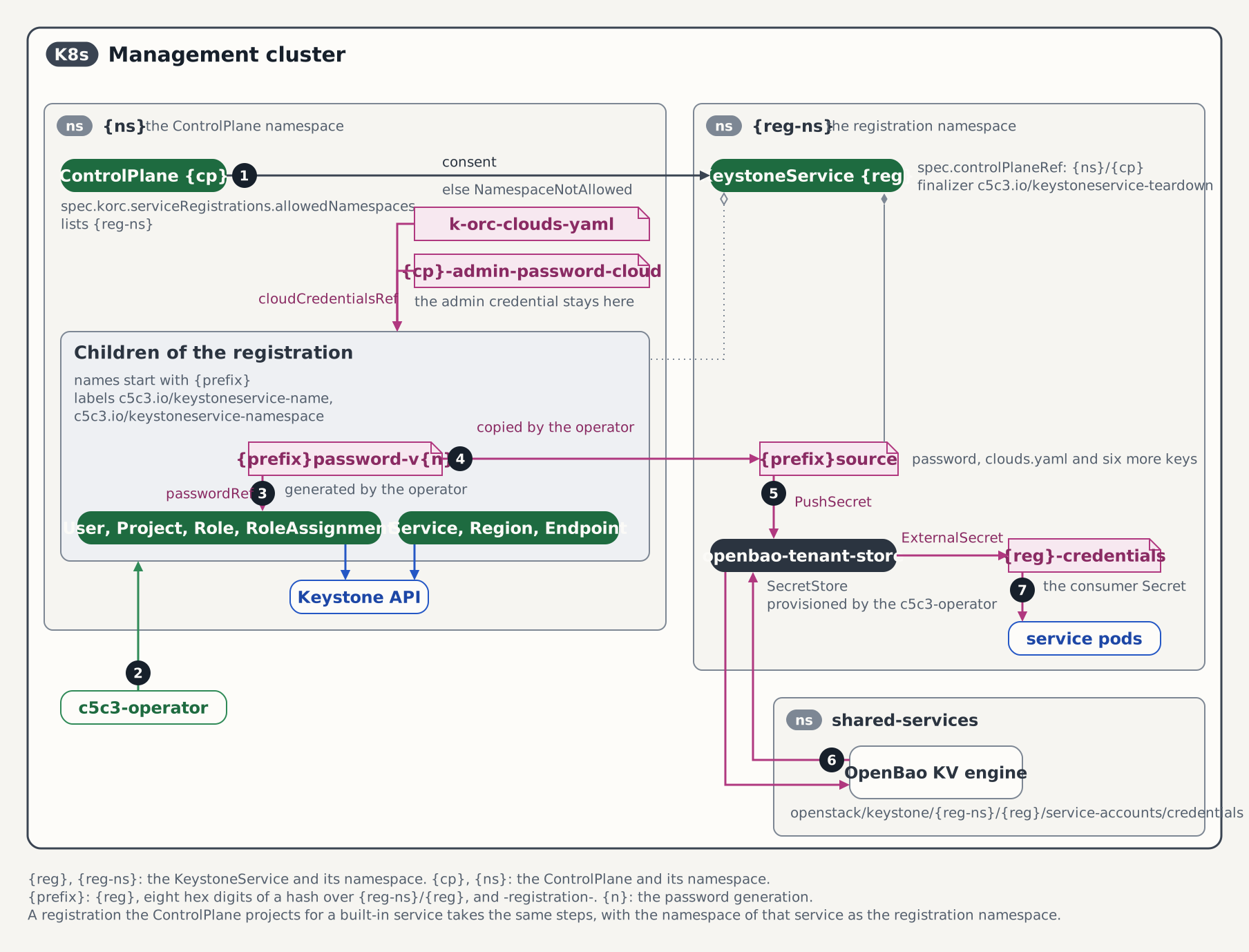
The allowlist is an admission gate, not a revocation tool. Removing a namespace freezes reconciliation of the registrations in it while every Keystone user, catalog row, and delivered Secret already minted stays in place and keeps authenticating. Teardown happens only through deletion of the KeystoneService itself, so an allowlist edit can never destroy credentials a running service depends on.
Role allowlist
A namespace admitted through allowedNamespaces may also have a management-cluster entry in the ControlPlane's spec.namespaceAssignments. Its allowedRoles then limits spec.account.roles of every KeystoneService in that namespace. A role matches only its own case-sensitive name. A role outside the list sets AccountReady=False/RoleNotAllowed and projects nothing for the account, while the catalog block keeps reconciling. The message names the allowed list and the refused roles.
The refusal freezes the account: a role assignment that already exists in Keystone stays, and so does the delivered consumer Secret, until the owner drops the role from spec.account.roles or deletes the CR. A namespace without an entry stays unlimited, and removing the entry lifts the limit again. The ControlPlane's own namespace and its dedicated service namespaces are never bound, and an entry alone never admits a registration. See NamespaceAssignmentSpec.
The Register a Service the ControlPlane Does Not Manage guide walks the flow on the ControlPlane devstack, including what removing a namespace from the allowlist does and does not do.
Consumer Secret contract
A registration with an account block delivers its credentials as a Secret in the KeystoneService's own namespace, whatever namespace the ControlPlane lives in.
| Property | Value |
|---|---|
| Name | <metadata.name>-credentials, also reported in status.account.secretName |
| Namespace | the KeystoneService's own |
| Data keys | clouds.yaml and password |
| Ownership | ESO, with CreationPolicy: Owner |
| Backing path | openstack/keystone/<namespace>/<name>/service-accounts/credentials in OpenBao |
clouds.yaml is a ready-to-use document naming the auth URL, the user, the project, and both domain names; password carries the same password on its own, for consumers that build their own configuration. The name is the one child name that carries no internal prefix, so it stays predictable from the CR's name alone.
Because the Secret is owned by its ExternalSecret and not by the KeystoneService, it is garbage-collected when that ExternalSecret goes away, which is what the registration's teardown removes. Do not delete the Secret directly; ESO recreates it.
On rotation the operator re-pushes the assembled document and forces an ESO re-sync, so the consumer Secret carries the new password without waiting for the refresh interval. A consumer must re-read the Secret to pick it up; the account is not reported ready again until the materialized password matches the generation Keystone applied.
Status
KeystoneServiceStatus
| Field | Type | Description |
|---|---|---|
conditions | []metav1.Condition | One condition per block plus the aggregate Ready. See Conditions. |
observedGeneration | int64 | The metadata.generation the controller last reconciled, so a stale status is distinguishable from a current one. |
catalog | KeystoneServiceCatalogStatus | Observed state of the catalog entry. nil while no catalog block is declared. |
account | KeystoneServiceAccountStatus | Observed state of the service account. nil while no account block is declared. |
KeystoneServiceCatalogStatus
| Field | Type | Description |
|---|---|---|
serviceID | string | The OpenStack service id K-ORC resolved or created. Empty until the Service child is Available. |
endpoints | []KeystoneServiceEndpointStatus | One entry per declared interface (listType=map keyed on interface). |
KeystoneServiceEndpointStatus
| Field | Type | Description |
|---|---|---|
interface | public | internal | admin | The interface the endpoint is published under. Keys the list. |
id | string | The OpenStack endpoint id K-ORC resolved or created. Empty until the Endpoint child is Available. |
KeystoneServiceAccountStatus
A CR registers one account, so the status needs no name key, and delivery is always the CR's own namespace, so it reports no Secret namespace.
| Field | Type | Description |
|---|---|---|
secretName | string | Name of the materialized consumer Secret. |
userID | string | The OpenStack user id. Empty until the User is Available. |
projectID | string | The OpenStack project id. Empty until the Project is Available. |
passwordGeneration | int64 | Generation of the password currently applied to the user. Increments on every rotation. |
lastPasswordRotation | *metav1.Time | Timestamp of the last successful rotation. Preserved across steady-state passes. |
Conditions
Both sub-condition types are always present, whether or not their block is declared: an undeclared block reports True with a NotDeclared reason rather than being omitted, so the aggregate Ready is derived from a fixed set and a missing type is never what a reader has to diagnose.
Several reasons are shared verbatim with the ControlPlane's own vocabulary. The two objects are different, and a reader comparing a registration to the plane it registers against should not have to learn a second vocabulary for the same idea.
| Type | Status | Reason | Meaning |
|---|---|---|---|
CatalogReady | True | CatalogNotDeclared | No catalog block is declared. |
CatalogReady | True | CatalogRegistered | The service row and every declared endpoint row are registered in the ControlPlane's region and Available. |
CatalogReady | False | ServiceCollision | A catalog entry of this type and name already exists and catalog.adopt is not set. Nothing was touched. |
CatalogReady | False | ProbingForCollision | The collision probe has not resolved yet. |
CatalogReady | False | WaitingForCatalog | The Service, the Region import or an Endpoint child is registered but not yet Available, or the region-less Endpoint an earlier version registered is being removed now that its regioned replacement is Available. |
CatalogReady | False | CatalogFailed | K-ORC reported a terminal error on the Service, the Region import or an Endpoint; it has stopped retrying. A latched transport error is cleared first, so K-ORC retries. |
CatalogReady | False | TransportErrorRetryFailed | Clearing a latched transport error from the Service, the Region import or an Endpoint child failed, for example because the operator's RBAC lacks patch on the K-ORC status subresources. |
CatalogReady | False | CatalogError | A Kubernetes-level failure applying a catalog child (not a K-ORC or OpenStack failure). |
AccountReady | True | AccountNotDeclared | No account block is declared. |
AccountReady | True | AccountProvisioned | The account exists in Keystone with its roles bound, and its credentials are materialized in the consumer Secret. |
AccountReady | False | ServiceAccountCollision | The user, or a create: true project, already exists without consent — or the registration resolves to the plane's admin identity. |
AccountReady | False | ProbingForCollision | The user or project collision probe has not resolved yet. |
AccountReady | False | SecretStoreNotReady | The ControlPlane's secret store is not ready in this CR's namespace; the upstream secret backend is unreachable. |
AccountReady | False | WaitingForServiceAccounts | A project, user, Role import, or RoleAssignment is registered but not yet Available; K-ORC has not applied the current password yet; or the OpenBao round-trip has not materialized the Secret yet. The message names the blocking dependency. |
AccountReady | False | ServiceAccountsFailed | K-ORC reported a terminal error on the account or one of its roles. A latched transport error is cleared first, so K-ORC retries. |
AccountReady | False | TransportErrorRetryFailed | Clearing a latched transport error from the Project, the User or a role child failed, for example because the operator's RBAC lacks patch on the K-ORC status subresources. |
AccountReady | False | ServiceAccountError | A Kubernetes-level failure projecting or delivering the account. |
AccountReady | False | RoleNotAllowed | The ControlPlane's spec.namespaceAssignments entry for this namespace does not list every role in spec.account.roles. Nothing is projected for the account, and what it already holds stays. See Role allowlist. |
| both | False | ControlPlaneNotFound | spec.controlPlaneRef does not resolve. Deferred, not failed: GitOps may apply the registration first. |
| both | False | NamespaceNotAllowed | The ControlPlane does not admit registrations from this namespace. Nothing is projected. See Namespace consent. |
| both | False | WaitingForAdminCredential | The ControlPlane's AdminCredentialReady is not True, so K-ORC cannot reach Keystone yet. |
Ready | True | AllReady | Both sub-conditions are present and True. |
Ready | False | NotAllReady | At least one sub-condition is not True. |
The three shared reasons are written onto every declared block. An undeclared block keeps its NotDeclared True: a gate the registration never reaches for that block is not a failure of it.
Against an External-mode ControlPlane, a bounded wait is replaced by the specific cause whenever K-ORC's failure can be classified: AuthenticationFailed, CredentialDrift, EndpointUnreachable, TLSVerificationFailed, or CatalogEndpointMismatch. A TLS or credential problem therefore does not read as "registered but not yet Available" forever.
One class of terminal error is cleared: a terminal InvalidConfiguration whose message classifies as a transport failure (no such host, connection refused, dial tcp, i/o timeout) is removed from the child's status, so K-ORC retries and the block reports its bounded wait. The same child is handed back at most once every 30s. Every other terminal error gives CatalogFailed or ServiceAccountsFailed, and a clear that fails gives TransportErrorRetryFailed. See Latched transport errors.
Defaulting and Validation Summary
Defaulting webhook. One field: account.userName is materialized from metadata.name when empty. Nothing else is defaulted. rotation.mode carries a schema default, and the account's domain and the catalog's service name resolve against values admission cannot see, so both stay reconciler-side.
Schema layer (CEL and kubebuilder markers, enforced by the API server even when the webhook is down): the at-least-one-block rule; the identity serviceType rejection; the immutability transition rules on controlPlaneRef.name, serviceType, serviceName, userName, domainName, project.name, and project.create; the name patterns and length caps mirroring K-ORC's OpenStackName and KeystoneName filters; the endpoint URL scheme pattern and its 1024-byte cap; the listType=map key on endpoints; and the 32-entry cap on roles.
Validating webhook (KeystoneServiceWebhook), which holds no client and reads nothing:
- The effective-value immutability comparisons for
serviceNameanduserName, and thecontrolPlaneRef.namespacefreeze: the three rules CEL cannot express, because two need a fallback resolved and one needsmetadata.namespace. - A
metadata.namelength bound. Nothing capsmetadata.namebelow 253 bytes, but the child CR names are composed from it, so a name admitted without this check would wedge the reconcile projecting a child the API server rejects, on a CR whose own admission already succeeded. The overhead accounted for is the largest child name the CR will project, which is bigger when the account declares roles. - A defense-in-depth mirror of the value rules above, for callers that bypass CRD schema admission.
Cross-object rules are absent by design. Whether the referenced ControlPlane exists, whether it admits this namespace, and whether the Keystone resources collide are all reconciler-side, because each needs a read admission cannot rely on. The reconciler fails loudly instead, with a condition that names the remedy.
The rejection corpus lives in tests/e2e/c5c3/invalid-keystoneservice-cr/, generated from its _generate.py and guarded by make verify-invalid-cr-fixtures.
Projected child names
The K-ORC resources a registration projects live in the ControlPlane's namespace, not the CR's, because that is where the admin credential K-ORC authenticates them with is materialized. They are named from a per-CR prefix:
<metadata.name>-<8 hex>-registration-<discriminator>The hash covers <namespace>/<name>, so two same-named registrations in different namespaces cannot collide on a child name. Discriminators are fixed per kind (user, project, service, region, region-ep-<interface>, role-<slug>, assign-<slug>, and the -probe twins of the three probed kinds), which is what makes kubectl get user -n <controlplane-namespace> read as the registration each user belongs to.
The consumer Secret is the one child that does not carry this prefix: it is a contract consumers read, so it stays predictable from the CR's name alone.
This composition is why the validating webhook bounds metadata.name: the longest child name it will produce has to stay within the API server's 253-byte object-name limit. The full child inventory is on the reconciler page.
Deletion Semantics
Deleting a KeystoneService runs the c5c3.io/keystoneservice-teardown finalizer, which removes every child the registration projected. What that destroys in Keystone follows managed-versus-referenced ownership:
| Resource | Fate |
|---|---|
| Catalog service row and its endpoints | Deleted, including an adopted row |
| Region | Left in place (an unmanaged import is released, never deleted) |
| Keystone user | Deleted, including an adopted user |
Project with create: true | Deleted |
Project with create: false | Left in place (an unmanaged import is released, never deleted) |
| Roles | Left in place; Keystone roles are global and are only ever imported |
| Role assignments | Removed (managed) |
| Consumer Secret | Garbage-collected with its ExternalSecret |
| OpenBao credential path | Deleted with the PushSecret that owns it |
While the referenced ControlPlane still exists the teardown is patient: the finalizer is held until no owned child is listed any more, and there is no stall escape by design. A child K-ORC cannot delete (a 403 on DELETE, an unreachable Keystone) leaves the CR visibly Terminating instead of silently orphaning a Keystone identity nobody is tracking.
Once the ControlPlane is gone the teardown fails open: K-ORC has no credentials left to reach Keystone with, so waiting could only hold the CR hostage to a plane that no longer exists. The Kubernetes children are still deleted, but their outcome no longer gates the finalizer.
Removing a block from the spec is a teardown of that block alone: the children it owned are swept on the next pass, and the owning block's condition is held until the removal completes.
Chainsaw E2E Tests
Three suites cover the CRD. tests/e2e/c5c3/keystone-service/ drives the own-namespace round-trip: both blocks registered, the account authenticating through its materialized clouds.yaml, a CredentialRotation rotating the password, a colliding registration held at ServiceCollision / ServiceAccountCollision until adopt takes the rows over, and a deletion that leaves no residue. tests/e2e/c5c3/keystone-service-foreign-namespace/ covers the cross-namespace path: an allowlisted namespace registering and reading its consumer Secret, an unlisted one holding at NamespaceNotAllowed, and de-listing freezing instead of tearing down. tests/e2e/c5c3/invalid-keystoneservice-cr/ is the admission rejection corpus.