Cinder Operator
The Cinder operator runs the OpenStack block-storage service: the API under uWSGI, the scheduler, one cinder-volume process per attached CinderBackend, and cinder-backup while a CinderBackupBackend is attached. All three kinds live in cinder.openstack.c5c3.io/v1alpha1. Cinder describes the service, and the two satellites describe storage: a volume backend and the one backup driver. The volume backend and the backup backend each ship the NFS and the RBD drivers.
Storage attaches out-of-band, the inverted attachment GlanceBackend established: the backend points at the Cinder, so adding or removing storage never edits the Cinder CR.
Processes
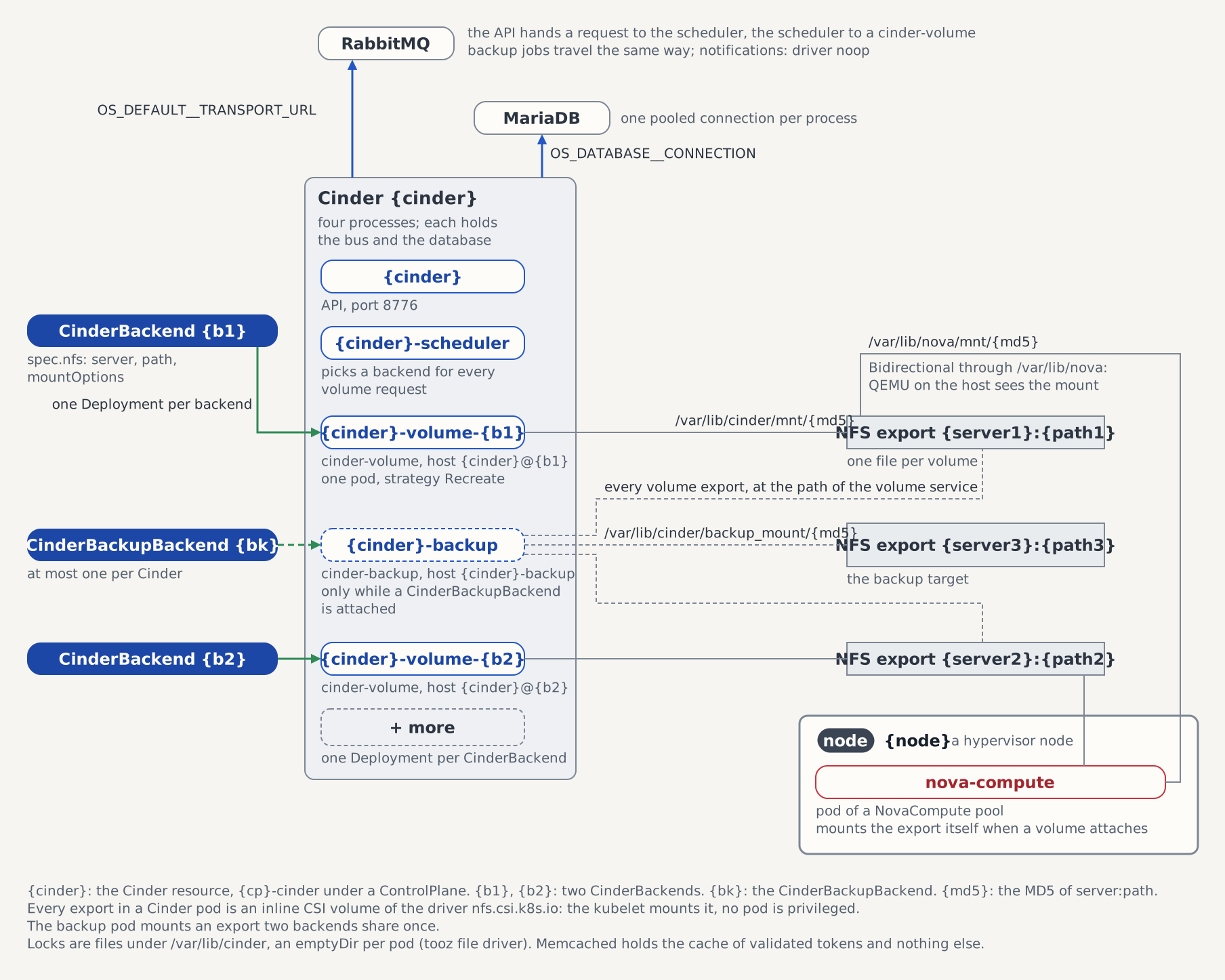
Four long-running processes carry the service. The rendered [DEFAULT] host is the CR's name, and the three processes that hold a row in cinder's service registry key that row on an identity derived from it.
| Process | Workload | Identity | What it does |
|---|---|---|---|
uWSGI on cinder.wsgi.api | the {name} Deployment | {name} (registers no row) | The block-storage API on port 8776 |
cinder-scheduler | the {name}-scheduler Deployment | {name}-scheduler | Picks a backend for every volume request the API accepts |
cinder-volume | one {name}-volume-{backend} Deployment per attached CinderBackend | {name}@{backend} | Creates and serves the volumes of its one backend |
cinder-backup | the {name}-backup Deployment | {name}-backup | Writes and restores volume backups |
A volume backend's identity is what the volumes it holds are keyed by, so it is derived from the CR and never from a pod: a Deployment roll, a rescheduled pod and a replaced node all keep it. The three non-API processes serve no HTTP port. Their readiness probe is cinder-amqp-ready, which reports whether a process of the container holds a socket established to the broker port (see Container Images).
The figure shows the four processes with what each mounts. A cinder-volume holds the export of its one backend, and the backup pod holds every volume export beside its own target.
Design decisions
The decision record lives in meta issue #979. These are the entries this operator implements, together with the choices the CRD carries.
- The message bus is required.
spec.messaginghas no optional form: the API hands every volume request to the scheduler over the bus, the scheduler hands it to acinder-volume, and backup jobs travel the same way. The URL reaches all four processes and every migration Job as theOS_DEFAULT__TRANSPORT_URLenvironment override sourced from the derived{name}-transport-urlSecret, so the broker password stays out of the rendered configuration. Volume lifecycle notifications are dropped at the source ([oslo_messaging_notifications] driver = noop), because nothing in this deployment consumes them. - No default backend. A volume type selects its backend by name, so the backends a
Cinderserves are peers, and an empty set is a valid state rather than a violated invariant:BackendsReadyis then True under the reasonNoBackends. That is the one place the satellite shape departs fromGlanceBackend, which elects exactly one default store. - One immutable Secret per backend. Each backend renders into its own content-hashed
{name}-backend-{backend}-<hash>Secret, which only that backend'scinder-volumeDeployment mounts, so attaching a second backend leaves the first one's pods untouched. - Inline CSI volumes for every share. A backend's export is mounted through an inline
nfs.csi.k8s.iovolume at/var/lib/cinder/mnt/<md5 of server:path>, the path os-brick's remotefs driver derives and cinder resolves every volume's provider location to. No PersistentVolume is bound and no cluster-scoped RBAC is needed, and a detaching backend leaves nothing to reclaim. The kind stack has to enable the driver's inline mode, which the CI wiring of #988 owns. - Detaching a backend runs a Job. A deleted
CinderBackendis held by thecinder.openstack.c5c3.io/service-removefinalizer until its volume service is stopped and a{name}-{backend}-service-removeJob has runcinder-manage service remove cinder-volume {name}@{backend}against the database. Exit code 2 ("host not found") counts as success: a backend whosecinder-volumenever registered has no row to remove and must still detach. - The privsep posture is unprivileged (decision D3). Both privsep contexts,
[cinder_sys_admin]and[privsep_osbrick], are rendered with an emptycapabilitiesvalue, because the pod's security context grants none, andnas_secure_file_operations = trueis written explicitly so the driver runs its file operations as the service user instead of through a root helper the image has no sudoers entry for. - Configuration reaches the processes as directories. Every process is launched with
--config-dir /etc/cinder/cinder.conf.d, which holds a file namedcinder.conf, plus the directories that carry its own overlay: the scheduler readsscheduler.conf.d, a volume service readsbackends.conf.dandvolume.conf.d, the backup service readsbackup.conf.d. oslo.config reads every file in a directory, so the split is what keeps one process from registering under another's identity. - A release bump rolls the processes in pipeline order: scheduler, volume, backup, then API. After the contract phase the three non-API Deployments roll once more, because the
cinder.c5c3.io/installed-releasepod annotation changes withstatus.installedRelease. Each of them caches the RPC version its peers announced at startup, and that cache pins the wire format for the life of the process.
Owned resources
The figure under Owned Resources of the Keystone operator draws the baseline this list follows: serving objects, config and Secrets, Jobs and CronJobs.
For a Cinder named {name}, with {backend} and {backupBackend} the names of the attached satellites:
| Resource | Name | Purpose |
|---|---|---|
| Deployment | {name} | The API pods, uWSGI on port 8776 |
| Service | {name} | ClusterIP in front of the API pods on port 8776 |
| PodDisruptionBudget | {name} | minAvailable: 1 above a lower replica bound of one, maxUnavailable: 1 at one (the bound is the HPA's minReplicas while spec.autoscaling is set); selects the API component and excludes Job pods |
| HorizontalPodAutoscaler | {name} | Only while spec.autoscaling is set; the API is the only autoscaled Deployment |
| NetworkPolicy | {name} | Only while spec.networkPolicy is set; one policy covers every workload and the Job pods |
| HTTPRoute | {name} | Only while spec.gateway is set |
| Deployment | {name}-scheduler | cinder-scheduler |
| Deployment | {name}-volume-{backend} | The cinder-volume of one attached backend |
| Deployment | {name}-backup | cinder-backup, only while a backup backend is projected |
| ConfigMap | {name}-config-<hash> | Immutable, content-addressed cinder.conf and scheduler.conf, plus logging.ini and policy.yaml when applicable; 3 historical retained |
| Secret | {name}-backend-{backend}-<hash> | Immutable, content-addressed backend.conf, shares and volume.conf of one backend; 3 historical retained |
| Secret | {name}-backup-{backupBackend}-<hash> | Immutable, content-addressed backup.conf; 3 historical retained |
| Secret | {name}-db-connection | The derived pymysql DSN, consumed through OS_DATABASE__CONNECTION |
| Secret | {name}-transport-url | The derived rabbit:// URL, consumed through OS_DEFAULT__TRANSPORT_URL |
| Job | {name}-db-sync | cinder-manage db sync |
| Job | {name}-db-expand, {name}-db-migrate, {name}-db-contract | The three release-upgrade phases |
| CronJob | {name}-db-purge | The recurring cinder-manage db purge |
| Job | {name}-{backend}-service-remove | Unregisters one detaching backend's volume service |
MariaDB Database / User / Grant | {name} | Managed mode only (spec.database.clusterRef); a brownfield database is left alone |
Reference pages
- Cinder CRD: the
spec/statuscontract, the rendered defaults, and the validation rules - CinderBackend CRD: one volume backend, its conditions, and the detach contract
- CinderBackupBackend CRD: the single backup driver and its conditions
- Controller Events: the Kubernetes events the three controllers emit
- Reconciler Architecture: the sub-reconciler pipeline, conditions, and requeue semantics
- Upgrade Flow: the four phases of a release upgrade, the pre-flight checks, the roll order, and the abort recipe