Keystone Operator Packaging
Reference documentation for the Keystone operator packaging artifacts. This covers the operator image, Helm chart configuration, FluxCD HelmRelease integration, dependency chain, and CRD installation behavior. These artifacts package the Keystone operator for deployment into Kubernetes clusters via the GitOps pipeline.
Directory Layout
operators/keystone/
├── vendor.json                         Vendor hash of the operator image (make nix-lock)
├── config/rbac/role.yaml               controller-gen ClusterRole from the RBAC markers (make manifests)
├── helm/
│   └── keystone-operator/
│       ├── Chart.yaml                  Helm chart metadata
│       ├── Chart.lock                  Pinned operator-library dependency
│       ├── values.yaml                 Default configuration values
│       ├── values.schema.json          JSON Schema for values validation (generated)
│       ├── values.schema.extras.json   Chart-specific schema additions (federation)
│       ├── crds/
│       │   └── keystone.openstack.c5c3.io_keystones.yaml   CRD (auto-installed by Helm)
│       └── templates/
│           ├── _helpers.tpl            Chart-specific helpers: the operator-library.chart.* hook overrides
│           ├── _rbac-rules.tpl         RBAC rules, generated from config/rbac/role.yaml (make sync-helm-rbac)
│           ├── _webhook-rbac-rules.tpl RBAC rules of the standalone webhook, generated from the same file
│           ├── serviceaccount.yaml     ServiceAccount (conditional)
│           ├── clusterrole.yaml        ClusterRole (cluster-scoped RBAC, default)
│           ├── clusterrolebinding.yaml ClusterRoleBinding (default)
│           ├── role.yaml               Namespace-scoped Role (rbac.namespaceScoped)
│           ├── rolebinding.yaml        Namespace-scoped RoleBinding (rbac.namespaceScoped)
│           ├── deployment.yaml         Operator Deployment
│           ├── service.yaml            ClusterIP Service (webhook + metrics)
│           ├── pdb.yaml                PodDisruptionBudget (replicas > 1)
│           ├── certificate.yaml        Self-signed Issuer + webhook Certificate (conditional)
│           ├── networkpolicy.yaml      Operator pod NetworkPolicy (opt-in)
│           ├── servicemonitor.yaml     Prometheus ServiceMonitor (opt-in)
│           └── webhook-configuration.yaml  Mutating + Validating webhooks (conditional)
operators/shared/helm/
├── operator-library/                   Library chart: every manifest template above, defined once
└── operator-library-testbed/           Test consumer of the library; runs the shared helm-unittest suites
deploy/flux-system/
├── kustomization.yaml                  Base kustomization (includes keystone-operator release)
└── releases/
    └── keystone-operator.yaml          FluxCD HelmRelease
Image
Location: nix/lib/operator-image.nix (shared by all operators) and operators/keystone/vendor.json, the vendor hash of the keystone module
The root flake builds the image as the attribute keystone-operator-image, a dockerTools.streamLayeredImage around a statically linked operator binary (Operator images).
Source
The build runs the keystone module on its own with GOWORK=off, so operators/keystone/go.mod and its replace directive for internal/common decide the module graph. The source holds internal/common and operators/keystone, without the _test.go files and the helm/, dashboards/ and config/ directories, which no go:embed reads. The embedded option catalogs under api/v1alpha1/catalogs/ and the scripts under internal/controller/scripts/ are part of it. A commit to another operator or to the chart leaves the image unchanged.
Toolchain
buildGo127Module of the locked nixpkgs-images compiles the binary with CGO_ENABLED=0 and the ldflags -s -w. proxyVendor keeps the fixed-output derivation to the module download, whose hash is the vendorHash of operators/keystone/vendor.json; make nix-lock writes it when the go.mod or go.sum files it derives from move. The unit tests run under make test, not in the build.
Runtime Image Properties
The image is nix/lib/static-image.nix, the stand-in for gcr.io/distroless/static:nonroot:
| Property | Value |
|---|---|
| Binary | /usr/bin/manager |
| User | 65532:65532 (nonroot) |
| Working directory | /home/nonroot |
| Entrypoint | ["/usr/bin/manager"] |
| Shell | None |
| Package manager | None |
OCI Annotations
The image carries four static labels and no per-build label:
| Annotation | Value |
|---|---|
org.opencontainers.image.title | keystone-operator |
org.opencontainers.image.description | CobaltCore keystone operator |
org.opencontainers.image.licenses | Apache-2.0 |
org.opencontainers.image.vendor | SAP SE |
The merge-operator-images job of the CI workflow records the per-build metadata on the published manifest list as index annotations: the commit (org.opencontainers.image.revision), the version, the creation time, and the source and URL of the repository.
Local Build
# From the repository root, with Nix and flakes
make image OPERATOR=keystone IMG=keystone-operator:dev

# Verify: prints the flags of the manager
docker run --rm keystone-operator:dev --help
Helm Chart
Location: operators/keystone/helm/keystone-operator/
Chart Metadata
File: Chart.yaml
| Field | Value |
|---|---|
apiVersion | v2 |
name | keystone-operator |
description | A Helm chart for deploying the Keystone OpenStack operator |
type | application |
version | 0.5.0 |
appVersion | 0.1.0 |
Shared Library Subchart
The chart depends on the operator-library library chart (operators/shared/helm/operator-library), declared in Chart.yaml:
dependencies:
  - name: operator-library
    version: 0.1.0
    repository: "file://../../../shared/helm/operator-library"
The library holds, in one place, the naming and label helpers (operator-library.fullname, operator-library.labels, operator-library.selectorLabels, operator-library.serviceAccountName) and every manifest template the operator charts render: the Deployment skeleton, the ClusterRole and Role, the NetworkPolicy, certificate, Service, ServiceAccount, bindings, PDB, ServiceMonitor and webhook configurations. Each templates/*.yaml in this chart is a one-line include. What only this chart knows goes through the operator-library.chart.* hooks: the library defines each hook empty, and a chart overrides it by defining a template of the same name in its _helpers.tpl (Helm loads the parent chart's templates last, so its definition wins). The keystone-operator overrides operator-library.chart.args to render --federation-metadata-allow-cidrs.
The RBAC rules are not written by hand: make manifests has controller-gen assemble config/rbac/role.yaml from the +kubebuilder:rbac markers in the Go sources, and make sync-helm-rbac copies its rules into templates/_rbac-rules.tpl as the keystone-operator.rbacRules template the library's ClusterRole and Role include (plus the leader-election leases rule). make verify-helm-rbac fails on drift; the rationale for each grant lives as a comment next to its marker. The operator-library's own helm-unittest suites run once against operators/shared/helm/operator-library-testbed, a test consumer that renders every shared template with the values contract the operator charts share; this chart's suites cover only what it adds. A library change is released to every consumer with make helm-bump-library VERSION=x.
Chart.lock pins the dependency and is committed; the vendored copy under charts/ is a build artifact (git-ignored). helm dependency build vendors it from the local path. Run make helm-deps before helm lint/template/ unittest, and make helm-package does it automatically so the published tarball is self-contained.
Configuration Reference
File: values.yaml
All configurable parameters with their types, defaults, and descriptions:
Image
| Parameter | Type | Default | Description |
|---|---|---|---|
image.repository | string | ghcr.io/c5c3/keystone-operator | Container image registry and repository |
image.tag | string | "" (appVersion) | Image tag. When empty, defaults to appVersion from Chart.yaml |
image.pullPolicy | string | IfNotPresent | Kubernetes image pull policy (Always, IfNotPresent, Never) |
Replicas
| Parameter | Type | Default | Description |
|---|---|---|---|
replicas | integer | 2 | Number of operator pod replicas. Use 2+ for high availability with leader election |
Resources
| Parameter | Type | Default | Description |
|---|---|---|---|
resources.limits.cpu | string | 500m | CPU limit per operator pod |
resources.limits.memory | string | 128Mi | Memory limit per operator pod |
resources.requests.cpu | string | 10m | CPU request per operator pod |
resources.requests.memory | string | 64Mi | Memory request per operator pod |
Scheduling
| Parameter | Type | Default | Description |
|---|---|---|---|
nodeSelector | object | {} | Node labels the operator pods must match. Empty renders no nodeSelector |
tolerations | array | [] | Taints the operator pods tolerate. Empty renders no tolerations |
priorityClassName | string | "" | PriorityClass of the operator pods; the class must exist. Empty renders none |
RBAC
| Parameter | Type | Default | Description |
|---|---|---|---|
rbac.namespaceScoped | boolean | false | When true, renders a namespace-scoped Role/RoleBinding instead of the ClusterRole/ClusterRoleBinding, restricting the operator to its release namespace. See the Multi-Tenant Deployment guide |
Leader Election
| Parameter | Type | Default | Description |
|---|---|---|---|
leaderElection.enabled | boolean | true | Enable leader election for controller manager. Required when running multiple replicas to ensure only one active controller |
When enabled, the --leader-elect flag is passed to the manager binary. When disabled, the flag is omitted (not set to false), and all replicas process reconciliation events concurrently. Disable only for single-replica development deployments.
Webhook
| Parameter | Type | Default | Description |
|---|---|---|---|
webhook.enabled | boolean | true | Enable admission webhooks (MutatingWebhookConfiguration and ValidatingWebhookConfiguration). Requires cert-manager for TLS certificate injection |
webhook.standalone | boolean | false | Run the release as a standalone admission webhook for the namespace-scoped installs of the chart. Requires webhook.enabled=true and rbac.namespaceScoped=false |
When disabled, the webhook container port (9443) is omitted from the Deployment and no webhook configuration resources are created. The operator continues to function without admission validation; CRs are not validated or defaulted at admission time. A namespace-scoped install sets webhook.enabled=false, which the values schema requires beside rbac.namespaceScoped=true.
With webhook.standalone=true the release reconciles nothing. The Deployment passes --enable-controllers=false and no --leader-elect, so the manager registers no controller, elects no leader and serves only the admission webhooks. The ClusterRole renders the standalone webhook rule set. The Service, Issuer, Certificate and both webhook configurations render as with webhook.enabled=true, and the configurations admit the Keystone and KeystoneIdentityBackend CRs of every namespace. One such release per cluster admits the CRs of every namespace-scoped install of the chart; see Multi-Tenant Deployment → Admission webhooks.
Metrics
| Parameter | Type | Default | Description |
|---|---|---|---|
metrics.port | integer | 8080 | Port for the Prometheus metrics endpoint. Exposed via both the container port and the Service |
Logging
| Parameter | Type | Default | Description |
|---|---|---|---|
logging.development | boolean | false | When true, passes --zap-devel (console encoder, debug verbosity). Leave false for the production profile (JSON encoder, info level) |
logging.level | string | "" | --zap-log-level: debug, info, error, panic, or a positive integer. Empty uses the mode default |
logging.encoder | string | "" | --zap-encoder: json or console. Empty uses the mode default |
Each value maps to a controller-runtime --zap-* flag and is omitted from the operator args when left at its default.
Monitoring
| Parameter | Type | Default | Description |
|---|---|---|---|
monitoring.serviceMonitor.enabled | boolean | false | Render a monitoring.coreos.com/v1 ServiceMonitor targeting the metrics port. Requires prometheus-operator CRDs in the cluster |
monitoring.serviceMonitor.interval | string | 30s | Scrape interval on the ServiceMonitor endpoint |
See Enable Keystone Operator Metrics for the end-to-end scraping setup.
NetworkPolicy
| Parameter | Type | Default | Description |
|---|---|---|---|
networkPolicy.enabled | boolean | false | Opt-in NetworkPolicy that default-denies operator pod traffic and opens explicit rules (kube-apiserver, DNS, webhook, metrics) |
networkPolicy.kubeApiServer.cidrs / .ports | list | [] | API-server egress targets. Both must be non-empty when the policy is enabled (fail-closed template guard) |
networkPolicy.dns.* | — | kube-dns | DNS egress selectors (UDP/TCP 53) |
networkPolicy.allowMetricsFrom | list | [] | Ingress peers allowed to scrape metrics |
networkPolicy.webhookClients.cidrs | list | [] | Webhook ingress override; falls back to kubeApiServer.cidrs |
Full semantics live in the Operator NetworkPolicy reference.
Federation
| Parameter | Type | Default | Description |
|---|---|---|---|
federation.metadataAllowCidrs | list of CIDR strings | [] | CIDRs the SSRF-guarded federation-metadata client may additionally dial to fetch identity-provider metadata (OIDC discovery documents and SAML IdP metadata) — e.g. the cluster's Service CIDR 10.96.0.0/12 for a trusted in-cluster IdP. Rendered as --federation-metadata-allow-cidrs. Empty (the default) keeps the operator refusing every non-public address; loopback, link-local (cloud IMDS), multicast, and unspecified addresses stay blocked even when an entry covers them. Operator-level only — never derived from a CR |
See Attach an OIDC Federation Backend to Keystone for the discovery workflow this value enables.
Service Account
| Parameter | Type | Default | Description |
|---|---|---|---|
serviceAccount.create | boolean | true | Create a ServiceAccount for the operator. Set to false to use an existing ServiceAccount |
serviceAccount.name | string | "" (fullname) | Name of the ServiceAccount. When empty, defaults to the Helm release fullname |
Rendered Resources
The chart renders the following Kubernetes resources with default values:
| Resource | Kind | Name Pattern | Conditional |
|---|---|---|---|
| ServiceAccount | v1/ServiceAccount | {fullname} | serviceAccount.create |
| ClusterRole | rbac.authorization.k8s.io/v1/ClusterRole | {fullname} | rbac.namespaceScoped=false (default); carries the standalone webhook rule set instead of the manager rules under webhook.standalone=true |
| ClusterRoleBinding | rbac.authorization.k8s.io/v1/ClusterRoleBinding | {fullname} | rbac.namespaceScoped=false (default) |
| Role | rbac.authorization.k8s.io/v1/Role | {fullname} | rbac.namespaceScoped=true |
| RoleBinding | rbac.authorization.k8s.io/v1/RoleBinding | {fullname} | rbac.namespaceScoped=true |
| Deployment | apps/v1/Deployment | {fullname} | Always |
| Service | v1/Service | {fullname} | Always |
| PodDisruptionBudget | policy/v1/PodDisruptionBudget | {fullname} | replicas > 1 |
| Issuer | cert-manager.io/v1/Issuer | {fullname}-selfsigned | webhook.enabled |
| Certificate | cert-manager.io/v1/Certificate | {fullname}-webhook | webhook.enabled |
| NetworkPolicy | networking.k8s.io/v1/NetworkPolicy | {fullname} | networkPolicy.enabled |
| ServiceMonitor | monitoring.coreos.com/v1/ServiceMonitor | {fullname} | monitoring.serviceMonitor.enabled |
| MutatingWebhookConfiguration | admissionregistration.k8s.io/v1 | {fullname}-mutating | webhook.enabled |
| ValidatingWebhookConfiguration | admissionregistration.k8s.io/v1 | {fullname}-validating | webhook.enabled |
The {fullname} pattern resolves to {release-name}-keystone-operator unless fullnameOverride is set.
Standard Labels
All resources include standard Helm labels via the operator-library.labels helper:
| Label | Value |
|---|---|
helm.sh/chart | keystone-operator-0.5.0 |
app.kubernetes.io/name | keystone-operator |
app.kubernetes.io/instance | {release-name} |
app.kubernetes.io/version | 0.1.0 |
app.kubernetes.io/managed-by | Helm |
Selector labels (used by Deployment and Service) are a subset: app.kubernetes.io/name and app.kubernetes.io/instance.
Deployment Configuration
The operator Deployment is configured with the following fixed settings:
Container arguments:
| Argument | Value | Configurable |
|---|---|---|
--leader-elect | Present when leaderElection.enabled=true | Yes |
--metrics-bind-address | :{{ .Values.metrics.port }} (default :8080) | Yes (port) |
--health-probe-bind-address | :8081 | No (hardcoded in bootstrap.Run) |
--federation-metadata-allow-cidrs | Comma-separated .Values.federation.metadataAllowCidrs; omitted when the list is empty | Yes |
Health probes:
| Probe | Path | Port | Protocol |
|---|---|---|---|
| Liveness | /healthz | 8081 | HTTP |
| Readiness | /readyz | 8081 | HTTP |
The health probe port (8081) is hardcoded in the bootstrap.Run() defaults and is not configurable via Helm values.
Container ports:
| Name | Port | Conditional |
|---|---|---|
metrics | {{ .Values.metrics.port }} (default 8080) | Always |
health | 8081 | Always |
webhook | 9443 | webhook.enabled |
Pod security context:
| Field | Value |
|---|---|
runAsNonRoot | true |
runAsUser | 65532 |
runAsGroup | 65532 |
fsGroup | 65532 |
seccompProfile.type | RuntimeDefault |
Container security context:
| Field | Value |
|---|---|
allowPrivilegeEscalation | false |
capabilities.drop | [ALL] |
readOnlyRootFilesystem | true |
seccompProfile.type | RuntimeDefault |
Scheduling and disruption:
The pod template carries a best-effort topology spread constraint (maxSkew: 1, topologyKey: kubernetes.io/hostname, whenUnsatisfiable: ScheduleAnyway) so replicas are scheduled on different nodes where possible while single-node clusters (kind) stay schedulable. Together with the PodDisruptionBudget (minAvailable: 1, rendered only when replicas > 1), a voluntary disruption such as a node drain can never evict every replica, and with it the in-process admission webhook, at once. nodeSelector, tolerations and priorityClassName render on the pod spec only when set (see Scheduling).
Service Configuration
The Service is type ClusterIP with two ports:
| Name | Port | Target Port | Purpose | Conditional |
|---|---|---|---|---|
webhook | 443 | 9443 | Admission webhook callbacks from the API server | webhook.enabled |
metrics | {{ .Values.metrics.port }} | {{ .Values.metrics.port }} | Prometheus metrics scraping | Always |
RBAC Configuration
The ClusterRole includes permissions generated from the kubebuilder RBAC markers spread across the reconciler files in operators/keystone/internal/controller/ (see the RBAC paragraph under Helm Chart). controller-gen merges resources that share a verb set into one rule and sorts the verbs, so the rendered rules group differently from the table below; the grants are the same. These are the minimum permissions required for the operator to manage Keystone resources and their dependencies:
| API Group | Resources | Verbs |
|---|---|---|
keystone.openstack.c5c3.io | keystones | get, list, watch, create, update, patch, delete |
keystone.openstack.c5c3.io | keystones/status | get, update, patch |
keystone.openstack.c5c3.io | keystones/finalizers | update |
apps | deployments | get, list, watch, create, update, patch, delete |
autoscaling | horizontalpodautoscalers | get, list, watch, create, update, patch, delete |
autoscaling.k8s.io | verticalpodautoscalers | get, list, watch, create, update, patch, delete |
"" (core) | services, configmaps, secrets, serviceaccounts | get, list, watch, create, update, patch, delete |
"" (core) | events | create, patch |
"" (core) | pods | get, list |
batch | jobs, cronjobs | get, list, watch, create, update, patch, delete |
cert-manager.io | certificates | get, list, watch, create, update, patch, delete |
k8s.mariadb.com | databases, users, grants | get, list, watch, create, update, patch, delete |
k8s.mariadb.com | mariadbs | get, list, watch |
external-secrets.io | externalsecrets | get, list, watch, create, update, patch |
external-secrets.io | pushsecrets | get, list, watch, create, update, patch, delete |
external-secrets.io | clustersecretstores | get, list, watch |
gateway.networking.k8s.io | httproutes | get, list, watch, create, update, patch, delete |
gateway.networking.k8s.io | httproutes/status | get |
networking.k8s.io | networkpolicies | get, list, watch, create, update, patch, delete |
policy | poddisruptionbudgets | get, list, watch, create, update, patch, delete |
rbac.authorization.k8s.io | roles, rolebindings | get, list, watch, create, update, patch, delete |
scheduling.k8s.io | priorityclasses | get, list, watch |
Notable verb restrictions:
eventshas onlycreateandpatch: the operator emits events but never reads or deletes them.externalsecretshas nodeleteverb: ExternalSecret cleanup is left to owner-reference garbage collection.pushsecretsdoes includedelete: the OpenBao finalizer deletes the key-backup PushSecrets when a Keystone CR is deleted so ESO stops pushing to OpenBao.mariadbs,clustersecretstores,priorityclasses,pods, andhttproutes/statusare read-only: the operator observes them but never mutates them.
The ClusterRoleBinding binds the ClusterRole to the operator's ServiceAccount in the release namespace only. With rbac.namespaceScoped=true the identical rule set is rendered as a namespaced Role/RoleBinding instead (both library templates include the generated keystone-operator.rbacRules partial). The rule set's cluster-scoped entries, clustersecretstores and priorityclasses, grant nothing in a Role. The operator started with --namespace neither watches nor reads them: it registers no ClusterSecretStore watch and refuses a Keystone whose effective store is cluster-scoped, and only the webhook, which this mode disables, reads PriorityClasses.
Standalone webhook rule set
Under webhook.standalone=true the ClusterRole carries only what the admission webhooks read through their uncached API reader:
| API Group | Resources | Verbs | Read by |
|---|---|---|---|
scheduling.k8s.io | priorityclasses | get | The validating Keystone webhook, for spec.deployment.priorityClassName and the Job priority classes |
keystone.openstack.c5c3.io | keystoneidentitybackends | list | The validating KeystoneIdentityBackend webhook, for the backends in the namespace |
It grants nothing on secrets, rolebindings or leases. Each read is declared with a +kubebuilder:rbac marker ending in roleName=keystone-webhook beside the +kubebuilder:webhook markers of the file that performs it (operators/keystone/api/v1alpha1/keystone_webhook.go, keystoneidentitybackend_webhook.go). controller-gen writes those markers into a second ClusterRole of config/rbac/role.yaml, keystone-webhook, and make sync-helm-rbac copies its rules into templates/_webhook-rbac-rules.tpl as the keystone-operator.webhookRbacRules template, without a leases rule.
The generator also guards coverage: every (apiGroup, resource, verb) the keystone-webhook ClusterRole grants must be granted by the manager rules too, and make sync-helm-rbac and make verify-helm-rbac exit 1 otherwise. The in-process webhook of a cluster-wide release runs under the manager identity, so a read declared for the webhook role alone would fail there. The manager rules keep priorityclasses at get, list, watch; controller-gen merges the verbs of markers per resource.
Webhook Configuration
Two webhook configurations are rendered when webhook.enabled=true:
MutatingWebhookConfiguration ({fullname}-mutating):
| Field | Value |
|---|---|
| Webhook name | mkeystone.kb.io |
| Path | /mutate-keystone-openstack-c5c3-io-v1alpha1-keystone |
| Operations | CREATE, UPDATE |
| API group | keystone.openstack.c5c3.io |
| API version | v1alpha1 |
| Resource | keystones |
| Failure policy | Fail |
| Side effects | None |
| Admission review versions | v1 |
ValidatingWebhookConfiguration ({fullname}-validating):
| Field | Value |
|---|---|
| Webhook name | vkeystone.kb.io |
| Path | /validate-keystone-openstack-c5c3-io-v1alpha1-keystone |
| Operations | CREATE, UPDATE |
| API group | keystone.openstack.c5c3.io |
| API version | v1alpha1 |
| Resource | keystones |
| Failure policy | Fail |
| Side effects | None |
| Admission review versions | v1 |
Neither configuration intercepts DELETE: the webhook is served in-process by the operator, or by the standalone webhook release, so with failurePolicy: Fail a DELETE rule would let a down webhook pod block CR (and thereby namespace) deletion.
Both configurations include the annotation:
cert-manager.io/inject-ca-from: {{ .Release.Namespace }}/{{ include "operator-library.fullname" . }}-webhookThis instructs cert-manager to inject the CA bundle from the named Certificate resource into the webhook caBundle field automatically. The chart renders that Certificate itself: templates/certificate.yaml creates a self-signed Issuer ({fullname}-selfsigned) and the {fullname}-webhook Certificate in the release namespace whenever webhook.enabled=true.
FluxCD HelmRelease
File: deploy/flux-system/releases/keystone-operator.yaml
The HelmRelease deploys the Keystone operator chart via FluxCD's helm-controller, following the established pattern used by other operators in the project (memcached-operator, mariadb-operator).
| Property | Value |
|---|---|
| API version | helm.toolkit.fluxcd.io/v2 |
| Name | keystone-operator |
| Target namespace | keystone-system |
| Reconciliation interval | 30m |
| Chart | keystone-operator |
| Version constraint | >=0.1.0 <1.0.0 |
| Source | c5c3-charts HelmRepository in flux-system namespace |
Helm values applied by the HelmRelease:
| Key | Value | Purpose |
|---|---|---|
replicas | 2 | High availability with leader election |
leaderElection.enabled | true | Single active controller with 2 replicas |
All other values use chart defaults.
Install settings:
| Setting | Value |
|---|---|
install.crds | CreateReplace |
install.createNamespace | true |
install.remediation.retries | 3 |
Upgrade settings:
| Setting | Value |
|---|---|
upgrade.crds | CreateReplace |
upgrade.remediation.retries | 3 |
Kustomization inclusion: The HelmRelease is listed in deploy/flux-system/kustomization.yaml under the resources list as releases/keystone-operator.yaml.
Dependency Chain
The Keystone operator depends on four infrastructure operators that must be running before it starts. FluxCD enforces this ordering via spec.dependsOn:
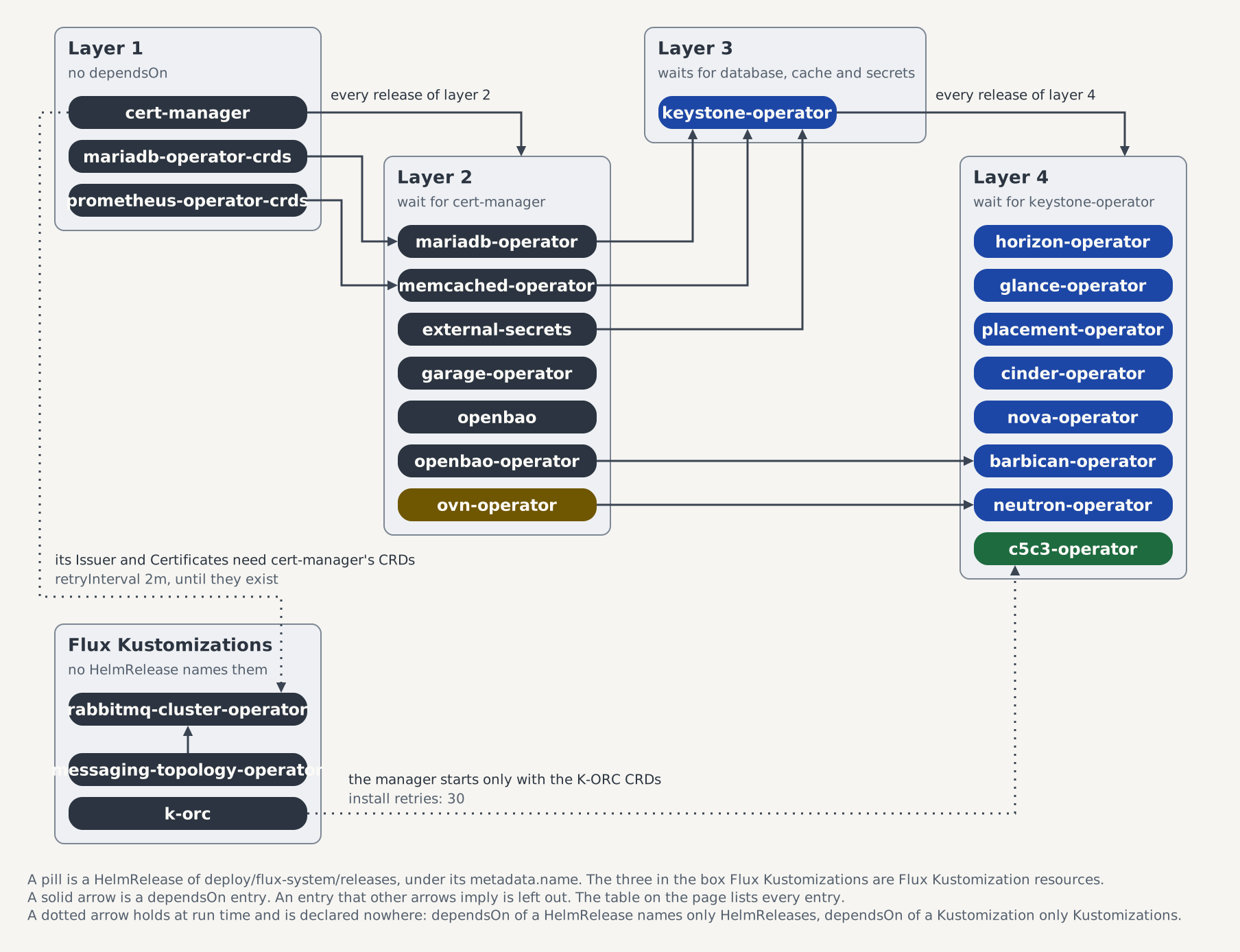
The keystone-operator HelmRelease sits in layer 3 of the figure: it waits for cert-manager, mariadb-operator, memcached-operator and external-secrets.
Why Each Dependency Is Required
| Dependency | Namespace | Reason |
|---|---|---|
cert-manager | cert-manager | Provides TLS certificate injection for admission webhooks via cert-manager.io/inject-ca-from annotation. Without cert-manager, webhook TLS is not provisioned and the API server cannot call admission webhooks |
mariadb-operator | mariadb-system | Installs the k8s.mariadb.com CRDs (Database, User, Grant) that the Keystone operator creates to provision database resources for each Keystone CR |
memcached-operator | memcached-system | Installs the memcached.c5c3.io CRDs (Memcached) that the Keystone operator references for cache discovery |
external-secrets | external-secrets | Installs the external-secrets.io CRDs (ExternalSecret, PushSecret) that the Keystone operator creates to manage secret synchronization from the secret store |
Deployment Sequence
FluxCD resolves the dependency graph and deploys in this order:
- cert-manager — base layer, no dependencies
- mariadb-operator, memcached-operator, and external-secrets — depend only on cert-manager, can install in parallel
- keystone-operator — depends on all four, installs last
If any dependency is not ready (HelmRelease not in Ready condition), the keystone-operator HelmRelease remains in a pending state until all dependencies are satisfied.
CRD Installation Behavior
CRD file: operators/keystone/helm/keystone-operator/crds/keystone.openstack.c5c3.io_keystones.yaml
Helm CRD Lifecycle
The CRD is placed in the chart's crds/ directory (not templates/). Helm handles CRDs in crds/ with special behavior:
On install: Helm installs CRDs from
crds/before rendering and applying templates. This ensures the CRD exists before any templates that reference it are created, avoiding chicken-and-egg ordering issues.On upgrade (with FluxCD
crds: CreateReplace): FluxCD's helm-controller replaces the existing CRD with the version from the chart. This enables CRD schema updates when the chart version is upgraded.On uninstall: Helm does not delete CRDs from the
crds/directory onhelm uninstall. This is intentional: CRDs are cluster-scoped resources and deleting them would destroy all custom resources of that type across all namespaces.
CRD Source
The CRD file in crds/ is an exact copy of the generated CRD at operators/keystone/config/crd/bases/keystone.openstack.c5c3.io_keystones.yaml. It defines the Keystone kind in the keystone.openstack.c5c3.io API group.
Important: The CRD in crds/ must remain an exact copy of the source CRD. Manual modifications would cause divergence between the Helm-installed CRD and the kubebuilder-generated source. When the source CRD changes (e.g., new spec fields are added), the copy in crds/ must be updated to match.
FluxCD CRD Policy
The HelmRelease configures both install and upgrade to use crds: CreateReplace:
install:
  crds: CreateReplace
upgrade:
crds: CreateReplace| Policy | Behavior |
|---|---|
CreateReplace | Create CRDs if they do not exist; replace (overwrite) if they do. This ensures CRD schema updates are applied on chart upgrades |
| Alternatives | Skip (never touch CRDs), Create (create only, never update). CreateReplace is recommended for operator charts where CRD evolution is expected |
Data Flow
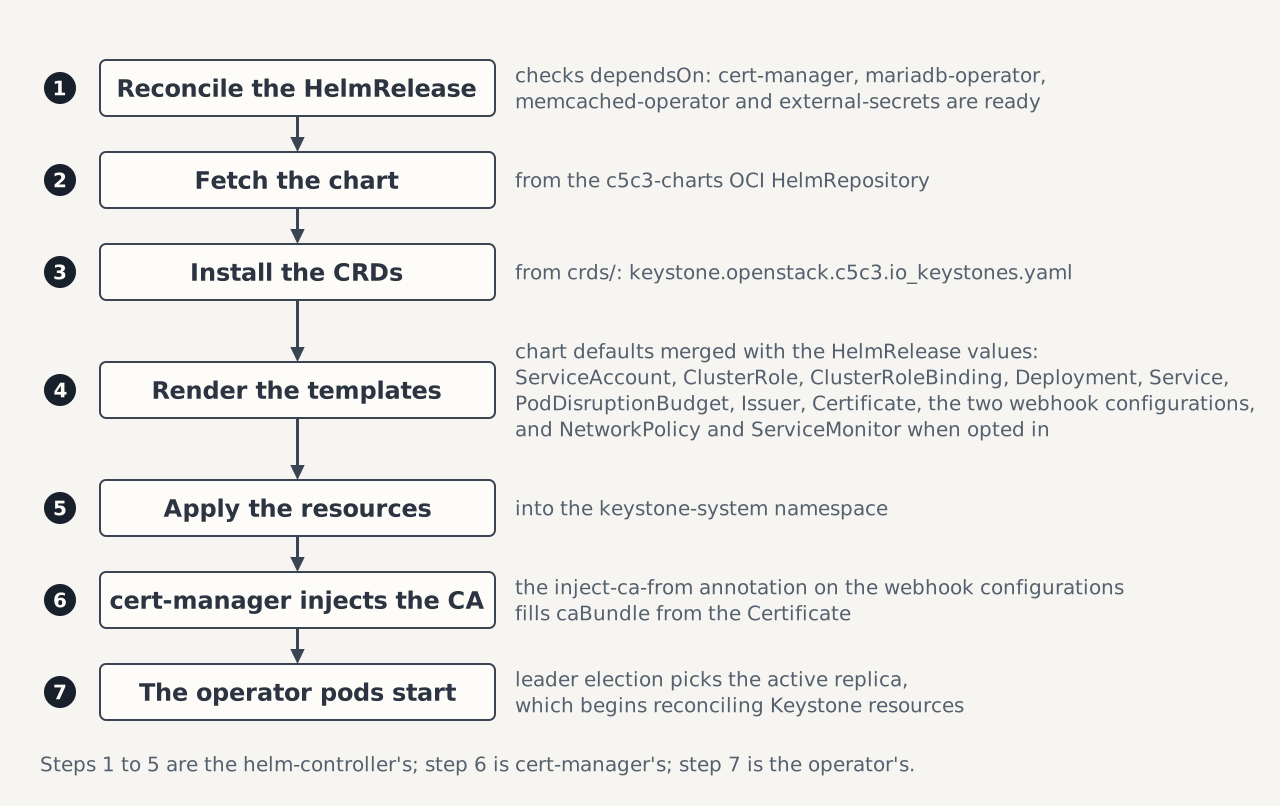
End-to-end deployment flow from FluxCD reconciliation to operator startup: