Attach an OIDC Federation Backend to Keystone
This guide walks through federating a running Keystone with an OpenID Connect identity provider using the KeystoneIdentityBackend CRD: create the client-secret Secret, apply one CR, watch the conditions converge, and verify a federated user can log in. The worked example uses the same Keycloak fixture the e2e suite deploys, and every value below is one that fixture produces — so the whole flow is reproducible on the kind devstack.
When at least one OIDC backend attaches, the operator injects an Apache/mod_auth_openidc reverse-proxy sidecar into the Keystone pod, binds uWSGI to localhost behind it, and switches the Service to the proxy port. Detaching the last federation backend, OIDC or SAML, restores the plain uWSGI-only pod — the sidecar costs nothing until federation is in use.
For the full field reference, see the KeystoneIdentityBackend CRD API Reference.
Prerequisites
Devstack
This guide is written against the Quick Start (ControlPlane) devstack. Stand it up first:
KIND_HOST_PORT=8443 WITH_CONTROLPLANE=true make deploy-infraFollow that tutorial through to its final Verify step, so a ControlPlane CR named controlplane is Ready in the openstack namespace and its projected controlplane-keystone Keystone child is running. Every resource name in the examples below is one that devstack produces.
The Keystone child is operator-owned
On a ControlPlane deployment the controlplane-keystone Keystone CR is projected by the c5c3-operator, which re-asserts the entire spec.federation block (proxy image and trusted dashboards) on every reconcile. Set the federation proxy image on the ControlPlane CR (Step 3), and the trusted dashboards flow from spec.services.horizon — see End-to-End SSO. The KeystoneIdentityBackend CR you apply in Step 4 is yours to own; only the projected Keystone child's spec.federation is operator-managed.
- An OIDC identity provider reachable from the cluster (this guide uses a Keycloak realm) with a confidential client registered for keystone. The client's redirect URIs must cover
<keystone endpoint base>/v3/OS-FEDERATION/redirect_uri. - A federation proxy image. On the ControlPlane path the c5c3-operator projects
ghcr.io/c5c3/keystone-federation-proxy:latestonto the child automatically, overridable viaspec.services.keystone.federationProxyImage(Step 3); standalone Keystone installations setspec.federation.proxyImagethemselves (see the Standalone Keystone section). Without a proxy image, OIDC backends stay pending with aFederationProxyImageMissingWarning — no hidden default is assumed. - Service users stay SQL-backed. Federated users are ephemeral shadow users; OpenStack service accounts and the bootstrap admin remain in the SQL-backed
Defaultdomain, which the CRD hard-rejects federating.
Step 1 — Deploy the fixture IdP (kind devstack)
On the kind devstack, stand up the same Keycloak the e2e suite uses. It is a plain namespace-pinned manifest, so kubectl apply runs it verbatim:
kubectl apply -f tests/e2e/keystone/oidc-federation/00-keycloak.yaml
kubectl -n openstack rollout status deploy/keycloak
This provides, all in the openstack namespace:
| What | Value |
|---|---|
| Realm | cobaltcore |
| Issuer | http://keycloak.openstack:8080/realms/cobaltcore |
| Confidential client | keystone (direct access grants + standard flow enabled) |
| Client secret | keystone-cobaltcore-secret (also shipped as Secret keycloak-cobaltcore-client) |
| Test user | fry / fry-password (group /engineers) |
| Keycloak admin | admin / admin-password |
The fixture pins KC_HOSTNAME to the cluster-internal issuer above, so tokens carry a stable iss regardless of how you reach the pod. It also serves an https listener on 8443 with a throwaway self-signed cert for the introspection endpoint (mod_auth_openidc requires https there).
Registering a client at your own IdP (non-kind)
On a non-kind cluster, skip the fixture and use your own Keycloak (or any OIDC IdP): create (or pick) a realm, add a confidential client keystone with Standard flow enabled and a client secret, and note the realm's issuer URL — it must match the iss claim the IdP asserts, byte for byte. Substitute your issuer, endpoints, and client secret for the fixture values below.
Step 2 — Create the client-secret Secret
The projection reads one fixed data key, clientSecret:
kubectl create secret generic keycloak-cobaltcore-client -n openstack \
  --from-literal=clientSecret='<the client secret from Keycloak>'
Rotating this Secret later re-renders the federation configuration automatically — the operator watches it.
On the kind devstack
Step 1's fixture already ships the keycloak-cobaltcore-client Secret with the fixed clientSecret: keystone-cobaltcore-secret key, so you can skip this kubectl create — the backend CR in Step 4 references it as-is.
Step 3 — Pin the federation proxy image (optional)
On the ControlPlane path the c5c3-operator already projects ghcr.io/c5c3/keystone-federation-proxy:latest onto the controlplane-keystone child, so OIDC federation works out of the box — this step is only needed to pin an immutable digest for production or to test a locally built sidecar. Override the default on the ControlPlane CR:
apiVersion: c5c3.io/v1alpha1
kind: ControlPlane
metadata:
  name: controlplane
  namespace: openstack
spec:
  services:
    keystone:
      federationProxyImage:
        repository: ghcr.io/c5c3/keystone-federation-proxy
        digest: sha256:<digest>   # pin a digest for production
The sidecar's CPU and memory come from spec.sizing.keystone.federationProxy.resources on the same CR, which the operator projects onto the child's spec.federation.proxyResources.
Do not set spec.federation.proxyImage on the projected child
Editing spec.federation.proxyImage (or any spec.federation field, including proxyResources) on the controlplane-keystone child directly is reverted on the next reconcile: the c5c3-operator re-asserts the whole spec.federation block from the ControlPlane. Set the override via spec.services.keystone.federationProxyImage or spec.sizing.keystone.federationProxy on the ControlPlane CR instead.
The projected image is inert until a federation backend, OIDC or SAML, attaches.
Step 4 — Apply the backend CR
apiVersion: keystone.openstack.c5c3.io/v1alpha1
kind: KeystoneIdentityBackend
metadata:
  name: keycloak-cobaltcore
  namespace: openstack
spec:
  keystoneRef:
    name: controlplane-keystone
  domain:
    name: cobaltcore
    mode: Manage           # the operator creates the domain
    deletionPolicy: Retain # keep the domain when this CR is deleted
  type: OIDC
  oidc:
    issuer: http://keycloak.openstack:8080/realms/cobaltcore
    clientID: keystone
    clientSecretRef:
      name: keycloak-cobaltcore-client
    # Explicit endpoints are required against the fixture: the operator's
    # metadata-fetch SSRF guard blocks discovery against the in-cluster
    # Keycloak's private ClusterIP, so the .well-known auto-discovery
    # (bare `issuer:` alone) does not run here. Everything speaks the fixture's
    # plain-http :8080 listener EXCEPT introspection, which mod_auth_openidc
    # requires to be https — the fixture serves it on the self-signed :8443
    # listener, and tlsVerify opts out of verifying that throwaway cert.
    # A publicly resolvable IdP can drop this block and rely on discovery.
    endpoints:
      # The browser opens this endpoint, so it uses the issuer's host: Keycloak
      # posts the login form to that host, and a session cookie set on the FQDN
      # would not be sent along (400, cookie_not_found).
      authorizationEndpoint: http://keycloak.openstack:8080/realms/cobaltcore/protocol/openid-connect/auth
      tokenEndpoint: http://keycloak.openstack.svc.cluster.local:8080/realms/cobaltcore/protocol/openid-connect/token
      jwksURI: http://keycloak.openstack.svc.cluster.local:8080/realms/cobaltcore/protocol/openid-connect/certs
      userinfoEndpoint: http://keycloak.openstack.svc.cluster.local:8080/realms/cobaltcore/protocol/openid-connect/userinfo
      introspectionEndpoint: https://keycloak.openstack.svc.cluster.local:8443/realms/cobaltcore/protocol/openid-connect/token/introspect
    oauth2Introspection:
      enabled: true        # CLI clients may present IdP-issued bearer tokens
      tlsVerify: false     # the fixture's :8443 cert is a throwaway self-signed cert
  mappings:
  - remote:
    - type: HTTP_OIDC_ISS
      anyOneOf:
      - http://keycloak.openstack:8080/realms/cobaltcore
    - type: HTTP_OIDC_PREFERRED_USERNAME
    local:
    - user:
        name: "{0}"        # {N} indexes only the value-producing remote rules
      group:
        name: federated-users
        domain:
          name: cobaltcore
  groups:
  - name: federated-users
    description: Federated Keycloak users
    roleAssignments:
    - role: member
      domain: true         # or scope to a project: {project: {name: demo}}
What the operator does with this:
- The dedicated backend controller provisions the domain, then the three keystone federation API objects: the identity provider
keycloak-cobaltcore(remote ID = the issuer), the mappingkeycloak-cobaltcore-mapping(your typed rules, drift-corrected on every change), and the protocolopenidbinding the two. It also creates thefederated-usersgroup and grants itmemberon the domain. - The keystone-side projection fetches the IdP's discovery document (
<issuer>/.well-known/openid-configurationunless you setproviderMetadataURLor spell outendpointsfor air-gapped setups), renders themod_auth_openidcconfiguration plus per-provider metadata into a content-hashed Secret, and rolls the Deployment with the sidecar. keystone.confgains theopenidauth method, the[openid]remote_id_attribute, and the WebSSO callback template.
The mapping's remote[].type entries are full WSGI environ keys: the proxy passes claims as OIDC-<claim> headers, which uWSGI surfaces as HTTP_OIDC_<CLAIM>. The operator strips these headers from inbound requests (in both dash and underscore spelling) so in-cluster clients cannot spoof claims past the module.
The {N} placeholders in local index only the value-producing remote rules, in order — a rule carrying anyOneOf/notAnyOf is a pure condition and is skipped. In the example above HTTP_OIDC_ISS only gates the rule, so HTTP_OIDC_PREFERRED_USERNAME is {0}. Referencing an index past the last value (e.g. {1} here) makes keystone reject the assertion with a DirectMappingError.
Step 5 — Watch the conditions converge
kubectl get keystoneidentitybackends -n openstack
NAME             READY   DOMAIN   KEYSTONE               AGE
keycloak-cobaltcore   True    cobaltcore    controlplane-keystone  1m
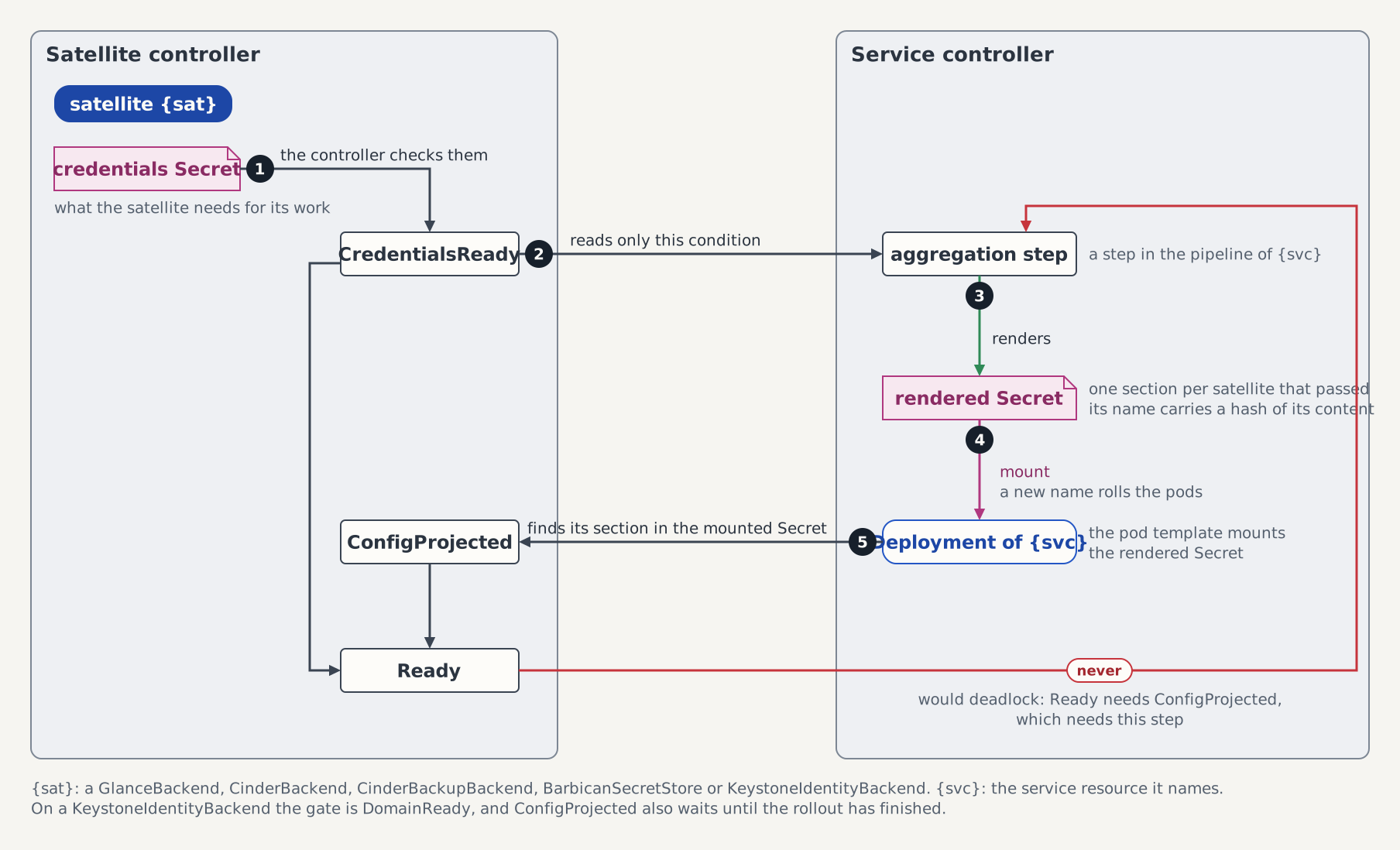
kubectl describe shows the progression: DomainReady=True, then FederationObjectsReady=True (identity provider + protocol upserted) and MappingsReady=True (mapping, groups, role assignments applied), then ConfigProjected=True (the sidecar mounts this backend's client document), then Ready=True. The Keystone CR aggregates all attached backends via its IdentityBackendsReady condition.
The figure shows that order for every satellite kind. Its gate, CredentialsReady, is DomainReady on an identity backend. The handshake lists the five steps and what differs per kind.
The Deployment now runs two containers (keystone, federation-proxy) and the Service's targetPort points at the proxy — the API endpoint itself is unchanged.
Step 6 — Log in as a federated user
CLI (bearer token) — reproducible on the kind devstack
This flow needs oauth2Introspection enabled on exactly one backend (Step 4 sets it). The fixture's keystone client has direct-access-grants enabled, so you can mint a token with a username/password and exchange it — no browser required. Port-forward Keycloak and obtain an access token:
kubectl -n openstack port-forward svc/keycloak 8080:8080 &

TOKEN=$(curl -s http://localhost:8080/realms/cobaltcore/protocol/openid-connect/token \
  -d grant_type=password -d client_id=keystone \
  -d client_secret=keystone-cobaltcore-secret \
  -d username=fry -d password=fry-password \
  -d scope=openid | jq -r .access_token)
KC_HOSTNAME pins the realm issuer to http://keycloak.openstack:8080/realms/cobaltcore, so a token minted through the port-forward still carries the cluster-internal iss the in-cluster proxy expects. Exchange the bearer for an unscoped Keystone token against the devstack's published Keystone endpoint (-k for the devstack's self-signed gateway cert, matching the Quick Start):
# The proxy introspects the bearer (in-cluster, over :8443) and keystone maps
# it to an unscoped token:
curl -sik -H "Authorization: Bearer $TOKEN" \
  "https://keystone.127-0-0-1.nip.io:8443/v3/OS-FEDERATION/identity_providers/keycloak-cobaltcore/protocols/openid/auth" \
  | grep -i x-subject-token
The unscoped token exchanges for a domain- or project-scoped one through the regular POST /v3/auth/tokens — authorized by the roles the mapped group carries.
Browser (WebSSO)
Navigate to
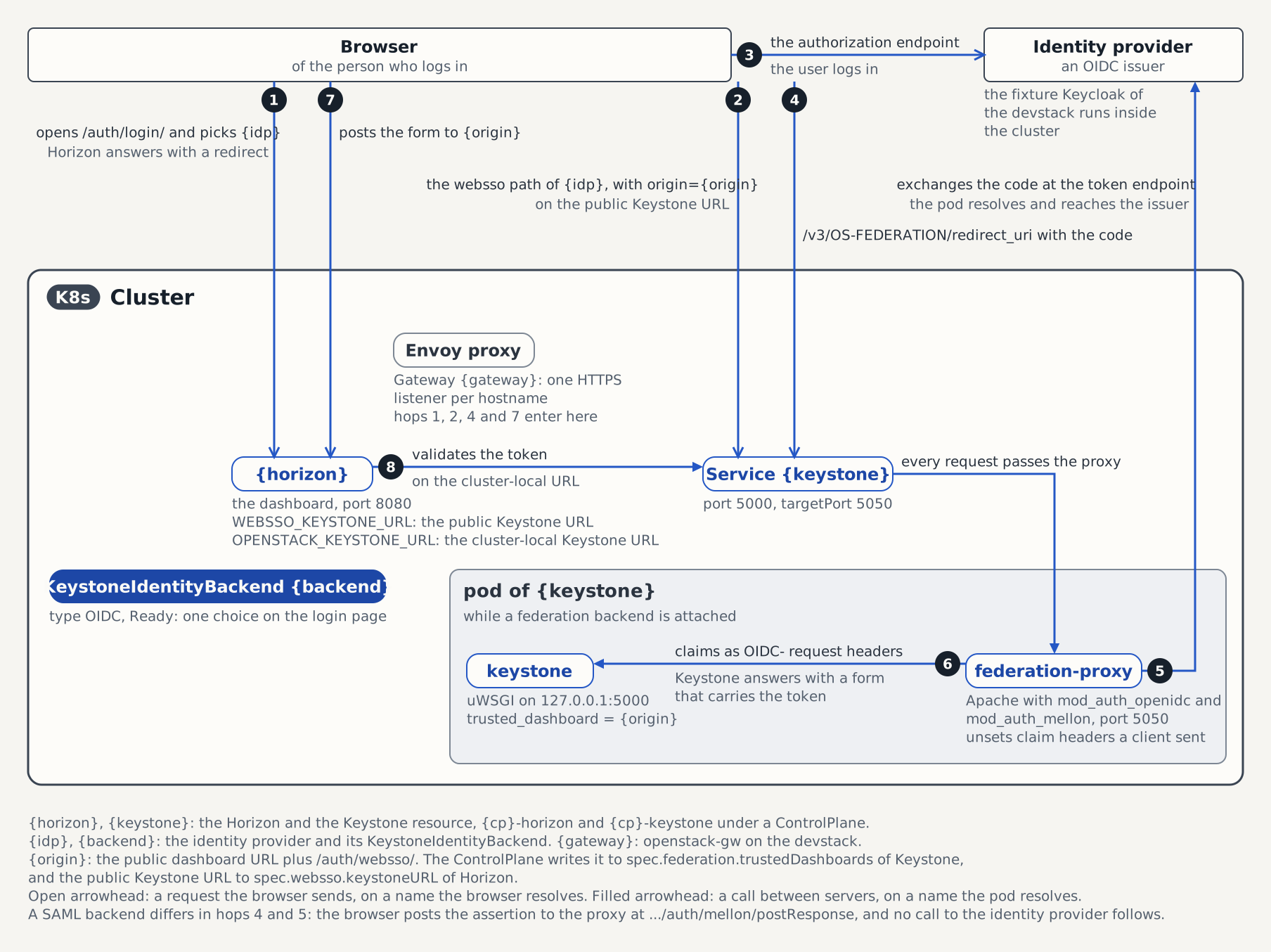
<keystone endpoint base>/v3/auth/OS-FEDERATION/identity_providers/keycloak-cobaltcore/protocols/openid/websso?origin=<dashboard origin>You are redirected to the Keycloak login form; after authenticating, keystone answers with the auto-submitting token form that hands the token to the dashboard. The origin must be listed in keystone's [federation] trusted_dashboard. On a ControlPlane deployment the operator projects this onto the child's typed spec.federation.trustedDashboards from the dashboard's spec.services.horizon (publicEndpoint / gateway) — you do not set it by hand; see End-to-End SSO. On a standalone Keystone, set spec.federation.trustedDashboards directly (see the Standalone Keystone section).
The figure shows this login with Horizon as the dashboard. The URL above is hop 2. The hops of a login lists all eight.
The fixture IdP is not reachable from a host browser
The fixture Keycloak issuer is a cluster-internal Service name, so a browser on your workstation cannot complete the login form against it — the browser WebSSO flow needs an externally reachable IdP (your production Keycloak, or a fixture published through the gateway with matching redirect URIs). The headless authorization-code round trip against the in-cluster fixture is exercised end-to-end by the mirroring e2e suite (see Tested by); the CLI bearer flow above is the copy-pasteable devstack path.
Multiple identity providers
Attach one KeystoneIdentityBackend per realm/IdP; the shared sidecar serves all of them from one metadata directory, and each per-IdP websso path pins its own issuer. Two constraints apply across the OIDC backends of one Keystone (webhook-enforced): remoteIDAttribute must be uniform, and at most one backend may enable oauth2Introspection — the module's OIDCOAuth* resource-server directives are server-scoped. The global /v3/auth/OS-FEDERATION/websso/<protocol> path exists only for a protocol ID that one backend of this Keystone uses alone. Two backends with the same protocol ID get none for it; use the per-IdP paths.
Deleting a backend
kubectl delete keystoneidentitybackend keycloak-cobaltcore de-projects the configuration first (with the last federation backend, OIDC or SAML, the sidecar disappears and the Service returns to uWSGI), then removes the protocol, mapping, and identity provider — always — and finally applies spec.domain.deletionPolicy to the domain like the LDAP flow. Declarative groups live inside the domain and follow it.
Discovery against an in-cluster identity provider
By default the operator's federation-metadata client is SSRF-guarded: it refuses to dial any non-public address when it fetches an OIDC discovery document (or SAML IdP metadata). Auto-discovery of <issuer>/.well-known/openid-configuration therefore cannot reach an IdP on a private in-cluster address — for example the fixture Keycloak's ClusterIP in the kind Service CIDR. That is why Step 4 spells out spec.oidc.endpoints: explicit endpoints skip the metadata fetch entirely and stay the recommended path for air-gapped setups and anywhere the allowlist is not wanted.
To let discovery run against a trusted in-cluster IdP instead, allowlist its address range on the operator deployment. The federation.metadataAllowCidrs chart value (rendered as the operator's --federation-metadata-allow-cidrs flag) lists the extra CIDRs the metadata client may dial:
helm upgrade keystone-operator oci://ghcr.io/c5c3/charts/keystone-operator \
  --namespace keystone-system \
  --set 'federation.metadataAllowCidrs={10.96.0.0/12}'
or in a values file:
federation:
  metadataAllowCidrs:
    - 10.96.0.0/12   # the cluster's Service CIDR
With the Service CIDR allowlisted, an OIDC backend can drop spec.oidc.endpoints and rely on issuer: alone — the operator fetches the discovery document from the in-cluster IdP itself.
Scope the allowlist narrowly
Allowlist the smallest range that reaches the IdP — the cluster's Service CIDR (e.g. 10.96.0.0/12). A default route (0.0.0.0/0, ::/0) is rejected at startup: the operator refuses to boot rather than lift the private-range guard wholesale. The allowlist is operator-level configuration and can never be set or widened from a KeystoneIdentityBackend CR, so a tenant cannot expand the operator's reachable surface. Only the private-range classes are liftable: loopback, link-local (including the cloud IMDS at 169.254.169.254), multicast, and unspecified addresses stay blocked even when an allowlist entry covers them.
A tenant can still aim spec.oidc.providerMetadataURL at any address inside the range you allowlist, so keep the range to what the IdP actually needs. The operator does not help them read the result: every fetch failure — refused connection, timeout, HTTP status, unparseable body — collapses to the same tenant-visible message, and the underlying cause goes to the operator log only.
The operator NetworkPolicy blocks metadata fetches outright
The keystone-operator chart's opt-in NetworkPolicy (networkPolicy.enabled=true) default-denies egress except kube-apiserver and DNS, so it blocks every metadata fetch — public or allowlisted — at the network layer regardless of this allowlist. With that policy enabled, keep spelling out spec.oidc.endpoints; this was already the case for public IdPs.
Security considerations
- Register an exact redirect URI at the IdP. mod_auth_openidc derives the absolute
redirect_urifrom the request URL, so a strictly-registered client turns any host-header manipulation into a login failure rather than a usable redirect. Avoid wildcard redirect URIs in production. - Expose Keystone through
spec.gatewaywhen a proxy sits in front. The sidecar honors inboundX-Forwarded-Host/X-Forwarded-Protofor URL computation only whenspec.gatewayis set; that Gateway is the trust boundary and must overwrite these headers so an in-cluster client cannot spoof them. With no declared gateway the headers are ignored and the sidecar falls back to the request host.
Troubleshooting
| Symptom | Likely cause |
|---|---|
IdentityBackendsReady=False with a FederationProxyImageMissing Warning | The child Keystone CR has no spec.federation.proxyImage. On a ControlPlane deployment the operator always projects it, so this points to a standalone Keystone with no proxy image — set spec.federation.proxyImage on it (see the Standalone Keystone section). |
IdentityBackendSkipped Warning naming provider metadata unavailable (or the client refusing to dial non-public address) | The discovery document could not be fetched from the operator pod, or its issuer does not equal spec.oidc.issuer. The Event withholds the underlying cause on purpose (SSRF probe oracle) — read the operator log for the concrete failure. Check egress/DNS; spell out spec.oidc.endpoints; or — for a trusted in-cluster IdP — allowlist its CIDR via the operator's federation.metadataAllowCidrs chart value (see Discovery against an in-cluster identity provider). |
FederationObjectsReady=False/NoMappingRules | spec.mappings is empty — keystone cannot represent a rule-less mapping; add at least one rule. |
MappingsReady=False/RoleOrProjectNotFound | A role assignment references a role or project that does not exist (yet); the backend retries on a bounded poll. |
| Federated login returns 401 with valid IdP credentials | The mapping did not match: compare the asserted claims (the sidecar logs them at debug) against your remote[].type matchers, and remember the issuer gate must equal the iss claim byte for byte. |
WebSSO ends in 401/403 at the final hop | The origin parameter is not listed in [federation] trusted_dashboard. |
| Bearer-token auth returns non-2xx while browser login works | oauth2Introspection is not enabled on this backend, or another backend already holds the single introspection slot. |
Bearer-token auth returns 401 and introspection yields active:false for a fresh token | The IdP does not list the resource-server client in the token's aud. Recent Keycloak (>= 25) rejects introspection when the introspecting client is absent from the audience — add an audience mapper (or client scope) so the access token's aud includes the clientID. |
Bearer-token auth returns 401 with Access token JWT check failed in the IdP log | The token's iss differs from what the IdP computes at the introspection endpoint (e.g. tokens minted over one hostname/scheme, introspected over another). Pin a fixed frontend URL / hostname on the IdP so the issuer is stable across listeners. |
The backend is skipped with is not https in the Warning | The IdP publishes an http introspection endpoint, which mod_auth_openidc refuses. Point endpoints.introspectionEndpoint at an https listener (and set oauth2Introspection.tlsVerify: false if its certificate is not in the system trust store). |
| Admission rejects the CR | The message names the exact rule: discovery-shape exclusivity, the fixed clientSecret data-key contract, mapping-rule completeness, identity-provider-name uniqueness, remote-id uniformity, or the single-introspection limit. |
Standalone Keystone, without a ControlPlane
On the Quick Start / Quick Start (Extended) devstacks a standalone Keystone CR named keystone runs with no ControlPlane projecting it, so there is no operator projecting the federation block onto it — you set it directly on the Keystone CR.
Proxy image. A standalone Keystone assumes no hidden default, so set spec.federation.proxyImage yourself (mirroring the required spec.image). Without it, OIDC backends stay pending with a FederationProxyImageMissing Warning:
apiVersion: keystone.openstack.c5c3.io/v1alpha1
kind: Keystone
metadata:
  name: keystone
spec:
  # ...
  federation:
    proxyImage:
      repository: ghcr.io/c5c3/keystone-federation-proxy
      tag: latest   # pin a digest for production
Backend keystoneRef. Point the KeystoneIdentityBackend from Step 4 at the standalone CR by name — keystoneRef.name: keystone instead of controlplane-keystone.
Trusted dashboards. Without the ControlPlane there is nothing to project the WebSSO origin, so set spec.federation.trustedDashboards directly on the Keystone CR. It is a list, rendered as one [federation] trusted_dashboard line per entry. See the standalone section of End-to-End SSO for the full shape and the spec.extraConfig conflict rule.
Tested by
Attaching the OIDC backend, watching the conditions converge, and the headless CLI bearer flow are asserted end-to-end on the CI e2e kind cluster by this chainsaw suite:
chainsaw test --test-dir tests/e2e/keystone/oidc-federationThe backend CR the suite applies
The suite isolates its Keystone instance from the parallel suite pool, so its backend CR points keystoneRef at keystone-oidc (and enables oauth2Introspection for the CLI bearer flow) — differing from the controlplane-keystone reference used in the walkthrough above.
apiVersion: keystone.openstack.c5c3.io/v1alpha1
kind: KeystoneIdentityBackend
metadata:
  name: keycloak-cobaltcore
  namespace: openstack
spec:
  keystoneRef:
    name: keystone-oidc
  domain:
    name: cobaltcore
    mode: Manage
    deletionPolicy: Delete
    description: Keycloak cobaltcore realm
  type: OIDC
  oidc:
    issuer: http://keycloak.openstack:8080/realms/cobaltcore
    clientID: keystone
    clientSecretRef:
      name: keycloak-cobaltcore-client
    # Explicit endpoints: this backend pins the explicit-endpoints path while
    # 03-backend2-cr.yaml pins discovery mode, so both metadata shapes stay
    # covered. Everything speaks the fixture's plain-http listener EXCEPT the
    # introspection endpoint, which mod_auth_openidc requires to be https — the
    # fixture serves it on the self-signed 8443 listener, and tlsVerify opts out
    # of verifying that throwaway certificate.
    endpoints:
      # The browser opens this endpoint, so it uses the issuer's host: Keycloak
      # posts the login form to that host, and a session cookie set on the FQDN
      # would not be sent along (400, cookie_not_found).
      authorizationEndpoint: http://keycloak.openstack:8080/realms/cobaltcore/protocol/openid-connect/auth
      tokenEndpoint: http://keycloak.openstack.svc.cluster.local:8080/realms/cobaltcore/protocol/openid-connect/token
      jwksURI: http://keycloak.openstack.svc.cluster.local:8080/realms/cobaltcore/protocol/openid-connect/certs
      userinfoEndpoint: http://keycloak.openstack.svc.cluster.local:8080/realms/cobaltcore/protocol/openid-connect/userinfo
      introspectionEndpoint: https://keycloak.openstack.svc.cluster.local:8443/realms/cobaltcore/protocol/openid-connect/token/introspect
    oauth2Introspection:
      enabled: true
      tlsVerify: false
  mappings:
  - remote:
    - type: HTTP_OIDC_ISS
      anyOneOf:
      - http://keycloak.openstack:8080/realms/cobaltcore
    - type: HTTP_OIDC_PREFERRED_USERNAME
    local:
    # {0} is the first value-producing remote: the HTTP_OIDC_ISS rule carries
    # anyOneOf, so Keystone treats it as a pure condition and never adds it to
    # the positional direct-map tuple — HTTP_OIDC_PREFERRED_USERNAME is the only
    # value, at index 0 (a "{1}" here raises DirectMappingError/IndexError).
    - user:
        name: "{0}"
      group:
        name: federated-users
        domain:
          name: cobaltcore
  groups:
  - name: federated-users
    description: Federated Keycloak cobaltcore users
    roleAssignments:
    - role: member
      domain: true