OVNChassis CRD
ovnchassis.ovn.openstack.c5c3.io/v1alpha1, kind OVNChassis. The CRD is generated from operators/ovn/api/v1alpha1/ovnchassis_types.go; the defaulting and validating webhooks live in operators/ovn/api/v1alpha1/ovnchassis_webhook.go.
One CR describes one class of node. It puts the Open vSwitch and ovn-controller DaemonSets onto the nodes spec.nodeSelector matches and registers each of those nodes as a chassis with the OVNCentral it names. Everything below the selector applies uniformly to every node matched: the bridge mappings, the encapsulation, the rollout pace. A deployment whose gateway nodes carry different wiring, or an availability zone with its own provider networks, gets a second CR of its own; widening the selector would apply one CR's wiring to nodes that do not have it.
The link to the control plane is one field. spec.centralRef names an OVNCentral in the same namespace; the chassis wait for its published Southbound address and for status.clientSecretName, and mount that Secret. A central that projects onto another cluster than the chassis is reached at the addresses it publishes on node ports, and the chassis mounts a copy of its Secret, {name}-ovn-client, which the operator writes on the chassis's own cluster. Both refs are immutable, because repointing a live chassis strands its registration in the old Southbound database.
kubectl get ovnchassis prints Ready (.status.conditions[?(@.type=='Ready')].status), Desired (.status.desiredNumberScheduled), Ready pods (.status.numberReady), and Age.
Spec
| Field | Type | Required | Default | Description |
|---|---|---|---|---|
image | *commonv1.ImageSpec | no | operator-resolved ghcr.io/c5c3/ovn:26.03.2 | The image that runs Open vSwitch and ovn-controller. Both ship in the one OVN image, so one reference covers them. The operator resolves it at reconcile time, so an unset field keeps tracking its tested version across upgrades (image.go). An unset image names no pullPolicy of its own, so its containers take the operator default (--default-image-pull-policy) or the rule: Always for the tag (see pull policy resolution) |
centralRef | OVNCentralRef | yes | none | The OVNCentral whose Southbound database these chassis connect to and whose client Secret they mount. Immutable, enforced by a CEL transition rule and by the webhook |
nodeSelector | map[string]string (MinProperties=1) | yes | none | The nodes both DaemonSets land on. At least one label is required: an empty selector matches every node in the cluster, which would start ovn-controller on the control-plane nodes and on whatever joins later |
tolerations | []corev1.Toleration | no | none | Lets the DaemonSet pods run on tainted nodes. Networking nodes are commonly tainted to keep ordinary workloads off them, and the chassis pods are what has to run there |
jobs | *commonv1.JobBaseSpec | no | nil | Sizes and prioritizes the maintenance Jobs: apply, evacuate and chassis-del. It carries resources and priorityClassName only. Unset resources default to a 70m CPU request and 368Mi memory as request and limit, and an unset priority class renders none; there is no fallback Deployment. The Jobs take spec.tolerations. The block has no placement fields: the apply Job is pinned to its node, and a node selector that node does not match fails the pinned pod's kubelet admission |
gateway | *OVNGatewaySpec | no | nil | Marks the subset of the selected nodes that announce enable-chassis-as-gw, the flag that makes a chassis eligible to host a distributed router's gateway port. When nil no node in this CR is a gateway |
bridgeMappings | []OVNBridgeMapping | no | none | Maps each OpenStack physical network onto the local OVS bridge that reaches it. List-map keyed by physicalNetwork. Every node this CR selects gets the same mapping |
encapType | string (Enum geneve, vxlan) | no | geneve | The tunnel protocol between chassis. Geneve carries the variable-length option header OVN uses for its logical metadata; VXLAN has no room for it and so caps the logical topology. VXLAN exists for hardware that cannot terminate Geneve |
updateStrategy | OVNChassisUpdateStrategy | no | {} | Paces the DaemonSet rollout. Restarting ovn-controller interrupts the dataplane programming on that node, so the pace is a per-deployment tradeoff |
remoteProbeIntervalMs | int32 (Minimum=0) | no | 60000 | How long ovn-controller lets its Southbound connection sit idle before probing it. Zero disables the probe, which is what a chassis behind a connection-tracking middlebox needs when the probe is what tears the connection down |
ovs | *OVNChassisOVSSpec | no | nil | Tunes the ovs-vswitchd container: its resources and its revalidator thread count. When nil the operator renders no requests or limits for the container and pins 2 revalidator threads. The local ovsdb-server container beside it takes no resources from any field |
controller | *OVNChassisContainerSpec | no | nil | Tunes the ovn-controller container |
verticalAutoscaling | *VerticalAutoscalingSpec | no | nil | Opts both chassis DaemonSets, {name}-ovs and {name}-ovn-controller, one VPA each, into a VerticalPodAutoscaler that controls the requests of its containers; see VerticalAutoscalingSpec. On a cluster without the VPA, VPAReady turns False with reason VPANotInstalled. |
targetClusterRef | *commonv1.TargetClusterRefSpec | no | nil (the local cluster) | The registered target cluster the DaemonSets are created on. The CR itself, its status and its finalizer stay on the management cluster. Immutable, enforced by two CEL transition rules and by the webhook. It may name another cluster than the OVNCentral's, which then has to publish both databases outside its cluster (see Conditions). See Target Clusters |
OVNCentralRef
| Field | Type | Required | Default | Description |
|---|---|---|---|---|
name | string (MinLength=1) | yes | none | The OVNCentral's name. The reference is namespace-local: the chassis mount the client Secret it publishes, and a Secret cannot be mounted across namespaces. Across clusters the chassis mounts the copy in the same namespace on its own cluster |
OVNGatewaySpec
| Field | Type | Required | Default | Description |
|---|---|---|---|---|
nodeSelector | map[string]string (MinProperties=1) | yes | none | Picks the gateway nodes out of the set spec.nodeSelector already matched, so it can only narrow that set. At least one label is required: an empty selector would promote every selected node to a gateway, spreading external connectivity across nodes with no uplink to carry it |
OVNBridgeMapping
Ties one OpenStack physical network to one local OVS bridge.
| Field | Type | Required | Default | Description |
|---|---|---|---|---|
physicalNetwork | string (Pattern ^[a-z0-9]([-a-z0-9]*[a-z0-9])?$, MaxLength=63) | yes | none | The provider-network name Neutron knows the segment by. The grammar is the DNS-1123 label the Neutron network name is bounded to |
bridge | string (Pattern ^[a-zA-Z0-9_.-]{1,15}$) | yes | none | The local OVS bridge name, bounded to 15 characters: the bridge appears as a Linux interface and the kernel's IFNAMSIZ leaves 15 usable bytes |
OVNChassisUpdateStrategy
A narrowed DaemonSetUpdateStrategy. There is no maxSurge counterpart, because a second ovn-controller on the same node would contend with the first one over the local Open vSwitch database.
| Field | Type | Required | Default | Description |
|---|---|---|---|---|
type | string (Enum RollingUpdate, OnDelete) | no | RollingUpdate | The rollout mode. OnDelete hands the pace to whoever drains the nodes, which is what a deployment with an external maintenance workflow wants |
maxUnavailable | *intstr.IntOrString | no | operator-resolved 1 | How many selected nodes may lose their dataplane programming at once. It applies to RollingUpdate only, and the webhook rejects it alongside OnDelete so it cannot read as effective |
OVNChassisOVSSpec
The ovs block carries the fields of OVNChassisContainerSpec inline, so spec.ovs.resources keeps its place, and adds one field.
| Field | Type | Required | Default | Description |
|---|---|---|---|---|
resources | *corev1.ResourceRequirements | no | none | As in OVNChassisContainerSpec, for ovs-vswitchd and host-prepare |
revalidatorThreads | *int32 (Minimum=1) | no | operator-resolved 2 | The number of revalidator threads ovs-vswitchd runs, the threads that dump the datapath flows and expire or revalidate them. The operator resolves the default at render time and never writes it into the CR |
The count reaches the ovs-vswitchd container as the environment variable OVS_REVALIDATOR_THREADS, and run-vswitchd.sh writes it as other_config:n-revalidator-threads into the node's Open_vSwitch table before it starts the daemon. A pod created before the operator upgrade has no such variable, but the kubelet still refreshes the script inside it. When that pod's ovs-vswitchd container restarts, the script skips the write and starts the daemon with the OVS default count, which lasts until the DaemonSet replaces the pod.
Unpinned, OVS 3.7 starts the handler count divided by four, plus one, revalidators. The handler count follows the CPU cores in the process's CPU affinity, so the default would be 2 revalidators on a 4-CPU node and 5 on a 16-CPU node, and a chassis pod's footprint would depend on the node it lands on. The handler threads cannot be pinned the same way. Under the kernel datapath's per-CPU upcall dispatch, which Linux 5.14 and later provide, OVS starts one handler per core in its CPU affinity and overrides other_config:n-handler-threads. A CPU limit does not change that affinity; only a cpuset bounds the handlers.
ovs-vswitchd logs the applied counts at INFO when it starts its threads:
Overriding n-handler-threads to <n>, setting n-revalidator-threads to <m>kubectl logs <pod> -c ovs-vswitchd shows the line, and kubectl exec <pod> -c ovs-vswitchd -- ovs-vsctl get open . other_config:n-revalidator-threads prints the pinned value. The value lives in the node's conf.db, which outlives the pod. Every start of ovs-vswitchd writes it again, so changing revalidatorThreads takes effect when the DaemonSet rolls the pod. An operator downgrade to a release without the field leaves the last value in place; remove it with ovs-vsctl remove open . other_config n-revalidator-threads.
OVNChassisContainerSpec
| Field | Type | Required | Default | Description |
|---|---|---|---|---|
resources | *corev1.ResourceRequirements | no | none | Requests and limits for the container and for the init container that prepares it: host-prepare in the OVS DaemonSet for spec.ovs, apply-node in the controller DaemonSet for spec.controller. An init container never runs beside the main containers, so this adds nothing to the pod's footprint. When nil the operator renders none on either, unless a LimitRange in the namespace fills them in: what a datapath needs depends on the traffic the node carries, so no default fits most hardware |
Defaulting and validation
The mutating webhook leaves the object untouched. Every default is either a +kubebuilder:default the API server applies from the CRD schema, or a value the operator resolves at reconcile time: the image and the maxUnavailable of 1. Resolving those two late keeps an unset field tracking the operator default across upgrades instead of freezing today's value into the stored CR. The webhook stays registered so a default that has to be materialized later can be added without changing the deployed webhook configuration.
Schema-layer rules
These hold even when the webhook is down.
| Message | Where it comes from |
|---|---|
targetClusterRef is immutable | Two CEL transition rules on OVNChassisSpec, one for adding or removing the ref and one for renaming it |
centralRef is immutable | A third transition rule on OVNChassisSpec. Repointing a live chassis leaves its registration behind in the old Southbound database, where it keeps claiming the ports of workloads that have moved on |
exactly one of image.tag or image.digest must be set | Inherited from commonv1.ImageSpec on spec.image |
The three transition rules are evaluated on UPDATE only. Beside them the schema carries the ordinary field markers: MinProperties=1 on both selectors, the geneve/vxlan enum on spec.encapType, the RollingUpdate/OnDelete enum on spec.updateStrategy.type, Minimum=0 on spec.remoteProbeIntervalMs, Minimum=1 on spec.ovs.revalidatorThreads, the two patterns on a bridge mapping, and MinLength=1 on spec.centralRef.name. spec.bridgeMappings is a list-map keyed by physicalNetwork, so the API server already refuses a repeated physical network.
Webhook rules
The validating webhook accumulates every violation into one admission response.
| Message | Trigger |
|---|---|
name must be at most %d characters: the per-node Jobs append up to 21 characters and Kubernetes caps object names at 63 | metadata.name longer than MaxOVNChassisNameLength. The argument is the bound, 42 |
centralRef.name must be set | spec.centralRef.name is empty |
centralRef is immutable | An update renames spec.centralRef.name, the webhook-layer twin of the CEL rule |
nodeSelector must carry at least one label | spec.nodeSelector is empty or absent, mirroring the MinProperties=1 marker |
gateway.nodeSelector must carry at least one label | spec.gateway is set with an empty selector, mirroring the second MinProperties=1 marker |
maxUnavailable applies to RollingUpdate only | spec.updateStrategy.maxUnavailable is set alongside type: OnDelete, where nothing reads it |
maxUnavailable must be an integer or a percentage such as "25%" | The value is neither, so intstr.GetScaledValueFromIntOrPercent refuses it |
maxUnavailable must resolve to at least 1 for RollingUpdate | The value scales to zero, which is a rollout that can never move a node |
Duplicate value on spec.bridgeMappings[i].bridge | Two mappings name the same local bridge. The rendered ovn-bridge-mappings string would have its second entry shadow the first, and the list-map key covers the physical-network side alone |
Duplicate value on spec.bridgeMappings[i].physicalNetwork | Two mappings name the same physical network. The +listMapKey already refuses this at the schema layer; the webhook repeats it so the invariant holds where schema validation is bypassed |
repository must be set | spec.image.repository is empty |
exactly one of image.tag or image.digest must be set | Both or neither are set on spec.image, re-checked outside the schema |
target cluster name must be set | spec.targetClusterRef is present with an empty name |
targetClusterRef is immutable (adding or removing it after creation is not permitted) | An update adds or drops the ref. Both strand the children already created on the previously selected cluster |
targetClusterRef is immutable (the children already exist on the previously named cluster) | An update renames the ref |
%s request must not exceed limit (%s) | A request in spec.jobs.resources above its own limit |
field.NotFound on spec.jobs.priorityClassName | The named PriorityClass does not exist. Skipped when no lookup client is injected, and for "" |
revalidatorThreads must be at least 1 | spec.ovs.revalidatorThreads is set below 1, mirroring the Minimum=1 marker |
The percentage in maxUnavailable is scaled against 100, not against the node count, and rounded up the way the DaemonSet controller rounds it. The nodes a DaemonSet lands on are unknown at admission time, and a percentage that rounds to zero on a smaller cluster wedges the rollout the same way. 1% is therefore admitted and behaves as one node.
MaxOVNChassisNameLength is 42. The child with the tightest name budget is the per-node chassis-deletion Job: {name}-chassis-del-{8 hex} adds 21 characters, and Kubernetes caps an object name at 63. The bound is enforced on create only. metadata.name is immutable, so on update the rule could only fire against an object a pre-upgrade operator already admitted, and the validating webhook also sees the finalizer-removal update that completes a deletion: rejecting that one would wedge the CR in Terminating with no field left to edit.
One cross-CR constraint is outside the webhook's reach. spec.centralRef may name an OVNCentral that does not exist at admission time, so the controller checks it. When the two CRs project onto different clusters, the central has to set spec.northbound.externallyReachable and spec.southbound.externallyReachable: the chassis dials the Southbound database, and the gateway-evacuation Job writes the Northbound one. A central that publishes either one alone leaves the chassis at CentralReady=False with reason CentralNotExternallyReachable, and the message names both fields.
Status
| Field | Type | Description |
|---|---|---|
conditions | []metav1.Condition | List-map keyed by type; see Conditions |
observedGeneration | int64 | The .metadata.generation the controller last reconciled |
installedImage | string | The image reference the running DaemonSets were projected from, recorded once the ovn-controller DaemonSet reports every node ready. It tells a rollout that has not reached the nodes from one that has |
clientSecretName | string | The Secret in this CR's namespace, on the cluster this CR projects onto, that the chassis pods mount: the OVNCentral's status.clientSecretName when both CRs project onto the same cluster, the copy {name}-ovn-client when they do not. A NeutronMetadataAgent attached to this chassis mounts the same Secret |
desiredNumberScheduled | int32 | How many nodes the DaemonSets should run on, mirrored from the ovn-controller DaemonSet |
numberReady | int32 | How many of those nodes have a ready ovn-controller pod |
nodes | []OVNChassisNodeStatus | The per-node registration state, list-map keyed by name |
The two counters are read from the ovn-controller DaemonSet, not from the Open vSwitch one: ovn-controller is what makes a node a chassis, and a node running Open vSwitch alone carries no logical flows.
OVNChassisNodeStatus
status.nodes is what the controller works from; it re-derives nothing from the Southbound database on a normal pass. A node that stops being selected disappears from the node list while its chassis registration survives, so the record of it has to outlive the selection.
| Field | Type | Description |
|---|---|---|
name | string | The node's name. Also the key of that node's entry in the {name}-nodes ConfigMap and the file the pod on it reads |
systemID | string | The chassis identity ovn-controller registered in the Southbound database, a UUID. A chassis-deletion Job addresses it, so it has to be recorded before the node goes away |
gateway | bool | Whether the node currently announces enable-chassis-as-gw. It reports what the node last applied, so the flip to false is held back until the evacuation has landed |
configHash | string | Eight hex characters of the SHA-256 of the entry the node last applied. Comparing it against the rendered entry tells a configuration change from a node that has not reported back yet |
gatewayEvacuated | bool | The evacuation Job moved the gateway ports off this node and succeeded. It resets when the node takes the gateway role back, so a re-promoted node is not treated as still drained |
leaving | bool | The node is no longer selected, or no longer in the cluster, and its chassis registration has still to be deleted. Until that deletion lands the stale chassis keeps claiming the ports of workloads that have moved elsewhere |
Conditions
Seven sub-reconcilers set six condition types: the client-Secret step reports under CentralReady, the condition of the central step before it. The aggregate Ready is True only when all six are. For the pipeline that sets them see Reconciler Architecture.
| Type | Status | Reason | Meaning |
|---|---|---|---|
CentralReady | True | CentralResolved | The OVNCentral published the addresses that apply and its client Secret, and the Secret the pods mount is in place. The message names the address the chassis dial: the relay or the Southbound database inside one cluster, the relay's or the Southbound database's node address across clusters |
CentralReady | False | CentralNotFound | No OVNCentral of that name in the namespace. An OVNChassis applied before its OVNCentral is an ordinary ordering of two objects in one manifest, so this polls |
CentralReady | False | CentralReadError | Reading the OVNCentral failed |
CentralReady | False | CentralNotExternallyReachable | The two CRs project onto different clusters and the central does not set both spec.northbound.externallyReachable and spec.southbound.externallyReachable. The message names both clusters and both fields. No requeue: the fix is an edit to the central, which the central watch delivers |
CentralReady | False | CentralNotReady | The OVNCentral has not published the Southbound address that applies (outside its cluster, across a boundary) or its client Secret yet, or it publishes its relay outside its cluster and has no relay node address yet |
CentralReady | False | ClientSecretPending | The central's client Secret does not exist yet on the central's cluster, so there is nothing to copy. Polls |
CentralReady | False | ClientSecretIncomplete | The central's client Secret lacks tls.crt, tls.key or ca.crt, or carries one empty. The message names the key. Polls |
CentralReady | False | ClientSecretReadError | Reading the central's client Secret failed |
CentralReady | False | ClientSecretCopyFailed | Writing the copy {name}-ovn-client failed, or a Secret of that name exists that this chassis does not own, which the operator refuses to overwrite |
CentralReady | False | CentralUpgrading | The central's status.installedImage differs from the image it resolves, so its own rollout is still in flight. OVN's supported upgrade order is central first, hypervisors second: ovn-controller reads the Southbound schema the central owns |
CentralReady | False | TargetClusterUnavailable | spec.targetClusterRef names a cluster that does not resolve, or the cluster the central projects onto does not resolve when the client Secret has to be copied from it. This is the pipeline's first gate, so the failure lands on the condition the rest of the graph waits behind |
NodesReady | True | NodesRendered | Every selected node has an entry in the {name}-nodes ConfigMap. The message counts the entries and how many of them are leaving |
NodesReady | False | NoMatchingNodes | No node carries spec.nodeSelector. The message repeats the selector. Both ConfigMaps are still applied, because a pod whose ConfigMap volume does not exist never starts |
NodesReady | False | NodeListError | Listing the nodes of the target cluster failed |
NodesReady | False | NodesError | Reading the live nodes ConfigMap or applying one of the two ConfigMaps failed |
OVSReady, ControllerReady | True | DaemonSetReady | That DaemonSet runs a ready pod on every node it selects. A DaemonSet selecting no node is ready on zero nodes: its rollout has nothing left to do |
OVSReady, ControllerReady | False | DaemonSetProgressing | Fewer nodes run a ready pod than the DaemonSet schedules. The message counts both |
OVSReady, ControllerReady | False | DaemonSetError | The DaemonSet could not be applied or read |
MaintenanceReady | True | MaintenanceIdle | No node has maintenance outstanding |
MaintenanceReady | True | MaintenanceRunning | Per-node Jobs are in flight. The message names the nodes. It stays True: a Job that runs finishes on its own, and holding the aggregate Ready down for it would report a rolling drain as an outage |
MaintenanceReady | True | MaintenanceDeferred | A node needs an address the OVNCentral has not published. It outranks MaintenanceRunning in the message, because this one waits on another CR |
MaintenanceReady | False | MaintenanceJobFailed | A per-node Job reached a terminal failure. The message names the kind, the Job and the node. No error is returned: a rerun under an unchanged key produces the same failure |
MaintenanceReady | False | MaintenanceError | Running a Job, or dropping a deregistered node from the ConfigMap, failed |
Ready | True | AllReady | All six sub-conditions are True |
Ready | False | NotAllReady | At least one is not |
VPAReady | True | VPAReady | The VerticalPodAutoscaler of every opted-in workload is applied; the message names them. See VerticalAutoscalingSpec |
VPAReady | True | VPANotRequired | No workload opts in (spec.verticalAutoscaling unset); a VPA the CR created before is deleted |
VPAReady | False | VPANotInstalled | A workload opts in, but the cluster the children land on does not serve autoscaling.k8s.io/v1 VerticalPodAutoscaler. Nothing is created, and the other conditions still converge |
VPAReady | False | CapabilityProbeFailed | The target cluster the CR names could not be probed for the kind |
VPAReady | False | VPAError | Listing, applying or deleting a VPA failed; the message carries the error |
Sub-Resource Naming Convention
Every child takes the CR name plus a component suffix. For an OVNChassis named {name}:
| Resource | Name | Notes |
|---|---|---|
| DaemonSet | {name}-ovs | ovsdb-server and ovs-vswitchd on the selected nodes, in the node's network namespace |
| DaemonSet | {name}-ovn-controller | ovn-controller, connected to the Southbound address the central published |
| ConfigMap | {name}-nodes | One key per node this CR is responsible for, carrying that node's values. One object serves every node: the pod on a node reads the file named after it and ignores the rest |
| ConfigMap | {name}-chassis-scripts | The scripts both DaemonSets and the three Jobs run. The suffix names the kind, so a chassis and a central of the same name keep separate scripts ConfigMaps in one namespace |
| Secret | {name}-ovn-client | Only while the central projects onto another cluster. The copy of the central's client identity (tls.crt, tls.key, ca.crt) the pods mount, kept equal to the source across renewals. Swept with the DaemonSets on a placed chassis, garbage-collected through its controller reference on a local one |
| Job | {name}-apply-<8 hex> | Re-applies one node's values after they changed. Pinned to that node and in its network namespace |
| Job | {name}-evacuate-<8 hex> | Moves the gateway duties off one node, against the Northbound database |
| Job | {name}-chassis-del-<8 hex> | Deletes one node's Southbound Chassis row, against the Southbound database |
The eight hex characters are the first four bytes of the SHA-256 of the node name. A node name is a DNS subdomain of up to 253 characters and a Job name has 63, so the name is hashed into the suffix; four bytes tell any two node names of one cluster apart. Each Job runs with backoffLimit: 0, an active deadline of 300 seconds and a TTL of 86400 seconds after it finishes.
The longest of the three suffixes is what bounds metadata.name at 42 characters. See Webhook rules.
Node contract
spec.nodeSelector is required and is copied onto both DaemonSets, so the pods land where the CR says and nowhere else. spec.gateway.nodeSelector is evaluated on top of it: a node is a gateway when it matches both. A nil spec.gateway matches no node.
The figure shows the two chassis pods on a node, the pods of a metadata agent and of a compute pool that wait for them, and what a gateway node adds.
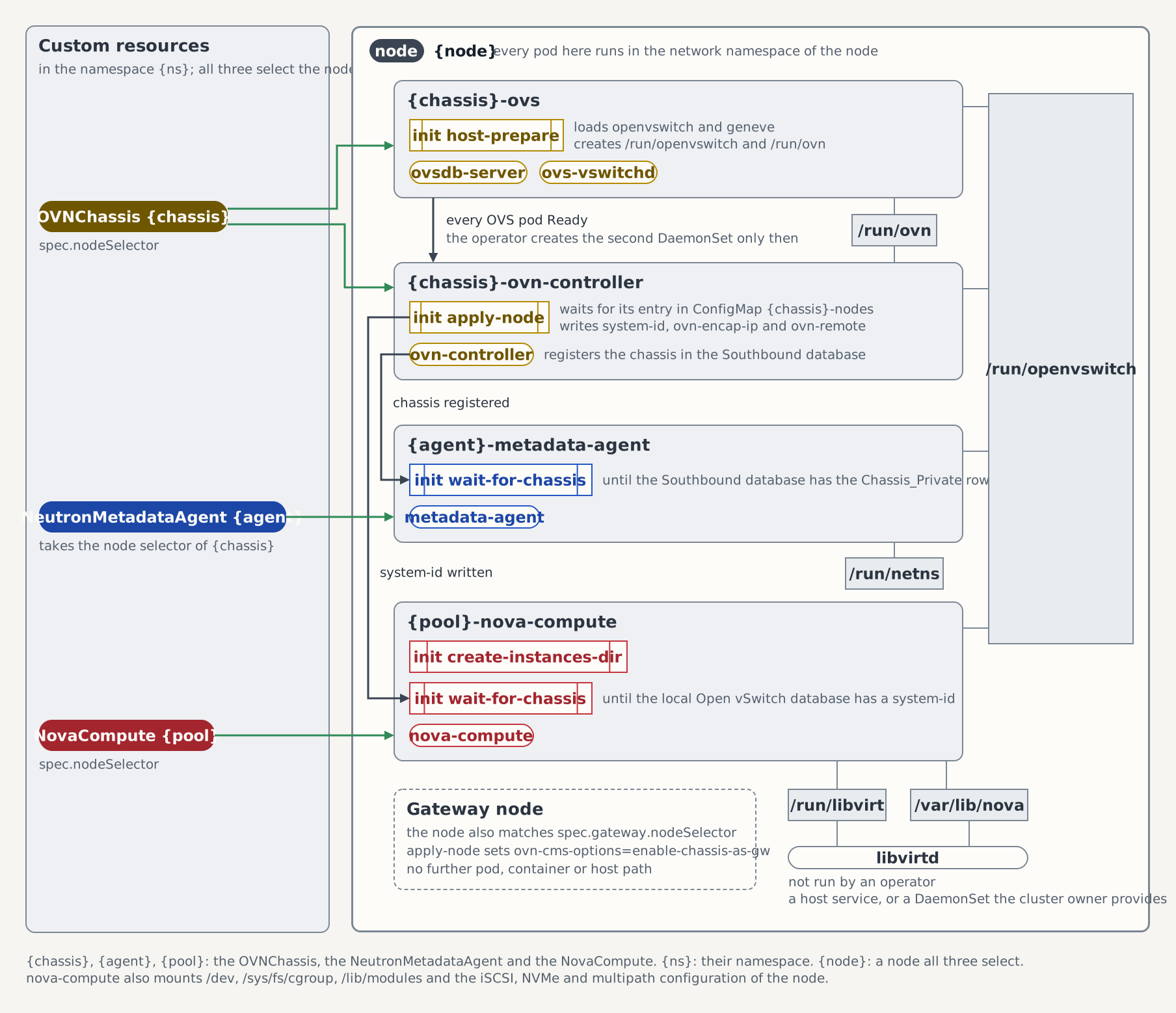
The operator never writes a Node. Its RBAC on nodes is get, list and watch, and the labels a node carries are an input. Whoever provisions the cluster owns them.
Both DaemonSets run with hostNetwork: true. The tunnels between chassis terminate on the node's own address, and the bridges the datapath attaches to are the node's interfaces. Three host paths are mounted:
| Path | Mounted by | Why it is a host path |
|---|---|---|
/run/openvswitch | both DaemonSets, the apply Job | The local Open vSwitch database, the sockets the containers reach each other through, and the pid files. The kernel datapath outlives the pod: a restarted pod that found an empty directory would build a second database and leave the flows of the first one behind |
/run/ovn | both DaemonSets | ovn-controller's socket and pid file, for the same reason |
/lib/modules | the ovs DaemonSet, read-only | The node's kernel module tree, which the init container loads the datapath modules from. It is mounted as it is, with no DirectoryOrCreate, so a node that has no module tree fails on the mount instead of on a modprobe |
The one privileged container is the host-prepare init of the {name}-ovs DaemonSet. It runs modprobe openvswitch && modprobe geneve, creates the two run directories group-writable under uid and gid 42424, creates the local database when the node carries none, and converts an existing one to the schema of the image that is now running. Everything else runs unprivileged or with two named capabilities: NET_ADMIN and SYS_NICE on ovs-vswitchd, NET_ADMIN on ovn-controller. SYS_NICE is what lets ovs-vswitchd raise the priority of its own polling threads; without it every start logs the failure and the daemon runs at ordinary priority.
The apply-node init container of the {name}-ovn-controller pod is what writes the node's identity into the local database, and the apply Job runs the same script. It waits for its own key in the {name}-nodes ConfigMap, then sets these external_ids on the Open_vSwitch table:
| Key | Value |
|---|---|
system-id | The UUID recorded as status.nodes[].systemID |
hostname | The node name, from the downward API |
ovn-encap-type | spec.encapType |
ovn-encap-ip | The node's own address, from the downward API |
ovn-remote | The Southbound relay when the central runs one the chassis can reach: on another cluster, only a relay published with spec.relay.externallyReachable. The Southbound database itself otherwise |
ovn-remote-probe-interval | spec.remoteProbeIntervalMs |
ovn-bridge-mappings | The physnet:bridge list rendered from spec.bridgeMappings, in spec order. Removed when there are no mappings, never set to the empty string: ovs-vsctl refuses a value-less assignment and would fail the init container under set -eu |
ovn-cms-options | enable-chassis-as-gw on a gateway node, removed on every other one |
Every mapped bridge is then created with ovs-vsctl --may-exist add-br. ovn-controller attaches patch ports to a bridge but never creates one, so a mapping pointing at a bridge that does not exist would silently drop every packet on that physical network.
The ovs-vswitchd container writes one other_config key on the same table itself, before its daemon starts: n-revalidator-threads, from spec.ovs.revalidatorThreads.
The CRD fixes no label keys. The suites and the guides use openstack.c5c3.io/chassis=true for the nodes an OVNChassis selects and openstack.c5c3.io/gateway=true for the gateway subset, and following that convention keeps a deployment readable next to the e2e fixtures.
Example
apiVersion: ovn.openstack.c5c3.io/v1alpha1
kind: OVNChassis
metadata:
  name: ovn-chassis
  namespace: openstack
spec:
  centralRef:
    name: ovn-chassis-central
  nodeSelector:
    openstack.c5c3.io/chassis: "true"
This is the fixture the chassis-single-node suite applies (tests/e2e/ovn/chassis-single-node/02-ovnchassis-cr.yaml). It carries no bridge mappings and no gateway: a kind node has no provider network to map, and a gateway chassis without an uplink would announce connectivity it does not have. spec.image is left unset so the operator resolves the same OVN image the control plane runs.