Keystone Reconciler Architecture
Reference documentation for the KeystoneReconciler and its sub-reconciler contracts. The KeystoneReconciler implements the control loop that drives a Keystone CR from desired state to a fully operational Keystone Identity Service deployment.
For CRD type definitions and webhooks, see Keystone CRD API Reference. For the shared library functions used by sub-reconcilers, see Kubernetes-Interacting Packages.
For the NetworkPolicy that hardens the keystone-operator pod itself (distinct from the per-CR NetworkPolicy emitted by reconcileNetworkPolicy below), see Keystone Operator NetworkPolicy.
Controller Registration
The KeystoneReconciler is registered with the controller manager in operators/keystone/main.go via the shared bootstrap package:
import (
    keystonev1alpha1 "github.com/c5c3/cobaltcore/operators/keystone/api/v1alpha1"
    "github.com/c5c3/cobaltcore/operators/keystone/internal/controller"
)

// In init():
utilruntime.Must(keystonev1alpha1.AddToScheme(scheme))
utilruntime.Must(esov1alpha1.SchemeBuilder.AddToScheme(scheme))
utilruntime.Must(esov1beta1.SchemeBuilder.AddToScheme(scheme))
utilruntime.Must(mariadbv1alpha1.AddToScheme(scheme))

// In SetupFunc:
(&controller.KeystoneReconciler{
    Client:   mgr.GetClient(),
    Scheme:   mgr.GetScheme(),
    Recorder: mgr.GetEventRecorder("keystone-controller"),
}).SetupWithManager(mgr)
Scheme Registration
The operator registers these external schemes in init() to support typed interactions with external operator CRDs:
| Module | Scheme | Types Used |
|---|---|---|
github.com/external-secrets/external-secrets | esov1alpha1.SchemeBuilder | PushSecret |
github.com/external-secrets/external-secrets | esov1beta1.SchemeBuilder | ExternalSecret |
github.com/mariadb-operator/mariadb-operator | mariadbv1alpha1.AddToScheme | Database, User, Grant |
Note: ESO uses separate
v1beta1andv1alpha1scheme builders (not a singleAddToScheme). Both must be registered independently.
Watches
The controller watches the primary Keystone CR and all owned resources:
| Resource | Watch Type | Effect |
|---|---|---|
Keystone | For() | Triggers reconciliation on CR changes, filtered by a predicate (see below) so the controller is not re-woken by its own status writes |
Deployment | Owns() | Triggers reconciliation when owned Deployment changes |
Service | Owns() | Triggers reconciliation when owned Service changes |
ConfigMap | Owns() | Triggers reconciliation when owned ConfigMap changes |
Job | Owns() | Triggers reconciliation when owned Job changes |
PodDisruptionBudget | Owns() | Triggers reconciliation when owned PDB changes |
HorizontalPodAutoscaler | Owns() | Triggers reconciliation when owned HPA changes |
NetworkPolicy | Owns() | Triggers reconciliation when the owned NetworkPolicy changes |
VerticalPodAutoscaler | Owns() (optional) | Registered only when the cluster serves the VerticalPodAutoscaler kind; reacts to changes of its spec |
CronJob | Owns() | Triggers reconciliation when owned CronJob changes |
HTTPRoute | Owns() (optional) | Registered only when the gateway.networking.k8s.io/v1 CRD is installed; detected at startup via the manager's RESTMapper. That detection gates the local watch leg and answers for Keystone CRs whose children stay on the management cluster; a CR naming a target cluster is probed against that cluster's RESTMapper on every pass. Triggers reconciliation when owned HTTPRoute changes (only created when spec.gateway is set). |
Certificate | Owns() (optional) | Registered only when the cert-manager.io/v1 CRD is installed; detected at startup via the manager's RESTMapper. As with the HTTPRoute leg, that detection gates the local watch and answers for CRs without a target cluster, while a CR that names one is probed against its target per pass. Triggers reconciliation when the managed <name>-db-client Certificate changes, so later issuance failures surface in DatabaseTLSReady (only created when managed DB TLS is enabled). |
Secret | Watches() | Maps Secret events to referencing Keystone CRs via the KeystoneSecretNameIndexKey field indexer, with an owner-ref fallback for rotation staging Secrets |
MariaDB | Watches() | Propagates upstream DB cluster health into DatabaseReady |
ClusterSecretStore | Watches() | Propagates OpenBao-backend health into SecretsReady; per-ref fan-out via storeToKeystoneMapper (bound to the shared watch.StoreRefFanOut for the cluster kind) enqueues only the Keystone CRs whose effective spec.secretStoreRef resolves to the changed cluster store. Not registered when the operator runs with --namespace: a Role cannot grant the cluster-scoped kind, and the Secrets step refuses a cluster store with ClusterSecretStoreUnsupported instead |
SecretStore | Watches() | The namespaced twin of the store watch, scoped to the store's own namespace, so a Keystone CR pinned to a per-tenant SecretStore still reacts immediately to its backend health (storeToKeystoneMapper for the namespaced kind) |
KeystoneIdentityBackend | Watches() | Maps backend events to the attached Keystone (identityBackendToKeystoneMapper), with no generation predicate: DomainReady status flips trigger projection and DeletionTimestamp flips trigger de-projection |
PushSecret | Watches() | Maps backup PushSecret events to the owning Keystone CR via pushSecretToKeystoneMapper (name-match against openBaoBackupPushSecretNames). A predicate admits only the transitions that affect the OpenBao Finalizer state machine — esoPushSecretFinalizer set churn, DeletionTimestamp flip, or Generation bump — and suppresses ESO's status-only re-emits. Replaces the prior Owns(PushSecret) wiring. |
Secrets use Watches() with a MapFunc instead of Owns() because some Secrets (ESO-provided credentials in spec.database.secretRef and spec.bootstrap.adminPasswordSecretRef) are owned by the ExternalSecret controller, not by the Keystone CR, so an owner-reference filter would never match them. The mapper therefore combines an indexed reverse lookup with an owner-ref fallback for rotation staging Secrets — see Secret Field Indexer below. The MariaDB, ClusterSecretStore, and SecretStore watches exist so the operator reacts immediately to upstream dependency outages without waiting for the next periodic requeue. The PushSecret watch plays the same role for the OpenBao-backup finalizer loop: without it the finalizer would requeue at the RequeueSecretPolling (15s) cadence between each esoPushSecretFinalizer adoption check (Pass-0) and each DeletionTimestamp check (Pass-1); with it, each stage transition wakes on watch delivery instead — see PushSecret Name-Match Mapper below.
The For(Keystone) watch carries a predicate (Or(GenerationChangedPredicate, LabelChangedPredicate, AnnotationChangedPredicate, terminating)) so a Status().Update — which the controller issues on every reconcile — does not re-enqueue the CR and spin the loop. The trade-offs are deliberate: because the CRD has a status subresource, setting deletionTimestamp does not bump the generation and touches neither labels nor annotations, so the dedicated terminating predicate admits the live→Terminating transition — otherwise finalizer cleanup (and kubectl delete) would stall until the next resync; the operator's own annotation patches pass via AnnotationChangedPredicate; the 10-minute informer resync on the CR itself is filtered, but every Owns()/Watches() secondary resource still resyncs and enqueues the owner, so drift repair is preserved. A future feature that must reconcile on CR status written by another actor would be filtered by this predicate — an intentional part of the contract.
Secret Field Indexer
The Keystone controller registers a controller-runtime field indexer on the Keystone kind so that a Secret event is resolved to the referencing Keystone CR(s) via an O(1) cache lookup instead of an unfiltered namespace-scoped List. Without the indexer, every Secret create/update/delete event in a namespace containing ESO-managed Secrets would force the mapper to List every Keystone CR in that namespace — producing API server load that scales linearly with the number of Secret events, not with the number of Keystone CRs.
| Aspect | Value |
|---|---|
| Index key | KeystoneSecretNameIndexKey = "spec.secretRefs.name" (exported package-level constant in operators/keystone/internal/controller/keystone_controller.go) |
| Indexed fields | spec.database.secretRef.name and spec.bootstrap.adminPasswordSecretRef.name — the deduplicated union of both is emitted by the extractor; empty strings are skipped so unset optional fields do not pollute the index. |
| Registration site | SetupWithManager → registerSecretNameIndex(ctx, mgr.GetFieldIndexer()), invoked before the Watches(Secret, …) chain. Any error from IndexField is wrapped with the index key and propagated, so manager startup aborts loudly if registration fails. |
| Lookup site | secretToKeystoneMapper(mgr.GetClient()) — performs a namespace-scoped client.List with client.MatchingFields{KeystoneSecretNameIndexKey: secret.Name}. On List error, the error is logged and swallowed (the handler.MapFunc contract forbids returning errors) so the owner-ref fallback still runs. |
| Owner-ref fallback | For each ownerReference on the Secret where Kind == "Keystone" and the parsed group of APIVersion equals keystonev1alpha1.GroupVersion.Group (keystone.openstack.c5c3.io, any version), the mapper enqueues {Namespace: secret.Namespace, Name: ownerRef.Name}. A cached Get against the informer cache drops owner-refs whose target Keystone no longer exists (stale or spurious refs); any non-NotFound error falls through and enqueues anyway so a transient cache blip cannot swallow a legitimate event. Group-only matching means existing Secrets continue to resolve after a future API version bump. This preserves the enqueue path for rotation staging Secrets ({name}-fernet-keys-rotation, {name}-credential-keys-rotation; see Key Rotation RBAC Split) which are owned by the Keystone CR but not referenced by name from the spec. |
| Deduplication | The indexed-lookup and owner-ref paths are unioned by types.NamespacedName before returning, so a Secret that is both name-referenced and owner-referenced to the same Keystone yields exactly one reconcile.Request. |
Adding new Secret references. When a future change introduces another SecretRef field on KeystoneSpec, extend keystoneSecretNameExtractor to emit that field's name alongside the existing two, and add a corresponding unit-test case. The index key itself (spec.secretRefs.name) is intentionally named as a union key so new indexed fields do not require a new indexer.
PushSecret Name-Match Mapper
The backup PushSecrets that the OpenBao Finalizer reconciles (the Fernet and credential key PushSecrets produced by openBaoBackupPushSecretNames(keystone)) are watched via an explicit name-matching mapper rather than Owns(). The mapper's contract mirrors the Secret Field Indexer mapper above but uses direct name matching instead of a field indexer (there are at most two backup PushSecret names per Keystone CR, so an indexer would not pay for itself).
Why not Owns(PushSecret)? An earlier iteration wired the backup PushSecrets through the manager's Owns(&esov1alpha1.PushSecret{}). That form wakes the Keystone workqueue on every change to an owned PushSecret, including the status-only ticks ESO emits on every successful sync (status.syncedResourceVersion bump, condition LastTransitionTime, observedGeneration echo). In a typical deployment ESO syncs each adopted PushSecret on its configured refreshInterval (default 1h but often minutes), which under Owns() translates directly into reconcile wake-ups the finalizer state machine has nothing to do with — they do not change Generation, do not add or remove finalizers, and do not flip DeletionTimestamp, so each such wake-up is discarded after a Get + status diff. Replacing Owns() with an explicit Watches() plus pushSecretRelevantChangePredicate admits only the transitions the Pass-0 adoption gate and Pass-1 delete step actually branch on, eliminating the per-sync-tick workqueue churn while preserving the sub-15s latency win the feature targets.
| Aspect | Value |
|---|---|
| Name match | Namespace-scoped client.List of Keystone CRs in obj.GetNamespace(); for each CR, iterate openBaoBackupPushSecretNames(keystone) and compare against obj.GetName(). A PushSecret event whose namespace matches no Keystone returns nil. |
| Namespace scope | The List always carries client.InNamespace(obj.GetNamespace()). PushSecret is a namespaced resource, so the apiserver guarantees obj.GetNamespace() is non-empty in practice and the List is always single-namespace; an event whose namespace matches no Keystone returns nil. |
| List error handling | Logged via log.FromContext(ctx).Error and swallowed. The handler.MapFunc contract forbids returning errors, and a transient List blip must not panic or silently drop the event; on the next relevant PushSecret update the predicate will admit it again and the mapper will retry. |
| Deduplication | Builds a map[types.NamespacedName]struct{} before emitting []reconcile.Request, so even if both of a Keystone's backup PushSecrets changed in the same batch the owning CR is enqueued exactly once. |
Predicate (pushSecretRelevantChangePredicate) | Create, Delete, and Generic return true unconditionally. Update returns true iff (a) the finalizer set differs (typically esoPushSecretFinalizer added or removed), (b) DeletionTimestamp presence flips (nil vs non-nil between old and new), or (c) GetGeneration() differs. Status-only re-emits are filtered out. The presence check uses == nil rather than .IsZero() so the expression is obviously nil-safe without relying on metav1.Time.IsZero's nil-receiver guard. |
The motivating transitions are:
- Pass-0 adoption gate. The operator waits for ESO to stamp
esoPushSecretFinalizer(declared inreconcile_secrets.go) onto each backup PushSecret before allowingDelete; otherwise a racingDeletecould remove the object before ESO's cleanup finalizer runs. Under the priorOwns()wiring this check requeued atRequeueSecretPolling(15s); now it wakes on theesoPushSecretFinalizer-add update. - Pass-1 delete step. The operator issues
Deleteagainst each backup PushSecret and then waits forDeletionTimestampto be non-zero and eventually for the object to disappear. Each of those observations was a 15s requeue earlier; they are now watch-driven.
See OpenBao Finalizer for the full Pass-0/Pass-1 state machine the watch feeds, and RBAC Permissions for the external-secrets.io/pushsecrets verb set (get, list, watch, create, update, patch, delete).
Reconciler Struct
type KeystoneReconciler struct {
    client.Client
    Scheme     *runtime.Scheme
    Recorder   record.EventRecorder
    HTTPClient HTTPDoer
}| Field | Type | Purpose |
|---|---|---|
Client | client.Client | Kubernetes API client for CRUD operations |
Scheme | *runtime.Scheme | Runtime scheme for owner reference resolution |
Recorder | record.EventRecorder | Records Kubernetes events for state transitions |
HTTPClient | HTTPDoer | Injectable HTTP client for health checks; falls back to http.DefaultClient when nil |
RBAC Permissions
RBAC markers on the reconciler generate the required ClusterRole:
| API Group | Resources | Verbs |
|---|---|---|
keystone.openstack.c5c3.io | keystones | get, list, watch, create, update, patch, delete |
keystone.openstack.c5c3.io | keystones/status | get, update, patch |
keystone.openstack.c5c3.io | keystones/finalizers | update |
apps | deployments | get, list, watch, create, update, patch, delete |
core | services, configmaps, secrets | get, list, watch, create, update, patch, delete |
batch | jobs, cronjobs | get, list, watch, create, update, patch, delete |
k8s.mariadb.com | databases, users, grants | get, list, watch, create, update, patch, delete |
k8s.mariadb.com | mariadbs | get, list, watch |
external-secrets.io | externalsecrets, pushsecrets | get, list, watch, create, update, patch, delete |
external-secrets.io | clustersecretstores, secretstores | get, list, watch |
policy | poddisruptionbudgets | get, list, watch, create, update, patch, delete |
autoscaling | horizontalpodautoscalers | get, list, watch, create, update, patch, delete |
autoscaling.k8s.io | verticalpodautoscalers | get, list, watch, create, update, patch, delete |
gateway.networking.k8s.io | httproutes | get, list, watch, create, update, patch, delete |
gateway.networking.k8s.io | httproutes/status | get |
Labels and Annotations
The reconciler applies commonLabels(keystone) (app.kubernetes.io/name, app.kubernetes.io/instance, app.kubernetes.io/managed-by) to every owned resource.
Pod templates carry one label on top of that, app.kubernetes.io/component, naming the workload the pod belongs to:
| Pod template | app.kubernetes.io/component |
|---|---|
| API Deployment | api |
{name}-trust-flush CronJob | trust-flush |
{name}-fernet-rotate CronJob | fernet-rotation |
{name}-credential-rotate CronJob | credential-rotation |
{name}-admin-password-rotate CronJob | admin-password-rotation |
The API Service selects on app.kubernetes.io/component=api in addition to the name and instance labels, so a maintenance pod cannot become one of its endpoints. It adopts that selector only once the API Deployment runs nothing but the labelled pod template, and never gives it up again — see the Service Spec section.
The PodDisruptionBudget needs the same exclusion but must not depend on the component label: a pod that no budget selects is not protected at all, so keying the budget on a label the pods currently serving do not carry would leave them without a budget. It therefore stays on name and instance and excludes maintenance pods by the absence of batch.kubernetes.io/job-name, the label the Job controller stamps on every pod it creates. Both routes keep a maintenance pod from counting towards currentHealthy — a Job pod carries no readiness probe, so it would be counted as healthy the moment it starts and would raise disruptionsAllowed — but only this one also covers API pods from a template predating the component label.
The CronJob objects themselves carry plain commonLabels; only their pod templates get a component. Two selectors stay on name and instance alone with no further narrowing: the Deployment pod selector (immutable after creation) and the NetworkPolicy pod selector (maintenance pods must keep inheriting its egress rules).
The following CobaltCore-specific metadata keys carry controller-observable semantics and are stable across releases — consumers (watch predicates, chainsaw tests, dashboards) may rely on them:
| Key | Kind | Applied to | Value | Purpose |
|---|---|---|---|---|
cobaltcore.c5c3.io/rotation-target | Label | Staging Secrets ({name}-fernet-keys-rotation, {name}-credential-keys-rotation, {name}-admin-password-rotation) | fernet-keys, credential-keys, admin-password | Distinguishes rotation staging Secrets from production key Secrets so the operator's Secret→Keystone mapper can enqueue the owning Keystone on staging PATCHes. |
cobaltcore.c5c3.io/rotation-completed-at | Annotation | Staging Secrets (written by the rotation CronJob) | RFC3339 UTC timestamp (e.g. 2026-04-18T12:34:56Z) | Single-shot commit marker. The operator only applies a staging Secret's data to the production Secret when this annotation is present and parses cleanly; the annotation is removed implicitly when the staging Secret is deleted at the end of a successful apply. |
cobaltcore.c5c3.io/admin-password-hash | Annotation | Bootstrap Job pod template ({name}-bootstrap) | hex(SHA-256(password)) of the password key of the admin Secret | Carries the admin-password digest into the pod template so a rotated password changes the pod-spec hash and re-runs the idempotent bootstrap Job. See reconcileBootstrap. |
cobaltcore.c5c3.io/pod-spec-hash | Annotation | Operator-managed Jobs ({name}-bootstrap, migration Jobs) | hex(SHA-256(PodTemplateSpec)) stamped at creation time | Change-detection gate for completed Jobs. job.RunJob compares the desired hash against this annotation and recreates the Job (so it re-runs) when they differ, without normalizing API-server defaults. |
The Go constants backing the rotation keys are exported from operators/keystone/internal/controller/rotation_staging.go:
const StagingSecretLabelKey       = "cobaltcore.c5c3.io/rotation-target"
const RotationCompletedAnnotation = "cobaltcore.c5c3.io/rotation-completed-at"
cobaltcore.c5c3.io/pod-spec-hash is backed by job.PodSpecHashAnnotation in internal/common/job/job.go; cobaltcore.c5c3.io/admin-password-hash by the unexported adminPasswordHashAnnotation const in operators/keystone/internal/controller/reconcile_bootstrap.go.
See Key Rotation RBAC Split under the Fernet and credential sub-reconciler sections for the full contract.
Reconciliation Flow
A pass runs the pipeline one entry after another. The figure draws the order, the two groups whose members all run, and the one exit every pass takes to the status write.
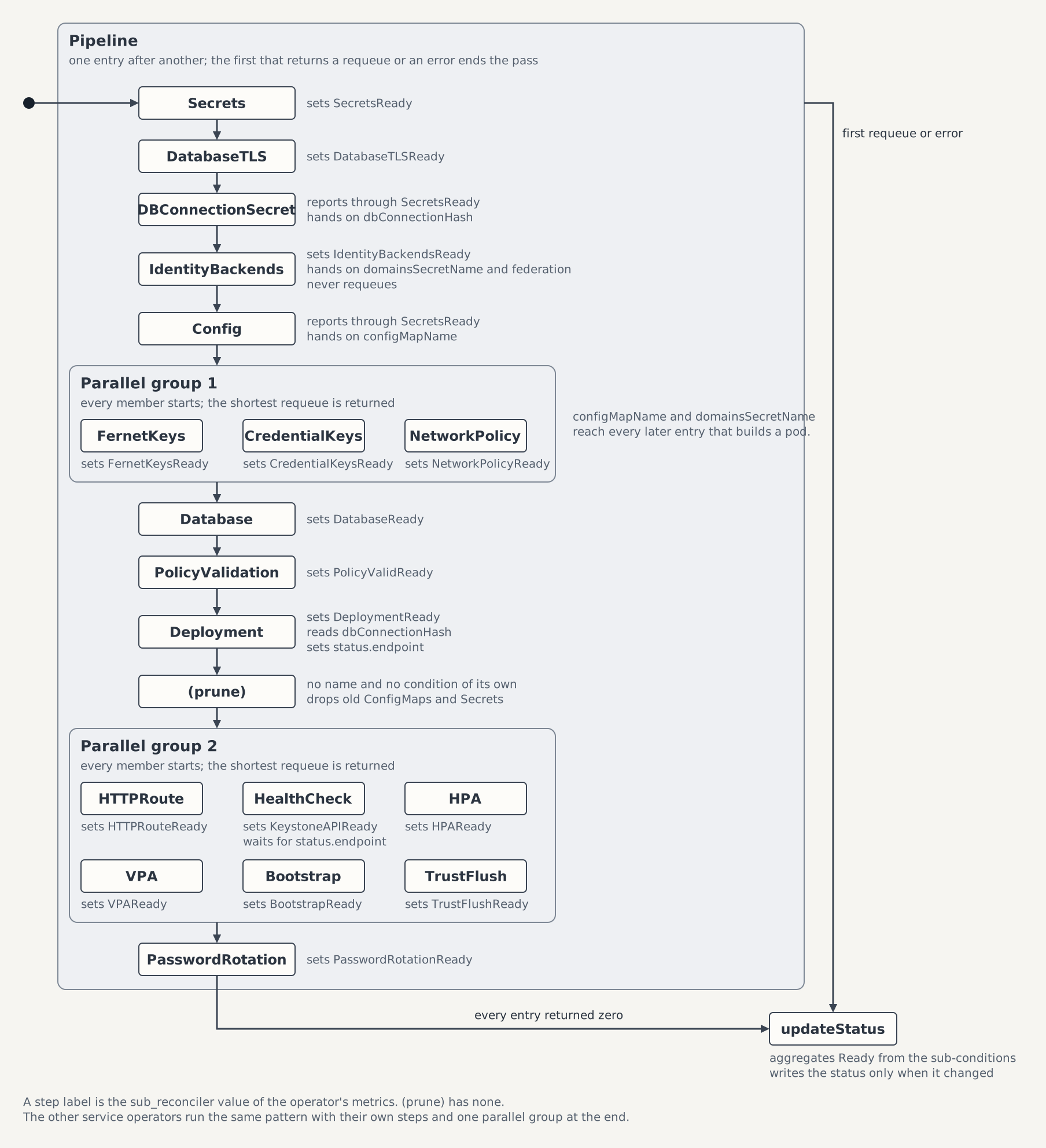
One pass, in order:
- Fetches the Keystone.
NotFoundends the pass with an empty result. - Hands a Keystone that carries a deletion timestamp to the deletion path:
reconcileDelete,reconcileDeleteOpenBao, then the sweep of the children on a target cluster (see Finalizer and OpenBao Finalizer). - Resolves the client its children are written with. A
spec.targetClusterRefthat does not resolve setsSecretsReady=False/TargetClusterUnavailableand requeues after 15s, and no finalizer is added. - Installs the finalizers
keystone.openstack.c5c3.io/finalizerandkeystone.openstack.c5c3.io/openbao-finalizer, andopenstack.c5c3.io/remote-childrenwhilespec.targetClusterRefis set. A pass that installs one ends with a requeue after 1s. - Runs the pipeline through
RunPipeline, the rows below. The first entry that returns a requeue or an error ends the pass. - Calls
updateStatus()on every exit path of steps 3 and 5: it recomputes the aggregateReady, stampsstatus.observedGeneration, and skips the write when nothing changed.
The entries in call order. A member of a parallel group never stops another member, and the group returns the shortest requeue of its members.
| Step | Function | Runs | Sets | Hands on | Requeue |
|---|---|---|---|---|---|
Secrets | reconcileSecrets | in order | SecretsReady | nothing | 15s while the secret store or a credential Secret is not ready |
DatabaseTLS | reconcileDatabaseTLS | in order | DatabaseTLSReady | nothing | 15s while the client Certificate is pending |
DBConnectionSecret | reconcileDBConnectionSecret | in order | SecretsReady | dbConnectionHash, the SHA-256 of the DSN, to Deployment | 15s while the database credentials are not synced |
IdentityBackends | reconcileIdentityBackends | in order | IdentityBackendsReady | domainsSecretName and federation to Config and to every later entry that builds a pod | never |
Config | reconcileConfig | in order | SecretsReady, only on failure (ConfigError) | configMapName to every later entry that builds a pod | never |
FernetKeys | reconcileFernetKeys | parallel group 1 | FernetKeysReady | nothing | 15s after the first key generation and after an applied rotation |
CredentialKeys | reconcileCredentialKeys | parallel group 1 | CredentialKeysReady | nothing | 15s after the first key generation and after an applied rotation |
NetworkPolicy | reconcileNetworkPolicy | parallel group 1 | NetworkPolicyReady | nothing | never |
Database | reconcileDatabase | in order | DatabaseReady | status.upgradePhase to Deployment | 30s while MariaDB, a db_sync Job or an upgrade phase Job is not done; 1s between two upgrade phases |
PolicyValidation | reconcilePolicyValidation | in order | PolicyValidReady | nothing | 15s while the validation Job runs |
Deployment | reconcileDeployment | in order | DeploymentReady | status.endpoint to HealthCheck | 10s while the Deployment is not available; 1s after it ends the RollingUpdate phase |
(prune) | pruneStaleConfigMaps, pruneStaleDomainsSecrets, pruneStaleFederationSecrets | in order | SecretsReady, only on failure | nothing | never |
HTTPRoute | reconcileHTTPRoute | parallel group 2 | HTTPRouteReady | nothing | 10s until the Gateway accepts the route |
HealthCheck | reconcileHealthCheck | parallel group 2 | KeystoneAPIReady | nothing | 10s while the API does not answer |
HPA | reconcileHPA | parallel group 2 | HPAReady | nothing | never |
VPA | reconcileVPA | parallel group 2 | VPAReady | nothing | never |
Bootstrap | reconcileBootstrap | parallel group 2 | BootstrapReady | nothing | 60s while the bootstrap Job runs |
TrustFlush | reconcileTrustFlush | parallel group 2 | TrustFlushReady | nothing | never |
PasswordRotation | reconcilePasswordRotation | in order | PasswordRotationReady | nothing | 1s after it applied a staged rotation |
Execution Model
Sub-reconcilers execute in a defined order using two execution modes:
- Sequential sub-reconcilers run one at a time. Each is called only if all previous sub-reconcilers succeeded without requesting a requeue.
- Parallel groups (
reconcileParallelGroup) run independent sub-reconcilers concurrently viaerrgroup.WithContext. Each goroutine operates on aDeepCopyof the Keystone CR to prevent data races. There are two groups: the first (after Config) runs FernetKeys / CredentialKeys / NetworkPolicy; the second (after Deployment and config pruning) runs HTTPRoute / HealthCheck / HPA / VPA / Bootstrap / TrustFlush, which share no inter-dependency once the Deployment/Service/Config outputs exist.reconcilePasswordRotationstays sequential after the second group because it depends on Bootstrap having seeded the initial admin credential. See Parallel Group Architecture for details.
The chain is a table-driven pipeline over the shared scaffolding in internal/common/reconcile. Each step is a commonreconcile.Step (Name + Fn); commonreconcile.RunPipeline attempts the steps in order (named steps wrapped in instrumenter.Instrument, empty-Name steps run bare because they self-instrument or are intentionally uninstrumented) and the single call site funnels every exit path through updateStatus by construction:
result, err := commonreconcile.RunPipeline(ctx, instrumenter.Instrument, pipeline)
return r.updateStatus(ctx, &keystone, statusBefore, result, err)
This guarantees:
- A step error propagates immediately — subsequent steps are skipped.
- A non-zero result (
!result.IsZero()) causes an early return — status is persisted and the reconciler exits. - Status conditions from the failing/requeuing step are always persisted via
updateStatus()before returning.
reconcileConfig and pruneStaleConfigMaps are ordinary steps in this pipeline. They signal failure with a bare error rather than a status condition of their own, so each wraps its call to flip SecretsReady=False (via markConfigFailed) on failure. Without that, setReadyCondition would re-aggregate the still-True sub-conditions and persist a stale Ready=True at the new generation — the failure would be visible only in logs and the error counter.
A parallel group follows a different contract: all its members run simultaneously, errors cancel the errgroup context, and conditions from completed sub-reconcilers are merged even on partial failure.
Status Update Pattern
updateStatus() delegates to the shared commonreconcile.UpdateStatus: it persists all condition changes via r.Status().Update() and returns the provided (result, error) pair unchanged.
Reconcile snapshots keystone.Status immediately after the initial Get and threads that snapshot into updateStatus. After aggregating Ready and stamping ObservedGeneration, updateStatus compares the result against the snapshot with equality.Semantic.DeepEqual and skips r.Status().Update() when nothing changed. meta.SetStatusCondition preserves LastTransitionTime on a no-op upsert, so a converged steady-state pass produces a byte-identical status and issues no write — no write means no watch event and no resourceVersion churn. A change to any condition, reason, message, or ObservedGeneration still writes.
If the status update itself fails, the behavior depends on whether a reconcile error is also present:
| reconcileErr | Status().Update() | Returned error |
|---|---|---|
| nil | succeeds | nil |
| non-nil | succeeds | reconcileErr (unchanged) |
| nil | fails | fmt.Errorf("updating status: %w", statusErr) |
| non-nil | fails | errors.Join(reconcileErr, fmt.Errorf("updating status: %w", statusErr)) |
In the dual-failure case, errors.Join preserves both the original reconcile error and the status update error. Both are unwrappable via errors.Is and errors.As, and both appear in the controller-runtime log output (separated by newline). The reconcile error appears first in the joined error string for readability. When reconcileErr is nil, errors.Join(nil, statusErr) discards the nil argument per the Go spec, returning a joined error containing only the status update error.
Ready Condition Aggregation
On every status write, including a pass that ends early, setReadyCondition() evaluates whether all sub-condition types are True using conditions.AllTrue():
| All Sub-Conditions True | Ready Condition | Reason |
|---|---|---|
| Yes | Status: True | AllReady |
| No (any missing or False) | Status: False | NotAllReady |
The Ready condition includes ObservedGeneration set to keystone.Generation so clients can detect stale status.
Parallel Group Architecture
The pipeline uses two parallel groups, each driven by reconcileParallelGroup:
- Group 1 —
reconcileFernetKeys,reconcileCredentialKeys, andreconcileNetworkPolicy— runs afterreconcileConfigcompletes and beforereconcileDatabasebegins. - Group 2 —
reconcileHTTPRoute,reconcileHealthCheck,reconcileHPA,reconcileVPA,reconcileBootstrap, andreconcileTrustFlush— runs afterreconcileDeploymentand config pruning. Once the Deployment/Service and the config ConfigMap exist, these six share no data dependency on each other.
Both groups' members are eligible for parallelization because they have no data dependencies on each other (see Dependency Graph below). reconcilePasswordRotation stays sequential after group 2 because it depends on Bootstrap having seeded the initial admin credential. A member that returns a non-zero result no longer short-circuits its siblings: all members run every pass and commonreconcile.ShortestRequeue aggregates their requeues.
File: operators/keystone/internal/controller/keystone_controller.go
Signature:
func (r *KeystoneReconciler) reconcileParallelGroup(
    ctx context.Context,
    keystone *keystonev1alpha1.Keystone,
    subs []commonreconcile.ParallelStep[*keystonev1alpha1.Keystone],
) (ctrl.Result, error)
The method is a thin binding of the shared commonreconcile.RunParallelGroup (errgroup, per-member DeepCopy, condition merge on partial failure, shortest-requeue aggregation) to the Keystone CR type. Each parallel sub-reconciler is described by a commonreconcile.ParallelStep:
type ParallelStep[T any] struct {
    Name          string
    ConditionType string
    Fn            func(ctx context.Context, cr T) (ctrl.Result, error)
}
Dependency Graph
The dependency graph determines which sub-reconcilers can run in parallel. A sub-reconciler is eligible for parallelization when it has no data dependency on any other parallelizable sub-reconciler and no downstream sub-reconciler depends on its output (other than conditions merged after the group completes).
| Sub-Reconciler | Inputs | Condition Type | Dependencies | Parallel |
|---|---|---|---|---|
reconcileSecrets | CR spec | SecretsReady | none | no (must run first) |
reconcileDatabaseTLS | CR spec | DatabaseTLSReady | Secrets | no |
reconcileDBConnectionSecret | database credentials Secret | SecretsReady (returns dbConnectionHash) | Secrets, DatabaseTLS | no |
reconcileIdentityBackends | backend CRs + bind/client Secrets + provider metadata | IdentityBackendsReady | DBConnectionSecret (position only — it must run before Config, whose [identity] options it drives) | no (never requeues: waiting states are watch-driven) |
reconcileConfig | CR spec, DB secret | SecretsReady (False on failure; returns configMapName) | Secrets | no (produces configMapName) |
reconcileFernetKeys | configMapName | FernetKeysReady | Config | yes (group 1) |
reconcileCredentialKeys | configMapName | CredentialKeysReady | Config | yes (group 1) |
reconcileNetworkPolicy | CR spec, federation projection | NetworkPolicyReady | IdentityBackends | yes (group 1) |
reconcileDatabase | configMapName | DatabaseReady | Config | no (complex state machine) |
reconcilePolicyValidation | configMapName | PolicyValidReady | Config | no (gates Deployment) |
reconcileDeployment | configMapName, dbConnectionHash, domainsSecretName, federation projection | DeploymentReady | Database (implicit) | no |
pruneStaleConfigMaps | configMapName | SecretsReady (False on failure) | Deployment (must be ready) | no |
reconcileHTTPRoute | CR spec | HTTPRouteReady | Deployment (ensures backend Service exists) | yes (group 2) |
reconcileHealthCheck | status.endpoint | KeystoneAPIReady | Deployment (sets endpoint) | yes (group 2) |
reconcileHPA | CR spec | HPAReady | Deployment (naming) | yes (group 2) |
reconcileVPA | CR spec | VPAReady | Deployment (naming) | yes (group 2) |
reconcileBootstrap | configMapName | BootstrapReady | Config, DB (runs its own Job) | yes (group 2) |
reconcileTrustFlush | configMapName | TrustFlushReady | Config | yes (group 2) |
reconcilePasswordRotation | spec.passwordRotation | PasswordRotationReady | Bootstrap (re-bootstrap is the downstream consumer) | no |
Key constraints that prevent further parallelization:
- reconcileDatabase has a multi-step state machine (MariaDB CRs → db_sync Job → schema-check Job) with 30s requeue waits, and
reconcileDeploymentdepends on the database being ready. - reconcilePolicyValidation must gate
reconcileDeployment— invalid policy overrides must be caught before reaching running pods. - reconcilePasswordRotation stays sequential after group 2 because it depends on Bootstrap having seeded the initial admin credential.
DeepCopy Condition Merge Pattern
Each parallel sub-reconciler receives its own DeepCopy of the Keystone CR. This eliminates shared mutable state by construction — conditions.SetCondition writes to the copy's Status.Conditions slice, not the original. No sync.Mutex is needed.
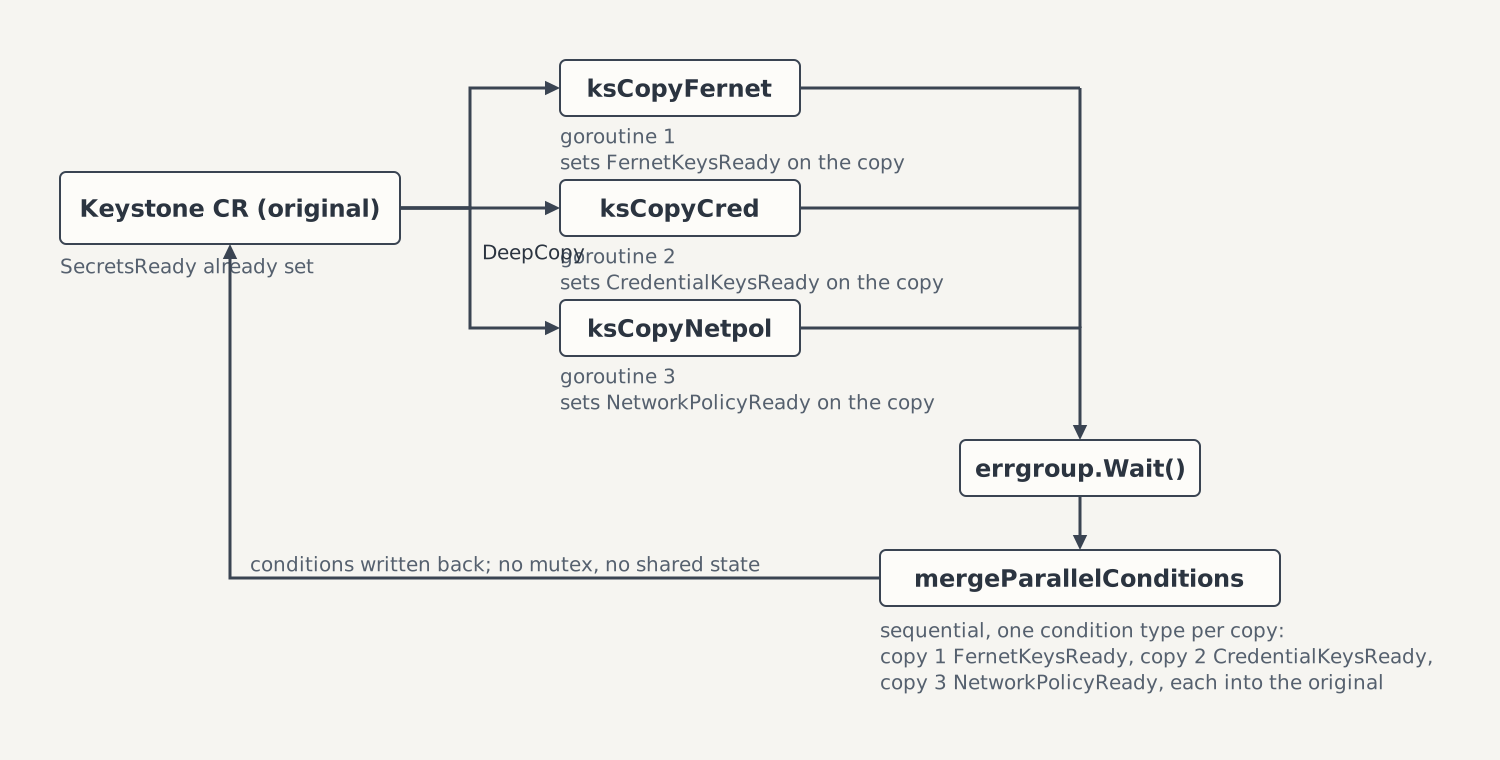
After g.Wait() returns, conditions from each copy are merged sequentially into the original via mergeParallelConditions(dst, src, conditionType):
func mergeParallelConditions(dst, src *keystonev1alpha1.Keystone, conditionType string) {
    cond := conditions.GetCondition(src.Status.Conditions, conditionType)
    if cond == nil {
        return
    }
    conditions.SetCondition(&dst.Status.Conditions, *cond)
}
Merge behavior:
- Pre-existing conditions on the destination are preserved.
- If the source copy does not contain a condition of the expected type (e.g., the goroutine was cancelled before setting it), the destination is left unchanged.
- Conditions from sub-reconcilers that completed before an error are still merged, so partial progress is visible in the CR status.
errgroup Usage
The parallel group uses errgroup.WithContext(ctx) for two properties:
- Error propagation — The first error from any goroutine is returned by
g.Wait(). - Context cancellation — When one goroutine returns an error, the derived context (
gctx) is cancelled, signalling remaining goroutines to exit promptly.
g, gctx := errgroup.WithContext(ctx)
// Each goroutine receives gctx, not the parent ctx
The error returned by g.Wait() is returned as the Reconcile error, triggering controller-runtime's exponential backoff. Conditions from all completed goroutines — including those that succeeded before the error — are merged before returning.
Requeue Resolution
When all parallel sub-reconcilers succeed, the shared commonreconcile.ShortestRequeue selects the ctrl.Result with the shortest non-zero RequeueAfter from the group:
func ShortestRequeue(results ...ctrl.Result) ctrl.Result| All results zero | Shortest non-zero | Returned result |
|---|---|---|
| Yes | — | ctrl.Result{} (no requeue) |
| No | e.g. 15s | ctrl.Result{RequeueAfter: 15s} |
This ensures the reconcile loop runs at the pace of the most urgent sub-reconciler in the group.
Finalizer
The KeystoneReconciler installs a finalizer on every Keystone CR so that the MariaDB Database, User, and Grant CRs owned by the Keystone are deterministically torn down before the Keystone CR itself is removed from etcd. Without a finalizer, the Keystone CR would be deleted immediately on kubectl delete keystone <name> and the controller would have no opportunity to clean up the MariaDB resources it orchestrated — leaving them orphaned when redeploying or tearing down the service.
Finalizer Constant
The finalizer name is declared once as a package-level constant in operators/keystone/internal/controller/keystone_controller.go:
const keystoneFinalizer = "keystone.openstack.c5c3.io/finalizer"The value uses the canonical CRD group prefix (keystone.openstack.c5c3.io) so that it is unambiguous under kubectl get keystone -o yaml and cannot collide with finalizers owned by other controllers. The constant is the single source of truth used by Reconcile, reconcileDelete, finalizeDatabaseResources, hasLiveMariaDBResources, the unit and integration tests, and this documentation.
Resources Cleaned Up
When the Keystone CR is deleted, the finalizer cleanup deletes these MariaDB CRs (all matched by the Keystone CR's metadata.name in the same metadata.namespace):
| Resource | API Group | Name | Namespace |
|---|---|---|---|
Database | k8s.mariadb.com | {keystone.Name} | {keystone.Namespace} |
User | k8s.mariadb.com | {keystone.Name} | {keystone.Namespace} |
Grant | k8s.mariadb.com | {keystone.Name} | {keystone.Namespace} |
These three CRs are the only resources the finalizer manages. Every other resource owned by the Keystone CR (Deployment, Service, ConfigMap, Secret, Job, CronJob, PDB, HPA, NetworkPolicy) is reclaimed by the built-in Kubernetes garbage collector via owner references — the finalizer does not touch them. See Owned Resources for the full owner-reference list.
Reconcile Branching on DeletionTimestamp
Reconcile inspects metadata.deletionTimestamp immediately after the CR Get and before any sub-reconciler executes:

Running sub-reconcilers against a Terminating CR is not safe: sub-reconcilers such as reconcileDatabase would re-create the very MariaDB CRs the finalizer is deleting, producing an infinite reconcile loop. The early branch avoids this entirely — Terminating CRs only ever flow through reconcileDelete.
On the live-CR path, controllerutil.AddFinalizer is called if the finalizer is missing and the CR is Updated, followed by an early RequeueAfter: RequeueNextPass (1s) return. This ensures the next reconcile pass observes the finalizer already persisted in etcd rather than a transient in-memory copy, and it makes the finalizer installation a single-pass, conflict-safe operation under controller-runtime's retry semantics.
reconcileDelete
func (r *KeystoneReconciler) reconcileDelete(
    ctx context.Context,
    keystone *keystonev1alpha1.Keystone,
) (ctrl.Result, error)
The deletion handler proceeds in four steps, all within a single reconcile pass:
- No-op guard. If the Keystone CR never carried the finalizer (e.g. a CR created by an earlier operator version that did not install finalizers, or one whose finalizer was already released on a prior pass),
reconcileDeletereturns(ctrl.Result{}, nil)immediately. No Delete calls are issued, no Events are emitted. - Cleanup-work announcement.
hasLiveMariaDBResourcesprobes whether any of the three MariaDB CRs is still live (i.e. exists and hasDeletionTimestamp == 0). If so, a single Normal Event with reasonFinalizingDatabaseis emitted. Brownfield CRs skip the event because they never created the MariaDB CRs and there is no cleanup work to announce. - Cleanup.
finalizeDatabaseResourcesissuesDeletefor each ofDatabase,User,Grantand returns as soon as every Delete is accepted (or tolerated as NotFound). It does not block on the MariaDB operator completing its own teardown — see Why the finalizer does not wait. - Finalizer release. A Normal Event with reason
DatabaseFinalizedis emitted, the finalizer is removed viacontrollerutil.RemoveFinalizer, and the CR isUpdated. The API server then observes an empty finalizers list and garbage-collects the Keystone CR from etcd.
Why the finalizer does not wait
An earlier implementation re-Getd each MariaDB CR after Delete and only released the Keystone finalizer when all three were confirmed NotFound. Under concurrent Keystone deletions (chainsaw parallel: 4) this created a deadlock:
- The Keystone finalizer kept the Keystone CR in etcd.
- Kubernetes garbage collection therefore did not cascade-delete the owned
Deployment, so thekeystonePod kept its MariaDB connections open. - The MariaDB operator could not run
DROP DATABASEwhile connections were live, so theDatabaseCR stayed in Terminating state. - Goto 1 — the finalizer never released, the 2 min
delete:timeout in thedeletion-cleanupchainsaw test expired, and cascading test cleanups stacked up behind the same block.
Releasing the Keystone finalizer as soon as the Delete requests are issued breaks the cycle. GC cascade-deletes the Deployment, Pods terminate, connections close, and the MariaDB operator completes the drop asynchronously. The owner references set by reconcileDatabase (controllerutil.SetControllerReference in EnsureDatabase / EnsureDatabaseUser) guarantee that even if the explicit Delete is a no-op (e.g., the MariaDB operator has already started its own teardown), the CRs are still reclaimed.
NotFound Tolerance and Idempotency
Delete on an absent MariaDB CR returns NotFound, which finalizeDatabaseResources logs at V(1) and treats as success — the CR was already garbage-collected, externally deleted, or never existed.
This tolerance makes finalizeDatabaseResources idempotent: calling it twice in a row with no MariaDB CRs present returns nil both times, and no additional side effects are produced on the second call. Idempotency is essential because:
- Controller-runtime retries
Reconcilewith exponential backoff on transient errors, so any finalizer pass may be replayed. - The MariaDB operator may have already collected the CRs via its own owner-reference chain before the finalizer runs.
- An external actor (SRE, GitOps reconciliation) may have manually deleted the CRs before the Keystone deletion.
In all three cases the finalizer converges in a single reconcile pass without surfacing spurious errors or Events.
Brownfield No-Op Behaviour
Brownfield deployments (spec.database.host set, spec.database.clusterRef nil) never create MariaDB CRs — the operator connects to a pre-existing external MariaDB cluster. The finalizer path is intentionally branch-free: brownfield CRs still receive the finalizer on first reconcile and still flow through reconcileDelete on deletion, but every Delete call is a no-op NotFound. Consequences:
- The finalizer is removed in the same reconcile pass that observes deletion — the same pass-count as managed mode after the wait was removed.
- No
FinalizingDatabaseevent is emitted (there is no real cleanup work to announce —hasLiveMariaDBResourcesreturnsfalsebecause the probe observes zero live MariaDB CRs). - A
DatabaseFinalizedevent is emitted — it is the common signal that the finalizer has released the CR. - No spurious NotFound errors reach the user.
This keeps brownfield and managed-mode deletion paths symmetric in code while preserving the correct observable behaviour.
Upgrade Path
Keystone CRs created by an earlier operator version that did not install finalizers gain the finalizer on their next reconcile under the new version:
- The live-CR branch sees
ContainsFinalizer == false, callsAddFinalizer+Update, and requeues. - The next reconcile observes the persisted finalizer and proceeds through the normal sub-reconciler pipeline —
Statusand existing conditions are unchanged by the finalizer addition itself. - On subsequent deletion, the full cleanup flow runs as described above.
No manual migration of existing CRs is required.
Events
Two Normal Events are emitted on the Keystone CR during finalizer-driven cleanup, captured via record.EventRecorder, plus one Warning for the CR whose target cluster is gone:
| Reason | Type | Message | Emitted When |
|---|---|---|---|
FinalizingDatabase | Normal | "Cleaning up MariaDB Database, User, and Grant before removing Keystone" | First terminating reconcile pass where at least one MariaDB CR is still live (not emitted for brownfield CRs or when all CRs are already gone) |
DatabaseFinalized | Normal | "MariaDB Database, User, and Grant removed; releasing finalizer" | Once per termination, immediately before RemoveFinalizer + Update |
RemoteChildrenAbandoned | Warning | "Target cluster is no longer registered; releasing the finalizer without deleting the MariaDB Database, User, and Grant on it" | The CR's spec.targetClusterRef no longer resolves while it terminates. Replaces both Normal Events for that pass: nothing on the deregistered cluster can be reached, so each finalizer is released against no cleanup at all. See Target Clusters |
Note: The two Events are intentionally asymmetric. A brownfield-terminating CR (or a managed CR whose MariaDB resources were already removed externally before deletion) emits only
DatabaseFinalized, notFinalizingDatabase, because there is no real cleanup work to announce.DatabaseFinalizedis therefore the common, authoritative signal that the finalizer has released the CR;FinalizingDatabaseis a supplementary signal that real cleanup was observed at least once. See Brownfield No-Op Behaviour for the full state-machine reasoning.
No Warning Event is emitted on cleanup errors — controller-runtime retries the reconcile with exponential backoff and the underlying API error is logged via log.FromContext(ctx). Error-level Events would only add noise to a retry loop that already has a structured-logging record.
All finalizer-related log lines include the Keystone name and namespace via log.FromContext(ctx).WithValues("keystone", ...), keeping log correlation consistent with the rest of the reconciler.
Owner References vs Finalizer
Every MariaDB CR created by reconcileDatabase already carries an ownerReference to the Keystone CR (via controllerutil.SetControllerReference in internal/common/database/database.go). Kubernetes' built-in garbage collector would normally suffice to cascade the deletion. The finalizer is deliberately additive, not a replacement:
| Mechanism | What it guarantees |
|---|---|
| Owner references | MariaDB CRs are eventually garbage-collected after Keystone CR removal |
| Finalizer | Keystone CR is removed only after all three MariaDB CRs are confirmed NotFound; cleanup is observable via Events and logs |
The two mechanisms do not conflict: Delete is idempotent under NotFound, so if GC removes a CR before the finalizer's Delete call, the finalizer simply observes NotFound and continues. The finalizer adds deterministic ordering and observability on top of GC's eventual-consistency guarantee.
OpenBao Finalizer
In addition to the MariaDB finalizer, every Keystone CR carries a dedicated finalizer that drives cleanup of the backup PushSecrets ESO uses to persist the Fernet and credential signing keys to OpenBao. Without this finalizer, deleting a Keystone CR would garbage-collect the PushSecret CRs via owner references without triggering the remote delete on the KV-v2 path — leaving stale cryptographic material in OpenBao after the Keystone CR is gone. The two finalizers are independent: each is installed, tracked, and released by its own handler, and they can complete in either order.
Finalizer Constant
The finalizer name is declared once as a package-level constant in operators/keystone/internal/controller/reconcile_secrets.go:
const keystoneOpenBaoFinalizer = "keystone.openstack.c5c3.io/openbao-finalizer"The -finalizer suffix differentiates it from the MariaDB finalizer (keystone.openstack.c5c3.io/finalizer) so that kubectl get keystone -o yaml shows both entries unambiguously under metadata.finalizers. The constant is the single source of truth used by Reconcile, reconcileDeleteOpenBao, finalizeOpenBaoSecrets, hasLiveOpenBaoBackupPushSecrets, all unit and integration tests, and this documentation.
Resources Cleaned Up
When the Keystone CR is deleted, the finalizer cleanup deletes these backup PushSecret CRs (both in the Keystone's namespace):
| PushSecret | API Group | KV-v2 Path (OpenBao) |
|---|---|---|
{keystone.Name}-fernet-keys-backup | external-secrets.io | kv-v2/data/openstack/keystone/{keystone.Namespace}/{keystone.Name}/fernet-keys |
{keystone.Name}-credential-keys-backup | external-secrets.io | kv-v2/data/openstack/keystone/{keystone.Namespace}/{keystone.Name}/credential-keys |
The names are produced by openBaoBackupPushSecretNames(keystone) so that adding a third backup target in the future is a one-line change. Both PushSecrets share a single builder convention in reconcile_fernet.go and reconcile_credential.go respectively; neither carries secret material of its own — the live Secret referenced by Spec.Selector.Secret.Name is the source of truth, and the PushSecret is the control-plane object that tells ESO what to push (and, on deletion, what to purge).
The finalizer does not touch any other Keystone-owned resource (Deployment, ConfigMap, Service, CronJob, etc.). Those are reclaimed by the built-in Kubernetes garbage collector via owner references — see Owned Resources.
Path scoping: Both KV-v2 paths are per-CR-scoped via
openstack/keystone/{keystone.Namespace}/{keystone.Name}/<leaf>(where<leaf>isfernet-keysorcredential-keys), so multiple Keystone CRs — in the same namespace or across namespaces — write to disjoint paths and cannot collide. The leading{keystone.Namespace}segment was the most recent addition, layered on top of an earlier per-name scoping. See Migration note: legacy flat paths for upgrade behaviour and recommended cleanup of orphaned legacy paths.
Migration note: legacy flat paths
The KV-v2 path layout for these backups has evolved in two steps:
- Flat → per-name. Originally both backup PushSecrets wrote to the cluster-global, flat KV-v2 paths
kv-v2/openstack/keystone/fernet-keysandkv-v2/openstack/keystone/credential-keys. A first migration scoped them per CR by adding the CR-name segment:kv-v2/openstack/keystone/{keystone.Name}/fernet-keysand…/{keystone.Name}/credential-keys. - Per-name → namespace+name. A later migration added the leading namespace segment so the paths are unique across namespaces as well as within one. The operator now writes to
kv-v2/openstack/keystone/{keystone.Namespace}/{keystone.Name}/fernet-keysand…/{keystone.Namespace}/{keystone.Name}/credential-keys.
The RemoteKey change lands the moment the Keystone operator is upgraded — the next reconcile of each Keystone CR emits the new path. A standalone Keystone's Fernet/credential backup PushSecrets authenticate as the per-tenant eso-tenant identity through a namespaced openbao-tenant-store SecretStore, so for existing clusters that identity and store must be in place — otherwise ESO will return 403 on the backup step and FernetKeysReady / CredentialKeysReady will flip to False. The write authorisation comes from the eso-tenant policy (deploy/openbao/policies/eso-tenant.hcl), whose paths are templated to the caller's own namespace; it is created by deploy/openbao/bootstrap/setup-auth.sh (the eso-tenant auth role) and deploy/openbao/bootstrap/setup-policies.sh (the policy). For kind/dev clusters this happens automatically when hack/deploy-infra.sh is re-run; the in-cluster namespaced store is then provisioned per namespace by deploy/openbao/bootstrap/setup-eso-tenant.sh <namespace>, and the standalone Keystone CR must select it with spec.secretStoreRef: {kind: SecretStore, name: openbao-tenant-store}.
The superseded paths (both the original flat paths and the per-name paths that lacked the namespace segment) are orphaned but harmless after upgrade: the live Keystone control plane reads its Fernet and credential keys from the local Kubernetes Secret ({name}-fernet-keys, {name}-credential-keys), not from the OpenBao backup. The OpenBao copy is a disaster-recovery artefact only; the legacy entries simply stop being refreshed, never get deleted by DeletionPolicy=Delete (no live PushSecret references them anymore), and are otherwise inert.
Operators who want a clean OpenBao state can purge the superseded entries manually after upgrade — both the original flat paths and the per-name (namespace-less) paths:
# original flat paths
bao kv metadata delete kv-v2/openstack/keystone/fernet-keys
bao kv metadata delete kv-v2/openstack/keystone/credential-keys
# per-name paths that lacked the namespace segment
bao kv metadata delete kv-v2/openstack/keystone/<name>/fernet-keys
bao kv metadata delete kv-v2/openstack/keystone/<name>/credential-keys
metadata delete removes both the current version and all historical versions of the secret at that path; this is the canonical KV-v2 purge operation and the right inverse of the now-superseded write.
Admin-password path migration (Model B)
The Model-B admin-password PushSecret moves onto the same per-CR layout. The flat bootstrap/keystone-admin object becomes the per-CR bootstrap/{keystone.Namespace}/{keystone.Name}/admin. As above, the new RemoteKey lands on operator upgrade, and the same per-tenant eso-tenant identity authorises the push: the admin leaf is covered by the eso-tenant policy (deploy/openbao/policies/eso-tenant.hcl), templated to the caller's own namespace. Re-run deploy/openbao/bootstrap/setup-auth.sh and deploy/openbao/bootstrap/setup-policies.sh (or hack/deploy-infra.sh) and provision the namespaced store with deploy/openbao/bootstrap/setup-eso-tenant.sh <namespace> — otherwise ESO returns 403 on the push and PasswordRotationReady flips to False. The legacy bootstrap/keystone-admin object is orphaned but harmless after migration and can be purged once the per-CR path is populated and Ready:
bao kv metadata delete kv-v2/bootstrap/keystone-adminFor the end-to-end, multi-credential operator runbook (admin application credential + admin password + Fernet/credential keys, with the one-time copy commands and the full ACL re-apply set), see the c5c3 controlplane reconciler's Migration: legacy flat paths → per-ControlPlane paths.
DeletionPolicy=Delete Wiring Through ESO
The Keystone operator has no OpenBao credentials and does not talk to the OpenBao API directly. Remote purge of the KV-v2 path is delegated to ESO via the PushSecret field Spec.DeletionPolicy. The RemoteKey follows the per-CR layout openstack/keystone/{keystone.Namespace}/{keystone.Name}/<leaf> (scoped by the CR's namespace and name), so each Keystone CR writes to its own KV-v2 prefix:
Spec: esov1alpha1.PushSecretSpec{
    DeletionPolicy: esov1alpha1.PushSecretDeletionPolicyDelete,
    // Store ref is derived from the CR's spec.secretStoreRef (default: the
    // shared cluster store openbao-cluster-store) via secrets.PushSecretStoreRefs.
    SecretStoreRefs: secrets.PushSecretStoreRefs(
        secrets.EffectiveStoreRef(keystone.Spec.SecretStoreRef)),
    // ...
    Data: []esov1alpha1.PushSecretData{{
        Match: esov1alpha1.PushSecretMatch{
            RemoteRef: esov1alpha1.PushSecretRemoteRef{
                RemoteKey: fmt.Sprintf("openstack/keystone/%s/%s/fernet-keys", keystone.Namespace, keystone.Name),
            },
        },
    }},
}
DeletionPolicy=Delete instructs ESO to issue an OpenBao DELETE against the configured RemoteKey as part of the PushSecret's own teardown. ESO installs a cleanup finalizer on the PushSecret, holds the object in Terminating state until the remote delete succeeds, then releases its finalizer so the API server garbage-collects the PushSecret.
This means the Keystone finalizer does not need OpenBao credentials — the single component that talks to OpenBao is still ESO, and the abstraction boundary (the selected secret store, policy, auth) stays in one place. The Keystone finalizer's responsibility is purely ordering: ensure the Delete happens before the Keystone CR leaves etcd.
Reconcile Branching on DeletionTimestamp
Reconcile dispatches terminating CRs to both finalizer handlers immediately after the CR Get and before any sub-reconciler executes:
Running sub-reconcilers against a Terminating CR would be unsafe: reconcileFernetKeys and reconcileCredentialKeys build the live Secret and the backup PushSecret on every pass, and would therefore re-create the PushSecrets the finalizer just deleted — classic infinite reconcile loop. The early branch avoids this entirely.
On the live-CR path, controllerutil.AddFinalizer(keystone, keystoneOpenBaoFinalizer) is called if the finalizer is missing, the CR is Updated, and an early RequeueAfter: RequeueNextPass (1s) return ensures the next reconcile pass observes the finalizer already persisted in etcd. The MariaDB and OpenBao finalizer additions are independent Update+Requeue steps; both converge within two requeues on a fresh CR and within a single pass on subsequent reconciles.
reconcileDeleteOpenBao
func (r *KeystoneReconciler) reconcileDeleteOpenBao(
    ctx context.Context,
    keystone *keystonev1alpha1.Keystone,
) (ctrl.Result, error)
The deletion handler proceeds as follows:
- No-op guard. If the Keystone CR does not carry
keystoneOpenBaoFinalizer(e.g. a CR that predates the finalizer, or whose finalizer was already released on a prior pass),reconcileDeleteOpenBaoreturns(ctrl.Result{}, nil)immediately — no Delete calls, no Events. - Cleanup-work announcement.
hasLiveOpenBaoBackupPushSecretsprobes whether any backup PushSecret is still live (exists andDeletionTimestamp == 0). If so, a single Normal Event with reasonFinalizingOpenBaoSecretsis emitted. Once the PushSecret transitions to Terminating (DeletionTimestamp set) or disappears, subsequent requeues observe no live PushSecret and suppress the emit, giving exactly-once semantics per termination across requeue loops. - Cleanup.
finalizeOpenBaoSecretsruns in three sequential passes over the backup PushSecret names (the two-pass design was extended with a Pass-0 adoption wait):- Pass-0 — adoption wait. For each backup PushSecret that still exists and is not already Terminating, verify that ESO's cleanup finalizer (
pushsecret.externalsecrets.io/finalizer) is present. On the first unadopted PushSecret, setdone=false, recordSecretsReady=False / WaitingForESOAdoptionviasetOpenBaoWaitingForESOAdoptionCondition, and return without firing anyDelete. This closes the race where a Keystone CR deleted seconds after creation outruns ESO's first reconcile — a racingDeletewould remove the PushSecret object outright before ESO had a chance to installDeletionPolicy=Delete, orphaning the kv-v2 path in OpenBao (see Three-pass lifecycle with two blocked states). The wait is bounded byOpenBaoAdoptionWaitTimeout(10m): once the CR has been deleting longer than that, an unadopted PushSecret stops blocking — the handler emits anESOAdoptionTimedOutWarning event and proceeds to Pass-1'sDelete— so a renamed or absent ESO finalizer cannot hang CR deletion forever atWaitingForESOAdoption. - Pass-1 — parallel Delete. Issue
Deleteon every backup PushSecret (toleratingNotFound), so ESO's cleanup finalizers fire on all of them in parallel rather than in a serialised Delete→Get loop that would double the worst-case deletion window. - Pass-2 — wait-for-gone. Re-
Geteach name;done=trueonly when every PushSecret returnsNotFound. On a still-present PushSecret (typically Terminating behind ESO's cleanup finalizer) the handler setsdone=falseand recordsSecretsReady=False / OpenBaoFinalizerBlockedviasetOpenBaoFinalizerBlockedCondition, so the stuck object's name surfaces onkubectl get keystonerather than being returned by the function (the signature is(done bool, err error)only). The wait is bounded byOpenBaoCleanupStallTimeout(5m): past it the handler force-removes the stuck PushSecrets' finalizers after anOpenBaoCleanupStalledWarning naming the kv-v2 paths that keep their data, and reportsdone=true— a purge whose SecretStore died with the surrounding teardown (a namespace deletion reaps the store and its auth unsequenced) can never succeed, and an unbounded wait would hold the CR, and the namespace containing it, in Terminating forever.
- Pass-0 — adoption wait. For each backup PushSecret that still exists and is not already Terminating, verify that ESO's cleanup finalizer (
- Requeue while blocked. If
done=false, the handler records theSecretsReady=False / OpenBaoFinalizerBlockedcondition (see SecretsReady=False / OpenBaoFinalizerBlocked), returnsctrl.Result{RequeueAfter: RequeueSecretPolling}(15s), and leaves the finalizer in place so the Keystone CR stays alive until ESO finishes. - Finalizer release. When
done=true, a Normal Event with reasonOpenBaoSecretsFinalizedis emitted, the finalizer is removed viacontrollerutil.RemoveFinalizer, and the CR isUpdated. The API server then observes the emptied finalizers list and, if no other finalizers remain, garbage-collects the Keystone CR.
Why the finalizer waits
Unlike the MariaDB finalizer (which deliberately does not wait for the MariaDB CRs to disappear from etcd — see Why the finalizer does not wait), the OpenBao finalizer must wait for the PushSecrets to be fully garbage-collected. The asymmetry is driven by the cleanup mechanism:
- MariaDB: the
DatabaseCR owns the actual remote resource (the database) via its own finalizer; releasing the Keystone finalizer early does not orphan the database because owner references and the MariaDB operator both handle the cascade. - OpenBao: the remote resource (the KV-v2 path) is purged only as a side-effect of the PushSecret's Delete. If the Keystone finalizer is released before ESO has finished its own teardown, and if ESO then fails for any reason (auth revoked, OpenBao unreachable, operator crashed), the PushSecret may be garbage-collected by the API server while the remote path still exists — leaking cryptographic material.
Waiting on the re-Get therefore provides the critical guarantee: "Keystone CR gone" implies "remote KV-v2 path purged (or ESO has surfaced the failure via its own status)".
NotFound Tolerance and Idempotency
finalizeOpenBaoSecrets treats NotFound as success on both the Delete call and the follow-up Get:
DeletereturningNotFound→ the PushSecret was already removed by GC, a prior finalizer pass, or an external actor; log atV(1)and continue.GetreturningNotFound→ the PushSecret (and, via ESO'sDeletionPolicy=Delete, the remote KV-v2 path) is fully gone; count this object as done.
This tolerance makes finalizeOpenBaoSecrets idempotent: calling it twice in a row with no PushSecrets present returns (true, nil) both times and issues a second batch of Delete calls that are all no-op NotFounds. The reconcile pass that first observes done=true is the only one that emits OpenBaoSecretsFinalized and calls RemoveFinalizer — no duplicate Events are produced under requeue loops. Idempotency matters because:
- Controller-runtime retries
Reconcilewith exponential backoff on transient errors; any finalizer pass may be replayed. - ESO may have completed the PushSecret deletion before the Keystone finalizer's next reconcile observes it.
- An SRE may have manually deleted the PushSecrets before the Keystone deletion.
In all three cases the finalizer converges without surfacing spurious errors.
Three-pass lifecycle with two blocked states
A single Keystone CR deletion drives the openbao-finalizer through three sequential passes (Pass-0, Pass-1, Pass-2). Two of those passes can block the handler waiting on ESO; the third (Pass-1) is a non-blocking fire-and-forget Delete. The two blocked states surface on the SecretsReady condition with Status=False but use distinct Reason values so that kubectl describe keystone distinguishes them without reading controller logs:
| Reason | Pass | When Emitted | Typical Remediation |
|---|---|---|---|
WaitingForESOAdoption | Pre-Delete adoption wait (Pass-0) | A backup PushSecret exists, is not Terminating, and does not yet carry ESO's adoption finalizer (pushsecret.externalsecrets.io/finalizer). | Resolves itself on ESO workqueue drain. Check kubectl -n external-secrets logs deploy/external-secrets for backlog or errors. The wait is bounded by OpenBaoAdoptionWaitTimeout (10m); past that the handler emits an ESOAdoptionTimedOut Warning and force-deletes so CR deletion never hangs. |
OpenBaoFinalizerBlocked | Post-Delete wait-for-gone (Pass-2) | A backup PushSecret is still present in the API server after Delete was issued, typically in Terminating state behind ESO's cleanup finalizer. | ESO is running DeletionPolicy=Delete against OpenBao. A persistent block here may indicate OpenBao unreachable or the selected secret store's auth revoked. The wait is bounded by OpenBaoCleanupStallTimeout (5m); past that the handler emits an OpenBaoCleanupStalled Warning naming the kv-v2 paths that keep their data, force-removes the PushSecret finalizers, and releases — so a namespace deletion never wedges on an unpurgeable PushSecret. |
The three passes execute in strict order:
- Pass-0 — adoption wait. For each backup PushSecret that exists and is not Terminating, the handler
Gets the object and inspects itsmetadata.finalizersforpushsecret.externalsecrets.io/finalizer. On the first unadopted PushSecret it recordsWaitingForESOAdoptionand returns(done=false, nil)without firing anyDelete. This wait is bounded byOpenBaoAdoptionWaitTimeout(10m): past that deadline the unadopted PushSecret no longer blocks — the handler emits anESOAdoptionTimedOutWarning and breaks to Pass-1's force-Delete. The force-delete stays safe when ESO merely renamed its finalizer (the PushSecret carries the renamed finalizer, soDeleteonly marks it Terminating and ESO still purges the kv-v2 path); the path is orphaned only if ESO is genuinely not running during the deletion window. - Pass-1 — parallel Delete. Once every still-present PushSecret is adopted (ESO finalizer present) or already Terminating, the handler issues
Deleteon every name in a single pass so the cleanup finalizers fire in parallel. - Pass-2 — wait-for-gone. The handler re-
Gets each name and, on a still-present PushSecret, recordsOpenBaoFinalizerBlockedand returns(done=false, nil). Release of the openbao-finalizer requires all PushSecrets to returnNotFound— or the boundedOpenBaoCleanupStallTimeoutto elapse, after which the handler force-removes the stuck PushSecrets' finalizers behind anOpenBaoCleanupStalledWarning instead of wedging the CR forever.
Motivating race
Without Pass-0, a Keystone CR deleted within 1–2 s of creation can outrun ESO's first reconcile: the operator calls Delete on the PushSecret before ESO has installed its own cleanup finalizer, the API server immediately garbage-collects the PushSecret object, and ESO never observes the DeletionTimestamp — so DeletionPolicy=Delete never runs and the referenced kv-v2 path is orphaned in OpenBao. The observed stuck path now takes the per-CR form kv-v2/openstack/keystone/{namespace}/{name}/fernet-keys; this was originally seen in CI run 24842115250 against the now-legacy flat path kv-v2/openstack/keystone/fernet-keys. The race itself is path-shape independent — the only difference is the kv-v2 key that would be left orphaned without Pass-0. Pass-0 gates the operator's Delete on ESO having signalled adoption by installing its cleanup finalizer, so the race collapses into an observable WaitingForESOAdoption state that resolves on the next ESO reconcile instead of a silent leak.
Symmetric coverage of both PushSecrets
Both {name}-fernet-keys-backup (Fernet token-signing material) and {name}-credential-keys-backup (credential-encryption keys) are covered by the same three-pass handler via the single openBaoBackupPushSecretNames iteration — there are no per-resource branches. A mixed adoption state (one PushSecret adopted by ESO, the other not) blocks on the unadopted resource in Pass-0 and fires zero Delete calls in that pass, so the existing Pass-1 "fire all deletes in parallel" property is preserved once adoption is confirmed. Adding a third backup target in the future remains a one-line change in openBaoBackupPushSecretNames — Pass-0, Pass-1, and Pass-2 all iterate the same list.
SecretsReady=False / WaitingForESOAdoption
While the finalizer is waiting for ESO to adopt a backup PushSecret (i.e. install its own cleanup finalizer) before the operator issues Delete, the SecretsReady condition surfaces the pre-Delete adoption wait:
| Field | Value |
|---|---|
Type | SecretsReady |
Status | False |
Reason | WaitingForESOAdoption |
Message | Waiting for ESO to adopt PushSecret "<name>" (cleanup finalizer not yet installed) |
ObservedGeneration | keystone.Generation |
The message names the first unadopted PushSecret encountered in the openBaoBackupPushSecretNames iteration. On the next reconcile after that PushSecret gains ESO's cleanup finalizer, Pass-0 advances past it and, if the other PushSecret is still unadopted, the condition message rotates to name the next one; otherwise Pass-1 fires Delete and the condition transitions to OpenBaoFinalizerBlocked (or clears if all PushSecrets terminate quickly).
No Warning Event is emitted for this state. The structured log line openbao finalizer waiting for ESO adoption is produced at V(1) with pushsecret=<name>, and the SecretsReady=False condition is the primary observability signal. reconcileDeleteOpenBao returns ctrl.Result{RequeueAfter: RequeueSecretPolling} (15 s — see internal/common/reconcile) on (done=false, nil), so the adoption wait is actively polled every 15 s until ESO installs its cleanup finalizer. The handler never force-deletes: if ESO is permanently broken, the Keystone CR correctly stays Terminating until an operator investigates (see Why the finalizer waits).
SecretsReady=False / OpenBaoFinalizerBlocked
While the finalizer is waiting for ESO to finish garbage-collecting a backup PushSecret, the existing SecretsReady condition is re-used to surface the blocked state:
| Field | Value |
|---|---|
Type | SecretsReady |
Status | False |
Reason | OpenBaoFinalizerBlocked |
Message | Waiting for PushSecret "<name>" to be garbage-collected before releasing openbao-finalizer |
ObservedGeneration | keystone.Generation |
The message names the specific PushSecret (first stuck one encountered) so kubectl get keystone -o yaml surfaces which backup is wedged without attaching a debugger. Reusing SecretsReady (instead of introducing a new condition type) keeps the status surface coherent — any secret-store lifecycle concern (initial ExternalSecret sync, ClusterSecretStore health, finalizer teardown) appears under the same condition type. The condition is persisted through the existing updateStatus path so the message stays fresh across requeues at the RequeueSecretPolling (15s) interval.
The condition clears together with the Keystone CR itself: once both PushSecrets are NotFound, reconcileDeleteOpenBao removes the finalizer and the CR is garbage-collected. There is no explicit "clearing" write — the condition disappears when its owning object is reaped.
No Warning Event is emitted for the blocked state. Controller-runtime retries at RequeueSecretPolling, the structured log line openbao finalizer blocked on PushSecret garbage collection is produced at V(1) with pushsecret=<name>, and the SecretsReady=False condition is the primary observability signal.
Events
Two Normal Events are emitted on the Keystone CR during OpenBao finalizer-driven cleanup:
| Reason | Type | Message | Emitted When |
|---|---|---|---|
FinalizingOpenBaoSecrets | Normal | "Cleaning up OpenBao backup PushSecrets before removing Keystone" | First terminating reconcile pass where at least one backup PushSecret is still live (not Terminating). Subsequent requeues observe the PushSecret Terminating (DeletionTimestamp set) or absent and suppress the emit, giving exactly-once semantics. |
OpenBaoSecretsFinalized | Normal | "OpenBao backup PushSecrets deleted; releasing openbao-finalizer" | Once per termination, immediately before RemoveFinalizer + Update. |
If both PushSecrets are already NotFound on the first terminating reconcile (re-runs, pre-deleted PushSecrets), the start Event is skipped and only the completion Event fires.
All OpenBao-finalizer log lines include the Keystone name and namespace via log.FromContext(ctx).WithValues("keystone", client.ObjectKeyFromObject(keystone)), keeping log correlation consistent with the rest of the reconciler.
Upgrade Path
Keystone CRs created by an earlier operator version that did not install the OpenBao finalizer gain it on their next reconcile under the new version: the live-CR branch sees ContainsFinalizer(keystone, keystoneOpenBaoFinalizer) == false, calls AddFinalizer + Update, and requeues. The CR's status and spec are otherwise unchanged by the finalizer addition, and subsequent deletions flow through the full cleanup path. No manual migration of existing CRs is required.
Owner References vs OpenBao Finalizer
Both backup PushSecrets carry an ownerReference to the Keystone CR (set by reconcileFernetKeys and reconcileCredentialKeys via controllerutil.SetControllerReference). Kubernetes' built-in garbage collector would normally cascade the deletion of the PushSecret objects, but GC alone is insufficient here:
| Mechanism | What it guarantees |
|---|---|
| Owner references | PushSecret CRs are eventually garbage-collected after Keystone CR removal |
Spec.DeletionPolicy=Delete | ESO purges the remote KV-v2 path when the PushSecret's own Delete is processed |
| OpenBao finalizer | Keystone CR is removed only after both PushSecrets are confirmed NotFound, guaranteeing the remote purge has actually run |
Without the finalizer, cascade-deletion of the PushSecret would race against ESO's own reconciliation — the PushSecret object could be garbage-collected by the API server before ESO has had a chance to run its DeletionPolicy=Delete path. The finalizer's Delete + re-Get loop forces the ordering to be deterministic and observable.
Sub-Reconciler Contracts
All sub-reconcilers are private methods on the KeystoneReconciler receiver. Each sub-reconciler is responsible for:
- Ensuring the resources it manages exist with the correct spec.
- Setting its designated status condition with
ObservedGeneration,Reason, andMessage. - Returning
(ctrl.Result{RequeueAfter: N}, nil)for transient not-ready states. - Returning
(ctrl.Result{}, error)for failures. - Returning
(ctrl.Result{}, nil)when its phase is complete.
ObservedGeneration Convention
Every conditions.SetCondition call must include ObservedGeneration: keystone.Generation so that external tooling (ArgoCD health checks, status controllers) can distinguish whether a condition reflects the current spec or a stale generation. This applies to both True and False condition paths — no condition may omit the field.
conditions.SetCondition(&keystone.Status.Conditions, metav1.Condition{
    Type:               "SecretsReady",
    Status:             metav1.ConditionFalse,
    ObservedGeneration: keystone.Generation,
    Reason:             "SecretStoreNotReady",
    Message:            "ClusterSecretStore is not ready",
})
Because Go struct literals allow zero-value omission, the compiler cannot enforce the presence of ObservedGeneration. Enforcement is instead provided by a dedicated unit test in each sub-reconciler test file, following the naming convention TestReconcile{SubReconciler}_ConditionObservedGeneration. Each test exercises at least the True and one False condition path with distinct, non-default generation values (e.g. 7 and 12) to verify the field is propagated correctly.
The integration test TestIntegration_ObservedGeneration additionally verifies that after a full reconcile loop, every condition in the status carries the correct ObservedGeneration.
Sub-Condition Types
| Condition Type | Set By | Description |
|---|---|---|
SecretsReady | reconcileSecrets, reconcileDBConnectionSecret, and on failure reconcileConfig and the prune step | ESO-provided credentials are synced |
DatabaseReady | reconcileDatabase | MariaDB CRs ready and db_sync complete |
DatabaseTLSReady | reconcileDatabaseTLS | Client certificate for the database issued (CertificateIssued), supplied by the user (ExternallyManaged) or not required (NotRequired) |
FernetKeysReady | reconcileFernetKeys | Fernet Secret, script ConfigMap, CronJob, and PushSecret ensured |
CredentialKeysReady | reconcileCredentialKeys | Credential keys Secret, script ConfigMap, CronJob, and PushSecret ensured |
NetworkPolicyReady | reconcileNetworkPolicy | NetworkPolicy configured or not required |
PolicyValidReady | reconcilePolicyValidation | Policy override validation passed or not required |
DeploymentReady | reconcileDeployment | Deployment available and Service created |
KeystoneAPIReady | reconcileHealthCheck | Keystone API responding to HTTP health check |
HTTPRouteReady | reconcileHTTPRoute | HTTPRoute accepted by Gateway, not required (no spec.gateway), Gateway API CRD missing on the cluster the children land on (reason GatewayAPINotInstalled), or that cluster could not be probed for the kind (reason CapabilityProbeFailed) |
HPAReady | reconcileHPA | HPA configured or not required |
VPAReady | reconcileVPA | VerticalPodAutoscaler configured (reason VPAReady) or not required (VPANotRequired), the VPA CRD missing on the cluster the children land on while spec.deployment.verticalAutoscaling is set (VPANotInstalled), that cluster not probeable (CapabilityProbeFailed), or a list, apply or delete failure (VPAError) |
BootstrapReady | reconcileBootstrap | Bootstrap Job completed successfully |
TrustFlushReady | reconcileTrustFlush | Trust flush CronJob configured or not required |
PasswordRotationReady | reconcilePasswordRotation | Model B admin-password rotation CronJob configured, or disabled/torn down |
IdentityBackendsReady | reconcileIdentityBackends | Every attached, DomainReady KeystoneIdentityBackend is projected into its type's Secret — the domains Secret (LDAP) or the federation Secret (OIDC) — and the Keystone Deployment has converged onto exactly that projection (every replica updated, ready, and counted). The gate holds in both directions: an attach and a detach each keep the condition False/WaitingForRollout until the rollout lands. True/IdentityBackendsNotRequired when none attach, likewise only once the Deployment carries no projection volumes anymore |
reconcileSecrets
File: operators/keystone/internal/controller/reconcile_secrets.go
Signature:
func (r *KeystoneReconciler) reconcileSecrets(ctx context.Context,
    keystone *keystonev1alpha1.Keystone) (ctrl.Result, error)
Purpose: Verify that ESO has synced credentials from OpenBao before proceeding. This sub-reconciler does not create any resources — it only checks readiness of ExternalSecrets managed by the External Secrets Operator.
Checks (in order):
| Step | Resource | Source |
|---|---|---|
| 0 | selected secret store | Ready condition of the store chosen by spec.secretStoreRef — a ClusterSecretStore (default openbao-cluster-store) or a namespaced SecretStore resolved in the Keystone's own namespace |
| 1 | DB credentials ExternalSecret | spec.database.secretRef.name |
| 2 | Admin credentials ExternalSecret | spec.bootstrap.adminPasswordSecretRef.name |
The store check runs first so upstream OpenBao outages surface as SecretsReady=False immediately. Per-ExternalSecret Ready conditions alone would mask outages up to the ESO refreshInterval (1h) because the cached Secret remains valid. The store is resolved from the CR's spec.secretStoreRef via secrets.EffectiveStoreRef (a nil ref defaults to the shared cluster store openbao-cluster-store), and gated with the store-ref-aware secrets.GateStoreReady, which dispatches on the store kind.
Condition Contract:
| Status | Reason | Message | RequeueAfter |
|---|---|---|---|
False | TargetClusterUnavailable | The resolver's error verbatim, cluster not found when spec.targetClusterRef names a cluster that is not registered or no longer resolves. Set before this sub-reconciler runs: the CR gets no finalizer and nothing is created on any cluster. See Target Clusters | 15s |
False | SecretStoreNotReady | "<kind> \"<name>\" is not ready; upstream secret backend unreachable" — the message names the selected store's kind and name, e.g. ClusterSecretStore "openbao-cluster-store" or SecretStore "openbao-tenant-store" | 15s |
False | ClusterSecretStoreUnsupported | "ClusterSecretStore \"<name>\" cannot be read by a namespace-scoped operator; set spec.secretStoreRef to a SecretStore in namespace \"<namespace>\"". Set only when the operator runs with --namespace and the effective store is a ClusterSecretStore, which an omitted spec.secretStoreRef resolves to. The store is not read; see Secret stores in namespace-scoped mode | 15s |
False | WaitingForDBCredentials | "Waiting for ESO to sync database credentials from OpenBao" | 15s |
False | WaitingForAdminCredentials | "Waiting for ESO to sync admin credentials from OpenBao" | 15s |
True | SecretsAvailable | — | — |
Error handling: API errors from secrets.GateStoreReady() / secrets.IsStoreRefReady() (including an unknown store kind) and secrets.WaitForExternalSecret() are returned directly (no condition set), causing controller-runtime exponential backoff.
Shared library calls: secrets.GateStoreReady() (which calls secrets.IsStoreRefReady() — cluster stores via IsClusterSecretStoreReady, namespaced stores via IsSecretStoreReady), secrets.WaitForExternalSecret()
reconcileDatabase
File: operators/keystone/internal/controller/reconcile_database.go
Signature:
func (r *KeystoneReconciler) reconcileDatabase(ctx context.Context,
    keystone *keystonev1alpha1.Keystone) (ctrl.Result, error)
Purpose: Provision the Keystone database schema and verify schema integrity. Supports two modes:
- Managed mode (
spec.database.clusterRefset): Creates MariaDB Database, User, and Grant CRs within the referenced cluster, then runsdb_sync, then runs schema-check. - Brownfield mode (
spec.database.hostset): Skips MariaDB CRs entirely and runsdb_syncdirectly against the external database, then runs schema-check.
After db_sync completes successfully, a schema-check Job verifies that the database schema matches the expected Alembic migration head. See Schema Drift Detection for details.
Managed Mode Resources:
| Resource | Name | Key Spec Fields |
|---|---|---|
Database | keystone | CharacterSet: utf8mb4, Collate: utf8mb4_general_ci, MariaDBRef from spec.database.clusterRef |
User | keystone | Password from spec.database.secretRef, MariaDBRef from spec.database.clusterRef, MaxUserConnections sized from the topology |
Grant | keystone | Privileges: ALL PRIVILEGES, Database: keystone, Table: *, Username: keystone |
The User's max_user_connections cap is (pods + 1) x processes x (threads + 1) + 2: pods is the autoscaling ceiling when an HPA owns the replica count, the + 1 on it is the surge pod a rollout adds, and the trailing 2 covers Jobs that overlap the fleet. A uWSGI process holds one pooled connection per thread and one more behind them. The default topology (3 replicas, 2 processes, 1 thread) sizes to 18. Left unsized, the mariadb-operator CRD default of 10 applied, which that topology can exceed with 12 connections; the process past the cap gets MySQL error 1226 and token validation answers HTTP 500.
db_sync Job:
| Field | Value |
|---|---|
| Name | {name}-db-sync |
| Image | {spec.image.repository}:{spec.image.tag} |
| Command | keystone-manage db_sync |
| BackoffLimit | 4 |
| RestartPolicy | OnFailure |
Condition Contract:
| Status | Reason | Message | RequeueAfter |
|---|---|---|---|
False | WaitingForDatabase | "MariaDB Database CR is not ready" | 30s |
False | WaitingForDatabase | "MariaDB User or Grant CR is not ready" | 30s |
False | DBSyncInProgress | "db_sync job is running" | 30s |
False | DBSyncFailed | "db_sync job failed: {error}" | — (error returned) |
False | SchemaCheckInProgress | "schema-check job is running" | 30s |
False | SchemaDriftDetected | "schema-check job failed: {error}" | — (error returned) |
True | DatabaseSynced | "Database schema is up to date (revision verified)" | — |
Error handling: Errors from the shared provisioning and sync flows — database.ReconcileProvision() and database.ReconcileSyncJobs(), which run database.EnsureDatabase()/EnsureDatabaseUser() and job.RunJob() (db_sync, schema-check) internally — are wrapped with context and returned. The DBSyncFailed condition is set before returning the error so that the failure reason is visible in the CR status.
Shared library calls: database.ReconcileProvision() (managed/brownfield provisioning: cluster gate, EnsureDatabase/EnsureDatabaseUser) and database.ReconcileSyncJobs() (db_sync then schema-check via job.RunJob()). The expand-migrate-contract upgrade branch between them stays keystone-private.
Dynamic credentials mode: when spec.database.credentialsMode: Dynamic, the OpenBao database engine owns the DB user lifecycle — it issues short-lived MySQL users on demand and revokes them at lease end. The provisioning flow (database.ReconcileProvision()) therefore skipsdatabase.EnsureDatabaseUser() (no MariaDB User/Grant CR is provisioned) while still managing the schema via database.EnsureDatabase(). A pre-existing operator-provisioned User/Grant from a prior Static deployment is intentionally not deleted, so its grant overlaps the engine-issued logins for a downtime-free migration; retiring the static user is a documented migration step (see Migrate Keystone DB to Dynamic Credentials).
reconcileFernetKeys
File: operators/keystone/internal/controller/reconcile_fernet.go
Signature:
func (r *KeystoneReconciler) reconcileFernetKeys(ctx context.Context,
    keystone *keystonev1alpha1.Keystone, configMapName string) (ctrl.Result, error)
Purpose: Manage Fernet token signing keys — initial generation, rotation schedule, and disaster recovery backup to OpenBao.
Steps (in order):
- Ensure Fernet keys Secret — If
{name}-fernet-keysSecret does not exist, generate initial keys and create the Secret with a controller owner reference. - Ensure rotation RBAC — Create or update the ServiceAccount, Role, and RoleBinding (
{name}-fernet-rotate) for the rotation CronJob. - Create script ConfigMap — Create an immutable, versioned ConfigMap
{name}-fernet-rotate-script-{hash}containing the embeddedfernet_rotate.shscript. Usesconfig.CreateImmutableConfigMap()which appends a content-hash suffix and setsimmutable: true. - Ensure rotation CronJob — Create or update
{name}-fernet-rotateCronJob with the schedule fromspec.fernet.rotationSchedule. - Ensure PushSecret — Create or update
{name}-fernet-keys-backupPushSecret targetingkv-v2/data/openstack/keystone/{namespace}/{name}/fernet-keysin the store the Keystone selected viaspec.secretStoreRef(default cluster storeopenbao-cluster-store; its store ref is built bysecrets.PushSecretStoreRefs). Switching the ref updates the PushSecret in place — the name and OpenBao RemoteKey are unchanged — so the irreplaceable fernet key material is moved to the new store, never re-created.
Key Generation:
| Property | Value |
|---|---|
| Algorithm | crypto/rand (32 bytes) |
| Encoding | URL-safe base64 without padding (base64.URLEncoding.WithPadding(base64.NoPadding)) |
| Key count | max(spec.fernet.maxActiveKeys, 3) |
| Secret data keys | String indices: "0", "1", "2", ... |
| Secret name | {name}-fernet-keys |
Rotation CronJob:
| Field | Value |
|---|---|
| Name | {name}-fernet-rotate |
| Pod labels | commonLabels(keystone) + app.kubernetes.io/component=fernet-rotation |
| Schedule | spec.fernet.rotationSchedule |
| Suspend | spec.fernet.suspend (default false); set true to pause rotation during an incident without deleting the CronJob or changing its schedule |
| ServiceAccount | {name}-fernet-rotate |
| Init container | Copies keys from fernet-keys-src (Secret) to fernet-keys (emptyDir) |
| Command | /scripts/fernet_rotate.sh |
Volume fernet-keys-src | Secret {name}-fernet-keys (read-only source, defaultMode: 0400) |
Volume fernet-keys | emptyDir (writable working copy; init container writes files with install -m 0400) |
Volume credential-keys | Secret {name}-credential-keys (read-only, required by config, defaultMode: 0400) |
Volume config | ConfigMap {configMapName} |
Volume scripts | ConfigMap {name}-fernet-rotate-script-{hash} (defaultMode: 0555) |
Pod fsGroup | 42424 (openstack GID — grants the rotation Pod's UID 42424 group access to projected key files at mode 0400) |
| Rationale | Mirrors upstream Keystone's keystone.common.fernet_utils._check_key_repository, which logs a WARNING when the key directory or any key file is world-readable (stat.S_IROTH); pinning defaultMode: 0400 plus fsGroup: 42424 keeps the projected files group-readable to UID 42424 only and silences the warning |
PushSecret:
| Field | Value |
|---|---|
| Name | {name}-fernet-keys-backup |
| Store | selected via spec.secretStoreRef (default ClusterSecretStore/openbao-cluster-store) |
| Source Secret | {name}-fernet-keys |
| Remote Key | kv-v2/data/openstack/keystone/{namespace}/{name}/fernet-keys |
Condition Contract:
| Status | Reason | Message | RequeueAfter |
|---|---|---|---|
False | GeneratingKeys | "Initial Fernet keys have been generated" | RequeueSecretPolling (15s) |
True | FernetKeysRotated | "rotation applied; staging secret cleared" | RequeueSecretPolling (15s) (transient: apply-success short-circuit in reconcileFernetKeys; operators see this immediately after a rotation apply via kubectl describe, before the next reconcile transitions to the steady-state Reason) |
True | FernetKeysAvailable | "Fernet keys Secret exists and rotation CronJob is configured" | — |
Versioned Script ConfigMap:
The rotation script is embedded in the Go binary via go:embed and mounted into the CronJob pod through a versioned, immutable ConfigMap. The ConfigMap name includes a content-hash suffix (e.g., {name}-fernet-rotate-script-abc123), which ensures that changes to the script trigger a new CronJob spec and thus a rolling update. The ConfigMap is created with immutable: true to prevent accidental modification and enable kube-apiserver caching optimizations.
Error handling: Errors from Secret creation, RBAC ensure, script ConfigMap creation, CronJob ensure, or PushSecret ensure are wrapped with context and returned directly. No requeue delays — errors trigger controller-runtime exponential backoff.
Idempotency: If the {name}-fernet-keys Secret already exists, it is not modified. This prevents overwriting keys that have been rotated by the CronJob. The script ConfigMap uses content-based naming — if the script has not changed, config.CreateImmutableConfigMap() returns the existing ConfigMap name without creating a new one.
Shared library calls: config.CreateImmutableConfigMap(), job.EnsureCronJob(), secrets.EnsurePushSecret()
Key Rotation RBAC Split
The Fernet rotation path separates the compute of new keys (performed by the rotation CronJob) from the write onto the production Secret (performed by the operator). The CronJob ServiceAccount has no verb that can mutate the production {name}-fernet-keys Secret — eliminating the token-forgery primitive from the CronJob's attack surface.
The figure shows who reads and who writes each Secret. Its numbers are the steps below.
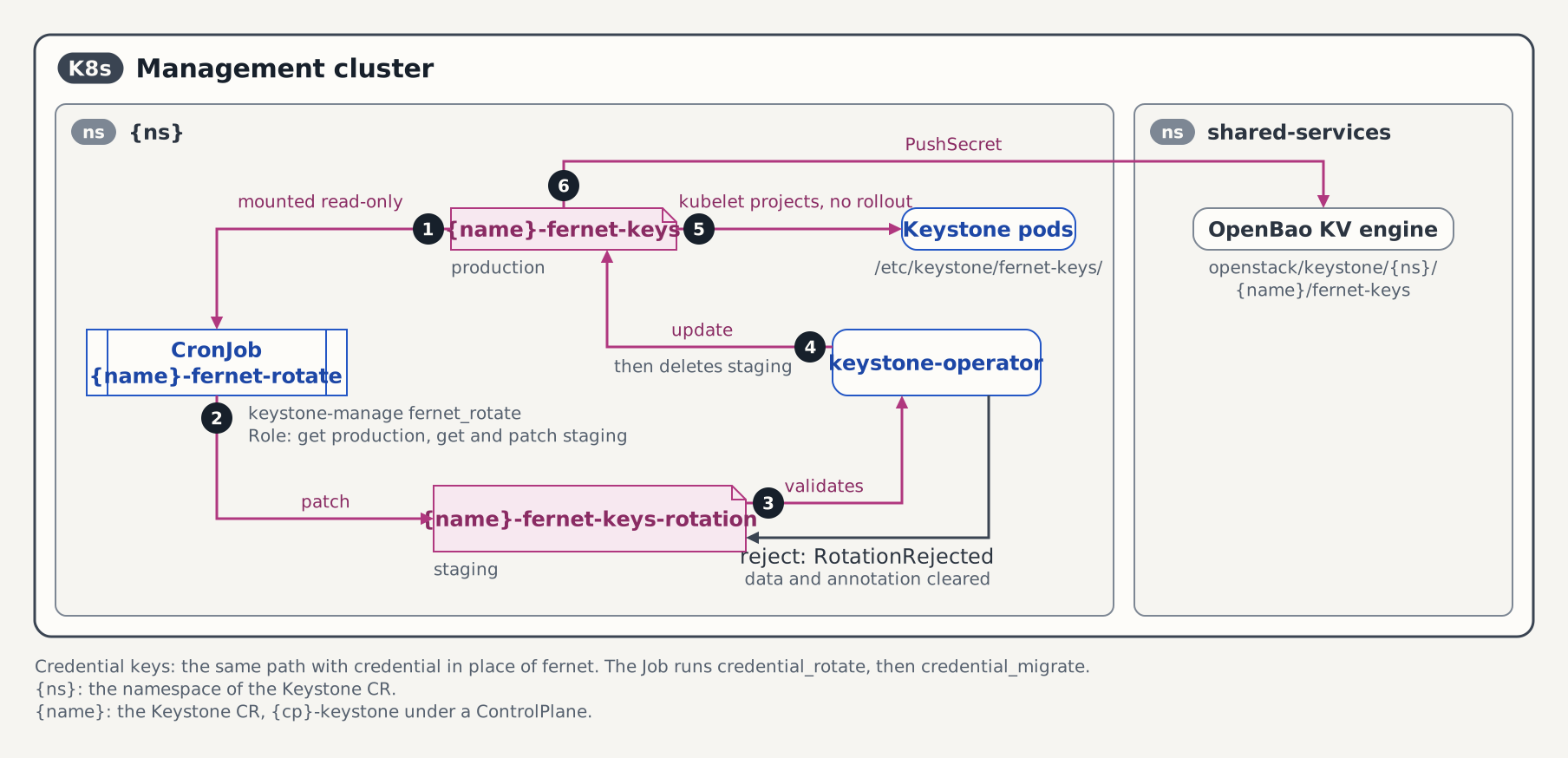
- The kubelet mounts
{name}-fernet-keysinto the Job pod and an init container copies it to anemptyDir. - The Job runs
keystone-manage fernet_rotateon the copy and sends one PATCH with the newdataand the annotationcobaltcore.c5c3.io/rotation-completed-at. - The Secret watch wakes the operator, which checks key count, key format and uniqueness.
- A valid payload replaces the
dataof the production Secret in oneUpdate, the staging Secret is deleted, and the eventFernetKeysRotatedis emitted. A rejected payload raises the Warning eventRotationRejected, the operator clears the staging Secret'sdataand annotation, the production Secret is not written, and no condition changes. - The kubelet projects the new
datainto/etc/keystone/fernet-keys/of the running pods. No pod restarts. {name}-fernet-keys-backupcopies the keys tokv-v2/openstack/keystone/{ns}/{name}/fernet-keys.
Staging Secret naming. Per fernetStagingSecretName, the staging Secret is {keystone.Name}-fernet-keys-rotation. It is created and owned by the operator via ensureFernetStagingSecret:
- Empty
Dataon creation; the CronJob PATCHesDataon rotation. - Labels:
commonLabels(keystone)+cobaltcore.c5c3.io/rotation-target=fernet-keys. - Owner reference: the Keystone CR (garbage-collected with the CR).
Completion annotation contract. The CronJob's fernet_rotate.sh PATCH writes both the new data map and the cobaltcore.c5c3.io/rotation-completed-at annotation in a single atomic strategic-merge PATCH. Format: datetime.datetime.now(datetime.timezone.utc).isoformat(timespec="seconds").replace("+00:00","Z") — an RFC3339 UTC timestamp such as 2026-04-18T12:34:56Z. The operator treats the annotation as the single-shot commit marker: it never rewrites the production Secret unless the annotation is present and parses cleanly.
Operator validation rules. Before copying staged data to production, applyRotationOutput calls validateRotationOutput (see operators/keystone/internal/controller/rotation_validation.go) which enforces all of:
- Key count:
minKeys=3,maxKeys=normalizedFernetMaxActiveKeys(keystone)+1. The+1tolerates the brief window in which the newly staged primary coexists with the existing active set. Violations returnErrKeyCountOutOfRange. - Key format: each value is exactly 44 bytes and base64url-decodes to 32 bytes — the
generateFernetKeyoutput shape. Violations returnErrInvalidKeyFormat. - Uniqueness: no two values are byte-equal. Violations return
ErrDuplicateKeys.
On rejection the operator emits a Warning event RotationRejected on the Keystone CR and clears the staging Secret's data and its rotation-completed-at annotation. The Secret object stays, so the next CronJob run starts from an empty payload. On a malformed rotation-completed-at value the operator emits RotationAnnotationInvalid and leaves staging in place, allowing the next CronJob run to overwrite with a valid payload.
Apply algorithm. On a valid staging Secret, applyRotationOutput GETs the production Secret, replaces its .data map with the staging payload verbatim, issues an Update, deletes the staging Secret, and emits a Normal event FernetKeysRotated. UPDATE-then-DELETE ordering is deliberate: if DELETE fails the production Secret is already updated, and a subsequent reconcile will no-op until the next CronJob run writes a new annotation timestamp.
Production Secret.Data field ownership. The production Fernet Secret's .data map is owned solely by the operator. Writes happen exclusively through the applyRotationOutput GET-then-Update round-trip under the controller-owned ResourceVersion, which guarantees optimistic concurrency (a concurrent writer triggers a 409 Conflict and the reconciler requeues). The Update fully replaces the map — stale key indices absent from the staging payload (e.g. those renumbered by keystone-manage fernet_rotate or trimmed by a reduction in spec.fernet.maxActiveKeys) are removed, which is the atomic-swap semantic the rotation flow requires. A strategic-merge PATCH on this field would merge by key and allow decommissioned keys to accumulate, so it is intentionally avoided.
RBAC verb matrix. Two principals touch the production and staging Secrets, with strictly disjoint capabilities:
| Principal | Resource | Verbs | Source |
|---|---|---|---|
CronJob ServiceAccount ({name}-fernet-rotate) | Secret {name}-fernet-keys (production) | get | Role rule 1 in ensureFernetRotationRBAC |
CronJob ServiceAccount ({name}-fernet-rotate) | Secret {name}-fernet-keys-rotation (staging) | get, patch | Role rule 2 in ensureFernetRotationRBAC |
| Operator ServiceAccount | Secret {name}-fernet-keys (production) | get, patch, create, update, delete, list, watch | Cluster-scoped core secrets verbs (see RBAC Permissions) |
| Operator ServiceAccount | Secret {name}-fernet-keys-rotation (staging) | get, create, update, patch, delete, list, watch | Cluster-scoped core secrets verbs |
The CronJob ServiceAccount has no create, update, or delete on either Secret — only get (both) and patch (staging only). Chainsaw tests in tests/e2e/keystone/fernet-rotation/chainsaw-test.yaml assert this exact verb split.
reconcileCredentialKeys
File: operators/keystone/internal/controller/reconcile_credential.go
Signature:
func (r *KeystoneReconciler) reconcileCredentialKeys(ctx context.Context,
    keystone *keystonev1alpha1.Keystone, configMapName string) (ctrl.Result, error)
Purpose: Manage credential encryption keys — initial generation, rotation schedule with credential migration, and disaster recovery backup to OpenBao.
Steps (in order):
- Ensure credential keys Secret — If
{name}-credential-keysSecret does not exist, generate initial keys and create the Secret with a controller owner reference. - Ensure rotation RBAC — Create or update the ServiceAccount, Role, and RoleBinding (
{name}-credential-rotate) for the rotation CronJob. - Create script ConfigMap — Create an immutable, versioned ConfigMap
{name}-credential-rotate-script-{hash}containing the embeddedcredential_rotate.shscript. Usesconfig.CreateImmutableConfigMap()which appends a content-hash suffix and setsimmutable: true. - Ensure rotation CronJob — Create or update
{name}-credential-rotateCronJob with the schedule fromspec.credentialKeys.rotationSchedule. - Ensure PushSecret — Create or update
{name}-credential-keys-backupPushSecret targetingkv-v2/data/openstack/keystone/{namespace}/{name}/credential-keysin the store the Keystone selected viaspec.secretStoreRef(default cluster storeopenbao-cluster-store; its store ref is built bysecrets.PushSecretStoreRefs). Switching the ref updates the PushSecret in place — the name and OpenBao RemoteKey are unchanged — so the irreplaceable credential key material is moved to the new store, never re-created.
Key Generation:
| Property | Value |
|---|---|
| Algorithm | crypto/rand (32 bytes), same format as Fernet keys |
| Encoding | URL-safe base64 (base64.URLEncoding.EncodeToString) |
| Key count | max(spec.credentialKeys.maxActiveKeys, 3) |
| Secret data keys | String indices: "0", "1", "2", ... |
| Secret name | {name}-credential-keys |
Rotation CronJob:
| Field | Value |
|---|---|
| Name | {name}-credential-rotate |
| Pod labels | commonLabels(keystone) + app.kubernetes.io/component=credential-rotation |
| Schedule | spec.credentialKeys.rotationSchedule |
| Suspend | spec.credentialKeys.suspend (default false); set true to pause rotation during an incident without deleting the CronJob or changing its schedule |
| ServiceAccount | {name}-credential-rotate |
| Init container | Copies keys from credential-keys-src (Secret) to credential-keys (emptyDir) |
| Command | /scripts/credential_rotate.sh |
Volume credential-keys-src | Secret {name}-credential-keys (read-only source, defaultMode: 0400) |
Volume credential-keys | emptyDir (writable working copy; init container writes files with install -m 0400) |
Volume fernet-keys | Secret {name}-fernet-keys (read-only, required by config, defaultMode: 0400) |
Volume config | ConfigMap {configMapName} |
Volume scripts | ConfigMap {name}-credential-rotate-script-{hash} (defaultMode: 0555) |
Pod fsGroup | 42424 (openstack GID — grants the rotation Pod's UID 42424 group access to projected key files at mode 0400) |
| Rationale | Mirrors upstream Keystone's keystone.common.fernet_utils._check_key_repository, which logs a WARNING when the key directory or any key file is world-readable (stat.S_IROTH); pinning defaultMode: 0400 plus fsGroup: 42424 keeps the projected files group-readable to UID 42424 only and silences the warning |
Note: The
credential_rotate.shscript runs bothcredential_rotateandcredential_migrate. The migrate step re-encrypts existing credentials in the database with the new primary key, which is critical to prevent data loss when old keys are eventually purged.
PushSecret:
| Field | Value |
|---|---|
| Name | {name}-credential-keys-backup |
| Store | selected via spec.secretStoreRef (default ClusterSecretStore/openbao-cluster-store) |
| Source Secret | {name}-credential-keys |
| Remote Key | kv-v2/data/openstack/keystone/{namespace}/{name}/credential-keys |
Condition Contract:
| Status | Reason | Message | RequeueAfter |
|---|---|---|---|
False | GeneratingKeys | "Initial credential keys have been generated" | RequeueSecretPolling (15s) |
True | CredentialKeysRotated | "rotation applied; staging secret cleared" | RequeueSecretPolling (15s) (transient: apply-success short-circuit in reconcileCredentialKeys; operators see this immediately after a rotation apply via kubectl describe, before the next reconcile transitions to the steady-state Reason) |
True | CredentialKeysAvailable | "Credential keys Secret exists and rotation CronJob is configured" | — |
Versioned Script ConfigMap:
Uses the same versioned, immutable ConfigMap pattern as reconcileFernetKeys. See the description in that section for details on content-hash naming and immutability.
Error handling: Errors from Secret creation, RBAC ensure, script ConfigMap creation, CronJob ensure, or PushSecret ensure are wrapped with context and returned directly. No requeue delays — errors trigger controller-runtime exponential backoff.
Idempotency: If the {name}-credential-keys Secret already exists, it is not modified. This prevents overwriting keys that have been rotated by the CronJob.
Shared library calls: config.CreateImmutableConfigMap(), job.EnsureCronJob(), secrets.EnsurePushSecret()
Key Rotation RBAC Split
The credential rotation path mirrors the Fernet split exactly: the {name}-credential-rotate CronJob computes rotated keys, PATCHes them into a dedicated staging Secret, and the operator performs the final write onto the production {name}-credential-keys Secret.
The figure and its steps under reconcileFernetKeys apply with credential in every name. Step 2 runs keystone-manage credential_migrate against the database after credential_rotate.
Staging Secret naming. Per credentialStagingSecretName, the staging Secret is {keystone.Name}-credential-keys-rotation. It is created and owned by the operator via ensureCredentialStagingSecret:
- Empty
Dataon creation; the CronJob PATCHesDataon rotation. - Labels:
commonLabels(keystone)+cobaltcore.c5c3.io/rotation-target=credential-keys. - Owner reference: the Keystone CR (garbage-collected with the CR).
Completion annotation contract. credential_rotate.sh runs keystone-manage credential_rotate and then keystone-manage credential_migrate (in that order — migrate re-encrypts existing stored credentials with the new primary key) before emitting a single atomic PATCH that sets both data and the cobaltcore.c5c3.io/rotation-completed-at annotation (RFC3339 UTC, Z suffix). As with Fernet, the annotation is the single-shot commit marker; absence or malformed format blocks the operator's apply path.
Operator validation rules. Identical to Fernet, with one parameter difference — maxKeys=normalizedCredentialMaxActiveKeys(keystone)+1:
- Key count:
[3, normalizedCredentialMaxActiveKeys(keystone)+1]inclusive.ErrKeyCountOutOfRangeon violation. - Key format: 44-byte base64url decoding to 32 bytes.
ErrInvalidKeyFormaton violation. - Uniqueness: byte-distinct values.
ErrDuplicateKeyson violation.
Rejection emits RotationRejected (Warning, on the CR) and clears the staging Secret's data and annotation. A malformed rotation-completed-at emits RotationAnnotationInvalid and leaves staging intact.
Apply algorithm. On a valid staging Secret, applyRotationOutput GETs the production Secret, replaces its .data map with the staging payload verbatim, issues an Update, deletes the staging Secret, and emits a Normal event CredentialKeysRotated. Because the CronJob already ran credential_migrate before PATCHing staging, every credential row in the database is re-encrypted with the new primary by the time the operator commits the Secret swap — no data loss when old keys age out.
Key-rollover window. There is a ~60s window between
credential_migratecompletion and the kubelet refreshing the in-place Secret projection. During that window, running Keystone pods still have the old credential keyset mounted — database rows are already encrypted under the new primary, but the pods cannot decrypt them yet. This is an inherent property of the rotation flow and is tracked as a known limitation; it should be considered when sizing the rotation schedule against request volume.
Production Secret.Data field ownership. Same contract as Fernet: the operator owns the production .data map, writes are Update-based under the controller-owned ResourceVersion, and the Update fully replaces the map so stale indices are removed atomically. Strategic-merge PATCH is intentionally avoided here for the same merge-vs-replace reason documented in the Fernet section.
RBAC verb matrix. The CronJob ServiceAccount and the operator ServiceAccount have strictly disjoint capabilities on the production and staging Secrets:
| Principal | Resource | Verbs | Source |
|---|---|---|---|
CronJob ServiceAccount ({name}-credential-rotate) | Secret {name}-credential-keys (production) | get | Role rule 1 in ensureCredentialRotationRBAC |
CronJob ServiceAccount ({name}-credential-rotate) | Secret {name}-credential-keys-rotation (staging) | get, patch | Role rule 2 in ensureCredentialRotationRBAC |
| Operator ServiceAccount | Secret {name}-credential-keys (production) | get, patch, create, update, delete, list, watch | Cluster-scoped core secrets verbs (see RBAC Permissions) |
| Operator ServiceAccount | Secret {name}-credential-keys-rotation (staging) | get, create, update, patch, delete, list, watch | Cluster-scoped core secrets verbs |
The CronJob ServiceAccount has no create, update, or delete on either Secret — only get (both) and patch (staging only). Chainsaw tests in tests/e2e/keystone/credential-rotation/chainsaw-test.yaml assert this exact verb split.
reconcileConfig
File: operators/keystone/internal/controller/reconcile_config.go
Signature:
func (r *KeystoneReconciler) reconcileConfig(ctx context.Context,
    keystone *keystonev1alpha1.Keystone, domainsProjected bool) (string, error)
Purpose: Build the Keystone configuration files and store them in an immutable ConfigMap with a content-hash suffix. Returns the ConfigMap name for use by reconcileDeployment.
Note: This sub-reconciler has a different signature — it returns
(string, error)instead of(ctrl.Result, error), andreconcileConfigitself sets no status condition and requests no requeue. Its pipeline step wraps the call so that a failure flipsSecretsReady=False(viamarkConfigFailed); otherwise the aggregateReadywould re-aggregate the still-True sub-conditions and persist a staleReady=Trueat the new generation.SecretsReadyis reused rather than introducing a dedicatedConfigReady, matching thesubReconcilerConditionTypes"Config" -> "SecretsReady"mapping.
Configuration Pipeline:
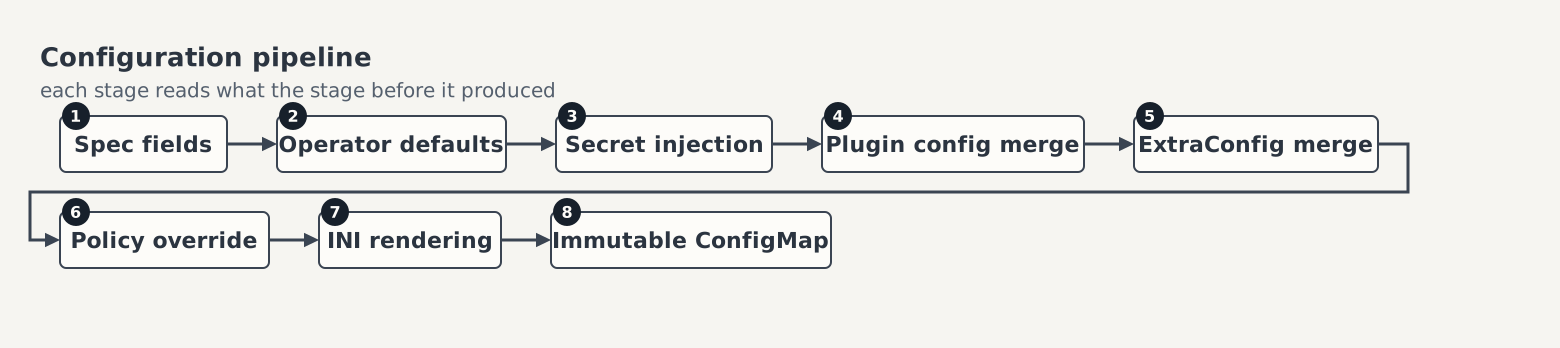
Step 1: Build operator defaults
The following INI sections are generated from CRD spec fields:
| Section | Key | Value Source |
|---|---|---|
DEFAULT | use_stderr | true (operator default) |
DEFAULT | debug | spec.logging.debug |
DEFAULT | default_log_levels | Deterministic CSV from spec.logging.perLoggerLevels, omitted when empty |
DEFAULT | log_config_append | /etc/keystone/keystone.conf.d/logging.conf — emitted only when spec.logging.format == "json" |
token | provider | fernet (hardcoded) |
fernet_tokens | key_repository | /etc/keystone/fernet-keys (hardcoded) |
fernet_tokens | max_active_keys | spec.fernet.maxActiveKeys |
cache | enabled | true (hardcoded) |
cache | backend | spec.cache.backend |
cache | memcache_servers | Resolved from spec (see below) |
memcache | servers | Same as cache.memcache_servers |
oslo_middleware | enable_proxy_headers_parsing | true (hardcoded) |
identity | default_domain_id | default (hardcoded) |
database | connection | Resolved connection string (see below) |
database | max_retries | -1 (hardcoded) |
database | connection_recycle_time | 600 (hardcoded) |
Step 2: Resolve cache servers
| Mode | Source | Format |
|---|---|---|
| Brownfield | spec.cache.servers | Comma-joined list |
| Managed | spec.cache.clusterRef.name | memcached-0.{name}:11211,memcached-1.{name}:11211,memcached-2.{name}:11211 |
Step 3: Resolve database connection string
| Mode | Host Resolution | Format |
|---|---|---|
| Managed | {clusterRef.name}.{namespace}.svc:{port} | mysql+pymysql://{username}:{password}@{host}:{port}/keystone |
| Brownfield | {spec.database.host}:{port} | mysql+pymysql://{username}:{password}@{host}:{port}/keystone |
- The password is always read from
spec.database.secretRefviasecrets.GetSecretValue(). The username source depends on the mode: in Static managed mode it is derived from the CR name (the MariaDBUserCR name); in brownfield and Dynamic managed mode it is read from the Secret'susernamekey (the engine issues an ephemeral username alongside the password). A missingusernamekey setsSecretsReady=Falsewith reasonWaitingForDBCredentials. - Default port is 3306 when
spec.database.portis 0. reconcileDBConnectionSecretreturns the SHA-256 of the assembled DSN, which the Deployment step stamps as thekeystone.c5c3.io/db-connection-hashpod-template annotation in Dynamic mode (see the Deployment section) so a rotated engine-issued credential rolls the Deployment.
Step 4: Merge plugin config — If spec.plugins is non-empty, plugins.RenderPluginConfig() generates INI sections that are merged with config.MergeDefaults().
Step 5: Merge extraConfig — If spec.extraConfig is set, it is merged as the higher-priority input to config.MergeDefaults(), so user-provided values override operator defaults.
Step 6: Handle policyOverrides — If spec.policyOverrides is set:
- Load external rules from
configMapRef(if set) viapolicy.LoadPolicyFromConfigMap(). - Merge inline
rulesover external rules (inline wins). - Render
policy.yamlviapolicy.RenderPolicyYAML(). - Inject
oslo_policysection intokeystone.confviaconfig.InjectOsloPolicyConfig()with path/etc/keystone/policy.yaml.
Step 7: Render api-paste.ini — Uses plugins.RenderPastePipelineINI() with:
| Field | Value |
|---|---|
| Pipeline name | public_api |
| App name | admin_service |
| Base filters | cors, sizelimit, http_proxy_to_wsgi, osprofiler, url_normalize, request_id, authtoken |
| Middleware | spec.middleware |
Step 8: Create immutable ConfigMap
| Field | Value |
|---|---|
| Base name | keystone-config |
| Actual name | keystone-config-{8-char-sha256} |
| Data keys | keystone.conf, api-paste.ini, policy.yaml (if spec.policyOverrides set), logging.conf (if spec.logging.format == "json") |
| Immutable | true |
When spec.logging.format == "json", the logging.conf data key wires oslo_log.formatters.JSONFormatter to a stderr StreamHandler and Step 1 emits [DEFAULT].log_config_append pointing at the on-pod path so oslo.log loads it on startup. Toggling back to format: "text" drops both the data key and the log_config_append entry, changing the content hash and rolling the Deployment.
renderLoggingConf template deviation
renderLoggingConf (reconcile_config.go:renderLoggingConf) intentionally deviates from the template sketched in the design brief on two points, and the deviation is locked in by TestReconcileConfig_LoggingJSONPlusPerLoggerLevels:
- The
[loggers]section emitskeys = rootonly — there is no[logger_keystone](or any other named-logger) subsection. This makesspec.logging.perLoggerLevels(rendered as[DEFAULT].default_log_levels) the single config surface that owns per-logger filtering. Splitting that responsibility between a[logger_<name>]block inlogging.confand the CSV inkeystone.confwould create two interleaved sources of truth and invite drift between them on future template edits. [handler_stderr]pinslevel = NOTSETrather than mirroring the root logger's level. The handler therefore emits every record the root logger forwards; hardcoding the level here would silently shadowspec.logging.levelfor all records that do not also clear an explicit per-handler filter.
These shape constraints are intentional and load-bearing — do not "fix" the renderer to match the original four-section template without first updating the corresponding test invariants.
Error handling: All errors are wrapped with context and returned. No conditions are set by this sub-reconciler.
Shared library calls: secrets.GetSecretValue(), config.MergeDefaults(), config.InjectOsloPolicyConfig(), config.RenderINI(), config.CreateImmutableConfigMap(), plugins.RenderPluginConfig(), plugins.RenderPastePipelineINI(), policy.LoadPolicyFromConfigMap(), policy.RenderPolicyYAML()
reconcilePolicyValidation
File: operators/keystone/internal/controller/reconcile_policyvalidation.go
Signature:
func (r *KeystoneReconciler) reconcilePolicyValidation(ctx context.Context,
    keystone *keystonev1alpha1.Keystone, configMapName string) (ctrl.Result, error)
Purpose: Validate custom oslo.policy overrides via oslopolicy-validator before the Deployment is updated. This sub-reconciler gates the Deployment rollout: invalid policy overrides are caught before reaching running pods. Two lifecycle paths:
- No policy overrides (
spec.policyOverridesis nil): Delete any existing validation Job and setPolicyValidReady=Truewith reasonNotRequired. - Policy overrides set (
spec.policyOverridesis set): Build and run a validation Job viajob.RunJob(). Track lifecycle through InProgress → Passed/Failed states.
Note: This sub-reconciler accepts the
configMapNamereturned byreconcileConfigto mount the correct immutable ConfigMap (containing the renderedpolicy.yaml) in the validation Job pod spec.
Validation Job:
| Field | Value |
|---|---|
| Name | {name}-policy-validation |
| Image | {spec.image.repository}:{spec.image.tag} |
| Command | oslopolicy-validator --namespace keystone --config-dir /etc/keystone/keystone.conf.d/ |
| BackoffLimit | 2 |
| TTLSecondsAfterFinished | not set |
| RestartPolicy | Never |
| SecurityContext | restrictedSecurityContext() (PSS Restricted) |
| TerminationMessagePolicy | FallbackToLogsOnError |
Volume Mounts:
| Volume Name | Mount Path | Source | ReadOnly |
|---|---|---|---|
config | /etc/keystone/keystone.conf.d/ | ConfigMap {configMapName} | Yes |
Error Extraction (getValidationErrorMessage):
When a validation Job fails, the reconciler extracts a descriptive error message from the failed Pod's termination message:
- Lists Pods by
job-namelabel selector in the Job's namespace, through the uncached API reader of the cluster that holds the Job. The operator never watches pods, so its RBAC grantspodsonlygetandlist. - Sorts by creation timestamp (most recent first).
- Searches container termination messages for a non-empty
Terminated.Message. - Truncates to 500 characters if the message exceeds that length.
- Falls back to a
kubectl logsreference if the reader cannot be resolved, the List fails, or no termination message is available.
Condition Contract:
| Status | Reason | Message | RequeueAfter |
|---|---|---|---|
True | NotRequired | "No policy overrides configured" | — |
False | PolicyValidationInProgress | "Policy validation job is running" | 15s |
True | PolicyValidationPassed | "Policy validation completed successfully" | — |
False | PolicyValidationFailed | Descriptive error from Pod termination message | — (error returned) |
Error handling: Errors from job.RunJob() are wrapped with "running policy validation" context. When job.ErrJobFailed is detected, getValidationErrorMessage() extracts the failure detail before setting the condition. The PolicyValidationFailed condition is set before returning the error so that the failure reason is visible in the CR status.
Shared library calls: job.RunJob()
reconcileDeployment
File: operators/keystone/internal/controller/reconcile_deployment.go
Signature:
func (r *KeystoneReconciler) reconcileDeployment(ctx context.Context,
    keystone *keystonev1alpha1.Keystone, configMapName string) (ctrl.Result, error)
Purpose: Ensure the Keystone API Deployment and Service exist with the correct spec. Sets status.endpoint when the Deployment becomes available.
Note: This sub-reconciler accepts the
configMapNamereturned byreconcileConfigto reference the correct immutable ConfigMap in volume mounts.
In-Place Key Rotation:
Fernet and credential key rotation is handled in-place via kubelet Secret projection. When the operator commits a rotation to a key Secret, the kubelet automatically projects the new data into running pods without requiring a Deployment rollout. The pod template does not include hash annotations for the fernet/credential key Secrets, so those Secret changes do not trigger rolling restarts. This preserves Keystone availability, PDB budget, and uWSGI/Memcached connections during routine key rotation.

The database connection string is the deliberate exception. It is consumed via the OS_DATABASE__CONNECTION environment variable (not a mounted volume), so a rotated credential only takes effect on a Pod restart. In Dynamic credentials mode (spec.database.credentialsMode: Dynamic) the DSN rotates at the engine lease TTL, so reconcileDeployment stamps a keystone.c5c3.io/db-connection-hash pod-template annotation (the SHA-256 of the DSN returned by reconcileDBConnectionSecret) to roll the Deployment when the engine-issued credential changes. Static and brownfield modes leave the annotation absent, preserving the no-rollout behavior.
Deployment Spec:
| Field | Value |
|---|---|
| Name | {name} (bare CR name) |
| Replicas | spec.deployment.replicas; left nil when spec.autoscaling is set, so the HorizontalPodAutoscaler owns the count and the operator does not reset it each reconcile |
| Labels | app.kubernetes.io/name=keystone, app.kubernetes.io/instance={name}, app.kubernetes.io/managed-by=keystone-operator, app.kubernetes.io/component=api (on the Deployment metadata and on the pod template) |
| Selector | app.kubernetes.io/name=keystone, app.kubernetes.io/instance={name} (the component label is left out: a Deployment pod selector is immutable after creation) |
| Container name | keystone |
| Image | {spec.image.repository}:{spec.image.tag} |
| Port | 5000 (named keystone) |
Probes (keystone container):
| Probe | Type | Target | InitialDelay | Period | Timeout |
|---|---|---|---|---|---|
| Liveness | TCPSocket 5000; with federation active an exec-form localhost connect (uWSGI binds 127.0.0.1 only) | uWSGI accepting connections | 15s | 20s | 10s (both variants) |
| Readiness | Exec | TCP connect to the host/port parsed from OS_DATABASE__CONNECTION (inner connect timeout 20s) | 10s | 30s | 25s |
| Startup | HTTPGet /v3 port 5000; with federation active an exec-form localhost fetch (inner timeout 5s) | WSGI app answering | — | 10s | 8s (FailureThreshold 30) |
The exec-form probes fork a shell plus a Python interpreter, which alone can consume the kubelet's 1-second default timeout — every exec probe therefore carries an explicit timeoutSeconds sitting above its inner connect/fetch timeout and below its own period. The liveness probe carries 10 seconds in both variants, the liveness timeout of every API front end: a single-worker uWSGI holds an HTTP check for the whole request in flight, and the kubelet's 1-second default would restart a busy API. A TCP connect does not wait on the worker, so keystone takes the value to stay in line with the other front ends. The liveness and readiness probes are intentionally separated. The liveness probe only verifies uWSGI is accepting connections, without exercising the database code path, so the kubelet does not kill pods during transient database outages (e.g., MariaDB maintenance). The readiness probe TCP-connects to the database endpoint from inside the pod — /v3 is served without touching the database and cannot observe a lost connection — so a keystone-side database outage depools the pod from the Service instead of going unnoticed, and the pod re-enters the endpoints within one probe period after recovery.
Probes (federation-proxy sidecar, when federation is active):
| Probe | Type | InitialDelay | Period | Timeout |
|---|---|---|---|---|
| Startup | TCPSocket on the proxy port | — | 2s | kubelet default (FailureThreshold 30) |
| Liveness | TCPSocket on the proxy port | 15s | 20s | kubelet default |
| Readiness | HTTPGet /v3 through the whole proxy-to-uWSGI chain | 5s | 10s | 5s |
The sidecar's TCP probes fork no process and keep the kubelet default; only its readiness probe, which traverses Apache and uWSGI, carries an explicit 5-second timeout.
Volume Mounts:
| Volume Name | Mount Path | Source | ReadOnly |
|---|---|---|---|
config | /etc/keystone/keystone.conf.d/ | ConfigMap {configMapName} | Yes |
fernet-keys | /etc/keystone/fernet-keys/ | Secret keystone-fernet-keys (defaultMode: 0400) | Yes |
credential-keys | /etc/keystone/credential-keys/ | Secret keystone-credential-keys (defaultMode: 0400) | Yes |
Pod-level Security:
| Field | Value |
|---|---|
spec.template.spec.securityContext.fsGroup | 42424 (openstack GID — grants the API Pod's UID 42424 group access to projected key files at mode 0400) |
| Rationale | Mirrors upstream Keystone's keystone.common.fernet_utils._check_key_repository, which logs a WARNING when the key directory or any key file is world-readable (stat.S_IROTH); pinning defaultMode: 0400 plus fsGroup: 42424 keeps the projected files group-readable to UID 42424 only and silences the warning |
Service Spec:
| Field | Value |
|---|---|
| Name | {name} (bare CR name) |
| Selector | app.kubernetes.io/name=keystone, app.kubernetes.io/instance={name}, app.kubernetes.io/component=api from the first pass that observes a fully rolled-out Deployment onwards; app.kubernetes.io/name and app.kubernetes.io/instance alone before that |
| Port | 5000 TCP |
The selector is narrowed in two phases. The PodDisruptionBudget selector is not: it never keys on the component label at all.
deployment.EnsureDeployment is a Server-Side Apply: it returns as soon as the API server accepts the pod template, long before the rollout finishes. On the operator upgrade that first ships app.kubernetes.io/component=api, applying the narrowed selector in that same reconcile pass would drop every API pod still running from the previous build — none of them carries the label — out of the EndpointSlices while they are the only pods serving. The Service would have no backends until the first re-rolled pod passed its probes, and a rollout that never completes (image pull failure, ResourceQuota rejection, no schedulable node) would never repool them, turning a stuck rollout into an unbounded outage.
The reconciler therefore keeps the wide selector until deployment.TemplateConverged reports that no pod predates the current pod template — the deployment controller has observed the latest generation, reports at least one pod, and status.replicas (pods across all ReplicaSets) equals status.updatedReplicas (pods of the newest one) — and narrows it on the next pass. The Deployment is watched (Owns), so that pass is triggered by the status update itself.
Readiness is deliberately not part of that gate. An unready pod is not an endpoint whichever selector the Service carries, while requiring full readiness would strand a Deployment that never reaches it — a third replica pending on resource pressure or on an unsatisfiable topology-spread constraint — on the wide selector permanently, and with it on the maintenance-pod race the narrowing closes. (The stricter keystoneDeploymentRolledOut, which does require readiness, gates the RollingUpdate → Contracting flip, where old-image pods must be gone before their columns are dropped.)
The narrowing is a one-way migration, so the reconciler latches it: when the Deployment is not converged it reads the live Service and keeps the narrow selector if it is already there (deployment.APISelectorNarrowed). Only a pod template built by an operator predating app.kubernetes.io/component=api can miss the narrow selector, and every template this operator builds carries it — so after the migration the wide selector protects nothing and only re-admits maintenance pods. Without the latch the selector would not migrate once but oscillate: deployment.TemplateConverged turns false on every later rollout (a rotated Dynamic database credential restamps the pod template on each ESO refresh), re-admitting maintenance pods for as long as that rollout lasts.
The latch reads the Service through mgr.GetAPIReader(), not the informer cache. Right after the narrowing write the cache can still hold the wide Service; a reconcile triggered in that window by an unrelated event, with the Deployment momentarily unconverged, would read the stale copy and apply the wide selector again. The read runs at most once per reconcile and only while the Deployment is unconverged.
tests/e2e-operator-upgrade/keystone-helm-upgrade asserts the migration across a real helm upgrade: it records the EndpointSlice address count before the upgrade and samples it until the selector narrows, failing if the count ever drops.
Status Endpoint:
When the Deployment becomes ready, status.endpoint is set via the keystoneStatusEndpoint helper (defined in reconcile_httproute.go):
spec.gateway | Resulting status.endpoint |
|---|---|
| nil | http://{name}.{namespace}.svc.cluster.local:5000/v3 |
set (hostname api.example.com) | https://api.example.com/v3 |
The helper is owned by reconcile_httproute.go but invoked from reconcileDeployment because the endpoint must be populated before the reconcileHealthCheck step reads it. reconcileHTTPRoute runs later in the sequence and does not mutate status.endpoint.
PodDisruptionBudget:
After ensuring the Deployment and Service, reconcileDeployment creates or updates a PodDisruptionBudget via deployment.EnsurePDB(). The PDB branches on the lower replica bound, deployment.EffectiveMinReplicas: the HPA's minReplicas while spec.autoscaling is set, otherwise the effective spec.deployment.replicas. An unset minReplicas falls back to the replica count, the value the HPA renders.
| Lower bound | Field | Value | Rationale |
|---|---|---|---|
> 1 | minAvailable | 1 | Guarantees at least one pod remains during voluntary disruptions |
<= 1 | maxUnavailable | 1 | Avoids drain deadlock: a PDB with minAvailable=1 on a single pod would block all evictions, including the one pod an HPA at minReplicas: 1 may leave running |
A flip between the two fields drops the one the operator no longer asserts, because EnsurePDB applies the budget with server-side apply.
| PDB Field | Value |
|---|---|
| Name | {name} |
| Labels | commonLabels (the Deployment metadata adds app.kubernetes.io/component=api on top; the PDB does not) |
| Selector | matchLabels: app.kubernetes.io/name=keystone, app.kubernetes.io/instance={name}; matchExpressions: batch.kubernetes.io/job-name DoesNotExist |
The budget needs the same maintenance-pod exclusion as the Service but reaches it the other way round, and it needs no two-phase narrowing.
Excluding maintenance pods matters because the disruption controller counts every pod its selector matches towards currentHealthy, and a Job pod carries no readiness probe, so it is healthy the moment it starts — inflating disruptionsAllowed and letting a node drain evict the API pods the budget exists to protect. Every maintenance workload is a CronJob, so the absence of batch.kubernetes.io/job-name — the label the Job controller stamps on each pod it creates — separates the API pods from them exactly.
Keying on app.kubernetes.io/component=api instead would open a worse hole than it closes. The eviction API only consults budgets whose selector matches the pod being evicted, so a pod that no budget matches has no budget at all: on the operator upgrade that first ships the component label, a component-keyed budget would match none of the API pods actually serving, and a node drain, an autoscaler consolidation, or a node upgrade could take every replica at once. The gap would last the whole migration rollout — and, unlike the Service's, it has no bound: a rollout that wedges on a bad image tag, a ResourceQuota rejection, or an unschedulable pod keeps the unlabelled pods alive indefinitely.
Because the Job-name requirement holds for labelled and unlabelled API pods alike, the budget can carry its final selector from the first reconcile. Only the Service, whose narrow selector genuinely misses the pre-upgrade pods, needs the two-phase narrowing.
Condition Contract:
| Status | Reason | Message | RequeueAfter |
|---|---|---|---|
False | WaitingForDeployment | "Keystone API deployment is not yet available" | 10s |
True | DeploymentReady | "Keystone API deployment is available" | — |
Error handling: Errors from deployment.EnsureDeployment(), deployment.EnsureService(), and deployment.EnsurePDB() are wrapped with context and returned.
Shared library calls: deployment.EnsureDeployment(), deployment.EnsureService(), deployment.EnsurePDB()
pruneStaleConfigMaps
File: operators/keystone/internal/controller/reconcile_config.go
Signature:
func (r *KeystoneReconciler) pruneStaleConfigMaps(ctx context.Context,
    keystone *keystonev1alpha1.Keystone, configMapName string) error
Purpose: Remove historical immutable ConfigMaps that exceed the retain count after the Deployment has rolled out successfully. This prevents unbounded accumulation of {name}-config-{hash} ConfigMaps in the namespace.
Note: This is not a sub-reconciler — it does not set any status condition and returns only
error. It is a thin wrapper aroundconfig.PruneImmutableConfigMapsthat derives thebaseNamefrom the Keystone CR name and passes the hardcoded retain count.
Placement rationale: Pruning runs after reconcileDeployment returns ready to ensure all pods are running the new configuration before old ConfigMaps are deleted. During a rolling update, old ReplicaSet pods still reference the previous ConfigMap — pruning before Deployment readiness could delete a ConfigMap that is still mounted.
Parameters:
| Name | Source | Description |
|---|---|---|
keystone | CR | Owning Keystone CR (provides UID for owner-reference filtering and name for baseName) |
configMapName | reconcileConfig return value | Currently active ConfigMap name (never deleted) |
Delegation:
baseName := fmt.Sprintf("%s-config", keystone.Name)
config.PruneImmutableConfigMaps(ctx, r.Client, keystone,
    baseName, keystone.Namespace, configMapName, defaultConfigMapRetainCount)
Constants:
| Name | Value | Description |
|---|---|---|
defaultConfigMapRetainCount | 3 | Number of historical ConfigMaps to keep beyond the current active one. Keeps current + 3 historical = 4 total, sufficient for rollback. Not CRD-configurable by design. |
Behavior:
| State | Result |
|---|---|
| 5 historical ConfigMaps, retain=3 | 2 oldest deleted, 3 newest + current remain (4 total) |
| 2 historical ConfigMaps, retain=3 | No-op (fewer than retain count) |
| 0 historical ConfigMaps | No-op |
| ConfigMap owned by different CR | Skipped (owner UID mismatch) |
| ConfigMap with no owner reference | Skipped |
| ConfigMap deleted between list and delete | NotFound silently ignored via client.IgnoreNotFound |
Auditability: Each pruned ConfigMap name is logged at info level with structured fields name and namespace.
Error handling: Errors from listing or deleting ConfigMaps are wrapped with context and returned to the reconcile loop, which applies exponential backoff via controller-runtime. All preceding steps (config creation, deployment) are idempotent, so requeue after a pruning error is safe.
Shared library calls: config.PruneImmutableConfigMaps()
reconcileHTTPRoute
File: operators/keystone/internal/controller/reconcile_httproute.go
Signature:
func (r *KeystoneReconciler) reconcileHTTPRoute(ctx context.Context,
    keystone *keystonev1alpha1.Keystone) (ctrl.Result, error)
Purpose: Manage the optional Gateway API HTTPRoute that exposes the Keystone API outside the cluster via a pre-existing Gateway. The Gateway is owned by the platform team; this sub-reconciler only ensures the route that attaches the Keystone Service to it. Four lifecycle paths:
- The children's cluster does not serve the HTTPRoute kind (
commonmulticluster.ChildrenServeKindanswers false): Whenspec.gatewayis nil, setHTTPRouteReady=Truewith reasonHTTPRouteNotRequired(no delete attempt —c.Deletewould fail withno matches for kind). Whenspec.gatewayis set, setHTTPRouteReady=Falsewith reasonGatewayAPINotInstalled; the operator otherwise keeps reconciling so that Keystone CRs withoutspec.gatewaystill become Ready. Where the answer comes from, and what the message asks for, depends on the CR:- Without
spec.targetClusterRef: fromr.gatewayAPIAvailable, the latchSetupWithManagerprobed against the management cluster'sRESTMapper. It found no mapping forHTTPRoute.gateway.networking.k8s.io/v1, so theOwns(HTTPRoute)watch was skipped too. Installing the CRD at runtime requires an operator restart for the probe and the watch to pick it up, and the message says so. - With
spec.targetClusterRef: from the target cluster's ownRESTMapper, probed on every pass with nothing memoized, so a CRD installed on the target is seen on the next reconcile. The drift watch is fixed at cluster engagement and does not come back with it, so the message asks for Gateway API on the target plus a rotation of the cluster's kubeconfig Secret, which re-engages the cluster and restores theHTTPRoutewatch.
- Without
- Gateway disabled (
spec.gatewayis nil, CRD present): Delete any existing{name}HTTPRoute and setHTTPRouteReady=Truewith reasonHTTPRouteNotRequired. - Gateway enabled (
spec.gatewayis set, CRD present): Build the desired HTTPRoute viabuildKeystoneHTTPRoute()and callensureHTTPRoute()to create or update it. Re-fetch to read the parentAcceptedcondition written by the Gateway controller, then reflect that status asHTTPRouteReady:Accepted=True→ conditionTruewith reasonHTTPRouteAccepted; otherwise conditionFalsewith reasonHTTPRouteNotAcceptedand a 10s requeue. - Error: Propagate errors from ensure/delete/get operations with descriptive context. A capability probe that fails instead of answering (the target API server unreachable, or throttling the discovery request) belongs here as well: it sets
HTTPRouteReady=Falsewith reasonCapabilityProbeFailedand returns the wrapped error, so the pass is retried with backoff.
Placement rationale: Runs after reconcileDeployment + pruneStaleConfigMaps so the backend Service ({name}) is guaranteed to exist before the HTTPRoute references it, and before reconcileHealthCheck reads status.endpoint. The route is deliberately not part of reconcileParallelGroup because it has a transitive dependency on the Service created by reconcileDeployment.
HTTPRoute Construction (buildKeystoneHTTPRoute):
| HTTPRoute Field | Source |
|---|---|
metadata.name | {name} (shared with the Keystone API Service) |
metadata.namespace | Keystone CR namespace |
metadata.labels | commonLabels(keystone) |
metadata.annotations | spec.gateway.annotations (copied; operator-managed keys stay authoritative on merge) |
spec.parentRefs[0].name | spec.gateway.parentRef.name |
spec.parentRefs[0].namespace | spec.gateway.parentRef.namespace (omitted when empty; defaults to CR namespace) |
spec.parentRefs[0].sectionName | spec.gateway.parentRef.sectionName (omitted when empty) |
spec.hostnames[0] | spec.gateway.hostname |
spec.rules[0].matches[0].path.type | PathPrefix |
spec.rules[0].matches[0].path.value | spec.gateway.path (defaults to / when empty, defaultHTTPRoutePath) |
spec.rules[0].backendRefs[0].kind | Service |
spec.rules[0].backendRefs[0].name | {name} |
spec.rules[0].backendRefs[0].port | 5000 (keystoneAPIPort) |
metadata.ownerReferences | Keystone CR (controller owner via controllerutil.SetControllerReference) |
Merge strategy (ensureHTTPRoute): Mirrors ensureNetworkPolicy. On update, the Spec is overwritten with the desired state, labels and annotations are merged additively so user-added metadata is preserved while operator-managed keys remain authoritative, and the owner reference is re-asserted. apiequality.Semantic.DeepEqual guards against no-op writes — client.Update is called only when Spec, labels, annotations, or owner references actually changed. Empty maps are normalized to nil via hrNormalizeMap so nil-vs-empty does not trigger a spurious diff.
Acceptance Detection (isHTTPRouteAccepted): Iterates status.parents[*].conditions and returns true as soon as any parent reports Accepted=True. An empty Parents slice (Gateway controller has not yet observed the route) is treated as "not yet accepted", yielding a False condition with a short requeue rather than a permanent error.
Condition Contract:
| Status | Reason | Message | RequeueAfter |
|---|---|---|---|
True | HTTPRouteNotRequired | "External API exposure via Gateway API is not configured" | — |
True | HTTPRouteAccepted | "HTTPRoute accepted by Gateway" | — |
False | HTTPRouteNotAccepted | "HTTPRoute not yet accepted by Gateway" | 10s |
Requeue Constants:
| Constant | Value | Purpose |
|---|---|---|
requeueHTTPRouteAccepted | RequeueDeploymentPolling (10s) | Interval for requeuing while waiting for the Gateway controller to set Accepted=True on the route's parent status |
keystoneAPIPort | gatewayv1.PortNumber(5000) | Backend Service port targeted by the route |
defaultHTTPRoutePath | "/" | Path prefix applied when spec.gateway.path is empty |
status.endpoint Derivation: The gateway-aware helper keystoneStatusEndpoint() is defined alongside this sub-reconciler but called from reconcileDeployment. When spec.gateway.hostname is set, the helper returns https://{hostname}/v3; otherwise it returns the cluster-local http://{name}.{namespace}.svc.cluster.local:5000/v3. The gateway path prefix from spec.gateway.path is used for HTTPRoute routing only; it is not appended to status.endpoint. The https scheme is emitted unconditionally when a gateway hostname is configured — gateways are the public-ingress hop and terminate TLS.
Interaction with reconcileNetworkPolicy: When spec.gateway is set, reconcileNetworkPolicy appends an extra ingress peer that selects the gateway's namespace by the well-known label kubernetes.io/metadata.name={parentRef.namespace or CR namespace}. This lets Gateway data-plane pods reach the Keystone API Service on port 5000 without widening the base NetworkPolicy. The peer is added only while spec.gateway is non-nil and is removed automatically on the next reconcile after spec.gateway is cleared. The operator's own namespace is whitelisted by a separate, always-on ingress peer (see reconcileHealthCheck), independent of spec.gateway.
Error handling: Errors from ensureHTTPRoute() are wrapped with "ensuring HTTPRoute" context; errors from deleteHTTPRoute() with "deleting HTTPRoute"; the post-ensure Get with "getting HTTPRoute {ns}/{name}". All are returned directly to controller-runtime for exponential backoff. Acceptance failures are not returned as errors — they set a False condition and requeue at a fixed interval.
Shared library calls: none. All helpers (ensureHTTPRoute, deleteHTTPRoute, buildKeystoneHTTPRoute, isHTTPRouteAccepted, hrNormalizeMap, keystoneStatusEndpoint) are defined in reconcile_httproute.go.
reconcileHealthCheck
File: operators/keystone/internal/controller/reconcile_healthcheck.go
Signature:
func (r *KeystoneReconciler) reconcileHealthCheck(ctx context.Context,
    keystone *keystonev1alpha1.Keystone) (ctrl.Result, error)
Purpose: Perform an HTTP GET to the Keystone /v3 endpoint after the Deployment reports ready, verifying that the API is actually responding to requests. This catches cases where pods pass their readiness probe but the API is not functionally healthy.
Endpoint: Uses keystone.Status.Endpoint which is set by reconcileDeployment (e.g., http://keystone.{namespace}.svc.cluster.local:5000/v3). If the endpoint is empty (not yet configured), the health check sets KeystoneAPIReady=False with reason EndpointNotReady and requeues.
NetworkPolicy interaction: The operator pod runs in a dedicated namespace (e.g. keystone-system) distinct from the workload namespace, so a spec.networkPolicy whose ingress admits only the user-declared sources would block this health check and pin KeystoneAPIReady=False for a healthy deployment. To prevent that, reconcileNetworkPolicy appends an always-on ingress peer for the operator namespace — resolved at startup from POD_NAMESPACE or the mounted ServiceAccount namespace file (DetectOperatorNamespace) — so a correctly deployed operator can always reach the API on TCP 5000. On the egress side the same NetworkPolicy auto-derives rules for DNS, the kube-apiserver (used by the rotation CronJob pods that share the policy's pod selector), the database (port from spec.database.port), and the cache, in both managed and brownfield modes, so neither the readiness probe nor the scheduled key rotations are blocked. See NetworkPolicySpec for the full rule set.
Target-cluster placement: A Keystone with spec.targetClusterRef serves on the target cluster, where its Service DNS name is the only one that resolves. The probe keeps that URL and runs it through the target API server's services/proxy subresource, under the credentials of the kubeconfig the cluster is registered with. Conditions are unaffected: the message names the Service URL whether the request left from here or from there. The registered kubeconfig needs get on services/proxy in the workload namespace; without it the probe reports APIUnhealthy carrying the API server's forbidden message.
HTTPDoer Interface:
type HTTPDoer interface {
    Do(*http.Request) (*http.Response, error)
}
The HTTPDoer interface abstracts *http.Client so that tests can inject mock HTTP servers via httptest.NewServer. The httpClient() helper returns the injected HTTPClient field if non-nil, otherwise falls back to http.DefaultClient.
Timeout: The HTTP request uses a derived context with HealthCheckTimeout (10 seconds), preventing a hanging Keystone API from blocking the reconcile loop.
Error Classification:
Network errors are classified into descriptive condition reasons via classifyHealthCheckError():
| Error Type | Detection | Reason | Message |
|---|---|---|---|
| Context deadline exceeded | errors.Is(err, context.DeadlineExceeded) | HealthCheckTimeout | "health check timed out" |
| DNS resolution failure | errors.As(err, &net.DNSError) | EndpointNotReady | "endpoint not resolvable" |
| Connection refused | strings.Contains(err.Error(), "connection refused") | ConnectionFailed | "connection failed: {error}" |
| Other network error | fallthrough | HealthCheckFailed | "health check failed: {error}" |
All network errors result in a condition False + requeue, not a returned error. Returning network errors would trigger controller-runtime's exponential backoff, delaying recovery. Instead, a descriptive condition is set and the reconciler requeues at a fixed interval (RequeueHealthCheck = 10s).
Condition Contract:
| Status | Reason | Message | RequeueAfter |
|---|---|---|---|
False | EndpointNotReady | "endpoint not yet configured" | 10s |
False | EndpointNotReady | "endpoint not resolvable" | 10s |
False | HealthCheckTimeout | "health check timed out" | 10s |
False | ConnectionFailed | "connection failed: {error}" | 10s |
False | HealthCheckFailed | "health check failed: {error}" | 10s |
False | APIUnhealthy | "Keystone API returned HTTP {status}", with ": {body}" appended when the response carries a body | 10s |
True | APIHealthy | "Keystone API is responding at {endpoint}" | — |
Non-2xx body: A failed probe appends a single-line excerpt of the response body, capped at 256 bytes, when the body is non-empty. A probe that ran through a target cluster's API server states its cause only there (no endpoints available for service ..., a forbidden services/proxy message), and the status code alone does not say which of the two clusters is unhealthy.
Requeue Constants (defined in internal/common/healthcheck):
| Constant | Value | Purpose |
|---|---|---|
RequeueHealthCheck | 10s | Interval for requeuing on health check failure |
HealthCheckTimeout | 10s | Bounded timeout for the HTTP health check request |
Response body handling: The HTTP response body is always closed via defer resp.Body.Close(), even on non-2xx responses. Go's net/http returns a non-nil Body for all responses regardless of status code.
Error handling: Only the http.NewRequestWithContext error (malformed URL) is returned as a reconcile error. All HTTP transport errors and non-2xx responses set a condition and requeue — they are never returned as errors.
reconcileHPA
File: operators/keystone/internal/controller/reconcile_hpa.go
Signature:
func (r *KeystoneReconciler) reconcileHPA(ctx context.Context,
    keystone *keystonev1alpha1.Keystone) (ctrl.Result, error)
Purpose: Manage the HorizontalPodAutoscaler for the Keystone API Deployment. Three lifecycle paths:
- Autoscaling disabled (
spec.autoscalingis nil): Delete any existing HPA and setHPAReady=Truewith reasonHPANotRequired. - Autoscaling enabled (
spec.autoscalingis set): Build the desired HPA viabuildKeystoneHPA()and calldeployment.EnsureHPA()to create or update it. SetHPAReady=Truewith reasonHPAReady. - Error: Propagate errors from ensure/delete operations with descriptive context.
HPA Construction (buildKeystoneHPA):
| HPA Field | Value |
|---|---|
| Name | {name} |
| Labels | commonLabels(keystone) |
scaleTargetRef.apiVersion | apps/v1 |
scaleTargetRef.kind | Deployment |
scaleTargetRef.name | {name} |
minReplicas | spec.autoscaling.minReplicas (falls back to spec.deployment.replicas when nil) |
maxReplicas | spec.autoscaling.maxReplicas |
behavior | A copy of spec.autoscaling.behavior (nil when unset, leaving the Kubernetes defaults in force) |
Metrics:
| Target Field Set | Metric Type | Resource | Target |
|---|---|---|---|
targetCPUUtilization | Resource | cpu | AverageUtilization at specified percentage |
targetMemoryUtilization | Resource | memory | AverageUtilization at specified percentage |
Both metrics can be set simultaneously. At least one is required (enforced by CEL validation on the CRD).
Condition Contract:
| Status | Reason | Message | RequeueAfter |
|---|---|---|---|
True | HPANotRequired | "Autoscaling is not configured" | — |
True | HPAReady | "HorizontalPodAutoscaler is configured" | — |
Error handling: Errors from deployment.EnsureHPA() are wrapped with "ensuring HorizontalPodAutoscaler" context. Errors from deployment.DeleteHPA() are wrapped with "deleting HorizontalPodAutoscaler" context. Both are returned directly to controller-runtime for exponential backoff.
Shared library calls: deployment.EnsureHPA(), deployment.DeleteHPA()
reconcileVPA
File: operators/keystone/internal/controller/reconcile_vpa.go
Signature:
func (r *KeystoneReconciler) reconcileVPA(ctx context.Context, children client.Client,
    keystone *keystonev1alpha1.Keystone) (ctrl.Result, error)
Purpose: Manage the VerticalPodAutoscaler of the Keystone API Deployment through the shared deployment.ReconcileVPAs flow. The API Deployment is the one target, fed by spec.deployment.verticalAutoscaling. The flow runs three paths:
- The children's cluster does not serve the kind. Local children answer from the
vpaAvailablelatch the controller set at startup, children on a target cluster from a probe of that cluster on every pass. Nothing is listed, applied or deleted. The condition isVPAReady=Truewith reasonVPANotRequiredwithout an opt-in, andVPAReady=Falsewith reasonVPANotInstalledwith one. - The cluster serves the kind. The flow lists the VPAs carrying
commonLabels(keystone), applies the VPA of the opted-in Deployment via SSA (deployment.BuildVPA, see VPA Resource Mapping), and deletes every other listed VPA. The condition isVPAReady=Truewith reasonVPAReady, orVPANotRequiredwithout an opt-in. - Error: a failed probe sets
CapabilityProbeFailed, a failed list, apply or deleteVPAError; each returns a wrapped error for backoff.
Condition Contract:
| Status | Reason | Message | RequeueAfter |
|---|---|---|---|
True | VPANotRequired | "no workload opts into vertical autoscaling" | — |
True | VPAReady | "VerticalPodAutoscalers are configured: <names>" | — |
False | VPANotInstalled | names autoscaling.k8s.io/v1 VerticalPodAutoscaler and the opted-in workloads | — |
False | CapabilityProbeFailed | "Probing the target cluster for the VerticalPodAutoscaler kind failed: <error>" | backoff |
False | VPAError | the failed operation and its error | backoff |
Watches: Owns(VerticalPodAutoscaler) is registered only while the vpaAvailable latch is true, and it carries predicate.GenerationChangedPredicate, as does the remote child leg, so the recommender's status writes do not wake the Keystone CR.
Shared library calls: deployment.ReconcileVPAs(), multicluster.ChildrenServeKind(), apply.EnsureObject()
reconcileBootstrap
File: operators/keystone/internal/controller/reconcile_bootstrap.go
Signature:
func (r *KeystoneReconciler) reconcileBootstrap(ctx context.Context,
    keystone *keystonev1alpha1.Keystone) (ctrl.Result, error)
Purpose: Run the Keystone bootstrap Job that creates the initial admin user, project, roles, and service catalog entries.
Bootstrap Job:
| Field | Value |
|---|---|
| Name | {name}-bootstrap |
| Image | {spec.image.repository}:{spec.image.tag} |
| Command | keystone-manage bootstrap |
| BackoffLimit | 4 |
| TTLSecondsAfterFinished | not set |
| RestartPolicy | OnFailure |
Note:
TTLSecondsAfterFinishedis intentionally unset. The completed Job lingers as thejob.RunJobpod-spec-hash state record and is garbage-collected via itsownerReferencewhen the Keystone CR is deleted. Setting a TTL would let the TTL-after-finished controller delete the finished Job and trigger re-creation on the next reconcile.
Bootstrap Arguments:
| Argument | Value Source |
|---|---|
--bootstrap-password | $(BOOTSTRAP_PASSWORD) env var from spec.bootstrap.adminPasswordSecretRef Secret, key password |
--bootstrap-admin-url | http://keystone.{namespace}.svc.cluster.local:5000/v3 |
--bootstrap-internal-url | http://keystone.{namespace}.svc.cluster.local:5000/v3 |
--bootstrap-public-url | http://keystone.{namespace}.svc.cluster.local:5000/v3 |
--bootstrap-region-id | spec.bootstrap.region |
Admin-password rotation re-run: Before building the Job, the reconciler reads the password key of the admin Secret named by spec.bootstrap.adminPasswordSecretRef.Name and stamps its digest — hex(SHA-256(password)) — onto the bootstrap Job's pod template as the cobaltcore.c5c3.io/admin-password-hash annotation. Because job.PodSpecHash hashes the full PodTemplateSpec (metadata included), a rotated password changes this annotation and therefore the cobaltcore.c5c3.io/pod-spec-hash gate. On the next reconcile job.RunJob sees the desired hash diverge from the completed {name}-bootstrap Job's stored hash, deletes the stale Job, and recreates it so keystone-manage bootstrap re-runs against the new admin credentials. A missing or unreadable admin Secret, an absent password key, or an empty value is a hard precondition failure: the reconciler sets BootstrapReady=False with reason AdminSecretInvalid, emits a Warning event, and returns the error (requeue with backoff) rather than building a Job with empty credentials.
Pod-template annotation: cobaltcore.c5c3.io/admin-password-hash is written to the Job's Spec.Template.ObjectMeta.Annotations (the pod template), not the Job's own metadata, so it participates in job.PodSpecHash. See the Labels and Annotations table for the cross-reconciler contract; the backing const is the unexported adminPasswordHashAnnotation in reconcile_bootstrap.go.
Condition Contract:
| Status | Reason | Message | RequeueAfter |
|---|---|---|---|
False | AdminSecretInvalid | "Admin password Secret {ns}/{name} is missing, unreadable, or has an empty "password" value" | — (error returned) |
False | BootstrapFailed | "Keystone bootstrap job failed: {error}" | — (error returned) |
False | BootstrapInProgress | "Keystone bootstrap job is running" | 60s |
True | BootstrapComplete | "Keystone bootstrap completed successfully" | — |
Error handling: The AdminSecretInvalid and BootstrapFailed conditions are set before returning the error, so the failure reason is visible in the CR status even when the error triggers controller-runtime backoff.
Idempotency: The bootstrap Job is idempotent — keystone-manage bootstrap can be run multiple times without side effects. This idempotency is what makes the admin-password-triggered re-run above safe: re-running bootstrap against an already-bootstrapped database simply re-applies the (now rotated) admin credentials rather than failing or duplicating the initial admin user, project, roles, and catalog entries.
Shared library calls: job.RunJob()
reconcileTrustFlush
File: operators/keystone/internal/controller/reconcile_trustflush.go
Signature:
func (r *KeystoneReconciler) reconcileTrustFlush(ctx context.Context,
    keystone *keystonev1alpha1.Keystone, configMapName string) (ctrl.Result, error)
Purpose: Manage the trust flush CronJob that periodically purges expired trust delegations from the Keystone database. Three lifecycle paths:
- Trust flush configured (
spec.trustFlushis set — the production path, including default-on objects materialized by the webhook): Build the desired CronJob viatrustFlushCronJob()and calljob.EnsureCronJob()to create or update it. SetTrustFlushReady=Truewith reasonTrustFlushReady. On a webhook-enabled cluster the CR always reaches the reconciler in this state because the defaulting webhook materializesspec.trustFlush = {schedule: "0 * * * *", suspend: false}whenever the field is unset. Settingspec.trustFlush.suspend: truekeeps this path: the CronJob is ensured withspec.suspend: trueand the condition reason remainsTrustFlushReady. - Legacy bypass — webhook did not run (
spec.trustFlushis nil): Reachable only on envtest fixtures or other clusters where the defaulting webhook is not wired up, or when programmatic callers (envtest/unit tests) invokereconcileTrustFlushdirectly without going through admission. The reconciler emits (a) a structured log entry withreason=webhook-bypassplus the CR'snamespace/namefor log pipelines and (b) a Kubernetes Warning Event of reasonTrustFlushBypasson the Keystone CR so the bypass surfaces inkubectl describe. It then deletes any existing{name}-trust-flushCronJob and setsTrustFlushReady=Truewith reasonTrustFlushNotRequiredand a message identifying the bypass posture. Production CRs never enter this branch. - Error: Propagate errors from ensure/delete operations with descriptive context.
Note: This sub-reconciler accepts the
configMapNamereturned byreconcileConfigto mount the correct immutable ConfigMap in the CronJob pod spec.
CronJob Construction (trustFlushCronJob):
| CronJob Field | Value |
|---|---|
| Name | {name}-trust-flush |
| Labels | commonLabels(keystone) |
| Pod labels | commonLabels(keystone) + app.kubernetes.io/component=trust-flush |
| Schedule | spec.trustFlush.schedule |
| Suspend | &spec.trustFlush.suspend (pointer to CRD bool) |
| Container name | trust-flush |
| Image | {spec.image.repository}:{spec.image.tag} |
| Command | ["keystone-manage", "--config-dir=/etc/keystone/keystone.conf.d/", "trust_flush"] + spec.trustFlush.args |
| SecurityContext | restrictedSecurityContext() (PSS Restricted) |
| RestartPolicy | OnFailure |
Volume Mounts:
| Volume Name | Mount Path | Source | ReadOnly |
|---|---|---|---|
config | /etc/keystone/keystone.conf.d/ | ConfigMap {configMapName} | Yes |
fernet-keys | /etc/keystone/fernet-keys | Secret {name}-fernet-keys | Yes |
credential-keys | /etc/keystone/credential-keys | Secret {name}-credential-keys | Yes |
Deletion Helper (deleteCronJob):
Invoked only on the legacy-bypass path (spec.trustFlush is nil). deleteCronJob() issues a client.Delete for the CronJob by name and uses client.IgnoreNotFound so the operation is a no-op if the CronJob does not exist (e.g., first reconciliation of an envtest CR that never had a trust-flush CronJob).
Condition Contract:
| Status | Reason | Message | RequeueAfter | Path |
|---|---|---|---|---|
True | TrustFlushNotRequired | "Trust flush bypass: spec.trustFlush is nil (webhook did not default this object)" | — | Legacy bypass only — spec.trustFlush == nil |
True | TrustFlushReady | "Trust flush CronJob is configured" | — | Production path (default-on or explicit) |
Error handling: Errors from job.EnsureCronJob() are wrapped with "ensuring trust flush CronJob" context. Errors from deleteCronJob() are wrapped with "deleting trust flush CronJob" context. Both are returned directly to controller-runtime for exponential backoff.
Shared library calls: job.EnsureCronJob()
reconcilePasswordRotation
File: operators/keystone/internal/controller/reconcile_passwordrotation.go
Signature:
func (r *KeystoneReconciler) reconcilePasswordRotation(ctx context.Context,
    keystone *keystonev1alpha1.Keystone, _ string) (ctrl.Result, error)
The third parameter is the shared config ConfigMap name. It is accepted only for sub-reconciler call-site symmetry with reconcileFernetKeys and reconcileTrustFlush — the controller wires this sub-reconciler as instrumenter.Instrument(ctx, "PasswordRotation", ...) passing configMapName. It is intentionally unused (named _) because the rotate script never runs keystone-manage and therefore needs no keystone configuration.
Purpose: Drive Model B scheduled admin-password rotation. A CronJob mints a fresh strong password and PATCHes it onto a staging Secret; the operator validates and commits it onto an operator-owned push-source Secret; a PushSecret mirrors that to OpenBao at the per-CR path bootstrap/{keystone.Namespace}/{keystone.Name}/admin; External Secrets Operator (ESO) then syncs it back into the admin Secret and reconcileBootstrap re-runs keystone-manage bootstrap (admin-password-hash gate) to apply it.
The figure shows the path. The scheduled-rotation guide lists its steps.
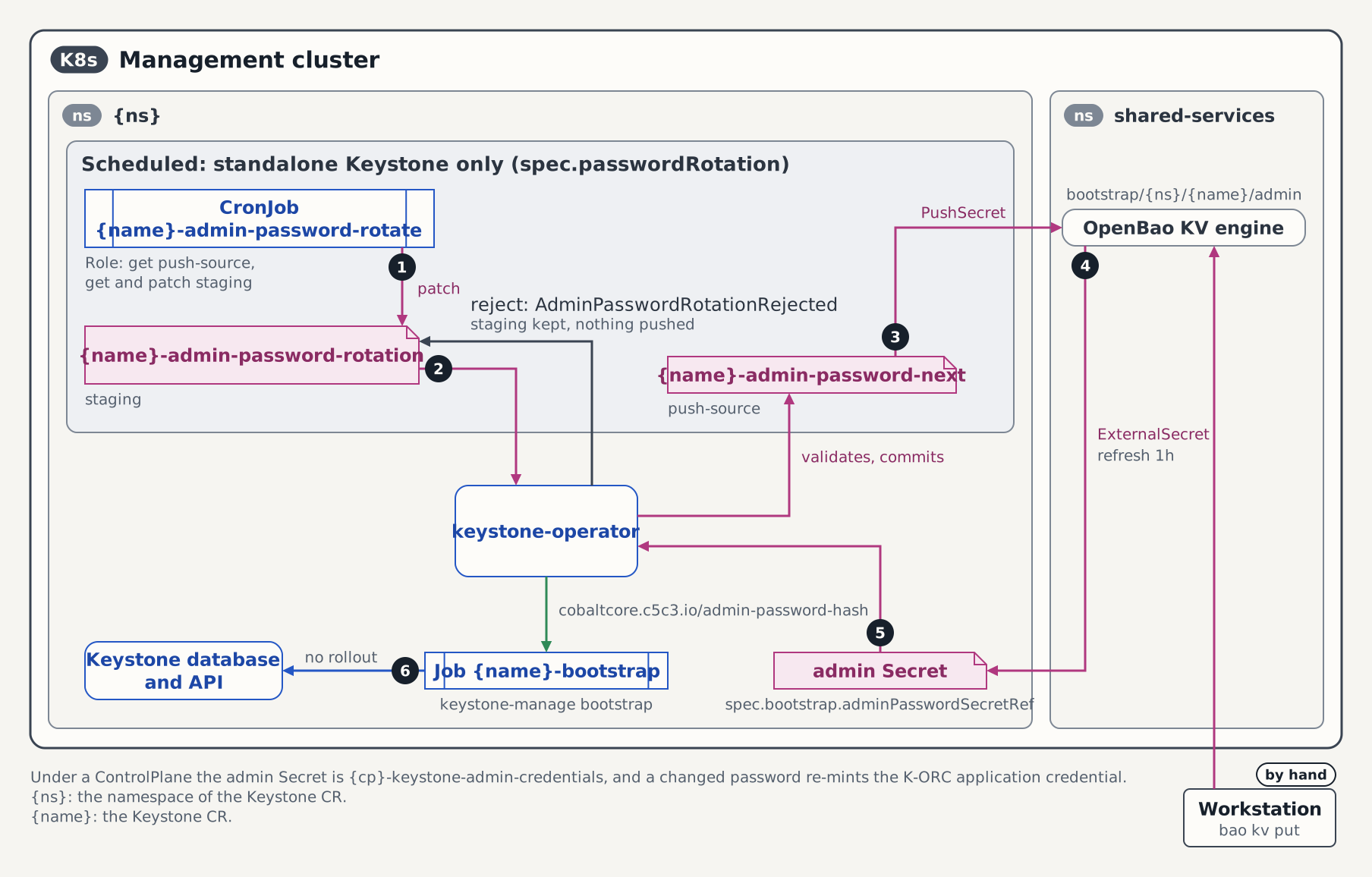
Two lifecycle paths:
- Disabled / teardown (
spec.passwordRotationis nil ORenabled: false):teardownPasswordRotationdeletes every Model B resource (CronJob, staging Secret, push-source Secret, ServiceAccount/Role/RoleBinding, PushSecret, and all hash-suffixed script ConfigMaps), every delete toleratingNotFoundso teardown is idempotent and safe on a CR that never enabled rotation. SetsPasswordRotationReady=Truewith reasonRotationDisabled. A nil pointer means the feature was never opted into (the defaulting webhook deliberately does not materialize it);enabled: falsemeans it was switched off — both branches tear down. The PushSecret usesDeletionPolicy=None(see below), so its deletion leaves the last-pushed password intact in OpenBao — disabling rotation never locks the admin out. - Enabled: the ordered steps below.
Steps (in order):
- Ensure push-source Secret —
ensureAdminPasswordPushSourceSecretensures the operator-owned{name}-admin-password-nextSecret exists (metadata and owner reference only). Its.datais owned exclusively byapplyAdminPasswordRotationand is never clobbered on reconcile. - Ensure staging Secret —
ensureStagingSecret(..., "admin-password")ensures{name}-admin-password-rotation, which the CronJob PATCHes rotated passwords into. - Refresh rotation-age gauge —
observeRotationAge(..., key_type "admin-password")refreshes the rotation-age gauge from the push-source Secret'scobaltcore.c5c3.io/rotation-completed-atannotation, falling back to the staging Secret during the pre-first-apply window. Called before the apply so the next reconcile picks up the freshest timestamp once the apply re-stamps the push-source annotation. - Apply any completed rotation —
applyAdminPasswordRotationvalidates and commits a staged rotation if one is present. On a successful apply it setsPasswordRotationReady=Truewith reasonAdminPasswordRotated("rotation applied; staging secret cleared") and short-circuits withRequeueNextPass(1s) so the next pass re-enters the happy path with the push-source Secret already updated. - Ensure rotation RBAC —
ensureAdminPasswordRotationRBACcreates or updates the split ServiceAccount, Role, and RoleBinding ({name}-admin-password-rotate). - Create script ConfigMap —
config.CreateImmutableConfigMap()of the embeddedadmin_password_rotate.shscript into{name}-admin-password-rotate-script-{hash}. - Ensure rotation CronJob —
job.EnsureCronJob()creates or updates{name}-admin-password-rotate. - Clobber-safe PushSecret — only ensure
adminPasswordPushSecretonceadminPasswordPushSourceReadyreports the push-source Secret holds a valid password (≥ minLength). Before the first rotation completes the push-source is empty, and pushing it would overwrite the seeded per-CRbootstrap/{keystone.Namespace}/{keystone.Name}/adminvalue with nothing. - Report ready — sets
PasswordRotationReady=Truewith reasonPasswordRotationConfigured("Admin password rotation CronJob is configured").
Rotation CronJob (adminPasswordRotationCronJob):
| Field | Value |
|---|---|
| Name | {name}-admin-password-rotate |
| Labels | commonLabels(keystone) |
| Pod labels | commonLabels(keystone) + app.kubernetes.io/component=admin-password-rotation |
| Schedule | spec.passwordRotation.schedule |
| Suspend | &spec.passwordRotation.suspend (pointer to CRD bool) |
| ServiceAccount | {name}-admin-password-rotate |
| Container name | admin-password-rotate |
| Image | {spec.image.repository}:{spec.image.tag} |
| Command | ["/scripts/admin_password_rotate.sh"] |
| SecurityContext | restrictedSecurityContext() (PSS Restricted) |
| RestartPolicy | OnFailure |
Env SECRET_NAME | {name}-admin-password-rotation (staging Secret) |
Env SECRET_NAMESPACE | fieldRef to metadata.namespace |
Env PASSWORD_LENGTH | normalizedAdminPasswordLength (webhook default 32, defense-in-depth floor 24) |
Volume scripts | ConfigMap {name}-admin-password-rotate-script-{hash} (defaultMode: 0555), mounted read-only at /scripts |
The CronJob mounts only the rotation script — no keystone configuration and no key repositories — because it never runs keystone-manage. SECRET_NAME points only at the staging Secret; the CronJob ServiceAccount can never patch the push-source Secret (see the RBAC split below).
PushSecret (adminPasswordPushSecret):
| Field | Value |
|---|---|
| Name | {name}-admin-password-backup |
| Store | selected via spec.secretStoreRef (default ClusterSecretStore/openbao-cluster-store); switching the ref moves the push in place (same name and RemoteKey) |
| Source Secret | {name}-admin-password-next (push-source) |
| Remote Key | bootstrap/{keystone.Namespace}/{keystone.Name}/admin (per-CR path) |
| Property | password |
| DeletionPolicy | None |
The RemoteKey is CR-scoped to bootstrap/{keystone.Namespace}/{keystone.Name}/admin, so each Model-B-enabled Keystone CR writes its admin password to its own OpenBao object and multiple Keystone CRs never collide on a shared bootstrap/keystone-admin key. DeletionPolicy=None is chosen because this is a per-Keystone-CR persistent bootstrap secret: keeping the last-pushed password in OpenBao on teardown (or when rotation is disabled — the teardown path deletes this PushSecret) means re-adoption works and the admin is never locked out.
Condition Contract:
| Status | Reason | Message | RequeueAfter | Path |
|---|---|---|---|---|
True | RotationDisabled | "Scheduled admin password rotation is disabled; Model B resources removed" | — | Disabled/teardown — spec.passwordRotation nil or enabled: false |
True | AdminPasswordRotated | "rotation applied; staging secret cleared" | — (transient: apply-success short-circuit, requeues — operators see this immediately after an apply via kubectl describe, before the next reconcile transitions to steady state) | Enabled path |
True | PasswordRotationConfigured | "Admin password rotation CronJob is configured" | — | Enabled steady state |
Error handling: Errors from the teardown, push-source/staging Secret ensure, the rotation apply, RBAC ensure, script ConfigMap creation, CronJob ensure, or PushSecret ensure are wrapped with context and returned directly. No requeue delays — errors trigger controller-runtime exponential backoff.
Idempotency: The push-source Secret's metadata is reconciled but its .data is never touched outside applyAdminPasswordRotation, so a reconcile never clobbers a previously committed password. The script ConfigMap uses content-based naming — an unchanged script returns the existing ConfigMap name. All teardown deletes tolerate NotFound. The apply step is a no-op unless a completed rotation is staged, so reconciles in the steady state converge without side effects.
Shared library calls: config.CreateImmutableConfigMap(), job.EnsureCronJob(), secrets.EnsurePushSecret()
Admin Password Rotation RBAC Split
The rotation path separates the compute of the new password (performed by the rotation CronJob) from the write onto the push-source Secret and the commit (performed by the operator). ensureAdminPasswordRotationRBAC creates a ServiceAccount, Role, and RoleBinding all named {name}-admin-password-rotate, mirroring ensureFernetRotationRBAC's split shape.
Staging Secret naming. Per adminPasswordStagingSecretName, the staging Secret is {keystone.Name}-admin-password-rotation. It is created and owned by the operator via ensureStagingSecret:
- Empty
Dataon creation; the CronJob PATCHesDataon rotation. - Labels:
commonLabels(keystone)+cobaltcore.c5c3.io/rotation-target=admin-password(see Labels and Annotations). - Owner reference: the Keystone CR (garbage-collected with the CR).
Split Role. The Role has two PolicyRules:
- Rule 1 —
geton the push-source Secret{name}-admin-password-next. - Rule 2 —
get,patchscoped to the staging Secret{name}-admin-password-rotation.
The CronJob ServiceAccount has no create, update, or delete on either Secret. The operator — not the CronJob — writes the push-source Secret via applyAdminPasswordRotation's GET-then-Update full replacement, keeping the token-forgery primitive (write access to a Secret a privileged workload consumes) out of the CronJob's attack surface.
RBAC verb matrix. Two principals touch the push-source and staging Secrets, with strictly disjoint capabilities:
| Principal | Resource | Verbs | Source |
|---|---|---|---|
CronJob ServiceAccount ({name}-admin-password-rotate) | Secret {name}-admin-password-next (push-source) | get | Role rule 1 in ensureAdminPasswordRotationRBAC |
CronJob ServiceAccount ({name}-admin-password-rotate) | Secret {name}-admin-password-rotation (staging) | get, patch | Role rule 2 in ensureAdminPasswordRotationRBAC |
| Operator ServiceAccount | Secret {name}-admin-password-next (push-source) | get, create, update, patch, delete, list, watch | Cluster-scoped core secrets verbs (see RBAC Permissions) |
| Operator ServiceAccount | Secret {name}-admin-password-rotation (staging) | get, create, update, patch, delete, list, watch | Cluster-scoped core secrets verbs |
Operator output contract. validateAdminPasswordRotationOutput requires a non-empty password value of at least minLength bytes, where minLength is the normalized PasswordLength (webhook default 32, defense-in-depth floor 24 via adminPasswordMinLength). On rejection the operator emits a Warning event AdminPasswordRotationRejected and retains the staging Secret for inspection. A malformed cobaltcore.c5c3.io/rotation-completed-at value emits a Warning event AdminPasswordRotationAnnotationInvalid and likewise retains staging. The password value is never logged or echoed in events.
Apply algorithm. On a valid staging Secret, applyAdminPasswordRotation:
- GETs the staging Secret (absent ⇒ no-op).
- Requires
cobaltcore.c5c3.io/rotation-completed-atto be present and RFC3339-parseable. - Validates the staged password.
- GETs the push-source Secret, replaces its
.dataverbatim, stamps therotation-completed-atannotation, and issues anUpdateunder the controller-ownedResourceVersion(optimistic concurrency). - DELETEs the staging Secret (tolerating
NotFound). - Emits a Normal event
AdminPasswordRotated.
UPDATE-then-DELETE ordering is deliberate: the push-source Secret is the durable record of the last successful rotation timestamp once staging is deleted, so the rotation-age gauge can refresh on every reconcile.
Downstream consumer. reconcileBootstrap is the consumer of the rotated password: once ESO syncs the new value from bootstrap/{keystone.Namespace}/{keystone.Name}/admin into the admin Secret, the bootstrap reconciler's cobaltcore.c5c3.io/admin-password-hash gate re-runs the idempotent bootstrap Job to apply it. See the Labels and Annotations entries for cobaltcore.c5c3.io/rotation-target (value admin-password for the staging Secret), cobaltcore.c5c3.io/rotation-completed-at, and cobaltcore.c5c3.io/admin-password-hash.
reconcileIdentityBackends
File: operators/keystone/internal/controller/reconcile_identitybackends.go
Signature:
func (r *KeystoneReconciler) reconcileIdentityBackends(ctx context.Context, keystone *keystonev1alpha1.Keystone) (identityBackendsProjection, error)Aggregates every attached, DomainReadyKeystoneIdentityBackend into per-type projection artifacts and sets the aggregated IdentityBackendsReady condition:
- LDAP backends render into one immutable, content-hashed
<name>-domainsSecret (onekeystone.<domain>.confper backend, plus a<domain>-ca.pemsibling when TLS is configured). The Secret name is threaded toreconcileConfig— which then turns[identity] domain_specific_drivers_enabledon and pointsdomain_config_dirat/etc/keystone/domains— and to every workload builder (the Deployment and each keystone-manage Job/CronJob mount it read-only at that path, mode 0400). - OIDC backends render into one immutable, content-hashed
<name>-federationSecret: the assembledmod_auth_openidcproxy.confplus per-backend.provider/.client/.confdocuments under backend-named data keys (%is invalid in Secret keys, soKeyToPathitems restore the real scheme-stripped, URL-escaped issuer filenames at mount time). The.providerdiscovery document is pre-provisioned — assembled from explicitendpointsor fetched fromproviderMetadataURLthrough the operator's HTTP seam with a per-backend(uid, generation)cache and an issuer-equality check. That fetch client blocks non-public addresses by default (SSRF guard), relaxable per-CIDR via the operator-level--federation-metadata-allow-cidrsflag — never via the CR — so discovery against a trusted in-cluster IdP is opt-in. TheOIDCCryptoPassphraselives in the stable-named<name>-oidc-crypto-passphraseSecret (operator-generated, no OpenBao backup — regenerable by design) and is embedded intoproxy.conf, so a regeneration re-hashes the federation Secret and rolls every pod together. The resultingfederationProjectiondrives the[auth]/[openid]/[federation]sections inreconcileConfig, the sidecar container / localhost uWSGI bind / Service targetPort switch inreconcileDeployment, and the ingress-port/IdP-egress rules inreconcileNetworkPolicy. A missingspec.federation.proxyImageparks every OIDC backend pending with aFederationProxyImageMissingWarning (no hidden image default).
Contract — waiting states never short-circuit the pipeline. Pending domains, missing bind/client Secrets and unreachable or issuer-mismatched provider metadata (skipped per-backend with an IdentityBackendSkipped Warning event while healthy siblings keep projecting), and the defensive duplicate-domain skip all return a zero result: RunPipeline short-circuits on non-zero results, and blocking here would deadlock first-install — a backend cannot become DomainReady until the Keystone API is up, which needs the Deployment this pipeline has not created yet. Wake-ups are watch-driven (backend status flips re-enqueue the Keystone). Only genuine infrastructure failures (List/render/create errors) surface as errors.
Deleting backends (DeletionTimestamp set) are de-projected immediately — the dedicated controller's finalizer waits for exactly this de-projection before it applies the domain deletion policy, so keystone never runs with config pointing at a domain mid-teardown. Stale domains and federation Secrets are pruned alongside the config ConfigMaps (retain 3; full cleanup when the last backend of a type detaches so no bind password, client secret, or passphrase copy lingers). The config render cache keys on the projection state — domains flag, federation flag, and remote-id attribute — because attach/detach changes no Keystone generation. No new Keystone-CR condition type exists for federation by design: everything stays under the IdentityBackends step and its IdentityBackendsReady condition, so the subConditionTypes vocabulary and the metrics label mapping are unchanged.
KeystoneIdentityBackendReconciler
File: operators/keystone/internal/controller/keystoneidentitybackend_controller.go
The dedicated backend controller runs as a second reconciler in the same manager (registered after KeystoneReconciler in main.go — that reconciler's SetupWithManager is the single registration site for the KeystoneIdentityBackend field indexes both controllers use). It is the single writer of KeystoneIdentityBackend status; the keystone-side reconcileIdentityBackends only reads DomainReady and writes the aggregated condition onto the Keystone CR instead.
Registration:
if err := (&controller.KeystoneIdentityBackendReconciler{
    Client:                  mgr.GetClient(),
    Scheme:                  mgr.GetScheme(),
    Recorder:                mgr.GetEventRecorderFor("keystoneidentitybackend-controller"),
    MaxConcurrentReconciles: maxConcurrentReconciles,
}).SetupWithManager(mgr); err != nil {
    return err
}
Watch topology:
| Resource | Watch Type | Effect |
|---|---|---|
KeystoneIdentityBackend | For() | Filtered by watch.CRUpdatePredicate() so the controller's own status writes do not re-wake it |
Keystone | Watches() | Fans a Keystone event out to its attached backends via the spec.keystoneRef.name field index (keystoneToIdentityBackendsMapper), with no generation predicate — Keystone status flips (KeystoneAPIReady, the projection landing) are exactly the wake signals the DomainReady/ConfigProjected gates wait on |
There is no dedicated Secret watch: bind/CA Secret changes re-render via the Keystone side (the Keystone controller's Secret watch carries an identity-backend leg over the spec.secretRefs.name index), and the resulting projection flip reaches this controller through the Keystone watch.
Reconcile flow (normal path): resolve the Keystone (KeystoneNotFound when absent — admission tolerates dangling references for GitOps ordering), gate on KeystoneAPIReady=True (WaitingForKeystoneAPI), read the bootstrap admin password, and drive the domain through the minimal identity client (operators/keystone/internal/identity — stdlib-only domain CRUD, authenticated per call with the bootstrap admin against internalAPIURL): Manage creates the domain and reconciles description/enabled drift on its own domain (recorded status.domainID), never seizing a same-named foreign domain (DomainAlreadyExists); Adopt resolves by name and never mutates. status.domainID is the only record that a domain is the backend's own, so Manage writes it with a merge patch directly after the create instead of with the end-of-pass status update: that update is optimistic, and one lost to a conflict left the backend at DomainAlreadyExists for the domain it had just created.
For OIDC backends the flow continues (gated on DomainReady=True): the controller upserts the three keystone federation API objects with real drift detection — the identity provider (remote_ids pinned to the issuer, domain-scoped, patched only on description/remoteIDs/enabled divergence), the mapping (<identityProviderName>-mapping, created from the typed spec.mappings rules through gophercloud, updated only on deep-compare divergence), and the protocol (bound to the mapping, re-pointed on drift) — plus the declarative groups (create-if-missing in the backend's domain) and their role assignments (resolved by role/project name; an existence probe keeps steady-state passes free of mutating identity-API calls). Mappings ride gophercloud v2 (the one federation resource its SDK covers); identity providers, protocols, groups, roles, and assignments use the local REST client. FederationObjectsReady covers the identity provider + protocol, MappingsReady the mapping/groups/assignments.
ConfigProjected is derived from the single authoritative pointer — the Keystone Deployment's domains volume and the conf file inside the Secret it references (LDAP), or the federation-metadata volume and the backend's client document (OIDC) — with a RequeueSecretPolling safety net because a converged Keystone status emits no watch event. A config the pod template mounts but the Deployment has not finished rolling out reports False/WaitingForRollout, so the condition — in both the attach and the detach direction — trails the running workload, not the rendered spec; the keystone-side IdentityBackendsReady applies the same gate. Ready aggregates the backend type's own sub-condition set via the shared helper (LDAP: DomainReady + ConfigProjected; OIDC: plus FederationObjectsReady and MappingsReady).
Finalizer (keystone.openstack.c5c3.io/identitybackend): deletion waits for de-projection first; OIDC backends then tear their federation objects down unconditionally in reverse dependency order (protocol → mapping → identity provider, tolerating objects already gone, warning with FederationTeardownFailed on API errors); then spec.domain.deletionPolicy applies (Manage+Delete disables the domain before deleting it; Retain and Adopt leave it untouched — declarative groups follow the domain), then the finalizer releases. Keystone-gone and admin-credential-gone teardowns fail open with a DomainDeleteFailed / FederationTeardownFailed Warning instead of holding the CR hostage.
The controller is deliberately not wrapped by instrumenter.Instrument — those metrics and the subReconcilerConditionTypes map are keystone-pipeline-scoped (the guard tests require map values to be members of subConditionTypes); controller-runtime's per-controller metrics cover it.
Error Handling Summary
| Sub-Reconciler | Transient State | RequeueAfter | Permanent Failure |
|---|---|---|---|
reconcileSecrets | ESO not synced | 15s | API error → exponential backoff |
reconcileDatabaseTLS | Client Certificate pending | 15s | Missing certificate refs set DatabaseTLSReady=False/MissingCertificateRefs and return an error |
reconcileDBConnectionSecret | Database credentials not synced | 15s | API error → exponential backoff |
reconcileIdentityBackends | None: waiting states never requeue | — | List, render or create failure → exponential backoff |
reconcileDatabase | MariaDB CRs not ready | 30s | ErrJobFailed from db_sync |
reconcileDatabase | db_sync running | 30s | API error → exponential backoff |
reconcileFernetKeys | Initial key generation / rotation applied | 15s | API error → exponential backoff |
reconcileCredentialKeys | Initial key generation / rotation applied | 15s | API error → exponential backoff |
reconcileNetworkPolicy | — | — | API error → exponential backoff |
reconcileConfig | — | — | Secret read / render / ConfigMap failure → SecretsReady=False, exponential backoff |
reconcilePolicyValidation | Job running | 15s | ErrJobFailed from validation → descriptive error |
reconcileDeployment | Deployment not available | 10s | API error → exponential backoff |
pruneStaleConfigMaps | — | — | List/delete failure → SecretsReady=False, exponential backoff |
reconcileHTTPRoute | Gateway has not yet set Accepted=True on parent status | 10s | API error on ensure/get/delete → exponential backoff |
reconcileHealthCheck | Non-2xx, timeout, DNS, connection refused | 10s | Malformed URL → exponential backoff |
reconcileHPA | — | — | API error → exponential backoff |
reconcileVPA | — | — | API error → exponential backoff |
reconcileBootstrap | Job running | 60s | ErrJobFailed from bootstrap |
reconcileTrustFlush | — | — | API error → exponential backoff |
reconcilePasswordRotation | Rotation applied (short-circuit) | RequeueNextPass (1s) | API error → exponential backoff |
All errors are wrapped with descriptive context via fmt.Errorf("...: %w", err). Unrecoverable API errors (e.g., permission denied, schema validation failure) are returned directly to controller-runtime, which applies exponential backoff with jitter.
Owned Resources
On the cluster of the Keystone CR every object the reconciler creates carries a controller owner reference to it, so deleting the CR garbage-collects them. With spec.targetClusterRef the children live on another cluster, where no owner reference can point at the CR: they carry ownership labels, and the openstack.c5c3.io/remote-children finalizer sweeps them. The figure groups the objects and draws who mounts what.
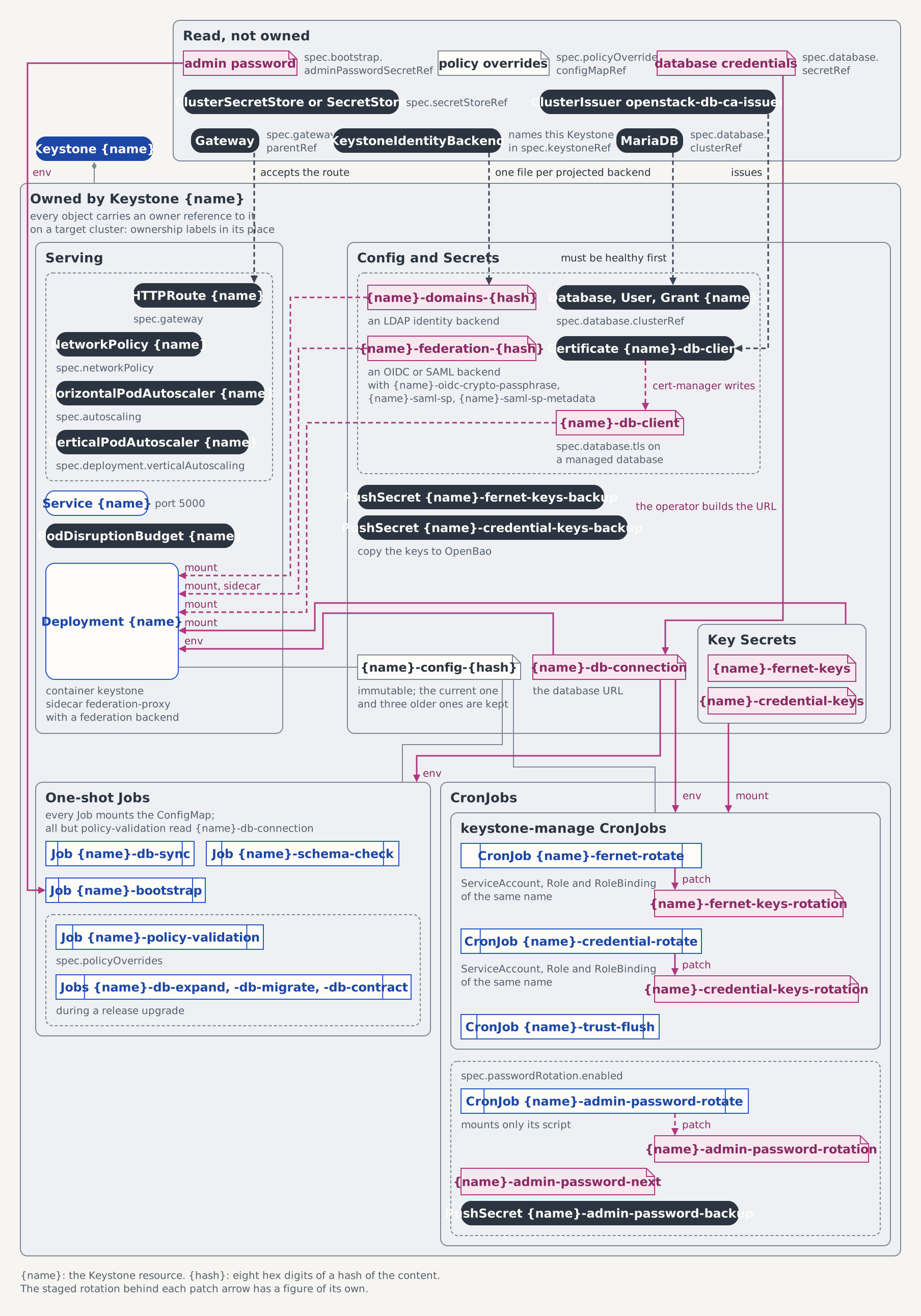
For a Keystone CR named {name} the operator manages:
| Resource | Name | Exists |
|---|---|---|
| Deployment | {name} | Always |
| Service | {name} | Always |
| PodDisruptionBudget | {name} | Always |
| HorizontalPodAutoscaler | {name} | Only with spec.autoscaling |
| VerticalPodAutoscaler | {name} | Only with spec.deployment.verticalAutoscaling, on a cluster that serves the kind |
| NetworkPolicy | {name} | Only with spec.networkPolicy |
| HTTPRoute | {name} | Only with spec.gateway, on a cluster that serves the Gateway API |
| ConfigMap | {name}-config-{hash} | Always. Immutable; the current one and the three newest before it are kept |
| Secret | {name}-db-connection | Always |
| Secret | {name}-fernet-keys | Always |
| Secret | {name}-credential-keys | Always |
| PushSecret | {name}-fernet-keys-backup | Always |
| PushSecret | {name}-credential-keys-backup | Always |
| Secret | {name}-domains-{hash} | Only while at least one KeystoneIdentityBackend is projected |
| Secret | {name}-federation-{hash} | Only while an OIDC or SAML backend is projected and spec.federation.proxyImage is set |
| Secret | {name}-oidc-crypto-passphrase | Created with the first OIDC backend and kept afterwards |
| Secret | {name}-saml-sp | Created with a SAML backend that names no certificate Secret of its own, and kept afterwards |
| Secret | {name}-saml-sp-metadata | Only while a SAML backend is projected |
| Certificate | {name}-db-client | Only with spec.database.tls and spec.database.clusterRef. cert-manager writes the Secret of the same name |
| Database | {name} | Only with spec.database.clusterRef; additionally cleaned up by the finalizer |
| User | {name} | Only with spec.database.clusterRef and a credentials mode other than Dynamic; additionally cleaned up by the finalizer |
| Grant | {name} | Only with spec.database.clusterRef and a credentials mode other than Dynamic; additionally cleaned up by the finalizer |
| Job | {name}-db-sync | Always |
| Job | {name}-schema-check | Always, after db-sync |
| Job | {name}-db-expand | Only during a release upgrade |
| Job | {name}-db-migrate | Only during a release upgrade |
| Job | {name}-db-contract | Only during a release upgrade |
| Job | {name}-bootstrap | Always |
| Job | {name}-policy-validation | Only with spec.policyOverrides |
| CronJob | {name}-fernet-rotate | Always |
| ServiceAccount, Role, RoleBinding | {name}-fernet-rotate | Always |
| Secret | {name}-fernet-keys-rotation | Always (rotation staging) |
| ConfigMap | {name}-fernet-rotate-script-{hash} | Always |
| CronJob | {name}-credential-rotate | Always |
| ServiceAccount, Role, RoleBinding | {name}-credential-rotate | Always |
| Secret | {name}-credential-keys-rotation | Always (rotation staging) |
| ConfigMap | {name}-credential-rotate-script-{hash} | Always |
| CronJob | {name}-trust-flush | Only with spec.trustFlush, which the defaulting webhook sets |
| CronJob | {name}-admin-password-rotate | Only with spec.passwordRotation.enabled |
| ServiceAccount, Role, RoleBinding | {name}-admin-password-rotate | Only with spec.passwordRotation.enabled |
| Secret | {name}-admin-password-rotation | Only with spec.passwordRotation.enabled (rotation staging) |
| Secret | {name}-admin-password-next | Only with spec.passwordRotation.enabled (push source) |
| ConfigMap | {name}-admin-password-rotate-script-{hash} | Only with spec.passwordRotation.enabled |
| PushSecret | {name}-admin-password-backup | Only with spec.passwordRotation.enabled, once the push source holds a valid password |
Who mounts what
Every workload reads the database URL from the env var OS_DATABASE__CONNECTION, which comes from {name}-db-connection, unless the table says otherwise.
| Workload | Mounts | Reads through env | Writes through the API |
|---|---|---|---|
Deployment {name}, container keystone | The config ConfigMap, {name}-fernet-keys, {name}-credential-keys; the domains Secret and the database TLS Secrets when they exist | The database URL | Nothing |
Deployment {name}, sidecar federation-proxy | {name}-federation-{hash} | Nothing | Nothing |
Jobs -db-sync, -schema-check, -db-expand, -db-migrate, -db-contract | The config ConfigMap; the domains Secret and the database TLS Secrets when they exist | The database URL | Nothing |
Job -bootstrap | The config ConfigMap, {name}-fernet-keys; the domains Secret and the database TLS Secrets when they exist | The database URL, and BOOTSTRAP_PASSWORD from the admin password Secret | Nothing |
Job -policy-validation | The config ConfigMap; the domains Secret when it exists | No Secret | Nothing |
CronJobs -fernet-rotate, -credential-rotate | The config ConfigMap, both key Secrets, the script ConfigMap; the domains Secret when it exists | The database URL | Patches its staging Secret |
CronJob -trust-flush | The config ConfigMap, both key Secrets; the domains Secret when it exists | The database URL | Nothing |
CronJob -admin-password-rotate | Its script ConfigMap | No Secret | Patches {name}-admin-password-rotation |
Database credentials and oslo.config env-var overrides
Keystone's [database] connection URL embeds the MySQL username and password. Earlier, the rendered URL was written directly into keystone.conf inside the operator-managed immutable ConfigMap. ConfigMaps lack encryption at rest and are routinely granted broad get RBAC for observability workflows, which caused production database credentials to be readable by any actor with get configmap on the Keystone namespace. The current design replaces that by (1) writing a non-secret placeholder into the ConfigMap and (2) materialising the real connection URL into a derived Kubernetes Secret which every pod consumes through the oslo.config OS_<GROUP>__<OPTION> environment-variable override mechanism.
Derived <name>-db-connection Secret
The reconcileDBConnectionSecret sub-reconciler (in operators/keystone/internal/controller/reconcile_dbconnection_secret.go) delegates to the shared database.ReconcileConnectionSecret() and runs between reconcileSecrets and reconcileConfig. On every reconcile it:
- Reads the upstream DB credentials
Secretreferenced byspec.database.secretRef. In managed mode the username is the Keystone CR name (matching the MariaDBUserCR); in brownfield mode bothusernameandpasswordkeys are read from the upstream Secret. - Builds the pymysql URL using
url.UserPassword()for RFC 3986-compliant percent-encoding of reserved characters in the userinfo component, the shareddatabase.ResolveHost()/database.Port()helpers for host resolution, and?charset=utf8as the fixed query string. The URL scheme ismysql+pymysql. - Writes the URL to a derived
Secretnamed<keystone.Name>-db-connectionin the Keystone namespace under the single data keyconnection. The derived Secret carries a controller owner reference to the Keystone CR so Kubernetes garbage collection deletes it when the Keystone CR is deleted.
Important contracts:
| Contract | Enforcement |
|---|---|
Exactly one data key (connection) | reconcileDBConnectionSecret replaces Data wholesale on any drift (extra keys removed, stale values rewritten) |
| Owner reference to the Keystone CR | Set on create via controllerutil.SetControllerReference; re-enqueues on change via the existing secretToKeystoneMapper |
Upstream Secret missing or missing username/password key | Sets SecretsReady=False with reason WaitingForDBCredentials, requeues after RequeueSecretPolling, does NOT create an invalid derived Secret |
| Password rotation | Upstream password change triggers an in-place Update of the derived Secret — Name/UID remain stable so Pod env consumers pick up the new value without restart churn |
| No ESO artefacts | The derived Secret is a plain corev1.Secret. No ExternalSecret or PushSecret is created for it — it is a pure materialization from the already-synced upstream Secret |
The derived Secret is listed as an owned resource in the Owned Resources table and triggers reconciliation through the existing Watches(Secret) filter using handler.OnlyControllerOwner().
ConfigMap placeholder
reconcileConfig sets [database] connection in keystone.conf to the package-level constant dbConnectionPlaceholder = "mysql+pymysql://placeholder". The placeholder is intentionally a syntactically valid pymysql URL so that oslo.config can parse the file on startup before the environment override is applied — parsing errors in the file layer would prevent the process from reaching the override layer. All other keys in the [database] section (max_retries, connection_recycle_time) are unchanged.
Tests guarantee that no credential byte (username, password, or their percent-encoded forms) ever appears in the rendered keystone.conf. See TestReconcileConfig_BrownfieldDatabase_PlaceholderInsteadOfPassword, TestReconcileConfig_ManagedDatabase_NoCredentialsInConfigMap, and TestReconcileConfig_SpecialCharactersInCredentials_DoNotLeakToConfigMap in reconcile_config_test.go.
OS_<GROUP>__<OPTION> environment-variable override
Upstream oslo.config supports sourcing any option value from an environment variable whose name is derived from the option's group and key, overriding the value present in any configuration file. The encoding is:
OS_<GROUP>__<OPTION><GROUP>— the INI section name (e.g.database), uppercased.<OPTION>— the INI key (e.g.connection), uppercased.- The separator between group and option is a double underscore (
__).
For Keystone's database URL this yields OS_DATABASE__CONNECTION. The operator wires this env var on every container that loads keystone.conf and needs database access, sourcing the value from the derived <name>-db-connection Secret via a SecretKeyRef:
env:
  - name: OS_DATABASE__CONNECTION
    valueFrom:
      secretKeyRef:
        name: <keystone.Name>-db-connection
        key: connection
The helper buildDBConnectionEnvVar() in reconcile_deployment.go constructs this corev1.EnvVar value and is invoked from every pod-spec builder in the operator. Containers that use the env var include:
| Workload | Builder | Purpose |
|---|---|---|
Deployment | buildKeystoneDeployment (reconcile_deployment.go) | Keystone API pods |
Job {name}-bootstrap | buildBootstrapJob (reconcile_bootstrap.go) | Initial bootstrap of admin user/project/roles |
Job {name}-db-sync and variants (expand, migrate, contract, schema-check) | buildDBJob (database_jobs.go) | Database schema provisioning and drift checks |
CronJob {name}-trust-flush | trustFlushCronJob (reconcile_trustflush.go) | Periodic expired trust cleanup — default-on hourly via webhook materialization |
CronJob {name}-fernet-rotate | fernetRotationCronJob (reconcile_fernet.go) | Fernet key rotation — appended alongside the pre-existing OS_fernet_tokens__max_active_keys override |
CronJob {name}-credential-rotate | credentialRotationCronJob (reconcile_credential.go) | Credential key rotation |
At process start, oslo.config loads keystone.conf (seeing the placeholder), then walks its option registry for environment overrides. The OS_DATABASE__CONNECTION value replaces the placeholder before any option consumer (SQLAlchemy engine creation, migrations, etc.) reads it. This means the password never reaches the file layer on any Pod's filesystem and is not readable through the get configmap verb.
References
- Upstream oslo.config change that introduced the
OS_<GROUP>__<OPTION>environment override mechanism: openstack/oslo.config change 585850. - Related sub-reconciler contracts:
reconcileSecrets(gates DB credential readiness),reconcileConfig(renders the placeholder),reconcileDeployment(mounts the env var on Keystone API pods).
Testing
The reconciler has comprehensive unit tests using gomega with NewGomegaWithT(t). For end-to-end Chainsaw tests that validate the reconciler in a real cluster, see Keystone E2E Test Suites.
Running Tests
| Scope | Command |
|---|---|
| All controller tests | go test ./operators/keystone/internal/controller/... |
| Specific sub-reconciler | go test -run TestReconcileSecrets ./operators/keystone/internal/controller/ |
ObservedGeneration Test Convention
Every sub-reconciler test file that sets conditions includes a dedicated TestReconcile{SubReconciler}_ConditionObservedGeneration test function. This test exercises at least one True and one False condition path with distinct, non-default generation values to verify that ObservedGeneration is propagated on every code path. When adding a new sub-reconciler, copy this test pattern from any existing file (e.g. reconcile_hpa_test.go).
Test Files
| File | Coverage |
|---|---|
keystone_controller_test.go | Reconcile() orchestration, sequential execution, parallel group, early return, Ready aggregation, idempotency, benchmark, finalizer install/remove and termination branching + Events |
reconcile_secrets_test.go | DB/admin credential readiness, error propagation, condition messages, ObservedGeneration |
reconcile_database_test.go | Managed/brownfield modes, MariaDB CRs, db_sync lifecycle, stale Job detection, ObservedGeneration, finalizeDatabaseResources cleanup + idempotency |
reconcile_fernet_test.go | Key generation, Secret idempotency, script ConfigMap creation, CronJob schedule/volumes, PushSecret, key validity, ObservedGeneration |
reconcile_credential_test.go | Key generation, Secret idempotency, script ConfigMap creation, CronJob schedule/volumes, PushSecret, RBAC, key validity, ObservedGeneration |
reconcile_networkpolicy_test.go | NetworkPolicy creation, update, deletion, ingress rules, condition contract |
reconcile_config_test.go | INI generation, extraConfig merge, plugin config, policy overrides, ConfigMap hashing |
reconcile_policyvalidation_test.go | Policy validation lifecycle, condition contract, error extraction, Job spec, ObservedGeneration |
reconcile_deployment_test.go | Deployment spec, Service creation, readiness, endpoint, owner references, stable pod template, ObservedGeneration |
reconcile_healthcheck_test.go | Health check happy/unhealthy paths, timeout, DNS, connection refused, empty endpoint, response body close, HTTPDoer injection, ObservedGeneration |
reconcile_hpa_test.go | HPA creation, update, deletion, metrics (CPU/memory), minReplicas defaulting, condition contract, error propagation, ObservedGeneration |
reconcile_httproute_test.go | HTTPRoute creation, update, deletion, gateway namespace defaulting, PathPrefix match, backend Service port 5000, parent Accepted reflection, status.endpoint derivation, condition contract, ObservedGeneration |
reconcile_trustflush_test.go | CronJob creation, deletion, schedule/suspend/args, security context, volume mounts, condition contract, error propagation, ObservedGeneration |
reconcile_passwordrotation_test.go | CronJob shape/suspend, staging + push-source Secrets, split-Role RBAC shape, apply/validate commit + reject (short/missing/malformed-annotation) paths, clobber-safe PushSecret gating, teardown idempotency (disabled and nil-spec), condition contract |
reconcile_bootstrap_test.go | Job creation, completion, failure, stale detection, backoff, ObservedGeneration |
integration_test.go | Full reconciliation envtest: CronJob spec, bootstrap Job spec, brownfield mode, condition progression, ObservedGeneration |
File Layout
operators/keystone/
├── main.go                                     Scheme registration + bootstrap wiring
├── api/v1alpha1/
│   ├── keystone_types.go                       CRD types
│   ├── keystone_webhook.go                     Webhooks
│   └── ...
└── internal/
    ├── controller/
    │   ├── keystone_controller.go              Reconciler struct, Reconcile() pipeline, SetupWithManager
    │   ├── keystone_watches.go                 Secret/MariaDB/ClusterSecretStore/SecretStore/PushSecret event mappers (store watches via storeToKeystoneMapper → StoreRefFanOut) + predicate
    │   ├── reconcile_secrets.go                reconcileSecrets sub-reconciler
    │   ├── reconcile_database.go               reconcileDatabase sub-reconciler
    │   ├── reconcile_fernet.go                 reconcileFernetKeys sub-reconciler
    │   ├── reconcile_credential.go             reconcileCredentialKeys sub-reconciler
    │   ├── reconcile_networkpolicy.go          reconcileNetworkPolicy sub-reconciler
    │   ├── reconcile_config.go                 reconcileConfig + pruneStaleConfigMaps
    │   ├── reconcile_policyvalidation.go        reconcilePolicyValidation sub-reconciler
    │   ├── reconcile_deployment.go             reconcileDeployment sub-reconciler
    │   ├── reconcile_healthcheck.go           reconcileHealthCheck sub-reconciler
    │   ├── reconcile_hpa.go                   reconcileHPA sub-reconciler
    │   ├── reconcile_httproute.go             reconcileHTTPRoute sub-reconciler + keystoneStatusEndpoint helper
    │   ├── reconcile_trustflush.go            reconcileTrustFlush sub-reconciler
    │   ├── reconcile_passwordrotation.go       reconcilePasswordRotation sub-reconciler (Model B)
    │   ├── reconcile_bootstrap.go              reconcileBootstrap sub-reconciler
    │   ├── scripts/
    │   │   ├── fernet_rotate.sh               Fernet key rotation script
    │   │   ├── credential_rotate.sh           Credential key rotation script
    │   │   └── admin_password_rotate.sh       Admin password rotation script (Model B)
    │   ├── keystone_controller_test.go         Orchestration tests
    │   ├── reconcile_secrets_test.go           Secrets tests
    │   ├── reconcile_database_test.go          Database tests
    │   ├── reconcile_fernet_test.go            Fernet tests
    │   ├── reconcile_credential_test.go        Credential keys tests
    │   ├── reconcile_networkpolicy_test.go     NetworkPolicy tests
    │   ├── reconcile_config_test.go            Config tests
    │   ├── reconcile_policyvalidation_test.go   Policy validation tests
    │   ├── reconcile_deployment_test.go        Deployment tests
    │   ├── reconcile_healthcheck_test.go      Health check tests
    │   ├── reconcile_hpa_test.go              HPA tests
    │   ├── reconcile_httproute_test.go        HTTPRoute tests
    │   ├── reconcile_trustflush_test.go       Trust flush tests
    │   ├── reconcile_passwordrotation_test.go  Admin password rotation tests (Model B)
    │   ├── reconcile_bootstrap_test.go         Bootstrap tests
    │   └── integration_test.go                 Envtest integration tests
    └── testutil/
        └── envtest_setup.go                    Keystone-specific envtest helper
Metrics Instrumentation
Every sub-reconciler invocation is instrumented for Prometheus via a single package-scope instrumenter, declared in operators/keystone/internal/controller/instrumentation.go. The orchestration Reconcile wraps every sub-reconciler call with its Instrument method; direct calls that bypass it are a contract violation.
For the authoritative catalogue of registered metrics — names, labels, and histogram buckets — see Keystone Operator Prometheus Metrics.
The instrumenter.Instrument method
func (i *Instrumenter) Instrument(
    ctx context.Context,
    name string,
    fn  func(context.Context) (ctrl.Result, error),
) (ctrl.Result, error)
Behavioural contract:
- Always records one observation in
keystone_operator_reconcile_duration_seconds{sub_reconciler=name}viadefer— the observation is emitted on the success path, the error path, and even whenfnpanics (the deferred call runs before the stack unwinds). - Only increments
keystone_operator_reconcile_errors_total{sub_reconciler=name, condition_type=…}whenfnreturns a non-nil error. - Does not recover from panics — the caller sees the same
panic/error thatfnproduced. - Carries no per-CR labels. The
sub_reconcilerlabel is bounded by the number of sub-reconciler names, keeping series count fleet-independent.
Name → condition_type lookup
The condition_type label on the error counter is resolved from the package-private table subReconcilerConditionTypes in instrumentation.go. Each entry maps a sub-reconciler name to the Ready sub-condition whose True transition that sub-reconciler is responsible for driving:
sub_reconciler | condition_type |
|---|---|
Secrets, DBConnectionSecret, Config | SecretsReady |
IdentityBackends | IdentityBackendsReady |
FernetKeys | FernetKeysReady |
CredentialKeys | CredentialKeysReady |
NetworkPolicy | NetworkPolicyReady |
Database | DatabaseReady |
DatabaseTLS | DatabaseTLSReady |
PolicyValidation | PolicyValidReady |
Deployment | DeploymentReady |
HTTPRoute | HTTPRouteReady |
HealthCheck | KeystoneAPIReady |
HPA | HPAReady |
VPA | VPAReady |
Bootstrap | BootstrapReady |
TrustFlush | TrustFlushReady |
PasswordRotation | PasswordRotationReady |
The collapsed SecretsReady mapping for Secrets, DBConnectionSecret, and Config is intentional — those three sub-reconcilers form the earliest readiness gate and share a single condition type. The cardinality drift-guard TestSubReconcilerConditionTypesCoversAllNames asserts that every value in this table appears in subConditionTypes, so a rename in one place without the other fails CI.
Contract: wrap every new sub-reconciler
Whenever a new sub-reconciler is added to Reconcile (as a pipeline commonreconcile.Step or a reconcileParallelGroup member), it MUST be:
- Added to the
pipelineinReconcileas acommonreconcile.Stepwith a non-emptyName.RunPipelinewraps named steps ininstrumenter.Instrument(ctx, s.Name, s.Fn); only the parallel group (whose members self-instrument) and config pruning use an empty name and bypass the wrapper. - Added to
subConditionTypesinkeystone_controller.go(so its readiness participates in the aggregateReady). - Added to
subReconcilerConditionTypesininstrumentation.gowith acondition_typethat is a member ofsubConditionTypes.
Three regression tests guard this contract:
TestReconcileEmitsDurationForEverySubReconciler— every name registered insubReconcilerConditionTypesmust emit at least one duration sample perReconcilepass.TestReconcileParallelGroupErrorCountsAreAttributed— an induced failure in a parallel-group member must increment the error counter with the correctsub_reconcilerlabel (not the group's).TestSubReconcilerConditionTypesCoversAllNames— every mappedcondition_typemust exist insubConditionTypes.
For CR lifecycle hygiene, reconcileDelete calls metrics.DeleteForKeystone(name, namespace) after the finalizer is removed so per-CR series (key_rotation_age_seconds, db_sync_*) do not leak across the lifetime of a cluster.