Migrate Keystone DB to Dynamic Credentials
This guide takes a managed-mode ControlPlane from a long-lived static Keystone database credential to dynamic, engine-issued credentials, without database downtime. It is the operator-facing side of the OpenBao MariaDB database secrets engine wired for the Keystone service DB user (issue #439).
What changes
- Before: the Keystone DB password is a long-lived value materialised from an OpenBao KV path (
openstack/keystone/{namespace}/{name}/db) into the{name}-keystone-db-credentialsSecret. Nothing seeds that path, so on the static branch an operator writes it and rotates it by hand. - After: the c5c3 operator projects a per-ControlPlane
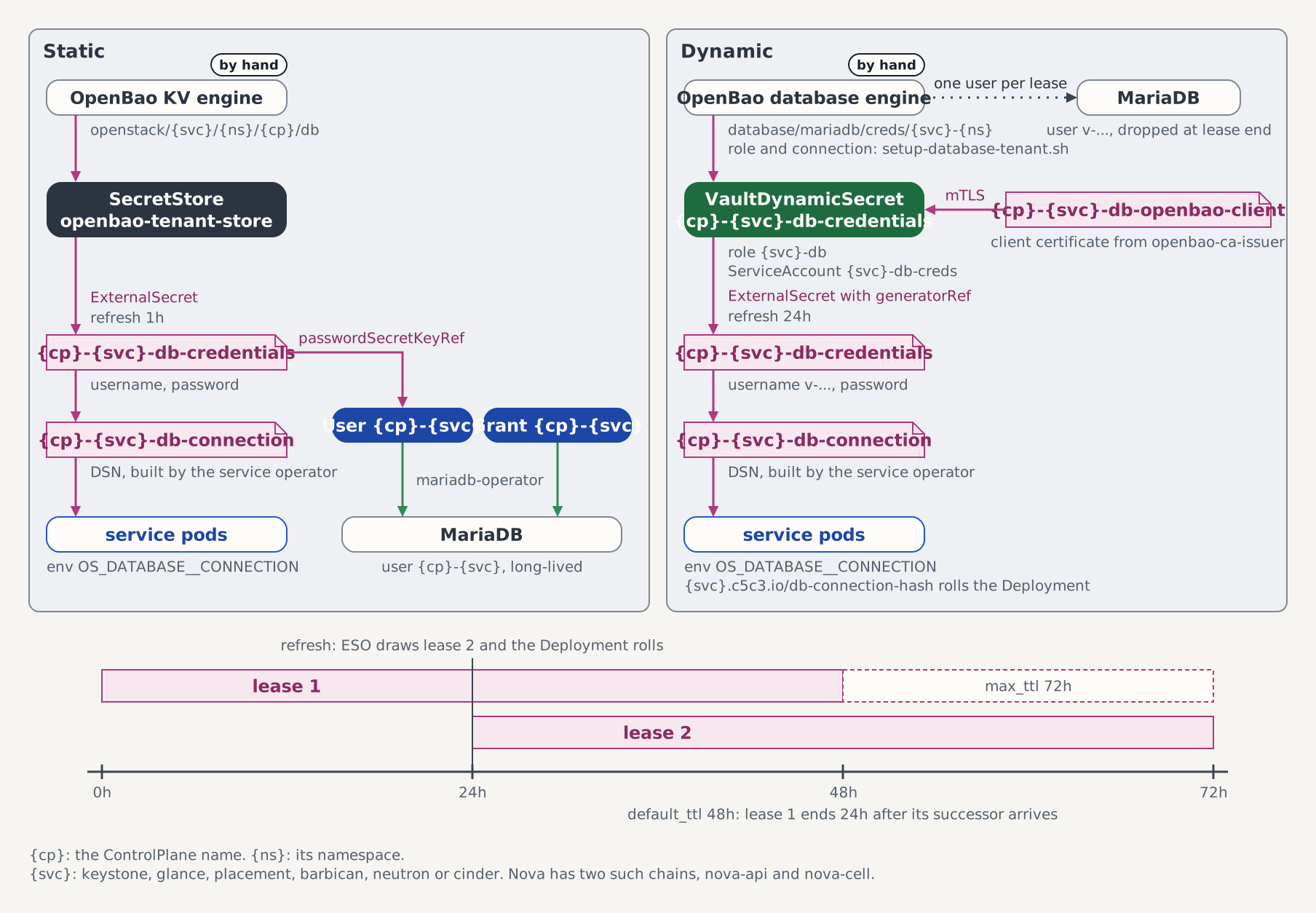
VaultDynamicSecretgenerator that reads short-lived credentials from the OpenBao database engine (database/mariadb/creds/keystone-{namespace}, where{namespace}is the Keystone service namespace, the ControlPlane's own namespace unless Keystone runs in a dedicated one). The External Secrets Operator re-issues a fresh lease before the previous one expires and materialises the current username and password into the same Secret. No long-lived static DB password remains at rest.
The engine issues an ephemeral MySQL user per lease (for example v-kube-...) with ALL PRIVILEGES on the Keystone database and drops it at lease end.
The figure shows both chains. {svc} stands for keystone here, and {cp} is controlplane on the devstack.
Prerequisites
Devstack
This guide is written against the Quick Start (ControlPlane) devstack. Stand it up first:
KIND_HOST_PORT=8443 WITH_CONTROLPLANE=true make deploy-infraFollow that tutorial through to its final Verify step. On this devstack the ControlPlane is controlplane in openstack, so its projected Keystone is controlplane-keystone and its DB-credential Secret is controlplane-keystone-db-credentials — the names the migration below manages.
- The OpenBao
databasesecrets engine is mounted atdatabase/mariadb(thesetup-secret-engines.shbootstrap step). On a greenfield cluster this is already in place; on a brownfield cluster, re-apply the bootstrap scripts (see below). - cert-manager and its
openbao-ca-issuerClusterIssuer are installed (they issue the per-ControlPlane mTLS client certificate the generator presents to the OpenBao listener). - The External Secrets Operator can request ServiceAccount tokens (
serviceaccounts/tokencreate) so the generator can authenticate to OpenBao as the per-ControlPlanekeystone-db-credsServiceAccount.
Migration steps
1. Re-apply the OpenBao bootstrap on brownfield clusters
The database engine mount, the keystone-db Kubernetes-auth role, and the keystone-db-dynamic policy are added by the (idempotent) bootstrap scripts. Re-apply them so a cluster provisioned before this change picks them up:
# From the repo root, with BAO_TOKEN exported (the OpenBao root token).
bash deploy/openbao/bootstrap/setup-secret-engines.sh
bash deploy/openbao/bootstrap/setup-auth.sh
bash deploy/openbao/bootstrap/setup-policies.sh
make deploy-infra runs these for you on a fresh kind cluster.
2. Onboard the per-tenant database-engine role
The engine role for a tenant only exists once its MariaDB is Ready and setup-database-tenant.sh has configured the connection and role against it:
# BAO_TOKEN must be exported; <namespace>/<controlplane> identify the tenant.
bash deploy/openbao/bootstrap/setup-database-tenant.sh <namespace> <controlplane>
This writes:
database/mariadb/config/keystone-<namespace>— the connection to the tenant's MariaDB, authenticated as root.database/mariadb/roles/keystone-<namespace>— the role that issues short-lived users (default_ttl48h,max_ttl72h by default; override withDB_CREDS_DEFAULT_TTL/DB_CREDS_MAX_TTL).
make deploy-infra WITH_CONTROLPLANE=true WITH_CONTROLPLANE_CR=true runs this automatically for the bundled ControlPlane after its MariaDB becomes Ready.
3. (Optional) Stage the cutover with credentialsMode: Static
Dynamic is the default effective mode for a managed ControlPlane. To keep a ControlPlane on the static credential while you onboard the engine, set:
spec:
  infrastructure:
    database:
      credentialsMode: Static
A ControlPlane pinned to Static after this change no longer has its static KV path seeded automatically (the per-ControlPlane seed is retired), so you must seed kv-v2/openstack/keystone/<namespace>/<controlplane>/db (username, password) by hand while staging. Remove the field (or set it to Dynamic) to cut over.
The shared spec.infrastructure.database.credentialsMode: Static above stages every service on the shared database at once. To scope the staging to Keystone alone, set spec.services.keystone.databaseCredentialsMode: Static instead — the per-service variant of the same opt-out, so another service (for example Glance) can already run Dynamic while Keystone stays Static. An empty override inherits the shared mode; clear it (or set it to Dynamic) to cut Keystone over.
4. Upgrade the operators and observe the cutover
Upgrade the c5c3 and keystone operators to a build that includes the dynamic engine wiring. On the next reconcile the c5c3 operator projects the generator, ServiceAccount, and Certificate, and the ExternalSecret switches to drawing from the generator. Watch for:
- The
{name}-keystone-db-credentialsExternalSecret spec changing from staticdata[].remoteReftodataFrom[].sourceRef.generatorRef(kindVaultDynamicSecret). - The materialised Secret's
usernamebecoming an engine-issued login (notkeystone). - A Keystone Deployment rollout: the operator stamps a
keystone.c5c3.io/db-connection-hashpod-template annotation in Dynamic mode, so a rotated credential rolls the Deployment (the DSN is consumed via theOS_DATABASE__CONNECTIONenv var, which only takes effect on a Pod restart).
Because the engine's GRANT overlaps any pre-existing operator-provisioned User/Grant from the static deployment, Keystone keeps serving throughout — the rolling restart (protected by the Keystone PodDisruptionBudget) simply moves it onto an engine-issued login. This is the no-downtime property.
5. Retire the static credential
Once the ControlPlane reports DBCredentialsReady=True on the dynamic path and Keystone is Ready:
Delete the leftover static MariaDB
UserandGrantCRs (they carry the<controlplane>-keystonelogin the engine no longer uses):bashkubectl delete user,grant <keystone-cr-name> -n <namespace> --ignore-not-foundRemove the retired static KV secret:
bash# Inside the OpenBao pod, or with a bao client configured for it. bao kv metadata delete kv-v2/openstack/keystone/<namespace>/<controlplane>/db
The push-keystone-db.hcl PushSecret policy that stage (a) deferred is not needed and is not created: a dynamic engine has no static password to push back.
Rollback
To revert to the static credential, set credentialsMode: Static, re-seed the KV path (step 3), and re-create the User/Grant (the operator recreates them on the next reconcile in Static mode). Roll back the operators if you also need to remove the generator objects.
Operational considerations
- Rotation churn vs. lease headroom: because the DSN is consumed via an environment variable, a rotated engine credential only takes effect on a Pod restart, so Keystone rolls each time the ExternalSecret re-issues the credential (a rotating dynamic credential means every refresh is a new credential — there is no stable value to renew in place). The defaults balance two concerns: the 24h refresh interval keeps the roll cadence to at most once a day, while the 48h
default_ttlkeeps a 24h gap (default_ttl− refresh) so the operator has a full day to roll the pods before the previous, still-in-use lease is revoked — long enough that a stalled rollout pages on-call before it can become an outage. RaiseDB_CREDS_DEFAULT_TTL/DB_CREDS_MAX_TTL(and the operator's refresh interval) further to trade churn against lease headroom; the PodDisruptionBudget and the surge-before-remove rollout strategy keep each roll zero-downtime. - Auth-token TTL bounds the lease: OpenBao revokes a dynamic-secret lease together with the auth token that minted it, so the effective credential lifetime is
min(lease TTL, minting token TTL). Thekeystone-dbauth role therefore pins its token TTLs toDB_CREDS_MAX_TTL(72h). When raisingDB_CREDS_*beyond that, raise the role'stoken_ttl/token_max_ttlin lockstep — a shorter token silently drops the ephemeral MySQL user under a running Keystone long before the advertised lease end. - Revocation semantics: revoking a lease runs
DROP USER, which rejects new connections. Already-open sessions of a dropped user may persist until they disconnect. - ESO/OpenBao outage longer than the lease: the materialised credential expires before a refresh lands; running Pods keep pooled connections but new connections fail until ESO recovers. This surfaces as
DBCredentialsReady=Falsevia the ClusterSecretStore gate.
See also
- OpenBao Bootstrap reference — engines, auth roles, policies, and secret paths.
- ControlPlane reconciler reference —
reconcileDBCredentialsprojection flow.
Tested by
The dynamic, engine-issued per-ControlPlane database credential this guide migrates to — the VaultDynamicSecret, the owned controlplane-keystone-db-credentials ExternalSecret, and the transient engine-issued login — is asserted on the CI e2e kind cluster by this chainsaw suite:
chainsaw test --test-dir tests/e2e/c5c3/db-credential-scoping