Day 2 Operations
Three operational patterns you will use most often on a running control plane: scaling, upgrading the OpenStack release, and rotating Fernet keys.
Prerequisites
Devstack
This guide is written against the Quick Start (ControlPlane) devstack. Stand it up first:
KIND_HOST_PORT=8443 WITH_CONTROLPLANE=true make deploy-infraFollow that tutorial through to its final Verify step, so a ControlPlane CR named controlplane is Ready in the openstack namespace and its projected controlplane-keystone Keystone child is running. Every resource name in the examples below is one that devstack produces.
The Keystone child is operator-owned
On a ControlPlane deployment the controlplane-keystone Keystone CR is projected by the c5c3-operator. It re-asserts the projected fields (image, database, cache, replicas, federation, policy overrides, gateway) on every reconcile, so a knob you set directly on the child is reverted. Set operational knobs on the ControlPlane CR and let the operator project them down. Where the ControlPlane CRD does not expose a knob, this guide points to the Standalone Keystone section, which drives a Keystone CR you own. See the ControlPlane Reconciler for the full projection contract.
Scale replicas
Set the Keystone API replica count under spec.sizing on the ControlPlane CR; the operator projects it onto the controlplane-keystone child and Kubernetes handles the rollout.
kubectl patch controlplane controlplane -n openstack \
  --type merge \
  -p '{"spec":{"sizing":{"keystone":{"api":{"replicas":5}}}}}'
Watch the rollout on the projected child:
kubectl rollout status deploy/controlplane-keystone -n openstackScale down the same way. The keystone-operator maintains a PodDisruptionBudget named controlplane-keystone, sized from the child's replica count. At replicas > 1 it sets minAvailable=1 so a voluntary disruption never drains the last healthy pod; at replicas == 1 it sets maxUnavailable=1 instead, allowing eviction so a node drain cannot deadlock on a single-replica child.
Load-driven autoscaling
spec.sizing.keystone.api.autoscaling projects a HorizontalPodAutoscaler onto the Keystone child, which then scales between its bounds on load. The HPA needs metrics-server, so no sizing profile sets it. See Advanced Configuration: Autoscaling (HPA).
Upgrade the OpenStack release
Back up the database first
Make a database backup before starting the upgrade. Recovery from a bad upgrade requires restoring the database because the schema migrations are not reversible.
Before you patch, make the target-release images node-local. The devstack preloads only the 2026.1 Keystone image, while all six enabled service children follow spec.openStackRelease. Pull and load the target release images into kind, or their rollouts stall on image pulls:
RELEASE=2026.2
for operator in barbican glance horizon keystone neutron placement; do
  podman pull "ghcr.io/c5c3/${operator}:${RELEASE}"
  kind load docker-image "ghcr.io/c5c3/${operator}:${RELEASE}" --name cobaltcore
done
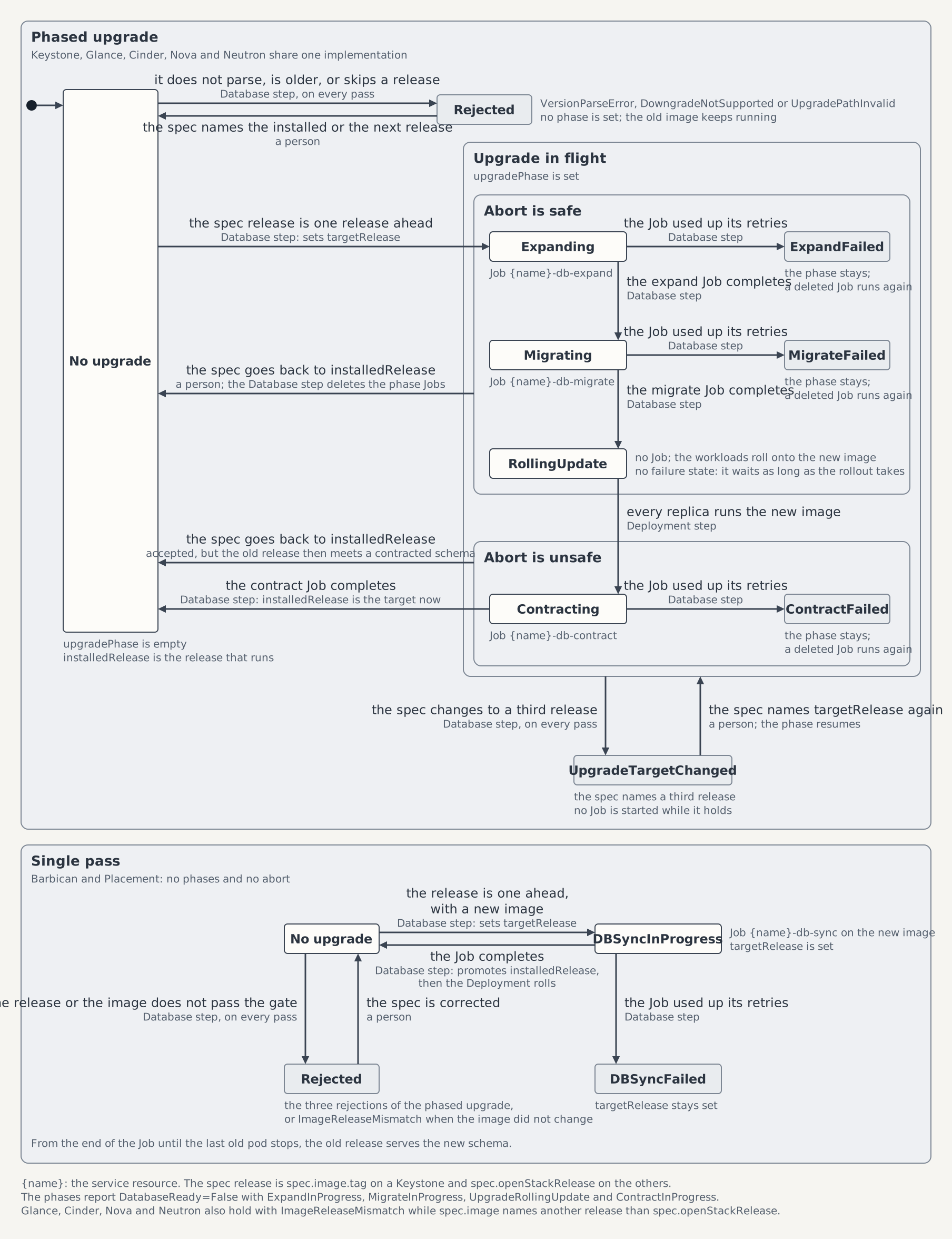
Change spec.openStackRelease on the ControlPlane CR to the target release. The operator projects the new image tags onto the service children and triggers their release-specific upgrade flows. Keystone uses its expand-migrate-contract pipeline. Its API stays available throughout because old and new schemas coexist while data is migrated.
kubectl patch controlplane controlplane -n openstack \
  --type merge \
  -p '{"spec":{"openStackRelease":"2026.2"}}'
The child image tag is derived from spec.openStackRelease unlessspec.services.keystone.image overrides the whole image reference. An image override pins the tag, so it must be dropped before a release upgrade takes effect; likewise a patch-suffix build such as 2026.1-p1 is not a valid openStackRelease value (the field only accepts the YYYY.N cadence) and is delivered through the image override instead.
Watch the ControlPlane's driven release and the child's upgrade phases:
kubectl get controlplane controlplane -n openstack -wkubectl get keystone controlplane-keystone -n openstack -w \
-o custom-columns='NAME:.metadata.name,PHASE:.status.upgradePhase,FROM:.status.installedRelease,TO:.status.targetRelease,READY:.status.conditions[?(@.type=="Ready")].status'Expected timeline on the child:
| Phase | What the operator does |
|---|---|
Expanding | Runs db_sync --expand with the new image, adding columns/tables without dropping anything |
Migrating | Runs db_sync --migrate, copying or transforming data into new schema elements |
RollingUpdate | Updates the Deployment to the new image and waits for rollout |
Contracting | Runs db_sync --contract, dropping old columns/tables that are no longer read |
When all four complete successfully:
- The child's
.status.installedReleaseis set to the new tag .status.targetReleaseand.status.upgradePhaseare cleared- The ControlPlane's
.status.services[?(@.name=='keystone')].releasereports the new release - A
UpgradeCompleteevent is emitted on the child
The figure shows the same four phases with their failure states. Its abort arrows start at the child's own spec, which the ControlPlane owns here: lowering spec.openStackRelease is rejected at admission, so Recovering from a bad upgrade describes the way back on this path.
Upgrade constraints
Only sequential upgrades are supported. 2026.1 → 2026.2 is the one step the release floor leaves today, and a YYYY.2 → YYYY+1.1 step such as 2026.2 → 2027.1 is sequential too. A downgrade is rejected at ControlPlane admission with openStackRelease downgrade from "…" to "…" is not permitted; Keystone DB migrations are not reversible. A skip-level jump (e.g. 2026.1 → 2027.1) is admitted at the ControlPlane but surfaces as an UpgradePathInvalid Warning event on the controlplane-keystone child, which the keystone-operator refuses to run.
Full contract in Keystone Upgrade Flow.
Minimum supported release
This operator version supports OpenStack 2026.1 and later. Before you install it, bring every ControlPlane, every service resource with spec.openStackRelease (Barbican, Cinder, Glance, Neutron, NeutronMetadataAgent, Nova and Placement), and every Keystone or Horizon whose spec.image.tag names a release to 2026.1 or later. Run that upgrade with the operator version you already have.
The validating webhooks reject a create, or a change of the release, below the floor:
spec.openStackRelease: Invalid value: "2025.2": must be 2026.1 or later: this operator version no longer supports OpenStack releases below 2026.1An update that keeps a stored release below the floor is admitted with a warning, so the resource stays editable:
Warning: spec.openStackRelease "2025.2" is below 2026.1, the oldest OpenStack release this operator version supports; the unchanged value is admitted, but the operator renders the 2026.1 configuration for it. Set spec.openStackRelease to 2026.1 or later.For Keystone and Horizon the field in both messages is spec.image.tag. A digest-pinned image, or a tag that names no release, is not checked.
From this operator version on, the controllers render the 2026.1 launch and paste layout for any release: Glance runs under uWSGI, and Barbican's paste file carries the request_id filter. The Glance connection cap no longer accounts for a status.installedRelease of 2025.2. A ControlPlane left at 2025.2 stays editable, but a service child it creates at that release is refused by the child's webhook.
Recovering from a bad upgrade
The upgrade pipeline is forward-only at both levels: the keystone-operator has no db_sync --downgrade, and the ControlPlane webhook rejects lowering spec.openStackRelease. There is therefore no in-place rollback. If a new release is broken, recovery is to restore the database from backup and redeploy at the restored release. Plan cut-overs around a maintenance window and a tested backup.
Rotate Fernet keys manually
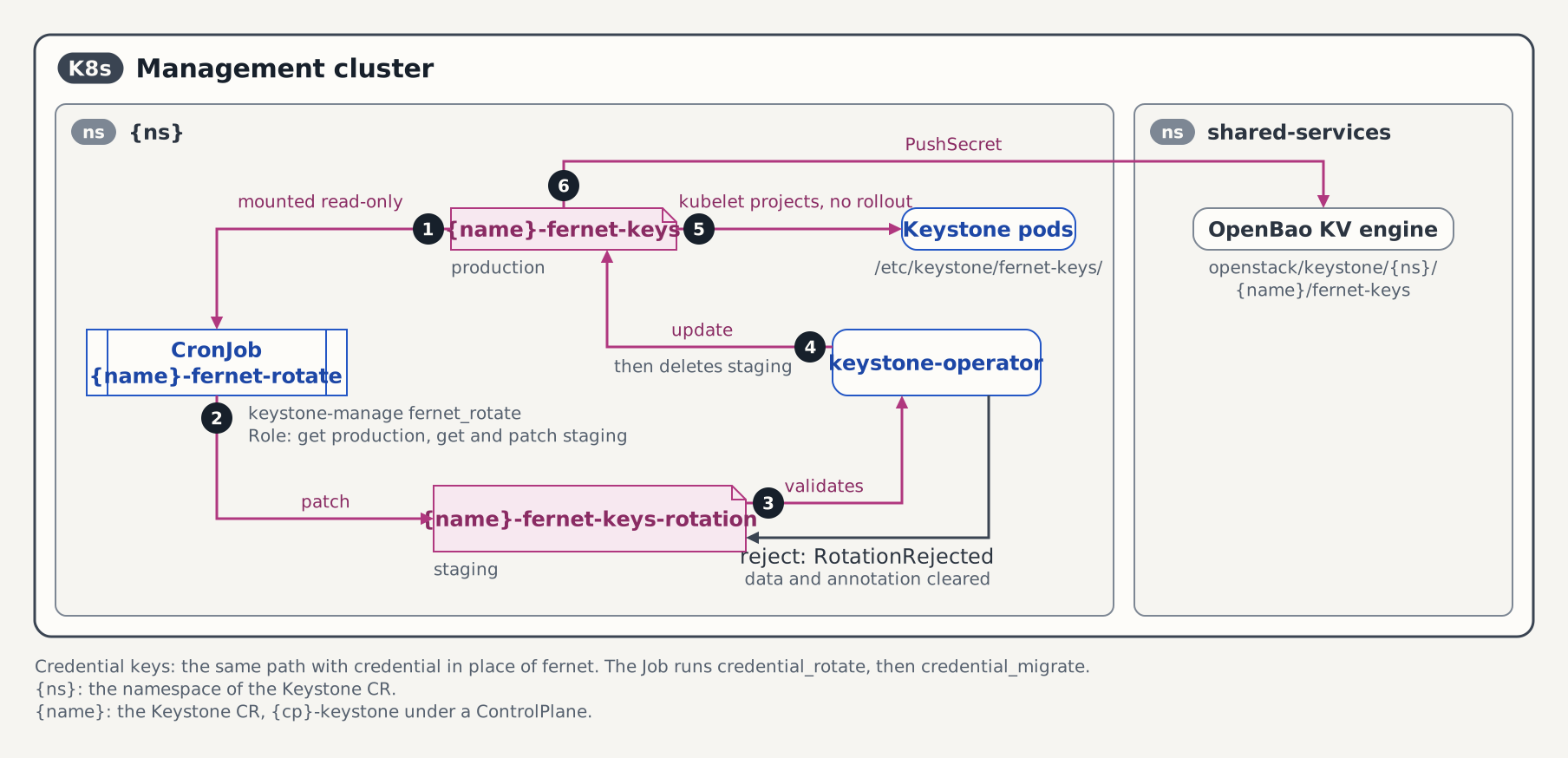
The keystone-operator ships a CronJob on the projected child that rotates the Fernet keys on a schedule. You can trigger a rotation immediately without waiting for the cron job to fire. This is useful after a suspected key compromise.
On the ControlPlane path the schedule is set through spec.services.keystone.rotationInterval, a duration (e.g. 168h) the operator converts to a cron expression and projects onto the child's spec.fernet.rotationSchedule and spec.credentialKeys.rotationSchedule. The ControlPlane CRD does not expose the suspend or maxActiveKeys knobs; pausing scheduled rotation or tuning the overlap window is standalone-only (see the Standalone Keystone section).
Rotation uses a split staging-to-production path: the CronJob writes the new key set to a staging Secret, and the operator validates it and applies it to the production controlplane-keystone-fernet-keys Secret on its next reconcile. So the right signal that a manual rotation landed is the operator's event on the child, not the production Secret's contents immediately after the Job finishes. Creating a Job from the CronJob is not a CR edit, so it is valid against the operator-owned child.
A Job you create from the CronJob enters the figure at step 1. The reconciler reference lists the steps.
# Trigger an on-demand rotation by creating a Job from the CronJob
kubectl -n openstack create job \
  --from=cronjob/controlplane-keystone-fernet-rotate \
  controlplane-keystone-fernet-rotate-manual-$(date +%s)
Confirm the operator applied the staged rotation:
kubectl -n openstack describe keystone controlplane-keystone | grep FernetKeysRotatedWhat to expect
The production Secret now holds a new primary key. Older keys stay until the child's
maxActiveKeysis exceeded, so tokens issued before rotation remain valid through the overlap window.No Deployment rollout happens. Running pods pick up the new keys via the in-place Secret projection (~60s). Their UIDs stay unchanged.
Credential keys rotate the same way and are always managed. Swap
fernetforcredentialin the CronJob name:bashkubectl -n openstack create job \ --from=cronjob/controlplane-keystone-credential-rotate \ controlplane-keystone-credential-rotate-manual-$(date +%s)
For the full staging-aware verification flow, the operator's validation contract, and recovery from a rejected rotation (RotationRejected), see Rotate Keystone Fernet and Credential Keys.
Cleanup
Manual rotation Jobs are not garbage-collected automatically and accumulate if you run them often. Delete them after verification:
kubectl -n openstack get jobs -o name \
  | grep -E '/controlplane-keystone-(fernet|credential)-rotate-manual-' \
  | xargs -r kubectl -n openstack delete
Standalone Keystone, without a ControlPlane
On the Quick Start / Quick Start (Extended) devstacks a standalone Keystone CR named keystone runs with no ControlPlane projecting it. Drive these operations directly on that CR.
Scale by patching spec.deployment.replicas:
kubectl patch keystone keystone -n openstack \
  --type merge \
  -p '{"spec":{"deployment":{"replicas":5}}}'

kubectl rollout status deploy/keystone -n openstack
For load-driven scaling use spec.autoscaling instead. See Advanced Configuration: Autoscaling (HPA).
Upgrade by patching spec.image.tag:
kubectl patch keystone keystone -n openstack \
  --type merge \
  -p '{"spec":{"image":{"tag":"2026.1"}}}'
The same sequential-only constraint, the four-phase pipeline, and the forward-only recovery path apply. Make the target image node-local first, or the upgrade stalls at its first phase that needs it, Expanding, which runs db_sync --expand with the new image:
docker pull ghcr.io/c5c3/keystone:2026.1
kind load docker-image ghcr.io/c5c3/keystone:2026.1 --name cobaltcore
On the Quick Start (Extended) local-build path, rebuild the service image with RELEASE=2026.1 per that tutorial's Step 6 instead of pulling it.
Rotate Fernet keys against the keystone-fernet-rotate / keystone-credential-rotate CronJobs, and tune or pause scheduled rotation with the standalone-only spec.fernet fields:
kubectl -n openstack create job \
  --from=cronjob/keystone-fernet-rotate \
  keystone-fernet-rotate-manual-$(date +%s)
spec.fernet.rotationSchedule (a cron string, default weekly) sets the cadence, spec.fernet.suspend: true (and spec.credentialKeys.suspend: true) pauses scheduled rotation during an incident without deleting the CronJob, and spec.fernet.maxActiveKeys bounds the overlap window.
Further reading
- Observability & Diagnostics: reading conditions, events, and status fields while operations run
- Rotate Keystone Fernet and Credential Keys: the full staging-to-production rotation flow, validation contract, and recovery
- Rotate the Keystone Admin Password: manual admin-password rotation at the OpenBao source
- Schedule Keystone Admin Password Rotation: CronJob-driven scheduled admin-password rotation
- Keystone Upgrade Flow: state machine, job names, retry behavior
- Keystone Controller Events: full event catalogue for upgrade, rotation, and scale events
- Advanced Configuration: brownfield DB, autoscaling, network policy, and more
Tested by
Scale, release upgrade, image upgrade, zero-downtime rollout, manual Fernet rotation, and the release floor are each asserted on the CI e2e kind cluster by these chainsaw suites:
chainsaw test --test-dir tests/e2e/keystone/release-upgrade
chainsaw test --test-dir tests/e2e/keystone/image-upgrade
chainsaw test --test-dir tests/e2e/keystone/rolling-update-zero-downtime
chainsaw test --test-dir tests/e2e/keystone/fernet-rotation
chainsaw test --test-dir tests/e2e/c5c3/invalid-cr