GlanceBackend CRD API Reference
Reference documentation for the GlanceBackend Custom Resource Definition. One CR attaches to a Glance CR via spec.glanceRef and describes one image store. Phase 1 ships the S3-compatible object store (type: S3); the File store is deliberately never supported, because a shared object store is required so every Glance replica reads and writes the same images.
The attachment is inverted: the backend points at the Glance, not the other way round, so stores are added and removed without editing the Glance CR. A dedicated controller owns the backend lifecycle — credential resolution and the per-backend conditions — while the glance-side sub-reconciler aggregates all attached, credential-ready backends into the rendered store config, promoting the one marked isDefault to the default store. For that controller topology see Glance Reconciler Architecture.
The CRD is generated from operators/glance/api/v1alpha1/glancebackend_types.go; the webhook lives in glancebackend_webhook.go and the controllers in operators/glance/internal/controller/glancebackend_controller.go and reconcile_backends.go.
API Group and Version
| Field | Value |
|---|---|
| Group | glance.openstack.c5c3.io |
| Version | v1alpha1 |
| Kind | GlanceBackend |
| List Kind | GlanceBackendList |
| Scope | Namespaced |
Printer columns: kubectl get glancebackends shows Ready (.status.conditions[?(@.type=='Ready')].status), Type (.spec.type), Default (.spec.isDefault), Glance (.spec.glanceRef.name), and Age.
Example
apiVersion: glance.openstack.c5c3.io/v1alpha1
kind: GlanceBackend
metadata:
  name: garage-a
  namespace: openstack
spec:
  glanceRef:
    name: glance-multistore
  type: S3
  isDefault: true
  s3:
    host: http://garage.shared-services.svc.cluster.local:3900
    bucket: glance-images
    region: garage
    credentialsSecretRef:
      name: garage-s3-credentials
status:
  conditions:
  - type: CredentialsReady
    status: "True"
    reason: CredentialsAvailable
  - type: ConfigProjected
    status: "True"
    reason: ConfigProjected
  - type: Ready
    status: "True"
    reason: AllReady
The metadata.name (garage-a) becomes the Glance store identifier: it is the enabled_backends entry garage-a:s3 and the [garage-a] store section in the rendered config.
Spec
GlanceBackendSpec
Three schema-level CEL rules hold even when the webhook is down: glanceRef and type are immutable (UPDATE transition rules), and the type/s3 union rule (self.type == 'S3') == has(self.s3) enforces exactly one backend block matching spec.type.
| Field | Type | Required | Default | Description |
|---|---|---|---|---|
glanceRef | GlanceRefSpec | Yes | — | Names the Glance CR in the same namespace. Immutable (CEL transition rule): re-pointing a backend would strand the old deployment's store and race the new projection; delete and recreate instead. The Glance need not exist at admission time (GitOps ordering) — a dangling reference surfaces as Ready=False. |
type | GlanceBackendType | Yes | — | Store driver; Phase 1 supports S3 only (enum). Immutable (CEL transition rule). |
s3 | *S3BackendSpec | When type: S3 | — | The S3-compatible object store. Required exactly when type is S3 (union rule). |
isDefault | bool | No | false | Marks this backend the Glance default store ([glance_store] default_backend). Mutable. Exactly one attached, credential-ready backend must be the default; the glance-side sub-reconciler and a sibling-uniqueness webhook both enforce the single-default invariant. |
extraOptions | map[string]string | No | — | Free-form [<name>] store-section options not covered by the typed fields, keyed by bare option name. MaxProperties=32, and a CEL rule bounds each key at 256 and each value at 1024 characters. See the denylist. |
GlanceRefSpec
| Field | Type | Required | Description |
|---|---|---|---|
name | string | Yes | The referenced Glance CR's name (MinLength=1). |
S3BackendSpec
Optional fields are only rendered into the store section when set, so upstream Glance defaults apply for everything left unset.
| Field | Type | Required | Default | Rendered [<name>] option | Description |
|---|---|---|---|---|---|
host | string | Yes | — | s3_store_host | S3 endpoint URL; MinLength=1, pattern ^https?:// |
bucket | string | Yes | — | s3_store_bucket | The bucket images are stored in; MinLength=1 |
credentialsSecretRef | SecretNameRefSpec | Yes | — | s3_store_access_key / s3_store_secret_key | The Secret holding the S3 credentials under the fixed data keys access-key-id and secret-access-key (see below) |
bucketURLFormat | string | No | path | s3_store_bucket_url_format | path (https://host/bucket) or virtual (https://bucket.host) — enum |
region | string | No | — | s3_store_region_name | The S3 region the bucket lives in |
createBucketOnPut | bool | No | false | s3_store_create_bucket_on_put | Create the bucket on first write; only rendered when true |
largeObjectSize | *int32 (Minimum=1) | No | — | s3_store_large_object_size | Multipart-upload threshold in MiB; only rendered when set |
largeObjectChunkSize | *int32 (Minimum=1) | No | — | s3_store_large_object_chunk_size | Multipart chunk size in MiB; only rendered when set |
Credentials data-key contract. The Secret referenced by credentialsSecretRef MUST carry exactly two data keys, pinned by contract (not selectable per CR) and matching the repo's Garage S3 seeding:
| Data key | Rendered option |
|---|---|
access-key-id | s3_store_access_key |
secret-access-key | s3_store_secret_key |
SecretNameRefSpec
Unlike commonv1.SecretRefSpec, this reference carries no key field — the data keys are fixed by contract, so there is nothing to select.
| Field | Type | Required | Description |
|---|---|---|---|
name | string | Yes | The referenced Secret's name (MinLength=1). |
extraOptions Denylist
The validating webhook rejects extraOptions keys the projection owns, so the escape hatch cannot silently contradict the typed spec. Every key must first match ^[A-Za-z0-9_]+$ (letters, digits, underscore); the pattern runs before the denylist so an embedded newline or a denylist-evading trailing space cannot slip through. Values carrying a newline or carriage-return are rejected as an INI-injection guard.
| Group | Rejected keys |
|---|---|
| Rendered from typed fields | s3_store_host, s3_store_bucket, s3_store_access_key, s3_store_secret_key, s3_store_bucket_url_format, s3_store_region_name, s3_store_create_bucket_on_put, s3_store_large_object_size, s3_store_large_object_chunk_size |
| Operator-owned | store_description |
Separately, a backend's metadata.name becomes its store identifier and [<name>] config section, so the webhook rejects a name that collides with a reserved Glance section: the exact names default (case-insensitively), database, keystone_authtoken, glance_store, paste_deploy, oslo_policy, os_glance_staging_store, os_glance_tasks_store, and any name using the reserved os_glance_ / os-glance- prefix (Glance owns that namespace for its staging and tasks stores).
Default-Backend Semantics
Exactly one attached, credential-ready backend must be marked isDefault. Two gates enforce this:
- Admission (sibling uniqueness). When a backend under validation sets
isDefault, the webhook lists its namespace siblings (an uncached read), filters to the samespec.glanceRef.name, skips self andTerminatingsiblings, and rejects if another default already exists. - Reconcile (exactly-one rule). The glance-side sub-reconciler counts the credential-ready defaults. Zero or more than one is an invalid projection: it sets
BackendsReady=False / NoDefaultBackend, re-renders nothing, and the config step retains the last-good artefacts the live Deployment mounts.
Because the default store is rendered as [glance_store] default_backend in glance-api.conf (the config ConfigMap) and not into backends.conf, the content of the backends Secret is invariant to an isDefault flip: flipping the default re-renders the config ConfigMap, not the content-hashed backends Secret.
Conditions
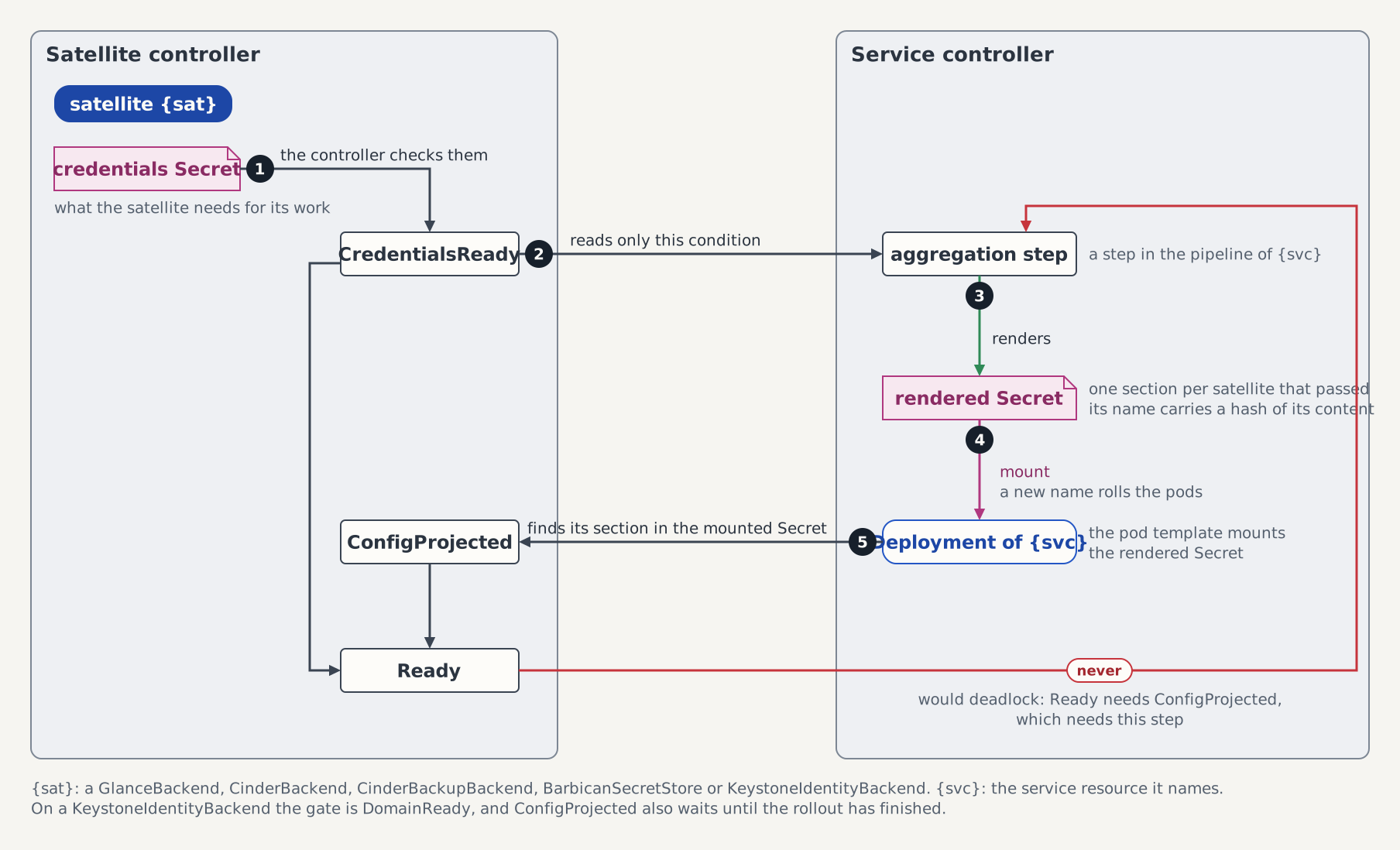
The dedicated GlanceBackendReconciler is the single writer of this status. The glance-side sub-reconciler only reads CredentialsReady (it gates config projection) and writes the aggregated BackendsReady condition onto the Glance CR instead.
The figure shows why the step reads CredentialsReady and never Ready. The handshake lists the five steps and what differs per kind.
| Type | Owner | Status | Reason | Meaning |
|---|---|---|---|---|
CredentialsReady | GlanceBackend | True | CredentialsAvailable | The credentials Secret exists and carries access-key-id / secret-access-key. |
CredentialsReady | GlanceBackend | False | WaitingForCredentials | The Secret is absent or missing a contract key (polled as a backstop). |
CredentialsReady | GlanceBackend | False | WaitingForParent | No Glance of the name in spec.glanceRef exists, so which cluster this backend's credentials live on is unknown. The backend waits and requeues after 15 seconds rather than gating on a same-named Secret beside the CR. |
CredentialsReady | GlanceBackend | False | TargetClusterUnavailable | The parent Glance's spec.targetClusterRef names a target cluster that is not registered or no longer resolves. The message carries the resolver's error, the backend requeues after 15 seconds, and nothing is created on any cluster. See Target Clusters. |
ConfigProjected | GlanceBackend | True | ConfigProjected | The parent Glance Deployment mounts a backends.conf carrying this backend's [<name>] store section. |
ConfigProjected | GlanceBackend | False | WaitingForProjection | The projection has not landed in the Deployment yet. |
Ready | GlanceBackend | True | AllReady | Both sub-conditions are True. |
Ready | GlanceBackend | False | NotAllReady | At least one sub-condition is not True. |
BackendsReady | Glance | True | AllBackendsProjected | Every attached backend is credential-ready and projected, with a valid default. |
BackendsReady | Glance | False | WaitingForBackends | A valid default exists but at least one backend is pending (not yet credential-ready, or skipped for a per-backend fault); the ready subset is still projected. |
BackendsReady | Glance | False | NoDefaultBackend | Zero or more than one credential-ready backend is marked isDefault; last-good config is retained. |
Per-backend fault isolation. When a backend's credentials Secret is missing/unreadable, or a rendered value carries a control character, the glance-side step skips that backend, emits a GlanceBackendSkipped Warning event on the Glance CR, and keeps projecting the healthy siblings — a single bad backend never fails the whole aggregation. The GlanceBackend controller itself emits no events: its CredentialsReady / ConfigProjected / Ready conditions carry the entire per-backend contract.
Immutability and Validation Summary
Schema-layer rules (CEL / kubebuilder markers, enforced even when the webhook is down): the glanceRef and type transition rules, the type/s3 union, the S3 type enum, the host URL pattern and MinLength guards, the bucketURLFormat enum, the largeObjectSize/largeObjectChunkSize minimums, and the extraOptions MaxProperties / key-and-value-length bounds.
Webhook rules (defense-in-depth plus the rules CEL cannot express): the union re-check, the reserved-store-name collision guard on metadata.name, the extraOptions key allowlist and denylist, the INI-injection guard on extraOptions values, and the single-default sibling-uniqueness check. The bucketURLFormat default (path) is materialized by the defaulting webhook for callers that bypass it.
Chainsaw E2E Tests
The end-to-end multi-store flow — a two-backend Glance against the Garage S3 of the infrastructure stack, credential resolution, and store projection — lives in tests/e2e/glance/s3-multistore. The default-store switch (flipping isDefault between siblings and re-rendering default_backend) lives in tests/e2e/glance/default-backend-switch. The detach path (deleting a backend and de-projecting its store) lives in tests/e2e/glance/deletion-cleanup. The rejection corpus lives in tests/e2e/glance/invalid-glancebackend-cr.
Retained Artefacts
The rendered store sections live in a content-hashed <glance>-backends-<hash> Secret owned by the parent Glance CR — up to 3 historical copies are retained for fast rollback, and all are garbage-collected with the Glance CR. Its single data key is backends.conf, an INI document with one [<name>] store section per attached, credential-ready backend, mounted into the API pods at /etc/glance/backends.conf.d/ as a second oslo.config --config-dir root.
Each backend's store identifier is its CR name: the section header is [<name>] and the [DEFAULT] enabled_backends list carries the entry <name>:s3.