Nova CRD
novas.nova.openstack.c5c3.io/v1alpha1, kind Nova. The CRD is generated from operators/nova/api/v1alpha1/nova_types.go; the validating and defaulting webhooks live in operators/nova/api/v1alpha1/nova_webhook.go. The Helm chart ships a synced copy (make sync-crds / make verify-crd-sync).
One Nova CR describes the compute control plane: its OpenStack release, the container image, the two database schemas, the cache and message-bus connections, the Keystone integration, the services Nova calls as a client, and the pod-level knobs of its five Deployments. The compute nodes are not in this spec. They read the contract Secret status.computeConfigSecretRef names. A compute on another cluster reads a copy of the remote contract status.remoteComputeConfigSecretRef names, and the ControlPlane mirrors that copy under the name status.computeConfigSecretRef gives.
kubectl get novas shows Ready (.status.conditions[?(@.type=='Ready')].status), Release (.status.installedRelease), Endpoint (.status.endpoint) and Age.
Spec
| Field | Type | Required | Description |
|---|---|---|---|
openStackRelease | string | yes | The OpenStack release the operator deploys and drives; pattern ^\d{4}\.[12]$ (the YYYY.N cadence, N in {1,2}). It governs install and upgrade tracking: status.installedRelease is promoted to it after a successful migration. Kept separate from the image tag so a digest-pinned image still resolves a schema. The validating webhook rejects a value below 2026.1, the oldest supported release, on create and on change, and warns on an unchanged one. |
image | ImageSpec | yes | The container image every process runs: the five Deployments, the migration Jobs and the archive CronJob. Exactly one of tag or digest (shared CEL rule, re-checked by the webhook) |
apiDatabase | DatabaseSpec | yes | The MariaDB connection of the nova_api schema: the cell map, the flavors, the instance-to-cell mappings and the API-level quotas. The operator names its managed instance {name}-api. Exactly one of clusterRef (managed) or host (brownfield); credentialsMode (Static | Dynamic, where Dynamic requires clusterRef), secretRef, and optional tls. The rules are inherited from commonv1.DatabaseSpec. The schema name and the managed/brownfield mode are immutable (two CEL transition rules, mirrored by the webhook): the schema holds the cell map and every instance mapping |
database | DatabaseSpec | yes | The MariaDB connection of the cell schema: the instances, their migrations, their block-device mappings. The operator names its managed instance {name} and grants the same user on {database}_cell0 as well, so the name is bounded at 58 characters. It must name a different schema than apiDatabase, apiDatabase must not name its cell0, and both use the same credentialsMode (three CEL rules on the spec). The schema name and the managed/brownfield mode are immutable (two CEL transition rules, mirrored by the webhook): the cell mappings store the schema name |
cache | CacheSpec | yes | Memcached. Exactly one of clusterRef (managed) or servers (brownfield). It backs both [keystone_authtoken] memcached_servers and the [cache] block Nova keeps its resolved cell mappings in |
messaging | MessagingSpec | yes | The RabbitMQ connection, with no optional form: the API hands every instance request to the conductor over the bus, the conductor asks the scheduler for a host over the bus, and every nova-compute joins the same way. Exactly one of clusterRef (managed) or secretRef (brownfield), plus optional tls. A brownfield URL must name an explicit port and must not use an IPv6 literal host: nova expands the cell mapping's {hostname}:{port} template from it |
api | NovaAPISpec | no | The API Deployment's pod-level block and its uWSGI parameters |
metadata | NovaMetadataSpec | yes | The metadata Deployment, its uWSGI parameters, the shared secret it verifies proxied requests with, and its own gateway block. Required because the shared secret has no default |
scheduler | NovaSchedulerSpec | no | The scheduler Deployment and its worker count |
conductor | NovaConductorSpec | no | The conductor Deployment and its worker count |
jobs | *JobSpec | no | Sizes, prioritizes and places the pods of the db-sync Job (which also runs the cell_v2 steps), the db-expand, db-migrate and db-contract upgrade phases, the db-archive CronJob, and the host discovery Job a NovaCompute pool runs. A field left unset falls back to spec.api.deployment; unset resources default to a 70m CPU request and 368Mi memory as request and limit |
consoleProxy | NovaConsoleProxySpec | no | The console proxy: the switch that projects it, its Deployment, and its own gateway block |
keystoneEndpoint | string | yes | The Keystone auth URL rendered as [keystone_authtoken] auth_url and as the auth_url of every client section; MinLength=1, pattern ^https?://, and the webhook also requires a parseable URL with a host. Nova reaches it server-side on every request and before every outgoing call, so it must resolve from inside the cluster. Nova has no Keystone-free posture: an instance boot needs a Placement allocation, a Neutron port and a Glance image, and all three are authenticated calls |
keystonePublicEndpoint | string | no | The browser-facing Keystone base URL rendered as www_authenticate_uri, the address a 401 points unauthenticated clients at. When empty the operator falls back to keystoneEndpoint at render time (EffectiveKeystonePublicEndpoint), correct only when the internal and public URLs coincide |
remoteCompute | NovaRemoteComputeSpec | no | Publishes a second compute contract, {name}-remote-compute-config, for a nova-compute on another cluster: the same keys, with addresses that leave the cluster. Requires messaging.tls (CEL rule on the spec, mirrored by the webhook). When nil no remote contract is published, and one published earlier is deleted. See The remote contract |
serviceUser | ServiceUserSpec | yes | The Keystone service account and the Secret holding its password. The same account validates tokens and makes every outgoing call |
region | string | no | The Keystone region (region_name in both identity sections and in every client section); omitted when empty, and Nova then uses the catalog's default region |
endpoints | NovaEndpointsSpec | no | Pins the services Nova calls as a client and switches the two optional ones on |
dbArchive | DBArchiveSpec | no | The recurring archive that moves Nova's soft-deleted rows into the shadow tables. A nil block resolves like an empty one: @daily, 1000 rows per table per batch, one second between batches, no retention window, not suspended |
gateway | GatewaySpec | no | External exposure of the API through a Gateway API HTTPRoute on port 8774; requires hostname and parentRef.name |
networkPolicy | NetworkPolicySpec | no | Ingress restricted to TCP 8774, 8775 and 6080 from the listed sources; egress auto-derived. At least one ingress source is required (fail-closed). See Network policy |
autoscaling | AutoscalingSpec | no | HPA bounds, CPU/memory utilization targets and scaling behavior. It reaches the API Deployment alone |
logging | LoggingSpec | no | oslo.log derivation: format (text/json), level, debug, perLoggerLevels. Materialized by the defaulting webhook to text/INFO/debug: false |
extraConfig | map[string]map[string]string | no | Free-form INI sections for options with no dedicated field. See extraConfig |
secretStoreRef | SecretStoreRefSpec | no | Selects the External Secrets store SecretsReady is resolved against: kind (ClusterSecretStore | SecretStore, default ClusterSecretStore) and a required name. When omitted the shared cluster-scoped openbao-cluster-store is used |
targetClusterRef | TargetClusterRefSpec | no | Names the registered target cluster that receives this Nova's children: the five Deployments, the Services, the ConfigMaps, the Secrets, the Jobs, the CronJob and the database CRs. The CR itself does not move, and neither do its status, its finalizers or the webhooks that admit it. Immutable (two CEL transition rules, mirrored by the webhook): adding, removing or renaming it strands the children on the previously selected cluster; delete and recreate instead. See Target Clusters |
NovaAPISpec
The API is the only Deployment that scales horizontally.
| Field | Type | Required | Default | Description |
|---|---|---|---|---|
deployment | DeploymentSpec | no | replicas: 3 | Pod-level knobs: replicas, resources (resolved per resource when the pod is rendered: 70m CPU request, no CPU limit, and memory sized from spec.api.uwsgi, 720Mi as request and limit at its defaults, see the resource defaults), terminationGracePeriodSeconds (30), preStopSleepSeconds (5), strategy, topologySpreadConstraints, priorityClassName, and the node placement nodeSelector, tolerations and affinity (see NodePlacementSpec). It is also the fallback of spec.jobs |
deployment.verticalAutoscaling | *VerticalAutoscalingSpec | no | nil | Opts the Nova API Deployment into a VerticalPodAutoscaler that controls the requests of its containers; see VerticalAutoscalingSpec. Rejected beside spec.autoscaling, which scales the same Deployment. On a cluster without the VPA, VPAReady turns False with reason VPANotInstalled. |
uwsgi | UWSGISpec | no | materialized | uWSGI parameters: processes (2), threads (1), httpKeepAlive (true), harakiri and httpKeepAliveTimeout (both omitted when unset). The defaulting webhook materializes the block, so the API always runs with the documented values |
NovaMetadataSpec
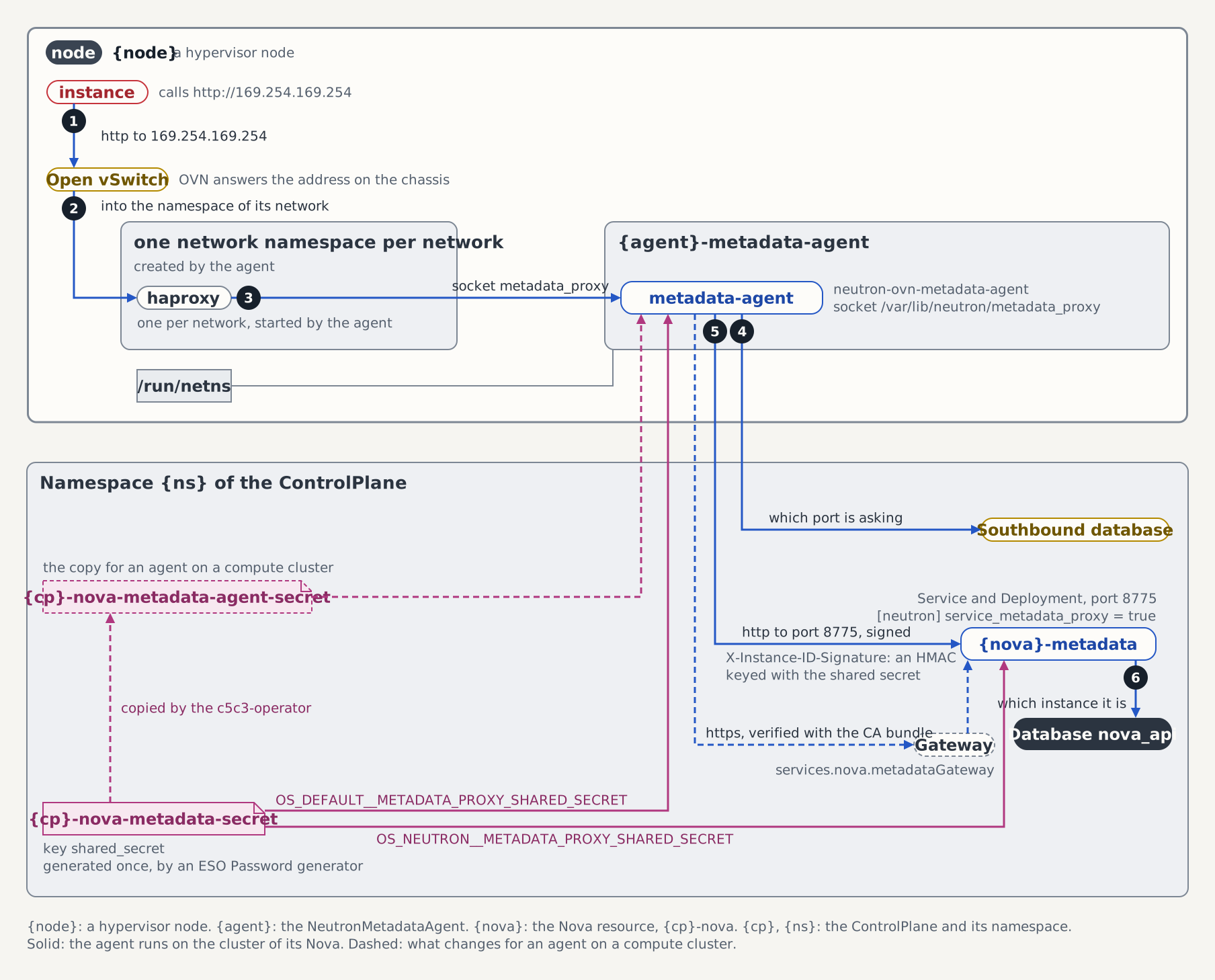
The metadata API answers an instance's call to 169.254.169.254. The request does not arrive from the instance: the Neutron metadata agent proxies it and signs it with a shared secret, which is what tells this API which instance asked.
The figure follows such a request from the instance to this API. The path of a request lists the hops.
| Field | Type | Required | Default | Description |
|---|---|---|---|---|
deployment | DeploymentSpec | no | replicas: 1 | The same pod-level knobs, node placement included, with memory sized from spec.metadata.uwsgi (720Mi at its defaults). The front end holds no state between requests, so the count may be raised |
deployment.verticalAutoscaling | *VerticalAutoscalingSpec | no | nil | Opts the metadata Deployment into a VerticalPodAutoscaler that controls the requests of its containers; see VerticalAutoscalingSpec. On a cluster without the VPA, VPAReady turns False with reason VPANotInstalled. |
uwsgi | UWSGISpec | no | materialized | The same uWSGI parameters as the API's |
sharedSecretRef | SecretRefSpec | yes | key to shared_secret | The Secret holding the value the Neutron metadata agent signs proxied requests with. The operator reads it rather than generating one: the same value has to reach the NeutronMetadataAgent, and a value only this side knows leaves every metadata request rejected |
gateway | GatewaySpec | no | External exposure of the metadata API on a hostname of its own. An agent on this Nova's cluster dials the Service; an agent on a compute cluster dials this hostname over https |
NovaSchedulerSpec
| Field | Type | Required | Default | Description |
|---|---|---|---|---|
deployment | DeploymentSpec | no | replicas: 1, terminationGracePeriodSeconds: 200 | The same pod-level knobs, node placement included, with memory sized from workers, one single-threaded process each: 720Mi at the default two, 1072Mi at three. Schedulers are peers that read the same host state out of Placement and hold nothing between requests, so the count may be raised |
deployment.verticalAutoscaling | *VerticalAutoscalingSpec | no | nil | Opts the scheduler Deployment into a VerticalPodAutoscaler that controls the requests of its containers; see VerticalAutoscalingSpec. On a cluster without the VPA, VPAReady turns False with reason VPANotInstalled. |
workers | *int32 (Minimum=1) | no | 2 | nova-scheduler worker processes per pod, rendered into the scheduler's own overlay. Raising it multiplies the database and bus connections the pod holds |
NovaConductorSpec
| Field | Type | Required | Default | Description |
|---|---|---|---|---|
deployment | DeploymentSpec | no | replicas: 1, terminationGracePeriodSeconds: 200 | The same pod-level knobs, node placement included, with memory sized from workers like the scheduler's (720Mi at the default two) |
deployment.verticalAutoscaling | *VerticalAutoscalingSpec | no | nil | Opts the conductor Deployment into a VerticalPodAutoscaler that controls the requests of its containers; see VerticalAutoscalingSpec. On a cluster without the VPA, VPAReady turns False with reason VPANotInstalled. |
workers | *int32 (Minimum=1) | no | 2 | nova-conductor worker processes per pod, rendered into the conductor's own overlay |
The raised grace period is the one place these two blocks depart from the shared defaults. Both shut down by draining their RPC server, which nova 33.0.0 completes in 165 to 167 seconds, so the shared 30-second window would end every rollout in a SIGKILL with requests still in flight. An explicit value is left alone.
The one-replica defaults of the metadata, scheduler and conductor blocks are applied by the defaulting webhook and reach the absent block only. commonv1.DeploymentSpec.Replicas carries +kubebuilder:default=3, which the API server materializes as soon as the CR carries a deployment object at all, before any mutating webhook runs.
NovaConsoleProxySpec
| Field | Type | Required | Default | Description |
|---|---|---|---|---|
enabled | *bool | no | true | Projects the proxy. Setting it to false deletes the Deployment, the Service, the HTTPRoute and the proxy's NetworkPolicy, renders [vnc] enabled = false in nova.conf and in the compute contract, and the defaulting webhook removes consoleProxy.deployment in the same request |
deployment | *DeploymentSpec | no | replicas: 1 while enabled | The pod-level knobs, node placement included. The field is a pointer so an absent block stays absent: a value block would serialize as deployment: {} on every CR, the API server would fill it with three replicas, and the console rule below would fire on a block nobody wrote. For the same reason the defaulting webhook removes the block it materialized once the proxy is switched off, so a patch that sets only enabled: false is admitted. The proxy runs one single-threaded process, so a block that names neither CPU nor memory, or no block at all, renders a 70m CPU request, no CPU limit, and 368Mi as memory request and limit |
deployment.verticalAutoscaling | *VerticalAutoscalingSpec | no | nil | Opts the console proxy Deployment while the proxy is enabled into a VerticalPodAutoscaler that controls the requests of its containers; see VerticalAutoscalingSpec. On a cluster without the VPA, VPAReady turns False with reason VPANotInstalled. |
gateway | GatewaySpec | no | External exposure of the proxy on a hostname of its own. The console URL is https://<hostname>/vnc_lite.html?path=%3Ftoken%3D<token>, and the WebSocket that follows the page opens on /, so the two cannot be split off the API's hostname by path. For the same reason path must be empty or / (webhook): a prefix route would match neither |
ServiceUserSpec
The identity fields are webhook-defaulted, so a minimal block need only supply the password Secret reference.
| Field | Type | Required | Default | Description |
|---|---|---|---|---|
username | string | no | nova | Keystone username (username in both identity sections and in the credential-carrying client sections) |
projectName | string | no | service | The project the service user scopes to |
userDomainName | string | no | Default | The domain the service user lives in |
projectDomainName | string | no | Default | The domain the service project lives in |
secretRef | SecretRefSpec | yes | key to password | The Secret holding the service-user password. The value is injected as OS_KEYSTONE_AUTHTOKEN__PASSWORD, OS_SERVICE_USER__PASSWORD, OS_PLACEMENT__PASSWORD, OS_NEUTRON__PASSWORD and, with Cinder enabled, OS_CINDER__PASSWORD; it is never rendered into config |
NovaEndpointsSpec
Each block configures one client section. An empty override leaves Nova resolving the service from the Keystone catalog with valid_interfaces = internal, which is the right answer for a colocated control plane. An override is for the deployment whose catalog carries an address the Nova pods cannot reach, or none at all.
| Field | Type | Required | Default | Description |
|---|---|---|---|---|
placement.override | string | no | [placement] endpoint_override; pattern ^https?://. Nova claims every instance's resources here before it boots, so the service is mandatory and the block only decides how it is addressed | |
neutron.override | string | no | [neutron] endpoint_override; same pattern. Nova creates and binds a port for every instance | |
glance.override | string | no | [glance] endpoint_override; same pattern. Nova reads the image of every instance it boots | |
cinder.enabled | bool | no | false | Renders [cinder] at all. A standalone Nova without block storage has no volume service to name |
cinder.override | string | no | [cinder] endpoint_template, read only while cinder.enabled is true. The section addresses the volume service by catalog tuple (catalog_info = block-storage:cinder:internalURL), so its addressing keys differ from the siblings above | |
barbican.enabled | bool | no | false | Renders [key_manager] and [barbican], which is what lets Nova read the key of an encrypted volume |
barbican.override | string | no | [barbican] barbican_endpoint, read only while barbican.enabled is true |
NovaRemoteComputeSpec
The two addresses the remote contract cannot derive from the rest of the spec.
| Field | Type | Required | Default | Description |
|---|---|---|---|---|
keystoneEndpoint | string | yes | The Keystone v3 URL a compute on another cluster authenticates against. It renders as every auth_url of the remote fragment and as [barbican] auth_endpoint; MinLength=1, pattern ^https://, and the webhook also requires a parseable URL with a host and scheme https. The nova service-user password is sent to it on every token request, across a cluster boundary | |
transportURLSecretRef | SecretRefSpec | yes | key to transport_url | A Secret in this Nova's namespace, on the cluster its children run on, holding the complete rabbit:// URL of the broker's external listener. The operator reads it and never writes it, and copies the value into the remote contract's transport_url. name is required (MinLength=1) |
DBArchiveSpec
Nova never hard-deletes on its own: deleting an instance flips its row to deleted, so the tables grow for the lifetime of the deployment. The operator projects a CronJob running nova-manage db archive_deleted_rows on every Nova, whether or not the block is set. The archive is a move: the rows survive in the shadow tables and stay available for accounting, and reclaiming that space is a separate nova-manage db purge the operator does not schedule. A run repeats bounded batches until one finds nothing left to move or its 50-minute budget is spent; the next run continues where it stopped.
| Field | Type | Required | Default | Description |
|---|---|---|---|---|
schedule | string | no | @daily | The cron expression the CronJob runs on. Checked by the webhook against the cron grammar, the one rule with no CRD-schema counterpart: a regex that accepts a descriptor like @daily alongside 5-field expressions would also accept invalid ones |
maxRows | *int32 (Minimum=1) | no | 1000 | The --max_rows bound, how many rows one batch moves per table. It keeps a batch on a long-neglected database from holding table locks for the length of the backlog |
sleep | *int32 (Minimum=0) | no | 1 | The seconds the run pauses between batches. Zero runs the batches back to back, which finishes sooner at the cost of the database serving the API at the same time |
retentionDays | *int32 (Minimum=1) | no | unset | When set, the run passes --before with today's date minus this many days, so a row soft-deleted inside the window stays in the live table, and --task-log with it. Unset passes neither, so every soft-deleted row is eligible and task_log is left alone: its rows are never soft-deleted, and archiving them without a date would move the audit period the os-instance_usage_audit_log API still reports on. Lowering it, or dropping it after it was set, widens what the next run moves, so the webhook warns |
suspend | bool | no | false | Pauses the CronJob without deleting it. DBArchiveReady stays True under the reason DBArchiveSuspended |
The settings are resolved at reconcile time and never written back into the CR, so a field left unset keeps tracking the operator default across upgrades.
extraConfig
spec.extraConfig is the escape hatch for options with no dedicated field. The render-time merge is operator defaults < extraConfig, so a user value wins. Overrides of operator-owned keys are honored and reported through the ExtraConfigHealthy condition and an ExtraConfigOwnedKeyOverride Warning event, with one group of exceptions: the keys below are rejected at admission, because honoring them does the damage before any condition could report it.
| Section | Rejected keys | Why |
|---|---|---|
[DEFAULT] | transport_url | Env-injected via OS_DEFAULT__TRANSPORT_URL, so a file value is inert at runtime and only copies the broker credentials into the rendered config |
[DEFAULT] | web | The directory the console proxy serves the noVNC client from. The operator mounts the client the image ships at this path; another path either is empty or is not that client, and the browser gets a blank page with no error from the proxy |
[database], [api_database] | connection | Env-injected via OS_DATABASE__CONNECTION and OS_API_DATABASE__CONNECTION, same reasoning as transport_url |
[keystone_authtoken], [service_user], [placement], [neutron], [cinder] | password | Each is env-injected through its own OS_<SECTION>__PASSWORD override |
[neutron] | metadata_proxy_shared_secret | Env-injected; a file value would copy the value a proxied request's signature is verified with into the ConfigMap every pod mounts |
[oslo_messaging_rabbit] | ssl, ssl_ca_file | The first selects whether the bus that carries every RPC call is encrypted; the second points the verification at a file the operator mounts |
[vnc] | novncproxy_host, novncproxy_port | The proxy's Service routes to this address and port. Another one leaves the Service with a port nothing listens on while the pod stays Ready |
Option names are validated at admission against a per-release option catalog embedded in the operator (the release comes from spec.openStackRelease; a release with no embedded catalog skips the check with an admission warning). An unknown section or option is rejected with the section and key named, and a deprecated-but-accepted option is admitted with a warning naming its replacement. The owned keys are exempt from the catalog scan, which is what keeps the keystoneauth credentials out of it: keystonemiddleware and the auth plugins register them at run time and no catalog enumerates them. Values are checked for one thing, a newline or carriage return in a section name, key or value, because the rendered INI writes each verbatim and a newline injects further config lines past the ownership and catalog gates.
[api] auth_strategy is absent from the registry on purpose. Neither embedded catalog registers such an option, so the operator neither renders it nor claims it; keystonemiddleware is wired through the api-paste pipeline instead.
Defaulting and validation
The defaulting webhook resolves the metadata, scheduler and conductor replica counts to one before the shared DeploymentSpec defaults run, materializes the console-proxy block at one replica while the proxy is enabled and removes it while it is disabled, gives the scheduler and the conductor the 200-second grace period and two workers each, materializes both uwsgi blocks and spec.logging, fills the cache backend, and materializes the ServiceUserSpec identity defaults together with the two Secret keys (password and shared_secret), and fills an empty spec.remoteCompute.transportURLSecretRef.key with transport_url while that block is set. It leaves spec.dbArchive untouched, because those fields are resolved at reconcile time.
Seven CEL rules sit on NovaSpec itself:
| Rule | Message |
|---|---|
has(self.targetClusterRef) == has(oldSelf.targetClusterRef) | targetClusterRef is immutable |
self.targetClusterRef.name == oldSelf.targetClusterRef.name | targetClusterRef is immutable |
self.apiDatabase.database != self.database.database | apiDatabase and database must name different schemas |
self.apiDatabase.database != self.database.database + '_cell0' | apiDatabase must not name the cell0 schema derived from database |
the two credentialsMode values, each resolved to Static when empty | apiDatabase and database must use the same credentialsMode |
!has(self.consoleProxy.deployment) while the proxy is disabled | consoleProxy.deployment must not be set when consoleProxy.enabled is false |
!has(self.remoteCompute) || has(self.messaging.tls) | remoteCompute requires messaging.tls: a compute on another cluster verifies the broker against the messaging CA bundle |
Five more sit on the two database blocks:
| Field | Rule | Message |
|---|---|---|
apiDatabase | self.database == oldSelf.database | apiDatabase.database is immutable: the schema holds the cell map and every instance mapping |
apiDatabase | has(self.clusterRef) == has(oldSelf.clusterRef) | apiDatabase mode (managed clusterRef vs brownfield host) is immutable |
database | self.database == oldSelf.database | database.database is immutable: the cell mappings store the schema name |
database | has(self.clusterRef) == has(oldSelf.clusterRef) | database mode (managed clusterRef vs brownfield host) is immutable |
database | size(self.database) <= 58 | database.database must be at most 58 characters: cell0 is provisioned as <database>_cell0 under the 64-character schema limit |
The transition rules are evaluated on UPDATE only, so the ref, the schema names and the connection modes are frozen at the schema layer even while the validating webhook is down. A renamed cell schema would be migrated and read by the conductor while nova-api kept reading the old one through the unchanged cell mapping, and a renamed nova_api schema would orphan every instance and host mapping. The database rules on the spec keep the pair of schemas apart: both run their own db-sync against a different set of migrations, so pointing them at one schema, or the API block at cell0, installs both migration histories into it, and they share a credential path, so a deployment cannot issue one of them dynamic credentials and the other a static password.
The console rule only ever meets a block written past the defaulting webhook, which removes the block while the proxy is disabled. The invalid-cr corpus therefore carries no fixture for it; the CRD-only envtest pins it.
The remote-compute rule ties the second contract to a verified bus. A compute on another cluster reaches the broker across a cluster boundary, with the broker credentials in the URL, and the messaging CA bundle is the only trust anchor either contract carries.
The validating webhook accumulates every violation into one admission response. It repeats the schema-layer rules as defense in depth (the image tag/digest XOR, both databases' mutual-exclusivity and Dynamic-requires-clusterRef rules, the database rules and transition rules above, the console rule, the remote-compute rule as a Required error on spec.messaging.tls, the https scheme of spec.remoteCompute.keystoneEndpoint, the cache and messaging rules, the secret-store-ref shape, the replica floor of every block, the worker floors, the autoscaling bounds including the implicit minReplicas default from spec.api.deployment.replicas and a non-zero spec.api.deployment.resources request for each utilization target, the network-policy ingress source, and the hostname and parentRef.name of all three gateway blocks, and the non-empty spec.remoteCompute.transportURLSecretRef.name) and adds the rules CEL cannot express: the URL shape of every endpoint field, spec.remoteCompute.keystoneEndpoint included (its url.Parse also refuses a newline), the cron grammar of spec.dbArchive.schedule, the logging enums including the per-logger-level map, the graceful-termination arithmetic (preStopSleepSeconds < terminationGracePeriodSeconds, and each harakiri strictly inside its own drain window), the request-versus-limit ordering, the PriorityClass lookup, the topology-spread selector, the node selector label grammar and the toleration rules on each of the five deployment blocks, the spec.jobs block (requests within limits, an existing priority class, and its node placement), the extraConfig guards, a newline or carriage return in any typed field rendered verbatim into nova.conf and the compute fragment (spec.region, the four spec.serviceUser names, and spec.consoleProxy.gateway.hostname), and the console gateway's path.
An update to a CR that is being deleted and leaves the spec unchanged is admitted without validation. That is the finalizer removal the reconciler issues, and an unchanged spec admitted earlier can fail today's rules, a PriorityClass deleted since or an owned key a later operator rejects; rejecting the removal would hold the CR in Terminating with nothing left to edit.
Each block's topology-spread selector is measured against the pod selector of the Deployment that block configures. The API's selector is the shared one narrowed by app.kubernetes.io/component=api; the other four are narrowed by metadata, scheduler, conductor and novncproxy, so a constraint on one of those blocks has to carry its component too. The console block is measured only while the proxy is enabled and the block exists: a disabled proxy's block is already rejected by the console rule, and running it through the pod-level rules as well would report a replica floor on a Deployment the operator never creates.
One rule produces a warning rather than a rejection: an update that reduces spec.dbArchive.retentionDays, or drops it after it was set, because the next run then also moves the rows soft-deleted inside the old window. The rows land in the shadow tables and do not disappear, so this stays a warning, but a typo (3 for 30) is indistinguishable from an intended edit at admission time. Setting a window where there was none, or raising one, is silent.
metadata.name is bounded at 41 characters on create. The {name}-db-archive CronJob is the child with the tightest budget: Kubernetes caps a CronJob name at 52 characters, because its controller appends an 11-character timestamp suffix to every Job it spawns. The bound applies on create only, since metadata.name is immutable and an update rule could only reject a CR an earlier operator version already admitted, including the finalizer-removal update that completes its deletion. Such a grandfathered CR still reconciles: the operator collapses the overflowing tail onto a content-stable hash and names the CronJob {truncated}-{hash}-db-archive. The host discovery Job a NovaCompute pool runs is collapsed the same way, to {truncated}-{hash}-discover-hosts, once {name}-discover-hosts would pass the 63 characters of a Job name.
metadata.name also must not end in -api, -metadata, -scheduler, -conductor, -novncproxy or -console, on create only for the same reason. A Nova named nova names children under each of those suffixes, and a Nova named nova-api would name its cell schema's MariaDB objects and connection Secret exactly like the first one's nova_api objects, so the two CRs would write, and on deletion delete, each other's. It must not end in -cell0 either: a Nova named nova with spec.database.database: nova names its cell0 Database and Grant nova-nova-cell0, which a Nova named nova-nova-cell0 would name its cell schema's objects.
The validating webhook also holds spec.openStackRelease to a release floor, a rule with no schema counterpart because the floor moves with the operator version. A value below 2026.1, the oldest OpenStack release this operator version supports, is rejected on create and whenever an update changes it, with must be 2026.1 or later: this operator version no longer supports OpenStack releases below 2026.1. An update that keeps a stored value below the floor is admitted with a warning, so an unrelated edit never blocks the resource: spec.openStackRelease "2025.2" is below 2026.1, the oldest OpenStack release this operator version supports; the unchanged value is admitted, but the operator renders the 2026.1 configuration for it. Set spec.openStackRelease to 2026.1 or later.
Rendered configuration
nova.conf is byte-identical across the supported releases, so a release bump never rotates the ConfigMap for a configuration change that is not there. A golden test pins the full document of two fixtures at both releases and compares the renders against each other.
Every process reads the same nova.conf. These are its sections:
| Section | What it carries |
|---|---|
[DEFAULT] | use_stderr = true, debug from spec.logging.debug, and state_path = /var/lib/nova. default_log_levels joins them while spec.logging.perLoggerLevels is non-empty, and log_config_append while the format is json |
[api] | local_metadata_per_cell = false: one global metadata front end instead of one per cell, so it resolves an instance through the API database |
[api_database], [database] | connection = mysql+pymysql://placeholder in both. The real URLs arrive as environment overrides, and the placeholder is there so oslo.config parses the file before they apply |
[keystone_authtoken] | The token middleware: auth_type, auth_url, www_authenticate_uri, the four identity fields, memcached_servers, and region_name while spec.region is set. No password |
[service_user] | The same identity plus send_service_user_token = true, which is what lets a call outlive the user token that started the request |
[placement] | The client credentials plus valid_interfaces = internal, endpoint_override when the block pins one, and timeout = 60. keystoneauth applies the timeout to every Placement request as both the connect and the read timeout, and openstacksdk retries a timed-out request once, so a build whose Placement call gets no answer fails with ERROR after about two minutes. Without it the scheduler waits out the kernel's retransmissions, about 15 minutes on an established connection, and logs nothing |
[neutron] | The client credentials plus valid_interfaces = internal, and endpoint_override when the block pins one |
[glance] | valid_interfaces = internal, plus region_name and endpoint_override when set. No credentials: Nova reads an image with the token of the request it is serving |
[cinder] | Only while spec.endpoints.cinder.enabled: the client credentials, catalog_info = block-storage:cinder:internalURL, os_region_name and endpoint_template when set |
[key_manager], [barbican] | Only while spec.endpoints.barbican.enabled: backend = barbican, then auth_endpoint, barbican_endpoint_type = internal, send_service_user_token = true, plus barbican_region_name and barbican_endpoint when set |
[oslo_messaging_rabbit] | rabbit_quorum_queue, rabbit_transient_quorum_queue and use_queue_manager, plus ssl and ssl_ca_file while spec.messaging.tls is set |
[oslo_messaging_notifications] | driver = noop |
[oslo_concurrency] | lock_path = /var/lib/nova/tmp |
[upgrade_levels] | compute = auto, which caps the compute RPC version at the oldest nova-compute still registered, so a control plane upgraded ahead of its computes keeps talking to them |
[cache] | enabled = true, the backend from spec.cache.backend, and memcache_servers derived from the cache block |
[scheduler] | discover_hosts_in_cells_interval = 300, the periodic that maps a newly registered compute node into the cell. The worker count is not here; it is the scheduler's own overlay |
[filter_scheduler] | build_failure_weight_multiplier = 0 and shuffle_best_same_weighed_hosts = true. The first switches off the weigher that ranks a host by its failed_builds counter; the second spreads the first builds over hosts of equal weight. Only the scheduler reads the section, which stays in the shared document so extraConfig can override it |
[vnc] | enabled from spec.consoleProxy.enabled, and novncproxy_base_url while the proxy runs: the gateway hostname when one is set, the cluster-local Service URL otherwise |
[DEFAULT] host is absent, so every process registers under its own pod name. No password is in the file: the identity sections are rendered without one and each arrives as an environment override.
Nova's own build_failure_weight_multiplier is 1000000.0. Nova normalizes the failed_builds counters of the candidate hosts to the range 0 to 1 before it multiplies, so one failed or aborted build puts a host 1000000 below every host without one, whatever the other weighers say. The counter resets only when a build succeeds on that host, and with Nova's host_subset_size of 1 that build never comes while another host has room. A server deleted while it is still scheduling counts as a failed build. 0 is the value Nova documents for switching the weigher off. At 0 nothing steers builds away from a host whose builds keep failing: as the emptiest host it keeps winning the ram, cpu and disk weighers, so unpinned builds keep landing on it until its compute service is disabled. The shuffle's cost is less dense packing among hosts of equal weight.
The counter keeps counting and stays readable in compute_nodes.stats; the compute-cluster guide reads it, disables a failing host and resets the counter in A hypervisor that receives no builds. A deployment that wants Nova's weigher back sets build_failure_weight_multiplier: "1000000.0" under filter_scheduler in extraConfig, which is honored and reported through ExtraConfigHealthy.
The operator upgrade that brings [filter_scheduler] renders a new nova.conf for every Nova whose extraConfig does not already set both keys. The content-hashed config ConfigMap rotates once, and the API, the metadata API, the scheduler, the conductor and, while it runs, the console proxy roll. The db-sync Job runs once more, and the archive CronJob mounts the new ConfigMap on its next run. Nothing has to be set. A value for either key that a deployment set through extraConfig before the upgrade stays in force, and from then on it is reported with ExtraConfigHealthy=False and an ExtraConfigOwnedKeyOverride Warning event.
The operator upgrade that brings [placement] timeout renders a new nova.conf for every Nova whose extraConfig does not set the key. The content-hashed config ConfigMap rotates once, and the API, the metadata API, the scheduler, the conductor and, while it runs, the console proxy roll. The db-sync Job runs once more, and the archive CronJob mounts the new ConfigMap on its next run. A deployment whose Placement calls take longer than 60 seconds sets timeout: "<seconds>" under placement in extraConfig. The value is honored and reported with ExtraConfigHealthy=False and an ExtraConfigOwnedKeyOverride Warning event. nova-compute.conf does not carry the key, so the compute contract is unchanged.
Four overlays ship beside nova.conf in the same ConfigMap, one per role that owns options the others must not read. They are assembled by string formatting instead of by the INI renderer, and a test pins them byte for byte.
metadata.conf, the key that makes the metadata API trust the instance identity in the headers of a proxied request:
[neutron]
service_metadata_proxy = true
scheduler.conf and conductor.conf, each carrying the worker count of its own process (spec.scheduler.workers and spec.conductor.workers, two when unset):
[scheduler]
workers = 2[conductor]
workers = 2novncproxy.conf, the client directory the proxy serves and the address pair its Service routes to. The empty [api_database] connection blanks the placeholder of the shared document: the proxy gets no nova_api credentials, and nova reads a non-empty value as a reachable API database:
[DEFAULT]
web = /usr/share/novnc

[api_database]
connection =

[vnc]
novncproxy_host = 0.0.0.0
novncproxy_port = 6080
All four ship on every render, including the console proxy's while the proxy is disabled. The ConfigMap is one object for the whole CR, and a key no pod mounts costs nothing, while a key that came and went with a switch would rotate the ConfigMap and roll the four workloads that do not read it.
Config directories and mounts
oslo.config reads every file in a --config-dir, so each process is given the shared directory and, where it owns one, an overlay directory of its own.
| Path | Content | Read by |
|---|---|---|
/etc/nova/nova.conf.d | nova.conf, plus logging.ini when the render produced one, plus metadata.conf for the metadata API alone | All five processes, the migration Jobs and the archive CronJob |
/etc/nova/scheduler.conf.d | scheduler.conf | The scheduler pods |
/etc/nova/conductor.conf.d | conductor.conf | The conductor pods |
/etc/nova/novncproxy.conf.d | novncproxy.conf | The console proxy pods |
/var/lib/nova | [DEFAULT] state_path, an emptyDir; the [oslo_concurrency] lock_path directory tmp lives below it | Every process |
/tmp | Writable scratch beside the read-only root filesystem | Every process and every Job |
/etc/nova-db-tls/api/, /etc/nova-db-tls/cell/ | ca.crt, tls.crt, tls.key of one schema each | Only while that block's tls is enabled |
/etc/rabbitmq-ca | ca.crt, the file ssl_ca_file names | Only while spec.messaging.tls is set |
The two db-tls directories sit outside /etc/nova rather than under it: the config mount occupies /etc/nova/nova.conf.d read-only, and a mount nested inside a read-only tmpfs has no mountpoint directory the runtime could create.
The three console-script roles read their overlay from a directory and not from a file name, because they are launched with two --config-dir arguments:
nova-scheduler --config-dir /etc/nova/nova.conf.d --config-dir /etc/nova/scheduler.conf.dThe two HTTP front ends have no such argument list. They are WSGI applications launched with uwsgi --module, and they name the documents they load through two environment variables instead:
| Variable | Value |
|---|---|
OS_NOVA_CONFIG_DIR | /etc/nova/nova.conf.d |
OS_NOVA_CONFIG_FILES (API) | /var/lib/openstack/etc/nova/api-paste.ini;nova.conf |
OS_NOVA_CONFIG_FILES (metadata) | /var/lib/openstack/etc/nova/api-paste.ini;nova.conf;metadata.conf |
The first entry is absolute, and its position is fixed. wsgi_app.py joins every entry to OS_NOVA_CONFIG_DIR with os.path.join, which returns an absolute entry unchanged, and deploy.loadapp reads the first entry of the list as the paste configuration. An api-paste.ini anywhere else in the list is a document nova loads as service configuration.
The migration Jobs and the archive CronJob mount the whole ConfigMap at /etc/nova/nova.conf.d. They need no file selection, and the role overlays they see beside nova.conf set worker counts and listen addresses nova-manage does not read.
Environment overrides
Every credential reaches the processes as an oslo.config OS_<GROUP>__<OPTION> environment override sourced from a Secret, so none of them is written into the ConfigMap the pods mount. The order is fixed, so a rebuilt pod template is byte-identical to the live one and no workload rolls on a reordered slice.
| Variable | Source | Overrides | Carried by |
|---|---|---|---|
OS_DEFAULT__TRANSPORT_URL | {name}-transport-url | [DEFAULT] transport_url | Every role |
OS_DATABASE__CONNECTION | {name}-db-connection | [database] connection | Every role |
OS_API_DATABASE__CONNECTION | {name}-api-db-connection | [api_database] connection | Every role but the console proxy |
OS_KEYSTONE_AUTHTOKEN__PASSWORD | spec.serviceUser.secretRef | [keystone_authtoken] password | Every role |
OS_SERVICE_USER__PASSWORD | spec.serviceUser.secretRef | [service_user] password | Every role |
OS_PLACEMENT__PASSWORD | spec.serviceUser.secretRef | [placement] password | Every role |
OS_NEUTRON__PASSWORD | spec.serviceUser.secretRef | [neutron] password | Every role |
OS_CINDER__PASSWORD | spec.serviceUser.secretRef | [cinder] password | Every role, only while spec.endpoints.cinder.enabled |
OS_NEUTRON__METADATA_PROXY_SHARED_SECRET | spec.metadata.sharedSecretRef | [neutron] metadata_proxy_shared_secret | The metadata API alone |
NOVA_AMQP_PORT | the resolved transport URL | nothing; the readiness probe reads it | The scheduler and the conductor |
"Every role" includes the migration Jobs and the archive CronJob. They connect to neither the bus nor Keystone (the db-sync Job reads [DEFAULT] transport_url only to fill the cell mapping of cell1), but an override is inert without the section that consumes it, and one environment for every process is what keeps a Job from migrating a different database than the API serves. The console proxy is the one exception: it reads console tokens out of the cell schema and opens no nova_api connection, so an override for a section it does not configure would only be an unused Secret reference.
NOVA_AMQP_PORT is a plain shell variable rather than an oslo.config override. The nova-amqp-ready probe reads it, and the port travels in the environment so the value stays out of the Unhealthy event the kubelet copies a probe's output into. The archive CronJob takes two more of the same kind, MAX_ROWS and SLEEP, plus RETENTION_DAYS while a window is configured. Its script turns MAX_ROWS and RETENTION_DAYS into nova-manage arguments and pauses SLEEP seconds between batches.
Each credential is digested into a pod-template annotation, so a rotation at the OpenBao source rolls the pods that consume it:
| Annotation | Digest of | Carried by |
|---|---|---|
nova.c5c3.io/api-db-connection-hash | The nova_api DSN | Every workload |
nova.c5c3.io/db-connection-hash | The cell DSN | Every workload |
nova.c5c3.io/authtoken-hash | The service-user password | Every workload |
nova.c5c3.io/transport-url-hash | The transport URL | Every workload |
nova.c5c3.io/metadata-secret-hash | The metadata shared secret | The metadata API alone |
nova.c5c3.io/installed-release | status.installedRelease | Every role but the API |
The release annotation is what rolls the four non-API roles once more after the contract phase of an upgrade. The scheduler and the conductor cache the RPC version their peers announced at startup, and that cache pins the wire format for the life of the process; the metadata API and the console proxy read rows the contract phase rewrites. The API carries no such stamp, because it rolled during the RollingUpdate phase and came up holding the new minimum. Each digest annotation is stamped only while its value is non-empty, so a pass that stopped at a credential gate leaves the annotation alone instead of clearing it and rolling every pod.
Status
| Field | Description |
|---|---|
conditions | List-map keyed by type; see the reconciler reference for the vocabulary |
observedGeneration | The .metadata.generation last reconciled |
endpoint | The Nova API URL: https://{gateway.hostname}/ when a gateway is set, otherwise the cluster-local Service URL |
installedRelease | The OpenStack release whose schema is currently installed, promoted to spec.openStackRelease after the upgrade completes (or after the first db-sync on a fresh install) |
targetRelease | The release being upgraded to during an active transition. Set when the upgrade initiates, cleared on completion or abort |
upgradePhase | The current phase during an active release upgrade (Expanding, Migrating, RollingUpdate, Contracting); empty when no upgrade is in flight |
cells | One entry per mapped cell, name and uuid, cell0 first. The UUIDs are read back off the db-sync Job's termination log, because nova generates them at map time and a per-cell nova-manage cell_v2 command addresses a cell by UUID |
computeConfigSecretRef | Names the compute-contract Secret, {name}-compute-config |
remoteComputeConfigSecretRef | Names the remote compute-contract Secret, {name}-remote-compute-config, on this Nova's own cluster. A copy on a compute cluster carries the name its copier gives it; the ControlPlane mirror keeps the computeConfigSecretRef name. Set once that Secret is written while spec.remoteCompute is set, and cleared when the block is removed |
Compute contract
{name}-compute-config is the whole handover to the compute nodes. It keeps one name for the lifetime of the CR and is updated in place: a consumer mounts it by name, so a content-hashed name of the kind the config ConfigMap carries would break that mount on every rotation.
| Key | Content |
|---|---|
nova-compute.conf | The nova.conf fragment a nova-compute reads |
transport_url | The same rabbit:// URL the control-plane pods use |
password | The service-user password |
metadata_proxy_shared_secret | The value the Neutron metadata agent signs proxied requests with |
cell_name | cell1, the single real cell the db-sync Job maps |
ca.crt | The broker's CA bundle, only while spec.messaging.tls is set |
The fragment carries [DEFAULT] (use_stderr, debug), [keystone_authtoken], [service_user], [placement], [neutron], [glance], [oslo_messaging_rabbit], [oslo_messaging_notifications], [upgrade_levels] and [vnc], plus [cinder], [key_manager] and [barbican] under the same switches the shared document uses. Every section comes from the helper the control plane's own nova.conf is rendered with, so the two documents name one service the same way or neither does, and switch the console the same way: [vnc] enabled defaults to true on a compute, so a disabled proxy is rendered as enabled = false rather than left out.
The fragment is rendered from typed spec fields, so it is checked for a newline or carriage return before the Secret is written. A value carrying one sets ComputeConfigReady=False under ComputeConfigError and leaves the published Secret as it was, the way the Config step keeps its last-good ConfigMap.
What the fragment leaves out is the more interesting half:
- No
[database],[api_database]or[api]. A compute node reaches no schema directly; the conductor reads the cell database on its behalf, which is the whole point of the split. - No
[cache], and nomemcached_serversin[keystone_authtoken]. The memcached this deployment runs is a management-cluster Service a compute cluster does not resolve.www_authenticate_uristays: it is an address a 401 points a client at, not one this process dials. - No
[neutron] service_metadata_proxyand nometadata_proxy_shared_secret. Both belong to the metadata API that verifies a proxied request, not to the compute. The shared secret travels as its own Secret key instead. - No
[scheduler],[conductor]or[oslo_concurrency], which configure processes a compute node does not run, and nostate_pathorlog_config_append, which name paths inside a pod this operator builds. - No
[placement] timeout. The 60-second request bound is for the control plane's Placement clients. A compute's inventory updates are periodic and retried, and the fragment is loaded by hypervisors in another trust domain. - No
spec.extraConfig. The overrides configure the control plane the CR author runs, while the fragment is loaded by hypervisors in another trust domain, where a section of the author's choosing would reach options no typed field exposes: the privsep helpers, libvirt, the instance paths. An override a compute needs as well belongs to the compute deployment.
The mount path is part of the contract. [oslo_messaging_rabbit] ssl_ca_file resolves to /etc/nova/compute-config/ca.crt, so a compute that projects the Secret anywhere else finds no CA bundle where its own config says one is.
The consumer is the NovaCompute kind of this group. A node pool mounts the Secret at /etc/nova/compute-config, reads the fragment as its --config-file and compute-pool.conf beside it, and takes transport_url and password as environment overrides. It reads the Secret in its own namespace on the cluster its pods run on. For a Nova a ControlPlane projects, the ControlPlane copies the Secret there under the same name, labelled nova.openstack.c5c3.io/compute-config-mirror: "true", and the last pool of the Nova on that cluster deletes the copy when it is torn down. The hypervisor operator's auth Secret <nova>-hypervisor-operator-auth, which the ControlPlane copies to the same places, is reaped the same way. A Secret without that label (the Nova's own, or one copied by hand) is never reaped.
The remote contract
{name}-compute-config names in-cluster addresses: the broker's Service, the in-cluster Keystone, and the internal catalog rows, which name Service URLs. A nova-compute on another cluster reaches none of them. While spec.remoteCompute is set, the ComputeConfig step also publishes {name}-remote-compute-config for such a compute, and names it in status.remoteComputeConfigSecretRef. The in-cluster contract keeps its bytes, so a compute beside this Nova keeps reading it.
The figure shows where the remote contract goes: the ControlPlane mirrors it onto the compute cluster under the in-cluster name, and nova-compute there dials the addresses it carries.
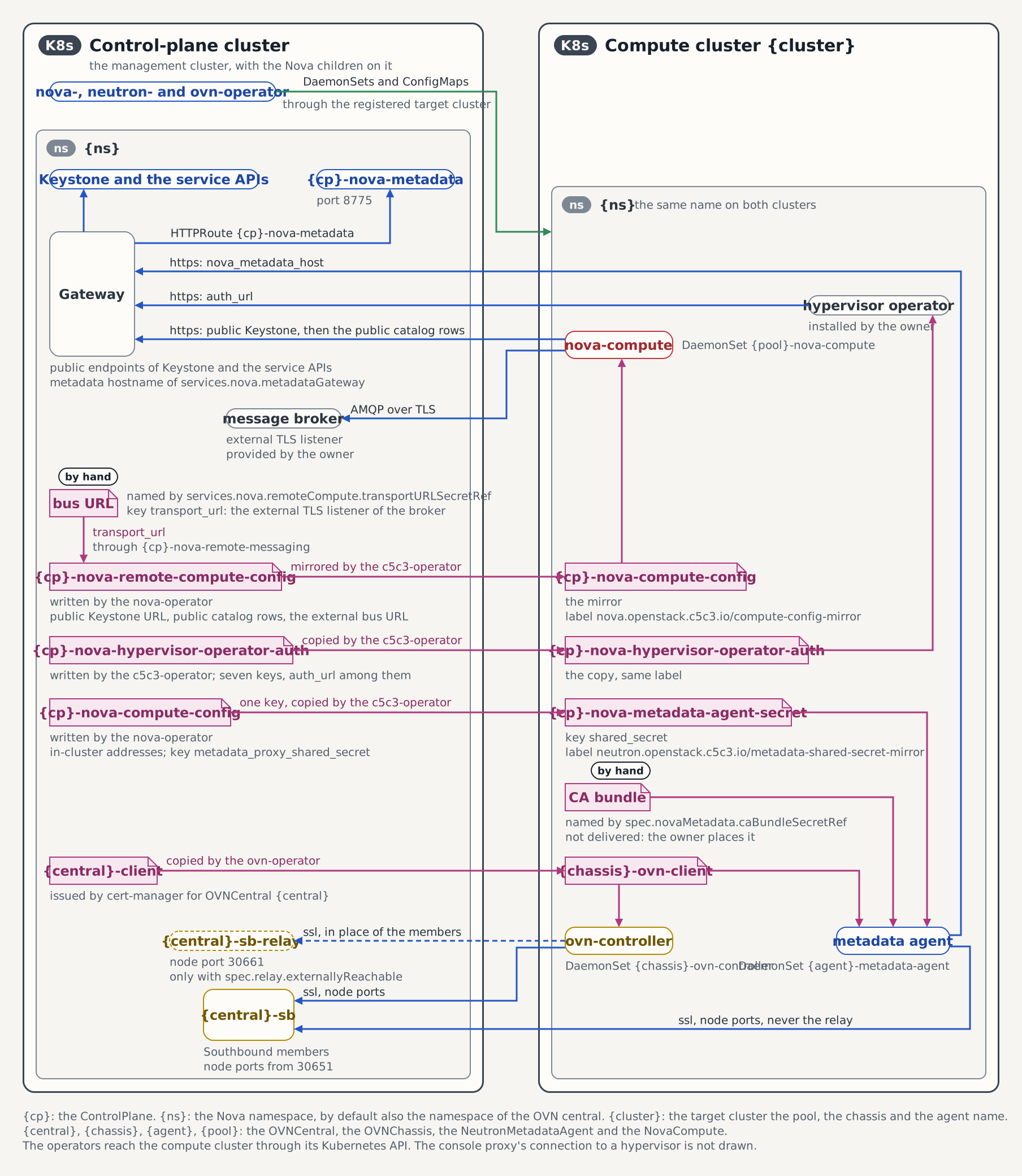
The remote contract carries the same six keys. password, metadata_proxy_shared_secret, cell_name and ca.crt hold the same values, and the fragment has the same sections and the same mount path. It differs in four places:
| Difference | In-cluster contract | Remote contract |
|---|---|---|
Every auth_url ([keystone_authtoken], [service_user], [placement], [neutron], [cinder]) and [barbican] auth_endpoint | spec.keystoneEndpoint | spec.remoteCompute.keystoneEndpoint |
| The catalog row each client section resolves | valid_interfaces = internal, catalog_info = block-storage:cinder:internalURL, barbican_endpoint_type = internal | valid_interfaces = public, catalog_info = block-storage:cinder:publicURL, barbican_endpoint_type = public |
| Override keys | endpoint_override, endpoint_template and barbican_endpoint from spec.endpoints | none: an override names an address the control-plane pods dial |
transport_url | the URL the control-plane pods use | the value of spec.remoteCompute.transportURLSecretRef |
www_authenticate_uri, [oslo_messaging_rabbit], [vnc] and [upgrade_levels] are the same in both documents.
A missing transport URL Secret, or an empty key in it, sets ComputeConfigReady=False under WaitingForRemoteTransportURL with a message prefixed spec.remoteCompute.transportURLSecretRef:. That wait does not stop the pipeline, because the remote contract is an output only a compute reads, and a remote Secret published earlier stays as it was. A URL whose scheme is not rabbit is an error (ComputeConfigError), which does halt the steps behind the ComputeConfig step until the Secret is fixed. The error names the scheme and never the URL, which carries the broker password. Removing spec.remoteCompute deletes the remote Secret, unless a same-named Secret is not this Nova's, and clears the status reference.
Network policy
While spec.networkPolicy is set, one NetworkPolicy covers every pod of the CR. Its selector carries no component key, so the five Deployments and the Job pods are all subject to it: they read the same two schemas, publish on the same broker and call the same siblings, so splitting the egress set per component would duplicate every rule and let the copies drift.
Ingress is a single rule over TCP 8774, 8775 and 6080. Its peers are the declared spec.networkPolicy.ingress sources, then one peer per namespace a Gateway fronts one of the three front ends from (deduplicated, since one Gateway commonly carries all three routes, and without the console gateway while the proxy is disabled, since no route fronts it then), then the operator's own namespace so its health check can reach the API.
Egress is auto-derived in a fixed order:
- DNS.
- The
spec.apiDatabaseport, then thespec.databaseport. Each block carries its own connection parameters and may sit on a different MariaDB, so each contributes a rule. - The cache port, when the cache block yields one.
- The
spec.keystoneEndpointport. Port-only, with the destination unrestricted, like the database and cache rules. - One rule holding the ports of the siblings Nova calls as a client.
- The broker port of the resolved transport URL. It is omitted while the messaging step has not materialised a URL yet.
- Everything in
spec.networkPolicy.additionalEgress, appended last.
The remote transport URL contributes no rule: only a compute on another cluster dials it, never a pod of this CR, so the broker rule keeps the port of the in-cluster URL.
The sibling rule reads only the port off each endpoint. A block that pins an override contributes that URL's port; a block that pins none contributes the conventional port of that service, because Nova then resolves the address from the Keystone catalog and the operator has no way to read it.
| Sibling | Port used without an override |
|---|---|
| Placement | 8778 |
| Neutron | 9696 |
| Glance | 9292 |
| Cinder | 8776, only while spec.endpoints.cinder.enabled |
| Barbican | 9311, only while spec.endpoints.barbican.enabled |
The console proxy dials something none of the other pods do: the VNC server of the hypervisor an instance runs on, on a port libvirt picked from 5900 to 65535. While the proxy is enabled, a second NetworkPolicy, {name}-novncproxy, selects the proxy pods alone and opens egress to TCP 5900-65535, port-only because the hypervisors are addressed by whatever the compute registered. It carries no ingress policy type, so the proxy's ingress stays governed by the main policy, and it lives apart from it because policies are additive per pod: on the main policy the range would open for every Nova pod.
Sub-Resource Naming Convention
Operator-managed sub-resources of the API (Deployment, Service, PodDisruptionBudget, HorizontalPodAutoscaler, NetworkPolicy, HTTPRoute) use the bare CR name with no suffix, matching the keystone convention. A Nova named nova in the openstack namespace is therefore reachable in-cluster at nova.openstack.svc.cluster.local:8774, the port every OpenStack client and catalog entry assumes.
The other children carry a suffix:
| Resource | Name | Notes |
|---|---|---|
| Metadata Deployment / Service | {name}-metadata | Port 8775; the Neutron metadata agent of every compute node dials this Service, so the name is part of the deployment's contract with Neutron |
| Scheduler Deployment | {name}-scheduler | No Service: the process takes its work off the bus |
| Conductor Deployment | {name}-conductor | No Service, same reason |
| Console proxy Deployment / Service | {name}-novncproxy | Port 6080, named after the process the image ships |
| Console proxy NetworkPolicy | {name}-novncproxy | The proxy's VNC egress, only while spec.networkPolicy is set and the proxy is enabled |
| Console HTTPRoute | {name}-console | Named after what it exposes, not after the process behind it |
| Metadata HTTPRoute | {name}-metadata | Only while spec.metadata.gateway is set |
| Config ConfigMap | {name}-config-<hash> | Immutable, content-hashed nova.conf and the four role overlays; 3 historical retained |
| API DB-connection Secret | {name}-api-db-connection | Derived pymysql DSN of the nova_api schema, stable name |
| Cell DB-connection Secret | {name}-db-connection | Derived pymysql DSN of the cell schema, stable name |
| Transport-URL Secret | {name}-transport-url | Derived rabbit:// URL, stable name |
| Compute-contract Secret | {name}-compute-config | Stable name, updated in place |
| Remote compute-contract Secret | {name}-remote-compute-config | Only while spec.remoteCompute is set; stable name, updated in place |
| DB-sync Job | {name}-db-sync | Both schema migrations and the cell mapping |
| Upgrade Jobs | {name}-db-expand, {name}-db-migrate, {name}-db-contract | The three release-upgrade phases |
| DB-archive CronJob | {name}-db-archive | nova-manage db archive_deleted_rows |
MariaDB Database / User / Grant | {name}-api | The nova_api schema, managed mode only |
MariaDB Database / User / Grant | {name} | The cell schema, managed mode only |
MariaDB Database / Grant | {name}-{database}-cell0 | cell0, an additional schema on the cell block's user, so it gets no User of its own. The object name is the SQL name {database}_cell0 lowercased with _ mapped to -, so a Nova named nova with spec.database.database: nova derives nova-nova-cell0 |
Two names are contracts with nova rather than with Kubernetes. The single real cell is mapped as cell1, which the compute contract publishes under cell_name and status.cells reports beside cell0. The holding pen's schema is {database}_cell0, derived rather than configured: nova-manage maps it by convention, and both names are provisioned on the same block's user, because nova-api reads cell0 on every instance list and a user without it turns a routine list into an error.
metadata.name is capped at 41 characters, which is what the 52-character CronJob cap leaves once -db-archive is appended. It must not end in -api, -metadata, -scheduler, -conductor, -novncproxy or -console: the Nova named by the rest of the name builds children under exactly that name. Nor may it end in -cell0, the suffix of every cell0 Database and Grant.
The pod-template annotations follow the same convention under the nova.c5c3.io/ prefix: api-db-connection-hash, db-connection-hash, authtoken-hash and transport-url-hash on every workload, metadata-secret-hash on the metadata pods, and installed-release on every role but the API. See Environment overrides for what each digests.
Example
apiVersion: nova.openstack.c5c3.io/v1alpha1
kind: Nova
metadata:
  name: nova
  namespace: openstack
spec:
  openStackRelease: "2026.1"
  image:
    repository: ghcr.io/c5c3/nova
    tag: "2026.1"
  apiDatabase:
    clusterRef:
      name: openstack-mariadb
    database: nova_api
    secretRef:
      name: nova-api-db
  database:
    clusterRef:
      name: openstack-mariadb
    database: nova
    secretRef:
      name: nova-db
  cache:
    clusterRef:
      name: openstack-memcached
  messaging:
    clusterRef:
      name: openstack-rabbitmq
  keystoneEndpoint: http://keystone.openstack.svc.cluster.local:5000/v3
  serviceUser:
    secretRef:
      name: nova-keystone
  metadata:
    sharedSecretRef:
      name: nova-metadata-secret
  consoleProxy:
    gateway:
      hostname: console.example.com
      parentRef:
        name: openstack-gw
Chainsaw E2E Tests
The rejection corpus lives in tests/e2e/nova/invalid-cr, generated by its _generate.py: the release pattern and the release floor, the image and database and cache and messaging union rules, the messaging TLS rule, the archive and scheduler bounds, the two cross-database rules, the cell0 name rules, both extraConfig guards, the two metadata.name rules, the two empty-name reference rules (spec.metadata.sharedSecretRef, spec.targetClusterRef), the region control-character rule, the URL fields, the console gateway path, the two spec.remoteCompute rules (the messaging.tls requirement and the https pattern of its keystoneEndpoint, with and without a scheme), and the verticalAutoscaling rules. The functional suites that reconcile a Nova to Ready are described in Nova E2E Test Suites.