Nova Cells
Reference documentation for the cells a Nova CR maps: what the two cells hold, how their mapping rows reach a database without storing a password, how a compute host is mapped into a cell and out of it again, and why one CR maps a single real cell. The command sequence that writes the mappings is described under The cells sequence, and the two database blocks behind them under Design decisions.
The commands on this page use the names of the ControlPlane quick start: the projected Nova controlplane-nova in openstack.
Two cells per CR
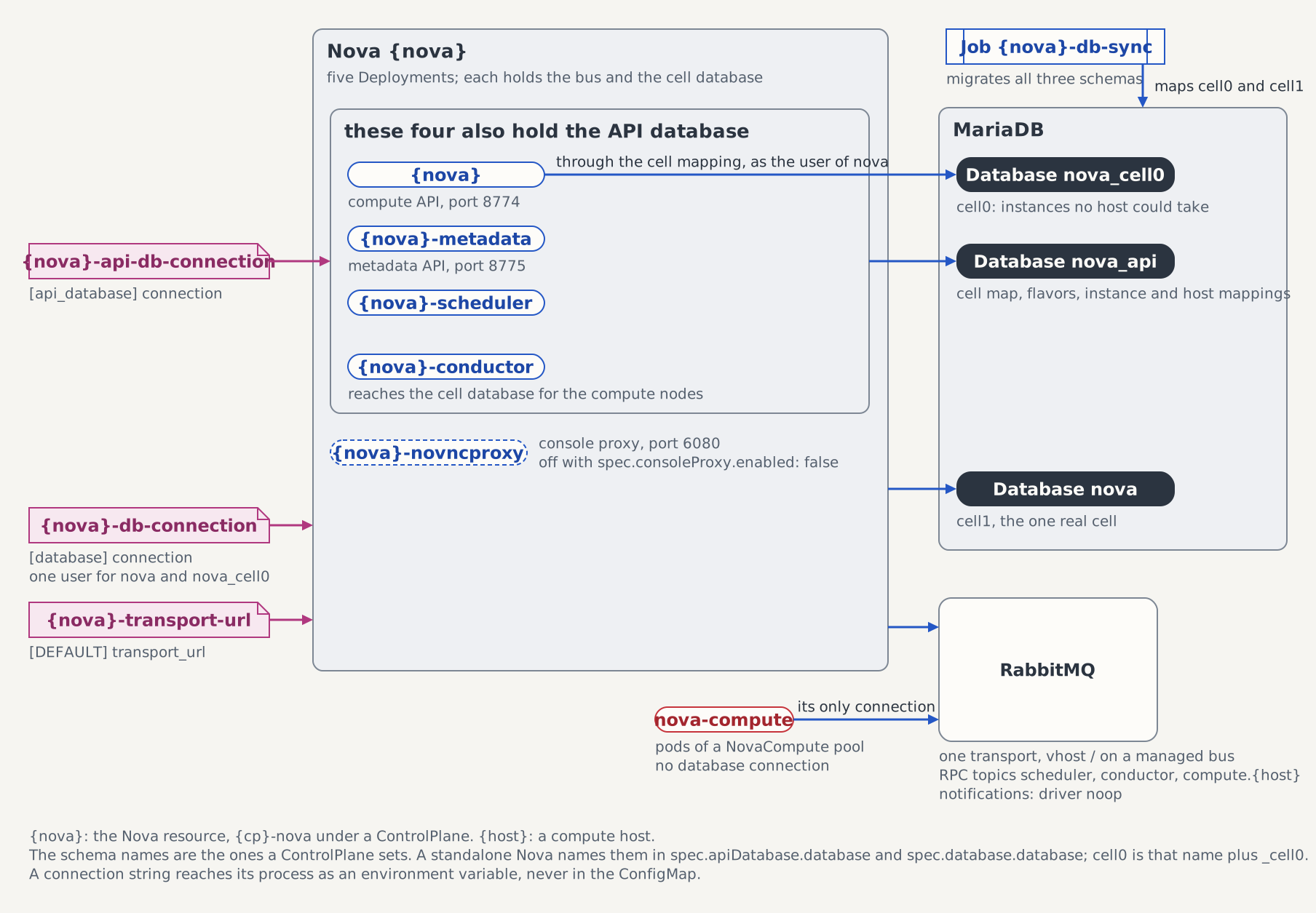
nova splits its state in two. The nova_api schema (spec.apiDatabase) holds the global tables: the cell map, the flavors, one mapping row per instance and one per compute host. Each cell has a schema of its own for the instances placed in it. A Nova CR maps two cells:
| Cell | Schema | What it holds |
|---|---|---|
cell0 | {database}_cell0, derived from spec.database.database | The holding pen for instances that failed scheduling. An instance no host could take is recorded here in ERROR, so it can still be listed and deleted |
cell1 | spec.database.database | The one real cell. Every compute host is mapped into it, and the compute contract publishes its name under cell_name |
Both schemas are reached with the cell block's one user, because nova-api reads cell0 on every instance list. The {name}-db-sync Job maps the two cells and reports their UUIDs; the eight commands it runs, and the guard that keeps a rerun from mapping cell1 twice, are listed under The cells sequence.
The figure shows the three schemas with the processes that hold a connection to each.
Template URLs
A cell mapping row stores the transport URL and the database connection nova uses to reach that cell. The operator writes both as templates:
{scheme}://{username}:{password}@{hostname}:{port}/{path}?{query}
{scheme}://{username}:{password}@{hostname}:{port}/<schema>?{query}
A process that loads a mapping fills the placeholders from its own [DEFAULT] transport_url and [database] connection, so the stored rows carry no credential. Every control-plane process and Job that formats a mapping therefore needs [database], including the ones whose own work is on nova_api. The console proxy sits at the other end: it gets [database] only, with no nova_api connection, because it reads console tokens out of the cell schema. Environment overrides lists which role carries which override.
Rotation follows from the templates. A rotated database or broker credential needs no nova-manage cell_v2 update_cell: the connection-hash annotations (nova.c5c3.io/api-db-connection-hash, nova.c5c3.io/db-connection-hash, nova.c5c3.io/transport-url-hash) roll every role, and the restarted processes expand the unchanged rows with the new values.
list_cells --verbose prints database and broker credentials
nova-manage cell_v2 list_cells --verbose is documented upstream as "Show sensitive details, such as passwords". With template mappings it prints the expanded URLs, so the output carries the database password and the broker password of the process it runs in. The plain list_cells prints the same URLs with the passwords masked; use it, and keep --verbose out of scripts, tickets and support bundles.
Reading the cells back
nova generates a cell's UUID when it maps the cell, and every per-cell nova-manage cell_v2 command addresses a cell by that UUID. The operator reads the UUIDs off the db-sync Job and publishes them in status.cells, cell0 first:
kubectl get nova controlplane-nova -n openstack -o jsonpath='{.status.cells}'The same list, read through nova itself, comes from the conductor, which carries both database connections:
kubectl exec -n openstack deploy/controlplane-nova-conductor -c conductor -- \
  nova-manage --config-dir /etc/nova/nova.conf.d cell_v2 list_cells
Host discovery
A nova-compute registers its service record in the cell database when it starts. The scheduler places an instance only on a host that also has a host mapping in the nova_api schema, and discovery is the step that writes one.
The operator renders [scheduler] discover_hosts_in_cells_interval = 300, so discovery runs as a scheduler periodic every 300 seconds. With more than one scheduler replica, the live scheduler whose host name sorts first runs it and the others skip the pass. Every replica registers under its pod name, so that is the lowest-named scheduler pod that reports up. A new compute is therefore mapped within 300 seconds of registering.
A NovaCompute node pool does not wait for the periodic. As soon as it sees a node whose service is registered and whose host is not mapped, it runs the same discovery in the Job <nova>-discover-hosts and looks again every 10 seconds, so a pool's host is mapped within about a minute of registering. The pool keeps such a node Pending and reports Ready only once the host is mapped (see Reaching Nova). The periodic still covers a compute without a pool.
A consumer that polls for the mapping adds its own interval on top. openstack-hypervisor-operator polls every 60 seconds, so it sees a newly registered compute as mapped within 360 seconds.
A reader who does not want to wait runs the discovery by hand in the conductor pod:
kubectl exec -n openstack deploy/controlplane-nova-conductor -c conductor -- \
  nova-manage --config-dir /etc/nova/nova.conf.d cell_v2 discover_hosts --verbose
--verbose names the hosts it mapped. Discovery is idempotent: a host that already has its mapping is skipped. It only maps a compute that has registered, so a run issued before the compute's service record exists maps nothing.
Unmapping a host
Deleting the compute service through the API unmaps the host:
openstack compute service delete <service-id>At nova 33.0.0 (the 2026.1 image) and 34.0.0 (2026.2) the delete also removes the host's mapping, deletes its resource provider in Placement with a cascade, and takes the host out of every aggregate it belongs to. It is refused with a conflict while the host still carries instances, or while a migration involving it is in progress. Delete or migrate those first.
A NovaCompute node pool does this delete itself for a node that leaves the pool: once Nova counts no instance on the host and the node's nova-compute pod is gone, it calls DELETE /os-services/{id}, so the host mapping goes with the service (see The drain). A pool maps the hosts of its own nodes through its discovery Job, described in Host discovery.
A service record removed any other way leaves the mapping behind, and a compute registering again under the same name then finds a stale row. Remove it with delete_host, which requires both the cell UUID and the host name:
CELL1="$(kubectl get nova controlplane-nova -n openstack \
  -o jsonpath='{.status.cells[?(@.name=="cell1")].uuid}')"
kubectl exec -n openstack deploy/controlplane-nova-conductor -c conductor -- \
  nova-manage --config-dir /etc/nova/nova.conf.d cell_v2 delete_host \
  --cell_uuid "$CELL1" --host <host>
Sharing a broker
The transport URL the operator derives for a managed bus always names the root vhost /, the vhost the RabbitMQ Cluster Operator grants its default user. Two Nova CRs on one managed broker therefore publish on the same scheduler, conductor and compute.<host> topics, and each one's conductor answers the other's computes.
Give each Nova a vhost of its own. Create the vhost on the broker, grant a broker user permissions on it, store the resulting rabbit:// URL (with an explicit port) in a Secret, and name that Secret in spec.messaging.secretRef, the brownfield form of the messaging block. The e2e suites do the same with the helper tests/e2e/cinder/broker-vhost.sh.
Multi-cell is a non-goal
A Nova CR maps cell0 and one real cell, and there is no NovaCell kind and no third database block. The template URLs are the reason. nova fills every mapping from the one [database] connection the process formatting it carries, so all cells a process can reach share that process's database user. A distinct cell0 user could never be substituted into the cell0 row, and a second real cell on a database of its own could not be reached by the processes that already serve the first.
A second cell would need its own database, its own message bus, its own conductor and its own console proxy, plus a super-conductor split: the conductor that talks to the API layer runs apart from the per-cell conductors that talk to the computes. The shape left open for that is a spec.cells[] list beside a default cell, so the fields a single-cell CR carries today keep describing that default cell. The follow-ups are tracked in meta issue #1014.