Cinder Upgrade Flow
Reference documentation for the Cinder release upgrade: what the operator runs when spec.openStackRelease advances, in which order the block-storage processes move onto the new image, and how to stop an upgrade that is stuck. For the field definitions see Cinder CRD; for the sub-reconciler pipeline and the condition vocabulary see Cinder Reconciler Architecture.
Overview
OpenStack services move a database schema forward under a live API with the expand-migrate-contract pattern. Additive schema work lands first, every process is restarted onto the new code, and only then does the data backfill run against rows the old code no longer writes. The operator walks four phases in a fixed order: Expanding, Migrating, RollingUpdate, Contracting.
The phase machine lives in internal/common/database (upgrade.go) and is shared with Keystone, Glance, Nova and Neutron. Cinder supplies the service-specific parts: the spec.openStackRelease seam, the cinder-manage and cinder-status phase commands, and the DatabaseReady condition every phase reports on. The sibling pages are Glance Upgrade Flow and Keystone Upgrade Flow.
Cinder has no separate expand and contract verbs. cinder-manage db sync is an idempotent alembic upgrade to head, so the expand phase runs the same command the steady state does, and the contract phase runs the online data migrations that backfill what the new schema needs.
Trigger
An upgrade starts when spec.openStackRelease moves one release forward, for example 2026.1 to 2026.2. The release field drives tracking and upgrade detection, while every phase Job and every workload runs spec.image. The image reference is therefore bumped in the same edit, and the operator refuses to advance while the two disagree; see Image and Release Lockstep.
Bumping the image alone, with spec.openStackRelease unchanged, is not an upgrade. It stays on the single-pass sync; see Fresh Installs and Patch Bumps.
Version Format
spec.openStackRelease follows the OpenStack date-based scheme, two releases per year:
| Component | Format | Examples |
|---|---|---|
| Release | YYYY.N where N is 1 or 2 | 2026.1, 2026.2, 2027.1 |
The CRD pattern, the validating webhook, and release.ParseRelease agree on this shape, so a non-cadence minor such as 2025.9 is rejected at admission.
Accepted Transitions
IsSequentialUpgrade accepts a single step forward and nothing else. A same-release reconcile is a no-op for the schema; a skip-level jump and a downgrade are both refused:
| From | To | Accepted | Reason |
|---|---|---|---|
2026.1 | 2026.2 | Yes | Same year, minor +1 |
2026.2 | 2027.1 | Yes | Year +1, minor 2 to minor 1 |
2026.1 | 2027.1 | No | Skip-level (skips 2026.2) |
2026.2 | 2026.1 | No | Downgrade |
Status Fields
Three status fields track the upgrade, all written through the status subresource.
| Field | Type | During an upgrade | Steady state |
|---|---|---|---|
status.installedRelease | string | The release installed before the upgrade began | The currently installed release |
status.targetRelease | string | The release being upgraded to | Empty ("") |
status.upgradePhase | UpgradePhase | The current phase (see below) | Empty ("") |
installedRelease is promoted to targetRelease only after the contract phase completes, so a CR that failed mid-upgrade still reports the release its schema is actually at. targetRelease is set when the upgrade initiates and cleared on completion or abort. upgradePhase takes one of four values while an upgrade is active:
| Value | Meaning |
|---|---|
Expanding | cinder-manage db sync running on the target image |
Migrating | cinder-status upgrade check running on the target image |
RollingUpdate | Waiting for the Deployments to converge on the target image |
Contracting | cinder-manage db online_data_migrations running on the target image |
Phases
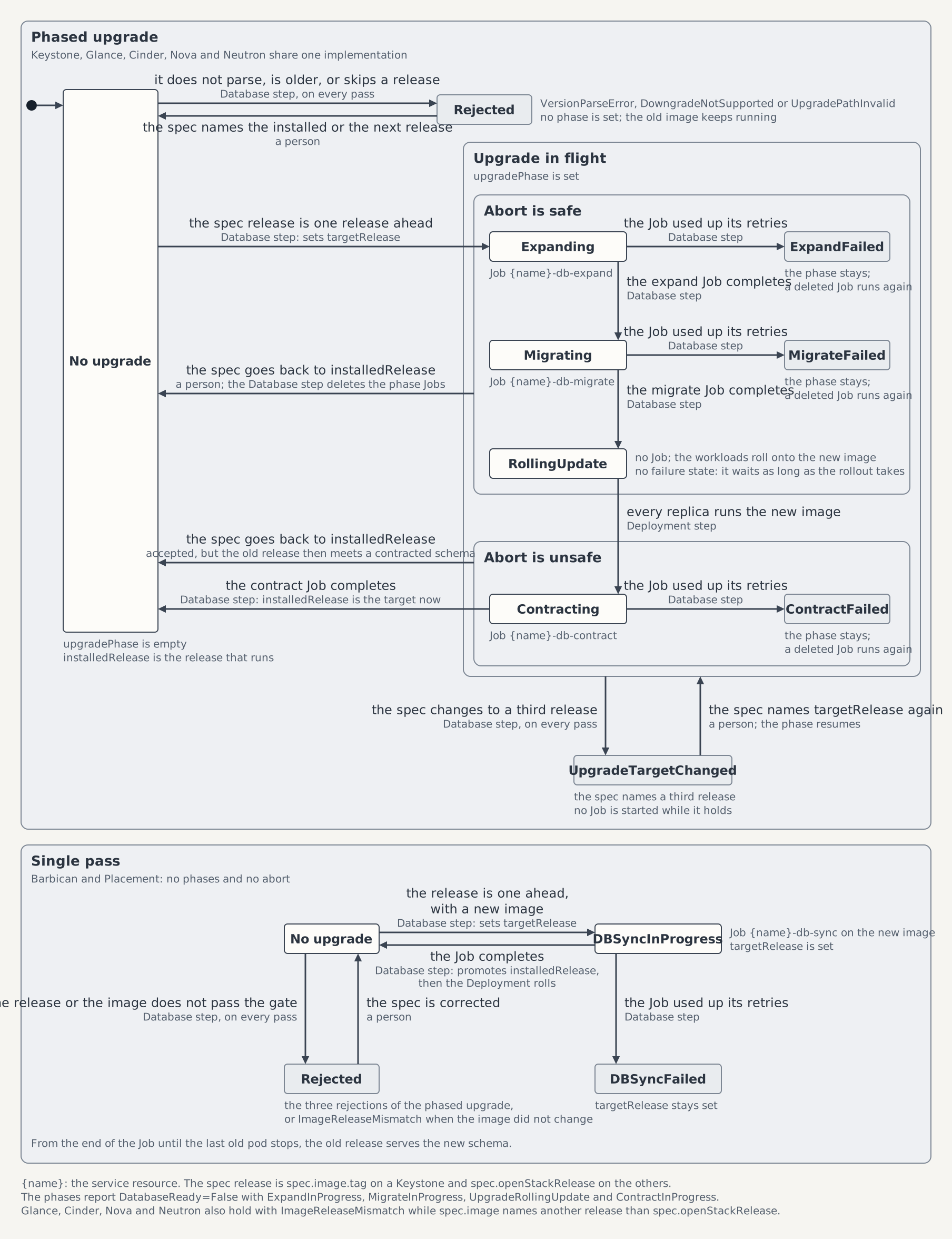
Each transition is driven by a phase Job completing or by every Deployment reporting a finished rollout.
| Phase | What runs | Job |
|---|---|---|
Expanding | cinder-manage --config-dir /etc/cinder/cinder.conf.d db sync on the target image while every service still runs the installed release. Between the cinder 27.0.0 and 28.0.0 trees the alembic revision set is identical, so this pass applies zero schema revisions | <cinder>-db-expand |
Migrating | cinder-status --config-dir /etc/cinder/cinder.conf.d upgrade check inside a tolerant wrapper. The wrapper writes cinder-status upgrade check exit <rc> to the pod's termination message and exits 0 for rc 0, 1 and 2, so no severity the check reports can wedge the Job; anything else fails with its own code | <cinder>-db-migrate |
RollingUpdate | No Job. The four workloads roll in the order scheduler → volume → backup → api, because that is the order the pipeline ensures them in, and each step is gated on its own rollout before the next one runs: <cinder>-scheduler, then every <cinder>-volume-<name>, then <cinder>-backup, then the API <cinder> | — |
Contracting | cinder-manage --config-dir /etc/cinder/cinder.conf.d db online_data_migrations, which exits 0 or 2 and never 1: without --max_count it loops in batches until a pass migrates nothing, so the "work remains" exit code is unreachable. The only online migration at these tags is remove_temporary_admin_metadata_data_migration | <cinder>-db-contract |
Every phase Job runs spec.image, the target-release image, with backoffLimit: 4. The gate during RollingUpdate is stricter than steady-state readiness: a Deployment counts as rolled out only once every replica is updated, ready and counted, because the surge-tolerant readiness signal turns true while old-image pods still serve, and the contract phase would then run migrations those pods have no code for.
The figure draws the same four phases with what the table leaves out: the gate in front of them, the state a failed Job leaves, the hold on a changed target, and the abort.
The second roll
Promoting installedRelease changes the cinder.c5c3.io/installed-release pod annotation the scheduler, the volume services and the backup service carry, so those three roll a second time after Contracting. Each caches the RPC version its peers announced at startup, and that cache pins the wire format for the life of the process. The API carries no such annotation: it rolled last during RollingUpdate and came up holding the new minimum. The mechanism is described under Release upgrade.
The pre-flight checks
cinder-status upgrade check runs seven checks at cinder 28.0.0: Backup Driver Path, Use of Policy File, Removed Drivers, Periodic Interval Use, Service UUIDs, Attachment specs, and Use of Nested Quota Driver. At 27.0.0 an eighth, Windows Driver Path, runs alongside them. Two of them have consequences for how the operator wires the Job.
Use of Policy File locates the configuration through CONF.find_file('cinder.conf') and warns when it finds nothing, so the rendered file the Jobs mount has to carry the name cinder.conf. That is what the ConfigMap data key cinderConfDataKey in operators/cinder/internal/controller/reconcile_config.go sets, and the whole ConfigMap is mounted at /etc/cinder/cinder.conf.d.
Service UUIDs returns a failed check, exit code 2, whenever a single volume row has service_uuid IS NULL. One volume left in error by a failed scheduling attempt is enough. A cluster in that state would otherwise be unable to upgrade at all, which is why the Migrate Job tolerates exit 2 and the operator records UpgradeCheckWarnings instead of wedging the CR in MigrateFailed.
Condition Reasons
Every phase reports through DatabaseReady; the upgrade adds no new condition type. The message carries the source and target release strings.
In progress
| Reason | Phase |
|---|---|
ExpandInProgress | Expanding |
MigrateInProgress | Migrating |
UpgradeRollingUpdate | RollingUpdate |
ContractInProgress | Contracting |
Failure
| Reason | Cause |
|---|---|
VersionParseError | The installed or target release is not a valid YYYY.N string |
DowngradeNotSupported | The target release is older than the installed release |
UpgradePathInvalid | The requested jump is not a single sequential step |
UpgradeTargetChanged | spec.openStackRelease changed to a third value during an active upgrade |
ExpandFailed | The expand phase Job failed permanently |
MigrateFailed | The migrate phase Job failed permanently |
ContractFailed | The contract phase Job failed permanently |
A validation failure and a phase-Job failure both set DatabaseReady=False, emit a Warning event, and return an error, so the controller backs off and retries. Under UpgradeTargetChanged a running upgrade neither advances nor restarts: revert spec.openStackRelease to targetRelease to continue, or to installedRelease to abort.
Events
The upgrade emits these events on the Cinder CR. They are documented with their example messages in Controller Events.
| Type | Reason | Trigger |
|---|---|---|
| Normal | UpgradeInitiated | An accepted release bump starts the upgrade |
| Normal | ExpandComplete | The expand phase Job succeeded |
| Normal | MigrateComplete | The migrate phase Job succeeded |
| Normal | UpgradeCheckCompleted | The upgrade check exited 0, or its exit code could not be read off the pod |
| Warning | UpgradeCheckWarnings | The same check exited 1 or 2; neither wedges the upgrade |
| Normal | DeploymentRolloutComplete | The API Deployment rolled out; the phase flips to Contracting |
| Normal | UpgradeComplete | The contract phase Job succeeded; the upgrade finished |
| Normal | UpgradeAborted | spec.openStackRelease was reverted to the installed release |
| Warning | UpgradeCheckEventEmissionDeferred | Patching the last-observed Job UID annotation failed; the check report moves to the next reconcile |
| Warning | VersionParseError | Unparseable installed or target release |
| Warning | DowngradeNotSupported | Target older than installed |
| Warning | UpgradePathInvalid | Non-sequential jump |
| Warning | UpgradeTargetChanged | Spec target changed mid-upgrade |
| Warning | ExpandFailed | The expand phase Job failed permanently |
| Warning | MigrateFailed | The migrate phase Job failed permanently |
| Warning | ContractFailed | The contract phase Job failed permanently |
The in-progress polling states emit nothing, so a requeue loop does not flood the event stream.
Aborting an Upgrade
Revert spec.openStackRelease to the value in status.installedRelease while an upgrade is active. The operator then:
- Deletes the
<cinder>-db-expand,<cinder>-db-migrate, and<cinder>-db-contractJobs (background propagation removes their Pods too). - Clears
status.upgradePhaseandstatus.targetRelease. - Emits a Normal
UpgradeAbortedevent. - Requeues, so the next reconcile takes the steady-state
db syncpath and restoresDatabaseReadyagainst the installed release.
# Abort an in-flight upgrade by reverting both fields to the installed release.
# Digest-pinned image: drop the "image" key — tag and digest are mutually
# exclusive, and the whole patch is rejected if both are set.
kubectl patch cinder <name> --type=merge \
  -p '{"spec":{"openStackRelease":"<installed-release>","image":{"tag":"<installed-release>"}}}'
Revert spec.image in the same patch. The abort trigger itself needs only the release field — the lockstep guard is skipped while an upgrade is active and spec.openStackRelease has been reverted, which is what keeps a wedged upgrade unstuckable. But the abort clears status.upgradePhase, and with the phase gone the next reconcile is an ordinary one: the guard runs unconditionally there, and a spec.image.tag still naming the target release parks the CR at DatabaseReady=False under ImageReleaseMismatch instead of letting the steady-state db sync run. Reverting the release alone therefore triggers the abort and then stalls on it.
A digest-pinned image, or a tag that does not parse as a release, carries no release string for the guard to compare, so for those the release field is the whole patch — and the Deployments keep running the target image until that digest is rolled back too.
Abort is only safe before the contract phase
Expand and migrate are additive: they add schema elements and read the database without dropping anything the installed release still needs, so the pre-contract schema is a superset both releases run against. Aborting during Expanding, Migrating, or RollingUpdate is therefore safe. The contract phase backfills rows for the new code; aborting during Contracting can leave the installed release reading data it did not write. The operator clears the upgrade state from any phase, so validate the database before relying on a Contracting-phase abort. Once contract completes, reverting the release is a downgrade, which the operator rejects.
Image and Release Lockstep
spec.image and spec.openStackRelease are separate fields so digest pinning stays possible: the release drives tracking and upgrade detection, the phase Jobs and the Deployments run the image. The operator's contract is that the two are bumped together, and for a tag-pinned image the reconciler enforces it. When spec.image.tag parses as an OpenStack release that differs from spec.openStackRelease, DatabaseReady goes False and neither the upgrade nor the steady-state sync advances until the image is bumped. The patch suffix is ignored, so a patched build tagged 2026.1-p1 still matches release 2026.1.
Without the guard, a lone release bump would run the old cinder-manage binary against a schema already at its own head. The Jobs would exit 0 as no-ops and the flow would promote installedRelease to a release the pods neither run nor migrated to. A digest-pinned image, or a tag that does not parse as a release, carries no comparable release string and is trusted to match the declared spec.openStackRelease.
The guard is skipped on one path: while an upgrade is active and spec.openStackRelease has been reverted to installedRelease. That is the abort trigger, and it has to stay reachable while the two fields disagree.
Fresh Installs and Patch Bumps
A fresh install has an empty status.installedRelease. It runs the single <cinder>-db-sync Job, cinder-manage db sync, and sets installedRelease to spec.openStackRelease on success. No phase is entered and no expand, migrate, or contract Job is created.
A change that keeps spec.openStackRelease the same, such as bumping the image to a patch build, is not an upgrade either. The pod-spec-hash gate re-runs the db-sync Job on the new image, cinder-manage db sync applies any pending migrations in one pass, and the Deployments roll without the phase machine.