Infrastructure E2E Deployment
Reference documentation for the infrastructure E2E deployment automation. This feature provides shell-based orchestration to deploy the full infrastructure stack (cert-manager, OpenBao, ESO, MariaDB Operator, Memcached Operator, infrastructure CRs, ExternalSecrets) into a local kind cluster and validate it with Chainsaw E2E tests.
Architecture Overview
Four make targets drive the deployment:
| Target | What it does |
|---|---|
make install-test-deps | Installs chainsaw, kind and kubectl, and flux under WITH_FLUX_CLI=true |
make deploy-infra | Runs the 8-step deployment into the kind cluster |
make e2e | Runs the Chainsaw E2E tests against the cluster |
make teardown-infra | Deletes the kind cluster |
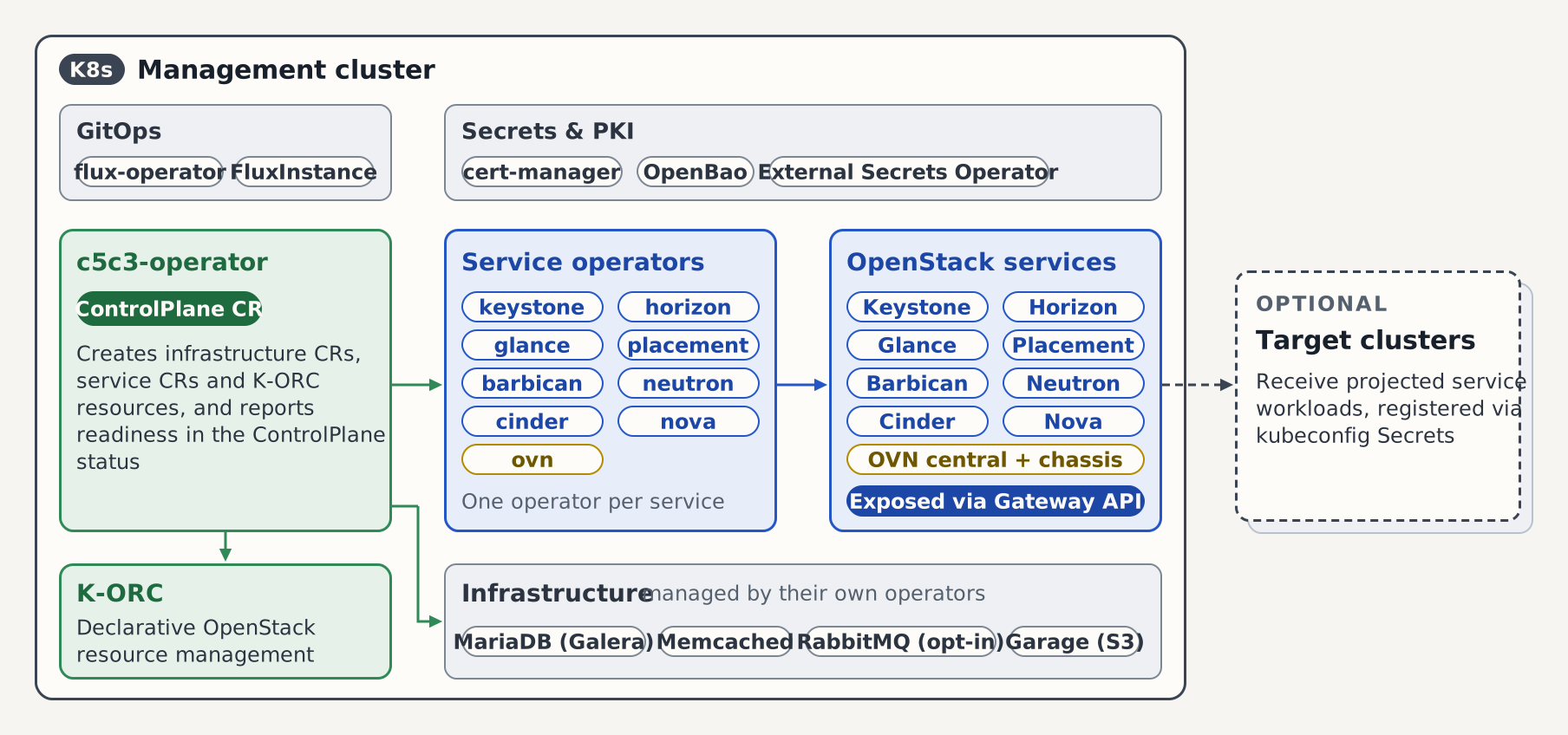
A plain make deploy-infra on kind brings up three groups of the figure: GitOps, Secrets & PKI, and Infrastructure. The releases of all service operators are suspended on kind (deploy/kind/base/kustomization.yaml). WITH_CONTROLPLANE=true un-suspends them and deploys the c5c3-operator and K-ORC, and the OpenStack services appear once a service CR or a ControlPlane is applied.
Prerequisites
| Prerequisite | Details |
|---|---|
| Docker | Running Docker daemon (kind uses Docker containers as nodes) |
| kubectl | Kubernetes CLI for cluster interaction |
| kind | Kubernetes IN Docker for local cluster creation |
| flux | Optional — the Flux CLI is no longer required by make deploy-infra; bootstrap uses flux-operator + FluxInstance. Opt in with WITH_FLUX_CLI=true make install-test-deps for ad-hoc flux logs debugging. |
| chainsaw | Kyverno Chainsaw for E2E test execution |
| jq | JSON processor used by deployment scripts |
make install-test-deps installs chainsaw, kind and kubectl, and flux on request; Docker and jq come from the package manager of the system.
Makefile Targets
make deploy-infra
Deploys the full infrastructure stack to a kind cluster by running hack/deploy-infra.sh. The script executes an 8-step deployment sequence (see Deployment Sequence below). Exits 0 on success, non-zero on any failure with a descriptive error message. EXTERNAL_CLUSTER=true make deploy-infra deploys onto the cluster the current kubeconfig context points at instead, with the deploy/lab/metal-stack/ overlay, and needs neither Docker nor kind (see EXTERNAL_CLUSTER).
make teardown-infra
Deletes the kind cluster by running hack/teardown-infra.sh. Idempotent — succeeds silently if no cluster exists. The kind teardown always exits 0.
EXTERNAL_CLUSTER=true make teardown-infra leaves the cluster in place and removes the stack that EXTERNAL_CLUSTER=true make deploy-infra put on it. It needs kubectl and yq v4.40.1 or newer, checks both before the first delete, and deletes in an order that lets every finalizer run while its controller still exists.
When the overlay has a chaos-mesh/ kustomization (see Lab Chaos Mesh), Chaos Mesh goes first, while chaos-controller-manager, chaos-daemon and the helm-controller still run. The teardown reads the scope of the chaos-mesh.org CRDs and deletes the schedules and workflows, which create experiments, then every other namespaced kind of the group, then its cluster-scoped kinds. The per-pod records podnetworkchaos, podiochaos and podhttpchaos are left out: the controller writes them while it releases a fault, they carry no finalizer, and step 8 removes them with their CRDs. An experiment keeps its finalizer until the controller has released its fault, so a delete that runs out exits 1 with kubectl's error and A Chaos Mesh experiment keeps its finalizer until chaos-controller-manager has released its fault. ..., which names the controller's log and warns that a finalizer removed by hand leaves the fault injected. Then it deletes the render of <overlay>/chaos-mesh without its Namespace: the HelmRepository, the HelmRelease, whose finalizer has the helm-controller uninstall the chart, and the DaemonSet chaos-mesh-modules. The Namespace holds Helm's release Secret, so step 7 deletes it. A CRD read that fails exits 1 with ERROR: cannot read the scope of the cluster's CRDs (kubectl's error is above). before any delete, and a render that fails exits 1 with ERROR: cannot render <overlay>/chaos-mesh (kustomize's error is above). before the overlay delete. The NetworkChaos modules the loader put on the nodes stay until a node reboots.
When the overlay has a dizzy-soak/ kustomization (see Lab dizzy soak), the dizzy soak goes next, before the hypervisors: its servers would keep a NovaCompute from being finalized. The teardown deletes the Job dizzy-soak and the pod dizzy-soak-reader in dizzy in the foreground. The runner gets TERM, dizzy removes the run's servers, volumes, ports and networks, and the runner writes its report, within the pod's grace period of 540 seconds. Then the teardown deletes the render of <overlay>/dizzy-soak: the K-ORC identity of the soak, while K-ORC and Keystone still run, its ServiceAccount, ClusterRole and ClusterRoleBinding, and the claim dizzy-soak-reports with the reports. A delete that runs out exits 1 with kubectl's error before step 0, and a render that fails exits 1 with ERROR: cannot render <overlay>/dizzy-soak (kustomize's error is above). before its delete. Then:
The lab hypervisors, when the overlay has a
hypervisor/kustomization (see Lab hypervisors), while the ControlPlane and every operator still run. Each kind is deleted only where its CRD exists:- the servers, volume backups, volume snapshots and volumes of every project, while Nova and Cinder still answer. For every
ControlPlaneinopenstackthe teardown reads the Secret<cp>-admin-password-cloud, the adminclouds.yamlthe c5c3-operator keeps current, and the image of the Deployment<cp>-nova, the ControlPlane's Nova API, then runs a podteardown-openstack-cleanupinopenstackfrom that image, which ships the openstacksdk, with the Secret under/etc/openstack, and execs a program into it that deletes the servers, then the backups, the snapshots and the volumes, each forced, an attachment left on a volume removed first, and polls each kind until none is left, withinTEARDOWN_TIMEOUTfor the whole run. Every line the program prints is logged, and the pod goes afterwards. A ControlPlane without the Secret, or without the Deployment because it runs no Nova, is logged and skipped. A read that fails exits 1 before anything is deleted; a pod that does not turn Ready in time exits 1 and stays for a look; a run that ends 1 lists what is still present, and the teardown exits 1 once the pod is deleted; - every
NovaCompute,NeutronMetadataAgentandOVNChassisinopenstack. ANovaComputekeeps its finalizernova.openstack.c5c3.io/compute-drainuntil every one of its nodes is released: no server on it, its pod gone and its compute service deleted, so a pool that still holds a server sub-step 1 could not reach outlives the wait: the teardown exits 1 with the delete's error and the lineDelete the servers on the lab hypervisors first (openstack server list --all-projects).; - the
Hypervisor,EvictionandMigrationobjects ofkvm.cloud.sap, which Nodes own and garbage collection therefore never reaps; - the fixtures, when the overlay has
hypervisor-fixtures/. While the K-ORC domainhvo-cc3testexists, it is disabled first and the wait for K-ORC to apply that is bounded byTEARDOWN_TIMEOUT, because Keystone refuses to delete an enabled domain. The delete runs either way, so a rerun after a partial delete still removes the image and the flavor. A read of the domain that fails exits 1 before the delete: K-ORC applies no spec change to a domain that is being deleted, so one deleted while enabled could never be disabled; - the hypervisor overlay, with the two operators, the libvirt DaemonSet and the migration port reservation;
- the
DeploymentandPodDisruptionBudgetmaint-<node>the hypervisor operator leaves inkube-system, for every node. Its lifecycle controller recreates them while it runs, so they go after sub-step 5; - the labels
openstack.c5c3.io/chassis,openstack.c5c3.io/nova-compute-pool,nova.openstack.cloud.sap/virt-driverandcobaltcore.cloud.sap/node-hypervisor-lifecycle, and the annotationsnova.openstack.cloud.sap/custom-traitsandnova.openstack.cloud.sap/aggregates, from every node.
What the hypervisors left on the nodes, under
/var/lib/nova,/var/lib/libvirtand/etc/pki, stays, and so do the reserved ports innet.ipv4.ip_local_reserved_portsuntil a node reboots.- the servers, volume backups, volume snapshots and volumes of every project, while Nova and Cinder still answer. For every
When the
controlplanes.c5c3.ioCRD exists, the orders of the c5c3-operator first, in every namespace: every CR of the groupc5c3.iowhosespec.controlPlaneRefnames a ControlPlane. Those are the eight order kinds the Quick Start (Orders) applies inworkflow. Each keeps children in the ControlPlane's namespace, beside its Secrets, that only the stack can finalize:Order kind Children its teardown removes through the stack KeystoneUserK-ORC User, backup PushSecret KeystoneProjectK-ORC Project KeystoneRoleAssignmentK-ORC RoleAssignment and Role import KeystoneApplicationCredentialK-ORC ApplicationCredentials, backup PushSecret KeystoneCatalogEntryK-ORC Endpoints, Service and Region import KeystoneServiceof a foreign serviceK-ORC User, Project, Role, RoleAssignment, Service, Region and Endpoints MariaDBDatabaseOpenBao database role, ExternalSecret, VaultDynamicSecret, mariadb-operator Database RabbitMQVhostbackup PushSecret, topology operator Permissions, Users and Vhost The teardown reads every namespaced
c5c3.iokind butControlPlane, so an order kind added later is covered without a change. Each order is logged asOrder: <namespace>/<kind>.c5c3.io/<name>, and one delete per namespace, bounded byTEARDOWN_TIMEOUT, removes them. The holds of a user, a project and an assignment wait for the orders that use them. None of the children carries an owner reference to the ControlPlane, so its finalizer leaves them. Deleted after the ControlPlane, they could no longer be finalized: Keystone and theeso-tenant-authServiceAccount are gone, ESO keeps the SecretStoreopenbao-tenant-storewhile a PushSecret withdeletionPolicy: Deletenames it, the wait of step 2 runs out on that store, and step 2 takes MariaDB, OpenBao and the message bus. A CR the ControlPlane owns or labels withc5c3.io/controlplane-name, such as theKeystoneServiceof a service it runs, is its child and is left to its finalizer. ACredentialRotationand aSecretAggregatename no ControlPlane, carry no finalizer and go with their CRDs in step 8. A read of the CRDs or of the orders that fails exits 1 before any delete. Then everyControlPlaneinopenstack, so the c5c3-operator reaps its children. Then everyOVNCentralinopenstack, when theovncentrals.ovn.openstack.c5c3.ioCRD exists: the quick start'scontrolplane-ovnis referenced by the ControlPlane, not owned by it, carries no finalizer, and its database pods would otherwise hold their PVCs through step 4.The infrastructure overlay (
kubectl delete -k <overlay>/infrastructure) and the opt-indeploy/kind/messagingoverlay, while their operators run. The provingOpenBaoClusteropenbao-instanceis switched todeletionPolicy: DeletePVCsfirst. Under the defaultRetainthe openbao-operator strips the owner references of the instance's unseal-key and root-token Secrets before it clears its finalizer, and it is allowed neither: its admission policy denies the patch on the ESO-materialized unseal key, and the tenant RBAC grants no read on the root token. The step ends with a wait, bounded byTEARDOWN_TIMEOUT, until no CR of the stack's namespaced CRDs inopenstackis still being reaped, that is, carries a deletion timestamp or has lost an owner of a stack kind. The ControlPlane delete of step 1 returns when the ControlPlane is gone. Its finalizer deletes the co-located Keystone and waits for it first, so the Keystone and the backup PushSecrets its OpenBao finalizer purges are finalized by then. Garbage collection reaps the other children afterwards (the SecretStore, the dedicated Barbican OpenBao instance), and the Keystone too when the finalizer gave up on it at its deadline; their finalizers need the operators step 3 uninstalls. Without the wait a slow finalizer loses its controller and holds the namespace inTerminating. The base overlay's Gateway and the objects the deploy applies outside the overlays are nobody's children and are left to steps 3 and 7. Onekubectl getreads every kind per pass, and a read that fails counts as objects left, not as an empty namespace.When the overlay has an
nfs/kustomization (see Lab NFS stack), step 2 ends with the NFS stack, while the helm-controller still runs to uninstall its chart. While the HelmReleasekube-system/csi-driver-nfsexists, it first waits, bounded byTEARDOWN_TIMEOUT, until no pod in any namespace mounts an inlinenfs.csi.k8s.iovolume and no PersistentVolume of that driver isBound. The kubelet unmounts such a volume through thecsi-nfs-nodepod, and a pod that garbage collection terminates after that pod is gone stays inTerminatingwith its mount on the node and holds its namespace through step 7. A pod that mounts a share through a claim, as thenfs-healthprobe does, is found by the PersistentVolume its claim binds; the teardown never deletes that namespace. A read of the pods or the PersistentVolumes that fails, or thatyqcannot parse, counts as pods left. Without the release the stack runs no NFS CSI driver, so there is no wait, and the pods and claims of a driver the platform runs are left alone; a read of the release that fails exits 1. A wait that runs out exits 1 withERROR: pods or bound PersistentVolumes still use an nfs.csi.k8s.io volume after <n>s:and one<namespace>/<name>line per pod and onepv/<name> (claim <namespace>/<name>)line per PersistentVolume, before anything of the stack is deleted. Then it deletes<overlay>/nfs: the HelmReleasecsi-driver-nfsinkube-system, whose finalizer has the helm-controller uninstall the chart, the NFS server with its Service and claim, and the DaemonSetnfs-client-modules. The NetworkPolicynfs-server-clientsof<overlay>/nfs/client-policy.yamlfollows the server it guarded, when the overlay ships that file. Last comes theCSIDriverwith the labelshelm.toolkit.fluxcd.io/name=csi-driver-nfsandhelm.toolkit.fluxcd.io/namespace=kube-system, which the helm-controller sets on every object of that release, so aCSIDriverthe platform ships is never named; once the uninstall has finished, the delete finds nothing. The kernel modules the stack's pods loaded stay on the nodes until they reboot.When the overlay has a
ceph/cluster/kustomization (see Lab Ceph), step 2 then removes the lab Ceph withteardown_ceph, while the Rook operator and the helm-controller still run. It rendersceph/cluster/. While the CRDcephclusters.ceph.rook.ioexists and the CephClusterrook-cephanswers, it reads the nodes the Ceph daemons run on, setsspec.cleanupPolicy.confirmationtoyes-really-destroy-dataand marks the CephCluster for deletion without waiting. Rook's pool and client controllers count a CephCluster marked for deletion under that policy as gone and release their CRs without a Ceph command. Then it deletes the render without its CephCluster: the CephClients, the CephBlockPools, the toolbox, the PushSecrets and the ExternalSecrets with their SecretStores, Certificates and ServiceAccounts, and waits for the CephCluster, which Rook deletes once no other Rook CR references it. A delete that runs out exits 1 withThe rook-ceph-operator has to clear the CephCluster's finalizer; .... Rook starts the cleanup Jobscluster-cleanup-job-<node>, labelledrook-ceph-cleanup=true, only after the CephCluster is gone, so the teardown waits, bounded byTEARDOWN_TIMEOUT, until one Job per node of that read has finished, and logs each as<name>: succeeded: <n>. A wait that runs out exits 1 withERROR: the Rook cleanup Jobs in rook-ceph are not done after <n>s:and the Jobs still running, or the number created. The number of nodes is saved on the namespacerook-cephas the annotationteardown.c5c3.io/ceph-nodesbefore the CephCluster is marked, so a rerun that finds the CRD without the CephCluster waits for as many Jobs; without the annotation it waits for the cleanup Jobs that exist. A wait that passes removes the annotation, and a rerun that reads a value other than a decimal count exits 1 before the wait. Then it deletes the PVCs inrook-cephand the render ofceph/without its Namespace, whose HelmRelease finalizer has the helm-controller uninstall the chart. A render that fails exits 1 before the deletes it feeds. The PushSecrets leave the keys in OpenBao, which go with OpenBao's volumes in step 4.The base overlay without its Namespaces and FluxInstance. Every suspended HelmRelease with a release history and every suspended Flux Kustomization with an inventory is resumed first, because Flux neither uninstalls a suspended release nor prunes a suspended Kustomization. The Gateway and GatewayClass go first, while Envoy Gateway clears their finalizer, and the opt-in
kube-prometheus-stackgoes after the rest, in three deletes: its HelmRelease, by the filedeploy/kind/prometheus/release.yaml, whose finalizer has the helm-controller uninstall the chart, then the PVCs inmonitoring, which Helm and the Prometheus Operator leave behind, then the Service and the Endpointskube-prometheus-stack-kubeletinkube-system, which the Prometheus Operator writes for itskubeletjob and no uninstall removes. They run whatever the overlay holds and find nothing on a cluster deployed withoutWITH_PROMETHEUS=true(see Lab Prometheus stack); a release delete that runs out exits 1 before any claim is deleted. When the overlay has adizzy/kustomization (see Lab dizzy stack), the dizzy stack follows, by name: the HelmReleasesdizzy-victoria-metricsanddizzy-grafanaindizzy, whose finalizer has the helm-controller uninstall both charts, then the HelmRepositoriesvictoria-metricsandgrafanainflux-system, then the PVCs indizzy, which Helm leaves behind; the soak's claim went before step 0. Where the default class has the reclaim policyDelete, the VictoriaMetrics volume goes with its claim. A HelmRelease delete that runs out exits 1 before any claim is deleted.The PVCs in
shared-servicesandopenstack. The openbao-operator chart's admission policy denies deleting its managed PVCs until step 3 has uninstalled the chart.The FluxInstance, so the flux-operator uninstalls the toolkit.
The
flux-systemnamespace and the flux-operator's ClusterRoles and ClusterRoleBinding.The namespaces of
deploy/flux-system/namespaces.yaml,envoy-gateway-system,headlamp-system,chaos-mesh,dizzyandrook-ceph. Then every ClusterRole, ClusterRoleBinding, MutatingWebhookConfiguration and ValidatingWebhookConfiguration whose labelhelm.toolkit.fluxcd.io/namespacenames one of these namespaces orflux-system. The helm-controller sets that label, the namespace of the HelmRelease, on every object it renders, hooks included. Helm does not track a hook object as part of its release, so no uninstall removes one:gateway-helm1.9.2 leaves the ClusterRole and the ClusterRoleBindingenvoy-gateway-gateway-helm-certgen:envoy-gateway-systemand the MutatingWebhookConfigurationenvoy-gateway-topology-injector.envoy-gateway-system. The read runs once the namespaces are gone, when no HelmRelease is left to own such an object. Each object is logged asChart leftover: <kind>.<group>/<name>before it is deleted, and a read that fails exits 1 with kubectl's error. Then the Leasescert-manager-cainjector-leader-electionandcert-manager-controllerinkube-system, on which cert-manager's cainjector and controller elect their leader. The chart keeps them outside thecert-managernamespace, so the namespace delete leaves them, and a cainjector deployed within the lease duration waits for the old holder's Lease before it injects the webhook's CA. They go after the namespaces because a cert-manager pod that still runs writes its Lease again.The CRDs of the stack's API groups (the cert-manager, External Secrets, MariaDB, Memcached, OpenBao, Garage, RabbitMQ, Gateway API, Envoy Gateway, Prometheus Operator, CobaltCore, K-ORC, Flux and flux-operator groups,
kvm.cloud.sap, whose CRDs the lab hypervisors' charts install and Helm leaves behind,chaos-mesh.org, whose CRDs the Chaos Mesh chart installs from itscrds/and Helm never deletes, andceph.rook.io,objectbucket.ioandcsi.ceph.io: therook-cephchart marks its CRDshelm.sh/resource-policy: keep, andcsi.ceph.ioholds the one CRDceph/applies for the operator's watch, which its uninstall leaves).
In kube-system it deletes only the maint-<node> objects of step 0, the csi-driver-nfs HelmRelease of step 2 with its chart, the Service and the Endpoints kube-prometheus-stack-kubelet of step 3, and the two cert-manager Leases of step 7. It never names firewall, metallb-system or default, nor a CRD of the platform (autoscaling.k8s.io, cert.gardener.cloud, dns.gardener.cloud, crd.projectcalico.org, metallb.io). Every delete ignores absence, so a second run finds nothing and exits 0. A delete that does not finish within TEARDOWN_TIMEOUT seconds exits 1 with the objects kubectl names, and so does a final count of stack CRDs, stack namespaces or cluster-scoped chart objects above zero. Each chart object still present is logged as Still present: <kind>.<group>/<name>. The teardown selects the chart objects by label and names none of them: the Envoy Gateway release floats inside >=1.9.2 <2.0.0, so Flux can install a chart whose hook objects carry other names.
The startup API check and the Lease delete were run on the metal-stack lab (shoot forge) on 2026-10-03, from commit 36a34e4b. EXTERNAL_CLUSTER=true WITH_CONTROLPLANE=true make deploy-infra exited 0, and kubectl get events -n cert-manager --field-selector involvedObject.name=cert-manager-startupapicheck listed the Job's Completed event. In that deploy cainjector waited 87 seconds for the Lease an earlier stack had left in kube-system, and the cert-manager release was Ready 97 seconds after its pods started. EXTERNAL_CLUSTER=true make teardown-infra exited 0, and kubectl get lease -n kube-system cert-manager-cainjector-leader-election cert-manager-controller answered NotFound for both names. The same deploy, started one second after the teardown's === Done === line, exited 0, and none of its 22 HelmReleases had a Stalled condition with status True. Its cainjector took the Lease on the first attempt, and the cert-manager release was Ready 18 seconds after its pods started.
make install-test-deps
Installs pinned versions of chainsaw, flux, kind, and kubectl by running hack/install-test-deps.sh. Idempotent — skips tools already installed at the correct version. Installs to $INSTALL_DIR (default: ~/.local/bin).
make e2e
Runs all Chainsaw E2E tests: chainsaw test --config tests/e2e/chainsaw-config.yaml tests/e2e/. Produces JUnit XML reports in _output/reports/.
Deployment Sequence
hack/deploy-infra.sh runs eight steps and logs each as === Step n/8: ... ===. The figure shows them with the waits between them, the two cluster modes and the step each opt-in changes. The list under the figure describes every step under its number.
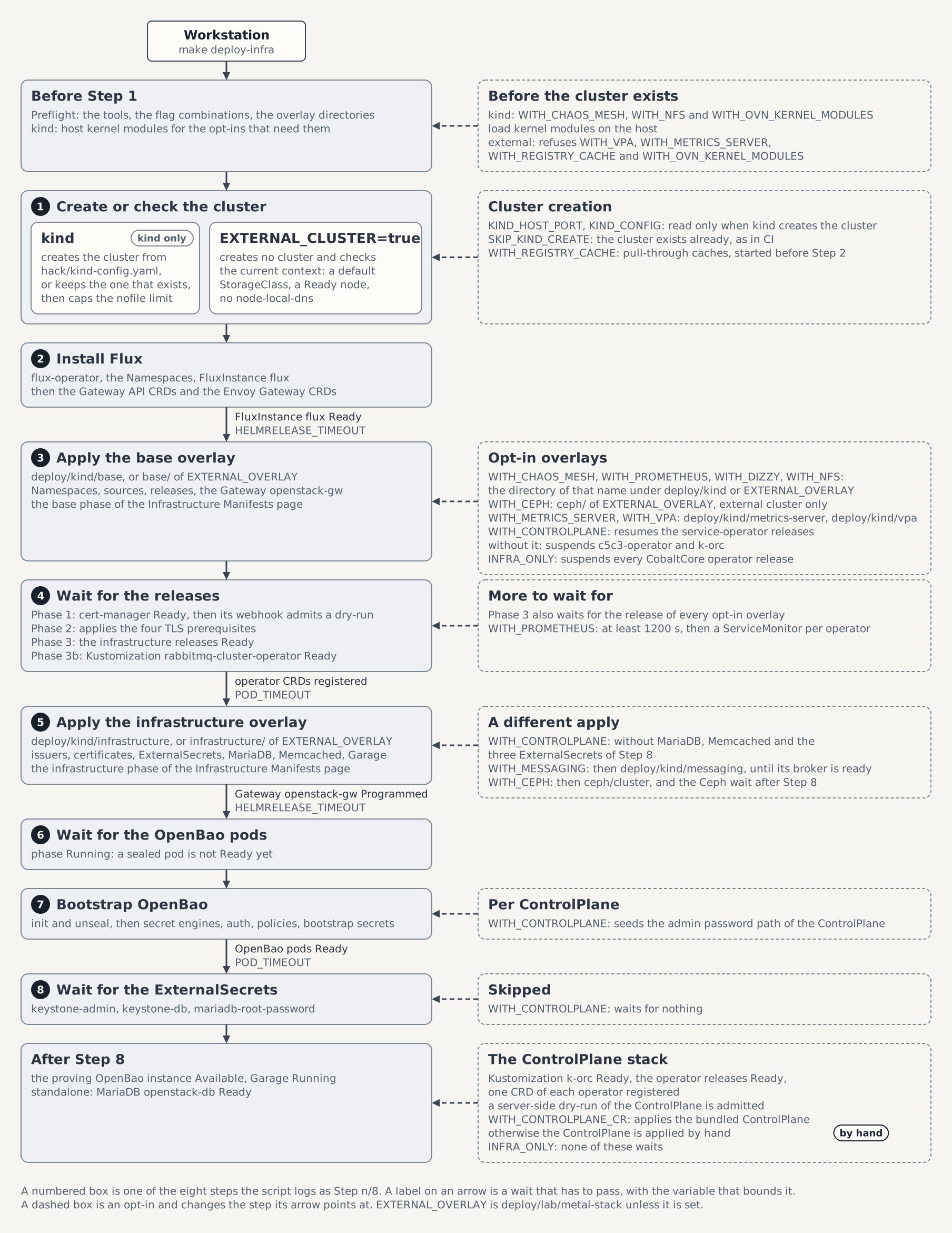
Before Step 1 the script runs its preflight checks: the tools on the PATH (docker, kind, kubectl and jq, under EXTERNAL_CLUSTER=true only kubectl and jq), the flag combinations it refuses, and under EXTERNAL_CLUSTER=true the directories of the overlay. In kind mode it then runs modprobe on the host for WITH_CHAOS_MESH, WITH_OVN_KERNEL_MODULES and WITH_NFS.
- Create or check the cluster. In kind mode the script creates the cluster from
hack/kind-config.yaml, or keeps a cluster of that name, and then caps theRLIMIT_NOFILEof containerd on every node. UnderEXTERNAL_CLUSTER=trueit creates none and checks the current context for a default StorageClass, a Ready node and nonode-local-dnsDaemonSet. UnderWITH_NFS=trueit also checks for noCSIDrivernfs.csi.k8s.ioof another installer and for a node network that holds every node. Before Step 2 the script refuses a cluster deployed before the relocation toshared-services, and underWITH_REGISTRY_CACHE=trueit starts the pull-through caches. - Install Flux.
kubectl apply -fof the flux-operatorinstall.yaml, ofdeploy/flux-system/namespaces.yamland ofdeploy/flux-system/fluxinstance.yaml.wait_for_fluxinstancepolls theReadycondition forHELMRELEASE_TIMEOUTseconds. Two CRD installs follow, each akubectl apply --server-sideof an upstream file:- Install Gateway API standard CRDs, from
standard-install.yamlofGATEWAY_API_VERSION, whose default matchesgo.mod. The keystone-operator watchesHTTPRoute. The install is skipped when all ten standard-channel CRDs of the pinned bundle exist at that version, a newer one or an unversioned one. It never downgrades, and it upgrades a complete set that is older than the pin in place. The bundle also ships thesafe-upgradesValidatingAdmissionPolicy, which denies applying experimental-channel CRDs over the standard channel. - Install Envoy Gateway CRDs (
gateway.envoyproxy.io), fromenvoy-gateway-crds.yamlofENVOY_GATEWAY_VERSION, which stays inside the SemVer range of theenvoy-gatewaychart. The HelmRelease runs withcrds.enabled: false: its bundled CRD copy carries the experimental Gateway API channel, which the policy above refuses. This install is therefore the only owner of the group. It is skipped when all eight CRDs exist, because they carry no version annotation to compare.
- Install Gateway API standard CRDs, from
- Apply the base overlay,
deploy/kind/base/orbase/ofEXTERNAL_OVERLAY: the Namespaces, the Flux sources, the HelmReleases and the two Flux Kustomizations ofdeploy/flux-system/, and what the kind overlay adds, among it theenvoy-gatewayHelmRelease,GatewayClass/envoyandGateway/openstack-gwon port 443. The productiondeploy/flux-system/ships no Gateway, and the lab overlay inherits this one. Still in Step 3:- Each of
WITH_CHAOS_MESH,WITH_PROMETHEUS,WITH_DIZZYandWITH_NFSapplies the directory of its name underdeploy/kind/or underEXTERNAL_OVERLAY.WITH_METRICS_SERVERandWITH_VPAapplydeploy/kind/metrics-serveranddeploy/kind/vpa. UnderEXTERNAL_CLUSTER=truethe script waits for the rollout of the DaemonSetschaos-mesh-modulesandnfs-client-modules, and underWITH_NFS=truein both modes for the rollout ofnfs-server. WITH_CEPH=true, underEXTERNAL_CLUSTER=truealone, appliesceph/ofEXTERNAL_OVERLAY: the Namespacerook-cephand the Rook operator's HelmRepository and HelmRelease.WITH_CONTROLPLANE=truewithCONTROLPLANE_OPERATORS=fluxresumes the nine service-operator HelmReleases. Every other run suspends thec5c3-operatorHelmRelease and thek-orcKustomization with their sources.INFRA_ONLY=truesuspends all ten operator HelmReleases and scales their Deployments to zero.
- Each of
- Wait for the releases, in four phases:
- Phase 1:
cert-manageris Ready (HELMRELEASE_TIMEOUT). Then the cert-manager webhook has to admit a server-side dry-run ofcluster-issuer.yaml(WEBHOOK_TIMEOUT). On an install the startup API check of the release already holds Ready until the webhook admits a request. The dry-run is the script's own gate for an upgrade, which runs no hook, and for an overlay that turns the check off. - Phase 2:
kubectl apply -fof the four TLS prerequisitescluster-issuer.yaml,openbao-ca-issuer.yaml,openbao-tls-cert.yamlanddb-ca-issuer.yamlfromdeploy/flux-system/infrastructure/. OpenBao and MariaDB cannot start without them. - Phase 3:
prometheus-operator-crds,openbao,mariadb-operator-crds,mariadb-operator,external-secrets,memcached-operator,envoy-gateway,garage-operatorandopenbao-operatorare Ready (HELMRELEASE_TIMEOUT), and with them the release of every opt-in overlay of Step 3,rook-cephunderWITH_CEPH=true, whose chart registers the Rook CRDs.WITH_PROMETHEUS=trueraises the wait to at least 1200 seconds. - Phase 3b:
kustomization/rabbitmq-cluster-operatoris Ready. The RabbitMQ Cluster Operator arrives as a Flux Kustomization, which the HelmRelease wait cannot see. This wait fails the run on every cluster, because a ControlPlane projects aRabbitmqClusterforspec.infrastructure.messaging. The script then requires every image inrabbitmq-systemto be pinned by digest. UnderWITH_PROMETHEUS=trueit turns on the ServiceMonitor of the nine service operators.
- Phase 1:
- Apply the infrastructure overlay,
deploy/kind/infrastructure/orinfrastructure/ofEXTERNAL_OVERLAY. The step starts withwait_for_crds(POD_TIMEOUT) on ten operator CRDs:memcacheds,externalsecrets,clustersecretstores,mariadbs,envoyproxies, the three Garage kinds,openbaoclustersandrabbitmqclusters.rabbitmq.com. The overlay holds the ClusterIssuers, the CA certificates, the Gateway certificates thatselfsigned-cluster-issuersigns (the one forkeystone.127-0-0-1.nip.ioamong them), the NodePortEnvoyProxyon 31443, the MariaDB, Memcached and Garage CRs, the provingOpenBaoClusterand the ESO resources. UnderWITH_CONTROLPLANE=truethe script applies the render withoutMariaDB,Memcachedand the three ExternalSecrets of Step 8. UnderWITH_CEPH=trueit then waits for the CRDscephclusters,cephblockpoolsandcephclientsofceph.rook.io(POD_TIMEOUT) and appliesceph/cluster/ofEXTERNAL_OVERLAY. UnderWITH_MESSAGING=trueit then appliesdeploy/kind/messagingand waits forrabbitmqcluster/shared-rabbitmq. The step ends withwait_for_gateway_programmed, which pollsProgrammed=TrueonGateway/openstack-gw(HELMRELEASE_TIMEOUT): the Gateway is programmed only once theEnvoyProxyof this overlay exists. - Wait for the OpenBao pods to reach the phase
Running(POD_TIMEOUT). A sealed pod is not Ready yet. - Bootstrap OpenBao.
openbao_init_unsealinitialises and unseals it.openbao_bootstrapthen runssetup-secret-engines.sh,setup-auth.sh,setup-policies.shandwrite-bootstrap-secrets.shfromdeploy/openbao/bootstrap/. UnderWITH_CONTROLPLANE=truethe last one seeds the paths ofopenstack/<CONTROLPLANE_NAME>. The step ends when the OpenBao pods are Ready (POD_TIMEOUT), and the script asks ESO to validateopenbao-cluster-storeagain. - Wait for the ExternalSecrets
keystone-admin,keystone-dbandmariadb-root-passwordto sync (EXTERNALSECRET_TIMEOUT). The script first provisions the tenant store of theopenstacknamespace withsetup-eso-tenant.sh. UnderWITH_CONTROLPLANE=truethe step waits for nothing: Step 5 left the three out, and the c5c3-operator projects the credentials of each ControlPlane.
After Step 8 the script un-pauses the proving OpenBaoCluster and waits for it to be Available, and it waits for the Garage ExternalSecrets and for garagecluster/garage to reach the phase Running. Under WITH_CEPH=true it then waits up to CEPH_TIMEOUT seconds for the CephCluster rook-ceph to be Ready with HEALTH_OK and one ready OSD per device, and hands the two client keys to openstack through OpenBao: it forces the two SecretStores, the two PushSecrets and the two ExternalSecrets of ceph/cluster/ and waits for each. A standalone run ends when mariadb/openstack-db is Ready.
A run under WITH_CONTROLPLANE=true ends with the ControlPlane admission instead. On the flux path, unless INFRA_ONLY=true, it waits for kustomization/k-orc, for the ten operator HelmReleases (HELMRELEASE_TIMEOUT) and for one CRD per operator (POD_TIMEOUT). Then a server-side dry-run of the ControlPlane manifests has to be admitted or denied by the API server (WEBHOOK_TIMEOUT). Under WITH_CONTROLPLANE_CR=true the script probes the bundled CR and applies it once. Otherwise it probes the render of the overlay's controlplane/ directory, or the kind controlplane.yaml, and prints the command that applies it by hand.
ExternalSecret shims of the kind overlay. The keystone-admin, keystone-db and mariadb-root-password ExternalSecrets of Step 8 come from deploy/kind/infrastructure/, and the lab overlay inherits them. The production base has none of them. The production deploy/eso/ stack ships only the ClusterSecretStore: in a ControlPlane-based deployment the admin password is projected per ControlPlane by the c5c3-operator, and a non-kind Flux MariaDB baseline provides the mariadb-root-password Secret itself.
Why two-phase kustomize? The base kustomization holds Namespaces and resources whose CRDs Step 2 has registered: the Flux sources, the HelmReleases, the two Flux Kustomizations, and on kind the GatewayClass and the Gateway. The infrastructure kustomization holds resources of the operators those releases install (ClusterIssuer, MariaDB CR, Memcached CR). Applying them in two phases prevents kubectl apply failures on fresh clusters where the operator CRDs do not yet exist.
Steps and phases
This page and Infrastructure Manifests count in five ways:
| Term | Where | Means | In the run above |
|---|---|---|---|
| Step 1 to Step 8 | this page, the log of the script | the steps of make deploy-infra | the numbered boxes |
| Phase 1, 2, 3 and 3b | this page, the log of the script | the four parts of the release wait | inside Step 4 |
| base phase and infrastructure phase, "two-phase kustomize" | both pages | the two kustomize applies | Step 3 and Step 5 |
| "Step 1: Apply base resources", "Step 2: Apply infrastructure resources" | Deployment | the same two applies, by hand on deploy/flux-system/ | Step 3 and Step 5 |
| step 0 to step 8, lower case | make teardown-infra | the order of the teardown | not part of the run |
Idempotent Re-runs
Re-running make deploy-infra against an existing cluster converges rather than failing — each step detects the work it already completed and skips it:
- Step 1 skips cluster creation when the kind cluster already exists.
- The containerd nofile cap skips the write, the containerd restart, and the node-Ready wait only when the node's drop-in and the limit the running containerd reports both already match. Checking the drop-in alone would permanently skip a node whose write landed but whose restart failed, leaving containerd uncapped behind a clean-looking deploy.
- Gateway API CRDs are skipped when all ten standard-channel CRDs are present (see the sequence above).
- The kustomize overlays and TLS prerequisites re-apply convergently (
kubectl apply/ upserts). - OpenBao init, unseal, and bootstrap detect completed work: initialized and unsealed checks, enable-if-missing for engines/auth/policies, and write-if-missing for the bootstrap secrets.
- Additional
WITH_*opt-ins on a re-run install only the newly enabled components; the already-deployed ones are left untouched. - Removing a previously enabled flag does not uninstall that component — cleanup is
make teardown-infra's job. WITH_REGISTRY_CACHEneeds a cluster created with the flag; enabling it on a pre-existing cluster leaves the mirrors inert and prints a warning.WITH_CONTROLPLANEon a provisioned standalone stack is a mode change (the ControlPlane owns MariaDB/Memcached), not supported as a re-run — start from a fresh cluster.
Kustomize Overlay Structure
The lab overlay takes the kind overlay as its base, and the kind overlay takes the production manifests. The figure shows that chain and who applies each directory. The table lists every directory under deploy/ that holds a kustomization.yaml, with the bases it lists under resources.
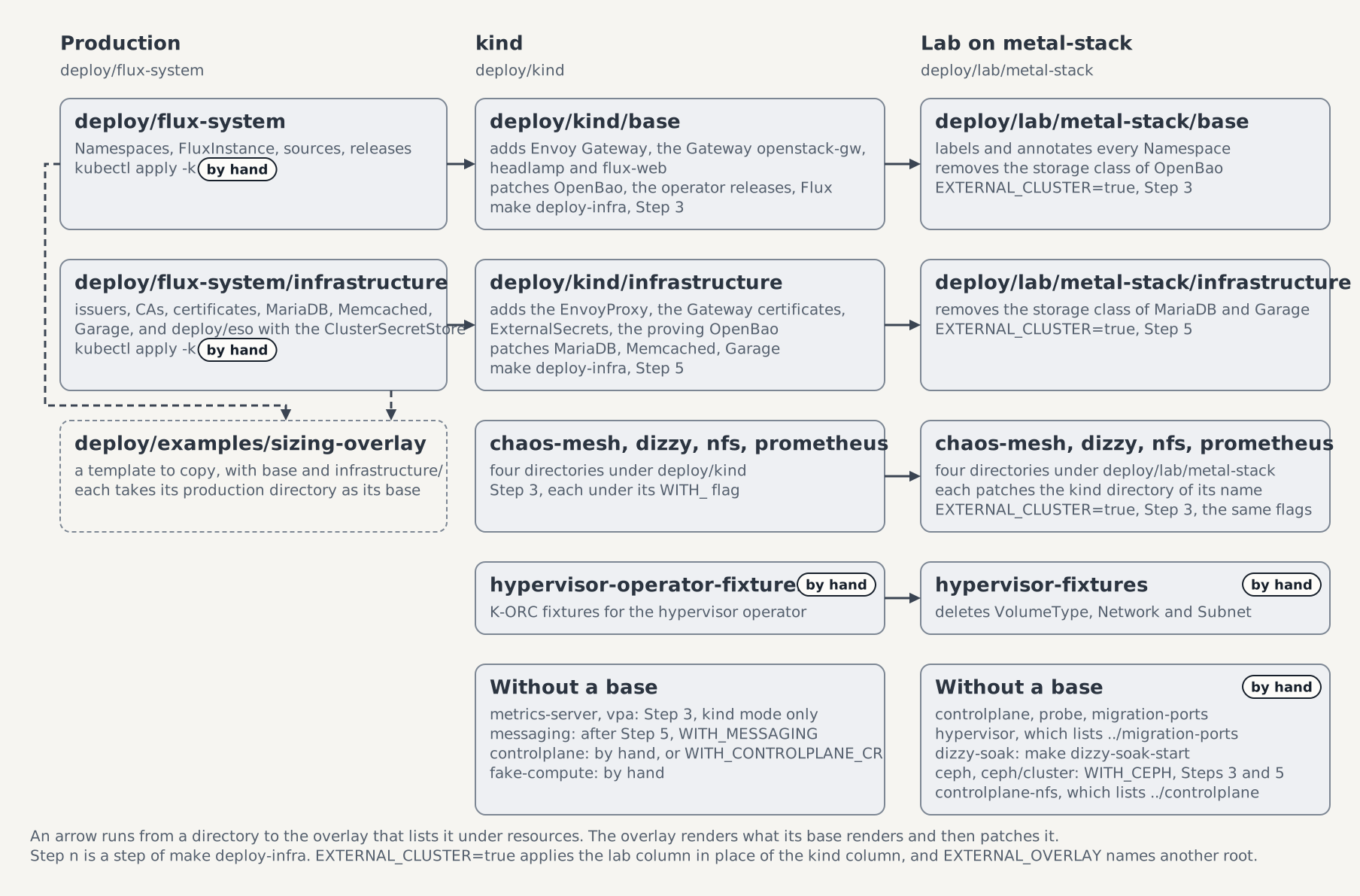
| Directory | Base | Applied by |
|---|---|---|
deploy/flux-system | none | a person, with kubectl apply -k (Deployment) |
deploy/flux-system/infrastructure | deploy/eso | a person, once the operators have installed their CRDs |
deploy/eso | none | nothing on its own |
deploy/examples/sizing-overlay | deploy/flux-system | nothing: a template to copy (Sizing and placement overrides) |
deploy/examples/sizing-overlay/infrastructure | deploy/flux-system/infrastructure | nothing: the second phase of that template |
deploy/kind/base | deploy/flux-system | make deploy-infra, Step 3 |
deploy/kind/infrastructure | deploy/flux-system/infrastructure | make deploy-infra, Step 5 |
deploy/kind/chaos-mesh | none | Step 3 under WITH_CHAOS_MESH=true |
deploy/kind/dizzy | none | Step 3 under WITH_DIZZY=true |
deploy/kind/nfs | none | Step 3 under WITH_NFS=true |
deploy/kind/prometheus | none | Step 3 under WITH_PROMETHEUS=true |
deploy/kind/metrics-server | none | Step 3 under WITH_METRICS_SERVER=true or WITH_VPA=true, in kind mode only |
deploy/kind/vpa | none | Step 3 under WITH_VPA=true, in kind mode only |
deploy/kind/messaging | none | after the apply of Step 5 under WITH_MESSAGING=true, in both cluster modes |
deploy/kind/controlplane | none | a person, as the file controlplane.yaml (Quick Start (ControlPlane)), or the script under WITH_CONTROLPLANE_CR=true |
deploy/kind/fake-compute | none | a person (Run a Fake Compute for Testing) |
deploy/kind/hypervisor-operator-fixtures | none | a person (Connect a Compute Cluster) |
deploy/lab/metal-stack/base | deploy/kind/base | Step 3 under EXTERNAL_CLUSTER=true |
deploy/lab/metal-stack/infrastructure | deploy/kind/infrastructure | Step 5 under EXTERNAL_CLUSTER=true |
deploy/lab/metal-stack/chaos-mesh | deploy/kind/chaos-mesh | Step 3 under EXTERNAL_CLUSTER=true and WITH_CHAOS_MESH=true |
deploy/lab/metal-stack/dizzy | deploy/kind/dizzy | Step 3 under EXTERNAL_CLUSTER=true and WITH_DIZZY=true |
deploy/lab/metal-stack/nfs | deploy/kind/nfs | Step 3 under EXTERNAL_CLUSTER=true and WITH_NFS=true |
deploy/lab/metal-stack/prometheus | deploy/kind/prometheus | Step 3 under EXTERNAL_CLUSTER=true and WITH_PROMETHEUS=true |
deploy/lab/metal-stack/ceph | none | Step 3 under EXTERNAL_CLUSTER=true and WITH_CEPH=true (Lab Ceph) |
deploy/lab/metal-stack/ceph/cluster | none | Step 5 under EXTERNAL_CLUSTER=true and WITH_CEPH=true |
deploy/lab/metal-stack/controlplane | none | a person (Quick Start (metal-stack)) |
deploy/lab/metal-stack/controlplane-nfs | deploy/lab/metal-stack/controlplane | a person, over controlplane/ on a lab deployed with WITH_NFS=true as well (Lab ControlPlane) |
deploy/lab/metal-stack/hypervisor-fixtures | deploy/kind/hypervisor-operator-fixtures | a person, after the ControlPlane |
deploy/lab/metal-stack/hypervisor | deploy/lab/metal-stack/migration-ports | a person, after the ControlPlane |
deploy/lab/metal-stack/migration-ports | none | a person, and as the base of hypervisor/ |
deploy/lab/metal-stack/probe | none | a person (Node probe) |
deploy/lab/metal-stack/dizzy-soak | none | make dizzy-soak-start (Lab dizzy soak) |
The overlays reference the production FluxCD manifests as their base and apply strategic merge patches to reduce resource requirements for a single-node kind cluster. With the ControlPlane on the Minimal sizing profile, the full stack requests at most 4 CPU and 16 GiB of memory, which the node budget gate of the e2e-controlplane job enforces.
Base Overlay Patches (OpenBao)
| Setting | Production | Kind |
|---|---|---|
| Replicas | 3 (HA) | 1 (standalone) |
| HA enabled | true | false |
| Raft config | retry_join with 3 peers | No retry_join (standalone) |
| Storage class | local-path | standard |
| CPU request | 250m | 100m |
Base Overlay Patches (operators and Flux)
| Setting | Production | Kind |
|---|---|---|
Operator HelmReleases (spec.values.replicas) | 2 (chart default) | 1 |
| Flux controllers (CPU request) | 100m (upstream manifests) | 25m, through spec.kustomize.patches on the FluxInstance |
The overlay applies the nine service-operator HelmReleases suspended and the c5c3-operator one active, because the CONTROLPLANE_OPERATORS=flux path relies on it. The patches lower requests and change no limit.
Infrastructure Overlay Patches
MariaDB CR (openstack-db):
| Setting | Production | Kind |
|---|---|---|
| Replicas | 3 | 1 |
| Galera | enabled | disabled |
| MaxScale | enabled | disabled |
| Storage class | ceph-rbd | standard |
| Resources | operator defaults (none) | memory request and limit 1Gi, no CPU |
The memory request takes the single database out of the BestEffort class, which the kernel OOM killer drains first when parallel e2e suites exhaust the memory of the kind node; every service workload already requests between 368Mi and 2064Mi of memory, and no service container carries a default CPU limit. The CPU fields stay unset on purpose: a 500m request left pods Pending on the keystone leg (#970), and a limit would throttle the liveness probe the overlay relaxes.
Memcached CR (openstack-memcached):
| Setting | Production | Kind |
|---|---|---|
| Replicas | 3 | 1 |
cert-manager, mariadb-operator and ESO are not patched — they are single-replica or stateless by default. The memcached-operator release gets one patch, webhook.enabled: false.
Lab Overlay Patches
deploy/lab/metal-stack/
├── base/
│   └── kustomization.yaml          References ../../../kind/base/
│                                    Patches OpenBao HelmRelease → removes the storage class,
│                                    every Namespace → Gardener apiserver-proxy opt-out label
│                                    and chaos-mesh.org/inject annotation
├── ceph/                           The Rook operator (#1344), applied in Step 3 under WITH_CEPH=true
│   ├── kustomization.yaml          Lists the four manifests below; no kind base
│   ├── namespace.yaml              Namespace rook-ceph, privileged, Gardener opt-out label
│   ├── source.yaml                 HelmRepository rook-release in flux-system
│   ├── release.yaml                HelmRelease rook-ceph, chart pinned, CSI off
│   ├── csi-clientprofile-crd.yaml  CRD clientprofiles.csi.ceph.io, which the operator watches without a CSI operator
│   └── cluster/                    The Ceph, applied in Step 5 under WITH_CEPH=true
│       ├── kustomization.yaml      Lists the six manifests below
│       ├── cluster.yaml            CephCluster rook-ceph: one mon, one mgr, nine OSDs on Block claims
│       ├── pools.yaml              CephBlockPools volumes and backups, two replicas
│       ├── clients.yaml            CephClients cinder and cinder-backup, aes keys
│       ├── toolbox.yaml            Deployment rook-ceph-tools, Rook's toolbox
│       ├── keys-push.yaml          PushSecrets of the client keys to OpenBao, in rook-ceph
│       └── keys-pull.yaml          ExternalSecrets of the client keys, in openstack
├── chaos-mesh/                     Chaos Mesh (#1221), applied under WITH_CHAOS_MESH=true
│   ├── kustomization.yaml          References ../../../kind/chaos-mesh/
│   │                                Patches the Namespace → Gardener opt-out label,
│   │                                HelmRelease → enableFilterNamespace: true
│   └── modules-daemonset.yaml      DaemonSet chaos-mesh-modules on every node
├── controlplane/                   The quick start's OVNCentral and ControlPlane CR (#1141), applied by hand
│   ├── kustomization.yaml          Lists the two manifests below
│   ├── ovncentral.yaml             OVNCentral controlplane-ovn, as on the quick-start page
│   └── controlplane-lab.yaml       ControlPlane controlplane with its cinder block on the lab Ceph, plus global_physnet_mtu and hypervisorOperator
├── controlplane-nfs/               The NFS variant of controlplane/, applied by hand in Part 3 of the quick start
│   └── kustomization.yaml          References ../controlplane/; a JSON patch adds nfs1 beside ceph1
├── dizzy/                          The dizzy metrics stack (#1225), applied under WITH_DIZZY=true
│   └── kustomization.yaml          References ../../../kind/dizzy/
│                                    Patches the Namespace → Gardener opt-out label,
│                                    VictoriaMetrics HelmRelease → 10Gi volume, ClusterIP Service
├── dizzy-soak/                     The dizzy soak (#1274), applied by make dizzy-soak-start
│   ├── kustomization.yaml          Lists the three manifests below
│   ├── identity.yaml               K-ORC Domain, Project, User, Role and RoleAssignment of the user dizzy-soak
│   ├── rbac.yaml                   ServiceAccount, read-only ClusterRole and ClusterRoleBinding
│   ├── reports-pvc.yaml            Claim dizzy-soak-reports, 5Gi, no storage class
│   ├── job.yaml                    Job dizzy-soak, outside the kustomization, created by start
│   └── scenario.yaml               dizzy's mix small profile with the lab's names, outside the kustomization
├── hypervisor/                     The two workers as KVM hypervisors (#1142), applied by hand
│   ├── kustomization.yaml          Lists ../migration-ports and the seven manifests below; the apply order and node labels in its header
│   ├── libvirt-ca.yaml             The libvirt migration CA and Issuer nova-hypervisor-agents-ca-issuer
│   ├── libvirt-configmap.yaml      host-prepare.sh, libvirtd.sh, ceph-secret.sh, libvirtd.conf, qemu.conf
│   ├── libvirt-daemonset.yaml      DaemonSet libvirt on the pool's nodes
│   ├── compute.yaml                OVNChassis, NeutronMetadataAgent, NovaCompute
│   ├── sources.yaml                OCIRepository of each chart, digest-pinned
│   ├── hvo-release.yaml            HelmRelease openstack-hypervisor-operator
│   └── kna-release.yaml            HelmRelease kvm-node-agent
├── hypervisor-fixtures/
│   └── kustomization.yaml          References ../../../kind/hypervisor-operator-fixtures/
│                                    Deletes VolumeType, Network and Subnet
├── infrastructure/
│   └── kustomization.yaml          References ../../../kind/infrastructure/
│                                    Patches MariaDB CR, GarageCluster → removes the storage class
├── migration-ports/                The reservation of QEMU's migration ports (#1189), applied by hand
│   ├── kustomization.yaml          Lists the two manifests below
│   ├── namespace.yaml              Namespace hypervisor-system, labelled and annotated like base/
│   └── reservation-daemonset.yaml  DaemonSet migration-port-reservation on every node
├── nfs/                            The NFS server and csi-driver-nfs (#1196), applied under WITH_NFS=true
│   ├── kustomization.yaml          References ../../../kind/nfs/
│   │                                Patches the export claim → 100Gi, no storage class
│   ├── client-modules-daemonset.yaml  DaemonSet nfs-client-modules on every node
│   └── client-policy.yaml          NetworkPolicy template, outside the kustomization:
│                                    only the node network reaches the server on 2049
├── probe/                          Node probe and NFS module load test, applied by hand
│   ├── kustomization.yaml          Lists node-probe.yaml alone
│   ├── node-probe.yaml             Read-only node probe Job (#1139)
│   └── nfs-module-load.yaml        NFS module load test Job (#1194), outside the kustomization
└── prometheus/                     kube-prometheus-stack (#1226), applied under WITH_PROMETHEUS=true
    ├── kustomization.yaml          References ../../../kind/prometheus/
    │                                Deletes the Namespace, patches the HelmRelease →
    │                                four scrape jobs off, 7d on a 10Gi volume, ruleSelector {}, 1Gi/2Gi
    └── hypervisor-operator.json    Grafana dashboard Hypervisor Operator, read by the configMapGenerator
EXTERNAL_CLUSTER=true applies base/ in Step 3 and infrastructure/ in Step 5 in place of the kind overlays, under WITH_NFS=true it applies nfs/ in Step 3 in place of deploy/kind/nfs, under WITH_CHAOS_MESH=true chaos-mesh/ in place of deploy/kind/chaos-mesh, under WITH_DIZZY=true dizzy/ in place of deploy/kind/dizzy, and under WITH_PROMETHEUS=true prometheus/ in place of deploy/kind/prometheus. Each takes its kind overlay as its base, so the lab inherits every patch above. Under WITH_CEPH=true it applies ceph/ in Step 3 and ceph/cluster/ in Step 5; neither has a kind overlay, and the kind mode refuses the flag. It removes the storage class, labels the Namespaces with Gardener's apiserver-proxy opt-out and annotates them for Chaos Mesh, turns on Chaos Mesh's namespace filter, loads the NFS and NetworkChaos kernel modules in pods, keeps the dizzy metrics on a volume behind a ClusterIP Service, leaves the Namespace monitoring to the base, keeps the Prometheus metrics on a volume, turns off four scrape jobs and adds the hvo dashboard. It changes nothing else. The script never applies controlplane/, which the completion hint of WITH_CONTROLPLANE=true names, or controlplane-nfs/, which Part 3 of the quick start applies by hand. Nor does it apply hypervisor/ or hypervisor-fixtures/, which follow the ControlPlane by hand, or dizzy-soak/, which make dizzy-soak-start applies. Every volume of the lab, the proving OpenBaoCluster's, the NFS export claim, the dizzy VictoriaMetrics claim, the soak's report claim, the Prometheus claim and the Ceph's mon and OSD claims included, binds to the cluster's default class, which Step 1 checks exists.
| Setting | Kind | Lab |
|---|---|---|
OpenBao storage class (dataStorage) | standard | the cluster's default class |
| MariaDB storage class | standard | the cluster's default class |
| Garage storage class (metadata and data) | standard | the cluster's default class |
Namespace label apiserver-proxy.networking.gardener.cloud/inject | absent | disable |
Namespace annotation chaos-mesh.org/inject | absent | enabled |
Chaos Mesh namespace filter (controllerManager.enableFilterNamespace) | off | on |
| NetworkChaos kernel modules | modprobe on the host by the deploy script | the DaemonSet chaos-mesh-modules |
NFS export claim (nfs-server-exports) | standard, 5Gi | the cluster's default class, 100Gi |
NFS client modules (nfs, nfsv4) | modprobe on the host by the deploy script | the DaemonSet nfs-client-modules |
| Clients admitted to the NFS server's port 2049 | every pod and node | the node network, by the NetworkPolicy nfs-server-clients |
Namespace dizzy | no label | the label apiserver-proxy.networking.gardener.cloud/inject: disable, no chaos-mesh.org/inject annotation |
VictoriaMetrics Service (dizzy-victoria-metrics-server) | NodePort 30428, mapped to host port 8428 | ClusterIP (headless), reached through kubectl port-forward on local port 8428 |
| VictoriaMetrics storage | emptyDir | the claim server-volume-dizzy-victoria-metrics-server-0, 10Gi on the cluster's default class |
Namespace monitoring | declared by the Prometheus overlay, without labels | not in the render of prometheus/; the base overlay declares, labels and annotates it |
| Prometheus scrape jobs | the chart's defaults | kubeEtcd, kubeScheduler, kubeControllerManager and kubeProxy off: Gardener runs the first three in the seed, and the chart's kube-proxy Service selects no pod of the shoot |
| Prometheus retention | 6h | 7d, bounded by retentionSize: 8GB |
| Prometheus storage | emptyDir | a 10Gi volume claim template on the cluster's default class |
| Prometheus rule selector | release: kube-prometheus-stack | every PrometheusRule (ruleSelectorNilUsesHelmValues: false) |
| Prometheus memory request and limit | 256Mi, 512Mi | 1Gi, 2Gi |
| Grafana dashboards | Keystone Operator | Keystone Operator and Hypervisor Operator |
Rook operator (rook-ceph chart) | none | v1.21.0, pinned, CSI operator off, in the privileged Namespace rook-ceph |
| Ceph image and cluster shape | none | quay.io/ceph/ceph:v20.2.4 by digest; one mon on 10Gi, one mgr, nine OSDs (three per worker) on 100Gi volumeMode: Block claims of the default class |
| Ceph pools and clients | none | volumes and backups at two replicas; client.cinder and client.cinder-backup with rbd caps on their pool and aes keys |
| Ceph key hand-off | none | PushSecrets in rook-ceph to ceph/client-cinder and ceph/client-cinder-backup in OpenBao, ExternalSecrets into openstack/ceph-client-cinder and openstack/ceph-client-cinder-backup |
| Ceph toolbox | none | the Deployment rook-ceph-tools on the cluster's image |
| Everything else | as above | inherited from the kind overlay |
The overlay is described in Infrastructure Manifests.
Environment Variables
The deployment script supports configurable timeouts via environment variables:
| Variable | Default | Description |
|---|---|---|
CLUSTER_NAME | cobaltcore | Kind cluster name |
FLUX_OPERATOR_VERSION | pinned in script | Tag of the flux-operator install.yaml release applied in Step 2; kept in sync by Renovate via a customManager on hack/deploy-infra.sh |
HELMRELEASE_TIMEOUT | 600 | Seconds to wait for HelmReleases Ready (also bounds the wait_for_fluxinstance poll in Step 2) |
POD_TIMEOUT | 300 | Seconds to wait for OpenBao pods Ready |
EXTERNALSECRET_TIMEOUT | 120 | Seconds to wait for ExternalSecrets synced |
CEPH_TIMEOUT | 900 | Seconds wait_for_ceph_cluster waits under WITH_CEPH=true for the CephCluster rook-ceph to be Ready with HEALTH_OK and at least one ready OSD per device. The OSD preparation on block volumes takes minutes, so POD_TIMEOUT is too short. A timeout stops the run with the health details, the conditions and the logs of the OSD prepare pods and the operator |
WEBHOOK_TIMEOUT | 120 | Seconds to wait, after cert-manager is Ready, for its webhook to admit a server-side dry-run of the ClusterIssuer before the Phase-2 TLS prerequisites are applied. Also bounds the second probe, under WITH_CONTROLPLANE=true: the wait for the API server to admit or deny a server-side dry-run of the ControlPlane manifests. Under WITH_CONTROLPLANE_CR=true it probes the bundled CR before its apply; otherwise, on the flux path, it probes the render of the overlay's controlplane/ directory, or the kind controlplane/controlplane.yaml together with the lab's OVNCentral, before the by-hand hint. A timeout stops the run and prints the c5c3-operator and ovn-operator HelmReleases, pods and pod logs |
SKIP_KIND_CREATE | false | Skip kind cluster creation (CI mode where cluster is pre-created) |
KIND_CONFIG | hack/kind-config.yaml | The kind config render_kind_config starts from. Set it to hack/kind-config-multinode.yaml (1 control-plane node + 2 workers) for suites that need more than one schedulable node. Both configs bind the same host ports, so two clusters created from them cannot coexist on one host. A custom config must keep its control-plane node at nodes[0], which is the only node the KIND_HOST_PORT override rewrites. Read only on the run that creates the cluster: with SKIP_KIND_CREATE=true or an existing cluster of that name the value is ignored and the script warns |
OPENBAO_NAMESPACE | shared-services | OpenBao namespace (propagated to the bootstrap scripts, which resolve the same variable in common.sh). The generic NAMESPACE variable is deliberately ignored — chainsaw injects NAMESPACE=<test namespace> into e2e script steps |
INSTALL_DIR | ~/.local/bin | Directory for install-test-deps.sh to install tools |
WITH_CONTROLPLANE | false | When true, the c5c3 ControlPlane provisions MariaDB/Memcached in managed mode: deploy-infra skips the shared MariaDB/Memcached CRs and seeds the per-CR OpenBao admin-password paths instead |
CONTROLPLANE_OPERATORS | flux | How the ControlPlane operator stack is provided (only when WITH_CONTROLPLANE=true). flux deploys the published c5c3-operator chart + K-ORC Flux source, un-suspends the keystone-, horizon-, glance-, placement-, barbican-, ovn-, neutron-, cinder- and nova-operator releases, and pins the self-built operators' :latest images to their current digests via hack/refresh-operator-image-digests.sh (per-operator image-digest ConfigMaps consumed via valuesFrom; re-run with make refresh-operator-digests after a merge). On this path the run fails when the k-orc Kustomization is not Ready within HELMRELEASE_TIMEOUT, because the c5c3-operator cannot start without the K-ORC CRDs; the error prints the state of the k-orc GitRepository and Kustomization. The run then waits for the ten operator HelmReleases (the nine service operators and c5c3-operator) to be Ready within HELMRELEASE_TIMEOUT and for one primary CRD per operator to be registered within POD_TIMEOUT, and fails when either is not; after that it waits up to WEBHOOK_TIMEOUT for the API server to admit a server-side dry-run of the ControlPlane manifests. The two waits, and the probe before the by-hand hint, are skipped under INFRA_ONLY=true, and preflight refuses INFRA_ONLY=true together with WITH_CONTROLPLANE_CR=true, because such a cluster runs no operator to admit the bundled CR. external suspends the Flux stack and expects the operators to be deployed out of band (as the e2e-controlplane CI job does with local dev images + hack/ci-deploy-korc.sh) |
CONTROLPLANE_NAME | controlplane | Name of the ControlPlane CR under WITH_CONTROLPLANE=true; the per-CR OpenBao admin-password bootstrap path derives from it, so it must match the applied CR (the e2e-controlplane job sets controlplane-keystone) |
WITH_OVN_KERNEL_MODULES | false | When true, modprobe openvswitch and geneve on the host before the cluster is created, so the OVN chassis suites find the datapath and tunnel modules in the kernel the kind nodes share. Linux only, and it needs root or passwordless sudo: without either the script logs a warning and continues |
WITH_CHAOS_MESH | false | When true, deploy Chaos Mesh in Step 3 and append chaos-mesh to the Phase 3 HelmRelease wait. In kind mode it first runs modprobe for ip_set, ip_set_hash_ip, ip_set_hash_net, xt_set, sch_netem and sch_tbf on the host before the cluster is created and applies deploy/kind/chaos-mesh. The module load is Linux only and needs root or passwordless sudo: without either the script logs a warning and continues. Under EXTERNAL_CLUSTER=true it loads nothing on the host and applies <overlay>/chaos-mesh instead, whose DaemonSet chaos-mesh-modules loads the modules on the nodes, and waits up to POD_TIMEOUT seconds for that DaemonSet's rollout; a failed wait stops the run with ERROR: DaemonSet chaos-mesh/chaos-mesh-modules did not roll out, ... and the command that reads the loader's log. The overlays are described in Infrastructure Manifests and Lab Chaos Mesh |
WITH_NFS | false | When true, deploy the NFS server in openstack and the csi-driver-nfs mounter in kube-system in Step 3, wait for the nfs-server rollout, and append csi-driver-nfs to the Phase 3 HelmRelease wait. In kind mode it first runs modprobe for nfs and nfsv4, the modules the csi-driver-nfs node plugin mounts with, on the host before the cluster is created and applies the deploy/kind/nfs overlay; the server, NFS-Ganesha, needs no module. The module load is Linux only and needs root or passwordless sudo: without either the script logs a warning and continues. A rollout failure of the server stops the run with ERROR: the NFS server did not roll out. and the commands that read the logs of prepare-exports and nfs-server. Under EXTERNAL_CLUSTER=true it loads nothing on the host and applies <overlay>/nfs instead, whose DaemonSet nfs-client-modules loads the modules on the nodes; it also waits for that DaemonSet's rollout, and a failed wait stops the run with an error naming the log to read. When the overlay ships nfs/client-policy.yaml, it applies that NetworkPolicy before <overlay>/nfs, with the node network of Step 1 in place of the placeholder NODE_NETWORK. The overlays are described in Infrastructure Manifests and Lab NFS stack |
WITH_CEPH | false | Under EXTERNAL_CLUSTER=true only: deploy the lab Ceph. Step 3 applies <overlay>/ceph (the Rook operator), Phase 3 waits for the HelmRelease rook-ceph, Step 5 waits for the Rook CRDs and applies <overlay>/ceph/cluster (the CephCluster, its pools and clients, the toolbox and the key hand-off), and after Step 8 the script waits for the Ceph (CEPH_TIMEOUT) and syncs the two client keys into openstack through OpenBao. Preflight refuses the flag in kind mode, and under EXTERNAL_CLUSTER=true for an overlay without both kustomizations. make teardown-infra removes the Ceph at the end of its step 2. The overlays are described in Lab Ceph |
WITH_DIZZY | false | When true, stage dizzy's three Grafana dashboards into deploy/kind/dizzy/dashboards/ with hack/dizzy.sh stage-dashboards, deploy the dizzy metrics stack (VictoriaMetrics and Grafana) in Step 3, append dizzy-victoria-metrics and dizzy-grafana to the Phase 3 HelmRelease wait, and log the Grafana URL https://dizzy.127-0-0-1.nip.io on the public port. A dashboard download that fails stops the run before the stack is applied. In kind mode it applies deploy/kind/dizzy, whose VictoriaMetrics keeps its metrics in an emptyDir and takes dizzy's OTLP export on NodePort 30428, which hack/kind-config.yaml maps to host port 8428; the script warns when the cluster predates that mapping. Under EXTERNAL_CLUSTER=true it applies <overlay>/dizzy instead, whose VictoriaMetrics keeps its metrics on a 10Gi claim on the cluster's default class behind a ClusterIP Service, calls no docker port, and the completion banner names the kubectl port-forward to VictoriaMetrics on local port 8428 through which EXTERNAL_CLUSTER=true make dizzy-keystone exports, beside Grafana on the Gateway port-forward. The overlays are described in Infrastructure Manifests and Lab dizzy stack |
WITH_PROMETHEUS | false | When true, stage the Keystone Operator dashboard into deploy/kind/prometheus/keystone-operator.json, deploy kube-prometheus-stack (the Prometheus Operator, Prometheus and Grafana) in monitoring in Step 3, append kube-prometheus-stack to the Phase 3 HelmRelease wait and raise that wait to at least 1200 seconds, and then set monitoring.serviceMonitor.enabled=true on the nine service-operator HelmReleases, waiting for each one that is not suspended. In kind mode it applies deploy/kind/prometheus, whose Prometheus keeps 6 hours of metrics in an emptyDir. Under EXTERNAL_CLUSTER=true it applies <overlay>/prometheus instead, and preflight refuses the flag for an overlay without prometheus/kustomization.yaml. The lab's overlay leaves the Namespace monitoring to the base, turns off the scrape jobs of etcd, the scheduler, the controller manager and kube-proxy, keeps 7 days on a 10Gi claim on the cluster's default class, loads every PrometheusRule, and adds the dashboard of openstack-hypervisor-operator. make teardown-infra deletes the release, the PVCs in monitoring and the Service and Endpoints kube-system/kube-prometheus-stack-kubelet in its step 3. The overlays are described in Infrastructure Manifests and Lab Prometheus stack |
WITH_MESSAGING | false | When true, apply the deploy/kind/messaging overlay after Step 5 and wait for rabbitmqcluster/shared-rabbitmq in openstack to report AllReplicasReady. A timeout stops the run and prints the kubectl describe output for the broker plus the events of its server pod. The overlay is described in Infrastructure Manifests. The e2e-controlplane job is the broker's second consumer after the cinder e2e-operator leg: the full-ControlPlane suite takes a vhost of its own through tests/e2e/cinder/broker-vhost.sh and hands the ControlPlane the transport URL of that vhost brownfield |
WITH_REGISTRY_CACHE | false | Local-dev only. When true, bring up one distribution-registry (registry:2) pull-through proxy per upstream registry (docker.io, ghcr.io, registry.k8s.io, quay.io, plus the vanity fronts oci.external-secrets.io and docker-registry3.mariadb.com) on the kind Docker network and wire every node's containerd at them via a certs.d/<host>/hosts.toml mirror, so unmodified image refs are served from a persistent local cache that survives kind delete. The proxy streams and caches inline (fast even on a cold pull). The containerd mirror patch is injected only into the deploy-time kind config, never the checked-in hack/kind-config.yaml, so CI is unaffected. Requires yq. See the Extended Quick Start |
PURGE_REGISTRY_CACHE | false | Consumed by make teardown-infra. When true, also remove the registry pull-through cache containers and their volumes (identified by the cobaltcore.registry-cache=true label). The default leaves them running so the warm cache is reused on the next deploy |
EXTERNAL_CLUSTER | false | When true, deploy onto the cluster the current kubeconfig context points at (the script never switches contexts) with the EXTERNAL_OVERLAY overlays in Steps 3 and 5. Docker and kind are not required. Preflight refuses the four kind-bound opt-ins WITH_VPA, WITH_METRICS_SERVER, WITH_REGISTRY_CACHE and WITH_OVN_KERNEL_MODULES; the messages for WITH_VPA and WITH_METRICS_SERVER name the opt-in fields under spec.sizing of the ControlPlane, since the platform already runs a VPA and serves the metrics API. Preflight accepts WITH_NFS=true only when <overlay>/nfs/kustomization.yaml exists, WITH_CHAOS_MESH=true only when <overlay>/chaos-mesh/kustomization.yaml exists, WITH_DIZZY=true only when <overlay>/dizzy/kustomization.yaml exists, WITH_PROMETHEUS=true only when <overlay>/prometheus/kustomization.yaml exists and WITH_CEPH=true, which the kind mode refuses, only when both <overlay>/ceph/kustomization.yaml and <overlay>/ceph/cluster/kustomization.yaml exist, requires the context's API server to answer, and logs the context and the server URL. Step 1 creates no cluster; it checks for a default StorageClass, for the absence of a node-local-dns DaemonSet in kube-system and for a Ready node, and logs the class and the node names. Under WITH_NFS=true it also refuses a CSIDriver/nfs.csi.k8s.io whose helm.toolkit.fluxcd.io labels do not name the HelmRelease kube-system/csi-driver-nfs: the cluster then runs its own NFS CSI driver, which Step 3 would replace and the HelmRelease would adopt. For an overlay with nfs/client-policy.yaml it then reads the node network from data.nodeNetwork of the ConfigMap kube-system/shoot-info, logs it, and refuses a cluster where that value is missing or no IPv4 CIDR, or where a node has no IPv4 InternalIP inside it. Without WITH_NFS=true, when the ControlPlane of the overlay's controlplane/ (see EXTERNAL_OVERLAY) has a Cinder backend on NFS, it refuses a cluster whose CSIDriver/nfs.csi.k8s.io is missing or does not list the Ephemeral lifecycle mode, and logs the driver's modes: the Cinder pods mount every export as an inline volume of that driver, and only WITH_NFS=true installs it. The nofile cap and the Keystone image preload are skipped. The Gateway is reached through kubectl port-forward on local port 8443, which the completion banner prints, and the bundled ControlPlane CR's publicEndpoint gets :8443. Also consumed by make teardown-infra. Any other value keeps the kind mode |
EXTERNAL_OVERLAY | deploy/lab/metal-stack | Overlay root of EXTERNAL_CLUSTER=true: its base/ and infrastructure/ replace deploy/kind/base and deploy/kind/infrastructure. Relative to the repository root unless absolute. Preflight fails when either kustomization is missing. An overlay may also carry a controlplane/ kustomization, which make deploy-infra names in its WITH_CONTROLPLANE=true completion hint and never applies; while it exists and WITH_CONTROLPLANE_CR is not true, preflight renders it and refuses a failing render, a render with no ControlPlane or more than one, a ControlPlane other than openstack/<CONTROLPLANE_NAME>, the only one Step 7 seeds, and, unless WITH_NFS=true, a ControlPlane with a Cinder backend on the in-cluster NFS server nfs-server.openstack, which only WITH_NFS=true deploys. The server counts under nfs-server.openstack, nfs-server.openstack.svc and nfs-server.openstack.svc.cluster.local, in any case and the last with a trailing dot too. A backend on any other NFS server passes preflight, and Step 1 checks the cluster for the CSI driver it mounts through (see EXTERNAL_CLUSTER). Unless WITH_CEPH=true, preflight also refuses a ControlPlane with a Cinder volume backend or backup target on a monitor of the lab Ceph, which only WITH_CEPH=true deploys: a monitor rook-ceph-mon-<letter> in the namespace rook-ceph, under .rook-ceph, .rook-ceph.svc or .rook-ceph.svc.cluster.local, in any case and the last with a trailing dot too. An entry on any other Ceph passes. The lab's own controlplane/ puts both entries on the lab Ceph, so it needs WITH_CEPH=true. A hypervisor/ kustomization, with hypervisor-fixtures/ beside it, is applied by hand as well; make teardown-infra removes both in its step 0. An optional nfs/ kustomization is what Step 3 applies under WITH_NFS=true in place of deploy/kind/nfs; it has to render the Deployment nfs-server and the DaemonSet nfs-client-modules in openstack and the HelmRelease csi-driver-nfs in kube-system, the three objects the script waits for, and make teardown-infra removes it at the end of its step 2. nfs/ may also ship client-policy.yaml, a NetworkPolicy template outside the kustomization whose placeholder NODE_NETWORK the script replaces with the node network of a Gardener shoot; an overlay for a cluster without the ConfigMap kube-system/shoot-info ships none. An optional chaos-mesh/ kustomization is what Step 3 applies under WITH_CHAOS_MESH=true in place of deploy/kind/chaos-mesh; it has to render the DaemonSet chaos-mesh-modules and the HelmRelease chaos-mesh in chaos-mesh, the two objects the script waits for, and make teardown-infra removes it before its step 0. An optional dizzy/ kustomization is what Step 3 applies under WITH_DIZZY=true in place of deploy/kind/dizzy; it has to render the HelmReleases dizzy-victoria-metrics and dizzy-grafana in dizzy, the two objects the script waits for and make teardown-infra deletes in its step 3, and it takes its dashboards from deploy/kind/dizzy/dashboards/, which Step 3 stages. An optional prometheus/ kustomization is what Step 3 applies under WITH_PROMETHEUS=true in place of deploy/kind/prometheus; it has to render the HelmRelease kube-prometheus-stack in monitoring, the object the script waits for and make teardown-infra deletes in its step 3, and it takes the Keystone dashboard from deploy/kind/prometheus/keystone-operator.json, which Step 3 stages. Optional ceph/ and ceph/cluster/ kustomizations are what Steps 3 and 5 apply under WITH_CEPH=true, with no kind counterpart; ceph/ has to render the HelmRelease rook-ceph in rook-ceph, the object Phase 3 waits for, and ceph/cluster/ the CephCluster rook-ceph with its device set first, the SecretStore openbao-ceph-store in rook-ceph and in openstack, the PushSecrets ceph-client-cinder and ceph-client-cinder-backup in rook-ceph and the ExternalSecrets of the same names in openstack, the objects the script waits for. make teardown-infra removes both at the end of its step 2. Read by make deploy-infra and make teardown-infra |
TEARDOWN_TIMEOUT | 600 | Consumed by make teardown-infra under EXTERNAL_CLUSTER=true: seconds each delete waits for its objects to be gone before the teardown exits 1 |
Example: override HelmRelease timeout:
HELMRELEASE_TIMEOUT=600 make deploy-infraCI Job
The e2e-infra job in .github/workflows/ci.yaml runs only on pull requests (github.event_name == 'pull_request') and only when the e2e-infra path filter of the changes job matches. It depends only on changes — not on the lint or test jobs — so it starts as soon as the path filters are resolved.
Job steps:
- Checkout repository (SHA-pinned
actions/checkout) - Setup Go (SHA-pinned
actions/setup-gowithgo-version-file: go.work) - Create kind cluster (
create-kind-clustercomposite action withhack/kind-config.yaml) - Install Flux CLI (SHA-pinned
fluxcd/flux2/action) - Install test dependencies (
make install-test-deps, adds~/.local/bintoPATH) - Deploy infrastructure stack (
make deploy-infrawithSKIP_KIND_CREATE=true) - Run Chainsaw E2E tests against
tests/e2e/infrastructure/ - Re-run
make deploy-infrawith unchanged parameters (noSKIP_KIND_CREATE, exercises the script's existing-cluster detection) - Re-run the full infrastructure suite (report
chainsaw-report-rerun) to prove the healthy stack is left unchanged - Re-run
make deploy-infrawithWITH_METRICS_SERVER=trueandWITH_NFS=true(additive leg — the script's Phase 3 wait gates the new metrics-server andcsi-driver-nfsHelmReleases on Ready, and its Step 3 rollout wait gatesDeployment/nfs-server). Both opt-ins ride one convergence run:make deploy-infrare-applies every overlay and re-walks all eight steps, so a second additive leg would repeat the base install for onekubectl apply -k deploy/kind/nfs - Assert the additive
WITH_NFSopt-in landed (kubectl get deployment nfs-server -n openstackandkubectl get helmrelease csi-driver-nfs -n kube-system). nfs-health skips when the server is absent, so this is what turns a droppedWITH_NFS: "true"in step 10 into a red leg instead of a green one over an untested stack - Run a scoped Chainsaw suite (report
chainsaw-report-additive) over infra-stack-health, garage-health, flux-web-health, no-prometheus-when-disabled, openbao-instance, and nfs-health, skipping the metrics-server and NFS absence suites it would now rightly fail - Dump diagnostic info on failure (
kubectl get,flux logsfor troubleshooting) - Upload JUnit report as workflow artifact (SHA-pinned
actions/upload-artifact,if: always()) - Delete the kind cluster (
hack/ci-delete-kind-cluster.sh,if: always()) — last, so step 13 still had a cluster to read, and a cluster that survives is a warning rather than a failed job
Configuration:
| Setting | Value |
|---|---|
timeout-minutes | 50 |
permissions | contents: read (inherited from workflow-level) |
concurrency | Cancel-in-progress on PRs (inherited from workflow-level) |
| Action pinning | All uses: references are SHA-pinned with version comments |
Chainsaw E2E Test
File: tests/e2e/infrastructure/infra-stack-health/chainsaw-test.yaml
The test asserts readiness of all deployed components:
| # | Assertion | Namespace | Resource |
|---|---|---|---|
| 1 | cert-manager Deployment ready | cert-manager | Deployment |
| 2 | OpenBao StatefulSet ready | shared-services | StatefulSet |
| 3 | ESO Deployment ready | external-secrets | Deployment |
| 4 | MariaDB Operator Deployment ready | mariadb-system | Deployment |
| 5 | Memcached Operator Deployment ready | memcached-system | Deployment |
| 6 | ClusterIssuer Ready condition | (cluster-scoped) | ClusterIssuer |
| 7 | MariaDB CR Ready condition | openstack | MariaDB |
| 8 | Memcached CR Ready condition | openstack | Memcached |
| 9 | ClusterSecretStore Valid condition | (cluster-scoped) | ClusterSecretStore |
| 10 | ExternalSecrets SecretSynced | openstack | ExternalSecret (x3) |
Assert timeout is ~5 minutes to account for operator startup time.
The e2e-infra job auto-discovers every chainsaw-test.yaml under tests/e2e/infrastructure/, so sibling suites run in the same job with no CI wiring.
File: tests/e2e/infrastructure/garage-health/chainsaw-test.yaml
Covers the Garage object store (the S3 backend for the Glance e2e suites):
| # | Assertion | Namespace | Resource |
|---|---|---|---|
| 1 | garage-operator Deployment ready + HelmRelease Ready | garage-system | Deployment, HelmRelease |
| 2 | Credential ExternalSecrets SecretSynced: garage-admin-token and garage-s3-credentials beside the CRs, plus the retained garage-s3-credentials copy the Glance consumers read | shared-services, openstack | ExternalSecret (x3) |
| 3 | GarageCluster Running; GarageBucket / GarageKey Ready | shared-services | GarageCluster, GarageBucket, GarageKey |
| 4 | S3 put + list with the imported key over path-style HTTP; the probe pod stays in openstack and reaches Garage through garage.shared-services.svc.cluster.local | openstack | script (throwaway aws-cli pod) |
File: tests/e2e/infrastructure/nfs-health/chainsaw-test.yaml
Covers the NFS stack behind WITH_NFS, from the kind overlay or from the metal-stack lab's nfs/ (see Lab NFS stack); against the lab it runs by hand. It skips with a SKIP: line when Deployment/nfs-server is absent, so the default legs pass, and it runs as one script step because chainsaw has no step-level skip:
| # | Assertion | Namespace | Resource |
|---|---|---|---|
| 1 | Presence gate on Deployment/nfs-server (--ignore-not-found, so only a genuine absence skips and a failed lookup fails), then leftover Namespace/nfs-health-probe and the two nfs-health-* PersistentVolumes deleted up front | openstack, (cluster-scoped) | Deployment, Namespace, PersistentVolume |
| 2 | nfs-server rolled out, its container log holds Root fs for export /exports is /exports (otherwise the suite prints the log's FSAL lines), and its EndpointSlices carry at least one address | openstack | Deployment, EndpointSlice |
| 3 | HelmRelease/csi-driver-nfs Ready, DaemonSet/csi-nfs-node with numberReady >= 1, CSIDriver/nfs.csi.k8s.io present | kube-system, (cluster-scoped) | HelmRelease, DaemonSet, CSIDriver |
| 4 | Two static PV/PVC pairs (nfs.csi.k8s.io, nfsvers=4.1,soft,timeo=30,retrans=2) bound at the os-brick mount points /var/lib/cinder/mnt/<md5(share)> and /var/lib/cinder/backup_mount/<md5(share)>, the md5 taken over the share string with no trailing newline | nfs-health-probe | PersistentVolume, PersistentVolumeClaim |
| 5 | A restricted-admitted probe pod (UID 42424, no fsGroup) finds both mounts in /proc/mounts, writes and reads back nfs-health.probe under each, and stat reports 42424 42424 660 twice; the pod phase must be Succeeded and the log capture non-empty | nfs-health-probe | Pod (throwaway, the pinned server image) |
| 6 | finally deletes the Pod, then the Namespace, then both PersistentVolumes (--ignore-not-found --wait=false), on the passing path too | nfs-health-probe, (cluster-scoped) | Pod, Namespace, PersistentVolume |
File: tests/e2e/infrastructure/no-nfs-when-disabled/chainsaw-test.yaml
Pins the default posture: a cluster deployed without WITH_NFS carries none of the four resources. It mirrors no-metrics-server-when-disabled, and the additive WITH_NFS=true CI leg excludes it because this suite would then rightly fail. Every lookup runs through one helper that separates a genuine absence (--ignore-not-found, or a missing CRD on a bare kind cluster) from a failed lookup, so a transient API error stops the suite instead of passing as absence:
| # | Assertion | Namespace | Resource |
|---|---|---|---|
| 1 | No HelmRepository/csi-driver-nfs | flux-system | HelmRepository |
| 2 | No HelmRelease named csi-driver-nfs in any namespace, from a --field-selector list | (all) | HelmRelease |
| 3 | No Deployment/nfs-server | openstack | Deployment |
| 4 | No CSIDriver/nfs.csi.k8s.io | (cluster-scoped) | CSIDriver |
File: tests/e2e/infrastructure/openbao-instance/chainsaw-test.yaml
Covers the openbao-operator and the proving OpenBaoCluster instance:
| # | Assertion | Namespace | Resource |
|---|---|---|---|
| 1 | openbao-operator Deployment ready + HelmRelease Ready | openbao-operator-system | Deployment, HelmRelease |
| 2 | Unseal-key ExternalSecret SecretSynced, and the instance's ownerReference adoption of the Secret it materialized | openstack | ExternalSecret, Secret, OpenBaoCluster |
| 3 | OpenBaoCluster Available with readyReplicas: 1, APIServerNetworkReady, and a non-empty spec.network.apiServerEndpointIPs | openstack | OpenBaoCluster |
| 4 | Kubernetes auth to AppRole to KV v2 round-trip, including a rejected login with a wrong secret ID | openstack | script (kubectl exec into the instance pod) |
| 5 | Pod deletion, then the replacement pod reports sealed: false without any unseal command | openstack | script (kubectl exec into the instance pod) |
Pinned Tool Versions
hack/install-test-deps.sh installs these pinned versions with SHA256 checksum verification. For flux, kind, and kubectl, SHA256 hashes are pinned as constants in the script (per-platform). For chainsaw, checksums are fetched from upstream until pinned hashes are available. To update hashes after a version bump, download the new release artifacts, compute sha256sum, and replace the values in the script.
| Tool | Version | SHA256 Pinning |
|---|---|---|
| chainsaw | v0.2.15 | upstream (fetched) |
| flux | 2.9.5 | pinned |
| kind | v0.33.0 | pinned |
| kubectl | v1.37.0 | pinned |
Quick Start
# Install prerequisites (installs to ~/.local/bin — ensure it is in PATH)
make install-test-deps
export PATH="${HOME}/.local/bin:${PATH}"

# Deploy infrastructure stack
make deploy-infra

# Run E2E tests
make e2e

# Clean up
make teardown-infra
Related Resources
- OpenBao Bootstrap Procedure — OpenBao deployment and bootstrap
deploy/flux-system/— Production FluxCD base manifestsdeploy/kind/— Kind-specific kustomize overlaystests/e2e/infrastructure/— Chainsaw E2E test files.github/workflows/ci.yaml— CI workflow withe2e-infrajob