Build Images Workflow
Reference documentation for the GitHub Actions build-images workflow and the verify-container-images workflow. The build-images workflow builds, tags, and publishes container images for OpenStack services to GHCR (GitHub Container Registry). Each pushed image receives OCI Image Spec annotations, a CycloneDX SBOM, a Sigstore-signed attestation, and a Grype vulnerability scan with SARIF upload to the GitHub Security tab. The verify-container-images workflow runs static verification tests against container infrastructure files (Nix expressions, locks, workflows, release configs) without requiring Docker.
Repeated inline step sequences are extracted into reusable composite GitHub Actions (.github/actions/setup-docker-registry/, .github/actions/supply-chain-attest/, .github/actions/checkout-service-source/, .github/actions/export-digest/) and standalone CI scripts (hack/ci-merge-manifest.sh, hack/nix-lock.sh), reducing duplication across jobs. All jobs produce identical outputs and maintain the same security pipeline. See Reusable Components for details.
File Locations
| File | Path |
|---|---|
| Build Images workflow | .github/workflows/build-images.yaml |
| Verify Container Images workflow | .github/workflows/verify-container-images.yaml |
| Setup Docker Registry action | .github/actions/setup-docker-registry/action.yaml |
| Supply Chain Attest action | .github/actions/supply-chain-attest/action.yaml |
| Checkout Service Source action | .github/actions/checkout-service-source/action.yaml |
| Export Digest action | .github/actions/export-digest/action.yaml |
| Build Nix Image action | .github/actions/build-nix-image/action.yaml |
| Setup Nix action | .github/actions/setup-nix/action.yaml |
| Merge Manifest script | hack/ci-merge-manifest.sh |
| Lock generator | hack/nix-lock.sh |
| Resolve image changes script | hack/ci-resolve-image-changes.sh |
| Generate build matrix script | hack/ci-generate-build-matrix.sh |
| Resolve OVN version script | hack/ci-resolve-ovn-version.sh |
| Resolve hvo commit script | hack/ci-resolve-hvo-commit.sh |
| Resolve kna commit script | hack/ci-resolve-kna-commit.sh |
| Libvirt keeper tag script | hack/ci-tag-libvirt-keeper.sh |
Both workflow files use the .yaml extension and quote the trigger key as "on" to prevent YAML boolean interpretation. They start with the standard SPDX license header (matching ci.yaml).
Trigger Events
The workflow triggers on three events:
| Event | Scope | Description |
|---|---|---|
push | branches: [main, stable/**] | Runs on every push to main or any stable/** branch (recursive glob) |
pull_request | all branches | Runs when a changed path is one of the workflow's inputs; the changes job then decides which images the run builds |
workflow_dispatch | manual run | Builds every image, like a push |
Push events produce multi-arch images pushed to GHCR. Pull request events produce single-arch images loaded locally for testing (see PR vs Push Behavior).
The two path lists differ. The push list is the broad one it has always been: hack/ci-* and .github/actions/** as catch-alls, so any CI script or composite action republishes the images. The pull-request list names the inputs this workflow actually reads: the images and their build contexts, releases/**, patches/**, scripts/**, overrides/**, the option catalogs it verifies, and the ten composite actions and ten hack/ scripts its jobs call, directly or through build-nix-image, setup-docker-registry and merge-manifest-and-attest. Both lists name flake.nix, flake.lock, nix/lib/**, nix/pkgs/**, nix/locks/** and nix/base-requirements.txt, the inputs of the Nix-built images and their locks, and hack/nix-lock.sh, which nix-lock-check runs, so a Renovate pull request that moves only the base pins still runs that check; the pull-request list also names .github/actions/build-nix-image/**, which the push list's .github/actions/** covers. Four negative patterns exclude tests/container-images/verify_build_images_workflow.sh, verify_deviation_comments.sh, verify_release_config.sh and verify_spdx_headers.sh: those four belong to Verify Container Images, which runs them, while this workflow never does. GitHub evaluates the list in order, so each negation follows the positive tests/container-images/** entry it carves out of. Both lists also name tests/lib/ceph_bindings.sh, the helper the glance, cinder and nova-compute verify scripts source, and so do the svc_glance, svc_cinder and svc_nova filters of the changes job. They name tests/lib/build_tools.sh too, the build-tools check every service and Tempest verify script sources, which the base filter names because it rebuilds those images (the ovn and libvirt filters name it as well), and tests/lib/static_image.sh, the static-image check the hvo and kna verify scripts source, which the hvo and kna filters name.
Fork PRs are not supported. Fork PRs receive a read-only
GITHUB_TOKENthat cannot write packages. The workflow detects fork PRs and fails fast with a clear error message.
Permissions
Top-level permissions grant least privilege. Registry write access and attestation permissions are scoped to merge and build jobs only:
# Top-level (applies to all jobs)
permissions:
  contents: read

# Job-level (merge jobs)
permissions:
  contents: read
  packages: write
  id-token: write
  attestations: write
  artifact-metadata: write
  security-events: write

# Job-level (build-service-images, build-nova-compute-image)
permissions:
  contents: read
  packages: write
  id-token: write
  attestations: write
  artifact-metadata: write

# Verification jobs (verify-service-images, verify-nova-compute-image)
permissions:
  contents: read
  packages: read
contents: read allows repository checkout. packages: write is granted to the build jobs, build-service-images and build-tempest among them (for pushing per-platform digests), and to the merge jobs, merge-tempest-image and merge-service-images among them (for pushing manifest lists). id-token: write enables Sigstore keyless OIDC signing — the GitHub Actions runner requests a short-lived OIDC token bound to the workflow identity, which Sigstore uses to sign the attestation without managing keys. attestations: write grants access to the GitHub Attestations API for storing signed attestations. security-events: write allows uploading Grype vulnerability scan results in SARIF format to the GitHub Security tab; it is scoped to the merge-* jobs, the only jobs that upload. id-token, attestations and artifact-metadata are scoped to the merge jobs, build-service-images and build-nova-compute-image. The per-platform build jobs run the PR-only Grype scan via supply-chain-attest with scan-mode: image but upload no SARIF, so none of them holds security-events. The verification jobs (verify-service-images, verify-nova-compute-image and the other verify-* jobs) do not receive id-token, attestations, or security-events permissions — they only need contents: read (for checkout and test scripts) and packages: read (for pulling images from GHCR), following the principle of least privilege.
Concurrency
The workflow uses a concurrency group scoped per-branch per-workflow:
concurrency:
  group: ${{ github.ref }}-${{ github.workflow }}
  cancel-in-progress: ${{ github.event_name == 'pull_request' }}
For pull requests, pushing new commits cancels any in-progress build for that same PR branch. For pushes to main or stable/**, in-progress runs are not cancelled, ensuring every merge commit produces a complete set of images.
Reusable Components
Repeated inline step sequences are extracted into eleven composite GitHub Actions and eleven hack/ scripts. These components encapsulate patterns that were previously duplicated across multiple jobs, ensuring consistency. This section documents six of the actions and four of the scripts. All components follow the repository's CI script and composite action conventions.
setup-docker-registry
Configures Docker Buildx, authenticates to a container registry, and optionally installs cosign for image signing. Replaces the three-step setup sequence (buildx + login + cosign) that was previously inlined in every job.
| Input | Required | Default | Description |
|---|---|---|---|
registry | no | ghcr.io | Container registry URL |
username | yes | — | Registry username |
password | yes | — | Registry password/token |
install-cosign | no | 'true' | Whether to install cosign |
Usage: Every job that pulls or pushes images calls this composite action: 23 of the 29 jobs, all but changes, nix-flake-check, nix-lock-check, prepare, generate-matrix and test-service-images. Jobs that do not need cosign (build jobs, verification jobs) pass install-cosign: 'false'. Only merge jobs (which run attestation and signing) leave it at the default 'true'.
supply-chain-attest
Runs the full supply chain security pipeline for a container image: CycloneDX SBOM generation, Grype vulnerability scanning, SARIF upload to the GitHub Security tab (push events only), SBOM attestation, build provenance attestation, and cosign signing. Replaces the ~65-line inline sequence that was previously duplicated for each image type.
| Input | Required | Default | Description |
|---|---|---|---|
image-name | yes | — | Bare image name without tag/digest (e.g. ghcr.io/c5c3/keystone-federation-proxy) |
image-digest | no | '' | Image digest (sha256:...); required when scan-mode is sbom |
sbom-output-file | no | '' | SBOM output filename (e.g. sbom-keystone-federation-proxy.cyclonedx.json); required when scan-mode is sbom |
grype-category | yes | — | SARIF category for the GitHub Security tab |
scan-mode | no | 'sbom' | 'sbom' for full supply chain (non-PR) or 'image' for scan-only (PR) |
image-ref-for-scan | no | '' | Full image ref for image-mode scan |
Scan modes:
sbommode (push events): Generates SBOM, scans via SBOM, uploads SARIF, creates SBOM attestation, creates build provenance attestation, and signs with cosign. This is the full supply chain pipeline.imagemode (PR events): Scans the image directly with Grype. No SARIF upload, no SBOM generation, no attestation, no signing. The scan keeps the tooling exercised on PRs and is wherefail-buildturns into a severity gate once one is wanted.
Usage: Every merge job calls this composite action through merge-manifest-and-attest, and the build jobs through build-nix-image. Merge jobs use sbom mode; build jobs use image mode for PR-only scans. This replaces the per-image-type inline SBOM + Grype + SARIF + attest + provenance
- cosign sequences.
checkout-service-source
Resolves the upstream source ref for an OpenStack service from source-refs.yaml, checks out the upstream repository, applies release-specific patches, and runs constraint overrides. Replaces the multi-step source preparation sequence that was previously duplicated (with "MUST stay in sync" comments) between build-service-images and test-service-images.
| Input | Required | Default | Description |
|---|---|---|---|
service | yes | — | OpenStack service name (e.g. keystone) |
release | yes | — | Release directory name (e.g. 2026.1) |
| Output | Description |
|---|---|
source-ref | Resolved version string from source-refs.yaml |
Internal steps:
- Installs
yq(SHA-pinnedmikefarah/yq) - Reads the version from
releases/<release>/source-refs.yamlviayq(fails with::error::if not found or null) - Checks out
openstack/<service>at the resolved ref intosrc/<service> - Applies patches from
patches/<service>/<release>/*.patchviagit apply(skipped if no patches exist, guarded by a shellcompgen -Gcheck) - Runs
scripts/apply-constraint-overrides.sh <release>
Usage: build-service-images calls this composite action for the option catalog check, which reads the patched source.
export-digest
Writes an image digest to a staging directory and uploads it as a GitHub Actions artifact. Replaces the inline mkdir + touch + upload-artifact pattern that was previously duplicated for each image type.
| Input | Required | Default | Description |
|---|---|---|---|
digest | yes | — | Image digest (sha256:...) |
artifact-name | yes | — | Name for the uploaded artifact |
digest-dir | no | /tmp/digests | Directory for digest files |
Usage: build-nix-image calls this composite action after a push by digest, replacing inline mkdir/touch/upload-artifact steps.
build-nix-image
Builds a flake image attribute. Its inputs and steps are documented under The build-nix-image action.
Usage: build-keystone-federation-proxy, build-backup-shifter, build-libvirt, build-ovn, build-hvo, build-kna, build-tempest, build-service-images and build-nova-compute-image call this composite action.
setup-nix
Installs Nix with cachix/install-nix-action and adds the Cachix cache cobaltcore with cachix/cachix-action, which runs with continue-on-error: true: a cache that does not exist or does not answer fails no build, which then substitutes from cache.nixos.org. A composite action cannot read secrets, so the job passes the token in; without one the action reads the cache and pushes nothing. The binary cache section of Nix Image Build describes the cache.
| Input | Required | Default | Description |
|---|---|---|---|
cachix-auth-token | no | '' | The CACHIX_AUTH_TOKEN secret; empty pushes nothing (skipPush) |
push-filter | no | '' | Regular expression of the store paths never pushed (pushFilter) |
Usage: nix-flake-check, every job that calls build-nix-image and test-service-images call this composite action with cachix-auth-token: ${{ secrets.CACHIX_AUTH_TOKEN }}; test-service-images also passes push-filter: '-test-run$'. nix-lock-check installs Nix itself, because it hands the GitHub token to install-nix-action and reads no cache.
hack/ci-merge-manifest.sh
Merges per-platform digest files into a multi-arch manifest using docker buildx imagetools create, then inspects the result to extract and output the final manifest digest. Follows the repo's CI-script conventions: shebang, SPDX header, set -euo pipefail, env var interface with ::error:: annotations.
| Env var | Required | Default | Description |
|---|---|---|---|
IMAGE | yes | — | Full image name without tag (e.g. ghcr.io/c5c3/keystone-federation-proxy) |
DIGEST_DIR | yes | — | Path to directory containing digest files |
TAGS | yes | — | Space-separated list of full tag references to apply |
INSPECT_TAG | no | first entry in TAGS | Tag for post-creation digest inspection |
Writes digest=sha256:<hex> to $GITHUB_OUTPUT.
Usage: The Create and push manifest step of the merge-manifest-and-attest composite action calls this script via run: with env vars passed through the step's env: block. Every merge job reaches it through that action.
hack/nix-lock.sh
Writes the locks under nix/locks/ the Python images are built from, one per service and release plus one per release for Tempest, the noVNC hash of images/nova/novnc.json, and the hashes of the four pins images/ovn/source.json, images/keystone-federation-proxy/source.json, images/openstack-hypervisor-operator/source.json and images/kvm-node-agent/source.json, with the OVS commit of the ovs gitlink (Source-built images). --check regenerates every lock and pin and exits 1 with nix-lock.sh: the locks are stale; run make nix-lock and commit the result when the result differs from the committed files. The lock format, the seeding and the Renovate flow are documented under Python environments and locks.
Usage: nix-lock-check runs hack/nix-lock.sh --check in the lock-tools shell of the flake; make nix-lock and make nix-lock-check run it locally.
hack/ci-resolve-image-changes.sh
Turns the paths-filter outputs of the changes job into the service list and the image flags the build and test jobs gate on.
| Env var | Required | Default | Description |
|---|---|---|---|
EVENT_NAME | yes | — | github.event_name |
ALL_SERVICES | yes | — | Space-separated list of every service in the build matrix |
FILTER_svc_<service> | no | false | One per name in ALL_SERVICES |
FILTER_base | no | false | Flake inputs, Nix library and packages, release configs, build scripts, constraint overrides |
FILTER_tempest / FILTER_ovn / FILTER_proxy / FILTER_shifter / FILTER_libvirt / FILTER_hvo / FILTER_kna | no | false | The release-independent images, one each |
FILTER_plumbing | no | false | The workflow, its composite actions, its hack/ scripts |
GITHUB_OUTPUT | no | /dev/null | GitHub Actions output file |
Anything but the literal true is false, including the empty string the skipped filter step yields on push and workflow_dispatch.
| Output | Value |
|---|---|
services | all, a space-separated subset of ALL_SERVICES in ALL_SERVICES order, or empty |
has-services | true when services is all or non-empty |
build-tempest / build-ovn / build-proxy / build-shifter / build-libvirt / build-hvo / build-kna | true or false |
Three inputs resolve to everything, because everything is built from them: an event that is not a pull_request, a plumbing match, and a base match. The base class also sets build-tempest, since Nix builds the Tempest image from its lock with the same flake inputs and library and it reads releases/<release>/. The federation proxy, OVN, the backup shifter, libvirt, openstack-hypervisor-operator and kvm-node-agent are built by Nix from their own pins and flake.lock. None of them reads a release, so they follow their own filters, which also name the flake inputs, nix/lib/ and the two Nix actions.
Every output line is echoed as well as written, so running the script prints what it decided:
$ EVENT_NAME=pull_request ALL_SERVICES="keystone glance" FILTER_svc_glance=true \
    bash hack/ci-resolve-image-changes.sh
services=glance
has-services=true
build-tempest=false
build-ovn=false
build-proxy=false
build-shifter=false
build-libvirt=false
build-hvo=false
build-kna=false
hack/ci-generate-build-matrix.sh
Scans releases/*/ and writes the four matrices the build, test and verify jobs consume, plus the two nova-compute outputs. SERVICES restricts the two service matrices to a subset:
SERVICES | matrix and build-matrix | Exit |
|---|---|---|
unset or all | every {service, release} pair | 0 |
| a space-separated list | the pairs of those services, across every release | 0 |
| the empty string | {"include":[]} | 0 |
a name no source-refs.yaml carries | not written | 1, with an ::error:: naming it |
tempest-matrix and tempest-release-matrix are never filtered: the Tempest image is per release, not per service. The empty case reaches only jobs that gate on has-services, so an empty include never reaches a job that runs.
nova-compute-releases and nova-compute-build-matrix follow the nova pairs that remain after SERVICES, because images/nova-compute/ is built from nova's lock. nova-compute-releases is a JSON array of release names, [] when no nova pair remains. nova-compute-build-matrix holds {release, platform, runner} entries on the same platforms as build-matrix, and is {"include":[]} when empty. The three nova-compute jobs gate on the array, so an empty include never reaches one of them either. A tree without releases/ writes both empty next to the other four, and an unknown service exits 1 before either is written.
Jobs
The workflow's jobs form this dependency graph:
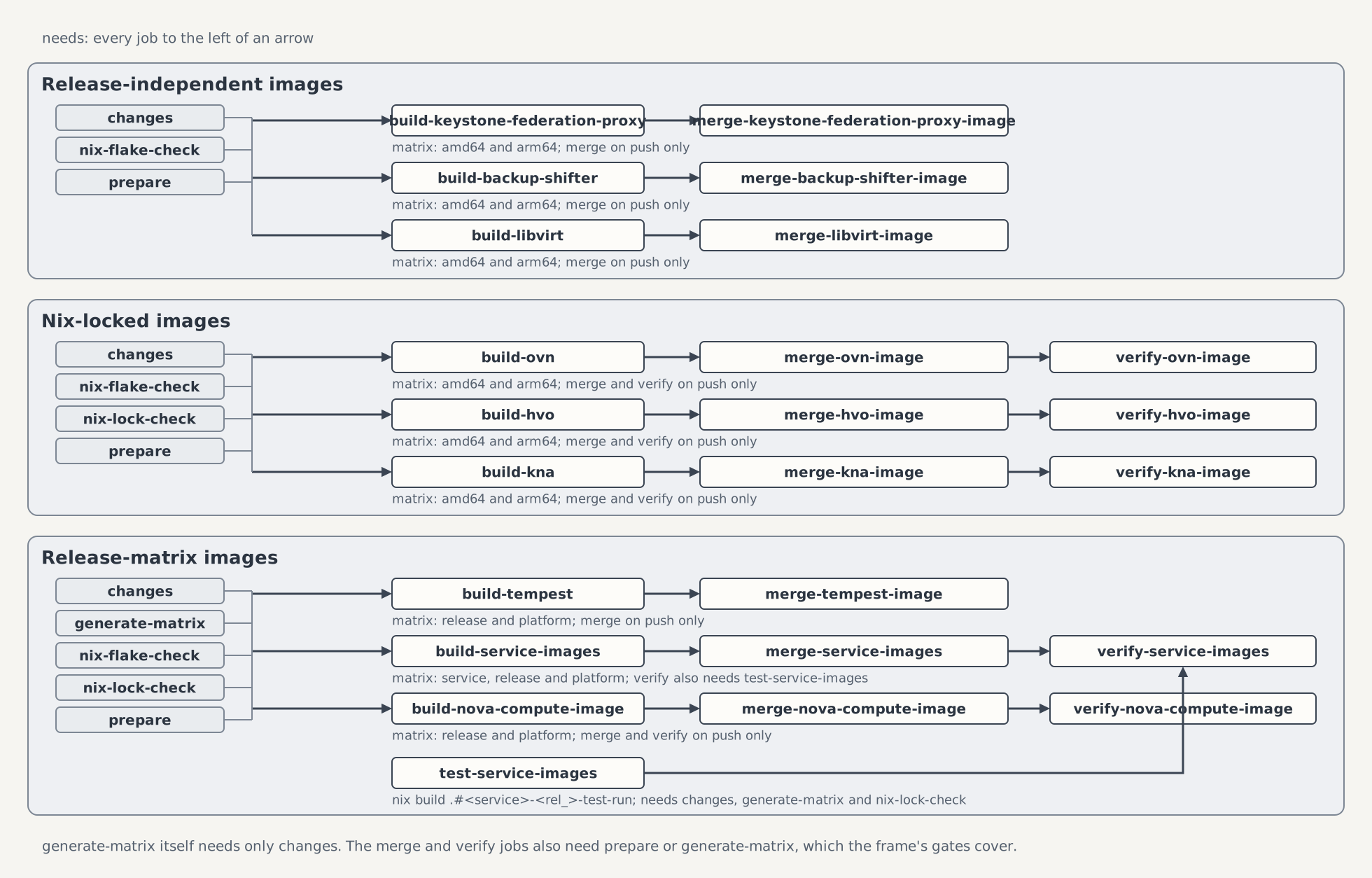
The figure leaves out the needs entries that a drawn path already implies: prepare on every merge job except merge-nova-compute-image, and generate-matrix on the merge and verify jobs of the release-matrix family. changes supplies the service list the matrix is built from and the flags the other jobs gate on. test-service-images needs nix-lock-check and generate-matrix but not nix-flake-check or prepare. build-libvirt needs no nix-lock-check, since no lock pin feeds the libvirt image.
Each platform (linux/amd64 on ubuntu-latest, linux/arm64 on ubuntu-24.04-arm) is built on a native runner and pushed by digest. The merge job of the image then assembles the multi-arch manifest list and runs the supply chain security pipeline via the supply-chain-attest composite action, as build-service-images and merge-service-images do for the service images and build-tempest and merge-tempest-image for Tempest. Every build job builds a flake attribute with build-nix-image. Every image this repository publishes is a flake attribute: the CI workflow builds the operator images through the same action (CI Workflow).
The test-service-images job runs the upstream unit tests of each service as a Nix build (nix/lib/service-tests.nix), in parallel with build-service-images. On push events, the verify-service-images job validates service images pulled from GHCR and gates on merge-service-images and test-service-images. On PRs, the equivalent image verification runs as an inline step within build-service-images because the loaded image is available only on the same runner (ARM64 is excluded on PRs).
Every job that pulls or pushes images uses the setup-docker-registry composite action for Docker Buildx setup, registry authentication, and optional cosign installation, replacing the previously duplicated three-step setup sequence.
changes
Classifies the changed paths of a pull request into paths filters — one per service image, one for what every service image is built from (the flake inputs, the Nix library and packages, the lock generator, the release configuration), one per release-independent image, and one for the workflow's own plumbing — and hands them to hack/ci-resolve-image-changes.sh, which resolves them into the service list and the image flags.
| Property | Value |
|---|---|
runs-on | ubuntu-latest |
timeout-minutes | 8 |
| Permissions | contents: read |
| Outputs | services, has-services, build-tempest, build-ovn, build-proxy, build-shifter, build-libvirt, build-hvo, build-kna |
The dorny/paths-filter step carries if: github.event_name == 'pull_request', since the action diffs against the pull request base. On push and workflow_dispatch it is skipped, its outputs resolve to the empty string, and the resolver answers all and sets every image flag to true regardless. That is why no gated job needs a github.event_name term in its condition.
ALL_SERVICES is a hand-maintained list, because dorny/paths-filter has no dynamic filter names. tests/unit/ci/build_images_services_lockstep_test.sh pins it to the union of the keys in releases/*/source-refs.yaml and fails when a service is missing its filter or its FILTER_svc_<service> env line. It runs under make test-shell on every pull request.
nix-flake-check
The gate of every Nix-built image.
| Property | Value |
|---|---|
runs-on | ubuntu-latest |
timeout-minutes | 15 |
| Permissions | contents: read |
The job installs Nix and adds the Cachix cache cobaltcore through the setup-nix composite action, and runs three commands:
nix flake check --no-build --print-build-logs
nix build .#checks.x86_64-linux.nix-lint .#checks.x86_64-linux.fhs-layout \
  .#checks.x86_64-linux.service-tests --print-build-logs
nix eval --json .#packages.aarch64-linux --apply 'builtins.mapAttrs (_: p: p.drvPath)'
nix flake check --no-build evaluates every output of the runner's system and fails on an attribute under packages or checks that is not a derivation. Without --no-build it would also build every check, the unit tests of all sixteen service locks included, which test-service-images runs one matrix entry each. The second command builds the three checks that need no service lock: nix-lint (nixfmt, statix, deadnix), fhs-layout and service-tests. nix flake check leaves the other systems unevaluated, and --all-systems would try to build the arm64 checks on the x86 runner, so nix eval instantiates every arm64 output without building it. The setup-nix action pushes only when the job hands it the secret CACHIX_AUTH_TOKEN (skipPush: ${{ inputs.cachix-auth-token == '' }}), and a cache it cannot reach fails no build (continue-on-error: true), as described under Binary cache.
nix-lock-check
Fails when the locks under nix/locks/, the noVNC hash or the hashes of the three images/<name>/source.json pins differ from what the pins produce.
| Property | Value |
|---|---|
runs-on | ubuntu-latest |
timeout-minutes | 30 |
| Permissions | contents: read |
The job runs on every event. It installs Nix with the workflow token as github_access_token, which lifts the GitHub API rate limit of the source prefetches, and runs:
nix develop .#lock-tools --command bash hack/nix-lock.sh --checkA failure adds the annotation the Nix locks or image pins are stale: run make nix-lock and commit the result. build-service-images, build-nova-compute-image, build-tempest, test-service-images, build-ovn, build-hvo and build-kna need the job, so no image and no unit test is built from a stale lock or pin. A Renovate pull request that moves a pin the locks are derived from fails here until make nix-lock is pushed to its branch (Renovate).
build-keystone-federation-proxy / merge-keystone-federation-proxy-image
The Apache federation reverse-proxy sidecar for Keystone, with mod_auth_openidc (OIDC) and mod_auth_mellon (SAML) in one image. The root flake builds it from images/keystone-federation-proxy/image.nix: mod_auth_openidc from the commit images/keystone-federation-proxy/source.json pins, Apache and mod_auth_mellon from the nixpkgs-images revision flake.lock pins (Nix Image Build). The image carries no OpenStack code, so the job pair has no release matrix. The two-platform build job depends on changes, nix-flake-check and prepare, installs Nix, adds the Cachix cache cobaltcore and calls build-nix-image with the attribute keystone-federation-proxy-image. On a pull request the action loads the amd64 image locally for the inline Grype scan and the tests/container-images/verify_keystone_federation_proxy.sh verify script; on a push it pushes each platform by digest with skopeo. The PR-skipped merge job assembles the multi-arch manifest with the :latest + :<sha> tags, followed by the supply-chain pipeline (SBOM, attestation, cosign).
Condition: needs.changes.outputs.build-proxy == 'true'. On a pull request the build job runs when images/keystone-federation-proxy/**, tests/container-images/verify_keystone_federation_proxy.sh, tests/lib/build_tools.sh, flake.nix, flake.lock, nix/lib/**, .github/actions/build-nix-image/** or .github/actions/setup-nix/** changed; on a push it always runs. The arm64 image is built on a push only.
build-backup-shifter / merge-backup-shifter-image
The rclone shifter that copies OVN database backups from a PVC to S3, the first Nix-built image: the root flake builds it from images/backup-shifter/image.nix (Nix Image Build). It runs as the shifter container of the OVNCentral backup CronJob, which the operator renders only when spec.backup.s3 is set. Like the federation proxy, the image carries no OpenStack code, so the job pair has no release matrix. The two-platform build job depends on changes, nix-flake-check and prepare, installs Nix, adds the Cachix cache cobaltcore and calls build-nix-image with the attribute backup-shifter-image. On a pull request the action loads the amd64 image locally for the inline Grype scan and the tests/container-images/verify_backup_shifter.sh verify script; on a push it pushes each platform by digest with skopeo. The PR-skipped merge job assembles the multi-arch manifest with the :latest + :<sha> tags, followed by the supply-chain pipeline, as for every release-independent image.
Condition: needs.changes.outputs.build-shifter == 'true'. On a pull request the build job runs when images/backup-shifter/**, tests/container-images/verify_backup_shifter.sh, flake.nix, flake.lock, nix/lib/** or .github/actions/build-nix-image/** changed; on a push it always runs. The arm64 image is built on a push only.
build-libvirt / merge-libvirt-image
The libvirt daemon and QEMU for containerized hypervisor nodes, built by Nix: the root flake builds libvirt-image from images/libvirt/ with the libvirt of nix/pkgs/libvirt.nix (Hypervisor images). The hypervisor package of issue #1142 runs it as a DaemonSet beside nova-compute. Like the backup shifter, the image carries no OpenStack code, so the job pair has no release matrix. The two-platform build job depends on changes, nix-flake-check and prepare, has 60 minutes for the first build per nixpkgs-images revision, which compiles libvirt and QEMU, installs Nix with the Cachix cache cobaltcore and calls build-nix-image with the attribute libvirt-image. On a pull request the action loads the amd64 image locally for the inline Grype scan and the tests/container-images/verify_libvirt.sh verify script, which starts libvirtd and queries the QEMU driver; on a push it pushes each platform by digest with skopeo and uploads the vulnix report vulnix-libvirt-<platform-pair>. The PR-skipped merge job assembles the multi-arch manifest with the :<sha> tag, plus :latest on main, followed by the supply-chain pipeline. The arm64 build runs on a push only.
On main, the step Mint the libvirt keeper tag of the merge job runs hack/ci-tag-libvirt-keeper.sh on the merged index and gives it the third tag, <libvirt-version>-r<N> (see Release-independent images). The script counts commits, so on main the merge job checks out the full history (fetch-depth: 0). The count reads commits and trees only, so the checkout leaves the blobs outside HEAD on the server (filter: blob:none). Its log ends in one of two ways: <image>:<tag> already names <digest>; not moved when an earlier build holds the tag, or tag=<tag> and minted=true once the new index carries the tag and a read-back returned its digest. Both lines are also the step's outputs tag and minted. An existence check that fails with anything but not found fails the step before it tags anything: moving an existing tag would take the keeper off a digest the lab pins.
A workflow_dispatch run on a branch publishes ghcr.io/c5c3/libvirt:<sha> and moves neither latest nor a keeper tag: the e2e-nova-libvirt leg of a pull request that changes no libvirt input runs the image latest names. The lab pins no such build, because the cleanup removes a branch's <sha> tag after 24 hours: a pull request that changes the image leaves the lab pins alone, and Renovate moves them to the keeper tag main's build mints after the merge.
Condition: needs.changes.outputs.build-libvirt == 'true'. On a pull request the build job runs when images/libvirt/**, nix/pkgs/libvirt.nix, tests/container-images/verify_libvirt.sh, tests/lib/build_tools.sh, flake.nix, flake.lock, nix/lib/** or one of the two Nix actions changed; on a push it always runs.
build-ovn / merge-ovn-image / verify-ovn-image
OVN and Open vSwitch daemons and client tools, compiled from upstream source by Nix: the root flake builds ovn-image from images/ovn/ (Source-built images). The version key of images/ovn/source.json is the whole version input. hack/ci-resolve-ovn-version.sh reads it, and every job that needs the number calls the script instead of reading the file. Open vSwitch comes from the ovs submodule gitlink at the pinned OVN commit, so one bump moves both projects (decision D1 of issue #898). Because a tag is a mutable ref, the pin records rev, the commit the tag names, and ovs.rev, the commit the gitlink names there, each with its NAR hash; make nix-lock derives ovs.rev from the gitlink, and nix-lock-check fails while the committed pin differs. OVN's Documentation/intro/install/general.rst notes under Build Requirements that the submodule is "not recommended to be used as a source for OVS build"; ovn-kubernetes builds its OVS from that gitlink in dist/images/Dockerfile.fedora, and this image does the same. Both trees are fixed-output fetches by hash, so no token enters the build.
build-ovn needs changes, nix-flake-check, nix-lock-check and prepare, and carries if: needs.changes.outputs.build-ovn == 'true': on a pull request it runs when images/ovn/**, tests/container-images/verify_ovn.sh, tests/lib/build_tools.sh, flake.nix, flake.lock, nix/lib/**, .github/actions/build-nix-image/** or .github/actions/setup-nix/** changed, and on a push it always runs. Its linux/amd64 + linux/arm64 include matrix is written out in the workflow, because the image has no source-refs.yaml key for generate-matrix to discover and no release axis. The job reads the Cachix cache through setup-nix and calls build-nix-image with the attribute ovn-image and the vulnix artifact vulnix-ovn-<pair>. Without a cached build of the pin both projects are compiled from source on a four-vCPU runner, so the job carries timeout-minutes: 60, the longest allowance of any build job here. On pull requests it builds amd64 only, loads the result locally as :pr-verify, and runs the inline Grype scan and tests/container-images/verify_ovn.sh against that tag. On push events it pushes per-platform digests for the merge job.
merge-ovn-image (push only) assembles the manifest through merge-manifest-and-attest: SBOM sbom-ovn.cyclonedx.json, Grype scan, attestation, cosign signature. It publishes <ovn-version>-<sha> on every push to main or stable/**, and adds <ovn-version> and latest on main (see Release-independent images). Its ovn-image output is the merged manifest as ghcr.io/<owner>/ovn@<digest>.
verify-ovn-image (push only) pulls that digest and runs verify_ovn.sh against the multi-arch manifest, on a [ubuntu-latest, ubuntu-24.04-arm] runner matrix. docker pull resolves the manifest to the runner's own architecture, so the two legs execute the amd64 and the arm64 variant respectively — pull requests compile amd64 only, and this job is where the arm64 binaries first run. It holds contents: read and packages: read and nothing else, so the post-merge check cannot write to the registry.
build-hvo / merge-hvo-image / verify-hvo-image
openstack-hypervisor-operator, compiled by Nix from a pinned commit of its upstream main branch with the patches under images/openstack-hypervisor-operator/patches/: the root flake builds openstack-hypervisor-operator-image from images/openstack-hypervisor-operator/, the manager with buildGo127Module and the image on nix/lib/static-image.nix. The rev key of images/openstack-hypervisor-operator/source.json is the whole version input. The Nix build and hack/nix-lock.sh read it themselves; every other job calls hack/ci-resolve-hvo-commit.sh, which prints the 40-character commit. See openstack-hypervisor-operator for the patches and why the pin is a main commit.
build-hvo needs changes, nix-flake-check, nix-lock-check and prepare, and carries if: needs.changes.outputs.build-hvo == 'true': on a pull request it runs when images/openstack-hypervisor-operator/**, tests/container-images/verify_hvo.sh, tests/lib/static_image.sh, the flake inputs, nix/lib/** or the build-nix-image and setup-nix actions changed, and on a push it always runs. Its linux/amd64 + linux/arm64 include matrix is written out in the workflow, and it carries timeout-minutes: 30. It reads the Cachix cache through setup-nix and calls build-nix-image with the attribute openstack-hypervisor-operator-image and the vulnix artifact vulnix-hvo-<pair>. The patch checks run inside the build. On pull requests it builds amd64 only, loads the result locally as :pr-verify, and runs the inline Grype scan and tests/container-images/verify_hvo.sh against that tag. On push events it pushes per-platform digests for the merge job.
merge-hvo-image (push only) assembles the manifest through merge-manifest-and-attest: SBOM sbom-hvo.cyclonedx.json, Grype scan, attestation, cosign signature. It publishes sha-<hvo-commit>-<sha> on every push to main or stable/**, and adds sha-<hvo-commit>, upstream-<hvo-commit> and latest on main (see Release-independent images). Its hvo-image output is the merged manifest as ghcr.io/<owner>/openstack-hypervisor-operator@<digest>.
verify-hvo-image (push only) pulls that digest and runs verify_hvo.sh on a [ubuntu-latest, ubuntu-24.04-arm] runner matrix, so the arm64 binary, which pull requests never build, runs here first. It holds contents: read and packages: read and nothing else.
build-kna / merge-kna-image / verify-kna-image
kvm-node-agent, compiled by Nix from a pinned commit of its upstream main branch with the patches under images/kvm-node-agent/patches/: the root flake builds kvm-node-agent-image from images/kvm-node-agent/, the same way as openstack-hypervisor-operator-image. The jobs are copies of the hvo jobs above with the short name kna. The rev key of images/kvm-node-agent/source.json is the whole version input. The Nix build and hack/nix-lock.sh read it themselves; every other job calls hack/ci-resolve-kna-commit.sh. The build runs the patch's two tests as a Nix build user. See kvm-node-agent for the patch and why the pin is a main commit.
build-kna needs changes, nix-flake-check, nix-lock-check and prepare, and carries if: needs.changes.outputs.build-kna == 'true': on a pull request it runs when images/kvm-node-agent/**, tests/container-images/verify_kna.sh, tests/lib/static_image.sh, the flake inputs, nix/lib/**, the build-nix-image and setup-nix actions or the plumbing changed, and on a push it always runs. It builds the linux/amd64 + linux/arm64 include matrix with timeout-minutes: 30, through build-nix-image with the attribute kvm-node-agent-image and the vulnix artifact vulnix-kna-<pair>. On pull requests it builds amd64 only, loads the result locally as :pr-verify, and runs the inline Grype scan and tests/container-images/verify_kna.sh against that tag. On push events it pushes per-platform digests as digests-kna-<pair> for the merge job.
merge-kna-image (push only) assembles the manifest through merge-manifest-and-attest: SBOM sbom-kna.cyclonedx.json, Grype scan grype-kna, attestation, cosign signature. It publishes sha-<kna-commit>-<sha> on every push to main or stable/**, and adds sha-<kna-commit>, upstream-<kna-commit> and latest on main (see Release-independent images). Its kna-image output is the merged manifest as ghcr.io/<owner>/kvm-node-agent@<digest>.
verify-kna-image (push only) pulls that digest and runs verify_kna.sh on a [ubuntu-latest, ubuntu-24.04-arm] runner matrix, with contents: read and packages: read only.
build-service-images
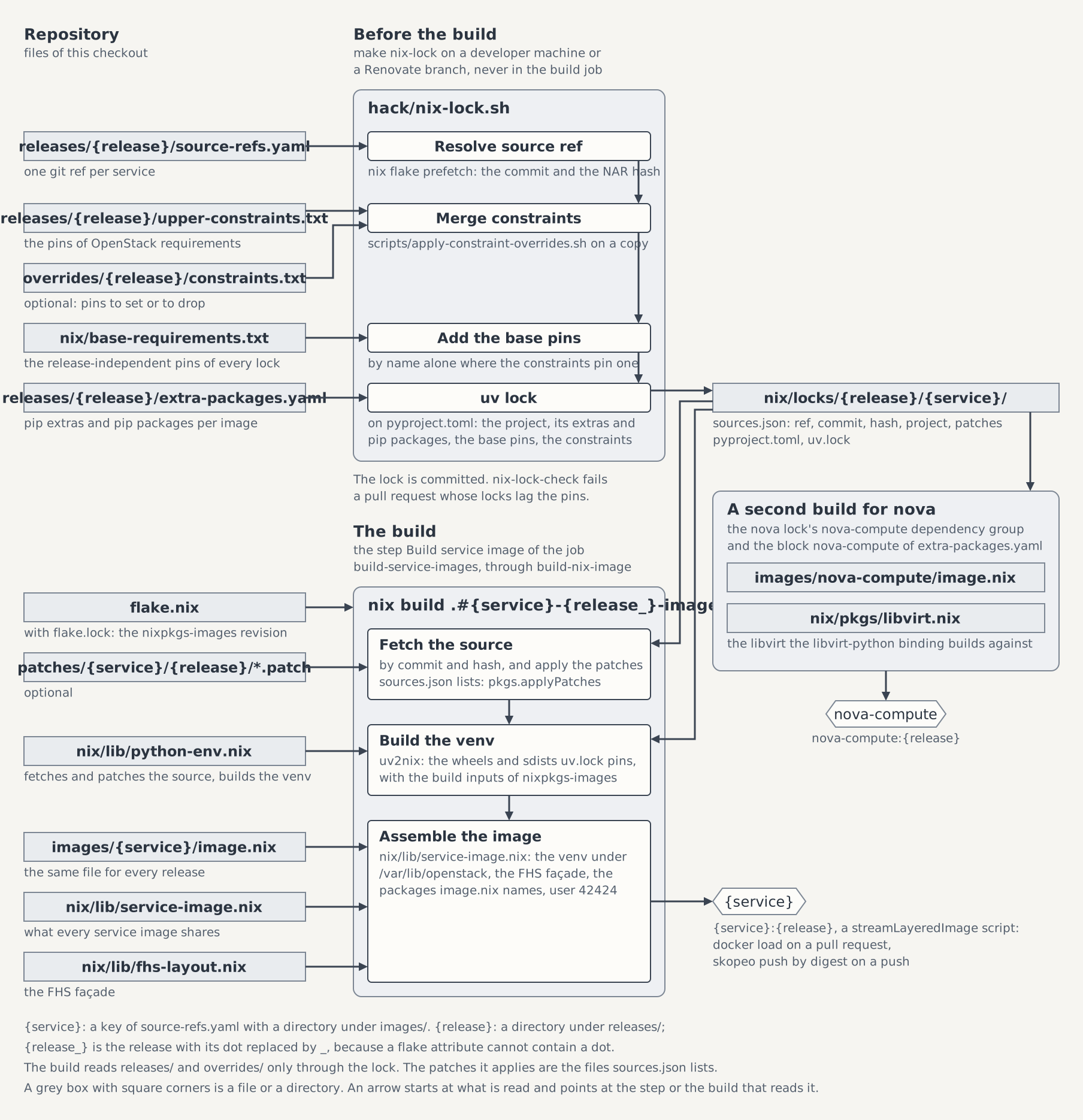
Builds service images per platform on native runners and pushes each single-arch image by digest. Each image is the flake attribute <service>-<rel_>-image, built from images/<service>/image.nix over the lock nix/locks/<release>/<service>/ by the build-nix-image action (Nix Image Build). The job runs behind nix-flake-check and nix-lock-check. The multi-arch manifest list is assembled by merge-service-images.
On pull requests, ARM64 is excluded (only linux/amd64 is built) and the image is loaded locally for inline verification instead of being pushed to GHCR.
The figure shows the files a service image build reads, the lock hack/nix-lock.sh writes from them, and the nix build of this job.
| Property | Value |
|---|---|
runs-on | ${{ matrix.runner }} (ubuntu-latest for amd64, ubuntu-24.04-arm for arm64) |
timeout-minutes | 45 |
needs | [changes, generate-matrix, nix-flake-check, nix-lock-check, prepare] |
| Condition | needs.changes.outputs.has-services == 'true' |
| Matrix | service × release × platform × runner (from generate-matrix.build-matrix; ARM64 excluded on PRs) |
Steps:
| # | Step | Action / Command | Details |
|---|---|---|---|
| 1 | Checkout | actions/checkout@v7 | Checks out this repository |
| 2 | Derive tags | .github/actions/derive-service-tags | Composite action. Computes image name and all tags (see Tag Schema). Passes no image input, so the image is named after the service |
| 3 | Prepare platform pair | .github/actions/platform-pair | Converts linux/amd64 → linux-amd64 for artifact names |
| 4 | Setup Docker registry | .github/actions/setup-docker-registry | Buildx + GHCR login (cosign disabled) |
| 5 | Set up Nix | .github/actions/setup-nix | Installs Nix and reads the cobaltcore cache; pushes only with CACHIX_AUTH_TOKEN set; an unreachable cache fails no build |
| 6 | Resolve flake attribute | Shell | Writes attribute=<service>-<release with _>-image (keystone-2026_1-image), because a flake attribute cannot contain a dot |
| 7 | Build service image | .github/actions/build-nix-image | Builds the attribute and scans its store paths with vulnix (artifact vulnix-<service>-<release>-<platform-pair>). Non-PR: pushes the stream by digest with skopeo, digest uploaded as artifact digests-service-<service>-<release>-<platform-pair>. PR: loads the stream, tags it with the composite tag, Grype scan of the loaded image (scan-mode: image; no SARIF upload), then verify_${{ matrix.service }}.sh against it |
| 8 | Checkout service source | .github/actions/checkout-service-source | Resolves source ref, clones upstream, applies patches and constraint overrides into src/<service>. It runs after the build because it edits releases/<release>/upper-constraints.txt in place, and the build has to evaluate an unmodified tree |
| 9 | Verify option catalog | hack/gen-option-catalog.sh --check | PR only, for keystone, glance, neutron, cinder and nova: diffs the option catalog generated from the locally loaded image against the committed catalog file, with src/<service> as SOURCE_DIR |
merge-service-images
Downloads per-platform digests from build-service-images, assembles multi-arch manifest lists, then runs SBOM generation, vulnerability scanning, attestation, and cosign signing. Runs only on push events.
| Property | Value |
|---|---|
runs-on | ubuntu-latest |
timeout-minutes | 45 |
needs | [build-service-images, generate-matrix, prepare] |
if | github.event_name != 'pull_request' |
| Matrix | service × release (from generate-matrix.matrix) |
| Permissions | contents: read, packages: write, id-token: write, attestations: write, artifact-metadata: write, security-events: write |
Tag derivation uses the same .github/actions/derive-service-tags composite action as build-service-images, ensuring the manifest is assembled under the exact same tags that were computed during the build.
Steps:
| # | Step | Action / Command | Details |
|---|---|---|---|
| 1 | Checkout | actions/checkout@v7 | Checks out the repository |
| 2 | Setup Docker registry | .github/actions/setup-docker-registry | Buildx + GHCR login + cosign |
| 3 | Derive tags | .github/actions/derive-service-tags | Composite action. Computes image name and all tags; no image input |
| 4 | Build service image tags | Shell | Assembles composite + SHA tags (all branches), version + release tags (main only) |
| 5 | Merge and attest service image | .github/actions/merge-manifest-and-attest | Downloads all digests-service-<service>-<release>-* artifacts (actions/download-artifact@v8), assembles per-platform digests into multi-arch manifest with hack/ci-merge-manifest.sh, then runs supply-chain-attest: SBOM + Grype scan + SARIF upload + attestation + provenance + cosign sign |
This job does not declare outputs. The verify-service-images job derives its own image refs independently via its own matrix strategy.
test-service-images
Runs the upstream unit tests of each service and release as Nix builds (Unit tests). The run derivation <service>-<rel_>-test-run executes the suite over the patched source with the venv of the lock's test group, MySQL 8.4 and PostgreSQL 18 running on 127.0.0.1 inside the build sandbox, and succeeds whenever the suite ran; the check <service>-<rel_>-tests then fails the job unless the run's exit status is 0. The split lets a failed run still upload its subunit stream. An optional per-service exclude-list (releases/<release>/test-excludes/<service>.txt) skips known-failing tests via stestr run --exclude-list.
This job runs in parallel with build-service-images, behind nix-lock-check. The verify-service-images job gates on both.
| Property | Value |
|---|---|
runs-on | ubuntu-latest |
timeout-minutes | 90 |
needs | [changes, generate-matrix, nix-lock-check] |
| Condition | needs.changes.outputs.has-services == 'true' |
| Permissions | contents: read, packages: read |
| Matrix | service × release (from generate-matrix.matrix) |
Steps:
| # | Step | Action / Command | Details |
|---|---|---|---|
| 1 | Checkout | actions/checkout@v7 | Checks out the repository |
| 2 | Set up Nix | .github/actions/setup-nix | As in build-service-images, plus push-filter: '-test-run$', so a failed run never reaches the cache |
| 3 | Run tests | Shell | nix build ".#<service>-<rel_>-test-run" --out-link result-test-run, copies its files to results/, prints results/summary.txt, then nix build ".#checks.x86_64-linux.<service>-<rel_>-tests" |
| 4 | Upload test results | actions/upload-artifact@v7 | Always runs. Uploads results/testresults.subunit as test-results-<service>-<release> with 30-day retention |
Test exclude-list:
If releases/<release>/test-excludes/<service>.txt exists, stestr uses it as --exclude-list to skip tests matching the regex patterns in the file. The file follows stestr exclude-list format: blank lines are ignored, # lines are comments, all other lines are regex patterns matching test IDs to skip. See releases/2026.1/test-excludes/keystone.txt for an example. A test that fails only in the build sandbox goes into the sandbox exclude list of nix/lib/service-tests.nix instead, with its error.
Test Coverage:
The verify_build_images_workflow.sh script validates test-service-images job structure and steps:
| Test | Validates |
|---|---|
test_test_service_images_job_structure | runs-on: ubuntu-latest, timeout-minutes: 90, contents: read, packages: read, no id-token, attestations, or security-events |
test_test_service_images_has_matrix | Matrix is a fromJson expression over a generate-matrix output, with fail-fast: false |
test_test_service_images_depends_on_base | needs array contains changes, generate-matrix and nix-lock-check, and neither merge-base-images nor verify-base-images |
test_service_unit_tests_run_as_nix_checks | No services: block, a -test-run build and a checks.x86_64-linux. build in Run tests, and push-filter: '-test-run$' on the setup-nix step |
test_test_service_images_subunit_output | Run tests builds the -test-run attribute and copies result-test-run/* to results/, and the upload path is results/testresults.subunit |
test_test_service_images_upload_artifacts | Upload test results step for subunit output with if: always() and 30-day retention |
test_test_service_images_artifact_name | Artifact name includes matrix.service and matrix.release for disambiguation |
test_test_service_images_env_vars | Run tests gets MATRIX_SERVICE and MATRIX_RELEASE from env: and interpolates no ${{ }} expression into its run block |
test_verify_service_images_depends_on_service_images | verify-service-images needs includes merge-service-images, test-service-images and generate-matrix |
test_timeout_minutes_on_all_jobs | All jobs including test-service-images have timeout-minutes set |
test_runs_on_ubuntu_latest | test-service-images, merge-service-images, verify-service-images and the six release-independent merge jobs use runs-on: ubuntu-latest; build-service-images, the six release-independent build jobs and verify-ovn-image, verify-hvo-image, verify-kna-image use matrix.runner |
test_matrix_jobs_fail_fast_false | build-service-images, test-service-images and verify-service-images have fail-fast: false |
The verify_release_config.sh script validates test-excludes file structure:
| Test | Validates |
|---|---|
test_test_excludes_file_format | test-excludes/keystone.txt contains valid stestr exclude-list format |
test_test_excludes_directory_structure | All files in test-excludes/ are .txt and named after services in source-refs.yaml |
test_test_excludes_files_match_services | Each filename (sans .txt) corresponds to a key in source-refs.yaml |
verify-service-images
Validates that built service images are functional by running verify_${{ matrix.service }}.sh. This job replaces the former smoke-test job and runs only on push events (when images are in GHCR). It uses its own matrix strategy matching build-service-images to test every service independently.
On PRs, the equivalent verification runs as an inline step within build-service-images (step 7 above) because --load makes the image available only on the same runner.
| Property | Value |
|---|---|
runs-on | ubuntu-latest |
timeout-minutes | 15 |
needs | [merge-service-images, test-service-images, generate-matrix] |
if | github.event_name != 'pull_request' |
| Permissions | contents: read, packages: read |
| Matrix | service × release (from generate-matrix.matrix) |
Steps:
| # | Step | Action / Command | Details |
|---|---|---|---|
| 1 | Checkout | actions/checkout@v7 | Checks out the repository (needed for test scripts, source-refs.yaml, and patch counting) |
| 2 | Setup Docker registry | .github/actions/setup-docker-registry | GHCR login (cosign disabled); replaces inline login step |
| 3 | Derive tags | .github/actions/derive-service-tags | Composite action. Reconstructs tags using the same logic as build-service-images and merge-service-images; no image input |
| 4 | Pull and verify service image | Shell | docker pull <image-ref> then runs verify_${{ matrix.service }}.sh with the pulled image ref |
| 5 | Verify option catalog | hack/gen-option-catalog.sh --check | For keystone, glance, neutron, cinder and nova: diffs the option catalog generated from the pulled image against the committed catalog file |
Test script executed:
| Script | Validates |
|---|---|
tests/container-images/verify_<service>.sh | Service-specific checks (e.g. keystone-manage --version exits 0), runs as openstack user, no build tools (gcc, cc, uv and python3-config not on PATH, no compiler, binutils or uv package in /nix/store), runtime packages present |
The job fails the workflow if the verify script exits non-zero. Tag derivation uses the .github/actions/derive-service-tags composite action, which is the single source of truth shared by build-service-images, merge-service-images, and verify-service-images.
build-nova-compute-image / merge-nova-compute-image / verify-nova-compute-image
These jobs build the compute image of images/nova-compute/ (see nova-compute) from nova's lock with its nova-compute dependency group. The image gets jobs of its own because a failed matrix entry of build-service-images on a main push skips merge-service-images for every service. Extra steps in the nova entry would add a compiled binding and the host tools to that blast radius. A failed compute build skips merge-nova-compute-image for every release and leaves every other merge job alone.
build-nova-compute-image gates on nova-compute-releases != '[]' from generate-matrix, and the merge and verify jobs follow its skip, so a pull request that leaves nova alone skips them. A compute-only change still reaches them: images/nova-compute/** and tests/container-images/verify_nova_compute.sh sit in the svc_nova paths filter, so the changes job resolves nova. Such a pull request also rebuilds the nova image and runs nova's unit tests. That cost is accepted, because the compute image has to rebuild whenever nova's lock moves, and one filter keeps that coupling in one place. A change to nix/pkgs/ reaches it through the base filter, which sets every service.
build-nova-compute-image needs changes, generate-matrix, nix-flake-check, nix-lock-check and prepare, has 60 minutes for the first build per nixpkgs-images revision, which compiles libvirt, and runs over nova-compute-build-matrix (release × platform, amd64 only on pull requests). Its steps mirror build-service-images:
derive-service-tagswithservice: novaandimage: nova-compute: nova's version and patch count under thenova-computenamesetup-nix, and aResolve flake attributestep that writesattribute=nova-compute-<release with _>-imagebuild-nix-imagewith that attribute, the image name of the tags step, the composite tag asverify-image-refand the vulnix reportvulnix-nova-compute-<release>-<platform-pair>
On pull requests the image is loaded locally, scanned by Grype (grype-nova-compute-<platform-pair>) and checked by tests/container-images/verify_nova_compute.sh. On push it is pushed by digest and uploaded as digests-nova-compute-<release>-<platform-pair>.
merge-nova-compute-image (push only) copies merge-service-images over a release matrix from nova-compute-releases. It merges digests-nova-compute-<release>-*, a pattern nova's own digests-service-nova-<release>-* cannot match, publishes the composite and SHA tags from every branch and the version and release tags from main, and writes sbom-nova-compute-<release>.cyclonedx.json with the Grype category grype-nova-compute-<release>. Like Tempest's, the category carries the release: both releases merge for the same commit, and under one category the later SARIF upload would replace the earlier one and close its alerts as fixed.
verify-nova-compute-image (push only) pulls the composite tag and runs verify_nova_compute.sh on a release × [ubuntu-latest, ubuntu-24.04-arm] matrix. It and build-nova-compute-image pass the release to the script as NOVA_COMPUTE_RELEASE. Pull requests build amd64 only, so this job is the first place the arm64 build of the binding and the host tools runs. It holds contents: read and packages: read only. There is no option-catalog step: the compute image adds no oslo.config namespace to the nova catalog.
Tag Schema
Each service image build produces two to four tags on push events:
| Tag | Format | Example | Branches |
|---|---|---|---|
| Composite | <version>-p<N>-<branch>-<sha> | keystone:29.0.0-p0-main-a1b2c3d | all |
| Version | <version> | keystone:29.0.0 | main only |
| Release | <release> | keystone:2026.1 | main only |
| SHA | <sha> | keystone:a1b2c3d | all |
The version-only and release tags are restricted to the main branch to prevent silent overwrites when multiple branches build the same upstream version. The composite tag already encodes the branch, so stable/** builds remain uniquely identifiable.
Tag components:
| Component | Source | Description |
|---|---|---|
<version> | releases/<release>/source-refs.yaml | Upstream OpenStack version tag (e.g., 29.0.0) |
p<N> | Count of .patch files in patches/<service>/<release>/ | Patch count; defaults to p0 when the directory is absent |
<branch> | GITHUB_REF_NAME with / replaced by - | Branch name, sanitized for Docker tag compatibility (e.g., stable/2026.1 becomes stable-2026.1) |
<sha> | First 7 characters of GITHUB_SHA | Short commit SHA |
The composite tag uniquely identifies the exact build: upstream version, patch level, branch, and commit. The version and SHA tags provide convenient shortcuts for deployment systems.
nova-compute carries nova's <version> and patch count under its own name: the compute jobs call derive-service-tags with service: nova and image: nova-compute, so nova-compute:2026.1 and nova:2026.1 are cut from the same nova (for example nova-compute:33.0.0-p0-main-a1b2c3d).
Release-independent images
keystone-federation-proxy, backup-shifter, libvirt, ovn, openstack-hypervisor-operator and kvm-node-agent have no OpenStack version to tag with:
| Image | Tags | Branches |
|---|---|---|
keystone-federation-proxy | latest, <sha> | all |
backup-shifter | latest, <sha> | all |
libvirt | <sha> | all |
libvirt | latest, <libvirt-version>-r<N> | main only |
ovn | <ovn-version>-<sha> | all |
ovn | <ovn-version>, latest | main only |
openstack-hypervisor-operator | sha-<hvo-commit>-<sha> | all |
openstack-hypervisor-operator | sha-<hvo-commit>, upstream-<hvo-commit>, latest | main only |
kvm-node-agent | sha-<kna-commit>-<sha> | all |
kvm-node-agent | sha-<kna-commit>, upstream-<kna-commit>, latest | main only |
<sha> is the full 40-character github.sha here. Restricting ovn:<ovn-version> and ovn:latest to main has the same reason as the service version tag above: when two branches build the same upstream version, a shared tag would be silently overwritten. The same holds for the three main-only tags of openstack-hypervisor-operator and kvm-node-agent, where <hvo-commit> and <kna-commit> are the full upstream commits their source.json pins. sha-<hvo-commit> and sha-<kna-commit> are the tags the upstream chart of that commit renders from its appVersion.
libvirt:<libvirt-version>-r<N>, such as libvirt:12.2.0-r57, names what a build contains. <libvirt-version> is the third field of the first line libvirtd --version prints in the image's linux/amd64 variant. <N> is git rev-list --count HEAD -- images/libvirt nix/pkgs/libvirt.nix nix/lib/image-defaults.nix flake.lock, the number of commits on main that touched the image's directory, its libvirt derivation, the creation date and labels every Nix image shares, or the flake's lock file. The tag is created once and never moved. The first main build with a new value gets it; every later build with the same value finds it in the registry, keeps latest and <sha> only, and is pruned once superseded. A new tag appears when a commit touches one of the four paths: a change to the image, to the libvirt override or to the shared image defaults, or a nixpkgs-images re-lock, which can rebuild QEMU, Ceph or glibc while libvirt keeps its version. A version that is not <major>.<minor>[.<patch>], such as 12.2.0-rc1, fails the step, because the prune's keep pattern and Renovate's allowedVersions assume that shape. The Docker-built image before #1407 carried <libvirt-package-version>-r<N>, such as 10.0.0-2ubuntu8.19-r2; the prune keeps those as the lab's rollback target. The lab manifests under deploy/lab/metal-stack/ pin the current tag by digest (see Lab hypervisors).
Retention
The nightly cleanup-images.yaml workflow decides retention from each package version's whole tag set, not from a "keep the newest N" counter. A version survives while it carries a keeper tag:
| Kept | Example | Why |
|---|---|---|
latest | backup-shifter:latest | Current build of a release-independent image |
| Version | keystone:29.0.0 | Names an upstream release |
| Release | keystone:2026.1 | Names an OpenStack release |
| Semver prerelease | keystone-operator:1.2.0-rc1 | Tagged operator build |
| Pinned upstream commit | openstack-hypervisor-operator:upstream-<commit>, kvm-node-agent:upstream-<commit> | A chart of that commit names the image |
| Libvirt keeper | libvirt:12.2.0-r57, and libvirt:10.0.0-2ubuntu8.19-r2 of the Docker-built image | The lab manifests pin that build by digest; the Docker-built keepers are the lab's rollback target |
Everything else is a build artifact with a successor and is deleted once it is older than 24 hours: composite tags, SHA tags in all four shapes (<sha>, <sha40>, sha-<sha40>, <release>-<sha40>), run-scoped e2e-<run_id>-* tags, dev, and untagged leftovers.
The rule works per manifest, so the current main build is untouched: its composite and SHA tags sit on the same manifest as 29.0.0 and 2026.1, and that release tag keeps the whole thing. Only once a later build moves 29.0.0 and 2026.1 onto a new manifest does the old one (now holding nothing but its composite and SHA tags) become deletable.
Two things survive without a tag of their own. A multi-arch image is an OCI index whose per-platform and buildx attestation manifests are separate untagged package versions; those are kept for as long as an index that references them is kept. Cosign and SBOM artifacts attach as a sha256-<digest> tag naming their subject and follow that subject.
hack/ghcr-prune-stale-versions.py implements this; run it with --dry-run to see a plan without deleting anything.
PR vs Push Behavior
The figure shows both paths for a service image: the three jobs every run executes, where a pull request ends, and what a push merges, attests and signs. The service images build from Nix through build-nix-image and run their unit tests as Nix builds. The table lists the differences aspect by aspect.
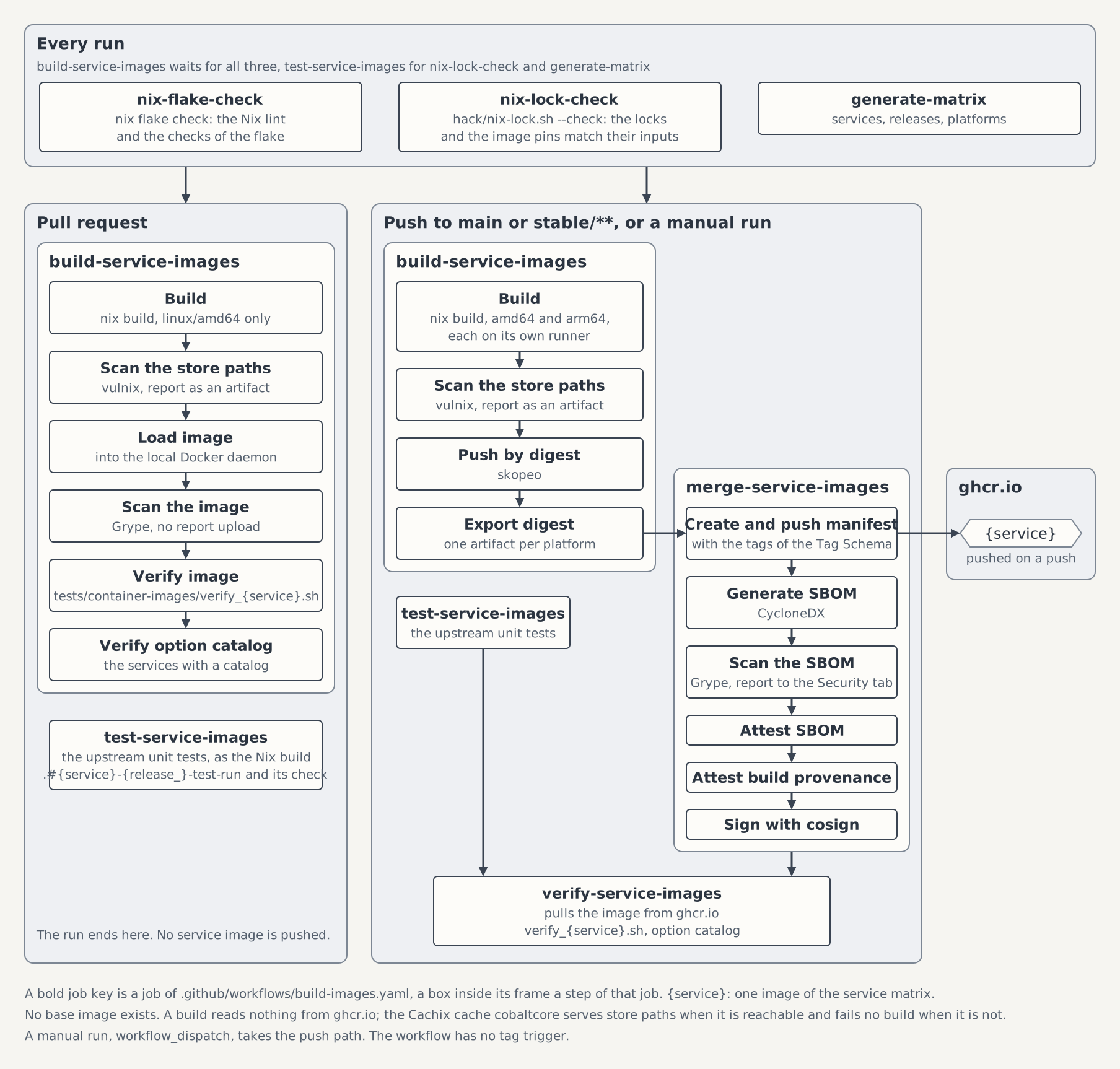
The workflow behaves differently depending on the trigger event:
| Aspect | Pull Request | Push (main / stable/**) |
|---|---|---|
| Service matrix | The services whose sources changed, every release each | Every service |
| Tempest images | On images/tempest/**, its locks, its verify script, a base change, or a plumbing change | Always |
| OVN, federation proxy, backup shifter, libvirt, openstack-hypervisor-operator, kvm-node-agent | On their own sources, or a plumbing change | Always |
| Service image platforms | linux/amd64 only (ARM64 excluded) | linux/amd64,linux/arm64 |
| Service image push | No (docker load on amd64 runner) | Yes (by digest with skopeo, tags assigned by merge-service-images) |
| Service image tags | Computed but not published | Published to GHCR |
| SBOM generation | Skipped | CycloneDX JSON for every merged manifest |
| Vulnerability scanning | Image-based scan on PR (image: input) in the build jobs | SBOM-based scan in the merge jobs (sbom: input) |
| SBOM attestation | Skipped | Sigstore-signed, pushed to GHCR |
| Cosign signing | Skipped | Keyless signature for every merged manifest |
| OIDC token request | None | Requested in merge jobs for Sigstore signing |
| Service image verification | Inline step in build-service-images | Separate verify-service-images job |
| Verification image source | Locally loaded image (same amd64 runner) | Pulled from GHCR |
| ovn image verification | Inline step in build-ovn (verify_ovn.sh on :pr-verify) | Separate verify-ovn-image job (pulled by digest from GHCR) |
| nova-compute image verification | Inline step in build-nova-compute-image (verify_nova_compute.sh, amd64) | Separate verify-nova-compute-image job on ubuntu-latest and ubuntu-24.04-arm |
On a pull request every image is scanned twice: Grype scans the loaded image, and vulnix scans the store paths of the image (The build-nix-image action).
Why PRs use single-arch for service images: docker load reads a single-platform image, and a multi-platform image cannot be loaded into the local Docker daemon. Since the inline verification step needs the image locally, PRs build only linux/amd64. The arm64 images are built and verified on push.
GHA Caching
No job of this workflow uses a type=gha cache. Every image is built by Nix, and the build jobs and test-service-images read the Cachix cache cobaltcore (Binary cache).
Action Pinning
All actions are pinned to full commit SHAs with version comments, matching the convention in ci.yaml:
uses: actions/checkout@3d3c42e5aac5ba805825da76410c181273ba90b1  # v7
uses: docker/setup-buildx-action@f87e5991a6d7451dcb8d9637bfbc97413f497069  # v4
uses: anchore/sbom-action@e22c389904149dbc22b58101806040fa8d37a610  # v0
uses: anchore/scan-action@e1165082ffb1fe366ebaf02d8526e7c4989ea9d2  # v7
uses: actions/attest@1e69f48acb82d1966a394da916b4c1698aa569d6  # v4
uses: github/codeql-action/upload-sarif@2892aa5e19bbd11bc0cff5427e3b750a04d9e3c2  # v4
uses: sigstore/cosign-installer@faadad0cce49287aee09b3a48701e75088a2c6ad  # v4
(GHCR authentication runs docker login via the registry-login composite action, with no third-party login action; the pinned SHAs above are kept current by Renovate, so treat the workflow files as the authoritative source.)
This prevents supply-chain attacks via tag mutation while remaining auditable through version comments.
SBOM Generation and Attestation
Every container image pushed to GHCR on non-PR events receives a CycloneDX SBOM and a Sigstore-signed attestation. This enables consumers to audit image contents, check for known vulnerabilities, and verify that images have not been tampered with since build time.
Consolidation note. SBOM generation, attestation, vulnerability scanning, build provenance, and cosign signing are handled by a single parameterised composite action (
.github/actions/supply-chain-attest). See supply-chain-attest for the composite action interface.
How It Works
After per-platform images are pushed by digest and the multi-arch manifest list is assembled by the merge job, the supply-chain-attest composite action runs in the merge job and performs:
SBOM generation (
anchore/sbom-action) — Syft scans the merged manifest (referenced by digest) and produces a CycloneDX JSON file covering the Nix store paths of the image (pkg:nixcomponents) and its Python packages (pkg:pypi, from the dist-info directories).SBOM attestation (
actions/attest) — The CycloneDX file is signed via Sigstore keyless OIDC (using the GitHub Actions workflow identity) and pushed to GHCR as an OCI referrer artifact alongside the image. No signing keys are managed; the OIDC token binds the attestation to the specific workflow run.
This pattern is applied to every published image via the supply-chain-attest composite action; the table lists four of them:
| Image | SBOM output file | Job |
|---|---|---|
libvirt | sbom-libvirt.cyclonedx.json | merge-libvirt-image |
nova-compute | sbom-nova-compute-${{ matrix.release }}.cyclonedx.json | merge-nova-compute-image |
tempest | sbom-tempest-${{ matrix.release }}.cyclonedx.json | merge-tempest-image |
Service (e.g., keystone) | sbom-${{ matrix.service }}.cyclonedx.json | merge-service-images |
PR Behavior
The supply-chain-attest composite action uses its scan-mode input to control PR vs push behavior. On pull requests the merge jobs do not run, and the build jobs pass scan-mode: image, which runs only the Grype vulnerability scan (no SBOM generation, no attestation, no signing). On push events, merge jobs use the default scan-mode: sbom for the full pipeline.
On pull requests:
- No SBOMs are generated or attested —
scan-mode: imageskips all SBOM/attestation steps. - No OIDC token requests occur — SBOM/attestation steps are skipped so
id-token: writeis not exercised. - No attestations are created for ephemeral PR builds.
- PR CI time is not increased by SBOM/attestation steps.
Required Permissions
SBOM attestation requires three additional job-level permissions beyond the existing contents: read and packages: write:
| Permission | Purpose |
|---|---|
id-token: write | Allows the GitHub Actions runner to request a short-lived Sigstore OIDC token for keyless signing |
attestations: write | Grants access to the GitHub Attestations API for storing signed attestations |
artifact-metadata: write | Allows actions/attest to write its storage record |
These permissions are granted to every merge job, to build-service-images and to build-nova-compute-image. Verification jobs (verify-service-images, verify-nova-compute-image and the other verify-* jobs) do not receive these permissions.
Verifying Attestations
To verify that an image has a valid Sigstore-signed attestation:
gh attestation verify oci://ghcr.io/<owner>/<service>:<tag> --owner <owner>To extract the SBOM predicate from the attestation, first inspect the raw output to find the exact predicateType URI used in your environment:
gh attestation verify oci://ghcr.io/<owner>/<service>:<tag> \
  --owner <owner> \
  --format json | jq '.[].verificationResult.statement.predicateType'
Then filter for that predicate type (the URI below may differ by action version):
gh attestation verify oci://ghcr.io/<owner>/<service>:<tag> \
  --owner <owner> \
  --format json | jq -r '
    [ .[] | select(.verificationResult.statement.predicateType | test("cyclonedx")) ]
    | if length == 0 then error("no CycloneDX attestation found") else .[0].verificationResult.statement.predicate end
  '
Test Coverage
The verify_build_images_workflow.sh script validates SBOM/attestation configuration:
| Test | Validates |
|---|---|
test_sbom_permissions_on_build_service_images | id-token: write and attestations: write on merge-service-images |
test_verify_jobs_no_sbom_permissions | verify-service-images, test-service-images, verify-ovn-image, verify-hvo-image, verify-kna-image and verify-nova-compute-image do not have id-token or attestations permissions |
test_sbom_generation_steps_exist | supply-chain-attest has one anchore/sbom-action step; merge-libvirt-image and merge-service-images call merge-manifest-and-attest once each |
test_sbom_format_cyclonedx_json | The SBOM step specifies format: cyclonedx-json |
test_sbom_generation_references_digest | The SBOM step builds its image ref from inputs.image-name and inputs.image-digest; merge-manifest-and-attest forwards steps.merge.outputs.digest; the libvirt and service merge calls pass their image |
test_sbom_attestation_steps_exist | supply-chain-attest has one actions/attest step |
test_sbom_attestation_push_to_registry | The actions/attest step has push-to-registry: true |
test_sbom_steps_pr_skip_guard | The SBOM and attestation steps have the scan-mode == 'sbom' guard; merge-service-images and merge-libvirt-image have the job-level github.event_name != 'pull_request' guard |
Cosign Image Signing
Every container image pushed to GHCR on non-PR events is signed with cosign keyless signing. This provides an independent signature layer alongside the SBOM attestation, enabling consumers to verify image provenance using standard Sigstore tooling.
How It Works
Cosign is installed by the setup-docker-registry composite action when install-cosign: 'true' (the default, used by merge jobs). The supply-chain-attest composite action then runs cosign sign --yes as the final step of the supply chain pipeline:
cosign-installer (
sigstore/cosign-installer@v4) — Installed bysetup-docker-registryin merge jobs.cosign sign — Executed by
supply-chain-attestinsbommode. Signs the image by digest using Sigstore keyless OIDC. The--yesflag confirms non-interactive mode. No signing keys are managed; the GitHub Actions OIDC token binds the signature to the specific workflow run.
This pattern is applied to every published image via the supply-chain-attest composite action; the table lists four of them:
| Image | Job | Digest source |
|---|---|---|
libvirt | merge-libvirt-image | steps.merge-libvirt.outputs.digest |
nova-compute | merge-nova-compute-image | steps.merge-nova-compute.outputs.digest |
tempest | merge-tempest-image | steps.merge-tempest.outputs.digest |
Service (e.g., keystone) | merge-service-images | steps.merge-service.outputs.digest |
PR Behavior
The supply-chain-attest composite action skips cosign signing in image mode. On pull requests:
- No images are signed —
scan-mode: imageskips all signing steps. - No OIDC token requests occur for signing.
- The
id-token: writepermission (shared with SBOM attestation) is not exercised.
Required Permissions
Cosign keyless signing reuses the same id-token: write permission required by SBOM attestation. No additional permissions are needed.
Verifying Signatures
To verify that an image has a valid cosign signature:
cosign verify \
  --certificate-oidc-issuer https://token.actions.githubusercontent.com \
  --certificate-identity-regexp "https://github.com/<owner>/<repo>/.github/workflows/build-images.yaml@refs/.*" \
  ghcr.io/<owner>/<service>@sha256:<digest>
Test Coverage
The verify_build_images_workflow.sh script validates cosign signing configuration:
| Test | Validates |
|---|---|
test_cosign_installer_in_build_service_images | setup-docker-registry has one sigstore/cosign-installer step, and merge-service-images leaves install-cosign at its default |
test_cosign_sign_steps_count | supply-chain-attest has one cosign sign step |
test_cosign_sign_steps_pr_guard | The sign step has the scan-mode == 'sbom' guard; merge-service-images has the job-level github.event_name != 'pull_request' guard |
test_cosign_sign_steps_reference_digest | The sign step takes IMAGE_NAME and IMAGE_DIGEST from the action inputs and signs ${IMAGE_NAME}@${IMAGE_DIGEST} |
test_cosign_sign_uses_yes_flag | The sign step uses the --yes flag |
Vulnerability Scanning
Every container image is scanned for known CVEs using Grype (via anchore/scan-action) on every push and pull request. Unlike SBOM generation, attestation, and cosign signing (which are skipped on PRs), vulnerability scanning runs on both event types. Only push events upload the results to the GitHub Security tab; a pull request runs the scan without uploading.
Consolidation note. Vulnerability scanning is part of the
supply-chain-attestcomposite action. Insbommode (push), Grype scans the SBOM and uploads SARIF to the GitHub Security tab. Inimagemode (PR), Grype scans the image directly and uploads nothing.
How It Works
The supply-chain-attest composite action includes two vulnerability scanning steps:
Grype scan (
anchore/scan-action) — Scans the image for known CVEs. On push events, Grype consumes the CycloneDX SBOM file (faster, offline-capable). On PR events, Grype scans the image directly (since SBOM generation is skipped on PRs). The scan usesseverity-cutoff: highwithfail-build: false. All CVEs at or above high severity are reported in SARIF but do not currently fail the build. Build failure on high/critical CVEs will be activated later.SARIF upload (
github/codeql-action/upload-sarif) — Uploads Grype results to the GitHub Security tab in SARIF format on push events. Each upload uses a uniquecategoryvalue to distinguish findings per image. The upload step runs withif: always(), agithub.event_name != 'pull_request'guard, and a guard that checks for non-empty SARIF output, ensuring the upload is skipped cleanly if the scan step crashes without producing output.The pull-request guard exists because code scanning compares the categories a pull request uploads with those present on the default branch. Main receives one upload per image from the merge jobs (
grype-<image>), while a pull request scans per platform and only the images it changed (grype-<image>-<platform>), so the two sets never matched and every image-building pull request carried a neutralgrypecheck reading "N configurations not found". Without a PR upload GitHub creates no such check.
This pattern is applied to every published image via the supply-chain-attest composite action; the table lists four of them:
| Image | SARIF category | Push job (uploads) | PR job (scan only) |
|---|---|---|---|
libvirt | grype-libvirt | merge-libvirt-image | build-libvirt |
nova-compute | grype-nova-compute-${{ matrix.release }} | merge-nova-compute-image | build-nova-compute-image |
tempest | grype-tempest-${{ matrix.release }} | merge-tempest-image | build-tempest |
Service (e.g., keystone) | grype-${{ matrix.service }} | merge-service-images | build-service-images |
Scan Input: PR vs Push
The supply-chain-attest composite action uses its scan-mode input to select the scan strategy. Internally, the action has two mutually exclusive Grype scan steps — one for sbom mode and one for image mode — because anchore/scan-action documents sbom and image as mutually exclusive inputs:
scan-mode | Grype input | Source |
|---|---|---|
sbom (push) | sbom: | CycloneDX SBOM file generated in a prior step |
image (PR) | image: | Image reference passed via image-ref-for-scan input |
The SARIF upload step uses a fallback expression to reference whichever scan step produced output, since exactly one runs per invocation.
On PRs, the image is referenced by the local tag the build job gave the loaded image: the composite tag from steps.tags.outputs.composite for a service image, <image>:pr-verify for a release-independent one.
Severity Threshold
All Grype scan steps use severity-cutoff: high with fail-build: false:
- Critical and High severity CVEs are reported in SARIF but do not currently fail the build (build failure will be activated later)
- Medium and Low severity CVEs are reported in SARIF but do not block the build
- All findings from push events are visible in the GitHub Security tab regardless of severity; pull-request scans upload nothing
CVE Suppression
A .grype.yaml configuration file at the repository root allows suppression of known-accepted CVEs. Grype automatically reads this file from the working directory (default behavior — no explicit configuration needed).
# .grype.yaml — add entries to suppress false positives
ignore:
  - id: CVE-YYYY-NNNNN
    reason: "<justification>"
    fix-state: "not-fixed"
The ignore list is initially empty. To add a CVE suppression, append an entry with the CVE identifier, a justification explaining why the CVE is acceptable, and optionally a fix-state field (fixed, not-fixed, wont-fix, or unknown). This prevents false-positive build failures on unfixable vulnerabilities without disabling scanning entirely.
SARIF Integration
Grype scan results are uploaded to the GitHub Security tab via github/codeql-action/upload-sarif:
- Each image has a unique SARIF
categoryvalue (e.g.,grype-libvirt,grype-<service>) for per-image categorization in the Security dashboard - Upload steps use
if: always()with a guard for non-empty SARIF output, ensuring clean skip when a scan step crashes without producing output - Uploads run on push events only (
github.event_name != 'pull_request'); the SARIF upload step description above explains why pull requests upload nothing - Results appear in the repository's Security > Code scanning alerts tab
Required Permissions
SARIF upload requires security-events: write permission on the merge jobs (merge-tempest-image, merge-service-images and the other merge-*-image jobs). The per-platform build jobs scan on pull requests without uploading and hold no security-events permission, and neither do the verification jobs (verify-service-images and the other verify-* jobs): least privilege.
Test Coverage
The verify_build_images_workflow.sh script validates vulnerability scanning configuration:
| Test | Validates |
|---|---|
test_grype_scan_steps_in_supply_chain_attest | 2 anchore/scan-action steps exist in supply-chain-attest (SBOM + image) |
test_grype_scan_step_in_build_service_images | build-nix-image calls supply-chain-attest once, and the build-service step passes a grype-category with matrix.service |
test_grype_scan_action_sha_pinned | anchore/scan-action is SHA-pinned with # v7 version comment |
test_grype_scan_steps_cover_both_contexts | The grype-sbom step has the scan-mode == 'sbom' guard and the grype-image step the scan-mode == 'image' guard; merge-service-images has the job-level pull-request guard |
test_grype_sbom_input_wiring | The grype-sbom step reads inputs.sbom-output-file, and the merge calls pass the filenames (sbom-libvirt.cyclonedx.json, etc.) |
test_grype_image_input_wiring | The grype-image step reads inputs.image-ref-for-scan; merge-manifest-and-attest builds it from inputs.image and the merged digest; the build-service step passes the composite tag |
test_grype_severity_threshold | Both Grype steps use severity-cutoff: high |
test_grype_fail_build_false | Both Grype steps use fail-build: false |
test_grype_output_format_sarif | Both Grype steps use output-format: sarif |
test_sarif_upload_steps_exist | 1 upload-sarif step in supply-chain-attest |
test_sarif_upload_categories | The upload category forwards inputs.grype-category; the callers pass grype-libvirt and categories with matrix.service |
test_sarif_upload_always_condition | The SARIF upload step has if: always(), the pull-request guard, and the SARIF output guard |
test_sarif_upload_action_sha_pinned | github/codeql-action/upload-sarif is SHA-pinned with # v4 version comment |
test_sarif_upload_references_grype_output | SARIF upload sarif_file references Grype step output |
test_security_events_permission_scoped_to_merge_jobs | The merge-* jobs have security-events: write; the per-platform build jobs do not |
test_verify_jobs_no_security_events_permission | Verify jobs do not have security-events permission |
OCI Annotations
Every image this repository publishes is Nix-built and sets its labels in its Nix expression (Nix-Built Images). The operator images, which the CI workflow builds from nix/lib/operator-image.nix, carry the four static labels of nix/lib/static-image.nix and no per-build label:
| Label | Value (example for keystone-operator) |
|---|---|
org.opencontainers.image.title | keystone-operator |
org.opencontainers.image.description | CobaltCore keystone operator |
org.opencontainers.image.licenses | Apache-2.0 |
org.opencontainers.image.vendor | SAP SE |
merge-operator-images in ci.yaml records the per-build metadata on the manifest list instead. Its docker/metadata-action step runs with DOCKER_METADATA_ANNOTATIONS_LEVELS: index and gives the tags and the index annotations created, revision, source, url and version, plus the four values of the table above; docker buildx imagetools create writes them with --annotation. The step also passes --annotation "index:org.opencontainers.image.revision=${GITHUB_SHA}" itself, which hack/ci-resolve-e2e-images.sh reads to decide whether a published :latest is current. No job of this workflow runs docker/metadata-action.
Nix-Built Images
A Nix-built image carries four static labels, set in its Nix expression, and no metadata-action step runs for it. A service or Tempest image adds org.opencontainers.image.version, the upstream ref its lock pins (29.0.0 for keystone 2026.1, the tempest version for Tempest); that label changes only with the lock. The ovn, hvo and kna images add it from their pin, and hvo and kna also carry io.c5c3.upstream-commit; an operator image adds neither. Without the per-build labels (created, revision, source, url) and the base.name / base.digest pair, the digest of a Nix-built image moves only when an input of the flake moves; the build-provenance attestation of the merge job records the commit. See Labels and reproducibility.
Version Label from the Lock
The upstream version of a service image comes from its lock: nix/lib/service-image.nix sets org.opencontainers.image.version to the ref of the lock's sources.json, the value releases/<release>/source-refs.yaml pins. The OCI version annotation therefore reflects the software version, not a Git-derived one, and no type=raw metadata strategy is involved. nova-compute gets nova's ref the same way, from the nova lock. The federation proxy carries no version label, like the backup shifter: it bundles several upstream components, and no single version names the image.
Test Coverage
verify_build_images_workflow.sh checks no label: every image of this workflow sets its labels in its Nix expression. verify_hvo.sh and verify_kna.sh check that the io.c5c3.upstream-commit label of their image names the pinned commit.
Adding a New Service
To add a new service (e.g., nova) to the build matrix:
1. Create the image expression
Add images/<service>/image.nix, a call of nix/lib/service-image.nix in the shape of images/keystone/image.nix: a header comment with the # DEVIATION line, the description OpenStack <service> service, and whatever the image adds to the venv (a WSGI script, runtime packages, state directories). Name only the arguments the file uses and end the argument set with ..., because deadnix fails on an unused one. checks.<system>.nix-lint formats and lints it (Lint).
2. Add the source ref
Add the service to releases/<release>/source-refs.yaml:
keystone: "28.0.0"
nova: "31.0.0"        # ← new entry
3. Add extra-packages entry and write the locks
Add the service to releases/<release>/extra-packages.yaml with its Python extras and additional pip packages; its runtime packages go into image.nix, and verify_release_config.sh fails a service block with an apt_packages key. Then run make nix-lock, which writes nix/locks/<release>/<service>/ for every release, and commit the result: the flake outputs follow the lock directories, and nix-lock-check fails until the locks exist.
nova:
  pip_extras:
    - oslo_vmware
  pip_packages: []
4. Wire the change class, then verify matrix discovery
The generate-matrix job discovers all services from source-refs.yaml in each releases/*/ directory, and produces the service × release matrices consumed by build-service-images, test-service-images, merge-service-images, and verify-service-images. Adding the service to source-refs.yaml (step 2) is what puts it there.
The changes job needs three edits in .github/workflows/build-images.yaml, because its filter names cannot be generated:
- A
svc_<service>paths filter listingimages/<service>/**,nix/locks/*/<service>/**,patches/<service>/**,tests/container-images/verify_<service>.sh, andoperators/<service>/api/v1alpha1/catalogs/**when the workflow verifies that service's option catalog. - A
FILTER_svc_<service>: ${{ steps.filter.outputs.svc_<service> }}line in theenv:of the resolve step. - The name appended to
ALL_SERVICESin that sameenv:block.
tests/unit/ci/build_images_services_lockstep_test.sh fails under make test-shell when any of the three is missing. Without them the service is in the matrix but never resolves to true, so its images stop being built on pull requests while the pipeline stays green.
5. (Optional) Add patches
If the service requires patches, create patch files at patches/<service>/<release>/*.patch and run make nix-lock, which lists them in the lock's sources.json; nix/lib/python-env.nix applies them to the source of the image and of the unit tests. No workflow changes are needed.
6. (Optional) Add constraint overrides
If the service requires constraint overrides, add entries to overrides/<release>/constraints.txt and run make nix-lock. The apply-constraint-overrides.sh script merges them into the constraints of the lock.
7. (Optional) Add test exclusions
If the service has upstream unit tests that cannot pass in CI (environment-dependent, flaky, or infrastructure-requiring tests), create an exclusion file at releases/<release>/test-excludes/<service>.txt. The file uses stestr exclude-list format: one regex pattern per line, # for comments, blank lines allowed. nix/lib/service-tests.nix picks up the file automatically when present — no workflow changes are needed.
The tag derivation, the flake attribute of the build, the unit test run (via nix/lib/service-tests.nix), supply chain attestation (via supply-chain-attest), and verification steps all use matrix variables and work automatically for new services. The verify-service-images job derives its own image refs independently via its own matrix strategy. Note that adding a new service also requires creating a corresponding verify_<service>.sh test script in tests/container-images/; the inline PR verification in build-service-images derives the script name from the matrix. A service whose option catalog the workflow verifies also joins the if list of the Verify option catalog steps in build-service-images and verify-service-images.
Release-independent images (non-OpenStack upstream)
Not every image tracks an OpenStack release. keystone-federation-proxy compiles mod_auth_openidc from a pinned upstream commit beside nixpkgs' Apache and mod_auth_mellon, and ovn compiles a family of C daemons from pinned upstream commits. Images on this path have no entry in source-refs.yaml or extra-packages.yaml, and generate-matrix never sees them. What they need in place of that wiring:
- The upstream version pinned beside the image. A Nix-built image keeps it in
images/<image>/source.jsonwith the commit and its hash, for example theversionandrevkeys ofimages/ovn/source.jsonorimages/keystone-federation-proxy/source.json, andhack/nix-lock.shwrites the hashes (make nix-lock). hack/ci-resolve-<image>-version.shas the parser of that pin in CI outside the Nix build andhack/nix-lock.sh, which read the file themselves. The workflow and the verify script call it.- A build a contributor reproduces with one command:
nix build .#<image>-image. - An expression at
images/<image>/image.nix(Nix Image Build) and abuild-<image>job that needschanges,nix-flake-checkandpreparewith its platform include matrix written out and callsbuild-nix-image, a PR-skippedmerge-<image>-imagejob, and averify-<image>-imagejob when the merged manifest is checked after the push. - Change detection: a paths filter for the image in the
changesjob, itsFILTER_<name>env line on the resolve step and abuild-<name>output; the flag inhack/ci-resolve-image-changes.sh(the header, both branches and theemitlines) and inassert_all_flagsoftests/unit/hack/ci_resolve_image_changes_test.sh; andif: needs.changes.outputs.build-<name> == 'true'on the build job. GitHub resolves an unknown output to the empty string, so a missing link leaves the image unbuilt on every pull request without an error. tests/container-images/verify_<image>.shas the image contract, wired into the inline PR verification and into the post-merge job.- Static assertions: the job structure and tag scheme in
verify_build_images_workflow.sh, a note inverify_release_config.shrecording why the image is absent from itsSERVICESlist, and a check inverify_deviation_comments.shwhen the image deviates from the user ofnix/lib/service-image.nix, by creating theopenstackuser itself or by keeping root. - A Renovate
customManagerfor the pin,packageRulesfor the update types the image accepts, and a regression test undertests/unit/renovate/. A pin with a hash failsnix-lock-checkafter a Renovate move untilmake nix-lockis pushed.
An image pinned to an upstream commit instead of a version names its resolver hack/ci-resolve-<image>-commit.sh and reads the rev key of its source.json. <image> is the short name the jobs and test files use: openstack-hypervisor-operator has hack/ci-resolve-hvo-commit.sh, build-hvo and verify_hvo.sh, and kvm-node-agent has hack/ci-resolve-kna-commit.sh, build-kna and verify_kna.sh.
An image built from nixpkgs alone (libvirt, backup-shifter) has no upstream pin of its own and therefore skips the resolver script and the Renovate customManager. keystone-federation-proxy has a pin and a customManager (the mod_auth_openidc manager) but no resolver script, because no job reads its version: verify_keystone_federation_proxy.sh reads the version key itself, as verify_nova.sh reads images/nova/novnc.json.
Adding a New Release
To add a new release series (e.g., 2026.1):
1. Create release configuration
Create the release directory with required files:
releases/2026.1/
├── extra-packages.yaml       # Extra pip packages per service
├── source-refs.yaml          # Service versions for this release
├── test-refs.yaml            # PyPI version pins for test tooling
├── test-excludes/            # (Optional) Per-service stestr exclude-lists
│   └── <service>.txt
└── upper-constraints.txt     # From openstack/requirements stable/2026.1
extra-packages.yaml is required — hack/nix-lock.sh reads the extras and pip packages of every service from it, and the nova-compute block into the nova lock's nova-compute group. test-refs.yaml is required — the tempest lock pins its five keys (tempest and the barbican, keystone, neutron and cinder plugins). Then run make nix-lock, which writes the locks of the new release under nix/locks/<release>/, and commit them. See Container Images — extra-packages.yaml for the YAML schema and releases/2026.1/extra-packages.yaml for a working example.
2. Verify matrix discovery
The generate-matrix job automatically discovers all releases from releases/*/ directories. Creating the release directory in step 1 is sufficient — no manual workflow changes are needed. The job produces service × release matrices for all downstream jobs (build-service-images, merge-service-images, test-service-images, verify-service-images) and release-only matrices for Tempest pipeline jobs (build-tempest, merge-tempest-image). Verify discovery by checking the generate-matrix job output in a CI run.
3. (Optional) Add patches and overrides
Create patches/<service>/<release>/ and overrides/<release>/constraints.txt as needed, and run make nix-lock afterwards.
4. (Optional) Add test exclusions
If any services have upstream tests that fail in the new release's CI environment, create releases/<release>/test-excludes/<service>.txt with stestr exclude-list patterns. Copy patterns from the previous release's exclusion file as a starting point and adjust as needed.
5. (Optional) Add Tempest test configuration
If multi-release Tempest testing is needed, create a release-specific Tempest configuration directory under tests/tempest/ (e.g., tests/tempest/keystone-<release>/) containing tempest.conf, include-tests.txt, exclude-tests.txt, and 00-keystone-cr.yaml. Then add a corresponding matrix entry to the tempest job in ci.yaml (see CI Workflow — tempest).
Verify Container Images Workflow
A separate workflow (.github/workflows/verify-container-images.yaml) runs static verification tests against container infrastructure files without requiring Docker. This workflow validates the Nix expressions and locks, workflow structure, SPDX compliance, release configuration, and constraint override scripts.
Trigger Events
The workflow triggers on pull requests only:
| Event | Scope | Description |
|---|---|---|
pull_request | all branches | Runs when a changed path matches images/**, releases/**, patches/**, scripts/**, hack/tempest/**, hack/gen-option-catalog.sh, the keystone or glance option catalogs, tests/container-images/**, tests/scripts/**, tests/tempest/test_retry_helpers.py, flake.nix, nix/lib/**, nix/pkgs/**, the build-nix-image action, build-images.yaml or verify-container-images.yaml |
Permissions and Concurrency
Top-level permissions are contents: read (least privilege). The concurrency group follows the standard pattern: ${{ github.ref }}-${{ github.workflow }} with cancel-in-progress limited to pull request events.
Job: verify-static-tests
A single job that runs all static test scripts sequentially. If any script exits non-zero, the job fails.
| Property | Value |
|---|---|
runs-on | ubuntu-latest |
timeout-minutes | 15 |
Steps:
| # | Step | Action / Command | Details |
|---|---|---|---|
| 1 | Checkout | actions/checkout@v7 | Checks out the repository |
| 2 | Install yq | Shell | Downloads yq binary from GitHub releases (version-pinned via YQ_VERSION env var) |
| 3 | Verify build-images workflow structure | Shell | Runs tests/container-images/verify_build_images_workflow.sh |
| 4 | Verify deviation comments | Shell | Runs tests/container-images/verify_deviation_comments.sh |
| 5 | Verify release config | Shell | Runs tests/container-images/verify_release_config.sh |
| 6 | Verify SPDX headers | Shell | Runs tests/container-images/verify_spdx_headers.sh |
| 7 | Test apply-constraint-overrides | Shell | Runs tests/scripts/test_apply_constraint_overrides.sh |
| 8 | Install tempest retry helper test dependencies | Shell | Installs python3-defusedxml with apt-get |
| 9 | Test tempest retry helpers | Shell | Runs tests/tempest/test_retry_helpers.py |
Test scripts executed:
| Script | Validates |
|---|---|
verify_build_images_workflow.sh | Workflow structure: job names, dependency chain, trigger events, permissions, action pinning, concurrency, matrix strategy, SBOM/attestation configuration, cosign signing configuration, OCI annotation configuration, vulnerability scanning configuration, test-service-images job structure and steps |
verify_deviation_comments.sh | # DEVIATION paragraphs in images/<name>/image.nix and nix/lib/service-image.nix cross-reference the Design Deviations section |
verify_release_config.sh | source-refs.yaml, extra-packages.yaml structure and content validity, test-excludes file format and directory structure |
verify_spdx_headers.sh | SPDX Apache-2.0 license headers present on all infrastructure files |
test_apply_constraint_overrides.sh | scripts/apply-constraint-overrides.sh correctly applies constraint overrides |
yq is installed before the test scripts because verify_build_images_workflow.sh and verify_release_config.sh use yq to parse YAML files. The installation uses a direct binary download from the mikefarah/yq GitHub releases (more reliable across runner updates than snap).
Relationship to build-images.yaml
The verify-container-images workflow is intentionally separate from build-images.yaml because it tests container infrastructure (file structure, conventions, configs) rather than the container images themselves. Separate workflows provide clear, independent signals in GitHub's check status UI. The image verification tests, which load or pull a built image (verify_<service>.sh, verify_libvirt.sh and the other per-image scripts), run inside build-images.yaml where the images are actually built.
Verification Coverage Summary
The following table summarizes which test scripts run where:
| Test Script | verify-container-images.yaml | build-images.yaml | Requires Docker |
|---|---|---|---|
verify_build_images_workflow.sh | verify-static-tests | — | No |
verify_deviation_comments.sh | verify-static-tests | — | No |
verify_release_config.sh | verify-static-tests | — | No |
verify_spdx_headers.sh | verify-static-tests | — | No |
test_apply_constraint_overrides.sh | verify-static-tests | — | No |
verify_<service>.sh | — | build-service-images (PR) / verify-service-images (push) | Yes |
verify_ovn.sh | — | build-ovn (PR) / verify-ovn-image (push) | Yes |
verify_nova_compute.sh | — | build-nova-compute-image (PR) / verify-nova-compute-image (push) | Yes |
verify_backup_shifter.sh | — | build-backup-shifter (PR) | Yes |
verify_libvirt.sh | — | build-libvirt (PR) | Yes |
verify_hvo.sh | — | build-hvo (PR) / verify-hvo-image (push) | Yes |
verify_kna.sh | — | build-kna (PR) / verify-kna-image (push) | Yes |
SPDX Header
The file starts with the standard SPDX license header:
# SPDX-FileCopyrightText: Copyright 2026 SAP SE or an SAP affiliate company
#
# SPDX-License-Identifier: Apache-2.0
---
Dependencies on Release Configs
The build-images workflow depends on the following artifacts:
| Artifact | Used by | Purpose |
|---|---|---|
images/<service>/image.nix | build-service-images | Service image (Nix expression over nix/lib/service-image.nix) |
images/nova-compute/image.nix | build-nova-compute-image | The compute image, built from the nova lock's nova-compute group |
images/libvirt/image.nix, nix/pkgs/libvirt.nix | build-libvirt | The libvirt image and the libvirt it shares with nova-compute |
nix/locks/<release>/<service>/ | build-service-images, build-nova-compute-image, test-service-images, nix-lock-check | The lock of the service release: source pin, patches, resolved dependencies |
nix/base-requirements.txt | nix-lock-check | The base pins of every lock |
flake.nix, flake.lock | every Nix job | The flake inputs and outputs |
images/<name>/source.json | build-ovn, build-hvo, build-kna, nix-lock-check | The pin of an image built from an upstream commit |
releases/2026.1/source-refs.yaml | nix-lock-check, build-service-images | Upstream version resolution |
releases/2026.1/upper-constraints.txt | nix-lock-check | Python dependency pins |
scripts/apply-constraint-overrides.sh | nix-lock-check, build-service-images | Constraint override application |
:::