ControlPlane Reconciler Architecture
Reference documentation for the ControlPlaneReconciler, the CredentialRotationReconciler, and their sub-reconciler contracts. The ControlPlaneReconciler implements the control loop that drives a ControlPlane CR from desired state to a fully operational Keystone control plane: backing infrastructure, the projected Keystone service, the K-ORC admin application credential, and the OpenStack service-catalog entries.
For CRD type definitions and webhooks, see ControlPlane CRD API Reference. For the shared controller-manager bootstrap pattern (internal/common/bootstrap) the c5c3 operator reuses verbatim, see the Keystone Reconciler — Controller Registration section. For the library functions used by the sub-reconcilers, see Kubernetes-Interacting Packages. For the infrastructure stack (MariaDB, Memcached, K-ORC, OpenBao) the operator targets, see Infrastructure Manifests.
The c5c3 operator is intentionally a thin orchestrator: it provisions and owns child CRs (MariaDB, Memcached, Keystone, Horizon, K-ORC ApplicationCredential / Service / Endpoint) and aggregates their readiness. It does not re-implement the per-service logic those child operators already own. As a consequence the c5c3 API surface is deliberately smaller than the Keystone reconciler's: its reconcile chain is a blocking prefix plus a sequential, non-short-circuiting tail group (RunSequentialGroup) — not the keystone reconciler's goroutine-backed parallel groups (RunParallelGroup) — and it keeps no per-CR metric cardinality. It does install a single finalizer to sequence K-ORC teardown ahead of Keystone/infrastructure teardown on deletion — see Owner-ref / GC model.
The figure places the operator among what it creates and what it relies on: the ControlPlane CR, the infrastructure CRs, service CRs and K-ORC resources it projects, and the service operators that turn those CRs into workloads.
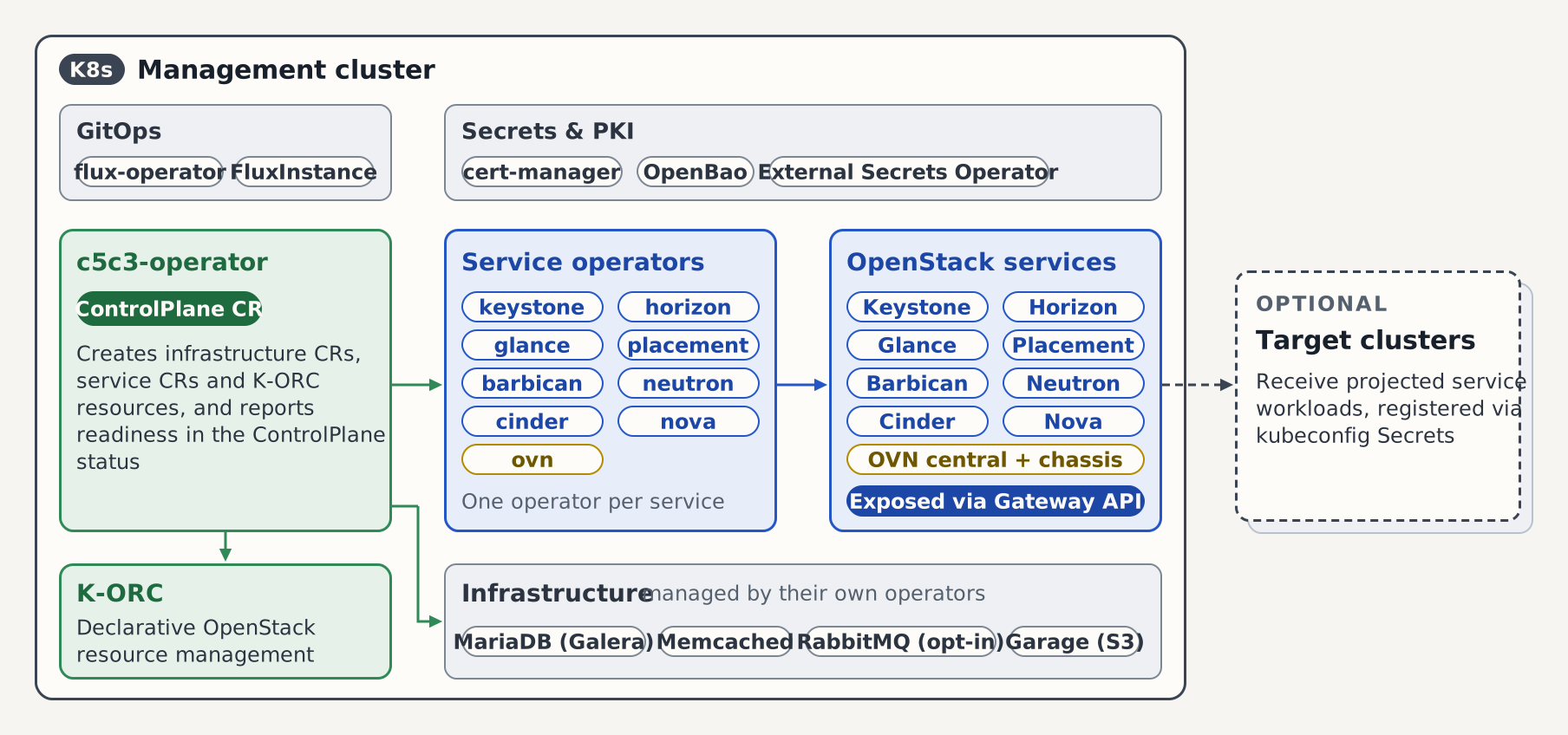
Controller Registration
The c5c3 operator registers two reconcilers and an optional webhook with the controller manager in operators/c5c3/main.go via the shared bootstrap package (github.com/c5c3/cobaltcore/internal/common/bootstrap). The bootstrap helper builds the manager, wires leader election, and invokes the operator's SetupFunc; the same pattern is documented in detail under Keystone Reconciler — Controller Registration.
import (
    "github.com/c5c3/cobaltcore/internal/common/bootstrap"
    c5c3v1alpha1 "github.com/c5c3/cobaltcore/operators/c5c3/api/v1alpha1"
    "github.com/c5c3/cobaltcore/operators/c5c3/internal/controller"
)

const leaderElectionID = "c5c3.openstack.c5c3.io"

bootstrap.Run(bootstrap.ManagerConfig{
    Scheme:           scheme,
    LeaderElectionID: leaderElectionID,
    TargetClusters:   true,
    SetupFunc: func(mcMgr mcmanager.Manager, opts bootstrap.SetupOptions) error {
        mgr := mcMgr.GetLocalManager()
        if opts.Controllers {
            if err := (&controller.ControlPlaneReconciler{
                Client:   mgr.GetClient(),
                Scheme:   mgr.GetScheme(),
                Recorder: mgr.GetEventRecorderFor("controlplane-controller"),
                Resolver: mcMgr,
            }).SetupWithManager(mcMgr); err != nil {
                return err
            }
            if err := (&controller.CredentialRotationReconciler{
                Client:   mgr.GetClient(),
                Scheme:   mgr.GetScheme(),
                Recorder: mgr.GetEventRecorderFor("credentialrotation-controller"),
            }).SetupWithManager(mgr); err != nil {
                return err
            }
        }
        if opts.Webhooks {
            return (&c5c3v1alpha1.ControlPlaneWebhook{Client: mgr.GetClient()}).
                SetupWebhookWithManager(mgr)
        }
        return nil
    },
})| Element | Value |
|---|---|
LeaderElectionID | c5c3.openstack.c5c3.io (a package-level constant in main.go; referenced by the deploy-stack RBAC and asserted by main_test.go so a rename cannot silently break leader election) |
| Primary reconciler | ControlPlaneReconciler (event recorder controlplane-controller), completed through the multicluster builder: it takes mcMgr, and its Resolver turns a service's targetClusterRef into the client that service's children are written with |
| Secondary reconciler | CredentialRotationReconciler (event recorder credentialrotation-controller), on the local manager: it only ever touches the management cluster |
TargetClusters | true: the binary engages the clusters registered in --clusters-namespace. The provider engages nothing while that namespace holds no registration Secret, which is the single-cluster default every existing install keeps |
| Webhook | ControlPlaneWebhook, registered only when bootstrap.Run passes opts.Webhooks == true to SetupFunc (the bootstrap layer resolves bootstrap.SetupOptions once from the flags). The reconcilers are registered only when opts.Controllers is true, which --enable-controllers=false clears for a standalone webhook deployment |
Scheme Registration
The operator registers these schemes in main.go's init() so the reconcilers can interact with the typed child CRDs:
| Module | Scheme | Types Used |
|---|---|---|
k8s.io/client-go/kubernetes/scheme | clientgoscheme.AddToScheme | core Kubernetes types (Secret, Event) |
github.com/c5c3/cobaltcore/operators/c5c3/api/v1alpha1 | c5c3v1alpha1.AddToScheme | ControlPlane, CredentialRotation, SecretAggregate (own API) |
github.com/c5c3/cobaltcore/operators/keystone/api/v1alpha1 | keystonev1alpha1.AddToScheme | Keystone (projected and owned child) |
github.com/c5c3/cobaltcore/operators/placement/api/v1alpha1 | placementv1alpha1.AddToScheme | Placement (projected and owned child) |
github.com/mariadb-operator/mariadb-operator | mariadbv1alpha1.AddToScheme | MariaDB (projected and owned child) |
github.com/external-secrets/external-secrets | esov1alpha1.SchemeBuilder | PushSecret (admin-credential mirror) |
github.com/external-secrets/external-secrets | esov1.SchemeBuilder | ExternalSecret, ClusterSecretStore, SecretStore (K-ORC clouds.yaml gate + per-ControlPlane store selection) |
github.com/k-orc/openstack-resource-controller/v3 | orcv1alpha1.AddToScheme | ApplicationCredential, Service, Endpoint |
Note (Memcached is unstructured):
memcached.c5c3.ioships no Go module, so theMemcachedchild is deliberately not registered in the scheme.reconcileInfrastructurebuilds and applies it as an*unstructured.Unstructuredcarrying the sharedmemcachedGVK(memcached.c5c3.io/v1beta1, kindMemcached), andSetupWithManagerOwnsthe same unstructured GVK. The GVK is resolved against the clusterRESTMapperat runtime, so no scheme entry is required.
Watches
The controller watches the primary ControlPlane CR, every child CR the sub-reconcilers project (including the owned ESO ExternalSecret and PushSecret), the admin-password Secret, and both OpenBao-backed store kinds (ClusterSecretStore and SecretStore):
| Resource | Watch Type | Effect |
|---|---|---|
ControlPlane | For() | Triggers reconciliation on CR changes |
MariaDB | Owns() | Re-reconciles the owning ControlPlane when the managed MariaDB child status changes |
Memcached (unstructured memcachedGVK) | Owns() | Re-reconciles when the managed Memcached child status changes; owned as *unstructured.Unstructured because the kind has no Go module |
Keystone | Owns() | Re-reconciles when the projected Keystone child status changes |
Horizon | Owns() | Re-reconciles when the projected Horizon dashboard child status changes |
Glance | Owns() | Re-reconciles when the projected Glance image-service child status changes |
GlanceBackend | Owns() | Re-reconciles when a projected GlanceBackend child status changes |
Placement | Owns() | Re-reconciles when the projected Placement child status changes |
Barbican | Owns() | Re-reconciles when the projected Barbican key-manager child status changes |
BarbicanSecretStore | Owns() | Re-reconciles when the projected BarbicanSecretStore status changes |
Neutron | Owns() + cross-namespace Watches() | Re-reconciles when the projected Neutron network-service child status changes. The neutron-operator is installed only for a ControlPlane that runs the network service, so both legs sit behind the discovery probe with the other sibling-operator kinds |
Cinder | Owns() + cross-namespace Watches() | Re-reconciles when the projected Cinder block-storage child status changes. The cinder-operator is installed only for a ControlPlane that runs the block-storage service, so both legs sit behind the discovery probe with the other sibling-operator kinds |
CinderBackend | Owns() + cross-namespace Watches() | Re-reconciles when a projected CinderBackend satellite status changes, under the same discovery guard as the Cinder kind |
CinderBackupBackend | Owns() + cross-namespace Watches() | Re-reconciles when the projected CinderBackupBackend satellite status changes, under the same discovery guard as the Cinder kind |
Nova | Owns() + cross-namespace Watches() | Re-reconciles when the projected Nova compute-service child status changes. The nova-operator is installed only for a ControlPlane that runs the compute service, so both legs sit behind the discovery probe with the other sibling-operator kinds |
OpenBaoCluster, OpenBaoTenant | Owns() | Re-reconciles when the OpenBao instance provisioned for a dedicated Barbican secret store, or the tenant admitting its namespace, changes. The openbao-operator is installed only for that mode, so a ControlPlane without one runs on a cluster that never serves these kinds; both legs sit behind the discovery probe with the other sibling-operator kinds (probeOptionalWatches, which skips the leg and registers a leader-gated re-check that restarts the operator once the CRD appears) |
RabbitmqCluster (unstructured rabbitmqClusterGVK) | Owns() + cross-namespace Watches() | Re-reconciles when the managed message-bus child status changes, so InfrastructureReady follows AllReplicasReady instead of waiting for the periodic requeue. Watched as *unstructured.Unstructured, since the c5c3 operator takes no dependency on the RabbitMQ Cluster Operator's Go module. Messaging is opt-in, so both legs sit behind the discovery probe with the openbao kinds: a cluster that does not serve rabbitmqclusters.rabbitmq.com starts without them, and crdWatchGate restarts the operator once the CRD appears |
NovaCompute | Watches() | Per-CR fan-out via novaComputeToControlPlaneMapper, matching the Nova namespace and the Nova name a pool's spec.novaRef names. Pools are user-authored and only read, for the clusters the compute contract is mirrored to, so they carry no owner reference. The predicate admits a pool being created, deleted or starting to be deleted, the events that change the mirror targets. The leg sits behind the discovery probe with the other nova-operator kinds |
NeutronMetadataAgent | Watches() | Per-CR fan-out via neutronMetadataAgentToControlPlaneMapper, waking every ControlPlane with services.nova and services.neutron whose OVN central namespace is the agent's namespace. Agents are user-authored and only read, for the clusters the metadata shared secret is copied to, so they carry no owner reference. neutronMetadataAgentDeliveryPredicate admits an agent being created, deleted or starting to be deleted, and a change of spec.novaMetadata.sharedSecretRef.name; status writes and generic events are dropped. The leg sits behind the discovery probe with the other neutron-operator kinds |
OVNCentral | Watches() | Per-CR fan-out via ovnCentralToControlPlaneMapper. The central is deployed outside the plane and only named by spec.services.neutron.ovn.centralRef, so it carries no owner reference an Owns() could match; the leg re-runs reconcileOVN when the central's status moves instead of waiting for the periodic requeue. The ovn-operator is installed only for a plane that runs a network service, so the leg sits behind the discovery probe with the other sibling-operator kinds |
SizingProfile | Watches() | Per-CR fan-out via sizingProfileToControlPlaneMapper, which lists every ControlPlane and enqueues those whose spec.sizing.profileRef.name names the event's profile. The kind is cluster-scoped and only referenced, so it carries no owner reference an Owns() could match. The watch is unconditional, because the CRD ships in the c5c3 chart; a List error is logged and drops the event. |
K-ORC ApplicationCredential | Owns() | Re-reconciles when the minted admin credential's Available condition or status.id changes |
K-ORC Service | Owns() | Re-reconciles when the identity catalog Service changes |
K-ORC Endpoint | Owns() | Re-reconciles when the public identity Endpoint changes |
K-ORC User, Domain | Owns() | Re-reconciles when the admin identity imports change. These, the ApplicationCredential, the identity Service/Endpoint and the adopted Region are the K-ORC CRs the ControlPlane itself owns (orcChildObjects) |
K-ORC Region | Owns() | Re-reconciles when the adopted bootstrap Region ({controlplane.Name}-region) reports status.id or its Available condition moves, which is what advances the two-phase description push |
K-ORC Project, Role, RoleAssignment | Owns() | Registered, but no CR the ControlPlane projects carries them any more. A registration's project, role imports and role assignments are claimed by its own KeystoneService (claimKeystoneServiceChild: a controller owner reference to the registration when co-located with it, ownership labels otherwise), never by the ControlPlane, so an Owns() leg keyed on a ControlPlane owner reference does not match them. Such a change wakes the registration's controller, and the ControlPlane sees it one step later when the registration's status moves, through the legs below |
ExternalSecret | Owns() | Re-reconciles when an owned ESO ExternalSecret (DB credential, admin password, K-ORC clouds.yaml) syncs or fails, so the credential conditions track ESO promptly |
PushSecret | Owns() | Re-reconciles when the owned admin-credential PushSecret status changes |
KeystoneService (co-located child) | Owns() | Re-reconciles when a registration child projected for a built-in service changes. Both gates the service legs apply are status-only reads, and the standalone mapper leg below drops exactly those writes, so without this leg a child going Ready would only reach the ControlPlane at the next periodic requeue |
KeystoneService (placed child) | Watches() | The label-predicate twin, for a registration child of a service placed in a namespace of its own, which can carry no owner reference |
KeystoneService (standalone) | Watches() | Per-CR fan-out via keystoneServiceToControlPlaneMapper, behind watch.CRUpdatePredicate(): which allowlisted namespaces host a registration is what decides where reconcileRegistrationTenantStores provisions a store, so a CR appearing or being deleted has to re-drive the plane. Such a CR is no child of the ControlPlane, so it is mapped by its own controlPlaneRef, and the predicate drops the KeystoneService controller's status-only writes, which cannot move the provisioning set |
Secret | Watches() | Maps Secret events to referencing ControlPlane CRs via the ControlPlaneSecretNameIndexKey field indexer (secretToControlPlaneMapper) |
ClusterSecretStore | Watches() | Per-ref fan-out via storeToControlPlaneMapper (bound to the shared watch.StoreRefFanOut for the cluster kind): a status change on a cluster-scoped store enqueues only the ControlPlanes whose effective spec.secretStoreRef resolves to it |
SecretStore | Watches() | The namespaced twin, scoped to the store's own namespace, so a ControlPlane pinned to a per-tenant SecretStore reacts to its backend health (storeToControlPlaneMapper for the namespaced kind) |
projected service children + Namespace (cross-namespace) | Watches() | Label-predicate twin of the Owns() rows for a service placed in a namespace of its own: a cross-namespace child carries no owner reference (Kubernetes forbids one), so Keystone / Horizon / Glance / GlanceBackend / Placement / Barbican / BarbicanSecretStore / Neutron / Cinder / CinderBackend / CinderBackupBackend / Nova / OpenBaoCluster / OpenBaoTenant / RabbitmqCluster / MariaDB / Memcached / ExternalSecret / KeystoneService — and the Namespace itself — are watched a second time through the ownership labels the projections stamp (crossNamespaceChildHandler gated by crossNamespaceChildPredicate), so same-namespace children keep flowing through Owns() alone and neither leg double-enqueues the other's objects |
The Secret watch uses Watches() with a MapFunc rather than Owns() because the admin-password Secret (spec.korc.adminCredential.passwordSecretRef) is typically ESO-managed — it is owned by the ExternalSecret controller, not by the ControlPlane CR — so an owner-reference filter would never match it. The index-backed namespace List is exactly what wakes the ControlPlane when its admin password rotates, so the re-mint chain (see K-ORC admin credential chain) converges on watch delivery instead of waiting for the next periodic requeue.
Both store watches are per-ref fan-outs rather than blanket enqueues: a status transition (for example ESO losing the backend connection) wakes only the ControlPlanes whose effective spec.secretStoreRef resolves to the changed store — the cluster watch lists every namespace, the namespaced watch only the store's own. A ControlPlane pinned to a different store stays untouched. This is why the DB-credential, admin-password, and admin-credential sub-reconcilers can flip their conditions to SecretStoreNotReady the moment the ControlPlane's own backend becomes unreachable instead of waiting up to a full ESO refresh interval (default 1h) for the next per-secret re-sync. The ExternalSecret/PushSecret children are owned (controller reference), so Owns() wires them directly.
Target-cluster watch legs
Every leg above is pinned to the management cluster, with EngageLocalCluster and EngageNoProviderClusters on each one. The ControlPlane CR, the K-ORC CRs, and the service CRs live there whatever a service names, so a provider-cluster leg would only watch objects this operator never wrote.
The kinds the ControlPlane writes into the namespace of a service placed on a target cluster take the opposite pinning: no local engagement, provider clusters only, and a per-cluster filter (ClusterServesKind) that skips the leg on a cluster not serving the kind. Eleven kinds are watched that way: MariaDB, Memcached, Certificate, ExternalSecret, PushSecret, VaultDynamicSecret, SecretStore, Secret, OpenBaoCluster, OpenBaoTenant, and Namespace. Memcached and Certificate are watched as *unstructured.Unstructured under the same memcachedGVK / certificateGVK values the local legs use, neither kind having a Go module the operator can type against. Secret and SecretStore carry two legs each: one maps a child back through its ownership labels, the other maps an input through the same mapper the management-side watch uses. The workqueue deduplicates what the two produce.
What keeps a registered cluster from reaching a ControlPlane that never named it is RemoteRequestsAmong. For every request a mapper produces it reads that ControlPlane on the management cluster and compares the cluster the event arrived from against TargetClusterNames(), the deduplicated set of the eight per-service refs; a cluster outside the set drops the event. The set comes from the CR, never from the object that raised the event, so an object planted in a shared namespace on any registered cluster cannot name a ControlPlane it does not belong to. A CR already deleted answers NotFound and the event is dropped in silence; any other read error is logged and the event dropped too. Surviving requests carry no cluster name, so the reconcile they trigger runs against the management cluster, where the CR is.
Secret Field Indexer
The controller registers a controller-runtime field indexer on the ControlPlane kind so that a Secret event resolves to the referencing ControlPlane CR(s) via an O(1) cache lookup instead of an unfiltered namespace-scoped List, mirroring the keystone operator's KeystoneSecretNameIndexKey.
| Aspect | Value |
|---|---|
| Index key | ControlPlaneSecretNameIndexKey = "spec.korc.adminCredential.passwordSecretRef.name" (exported package-level constant in operators/c5c3/internal/controller/controlplane_controller.go) |
| Indexed fields | spec.korc.adminCredential.passwordSecretRef.name (the effective admin-password Secret), the CA bundle of the Keystone endpoint K-ORC dials, and spec.services.nova.remoteCompute.transportURLSecretRef.name while that block is set, deduplicated. The extractor (controlPlaneSecretNameExtractor) returns an empty slice when the name is unset so an unset field does not pollute the index, and returns nil if invoked with the wrong type rather than panicking. |
| Registration site | SetupWithManager → registerControlPlaneSecretNameIndex(ctx, local.GetFieldIndexer()), invoked before the Watches(Secret, …) chain. It goes on the local field indexer rather than the multicluster manager's: with a provider configured, that one registers its indexes against the target clusters, which hold no ControlPlane CR, and applying it while engaging a cluster would fail that engagement. Every request the legs emit is pinned to the management cluster, so a remote event still resolves its CR through this index. Any error from IndexField is wrapped with the index key and propagated, so manager startup aborts loudly if registration fails. |
| Lookup site | secretToControlPlaneMapper(local.GetClient()) — performs a namespace-scoped client.List with client.MatchingFields{ControlPlaneSecretNameIndexKey: secret.Name}. On List error the error is logged via log.FromContext and the mapper returns nil per the handler.MapFunc contract (it must not return errors). |
| Result | Each matching ControlPlane in the Secret's namespace is enqueued as a reconcile.Request; an event matching no ControlPlane returns nil. |
Why no owner-ref fallback? Unlike the keystone operator, the c5c3 Secret mapper has a pure index-backed lookup with no owner-reference fallback branch — the ControlPlane projects no rotation-staging Secrets that are owned-but-unreferenced, so the union/owner-ref complexity of
secretToKeystoneMapperis not needed here.
Reconciler Struct
type ControlPlaneReconciler struct {
    client.Client
    Scheme   *runtime.Scheme
    Recorder record.EventRecorder
}| Field | Type | Purpose |
|---|---|---|
Client | client.Client | Kubernetes API client for CRUD operations (embedded) |
Scheme | *runtime.Scheme | Runtime scheme for owner-reference resolution |
Recorder | record.EventRecorder | Records Kubernetes events for state transitions |
The CredentialRotationReconciler has the identical three-field shape (client.Client embedded, Scheme, Recorder).
RBAC Permissions
RBAC markers on the two reconcilers generate the required ClusterRole. The ControlPlaneReconciler markers (in controlplane_controller.go):
| API Group | Resources | Verbs |
|---|---|---|
c5c3.io | controlplanes | get, list, watch, create, update, patch, delete |
c5c3.io | controlplanes/status | get, update, patch |
c5c3.io | controlplanes/finalizers | update |
c5c3.io | credentialrotations | get, list, watch, create, update, patch, delete |
c5c3.io | credentialrotations/status | get, update, patch |
c5c3.io | secretaggregates, sizingprofiles | get, list, watch |
scheduling.k8s.io | priorityclasses | get |
k8s.mariadb.com | mariadbs | get, list, watch, create, update, patch, delete |
memcached.c5c3.io | memcacheds | get, list, watch, create, update, patch, delete |
rabbitmq.com | rabbitmqclusters | get, list, watch, create, update, patch, delete |
keystone.openstack.c5c3.io | keystones | get, list, watch, create, update, patch, delete |
placement.openstack.c5c3.io | placements | get, list, watch, create, update, patch, delete |
barbican.openstack.c5c3.io | barbicans, barbicansecretstores | get, list, watch, create, update, patch, delete |
neutron.openstack.c5c3.io | neutrons | get, list, watch, create, update, patch, delete |
neutron.openstack.c5c3.io | neutronmetadataagents | get, list, watch |
cinder.openstack.c5c3.io | cinders, cinderbackends, cinderbackupbackends | get, list, watch, create, update, patch, delete |
nova.openstack.c5c3.io | novas | get, list, watch, create, update, patch, delete |
ovn.openstack.c5c3.io | ovncentrals | get, list, watch |
openbao.org | openbaoclusters, openbaotenants | get, list, watch, create, update, patch, delete |
rbac.authorization.k8s.io | roles, rolebindings, clusterrolebindings | get, create, patch, delete |
rbac.authorization.k8s.io | clusterroles (resourceNames: system:auth-delegator) | bind |
openstack.k-orc.cloud | applicationcredentials, services, endpoints, regions, users, domains, projects, roles, roleassignments | get, list, watch, create, update, patch, delete |
openstack.k-orc.cloud | applicationcredentials/status, services/status, endpoints/status, regions/status, users/status, domains/status, projects/status, roles/status, roleassignments/status | patch |
external-secrets.io | externalsecrets, pushsecrets | get, list, watch, create, update, patch, delete |
external-secrets.io | clustersecretstores, secretstores | get, list, watch |
generators.external-secrets.io | vaultdynamicsecrets, passwords | get, list, watch, create, update, patch, delete |
core | secrets | get, list, watch, create, update, patch, delete |
core | events | create, patch |
The sizingprofiles grant serves the Sizing step's read of the referenced profile and the watch on the kind. The ControlPlane and SizingProfile webhooks run under the same identity and look up the PriorityClasses a sizing names, which is what the priorityclasses grant is for.
The patch grant on the K-ORC status subresources lets the reconcilers clear a latched K-ORC transport error from a child's status (unlatchKORCTransportErrors in korc_unlatch.go).
The CredentialRotationReconciler markers (in reconcile_credentialrotation.go) are scoped tighter — it never mints, so it holds only update/patch (not create/delete) on K-ORC applicationcredentials and read-only access to controlplanes:
| API Group | Resources | Verbs |
|---|---|---|
c5c3.io | credentialrotations | get, list, watch, create, update, patch, delete |
c5c3.io | credentialrotations/status | get, update, patch |
c5c3.io | controlplanes | get, list, watch |
openstack.k-orc.cloud | applicationcredentials | get, list, watch, update, patch |
core | secrets | get, list, watch |
core | events | create, patch |
Blast radius and namespace scoping
By default the chart binds these markers to a cluster-wide ClusterRole, so the secrets rule lets a compromised operator pod read and write every Secret in every namespace; the Multi-Tenant Deployment → Security trade-off details that privilege-escalation path. Two specifics apply to this operator:
- It amplifies the exposure itself:
reconcileAdminPasswordandreconcileKORCproject the OpenStack admin password in cleartext into aclouds.yamlSecret, so cluster-wide read access exposes every projected admin password. - It writes RBAC. The dedicated Barbican secret store needs
get,create,patch, anddeleteonroles,rolebindings, andclusterrolebindingsto give the OpenBao instance its TokenReview and the barbican operator a bound provisioner token. What a forged binding can grant is still capped by the API server's privilege-escalation check: the operator holdsescalatenowhere andbindonly onsystem:auth-delegator(narrowed byresourceNames), so it can hand out no permission it does not already hold. The cluster-wide Secret read therefore remains the dominant risk.
The c5c3-operator chart refuses rbac.namespaceScoped: true: the render fails with rbac.namespaceScoped=true is not supported by c5c3-operator. The ControlPlane controller watches the cluster-scoped Namespace, SizingProfile and ClusterSecretStore kinds and creates ClusterRoleBinding objects. A namespaced Role grants none of them, so the manager would fail its cache sync at startup. Placing a service in a dedicated namespace needs the cluster-scoped namespaces verbs as well, which is why the markers add core/namespaces with get;list;watch;create;delete. See When cluster-wide RBAC is still required.
Reconciliation Flow
A pass runs a blocking prefix of seven steps and then one group of fourteen members that all run. The figure draws an arrow only where one condition gates another.
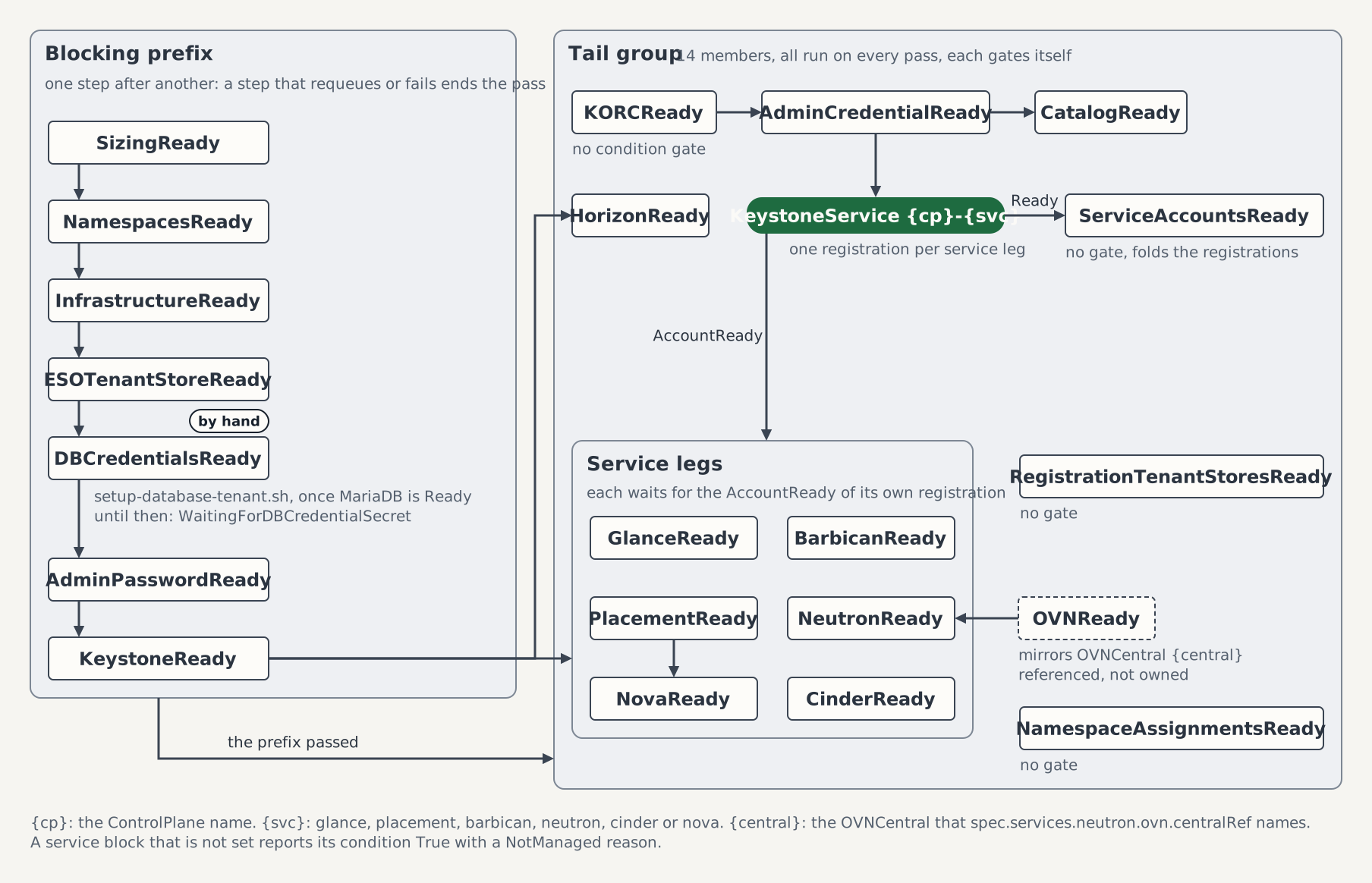
One pass, in order:
- Fetches the ControlPlane.
NotFoundends the pass with an empty result. - Hands a ControlPlane that carries a deletion timestamp to
reconcileDelete(see Owner-ref / GC model). - Runs the duplicate guard: every ControlPlane but the oldest in a namespace is parked with
Ready=False/DuplicateControlPlaneand requeued after 30s, and none of its sub-reconcilers run (see Multi-instance). - Installs the finalizer
c5c3.io/orc-teardown, andopenstack.c5c3.io/remote-childrenonce a target cluster the spec names resolves. A pass that installs one ends with a requeue. - Runs the blocking prefix through
RunPipeline, rows 1 to 7 below. The first step that returns a requeue or an error ends the pass. - Runs the tail group through
RunSequentialGroup, rows 8 to 21. Every member runs. Member requeues collapse to the shortest (ShortestRequeue), member errors are joined (errors.Join). - Calls
updateStatus()on every exit path of steps 5 and 6: it recomputes the aggregateReadyasAllTrue(subConditionTypes), writesstatus.services, stampsstatus.observedGeneration, and skips the write when nothing changed.
The 21 sub-reconcilers, in call order. The Gate column names the conditions a step checks itself and, after them, what else it waits for. A prefix step also runs only after the step before it has converged.
| # | Step | Sets | Gate | Does | Requeue |
|---|---|---|---|---|---|
| 1 | reconcileSizing | SizingReady | nothing | Resolves spec.sizing from the built-in profile or a SizingProfile | none: a missing or unreadable profile returns the error |
| 2 | reconcileNamespaces | NamespacesReady | nothing | Ensures or verifies the namespaces services are placed in. True/NoDedicatedNamespaces when no service declares one | 15s while a namespace is unusable |
| 3 | reconcileInfrastructure | InfrastructureReady | nothing | Ensures the managed MariaDB, Memcached and RabbitMQ children | 15s while a child is not Ready |
| 4 | reconcileESOTenantStore | ESOTenantStoreReady | nothing | Provisions ServiceAccount, client Certificate and the SecretStore openbao-tenant-store in every namespace the ControlPlane occupies. True/StoreRefOverridden when spec.secretStoreRef is set | 10s while a store is not Ready |
| 5 | reconcileDBCredentials | DBCredentialsReady | the secret store, and in Dynamic mode the tenant onboarding a person runs (setup-database-tenant.sh) | Projects the DB-credential ExternalSecret of Keystone | 10s while it has not synced (WaitingForDBCredentialSecret) |
| 6 | reconcileAdminPassword | AdminPasswordReady | the secret store | Projects the admin-password ExternalSecret | 10s while it has not synced |
| 7 | reconcileKeystone | KeystoneReady | InfrastructureReady | Projects the Keystone child | 5s gated, 15s while the child is not Ready |
| 8 | reconcileHorizon | HorizonReady | KeystoneReady | Projects the Horizon child | 5s gated, 15s child |
| 9 | reconcileKORC | KORCReady | no condition. The admin-password Secret, and the Keystone CA bundle when one is referenced | Writes the password-based clouds.yaml, has K-ORC mint the admin ApplicationCredential, and drives a re-mint | 10s |
| 10 | reconcileAdminCredential | AdminCredentialReady | KORCReady | Assembles the credential Secret, pushes it to OpenBao and waits until k-orc-clouds-yaml carries it | 10s |
| 11 | reconcileCatalog | CatalogReady | AdminCredentialReady | Managed mode: registers the identity Service, its public Endpoint and the adopted Region. External mode: imports the catalog | 10s |
| 12 | reconcileGlance | GlanceReady | KeystoneReady. Then its registration's AccountReady and its DB credential | Projects the KeystoneService registration, the DB credential, the Glance child and its backends | 5s gated, 10s registration or DB credential, 15s child |
| 13 | reconcilePlacement | PlacementReady | KeystoneReady. Then its registration's AccountReady and its DB credential | Projects the registration, the DB credential and the Placement child | 5s gated, 10s registration or DB credential, 15s child |
| 14 | reconcileBarbican | BarbicanReady | KeystoneReady. Then its registration's AccountReady, its DB credential, and on a dedicated secret store the OpenBao instance serving (WaitingForOpenBaoInstance) | Projects the registration, the DB credential, the dedicated OpenBao instance, the secret store and the Barbican child | 5s gated, 10s registration or DB credential, 15s instance or child |
| 15 | reconcileOVN | OVNReady | nothing | Reads the OVNCentral that services.neutron.ovn.centralRef names and mirrors its readiness. Writes nothing | 15s while the central is not usable |
| 16 | reconcileNeutron | NeutronReady | KeystoneReady, OVNReady. Then the message bus delivered into its namespace, its registration's AccountReady (and the notifier's while Nova is set) and its DB credential | Delivers the bus, projects the registrations, the DB credential and the Neutron child | 5s gated, 15s bus or child, 10s registration or DB credential |
| 17 | reconcileCinder | CinderReady | KeystoneReady. Then the bus, its registration's AccountReady and its DB credential | Delivers the bus, projects the registration, the DB credential, the CinderBackend and CinderBackupBackend satellites and the Cinder child | 5s gated, 15s bus or child, 10s registration or DB credential |
| 18 | reconcileNova | NovaReady | KeystoneReady, PlacementReady. Then the bus, its registration's AccountReady and its two DB credentials | Delivers the bus, projects the registration, the two DB credentials, the metadata shared secret and the Nova child, then the hypervisor operator's account when it is set | 5s gated, 15s bus or child, 10s registration or DB credential |
| 19 | reconcileServiceAccounts | ServiceAccountsReady | nothing | Folds the Ready of the registrations the legs projected, up to eight | 10s while one is not Ready |
| 20 | reconcileRegistrationTenantStores | RegistrationTenantStoresReady | nothing | Provisions the tenant-store trio in each allowlisted namespace that holds a registration. True/NoRegistrationNamespaces when there is none | 10s while a store is not Ready |
| 21 | reconcileNamespaceAssignments | NamespaceAssignmentsReady | nothing | Reports every spec.namespaceAssignments entry in status.namespaceAssignments. True/NoNamespaceAssignments when there is none | 1m while an entry is not Assigned |
A service whose block is not set reports its condition True with a NotManaged reason, so the aggregate is not blocked: KeystoneNotManaged, HorizonNotManaged, GlanceNotManaged, PlacementNotManaged, BarbicanNotManaged, OVNNotManaged, NeutronNotManaged, CinderNotManaged, NovaNotManaged.
Execution Model
The chain runs in two phases over the shared scaffolding in internal/common/reconcile (the same building blocks the keystone controller uses). Every step is a commonreconcile.Step, and the whole table is driven by one commonreconcile.RunPipeline call:
Phase 1 — the blocking prefix. Sizing → Namespaces → Infrastructure → ESOTenantStore → DBCredentials → AdminPassword → Keystone run as seven named, short-circuiting Step entries. RunPipeline returns the pass at the first non-zero result or error, because each step genuinely feeds the next — a later step applying before its predecessor converged would fail or wedge. Each named step is wrapped in instrumenter.Instrument (see Metrics Instrumentation) so a duration sample and an error counter are emitted under a stable sub_reconciler label.
Phase 2 — the tail group. Horizon, KORC, AdminCredential, Catalog, Glance, Placement, Barbican, OVN, Neutron, Cinder, Nova, ServiceAccounts, RegistrationTenantStores and NamespaceAssignments are the fourteen named members of one commonreconcile.RunSequentialGroup, embedded as the pipeline's final bare (unnamed) Step. The group members self-instrument through instrumenter.Instrument — following the keystone self-instrumenting-group convention — which is why the enclosing group step carries no sub_reconciler name of its own. RunSequentialGroup attempts every member on every pass and never short-circuits: each member self-gates on the conditions it needs (Horizon on KeystoneReady; KORC until the admin-password Secret is readable; AdminCredential on KORCReady; Catalog on AdminCredentialReady; Glance, Placement, Barbican, Neutron, Cinder and Nova on KeystoneReady and on the AccountReady of the KeystoneService registration each projects for itself, see Built-in service registrations), so running all of them each pass is safe. Barbican carries one gate the others do not: on a dedicated secret store it holds the projection until the OpenBao instance it provisions serves requests. Neutron, Cinder and Nova also wait for the shared message bus to be delivered into their namespace. Neutron gates on OVNReady as well, and Nova on PlacementReady. OVN itself carries none, because the OVNCentral it mirrors is deployed outside the plane and nothing this chain produces can converge it.
Of the three members that close the group, the first depends on its order in it. ServiceAccounts carries no gate: it only folds the registration children the service legs wrote earlier in the same pass, so it must run after them and has nothing to defer. RegistrationTenantStores carries no gate either. It consumes no condition this chain produces — the trio it writes depends on cert-manager and OpenBao alone, exactly like its blocking-prefix twin — and sits in the group rather than in that prefix so a namespace the control plane does not own can never park DBCredentials, AdminPassword and Keystone behind it. NamespaceAssignments carries no gate and only reads (see reconcileNamespaceAssignments).
pipeline := []commonreconcile.Step{
    {Name: "Sizing", Fn: func(ctx context.Context) (ctrl.Result, error) {
        return r.reconcileSizing(ctx, &cp)
    }},
    {Name: "Namespaces", Fn: func(ctx context.Context) (ctrl.Result, error) {
        return r.reconcileNamespaces(ctx, &cp)
    }},
    // ... Infrastructure, ESOTenantStore, DBCredentials, AdminPassword, Keystone
    //     — the blocking prefix, each short-circuiting via RunPipeline.
    //
    // The independent tail projections run as one self-instrumenting,
    // non-short-circuiting group embedded as the final bare Step:
    {Fn: func(ctx context.Context) (ctrl.Result, error) {
        return commonreconcile.RunSequentialGroup(ctx, instrumenter.Instrument,
            []commonreconcile.Step{
                {Name: "Horizon", Fn: /* ... */},
                // KORC, AdminCredential, Catalog, Glance, Placement,
                // Barbican, OVN, Neutron, Cinder, Nova, ServiceAccounts,
                // RegistrationTenantStores, NamespaceAssignments
            })
    }},
}
result, err := commonreconcile.RunPipeline(ctx, instrumenter.Instrument, pipeline)
return r.updateStatus(ctx, &cp, statusBefore, result, err)
This guarantees:
- Prefix (phase 1) — unchanged early-return semantics. A prefix sub-reconciler error propagates immediately and a non-zero result (
RequeueAfter > 0) causes an early return; either way the subsequent prefix steps and the whole tail group are skipped for that pass. - Group (phase 2) — every member runs each pass. No member's non-zero result or error prevents a later member from running, so a still-converging or failing Horizon no longer parks KORC, the AdminCredential/Catalog identity bootstrap, Glance, Placement, Barbican, OVN, Neutron, Cinder, Nova, or the four members that close the group. Each member's condition therefore always persists.
- Group result aggregation. When no member errors, the group result is the shortest member requeue (
commonreconcile.ShortestRequeue) and the error is nil. When one or more members error, the group returnsctrl.Result{}and theerrors.Joinof every member error — member requeues are discarded, and controller-runtime's error backoff drives the retry. - Status always persisted. Whichever phase ends the pass, its outcome funnels through
updateStatus(), so the conditions and the(result, error)pair are persisted by construction on every exit path.
Onboarding rule. A future service whose projection is independent of the others — it self-gates on the conditions it needs rather than being a hard prerequisite for a later step — joins the tail group, not the blocking prefix. Only a projection that genuinely feeds the next step belongs in the prefix.
Status Update Pattern
updateStatus() delegates to the shared commonreconcile.UpdateStatus: it stamps cp.Status.ObservedGeneration = cp.Generation, records the per-service status (setServicesStatus(), see below), persists all condition changes via r.Status().Update(), and returns the provided (result, error) pair.
Reconcile snapshots cp.Status immediately after the initial Get and threads that snapshot into updateStatus, which compares the computed status against it with equality.Semantic.DeepEqual and skips the write when a pass left status unchanged — no write means no watch event and no resourceVersion churn on a converged steady-state pass. Together with the watch.CRUpdatePredicate on the controller's For(...) watch (which filters the CR's own status-only updates), this closes the self-wake loop the previous always-write updateStatus and bare For() allowed.
When both a reconcile error and the status update fail, both errors are preserved via errors.Join so the original reconcile failure remains visible in controller-runtime logs:
| reconcileErr | Status().Update() | Returned error |
|---|---|---|
| nil | succeeds | nil |
| non-nil | succeeds | reconcileErr (unchanged) |
| nil | fails | errors.Join(nil, fmt.Errorf("updating status: %w", statusErr)) |
| non-nil | fails | errors.Join(reconcileErr, fmt.Errorf("updating status: %w", statusErr)) |
Because ObservedGeneration is stamped on every updateStatus call (early return or final), a stale status is always distinguishable from a current one.
Ready Condition Aggregation
On every status write, including a pass that ends early, setReadyCondition() evaluates whether every sub-condition type is True using aggregateReady(), which delegates to conditions.AllTrue(conds, subConditionTypes...):
| All Sub-Conditions True | Ready Condition | Reason | Message |
|---|---|---|---|
| Yes | Status: True | AllReady | All sub-conditions are ready |
| No (any missing or False) | Status: False | NotAllReady | One or more sub-conditions are not ready |
The aggregated sub-condition types (the source-of-truth subConditionTypes slice in controlplane_controller.go) are:
SizingReady, NamespacesReady, InfrastructureReady, ESOTenantStoreReady, DBCredentialsReady, KeystoneReady, HorizonReady, GlanceReady, PlacementReady, BarbicanReady, OVNReady, NeutronReady, CinderReady, NovaReady, KORCReady, AdminCredentialReady, AdminPasswordReady, CatalogReady, ServiceAccountsReady, RegistrationTenantStoresReady, NamespaceAssignmentsReadyThe Ready condition carries ObservedGeneration = cp.Generation so clients can detect a stale aggregate.
One path bypasses the aggregation entirely: a ControlPlane parked by the duplicate guard (see Multi-instance) gets Ready=False with reason DuplicateControlPlane written directly — setReadyCondition() would otherwise overwrite the reason with NotAllReady on the next status update.
Services and Update Phase
setServicesStatus() runs on every updateStatus call and populates two status fields that the schema declared but the reconciler previously never wrote:
| Field | Value |
|---|---|
status.updatePhase | Fixed at Idle — the release-update state machine is not implemented and the other UpdatePhase values are reserved, so "no update in progress" is the current state |
status.services | one entry per managed service, in a stable order: keystone (present when spec.services.keystone is set), then horizon (present when spec.services.horizon is set), then glance (present when spec.services.glance is set), then placement (present when spec.services.placement is set), then barbican (present when spec.services.barbican is set), then neutron (present when spec.services.neutron is set), then cinder (present when spec.services.cinder is set), then nova (present when spec.services.nova is set). Each entry's ready mirrors the matching KeystoneReady / HorizonReady / GlanceReady / PlacementReady / BarbicanReady / NeutronReady / CinderReady / NovaReady sub-condition (via conditions.AllTrue) and release is spec.openStackRelease; an unmanaged service is omitted rather than reported |
Sub-Reconciler Contracts
Each sub-reconciler owns exactly one Ready sub-condition. The tables below give each one's gate, what it projects/owns, and the condition reasons it sets on the True, requeue, and error paths. All condition constants are the exported source-of-truth strings in controlplane_controller.go; sub-reconcilers reference the constants (never inline literals) so a rename is a compile error and is caught by the no-inline-literals drift guard.
Every condition is stamped with ObservedGeneration = cp.Generation on every path.
Which cluster a sub-reconciler writes to. A sub-reconciler that projects into a service namespace does not reach for the reconciler's own client. It resolves one per namespace through childrenClientFor, which maps the namespace to the target cluster of the service placed there and hands back that cluster's client. The ControlPlane's own namespace answers with the local client, and so does any namespace no placed service declares. Co-located services cannot disagree about the answer, because admission rejects a shared namespace whose services name different clusters, so the namespace alone decides. An ensemble that spans several namespaces resolves all of them through childrenClientsFor before its first write: a cluster that does not resolve then leaves the whole ensemble unwritten rather than half of it, under TargetClusterUnavailable on the sub-reconciler's own condition, carrying the resolver's message verbatim (cluster not found for a name that was never registered).
A nil Resolver resolves nothing. The reconciler is then running without a multicluster manager, which is how the unit tests and the single-cluster envtest fixtures construct it, and every namespace answers with the local client whatever the spec names.
External keystone mode and the chain
When spec.services.keystone.mode is External, the ControlPlane manages identity against a pre-existing, externally-operated Keystone. The chain keeps its order; External mode changes what each link does. Four sub-reconcilers short-circuit — reconcileInfrastructure, reconcileDBCredentials, reconcileAdminPassword and reconcileKeystone — each reporting its own condition with Status=True and reason ExternallyManaged, and a message naming spec.services.keystone.external.authURL.
Skipped sub-reconcilers keep their condition types. The condition schema is therefore identical across modes, so subConditionTypes, setReadyCondition and the condition_type drift guard need no mode awareness.
Every skip is keyed on the mode discriminator cp.IsExternalKeystone(), never on the database shape: an External-mode ControlPlane has no spec.infrastructure block at all, so "no managed database" and "no database" are different states. The vocabulary keeps three "nothing was projected" reasons deliberately apart:
| Reason | Meaning |
|---|---|
ExternallyManaged | identity is managed against a pre-existing Keystone; this sub-reconciler has nothing to project |
KeystoneNotManaged | spec.services.keystone is unset: there is no identity plane at all (staged adoption) |
BrownfieldUserSuppliedCredential | the ControlPlane owns a Keystone, but the database is brownfield, so the user supplies its credential Secret |
services.horizon is forbidden in External mode, so reconcileHorizon always takes its HorizonNotManaged early-exit. The duplicate-ControlPlane parking guard is mode-agnostic and applies unchanged — External-mode ControlPlanes count towards the one-per-namespace contract.
reconcileCatalog neither skips nor behaves as it does in Managed mode: it forks. The catalog belongs to the external installation, so External mode is import-first — the existing identity service and its endpoints are imported read-only, zero catalog entries are created by default, and an import that resolves to nothing fails loud rather than waiting forever. See reconcileCatalog.
Egress and TLS posture
K-ORC — not the c5c3-operator — is what dials the external Keystone. It is installed by the Flux Kustomization deploy/flux-system/releases/k-orc.yaml into the orc-system namespace, and the operator never opens an OpenStack connection itself: everything stays K-ORC-mediated.
- Egress. No
NetworkPolicyexists anywhere underdeploy/, and none scopesorc-system, so nothing restricts K-ORC's egress on the shipped stack — out-of-cluster Keystone worked first-pass in the phase-1 spike. A cluster that applies a default-deny egress policy toorc-systemmust add an explicit allow rule to the external endpoint's host and port, or every mint, import and catalog call fails asEndpointUnreachable. - TLS. An IP-based
authURLrequires an IP SAN in the external Keystone's server certificate — a CN or DNS SAN alone will not verify. Hostnames resolve through cluster DNS via the upstream forwarder, so no extra DNS wiring is needed. A privately-signed certificate needsspec.services.keystone.external.caBundleSecretRef; without it K-ORC reports anx509failure, classified ontoKORCReady=False/TLSVerificationFailed. - CA-cache aliasing. K-ORC's provider-client cache keys on the parsed cloud struct only —
cacertis not part of the key (internal/scope/provider.go) — and the entry lives for the token lifetime / 2 (≈30 min at Keystone defaults). A rotated or removed CA bundle therefore converges the Secrets immediately but the trust store only after cache expiry. Nothing in this operator can shorten that window; an upstream fix would have to foldcacertinto the cache key.
Reaching a placed service
An in-cluster Service DNS name resolves only inside the cluster the Service runs on. Every URL the ControlPlane composes therefore depends on where the two ends sit, and the rule is the same everywhere: the in-cluster URL while both resolve to the same cluster (sameTargetCluster compares the two targetClusterRefs, with "no ref" meaning the management cluster), the public URL as soon as they do not.
- The seven dependents of Keystone.
horizonKeystoneEndpoint,glanceKeystoneEndpoint,placementKeystoneEndpoint,barbicanKeystoneEndpoint,neutronKeystoneEndpoint,cinderKeystoneEndpointandnovaKeystoneEndpointcompare their own service's ref against Keystone's. A service that shares Keystone's cluster keeps the conventionalhttp://{controlplane.Name}-keystone.<keystone-namespace>.svc:5000/v3; one on another cluster getskeystonePublicEndpoint—services.keystone.publicEndpointwhen set, else the gateway-derivedhttps://{gateway.hostname}/v3. - K-ORC and the service accounts.
korcAuthURLtakes the cluster the document is CONSUMED on and answers by the same rule. The two admin documents are read by K-ORC, which always runs on the management cluster wherever the ControlPlane places its services, so they render the public URL as soon as Keystone names a cluster — a placed Keystone's Service DNS name is an address K-ORC cannot dial. A registration'sclouds.yamlis rendered with no target-cluster ref, because a registration is delivered on the management cluster. It resolves like a document read there. External mode is untouched, and a co-located Keystone renders the in-cluster URL byte for byte as before. - The catalog. A placed service registers its public URL on its
internalinterface as well as itspublicone (internalCatalogURL), because that entry is what K-ORC and every consumer outside the service's cluster resolve. The identity row is unaffected: it registers a public interface only.
Admission is what keeps those public URLs from being empty. A placed catalog service (keystone, glance, placement, barbican, neutron, cinder, nova) must declare a publicEndpoint or a gateway, and Keystone must declare one as soon as ANY other service is placed away from it — the per-service rule only reaches a service carrying a ref of its own, so an unplaced Keystone would otherwise leave every dependent child with an empty spec.keystoneEndpoint its own CRD refuses. A placed Keystone's endpoint must additionally use https, because placement promotes it to the auth_url the credential documents render passwords next to. Composing those URLs is where this ends: making them routable between clusters is the deployment's job, a gateway or a load balancer per target cluster.
Projected satellites and the shared bus
Two shapes recur across services: a satellite child projected per spec entry, and the ControlPlane-wide message bus delivered into a service's namespace. Each is implemented once, and a service opts in by naming itself.
projectedChildren names one projected satellite kind of one service: an empty typed list, the kind name every wrapped error carries, the namespace the children live in, the name prefix every projected child carries, and a Keep set of names never deleted and never reported (nil keeps nothing). ownedProjectedChildren lists the kind in that namespace on the management client and returns, in list order, the objects this ControlPlane owns (isControlPlaneChild) whose name carries the prefix and is not in Keep.
pruneProjectedChildren is the reconcile-time arm. It deletes those objects with background propagation and ignores NotFound, so a child the projection no longer declares is removed on the same pass. sweepProjectedChildren is the teardown arm: a child already Terminating is reported without a second delete, and every owned child is reported as namespace/name for teardownDedicatedNamespaces to wait on. An absent satellite CRD (meta.IsNoMatchError on the List) is nothing to sweep. That is the reading deleteORCResources applies to an absent K-ORC stack, and it lets a ControlPlane whose service operator was uninstalled first finish deleting.
Each service supplies a constructor: glanceBackendChildren for the GlanceBackend kind under the {controlplane.Name}-glance- prefix (see reconcileGlance), barbicanSecretStoreChildren for the BarbicanSecretStore kind under {controlplane.Name}-barbican- (see reconcileBarbican), and cinderBackendChildren / cinderBackupBackendChildren for the two satellite kinds of the block-storage service (see reconcileCinder).
| Site | Helper | Keep |
|---|---|---|
reconcileGlanceBackends | pruneProjectedChildren | the backend names the pass declared |
deleteOrphanedGlance | pruneProjectedChildren | nil |
reconcileBarbicanSecretStore | pruneProjectedChildren | the store the projection names |
reconcileCinderBackends | pruneProjectedChildren | the backend names the pass declared |
reconcileCinderBackupBackend | pruneProjectedChildren | the backup-backend name the projection declares, nil when the block is unset |
deleteOrphanedCinder, both satellite kinds | pruneProjectedChildren | nil |
deleteServiceChildrenIn, Glance namespace | sweepProjectedChildren | nil |
deleteServiceChildrenIn, Barbican namespace | sweepProjectedChildren | barbicanSecretStoreName(cp) |
deleteServiceChildrenIn, Cinder namespace, both satellite kinds | sweepProjectedChildren | nil |
The Barbican teardown keeps the projected store because crossNamespaceServiceChildren already holds it in the wait set, so the sweep reports it once.
The two Cinder constructors carry Prefix: "", so ownership alone selects their satellites. A CinderBackend is named after its services.cinder.backends entry rather than after the ControlPlane, because cinder keys every volume by the backend it was created on and a rename would strand the volumes already there, so there is no prefix to recognise it by. The bare name is also what a person naming a hand-made object of that kind picks, which is why every satellite write goes through ensureProjectedSatellite instead of ensureUnownedOrOwned: the adoption pre-check runs in every namespace, the ControlPlane's own included, and refuses a same-named object this ControlPlane did not create. Without it the foreign object would become a child of the plane, and the prune that follows each projection would delete it as soon as the entry was dropped.
serviceMessagingTarget names a bus consumer by four fields: Service (the display name in the <Service>MessagingError reason and in the wrapped texts), ChildName (what the two Secrets are named after), Namespace (where they are written, on the client childrenClientFor resolves for it), and ConditionType (the ControlPlane condition every arm reports on). reconcileServiceMessaging resolves spec.infrastructure.messaging in the ControlPlane's own namespace on the management cluster (messaging.ResolveTransportURL) and writes the transport-URL Secret, plus the CA mirror on a TLS bus. serviceMessagingSpec renders the child's brownfield spec.messaging, messagingCAMirrorReleasable is the reap gate for the mirror, pruneServiceMessagingCA performs the reap, and serviceMessagingSecrets returns the two Secret stubs both teardown paths delete. Three services name themselves as targets. neutronMessagingTarget(cp) names Neutron, the {controlplane.Name}-neutron child, cp.NeutronNamespace() and NeutronReady, so the delivery lands as {controlplane.Name}-neutron-messaging and {controlplane.Name}-neutron-messaging-ca (see reconcileNeutron). cinderMessagingTarget(cp) names Cinder, the {controlplane.Name}-cinder child, cp.CinderNamespace() and CinderReady, so its delivery lands as {controlplane.Name}-cinder-messaging and {controlplane.Name}-cinder-messaging-ca (see reconcileCinder). novaMessagingTarget(cp) names Nova, the {controlplane.Name}-nova child, cp.NovaNamespace() and NovaReady, for {controlplane.Name}-nova-messaging and {controlplane.Name}-nova-messaging-ca (see reconcileNova). Each Secret carries the ControlPlane's own name rather than the one the service operator claims for the Secret it derives from spec.messaging.secretRef, so no two controllers rewrite one object. In the Nova namespace that rule is what keeps the ControlPlane's delivery apart from the {controlplane.Name}-nova-transport-url Secret the nova operator derives for itself.
Admission carries the same two shapes. projectedChildNameBound bounds a child name composed as {controlplane.Name} + infix + entry name against the apiserver's 253-byte metadata.name cap, and validateGlanceBackends calls it with the -glance- infix and the backend entry noun the remediation tells the operator to shorten. validateMessagingConsumers requires spec.infrastructure.messaging once per declared service whose child CRD requires spec.messaging; Neutron, Cinder and Nova are the three such services. The CinderBackend name carries a composed bound of its own that projectedChildNameBound does not express: validateCinderBackends keeps len(controlplane.Name) + 7 + len(entry name) at or below 47, the budget the satellite shares with its cinderRef in the <cinder>-<backend>-service-remove Job name a detach spawns.
reconcileSizing
| Aspect | Value |
|---|---|
| File | reconcile_sizing.go |
| Condition | SizingReady |
| Gate | none; the first step of the pipeline |
| Projects / Owns | nothing; resolves spec.sizing |
| Requeue | none; a failure returns the error, which stops the pass and requeues with backoff |
reconcileSizing reads the SizingProfile that spec.sizing.profileRef names through the cached client (the kind is watched) and reports the resolved base. A built-in profile needs no read.
| Status | Reason | When |
|---|---|---|
True | SizingResolved | sizing resolved from built-in profile "<base>", or sizing resolved from SizingProfile "<name>" (base "<base>"). |
False | SizingProfileNotFound | The profile is gone: SizingProfile "<name>" not found; the children keep their last projected sizing. The step returns the wrapped NotFound error of the read. |
False | SizingProfileError | Any other read error; the step returns it. |
Returning the error follows the InvalidRotationInterval precedent in reconcileKeystone: no later step runs, so no child is projected from a sizing that could not be resolved, and each keeps what it was last projected with.
Every consumer resolves the sizing for itself through effectiveSizing (c5c3v1alpha1.ResolveSizing over the read profile) rather than reading a value this step stored, because the members of a parallel group keep only the conditions and metadata they write. sizing_projection.go holds the rules they share: the replica fallback, the placement fallback to the top-level spec.sizing values, the spread completion with the child's pod selector, and the uWSGI, Job and Glance apiServer helpers. See SizingSpec → Projection.
reconcileNamespaces
| Aspect | Value |
|---|---|
| File | reconcile_namespaces.go |
| Condition | NamespacesReady |
| Gate | none (second in the prefix, after reconcileSizing) |
| Projects / Owns | Namespace objects for every service placed in a namespace of its own under the Managed lifecycle, on the management cluster and on the target cluster of a service that names one |
| Requeue | namespaceRequeueAfter = 15s while a namespace is unusable |
reconcileNamespaces ensures the namespaces the ControlPlane's services are placed in outside its own (see Service Namespaces), and runs ahead of every sub-reconciler that projects, because each of them projects into one of them — applying into a namespace that does not exist fails with an error naming neither the ControlPlane nor the assignment behind it. A ControlPlane with no assignments (the default) has nothing to ensure and reports NamespacesReady=True immediately, so the step costs nothing on the common path.
The two lifecycles are asymmetric. Under Managed the operator creates the namespace and stamps it with the ownership labels plus app.kubernetes.io/managed-by, and the annotation c5c3.io/controlplane-uid, which holds the ControlPlane's UID. Adoption requires it on a target cluster. A namespace that already exists without the labels is never adopted — the condition fails loud rather than taking over a namespace it did not create. On a target cluster the mark is required on top of them, because the labels alone are forgeable there: both are derived from the CR's name and namespace, so anyone holding patch on a namespace of that cluster can write them, while the UID is minted by the management cluster's API server. A mark naming a different ControlPlane disowns the namespace — and the condition message names the recorded UID, since such a namespace was created by a ControlPlane of this name, on a cluster several management clusters can register. A missing mark refuses adoption too, since nothing on the object separates a stripped mark from labels somebody else wrote; that message names both remedies, restoring the annotation or picking a free name. The read behind the verdict goes through the target cluster's live reader, as the teardown side does — which draws the missing-mark line one notch lower, because it is the last pass anything makes over that namespace. Under External the operator only verifies the namespace exists; a missing one parks the condition and requeues.
A namespace whose services carry a targetClusterRef is ensured on that cluster as well as on the management cluster, under whichever lifecycle it declares. Both copies are needed: the workload CR stays at home, in the namespace the service is assigned to, and the service operator that picks it up writes its own children into the namespace of the same name on the target. One reason vocabulary covers both sides, so a namespace missing on the target reports NamespaceNotFound as one missing at home does. The cluster is resolved per namespace before anything is written, and a name that does not resolve creates nothing on either side.
| Status | Reason | When |
|---|---|---|
True | NoDedicatedNamespaces | No service declares a namespace of its own. |
True | NamespacesReady | Every declared service namespace is present (and, for Managed, owned). |
False | NamespaceNotFound | An External namespace does not exist; requeue. |
False | NamespaceNotOwned | A Managed namespace exists but does not carry the operator's ownership labels, or — on a target cluster — its c5c3.io/controlplane-uid annotation is missing or names a different ControlPlane, so it is never adopted. The message distinguishes the three, because the remedies differ. |
False | NamespaceTerminating | The namespace is being deleted; wait and requeue. |
False | TargetClusterUnavailable | A service placed the namespace on a target cluster that does not resolve; the resolver's own message, cluster not found for a name that was never registered. On deletion the same reason marks a placed namespace whose cluster has not answered yet: the teardown waits for it, and gives up on its children only past the abandon window (see Owner-ref / GC model). |
False | FinalizingNamespaces | On deletion, waiting for cross-namespace children to be torn down (see Owner-ref / GC model). |
False | NamespaceError | A create/get against the namespace failed. |
reconcileInfrastructure
| Aspect | Value |
|---|---|
| File | reconcile_infrastructure.go |
| Condition | InfrastructureReady |
| Gate | none |
| Projects / Owns | Managed-mode MariaDB (k8s.mariadb.com) and Memcached (unstructured memcached.c5c3.io/v1beta1) children, each named after its clusterRef and created in the namespace of the service that resolves to it (cp.KeystoneNamespace() / cp.HorizonNamespace(), the ControlPlane's own unless a namespace assignment places the service elsewhere), on the cluster that namespace lives on; plus the managed-mode RabbitmqCluster (unstructured rabbitmq.com/v1beta1), always in the ControlPlane's own namespace on the local cluster |
| Requeue | infraRequeueAfter = 15s while a managed child is not yet Ready |
Backing services follow the service. managedInfraInstances adds each service's effective database and cache at that service's namespace and deduplicates on (kind, namespace, name), so the one shared spec.infrastructure block materializes once per namespace that consumes it — two instances when Keystone and Horizon are placed apart, one when they are co-located, exactly one (today's behavior) when neither is assigned a namespace. A child in a service namespace carries no owner reference (Kubernetes forbids a cross-namespace one) — it is stamped with the ownership labels and cleaned up by the finalizer instead; a same-namespace child keeps its controller owner reference. The dashboard's cache is enumerated only when the dashboard is declared, so a ControlPlane that places Keystone apart never provisions a phantom cache for an absent Horizon.
Sizing. reconcileInfrastructure resolves the sizing (effectiveSizing) and passes it to managedInfraInstances; every managed instance of a class takes that class's block, with the top-level spec.sizing placement folded in for the database and the bus. ensureMariaDB takes an unset replicas / storageSize from spec.sizing.database (the webhook normally stored them at admission) and writes spec.resources, spec.nodeSelector, spec.tolerations and spec.priorityClassName; an owned MariaDB is re-asserted with one Update when any of them differs (updating owned MariaDB "<name>" on failure), and an adopted one is never written. ensureMemcached takes an unset replicas from spec.sizing.cache on every pass, floors a zero count to 3, and writes or removes spec.resources; the Memcached CRD has no placement. ensureRabbitMQ takes an unset replicas from spec.sizing.messaging, writes spec.resources and spec.tolerations, and writes the node selector and priority class through spec.override.statefulSet.spec.template.spec (containers: [] included, which the upstream schema requires); unset resources that equal the operator's default count as matching, so a Standard bus is not rewritten on every pass. The shrink gate on c5c3.io/allow-messaging-recreate is unchanged. The teardown enumerates the instances with the zero sizing, since it only reads their names.
The message bus stays home. addMessaging is called once, at childNamespace(cp) with the declared-at path spec.infrastructure.messaging, and it is called whether or not a service consumes the bus. That makes messaging the single class enumerated at the ControlPlane's own namespace regardless of consumers: a bus is shared across services by nature, so declaring the block is what asks for the broker. Brownfield messaging (secretRef) enumerates nothing, the same way a brownfield database does. Consumers reach the managed bus at <clusterRef.name>.<cp.Namespace>.svc. A service placed on a target cluster cannot reach it from there; that path is open until the first consumer settles it (issue #906).
A service that names a targetClusterRef takes its backing services with it: the instance is created on that cluster, where the mariadb-operator that acts on the CR runs and where the service's own pods connect to it. The cluster of every enumerated instance is resolved before the first one is written, so an unresolvable name leaves the whole set unprovisioned rather than the database on one cluster and the cache nowhere.
reconcileInfrastructure provisions the backing services the ControlPlane owns. That set is the instances its services actually resolve to, not the set of declared blocks: the shared instances in spec.infrastructure, and the per-service dedicated instances under services.<svc>.dedicatedBackingServices (see DedicatedBackingServices) that a service opted into instead. managedInfraInstances enumerates them by walking the effective-instance resolvers per service and deduplicating on the identity of the child CR they resolve to — so several services on one shared instance ensure it exactly once, and a shared instance every service has opted out of has no consumer and is not provisioned at all. The defaulting webhook materializes spec.infrastructure.database whenever it is omitted, so once every declared database consumer — Keystone, Glance, Placement, Barbican — has taken a dedicated instance, provisioning the declared set instead would leave a full Galera cluster nothing talks to — with InfrastructureReady blocked on it coming up. A backing service is managed when its clusterRef is set and brownfield (provisions nothing) when host/servers are set instead.
Every managed child — shared or dedicated — is ensured in a single pass before readiness is gated, so a half-provisioned control plane (DB created but cache missing) never occurs; readiness is then evaluated collectively across the whole set. A service whose dedicated database is still converging therefore holds InfrastructureReady False even when every other instance is Ready, so that service's projection stays gated on the database it actually talks to. The condition message names the pending instance and the spec path it was declared at; the reasons stay per-class (WaitingForDatabase / WaitingForCache), so the reason vocabulary is unchanged by the dedicated opt-in.
ensureMariaDB / ensureMemcached take the declared instance rather than reading spec.infrastructure directly, which is what makes a dedicated instance carry the shared block's lifecycle rather than a parallel one of its own. It is created owned, in one of two forms. In the ControlPlane's own namespace it carries a controller owner reference, so it is garbage-collected with the ControlPlane. In a service namespace or on a target cluster it carries the two ownership labels c5c3.io/controlplane-name and c5c3.io/controlplane-namespace, and the finalizer-driven teardown deletes it (see Owner-ref / GC model). It is sized from itsreplicas / storageSize and re-projected on drift while it is owned in either form (isControlPlaneChild). A CR under that name that carries neither is adopted read-only: never reshaped, never GC-claimed.
ensureRabbitMQ is the twin of ensureMemcached: read-modify-write on an *unstructured.Unstructured carrying rabbitmqClusterGVK. On NotFound it creates the CR with spec.replicas and a controller owner reference (claimChildOwnership); on a CR it already owns it re-projects spec.replicas and nothing else; a CR of that name owned by someone else is adopted read-only. Its ownership test is the controller owner reference alone (IsControlledBy), because the bus is only provisioned in the ControlPlane's own namespace on the management cluster. The re-projection is asymmetric: growing an owned cluster is an in-place Update, while shrinking it is a delete-and-recreate — the RabbitMQ Cluster Operator refuses an in-place scale-down, so a lowered count written onto the CR would sit there ignored while AllReplicasReady (and with it InfrastructureReady) stayed True. The delete reports the bus not ready, so the next pass takes the NotFound branch and creates the cluster at the declared size. It is destructive by construction — the broker and its volumes come back empty, and with them every durable queue and unacked message — so it is gated on an annotation: without c5c3.io/allow-messaging-recreate: "true" on the ControlPlane the shrink is refused, the broker keeps running at its current size, and the divergence surfaces as InfrastructureReady=False / RabbitMQError with a message naming the annotation. The gate exists because replicas carries a schema default of 3: a commit that merely drops the line off a ControlPlane running five pods reads as a no-op in review and arrives at the reconciler as a scale-down nobody typed. With the annotation set, the recreate is the only path the operator offers for a declared count the running cluster exceeds.
On ControlPlane deletion the bus is not left to the owner-reference cascade: the finalizer deletes it with foreground propagation and waits for it to go, for the cluster-operator race described under Owner-ref / GC model.
A child that is mid-teardown is never reported ready. The RabbitMQ Cluster Operator holds a finalizer on its CRs, so a deleted RabbitmqCluster lingers in Terminating with its spec and its status.conditions intact — AllReplicasReady still reads True on a broker whose StatefulSet and Secrets are going away. A non-nil metadata.deletionTimestamp therefore short-circuits the pass to not-ready before the replica comparison, which would otherwise fall through to the condition read whenever the declared count happens to match the dying cluster's.
Image, resources, persistence, and spec.tls stay at the RabbitMQ Cluster Operator's defaults, or at whatever the platform set on the adopted CR, the posture ensureMariaDB takes on TLS and issuer refs. A bypassed replicas: 0 is floored to infraRabbitMQReplicasDefault (3) so the broker never comes up with no pods.
Its readiness reads AllReplicasReady through unstructuredConditionTrue(u, "AllReplicasReady"). The RabbitMQ Cluster Operator sets no Ready condition at all, so the Ready specialisation would never see a healthy broker. A cluster that does not serve the rabbitmq.com CRD answers the Get with a meta.NoKindMatchError, which apierrors.IsNotFound does not match, so a ControlPlane that declares managed messaging there fails closed with InfrastructureReady=False / RabbitMQError instead of quietly provisioning nothing.
spec.infrastructure is optional: an External-mode Keystone ControlPlane omits it (the validating webhook forbids it in External mode and requires it otherwise). In External mode the sub-reconciler provisions nothing and reports InfrastructureReady=True / ExternallyManaged immediately. A non-External ControlPlane that nevertheless reaches this point with the block unset is a webhook-bypass shape (direct etcd write, admission misconfigured); it fails closed with InfrastructureNotConfigured rather than dereferencing the nil pointer.
| Path | Status | Reason | Notes |
|---|---|---|---|
| External keystone mode | True | ExternallyManaged | no MariaDB/Memcached is provisioned; the message names external.authURL |
| MariaDB create/update fails | False | MariaDBError | returns the error (controller-runtime backoff) |
| Memcached create/update fails | False | MemcachedError | returns the error |
| MariaDB not yet Ready | False | WaitingForDatabase | requeue 15s |
| Memcached not yet Ready | False | WaitingForCache | requeue 15s |
| RabbitmqCluster create/update fails | False | RabbitMQError | returns the error; a cluster that does not serve rabbitmqclusters.rabbitmq.com lands here with the RESTMapper's no matches for kind |
Declared messaging.replicas below the owned cluster's, c5c3.io/allow-messaging-recreate unset | False | RabbitMQError | returns the error; the destructive delete-and-recreate is refused and the broker keeps running at its current size |
RabbitmqCluster not yet AllReplicasReady | False | WaitingForMessaging | requeue 15s |
spec.infrastructure unset, not External | False | InfrastructureNotConfigured | requeue 15s; unreachable on the admission path — fails closed for a webhook-bypassed CR |
| A service placed an instance on a target cluster that does not resolve | False | TargetClusterUnavailable | requeue 15s; the resolver's own message, cluster not found for a name that was never registered. Nothing is provisioned, on either cluster |
| All managed children Ready (or pure brownfield) | True | InfrastructureReady | — |
The managed MariaDB child is provisioned with a minimal-but-valid spec —
replicas: 3,galera.enabled: true,storage.size: 100Gi(infraMariaDBReplicas/infraMariaDBStorageSize) — mirroring the production baseline; the mariadb-operator webhook rejects a CR without a storage size. Both values come from the declared instance, so a dedicated database can be sized (and, withreplicas: 1, taken off Galera) independently of the shared cluster. The Memcached child'sspec.replicasis likewise taken from the declared instance'scache.replicas(widened toint64for unstructured nested-field storage). MariaDB readiness is read viaconditions.IsReady(mariadb.Status.Conditions); Memcached readiness is read from the unstructuredstatus.conditions[type=Ready].status == "True"(unstructuredReady), where a missing/malformed list is treated as not-ready rather than an error.unstructuredReadyis theReadyspecialisation ofunstructuredConditionTrue, which takes the condition type as an argument; the RabbitmqCluster child is read withAllReplicasReadythrough the same helper, and itsspec.replicascomes frommessaging.replicas.
reconcileESOTenantStore
| Aspect | Value |
|---|---|
| File | reconcile_esotenant.go |
| Condition | ESOTenantStoreReady |
| Gate | none — runs after Infrastructure and before every store-consuming sub-reconciler so the per-tenant store exists before they gate on it |
| Projects / Owns | when spec.secretStoreRef is omitted: a ServiceAccount (eso-tenant-auth), a cert-manager mTLS Certificate (eso-tenant-client-tls), and a namespaced SecretStore (openbao-tenant-store), one trio per namespace the ControlPlane occupies, each on the cluster that namespace lives on; when spec.secretStoreRef is set the sub-reconciler provisions nothing |
| Requeue | esoTenantStoreRequeueAfter = 10s while the SecretStore is not yet Ready |
reconcileESOTenantStore provisions the in-cluster half of the ControlPlane's per-tenant OpenBao identity and makes it the enforced default: every ControlPlane that omits spec.secretStoreRef routes its (and its children's) secret traffic through the per-tenant openbao-tenant-store, so OpenBao's templated eso-tenant policy — not a naming convention — isolates one control plane's key material from another. The OpenBao server and Kubernetes-auth mount are read from the shared cluster store (the per-tenant store cannot describe its own bootstrap). An explicit spec.secretStoreRef is an override: the sub-reconciler provisions nothing and reports ESOTenantStoreReady=True with reason StoreRefOverridden, and the store-consuming sub-reconcilers gate on the selected store's own readiness.
An ESO store and the Secrets it materialises are namespace-local and cluster-local, so each namespace the ControlPlane occupies gets its own trio, written to the cluster that namespace lives on and read back from there for the readiness gate. The condition is True only once every store is Ready, and it names the namespace of the first one that is not.
| Scenario | Status | Reason |
|---|---|---|
spec.secretStoreRef set (override) | True | StoreRefOverridden |
every per-tenant SecretStore Ready | True | ESOTenantStoreReady |
a per-tenant SecretStore not yet Ready | False | SecretStoreNotReady |
| a namespace's target cluster does not resolve | False | TargetClusterUnavailable |
| provisioning the objects failed | False | ProvisioningError |
reconcileDBCredentials
| Aspect | Value |
|---|---|
| File | reconcile_dbcredentials.go |
| Condition | DBCredentialsReady |
| Gate | none — runs unconditionally, positioned after Infrastructure and before Keystone so the Keystone CR is never projected before the DB-credential Secret exists |
| Projects / Owns | Managed-mode (spec.infrastructure.database.clusterRef != nil), effective Dynamic unless credentialsMode: Static: a VaultDynamicSecret generator, ServiceAccount (keystone-db-creds), mTLS client Certificate, and an ExternalSecret named {controlplane.Name}-keystone-db-credentials (dbCredentialSecretName) drawing from the generator, all in cp.KeystoneNamespace() and on the cluster that namespace lives on; brownfield projects nothing |
| Requeue | dbCredentialsRequeueAfter = 10s while the ExternalSecret is not yet Ready |
reconcileDBCredentials projects the per-ControlPlane service database credential so the projected Keystone CR consumes a DB credential scoped to its own ControlPlane. It mirrors reconcileAdminCredential's wait/condition handling.
Every decision below is made on the effective database (effectiveKeystoneDatabase) — the Keystone service's dedicated database when it opted into one, the shared spec.infrastructure.database otherwise — so the credential follows the instance the service actually connects to. A dedicated managed database always takes the Static branch: the OpenBao database engine carries one connection and one role per namespace, bootstrapped against the shared cluster, so no engine role can issue credentials for a dedicated instance. The validating webhook rejects an explicit credentialsMode: Dynamic there, and keying the reconciler's decision on the dedicated declaration (not only on the stored mode) makes a webhook-bypassed CR fail closed onto Static rather than project a generator that could never sync.
The database is managed when the effective clusterRef is set and brownfield when the user supplies a host-based connection:
Brownfield is a pure no-op. When
clusterRef == nilthe user owns the DB credential Secret out-of-band, so the operator projects no ExternalSecret and never references OpenBao or the selected secret store;DBCredentialsReadyis reportedTrueimmediately so the chain proceeds to Keystone.Managed defaults to Dynamic (engine-issued). After gating (via
secrets.IsStoreRefReady) on the ControlPlane's store, the operator projects (all owner-referenced): akeystone-db-credsServiceAccount, an mTLS clientCertificatefrom the cluster-scopedopenbao-ca-issuer, agenerators.external-secrets.io/v1alpha1VaultDynamicSecretreadingdatabase/mariadb/creds/keystone-{cp.Namespace}(dbDynamicCredsPathFor, keyed on the namespace alone), and anExternalSecret(RefreshInterval24h,Target.CreationPolicy: Owner) drawing from that generator viadataFrom.sourceRef.generatorRef— no staticDatarefs and noSecretStoreRef. The generator's OpenBao server URL and Kubernetes-auth mount are copied from the selected store's Vault provider byopenBaoConnectionFor(falling back to the documented defaults when unreadable), so the generator cannot drift from the store the rest of the stack uses. All Secret references are same-namespace (the generator is Namespaced), satisfying the OpenBao listener's require-and-verify-client-cert gate. The materialised Secret carries an engine-issued username and password with a finite lease, so no long-lived static DB password remains at rest.Managed Static is the opt-out — and the only mode a dedicated managed database has. The operator projects the stage-(a) KV-backed
ExternalSecret(SecretStoreRefthe ControlPlane's store, built viasecrets.ESOSecretStoreRef, withusername/passwordDatareadingopenstack/keystone/{cp.Namespace}/{cp.Name}/db) and tears down any leftover dynamic-mode objects.That KV path is seeded by neither the operator nor the bootstrap. The per-ControlPlane static seed was retired when managed mode moved to engine-issued credentials, so a Static ControlPlane — the explicit opt-out on the shared database, and every dedicated managed database — reaches Ready only once the path has been seeded (
username,password) out-of-band; see Migrate the Keystone DB to dynamic credentials. Until thenDBCredentialsReadystaysFalsewith reasonWaitingForDBCredentialSecret, and the message names the exact path to seed.
reconcileKeystone projects the effective mode onto the Keystone CR's spec.database.credentialsMode, so the Keystone operator consumes the matching credential shape.
The credential material follows the Keystone service onto its target cluster, because the ESO that runs the generator and the cert-manager that issues its client certificate are the ones on that cluster, and the Secret they produce has to be mountable by the Keystone pods. The gates in front of it (the store's readiness and the ExternalSecret's) are read from the same cluster. ensureServiceDBCredential, the shared helper behind the Glance, Placement, and Barbican credentials, does the same for their namespaces and reports an unresolvable cluster on the calling service's own condition rather than on DBCredentialsReady.
In External keystone mode the ControlPlane manages no database at all — neither a managed one to issue credentials for, nor a brownfield connection to reference — so neither OpenBao nor any secret store is consulted.
| Path | Status | Reason | Notes |
|---|---|---|---|
| External keystone mode | True | ExternallyManaged | no database is managed; nothing is projected and no secret store is read |
Brownfield (clusterRef == nil) | True | BrownfieldUserSuppliedCredential | no ExternalSecret projected; user supplies the DB credential Secret out-of-band |
| Keystone placed on a target cluster that does not resolve | False | TargetClusterUnavailable | requeue 10s; resolved before the store gate, so nothing is projected and no store is read. The resolver's own message |
| Selected secret store not Ready | False | SecretStoreNotReady | requeue 10s; managed mode only, checked before projection so an OpenBao/ESO outage surfaces promptly. The message names the store's kind and name |
| Dynamic generator/SA/Certificate/ExternalSecret create/update fails | False | GeneratorError | returns the error |
| Static ExternalSecret create/update fails | False | ExternalSecretError | returns the error |
| ExternalSecret create/update or read fails | False | ExternalSecretError | returns the error |
| ExternalSecret not yet synced | False | WaitingForDBCredentialSecret | requeue 10s |
| ExternalSecret Ready | True | DBCredentialsReady | — |
reconcileAdminPassword
| Aspect | Value |
|---|---|
| File | reconcile_adminpassword.go |
| Condition | AdminPasswordReady |
| Gate | none — runs unconditionally, positioned after DBCredentials and before Keystone so the Keystone CR is never projected before the admin-password Secret exists |
| Projects / Owns | Managed-mode (spec.infrastructure.database.clusterRef != nil) one external-secrets.io/v1 ExternalSecret named {controlplane.Name}-keystone-admin-credentials (adminPasswordSecretName) in cp.KeystoneNamespace(), on the cluster that namespace lives on; brownfield projects nothing |
| Requeue | adminPasswordRequeueAfter = 10s while the ExternalSecret is not yet Ready |
reconcileAdminPassword projects the per-ControlPlane Keystone admin password as an OpenBao-backed ExternalSecret, so the projected Keystone CR's bootstrap admin-password ref consumes a credential scoped to its own ControlPlane. It mirrors reconcileDBCredentials's wait/condition handling. The database is managed when spec.infrastructure.database.clusterRef is set and brownfield when the user supplies a host-based connection:
- Brownfield is a pure no-op. When
clusterRef == nilthe user owns the admin-password Secret out-of-band, so the operator projects no ExternalSecret and never references OpenBao or the selected secret store;AdminPasswordReadyis reportedTrueimmediately so the chain proceeds to Keystone. - Managed projects the ExternalSecret. The owned ExternalSecret has
RefreshInterval1h, itsSecretStoreRefbuilt from the ControlPlane'sspec.secretStoreRefviasecrets.ESOSecretStoreRef(default: the ControlPlane's store), andTarget.CreationPolicy: Owner(so ESO owns the materialised Secret of the same name). Its singlepasswordDatakey reads from the per-CP remote keybootstrap/{cp.Namespace}/{cp.Name}-keystone/admin(adminPasswordRemoteKeyFor) withProperty: password. Unlike the DB-credential path this key is Keystone-name-scoped ({cp.Name}-keystone, not{cp.Name}) so it matches the bootstrap seeder and the keystone-operator's Model-B rotationPushSecretatbootstrap/{keystone.Namespace}/{keystone.Name}/admin; the{namespace}/{keystone-name}scoping still keeps two ControlPlanes from colliding on the cluster-global OpenBao backend. The builderadminPasswordExternalSecret(cp)sets no owner reference; the reconciler applies the ExternalSecret via Server-Side Apply under the shared field manager (cobaltcore-operator), which stamps the ControlPlane controller reference for GC. In a dedicated Keystone namespace, and on a target cluster, no owner reference is possible: the ExternalSecret carries the ControlPlane's ownership labels instead and the finalizer-driven teardown deletes it. A placed Keystone takes the ExternalSecret with it, since only the ESO on that cluster can sync it into a Secret the Keystone pods can mount.
The managed-mode effective admin-password ref (effectiveAdminPasswordSecretRef) points the projected Keystone child's spec.bootstrap.adminPasswordSecretRef at this materialised Secret's password key ({controlplane.Name}-keystone-admin-credentials); in brownfield mode it stays the user-declared spec.korc.adminCredential.passwordSecretRef verbatim. The cp-level spec default for passwordSecretRef remains keystone-admin.
effectiveAdminPasswordSecretRef keys its External branch on spec.services.keystone.mode, not on the database shape, and returns spec.korc.adminCredential.passwordSecretRef verbatim. That Secret is the admin password source: the operator only ever reads it, because the external Keystone's admin password is owned out-of-band. Its SHA-256 feeds adminPasswordHashAnnotation, so updating that Secret is what drives a hash-driven re-mint of the admin application credential — the only supported rotation path in External mode. The field indexer (controlPlaneSecretNameExtractor) follows the same ref, so an edit to the user's Secret wakes the ControlPlane immediately.
| Path | Status | Reason | Notes |
|---|---|---|---|
| External keystone mode | True | ExternallyManaged | the admin password is read from the user-supplied passwordSecretRef Secret; no ExternalSecret is projected and no OpenBao bootstrap path is seeded |
Brownfield (clusterRef == nil) | True | BrownfieldUserSuppliedCredential | no ExternalSecret projected; user supplies the admin-password Secret out-of-band |
| Keystone placed on a target cluster that does not resolve | False | TargetClusterUnavailable | requeue 10s; resolved before the store gate, so no ExternalSecret is projected and no store is read. The resolver's own message |
| Selected secret store not Ready | False | SecretStoreNotReady | requeue 10s; managed mode only, checked before the ExternalSecret is projected. The message names the store's kind and name |
| ExternalSecret create/update or read fails | False | ExternalSecretError | returns the error |
| ExternalSecret not yet synced | False | WaitingForAdminPasswordSecret | requeue 10s |
| ExternalSecret Ready | True | AdminPasswordReady | — |
Identity-backend watch
KeystoneIdentityBackend CRs are authored by the operator, not projected by the ControlPlane, so they carry no ControlPlane owner reference an Owns() could match. SetupWithManager therefore registers a Watches(&KeystoneIdentityBackend{}, ...) bound to identityBackendToControlPlaneMapper, which enqueues the ControlPlane whose keystoneName(cp) equals the backend's keystoneRef.name. A backend attached to a hand-rolled Keystone beside a ControlPlane therefore never wakes it.
listIdentityBackends resolves a ControlPlane's backends with a cache-backed List in childNamespace(cp) and the same keystoneRef.name filter applied in memory — the set holds one backend per identity provider plus one per LDAP domain. Backends carrying a deletionTimestamp are dropped: a backend's own reconcileDelete never demotes Ready while it waits for de-projection, so a Terminating backend would otherwise keep offering an SSO choice whose Keystone-side federation objects are being torn down — and would collide with the same-named replacement its webhook admits during teardown.
RBAC is read-only (get;list;watch) in both the kubebuilder marker and the shared Helm rules helper: the reconciler never writes a backend.
Attaching, detaching, or a backend reaching Ready re-projects the Horizon websso choices immediately, without waiting for a periodic resync. The Keystone trusted_dashboard does not depend on the backends.
reconcileKeystone
| Aspect | Value |
|---|---|
| File | reconcile_keystone.go |
| Condition | KeystoneReady |
| Gate | InfrastructureReady == True |
| Projects / Owns | one Keystone child named {controlplane.Name}-keystone (keystoneNameSuffix) in childNamespace(cp) |
| Requeue | keystoneInfraGateRequeueAfter = 5s while gated; infraRequeueAfter = 15s while the child is not Ready |
reconcileKeystone projects spec.services.keystone into an owned Keystone CR. The projection is deliberately thin — it reuses the ControlPlane's own infrastructure specs verbatim so Keystone points at the same backing services the ControlPlane provisioned:
- Image: repository defaults to
ghcr.io/c5c3/keystonewith the tag derived fromspec.openStackRelease;spec.services.keystone.imageoverrides the whole image reference when set. An image without apullPolicyof its own takesspec.imagePullPolicy(withControlPlanePullPolicy). - Database / Cache:
keystone.Spec.Databaseandkeystone.Spec.Cacheare DeepCopies of the effective instances — the service's dedicated database/cache when it opted into one (effectiveKeystoneDatabase/effectiveKeystoneCache), the sharedspec.infrastructureinstance otherwise (the default). Projecting the effective spec is what carries the opt-in through the rest of the chain with no per-class special-casing: the keystone-operator derives its logical database, its MariaDBUser/GrantCRs, and its NetworkPolicy database/cache egress rules fromspec.database/spec.cache, so all of them follow the instance the service actually talks to. - Bootstrap: the admin-password Secret ref is the effective ref (
effectiveAdminPasswordSecretRef) — in managed mode the operator-projected per-CP Secret{controlplane.Name}-keystone-admin-credentials(see reconcileAdminPassword), in brownfield mode the user-declaredcp.Spec.KORC.AdminCredential.PasswordSecretRefverbatim (so Keystone and K-ORC agree on the admin-password source) — and the region iscp.Spec.Region. - Sizing:
spec.sizing.keystone(resolved) projects ontospec.deployment(replicas, falling back tocommonv1.DefaultReplicas; resources; node selector, tolerations and priority class with the top-level fallback; spread completed withkeystonev1alpha1.APIPodSelector),spec.uwsgi,spec.autoscaling,spec.jobs, andspec.federation.proxyResources. Every field is assigned on every pass. - Federation:
spec.federation.proxyImageis thespec.services.keystone.federationProxyImageoverride when set, elseghcr.io/c5c3/keystone-federation-proxy:latest, either withspec.imagePullPolicywhen it names nopullPolicyof its own;spec.federation.trustedDashboardsis the ControlPlane's own dashboard origin (cp.Spec.Services.Horizon.DerivedPublicEndpoint() + "/auth/websso/"), ornilwhen no dashboard is externally reachable. Both are assigned unconditionally, so clearing the override or the horizon block reverts the child. The origin is derived top-down fromcp.Spec, never from the Horizon child's status, so this projection carries no ordering dependency onreconcileHorizon(which is gated onKeystoneReadyand therefore runs strictly after it). Both fields are inert until a federation backend attaches. - Policy:
policy.MergePolicies(cp.Spec.GlobalPolicyOverrides, cp.Spec.Services.Keystone.PolicyOverrides)(the sharedinternal/common/policyhelper) merges the global base with per-service overrides (per-service wins on conflict). - Rotation: when
spec.services.keystone.rotationIntervalis set,intervalToCronconverts it to a cron schedule applied to bothFernet.RotationScheduleandCredentialKeys.RotationSchedule. Only168h(weekly,0 0 * * 0) and positive whole-day multiples (daily,0 0 * * *) are supported. - Target cluster:
spec.targetClusterRefis a DeepCopy ofservices.keystone.targetClusterRef, and a nil source projects no field at all. The Keystone CR itself is applied through the local client whichever cluster it names, so that one field is the whole hand-over: the keystone-operator reads the CR on the management cluster and owns everything it creates on the target. The same holds for the Horizon, Glance, Placement, and Barbican children. The value is frozen on both sides — the ControlPlane webhook rejects an edit, and each child CRD carries its own CEL transition rule — so re-projecting it never trips the child's freeze.
In External keystone mode no child is projected — and none is deleted. A Managed -> External flip is rejected at admission (adopting an existing installation must be a fresh External-mode ControlPlane), so no child can exist; were one to appear anyway, the fail-safe that preserves a child unless c5c3.io/allow-keystone-deletion: "true" opts in is the only sanctioned teardown path, because the child's credential/fernet keys are irreplaceable.
| Path | Status | Reason | Notes |
|---|---|---|---|
spec.services.keystone unset | True | KeystoneNotManaged | no identity plane at all; a previously-projected child is preserved by default |
| External keystone mode | True | ExternallyManaged | identity is managed against external.authURL; no child is projected and none is deleted |
InfrastructureReady not True | False | WaitingForInfrastructure | requeue 5s; no Keystone CR is created while infra is unready |
Invalid rotationInterval | False | InvalidRotationInterval | returns the error so the reconcile chain stops at Keystone and the manager requeues with backoff (the validating webhook already rejects unrepresentable intervals at admission, so this is defense-in-depth) |
| Keystone create/update fails | False | KeystoneError | returns the error |
| Keystone child not yet Ready | False | WaitingForKeystone | requeue 15s |
| Keystone child Ready | True | KeystoneReady | — |
reconcileHorizon
| Aspect | Value |
|---|---|
| File | reconcile_horizon.go |
| Condition | HorizonReady |
| Gate | KeystoneReady == True |
| Projects / Owns | one Horizon child named {controlplane.Name}-horizon (horizonNameSuffix) in childNamespace(cp) — only when spec.services.horizon is set |
| Requeue | keystoneInfraGateRequeueAfter = 5s while gated; infraRequeueAfter = 15s while the child is not Ready |
reconcileHorizon is optional: spec.services.horizon unset means this ControlPlane manages no dashboard, and the sub-reconciler reports HorizonReady=True / HorizonNotManaged so the aggregate is not blocked (staged adoption). A previously-projected child is preserved unless the ControlPlane opts in with c5c3.io/allow-horizon-deletion: "true" (then the orphan is deleted) — the same annotation UX as Keystone, though the dashboard is stateless.
When managed, the projection mirrors the Keystone one's thin discipline, reusing the ControlPlane's own specs so the dashboard points at the same backing services:
- Image: repository defaults to
ghcr.io/c5c3/horizonwith the tag derived fromspec.openStackRelease;spec.services.horizon.imageoverrides the whole image reference when set. An image without apullPolicyof its own takesspec.imagePullPolicy(withControlPlanePullPolicy). - Cache: a DeepCopy of the effective cache (
effectiveHorizonCache) — the dashboard's dedicated cache when it opted into one, the sharedspec.infrastructure.cacheotherwise — with the sameclusterRef/ servers / replicas, except thatBackendis overridden to the Horizon Django defaultdjango.core.cache.backends.memcached.PyMemcacheCache. The sharedCacheSpec.Backendcarries the oslo.cache dogpile path Keystone consumes (dogpile.cache.pymemcache), which Django renders verbatim as aCACHESbackend and rejects withInvalidCacheBackendError, so the dashboard would never go Ready — only the endpoint-bearing fields are reused unchanged. - Keystone endpoint: derived top-down via
horizonKeystoneEndpoint(cp)from the Keystone child's naming convention, not read from the Keystone child's status (no machine consumer reads status endpoints, per the settled convention). The cluster-local Service URL (the same URL K-ORC authenticates against) as long as the dashboard and Keystone resolve to the same cluster — never the externalpublicEndpointor gateway hostname, which the dashboard pods may not be able to reach: the dashboard's Django backend connects to this URL server-side, the browser never does. A dashboard on another cluster than Keystone cannot resolve that Service DNS name at all and getskeystonePublicEndpointinstead (see Reaching a placed service). - SecretKeyRef: defaults to the kind shim Secret
horizon-secret-key(keysecret-key), which is pinned to the default ControlPlane identity;spec.services.horizon.secretKeyRefoverrides it, and a second ControlPlane must set its own so each dashboard reads distinctSECRET_KEYmaterial. - Gateway: a DeepCopy of
spec.services.horizon.gateway; a nil source clears the projected gateway so removing the block tears the HTTPRoute down. - Sizing:
spec.sizing.horizon.apiprojects ontospec.deployment(replicas falling back tocommonv1.DefaultReplicas, resources, placement, spread) andspec.autoscaling, inside theCreateOrUpdateclosure. Every field is assigned unconditionally, so clearing a value reverts the fetched child instead of pinning a lost update. - WebSSO: projected from the Ready OIDC
KeystoneIdentityBackendCRs attached to the Keystone child (see Identity-backend watch). One choice per Ready backend, keyed{identityProvider}_{protocol}(truncated to a digest-suffixed 64 characters when the two names together exceed the Horizon CRD's bound onchoices[].id), with the local-credentials fallback leading the list and preselected;keystoneURLiskeystonePublicEndpoint(cp)— the browser-facing endpoint, because the browser follows the SSO redirect. At most 16 federated choices are projected (maxProjectedFederationChoices); the excess is dropped and logged rather than rejected by the API server as achoices/idpMappingoverflow that would wedge every later Horizon change.nilwhen no OIDC backend is attached, so a choice never appears for a backend whose federation objects are not provisioned yet — andniltoo when the hand-off could not complete anyway: no trusted dashboard origin (trustedDashboards(cp)) means Keystone bounces the browser after the user has entered their corporate credentials, and nokeystonePublicEndpoint(cp)means the redirect targets a cluster-local DNS name the browser cannot resolve. Both are logged. - MultiDomain:
enabledwithdefaultDomain: Defaultonce any LDAP backend is Ready, so the login form gains a domain field.domainChoices/domainDropdownare deliberately not projected: upstreamopenstack_authturns the domain field into a select bounded byOPENSTACK_KEYSTONE_DOMAIN_CHOICES, and the operator only ever sees the LDAP-backed domains — a dropdown built from them would lock out every user of a domain it cannot enumerate (a SQL-backed domain populated out-of-band, or the domain an OIDC backend targets).nilwhen no LDAP backend is attached. - Detached vs. unhealthy. Detaching the last backend of a type clears its block, so the login page reverts to local credentials. A backend that is attached but not Ready retains the previously-projected block instead (
projectWebSSO/projectMultiDomain): a backend's aggregateReadycan drop on a failed observation while the Keystone-side federation objects it provisioned are untouched, so the SSO button keeps working. Rebuilding the block from that view would re-renderlocal_settings.py, roll the dashboard Deployment, and roll it back on recovery — twice, for a login page that was never broken. The retention is logged.
A failure to list the backends surfaces as HorizonReady=False with reason IdentityBackendsUnavailable and returns the error — joined into the tail group's error, with controller-runtime's backoff driving the retry — never an empty websso block, which would silently remove a working SSO button.
| Path | Status | Reason | Notes |
|---|---|---|---|
spec.services.horizon unset | True | HorizonNotManaged | staged adoption — does not block the aggregate; a previously-projected child is preserved unless c5c3.io/allow-horizon-deletion: "true" is set |
KeystoneReady not True | False | WaitingForKeystone | requeue 5s; no Horizon CR is projected while Keystone is unready |
| Horizon create/update fails | False | HorizonError | returns the error |
| Projected spec rejected (HTTP 422 Invalid) | False | HorizonProjectionRejected | returns the error; the projection violates a Horizon CRD/webhook rule — reconcile the ControlPlane spec to a valid projection to recover |
| Horizon child not yet Ready | False | WaitingForHorizon | requeue 15s |
| Horizon child Ready | True | HorizonReady | — |
Built-in service registrations
Glance, Placement, Barbican, Neutron, Cinder and Nova each need a Keystone catalog row and a Keystone service user. None of the six registers either itself: every one of them projects a KeystoneService child and lets that CR's controller do the work. builtin_registrations.go is the leg all six share, so it is described once here rather than six times below, and a seventh built-in service adds the values it registers with rather than another copy of the leg.
| Aspect | Value |
|---|---|
| File | builtin_registrations.go |
| Conditions | GlanceReady, PlacementReady, BarbicanReady, NeutronReady, CinderReady, NovaReady — the leg writes the caller's condition, never one of its own |
| Projects / Owns | one KeystoneService named {controlplane.Name}-{service} in the namespace that service is placed in, applied through the local client whatever cluster the service runs on |
| Requeue | korcRequeueAfter = 10s while the registration is not usable yet |
What the child asserts. spec.controlPlaneRef names the ControlPlane's namespace explicitly rather than relying on the default, so the child resolves the same plane wherever it is placed. spec.catalog carries the service's type and name with two endpoints, internal and public, from the start, so no later catalog migration is needed. spec.account carries the service's user with a project of its own and create: true, plus the roles the caller passes: every service needs service, the role the OpenStack policy files reserve for service-to-service calls, and Cinder and Nova name admin on top. Each service creates its own project (service-placement, service-barbican, service-neutron, service-cinder, service-nova), because two registrations creating one project would each adopt the other's Keystone row.
Two registrations reach past service. Cinder deletes the Barbican secret of an encrypted volume as a fallback when the volume's owner cannot (decision D9 of #979), and under Barbican's secure-RBAC defaults the secret:get and secret:delete rules a bare admin holds are what carry that reach across projects. Nova calls the block-storage API through its [cinder] service user in admin contexts, where it carries no user token of its own, and cinder refuses a caller holding service alone on a volume that belongs to a user (decision D10 of #1019). builtinRegistration therefore takes the role list as a parameter instead of pinning service as a constant.
The URLs each row advertises. The internal endpoint advertises the in-cluster API Service URL — http://{controlplane.Name}-glance.<glance-namespace>.svc:9292 (glanceEndpointURL), …-placement.<placement-namespace>.svc:8778 (placementEndpointURL), …-barbican.<barbican-namespace>.svc:9311 (barbicanEndpointURL), …-neutron.<neutron-namespace>.svc:9696 (neutronEndpointURL), …-cinder.<cinder-namespace>.svc:8776 (cinderEndpointURL), …-nova.<nova-namespace>.svc:8774 (novaEndpointURL). The first four carry no path suffix; unlike identity, those APIs are served at the root. Block storage and compute do carry one. The two block-storage rows take /v3, the microversioned prefix the API is served under, project-less because cinder resolves the project from the token rather than from the URL (decision D8 of #979); the two compute rows take /v2.1, the compute API's own version prefix. cinderCatalogURL and novaCatalogURL append theirs exactly once whichever origin wins, since the validating webhook admits a publicEndpoint only as a bare origin. The public endpoint resolves through one preference order (glanceCatalogURL and its siblings): an explicit services.<svc>.publicEndpoint, advertised verbatim, then the externally routable gateway hostname https://{gateway.hostname}, then the same in-cluster URL when the service is not exposed through a Gateway.
A service carrying a targetClusterRef advertises its public URL on the internal interface too (internalCatalogURL): the in-cluster Service URL resolves only on the cluster that service runs on, so K-ORC — and every other consumer reading the catalog from elsewhere — would otherwise get an address it cannot connect to. Admission requires a placed catalog service to carry a publicEndpoint or a gateway, so that URL is never empty. The K-ORC children the registration projects stay on the management cluster in the ControlPlane's namespace whatever the rows advertise, under the naming convention the KeystoneService Reconciler documents.
The gate is two-staged. The service child is not projected until the registration reports AccountReady (builtinRegistrationAccountReady), because a service pointed at a Keystone user that does not exist, with a password its consumer Secret does not carry, cannot start. A previously projected child keeps running on the credentials it already has. The service's own condition then stays False until the registration reports its aggregate Ready (foldBuiltinRegistrationReady), which covers the catalog row: a running service whose catalog entry never landed is reachable by nothing that discovers it through the catalog.
The relayed reason is the child's first failing sub-condition, walked in keystoneServiceSubConditionTypes order, not the aggregate's. NotAllReady says only that something is wrong, while ServiceCollision on the registration's CatalogReady says what and admits a fix — so a catalog-side reason can and does surface on GlanceReady. The message names which child it came from.
Foreign spec fields are reclaimed, not tolerated. A field manager other than this operator can write assertions the projecting apply cannot take back: spec.catalog.adopt, spec.account.adopt, spec.account.rotation, and endpoint interfaces the ControlPlane never declared. Leaving them standing is not an option, because an undeclared endpoint row is published in the Keystone catalog by the registration's own controller, and every admin-scoped client that resolves it sends its token wherever the row points. An ordinary Update reclaims them, the pass halts, and the next one picks the reclaimed child up. Both a Warning event and the ServiceRegistrationFieldsReclaimed condition record it: an event ages out of etcd on the cluster's TTL, and without the condition a tampering remediated at 02:00 would leave the ControlPlane reporting Ready=True with no durable trace.
Two registrations carry no catalog entry at all. Both spec blocks of a KeystoneService are optional, so a registration naming only the account provisions the Keystone user and touches the catalog not at all. desiredNeutronNovaNotifierRegistration builds one of them: the {controlplane.Name}-neutron-nova child carrying the user the network service posts its port-status notifications to the compute service as. A user another service authenticates as answers no requests itself, so it has no endpoint to advertise, and the KeystoneService controller reports CatalogReady=True with reason CatalogNotDeclared for it. Its project is referenced rather than created: desiredNeutronRegistration owns service-neutron, and a second registration creating the same project would have the first teardown delete it under the second. The account holds admin beside service, which the network service's own registration does not: nova resolves the instance behind a notified port with the caller's own context, unelevated, so an account holding service alone has every notification answered 404 and leaves the port in BUILD. Every other rule builtinRegistration documents holds here too, the explicit ControlPlane namespace and the unset adopt flags among them. The other is {controlplane.Name}-nova-hypervisor-operator, which desiredNovaHypervisorOperatorRegistration builds while services.nova.hypervisorOperator is set.
Credentials follow a placed service. For a service on a target cluster the leg mirrors the registration's consumer credentials there (ensureBuiltinRegistrationMirror): it resolves that cluster, gates on the store being ready on that cluster, and writes an ExternalSecret drawing the same OpenBao path. A co-located service is a no-op. For the credentials' shape and the aggregate condition over every projected registration, see reconcileServiceAccounts.
| Path | Status | Reason | Notes |
|---|---|---|---|
| projecting, reading, reclaiming or mirroring the child fails | False | ServiceRegistrationError | returns the error. The refusal to adopt a same-named CR this ControlPlane did not create is relayed verbatim, since it spells out what it refuses and why |
| the child carries spec fields this ControlPlane never projected | False | ServiceRegistrationFieldsReclaimed | the fields are reset first, so neither the event nor the condition claims a reset that did not land; requeue 10s |
| the target cluster of a placed service does not resolve | False | TargetClusterUnavailable | the resolver's own message; a wait, not a failed reconcile; requeue 10s |
| the store on that target cluster is not ready | False | SecretStoreNotReady | an ExternalSecret written against it would never sync, and the service would wait on a Secret whose absence nothing explains; requeue 10s |
| the registration has not provisioned the account yet | False | WaitingForServiceRegistration | no service child is written at all; requeue 10s |
the registration reports a False sub-condition | False | (the child's own reason) | relayed with the child's message and which child it came from; requeue 10s |
the registration has not reported Ready at all yet | False | WaitingForServiceRegistration | a child created moments ago, before its controller reconciled it; requeue 10s |
reconcileGlance
| Aspect | Value |
|---|---|
| File | reconcile_glance.go |
| Condition | GlanceReady |
| Gate | KeystoneReady == True (Glance validates every token against the Keystone child) and the AccountReady of the KeystoneService registration it projects (see Built-in service registrations) |
| Projects / Owns | one Glance child named {controlplane.Name}-glance (glanceNameSuffix) in cp.GlanceNamespace(); one GlanceBackend child per services.glance.backends entry, named {controlplane.Name}-glance-{entry}; and — managed database only — the per-ControlPlane DB-credential objects in the Glance service namespace: in Dynamic mode (the managed-shared default) a ServiceAccount glance-db-creds, an mTLS client Certificate {controlplane.Name}-glance-db-openbao-client, a VaultDynamicSecret generator reading database/mariadb/creds/glance-{glance-namespace} (auth role glance-db), and a generator-backed ExternalSecret {controlplane.Name}-glance-db-credentials; in the Static opt-out a KV-backed ExternalSecret of the same name reading openstack/glance/{glance-namespace}/{controlplane.Name}/db (properties username, password). Only when spec.services.glance is set |
| Requeue | keystoneInfraGateRequeueAfter = 5s while gated on Keystone; korcRequeueAfter = 10s while the glance service account is not yet Ready; dbCredentialsRequeueAfter = 10s while the Dynamic DB credential has not landed; infraRequeueAfter = 15s while the child is not Ready |
reconcileGlance is the fifth member of the tail group and runs before reconcileServiceAccounts. It gates on the AccountReady of the registration it projects itself, and reconcileServiceAccounts folds that registration later in the same pass. It is optional: spec.services.glance unset means this ControlPlane manages no image service, and the sub-reconciler reports GlanceReady=True / GlanceNotManaged so the aggregate is not blocked (staged adoption). A previously-projected child — and its GlanceBackend children, DB-credential ExternalSecret, and (from a prior Dynamic deployment) the VaultDynamicSecret generator, its client Certificate, and the glance-db-creds ServiceAccount — is preserved unless the ControlPlane opts in with c5c3.io/allow-glance-deletion: "true" (then the orphans, plus the image catalog K-ORC CRs, are deleted). Cross-namespace children are ownership-checked, so a hand-created GlanceBackend sharing the namespace is never touched.
When managed, the projection mirrors the Keystone/Horizon thin discipline, reusing the ControlPlane's own specs so Glance points at the same backing services:
- Image: repository defaults to
ghcr.io/c5c3/glancewith the tag derived fromspec.openStackRelease;spec.services.glance.imageoverrides the whole image reference when set. An image without apullPolicyof its own takesspec.imagePullPolicy(withControlPlanePullPolicy). - Database: a DeepCopy of the effective database (
effectiveGlanceDatabase— Glance's dedicated database when it opted into one, the sharedspec.infrastructure.databaseotherwise) with its logical database name forced toglanceso Glance's schema stays isolated from Keystone's on a shared cluster. In managed mode (clusterRefset) thesecretRefis repointed at the operator-owned{controlplane.Name}-glance-db-credentialsSecret, and the projectedcredentialsModeis the effective mode:Dynamic(engine-issued) by default on the managed shared database — Glance now has its own engine roleglance-{glance-ns}, provisioned bysetup-database-tenant.sh— flipped toStaticby the shared-block opt-out or the per-serviceservices.glance.databaseCredentialsModeoverride, and alwaysStaticfor a dedicated glance database (fail-closed even when the stored mode says otherwise). InDynamicmode the generator objects above (theglance-db-credsServiceAccount, the client Certificate, theVaultDynamicSecret, and the generator-backed ExternalSecret) are ensured before the child; inStaticmode they are torn down and the KV-backed ExternalSecret is projected, reading a path seeded out-of-band (see Migrate the Glance DB to dynamic credentials). A brownfield database keeps the user-suppliedsecretRefandcredentialsMode. - Cache: a DeepCopy of the effective cache (
effectiveGlanceCache). - Keystone endpoint:
keystoneEndpointis derived top-down viaglanceKeystoneEndpoint(cp)— the cluster-local{controlplane.Name}-keystoneService URL (the same URL K-ORC authenticates against) while Glance and Keystone resolve to the same cluster, never the externalpublicEndpointor gateway hostname, because Glance validates tokens server-side and the pods must reach it in-cluster. Placed apart, Glance gets the public URL, the only one that leaves Keystone's cluster (see Reaching a placed service).keystonePublicEndpointis a pass-through of the Keystone service's own public endpoint (empty when Keystone is not externally exposed, in which case the child falls back to the internal URL). - Service user: derived from the
glanceaccount the projectedKeystoneServiceregistration provisions — itsusername, project, and user/project domains — with the password read from the consumer Secret that registration delivers,{controlplane.Name}-glance-credentials. - Backends: each
services.glance.backendsentry projects oneGlanceBackendchild (the CP-side S3endpointmaps to the child'sspec.s3.host; an unsetbucketURLFormatserializes away so the child's ownpathdefault applies), and previously-projected children whose entry was removed are pruned bypruneProjectedChildrenonglanceBackendChildrenwith the declared names inKeep, matched by the c5c3 ownership and the{controlplane.Name}-glance-name prefix (see Projected satellites and the shared bus). A prune de-registers a store whose id existing image location rows still reference: the backend's name is its store id, so dropping the entry removes the[<name>]section frombackends.confand the<name>:s3entry fromenabled_backends, and Glance no longer resolves that store. Images stored there stay listed in the catalog butGET /v2/images/{id}/filefails for each of them, so the breakage is invisible until download. Recovery is re-creating the entry under the identical name. Unlike unsettingspec.services.glance, which is gated behindc5c3.io/allow-glance-deletion, removing onebackends[]line takes effect immediately and is not gated. - Gateway / Replicas / SecretStoreRef / Region:
gatewayis a DeepCopy ofspec.services.glance.gateway(a nil source clears it, tearing the HTTPRoute down);spec.sizing.glanceprojects ontospec.deployment(replicas falling back tocommonv1.DefaultReplicas),spec.autoscalingandspec.jobs, and its process and thread counts ontospec.apiServer.uwsgi; the resolved store selection andspec.regionare projected through.
A child placed outside the ControlPlane's namespace (services.glance.namespace) carries no owner reference — it is stamped with the ownership labels and applied unowned, and the finalizer sweeps it by those labels.
| Path | Status | Reason | Notes |
|---|---|---|---|
spec.services.glance unset | True | GlanceNotManaged | staged adoption; a previously-projected child is preserved unless c5c3.io/allow-glance-deletion: "true" is set — but its dynamic DB-credential generator, ServiceAccount, and client Certificate are torn down either way, so no credential minter outlives the service |
KeystoneReady not True | False | WaitingForKeystone | requeue 5s; no Glance CR is projected while Keystone is unready |
| the projected registration has not provisioned the account yet | False | WaitingForServiceRegistration | requeue 10s; no Glance child is written until the Keystone user and its password exist. See Built-in service registrations |
| projecting, reading or mirroring the registration child fails | False | ServiceRegistrationError | returns the error |
| the registration child carries foreign spec fields | False | ServiceRegistrationFieldsReclaimed | they are reset and the pass halts; requeue 10s |
| Glance placed on a target cluster that does not resolve | False | TargetClusterUnavailable | requeue 10s; the DB credential resolves its namespace's cluster before it writes anything (ensureServiceDBCredential). The resolver's own message |
| DB-credential ensure fails (Dynamic generator objects or Static ExternalSecret) | False | GlanceDBCredentialError | returns the error (managed database only) |
| Dynamic DB credential not yet materialised | False | WaitingForGlanceDBCredential | requeue 10s; no Glance CR is projected and an existing child keeps its current mode until the generator-backed ExternalSecret reports Ready and the Secret it targets carries an engine-issued username. The message names the database/mariadb/creds/glance-<namespace> path, which only exists after setup-database-tenant.sh has onboarded the tenant, or — on a Static→Dynamic migration, where the in-place ExternalSecret update leaves the previous Static sync's Ready in place over a stale Secret — the non-engine-issued username it found |
projected GlanceBackend rejected (HTTP 422 Invalid) | False | GlanceBackendProjectionRejected | returns the error; reconcile the services.glance.backends entries to a valid projection to recover |
GlanceBackend project/prune fails | False | GlanceBackendError | returns the error |
| Glance child not yet Ready | False | WaitingForGlance | requeue 15s |
| projected Glance spec rejected (HTTP 422 Invalid) | False | GlanceProjectionRejected | returns the error; the projection violates a Glance CRD/webhook rule — reconcile the ControlPlane spec to a valid projection to recover |
| Glance create/update fails | False | GlanceError | returns the error |
| Glance child Ready | True | GlanceReady | — |
reconcilePlacement
| Aspect | Value |
|---|---|
| File | reconcile_placement.go, reconcile_placement_dbcredentials.go |
| Condition | PlacementReady |
| Gate | KeystoneReady == True (Placement validates every token against the Keystone child) and the AccountReady of the KeystoneService registration it projects (see Built-in service registrations) |
| Projects / Owns | one Placement child named {controlplane.Name}-placement (placementNameSuffix) in cp.PlacementNamespace(); and, on a managed database only, the per-ControlPlane DB-credential objects in the Placement service namespace: in Dynamic mode (the managed-shared default) a ServiceAccount placement-db-creds, an mTLS client Certificate {controlplane.Name}-placement-db-openbao-client, a VaultDynamicSecret generator reading database/mariadb/creds/placement-{placement-namespace} (auth role placement-db), and a generator-backed ExternalSecret {controlplane.Name}-placement-db-credentials; in the Static opt-out a KV-backed ExternalSecret of the same name reading openstack/placement/{placement-namespace}/{controlplane.Name}/db (properties username, password). Only when spec.services.placement is set |
| Requeue | keystoneInfraGateRequeueAfter = 5s while gated on Keystone; korcRequeueAfter = 10s while the placement service account is not yet Ready; dbCredentialsRequeueAfter = 10s while the Dynamic DB credential has not landed; infraRequeueAfter = 15s while the child is not Ready |
reconcilePlacement is the sixth member of the tail group, after reconcileGlance and before reconcileServiceAccounts. It gates on the AccountReady of the registration it projects itself. It is optional: spec.services.placement unset means this ControlPlane manages no placement service, and the sub-reconciler reports PlacementReady=True / PlacementNotManaged so the aggregate is not blocked (staged adoption). A previously-projected child is preserved unless the ControlPlane opts in with c5c3.io/allow-placement-deletion: "true"; with the annotation set, the child, its DB-credential ExternalSecret, the Dynamic-mode generator objects, and the placement catalog K-ORC CRs are deleted. Each object is only removed when this ControlPlane still owns it, so a foreign object colliding on a name is left alone.
The credential minter comes down either way. On the preserve branch the VaultDynamicSecret, its client Certificate, and the placement-db-creds ServiceAccount are torn down before the condition is written: a live generator keeps issuing a fresh MySQL user with all privileges on the placement schema at every refresh interval, for a service this ControlPlane has been told it no longer manages, behind a PlacementReady=True condition that surfaces none of it.
When managed, the projection follows the same thin discipline as its Keystone, Horizon, and Glance siblings, reusing the ControlPlane's own specs so Placement points at the same backing services:
- Image: repository defaults to
ghcr.io/c5c3/placementwith the tag derived fromspec.openStackRelease;spec.services.placement.imageoverrides the whole image reference when set. An image without apullPolicyof its own takesspec.imagePullPolicy(withControlPlanePullPolicy). - Database: a DeepCopy of the effective database (
effectivePlacementDatabase: Placement's dedicated database when it opted into one, the sharedspec.infrastructure.databaseotherwise) with its logical database name forced toplacement, so its schema stays isolated from Keystone's on a shared cluster. In managed mode (clusterRefset) thesecretRefis repointed at the operator-owned{controlplane.Name}-placement-db-credentialsSecret (keypassword), and the projectedcredentialsModeis the effective mode:Dynamic(engine-issued) by default on the managed shared database, drawn from the engine roleplacement-{placement-ns}thatsetup-database-tenant.shprovisions, flipped toStaticby the shared-block opt-out or the per-serviceservices.placement.databaseCredentialsModeoverride, and alwaysStaticfor a dedicated placement database (fail-closed even when the stored mode says otherwise). A brownfield database keeps the user-suppliedsecretRefandcredentialsMode. - Cache: a DeepCopy of the effective cache (
effectivePlacementCache). - Keystone endpoint:
keystoneEndpointis derived top-down viaplacementKeystoneEndpoint(cp), the cluster-local{controlplane.Name}-keystoneService URL (the same URL K-ORC authenticates against) while Placement and Keystone resolve to the same cluster, and never the externalpublicEndpointor gateway hostname, because Placement validates tokens server-side and the pods have to reach it in-cluster. Placed apart, Placement gets the public URL (see Reaching a placed service).keystonePublicEndpointis a pass-through of the Keystone service's own public endpoint (empty when Keystone is not externally exposed, in which case the child falls back to the internal URL). - Service user: derived from the
placementaccount the projectedKeystoneServiceregistration provisions, itsusername, project, and user/project domains, with the password read from the consumer Secret that registration delivers,{controlplane.Name}-placement-credentials. - ExtraConfig:
spec.globalExtraConfigmerged withservices.placement.extraConfig(the per-service value winning key by key), assigned unconditionally so clearing the ControlPlane block reverts the child instead of pinning the last projected value. - Gateway / Replicas / SecretStoreRef / Region:
gatewayis a DeepCopy ofspec.services.placement.gateway(a nil source clears it, tearing the HTTPRoute down);spec.sizing.placementprojects ontospec.deployment(replicas falling back tocommonv1.DefaultReplicas),spec.autoscaling,spec.jobs, andspec.apiServer.uwsgi(only when a process or thread count is set, so the child-side uWSGI defaults apply otherwise); the resolved store selection andspec.regionare projected through.
The DB-credential objects are ensured before the child, so the Secret it references exists when the placement operator resolves it. They are ensured for a managed database only: a brownfield one carries a user-supplied credential out-of-band, leaving nothing to project. In Dynamic mode the projection is held (WaitingForPlacementDBCredential) until the generator-backed ExternalSecret reports Ready and the Secret it targets carries an engine-issued username, so an existing child keeps its current mode rather than being handed a DSN for a login the engine never issued.
The placement catalog entry, a placement-type K-ORC Service with an internal and a public Endpoint, is registered by reconcileCatalog rather than here; unsetting spec.services.placement with the deletion annotation set sweeps those CRs along with the child.
A child placed outside the ControlPlane's namespace (services.placement.namespace) carries no owner reference: it is stamped with the ownership labels and applied unowned, and the finalizer sweeps it by those labels.
| Path | Status | Reason | Notes |
|---|---|---|---|
spec.services.placement unset | True | PlacementNotManaged | staged adoption; a previously-projected child is preserved unless c5c3.io/allow-placement-deletion: "true" is set, but its dynamic DB-credential generator, ServiceAccount, and client Certificate are torn down either way, so no credential minter outlives the service |
KeystoneReady not True | False | WaitingForKeystone | requeue 5s; no Placement CR is projected while Keystone is unready |
| the projected registration has not provisioned the account yet | False | WaitingForServiceRegistration | requeue 10s; no Placement child is written until the Keystone user and its password exist. See Built-in service registrations |
| projecting, reading or mirroring the registration child fails | False | ServiceRegistrationError | returns the error |
| the registration child carries foreign spec fields | False | ServiceRegistrationFieldsReclaimed | they are reset and the pass halts; requeue 10s |
| Placement placed on a target cluster that does not resolve | False | TargetClusterUnavailable | requeue 10s; the DB credential resolves its namespace's cluster before it writes anything (ensureServiceDBCredential). The resolver's own message |
| DB-credential ensure fails (Dynamic generator objects or Static ExternalSecret) | False | PlacementDBCredentialError | returns the error (managed database only) |
| Dynamic DB credential not yet materialised | False | WaitingForPlacementDBCredential | requeue 10s; the message names the database/mariadb/creds/placement-<namespace> path, which only exists once setup-database-tenant.sh has onboarded the tenant, or the non-engine-issued username it found in the target Secret |
| Placement child not yet Ready | False | WaitingForPlacement | requeue 15s |
| projected Placement spec rejected (HTTP 422 Invalid) | False | PlacementProjectionRejected | returns the error; the projection violates a Placement CRD/webhook rule, so reconcile the ControlPlane spec to a valid projection to recover |
| Placement create/update fails | False | PlacementError | returns the error |
| Placement child Ready | True | PlacementReady | — |
reconcileBarbican
| Aspect | Value |
|---|---|
| File | reconcile_barbican.go, reconcile_barbican_openbao.go, reconcile_barbican_dbcredentials.go |
| Condition | BarbicanReady |
| Gate | KeystoneReady == True (Barbican validates every token against the Keystone child) and the AccountReady of the KeystoneService registration it projects (see Built-in service registrations) |
| Projects / Owns | a trio in cp.BarbicanNamespace(): one Barbican child {controlplane.Name}-barbican (barbicanNameSuffix), one BarbicanSecretStore {controlplane.Name}-barbican-store (barbicanSecretStoreNameSuffix), and — on a dedicated secret store only — one OpenBaoCluster {controlplane.Name}-barbican-bao (barbicanOpenBaoNameSuffix) with the ensemble below. Plus, on a managed database only, the per-ControlPlane DB-credential objects in the same namespace: in Dynamic mode (the managed-shared default) a ServiceAccount barbican-db-creds, an mTLS client Certificate {controlplane.Name}-barbican-db-openbao-client, a VaultDynamicSecret generator reading database/mariadb/creds/barbican-{barbican-namespace} (auth role barbican-db), and a generator-backed ExternalSecret {controlplane.Name}-barbican-db-credentials; in the Static opt-out a KV-backed ExternalSecret of the same name reading openstack/barbican/{barbican-namespace}/{controlplane.Name}/db (properties username, password). Only when spec.services.barbican is set |
| Requeue | keystoneInfraGateRequeueAfter = 5s while gated on Keystone; korcRequeueAfter = 10s while the barbican service account is not yet Ready; dbCredentialsRequeueAfter = 10s while the Dynamic DB credential has not landed; infraRequeueAfter = 15s while the dedicated ensemble's target cluster does not resolve, while the OpenBao instance is not Available, while the secret store is being recreated, and while the child is not Ready |
reconcileBarbican runs after reconcileGlance and reconcilePlacement in the tail group, with reconcileOVN and reconcileNeutron behind it. It gates on the AccountReady of the KeystoneService registration it projects for itself, which the same pass writes. It is optional: spec.services.barbican unset means this ControlPlane manages no key manager, and the sub-reconciler reports BarbicanReady=True / BarbicanNotManaged so the aggregate is not blocked (staged adoption).
Unsetting the block deletes nothing on its own. c5c3.io/allow-barbican-deletion: "true" opts in to releasing the child, its secret store, its DB-credential ExternalSecret, and the key-manager catalog K-ORC CRs; destroying a dedicated OpenBao instance takes a second annotation on top of that one. Each object is only removed while this ControlPlane still owns it, so a foreign object colliding on a name is left alone. See Barbican secret-store teardown for the order and for what each annotation authorises.
The credential minter comes down either way. On the preserve branch the VaultDynamicSecret, its client Certificate, and the barbican-db-creds ServiceAccount are torn down before the condition is written: a live generator keeps issuing a fresh MySQL user with all privileges on the barbican schema at every refresh interval, for a service this ControlPlane no longer manages, behind a BarbicanReady=True condition that surfaces none of it.
When managed, the projection follows the same thin discipline as its Keystone, Horizon, Glance, and Placement siblings:
- Image: repository defaults to
ghcr.io/c5c3/barbicanwith the tag derived fromspec.openStackRelease;spec.services.barbican.imageoverrides the whole image reference when set. An image without apullPolicyof its own takesspec.imagePullPolicy(withControlPlanePullPolicy). - Database: a DeepCopy of the effective database (
effectiveBarbicanDatabase: Barbican's dedicated database when it opted into one, the sharedspec.infrastructure.databaseotherwise) with its logical database name forced tobarbican. The name is fixed: the pre-wired OpenBao bootstrap grants the dynamic credential access to that schema alone. In managed mode (clusterRefset) thesecretRefis repointed at the operator-owned{controlplane.Name}-barbican-db-credentialsSecret (keypassword), and the projectedcredentialsModeis the effective mode:Dynamic(engine-issued) by default on the managed shared database, drawn from the engine rolebarbican-{barbican-ns}thatsetup-database-tenant.shprovisions, flipped toStaticby the shared-block opt-out or the per-serviceservices.barbican.databaseCredentialsModeoverride, and alwaysStaticfor a dedicated barbican database (fail-closed even when the stored mode says otherwise). A brownfield database keeps the user-suppliedsecretRefandcredentialsMode. - Cache: a DeepCopy of the effective cache (
effectiveBarbicanCache). - Keystone endpoint:
keystoneEndpointis derived top-down viabarbicanKeystoneEndpoint(cp), the cluster-local{controlplane.Name}-keystoneService URL (the same URL K-ORC authenticates against) while Barbican and Keystone resolve to the same cluster, and never the externalpublicEndpointor gateway hostname, because Barbican validates tokens server-side and the pods have to reach it in-cluster. Placed apart, Barbican gets the public URL (see Reaching a placed service).keystonePublicEndpointis a pass-through of the Keystone service's own public endpoint, the URL Barbican advertises on a 401 (empty when Keystone is not externally exposed, in which case the child falls back to the internal endpoint). - Service user: derived from the
barbicanaccount the projectedKeystoneServiceregistration provisions, itsusername, project, and user/project domains, with the password read from the consumer Secret that registration delivers,{controlplane.Name}-barbican-credentials. - ExtraConfig:
spec.globalExtraConfigmerged withservices.barbican.extraConfig(the per-service value winning key by key), assigned unconditionally so clearing the ControlPlane block reverts the child instead of pinning the last projected value. - Gateway / Replicas / SecretStoreRef / Region:
gatewayis a DeepCopy ofspec.services.barbican.gateway(a nil source clears it, tearing the HTTPRoute down);spec.sizing.barbicanprojects ontospec.deployment(replicas falling back tocommonv1.DefaultReplicas),spec.autoscaling,spec.jobs, andspec.apiServer.uwsgi(only when a count is set); the resolved store selection andspec.regionare projected through.spec.dbCleanis not set, so the clean-up schedule keeps tracking the barbican operator's defaults.
The DB-credential objects are ensured before the child, so the Secret it references exists when the barbican operator resolves it. In Dynamic mode the projection is held (WaitingForBarbicanDBCredential) until the generator-backed ExternalSecret reports Ready and the Secret it targets carries an engine-issued username.
The dedicated OpenBao ensemble
A secretStore.dedicated Barbican gets an OpenBao instance of its own in the Barbican service namespace, projected by ensureBarbicanOpenBao in dependency order before the store that points at it. Every object is named after the instance {controlplane.Name}-barbican-bao, because the openbao-operator derives several of its own object names from that name:
| Object | Name | Purpose |
|---|---|---|
OpenBaoTenant | {instance}-tenant | Admits the service namespace to the openbao-operator |
Secret | {instance}-unseal-key | The static-seal key, under data key key. Written before the CR exists, or the operator blind-creates an immutable Secret of its own and the generated key is lost |
Certificate (cert-manager) | {instance}-tls-server, {instance}-tls-ca | The two fixed-name Secrets the instance's External TLS mode consumes |
ServiceAccount | {instance}-provisioner | The identity the Kubernetes-auth role provisioner binds to, which the barbican operator logs in with |
Role + RoleBinding | {instance}-provisioner-token | Let the barbican operator mint a bound token for that account |
ClusterRoleBinding | {instance}-{hash}-auth-delegator | Grants the TokenReview every Kubernetes-auth login is validated with. Cluster-scoped, so the name folds in eight bytes of sha256("{namespace}/{instance}"): two ControlPlanes of the same name in different namespaces derive the same instance name and would otherwise collide on one binding |
The instance runs the Development profile at a single replica with a static seal (see BarbicanDedicatedSecretStoreSpec for what that posture costs) and deletionPolicy: DeletePVCs. The deletion policy is not optional: the instance name is derived from the ControlPlane name, so a re-created ControlPlane of the same name would meet the previous instance's data-{instance}-0 PVC, raft storage initialised under a seal key that no longer exists, and never unseal. Its self-init requests (the KV mount, the AppRole identity, the Kubernetes auth method, and the two policies scoping them) run once against freshly initialised storage, so changing them requires recreating the instance and its PVC.
The whole ensemble is written to the cluster the Barbican service was placed on (its targetClusterRef), because everything that acts on it runs there: the openbao-operator that reconciles the instance, the cert-manager that issues its transport certificates, the TokenReview its Kubernetes-auth logins are validated with, and the Barbican pods that read their key material from it. The cluster-scoped ClusterRoleBinding is created on the target for the same reason — the account it names is a target-cluster account. On the target every object is claimed by the ownership labels alone. The one owner reference in the ensemble is target-local and stays: the unseal Secret takes the instance's, and the two live in the same namespace on the same cluster. The cluster is resolved before the first object is written, so an unresolvable name parks BarbicanReady=False/TargetClusterUnavailable and leaves the ensemble unwritten on both clusters.
The instance's spec.network carries two allowlists. trustedIngressPeers names the barbican operator's pods and the Barbican API pods, the only sources admitted to the API port. apiServerEndpointIPs is the egress half, and resolveAPIServerAccess resolves it per pass from the EndpointSlice kubernetes in default on the cluster the instance runs on, deduplicated and sorted. The policy is enforced by the CNI there, over pods that reach their own API server, so for a placed Barbican the management cluster's addresses would allow the instance nothing it needs. Without it the operator-rendered NetworkPolicy allows the API server only at the in-cluster service VIP on port 443, which a CNI enforcing egress against the post-DNAT destination never matches, and the instance loses the API server: raft auto-join times out, self-init cannot complete, and the partial raft state wedges every later initialization attempt. Sorting keeps the desired-versus-live comparison from reading endpoint reordering as drift, and the read goes through that cluster's uncached reader so no cluster-wide EndpointSlice informer starts for one well-known object.
The openbao-operator renders its rule for apiServerEndpointIPs on port 6443 and no other port. That is where kube-apiserver listens on kind, but behind Gardener's apiserver-proxy the slice publishes port 443. The resolution therefore also reads the slice's port (kube-apiserver publishes one, https) and projects egressRules: one rule per address, a /32 block (/128 for IPv6) on TCP at that port, in the same sorted order. On kind the rules duplicate the operator's own. A slice that carries addresses but no port is refused like an empty one.
The same pass reads the Service kubernetes in default on that cluster and writes https://<ClusterIP>:<port> as the kubernetes_host of the instance's Kubernetes auth method, the address OpenBao sends its TokenReviews to. The ClusterIP rather than the name kubernetes.default.svc, because the name needs a lookup and the operator-rendered NetworkPolicy admits DNS on port 53 alone. Where the resolver answers on another port behind its Service (Gardener's CoreDNS listens on 8053, and a CNI enforcing post-DNAT sees that port) the lookup is dropped, every login through the auth method waits out its deadline, and the store reports ProvisioningReady=False/OpenBaoUnreachable. The ClusterIP needs no lookup and is a subject alternative name of the API server's certificate on every cluster, which the endpoint addresses are not (Gardener's advertise address is absent from it). A Service without a ClusterIP or port is refused like an empty slice.
Once the instance exists, spec.selfInit is carried over from it like spec.storage: self-init ran once against its storage, and the openbao-operator ignores the field on an initialised instance, so a re-projected host would change nothing inside OpenBao. An instance created before the operator wrote the ClusterIP therefore keeps https://kubernetes.default.svc, in its spec and in auth/kubernetes/config. Where that name resolves for the instance pods nothing changes. Where it does not, as on a Gardener shoot, the store stays at ProvisioningReady=False/OpenBaoUnreachable. Deleting the OpenBaoCluster has the next pass recreate it with the ClusterIP, but deletionPolicy: DeletePVCs takes its PVC and every secret Barbican stored in it, so do that only while the store holds nothing Barbican still needs. For a placed Barbican, grant the Service read on the target before upgrading the operator (see Target Clusters).
That resolution fails closed. An instance created without the egress rules is recoverable only by deleting it together with its PVC, and self-init is one-shot, so a pass that cannot resolve the addresses or the Service writes no OpenBaoCluster at all and reports BarbicanReady=False/BarbicanOpenBaoError.
The store, and with it the child, waits until the instance is Available (BarbicanReady=False/WaitingForOpenBaoInstance): a store attached to an instance that is still initialising reports ProvisioningDenied and would have to be re-driven from a failure state. That gate is read from the cluster the instance was provisioned on. The BarbicanSecretStore and the Barbican child themselves do not move: they are the CRs the barbican operator reconciles from the management cluster, and it is that operator which then projects its own children onto the target.
Projecting the secret store
reconcileBarbicanSecretStore projects the one BarbicanSecretStore the service attaches to. It references its Barbican by name (inverted attachment), so it can be applied before the child exists.
A store whose frozen fields moved cannot be updated: the CRD's transition rules reject the write, and the loop would re-attempt it on every requeue with no self-heal. barbicanSecretStoreImmutableDrift compares the four fields the CRD freezes (the barbicanRef, the type, the store mode instanceRef vs server, and the KV mountpoint); when one moved, the live store is deleted and recreated on the next pass, with BarbicanReady=False/RecreatingBarbicanSecretStore reported in between. The AppRole credentials the barbican operator minted for it carry its owner reference, so they are collected with it rather than left pointing at the retired mount.
Every write routes through ensureUnownedOrOwned, and the prune runs pruneProjectedChildren on barbicanSecretStoreChildren with the projected store in Keep, so it deletes only c5c3-owned stores carrying the Barbican child's name prefix and a hand-created store attached to the same Barbican is never pruned or overwritten (see Projected satellites and the shared bus).
The key-manager catalog entry, a key-manager-type K-ORC Service with an internal and a public Endpoint, is registered by reconcileCatalog rather than here. A child placed outside the ControlPlane's namespace (services.barbican.namespace) carries no owner reference: it is stamped with the ownership labels and applied unowned, and the finalizer sweeps it by those labels.
| Path | Status | Reason | Notes |
|---|---|---|---|
spec.services.barbican unset | True | BarbicanNotManaged | staged adoption; the child, its store, and the catalog CRs are preserved unless c5c3.io/allow-barbican-deletion: "true" is set, and the dedicated OpenBao instance until c5c3.io/allow-barbican-secret-store-data-deletion: "true" is set on top of it. The dynamic DB-credential generator, ServiceAccount, and client Certificate are torn down either way. The message names whichever annotation is still missing |
KeystoneReady not True | False | WaitingForKeystone | requeue 5s; no Barbican CR is projected while Keystone is unready |
| the projected registration has not provisioned the account yet | False | WaitingForServiceRegistration | requeue 10s; no Barbican child is written until the Keystone user and its password exist. See Built-in service registrations |
| projecting, reading or mirroring the registration child fails | False | ServiceRegistrationError | returns the error |
| the registration child carries foreign spec fields | False | ServiceRegistrationFieldsReclaimed | they are reset and the pass halts; requeue 10s |
| Barbican placed on a target cluster that does not resolve | False | TargetClusterUnavailable | requeue 10s from the DB credential, which resolves its namespace's cluster before it writes anything (ensureServiceDBCredential); requeue 15s from the dedicated OpenBao ensemble, which is where a brownfield database reaches the resolver first. Nothing is written, on either cluster. The resolver's own message |
| DB-credential ensure or read fails (Dynamic generator objects or Static ExternalSecret) | False | BarbicanDBCredentialError | returns the error (managed database only) |
| Dynamic DB credential not yet materialised | False | WaitingForBarbicanDBCredential | requeue 10s; the message names the database/mariadb/creds/barbican-<namespace> path, which only exists once setup-database-tenant.sh has onboarded the tenant, or the non-engine-issued username it found in the target Secret |
| provisioning the dedicated OpenBao ensemble fails | False | BarbicanOpenBaoError | returns the error |
dedicated OpenBao instance not yet Available | False | WaitingForOpenBaoInstance | requeue 15s; the store and the child are projected once it serves requests |
BarbicanSecretStore project or prune fails | False | BarbicanSecretStoreError | returns the error |
projected BarbicanSecretStore rejected (HTTP 422 Invalid) | False | BarbicanSecretStoreProjectionRejected | returns the error; reconcile services.barbican.secretStore to a valid projection to recover |
| live store's frozen fields moved, so it was deleted | False | RecreatingBarbicanSecretStore | requeue 15s; recreated on the next pass |
| Barbican child not yet Ready | False | WaitingForBarbican | requeue 15s |
| projected Barbican spec rejected (HTTP 422 Invalid) | False | BarbicanProjectionRejected | returns the error; the projection violates a Barbican CRD/webhook rule, so reconcile the ControlPlane spec to a valid projection to recover |
| Barbican create/update fails | False | BarbicanError | returns the error |
| Barbican child Ready | True | BarbicanReady | — |
reconcileOVN
| Aspect | Value |
|---|---|
| File | reconcile_ovn.go |
| Condition | OVNReady |
| Gate | none. The OVNCentral is deployed outside the plane, so nothing this chain produces can make it ready |
| Projects / Owns | nothing. The sub-reconciler only READS the OVNCentral named by spec.services.neutron.ovn.centralRef, in cp.NeutronOVNCentralNamespace() (the ref's namespace, or the ControlPlane's own when it is empty) |
| Requeue | infraRequeueAfter = 15s on every not-yet arm |
reconcileOVN is the one sub-reconciler that writes nothing. The OVN control plane is referenced the way the infrastructure clusters in spec.infrastructure are: the ControlPlane never projects the central, never updates it, never deletes it. What it takes from the central is what the Neutron projection consumes, the two database addresses the ML2/OVN mechanism driver dials and the client Secret it presents there. The pass reads the central, decides whether those are usable, and records the verdict in OVNReady.
The read goes through the local client whatever cluster the network service is placed on: the OVNCentral CR lives on the management cluster, where the ovn-operator reconciles it, and only the children it projects land on the target cluster its own spec.targetClusterRef selects.
Which address form is mirrored depends on placement. A network service sharing a cluster with the central reads status.northbound.internalDbAddress / status.southbound.internalDbAddress; one on another cluster leaves its own cluster network and reads status.northbound.dbAddress / status.southbound.dbAddress, which exist only while the central publishes both databases on the node network. A cross-cluster placement therefore also requires spec.northbound.externallyReachable and spec.southbound.externallyReachable on the central.
Before the read, the pass re-runs the reach rule the validating webhook enforces on centralRef.namespace (ValidateNeutronOVNCentralNamespace, exported for this caller). It is the controller-side backstop keystoneServiceNamespaceAllowed is for the sibling cross-namespace trust decision: a ControlPlane can reach etcd without ever passing through admission — an unregistered webhook during install, a GitOps or etcd restore replaying stored objects — and naming a foreign plane's central is not a read-only act. The arms below would relay that central's database addresses and status, and the Neutron projection gated on OVNReady would hand the child a pointer whose operator mirrors the central's client Secret, a full mTLS identity for its Northbound and Southbound databases, into this plane's namespace. So the read does not happen at all, and the condition carries the webhook's own message.
No arm returns an error except the read failure: nothing the ControlPlane does can converge a central it does not own, so every other arm requeues after 15s and waits for the ovn-operator.
| Path | Status | Reason | Notes |
|---|---|---|---|
spec.services.neutron unset | True | OVNNotManaged | staged adoption; no OVN control plane is consumed, so the aggregate is not blocked |
the resolved centralRef namespace is outside the plane's reach | False | OVNCentralNamespaceForbidden | requeue 15s; the central is NOT read, so none of its addresses or status reaches this plane. The message is the webhook's own, naming the field and the direction of the refusal |
the referenced OVNCentral does not exist | False | OVNCentralNotFound | requeue 15s; the message carries the full <namespace>/<name> the ref resolved to |
the OVNCentral CRD is not served | False | OVNCentralReadError | requeue 15s; the message says to install the ovn-operator. A no-match is a deployment gap, not a fault manager backoff can retry out of |
reading the OVNCentral fails otherwise | False | OVNCentralReadError | returns the error wrapped as reading OVNCentral <namespace>/<name> |
| the network service runs on another cluster and the central does not publish both databases | False | OVNCentralNotExternallyReachable | requeue 15s; the message names spec.northbound.externallyReachable and spec.southbound.externallyReachable |
the central has not reported Ready, or reports it not True | False | WaitingForOVNCentral | requeue 15s; the central's own reason and message are relayed verbatim, because "not ready" alone says nothing an operator can act on |
the central reports Ready but has not published both addresses and status.clientSecretName | False | OVNEndpointsPending | requeue 15s; the message names each status field that is still empty, in the address form the placement selected |
| the central is ready and complete | True | OVNCentralReady | the message carries the Northbound and Southbound addresses that were selected |
reconcileNeutron
| Aspect | Value |
|---|---|
| File | reconcile_neutron.go, reconcile_service_messaging.go, reconcile_neutron_dbcredentials.go |
| Condition | NeutronReady |
| Gate | KeystoneReady == True (Neutron validates every token against the Keystone child), OVNReady == True (the ML2/OVN mechanism driver writes every network into the referenced central's Northbound database) and the AccountReady of the KeystoneService registration it projects (of both registrations while spec.services.nova is set; see Built-in service registrations) |
| Projects / Owns | one Neutron child named {controlplane.Name}-neutron (neutronNameSuffix) in cp.NeutronNamespace(); the bus delivery beside it, a {controlplane.Name}-neutron-messaging Secret (key transport_url) and, only while the shared bus declares tls, a {controlplane.Name}-neutron-messaging-ca Secret (key ca.crt), both written on the client that namespace resolves to and claimed by a controller owner reference at home or by the ownership labels in a service namespace or on a target cluster; and, on a managed database only, the per-ControlPlane DB-credential objects in the same namespace: in Dynamic mode (the managed-shared default) a ServiceAccount neutron-db-creds, an mTLS client Certificate {controlplane.Name}-neutron-db-openbao-client, a VaultDynamicSecret generator reading database/mariadb/creds/neutron-{neutron-namespace} (auth role neutron-db), and a generator-backed ExternalSecret {controlplane.Name}-neutron-db-credentials; in the Static opt-out a KV-backed ExternalSecret of the same name reading openstack/neutron/{neutron-namespace}/{controlplane.Name}/db (properties username, password). Only when spec.services.neutron is set |
| Requeue | keystoneInfraGateRequeueAfter = 5s while gated on KeystoneReady or OVNReady; infraRequeueAfter = 15s while the bus material has not landed, while the namespace's cluster does not resolve, and while the child is not Ready; korcRequeueAfter = 10s while the neutron service account is not yet Ready; dbCredentialsRequeueAfter = 10s while the Dynamic DB credential has not landed |
reconcileNeutron gates in order: KeystoneReady, OVNReady, the shared message bus delivered into the network service's namespace, the KeystoneService registration whose account Neutron authenticates as, and the DB credential the child references. The bus runs ahead of the registration because it reads nothing the registration produces and writes into the namespace on the cluster the child is applied to, so an unresolvable target cluster surfaces before the plane projects the registration that mints the Keystone user. The transport URL's digest is not projected onto the child: the neutron operator rolls its pods off the Secret it derives itself, so a second digest on the child would only add a redundant rollout trigger.
While spec.services.nova is set the pass takes a second registration, the account-only {controlplane.Name}-neutron-nova, and projects spec.nova on the child from it: the region, the four identity names, and the password read from that registration's consumer Secret {controlplane.Name}-neutron-nova-credentials under the key password. The presence of the block is the switch on the child, so a Neutron that carries it turns both notify_nova_on_port_* flags on and renders the [nova] credentials. It is projected only while a compute service is declared, because without one the account is a Keystone user nothing ever authenticates as, and its account gate parks NeutronReady on WaitingForServiceRegistration exactly as the first registration's does. Clearing services.nova assigns spec.nova = nil and, once the child reports the generation that apply produced, deletes the registration (pruneNeutronNovaNotifierRegistration), which is what removes the Keystone user behind it. The wait matters because the deletion cascades to the credentials Secret, and every neutron-server process sources OS_NOVA__PASSWORD from it through a non-optional secretKeyRef until the neutron-operator has re-rendered the workloads without spec.nova; a prune ahead of that, or ahead of a gate that halts the pass before the apply, leaves every neutron-server that restarts in the window unable to start. The preserve-by-default reserve a dropped services.<svc> block gets does not apply: the account is a wire between two services of this ControlPlane rather than a service of its own, and an account outliving the wire only leaves a credential in Keystone nothing uses.
It is optional: spec.services.neutron unset means this ControlPlane manages no network service, and the sub-reconciler reports NeutronReady=True / NeutronNotManaged so the aggregate is not blocked (staged adoption).
When managed, the projection follows the same thin discipline as its Placement and Barbican siblings, reusing the ControlPlane's own specs so Neutron points at the same backing services:
- Image: repository defaults to
ghcr.io/c5c3/neutronwith the tag derived fromspec.openStackRelease;spec.services.neutron.imageoverrides the whole image reference when set. An image without apullPolicyof its own takesspec.imagePullPolicy(withControlPlanePullPolicy). - Database: a DeepCopy of the effective database (
effectiveNeutronDatabase: Neutron's dedicated database when it opted into one, the sharedspec.infrastructure.databaseotherwise) with its logical database name forced toneutron. In managed mode (clusterRefset) thesecretRefis repointed at the operator-owned{controlplane.Name}-neutron-db-credentialsSecret (keypassword), and the projectedcredentialsModeis the effective mode:Dynamic(engine-issued) by default on the managed shared database, drawn from the engine roleneutron-{neutron-ns}thatsetup-database-tenant.shprovisions, flipped toStaticby the shared-block opt-out or the per-serviceservices.neutron.databaseCredentialsModeoverride, and alwaysStaticfor a dedicated neutron database. A brownfield database keeps the user-suppliedsecretRefandcredentialsMode. - Cache: a DeepCopy of the effective cache (
effectiveNeutronCache). - Messaging: what
serviceMessagingSpecrenders for the Neutron target (see Projected satellites and the shared bus): a brownfieldsecretRefnaming the{controlplane.Name}-neutron-messagingSecret the pass wrote beside the child, under the keytransport_url, plus atls.caBundleSecretRefnaming the{controlplane.Name}-neutron-messaging-camirror underca.crt, set only whilespec.infrastructure.messaging.tlsis declared. Both resolve in the Neutron's own namespace on the Neutron's own cluster, which is where the neutron operator looks for them. Dropping thetlsblock reverts both halves in order: the projection removes the child's pointer first, and the mirror goes once the pass clears the child's readiness return andmessagingCAMirrorReleasableopens the gate (the bus declares notls, the applied child names no TLS block, andstatus.observedGenerationhas caught up with the generation the apply produced).pruneServiceMessagingCAperforms the reap. Both steps of the order matter, because the pointer and the volume are removed on different passes: the reap does not sit on the messaging leg, which runs ahead of every gate that can halt the pass (a service-account rotation, a DB credential mid-rotation, a transient API error), and the neutron operator re-renders the Deployment that mounts the mirror only after the pointer is gone from the CR. Reaping ahead of either step leaves a live pod template naming a volume source that no longer exists, wedging every restarting pod onCreateContainerConfigError. - OVN:
spec.ovn.centralRefcarries the referenced central's name and its namespace resolved here rather than passed through: an empty ref namespace means the ControlPlane's own namespace, which is not the namespace the child would default it to once it is placed elsewhere. - Keystone endpoint:
keystoneEndpointis derived top-down vianeutronKeystoneEndpoint(cp), the cluster-local{controlplane.Name}-keystoneService URL while Neutron and Keystone resolve to the same cluster, and the public URL when they are placed apart (see Reaching a placed service).keystonePublicEndpointis a pass-through of the Keystone service's own public endpoint. - Service user: derived from the
neutronaccount the projectedKeystoneServiceregistration provisions, itsusername, theservice-neutronproject, and both domains from the ControlPlane's effective admin domain, with the password read from the consumer Secret that registration delivers. - ExtraConfig:
spec.globalExtraConfigmerged withservices.neutron.extraConfig(the per-service value winning key by key), assigned unconditionally so clearing the ControlPlane block reverts the child instead of pinning the last projected value. - Gateway / Replicas / SecretStoreRef / Region:
gatewayis a DeepCopy ofspec.services.neutron.gateway(a nil source clears it, tearing the HTTPRoute down);spec.sizing.neutronprojects ontospec.deployment,spec.workers.deployment(replicas, resources and placement, no spread; both replica counts fall back tocommonv1.DefaultReplicas),spec.apiServer.uwsgi(only when a count is set),spec.autoscalingandspec.jobs; the resolved store selection andspec.regionare projected through.spec.ovnDBSync,spec.networkPolicyandspec.loggingare not set, so the child-side defaults stay authoritative.
Unsetting spec.services.neutron deletes nothing on its own. With c5c3.io/allow-neutron-deletion: "true", deleteOrphanedNeutron releases, in order, the Neutron child, the DB-credential ExternalSecret, the Dynamic-mode VaultDynamicSecret, its client Certificate and the neutron-db-creds ServiceAccount, the two messaging Secrets, and finally both KeystoneService registrations, the network service's own and the compute-notifier account beside it. The first one's finalizer is what tears the network catalog rows, the service user and its project down; the second removes the notifier user alone. Each object is only removed while this ControlPlane still owns it, so a foreign object colliding on a name is left alone. The referenced OVNCentral is never deleted: it is deployed outside the plane and only read.
The credential minter comes down either way. On the preserve branch the VaultDynamicSecret, its client Certificate, and the neutron-db-creds ServiceAccount are torn down before the condition is written: a live generator keeps issuing a fresh MySQL user with all privileges on the neutron schema at every refresh interval, for a service this ControlPlane has been told it no longer manages, behind a NeutronReady=True condition that surfaces none of it.
A child placed outside the ControlPlane's namespace (services.neutron.namespace) carries no owner reference: it is stamped with the ownership labels and applied unowned, and the finalizer sweeps it by those labels.
| Path | Status | Reason | Notes |
|---|---|---|---|
spec.services.neutron unset | True | NeutronNotManaged | staged adoption; a previously-projected child is preserved unless c5c3.io/allow-neutron-deletion: "true" is set, but its dynamic DB-credential generator, ServiceAccount, and client Certificate are torn down either way |
KeystoneReady not True | False | WaitingForKeystone | requeue 5s; no Neutron CR is projected while Keystone is unready |
OVNReady not True | False | WaitingForOVN | requeue 5s; a Neutron pointed at a central whose databases do not serve cannot program a single network |
| the shared bus has not delivered its transport URL yet | False | WaitingForMessagingCredentials | requeue 15s; nothing is written, so the child never sees a partial URL |
| the messaging CA bundle Secret is absent or carries no data under its key | False | WaitingForMessagingCABundle | requeue 15s; an empty key is the ordinary transient of a two-step create-then-populate flow, so it waits rather than mirroring an empty trust anchor |
| resolving the URL, writing either messaging Secret, or reaping the stale CA mirror after the child stopped naming it fails | False | NeutronMessagingError | returns the error |
| the cluster the Neutron namespace resolves to is unavailable | False | TargetClusterUnavailable | the resolver's own message; a wait, not a failed reconcile. Requeue 15s from the bus delivery, 10s from the DB credential |
| the projected registration has not provisioned the account yet | False | WaitingForServiceRegistration | requeue 10s; no Neutron child is written until the Keystone user and its password exist. See Built-in service registrations |
| projecting, reading or mirroring the registration child fails | False | ServiceRegistrationError | returns the error |
| the registration child carries foreign spec fields | False | ServiceRegistrationFieldsReclaimed | they are reset and the pass halts; requeue 10s |
| DB-credential ensure fails (Dynamic generator objects or Static ExternalSecret) | False | NeutronDBCredentialError | returns the error (managed database only) |
| Dynamic DB credential not yet materialised | False | WaitingForNeutronDBCredential | requeue 10s; the message names the database/mariadb/creds/neutron-<namespace> path, which only exists once setup-database-tenant.sh has onboarded the tenant, or the non-engine-issued username it found in the target Secret |
| Neutron child not yet Ready | False | WaitingForNeutron | requeue 15s |
| projected Neutron spec rejected (HTTP 422 Invalid) | False | NeutronProjectionRejected | returns the error; the projection violates a Neutron CRD/webhook rule, so reconcile the ControlPlane spec to a valid projection to recover |
| Neutron create/update fails | False | NeutronError | returns the error |
| Neutron child Ready and its registration Ready | True | NeutronReady | — |
reconcileCinder
| Aspect | Value |
|---|---|
| File | reconcile_cinder.go, reconcile_service_messaging.go, reconcile_cinder_dbcredentials.go |
| Condition | CinderReady |
| Gate | KeystoneReady == True (Cinder validates every token against the Keystone child) and the AccountReady of the KeystoneService registration it projects (see Built-in service registrations). There is no OVN gate, and neither Glance nor Barbican gates the pass |
| Projects / Owns | one Cinder child named {controlplane.Name}-cinder (cinderNameSuffix) in cp.CinderNamespace(); one CinderBackend satellite per services.cinder.backends entry, named after the entry itself, and one CinderBackupBackend named after services.cinder.backupBackend; the bus delivery beside the child, a {controlplane.Name}-cinder-messaging Secret (key transport_url) and, only while the shared bus declares tls, a {controlplane.Name}-cinder-messaging-ca Secret (key ca.crt); the {controlplane.Name}-cinder KeystoneService registration; and, on a managed database only, the per-ControlPlane DB-credential objects in the same namespace: in Dynamic mode (the managed-shared default) a ServiceAccount cinder-db-creds, an mTLS client Certificate {controlplane.Name}-cinder-db-openbao-client, a VaultDynamicSecret generator reading database/mariadb/creds/cinder-{cinder-namespace} (auth role cinder-db), and a generator-backed ExternalSecret {controlplane.Name}-cinder-db-credentials; in the Static opt-out a KV-backed ExternalSecret of the same name reading openstack/cinder/{cinder-namespace}/{controlplane.Name}/db (properties username, password). Only when spec.services.cinder is set |
| Requeue | keystoneInfraGateRequeueAfter = 5s while gated on KeystoneReady; infraRequeueAfter = 15s while the bus material or the handed remote bus URL has not landed, while the backing services or the bus do not resolve, and while the child is not Ready; korcRequeueAfter = 10s while the cinder service account is not yet Ready; dbCredentialsRequeueAfter = 10s while the Dynamic DB credential has not landed |
reconcileCinder runs in a fixed order: the not-managed branch first, then a nil-safety fail-safe on the resolved database, cache and shared bus (a webhook-bypassed CR requeues after 15s rather than dereferencing a nil), then the KeystoneReady gate, the bus delivery into the block-storage service's namespace, the KeystoneService registration whose account Cinder authenticates as, the DB credential the child references, the two satellite kinds, and finally the child itself through ProjectChild. Past the apply it reaps a released messaging CA mirror and folds the registration's readiness into CinderReady.
The satellites are written before the child. A satellite references its Cinder by name (inverted attachment), so the order is immaterial to the cinder operator, but a satellite that could not be written has to halt the pass: a child applied behind it would run with a backend set the ControlPlane never projected.
It is optional: spec.services.cinder unset means this ControlPlane manages no block-storage service, and the sub-reconciler reports CinderReady=True / CinderNotManaged so the aggregate is not blocked (staged adoption).
When managed, the projection follows the same thin discipline as its Neutron sibling, reusing the ControlPlane's own specs so Cinder points at the same backing services:
- Image: repository defaults to
ghcr.io/c5c3/cinderwith the tag derived fromspec.openStackRelease;spec.services.cinder.imageoverrides the whole image reference when set. An image without apullPolicyof its own takesspec.imagePullPolicy(withControlPlanePullPolicy). - Database: a DeepCopy of the effective database (
effectiveCinderDatabase: Cinder's dedicated database when it opted into one, the sharedspec.infrastructure.databaseotherwise) with its logical database name forced tocinder. In managed mode (clusterRefset) thesecretRefis repointed at the operator-owned{controlplane.Name}-cinder-db-credentialsSecret (keypassword), and the projectedcredentialsModeis the effective mode:Dynamic(engine-issued) by default on the managed shared database, drawn from the engine rolecinder-{cinder-ns}thatsetup-database-tenant.shprovisions, flipped toStaticby the shared-block opt-out or the per-serviceservices.cinder.databaseCredentialsModeoverride, and alwaysStaticfor a dedicated cinder database. A brownfield database keeps the user-suppliedsecretRefandcredentialsMode. - Cache: a DeepCopy of the effective cache (
effectiveCinderCache). - Messaging: what
serviceMessagingSpecrenders for the Cinder target (see Projected satellites and the shared bus): a brownfieldsecretRefnaming the{controlplane.Name}-cinder-messagingSecret the pass wrote beside the child, under the keytransport_url, plus atls.caBundleSecretRefnaming the{controlplane.Name}-cinder-messaging-camirror underca.crt, set only whilespec.infrastructure.messaging.tlsis declared. Dropping thetlsblock reverts both halves in the order the Neutron leg documents, andpruneServiceMessagingCAruns on the far side of the child's readiness return for the same reason. The transport URL's digest is not projected: the cinder operator rolls its pods off the Secret it derives itself. - Keystone endpoint:
keystoneEndpointis derived top-down viacinderKeystoneEndpoint(cp), the cluster-local{controlplane.Name}-keystoneService URL while Cinder and Keystone resolve to the same cluster, and the public URL when they are placed apart (see Reaching a placed service).keystonePublicEndpointis a pass-through of the Keystone service's own public endpoint. - Service user: derived from the
cinderaccount the projectedKeystoneServiceregistration provisions, itsusername, theservice-cinderproject, and both domains from the ControlPlane's effective admin domain, with the password read from the consumer Secret that registration delivers. - Backends: each
services.cinder.backendsentry projects oneCinderBackendsatellite of the entry's type carrying the entry's bare name, itsnfsorrbdblock, and its image-volume cache bounds;services.cinder.backupBackendprojects the oneCinderBackupBackend. UnsetmountOptions,clusterName,secretUUID,fileSizeandcompressionserialize away, so the satellite CRD's own defaults (forsecretUUID, the driver's) apply at one layer. Both passes prune what the spec no longer declares (pruneProjectedChildrenoncinderBackendChildren/cinderBackupBackendChildren, ownership only, no name prefix). The volume pass projects and then prunes. The backup pass prunes first, because a Cinder takes one backup backend and the cinder webhook refuses a second one beside a live one: a renamed or retyped backup target leaves the plane without one for a pass, and until the entry is fixed if the new satellite is refused. A new backup name that aCinderBackupBackendthis ControlPlane did not create already holds is refused before the prune, so the current target stays. Dropping abackends[]entry detaches a live volume backend: the prunedCinderBackendkeeps the cinder operator'sservice-removefinalizer until the backend's volume Deployment is gone and a<cinder>-<backend>-service-removeJob has removed the service row, and the volumes stay on the share or in the pool while nothing serves them any more. Recovery is re-creating the entry under the identical name and type: no admission layer refuses a re-add under the other type, whose driver would take over the volumes it did not create. Unlike unsettingspec.services.cinder, which is gated behindc5c3.io/allow-cinder-deletion, removing onebackends[]line takes effect immediately and is not gated. - Glance, Barbican and the internal tenant:
glanceEndpointisglanceEndpointURL(cp)whileservices.glanceis declared and empty otherwise;keyManagernames the Barbican child by naming convention whileservices.barbicanis declared and is nil otherwise;internalTenantcarries theprojectIDanduserIDthe registration publishes on itsstatus.account, and stays nil until both are there. Neither sibling gates the pass: a Cinder with an emptyglanceEndpointand nokeyManagerruns, and the pass that follows a sibling block being declared re-renders the child with it. - Gateway / Replicas / SecretStoreRef / Region:
gatewayis a DeepCopy ofspec.services.cinder.gateway(a nil source clears it, tearing the HTTPRoute down);spec.sizing.cinderprojects ontospec.api.deployment(replicas falling back tocommonv1.DefaultReplicas),spec.api.uwsgi,spec.autoscaling,spec.scheduler.deployment(falling back to one replica), the resources and placement ofspec.volume.deploymentandspec.backup.deployment, andspec.jobs; the resolved store selection andspec.regionare projected through. The volume and backupdeployment.replicasare pinned to1, and the scheduler's is written explicitly: all three blocks are struct values, so the API server materializes the shared default of three onto the wire before the cinder operator's own defaulting webhook runs, and the Cinder CRD's CEL rules admit only1on the volume and backup blocks.spec.dbPurge,spec.networkPolicy,spec.loggingandspec.policyOverridesare not set, so the child-side defaults stay authoritative.
Unsetting spec.services.cinder deletes nothing on its own. With c5c3.io/allow-cinder-deletion: "true", deleteOrphanedCinder releases, in order, the Cinder child, the DB-credential ExternalSecret, the Dynamic-mode VaultDynamicSecret, its client Certificate and the cinder-db-creds ServiceAccount, the two messaging Secrets, every owned satellite of both kinds, and finally the KeystoneService registration, whose finalizer is what tears the block-storage catalog rows, the service user and its project down. Each object is only removed while this ControlPlane still owns it, so a foreign object colliding on a name is left alone, and a pruned CinderBackend outlives the call while its detach Job runs.
The credential minter comes down either way. On the preserve branch the VaultDynamicSecret, its client Certificate, and the cinder-db-creds ServiceAccount are torn down before the condition is written: a live generator keeps issuing a fresh MySQL user with all privileges on the cinder schema at every refresh interval, for a service this ControlPlane has been told it no longer manages, behind a CinderReady=True condition that surfaces none of it.
A child placed outside the ControlPlane's namespace (services.cinder.namespace) carries no owner reference: it is stamped with the ownership labels and applied unowned, and the finalizer sweeps it by those labels.
| Path | Status | Reason | Notes |
|---|---|---|---|
spec.services.cinder unset | True | CinderNotManaged | staged adoption; a previously-projected child and its satellites are preserved unless c5c3.io/allow-cinder-deletion: "true" is set, but the dynamic DB-credential generator, ServiceAccount, and client Certificate are torn down either way |
KeystoneReady not True | False | WaitingForKeystone | requeue 5s; no Cinder CR is projected while Keystone is unready |
| the shared bus has not delivered its transport URL yet | False | WaitingForMessagingCredentials | requeue 15s; nothing is written, so the child never sees a partial URL |
| the messaging CA bundle Secret is absent or carries no data under its key | False | WaitingForMessagingCABundle | requeue 15s; an empty key is the ordinary transient of a two-step create-then-populate flow, so it waits rather than mirroring an empty trust anchor |
| resolving the URL, writing either messaging Secret, or reaping the stale CA mirror after the child stopped naming it fails | False | CinderMessagingError | returns the error |
| the cluster the Cinder namespace resolves to is unavailable | False | TargetClusterUnavailable | the resolver's own message; a wait, not a failed reconcile. Requeue 15s from the bus delivery, 10s from the registration mirror and the DB credential |
| the projected registration has not provisioned the account yet | False | WaitingForServiceRegistration | requeue 10s; no Cinder child is written until the Keystone user and its password exist. See Built-in service registrations |
| projecting, reading or mirroring the registration child fails | False | ServiceRegistrationError | returns the error |
| the registration child carries foreign spec fields | False | ServiceRegistrationFieldsReclaimed | they are reset and the pass halts; requeue 10s |
| the store on a placed service's target cluster is not ready | False | SecretStoreNotReady | the registration's credentials cannot be materialised there; requeue 10s |
| DB-credential ensure fails (Dynamic generator objects or Static ExternalSecret) | False | CinderDBCredentialError | returns the error (managed database only) |
| Dynamic DB credential not yet materialised | False | WaitingForCinderDBCredential | requeue 10s; the message names the database/mariadb/creds/cinder-<namespace> path, which only exists once setup-database-tenant.sh has onboarded the tenant, or the non-engine-issued username it found in the target Secret |
| projecting or pruning a satellite fails | False | CinderBackendError | returns the error; the pass halts before the child, which would otherwise run with a backend set the ControlPlane never projected |
| a projected satellite is rejected (HTTP 422 Invalid) | False | CinderBackendProjectionRejected | returns the error; reconcile the services.cinder.backends / services.cinder.backupBackend entries to a valid projection to recover |
| Cinder child not yet Ready | False | WaitingForCinder | requeue 15s |
| projected Cinder spec rejected (HTTP 422 Invalid) | False | CinderProjectionRejected | returns the error; the projection violates a Cinder CRD/webhook rule, so reconcile the ControlPlane spec to a valid projection to recover |
| Cinder create/update fails | False | CinderError | returns the error |
| Cinder child Ready and its registration Ready | True | CinderReady | — |
reconcileNova
| Aspect | Value |
|---|---|
| File | reconcile_nova.go, reconcile_service_messaging.go, reconcile_nova_dbcredentials.go, reconcile_nova_metadata_secret.go, reconcile_nova_remote_compute.go, reconcile_nova_hypervisor_operator.go, reconcile_nova_metadata_agent.go |
| Condition | NovaReady |
| Gate | KeystoneReady == True (Nova validates every token against the Keystone child), PlacementReady == True (the conductor claims every instance's resources in Placement before it boots) and the AccountReady of the KeystoneService registration it projects (see Built-in service registrations). Neutron and Glance are required at admission but gate nothing here, and Cinder and Barbican are optional siblings |
| Projects / Owns | one Nova child named {controlplane.Name}-nova (novaNameSuffix) in cp.NovaNamespace(); the bus delivery beside it, a {controlplane.Name}-nova-messaging Secret (key transport_url) and, only while the shared bus declares tls, a {controlplane.Name}-nova-messaging-ca Secret (key ca.crt); only while services.nova.remoteCompute is set, a {controlplane.Name}-nova-remote-messaging Secret (key transport_url) carrying the handed external bus URL; the {controlplane.Name}-nova KeystoneService registration; the generated metadata shared secret, an ESO Password generator and an ExternalSecret both named {controlplane.Name}-nova-metadata-secret, unless services.nova.metadataSharedSecretRef names one instead; and, on a managed database only, two per-ControlPlane DB-credential chains in the same namespace. In Dynamic mode (the managed-shared default) each chain carries a ServiceAccount (nova-api-db-creds / nova-cell-db-creds), an mTLS client Certificate ({controlplane.Name}-nova-api-db-openbao-client / {controlplane.Name}-nova-db-openbao-client), a VaultDynamicSecret generator reading database/mariadb/creds/nova-api-{nova-namespace} (auth role nova-api-db) or database/mariadb/creds/nova-cell-{nova-namespace} (auth role nova-cell-db), and a generator-backed ExternalSecret ({controlplane.Name}-nova-api-db-credentials / {controlplane.Name}-nova-db-credentials); in the Static opt-out a KV-backed ExternalSecret of the same name reading openstack/nova/{nova-namespace}/{controlplane.Name}/api-db or …/db (properties username, password); while services.nova.hypervisorOperator is set, the account-only {controlplane.Name}-nova-hypervisor-operator KeystoneService registration and the {controlplane.Name}-nova-hypervisor-operator-auth Secret beside the child, plus a copy of that Secret on every compute-config mirror target; and a {controlplane.Name}-nova-metadata-agent-secret Secret (key shared_secret) in the OVN central's namespace on every cluster a NeutronMetadataAgent of the plane names it on, never deleted by the plane. Only when spec.services.nova is set |
| Requeue | keystoneInfraGateRequeueAfter = 5s while gated on KeystoneReady or PlacementReady; infraRequeueAfter = 15s while the bus material has not landed, while the backing services or the bus do not resolve, while a compute-config mirror cannot be served, while the child is not Ready, while the hypervisor operator's password has not landed or a target does not resolve, and while the compute contract carries no metadata shared secret for an agent's copy or an agent's cluster does not resolve; korcRequeueAfter = 10s while the nova or the hypervisor operator's account is not yet Ready; dbCredentialsRequeueAfter = 10s while either Dynamic DB credential has not landed |
reconcileNova runs in a fixed order: the not-managed branch first, then a nil-safety fail-safe on the resolved database, cache and shared bus (a webhook-bypassed CR requeues after 15s rather than dereferencing a nil), then the KeystoneReady gate, the PlacementReady gate, the bus delivery into the compute service's namespace, the KeystoneService registration whose account Nova authenticates as, the two DB credentials, the metadata shared secret, and finally the child itself through ProjectChild. Past the apply, and only once the child reports Ready for the generation the apply produced, it reaps a released messaging CA mirror and a generated metadata shared secret the child no longer names, delivers the compute contract to every mirror target, runs the hypervisor-operator leg against the same targets, copies the metadata shared secret to the metadata agents on target clusters, and folds the registration's readiness into NovaReady.
The API chain is ensured before the cell chain. Its schema is the one the cell schema's mappings are registered in, so an operator watching a stalled onboarding reads the two waits in the order the db-sync will need them. The mode is resolved once (novaDBCredentialsDynamicEnabled) and drives both projections, both readiness gates, and the value stamped on both of the child's database blocks: the Nova CRD rejects a child whose two blocks carry different credentialsModes, so one verdict has to cover both.
The metadata secret does not wait for its value to materialise. The Nova child gates on that itself (WaitingForMetadataSharedSecret), which is the same wait one requeue later and keeps the two legs from both parking the plane on one Secret.
The generated pair is written while the child reads it: metadataSharedSecretRef unset, or naming {controlplane.Name}-nova-metadata-secret itself. The ExternalSecret renames the generator's password key to shared_secret, the key both the Nova child and a NeutronMetadataAgent default their reference to. Once metadataSharedSecretRef names another Secret the pass writes nothing more, and reapGeneratedNovaMetadataSecret deletes the pair behind the child's convergence rather than ahead of the projection: the Secret goes with the ExternalSecret, and the live metadata Deployment sources its env from it until the nova operator has re-rendered it, which that operator does only once the new Secret exists. The Password is read through the uncached teardown reader, because nothing watches the kind and a cached read would start an informer over every Password on the cluster, one that never syncs on a target whose credentials cannot list the kind. A forbidden read counts as nothing to reap: the generator is only ever written through those same credentials, so a target whose access release predates the passwords grant holds none.
It is optional: spec.services.nova unset means this ControlPlane manages no compute service, and the sub-reconciler reports NovaReady=True / NovaNotManaged so the aggregate is not blocked (staged adoption).
When managed, the projection follows the same thin discipline as its Cinder sibling, reusing the ControlPlane's own specs so Nova points at the same backing services:
- Image: repository defaults to
ghcr.io/c5c3/novawith the tag derived fromspec.openStackRelease;spec.services.nova.imageoverrides the whole image reference when set. An image without apullPolicyof its own takesspec.imagePullPolicy(withControlPlanePullPolicy). - Two databases: both blocks are a DeepCopy of the effective database (
effectiveNovaDatabase: Nova's dedicated database when it opted into one, the sharedspec.infrastructure.databaseotherwise), each taking a copy of its own so the two never alias.apiDatabase.databaseis forced tonova_apianddatabase.databasetonova, the two schemas the pre-wired OpenBao engine roles grant on; the nova operator derivesnova_cell0from the second. In managed mode (clusterRefset) eachsecretRefis repointed at its own operator-owned Secret (keypassword) and both blocks carry the one effectivecredentialsMode:Dynamicby default on the managed shared database, flipped toStaticby the shared-block opt-out or the per-serviceservices.nova.databaseCredentialsModeoverride, and alwaysStaticfor a dedicated nova database. A brownfield database keeps the user-suppliedsecretRefandcredentialsModeon both. - Cache: a DeepCopy of the effective cache (
effectiveNovaCache). - Messaging: what
serviceMessagingSpecrenders for the Nova target (see Projected satellites and the shared bus): a brownfieldsecretRefnaming the{controlplane.Name}-nova-messagingSecret the pass wrote beside the child, plus atls.caBundleSecretRefnaming the{controlplane.Name}-nova-messaging-camirror, set only whilespec.infrastructure.messaging.tlsis declared. Dropping thetlsblock reverts both halves in the order the Neutron leg documents, andpruneServiceMessagingCAruns on the far side of the child's readiness return for the same reason. The transport URL's digest is not projected: the nova operator rolls its pods off the Secret it derives itself. - Remote compute:
spec.remoteComputeis assigned unconditionally fromnovaRemoteComputeSpec(cp): nil withoutservices.nova.remoteCompute, and otherwise the public Keystone URL (keystonePublicEndpoint) paired with the{controlplane.Name}-nova-remote-messagingSecretreconcileNovaRemoteMessagingwrote beside the child right after the shared bus. Clearing the ControlPlane block reverts the child, andreapNovaRemoteMessagingdeletes the delivered Secret beside the CA-mirror reap, once the child reportsobservedGeneration >= generation, because the nova operator reads it on every pass until then. A webhook-bypassed ControlPlane with no Keystone publication projects an emptykeystoneEndpoint, which the Nova CRD refuses underNovaProjectionRejected. - Keystone endpoint:
keystoneEndpointis derived top-down vianovaKeystoneEndpoint(cp), the cluster-local{controlplane.Name}-keystoneService URL while Nova and Keystone resolve to the same cluster, and the public URL when they are placed apart (see Reaching a placed service). Nova validates every token against it and calls Placement, Neutron, Glance, Cinder and Barbican through it.keystonePublicEndpointis a pass-through of the Keystone service's own public endpoint. - Service user: derived from the
novaaccount the projectedKeystoneServiceregistration provisions, itsusername, theservice-novaproject, and both domains from the ControlPlane's effective admin domain, with the password read from the consumer Secret that registration delivers. - Metadata:
metadata.deploymentis projected fromspec.sizing.nova.metadatawith the replica count written explicitly (falling back to1),metadata.uwsgifrom its process and thread counts,metadata.gatewayis a DeepCopy ofservices.nova.metadataGateway, andmetadata.sharedSecretRefis resolved rather than materialised: the Secretservices.nova.metadataSharedSecretRefnames when the ControlPlane supplies one, and otherwise the generated{controlplane.Name}-nova-metadata-secretunder the keyshared_secret. Removing a user-supplied reference therefore reverts the child to the generated value instead of pinning the last one. - Console proxy: three shapes. An absent
services.nova.consoleProxyleaves the switch absent on the wire, so the nova defaulting webhook enables the proxy, and carries thedeploymentsized fromspec.sizing.nova.consoleProxy(one replica underStandard, the value that webhook would materialize). A disabled proxy projects the switch and nothing else, because the Nova CRD rejects aspec.consoleProxy.deploymentwritten on a disabled proxy. An enabled one carries the switch, the sizeddeploymentand the listener it was given. - Endpoints:
endpoints.cinder.enabledfollowsservices.cinderandendpoints.barbican.enabledfollowsservices.barbican, so a plane that runs block storage lets Nova attach volumes and one that runs a key manager lets it read an encrypted volume's key. Every endpoint override stays empty on all five sections, Placement, Neutron and Glance included (decision D10 of #1019): the catalog's internal rows already carry the managed in-cluster URLs, so resolving through the catalog reaches the addresses an override would have pinned, and a placed service's rows follow it without a second projection having to agree. - DB archive:
services.nova.dbArchiveis DeepCopied and converted onto the child'sspec.dbArchive(the two types share one field layout), so the child never aliasescp.Spec. A nil block projects nil, which the nova operator resolves exactly like an empty one. - Gateway / Replicas / SecretStoreRef / Region:
gatewayis a DeepCopy ofspec.services.nova.gateway(a nil source clears it, tearing the HTTPRoute down);spec.sizing.novaprojects ontospec.api.deployment(replicas falling back tocommonv1.DefaultReplicas),spec.api.uwsgi,spec.autoscalingandspec.jobs, while the scheduler and conductor Deployments are written explicitly (falling back to1, for the reason the metadata count is) together with theirworkers; the resolved store selection andspec.regionare projected through.spec.networkPolicyandspec.loggingare not set, so the child-side defaults stay authoritative.
The compute-config mirror. The nova operator publishes the compute contract, the nova.conf fragment and bus credentials a nova-compute needs to join this plane, as {controlplane.Name}-nova-compute-config in the Nova namespace. A NovaCompute node pool mounts it in its own namespace on the cluster its pods run on, so the Secret has to exist there a second time. novaComputeConfigMirrorTargets lists the NovaComputes in the Nova namespace and returns one target per cluster a pool of this plane's Nova runs on, sorted, in the Nova namespace. Pools sharing a cluster share a target, the Nova's own placement is dropped because the published Secret lives there already, and a pool being deleted is left out. An unserved NovaCompute kind yields no target; any other list error fails NovaReady with NovaComputeConfigError. mirrorNovaComputeConfig copies the Secret into each target, stamped with this ControlPlane's ownership labels so the teardown reaps it with the rest, and with nova.openstack.c5c3.io/compute-config-mirror: "true". While services.nova.remoteCompute is set the source is the remote contract, {controlplane.Name}-nova-remote-compute-config, whose addresses a compute cluster reaches; the mirror keeps the in-cluster contract's name, the one a NovaCompute reads from its Nova's status.computeConfigSecretRef. A target that cannot be served parks NovaReady rather than failing the pass: the control plane is up, but a compute cluster that never receives the contract registers no hypervisor.
The figure shows the mirror beside the other Secrets a compute cluster receives, and the addresses its components dial.
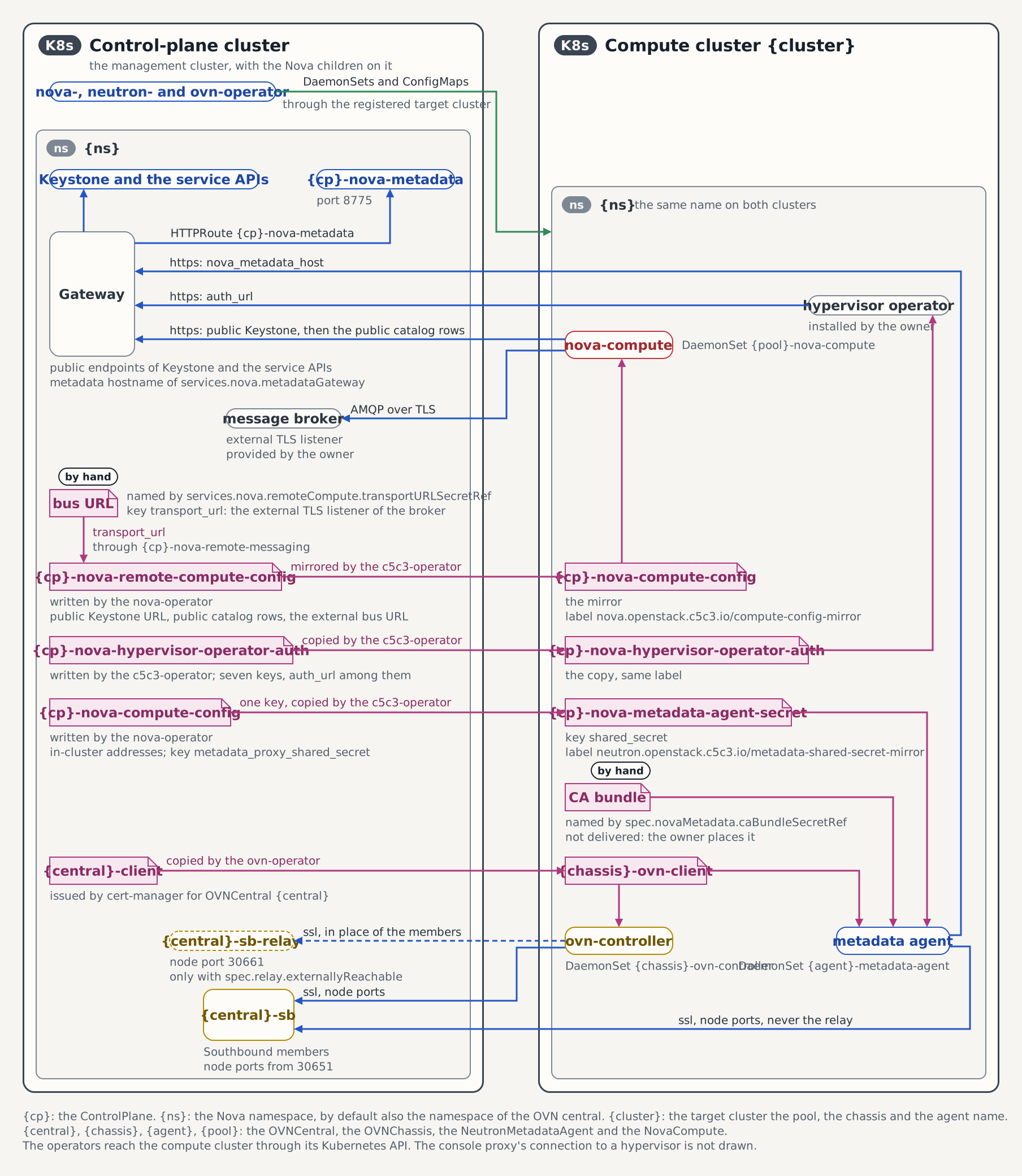
The plane records nothing in its status about what it mirrored, because reconcileNova runs in the parallel group, which keeps only conditions and metadata. A mirror left behind by the last pool of a cluster is reaped by that pool's own teardown, which deletes the Secret only while it carries the mirror label. A NovaCompute watch wakes the plane whose Nova a pool names, narrowed to pools being created, deleted or starting to be deleted, so a pool's status polls do not reconcile the plane.
The hypervisor-operator leg. While services.nova.hypervisorOperator is set, reconcileNovaHypervisorOperator runs after the mirror loop and takes its targets. It applies the account-only registration {controlplane.Name}-nova-hypervisor-operator through reconcileBuiltinRegistration (user hypervisor-operator, project service-hypervisor-operator created by the registration, role admin), whose halts relay their own reasons onto NovaReady. It then reads the password from the registration's consumer Secret {controlplane.Name}-nova-hypervisor-operator-credentials on the Nova's cluster, writes {controlplane.Name}-nova-hypervisor-operator-auth beside the Nova with the seven keys the hypervisor operator's chart values take (auth_url, username, user_domain_name, project_name, project_domain_name, region_name, password), and copies it into every target with the mirror label, which the last pool on a cluster reaps together with the contract mirror. The source carries no mirror label, so that reap never deletes it. Running after the child is Ready means a stuck account holds NovaReady and never the Nova projection. The Secret-name index lists the consumer Secret while the block is set, so a rotation of the account rewrites the auth Secret and every copy on the next pass.
While the block is unset, pruneNovaHypervisorOperator runs at the same place instead: it deletes the registration, whose finalizer removes the user and the project from Keystone, the credentials ExternalSecret on a placed Nova's cluster, the source Secret, and each target's copy that still carries the mirror label, each only while this ControlPlane owns it. That costs 2 + len(targets) reads per Nova pass, one more for a placed Nova. A read on another cluster goes through that cluster's uncached reader, so the prune starts no Secret informer on a compute cluster. See ServiceNovaHypervisorOperatorSpec for what the account and the Secret are for.
The metadata-agent leg. reconcileNovaMetadataAgentSecrets runs after the hypervisor-operator leg and before the registration fold, so it runs only once the Nova child is Ready. novaMetadataAgentTargets lists the NeutronMetadataAgents in cp.NeutronOVNCentralNamespace(), which is where every agent answering for this plane's ports lives: an agent's chassisRef is namespace-local, a chassis's centralRef is too, and one OVNCentral serves one ControlPlane. An agent qualifies while it is not being deleted, has a targetClusterRef, and names {controlplane.Name}-nova-metadata-agent-secret in spec.novaMetadata.sharedSecretRef; the result is one target per distinct cluster, sorted, in the central's namespace. The Nova's own cluster is not dropped, because the copy's name differs from every Secret the plane writes there. Without services.neutron nothing is listed, and a cluster that does not serve the kind yields no target. With no target the leg reads and writes nothing. Otherwise it reads {controlplane.Name}-nova-compute-config in the Nova namespace through the client childrenClientFor returns, takes its metadata_proxy_shared_secret, and writes the copy onto each target through ensureUnownedOrOwned: type Opaque, the single key shared_secret, the ControlPlane's ownership labels and neutron.openstack.c5c3.io/metadata-shared-secret-mirror: "true". The contract's bus URL and service password never reach the agent's privileged namespace, and a rotated value is rewritten on the next pass. A target that fails holds back none sorted after it: each of those still receives its copy, and NovaReady lists every failed target: NovaMetadataAgentSecretError when a write failed, TargetClusterUnavailable when clusters only did not resolve. A NeutronMetadataAgent watch wakes the plane, narrowed to agents arriving, leaving or re-pointing their shared secret.
The plane never deletes a copy: deleteOrphanedNova leaves it alone, and each agent's teardown reaps the copy on its own cluster once no other live agent there names it (see On a compute cluster). A plane pass already in flight when an agent starts deleting can rewrite a copy that teardown just reaped. The compute-contract mirror has the same race, and the next agent teardown in that namespace on that cluster reaps the copy.
Unsetting spec.services.nova deletes nothing on its own. With c5c3.io/allow-nova-deletion: "true", deleteOrphanedNova releases the Nova child, both DB-credential chains (each ExternalSecret, its VaultDynamicSecret, its client Certificate and its ServiceAccount), the metadata ExternalSecret and the Password generator behind it, the three messaging Secrets (the shared bus, its CA mirror, and the remote bus URL), the hypervisor operator's registration and auth Secret, and finally the KeystoneService registration, whose finalizer is what tears the compute catalog rows, the service user and its project down. The auth Secret's copies on compute clusters are each NovaCompute's own teardown to reap, and the metadata shared-secret copies each NeutronMetadataAgent's. The materialised metadata Secret carries ESO's own owner reference, so it comes down with its ExternalSecret. Each object is only removed while this ControlPlane still owns it, so a foreign object colliding on a name is left alone.
The credential minters come down either way. On the preserve branch both VaultDynamicSecrets, their client Certificates and the two ServiceAccounts are torn down before the condition is written: a live generator keeps issuing a fresh MySQL user with all privileges on a nova schema at every refresh interval, for a service this ControlPlane has been told it no longer manages, behind a NovaReady=True condition that surfaces none of it.
A child placed outside the ControlPlane's namespace (services.nova.namespace) carries no owner reference: it is stamped with the ownership labels and applied unowned, and the finalizer sweeps it by those labels.
| Path | Status | Reason | Notes |
|---|---|---|---|
spec.services.nova unset | True | NovaNotManaged | staged adoption; a previously-projected child is preserved unless c5c3.io/allow-nova-deletion: "true" is set, but both dynamic DB-credential generators, their ServiceAccounts, and their client Certificates are torn down either way |
KeystoneReady not True | False | WaitingForKeystone | requeue 5s; no Nova CR is projected while Keystone is unready |
PlacementReady not True | False | WaitingForPlacement | requeue 5s; a compute service ahead of its placement service accepts boot requests it cannot serve. The gate reads the condition, so a plane that manages no placement service passes it on the not-managed reason |
| the shared bus has not delivered its transport URL yet | False | WaitingForMessagingCredentials | requeue 15s; nothing is written, so the child never sees a partial URL |
| the messaging CA bundle Secret is absent or carries no data under its key | False | WaitingForMessagingCABundle | requeue 15s |
| resolving the URL, writing either messaging Secret, or reaping the stale CA mirror after the child stopped naming it fails | False | NovaMessagingError | returns the error |
services.nova.remoteCompute is set but the handed Secret or its key is missing or empty | False | WaitingForRemoteMessaging | requeue 15s; the message is prefixed services.nova.remoteCompute.transportURLSecretRef: and no Nova child is written this pass |
the handed URL is not a rabbit:// URL, or writing or reaping {controlplane.Name}-nova-remote-messaging fails | False | NovaRemoteMessagingError | returns the error, which names the scheme and never the URL |
| the cluster the Nova namespace resolves to is unavailable | False | TargetClusterUnavailable | the resolver's own message; a wait, not a failed reconcile. Requeue 15s from the bus delivery, the metadata secret and the compute-config mirror, 10s from the registration mirror and the DB credentials |
| the projected registration has not provisioned the account yet | False | WaitingForServiceRegistration | requeue 10s; no Nova child is written until the Keystone user and its password exist. See Built-in service registrations |
| projecting, reading or mirroring the registration child fails | False | ServiceRegistrationError | returns the error |
| the registration child carries foreign spec fields | False | ServiceRegistrationFieldsReclaimed | they are reset and the pass halts; requeue 10s |
| the store on a placed service's target cluster is not ready | False | SecretStoreNotReady | the registration's credentials cannot be materialised there; requeue 10s |
| API-schema DB-credential ensure fails | False | NovaAPIDBCredentialError | returns the error (managed database only) |
| the API-schema Dynamic credential has not materialised | False | WaitingForNovaAPIDBCredential | requeue 10s; the message names database/mariadb/creds/nova-api-<namespace>, or the non-engine-issued username it found in the target Secret |
| cell-schema DB-credential ensure fails | False | NovaCellDBCredentialError | returns the error (managed database only) |
| the cell-schema Dynamic credential has not materialised | False | WaitingForNovaCellDBCredential | requeue 10s; the twin of the row above over database/mariadb/creds/nova-cell-<namespace> |
| ensuring the generated metadata shared secret, or reaping it once the converged child names another Secret, fails | False | NovaMetadataSecretError | returns the error |
| Nova child not yet Ready | False | WaitingForNova | requeue 15s |
| projected Nova spec rejected (HTTP 422 Invalid) | False | NovaProjectionRejected | returns the error; the projection violates a Nova CRD/webhook rule, so reconcile the ControlPlane spec to a valid projection to recover |
| Nova create/update fails | False | NovaError | returns the error |
| the compute contract has not been published yet | False | WaitingForComputeConfig | requeue 15s; only reachable once a NovaCompute runs on a cluster other than the Nova's own. The message names the source waited for, {controlplane.Name}-nova-remote-compute-config while services.nova.remoteCompute is set |
| listing the NovaComputes, reading the compute contract, or writing a mirror fails | False | NovaComputeConfigError | returns the error |
hypervisorOperator set, the account provisioned, but its consumer Secret absent or without a password | False | WaitingForHypervisorOperatorCredentials | requeue 15s; no auth Secret is written yet |
| reading the consumer Secret, writing the auth Secret or a copy, or deleting any of them after the block was cleared fails | False | HypervisorOperatorError | returns the error; a failed copy names the namespace and the cluster |
an agent asks for the metadata shared-secret copy, but {controlplane.Name}-nova-compute-config is absent or carries no metadata_proxy_shared_secret | False | WaitingForComputeConfig | requeue 15s; the absent-contract message names the central's namespace whose agents sign with the value |
| the Nova's cluster or an agent's cluster does not resolve for the copy | False | TargetClusterUnavailable | requeue 15s; the resolver's own message, for an agent's cluster prefixed with the namespace and the cluster, one per cluster that did not resolve |
| listing the agents, reading the contract, or writing a copy fails, a foreign same-named Secret included | False | NovaMetadataAgentSecretError | returns the error; every failed copy names its namespace and cluster, and the message also lists the agent clusters that did not resolve |
| Nova child Ready, every mirror target served, the hypervisor operator's Secret delivered while its block is set, every requested metadata shared-secret copy written, and its registration Ready | True | NovaReady | — |
reconcileKORC
| Aspect | Value |
|---|---|
| File | reconcile_korc.go |
| Condition | KORCReady |
| Gate | none (but defers until the admin-password Secret is readable) |
| Projects / Owns | one K-ORC ApplicationCredential named {controlplane.Name}-admin-app-credential and the password-based clouds.yaml Secret {controlplane.Name}-admin-password-cloud, both in childNamespace(cp) |
| Requeue | korcRequeueAfter = 10s while deferring, while a re-mint is in progress, or while the AC is not yet Available |
reconcileKORC create-or-updates an owned K-ORC ApplicationCredential CR that instructs K-ORC to mint the admin application credential, and drives re-mint. Key behaviours:
- Restricted → Unrestricted inversion (CRITICAL). Our
ApplicationCredentialSpec.restrictedis the inverse of K-ORC'sspec.resource.unrestricted:restricted=true ⇒ Unrestricted=false(ptr.To(!restricted)).restricteddefaults totrue(least-privilege) when unset, matching the defaulting webhook. - Password-cloud (breaks the self-referential deadlock). The AC authenticates via an operator-owned, password-based clouds.yaml Secret
{controlplane.Name}-admin-password-cloud(ensureAdminPasswordCloud), notk-orc-clouds-yaml. That matters becausek-orc-clouds-yamlis the minted application credential itself, so deleting the AC to re-mint would invalidate the very clouds.yaml needed to re-authenticate; a restricted application credential also cannot mint a new application credential. The password-cloud is re-rendered from the live admin password on every pass (so a rotation flows through to it) and is not churned when the password is unchanged. The Domain/User imports and the catalog Service/Endpoint keep using the spec'sCloudCredentialsRef(k-orc-clouds-yaml) and tolerate the brief auth gap during a re-mint by requeueing. - Mode-aware
clouds.yaml(korc_cloudsyaml.go). Both builders renderauth_url,endpoint_typeandregion_namethrough three resolvers.korcAuthURLtakes the cluster the document is consumed on and returns the in-cluster Keystone Service DNS in managed mode —keystonePublicEndpointwhenever that cluster is not Keystone's (see Reaching a placed service) — andspec.services.keystone.external.authURLin External mode;korcEndpointTypereturnsinternalin managed mode (K-ORC runs in-cluster, sopublicwould resolve to an unreachable Gateway host) and the configuredendpointType(defaultpublic) in External mode;korcRegionreturnsspec.region(defaultRegionOne). Managed-mode output is byte-identical to before, pinned by golden tests, so no upgraded ControlPlane churns its Secrets. The key must beendpoint_type, neverinterface— K-ORC drops gophercloud'sInterfacefield (the authoritative note lives onbuildAppCredCloudsYAML). - Admin identities.
buildPasswordCloudsYAMLrendersusername,project_nameand both domain keys fromspec.korc.adminCredential.userName/.projectName/.domainName, andensureKORCAdminImportsuses the sameuserName/domainNameas theUserandDomainimport filters. Same-user constraint: Keystone's default policy mints an application credential only for the token's own user, so theclouds.yamlusernameand the importedUser(the AC'sUserRef) must be the same user — both derive fromadminUserName. - UserRef. The required K-ORC
UserRefpoints at the deterministic,cp.Name-scopedUserCR{controlplane.Name}-user-admin, imported as unmanaged byensureKORCAdminImports. The CR name is a stable handle; the OpenStack user it resolves to comes from the import filter above. - CA bundle (
cacert). Whenspec.services.keystone.external.caBundleSecretRefis set, the referenced bundle is read from the ControlPlane namespace and projected verbatim as the inlinecacertkey into both operator-owned credentials Secrets (setCACertKey). K-ORC reads that key natively from the same Secret asclouds.yaml, so there is no mount and no upstream change. The password-cloud is what the AC authenticates with directly; the app-credential Secret is the PushSecret's whole-Secret source, so the bundle also reaches OpenBao and is read back by thecacertentryensureKORCCloudsYAMLExternalSecretadds — gated on the resolved bundle, the same predicatesetCACertKeywrites the source key under, so the read-back can never point at a property the PushSecret did not push. Clearing the ref deletes the key and drops the read-back entry. A missing Secret/key — or a present-but- empty key, the transient of a two-step "create then populate" flow — defers the mint (WaitingForCABundle); see the CA-cache aliasing caveat. - Access rules.
projectAccessRulesmaps our{service, method, path}list onto K-ORC's rule shape:servicebecomes aserviceRef(Kubernetes name ref to an ORCServiceCR, e.g.identity),methodbecomes the typedHTTPMethodenum, andpathbecomes a string pointer. - Re-mint trigger (delete + recreate). K-ORC's AC actuator implements only Create + Delete, so a rotated admin password cannot re-mint in place. The SHA-256 of the admin password is stamped onto the AC CR under the
cobaltcore.c5c3.io/admin-password-hashannotation (adminPasswordHashAnnotation); on a later pass a mismatch (the hash moved, or the CredentialRotation reconciler zeroed the annotation to nudge) drivesreconcileKORCto delete the AC — the finalizer revokes the old Keystone credential, authenticating via the password-cloud — and regenerate the secretvalue, so the next pass recreates the AC for a fresh mint. The hash is computed by the package-levelcomputeAdminPasswordHash, shared with the CredentialRotation reconciler so both agree on one derivation. The annotation is (re-)stamped only on a fresh mint or when it is absent, never overwriting a present-but-empty value — that empty value is the CredentialRotation reconciler's nudge marker, so preserving it keeps a concurrently-cleared nudge from being silently lost (shouldStampPasswordHash). - Re-mint on immutable resource-block drift. K-ORC declares the AC's whole
spec.resourceblock immutable via CEL (self == oldSelf), so a legal, webhook- admitted change torestrictedoraccessRulescannot be reconciled by an in-place update — it would be rejected on every pass.reconcileKORCdetects drift on the operator-managed fields (Unrestricted,UserRef,SecretRef,AccessRules— never the whole struct, so a K-ORC/CRD-defaulted sub-field can never read as permanent drift) and routes it through the same delete+recreate re-mint (adminACResourceDrifted). - Re-mint progress / stall. While the old AC is
Terminatingthe condition isKORCReady=False/ReMinting; if it stays terminating longer thanremintStallTimeout(5m) — a finalizer K-ORC cannot clear, e.g. it cannot reach Keystone to revoke — it escalates toKORCReady=False/ReMintStalled. - Status reflection.
updateAdminApplicationCredentialStatusreflects the observed AC intocp.Status.AdminApplicationCredential(ID, the invertedRestricted, and aLastRotationre-stamped whenever the credential ID changes — i.e. advanced by a completed re-mint). - Missing-CRD safety. If the K-ORC CRD is absent the apiserver/RESTMapper returns a no-match error, detected via
meta.IsNoMatchErrorand surfaced as a clean condition without crash-looping the operator. - The admin password is read where it lives. In managed mode the operator materialises it beside the Keystone child (reconcileAdminPassword), so a placed Keystone takes it to its target cluster and the read goes through that cluster's client. The client is resolved for
effectiveAdminPasswordSecretNamespace(cp), which is the ControlPlane's own namespace in External and brownfield mode — the Secret is the user's there, and that namespace never leaves the management cluster. It is the only cross-cluster read in this sub-reconciler: everything it writes stays local, because K-ORC runs on the management cluster.
| Path | Status | Reason | Notes |
|---|---|---|---|
| Keystone placed on a target cluster that does not resolve | False | TargetClusterUnavailable | requeue 10s; the resolver's own message. Nothing is minted, seeded or written, on either cluster |
| Admin password Secret/key missing | False | WaitingForAdminPassword | requeue 10s (via secrets.IsMissingSecretOrKey) |
| Admin password read fails otherwise | False | AdminPasswordError | returns the error |
| Keystone CA bundle Secret/key missing or empty | False | WaitingForCABundle | requeue 10s; no credentials Secret is written before the endpoint can be verified. The message names the field the bundle was read off — external.caBundleSecretRef in External mode, caBundleSecretRef on a placed Keystone |
| External CA bundle read fails otherwise | False | CABundleError | returns the error |
| Password-cloud ensure fails | False | PasswordCloudError | returns the error |
| Hash mismatch → AC deleted for re-mint | False | ReMinting | requeue 10s; AC deleted + value regenerated, recreated next pass |
spec.resource drift (restricted/accessRules) → AC deleted for re-mint | False | ReMinting | requeue 10s; the block is CEL-immutable, so the change forces a delete+recreate |
Re-mint stuck Terminating past remintStallTimeout (5m) | False | ReMintStalled | requeue 10s; finalizer cannot revoke the old credential |
| AC create/update/delete/read fails otherwise | False | ApplicationCredentialError | returns the error |
value regeneration fails | False | SecretError | returns the error |
| clearing a latched transport error from an admin import or the AC fails | False | TransportErrorRetryFailed | returns the error; for example a Forbidden status patch when the chart's RBAC predates the patch grant on the K-ORC status subresources. What is latched and what is cleared: Latched transport errors |
| AC reports a terminal K-ORC error | False | ApplicationCredentialFailed | requeue 10s; gated on orcv1alpha1.GetTerminalError(ac) (an unrecoverable/invalid-config Progressing reason, e.g. K-ORC cannot authenticate with the clouds.yaml) so a credential that will never converge is not reported as an eternal wait. A terminal InvalidConfiguration whose message classifies as a transport failure (no such host, connection refused, dial tcp, i/o timeout), on the AC or on an admin Domain/User import, is cleared from the child's status before this check — at most once every 30s per child, so K-ORC retries and the pass reports WaitingForApplicationCredential. Every other terminal error lands here |
AC not yet Available | False | WaitingForApplicationCredential | requeue 10s; gated on orcv1alpha1.IsAvailable(ac) (K-ORC uses Available, not Ready) |
| AC minted and Available | True | ApplicationCredentialMinted | — |
Both the ApplicationCredentialFailed and WaitingForApplicationCredential messages fold in the admin Domain/User import status (ensureKORCAdminImports returns the admin Domain/User imports, and korcAdminImports.statusFragment() names the first that is terminally failed or not yet Available), so the documented endpoint/clouds.yaml failure class — where K-ORC swallows a list error and an import hangs on "created externally" — names the stuck dependency instead of surfacing as an opaque wait.
External-mode failure classification
K-ORC collapses every hard failure against a pre-existing Keystone — a wrong admin password (401), an unresolvable authURL, an untrusted private CA, a region/endpointType absent from the catalog — into the same non-terminalProgressing condition with reason=TransientError. Nothing in the observed inventory is terminal, so neither GetTerminalError nor the reason discriminates: the failure class survives only in the free-text message.
In External mode the ControlPlane therefore classifies on message substrings and relays K-ORC's message verbatim alongside the reason. Classification walks the admin Domain, then the admin User, then the ApplicationCredential, so the root stuck dependency is reported rather than the resource that merely blocked on it. Precedence, most specific first: catalog mismatch, credential drift, TLS, authentication, reachability.
It is gated on External mode — a managed ControlPlane's KORCReady reasons are byte-identical to before — and never runs against an Available credential: K-ORC leaves the message of the last transient attempt on the Progressing condition, and re-classifying it would flip a converged ControlPlane back to AuthenticationFailed on a failure it has already recovered from. A latched transport error on the ApplicationCredential is cleared ahead of the classification, so a latch that is being cleared is never reported as EndpointUnreachable.
| Path (External mode only) | Status | Reason | Notes |
|---|---|---|---|
message contains 401 / Unauthorized | False | AuthenticationFailed | the external Keystone rejected the admin credential — typically the password was rotated out-of-band and passwordSecretRef is stale |
message contains no such host / connection refused / dial tcp / i/o timeout | False | EndpointUnreachable | external.authURL could not be dialled |
message contains x509 | False | TLSVerificationFailed | supply the private CA via external.caBundleSecretRef |
message contains No suitable endpoint could be found in the service catalog | False | CatalogEndpointMismatch | a wrong external.endpointType or spec.region; fails loud rather than silently importing nothing. gophercloud never names the interface or region it looked for, so the message appends the effective endpointType and spec.region as the values the external catalog must publish |
message names identity:create_application_credential (403) | False | CredentialDrift | an application-credential create against a stale resolve-once import id; see drift |
admin import stuck on "Waiting for OpenStack resource to be created externally" beyond externalImportStallGrace | False | ImportStalled | the silent-empty detector |
externalImportStallGrace is 2 minutes. In External mode every import target pre-exists by definition, so an import that keeps waiting to be "created externally" never resolves on its own — K-ORC is looking in the wrong place. The message names the stuck import and points at external.endpointType and spec.region. The window is deliberately shorter than remintStallTimeout / orcTeardownStallTimeout (both 5m): those wait on work that is genuinely in flight, whereas a resolvable import has nothing to wait for.
Drift is surfaced, never fought
The external installation can change under the CR: the admin password is rotated without updating the referenced Secret, or the admin user is deleted and recreated. K-ORC imports are resolve-once — a resolved status.id is never re-resolved — so after a recreate the import stays Available=True with a stale id while an application-credential create against that id yields a Keystone 403 (identity:create_application_credential; Keystone's default policy allows creating an application credential only for the token's own user).
The operator never remediates the external installation. It signals drift on the existing sub-conditions with the documented CredentialDrift reason, and reconcileKORC emits a Warning CredentialDrift event on the transition into the drifted state (not on every 10s requeue). The remedy is to update the Secret spec.korc.adminCredential.passwordSecretRef names, which changes its digest and drives a hash-driven re-mint.
Hard CRD dependency. K-ORC (like Memcached, ESO, MariaDB, and Keystone) is a hard dependency:
SetupWithManagerOwns/Watchesits kinds, so the manager fails fast at startup if any CRD is absent. A missing K-ORC CRD never reaches the reconcile path, so there is no dedicated CRD-not-installed condition; a no-match error that could only occur if a CRD were deleted after startup propagates as a hard error (ApplicationCredentialError/ServiceError) and the manager requeues with backoff.
reconcileAdminCredential
| Aspect | Value |
|---|---|
| File | reconcile_admincredential.go |
| Condition | AdminCredentialReady |
| Gate | KORCReady == True, the ControlPlane's store is Ready, the K-ORC clouds.yaml ExternalSecret ({childNamespace(cp)}/{CloudCredentialsRef.SecretName}, co-located with the K-ORC CRs per C1) is Ready, the admin app-credential PushSecret has actually synced to OpenBao (its Ready condition is True), and the materialised clouds.yaml Secret semantically matches (parsed application-credential id+secret) the freshly assembled credential |
| Owns | the operator-owned Secret {controlplane.Name}-admin-app-credential and the PushSecret {controlplane.Name}-admin-app-credential-backup, both in childNamespace(cp) |
| Requeue | korcRequeueAfter = 10s while any gate is unmet (including a stale/absent materialised clouds.yaml) |
reconcileAdminCredential commits the minted credential and mirrors it to OpenBao:
- Operator-owned Secret. The operator generates key
valueof{name}-admin-app-credentialonce and keeps it across reconciles, because a new value would force a re-mint. K-ORC only readsvalueand passes it to Keystone.reconcileAdminCredentialwrites keyclouds.yamland skips the write when the content is unchanged. - clouds.yaml gate. Readiness is checked via
secrets.WaitForExternalSecret(childNamespace(cp)/CloudCredentialsRef.SecretName)so the credential is never published before K-ORC can actually authenticate. The Secret is co-located with the K-ORC CRs (C1) because K-ORC resolvesCloudCredentialsRefin the resource's own namespace; on a fresh clusterreconcileKORCitself seeds a password-based bootstrap clouds.yaml into the{controlplane.Name}-admin-app-credentialSecret (seedBootstrapCloudsYAML, write-if-empty) and the PushSecret mirrors it to the per-ControlPlane OpenBao path, so the operator-created per-CR ExternalSecret can materialise before any credential is minted — once the AC is minted the PushSecret carries the minted credential-based clouds.yaml instead. - PushSecret to OpenBao.
secrets.EnsurePushSecret(applied via server-side apply under a fixed field manager that owns only the fields the operator sets, so repeated applies of an unchanged desired spec are no-ops at the API server) builds the PushSecret to the ControlPlane's store (its store ref comes fromspec.secretStoreRefviasecrets.PushSecretStoreRefs, and switching the ref moves the push in place — unchanged name and remote key) at the per-ControlPlane remote keyopenstack/keystone/{cp.Namespace}/{cp.Name}/admin/app-credential(adminAppCredentialRemoteKeyFor) withDeletionPolicy: Delete; see Security invariant for why the credential leaves OpenBao with the ControlPlane. - Forced re-push on credential change. ESO's PushSecret controller does not watch its source Secret: its refresh gate reacts only to the PushSecret object's own label/annotation hash, so a source-Secret update — e.g. the fresh-create handoff from the password-based bootstrap clouds.yaml to the minted credential — would otherwise not reach OpenBao until the hourly
refreshInterval, leavingAdminCredentialReadystuck False for up to an hour.forceRepushAdminAppCredentialtherefore stamps the assembled clouds.yaml content hash onto the PushSecret (c5c3.io/push-content-hash, read-modify-write underRetryOnConflict), changing its metadata hash and forcing an immediate re-push. The annotation is keyed by the content hash, so it fires exactly once per credential change and a steady-state pass is a no-op. - PushSecret sync gate.
AdminCredentialReadyis gated on the PushSecret'sReadycondition — not merely on the CR existing — so a backend permission failure (e.g. the ESO role missing the push policy) surfaces asWaitingForPushSecretinstead of a false-positive Ready while OpenBao still serves the password-based bootstrap clouds.yaml. - Live clouds.yaml gate (stale-credential window). A re-mint revokes the old credential immediately, but the
k-orc-clouds-yamlSecret only refreshes from OpenBao at the ExternalSecret's hourlyrefreshInterval, so the PushSecret-Ready check above can pass while the materialised Secret K-ORC actually authenticates with still holds the revoked credential. After assembling the clouds.yaml,reconcileAdminCredentialstamps theexternal-secrets.io/force-syncannotation to nudge ESO to re-materialise immediately. The trigger value iscontentHash + "/" + PushSecret.status.syncedResourceVersion, not the content hash alone: both nudges (the PushSecret re-push above and this force-sync) are stamped in the same reconcile pass, but ESO processes the two objects independently — keyed on the content hash alone, the ExternalSecret refresh can read OpenBao before the re-push has written it, re-materialise the stale bootstrap document, and (with the annotation already at its final value) never be nudged again, wedgingAdminCredentialReadyatWaitingForCloudsYamlSyncuntil the hourly refresh. ESO bumpssyncedResourceVersiononly after a completed push, so folding it in re-nudges the ExternalSecret exactly once more as soon as the re-push lands; both inputs are stable once converged, so a steady-state pass still leaves the ExternalSecret untouched. It then compares the materialised Secret semantically — by the parsed application-credential id and secret, not byte-for-byte, so a benign ESO/OpenBao re-serialisation (a stripped trailing newline, reordered keys, requoting) cannot wedge the gate permanently — and only reportsAdminCredentialReady=Truewhen they match. The semantic compare — not the best-effort force-sync — is the correctness guarantee: the condition never reads True against a stale credential. A sync that never converges is bounded: once the materialised Secret has failed to match for longer thancloudsYamlSyncStuckTimeout(measured from the credential'sLastRotation), the reason escalates from the transientWaitingForCloudsYamlSyncto the alertableCloudsYamlSyncStuck, so a permanently broken sync is distinguishable from a 2-second transient miss. - Drift escalation (External mode). When the
KORCReadygate is closed because the external Keystone reports drift, the gate reportsCredentialDriftrather than the opaqueWaitingForKORC. Note that the live drift signal isKORCReadyitself:reconcileKORCwrites the driftedKORCReadyearlier in the pass, and because both run inside the non-short-circuiting tail group,reconcileAdminCredentialruns later in the same pass and observes it directly — so thisCredentialDriftescalation is the live same-pass path that keepsAdminCredentialReadyhonest, not merely a defense-in-depth fallback. An unreachable endpoint, a TLS failure, a catalog mismatch or a stalled import are not drift and keepWaitingForKORC— drift is a statement about the credential.
| Path | Status | Reason | Notes |
|---|---|---|---|
KORCReady not True | False | WaitingForKORC | requeue 10s |
KORCReady reports drift (AuthenticationFailed / CredentialDrift), External mode | False | CredentialDrift | requeue 10s; names the Secret the operator reads and states that the external installation is never remediated |
| Selected secret store not Ready | False | SecretStoreNotReady | requeue 10s; checked after the KORCReady gate so an OpenBao/ESO outage surfaces before the clouds.yaml wait. The message names the store's kind and name |
| Selected secret store check errors | False | SecretStoreError | returns the error; stamped rather than returned bare so the peers gating on AdminCredentialReady later in the tail group cannot read the previous pass's True |
| clouds.yaml ES check errors | False | CloudsYamlError | returns the error (also covers a force-sync/materialised-Secret read error) |
| clouds.yaml ES not Ready | False | WaitingForCloudsYaml | requeue 10s |
| operator Secret ensure fails | False | SecretError | returns the error |
| PushSecret ensure, re-push stamp, or readback fails | False | PushSecretError | returns the error |
| PushSecret not yet synced to OpenBao | False | WaitingForPushSecret | requeue 10s; the PushSecret's Ready condition is not True — the assembled credential has not landed in OpenBao yet |
| materialised clouds.yaml absent or semantically stale | False | WaitingForCloudsYamlSync | requeue 10s; force-sync annotation stamped, semantic compare (parsed id+secret) against the assembled document not yet satisfied |
materialised clouds.yaml stuck stale past cloudsYamlSyncStuckTimeout | False | CloudsYamlSyncStuck | requeue 10s; the sync has not converged since LastRotation — alertable, distinguishable from a transient miss |
| committed, mirrored, and materialised | True | AdminCredentialReady | — |
reconcileCatalog
| Aspect | Value |
|---|---|
| File | reconcile_catalog.go (Managed), reconcile_catalog_external.go (External) |
| Condition | CatalogReady |
| Gate | AdminCredentialReady == True, and every catalog child reports Available |
| Owns | Managed mode: a K-ORC identity Service ({controlplane.Name}-identity-service) and its public Endpoint ({controlplane.Name}-identity-endpoint). That is the whole managed table: a built-in service's catalog row belongs to the KeystoneService registration projected for it, not here. Managed mode also owns the Region ({controlplane.Name}-region, onDelete: detach) that adopts the bootstrap region. External mode: the same identity Service plus one Endpoint per interface ({controlplane.Name}-identity-endpoint-{interface}), all unmanaged imports, and nothing managed. All in childNamespace(cp) |
| Requeue | korcRequeueAfter = 10s while gated, while a child is not yet Available, or on a terminal K-ORC failure |
reconcileCatalog drives CatalogReady. Everything up to and including the AdminCredentialReady gate and the admin CloudCredentialsReference is mode-agnostic; below it the two postures are opposites, so the reconciler forks on cp.IsExternalKeystone(). K-ORC is a hard CRD dependency (see the note above), so a missing Service/Endpoint CRD never reaches this path and there is no CRD-not-installed condition.
Managed mode — the control plane owns the catalog
reconcileCatalog registers the OpenStack service-catalog entries the control plane itself owns as owned K-ORC CRs, driven from a per-service table (managedCatalogRows). That table holds exactly one row, the identity (Keystone) service: an identity-type Service named keystone, plus a public Endpoint whose URL defaults to the conventional in-cluster identity URL http://keystone.<namespace>.svc:5000/v3 and whose serviceRef points at the identity Service. The child is projected idempotently via Server-Side Apply under the shared field manager (cobaltcore-operator).
The rows for the built-in services are not here. Glance's image row, Placement's placement row and Barbican's key-manager row each belong to the KeystoneService registration their service leg projects, which owns the row's K-ORC children and their teardown; see Built-in service registrations for what each one advertises. The identity row stays ControlPlane-owned in both modes because nothing registers it on the plane's behalf: it is the entry K-ORC authenticates through.
The identity row registers a public interface only, so it needs none of the target-cluster switching a placed service's row does. Its Service/Endpoint CRs stay in childNamespace(cp) on the management cluster: they are K-ORC's to reconcile, and K-ORC runs there. See Reaching a placed service.
Alongside the rows, the reconciler projects one managed Region ({controlplane.Name}-region) per ControlPlane. It adopts the Keystone region named by spec.region, the row the keystone bootstrap inserted, and adoption runs in two phases. The first apply carries the region name and no description, which is what K-ORC's adoption filter matches on; once the CR reports status.id, the next pass adds spec.resource.description from spec.regionDescription. That order is fixed by the filter: it also matches on the description when the spec carries one, and the bootstrap row's description is empty, so a described first apply matches nothing, falls through to create, and takes Keystone's 409 Conflict as a terminal error. Each pass does one Get and one apply, never two, so the description does not flip the CR's generation on every pass.
spec.managedOptions.onDelete is detach. Keystone answers 403 for a region that still has endpoints, and the bootstrap identity endpoints reference this one, so deleting the CR leaves the Keystone row where it is; that row goes with the Keystone database. An empty spec.regionDescription keeps the Keystone description empty, and K-ORC applies the spec value on every resync, so a description set by hand in Keystone is overwritten either way. There is no third state: a managed Region drives the description, and K-ORC reads an absent spec.resource.description as the empty string. On upgrade that makes the first reconcile destructive for a control plane whose region was described by hand (openstack region set RegionOne --description ...) — the description is cleared, and nothing in the cluster holds the prior value. Copy it into spec.regionDescription before rolling out this version to keep it. Because that upgrade adopts the region without anyone editing the ControlPlane, admission never runs on it: the pass that creates the Region CR with spec.regionDescription empty therefore emits a Warning RegionDescriptionCleared event on the ControlPlane, naming the region and the field that would keep a description.
Only the upgrade raises it. The event is gated on CatalogReady being True while the Region CR is still absent, which is a state a fresh install cannot reach — there the CR is created on the same pass that first registers the catalog, and CatalogReady only turns True once that Region reports Available. So the notice reaches the control planes whose region may carry a hand-set description and stays off the ones whose bootstrap row has none to lose. It is emitted once, on the pass before K-ORC first writes to the region — no later pass repeats it, a failed Region apply stamps CatalogReady False and silences the retry pass, and a ControlPlane that carries a description never raises it.
The identity row names no region of its own: managedCatalogService and managedCatalogEndpoint set the management policy, the credentials ref, and the resource block (type/name/enabled, and interface/URL/serviceRef), and nothing else. The row K-ORC adopts for it is the public endpoint the keystone bootstrap inserted into spec.region, so it already sits in that region. The rows the registration children create are placed there explicitly: each KeystoneService imports spec.region and names the import as every Endpoint's regionRef (see Catalog Projection). A client that sets region_name, as every nova client section and the neutron notifier do, finds no region-less row. spec.region is also the clouds.yamlregion_name the admin credential renders.
Registering the child CRs only instructs K-ORC to create the catalog entries — it does not mean they exist in Keystone — so CatalogReady is gated on every child reporting Available for its current generation (korcAvailableUpToDate, which refuses a stale Available condition whose ObservedGeneration lags the object — the same generation gate GetTerminalError already applies via its Progressing check — so an endpoint/region edit that moves the catalog URL cannot flip CatalogReady True before K-ORC re-reconciles the new value), and a terminal K-ORC failure (GetTerminalError, the documented wrong-endpoint / import-stuck class) is surfaced as the distinct CatalogFailed reason instead of a false-positive Ready.
| Path | Status | Reason | Notes |
|---|---|---|---|
AdminCredentialReady not True | False | WaitingForAdminCredential | requeue 10s |
| Service create/update fails | False | ServiceError | returns the error |
| Endpoint create/update fails | False | EndpointError | returns the error |
| Region read (other than NotFound) or apply fails | False | RegionError | returns the error |
| clearing a latched transport error from a Service, Endpoint or the Region fails | False | TransportErrorRetryFailed | returns the error |
a catalog entry's Service/Endpoint, or the adopted Region, reports a terminal K-ORC error | False | CatalogFailed | requeue 10s (Service before its Endpoints, so the root stuck dependency surfaces; the Region is checked after the rows and its message names Region). A latched transport error (the InvalidConfiguration rule in the KORCReady table) is cleared before this check, so K-ORC retries and the pass reports WaitingForCatalog. Every other terminal error lands here |
a catalog entry's Service/Endpoint, or the adopted Region, registered but not yet Available | False | WaitingForCatalog | requeue 10s; the Region also fails this gate on the pass where the description apply bumped its generation |
| the region adopted, every catalog entry registered and Available | True | CatalogRegistered | the message names the adopted region and counts the registered entries, which is the identity row alone today; the table is what a future ControlPlane-owned row would be added to |
External mode — import-first
The catalog belongs to the pre-existing installation. Keystone enforces no uniqueness on service names, so registering an identity Service against a populated catalog would silently duplicate rows. reconcileCatalogExternal therefore imports instead: the identity Service and each of its three endpoint interfaces become K-ORC CRs with managementPolicy: unmanaged, an import filter, and no desired resource. K-ORC resolves them read-only and writes nothing; deleting their CRs later removes only the Kubernetes objects.
The ControlPlane creates zero catalog entries in External mode: this branch of reconcileCatalog is import-only. A genuinely new row is declared with a KeystoneService CR, whose own reconciler creates it, gates its own CatalogReady on it, and deletes it at that CR's teardown — so nothing the ControlPlane writes can duplicate or outlive a row in a catalog it does not own.
status.catalog.imports is rebuilt before any failure return, so an unresolved import is visible as resolved: false rather than omitted.
Import-first inverts the failure modes, and detecting them is the point. A K-ORC import that matches nothing does not error: it waits indefinitely on Available=False, reason=Progressing, "Waiting for OpenStack resource to be created externally" — by conditions indistinguishable from a resource that is about to appear. For a gating import the target pre-exists by definition, so past externalImportStallGrace (2m) that wait is a misconfiguration signal, not a wait. An import that matches several entries is terminal in K-ORC itself, which refuses to guess and stops retrying.
Only two of the four imports gate CatalogReady: the identity Service, and the Endpoint of the interface external.endpointType selects. The control plane already authenticates through that interface, so a catalog that does not publish it is not the catalog K-ORC was pointed at. The other two interfaces are imported for visibility, projected into status.catalog.imports, and may stall forever — or resolve ambiguously — without failing the condition. An external installation is free not to publish an interface, and free to publish it once per region (which K-ORC's region-less EndpointFilter cannot select among, so no spec edit repairs it); both are precisely the brownfield posture External mode adopts.
The precedence below reports the most specific cause first, and the Service before the Endpoints so the root stuck dependency is named rather than an endpoint merely blocked on the service it references:
| # | Path | Status | Reason | Notes |
|---|---|---|---|---|
| — | AdminCredentialReady not True | False | WaitingForAdminCredential | requeue 10s; no import CR is reconciled |
| — | import create/update fails | False | ImportError | returns the error |
| — | clearing a latched transport error from an import fails | False | TransportErrorRetryFailed | returns the error |
| 1 | an unresolved import carries a classifiable K-ORC message | False | AuthenticationFailed | EndpointUnreachable | TLSVerificationFailed | CatalogEndpointMismatch | CredentialDrift | requeue 10s; K-ORC's message is relayed verbatim. A resolved import is never re-classified — K-ORC leaves the last transient attempt's message on Progressing, and classifying it would flip a converged catalog to a failure it has recovered from |
| 2 | an import reports a terminal K-ORC error | False | CatalogFailed | requeue 10s; gating or not — K-ORC has given up on it. A latched transport error (the InvalidConfiguration rule in the KORCReady table) is cleared before this row, so K-ORC retries and the pass falls through to the waits below. On the >1-match message the hint names external.catalog.identityServiceName for the Service import, or the region limitation for an Endpoint import (K-ORC's EndpointFilter carries no region, so no spec field can select among per-region rows). One exception: an InvalidConfiguration on a non-gating import does not fail the condition. A non-gating import has no user-supplied configuration to fix — its filter is entirely operator-derived — so it has no remediation and nothing depends on it; it is tolerated exactly like the 0-match of row 3 and reported as resolved: false. The exception is keyed on K-ORC's machine-readable reason, never on the >1-match message text: keying it on the text would turn a K-ORC rewording into a permanent CatalogReady=False. An UnrecoverableError gates on every import, and so does any terminal error on a gating one |
| 3 | a gating import stalled past externalImportStallGrace | False | ImportStalled | requeue 10s; the 0-match case. The message names the stuck import, the authURL, and external.endpointType / spec.region — plus, for an Endpoint import, that the external catalog may publish no such interface |
| 4 | a gating import is unresolved | False | WaitingForCatalog | requeue 10s; the bounded, legitimate wait |
| 5 | every gating import resolved | True | CatalogImported | the message reports how many of the three endpoint interfaces resolved |
A latched transport error is cleared ahead of row 1, so a latch that is being cleared is not classified as EndpointUnreachable.
publicEndpoint is forbidden in External mode, so keystoneCatalogURL — the URL the Managed branch registers — is never consulted here: advertisement visibility is owned by the imports.
Promote-to-managed is reserved, not implemented. Turning an import into a managed row (to edit its endpoint URL declaratively) is a later phase. K-ORC's
managementPolicyis CEL-immutable, so it will have to be a delete-and-recreate of the import CR. Nothing in the deterministic CR names or the spec-derived filters chosen here precludes that.
reconcileServiceAccounts
| Aspect | Value |
|---|---|
| File | reconcile_serviceaccounts.go |
| Condition | ServiceAccountsReady |
| Gate | none — the member only reads the KeystoneService children the built-in service legs wrote earlier in the same pass, so there is no projection it could defer |
| Requeue | korcRequeueAfter = 10s while a registration is not yet Ready |
reconcileServiceAccounts aggregates: it reads the KeystoneService registration child each enabled built-in service leg projects (services.glance, services.placement, services.barbican, services.neutron, services.cinder, services.nova, in that order) and folds their readiness into the one condition operators alert on. The network service's account-only compute-notifier registration is aggregated beside its own, and only while both services.neutron and services.nova are set: without a compute service the account is a Keystone user nothing authenticates as. The hypervisor operator's account-only registration {controlplane.Name}-nova-hypervisor-operator follows nova's own while services.nova.hypervisorOperator is set. The Nova leg applies it only once the Nova child is Ready, so until then the aggregate reads it as not projected yet (WaitingForServiceRegistration). It projects no OpenStack resource itself; the registration CR owns the Keystone user, its project, its role assignments, the generation-scoped password, and the OpenBao round-trip that delivers the credentials.
The double reporting is intended. A failing registration already fails its own service condition (GlanceReady, PlacementReady, BarbicanReady, NeutronReady, CinderReady, NovaReady); the aggregate names the same cause under the condition type that does not depend on knowing which service broke.
| Path | Status | Reason | Notes |
|---|---|---|---|
| no built-in service block is declared | True | NoServiceRegistrationsProjected | every External-mode ControlPlane; set rather than omitted so the condition schema does not depend on the spec |
| a registration child is absent | False | WaitingForServiceRegistration | its service leg is gated on something upstream of its own apply; requeue 10s |
| reading a registration child fails | False | ServiceRegistrationError | returns the error, wrapped with which child was being read |
a registration reports a False sub-condition | False | (the child's own reason) | relayed verbatim with the child's message, prefixed by which child it came from; requeue 10s |
a registration has not reported Ready yet | False | WaitingForServiceRegistration | requeue 10s |
every registration reports Ready | True | ServiceAccountsProvisioned | the message counts them |
The relayed reason is the child's first failing sub-condition, not the aggregate's. keystoneServiceSubConditionTypes orders CatalogReady before AccountReady, so a registration whose Keystone catalog row failed reports a catalog reason (CatalogFailed, ServiceCollision) under a condition named for service accounts. That is deliberate: NotAllReady says only that something is wrong, while the sub-condition's own reason says what and admits a fix.
Consumption contract. Consumers read the credentials from the Secret the registration materializes in its own namespace — {keystoneservice.Name}-credentials, keys password and a ready-to-use clouds.yaml — named in the registration's status.account.secretName. For which OpenBao paths exist in each Keystone mode, see OpenBao paths per ControlPlane mode.
Deletion. The registrations go first at teardown: reconcileDelete deletes the projected KeystoneService children and waits for them, because their K-ORC CRs belong to the registration and its controller tears them down through the admin credential the next step revokes.
reconcileRegistrationTenantStores
| Aspect | Value |
|---|---|
| File | reconcile_esotenant.go |
| Condition | RegistrationTenantStoresReady |
| Gate | none — it consumes no condition this chain produces; the trio it writes depends on cert-manager and OpenBao alone |
| Projects / Owns | the same trio reconcileESOTenantStore writes (a ServiceAccount eso-tenant-auth, a cert-manager mTLS Certificate eso-tenant-client-tls, and a namespaced SecretStore openbao-tenant-store), one per allowlisted namespace hosting at least one KeystoneService; nothing when spec.secretStoreRef overrides the default |
| Requeue | esoTenantStoreRequeueAfter = 10s while a store is not yet Ready, and on a provisioning failure |
Credential delivery is namespace-local. A registration's consumer Secret is materialized through the tenant store in the CR's own namespace, and reconcileESOTenantStore provisions one only in the namespaces the ControlPlane occupies. Without this member an allowlisted foreign registration would mint its Keystone account and then wait forever on a store nobody creates.
It shares ensureESOTenantStoreTrioIn with its blocking-prefix twin, so the ownership mechanism, the adoption refusal and the error wording are written once. The OpenBao side needs nothing: the eso-tenant role binds the ServiceAccount name in any namespace and its templated policy confines each token to its own paths, so a trio in a foreign namespace authenticates as that namespace's tenant identity and reaches only its own paths.
Why it is a member of its own, at the end of the group. The tenant-store step runs in the chain's blocking prefix, where a non-zero result parks DBCredentials, AdminPassword and Keystone behind it. These namespaces are not the operator's — a foreign object can occupy the store's name, a certificate can fail to issue there — and none of that may reach the plane's core reconciliation. A failure here surfaces in this condition, and through it in the aggregate Ready, and stops. For the same reason a provisioning failure requeues rather than returning an error: the cause is usually a tenant-side one no backoff resolves, and returning an error would put the whole ControlPlane reconcile into exponential backoff for it. Every namespace is attempted even after one fails, so a single broken namespace cannot starve its peers, and the failures are reported together.
Collecting, and the one namespace it will not collect. The namespaces already provisioned are enumerated by ownership label before the allowlist is consulted, so emptying the allowlist still collects the trios whose registrations have left. A namespace that no longer appears in the allowlist but still holds registrations is frozen, not collected: de-listing is an admission gate, and revoking the store under a running service would destroy credentials it depends on. See ServiceRegistrationsSpec.
| Path | Status | Reason | Notes |
|---|---|---|---|
spec.secretStoreRef set (override) | True | StoreRefOverridden | nothing to provision and nothing this member created standing to collect; a registration resolves that store in its own namespace itself |
| no allowlisted namespace hosts a registration | True | NoRegistrationNamespaces | both arms share one message: nothing admitted at all, and an allowlist no registration sits in. Returns before the registration List, so a ControlPlane that never uses the feature never depends on the KeystoneService field index |
| provisioning or collecting a trio failed | False | ProvisioningError | requeue 10s, no error returned; the message names the failing namespaces and the joined error. A failed List while enumerating the provisioned namespaces or counting registrations sets the same reason and returns the error |
| a store is written but not yet Ready | False | SecretStoreNotReady | requeue 10s, naming the namespace; the delivery leg gates on exactly this, so reporting True early would claim a path that does not carry yet. A failed readiness read returns the error with no condition written, leaving the previous value standing |
| every store Ready | True | RegistrationTenantStoresReady | the message counts the namespaces |
reconcileNamespaceAssignments
| Aspect | Value |
|---|---|
| File | reconcile_namespace_assignments.go |
| Condition | NamespaceAssignmentsReady |
| Gate | none. It only reads |
| Projects / Owns | nothing. It writes status.namespaceAssignments, one entry per spec.namespaceAssignments entry, in spec order |
| Requeue | namespaceAssignmentRequeueAfter = 1m while an entry is not Assigned |
Per entry the step resolves the entry's cluster through ResolveChildrenClient and reads the assigned namespace there with one GET. A target cluster is read through its uncached reader, the management cluster through the cache. A pass costs at most 32 GETs and no LIST. The step never creates, labels or deletes an assigned namespace and writes nothing on any cluster, so the remote-children finalizer is not involved.
Each GET times out after namespaceAssignmentReadTimeout = 10s. A cluster that fails a GET with a transport error is not read again in the same pass: its later entries report ClusterUnreachable with the message namespace "<ns>" not read: <cluster> did not answer an earlier read in this pass: <err>. A cluster that accepts no connection therefore costs the pass one timeout in total. An API error such as Forbidden is read per entry, because the answer may differ per namespace.
No watch reaches an assigned namespace. The local Namespace watch filters on the ControlPlane's ownership labels, and a target cluster has no Namespace watch. A namespace created later, or a cluster registered later, shows up through the 1m requeue.
The step never returns an error. Each entry gets one of five reasons:
| Entry reason | clusterReachable | namespaceExists | When |
|---|---|---|---|
Assigned | true | true | the namespace exists |
NamespaceNotFound | true | false | the cluster answers NotFound |
NamespaceTerminating | true | true | the namespace carries a deletion timestamp |
TargetClusterUnavailable | false | false | the cluster name does not resolve. The message is the resolver's text |
ClusterUnreachable | false | false | the GET fails with any other error, for example Forbidden. The message is getting namespace "<ns>": <err> |
The condition is decided over all entries:
| Path | Status | Reason | Notes |
|---|---|---|---|
| no entry | True | NoNamespaceAssignments | clears status.namespaceAssignments |
any entry TargetClusterUnavailable | False | TargetClusterUnavailable | the message lists every unresolved and unreachable entry as <namespace> on <cluster> and says that orders from these namespaces are refused until the cluster resolves or the entry is removed |
else any entry ClusterUnreachable | False | ClusterUnreachable | the same listing |
| otherwise | True | NamespaceAssignmentsReady | the message counts the entries and, when one or more namespaces are missing, how many do not exist yet. An assignment may precede its namespace |
A False condition turns the aggregate Ready False, also when the cluster only serves tenants. See NamespaceAssignmentsReady.
CredentialRotation reconciler
| Aspect | Value |
|---|---|
| File | reconcile_credentialrotation.go |
For() | CredentialRotation |
| Condition | Ready (conditionTypeRotationReady) |
| Owns / mints | nothing — it never mints |
| Requeue | credentialRotationWaitInterval = 10s while waiting for the ControlPlane reconciler or for a dependency to appear |
The CredentialRotationReconciler drives one-shot rotations of a control-plane credential by nudging the owning reconciler rather than duplicating any mint logic. It dispatches on spec.target: adminApplicationCredential nudges the admin AC (clearing the AC's password-hash annotation), and serviceAccountPassword nudges the managed account of the referenced KeystoneService (clearing the managed User's cobaltcore.c5c3.io/password-generation annotation, which the KeystoneService controller's ensureManagedAccountUser consumes by bumping the password generation on its next pass). Its model:
- Nudge, never mint or delete. For the admin target it clears (zeroes) the
cobaltcore.c5c3.io/admin-password-hashannotation on the owned AC CR viaclearPasswordHashAnnotation(a no-opUpdatewhen already empty). On its next passreconcileKORCobserves the mismatch and performs the delete+recreate re-mint, re-stamping the fresh hash. TheserviceAccountPasswordtarget is the same discipline against the managedUser: it resolves theKeystoneServicenamed byspec.keystoneServicein the CredentialRotation's own namespace (KeystoneServiceNotFoundwhen it is absent), requires that CR'sspec.accountblock (NoAccountDeclaredotherwise), and resolves the ControlPlane through the registration'scontrolPlaneRef(ControlPlaneNotFoundwhen that dangles). Each of the three is aReady=Falsewait with the 10s requeue. Because that reference crosses namespaces and the caller controls it, the path then repeats all four pre-write gates the KeystoneService reconciler applies before it touches the account: the plane's registration consent for the CR's namespace (NamespaceNotAllowed— de-listing a namespace freezes its registrations, so theUseris still there to nudge while the reconciler that would act on the nudge no longer runs), the role allowlist of thespec.namespaceAssignmentsentry for that namespace (RoleNotAllowed, which freezes the account the same way; the message ends withcannot rotate), the plane'sAdminCredentialReadycondition (WaitingForAdminCredential— K-ORC cannot reach Keystone before the admin credential is minted, which freezes the registration the same way), and the ownership labels on theUseritself (ForeignServiceAccount— a cross-namespace child carries no owner reference, so the derived name is the only thing tying it to the registration). Each is refused before the nudge, so the generation stays unlatched and the rotation still fires once the gate opens. ACredentialRotationthat predatesspec.keystoneServicedecodes with an empty name and finishesReady=FalsereasonMissingKeystoneServicewith no requeue, naming the removedspec.serviceAccountfield rather than reporting a dangling reference to aKeystoneServicenobody wrote. Because there is no external password source to observe, the target has no auto-detect path, so a rotation fires only on an explicitreMint(latched to the spec generation). Keeping the resource lifecycle owned solely by the reconciler that owns the object (the ControlPlane reconciler for the admin AC, the KeystoneService reconciler for the managed account) avoids two controllers racing on the same object. reMintis one-shot per spec generation. An explicitspec.reMintis latched onstatus.lastTriggeredGeneration: the reconciler nudges only while it differs frommetadata.generation, then records the generation. AreMint: trueleft in the spec therefore fires the nudge once per edit, not on every cache resync (~10 min via the sharedSyncPeriod) or operator restart — without the latch it would revoke + re-mint the admin credential indefinitely, re-opening the stale-credential window each cycle. A pass over an already-latched generation reportsNoRotationNeeded. The auto-detect (password-hash change) path is not latched: it is self-limiting (it stops once the hash matches) and relies on resync to observe an out-of-band password rotation.- ControlPlane resolution (one-per-namespace). On the
adminApplicationCredentialtarget aCredentialRotationcarries no explicit ControlPlane reference, soresolveControlPlanelists ControlPlanes in the CredentialRotation's own namespace and requires exactly one. Zero →Ready=FalsereasonNoControlPlanewith a short requeue; multiple →Ready=FalsereasonAmbiguousControlPlanewith no requeue (an arbitrary pick could rotate the wrong credential). The one-ControlPlane-per-namespace contract is now enforced at admission by the ControlPlane validating webhook (validateUniqueInNamespace), so theAmbiguousControlPlanebranch is defense-in-depth: it is retained as a safety fallback but is unreachable while the webhook is active. TheserviceAccountPasswordtarget does not use this lookup. It reaches its ControlPlane through the referenced KeystoneService'scontrolPlaneRef, so it works from a namespace that holds no ControlPlane. - Bootstrap is idempotent. With
spec.bootstrap, an already-existing AC is a no-op success (BootstrapComplete); a missing AC waits (WaitingForBootstrap) for the ControlPlane reconciler to mint it. - Scheduled fields are read-but-ignored.
intervalDays/preRotationDays/gracePeriodDaysare accepted but deferred to a later level; when set, an informationalScheduledRotationDeferredevent is emitted but no loop runs and no error is raised. - Target enum.
adminApplicationCredentialandserviceAccountPasswordare supported; any other target finishesReady=FalsereasonUnsupportedTarget.
| Path | Status | Reason | Notes |
|---|---|---|---|
target neither adminApplicationCredential nor serviceAccountPassword | False | UnsupportedTarget | no requeue |
| no ControlPlane in namespace | False | NoControlPlane | requeue 10s |
| multiple ControlPlanes | False | AmbiguousControlPlane | no requeue; defense-in-depth — unreachable while the one-per-namespace webhook is active |
| ControlPlane List errors | False | ControlPlaneListError | no requeue |
| bootstrap, AC exists | True | BootstrapComplete | no-op success |
| bootstrap, AC absent | False | WaitingForBootstrap | requeue 10s |
| rotation, AC absent | False | WaitingForApplicationCredential | requeue 10s |
| admin password not yet readable | False | WaitingForAdminPassword | requeue 10s |
hash unchanged, no pending reMint (incl. a reMint already latched for this generation) | True | NoRotationNeeded | nothing to do |
| nudge performed | True | RotationTriggered | emits RotationNudged event; an explicit reMint latches status.lastTriggeredGeneration |
The CredentialRotation reconciler is registered with the manager via a plain For(&CredentialRotation{}) — it owns no children and registers no watches or field indexers.
K-ORC admin credential chain
The end-to-end path that delivers the admin application credential to the K-ORC controller spans four sub-reconcilers (reconcileAdminPassword, reconcileKORC, reconcileAdminCredential, reconcileCatalog) and the ESO/OpenBao backend.
The path passes OpenBao twice. The numbers in the figure are the steps below.
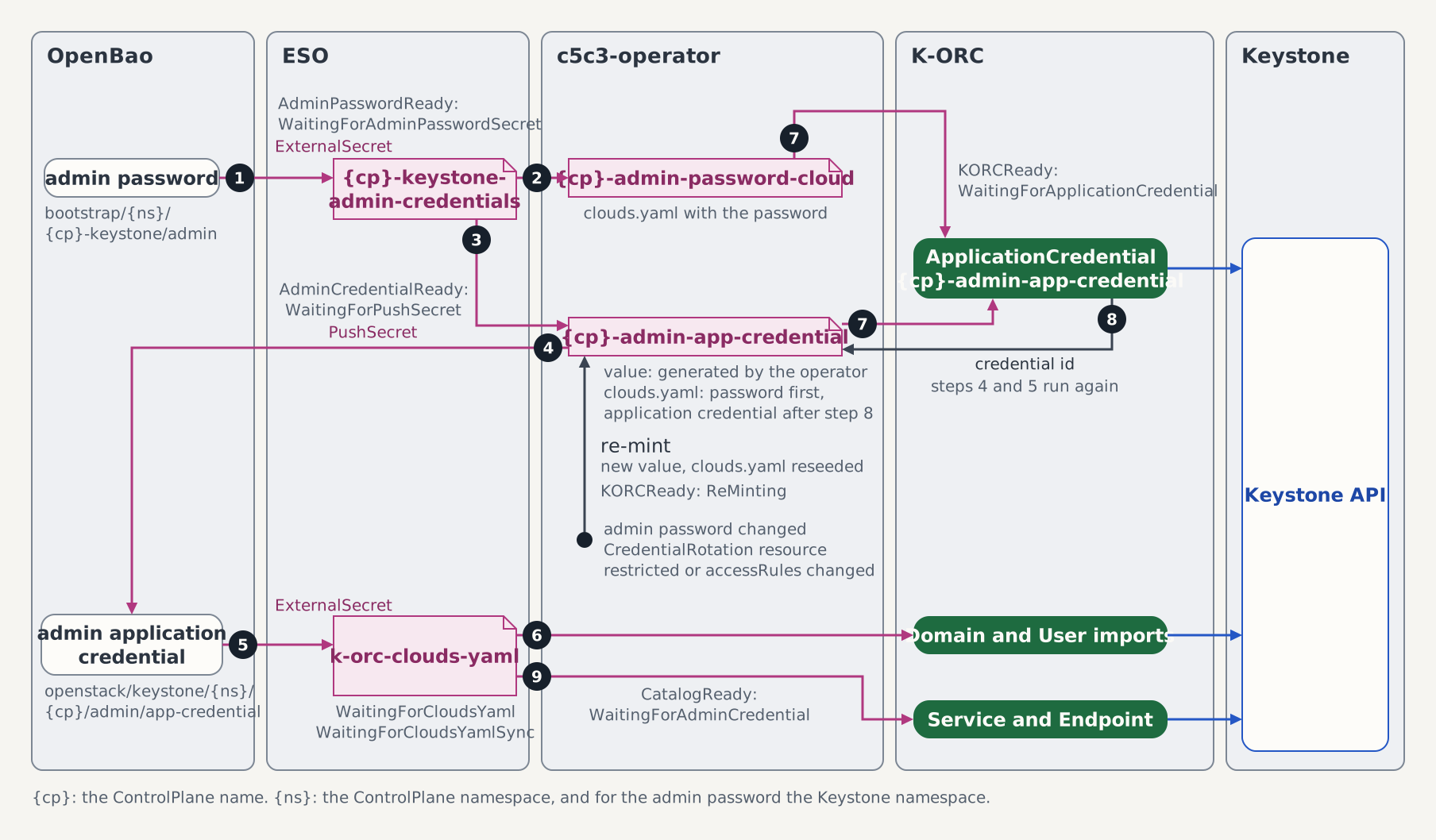
- ESO reads property
passwordofkv-v2/bootstrap/{keystone namespace}/{cp}-keystone/admininto the Secret{cp}-keystone-admin-credentials.reconcileAdminPasswordcreates the ExternalSecret in managed mode, owner-referenced to the ControlPlane. The Keystone namespace is the ControlPlane namespace unlessspec.services.keystone.namespaceis set. reconcileKORCreads the password, writes the Secret{cp}-admin-password-cloudwith a password-basedclouds.yamlon every pass, and keeps the SHA-256 of the password for thecobaltcore.c5c3.io/admin-password-hashannotation. Until the password exists:KORCReady=False, reasonWaitingForAdminPassword.reconcileKORCwrites the Secret{cp}-admin-app-credential. Its keyvalueis the secret of the future application credential, 32 random bytes that the operator generates. Its keyclouds.yamlis seeded with the password-based document while it is empty (seedBootstrapCloudsYAML).- ESO pushes the Secret whole through the PushSecret
{cp}-admin-app-credential-backuptokv-v2/openstack/keystone/{ns}/{cp}/admin/app-credential. The deletion policy isDelete: the key leaves OpenBao with the ControlPlane. - ESO reads property
clouds.yaml, andcacertwhen a CA bundle is set, into the Secret thatspec.korc.adminCredential.cloudCredentialsRef.secretNamenames, by defaultk-orc-clouds-yaml, in the ControlPlane namespace (ensureKORCCloudsYAMLExternalSecret, refresh 1h,creationPolicy: Owner, owner-referenced to the ControlPlane).orc-systemholds no copy: K-ORC resolves thecloudCredentialsRefof a resource in that resource's own namespace. - K-ORC resolves the unmanaged imports
Domain{cp}-domain-defaultandUser{cp}-user-adminwithk-orc-clouds-yaml, which still carries the password. - K-ORC creates the
ApplicationCredential{cp}-admin-app-credentialin Keystone. It authenticates with{cp}-admin-password-cloudand passesvalueas the secret.restricted: true, the default, becomesunrestricted: falseon the K-ORC resource.KORCReadyturns True with reasonApplicationCredentialMinted. reconcileAdminCredentialtakes the credential id from the ControlPlane status, overwrites keyclouds.yamlof{cp}-admin-app-credentialwith the application-credential document, and stampsc5c3.io/push-content-hashon the PushSecret, because ESO does not watch the source Secret. Steps 4 and 5 run a second time. The operator force-syncs the ExternalSecret and setsAdminCredentialReady=Trueonce the id and the secret ink-orc-clouds-yamlmatch.- K-ORC authenticates with the application credential and reconciles the catalog
ServiceandEndpointresources (reconcileCatalog).
Re-mint trigger. A rotation is signalled by comparing SHA-256(admin password) against the cobaltcore.c5c3.io/admin-password-hash annotation last stamped on the AC CR. reconcileKORC re-stamps and re-mints when they differ; the CredentialRotation reconciler forces the same path by clearing the annotation (which guarantees a mismatch). The admin-password Secret watch (see Secret Field Indexer) wakes the ControlPlane the moment the password rotates so the chain converges without waiting for the next periodic requeue. A change of restricted or accessRules re-mints as well, because K-ORC's spec.resource is immutable (adminACResourceDrifted in reconcileKORC).
Multi-instance
The ControlPlane reconciler scopes every admin / K-ORC credential it owns to the individual ControlPlane CR, so multiple control planes can coexist in a single cluster without sharing OpenBao state.
- One ControlPlane per namespace (admission-enforced). The ControlPlane validating webhook's
validateUniqueInNamespacecheck runs inValidateCreateonly (notValidateUpdate): it lists ControlPlanes in the object's namespace through the uncached API reader and returnsfield.Forbiddennaming the incumbent if one already exists. The cluster therefore admits exactly one ControlPlane per namespace. This is what makes the CredentialRotation reconciler'sAmbiguousControlPlanebranch defense-in-depth (see CredentialRotation reconciler). - Duplicate guard (reconciler-enforced). As defense-in-depth for CRs that predate the webhook guard, raced through the API server, or were written with the webhook bypassed,
ReconcilerunsduplicateControlPlaneIncumbentbefore the sub-reconciler chain: it lists ControlPlanes in the CR's namespace and parks every CR except the oldest (bycreationTimestamp, lexically smallest name breaking ties). A parked duplicate getsReady=Falsewith reasonDuplicateControlPlanenaming the incumbent, runs no sub-reconcilers, and requeues every 30s — so it takes over automatically once the incumbent is fully deleted (no watch event fires on the duplicate's behalf when that happens). - Per-CR OpenBao path for the admin AC. The admin application credential is pushed to the per-ControlPlane key
openstack/keystone/{cp.Namespace}/{cp.Name}/admin/app-credential(adminAppCredentialRemoteKeyFor), so two ControlPlanes never write to the same OpenBao object. The K-ORC adminUserCR is named{cp.Name}-user-admin(its Kubernetesmetadata.name), while the OpenStack username it imports staysadmin(set via the importFilter.Name) — the K8s-name and the OpenStack-name are deliberately split so the per-CR Kubernetes object is unique while the OpenStack identity is unchanged. - Per-CR OpenBao path for the service DB credential. The managed-mode service database credential is read from the per-ControlPlane key
openstack/keystone/{cp.Namespace}/{cp.Name}/db(dbCredentialRemoteKeyFor), scoped by both namespace and name (mirroringadminAppCredentialRemoteKeyFor) so two ControlPlanes never collide on the cluster-global OpenBao backend.reconcileDBCredentialsprojects an owned ExternalSecret readingusername/passwordfrom this key. - Running multiple control planes. Because the webhook caps a namespace at one ControlPlane and the OpenBao paths are keyed by
{namespace}/{name}, operating several control planes means deploying each into its own namespace. Each gets a disjoint OpenBao prefix (openstack/keystone/{namespace}/{name}/admin/app-credential), disjoint child CRs in its own namespace, and an independent rotation lifecycle — no two control planes can clobber one another's credentials.
See Migration: legacy flat paths → per-ControlPlane paths for moving an existing single-instance cluster onto the per-CR layout.
Owner-ref / GC model
A child CR created in the ControlPlane's own namespace carries an owner reference to the ControlPlane CR via controllerutil.SetControllerReference(). This enables both automatic garbage collection (deleting the ControlPlane cascades to its children) and watch-based reconciliation (a child change re-reconciles the owner).
A child created in a service namespace — one a namespace assignment places elsewhere — can carry no owner reference: Kubernetes garbage collection only cascades within one namespace, so the API server rejects a cross-namespace controller reference. Such a child is stamped with two ownership labels instead — c5c3.io/controlplane-name and c5c3.io/controlplane-namespace, which together name the owning ControlPlane. They carry the two jobs an owner reference would have done: isControlPlaneChild recognizes the child (so a colliding object owned by nobody is never reshaped or deleted), and a label-mapped Watches() leg resolves an event on it back to a reconcile request. Because nothing garbage-collects such a child, the finalizer tears it down explicitly (see below).
A child written to a target cluster carries no owner reference either, for a stronger reason: that cluster's garbage collector cannot resolve an owner living on the management cluster at all. Such a child takes the two labels above plus the three shared ownership labels (openstack.c5c3.io/owner-kind, -owner-name, -owner-namespace), which name the owning CR across operators, so a Keystone and a ControlPlane projecting into one target namespace each select only their own. Nothing on that cluster collects them, and no cascade crosses the boundary, so a second finalizer holds the ControlPlane in etcd until they are swept.
The figure shows the three cases side by side.
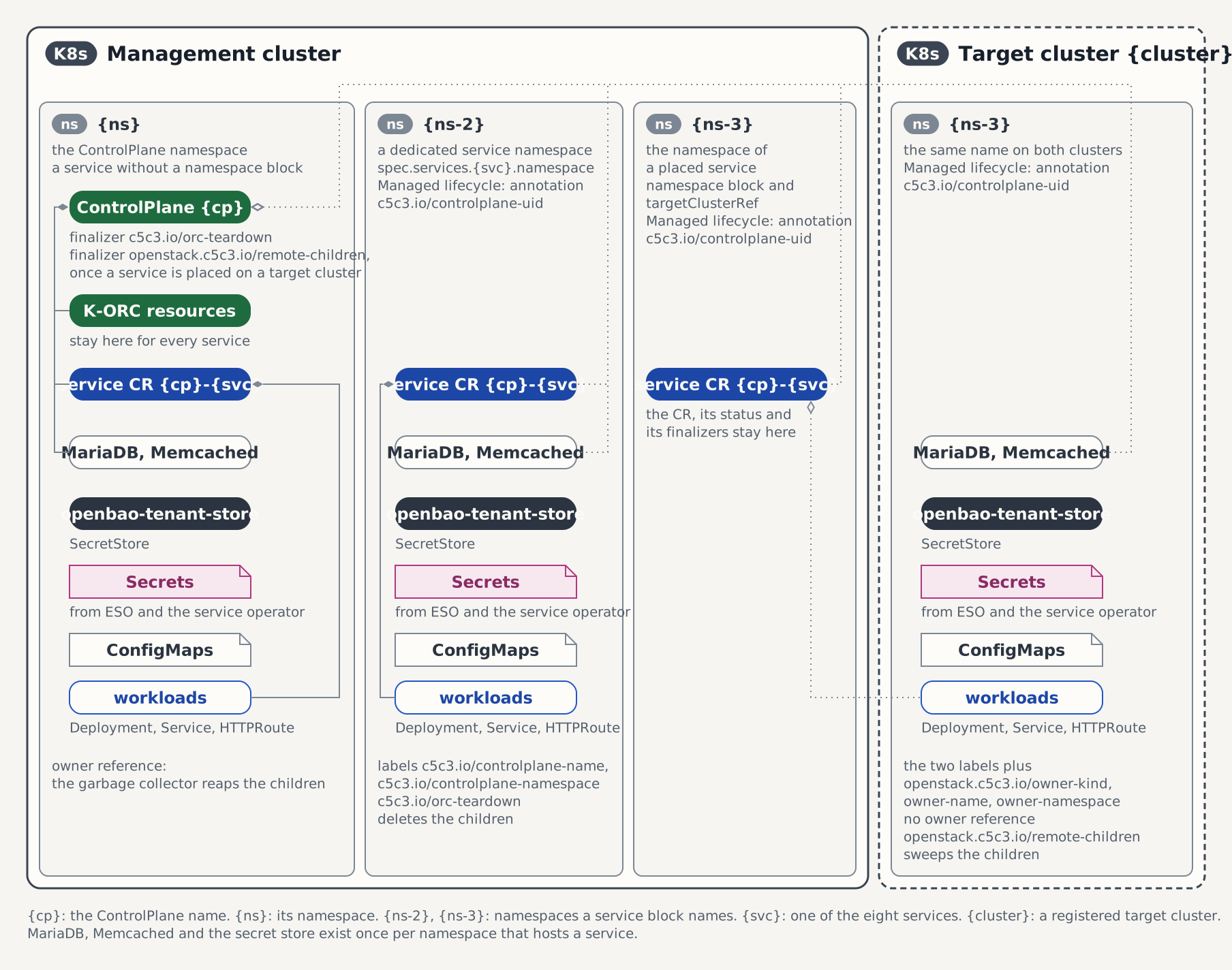
Deletion ordering — the c5c3.io/orc-teardown finalizer
Owner-reference GC alone is unordered: deleting the ControlPlane would garbage-collect every child at once. That is unsafe for the K-ORC CRs the operator owns (ApplicationCredential, Service, Endpoint, Region, User, Domain). Those CRs carry K-ORC finalizers that call the Keystone API to revoke/delete the credentials and catalog entries they minted; if Keystone (and in managed mode its MariaDB) were torn down concurrently, the K-ORC finalizers could never complete and the ControlPlane — and its namespace — would hang indefinitely on Terminating ORC CRs.
The ControlPlane reconciler therefore installs a single finalizer, c5c3.io/orc-teardown, added on the first reconcile before any K-ORC CR is projected. On deletion it:
Deletes the projected
KeystoneServiceregistrations first and waits for them to go. Their K-ORC CRs belong to the registration, not to the ControlPlane, so no enumeration in the sweep below names them, and their controller tears them down through the very admin credential step 2 revokes. While one is still Terminating the reconciler reportsKORCReady=Falsewith reasonFinalizingServiceRegistrationsand requeues; pastregistrationTeardownStallTimeout(2 minutes) it continues anyway and a WarningServiceRegistrationTeardownStallednames what was left behind. That window is a budget of its own rather than a share of the K-ORC one: this wait blocks the sweep below entirely, so a shared deadline would let an unreachable Keystone spend it all here and leave the admin credential's revocation with no time at all. A registration still standing when the ControlPlane is about to be released, on either path, has the children it owns — matched by both their ownership labels and their name prefix — deleted first, and theopenstack.k-orc.cloud/*finalizers of the K-ORC ones stripped afterwards, so the owning controller cannot re-add what it just lost. Its PushSecrets carryDeletionPolicy=Delete, so their deletion is left with ESO to purge from OpenBao untilorcTeardownDeadline— reported asKORCReady=Falsewith reasonFinalizingORCwhile the wait runs — and only past it are their finalizers stripped too. That wait is entered only while the tenantSecretStorethe purge authenticates through is still standing: for a registration in a dedicated namespace the namespace sweep above already took it (Managed: the whole namespace), so the finalizers are stripped at once rather than holding the namespaceTerminatingfor a purge ESO can no longer run. A WarningServiceRegistrationResourcesOrphanedthen names the OpenStack resources and the OpenBao paths left behind (unmanaged imports are released without being listed, the same line step 9 draws); a release that abandoned neither — every child was still live, or held nothing yet — reports a NormalServiceRegistrationChildrenReleasedinstead of a Warning naming empty sets. With its children gone the registration's own controller releases theKeystoneServiceCR.Deletes the owned K-ORC CRs and holds the ControlPlane CR in etcd. Holding the CR defers the owner-reference GC cascade, so Keystone stays reachable while K-ORC revokes. While ORC CRs are still Terminating the reconciler reports
KORCReady=Falsewith reasonFinalizingORCand requeues at the K-ORC cadence.Deletes the owned PushSecrets alongside them. Their
deletionPolicy: Deletecleanup — ESO deleting the mirrored OpenBao data — needs the per-tenantSecretStoreand itseso-tenant-authServiceAccount, both of which the post-release GC cascade reaps unsequenced. Deleting the PushSecrets while the finalizer still holds that infrastructure is what keeps the revoked credential from outliving the ControlPlane in OpenBao. A PushSecret still stuck past the stall window has its finalizers force-removed, and a WarningOpenBaoCleanupStallednames the OpenBao paths that may retain data. A placed namespace is swept on its target cluster as well as at home, because both the PushSecrets and the store their purge authenticates through live there; the force-remove goes to the cluster the PushSecret was found on.Tears down the cross-namespace children before releasing. A service placed in a namespace of its own — and the backing services, tenant store, and credential material that follow it — carries no owner reference, so no GC cascade reaches it; releasing the finalizer first would strand every one of them.
teardownDedicatedNamespacesdeletes them by hand, in order: the service children (Keystone/Horizon, and for a Barbican placed apart itsBarbican,BarbicanSecretStoreandOpenBaoClustertogether) first, waiting for them (their operators run a sequenced ESO cleanup through the tenant store in the same namespace), then the namespace per its lifecycle. The OpenBao instance belongs in that wait set because its own finalizer runs under the tenant RBAC living in the same namespace: deleting the namespace first reaps that RBAC out from under it and leaves the instance unfinalizable, with the namespace stuckTerminating. The service CRs live on the management cluster wherever their service is placed, so waiting for them here is also what waits out the service operators' own remote sweeps. AManagednamespace is deleted, which cascades everything left in it — but only when it carries the ownership marks, read through that cluster's uncached reader because the verdict authorises a whole-namespace cascade; one that does not is left standing with a WarningNamespaceNotOwned, because the operator never destroys a namespace it did not create. On a target cluster thec5c3.io/controlplane-uidannotation is read with them, so a namespace whose mark names another management cluster's ControlPlane is refused rather than cascaded away — while one whose mark was stripped is still reaped, unlike at adoption, since nothing else ever comes back for it. A placed one is deleted on both clusters, sincereconcileNamespacescreated it on both. AnExternalnamespace survives, so its residue (backing services, credential material, tenant-store trio last) is swept by name, each object ownership-checked so a same-named object belonging to somebody else in that shared namespace is left alone. On a placed namespace both run against that cluster's client. The label-selected sweep runs after theExternalresidue sweep and before aManagednamespace is deleted. While children remain the condition reportsNamespacesReady=False/FinalizingNamespaces; past theorcTeardownDeadlinethe sweep stops waiting, emits a WarningNamespaceTeardownStallednaming what is stuck, and releases anyway — a wedged child must not make a namespace undeletable forever.Removes the auth-delegator
ClusterRoleBindingby hand. A dedicated Barbican secret store places one cluster-scoped object,{instance}-{hash}-auth-delegator. A namespaced owner cannot own it, so no GC cascade collects it, and the per-namespace sweep in step 3 reaches it only when Barbican was placed in a namespace of its own.deleteBarbicanAuthDelegatorBindingtherefore runs on every ControlPlane teardown, Barbican or not, reading through the uncached API reader (a cached read would install a cluster-wideClusterRoleBindinginformer for one object) and deleting only a binding carrying this ControlPlane's ownership labels. It reads and deletes on the cluster Barbican was placed on, where the ensemble wrote the binding. A delete that cluster denies — its access chart grants the write verbs only behindauthDelegatorBinding— leaves the binding standing with a WarningAuthDelegatorBindingNotReclaimednaming it, rather than holding the ControlPlane inTerminatingfor a grant the target withdrew.Deletes the co-located Keystone and the managed message bus by hand, then releases the finalizers once the ORC CRs, PushSecrets, cross-namespace children, the Keystone and the bus are gone, letting GC cascade-delete the infrastructure and the remaining children. Both deletes run in the same pass, so the Keystone wait cannot spend the bus's deadline.
A Keystone in the ControlPlane's own namespace owns two backup PushSecrets with
deletionPolicy: Delete,<keystone>-fernet-keys-backupand<keystone>-credential-keys-backup. Itsopenbao-finalizerholds it until ESO has purged their OpenBao paths, and that purge authenticates through the per-tenantSecretStoreand itseso-tenant-authServiceAccount. The cascade deletes all of them at once and in no order.deleteColocatedKeystoneBeforeReleasetherefore deletes the Keystone itself, with background propagation, and holds the finalizer until it has left etcd, reported asKeystoneReady=False/FinalizingKeystonewith a 15-second requeue. The delete waits for the K-ORC CRs to go first, because K-ORC revokes and deletes through the Keystone API. Only a Keystone this ControlPlane owns is deleted. External mode projects none, and a cluster without the Keystone CRD has none, so neither waits; a Keystone in a dedicated namespace belongs to step 4. PastorcTeardownDeadline(7 minutes from the deletion timestamp, the deadline the steps before it share) a WarningKeystoneTeardownStallednames the Keystone and its pathsopenstack/keystone/<namespace>/<keystone>/fernet-keysandopenstack/keystone/<namespace>/<keystone>/credential-keys, and the release proceeds on the cascade. Those paths may then keep their data and have to be deleted by hand.The
RabbitmqClusteris the other same-namespace child the cascade is not trusted with: GC deletes with background propagation, so the CR vanishes the instant the RabbitMQ Cluster Operator removes its finalizer, and that operator's deletion path (v2.13.0 and later, rabbitmq/cluster-operator#1864) removes the finalizer throughcontrollerutil.CreateOrUpdate. A second reconcile of the deleting CR, queued by the first one's own pod-label and StatefulSet writes, reads NotFound from its cache and creates a fresh, unowned broker under the same name, which nothing collects.deleteManagedMessagingBeforeReleasetherefore deletes the owned bus itself with foreground propagation, which keeps the CR visible until every child the cluster-operator owns is gone, and holds the finalizer until the cluster-operator's own finalizer is off the Terminating CR (or the CR is gone), reported asInfrastructureReady=False/FinalizingMessaging. The CR then lingers underforegroundDeletiononly until GC has reaped its children; waiting for NotFound instead would wait on a garbage collector envtest does not run. A bus this ControlPlane does not control (an adopted, externally-provisioned one) is left standing, and a brownfieldsecretRefnames nothing to delete. PastmessagingTeardownDeadline(3 minutes from the deletion timestamp) a WarningMessagingTeardownStallednames the broker and the release proceeds on the cascade, so a wedged cluster-operator cannot make the ControlPlane undeletable. The escape paths below release without either wait. The remote-children finalizer goes in the same update, because by then every placed namespace has been swept or its cluster abandoned.Releases a CR-only remainder immediately. K-ORC re-fetches the resource through an authenticated actuator before releasing any finalizer, and those CRs authenticate with the admin application credential whose revocation step 1 already triggered. Once every CR still present is an
Unmanagedimport or a detach-on-delete resource (the adoptedRegion), waiting on K-ORC is waiting on a dead-credential retry loop. The reconciler force-removes theiropenstack.k-orc.cloud/*finalizers right away and emits a NormalORCImportsReleasedevent. Neither class owns the OpenStack resource behind it: an import's deletion is CR-only, and adetachresource is released by policy, so the external installation is untouched and nothing is orphaned.Bounds the wait. If managed ORC CRs stay Terminating past
orcTeardownDeadline(the 2-minute registration window plusorcTeardownStallTimeout, 5 minutes) — typically because Keystone is already gone and K-ORC cannot revoke — the reconciler force-removes the stuckopenstack.k-orc.cloud/*finalizers (preserving any non-K-ORC finalizers), emits a WarningORCTeardownStalledevent, and releases the ControlPlane finalizer so deletion completes rather than wedging forever. A projected registration still present here has its children force-released before that finalizer goes, under the same WarningServiceRegistrationResourcesOrphanedas on the normal release.Names what the escape orphaned. The escape strips the very finalizer that would have revoked the credential or removed the catalog row, so every
ManagedCR it releases leaves its OpenStack resource behind with no Kubernetes object naming it. A second Warning,ORCResourcesOrphaned, lists exactly those CRs — the adminApplicationCredentialamong them — and tells the operator to remove them from Keystone by hand.Unmanagedimports are never listed: their CR delete could not have touched OpenStack. The detachRegionis never listed either, becauseonDelete: detachleaves the Keystone row in place. The classification is byManagementPolicy, withdetachas its one exception, and fails loud (anything else not explicitlyUnmanagedis reported), because under-reporting a leak is worse than over-reporting one.
kubectl delete namespace makes the leak deterministic
Children live in the ControlPlane's own namespace, so the namespace controller reaps {name}-admin-password-cloud — the Secret the managed catalog entries authenticate with, chosen precisely so they can still authenticate during teardown — concurrently with the entry CRs themselves. K-ORC then has no credential to delete the rows with, the CRs stall, and after 5 minutes the escape releases them. Delete the ControlPlane CR and let it converge before deleting its namespace.
This mirrors the Keystone reconciler's sequenced-finalizer discipline (MariaDB then OpenBao cleanup); see Keystone reconciler — finalizer. The {name}-admin-app-credential-backup PushSecret carries DeletionPolicy: Delete like the others, so its OpenBao path is purged on teardown.
The placed namespaces — openstack.c5c3.io/remote-children
A ControlPlane that places a service on a target cluster carries a second finalizer, the shared openstack.c5c3.io/remote-children. It goes on once ANY cluster the spec names resolves, because reconcileNamespaces resolves and writes per namespace inside its loop, so that cluster's namespaces are created on the very same pass whatever a sibling ref does. Demanding every cluster would leave the written half unreclaimable when the ORC stall escape releases the other finalizer. While no cluster resolves, nothing has been written to any of them for it to reclaim, and reconcileNamespaces is what reports the unresolvable name. Once installed it stays for the CR's life: a cluster that stops resolving later still holds children.
What it holds the ControlPlane open for is the label-selected sweep in step 4. Per placed namespace, controlPlaneRemoteChildKinds names the fourteen kinds the ControlPlane writes there: MariaDB, Memcached, SecretStore, Certificate, ServiceAccount, Role, RoleBinding, Secret, ExternalSecret, PushSecret, VaultDynamicSecret, Password, OpenBaoTenant, OpenBaoCluster. Every object of them the ControlPlane owns is deleted through that cluster's client, listed through its uncached reader and paged so a shared namespace cannot arrive in one response. The list holds namespaced kinds only. The auth-delegator ClusterRoleBinding and the namespace itself are cluster-scoped and deleted by name (steps 5 and 4), while the service CRs and the K-ORC CRs never leave the management cluster.
The sweep runs through the credentials of the registered cluster's kubeconfig, never through the management ClusterRole. That is why Role and RoleBinding are swept although the markers grant them no list verb at home, and it means the blast radius of a placed ControlPlane is whatever that kubeconfig grants on its cluster.
A cluster that does not resolve while the ControlPlane is terminating is waited for: the pass requeues with both finalizers on and reports NamespacesReady=False/TargetClusterUnavailable. Engagement is asynchronous, so an operator restart is indistinguishable from a deregistration. After AbandonAfter (5 minutes, measured from both the first failed resolve in this process and the deletion timestamp) the cluster is abandoned: a WarningRemoteChildrenAbandoned names the cluster and the namespace whose objects stay behind, and the teardown continues without it — the Managed namespace's copy on the management cluster is still deleted, since abandoning the unreachable half does not license leaking the reachable one. The ORC stall escape (step 8) releases c5c3.io/orc-teardown alone. It never reaches this sweep, so the remote-children finalizer stays on and a later pass runs the sweep and releases it.
ControlPlane-scoped children live in the owner's namespace; service children follow their service. The K-ORC CRs, the
clouds.yamlSecret, the PushSecret, and the service-account material belong to the ControlPlane as a whole and are created inchildNamespace(cp) = cp.Namespace, owner-referenced. A service and the things that follow it (itsMariaDB,Memcached,Keystone/Horizon, tenant store, and credential material) are placed incp.KeystoneNamespace()/cp.HorizonNamespace()— the ControlPlane's own namespace by default, or the one anamespaceassignment gives it. A cross-namespace owner reference is rejected at admission because Kubernetes GC only cascades within a single namespace, so a service child in another namespace carries the ownership labels and is torn down by the finalizer instead of the GC cascade.
| Resource | Name | Owner | Notes |
|---|---|---|---|
MariaDB | {spec.infrastructure.database.clusterRef.name} | ControlPlane CR | managed mode only |
Memcached (unstructured) | {spec.infrastructure.cache.clusterRef.name} | ControlPlane CR | managed mode only |
ExternalSecret (DB credential) | {name}-keystone-db-credentials | ControlPlane CR | managed mode only; ESO owns the materialised Secret of the same name |
ExternalSecret (admin password) | {name}-keystone-admin-credentials | ControlPlane CR | managed mode only; ESO owns the materialised Secret of the same name |
Keystone | {name}-keystone | ControlPlane CR | managed mode only |
ApplicationCredential | {name}-admin-app-credential | ControlPlane CR | both modes; carries cobaltcore.c5c3.io/admin-password-hash |
Secret | {name}-admin-app-credential | ControlPlane CR | both modes; value generated and clouds.yaml assembled by the operator, read by K-ORC |
PushSecret | {name}-admin-app-credential-backup | ControlPlane CR | both modes; DeletionPolicy: Delete |
User (K-ORC) | {name}-user-admin | ControlPlane CR | both modes; unmanaged import |
Domain (K-ORC) | {name}-domain-default | ControlPlane CR | both modes; unmanaged import |
Service (K-ORC) | {name}-identity-service | ControlPlane CR | both modes; managed catalog entry in Managed mode, unmanaged import in External mode |
Endpoint (K-ORC) | {name}-identity-endpoint | ControlPlane CR | managed mode only; public interface |
Endpoint (K-ORC) | {name}-identity-endpoint-{interface} | ControlPlane CR | External mode only; one unmanaged import per interface (public, internal, admin) |
Barbican secret-store teardown
Unsetting spec.services.barbican takes a different path from deleting the ControlPlane, and deleteOrphanedBarbican gates it on two annotations rather than one. c5c3.io/allow-barbican-deletion: "true" releases the BarbicanSecretStore (first, so its controller can still reach the server while it finalizes), then the Barbican child, the DB-credential objects, and the key-manager catalog CRs. Reaching the dedicated OpenBao instance takes c5c3.io/allow-barbican-secret-store-data-deletion: "true" on top: the instance carries deletionPolicy: DeletePVCs, so the delete wipes the raft volume, and the teardown removes the static-seal Secret with it, leaving even a recovered volume unreadable. Without the second annotation the instance, its PVC, its seal key and the rest of the ensemble stand, and BarbicanReady says so, so re-declaring the service reattaches to the same instance.
It does not reattach to the same secrets. The first annotation already deletes the Barbican child, whose finalizer deletes the MariaDB Database CR, and database.BuildDatabase sets no cleanupPolicy, so mariadb-operator applies its Delete default and drops the schema. The secret and container rows, secret_store_metadata, the ACLs and the quotas go with it, and db-sync recreates the schema empty on the next projection, leaving the surviving OpenBao payloads unreferenced. A dump of the barbican schema taken before the teardown is the only thing that makes the preserve branch a round trip.
With both set the order is store, child, credentials, catalog rows, then the OpenBaoCluster. The sweep then waits for the instance to leave etcd before deleting the OpenBaoTenant and the rest of the ensemble. The tenant is what admits the namespace to the openbao-operator, and the instance's own finalizer runs under that admission, so removing it first would leave the instance unfinalizable. Each object is ownership-checked, and an object already gone is tolerated.
Both annotations are read from the live CR on every reconcile of that sweep, so the decision is not latched. Removing one while the instance is still finalizing resumes on the preserve branch after the OpenBaoCluster is already deleted, and the ensemble behind it is never swept. The cluster-scoped auth-delegator binding is the object that then has nothing left to collect it.
Deleting the ControlPlane takes the ensemble down either way, with no second opt-in: tearing down a whole control plane is already an explicit destructive act.
Neutron teardown residue
The network service leaves objects in three shapes, and both teardown paths name them. deleteOrphanedNeutron runs when spec.services.neutron is unset with c5c3.io/allow-neutron-deletion: "true"; the ControlPlane teardown reaches the same set through sweepExternalNamespaceResidue for a namespace it does not own, through crossNamespaceServiceChildren for the Neutron child in a dedicated namespace, and through projectedRegistrationKeys for the registration.
- The four DB-credential shapes: the
{controlplane.Name}-neutron-db-credentialsExternalSecretand theVaultDynamicSecretgenerator of the same name, the{controlplane.Name}-neutron-db-openbao-clientCertificate, and theneutron-db-credsServiceAccount. - The bus delivery: the
{controlplane.Name}-neutron-messagingSecret and the{controlplane.Name}-neutron-messaging-camirror. Both paths take the two stubs fromserviceMessagingSecrets(neutronMessagingTarget(cp)). Nothing else writes them, so an unmanaged service leaves no broker credential behind in the namespace. - The
Neutronchild and the{controlplane.Name}-neutronKeystoneServiceregistration, whose finalizer removes the network catalog rows, the service user, and its project.
Each object is ownership-checked against its live state, so a same-named object belonging to somebody else in a shared namespace is left alone. The OVNCentral the child references appears in neither path and is deleted nowhere: it is deployed outside the plane and only read.
Cinder teardown residue
The block-storage service leaves the shapes the network service does plus its two satellite kinds, and both teardown paths name them. deleteOrphanedCinder runs when spec.services.cinder is unset with c5c3.io/allow-cinder-deletion: "true"; the ControlPlane teardown reaches the set through sweepExternalNamespaceResidue for a namespace it does not own, through crossNamespaceServiceChildren for the Cinder child in a dedicated namespace, and through projectedRegistrationKeys for the registration.
- The four DB-credential shapes: the
{controlplane.Name}-cinder-db-credentialsExternalSecretand theVaultDynamicSecretgenerator of the same name, the{controlplane.Name}-cinder-db-openbao-clientCertificate, and thecinder-db-credsServiceAccount. - The bus delivery: the
{controlplane.Name}-cinder-messagingSecret and the{controlplane.Name}-cinder-messaging-camirror. Both paths take the two stubs fromserviceMessagingSecrets(cinderMessagingTarget(cp)). Nothing else writes them, so an unmanaged service leaves no broker credential behind in the namespace. - Every owned
CinderBackendandCinderBackupBackendin the Cinder namespace, swept kind by kind on ownership alone, since a satellite carries a bare entry name no prefix selects. The teardown waits on them: a deletedCinderBackendholds the cinder operator'sservice-removefinalizer until its detach Job has run, so the namespace must not be taken out from under that Job. - The
Cinderchild and the{controlplane.Name}-cinderKeystoneServiceregistration, whose finalizer removes the block-storage catalog rows, the service user, and its project.
Each object is ownership-checked against its live state, so a hand-created CinderBackend attached to the same Cinder is neither pruned nor swept.
Nova teardown residue
The compute service leaves the shapes its peers do, twice over for the credentials and with the generated metadata secret on top. deleteOrphanedNova runs when spec.services.nova is unset with c5c3.io/allow-nova-deletion: "true"; the ControlPlane teardown reaches the same set through sweepExternalNamespaceResidue for a namespace it does not own, through crossNamespaceServiceChildren for the Nova child in a dedicated namespace, and through projectedRegistrationKeys for its registration keys.
- Two DB-credential chains rather than one, because the
nova_apiand cell schemas each take a login of their own: the{controlplane.Name}-nova-api-db-credentialsand{controlplane.Name}-nova-db-credentialsExternalSecrets, theVaultDynamicSecretgenerators of the same names, the{controlplane.Name}-nova-api-db-openbao-clientand{controlplane.Name}-nova-db-openbao-clientCertificates, and thenova-api-db-credsandnova-cell-db-credsServiceAccounts. - The generated metadata shared secret: the
{controlplane.Name}-nova-metadata-secretExternalSecretand thePasswordgenerator behind it, the latter read uncached. The Secret they materialise carries ESO's own owner reference, so it comes down with the ExternalSecret rather than being deleted by name. - The bus delivery: the
{controlplane.Name}-nova-messagingSecret and the{controlplane.Name}-nova-messaging-camirror, both fromserviceMessagingSecrets(novaMessagingTarget(cp)), and the{controlplane.Name}-nova-remote-messagingSecret the remote compute contract reads its transport URL from. - The
Novachild and the{controlplane.Name}-novaKeystoneServiceregistration, whose finalizer removes the compute catalog rows, the service user, and its project. - The hypervisor operator's account: the
{controlplane.Name}-nova-hypervisor-operatorKeystoneServiceregistration, whichprojectedRegistrationKeysalways lists so a registration the dropped block left behind still comes down with the plane, and the{controlplane.Name}-nova-hypervisor-operator-authSecret. Its copies on compute clusters are reaped by eachNovaCompute's own teardown, as the compute-contract mirrors are.
The compute-notifier registration {controlplane.Name}-neutron-nova is not in this set: it lives in the Neutron namespace beside the service that authenticates as it, so deleteOrphanedNeutron and the Neutron teardown sweep it (and pruneNeutronNovaNotifierRegistration takes it down once services.nova is cleared while the network service stays and the Neutron child has converged on the spec without spec.nova).
The credential mirror a placed compute service carries is not swept by deleteOrphanedNova either. Like every object that function names it is resolved through NovaNamespace(), which without a services.nova block is the ControlPlane's own namespace, so that sweep reaches co-located objects only; the mirror is reaped by the ControlPlane teardown, which sweeps a placed namespace's label-owned ExternalSecrets on the target cluster.
External-mode deletion resource set
orcChildObjects(cp) derives the swept CR names from the ControlPlane spec, so Managed mode enumerates the six CRs it owns and External mode adds the per-interface identity Endpoint imports. A name that never existed in the current mode is simply NotFound and is tolerated as already-gone.
The enumeration is purely spec-derived, and it can be: every name it produces follows from the ControlPlane's identity and its keystone mode, neither of which a spec edit can drop while leaving a CR behind. Rows a KeystoneService registers are not in this set at all — that CR owns them, and reconcileDelete deletes the projected registrations first and waits for their own teardown.
What a Delete does to the external OpenStack installation is decided by each K-ORC CR's ManagementPolicy, not by the ControlPlane's mode:
ApplicationCredential—Managed. Its K-ORC finalizer revokes the credential at the Keystone level before the CR delete returns, so authenticating with it immediately afterwards yields 404Could not find Application Credential(not 401). This is the one identity object the operator minted, so it is the one it destroys.User,Domain—Unmanagedimports. Deleting their CRs removes the Kubernetes objects and leaves the OpenStack resources they imported untouched. K-ORC's deletion-guard finalizers also enforce the teardown order: aUsercannot go while anApplicationCredentialstill references it.Service,Endpoint— in Managed mode these are the managed catalog entries, so the sweep deletes them from Keystone's catalog. In External mode the identityServiceand its per-interfaceEndpoints areUnmanagedimports, so deleting them is a CR-only delete and the external catalog is left bit-for-bit intact.Region—ManagedwithonDelete: detach, so aDeleteremoves the CR and leaves the Keystone row in place; that row goes with the Keystone database. K-ORC still authenticates before releasing the detach finalizer, which is whyreconcileDeletereleases it together with the unmanaged imports. External mode projects noRegion, so the name isNotFoundthere. That holds for a teardown K-ORC can complete. The stall escape is the deliberate exception: pastorcTeardownDeadlineit releases every stuck CR by stripping the finalizer that would have done the revoke or theDELETE, so eachManagedCR it releases orphans its OpenStack resource. Those are the CRs theORCResourcesOrphanedWarning names.
The OpenBao-backed Secrets are torn down by owner-reference GC, and the path behind the {name}-admin-app-credential-backup PushSecret is purged with it (DeletionPolicy: Delete). Nothing else is touched — a K-ORC CR the ControlPlane does not own is never swept.
Security invariant
The admin password and the minted application-credential Secret are read only by the c5c3-operator and the K-ORC controller pods — they are never mounted into Keystone or any OpenStack service workload. Keystone receives the admin password solely through its own bootstrap Secret ref for the one-time keystone-manage bootstrap; the long-lived application credential lives exclusively on the c5c3↔K-ORC↔OpenBao path. restricted: true (the default) further bounds the blast radius by scoping the minted credential. These invariants are enforced by the credential_invariant_test.go checks (TestCredentialInvariant_MintedACIsRestricted, TestCredentialInvariant_AppCredentialSecretAbsentFromKeystoneSpec, TestCredentialInvariant_AppCredentialSecretReferencedOnlyByPushSecretAndAC, TestCredentialInvariant_NoWorkloadReferencesAppCredentialSecret).
The PushSecret carries DeletionPolicy: Delete. The credential leaves OpenBao with the ControlPlane. The teardown revokes it in Keystone, so a value kept at the path would be dead, and the next ControlPlane of the same name would authenticate K-ORC with it and fail. A re-created control plane mints a new credential.
Metrics Instrumentation
Every sub-reconciler invocation is instrumented for Prometheus via a single package-scope instrumenter, declared in operators/c5c3/internal/controller/instrumentation.go. Its Instrument method comes from the shared internal/common/instrumentation package — the duration/error metric pair and the wrapper logic are identical across all CobaltCore operators and live there; the c5c3 file supplies only the c5c3_operator prefix and the subReconcilerConditionTypes map. Reconcile wraps every sub-reconciler call with it; a direct call that bypasses it is a contract violation.
func (i *Instrumenter) Instrument(
    ctx  context.Context,
    name string,
    fn   func(context.Context) (ctrl.Result, error),
) (ctrl.Result, error)
Behavioural contract:
- Always records one observation in
c5c3_operator_reconcile_duration_seconds{sub_reconciler=name}viadefer— on the success path, the error path, and even whenfnpanics (the deferred call runs before the stack unwinds). - Only increments
c5c3_operator_reconcile_errors_total{sub_reconciler=name, condition_type=…}whenfnreturns a non-nil error. - Does not recover from panics — they propagate to the caller.
- Carries no per-CR labels (no
controlplane/namespace). The two label dimensions (sub_reconciler, andcondition_typeon the error counter) are bounded by the number of sub-reconcilers, keeping the series count fleet-independent. Per-CR collectors are intentionally out of scope.
Both vectors are registered exactly once on the controller-runtime registry via sync.Once; the histogram buckets are a fixed contract (0.01 … 30s).
Name → condition_type lookup and the drift guard
The condition_type label is resolved from the package-private subReconcilerConditionTypes map in instrumentation.go:
sub_reconciler | condition_type |
|---|---|
Sizing | SizingReady |
Namespaces | NamespacesReady |
Infrastructure | InfrastructureReady |
ESOTenantStore | ESOTenantStoreReady |
DBCredentials | DBCredentialsReady |
Keystone | KeystoneReady |
Horizon | HorizonReady |
Glance | GlanceReady |
Placement | PlacementReady |
Barbican | BarbicanReady |
OVN | OVNReady |
Neutron | NeutronReady |
Cinder | CinderReady |
Nova | NovaReady |
KORC | KORCReady |
AdminCredential | AdminCredentialReady |
AdminPassword | AdminPasswordReady |
Catalog | CatalogReady |
ServiceAccounts | ServiceAccountsReady |
RegistrationTenantStores | RegistrationTenantStoresReady |
NamespaceAssignments | NamespaceAssignmentsReady |
The map carries two further entries, KeystoneServiceCatalog and KeystoneServiceAccount, which belong to the KeystoneService controller rather than to this one; see the KeystoneService Reconciler. The RegistrationTenantStores series is kept apart from ESOTenantStore's because the two carry different blast radii and one alert should not read as the other.
If instrumenter.Instrument is ever called with a name absent from the map, the helper emits the sentinel condition_type=UNKNOWN (instrumentation.ConditionTypeUnknown) rather than an empty label, so any drift is visible in dashboards/alerts. One static drift guard keeps the map honest: TestSubReconcilerConditionTypesCoversAllNames asserts that every mapped condition_type is a member of subConditionTypes. Adding a new sub-reconciler therefore requires updating subConditionTypes andsubReconcilerConditionTypes; an unmapped name is not caught by CI and surfaces only as condition_type=UNKNOWN in the metrics.
Testing
The reconcilers have comprehensive unit tests using the controller-runtime fake client with gomega (NewGomegaWithT(t)), plus envtest integration tests that drive the full chain in a real manager against a live API server. They cover the full reconcile to Ready=True and two deletion scenarios, TestIntegration_ControlPlaneDeletion_SweepsProjectedRegistrationsFirst and TestIntegration_DedicatedNamespaces.
Running Tests
| Scope | Command |
|---|---|
| All controller unit tests | go test ./operators/c5c3/internal/controller/... |
| Integration (envtest) | go test -tags integration -run TestIntegration_FullReconcile_ManagedToReady ./operators/c5c3/internal/controller/ |
Integration test
TestIntegration_FullReconcile_ManagedToReady (integration_test.go, build tag integration) registers the real controller wiring (the inline builder is kept byte-for-byte in step with SetupWithManager) and drives a managed-mode ControlPlane through every sub-reconciler to the aggregate Ready=True. It simulates each external dependency's readiness in dependency order — MariaDB and Memcached Ready → the operator-created admin-password ExternalSecret synced → Keystone child Ready → K-ORC ApplicationCredential Available with a status.id → the {control-plane ns}/k-orc-clouds-yaml ExternalSecret synced — and asserts that every sub-condition and the aggregate Ready (reason AllReady) reach True, that status.observedGeneration and every condition's ObservedGeneration match the CR generation, and that status.adminApplicationCredential mirrors the simulated AC. Beyond the aggregate condition it also asserts the intermediate projected specs so a projection regression is caught: the Keystone image tag derived from openStackRelease, the database/cache clusterRefs wired to the infra CRs, the merged policyOverrides, the restricted→Unrestricted=false inversion on the AC, and the identity Service/Endpoint shape.
A phase between Infrastructure and Keystone exercises the new admin-password projection: it waits for the operator-created per-CP admin-password ExternalSecret, asserts its RemoteRef.Key equals adminPasswordRemoteKeyFor(cp) and that it is controller-owned by the ControlPlane, then simulates the ESO sync — SimulateExternalSecretSync patches only the ExternalSecret's status, so the renamed plain Secret (pre-created under the same name) stays the cleartext source the operator reads — and waits for AdminPasswordReady to reach True before the Keystone child is projected.
Two deletion scenarios run on the same harness with both controllers on one manager. TestIntegration_ControlPlaneDeletion_SweepsProjectedRegistrationsFirst pins the order for a co-located Placement registration: it goes before the admin ApplicationCredential, KORCReady=False/FinalizingServiceRegistrations persists while a K-ORC-shaped finalizer holds the registration's User, and the K-ORC sweep starts only once the registration, its K-ORC children, PushSecret and source Secret are gone. TestIntegration_DedicatedNamespaces asserts that order for a Barbican registration placed in a namespace of its own, ahead of the cross-namespace teardown assertions.
Test Files
| File | Coverage |
|---|---|
controlplane_controller_test.go | Reconcile orchestration, sequential early-return, Ready aggregation, updateStatus error-join, idempotency |
reconcile_sizing_test.go | reconcileSizing for a built-in profile (no read), an existing, a missing and an unreadable SizingProfile; the pipeline stop; sizingProfileToControlPlaneMapper |
sizing_projection_test.go | The shared projection helpers: spread completion against the child's selector, the placement fallback, the replica default, uWSGI, Jobs, and the Glance apiServer block |
reconcile_infrastructure_test.go | Managed/brownfield MariaDB + Memcached, unstructured readiness, condition contract, ObservedGeneration, the backing-service sizing of ensureMariaDB / ensureMemcached / ensureRabbitMQ |
reconcile_dbcredentials_test.go | Managed ExternalSecret projection (name/store/data/owner-ref), brownfield no-op Ready=True, not-ready requeue + condition contract, distinct per-CP remote key/secret name |
reconcile_adminpassword_test.go | Managed ExternalSecret projection (name/store/data/owner-ref), brownfield no-op Ready=True, not-ready requeue + condition contract, distinct per-CP remote key/secret name |
reconcile_keystone_test.go | Keystone projection, infra gate, image/rotation/policy projection, condition contract, ObservedGeneration |
reconcile_korc_test.go | AC mint, restricted↔unrestricted inversion, hash annotation/re-mint, missing-CRD safety, admin-credential push, catalog, condition contract |
reconcile_projected_children_test.go | Prune and sweep of projected satellite children: ownership, name prefix, the Keep set, an absent CRD, the wrapped errors |
reconcile_service_messaging_test.go | Bus delivery on the Neutron target, a second target under its own names, serviceMessagingSpec, the CA-mirror reap gate, the teardown stubs |
reconcile_cinder_test.go | Cinder projection, the Keystone and registration gates, the satellite projection and prune, the derived Glance/Barbican/internal-tenant fields, the replica pins, the orphan teardown |
reconcile_cinder_dbcredentials_test.go | Cinder DB-credential names, OpenBao paths, and the effective mode |
reconcile_nova_test.go | Nova projection, the Keystone and Placement gates, the registration gate, the two database blocks and their shared mode, the console-proxy shapes, the replica pins, the compute-config mirror seam and its remote source, the remote-compute projection and reap, the orphan teardown |
reconcile_nova_remote_compute_test.go | The remote bus delivery: the projected spec.remoteCompute, the handed URL landing in {controlplane.Name}-nova-remote-messaging at home and on a target, its rotation, the waits and errors, and the reap once the child has converged |
reconcile_nova_dbcredentials_test.go | The two Nova DB-credential targets: names, OpenBao roles and paths, and the one effective mode both carry |
reconcile_nova_metadata_secret_test.go | The generated metadata shared secret: the Password generator, the non-refreshing ExternalSecret and its shared_secret rewrite, the resolved reference, the pair a reference to the generated Secret keeps, and the reap once metadataSharedSecretRef names another Secret, on the target cluster as well as at home |
reconcile_nova_hypervisor_operator_test.go | The hypervisor operator's account: the registration and its name budget, the relayed registration wait, the password wait and read failure, the seven-key auth Secret, one copy per compute cluster, a failed or unresolvable target, a foreign auth Secret refused beside the Nova and on a compute cluster, a Nova in a dedicated namespace or on a target cluster, rotation, and the prune with its ownership and mirror-label gates, its uncached reads and the placed Nova's ExternalSecret |
reconcile_nova_metadata_agent_test.go | The metadata shared-secret copy for agents on target clusters: the targets one per cluster in the central's namespace and the agents left out, the neutron-less plane and the unserved kind, the single-key copy with its labels, one copy per cluster, a placed Nova's contract read on its own cluster, no target no write, the waits on the contract and its key, a contract read error, a failed agent list, an unresolvable Nova or agent cluster, a failed write and a foreign Secret, a failing cluster that holds back no other, rotation, and NovaReady waiting on the copy in reconcileNova |
builtin_registrations_test.go | The shared registration leg: the projected child, the gate, the credential mirror, the reclaim of foreign spec fields, and the per-service roles |
reconcile_credentialrotation_test.go | Nudge model, one-per-namespace resolution, bootstrap, deferred scheduled fields, target enum |
credential_invariant_test.go | Security invariants (restricted mint, app-credential Secret not on any workload) |
instrumentation_test.go | Wiring smoke test (records through the instrumenter), condition_type drift guard |
setupwithmanager_test.go | For/Owns/Watches wiring, field-indexer registration |
helpers_test.go | intervalToCron |
integration_test.go | Full envtest reconciliation to Ready=True; the deletion scenarios TestIntegration_ControlPlaneDeletion_SweepsProjectedRegistrationsFirst (registration-first teardown order, co-located) and TestIntegration_DedicatedNamespaces (the same in a dedicated namespace, with the cross-namespace sweep) (build tag integration) |
File Layout
operators/c5c3/
├── main.go                                     Scheme registration + bootstrap wiring, leaderElectionID
├── api/v1alpha1/
│   ├── controlplane_types.go                   ControlPlane CRD types
│   ├── sizing_types.go                         SizingSpec, ControlPlaneSizingSpec, SizingProfile CRD types
│   ├── sizing_profiles.go                      BuiltinSizing: the Minimal and Standard profiles
│   ├── sizing_merge.go                         MergeSizing, ResolveSizing, EffectiveSizingBase
│   ├── sizing_validation.go                    validateSizingSpec, validateResolvedSizing, inert warnings
│   ├── sizingprofile_webhook.go                SizingProfileWebhook (validating + defaulting)
│   ├── credentialrotation_types.go             CredentialRotation CRD types
│   ├── secretaggregate_types.go                SecretAggregate CRD types
│   ├── controlplane_webhook.go                 ControlPlaneWebhook (validating + defaulting)
│   ├── keystoneservice_types.go                KeystoneService CRD types (see the KeystoneService pages)
│   ├── keystoneservice_webhook.go              KeystoneServiceWebhook (see the KeystoneService pages)
│   └── ...
└── internal/
    ├── controller/
    │   ├── controlplane_controller.go          Reconciler struct, Reconcile(), setReadyCondition,
    │   │                                        aggregateReady, setServicesStatus, updateStatus, secret
    │   │                                        field indexer, SetupWithManager
    │   ├── external_mode.go                    IsExternalKeystone predicate + K-ORC external-failure
    │   │                                        classification and import-stall markers
    │   ├── helpers.go                          effective backing-service resolvers, intervalToCron
    │   ├── identity_backends.go                KeystoneIdentityBackend listing + WebSSO/MultiDomain
    │   │                                        projection helpers
    │   ├── instrumentation.go                  instrumenter + drift-guard map
    │   ├── reconcile_sizing.go                 reconcileSizing (SizingReady), effectiveSizing,
    │   │                                       sizingProfileToControlPlaneMapper
    │   ├── sizing_projection.go                shared projection of spec.sizing onto the children
    │   ├── korc_cloudsyaml.go                  clouds.yaml document builders (app-credential + password bootstrap)
    │   ├── korc_eso.go                         PushSecret + clouds.yaml ExternalSecret builders/ensure
    │   ├── korc_imports.go                     admin Domain/User import projection
    │   ├── korc_secrets.go                     app-credential Secret seeding, computeAdminPasswordHash
    │   ├── korc_unlatch.go                     clears latched K-ORC transport errors from child status
    │   ├── reconcile_infrastructure.go         reconcileInfrastructure (MariaDB + Memcached),
    │   │                                        childNamespace, memcachedGVK
    │   ├── reconcile_namespaces.go             reconcileNamespaces (dedicated service namespaces),
    │   │                                        child ownership labels + claim
    │   ├── reconcile_esotenant.go              reconcileESOTenantStore (per-tenant SecretStore + SA +
    │   │                                        mTLS cert), effectiveControlPlaneStoreRef
    │   ├── reconcile_dbcredentials.go          reconcileDBCredentials (per-CP DB-credential ExternalSecret)
    │   ├── reconcile_adminpassword.go          reconcileAdminPassword (per-CP admin-password ExternalSecret),
    │   │                                        effectiveAdminPasswordSecretRef
    │   ├── reconcile_keystone.go               reconcileKeystone projection
    │   ├── reconcile_horizon.go                reconcileHorizon projection (dashboard + WebSSO/MultiDomain)
    │   ├── reconcile_glance.go                 reconcileGlance projection (Glance + GlanceBackend
    │   │                                        children, DB-credential ExternalSecret)
    │   ├── reconcile_placement.go              reconcilePlacement projection (Placement child)
    │   ├── reconcile_placement_dbcredentials.go Placement DB-credential names, OpenBao paths, mode
    │   ├── reconcile_barbican.go               reconcileBarbican projection (Barbican +
    │   │                                        BarbicanSecretStore children, orphan teardown)
    │   ├── reconcile_barbican_openbao.go       Dedicated OpenBao instance and its ensemble
    │   ├── reconcile_barbican_dbcredentials.go Barbican DB-credential names, OpenBao paths, mode
    │   ├── reconcile_ovn.go                    reconcileOVN (mirror the referenced OVNCentral),
    │   │                                        ovnCentralToControlPlaneMapper
    │   ├── reconcile_neutron.go                reconcileNeutron projection (Neutron child, orphan
    │   │                                        teardown)
    │   ├── reconcile_cinder.go                 reconcileCinder projection (Cinder child, its two
    │   │                                        satellite kinds, orphan teardown)
    │   ├── reconcile_nova.go                   reconcileNova projection (Nova child, the
    │   │                                        compute-config mirror, orphan teardown)
    │   ├── reconcile_projected_children.go     Shared prune/sweep of a service's projected
    │   │                                        satellite children (ownership + name prefix)
    │   ├── reconcile_service_messaging.go      Shared-bus delivery on a service target
    │   │                                        (transport-URL Secret + CA mirror)
    │   ├── reconcile_neutron_dbcredentials.go  Neutron DB-credential names, OpenBao paths, mode
    │   ├── reconcile_cinder_dbcredentials.go   Cinder DB-credential names, OpenBao paths, mode
    │   ├── reconcile_nova_dbcredentials.go     The two Nova DB-credential targets: names, OpenBao
    │   │                                        roles and paths, the one shared mode
    │   ├── reconcile_nova_metadata_secret.go   The generated metadata shared secret (Password
    │   │                                        generator + ExternalSecret, resolve and prune)
    │   ├── reconcile_nova_remote_compute.go    The remote bus delivery, the projected
    │   │                                        spec.remoteCompute, and its reap
    │   ├── reconcile_nova_hypervisor_operator.go The hypervisor operator's account: registration,
    │   │                                        auth Secret, its copies, prune
    │   ├── reconcile_nova_metadata_agent.go    The metadata shared-secret copy for the agents
    │   │                                        on target clusters, its watch mapper and predicate
    │   ├── reconcile_korc.go                   reconcileKORC (AC mint/re-mint, drift detection)
    │   ├── reconcile_admincredential.go        reconcileAdminCredential (assemble + push + re-push
    │   │                                        nudges, semantic clouds.yaml gate)
    │   ├── reconcile_catalog.go                reconcileCatalog (mode fork; the managed identity
    │   │                                        Service/Endpoint), korcAvailableUpToDate
    │   ├── reconcile_catalog_external.go       reconcileCatalogExternal (import-first: unmanaged
    │   │                                        identity imports, opt-in entries, stall detection)
    │   ├── reconcile_serviceaccounts.go        reconcileServiceAccounts (folds the built-in
    │   │                                        registrations into ServiceAccountsReady)
    │   ├── builtin_registrations.go            The leg Glance/Placement/Barbican/Neutron/Cinder/
    │   │                                        Nova share: project the KeystoneService child,
    │   │                                        gate, mirror, reclaim; plus the account-only
    │   │                                        builder the Neutron-to-Nova notifier takes
    │   ├── registration_projection.go          K-ORC child + ESO builders shared with the
    │   │                                        KeystoneService controller
    │   ├── keystoneservice_controller.go       KeystoneServiceReconciler (see the KeystoneService pages)
    │   ├── keystoneservice_catalog.go          Its catalog block (see the KeystoneService pages)
    │   ├── keystoneservice_account.go          Its account block (see the KeystoneService pages)
    │   ├── reconcile_delete.go                 reconcileDelete (ORC-teardown finalizer sequencing)
    │   ├── reconcile_credentialrotation.go     CredentialRotationReconciler (nudge model)
    │   ├── requeue_intervals.go                infra/dbCredentials/adminPassword/keystone/korc/credentialRotation backoffs
    │   ├── controlplane_controller_test.go     Orchestration tests
    │   ├── external_mode_test.go               External-mode helper tests
    │   ├── helpers_test.go                     helper-function tests
    │   ├── identity_backends_test.go           Identity-backend projection tests
    │   ├── instrumentation_test.go             Metrics instrumentation + drift guards
    │   ├── korc_cloudsyaml_test.go             clouds.yaml builder tests
    │   ├── korc_unlatch_test.go                transport-error unlatch tests
    │   ├── reconcile_infrastructure_test.go    Infrastructure tests
    │   ├── reconcile_namespaces_test.go        Namespaces tests
    │   ├── reconcile_esotenant_test.go         ESO-tenant-store tests
    │   ├── reconcile_dbcredentials_test.go     DBCredentials tests
    │   ├── reconcile_adminpassword_test.go     AdminPassword tests
    │   ├── reconcile_keystone_test.go          Keystone projection tests
    │   ├── reconcile_horizon_test.go           Horizon projection tests
    │   ├── reconcile_glance_test.go            Glance projection tests
    │   ├── reconcile_placement_test.go         Placement projection tests
    │   ├── reconcile_placement_dbcredentials_test.go Placement DB-credential tests
    │   ├── reconcile_barbican_test.go          Barbican projection tests
    │   ├── reconcile_barbican_openbao_test.go  Dedicated OpenBao ensemble tests
    │   ├── reconcile_barbican_dbcredentials_test.go Barbican DB-credential tests
    │   ├── reconcile_ovn_test.go               OVNCentral mirroring tests
    │   ├── reconcile_neutron_test.go           Neutron projection tests
    │   ├── reconcile_cinder_test.go            Cinder projection tests
    │   ├── reconcile_nova_test.go              Nova projection tests
    │   ├── reconcile_projected_children_test.go Projected-children prune/sweep tests
    │   ├── reconcile_service_messaging_test.go Bus-delivery tests
    │   ├── reconcile_neutron_dbcredentials_test.go Neutron DB-credential tests
    │   ├── reconcile_cinder_dbcredentials_test.go Cinder DB-credential tests
    │   ├── reconcile_nova_dbcredentials_test.go Nova DB-credential tests
    │   ├── reconcile_nova_metadata_secret_test.go Nova metadata shared-secret tests
    │   ├── reconcile_nova_remote_compute_test.go Nova remote bus delivery tests
    │   ├── reconcile_nova_hypervisor_operator_test.go Hypervisor-operator account tests
    │   ├── reconcile_nova_metadata_agent_test.go Metadata-agent shared-secret copy tests
    │   ├── reconcile_korc_test.go              K-ORC mint/re-mint tests
    │   ├── reconcile_admincredential_test.go   AdminCredential tests
    │   ├── reconcile_catalog_test.go           Catalog (managed-mode) tests
    │   ├── reconcile_catalog_external_test.go  External-catalog tests
    │   ├── reconcile_serviceaccounts_test.go   ServiceAccounts tests
    │   ├── builtin_registrations_test.go       Built-in service registration tests
    │   ├── reconcile_delete_test.go            Deletion-sequencing (finalizer) tests
    │   ├── reconcile_credentialrotation_test.go CredentialRotation tests
    │   ├── credential_invariant_test.go        Security-invariant tests
    │   ├── setupwithmanager_test.go            Watch/Owns/indexer wiring tests
    │   ├── setupwithmanager_integration_test.go SetupWithManager envtest wiring (tag: integration)
    │   └── integration_test.go                 Envtest integration test (tag: integration)
    └── testutil/                                c5c3 envtest setup helpers
The c5c3_operator_* duration/error metric vectors are registered by the shared internal/common/instrumentation package (the former per-operator internal/metrics package was folded into it); instrumentation.go supplies only the c5c3_operator prefix and the name → condition_type map.
Migration: legacy flat paths → per-ControlPlane paths
Earlier releases wrote the admin / K-ORC credentials to cluster-global, flat OpenBao paths that assumed a single control plane per cluster. The operator now writes every credential family onto a per-CR path keyed by the owning ControlPlane's (or projected Keystone CR's) {namespace}/{name}, so multiple control planes (one per namespace; see Multi-instance) never collide in OpenBao. This is a one-time operator runbook to migrate an existing cluster; new clusters need no migration.
Switching a ControlPlane's secret store (from the default shared cluster store to a namespaced per-tenant
SecretStore, or between stores) is a separate operation from this path migration and is documented in the Multi-Tenant Deployment guide → Per-ControlPlane secret stores and OpenBao identities. Switching the ref moves each PushSecret in place — unchanged name and remote key — so the irreplaceable key material is relocated, never re-created.
The new RemoteKey lands the moment the operator is upgraded — the next reconcile of each CR emits the per-CR path — so re-apply the OpenBao ACLs first or concurrently with the operator upgrade. Without the updated policies ESO returns 403 on the backup/push and the corresponding Ready conditions flip False (AdminCredentialReady for the admin AC; PasswordRotationReady for the Model-B admin password; FernetKeysReady / CredentialKeysReady for the signing keys).
Path mapping (legacy → per-CR):
| Credential family | Legacy flat path | Per-CR path |
|---|---|---|
| Admin application credential (K-ORC) | openstack/keystone/admin/app-credential | openstack/keystone/{namespace}/{name}/admin/app-credential |
| Admin bootstrap password (Model B) | bootstrap/keystone-admin | bootstrap/{namespace}/{name}/admin |
| Fernet / credential keys (boundary-4) | openstack/keystone/{name}/{fernet,credential}-keys | openstack/keystone/{namespace}/{name}/{fernet,credential}-keys |
| Service-account passwords | — (new) | openstack/keystone/{namespace}/{name}/service-accounts/credentials, where {namespace}/{name} is the KeystoneService CR's |
For the admin AC the {namespace}/{name} is the ControlPlane CR's (adminAppCredentialRemoteKeyFor); for the admin password and the Fernet / credential keys it is the projected Keystone CR's ({cp.Name}-keystone). The Fernet / credential move adds the namespace segment on top of the prior flat→per-name migration (see the keystone reconciler's Migration note: legacy flat paths); this change only adds the leading {namespace}/ segment.
One-time copy (preserve the last-pushed value so nothing is locked out):
# admin application credential (per ControlPlane <ns>/<cp>)
bao kv get kv-v2/openstack/keystone/admin/app-credential
bao kv put kv-v2/openstack/keystone/<ns>/<cp>/admin/app-credential clouds.yaml=@-
# admin bootstrap password (per Keystone CR <ns>/<name>, name = <cp>-keystone)
bao kv get kv-v2/bootstrap/keystone-admin
bao kv put kv-v2/bootstrap/<ns>/<name>/admin password=<value>
# fernet / credential keys (per Keystone CR <ns>/<name>)
bao kv get kv-v2/openstack/keystone/<name>/fernet-keys
bao kv put kv-v2/openstack/keystone/<ns>/<name>/fernet-keys value=<value>
bao kv get kv-v2/openstack/keystone/<name>/credential-keys
bao kv put kv-v2/openstack/keystone/<ns>/<name>/credential-keys value=<value>
Re-apply the OpenBao ACLs. Re-run deploy/openbao/bootstrap/setup-policies.sh (the kind/dev path; also invoked by hack/deploy-infra.sh), or for production clusters managed outside the bootstrap flow apply the updated policy files directly with bao policy write …:
| Policy file | Grants write to |
|---|---|
eso-tenant.hcl | the per-tenant admin AC, admin-password, fernet-keys, credential-keys, and service-account paths, each templated to the caller's own namespace (…/keystone/{namespace}/+/… and bootstrap/{namespace}/+/admin) |
The three former wildcard write policies (push-keystone-keys.hcl, push-keystone-admin.hcl, push-app-credentials.hcl) were retired: they matched every tenant's paths behind a +/+ glob, so a leaked shared-identity token could overwrite any tenant's key material. Per-tenant secret traffic now authenticates as the eso-tenant role through the operator-provisioned per-tenant openbao-tenant-store, and eso-tenant.hcl scopes every writable path to the caller's own namespace.
Until the eso-tenant policy is re-applied, ESO's push to the new path returns 403 and the credential's Ready condition stays False.
Orphaned but harmless. After migration the legacy flat paths are orphaned but harmless: the live control plane no longer reads or refreshes them, no live PushSecret references them, and they are otherwise inert. Operators who want a clean OpenBao state can purge them once the per-CR paths are confirmed populated and Ready:
bao kv metadata delete kv-v2/openstack/keystone/admin/app-credential
bao kv metadata delete kv-v2/bootstrap/keystone-admin
bao kv metadata delete kv-v2/openstack/keystone/<name>/fernet-keys
bao kv metadata delete kv-v2/openstack/keystone/<name>/credential-keys
metadata delete removes the current version and all historical versions at the path — the canonical KV-v2 purge and the right inverse of the now-superseded write. (The Fernet / credential families were previously migrated flat→per-name in an earlier release, and the boundary-4 change layers the namespace segment on top.)