How-to: Run Barbican on a Dedicated OpenBao
This guide adds the Key Manager service to a running ControlPlane in the mode that needs nothing from outside the cluster. With services.barbican.secretStore.dedicated, the c5c3-operator provisions an OpenBao instance for this one Barbican, attaches the secret store to it, and lets the barbican-operator mint the AppRole credentials the API pods authenticate with. The walkthrough ends with a secret stored and read back from the host, and with the teardown that removes the service again.
The instance the ControlPlane provisions is proving-grade. It runs the openbao-operator's Development profile at a single replica with no PodDisruptionBudget, so any disruption of that one pod stops every secret read and write. It is sealed by a static key held in a plain Secret (controlplane-barbican-bao-unseal-key) in the same namespace as the raft volume that key seals, so read access to that namespace's Secrets, or a single etcd or namespace backup, yields the ciphertext and the key together. Admission repeats that as a warning on every apply. For a production key manager, point the service at a hardened server instead: see Attach an External OpenBao to Barbican.
Prerequisites
Devstack
This guide is written against the Quick Start (ControlPlane) devstack. Stand it up first:
KIND_HOST_PORT=8443 WITH_CONTROLPLANE=true make deploy-infraFollow that tutorial through to its final Verify step, so a ControlPlane CR named controlplane is Ready in the openstack namespace. Its Step 4 CR already carries the services.barbican block step 1 shows, so on a devstack brought up from it the service is reconciled and step 1 reads as a check. A ControlPlane created before that block existed, or from the bundled minimal CR (deploy/kind/controlplane/controlplane.yaml, keystone and horizon only), gets the block added in step 1. Every resource name in the examples that follow is one this devstack produces.
- The
python-barbicanclientplugin onPATH. Theopenstack secretsubcommands of step 5 come from it; without it the CLI rejectssecret storeas an unknown command. jqonPATHfor the condition readouts in step 3.- The OpenBao root token, for the one-time database-engine onboarding in step 2. On kind it is read from the
openbao-init-keysSecret, as in the tutorial's Step 5.
Step 1 — Declare the Barbican service
Barbican is one block on the ControlPlane CR. Edit the CR the tutorial created and add it beside the existing services:
kubectl edit controlplane controlplane -n openstackspec:
services:
barbican:
# The ControlPlane provisions the OpenBao instance and derives everything
# else (its name, its KV mount, its AppRole) by convention, so the block
# carries no fields.
secretStore:
dedicated: {}
# The key-manager API on the Barbican listener the kind overlay adds for
# barbican.127-0-0-1.nip.io, on the same shared Envoy Gateway as Keystone.
publicEndpoint: https://barbican.127-0-0-1.nip.io:8443
gateway:
parentRef:
name: openstack-gw
hostname: barbican.127-0-0-1.nip.io
sizing:
barbican:
api:
replicas: 1publicEndpoint is what carries the :8443 host port into the public key-manager catalog row. Dropped, the operator derives https://barbican.127-0-0-1.nip.io from the gateway hostname, which is the default-443 form and unreachable on a kind cluster mapped to 8443.
The operator projects a KeystoneService registration named after the Barbican child, carrying the key-manager catalog entry and the barbican service account (user barbican, project service-barbican, role service), so Barbican has a Keystone user to validate tokens as. The database, the cache, and the Keystone endpoint are derived from spec.infrastructure and from the Keystone child's naming convention; none of them is set here.
Step 2 — Onboard the barbican database-engine tenant
On the managed shared database the Barbican DB credential is engine-issued, and setup-database-tenant.sh provisions one engine connection and one role per declared service. It reads the live ControlPlane spec on every run and skips a service the CR does not declare, so a tenant setup that ran before services.barbican was declared provisioned no Barbican pair. Re-run it in that case:
export BAO_TOKEN=$(kubectl get secret openbao-init-keys -n shared-services \
  -o jsonpath='{.data.init-output}' | base64 -d | jq -r '.root_token')
deploy/openbao/bootstrap/setup-database-tenant.sh openstack controlplane
unset BAO_TOKEN
The script is idempotent: every config and role write is an upsert, so a repeat refreshes the pairs of the other services in place and writes database/mariadb/config/barbican-openstack and database/mariadb/roles/barbican-openstack, new when the earlier run skipped Barbican. Without that pair the next step parks on BarbicanReady=False with reason WaitingForBarbicanDBCredential, and the message names the database/mariadb/creds/barbican-openstack path it is waiting for.
Step 3 — Watch BarbicanReady
Watch the service's own condition, BarbicanReady, rather than the ControlPlane-wide Ready. The aggregate also covers Keystone, Horizon, Glance, and Placement, so it answers a broader question than the one this guide asks:
kubectl wait controlplane/controlplane -n openstack \
  --for=condition=BarbicanReady --timeout=15m
While it converges, the reason names the step in progress:
kubectl get controlplane controlplane -n openstack \
-o jsonpath='{.status.conditions[?(@.type=="BarbicanReady")]}' | jq| Reason | What it is waiting for |
|---|---|
WaitingForKeystone | KeystoneReady is not True yet. Barbican validates every token against the Keystone child, so its projection is deferred until then. |
WaitingForServiceRegistration | The KeystoneService registration projected above has not provisioned the barbican Keystone user and its password yet. No Barbican child is written until it has. |
ServiceRegistrationError | Projecting, reading or mirroring that registration child failed. The message relays what went wrong. |
WaitingForBarbicanDBCredential | No engine-issued credential has landed. Re-run step 2. |
WaitingForOpenBaoInstance | The dedicated instance is not Available. The store and the child are projected once it serves requests. |
WaitingForBarbican | The Barbican child exists and is not Ready yet (db-sync, rollout, store projection). |
Step 4 — Inspect what the ControlPlane projected
Three CRs carry the service. Their names are derived from the ControlPlane's:
kubectl get barbican controlplane-barbican -n openstack
kubectl get barbicansecretstore controlplane-barbican-store -n openstack
kubectl get openbaocluster controlplane-barbican-bao -n openstack
The BarbicanSecretStore is the attachment: it points at the Barbican by name and at the instance by openBao.instanceRef, and it is the Barbican's default store. Its Ready condition decomposes into CredentialsReady, ProvisioningReady, and ConfigProjected:
kubectl get barbicansecretstore controlplane-barbican-store -n openstack \
  -o jsonpath='{range .status.conditions[*]}{.type}{"\t"}{.status}{"\t"}{.reason}{"\n"}{end}'
The figure shows the order CredentialsReady and ConfigProjected turn True in; ProvisioningReady comes before its step 1. The handshake lists the five steps and what differs per kind.
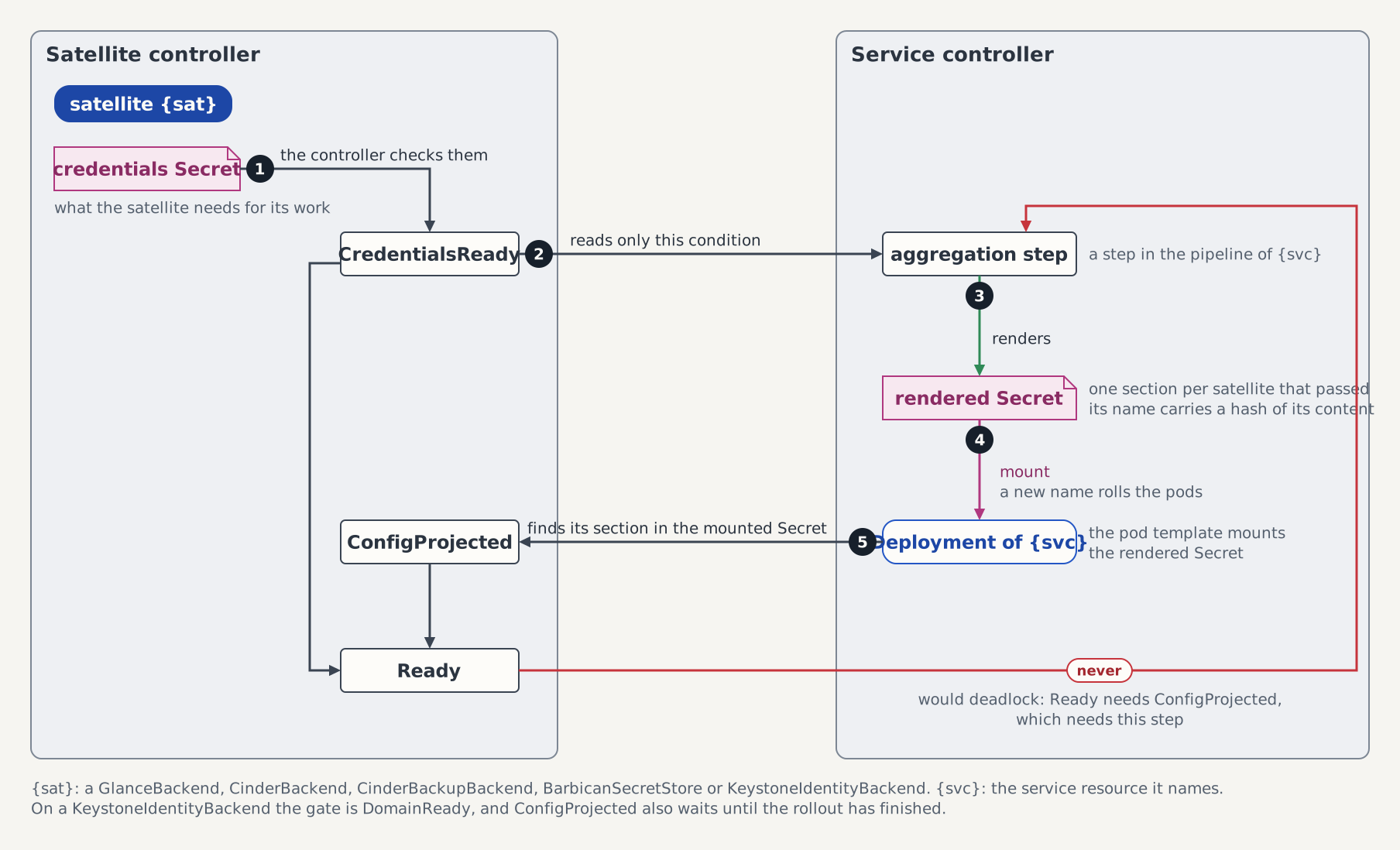
ProvisioningReady=True/Provisioned means the barbican-operator logged in to the instance as its provisioner ServiceAccount and found the barbican/ KV mount and the barbican AppRole the self-init created. The credentials it mints from that AppRole land in controlplane-barbican-store-approle, which is owned by the store rather than by the Barbican.
The left panel of the figure shows these resources and who talks to the instance. The right panel is the mode of Attach an External OpenBao to Barbican.
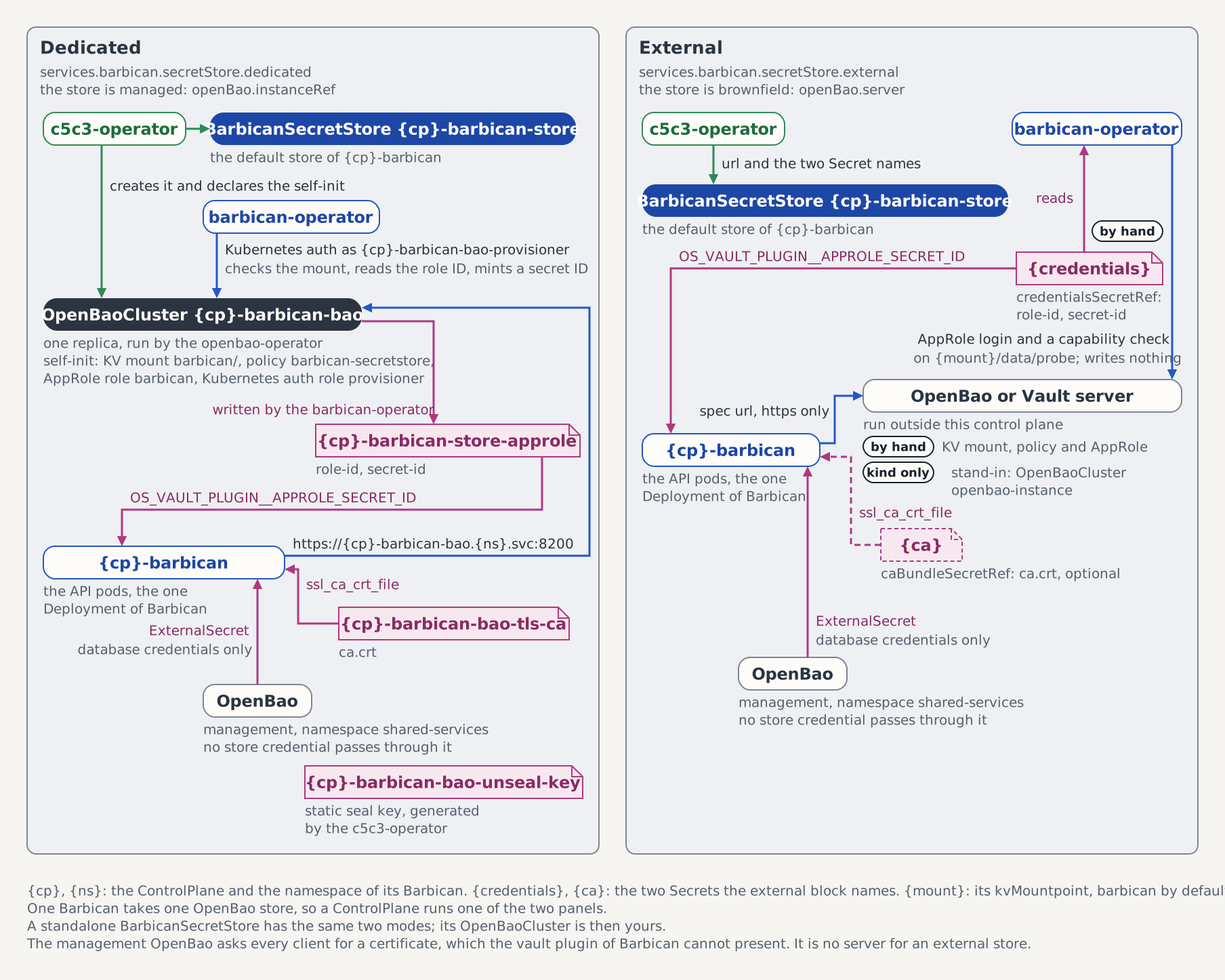
Around the instance sits the ensemble the openbao-operator's contracts require. Every object is named after the instance:
| Object | Name | Purpose |
|---|---|---|
| Secret | controlplane-barbican-bao-unseal-key | The static seal key, generated once and never rotated |
| Secret | controlplane-barbican-bao-tls-server | The API listener's cert-manager keypair (External TLS mode) |
| Secret | controlplane-barbican-bao-tls-ca | The trust bundle the operator and the API pods verify against |
| ServiceAccount | controlplane-barbican-bao-provisioner | The identity the barbican-operator's Kubernetes-auth login binds to |
| Role + RoleBinding | controlplane-barbican-bao-provisioner-token | Lets the barbican-operator mint a bound token for that one account |
| ClusterRoleBinding | controlplane-barbican-bao-<hash>-auth-delegator | Grants the instance pods the TokenReview every Kubernetes-auth login needs |
| OpenBaoTenant | controlplane-barbican-bao-tenant | Admits the namespace to the multi-tenant openbao-operator |
kubectl get secret,serviceaccount,role,rolebinding -n openstack \
  | grep controlplane-barbican-bao
kubectl get clusterrolebinding | grep controlplane-barbican-bao
The auth-delegator binding is cluster-scoped, so its name carries a hash of namespace/instance: two ControlPlanes of the same name in different namespaces derive the same instance name and would otherwise collide on one binding.
No controlplane-barbican-bao-tenant appears on this devstack. The kind overlay already ships an OpenBaoTenant admitting openstack, and the operator skips a namespace some tenant already targets, because a namespace admitted twice carries two finalizers. A ControlPlane whose Barbican lands in a fresh service namespace gets its own tenant there. That tenant is self-service, so the namespace keeps the openbao-operator's default LimitRange, and every container in it without a CPU limit gets a 500m default CPU limit. The kind overlay's tenant lives in the operator namespace and drops that limit for openstack.
Step 5 — Store and read a secret back
The key-manager row is in the catalog once BarbicanReady is True, and the public endpoint is the gateway URL from step 1, so the round-trip runs from the host. Export the admin credentials the way the tutorial's Verify step does.
export OS_AUTH_URL=https://keystone.127-0-0-1.nip.io:8443/v3
export OS_USERNAME=admin
export OS_PASSWORD=$(kubectl get secret controlplane-keystone-admin-credentials -n openstack -o jsonpath='{.data.password}' | base64 -d)
export OS_PROJECT_NAME=admin
export OS_USER_DOMAIN_NAME=Default
export OS_PROJECT_DOMAIN_NAME=Default

openstack --insecure catalog list | grep key-manager
Then store a secret, read its payload back, and delete it:
HREF=$(openstack --insecure secret store --name roundtrip \
  --payload 'cobaltcore-barbican-payload' -f value -c 'Secret href')
openstack --insecure secret get -p "$HREF" -f value -c Payload
openstack --insecure secret delete "$HREF"
A payload that comes back unchanged covers the whole chain in one call: the catalog row resolves the endpoint, Barbican validates the token against Keystone, and the payload travels through castellan's vault plugin into the dedicated OpenBao instance and out again. A catalogue-only check misses every step after the first.
cobaltcore-barbican-payload is a throwaway. Real key material does not belong behind --payload, which leaves it readable in the process argument vector and in your shell history; feed it in from a file or from standard input instead. --insecure is here because the kind gateway presents a self-signed certificate. It disables verification for the whole invocation, including the Keystone call above that sends OS_PASSWORD, so drop it wherever the gateway presents a certificate you trust.
Step 6 — Remove the service
Dropping the services.barbican block is not by itself enough to remove anything. Deletion takes an annotation, and destroying the stored secret material takes a second one.
Two opt-ins, and never edit the projected children
The three CRs of step 4 are projected by the c5c3-operator. A knob you set on controlplane-barbican, controlplane-barbican-store, or controlplane-barbican-bao directly is reverted on the next reconcile, and a projected child you delete by hand is recreated. Drive every change from the ControlPlane CR.
Removing services.barbican with no annotation preserves the Barbican child, its store, and the instance; only the dynamic DB-credential generator is torn down, because a live generator would keep issuing MySQL users for a service this ControlPlane no longer manages. BarbicanReady goes True with reason BarbicanNotManaged and the message names what was kept.
c5c3.io/allow-barbican-deletion=true authorises the teardown of the Barbican child, its secret store, its DB-credential objects, and its catalog rows.
That first annotation is already destructive on the database side. Deleting the Barbican child runs its finalizer, which deletes the MariaDB Database CR, and the CR the operator projects carries no cleanupPolicy, so mariadb-operator applies its Delete default and drops the barbican schema: secret_store_metadata, every secret and container row, the ACLs, and the quotas. The payloads in OpenBao outlive that, but nothing references them any more. Back the schema up before the teardown if you intend to come back to these secrets.
c5c3.io/allow-barbican-secret-store-data-deletion=true is required on top of it before the teardown reaches the dedicated OpenBao instance. That instance carries deletionPolicy: DeletePVCs, and the teardown removes the static-seal Secret as well, so a recovered volume stays unreadable. There is no snapshot, no soft delete, and no grace period: every secret Barbican ever stored is gone the moment the delete lands. Set this one only when that is what you mean.
To remove the service and keep the OpenBao instance, back the schema up first, then annotate and drop the block:
kubectl annotate controlplane controlplane -n openstack \
  c5c3.io/allow-barbican-deletion=true
kubectl edit controlplane controlplane -n openstack   # drop the services.barbican block
Re-declaring services.barbican later reattaches to the same instance, but not to the same secrets: db-sync recreates the dropped schema empty, so secret list comes back with nothing and the payloads still in OpenBao stay unreferenced. Restoring a barbican schema dump taken before the teardown is what brings them back.
To destroy the instance with the service, set the second annotation before dropping the block:
kubectl annotate controlplane controlplane -n openstack \
  c5c3.io/allow-barbican-secret-store-data-deletion=true
That teardown spans several reconciles. The sweep deletes the OpenBaoCluster, waits for it to leave etcd, and only then removes the seal Secret, the provisioner RBAC, and the cluster-scoped auth-delegator binding. Both annotations are read from the CR on every one of those passes. Take one away mid-sweep and the next pass returns on the preserve branch with the instance already gone, leaving that last group behind. No namespace deletion collects a cluster-scoped binding, so the auth-delegator stays until someone removes it by hand.
Wait for the sweep to finish. It has when the instance is gone and the binding with it:
kubectl get openbaocluster controlplane-barbican-bao -n openstack   # expect NotFound
kubectl get clusterrolebinding | grep controlplane-barbican-bao     # expect no output
Both annotations survive the teardown on the ControlPlane, and nothing in the operator clears them: left in place, they authorise the next drop of the block without a further confirmation. Remove them once the sweep has finished:
kubectl annotate controlplane controlplane -n openstack \
  c5c3.io/allow-barbican-deletion- \
  c5c3.io/allow-barbican-secret-store-data-deletion-
On a ControlPlane reconciled from Git, set and clear both annotations in the manifest, not with kubectl annotate. Flux applies server-side and prunes only the fields it owns, so an annotation it never saw survives every reconcile: setting one out of band leaves a live authorisation on the CR that taking it out of Git cannot clear. If you already set one out of band, take it away the same way, with the kubectl annotate ... - above.
Standalone Barbican, without a ControlPlane
Without a ControlPlane nothing projects the OpenBao instance, the store, or the Barbican child, so you own all three. The names below are ones you choose; they are not produced by any devstack, and none of the controlplane- names from the walkthrough above applies here.
The instance is an OpenBaoCluster whose self-init provisions what a managed store expects to find: the barbican/ KV v2 mount, the barbican-secretstore policy, the barbican AppRole carrying it, the Kubernetes auth method, and a provisioner role the barbican-operator logs in through.
apiVersion: openbao.org/v1alpha1
kind: OpenBaoCluster
metadata:
  name: barbican-bao
  namespace: openstack
spec:
  profile: Development
  version: "2.6.2"        # the static seal needs >= 2.4.0
  replicas: 1
  storage:
    size: 1Gi
  tls:
    enabled: true
    mode: External        # consumes barbican-bao-tls-server and barbican-bao-tls-ca
  unseal:
    type: static          # key material: Secret barbican-bao-unseal-key, data key `key`
  selfInit:
    enabled: true
    requests:
      - name: barbican_kv
        operation: create
        path: sys/mounts/barbican
        secretEngine:
          type: kv
          options:
            version: "2"
      # ... the policy, approle, and kubernetes-auth requests
deploy/kind/infrastructure/openbao-instance.yaml is the complete worked example, with every self-init request spelled out and the objects that have to exist beside the CR: the two cert-manager Certificates backing the fixed-name TLS Secrets, the provisioner ServiceAccount, and the ClusterRoleBinding that grants the instance pods system:auth-delegator, without which every Kubernetes-auth login fails with 403. Self-init runs once against freshly initialised storage and OpenBao revokes the root token afterwards, so changing the request list means recreating the instance and its PVC.
The store attaches to the instance by name and marks itself the default:
apiVersion: barbican.openstack.c5c3.io/v1alpha1
kind: BarbicanSecretStore
metadata:
  name: barbican-store
  namespace: openstack
spec:
  barbicanRef:
    name: barbican
  type: OpenBao
  isDefault: true
  openBao:
    instanceRef:
      name: barbican-bao
kvMountpoint is left at its default. A store in instanceRef mode is pinned to barbican/ and to the root namespace, because that is the only mount the self-init contract provisions.
The Barbican CR names its own database, cache, Keystone endpoint, and service user:
apiVersion: barbican.openstack.c5c3.io/v1alpha1
kind: Barbican
metadata:
  name: barbican
  namespace: openstack
spec:
  openStackRelease: "2026.1"
  deployment:
    replicas: 1
  image:
    repository: ghcr.io/c5c3/barbican
    tag: "2026.1"
  database:
    clusterRef:
      name: openstack-db
    database: barbican
    secretRef:
      name: barbican-db
  cache:
    clusterRef:
      name: openstack-memcached
  keystoneEndpoint: http://keystone.openstack.svc.cluster.local:5000/v3
  serviceUser:
    username: barbican
    projectName: service
    userDomainName: Default
    projectDomainName: Default
    secretRef:
      name: barbican-service-user
      key: password
The store may be applied before the Barbican CR: the attachment is inverted, so a dangling barbicanRef surfaces as Ready=False and resolves when the CR appears. See the Barbican CRD API Reference for the full standalone field surface.
See also
- BarbicanSecretStore CRD — both store modes, the credential contract, and the condition catalog.
- Barbican Reconciler Architecture — the sub-reconciler pipeline behind the child's
Ready. - Attach an External OpenBao to Barbican — the same service against a server run outside this control plane.
- Migrate Barbican DB to Dynamic Credentials — the credential mode step 2 onboards.
Tested by
The projected chain this guide walks through (the controlplane-barbican-bao instance, the controlplane-barbican-store attachment, the minted AppRole Secret, and a secret round-trip through the catalog) is asserted on the live CI e2e kind cluster by the first suite below. The second drives a managed store directly, without a ControlPlane.
chainsaw test --test-dir tests/e2e/c5c3/full-controlplane-keystone
chainsaw test --test-dir tests/e2e/barbican/secretstore-managed
The store CR the secretstore-managed suite applies
The suite isolates its Barbican from the parallel suite pool, so its CR names are the suite's isolation identifiers (Barbican barbican-store-managed, store barbican-store-managed-store, instance openbao-instance) rather than the controlplane-barbican names the walkthrough above uses.
apiVersion: barbican.openstack.c5c3.io/v1alpha1
kind: BarbicanSecretStore
metadata:
  name: barbican-store-managed-store
  namespace: openstack
spec:
  barbicanRef:
    name: barbican-store-managed
  type: OpenBao
  isDefault: true
  openBao:
    instanceRef:
      name: openbao-instance