Horizon Reconciler Architecture
The Horizon controller runs the shared table-driven pipeline (internal/common/reconcile) with eight sub-reconcilers and one unnamed prune step. Every step is instrumented under the horizon_operator metrics prefix (horizon_operator_reconcile_duration_seconds, horizon_operator_reconcile_errors_total), and the first step to return a non-zero result or an error short-circuits the chain — conditions and the requeue are persisted on every exit path.
Pipeline
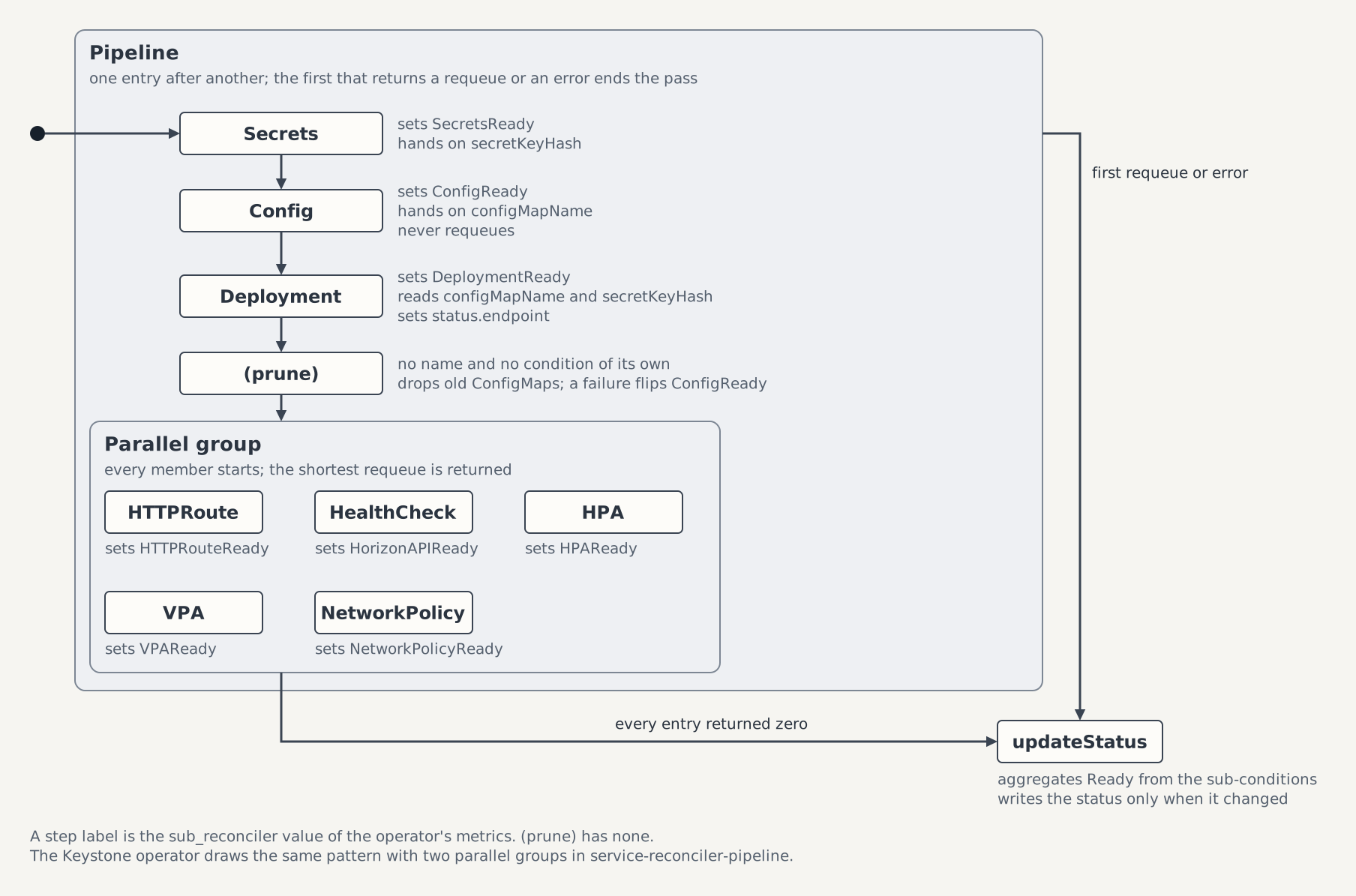
The figure draws the pattern the Keystone operator set: a lane of steps that ends the pass at the first requeue or error, and a group whose members all run. Reconciliation Flow describes that pattern in full. The table lists what each step does.
| Step | What it does | Condition |
|---|---|---|
| Secrets | Gates on the secret store the Horizon selected via spec.secretStoreRef (a ClusterSecretStore, default openbao-cluster-store, or a namespaced SecretStore resolved in the Horizon's own namespace — via secrets.GateStoreReady) and the ESO-synced SECRET_KEY Secret; digests the key material for the rollout annotation | SecretsReady |
| Config | Renders local_settings.py (signed-cookie sessions, CACHES with an image-scoped KEY_PREFIX, OPENSTACK_KEYSTONE_URL, OPENSTACK_ENDPOINT_TYPE = "internalURL", LOGGING, offline-compression settings, the WEBSSO_* / OPENSTACK_KEYSTONE_MULTIDOMAIN_* blocks, merged extraConfig) into an immutable content-addressed ConfigMap | ConfigReady |
| Deployment | Ensures the uWSGI Deployment (login-page readiness/startup probes, HORIZON_SECRET_KEY env var, secret-key-hash pod annotation), the Service (port 8080), and the PDB; sets status.endpoint | DeploymentReady |
| (prune) | Uninstrumented retention sweep of historical config ConfigMaps (retain 3 + current); failures flip ConfigReady | |
| HTTPRoute | Full spec.gateway lifecycle; reflects the Gateway's Accepted condition | HTTPRouteReady |
| HealthCheck | HTTP GET of the cluster-local login page through the shared TTL probe cache — rendering it exercises Django routing, templates, and the static-asset manifest without a live Keystone | HorizonAPIReady |
| HPA | Creates/deletes the HorizontalPodAutoscaler | HPAReady |
| VPA | reconcileVPA applies or removes the VerticalPodAutoscaler of the dashboard Deployment through the shared VPA flow; reports VPANotInstalled for an opt-in on a cluster without the VPA | VPAReady |
| NetworkPolicy | Creates/deletes the NetworkPolicy; refuses an empty ingress list (fail-closed) | NetworkPolicyReady |
Conditions
The aggregate Ready condition is True (reason AllReady) exactly when all eight sub-conditions are True:
| Type | True reasons | False reasons |
|---|---|---|
SecretsReady | SecretsAvailable | TargetClusterUnavailable, SecretStoreNotReady, ClusterSecretStoreUnsupported, WaitingForSecretKey |
ConfigReady | ConfigRendered | ConfigError |
DeploymentReady | DeploymentReady | WaitingForDeployment |
HTTPRouteReady | HTTPRouteAccepted, HTTPRouteNotRequired | HTTPRouteNotAccepted, GatewayAPINotInstalled, CapabilityProbeFailed |
HorizonAPIReady | APIHealthy | APIUnhealthy, EndpointNotReady, HealthCheckTimeout, ConnectionFailed, HealthCheckFailed |
HPAReady | HPAReady, HPANotRequired | — (errors propagate) |
VPAReady | VPAReady, VPANotRequired | VPANotInstalled, CapabilityProbeFailed, VPAError |
NetworkPolicyReady | NetworkPolicyReady, NetworkPolicyNotRequired | — (errors propagate) |
TargetClusterUnavailable is set ahead of every sub-reconciler, when spec.targetClusterRef names a target cluster that is not registered or no longer resolves. The message carries the resolver's error, the CR requeues after 15 seconds, and nothing is created on any cluster. See Target Clusters.
Requeue semantics
| Interval | Used by |
|---|---|
| 10s | Deployment readiness polling, HTTPRoute acceptance, health-check retry |
| 15s | ESO secret gate polling |
| 30s TTL | Health-probe cache (a passing login-page probe is reused within the TTL) |
Rotation and deletion
SECRET_KEYrotation happens at the OpenBao source: when ESO re-syncs the Secret, the Secrets step produces a new digest, the pod-template annotation changes, and the Deployment rolls. The key is consumed via an environment variable, so a restart is required for it to take effect.- Deletion needs no finalizer: every owned resource is namespace-scoped and carries a controller owner reference, so Kubernetes garbage collection reclaims the whole set when the CR is deleted. That holds on the management cluster. A projection on a target cluster carries an owner reference that cluster cannot resolve, so deleting a Horizon with a
targetClusterRefleaves its Deployment, Service, HTTPRoute, and Secret running there. See Target Clusters.
Watches
Beyond the owned resources, the controller watches Secrets (indexed reverse lookup on spec.secretKeyRef.name, plus group-scoped owner references) and both OpenBao-backed store kinds — a cluster-scoped ClusterSecretStore and a namespaced SecretStore — each bound to storeToHorizonMapper (the shared watch.StoreRefFanOut), which enqueues only the Horizon CRs whose effective spec.secretStoreRef resolves to the changed store, so upstream credential and backend changes retrigger reconciliation without waiting for a periodic requeue. The ClusterSecretStore leg is not registered when the operator runs with --namespace. The HTTPRoute watch is registered only when the Gateway API CRD is installed on the management cluster; without it, spec.gateway surfaces HTTPRouteReady=False with reason GatewayAPINotInstalled instead of crashing the controller. That setup probe answers for CRs without a spec.targetClusterRef; a CR that names a target cluster has the kind probed against that cluster's RESTMapper on every pass, so the verdict follows the cluster its children land on.
WebSSO and multi-domain rendering
reconcileConfig renders spec.websso and spec.multiDomain into the WEBSSO_* and OPENSTACK_KEYSTONE_MULTIDOMAIN_* Django settings (webSSOSettings / multiDomainSettings in reconcile_config.go).
A nil or disabled block emits nothing at all, so a CR that never opts into federated login renders byte-identically to the pre-websso operator — the same convention the Keystone reconciler uses for a nil federation projection. Empty optional settings are omitted rather than rendered as empty values: an empty WEBSSO_IDP_MAPPING dict or WEBSSO_KEYSTONE_URL string would each override an upstream default with something meaningless.
Two settings are operator-pinned and are not part of the typed surface:
WEBSSO_USE_HTTP_REFERER = False, becausespec.keystoneEndpointis by contract the cluster-local Service URL. With the upstream default (True)openstack_authwould validate the returned token against the external gateway URL derived from the browser'sReferer, resolved server-side from inside the pod.SECURE_PROXY_SSL_HEADER = ["HTTP_X_FORWARDED_PROTO", "https"], rendered bydefaultSettingswhenspec.gatewayis set. A Gateway terminates TLS and forwards plain HTTP, so Django'srequest.is_secure()would otherwise be false and the origin it sends Keystone (build_absolute_uri("/auth/websso/")) would carry anhttp://scheme that nohttps://trusted_dashboardentry matches. Gating on the Gateway is what makes trusting the header safe: Envoy overwritesX-Forwarded-Protoon ingress, so a client cannot spoof it through the proxy.
spec.extraConfig still wins the render-time merge for every setting, so a CR that bypassed the validating webhook keeps the escape hatch. The webhook rejects declaring a setting in both the typed block and extraConfig, since the override would silently drop the typed block.