Barbican Reconciler Architecture
The Barbican controller runs the shared table-driven pipeline (internal/common/reconcile) with twelve sub-reconcilers. Every step is instrumented under the barbican_operator metrics prefix, and the first step to return a non-zero result or an error short-circuits the chain. Conditions and the requeue are persisted on every exit path through the shared status skeleton, which also skips the write when a pass left status unchanged. A second reconciler in the same manager owns the attached BarbicanSecretStore CRs.
Two Prometheus vectors cover the pipeline (barbican_operator_reconcile_duration_seconds, barbican_operator_reconcile_errors_total, the latter labelled by sub_reconciler and condition_type). Five per-CR collectors cover the Jobs and the store credentials: barbican_operator_db_sync_total and barbican_operator_db_clean_total, each labelled by barbican, namespace, and the terminal result; barbican_operator_db_sync_duration_seconds and barbican_operator_db_clean_duration_seconds, labelled by barbican and namespace; and barbican_operator_secretstore_remints_total, labelled by store, namespace, and a trigger of proactive (the operator refreshed the AppRole secret ID before its TTL lapsed) or reactive (the server had already rejected it). The split is what tells a healthy rotation schedule apart from one that keeps arriving too late. The Job series are dropped when a Barbican's finalizer completes; the re-mint series is keyed by the store CR, so the store controller drops it on the pass that observes that store's deletion.
Pipeline
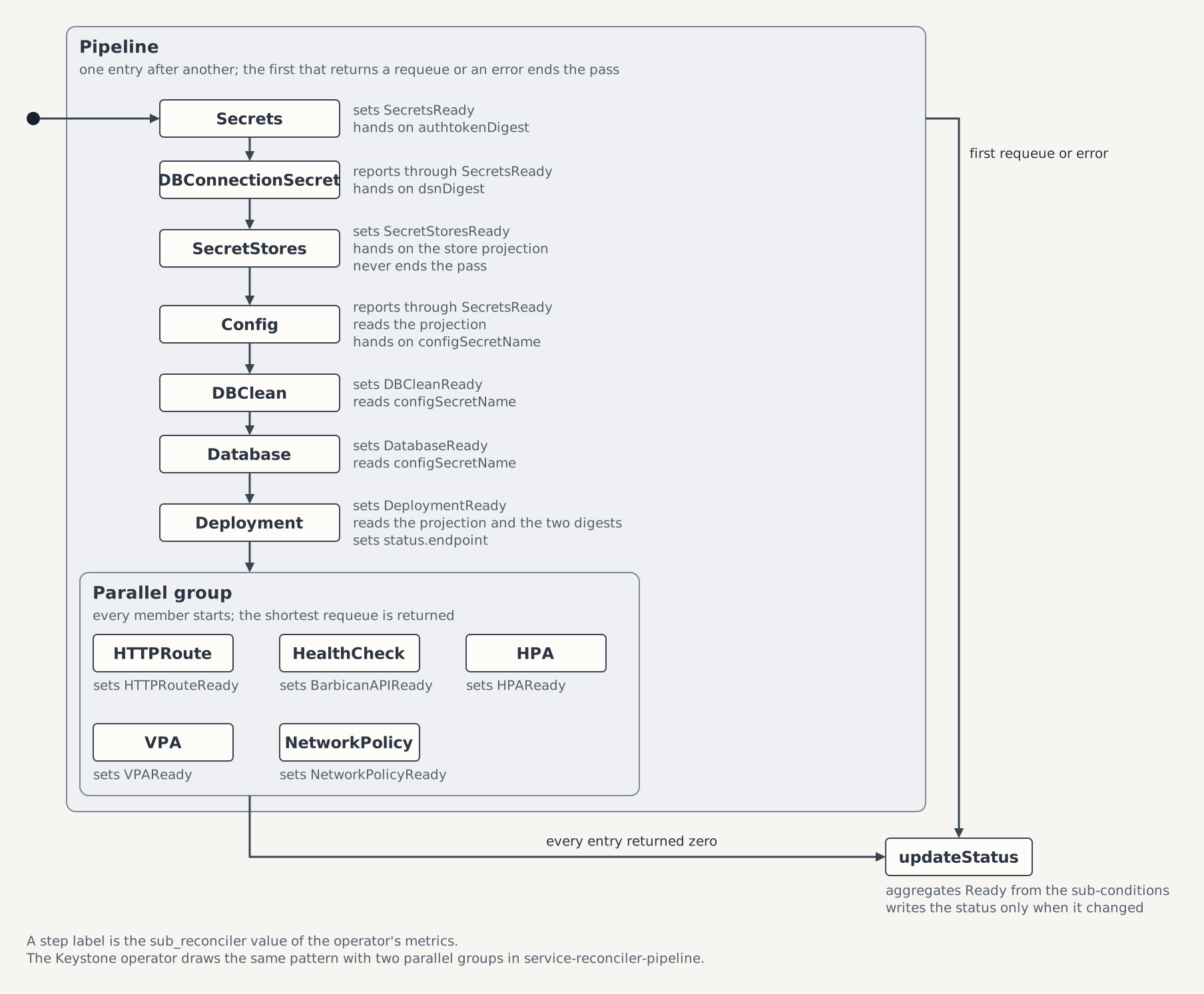
The figure draws the pattern the Keystone operator set: a lane of steps that ends the pass at the first requeue or error, and a group whose members all run. Reconciliation Flow describes that pattern in full. The table lists what each step does.
| Step | What it does | Condition |
|---|---|---|
| Secrets | Gates on the selected External Secrets store (spec.secretStoreRef, default openbao-cluster-store), then the ESO-synced database and service-user credential Secrets; digests the service-user password for the rollout annotation | SecretsReady |
| DBConnectionSecret | Materializes the pymysql DSN into the derived {name}-db-connection Secret and digests it; reports through SecretsReady | SecretsReady |
| SecretStores | Aggregates the attached, credential-ready BarbicanSecretStores into the secret-store sections of barbican.conf, records what it projected, and resolves the OpenBao egress hosts | SecretStoresReady |
| Config | Renders barbican.conf and barbican-api-paste.ini (plus policy.yaml when applicable) into an immutable content-hashed Secret, prunes the history down to three, and records the ExtraConfigHealthy guard. On an invalid projection it re-renders nothing and returns the Secret name the live Deployment mounts. Reports through SecretsReady (failure reason ConfigError) | SecretsReady |
| DBClean | Projects the {name}-db-clean CronJob against the rendered config and reports the newest terminal run it spawned | DBCleanReady |
| Database | Provisions the schema (MariaDB cluster gate, Database/User/Grant in managed mode), gates the requested release against the installed one, runs the {name}-db-sync Job, and promotes installedRelease | DatabaseReady |
| Deployment | Ensures the API Deployment, Service (port 9311), and PDB, narrows the Service selector to the API component once the rollout has converged, and stamps status.endpoint. It creates nothing while the projection is invalid | DeploymentReady |
| HTTPRoute | Full spec.gateway lifecycle; reflects the Gateway's Accepted condition. It renders no request timeout, since barbican answers short JSON requests and the gateway implementation's default is the right cap | HTTPRouteReady |
| HealthCheck | HTTP GET of the cluster-local /healthcheck app through the shared TTL probe cache. The paste composite routes that path outside the authtoken pipeline, so a 2xx means the WSGI app serves requests without a token or a database round trip | BarbicanAPIReady |
| HPA | Creates/deletes the HorizontalPodAutoscaler | HPAReady |
| VPA | reconcileVPA applies or removes the VerticalPodAutoscaler of the API Deployment through the shared VPA flow; reports VPANotInstalled for an opt-in on a cluster without the VPA | VPAReady |
| NetworkPolicy | Creates/deletes the NetworkPolicy (auto-derived DNS, database, Keystone, cache, and OpenBao egress); refuses an empty ingress list (fail-closed) | NetworkPolicyReady |
DBConnectionSecret and Config reuse SecretsReady instead of a dedicated ConfigReady condition, the same mapping the sibling operators use: both produce Secret artefacts that gate the same downstream graph, so a distinct sub_reconciler label on the error counter disambiguates them during triage while the status contract stays minimal.
Two orderings in that chain are decisions rather than data dependencies:
- DBClean runs ahead of Database. The clean-up's bulk
DELETEs contend with the DDL locks a schema migration holds, so the CronJob has to be suspended for the length of a migration. The pipeline short-circuits at the Database step for as long as the sync Job runs, which means a step placed behind it is never reached during the one window that needs pausing. Its only input is the rendered config the CronJob mounts, which the Config step above already produced. - SecretStores never short-circuits. Every waiting state of that step (no default, several defaults, several OpenBao stores, an unreadable credentials Secret) returns a zero result and no error, so a first install proceeds to the steps that report what is missing. A store's status flip re-enqueues the parent through the
BarbicanSecretStorewatch, which is a faster signal than any requeue interval.
The five members of the parallel group have no inter-dependency once the Deployment and Service exist. Each works on its own copy of the CR, sets one condition type, and always sets it, so a cluster without Gateway API or without autoscaling still resolves the aggregate through the NotRequired reasons.
Conditions
The aggregate Ready condition is True (reason AllReady) when all ten sub-conditions are True, and False (NotAllReady) otherwise.
| Type | True reasons | False reasons |
|---|---|---|
SecretsReady | SecretsAvailable | TargetClusterUnavailable, SecretStoreNotReady, ClusterSecretStoreUnsupported, WaitingForDBCredentials, WaitingForServiceUserCredentials, ConfigError |
SecretStoresReady | AllStoresProjected | NoDefaultSecretStore, MultipleOpenBaoStores, WaitingForSecretStores |
DBCleanReady | DBCleanScheduled, DBCleanSuspended | DBCleanJobFailed, DBCleanBlocked, WaitingForSecretStores |
DatabaseReady | DatabaseSynced | WaitingForSecretStores, WaitingForDatabase, DBSyncInProgress, DBSyncFailed, VersionParseError, DowngradeNotSupported, UpgradePathInvalid, ImageReleaseMismatch, plus the shared cluster-gate reason the provisioning flow sets while the referenced MariaDB is unavailable |
DeploymentReady | DeploymentReady | WaitingForSecretStores, WaitingForDeployment |
BarbicanAPIReady | APIHealthy | APIUnhealthy, HealthCheckTimeout, ConnectionFailed, HealthCheckFailed, plus the shared pre-endpoint wait the probe flow sets before status.endpoint is stamped |
HPAReady | HPAReady, HPANotRequired | — (errors propagate) |
VPAReady | VPAReady, VPANotRequired | VPANotInstalled, CapabilityProbeFailed, VPAError |
NetworkPolicyReady | NetworkPolicyReady, NetworkPolicyNotRequired | — (errors propagate) |
HTTPRouteReady | HTTPRouteAccepted, HTTPRouteNotRequired | HTTPRouteNotAccepted, GatewayAPINotInstalled, CapabilityProbeFailed |
TargetClusterUnavailable is set ahead of every sub-reconciler, when spec.targetClusterRef names a target cluster that is not registered or no longer resolves. The message carries the resolver's error, the CR requeues after 15 seconds and acquires no finalizer, and nothing is created on any cluster. The attached BarbicanSecretStore reports the same reason on CredentialsReady. See Target Clusters.
WaitingForSecretStores appears on four condition types. On SecretStoresReady it reports a credentials Secret this pass could not read. On DBCleanReady, DatabaseReady, and DeploymentReady it reports the cascade a missing default store causes: the CronJob and the migration Job have no config Secret to mount, and the API pods have no store to resolve secrets through.
DBCleanSuspended is a True reason twice over, once for spec.dbClean.suspend and once for the pause a schema convergence imposes. The migration pause reports DBCleanBlocked and False instead when the release gate rejected the transition it is waiting for: nothing is running, the convergence is not coming, and the backlog grows until spec.openStackRelease and spec.image are corrected.
One further condition is set and never aggregated. ExtraConfigHealthy reports whether spec.extraConfig overrides an operator-owned key: True with reason NoOwnedKeysOverridden, False with reason OwnedKeysOverridden and a message naming each overridden key. It stays out of the sub-condition list so an override the operator honors reports itself without holding the aggregate down. The three credential overrides that would already have done their damage by the time a condition could report them are refused at admission; see Defaulting and validation.
Secret-store aggregation
The SecretStores step lists the attached stores through the spec.barbicanRef.name field index, sorts them by name so the rendered sections and the config Secret's content hash are stable across passes, and keeps the ones whose CredentialsReady condition is True. It never consults the store's aggregate Ready, which also requires ConfigProjected and would deadlock, since ConfigProjected only turns True after this step projects the store.
What it renders into the one content-hashed config Secret:
[secretstore], the process-global registry, carryingenable_multiple_secret_stores = trueand astores_lookup_suffixlist of the ready store names.- One
[secretstore:<name>]per ready store, each withsecret_store_plugin = vault_plugin. The default store's section also carriesglobal_default = True; the option is written on that store alone, since a second global default is a configuration error barbican refuses to start with. [vault_plugin], derived from the default store alone. It is process-global, and the single-OpenBao-store rule guarantees the default is the only store that can contribute to it.
approle_secret_id is never rendered. The AppRole secret ID reaches the pods as the OS_VAULT_PLUGIN__APPROLE_SECRET_ID environment variable, sourced from the Secret the store itself owns, and its SHA-256 is stamped into a pod-template annotation so a re-mint rolls the Deployment. The rendered document is a Secret, but every API pod mounts it and the store controller reads it back to observe ConfigProjected, so the secret ID's only copy stays where the store keeps it. The role ID does travel in the file, which is why the config artefact is a Secret and not a ConfigMap.
Three historical config Secrets are retained beside the current one, so a rollback has something to roll back to. An invalid projection re-renders nothing at all: the Config step returns the Secret name the live Deployment mounts, and the running pods keep the configuration they started with. Egress follows that same last-good record, not the projection this pass could build. The NetworkPolicy step widens its OpenBao host set from status.projectedSecretStoreHosts, because a dropped host means no OpenBao rule at all, and with Egress in policyTypes no rule is a deny. The record is written on the valid path alone: re-deriving the URL from the live store spec would let anyone able to write a store point spec.openBao.server.url at a server of their choosing, let the projection go invalid, and have that port land in a destination-unrestricted egress rule on API pods they cannot edit.
A store that drops out of status.projectedSecretStores raises the SecretStoreDetached Warning event on the pass that de-projects it, naming what the change costs: barbican resolves each stored secret through the secret_stores row that names the store it was written to, so the material written through a de-projected store stops resolving.
Database
The Database step runs the shared provisioning flow first: a MariaDB cluster gate and Database/User/Grant in managed mode, a no-op in brownfield, and no User/Grant under credentialsMode: Dynamic, where an external engine issues the credential. The SQL user's max_user_connections is sized from the CR's own topology, (pods + 1) × processes × threads + 2, with pods taken from spec.autoscaling.maxReplicas when an HPA owns the replica count. Left unsized, the mariadb-operator default of 10 applies, which a raised spec.apiServer.uwsgi.processes exceeds before a single request is served.
The migration is a single {name}-db-sync Job running barbican-manage db upgrade, one alembic upgrade to head that applies every pending revision in one pass. The Job passes no --config-file: barbican-manage builds its oslo.config from the project name and resolves barbican.conf through the fixed search path, which the mounted config directory is on, so the Job and the API pods read the identical file. Because that one pass is idempotent, the Job set carries no schema-check command, and SchemaDriftDetected never fires for Barbican.
A release transition is a spec.openStackRelease bump with the image in lockstep. There is no phase machine: the release gate validates the requested release against status.installedRelease before any Job runs, and rejects an unparseable release on either side (VersionParseError), a downgrade (DowngradeNotSupported), and a jump of more than one release (UpgradePathInvalid). Each rejection sets DatabaseReady=False with the shared reason, raises a Warning event, and returns an error so the controller backs off. An accepted bump stamps status.targetRelease, the db-sync Job runs on the new image, the Deployment rolls onto it, and the sync flow promotes status.installedRelease on Job success, at which point targetRelease is cleared and status.installedImage records the image that ran the migration. The second panel of the figure under Phase Transitions draws this single pass beside the phase machine it does without.
Two guards keep the release marker honest, one per pinning style. A tag-pinned image whose tag names a different release than spec.openStackRelease sets DatabaseReady=False / ImageReleaseMismatch and requeues, since the Job would run the wrong barbican-manage binary. A release bump that leaves spec.image untouched is refused under the same reason, because the Job's pod template would be identical, the shared flow would short-circuit on the already-completed Job, and installedRelease would advance off a run of the previous release's binary. The second guard compares status.installedImage, so it covers a digest-pinned image the first one cannot read.
The single pass has one consequence the phased flow does not. This step runs ahead of the Deployment step and requeues while the Job runs, so the schema reaches release N before a single pod of release N exists: from Job completion until the last old pod terminates, release N-1 code serves traffic against a release N schema. Whether that window is safe is a property of the alembic revisions the target release carries. A release with a non-additive revision (a dropped or renamed column) needs the API drained before the upgrade; DatabaseReady goes True the moment the Job completes and reports nothing about the rollout that follows.
Requeue semantics
| Interval | Used by |
|---|---|
| 10s | Deployment readiness polling, HTTPRoute acceptance, health-check retry |
| 15s | ESO secret-gate polling (Secrets, DBConnectionSecret), the store controller's WaitingForParent and TargetClusterUnavailable states, and its remote-children finalizer hold while a deleted store's target cluster does not resolve or nothing names it |
| 30s | MariaDB and db-sync database wait, the finalizer hold while the MariaDB CRs tear down, and every other waiting or failure state of the store controller |
| 30s TTL | Health-probe cache (a passing /healthcheck probe is reused within the TTL) |
| 15m | Store credential revalidation: every pass for a brownfield store, and for a managed store whose secret ID carries no TTL and has no re-mint timer to ride on |
A managed store with a TTL requeues at its own proactive re-mint threshold, two thirds of the recorded lifetime, floored at the 30s retry cadence. That leaves a full third of the TTL as the margin in which a failing re-mint can be retried while the credential in the pods is still valid.
Rotation and deletion
- Credential rotation happens at the source. The service-user password (
OS_KEYSTONE_AUTHTOKEN__PASSWORD), the assembled DSN (OS_DATABASE__CONNECTION), and the AppRole secret ID (OS_VAULT_PLUGIN__APPROLE_SECRET_ID) are all environment-variable-delivered, so a restart is required for a rotation to take effect. Each value is digested into a pod-template annotation,barbican.c5c3.io/authtoken-hash,barbican.c5c3.io/db-connection-hash, andbarbican.c5c3.io/secret-store-credentials-hash, so a changed digest rolls the Deployment. Each annotation is omitted while its digest is empty, which is what the requeue and error paths upstream produce, so a short-circuited pass causes no spurious rollout. - Deletion runs the
barbican.openstack.c5c3.io/finalizer. It issues Delete on the MariaDBDatabase/User/GrantCRs before the owner-ref chain disappears, emittingFinalizingDatabasewhile cleanup remains andDatabaseFinalizedwhen the finalizer is released. Whether cleanup remains is observed before the Delete, since a Delete flipsDeletionTimestampand a post-Delete check would always report nothing live and release immediately. Every other owned resource is namespace-scoped with a controller owner reference, so Kubernetes garbage collection reclaims it. Releasing the finalizer also drops the CR's metric series and evicts its health-probe cache entry. A CR whose target cluster was deregistered in the meantime cannot reach any of it: the finalizer is released against no cleanup at all, aRemoteChildrenAbandonedWarning names what stays behind, and the CR leaves etcd instead of hanging in Terminating. See Target Clusters. ABarbicanSecretStorecarries no finalizer while its parent is on the management cluster, and the remote-children finalizer while its parent namesspec.targetClusterRef; see Retained Artefacts.
Watches
The Barbican controller Owns its Deployment, Service, Secret, PodDisruptionBudget, HorizontalPodAutoscaler, NetworkPolicy, Job, and CronJob. The HTTPRoute is added to the Owns set only when the Gateway API CRD is installed on the management cluster, probed at setup through the RESTMapper; without it spec.gateway surfaces HTTPRouteReady=False / GatewayAPINotInstalled instead of failing the controller at start with an unknown kind. That setup probe answers for CRs without a spec.targetClusterRef; a CR that names a target cluster has the kind probed against that cluster's RESTMapper on every pass, so the verdict follows the cluster its children land on. The CR's own status-only updates are filtered out, so a status write does not re-wake the controller.
Beyond the owned set it watches:
- Secrets, mapped to the Barbican CRs that reference them. One field index holds the deduplicated union of
spec.serviceUser.secretRef.nameandspec.database.secretRef.name; a second holds the AppRole credentials and CA bundle Secrets a brownfield store references, so a rotated store credential re-renders the config through the store's parent. A managed store indexes under nothing there, since it references no Secret by name. ESO-managed Secrets are owned by the ExternalSecret controller, so an owner-reference watch alone would never match them. - BarbicanSecretStores, mapped to their parent, without a generation predicate: the status transitions are the signal.
CredentialsReadyturning True triggers projection and aDeletionTimestamptriggers de-projection. - MariaDB clusters referenced by
spec.database.clusterRef, so an upstream database outage reflects inDatabaseReadywithout waiting for the periodic requeue. - Both the cluster-scoped
ClusterSecretStoreand the namespacedSecretStorea Barbican can select, so a backend outage reflects inSecretsReadyas soon as ESO flips the store's Ready condition. A Barbican that omitsspec.secretStoreRefresolves to the shared cluster store, so the default fan-out is preserved while a Barbican pinned to a namespaced store is woken only by its own. TheClusterSecretStoreleg is not registered when the operator runs with--namespace.
The store controller watches three objects of its own. The third is its credentials Secret on a target cluster. The other two carry no generation predicate, for the same reason: the parent Barbican, whose status flips carry the projection landing in the Deployment, and the OpenBaoCluster a managed store names, whose Available condition is what unblocks a store waiting on it. Both resolve through field indexes registered by the Barbican controller's SetupWithManager, which is the single registration site and therefore runs first.