OVN Operator
The OVN operator runs the SDN layer the Neutron ML2/OVN mechanism driver programs. It deploys no OpenStack service of its own: what it manages is OVN and Open vSwitch, across two kinds.
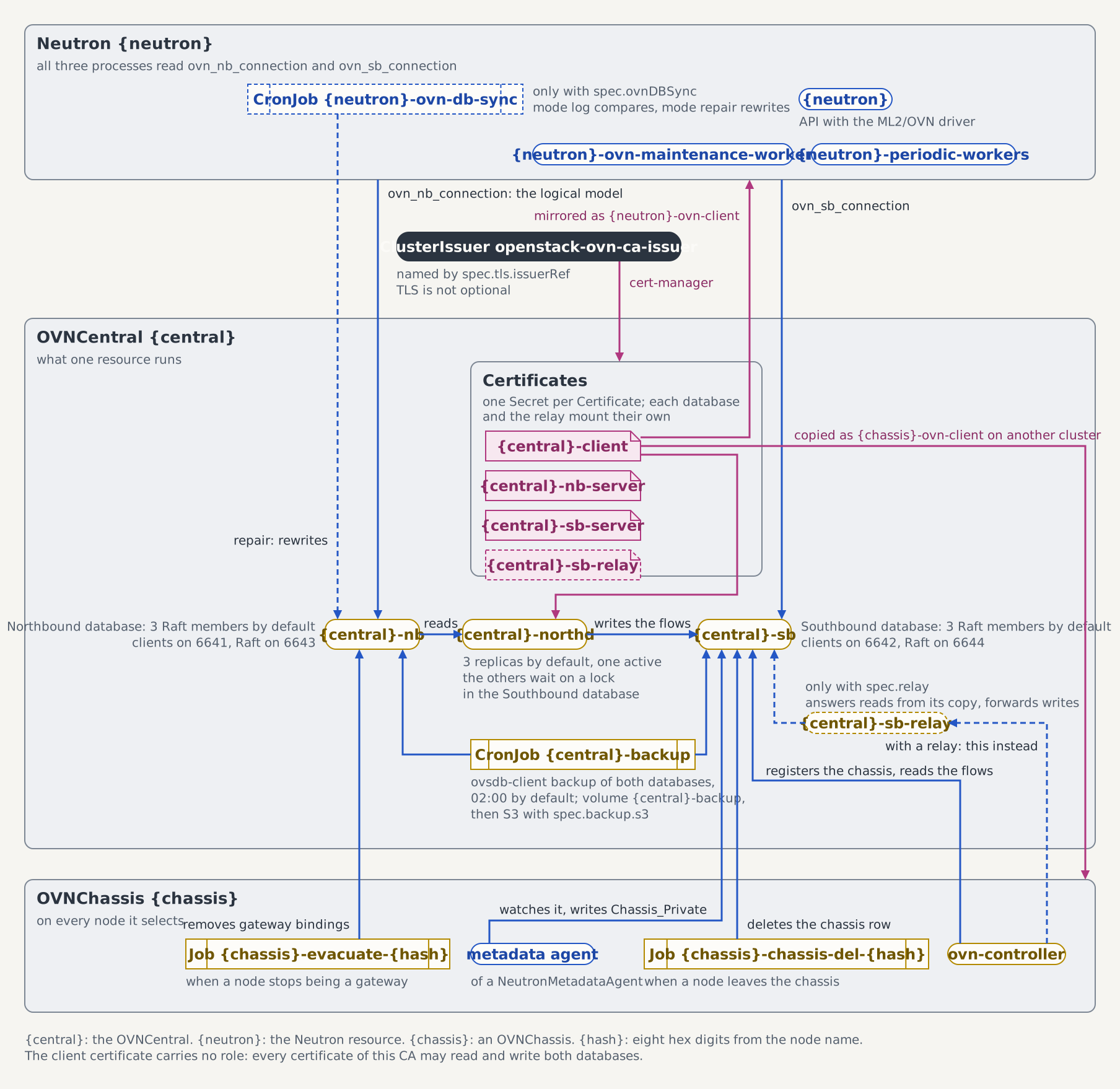
OVNCentral describes the control plane as one unit. The operator projects the Northbound and Southbound Raft databases as two StatefulSets with a headless Service and one Service per member, the ovn-northd Deployment that compiles the Northbound model into Southbound flows, an optional Southbound relay tier, the cert-manager Certificates every OVN connection is authenticated with, and the CronJob that snapshots both databases. The two databases share one CR because northd only works against both of them and their Raft clusters have to be sized together.
OVNChassis describes the node layer. The operator projects the ovs and ovn-controller DaemonSets onto the nodes a label selector picks, plus the per-node Jobs that apply a node's external_ids, evacuate a gateway node, and remove its chassis row from the Southbound database.
The two kinds are coupled through status. An OVNChassis names an OVNCentral, waits for its published Southbound address and for status.clientSecretName, and mounts that Secret. When the two project onto different clusters, the chassis reads the addresses the central publishes on node ports and copies the Secret onto its own cluster, as <chassis>-ovn-client. That link is the whole coupling.
The figure shows what one OVNCentral runs and which client talks to which database. Only ovn-controller is pointed at the relay; every other client dials the database members.
Design decisions
The Phase-0 decision record lives in meta issue #898. These are the entries this operator implements.
- D1 (OVN source and version line): self-built images from pinned
ovn-org/ovnsources, with Open vSwitch at OVN's own submodule pin, on the OVN 26.03 LTS line. The operator resolvesghcr.io/c5c3/ovnat that version when a CR leavesspec.imageunset. - D2 (operator split): one ovn-operator with the kinds
OVNCentralandOVNChassis, beside a neutron-operator that owns theNeutronkind. The coupling between them is CR status: the neutron-operator watchesOVNCentraland reads the addresses it publishes. That keeps the OVN layer available to a later consumer. - D3 (OVN central placement): the central runs on the same cluster as the chassis, which keeps the Southbound read path local, and publishes two addresses per database.
status.<db>.internalDbAddressis for consumers on that cluster,status.<db>.dbAddressfor a management-side neutron-server and for a chassis on another cluster, which also dials a relay published outside the central's cluster (status.relayDbAddress). - D4 (chassis management): OVS and ovn-controller run as DaemonSets projected from
OVNChassis, steered by node labels, and anOVNChassisworks on its own without a Neutron above it. Host-native OVS is revisited only if DPDK or SR-IOV becomes a requirement. - D6 (BGP path): flat and L2 provider networks now, with native OVN dynamic routing and the Neutron
ovn-bgpservice plugin as the target; ovn-bgp-agent is skipped. This operator has no BGP surface. What it keeps open is the OVN 26.03 line from D1 and gateway-chassis selection by node label. - D9 (cross-cluster NB/SB exposure): each Raft member gets its own
NodePortService underspec.<db>.externallyReachable, and both published addresses carry IP literals. python-ovs resolves no name without theunboundlibrary, which no release pins, and the ovsdb C tools ignore the pod's DNS search list. The same lab found that python-ovs accepts any certificate the configured CA signed without checking the hostname, which is why the OVN CA is scoped to OVN: every certificate it signs is a valid client of both databases. - D12 (recurring maintenance inventory): a backup CronJob for both databases, with a daily schedule, a retention bound and a suspend switch. The lab that settled it also pinned the restore constraints:
ovsdb-client restoreneeds a seekable stdin, so a snapshot is staged as a file; a clustered snapshot restored into a standalone server needs--force; and a failed run leaves a zero-byte file behind, so retention gates on the exit code.
BGP itself is tracked in its own meta, #899.
Owned resources
The figure under Owned Resources of the Keystone operator draws the baseline this list follows: serving objects, config and Secrets, Jobs and CronJobs.
For an OVNCentral named {name} the operator manages:
| Resource | Name | Purpose |
|---|---|---|
| StatefulSet | {name}-nb, {name}-sb | One Raft cluster per database, spec.<db>.replicas members, started in parallel, with a soft zone and hostname spread |
| PodDisruptionBudget | {name}-nb, {name}-sb | maxUnavailable: 1 over one database's members, so a drain evicts one member at a time |
| Service (headless) | {name}-nb, {name}-sb | Raft peer discovery; publishes not-ready addresses so a fresh cluster can form |
| Service (per member) | {name}-nb-0, {name}-sb-0, one per ordinal | ClusterIP, or NodePort at nodePortBase + ordinal under spec.<db>.externallyReachable |
| PersistentVolumeClaim | db-{name}-nb-0, one per member | From the StatefulSet's db volume claim template; retained on scale-down, deleted with the CR |
| ConfigMap | {name}-central-scripts | The run, set-connection, and backup scripts both databases share |
| Deployment | {name}-northd | ovn-northd; one replica is active and the rest wait on the Southbound lock |
| Deployment | {name}-sb-relay | Only while spec.relay is set |
| Service | {name}-sb-relay | ClusterIP in front of the relays, published as status.relayAddress. NodePort under spec.relay.externallyReachable, then also published as status.relayDbAddress |
| Certificate + Secret | {name}-nb-server, {name}-sb-server, {name}-client, and {name}-sb-relay with a relay | cert-manager issues them; each Secret takes its Certificate's name |
| PersistentVolumeClaim | {name}-backup | The snapshot volume |
| CronJob | {name}-backup | Snapshots both databases and prunes the window |
For an OVNChassis named {name}:
| Resource | Name | Purpose |
|---|---|---|
| DaemonSet | {name}-ovs | The ovsdb-server and ovs-vswitchd containers on the selected nodes, in the node's network namespace |
| DaemonSet | {name}-ovn-controller | ovn-controller, connected to the relay address the central published, or to its Southbound address when it runs no relay the chassis can reach |
| ConfigMap | {name}-nodes | One key per selected node, carrying that node's external_ids values |
| ConfigMap | {name}-chassis-scripts | The scripts both DaemonSets and the maintenance Jobs run |
| Job | {name}-apply-<hash>, {name}-evacuate-<hash>, {name}-chassis-del-<hash> | Per node; the node name is hashed to eight hex characters because a Job name has 63 and a node name up to 253 |
Reference pages
- OVNCentral CRD: the
spec/statuscontract of the control plane, its validation rules, and the backup - OVNChassis CRD: node selection, the per-node
external_ids, and the maintenance Jobs - OVN Controller Events: the Kubernetes events both controllers emit
- Reconciler Architecture: the two pipelines, their conditions, and requeue semantics
The OVN image is release-independent and built by Nix from the pin in images/ovn/source.json; see build-ovn / merge-ovn-image / verify-ovn-image. The ovn e2e leg and the multi-node overlay leg are documented in e2e-operator and e2e-ovn-overlay.