OVN Controller Events
Reference documentation for the Kubernetes events the two OVN controllers emit. They make a failed background Job visible through kubectl describe ovncentral and kubectl get events without reading controller logs.
Events complement status conditions. A condition reports current state for programmatic consumers; an event is a timestamped record of a transition, which is what an operator reads after the fact and what an alerting rule matches on. For the conditions themselves see OVNCentral CRD and OVNChassis CRD; for the pipelines that set them, Reconciler Architecture.
Event Conventions
- Reason strings are stable PascalCase identifiers. They are part of the controllers' public API and will not change without a deprecation notice.
- Every event this operator emits is of type Warning. It records no Normal event: what the two controllers surface are failed background Jobs and a teardown that gave up on its target cluster.
- No event is emitted for an in-progress or polling state, which keeps a requeue cycle from producing event noise.
- An event on an
OVNCentral(involvedObject.kind: OVNCentral) carries the recorder nameovncentral-controller, and one on anOVNChassiscarriesovnchassis-controller. That is what thereportingComponentfield selector matches. Both recorders are wired inoperators/ovn/main.go. - The API server deduplicates events by (involvedObject, reason, message, source). Repeated identical events increment a counter rather than creating new objects.
Event Reasons Reference
Backup
| Reason | Type | Trigger Condition | Example Message |
|---|---|---|---|
BackupJobFailed | Warning | The newest terminal backup Job of an OVNCentral failed | Backup Job ovn-basic-backup-29357280 failed; inspect its pod logs. The databases keep running, but there is no snapshot of what they hold now |
BackupMetricEmissionDeferred | Warning | Patching the last-observed Job UID annotation onto the OVNCentral failed, so the backup metrics are deferred to the next reconcile | Patching last-observed backup Job UID failed; metric emission deferred to the next reconcile: <error> |
Source: reconcileBackup in reconcile_backup.go, both raised through the shared RecordJobTerminalState in internal/common/job/terminal.go; the second reason is the deferral reason that call passes.
Note:
BackupJobFailedis also the reason of theBackupReady=Falsecondition, and the two fire on different schedules. The condition is set on every pass for as long as the failed Job stays the newest terminal one; the event rides the terminal-state helper, which dedupes on the Job UID through an annotation on the CR, so it fires once per failed run. Read the current state off the condition and the history off the events.
Chassis maintenance
The maintenance step runs one Job per node and per kind: apply writes the node's external_ids, evacuate moves gateway responsibilities off it, and chassis-del removes its chassis row from the Southbound database. The Job name carries the kind and an eight-character hash of the node name.
| Reason | Type | Trigger Condition | Example Message |
|---|---|---|---|
ChassisMaintenanceJobFailed | Warning | A per-node maintenance Job reached a terminal failure | The evacuate Job ovn-chassis-evacuate-1f3a9c2b for node worker-2 failed; inspect its pod logs |
ChassisMaintenanceMetricEmissionDeferred | Warning | Patching the last-observed Job UID annotation onto the OVNChassis failed | Patching last-observed maintenance Job UID failed; metric emission deferred to the next reconcile: <error> |
Source: runMaintenanceJob in reconcile_maintenance.go, through the same RecordJobTerminalState helper.
A permanently failed maintenance Job is reported on the condition instead of being returned as an error. Rerunning it under an unchanged key produces the same failure, so a returned error would only put the CR on the workqueue's backoff.
Finalization
| Reason | Type | Trigger Condition | Example Message |
|---|---|---|---|
RemoteChildrenAbandoned | Warning | Deletion of a CR whose spec.targetClusterRef no longer resolves, once the abandon window has passed. The finalizer is released without touching what was written on that cluster | Target cluster is no longer registered; releasing the remote-children finalizer without deleting the objects on it labelled as owned by this OVNCentral |
Source: SweepRemoteChildren in internal/common/multicluster/teardown.go, called from reconcileDeleteRemoteChildren in both controllers.
The trailing kind name is read from the owner's GVK, so the same event reads … owned by this OVNChassis on the node-layer CR. Before the window expires the deletion requeues instead, and the wait is reported with reason TargetClusterUnavailable on the first condition of the CR's pipeline: TLSReady=False on an OVNCentral, CentralReady=False on an OVNChassis. Engagement of a target cluster is asynchronous, so an operator restart looks like a deregistration until the provider has synced.
Alerting Configuration
Use kubectl get events --field-selector to filter by reason:
# Watch for failed database snapshots
kubectl get events --field-selector reason=BackupJobFailed -w

# Watch for failed per-node maintenance Jobs
kubectl get events --field-selector reason=ChassisMaintenanceJobFailed -w

# Watch for children left behind on a deregistered target cluster
kubectl get events --field-selector reason=RemoteChildrenAbandoned -w

# Watch for all Warning events from either OVN controller
kubectl get events --field-selector type=Warning,reportingComponent=ovncentral-controller -w
kubectl get events --field-selector type=Warning,reportingComponent=ovnchassis-controller -w
A failed backup run also moves ovn_operator_backup_total{result="failed"}, which is the signal to alert on when the event stream is not collected.
Event Flow
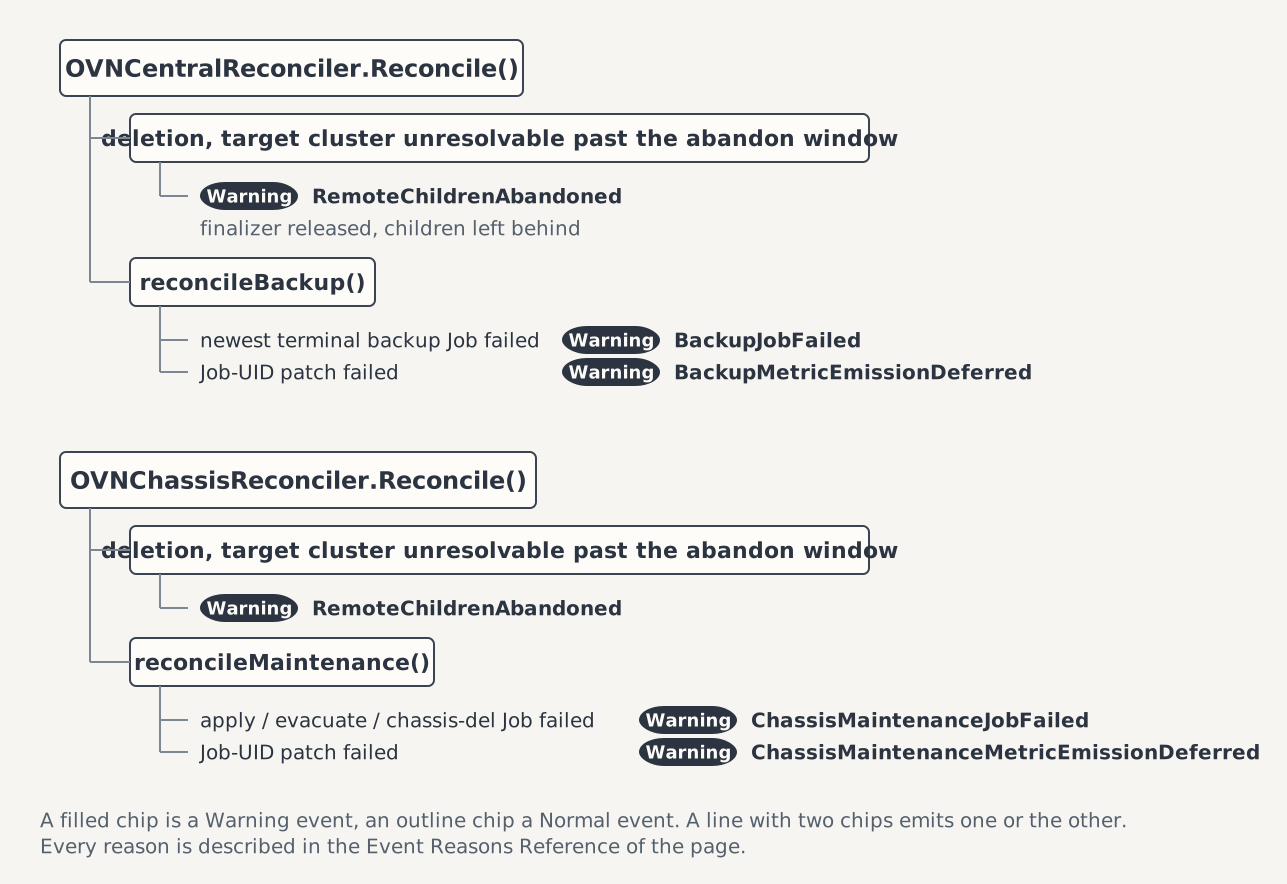
The figure draws which sub-reconciler emits which event, and on what. The Event Reasons Reference describes every reason.