Glance Reconciler Architecture
The Glance controller runs the shared table-driven pipeline (internal/common/reconcile) with twelve sub-reconcilers. Every step is instrumented under the glance_operator metrics prefix, and the first step to return a non-zero result or an error short-circuits the chain — conditions and the requeue are persisted on every exit path through the shared status skeleton.
Two Prometheus vectors cover the pipeline (glance_operator_reconcile_duration_seconds, glance_operator_reconcile_errors_total, the latter labelled by sub_reconciler and condition_type), two per-CR db-sync collectors cover the schema migration (glance_operator_db_sync_total, glance_operator_db_sync_duration_seconds), and two per-CR db-purge collectors cover the recurring purge (glance_operator_db_purge_total, glance_operator_db_purge_duration_seconds).
Pipeline
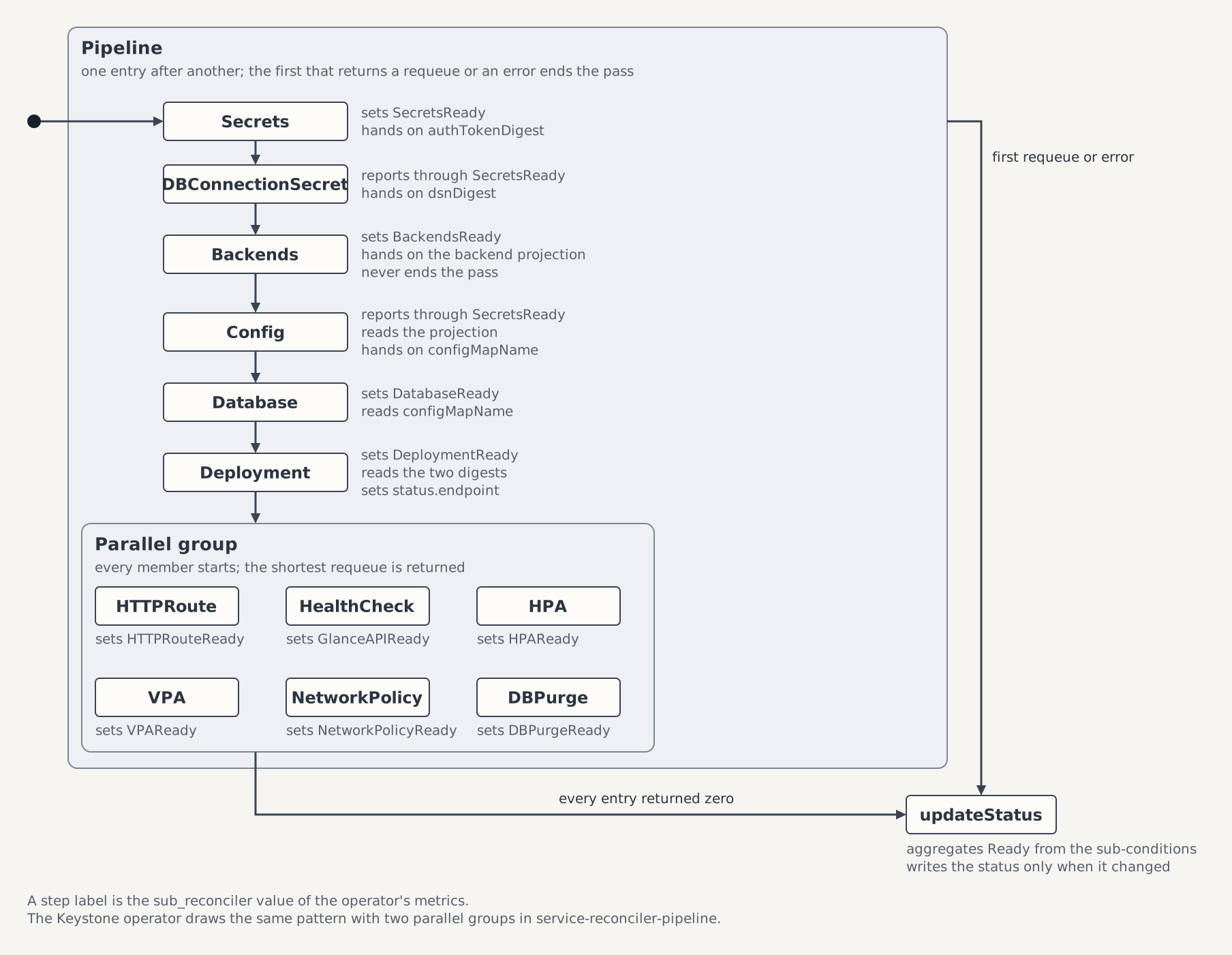
The figure draws the pattern the Keystone operator set: a lane of steps that ends the pass at the first requeue or error, and a group whose members all run. Reconciliation Flow describes that pattern in full. The table lists what each step does.
| Step | What it does | Condition |
|---|---|---|
| Secrets | Gates on the selected secret store (spec.secretStoreRef, default openbao-cluster-store), then the ESO-synced database and service-user credential Secrets; digests the service-user password for the rollout annotation | SecretsReady |
| DBConnectionSecret | Materializes the pymysql DSN into the derived {name}-db-connection Secret and digests it; reports through SecretsReady | SecretsReady |
| Backends | Aggregates the attached, credential-ready GlanceBackends into the content-hashed backends Secret. Waiting states never short-circuit the pipeline (first-install proceeds; a backend status flip re-enqueues via the watch) | BackendsReady |
| Config | Renders glance-api.conf / glance-api-paste.ini (plus policy.yaml / logging.conf when applicable) into an immutable content-addressed ConfigMap. With spec.imageCache set it adds the three [DEFAULT] image_cache_* keys (the cache directory, the sqlite driver, and a pruner threshold at 80% of the volume bound) and injects the cache paste filter directly before the root app. An invalid projection keeps the live Deployment's last-good names instead of re-rendering. Reports through SecretsReady (failure reason ConfigError) | SecretsReady |
| Database | Provisions/migrates the schema (MariaDB gate, Database/User/Grant, one glance-manage db sync Job); a release bump instead runs the shared expand-migrate-contract flow; promotes installedRelease | DatabaseReady |
| Deployment | Ensures the API Deployment, Service (port 9292), and PDB; stamps status.endpoint. Both scratch emptyDirs (staging, tasks-work) carry the sizeLimit resolved from spec.staging — none at all when spec.staging.unbounded is set — so changing the bound rolls the Deployment. spec.imageCache adds a third emptyDir, image-cache, bounded by its own sizeLimit and mounted into glance-api, plus a cache-maintenance sidecar looping glance-cache-pruner and glance-cache-cleaner. That loop prunes on the cache's own size — polled every 30s against image_cache_max_size — and on maintenanceInterval, whichever comes first. It gets no condition type of its own, and no failure of it ever exits the sidecar: every failed run is absorbed and shows only as a glance-cache-maintenance failed: <n> consecutive line in kubectl logs -c cache-maintenance, because the loop shares the pod with glance-api and a CrashLoopBackOff would drop that API replica from the Service. A count that keeps climbing is a pruner that can never run, and since nothing else enforces image_cache_max_size, every replica's cache then grows to the emptyDir bound and the kubelet evicts it — outside the eviction API, so the PDB does not stagger it. This sub-reconciler reports that only as WaitingForDeployment; no condition, event, or metric names the cause. Mid-upgrade it flips the RollingUpdate phase to Contracting once the rolled-out Deployment reports ready | DeploymentReady |
| HTTPRoute | Full spec.gateway lifecycle; reflects the Gateway's Accepted condition. The route renders timeouts.request: "4h", so the gateway does not truncate a long image transfer and a stalled one releases its worker eventually. The bound is on duration only — nothing the operator renders caps how many requests may occupy the API's workers at once | HTTPRouteReady |
| HealthCheck | HTTP GET of the cluster-local /healthcheck through the shared TTL probe cache | GlanceAPIReady |
| HPA | Creates/deletes the HorizontalPodAutoscaler | HPAReady |
| VPA | reconcileVPA applies or removes the VerticalPodAutoscaler of the API Deployment through the shared VPA flow; reports VPANotInstalled for an opt-in on a cluster without the VPA | VPAReady |
| NetworkPolicy | Creates/deletes the NetworkPolicy (auto-derived DB/cache/S3 egress); refuses an empty ingress list (fail-closed) | NetworkPolicyReady |
| DBPurge | Projects the {name}-db-purge CronJob and reports the newest terminal run it spawned | DBPurgeReady |
DBConnectionSecret and Config deliberately reuse SecretsReady rather than a dedicated ConfigReady condition: both produce Secret/ConfigMap artefacts that gate the same downstream graph, so a distinct sub_reconciler label on the error counter disambiguates them during triage while the status contract stays minimal.
Conditions
The aggregate Ready condition is True (reason AllReady) exactly when all ten sub-conditions are True; otherwise False (NotAllReady).
| Type | True reasons | False reasons |
|---|---|---|
SecretsReady | SecretsAvailable | TargetClusterUnavailable, SecretStoreNotReady, ClusterSecretStoreUnsupported, WaitingForDBCredentials, WaitingForServiceUserCredentials, ConfigError |
BackendsReady | AllBackendsProjected | WaitingForBackends, NoDefaultBackend |
DatabaseReady | DatabaseSynced | ClusterNotReady, WaitingForDatabase, DBSyncFailed, DBSyncInProgress, WaitingForBackends, ImageReleaseMismatch, VersionParseError, DowngradeNotSupported, UpgradePathInvalid, UpgradeTargetChanged, ExpandInProgress, MigrateInProgress, UpgradeRollingUpdate, ContractInProgress, ExpandFailed, MigrateFailed, ContractFailed |
DeploymentReady | DeploymentReady | WaitingForDeployment, WaitingForBackends |
GlanceAPIReady | APIHealthy | APIUnhealthy, EndpointNotReady, HealthCheckTimeout, ConnectionFailed, HealthCheckFailed |
HPAReady | HPAReady, HPANotRequired | — (errors propagate) |
VPAReady | VPAReady, VPANotRequired | VPANotInstalled, CapabilityProbeFailed, VPAError |
NetworkPolicyReady | NetworkPolicyReady, NetworkPolicyNotRequired | — (errors propagate) |
HTTPRouteReady | HTTPRouteAccepted, HTTPRouteNotRequired | HTTPRouteNotAccepted, GatewayAPINotInstalled, CapabilityProbeFailed |
DBPurgeReady | DBPurgeScheduled, DBPurgeSuspended | DBPurgeJobFailed |
TargetClusterUnavailable is set ahead of every sub-reconciler, when spec.targetClusterRef names a target cluster that is not registered or no longer resolves. The message carries the resolver's error, the CR requeues after 15 seconds and acquires no finalizer, and nothing is created on any cluster. An attached GlanceBackend reports the same reason on CredentialsReady. See Target Clusters.
Both DatabaseReady and DeploymentReady carry a WaitingForBackends reason: the schema cannot be db sync-ed and the Deployment cannot be created until a ready default backend has produced a rendered config to run against.
Launch mode
The API container runs one command on every supported release: uwsgi --http :9292 --http-auto-chunked --http-chunked-input --chunked-input-limit 16777216 …. The two chunked flags are always on because Glance streams image bodies with chunked transfer encoding, and the limit raises uWSGI's 1 MB cap on one request chunk to 16 MiB: glanceclient uploads a body of unknown size in 1 MiB chunks, which the default rejects with OSError: unable to receive chunked part and a 500, so cinder's upload-to-image and nova's snapshot upload fail under the default. Keep-alive (--http-keepalive, and --http-keepalive-timeout when set) and --harakiri are emitted from the spec.apiServer.uwsgi fields. uWSGI loads the WSGI app through --wsgi-file /var/lib/openstack/bin/glance-wsgi-api (the image-shipped shim) and passes both oslo.config --config-dir roots, the immutable config ConfigMap (/etc/glance/glance-api.conf.d/) and the backends Secret (/etc/glance/backends.conf.d/), via --pyargv, because glance's stock WSGI module ignores sys.argv.
spec.apiServer.workers is deprecated: the operator renders no [DEFAULT] workers, and the validating webhook warns spec.apiServer.workers is deprecated and has no effect: Glance runs under uWSGI on every supported release and the operator renders no [DEFAULT] workers; size the API with spec.apiServer.uwsgi instead.
Backends aggregation
The Backends step lists the attached GlanceBackends (via the spec.glanceRef.name field index), sorts them by name for deterministic output, and renders one [<name>] store section per credential-ready backend into a content-hashed backends Secret (rolled on any content change, 3 historical retained). It gates each backend on CredentialsReady==True — never the aggregate Ready, which also requires ConfigProjected and would deadlock, since ConfigProjected only turns True after this step projects the backend.
- Exactly-one-Ready-default rule. Zero or more than one credential-ready default is an invalid projection (
BackendsReady=False / NoDefaultBackend): nothing is re-rendered and the config step retains last-good. - Per-backend fault isolation. A backend whose credentials Secret is missing/unreadable, or whose rendered values carry a control character, is skipped with a
GlanceBackendSkippedWarning event on the Glance CR while the healthy siblings keep projecting.
Database
The Database step runs the shared provisioning + sync flow: a MariaDB cluster gate and Database/User/Grant in managed mode (a no-op in brownfield), then a single {name}-db-sync Job running glance-manage db sync followed by db load_metadefs. Because Glance's migrations apply in one idempotent pass, there is no schema-check Job, so, unlike Keystone, SchemaDriftDetected never fires for Glance. On fresh installs and patch bumps installedRelease is promoted to spec.openStackRelease on Job success.
A release transition (a spec.openStackRelease bump with the image in lockstep) instead dispatches to the shared expand-migrate-contract flow (internal/common/database), the same phase machine Keystone runs. The step validates the path against installedRelease, rejecting a downgrade or a non-sequential jump with VersionParseError, DowngradeNotSupported, or UpgradePathInvalid, then walks Expanding → Migrating → RollingUpdate → Contracting with glance-manage db expand|migrate|contract phase Jobs on the new image. The outgoing pods keep serving the expanded schema across the rollout, so the API stays available, and installedRelease is promoted only after contract completes. The Deployment step owns the RollingUpdate → Contracting flip: once reconcileDeployment sees the rolled-out Deployment ready, it advances the phase to Contracting and requeues so the contract Job runs. See the Glance Upgrade Flow for the phase table, condition reasons, events, and abort semantics.
Connection cap
The operator sets the MariaDB User's max_user_connections to a cap sized for the CR's own topology. It owns the field and applies the computed figure on every reconcile, so a value edited on the User by hand is reset; the cap rises only with the counts in the formula below. The mariadb-operator default of 10 is too small for the default fleet: three 2026.1 pods of two uWSGI processes hold up to 30 connections. A cap below the fleet's demand does not degrade gracefully. The process that opens the connection past it gets MySQL error 1226: at start-up its pod crash-loops, and under load the upload, import or snapshot it serves answers HTTP 500.
(apiPods + 1) x perPod + 2

perPod = uwsgiProcesses x (uwsgiThreads + 5)
The defaults size to 50 ((3 + 1) x 2 x (1 + 5) + 2). apiPods is the autoscaling ceiling when an HPA owns the count, and the + 1 beside it is the rolling-update surge. Each request thread holds one connection, and the + 5 is what the per-process async import pool added on top while web-download imports ran. A heavier import mix pushes that term toward [wsgi] task_pool_threads, which defaults to 16 per process.
perPod is computed from spec.apiServer.uwsgi alone: glanceConnectionsPerPod (operators/glance/internal/controller/reconcile_database.go) takes no release, so the cap does not move across a release transition. The trailing + 2 is headroom for one migration Job (db-sync, or the active expand, migrate or contract Job) overlapping a {name}-db-purge run. The cache-maintenance sidecar opens no database connection.
The operator renders neither [database] max_pool_size nor max_overflow: the thread count bounds demand, and an overflow pin would queue requests in any process running more than five threads. An extraConfig override of [database] max_pool_size or max_overflow is honoured and reported through ExtraConfigHealthy.
DBPurge
The DBPurge step runs in the parallel group, after Database and Deployment, so the purge CronJob can mount the same rendered config ConfigMap the Deployment already consumes. It projects the {name}-db-purge CronJob on every pass with the settings effectiveDBPurge resolves, and it derives run visibility rather than watching the CronJob: it lists the Jobs carrying the Glance's common labels, keeps the ones the CronJob controls, and reports on the newest that reached a terminal state.
A failed run flips DBPurgeReady to False (reason DBPurgeJobFailed) and raises a matching Warning event; a later successful run flips it back to True, so an old failure a bounded history has not yet pruned cannot wedge the condition once a newer run succeeds. A run that wedges rather than fails — an unschedulable pod, a glance-manage blocked on a database lock — reaches a terminal Failed state through the Job's activeDeadlineSeconds, so it surfaces on the same path instead of leaving DBPurgeReady reporting a purge that never happens. Every terminal run also feeds the glance_operator_db_purge_total / glance_operator_db_purge_duration_seconds pair exactly once per Job UID. Because that once-per-UID annotation is a write to the CR from inside the parallel group, the group adopts the member's post-patch metadata onto the primary object before the status write.
A CronJob suspended via spec.dbPurge.suspend keeps DBPurgeReady True — a pause is a posture, not a failure — but reports it under its own reason DBPurgeSuspended, because nothing else does: the CronJob never fires again, so no run fails, no Warning event follows, and glance_operator_db_purge_total merely stops incrementing while the soft-deleted backlog keeps growing.
See DBPurgeSpec for the CronJob shape and the glance-manage commands it runs.
The CronJob fires on the Kubernetes scheduler's clock, not on the pipeline's, so it keeps running during a release upgrade — while the Database step is driving expand/migrate/contract, the chain short-circuits before DBPurge and the CronJob keeps its pre-upgrade image. A run landing inside that window fails loudly (DBPurgeJobFailed) rather than corrupting anything, since the purge only issues bounded deletes. Suspend the CronJob via spec.dbPurge.suspend across a planned upgrade to avoid the noise.
Requeue semantics
| Interval | Used by |
|---|---|
| 10s | Deployment readiness polling, HTTPRoute acceptance, health-check retry |
| 15s | ESO secret-gate polling (Secrets, DBConnectionSecret; the GlanceBackend controller's credential/projection backstop) |
| 30s | MariaDB / db-sync / ready-default-backend database wait |
| 30s TTL | Health-probe cache (a passing /healthcheck probe is reused within the TTL) |
Rotation and deletion
- Credential rotation happens at the OpenBao source. The service-user password (consumed via
OS_KEYSTONE_AUTHTOKEN__PASSWORD) and the assembled DSN (consumed viaOS_DATABASE__CONNECTION) are both env-var-delivered, so a restart is required for a rotation to take effect. The Secrets and DBConnectionSecret steps digest each value into a pod-template annotation —glance.c5c3.io/authtoken-hashandglance.c5c3.io/db-connection-hash— so a changed digest rolls the Deployment. - Deletion runs the
glance.openstack.c5c3.io/finalizer: it issues Delete on the MariaDBDatabase/User/GrantCRs before the owner-ref chain disappears, emittingFinalizingDatabasewhile cleanup remains andDatabaseFinalizedwhen the finalizer is released. Every other owned resource is namespace-scoped with a controller owner reference, so Kubernetes garbage collection reclaims it. A CR whose target cluster was deregistered in the meantime cannot reach any of it: the finalizer is released against no cleanup at all, aRemoteChildrenAbandonedWarning names what stays behind, and the CR leaves etcd instead of hanging in Terminating. See Target Clusters. TheGlanceBackendcontroller has no finalizer: the operator provisions no S3 resources, so there is nothing to clean up remotely. Deletion still de-registers the store — the bucket and its objects are external state, and image location rows referencing that store id are left dangling, so those images become undownloadable until a backend with the same name is re-attached.
Watches
The Glance controller Owns its Deployment, Service, ConfigMap, Secret, PodDisruptionBudget, HorizontalPodAutoscaler, NetworkPolicy, and — for the db-sync migration — Job, plus the db-purge CronJob: its status.active list changes as each spawned run starts and finishes, which is what wakes the reconcile that refreshes DBPurgeReady. The HTTPRoute is added to the Owns set only when the Gateway API CRD is installed on the management cluster (otherwise spec.gateway surfaces HTTPRouteReady=False / GatewayAPINotInstalled instead of crashing the controller). That setup probe answers for CRs without a spec.targetClusterRef; a CR that names a target cluster has the kind probed against that cluster's RESTMapper on every pass. Beyond the owned set it watches:
- Secrets, mapped to the Glance CRs that reference them directly (via the
spec.serviceUser.secretRef.name/spec.database.secretRef.namefield index) or through an attached backend's S3 credentials Secret (via the backend secret-name index). - GlanceBackends, mapped to their parent Glance with no generation predicate — a backend's
CredentialsReadyflip is exactly what wakes the aggregation. - MariaDB clusters referenced by
spec.database.clusterRef, so an upstream database outage reflects inDatabaseReadywithout waiting for a periodic requeue. - Both the cluster-scoped
ClusterSecretStoreand the namespacedSecretStorea Glance can select, so a store-backend outage reflects inSecretsReady. TheClusterSecretStoreleg is not registered when the operator runs with--namespace.
The Glance reconciler registers both controllers' field indexes at setup (spec.glanceRef.name and the secret-name indexes), so it must be set up before the GlanceBackend controller. The GlanceBackend controller in turn watches its parent Glance (no generation predicate: the store config landing in the Deployment is the wake signal its ConfigProjected gate waits on) and is the single writer of GlanceBackend status.