Glance CRD
glances.glance.openstack.c5c3.io/v1alpha1, kind Glance. The CRD is generated from operators/glance/api/v1alpha1/glance_types.go; the validating and defaulting webhooks live in operators/glance/api/v1alpha1/glance_webhook.go. The Helm chart ships a synced copy (make sync-crds / make verify-crd-sync).
One Glance CR describes the Image API server: its OpenStack release, container image, database and cache connections, and the Keystone integration. Image stores are not part of this spec — they attach out-of-band through GlanceBackend CRs.
Spec
| Field | Type | Required | Description |
|---|---|---|---|
openStackRelease | string | yes | The OpenStack release the operator deploys and drives; pattern ^\d{4}\.[12]$ (the YYYY.N cadence, N ∈ {1,2}). Governs install/upgrade schema tracking and the option catalog. Kept separate from the image tag so digest-pinned images still resolve a schema. The validating webhook rejects a value below 2026.1, the oldest supported release, on create and on change, and warns on an unchanged one. |
deployment | DeploymentSpec | no | Shared pod-level knobs: replicas (default 3), resources (resolved per resource when the pod is rendered: 70m CPU request, no CPU limit, and memory sized at 1Gi per process, 2064Mi as request and limit at the uWSGI defaults, see the resource defaults), terminationGracePeriodSeconds, preStopSleepSeconds, strategy, topologySpreadConstraints, priorityClassName, and the node placement nodeSelector, tolerations and affinity (see NodePlacementSpec) |
deployment.verticalAutoscaling | *VerticalAutoscalingSpec | no | Opts the Glance API Deployment into a VerticalPodAutoscaler that controls the requests of its containers; see VerticalAutoscalingSpec. Rejected beside spec.autoscaling, which scales the same Deployment. On a cluster without the VPA, VPAReady turns False with reason VPANotInstalled. |
jobs | *JobSpec | no | Sizes, prioritizes and places the pods of the db-sync Job, the db-expand, db-migrate and db-contract upgrade phases, and the db-purge CronJob. A field left unset falls back to spec.deployment; unset resources default to a 70m CPU request and 368Mi memory as request and limit |
image | ImageSpec | yes | Container image; exactly one of tag or digest (shared CEL rule, re-checked by the webhook) |
database | DatabaseSpec | yes | MariaDB connection. Exactly one of clusterRef (managed) or host (brownfield); credentialsMode (Static | Dynamic, where Dynamic requires clusterRef), secretRef, and optional tls. Mutual-exclusivity and the Dynamic-requires-clusterRef rule are inherited from commonv1.DatabaseSpec |
cache | CacheSpec | yes | Memcached for the cache of validated tokens ([keystone_authtoken] memcached_servers). It has no part in the image cache of spec.imageCache. Exactly one of clusterRef (managed) or servers (brownfield) |
keystoneEndpoint | string | yes | The Keystone auth URL rendered as [keystone_authtoken] auth_url; must match ^https?:// and parse with a host. Consumed server-side on every request, so it must be reachable from inside the cluster — use the cluster-local Service URL, not an externally routable address |
keystonePublicEndpoint | string | no | The browser/client-facing Keystone base URL rendered as [keystone_authtoken] www_authenticate_uri (the address a 401 points unauthenticated clients at); must match ^https?:// when set. When empty the operator falls back to keystoneEndpoint at render time (see EffectiveKeystonePublicEndpoint), correct only when the internal and public Keystone URLs coincide |
serviceUser | ServiceUserSpec | yes | The Keystone service account Glance authenticates as, and the Secret holding its password |
region | string | no | The Keystone region ([keystone_authtoken] region_name); when empty the option is omitted and Glance uses the catalog's default region |
apiServer | *APIServerSpec | no | uWSGI API-process tuning (uwsgi); the deprecated workers field has no effect. When nil the operator uses the uWSGI defaults |
importFiltering | *ImportFilteringSpec | no | URI filtering for web-download image imports. The operator resolves the effective lists at render time, so a nil block and an empty struct behave alike: HTTPS on port 443, plus a literal host denylist |
importPlugins | *ImportPluginsSpec | no | Selects the image-import plugins Glance runs, rendered as [image_import_opts] image_import_plugins plus the section each enabled plugin reads. Presence of a sub-block enables that plugin, nil enables none; the rendered order is fixed (image_decompression, image_conversion, inject_image_metadata) and is not an input. Every default resolves at render time, so an unset field keeps tracking the operator default |
dbPurge | *DBPurgeSpec | no | Recurring database purge that hard-deletes rows Glance only ever soft-deletes. The operator resolves the effective settings at reconcile time, so a nil block and an empty struct behave alike: 30-day retention, daily at 1 0 * * *, task rows only, not suspended |
staging | *StagingSpec | no | Bounds the node-local scratch space an image import may consume. The operator resolves the effective limit at reconcile time, so a nil block, an empty struct, and a set block leaving sizeLimit unset all behave alike: 10Gi on each of the two scratch volumes. unbounded: true opts out of the bound entirely |
imageCache | *ImageCacheSpec | no | Turns on the per-replica local image cache: presence of the block enables it, nil disables it. sizeLimit bounds the cache emptyDir (default 10Gi, floor 1Mi), maintenanceInterval sets the pruner/cleaner cadence (default 5m, floor 1m), and maintenanceResources sizes the maintenance sidecar (default 25m CPU request, 256Mi memory request and limit). All three resolve at render time, so an unset field keeps tracking the operator default |
gateway | *GatewaySpec | no | External exposure via a Gateway API HTTPRoute on port 9292; requires hostname and parentRef.name |
networkPolicy | *NetworkPolicySpec | no | Ingress restricted to TCP 9292 from the listed sources; egress auto-derived (the ports of DNS, the database, the cache and the attached S3 backends, to any destination). At least one ingress source is required (fail-closed) |
autoscaling | *AutoscalingSpec | no | HPA bounds, CPU/memory utilization targets and scaling behavior |
logging | *LoggingSpec | no | oslo.log derivation: format (text/json), level, debug, perLoggerLevels. Materialized by the defaulting webhook to text/INFO/debug: false |
secretStoreRef | *SecretStoreRefSpec | no | Selects the External Secrets store the operator resolves SecretsReady against — kind (ClusterSecretStore | SecretStore, default ClusterSecretStore) and a required name. When omitted the shared cluster-scoped openbao-cluster-store is used. Normally projected from the owning ControlPlane |
targetClusterRef | *TargetClusterRefSpec | no | Names the registered target cluster that receives this Glance's children: the Deployment, the ConfigMaps, the Secrets, and the database CRs. The CR itself does not move, and neither do its status, its finalizers, or the webhooks that admit it. When omitted the children are created on the local cluster the operator runs on, so an existing CR keeps its behavior without an edit. name must be a non-empty DNS-1123 subdomain matching the registration Secret. An attached GlanceBackend carries no ref of its own and follows this one. Immutable (CEL transition rule): adding, removing, or renaming the ref strands the children already created on the previously selected cluster; delete and recreate instead. See Target Clusters |
policyOverrides | *PolicySpec | no | Custom oslo.policy rules. A CEL rule requires at least one of rules or configMapRef; when set, the operator renders a policy.yaml and wires oslo_policy.policy_file |
middleware | []MiddlewareSpec | no | WSGI middleware filters injected into the api-paste.ini pipeline |
plugins | []PluginSpec | no | Service plugins/drivers, modeled as a list-map keyed by configSection so duplicate sections are rejected structurally |
extraConfig | map[string]map[string]string | no | Free-form INI sections for configuration not covered by explicit fields — the escape hatch for options with no dedicated knob of their own. The render-time merge follows plugins < operator defaults < extraConfig (each stage merged key-wise), so user values win over both. Overrides of operator-owned keys are honored but reported (report-only) via the ExtraConfigHealthy condition and an ExtraConfigOwnedKeyOverride Warning event — except [keystone_authtoken] password, which the validating webhook rejects at admission so the env-injected service password never leaks into the namespace-readable ConfigMap, the six [import_filtering_opts] keys, which it rejects so the web-download URI filter stays reachable only through spec.importFiltering and its admission gates, and the three [DEFAULT] image_cache_* keys, which it rejects because each of them ends in an evicted glance-api pod or in database rows nothing reclaims — see ImageCacheSpec. The four image-import plugin keys are rejected on the same footing, so the plugin pipeline stays reachable only through spec.importPlugins and the order, enum, and property-name rules it carries. Option names are validated at admission against a per-release option catalog embedded in the operator (release derived from spec.openStackRelease; a release with no embedded catalog skips the check with an admission warning). Sections declared by spec.plugins, operator-owned keys, and the reserved store sections os_glance_staging_store and os_glance_tasks_store are exempt. An unknown section or option is rejected with the section and key named, so an arbitrary backend-named section is refused; backend options belong to the GlanceBackend CR. A deprecated-but-accepted option is admitted with a warning naming its replacement. Values are checked for one thing only — a newline or carriage return in a section name, key, or value is rejected, because the rendered INI writes each verbatim and a newline would inject arbitrary config lines past the ownership and catalog gates. Every rule here is webhook-only with no CEL backstop |
ServiceUserSpec
The name and domain fields are webhook-defaulted, so a minimal CR need only supply the password Secret reference.
| Field | Type | Required | Default | Description |
|---|---|---|---|---|
username | string | no | glance | Keystone username ([keystone_authtoken] username) |
projectName | string | no | service | The project the service user scopes to (project_name) |
userDomainName | string | no | Default | The domain the service user lives in (user_domain_name) |
projectDomainName | string | no | Default | The domain the service project lives in (project_domain_name) |
secretRef | SecretRefSpec | yes | key → password | The Secret holding the service-user password; the password is injected as the OS_KEYSTONE_AUTHTOKEN__PASSWORD env var, never rendered into config |
APIServerSpec
Tunes the API server process, which runs under uWSGI on every supported release. The validating webhook emits an admission warning (not a rejection) when the deprecated workers field is set.
| Field | Type | Required | Effective when | Description |
|---|---|---|---|---|
uwsgi | *UWSGISpec | no | always | uWSGI application-server parameters |
workers | *int32 (Minimum=1) | no | never | Deprecated, has no effect; the operator renders no [DEFAULT] workers and the webhook warns when the field is set. Size the API with uwsgi |
The process and thread counts, together with the replica count, size the database user's max_user_connections; see Connection cap.
UWSGISpec
A cross-field CEL rule mirrors the webhook: httpKeepAliveTimeout may only be set when httpKeepAlive is true (otherwise the --http-keepalive-timeout flag is never emitted).
| Field | Type | Required | Default | Description |
|---|---|---|---|---|
processes | int32 (Minimum=1) | no | 2 | uWSGI worker-process count (--processes) |
threads | int32 (Minimum=1) | no | 1 | Threads per worker (--threads) |
httpKeepAlive | *bool | no | true | Enables --http-keepalive. A nil-preserving pointer: nil restores the default, an explicit false is honored verbatim |
harakiri | *int32 (Minimum=1) | no | — | Per-request worker lifetime cap (--harakiri, seconds). Omitted entirely when nil (no hidden default). The webhook requires harakiri < terminationGracePeriodSeconds − preStopSleepSeconds |
httpKeepAliveTimeout | *int32 (Minimum=1) | no | — | Idle timeout of keep-alive connections (--http-keepalive-timeout, seconds). Omitted when nil; zero is rejected to avoid the unbounded interpretation |
ImportFilteringSpec
Constrains the URIs the web-download image-import method may fetch from, rendered as the [import_filtering_opts] group. Each attribute (scheme, host, port) has an allow-list and a deny-list, and Glance only evaluates one of the two: a non-empty allow-list makes it ignore the matching deny-list. Configuring both halves of a pair would silently drop the deny-list, so three CEL rules reject that combination, and the validating webhook mirrors them.
| Field | Type | Required | Description |
|---|---|---|---|
allowedSchemes | []string (MaxItems=64, items ∈ {http, https}) | no | Schemes web-download may fetch from (allowed_schemes). Glance's own default is [http, https]; the operator narrows an unset field to [https] |
disallowedSchemes | []string (MaxItems=64, items ∈ {http, https}) | no | Schemes web-download must refuse (disallowed_schemes). Ignored by Glance whenever allowedSchemes is non-empty |
allowedHosts | []string (MaxItems=64, item length 1–253) | no | Hosts web-download may fetch from (allowed_hosts). Non-empty pins imports to a known mirror and refuses every other host |
disallowedHosts | []string (MaxItems=64, item length 1–253) | no | Hosts web-download must refuse (disallowed_hosts). An unset field resolves to the operator denylist below, covering loopback, the link-local metadata address, and the in-cluster API server; entries set here are unioned onto that denylist rather than replacing it. Ignored by Glance whenever allowedHosts is non-empty |
allowedPorts | []int32 (MaxItems=64, 1–65535) | no | Ports web-download may connect to (allowed_ports). Glance's own default is [80, 443]; the operator narrows an unset field to [443] |
disallowedPorts | []int32 (MaxItems=64, 1–65535) | no | Ports web-download must refuse (disallowed_ports). Ignored by Glance whenever allowedPorts is non-empty |
The defaults are resolved at render time; the mutating webhook never writes them into the CR, so a field left unset keeps tracking the operator default across upgrades. Only a nil field is defaulted. An explicit empty list is honored as empty, which is how a deployment opts out of a default restriction, and a nil spec.importFiltering resolves the same way an empty struct does.
| Unset field | Resolves to |
|---|---|
allowedSchemes | https |
disallowedSchemes | empty |
allowedHosts | empty |
disallowedHosts | localhost, 127.0.0.1, 0.0.0.0, ::1, 169.254.169.254, kubernetes, kubernetes.default, kubernetes.default.svc, kubernetes.default.svc.cluster.local; empty while allowedHosts is non-empty |
allowedPorts | 443 |
disallowedPorts | empty |
Resolution never widens one default because of a value set on another field: a deny-list entry keeps the sibling allow-list default, and disallowedHosts entries are unioned onto the denylist above rather than replacing it, so tightening the filter cannot un-deny loopback, the metadata address, or the API server. The one carve-out left is disallowedHosts while allowedHosts is non-empty: Glance ignores the host denylist then, and the allow-list is the stricter half, so rendering the baseline would misreport what applies.
That makes a deny-list on disallowedSchemes or disallowedPorts inert on its own, because Glance evaluates a deny-list only while the matching allow-list is empty and the operator default keeps it populated. The shape is admitted — it is not wrong, only ineffective — so the validating webhook raises an admission warning naming the inert list. To make one authoritative, empty the sibling allow-list explicitly — the pair stays within the mutual-exclusivity rule, which is keyed on non-empty lists:
spec:
  importFiltering:
    allowedSchemes: []          # opt out of the https pin …
    disallowedSchemes: [http]   # … so this deny-list is what applies
All six keys are rendered on every reconcile, empty values included. Glance's own allowed_schemes and allowed_ports defaults are non-empty, so a key left out of the file would mean "Glance's permissive default", not "unrestricted by this operator".
Host matching is literal string membership. Glance supports no CIDR ranges, no wildcards, and no DNS-resolution-based blocking, so every host has to be spelled out the way an import URI would spell it. The default list therefore carries all four spellings of the API server Service a pod's resolv.conf search list resolves, but it still covers the names it lists and nothing else: a trailing-dot FQDN, a raw ClusterIP, or an in-cluster HTTPS service on port 443 whose name is absent stays reachable from a web-download import. The scheme-and-port pin is the control that holds there; where the residual reach matters, pin allowedHosts to the mirrors imports are supposed to use.
A mirror that only serves plaintext HTTP needs both the scheme and the port widened, since the two are filtered independently:
spec:
  importFiltering:
    allowedSchemes: [http, https]
    allowedPorts: [80, 443]
disallowedHosts stays unset there, so the operator's host denylist keeps applying — but it is now the only control left, and it matches literally. Widening either allow-list past the operator default therefore raises an admission warning: the scheme-and-port pin is what keeps an import off the link-local metadata endpoint (which answers on http/80), and once it is gone an alternate spelling of that address — an integer or IPv4-mapped form, a raw ClusterIP, a trailing-dot FQDN — is not covered by any denylist entry. Contain the widened reach instead of relying on the denylist: pin allowedHosts to the mirrors imports are supposed to use, or restrict the API pods' egress with spec.networkPolicy.additionalEgress.
Upgrading an operator that did not render this group
Before the operator rendered [import_filtering_opts], web-download ran under Glance's own defaults: schemes http and https, ports 80 and 443, no host denylist. Every Glance CR has spec.importFiltering unset, so the first reconcile after the operator upgrade narrows the filter to HTTPS on port 443 — no CR edit triggers it. The change rewrites the content-hashed config ConfigMap and rolls the Deployment, and from then on an import from an http:// mirror or a non-443 port fails immediately with a synchronous 400: it is a filter rejection, not a network or mirror fault.
Before upgrading, check which URIs the deployment imports from. If any is plaintext or off port 443, apply the widening block above in the same change. The effective filter is always readable from the rendered config:
kubectl get cm -n openstack "$(kubectl get deploy glance -n openstack \
  -o 'jsonpath={.spec.template.spec.volumes[?(@.name=="config")].configMap.name}')" \
  -o 'jsonpath={.data.glance-api\.conf}' | grep -A6 import_filtering_opts
All six keys are registered as operator-owned and rejected at admission when set through spec.extraConfig — unlike most owned keys, which are honoured and merely reported. spec.importFiltering expresses every one of them, so an extraConfig override adds no reach; it only skips the exclusivity rules, the host INI guard, and the warning that flags a loosened filter, leaving an audit that reads spec.importFiltering with the restrictive default while the rendered config says otherwise. Any other key under [import_filtering_opts] is rejected too: the section appears in no option catalog.
Changing the filter rewrites the content-hashed config ConfigMap, and the new hash rolls the Deployment. When spec.networkPolicy is set on the CR, a web-download import needs a matching spec.networkPolicy.additionalEgress rule when the port of its mirror is none the auto-derived egress opens: that egress allows the ports of DNS, the database, the cache and the S3 backends, to any destination, and no other port.
ImportPluginsSpec
Glance can put an imported image through a chain of plugins before the data reaches the backing store: unpack a compressed one, rewrite it into a single disk format, stamp image properties onto it. A plugin runs only while [image_import_opts] image_import_plugins names it, and this block is that naming. Presence of a sub-block adds its plugin to the list, nil leaves it out, the same opt-in convention ImageCacheSpec follows.
| Field | Type | Required | Description |
|---|---|---|---|
decompression | *ImportDecompressionSpec | no | Enables image_decompression, which unpacks a compressed image after staging so the later plugins and the store see the disk image instead of the archive. The struct carries no fields: upstream registers no options for the plugin, so its presence is the whole configuration. Setting it requires spec.staging to answer for the scratch bound — either sizeLimit or unbounded — because the plugin's expansion is unbounded and the operator default was sized against the largest download |
conversion | *ImportConversionSpec | no | Enables image_conversion, which rewrites the staged image into one target disk format |
injectMetadata | *ImportInjectMetadataSpec | no | Enables inject_image_metadata, which stamps a fixed set of image properties onto every image it applies to |
conversion carries one field:
| Field | Type | Required | Default | Description |
|---|---|---|---|---|
outputFormat | string (Enum: qcow2, raw, vmdk) | no | raw | The disk format every imported image is converted to ([image_conversion] output_format). raw is the format an RBD store clones copy-on-write; qcow2 stays sparse on a filesystem store |
injectMetadata carries two:
| Field | Type | Required | Default | Description |
|---|---|---|---|---|
properties | map[string]string (MinProperties 1, MaxProperties 64, name and value each ≤ 255 characters) | yes | — | The properties injected onto every image the plugin applies to ([inject_metadata_properties] inject). They are how a deployment marks provenance or pins scheduling and driver behaviour on images it did not build itself, without trusting the importing user to set them. Rendered with the keys sorted alphabetically, so an unordered map cannot reshuffle the config and roll the Deployment on a reconcile that changed nothing |
ignoreUserRoles | []string (MaxItems 64, item length 1–255) | no | admin | The Keystone roles exempt from the injection (ignore_user_roles): an import by a user holding one of them leaves the image's properties untouched |
The rendered order is fixed (image_decompression, image_conversion, inject_image_metadata) and is not an input. Glance runs the plugins in list order and needs decompression ahead of conversion, since converting first would rewrite the archive instead of the disk image inside it. With no ordering knob, no shape of this block gets that wrong.
Defaults resolve when the config is rendered, the contract ImportFilteringSpec and ImageCacheSpec already follow: the defaulting webhook writes nothing back into the CR, so an unset outputFormat keeps tracking raw and an unset ignoreUserRoles keeps tracking admin across upgrades. Only a nil ignoreUserRoles is defaulted. An explicitly empty list is honored verbatim and drops the exemption, which is how a deployment injects for every role, admins included.
One key is rendered unconditionally and three more while their plugin is enabled:
| Key | Rendered | Value |
|---|---|---|
[image_import_opts] image_import_plugins | always | The enabled plugin names in the fixed order; [] while spec.importPlugins is nil |
[image_conversion] output_format | conversion set | The resolved output format |
[inject_metadata_properties] inject | injectMetadata set | key:value pairs joined with commas, keys sorted |
[inject_metadata_properties] ignore_user_roles | injectMetadata set | The roles joined with commas, without brackets: the option is an unbounded oslo ListOpt, which would read a bracket as part of the first and last role name |
image_import_plugins is written on every reconcile, the empty list included, for the reason the filter lists are. An absent key leaves Glance on its own default; the empty list is what says no plugin. The operator upgrade that introduces this block therefore re-renders every existing Glance once, which rewrites the content-hashed config ConfigMap and rolls the Deployment. That roll happens once, with no CR edit, and the rendered list is [] until a CR asks for a plugin. Every later change to the block costs one further rollout.
The plugins reach the interoperable import flow and nothing else. They are taskflow stages of POST /v2/images/{image_id}/import. An image uploaded with PUT /v2/images/{image_id}/file never passes through them, so a deployment that relies on conversion or on injected metadata has to keep that upload path out of its policy. Glance also skips them for the copy-image import method, which moves an image already in one store into another. glance-direct is not among the import methods this operator enables (enabled_import_methods is pinned to [web-download,copy-image], see StagingSpec), which leaves one path: the plugins act on web-download imports.
Decompression unpacks one layer. Glance identifies the staged file by its magic number and unpacks gzip, zip, and LHA in place; LHA needs the optional lhafile package, which the operator's Glance image ships. A zip or LHA archive must hold exactly one file. A multi-layer archive such as tar.gz is unsupported, because unpacking the outer layer yields the tar, which is no more a disk image than the archive was. Formats the plugin does not recognize, bzip2 and xz among them, pass through untouched and reach the store as the archive they arrived as.
Size the staging area against the unpacked image, not the download
The plugin unpacks in place with no bound on the result, and it cannot know that size before writing it. image_size_cap is no help either: it measures the bytes transferred, so a ~10 MiB gzip that expands past 10 GiB is well under any cap the deployment sets — gzip reaches roughly 1000:1 on crafted input. The operator adds no bound of its own; the only one in the path is spec.staging.sizeLimit, whose default is 10Gi.
Breaching that bound evicts the glance-api pod rather than the offending import, and within one pod it is a single shared budget rather than per-import accounting, so every other in-flight import on that replica dies with it. The blast radius is per-replica and shared: on the single-replica layout the quick start uses, one web-download import of a compression bomb is a full image-service outage, repeatable on a loop. The import_filtering_opts allow-list does not catch it, since the filter inspects the URI and not the payload.
Which is why the bound cannot stay an inherited default here: a CR enabling decompression is rejected at admission unless it also sets spec.staging.sizeLimit, or spec.staging.unbounded to deliberately keep no bound. That is an acknowledgement, not a control — the ratio itself is nothing the operator can cap.
So enable decompression only where the import path is already restricted to trusted callers by oslo.policy, and size spec.staging.sizeLimit against the largest unpacked image the deployment expects rather than the largest download. Where the import path must stay open, run imports on a glance-api replica set of their own so an eviction cannot take the serving path with it — a per-tenant import quota is the other control, and neither is something this block can express.
Conversion shells out to qemu-img. The plugin runs qemu-img info on the staged file and qemu-img convert when the format it finds differs from outputFormat. That binary comes from the qemu-utils package, which the operator's Glance image ships; a plain Glance install carries neither it nor lhafile.
The conversion runs on the node-local staging area, and the source and the converted result live there together until the source is deleted. One import can therefore draw about twice the image size from the spec.staging budget while it converts. Size that bound against the largest image the deployment imports, measured at its full virtual size: the compressed file that arrives over the wire hides that number.
A failing qemu-img call fails the import task that ran it. The image never reaches active and the failure surfaces on the task; the API keeps serving.
The injected pairs render in the oslo Dict syntax, which splits the value on commas and each pair on its first colon. A property name therefore carries neither character, and a value may carry a colon (a URL-shaped value works) but no comma. Map keys are reachable from no CRD marker, so every rule on a property name lives in the validating webhook alone; see Defaulting and validation.
All four keys are registered as operator-owned and Rejected: the validating webhook refuses an extraConfig override of any of them, whether or not spec.importPlugins is set. The block expresses everything they express, so an override adds no reach. What it adds is a way around the fixed decompression-before-conversion order, the output-format enum, and the property-name rules that keep an injected pair inside the Dict syntax, leaving an audit that reads spec.importPlugins seeing one pipeline while the rendered config runs another.
Migrate these keys out of extraConfig before upgrading
Setting [image_import_opts] image_import_plugins through extraConfig was the only way to enable these plugins before spec.importPlugins existed, so a Glance already running conversion or metadata injection carries it. The rejection is unconditional and applies on update as much as on create: once the new operator is running, any write to such a CR is refused with a Forbidden naming a field the write did not touch, so an image bump, a replica change, or a credential rotation is blocked until the key is removed.
Move the settings onto spec.importPlugins before rolling the operator:
extraConfig key | Replacement |
|---|---|
[image_import_opts] image_import_plugins | The sub-block per plugin — decompression, conversion, injectMetadata |
[image_conversion] output_format | conversion.outputFormat |
[inject_metadata_properties] inject | injectMetadata.properties |
[inject_metadata_properties] ignore_user_roles | injectMetadata.ignoreUserRoles |
Through a ControlPlane the same key is rejected on services.glance.extraConfig and on the merged spec.globalExtraConfig, and the consequence is worse: the ControlPlane projects the merged extraConfig onto its Glance child unconditionally, so the child's webhook refuses the projection and nothing else the ControlPlane changes reaches the child either. That wedge is diagnosable rather than silent — GlanceReady goes False with reason GlanceProjectionRejected and the rejection message on it. Removing the key from the ControlPlane clears it.
DBPurgeSpec
Glance never hard-deletes on its own: deleting an image only flips its row to deleted, and every image import leaves a task row behind, so both grow for the lifetime of the deployment. This block tunes the recurring {name}-db-purge CronJob that reclaims that backlog.
| Field | Type | Required | Default | Description |
|---|---|---|---|---|
retentionDays | *int32 (Minimum=1) | no | 30 | How long a soft-deleted row survives before the purge hard-deletes it — the --age_in_days argument both commands take. The one-day floor keeps the purge from racing rows an in-flight import just wrote. Lowering it applies retroactively at the next firing, so the validating webhook warns on a reduction |
schedule | string | no | "1 0 * * *" | The cron expression the purge CronJob runs on. Checked by the validating webhook rather than a CRD pattern, so a descriptor such as @daily is accepted alongside standard 5-field expressions. Also the only lever over purge throughput (see max_rows below) |
purgeImagesTable | *bool | no | false | Chains the second glance-manage db purge_images_table pass, hard-deleting the images rows themselves and freeing their UUIDs for reuse |
suspend | bool | no | false | Pauses the CronJob without deleting it, matching TrustFlushSpec.suspend on Keystone. DBPurgeReady stays True — a paused purge is a posture, not a failure — but reports reason DBPurgeSuspended and a message naming the growing backlog, since nothing else surfaces a purge that stopped |
The operator resolves the knobs at reconcile time, the same contract ImportFilteringSpec follows: a field left unset keeps tracking the operator default across upgrades instead of freezing today's value into the stored CR, so a nil spec.dbPurge resolves exactly like an empty struct. The defaulting webhook leaves the block untouched for that reason. The task sweep is scheduled on every Glance either way, since an unbounded soft-delete backlog is an outage waiting to happen; what varies is the window, the frequency, whether the images pass is chained on, and whether the CronJob is running at all.
The CronJob renders as:
| CronJob field | Value |
|---|---|
metadata.name | {name}-db-purge |
metadata.labels | commonLabels (name, instance, managed-by) |
spec.schedule | resolved dbPurge.schedule |
spec.suspend | resolved dbPurge.suspend |
spec.concurrencyPolicy | Forbid |
spec.jobTemplate.spec.activeDeadlineSeconds | 3600 |
spec.jobTemplate.spec.template.metadata.labels | commonLabels + app.kubernetes.io/component=db-purge, which keeps the pods out of the API Service |
spec.jobTemplate.spec.template.spec.restartPolicy | OnFailure |
| Container name | db-purge |
| Container image | spec.image reference |
| Container command | glance-manage --config-dir /etc/glance/glance-api.conf.d/ db purge --age_in_days <retentionDays> --max_rows 1000, with && glance-manage --config-dir /etc/glance/glance-api.conf.d/ db purge_images_table --age_in_days <retentionDays> --max_rows 1000 appended when purgeImagesTable is true |
| Container securityContext | RestrictedSecurityContext() (PSS Restricted) |
| Container volumes | The rendered config ConfigMap, plus the db-tls keypair when spec.database.tls is enabled |
ownerReferences | Points to the Glance CR (controller: true) |
db purge sweeps the tasks table and the image child tables in one pass but leaves the images table itself alone, and that omission is a security property: while the row survives, its UUID stays reserved, so a deleted image's ID can never be claimed by a different image (OSSN-0075). Because Glance's v2 image-create accepts a client-supplied id, hard-deleting the row lets any project member claim the freed UUID — and every Heat template, Terraform state, or server image_ref still pinning it would then resolve to that image. The second db purge_images_table pass is therefore opt-in via purgeImagesTable, for deployments whose policy denies client-supplied image IDs. When enabled it runs after the first, so the child rows referencing an image are already gone by the time that image's own row is purged.
max_rows (1000) bounds each per-table delete transaction so a long-neglected backlog cannot stall a Galera cluster for the length of one write-set. It is operator-owned rather than a CRD field, set well above Glance's own built-in default of 100 rows. The cap applies per invocation, so the schedule sets the throughput: on the default daily schedule the purge drains at most 1000 rows per table per day. That keeps up only while the deployment soft-deletes fewer rows per table than one run removes — a cloud importing more than 1000 images a day grows its tasks table faster than the purge drains it, and a brownfield backlog takes one run per batch to work off. schedule is the lever for both: an hourly purge multiplies the daily ceiling by 24.
concurrencyPolicy: Forbid keeps a run that outlasts its interval from being overtaken by the next firing — two purges deleting the same rows contend, which is what the per-transaction cap exists to avoid. activeDeadlineSeconds bounds how long a single run may stay active, so a purge wedged on a database lock or an unschedulable pod reaches a terminal Failed state instead of staying active indefinitely with DBPurgeReady still reporting a healthy schedule.
One run can still fail visibly. With purgeImagesTable enabled, an image row past its retention window can have a younger child row referencing it, an edge case caused by unusual timestamp skew, and db purge_images_table then exits non-zero with a DBReferenceError. That flips DBPurgeReady to False (reason DBPurgeJobFailed) and raises a Warning event; a later run converges once the child row also crosses the retention window.
Rolling this operator onto a deployment that has never been purged applies the retention window retroactively on the first firing. To stage that, set suspend: true, raise retentionDays to cover the deployment's full history, un-suspend, and step the retention down while watching glance_operator_db_purge_total.
StagingSpec
Every image import lands on local disk before the data reaches the backing store. The reserved os_glance_staging_store takes the image an import downloads or copies, and what an import plugin makes of it. The reserved os_glance_tasks_store takes no image bytes of an import: Glance keeps the working copy of the Tasks API (POST /v2/tasks, open to admins only) and the marker files of running operations there. Both are emptyDir volumes on the node filesystem. This block caps them.
The figure shows the two volumes of this block and the cache volume of ImageCacheSpec, with the paths that write to each.
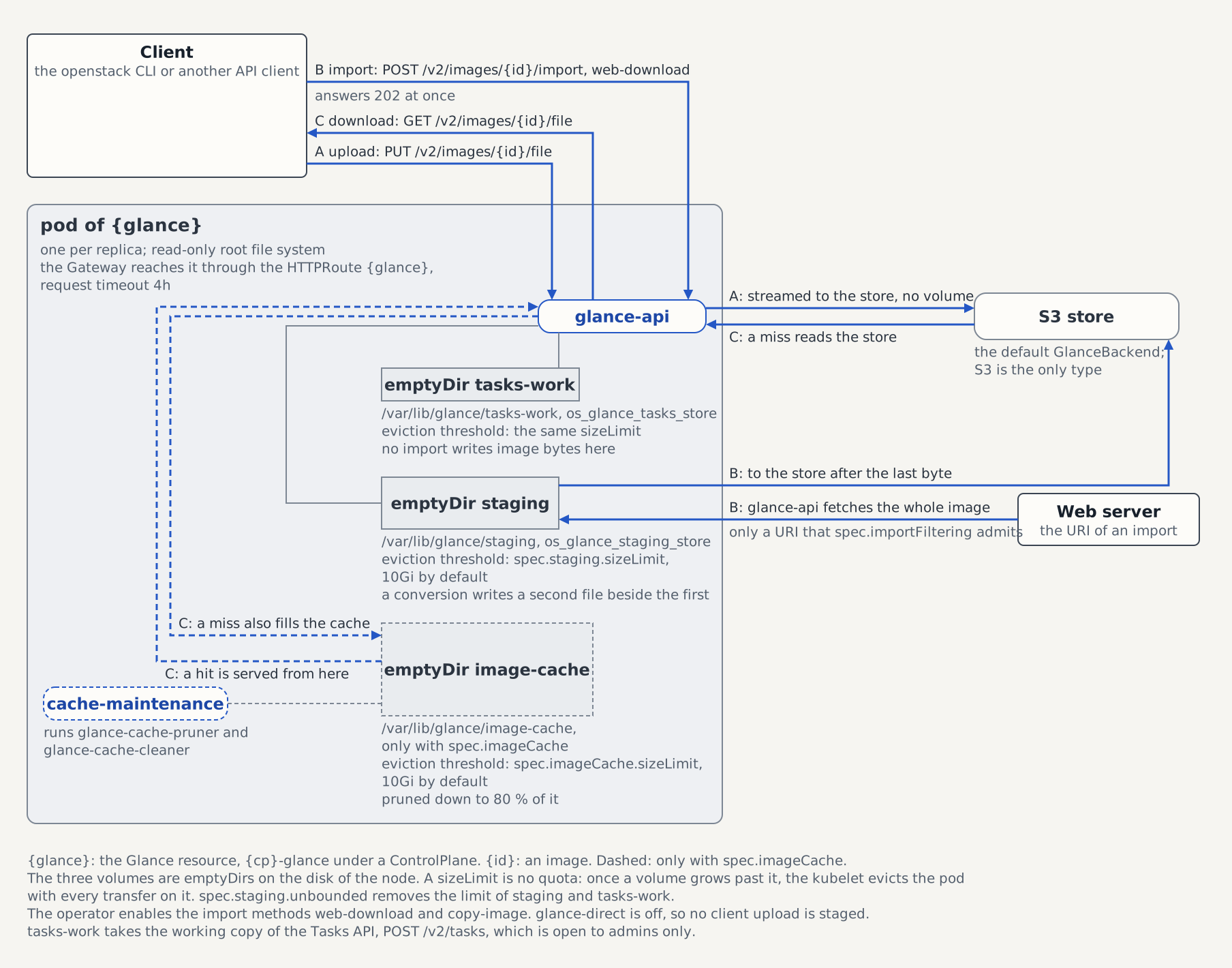
| Field | Type | Required | Default | Description |
|---|---|---|---|---|
sizeLimit | *resource.Quantity | no | 10Gi | The emptyDir.sizeLimit stamped on each of the two scratch volumes, staging and tasks-work. Must be at least 1Mi |
unbounded | bool | no | false | Renders both scratch volumes with no sizeLimit at all, the shape a Glance had before this block existed. Mutually exclusive with sizeLimit |
The operator resolves the value at reconcile time, the contract ImportFilteringSpec and DBPurgeSpec already follow: a nil spec.staging, an empty struct, and a set block whose sizeLimit is unset all resolve to the operator default of 10Gi, and the defaulting webhook writes nothing back into the CR. An unset field therefore keeps tracking that default across upgrades instead of freezing today's value into the stored spec.
One value covers two volumes, so one glance-api pod is expected to occupy at most twice the configured limit: 20Gi at the default.
Two caveats decide how much node disk that number really claims. The bound is an eviction threshold, not a filesystem quota — the kubelet evaluates it on its periodic local-storage housekeeping pass (~10 s), so a writer overshoots by whatever it appends within one pass, and a transfer shorter than one pass can finish before the kubelet ever looks. And the bound is not a scheduling reservation: the operator derives no resources.requests.ephemeral-storage from it, so co-scheduled replicas each get their own budget and the sum is bounded by the node's disk rather than by this field. Size nodes against replicas × 2 × sizeLimit plus that overshoot. To make the scheduler account for it, add ephemeral-storage to spec.deployment.resources.requests. The operator fills the CPU and memory defaults per resource, so they stay beside it.
The kubelet enforces the bound; Glance never sees it and keeps writing. Once an emptyDir grows past its sizeLimit, local-storage eviction evicts the glance-api pod. The in-flight import dies with the pod and its image never reaches active. The Deployment then replaces the pod and the API recovers without operator or human intervention.
Within one pod the bound is a single shared budget, not per-import accounting. Concurrent imports draw from it together, nothing admits or queues an import against the remaining space, and breaching it evicts the pod rather than the offending import — so every in-flight transfer on that replica dies with it, including well-behaved ones started by other projects. Size the bound for the concurrency the deployment expects, and run more than one replica so an eviction does not take the API with it.
web-download imports are what make the bound matter. Glance fetches the whole remote image onto the staging volume first and moves it into the backing store afterwards, so a remote image larger than the limit trips the bound long before it reaches the store. ImportFilteringSpec governs which URIs may be fetched at all; this block governs how much disk one fetch may consume.
unbounded: true is the opt-out, and the only way to say "no bound" — the operator then renders both emptyDirs without a sizeLimit, exactly as it did before this block existed. It is a separate field rather than a sentinel sizeLimit value so the 1Mi floor keeps rejecting the sub-byte quantities it exists to catch, and setting both is rejected at admission. Prefer a sizeLimit large enough for the deployment: an unbounded volume puts nothing between one runaway web-download import and the node's disk, and the pods evicted when that disk fills are ranked across the whole node, not only Glance's.
The bound applies retroactively on operator upgrade
Before this block existed the two scratch volumes were unbounded. Upgrading the operator stamps the resolved 10Gi onto every existing Deployment, which rolls the glance-api pods — killing any in-flight import — and then evicts the pod on an import that used to succeed above 10Gi.
Neither field can be set ahead of that upgrade. The block ships with the same chart version that introduces the behaviour, so against the older CRD a patch naming spec.staging is pruned as an unknown field: the request succeeds and stores nothing. The schema has to land before the value can, which leaves one working sequence — quiesce imports, upgrade, then set sizeLimit or unbounded, rolling the pods a second time.
The limit lives in the pod template, not in glance-api.conf. Changing it re-stamps emptyDir.sizeLimit on both volumes and rolls the Deployment, leaving the rendered config untouched. The effective bound is readable from the live Deployment, and is empty when unbounded is set:
kubectl get deploy glance -n openstack \
  -o 'jsonpath={.spec.template.spec.volumes[?(@.name=="staging")].emptyDir.sizeLimit}{"\n"}'
ImageCacheSpec
Glance can keep a copy of the image data it has served on the API pod's own filesystem, so a repeat download of the same image is answered from the node instead of from the backing store. This block is the opt-in. While spec.imageCache is set the operator mounts the cache volume, renders the cache config keys, injects the cache paste filter, and runs the maintenance sidecar; with it nil the pod template and the rendered config are what they were before the block existed.
| Field | Type | Required | Default | Description |
|---|---|---|---|---|
sizeLimit | *resource.Quantity | no | 10Gi | The emptyDir.sizeLimit stamped on the per-replica image-cache volume, mounted at /var/lib/glance/image-cache in the glance-api container. Must be at least 1Mi |
maintenanceInterval | *metav1.Duration | no | 5m | How often the cache-maintenance sidecar runs glance-cache-pruner and glance-cache-cleaner. Must be at least 1m |
maintenanceResources | *corev1.ResourceRequirements | no | 25m CPU request, 256Mi memory request and limit | CPU and memory of the cache-maintenance sidecar, resolved per resource: a CPU the block leaves out gets the 25m request and no limit, a memory it leaves out gets 256Mi as request and limit. A resource the block names is used as written. A request must not exceed its limit |
All three fields resolve at reconcile time, the contract ImportFilteringSpec, DBPurgeSpec and StagingSpec already follow: the defaulting webhook writes nothing back into the CR, so an empty block and a set block leaving one field unset both keep tracking the operator default across upgrades.
The cache is per replica, and it is not shared. Every pod fills its own copy, an image is cached once per replica that served it, and a request is answered from cache only when it lands on a replica that already holds the image. Three replicas therefore claim three times sizeLimit of node disk, and the same image is pulled from the store up to three times before every replica holds it. Hit rate rises as replicas fall, which is the one place where this block and the availability argument for more replicas pull in opposite directions.
Every rollout starts the cache cold. It lives in an emptyDir, so any pod replacement (a config change, a release upgrade, a node drain, an eviction) discards it and the first read of each image goes to the backing store again. Nothing warms it in advance, and no CR field changes that.
Three [DEFAULT] keys are rendered, and only while the block is set:
| Key | Value |
|---|---|
image_cache_dir | /var/lib/glance/image-cache |
image_cache_driver | sqlite |
image_cache_max_size | 80% of sizeLimit, in bytes |
image_cache_stall_time (86400) and image_cache_sqlite_db (cache.db) stay unrendered. Glance's own defaults for those two are already what this deployment wants, and rendering them would claim ownership of two more keys for no gain. The three above are registered as operator-owned and Rejected: the validating webhook refuses an extraConfig override of any of them, whether or not spec.imageCache is set. extraConfig wins over every operator default in the merge, and ExtraConfigHealthy is informational — it never gates Ready — so each of these overrides would be damage already done by the time a condition could report it. image_cache_max_size at or above the emptyDir bound leaves the pruner nothing to prune down to, so the volume grows until the kubelet evicts the pod. image_cache_dir elsewhere does not create an unbounded path — the root filesystem is read-only, so every writable path in the pod is already an emptyDir, bounded unless spec.staging.unbounded is set — it spends a different volume's bound, filling the staging or tasks-work budget and evicting the pod mid-import. image_cache_driver is covered below.
image_cache_max_size is derived as Value()/10*8, so a 10Gi bound renders 8589934592 and a 256Mi bound 214748360. The division runs before the multiplication, which keeps the truncation below the true 80% and never above it. The band matters because glance's pruner only prunes down toimage_cache_max_size, and only when the maintenance loop runs it, so the cache legitimately sits above that mark between two passes. The remaining 20% is the headroom those writes have before they cross the emptyDir bound and the kubelet evicts the pod. What bounds how much of that headroom one burst of downloads may eat is the sidecar's 30-second size poll, not maintenanceInterval — see the maintenance loop below.
A single image larger than image_cache_max_size is still cached in full: the size check happens after the download, and the next pruner pass removes it. Such an image only becomes a problem once it approaches sizeLimit itself, the bound the kubelet enforces and the one glance knows nothing about.
The driver is pinned to sqlite. Upstream marks that driver deprecated in favour of centralized_db, and the operator chooses it anyway. centralized_db keys cache state in the Glance database per worker_self_reference_url, and Deployment pods get a new name on every replacement: each roll would strand the dead pods' node_reference and cached_images rows there, and every cache hit would carry a database write. Nothing reclaims those rows: the db-purge CronJob sweeps the tasks table, the image child tables and the images table, and the pruner and cleaner key on the running pod's own worker_self_reference_url, so a surviving replica never sees a dead one's entries. sqlite keeps its metadata in cache.db inside the cache directory, so cache metadata shares the volume's lifecycle and the volume the pod's, and a replaced pod leaves nothing behind.
The cache paste filter is injected, and its name is reserved. The operator appends the filter directly before the root app, after every spec.middleware entry positioned after:
cors http_proxy_to_wsgi versionnegotiation authtoken context [middleware…] cache rootappGlance's cache filter applies a single policy rule, download_image, on GET /v2/images/{id}/file. Because the operator writes the [filter:cache] section itself, a spec.middleware entry named cache would define that filter a second time, and the validating webhook rejects it for as long as spec.imageCache is set. With the block nil the name stays free, so a CR that already carries such a middleware is unaffected.
The pod gains a volume and a container. An image-cache emptyDir bounded by the resolved sizeLimit, mounted read-write into glance-api, and a second container named cache-maintenance running the same image under the restricted security context. Its resources come from maintenanceResources: by default a 25m CPU request and 256Mi as memory request and limit. The per-resource rule always leaves a CPU request, and that request is not cosmetic: the HPA emits a pod-scoped Resource metric, so one container without a CPU request makes the metric unavailable for the whole pod and silently freezes spec.autoscaling. For the same reason the webhook rejects a maintenanceResources CPU request of zero while spec.autoscaling.targetCPUUtilization is set. The sidecar carries no environment either: both CLIs read the mounted config directory and touch only the cache directory and its sqlite metadata, so they open neither the database nor glance_store, and they make no network calls, which is why spec.networkPolicy needs no rule for them.
The loop runs on cache size first and the clock second. Glance applies no write barrier of its own — image_cache_max_size is read by the pruner, never by the API's cache filter — so a purely time-driven loop would let concurrent downloads pile into the emptyDir between two passes and cross the bound the kubelet does enforce. The sidecar therefore re-reads the directory every 30 seconds and prunes as soon as it sits above image_cache_max_size, whatever maintenanceInterval says. That interval remains the cadence for the passes that run while the cache is under the mark, which is what bounds how long a stalled entry survives.
The size poll deliberately measures less than the directory holds: the incomplete/, invalid/ and queue/ subdirectories are excluded, because their entries belong to glance-cache-cleaner and only once image_cache_stall_time (a day) has passed. Counting them would leave the size trigger latched on for that whole day over bytes no prune could release. A poll that fails to measure at all is logged and runs a pass anyway rather than read an unreadable directory as an empty cache.
No maintenance failure takes the pod down, and none of them reach the control plane. The loop reports each failed pass and retries on the next one, however long the failure lasts. The sidecar shares the pod with the API container, so an exiting loop would CrashLoopBackOff the pod into NotReady and drop that replica from the Service — and a permanently broken pruner (a corrupted sqlite index, a renamed CLI after an image bump) is a property of the image and the shared config, so it fails on every replica at once. Escalating it would turn a degraded cache into an immediate Glance outage.
Absorbing it is not free either, and the CR will not tell you so. Nothing else enforces image_cache_max_size, so under a pruner that never succeeds every replica's cache climbs to the emptyDir bound and the kubelet evicts it on ephemeral-storage pressure. That eviction is a node-local decision that never passes through the eviction API, so the PodDisruptionBudget the operator creates does not stagger it: replicas under even traffic cross their identical bound at roughly the same time and go together. What the Glance CR shows is DeploymentReady=False with reason WaitingForDeployment and nothing naming the cause — no condition, no event, and no metric tracks this loop.
The sidecar's log is therefore the only signal, and it is the one to alert on:
| Line | Meaning |
|---|---|
glance-cache-maintenance failed: <n> consecutive, cache at <used> KiB of <high water> | A pass failed. 1 consecutive on an otherwise quiet log is a transient (a lost sqlite lock); a count that keeps climbing is a pruner that can never run, and the evictions above are what comes next |
glance-cache-maintenance recovered: after <n> consecutive failures | A pass succeeded again — what closes an alert opened on the line above |
glance-cache-maintenance unmeasured: could not measure <dir>; running a pass anyway | The size poll failed; du's own error is on the line before it |
All three go to stderr, apart from the two CLIs' own output, and are read with kubectl logs -c cache-maintenance.
Enabling the cache, resizing it, or retuning the interval rolls the Deployment once. The pod template and the config hash change in the same reconcile, so the two do not produce separate rollouts. The effective bound is readable from the live Deployment, and the volume is absent while the block is nil:
kubectl get deploy glance -n openstack \
  -o 'jsonpath={.spec.template.spec.volumes[?(@.name=="image-cache")].emptyDir.sizeLimit}{"\n"}'
Defaulting and validation
The mutating webhook applies the shared DeploymentSpec/LoggingSpec defaults, materializes the PyMemcacheCache cache backend, fills the ServiceUserSpec identity defaults (glance / service / Default / Default, secretRef.key → password), and — only when spec.apiServer.uwsgi is present — the uWSGI sub-field defaults (processes 2, threads 1, httpKeepAlive true). It leaves spec.importFiltering untouched: those lists are resolved when the config is rendered (see ImportFilteringSpec), so materializing them here would freeze today's values into the stored CR.
The webhook writes no spec.deployment.resources either. The reconciler resolves them per resource when it renders the Deployment (see the resource defaults) and sizes memory at 1Gi per process instead of the shared 352Mi. The glance-api container carries the boto3-weighted S3 store driver. In the calibration run, two processes serving the image traffic of the Cinder Tempest leg on 2026.1 reached a VPA memory target of 2063 MiB (see Sizing Calibration). Two uWSGI processes come to 2064Mi as memory request and limit.
The defaulting webhook leaves spec.dbPurge untouched for the same reason: its fields are resolved at reconcile time (see DBPurgeSpec), not written back into the CR. The validating webhook still checks the block as defense in depth: retentionDays mirrors the CRD's Minimum=1 marker, and schedule is checked against the cron grammar, the one rule with no CRD-schema counterpart, since a regex expressive enough to accept a descriptor like @daily alongside standard 5-field expressions would also accept invalid ones. On update it also warns when retentionDays is reduced: the shorter window applies retroactively at the next firing and the rows it removes do not come back.
spec.staging is left alone by the defaulting webhook for the same reason. Its two rules split: unbounded and sizeLimit are mutually exclusive, enforced by a CEL rule on the block with the validating webhook repeating it, because unbounded is a plain boolean the schema can reason about. The floor has no schema counterpart at all: sizeLimit must be at least 1Mi, and the validating webhook is the only gate on it. A resource.Quantity renders as x-kubernetes-int-or-string in the CRD schema, a type that carries no Minimum marker, and Kubernetes core validation rejects only a negativeemptyDir.sizeLimit — so everything from 0 up to the sub-byte milli suffix reaches the kubelet verbatim. The floor is 1Mi rather than mere positivity because the schema pattern accepts 100m, a tenth of a byte and the most common typo for 100Mi: admitted, it would evict the glance-api pod on its first staged byte and the replacement on the next import, with nothing in the CR status naming the cause. A ControlPlane calls the same exported validator on spec.services.glance.staging, so both CRs admit the same values.
spec.imageCache is in the same position, one field over. The defaulting webhook leaves it untouched, and both of its floors are webhook-only: a resource.Quantity renders as x-kubernetes-int-or-string and a metav1.Duration as a plain string, and neither shape carries a Minimum marker, so no CEL rule can express "at least 1Mi" or "at least 1m". The same exported validator admits spec.services.glance.imageCache on a ControlPlane. The webhook additionally rejects a spec.middleware entry named cache while the block is set, since the operator injects a paste filter of that name itself (see ImageCacheSpec).
spec.importPlugins is untouched by the defaulting webhook for the same reason: an unset conversion.outputFormat resolves to raw and an unset injectMetadata.ignoreUserRoles to admin when the config is rendered, and a nil block enables no plugin. The validating webhook mirrors the schema as defense in depth (the output-format enum, the 1–64 property count, the 64-item and 1–255-character bounds on ignoreUserRoles, and the 255-character bound on each half of an injected property) and adds the rules the schema cannot reach. A map key carries no marker of its own, so every check on an injected property name apart from its length is webhook-only: it must be non-empty, must not start or end with whitespace, and must carry no colon, comma, newline, or carriage return, because the rendered [inject_metadata_properties] inject value is parsed as an oslo Dict that splits pairs on commas and each pair on its first colon. A property value is checked for the same characters minus the colon, which belongs to it. Length is the one rule with a schema counterpart for both halves — a CEL rule on properties — because every pair renders verbatim into the one inject line, and an unbounded value would let a CR that etcd accepts render a glance-api.conf past the 1 MiB ConfigMap ceiling, which the API server then refuses on every reconcile. Each ignoreUserRoles item is checked for commas and control characters, since that list renders as a plain comma join. A ControlPlane calls the same exported validator on spec.services.glance.importPlugins, so both CRs admit the same values.
One more importPlugins rule correlates two top-level fields, which puts it out of reach of any marker on either type: a CR enabling decompression must also set spec.staging.sizeLimit, or spec.staging.unbounded to deliberately keep no bound at all. The plugin expands the staged image by a ratio the caller picks, which makes that bound the only one in the path, and the operator default was sized against the largest download rather than the largest unpacked image — so admission asks for the one thing it can, that somebody chose the number. A ControlPlane enforces the same pairing on spec.services.glance, since it projects both blocks onto its Glance child untouched.
The validating webhook additionally bounds metadata.name at 43 characters. The {name}-db-purge CronJob is the child object with the tightest name budget — Kubernetes caps a CronJob name at 52 characters, because its controller appends an 11-character timestamp suffix to every Job it spawns — so a longer Glance would name a CronJob the API server refuses to create. The bound applies on create only: metadata.name is immutable, so on update it could only reject a CR an earlier operator version already admitted — including the finalizer-removal update that completes its deletion. Such a grandfathered CR still reconciles: the operator collapses the overflowing tail of the name onto a content-stable hash, naming its CronJob {truncated}-{hash}-db-purge instead of {name}-db-purge.
The same bound reaches one level up. A ControlPlane projects its Glance child as {controlplane}-glance, so a ControlPlane declaring spec.services.glance is capped at 36 characters; its own validating webhook rejects a longer one at create time, and on update when that update is what enables Glance.
The validating webhook accumulates every violation into one admission response, reusing the shared validators: replicas floor, image tag/digest XOR, the database mutual-exclusivity and Dynamic-requires-clusterRef rules, cache mutual-exclusivity, secret-store-ref shape, both Keystone endpoint URL shapes, logging enums (including the per-logger-level map, which has no schema-layer counterpart), the graceful-termination cross-field arithmetic (preStopSleepSeconds < terminationGracePeriodSeconds, and harakiri strictly inside the drain window), the Recreate-vs-rollingUpdate sanity check, autoscaling bounds (including the implicit minReplicas default from deployment.replicas, and a non-zero request for each utilization target in spec.deployment.resources and, while spec.imageCache is set, spec.imageCache.maintenanceResources), network-policy ingress, gateway hostname/parentRef, the three importFiltering allow/deny pairings together with the scheme enum, host length, port range, and 64-item cap of each list, the dbPurge.retentionDays floor and the dbPurge.schedule cron grammar, resource requests-vs-limits, PriorityClass existence, topology-spread selectors (matching the glance / instance labels), the spec.deployment.nodeSelector label grammar and tolerations (the API server's toleration rules), the spec.jobs block (requests within limits, an existing priority class, and the same node selector and toleration rules), imageCache.maintenanceResources requests within limits, and the extraConfig guards (a preserve-unknown-fields map CEL cannot constrain): empty section/key names, a newline or carriage return in any section name, key, or value, and the rejected overrides of [keystone_authtoken] password (owned via spec.serviceUser.secretRef), the six [import_filtering_opts] keys (owned via spec.importFiltering), the three [DEFAULT] image_cache_* keys (owned via spec.imageCache), and the four image-import plugin keys ([image_import_opts] image_import_plugins, [image_conversion] output_format, [inject_metadata_properties] inject and ignore_user_roles, owned via spec.importPlugins).
Two importFiltering rules have no schema-layer counterpart. A host carrying a newline or carriage return is rejected outright: the host lists are the only free-form strings in the block and are joined verbatim into [import_filtering_opts], where a newline injects arbitrary config lines and smuggles a whole section past the extraConfig ownership and catalog gates, which inspect map structure and never look inside a value. And the two posture problems the schema cannot express are reported as admission warnings rather than rejections, because both are legal deployment choices: a deny-list that Glance will never evaluate, and an allow-list widened past the operator default. Both are also raised on spec.services.glance.importFiltering of a ControlPlane, which is where most deployments author the filter.
The validating webhook also holds spec.openStackRelease to a release floor, a rule with no schema counterpart because the floor moves with the operator version. A value below 2026.1, the oldest OpenStack release this operator version supports, is rejected on create and whenever an update changes it, with must be 2026.1 or later: this operator version no longer supports OpenStack releases below 2026.1. An update that keeps a stored value below the floor is admitted with a warning, so an unrelated edit never blocks the resource: spec.openStackRelease "2025.2" is below 2026.1, the oldest OpenStack release this operator version supports; the unchanged value is admitted, but the operator renders the 2026.1 configuration for it. Set spec.openStackRelease to 2026.1 or later.
Status
| Field | Description |
|---|---|
conditions | List-map keyed by type; see the reconciler reference for the vocabulary |
observedGeneration | The .metadata.generation last reconciled |
endpoint | The Glance API URL: https://{gateway.hostname}/ when a gateway is set, otherwise the cluster-local Service URL |
installedRelease | The OpenStack release whose schema is currently installed, promoted to spec.openStackRelease after the upgrade completes (or after the first db sync on a fresh install) |
targetRelease | The spec.openStackRelease being upgraded to during an active release transition. Set when the upgrade initiates, cleared on completion or abort; empty in steady state |
upgradePhase | The current expand-migrate-contract phase during an active release upgrade (Expanding, Migrating, RollingUpdate, Contracting); empty when no upgrade is in flight |
INFO
A release transition (a spec.openStackRelease bump with the image in lockstep) walks the shared expand-migrate-contract phase machine, tracked through upgradePhase/targetRelease. See the Glance Upgrade Flow for the phases, condition reasons, events, and abort semantics.
Sub-Resource Naming Convention
Operator-managed sub-resources (Deployment, Service, PodDisruptionBudget, HorizontalPodAutoscaler, NetworkPolicy, HTTPRoute) use the bare CR name with no suffix, matching the keystone convention. A Glance CR named glance in the openstack namespace is therefore reachable in-cluster at glance.openstack.svc.cluster.local:9292 — the Service DNS name is the CR name.
The content-addressed and derived resources are the exceptions:
| Resource | Name | Notes |
|---|---|---|
| Config ConfigMap | {name}-config-<hash> | Immutable, content-hashed glance-api.conf; 3 historical retained |
| Backends Secret | {name}-backends-<hash> | Immutable, content-hashed backends.conf (the aggregated store sections); 3 historical retained |
| DB-connection Secret | {name}-db-connection | Derived pymysql DSN, stable name |
| DB-sync Job | {name}-db-sync | glance-manage db sync |
| DB-purge CronJob | {name}-db-purge | glance-manage db purge, plus db purge_images_table when opted in |
Example
apiVersion: glance.openstack.c5c3.io/v1alpha1
kind: Glance
metadata:
  name: glance
  namespace: openstack
spec:
  openStackRelease: "2026.1"
  deployment:
    replicas: 3
  image:
    repository: ghcr.io/c5c3/glance
    tag: "2026.1"
  database:
    clusterRef:
      name: openstack-mariadb
    database: glance
    secretRef:
      name: glance-db
  cache:
    clusterRef:
      name: openstack-memcached
  keystoneEndpoint: http://keystone.openstack.svc.cluster.local:5000/v3
  serviceUser:
    secretRef:
      name: glance-keystone