OVN Reconciler Architecture
The ovn-operator runs two controllers over the shared table-driven pipeline (internal/common/reconcile): OVNCentralReconciler with eight sub-reconcilers and OVNChassisReconciler with seven. In both, the first step to return a non-zero result or an error short-circuits the chain, and every exit path persists the conditions and the requeue through the shared status skeleton, which skips the write when a pass left status unchanged.
Every step is instrumented under the ovn_operator metrics prefix. Two vectors cover the pipelines: ovn_operator_reconcile_duration_seconds, labelled by sub_reconciler, and ovn_operator_reconcile_errors_total, labelled by sub_reconciler and condition_type. Two per-CR collectors cover the database backup: ovn_operator_backup_total, labelled by ovncentral, namespace and the terminal result, and ovn_operator_backup_duration_seconds, labelled by ovncentral and namespace (operators/ovn/internal/metrics/collectors.go). Both backup series are dropped for a CR name on the pass that observes the OVNCentral gone from the API server, so a deleted CR leaks no time series. There is nothing to drop for an OVNChassis: only an OVNCentral takes backups, and the two pipeline vectors carry no CR name.
Pipelines
OVNCentral
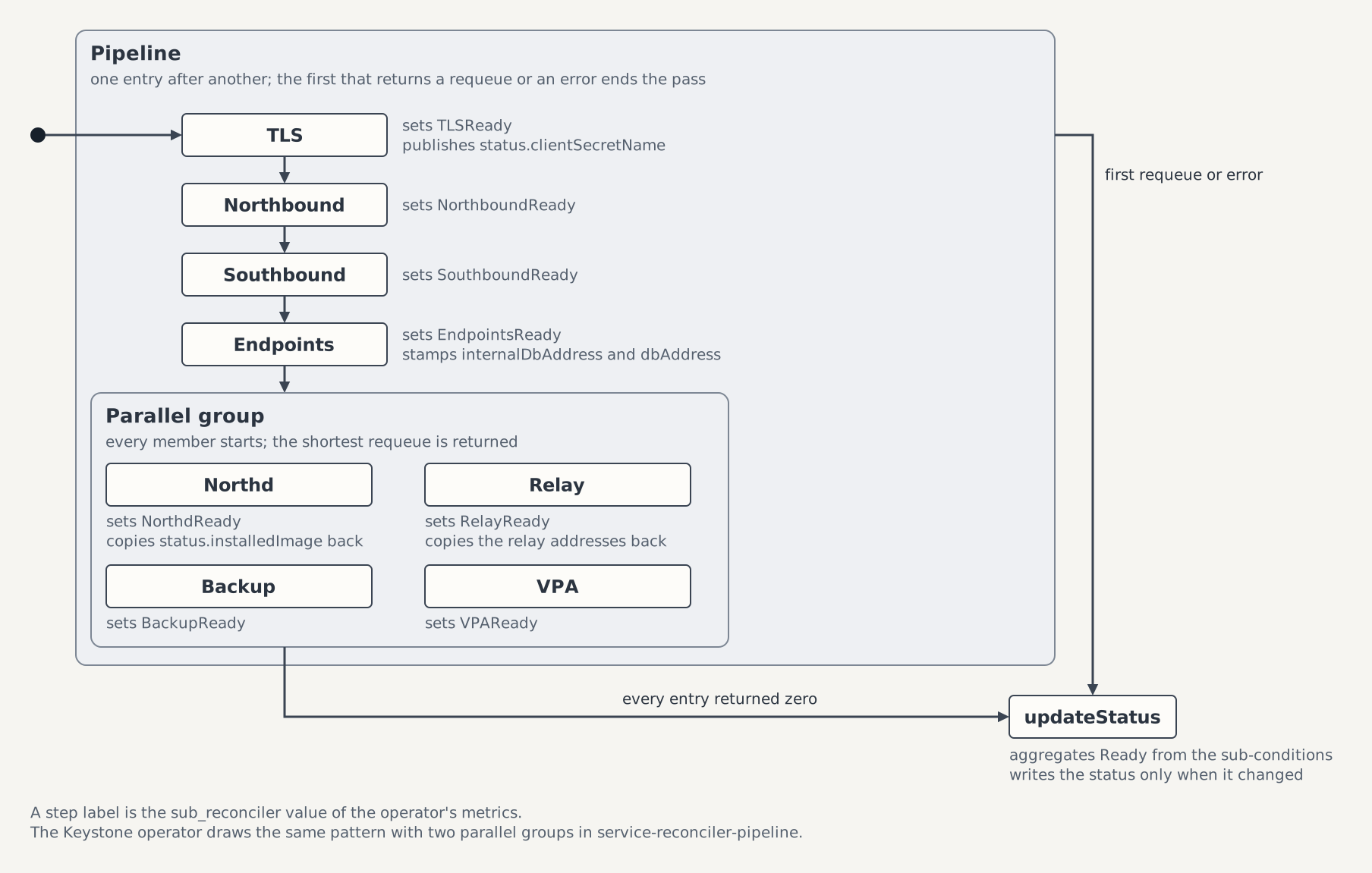
The figure draws the pattern the Keystone operator set: a lane of steps that ends the pass at the first requeue or error, and a group whose members all run. Reconciliation Flow describes that pattern in full. The table lists what each step does.
| Step | What it does | Condition |
|---|---|---|
| TLS | Probes the target cluster for the cert-manager.io/v1 Certificate kind, requests the two server keypairs, the client keypair and the relay keypair, and publishes status.clientSecretName once the client Secret carries tls.crt, tls.key and ca.crt | TLSReady |
| Northbound | Projects the Northbound Raft cluster: the shared scripts ConfigMap, the headless Service, one Service per member, the StatefulSet, and the PodDisruptionBudget | NorthboundReady |
| Southbound | The same code against the Southbound database, picking its condition type off the raftDB it was handed | SouthboundReady |
| Endpoints | Assembles both connection strings per database from the per-member Services and pods, and stamps internalDbAddress and dbAddress | EndpointsReady |
| Northd | Projects the ovn-northd Deployment and stamps status.installedImage once it is available | NorthdReady |
| Relay | Projects or removes the Southbound relay Deployment and Service, and stamps status.relayAddress, plus status.relayDbAddress when the relay is published outside the cluster | RelayReady |
| Backup | Projects the snapshot claim and the CronJob, and reports on the newest terminal backup Job | BackupReady |
| VPA | reconcileVPA applies or removes the VerticalPodAutoscalers of northd, the relay and the two Raft StatefulSets through the shared VPA flow. A Raft VPA carries the request floor as minAllowed for each resource the block does not name | VPAReady |
TLS is the first gate: every OVN connection is authenticated with the certificates it requests, so a database projected before them would come up with nothing to present. The two databases follow, then the step that publishes their addresses. The last three read those addresses and nothing of each other's output, so they run as a parallel group, with the VPA step beside them. Each member works on its own copy of the CR and always sets its one condition type, which is why a CR without spec.relay still resolves the aggregate, through RelayNotRequired.
RunParallelGroup merges the conditions and the metadata off a member's copy and nothing else, so the status fields a member publishes are copied onto the primary CR by hand in parallelSteps: status.installedImage from Northd, and status.relayAddress and status.relayDbAddress from Relay.
OVNChassis
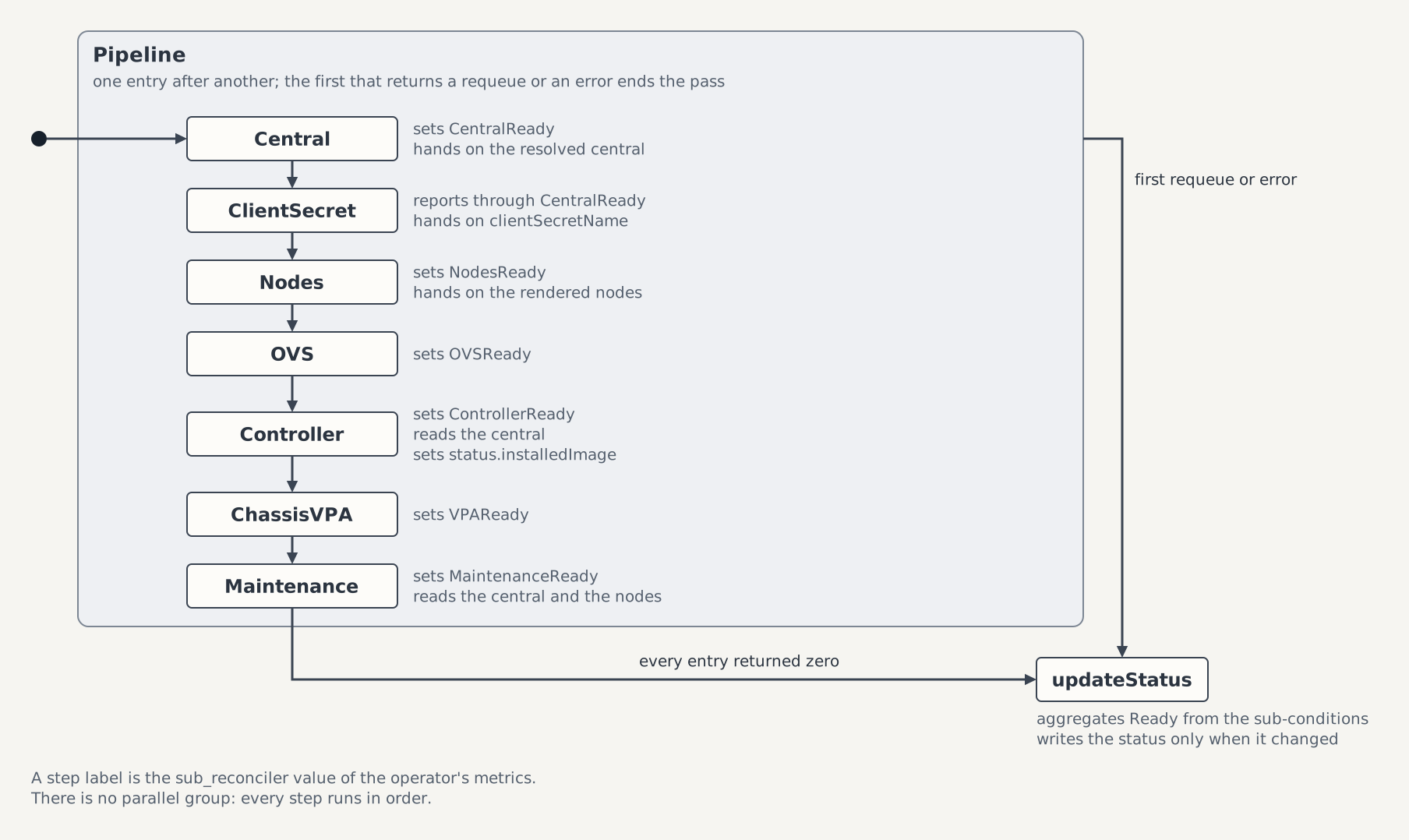
The figure draws the steps in call order. The table lists what each one does.
| Step | What it does | Condition |
|---|---|---|
| Central | Resolves the OVNCentral named by spec.centralRef into the Southbound remote and the two database addresses that apply to this chassis's cluster | CentralReady |
| ClientSecret | Settles the Secret the pods mount: the central's own on the same cluster, a copy {name}-ovn-client written onto this chassis's cluster otherwise. Publishes the name in status.clientSecretName | CentralReady |
| Nodes | Renders one entry per node into the {name}-nodes ConfigMap, applies the {name}-chassis-scripts ConfigMap, and rebuilds status.nodes | NodesReady |
| OVS | Projects the {name}-ovs DaemonSet | OVSReady |
| Controller | Projects the {name}-ovn-controller DaemonSet, mirrors its node counters into status, and stamps status.installedImage | ControllerReady |
| ChassisVPA | reconcileVPA applies or removes the VerticalPodAutoscalers of the two DaemonSets through the shared VPA flow | VPAReady |
| Maintenance | Runs the per-node apply, evacuate and chassis-del Jobs that are due | MaintenanceReady |
The OVNCentral is the first gate: its Southbound address and its client Secret parameterise every later step, so a chassis whose central has published neither projects nothing at all. The client-Secret step follows it under the same condition, because a central the chassis can reach but not authenticate against is not a resolved central. The per-node values come next, because both DaemonSets mount the ConfigMap holding them.
There is no parallel group here. The two DaemonSets look independent, but Open vSwitch owns the local database ovn-controller writes its chassis record into, so a node that runs the second without the first has nothing to register against. Maintenance runs last, since it acts on nodes the node step has already marked as leaving or as giving up the gateway role. central and nodes are threaded from the steps that resolve them to the steps that consume them through a closure, so the hand-off stays inside one pass. A field on the reconciler would be shared by every CR reconciled concurrently.
Conditions
Each aggregate Ready is True with reason AllReady when every sub-condition of that kind is True, and False with NotAllReady otherwise. An OVNCentral aggregates eight, an OVNChassis six.
| Type | Kind | True reasons | False reasons |
|---|---|---|---|
TLSReady | OVNCentral | CertificatesIssued | CertificatePending, CertificateError, CertManagerUnavailable, CapabilityProbeFailed, TargetClusterUnavailable |
NorthboundReady | OVNCentral | StatefulSetReady | StatefulSetProgressing, StatefulSetError |
SouthboundReady | OVNCentral | StatefulSetReady | StatefulSetProgressing, StatefulSetError |
EndpointsReady | OVNCentral | EndpointsPublished | EndpointsPending |
NorthdReady | OVNCentral | DeploymentReady | DeploymentProgressing, DeploymentError, WaitingForEndpoints |
RelayReady | OVNCentral | DeploymentReady, RelayNotRequired | DeploymentProgressing, DeploymentError, ServicePending, WaitingForEndpoints |
BackupReady | OVNCentral | BackupScheduled, BackupSuspended | BackupJobFailed, BackupPVCInvalid, BackupError, WaitingForEndpoints |
VPAReady | OVNCentral | VPAReady, VPANotRequired | VPANotInstalled, CapabilityProbeFailed, VPAError |
CentralReady | OVNChassis | CentralResolved | CentralNotFound, CentralReadError, CentralNotExternallyReachable, CentralNotReady, CentralUpgrading, ClientSecretPending, ClientSecretIncomplete, ClientSecretReadError, ClientSecretCopyFailed, TargetClusterUnavailable |
NodesReady | OVNChassis | NodesRendered | NoMatchingNodes, NodeListError, NodesError |
OVSReady | OVNChassis | DaemonSetReady | DaemonSetProgressing, DaemonSetError |
ControllerReady | OVNChassis | DaemonSetReady | DaemonSetProgressing, DaemonSetError |
MaintenanceReady | OVNChassis | MaintenanceIdle, MaintenanceRunning, MaintenanceDeferred | MaintenanceJobFailed, MaintenanceError |
VPAReady | OVNChassis | VPAReady, VPANotRequired | VPANotInstalled, CapabilityProbeFailed, VPAError |
TargetClusterUnavailable is set ahead of every sub-reconciler, when spec.targetClusterRef names a cluster that is not registered or no longer resolves. It lands on the first condition of that CR's pipeline, TLSReady on an OVNCentral and CentralReady on an OVNChassis, so it holds down the condition the rest of the graph waits behind. The message carries the resolver's error, the CR requeues after 15 seconds and acquires no finalizer, and nothing is created on any cluster. See Target Clusters.
A running maintenance Job leaves MaintenanceReady at True. A Job that runs finishes on its own, and holding the aggregate Ready down for a rolling drain would report ordinary progress as an outage. Only a terminal Job failure and an API error flip the condition.
One map attributes an error to its condition type for the condition_type label. It serves both pipelines, because a sub_reconciler name is unique across the two (instrumentation.go):
var subReconcilerConditionTypes = map[string]string{
	"TLS":        conditionTypeTLSReady,
	"Northbound": conditionTypeNorthboundReady,
	"Southbound": conditionTypeSouthboundReady,
	"Endpoints":  conditionTypeEndpointsReady,
	"Northd":     conditionTypeNorthdReady,
	"Relay":      conditionTypeRelayReady,
	"Backup":     conditionTypeBackupReady,
	"VPA":        "VPAReady",

	"Central":      conditionTypeCentralReady,
	"ClientSecret": conditionTypeCentralReady,
	"Nodes":        conditionTypeNodesReady,
	"OVS":          conditionTypeOVSReady,
	"Controller":   conditionTypeControllerReady,
	"ChassisVPA":   "VPAReady",
	"Maintenance":  conditionTypeMaintenanceReady,
}
A sub_reconciler name that reaches the instrumenter without a key here resolves to UNKNOWN. An empty label would collapse two series into one; UNKNOWN makes the drift visible in alerts.
Sub-reconcilers
reconcileTLS
File: operators/ovn/internal/controller/reconcile_tls.go
Purpose: Request every certificate an OVN connection is authenticated with: one server keypair per database, one for the relay tier when the CR runs one, and one client keypair shared by everything that dials them. All of them are ensured before the first pending one is reported, so a cluster starting from nothing requests every certificate on its first pass. Reporting the first pending one and returning would cost a polling interval per certificate. The step ends at the issued client Secret, one layer past the Certificates: the Secret is what the workloads mount and what an OVNChassis is pointed at through status.clientSecretName.
Condition Contract:
| Status | Reason | Message | RequeueAfter |
|---|---|---|---|
False | CapabilityProbeFailed | The RESTMapper probe for the Certificate kind failed against the target cluster | none (error returned) |
False | CertManagerUnavailable | "cert-manager is not installed on the cluster the children land on; spec.tls requires it" | RequeueSecretPolling |
False | CertificatePending | "Waiting for cert-manager to issue <names>", or "Waiting for cert-manager to write Secret <name>" | RequeueSecretPolling |
False | CertificateError | The wrapped apply or read error, or the defect of the issued Secret: "issued Secret <name> lacks tls.crt", or "issuer <kind>/<name> issued no ca.crt; spec.tls.issuerRef must name a CA issuer" | none |
True | CertificatesIssued | "Both server certificates and the client certificate in Secret <name> are issued" | none |
Error handling: A failed capability probe, a failed EnsureCertificate and a failed Secret read set the condition and return the error, so the controller backs off. A Secret that is missing a key is reported and left alone, with no requeue and no error: only an edit to spec.tls.issuerRef can leave that state, and a retry would change neither the Secret nor the message the CR carries. A cluster without cert-manager is a wait, not an error: spec.tls is required and the fix happens outside the CR.
reconcileNorthbound
File: operators/ovn/internal/controller/reconcile_database.go
Purpose: Project the Northbound Raft cluster. It is a two-line wrapper that hands reconcileRaftDatabase the northboundDB(cr) descriptor, which carries the nb suffix, the spec block, the ports and the condition type.
Condition Contract: as reconcileSouthbound, under NorthboundReady.
Error handling: as reconcileSouthbound.
reconcileSouthbound
File: operators/ovn/internal/controller/reconcile_database.go
Purpose: The same reconcileRaftDatabase body against the Southbound database. It applies the shared scripts ConfigMap, the headless Service, one Service per member before the StatefulSet, the StatefulSet itself, and the database's PodDisruptionBudget (maxUnavailable: 1, selecting its members), then reads the StatefulSet back and mirrors readyReplicas into status.<db>.readyReplicas. The budget goes in right after the StatefulSet and before the read, so a failed budget apply fails the step on the same pass. The per-member Services go first: a member that comes up before its Service has no address to publish, and the endpoint step would hold the whole CR unready until the next pass created it.
Condition Contract:
| Status | Reason | Message | RequeueAfter |
|---|---|---|---|
False | StatefulSetError | The wrapped error of whichever child failed to apply or read. A target cluster that grants the operator no statefulsets or poddisruptionbudgets verb lands here | none (error returned) |
False | StatefulSetProgressing | "<n> of <m> sb Raft members are ready" | RequeueRaftWait |
True | StatefulSetReady | "All <m> sb Raft members are ready" | none |
Error handling: Every failed apply reports StatefulSetError whichever of the five objects failed. The step is one unit of work, and a reason per object would put whichever happened to fail first into a field consumers match on. Readiness is judged on a Get after the apply: the counters live on the status subresource the apply strips out, and the observedGeneration comparison is what tells a converged cluster from one whose counters still describe the template before the last apply.
reconcileEndpoints
File: operators/ovn/internal/controller/reconcile_endpoints.go
Purpose: Publish the addresses clients connect to the two databases on. The internal string lists ssl:<clusterIP>:<port> per member in ordinal order; the external one is assembled only under spec.<db>.externallyReachable, as ssl:<hostIP>:<nodePortBase + ordinal>. Both are IP literals, because ovsdb-server resolves a remote once at startup and never again. Services and pods are read through the target cluster's uncached reader, so an address the cache has not caught up with is not published as absent.
Condition Contract:
| Status | Reason | Message | RequeueAfter |
|---|---|---|---|
False | EndpointsPending | "Waiting for every member Service to be assigned a cluster IP and for at least one member of each database to run on a node" | RequeueRaftWait |
True | EndpointsPublished | "Both databases are reachable at the published addresses" | none |
Error handling: A failed read of a Service or a pod sets EndpointsPending and returns the error. Nothing is published while either database is incomplete, and every address field is cleared on both databases: a client is handed the member list as one string, so a list missing the member that happens to be the leader reads to that client as a cluster that cannot serve writes. A member whose pod is gone is skipped in the node-facing list instead: a rescheduling member has no node to name, while the members beside it stay reachable.
reconcileNorthd
File: operators/ovn/internal/controller/reconcile_northd.go
Purpose: Project ovn-northd, the daemon that compiles the Northbound logical model into the Southbound flow table. Every replica connects to both databases and they coordinate through a lock in the Southbound, so the replica count buys failover. It buys no throughput. The step stamps status.installedImage once the Deployment is available: northd is the one process of the three that fails on a Southbound schema it cannot compile against, so it is what the image is judged by.
Condition Contract:
| Status | Reason | Message | RequeueAfter |
|---|---|---|---|
False | WaitingForEndpoints | "Waiting for both database addresses to be published" | RequeueRaftWait |
False | DeploymentError | "ensuring northd Deployment: <error>" | none (error returned) |
False | DeploymentProgressing | "Waiting for the northd Deployment to become available" | RequeueDeploymentPolling |
True | DeploymentReady | "The northd Deployment is available" | none |
Error handling: A failed apply sets DeploymentError and returns the error. The endpoint gate comes first and returns no error: applying a Deployment with an empty --ovnnb-db would crash-loop the pods until the next pass rewrote the template.
reconcileRelay
File: operators/ovn/internal/controller/reconcile_relay.go
Purpose: Project or remove the Southbound relay tier. Relays are stateless read-through caches in front of the Southbound database, which every chassis holds an open connection to. With spec.relay unset the step deletes the Deployment and the Service, clears status.relayAddress and status.relayDbAddress, and reports True: a chassis handed a cluster IP whose Service no longer exists waits out its own timeout instead of falling back to the database it can still reach.
Under spec.relay.externallyReachable the Service is NodePort on spec.relay.nodePort (30661 by default), and after the cluster-IP check the step lists the relay pods through the uncached reader and publishes status.relayDbAddress: ssl:<hostIP>:<nodePort> per node a relay pod runs on, deduplicated and sorted. It is empty while no relay pod has a node address, and cleared as soon as the flag is. A pod list that fails keeps the value a previous pass published, unless that value names another port than spec.relay.nodePort: once an edit moves the Service, the step clears it before any read, since the port it names is released.
Condition Contract:
| Status | Reason | Message | RequeueAfter |
|---|---|---|---|
True | RelayNotRequired | "spec.relay is not set; clients connect to the Southbound database directly" | none |
False | WaitingForEndpoints | "Waiting for the Southbound database address to be published" | RequeueRaftWait |
False | DeploymentError | The wrapped error of the Deployment, the Service, the live read, the removal, or the relay pod list ("listing sb-relay pods: <error>") | none (error returned) |
False | ServicePending | "Waiting for Service <name> to be assigned a cluster IP" | RequeueRaftWait |
False | DeploymentProgressing | "Waiting for the sb-relay Deployment to become available" | RequeueDeploymentPolling |
True | DeploymentReady | "The sb-relay Deployment is available at <relayAddress>", followed by " and at <relayDbAddress> outside the cluster" when the node address is set | none |
Error handling: All five failing reads and writes report DeploymentError and return the error, for the reason the database step gives. ServicePending is reported ahead of the Deployment's own state: without an address the relays are unreachable however many of them are running.
reconcileBackup
File: operators/ovn/internal/controller/reconcile_backup.go
Purpose: Project the snapshot claim and the backup CronJob, and report on the newest backup Job that reached a terminal state. Run visibility is derived rather than watched: the CronJob controller spawns one Job per firing and prunes them by history limit, so the step lists the Jobs carrying the backup component labels, keeps the ones this CronJob controls, and reads the newest terminal one. See Backup.
Condition Contract:
| Status | Reason | Message | RequeueAfter |
|---|---|---|---|
False | WaitingForEndpoints | "Waiting for both database addresses to be published" | RequeueRaftWait |
False | BackupPVCInvalid | "The API server rejected PersistentVolumeClaim <name>: <error>" | RequeueSecretPolling |
False | BackupError | The wrapped error of the claim, the CronJob, or the Job listing | none (error returned) |
True | BackupSuspended | The schedule and retention that apply when resumed, plus the last failed run when there was one | none |
False | BackupJobFailed | "Backup Job <name> failed; the snapshots are no longer current and a restore would lose everything written since the last successful run" | none |
True | BackupScheduled | The schedule and the retention window | none |
Error handling: An Invalid rejection of the snapshot claim, which is what lowering spec.backup.storage.size produces, surfaces the API server's own message on the condition and returns no error: a retry cannot fix a spec edit only a human can undo. Suspension outranks a failed run, because a suspended CronJob spawns no successor to supersede it, so a BackupJobFailed arm winning there would pin the aggregate Ready down until someone deleted the Job by hand. A terminal run feeds the two backup collectors and, on failure, a BackupJobFailed Warning, both deduped on the Job UID through an annotation on the CR. See Controller Events.
reconcileCentral
File: operators/ovn/internal/controller/reconcile_central.go
Purpose: Resolve the OVNCentral this chassis attaches to into the values the later steps are parameterised by: the Southbound remote ovn-controller dials, the Northbound address the evacuation Job edits the logical model through, the Southbound address the chassis-deletion Job writes to, and what the client-Secret step needs (whether the two CRs share a cluster, the central's target, and the name of the Secret it publishes). The central CR is read through the management-cluster client, because both CRs are written by whoever deploys the control plane and live beside each other whatever cluster their children land on.
Which addresses apply follows from where the two CRs project their children:
| Clusters | Database addresses | Southbound remote |
|---|---|---|
| Same cluster | status.<db>.internalDbAddress | status.relayAddress when set, the Southbound address otherwise |
Different clusters, both spec.<db>.externallyReachable set | status.<db>.dbAddress | status.relayDbAddress when spec.relay.externallyReachable is set, the Southbound address otherwise. A relay not published outside its cluster is skipped, since its cluster IP is unreachable |
| Different clusters, either database unpublished | none | none: CentralNotExternallyReachable |
Condition Contract:
| Status | Reason | Message | RequeueAfter |
|---|---|---|---|
False | CentralNotFound | "OVNCentral <name> does not exist in namespace <ns>; the chassis stay unconfigured until it does" | RequeueSecretPolling |
False | CentralReadError | "reading OVNCentral <ns>/<name>: <error>" | none (error returned) |
False | CentralNotExternallyReachable | "OVNCentral <name> projects onto <cluster> while this OVNChassis projects onto <cluster>, so the chassis reach it at the addresses published outside its cluster; set spec.northbound.externallyReachable and spec.southbound.externallyReachable on the OVNCentral to true to publish them" | none |
False | CentralNotReady | "Waiting for OVNCentral <name> to publish its Southbound address and its client Secret", with "outside its cluster" after "address" across clusters | RequeueRaftWait |
False | CentralNotReady | "Waiting for OVNCentral <name> to publish its relay's node address" | RequeueRaftWait |
False | CentralUpgrading | "Waiting for OVNCentral <name> to finish rolling out <image>; the chassis follow the central, because ovn-controller reads the Southbound schema the central owns" | RequeueRaftWait |
True | CentralResolved | "The chassis connect to OVNCentral <name> at <address>" | none |
Error handling: A missing OVNCentral polls and leaves the pass successful: an OVNChassis applied before its OVNCentral is an ordinary ordering of two objects in one manifest. An unpublished central across clusters sets the condition and returns neither an error nor a requeue: the fix is an edit to the central, and the OVNCentral watch delivers it. Both databases are required, because the evacuation Job writes the Northbound one. A published relay whose node address is still empty is waited for, so the chassis do not dial the Raft members for one pass and roll again when the relay address arrives. The upgrade gate compares the central's status.installedImage against the image it resolves, so it holds only while the central's own rollout is in flight. The chassis image is not compared against it: a chassis pinned to an older image than the central is the direction OVN supports, and a gate demanding equality would wedge it.
reconcileClientSecret
File: operators/ovn/internal/controller/reconcile_client_secret.go
Purpose: Settle the Secret the chassis pods mount and publish its name in status.clientSecretName. On the central's cluster that is the central's own Secret, and nothing is written. On another cluster the central's Secret does not exist where the pods run, so the step reads it live through the central's children client and writes its tls.crt, tls.key and ca.crt, and nothing else, into {name}-ovn-client in the chassis's namespace through the chassis's children client. The copy is claimed for the chassis: a controller reference on the management cluster, the ownership labels on a target, where the sweep removes it with the DaemonSets. A copy that drifted is replaced wholesale, and an unchanged one is not rewritten.
No pod rolls when the source is renewed. The copy is updated in place, the kubelet refreshes the mounted files, and ovn-controller and the maintenance Jobs read the keypair and the CA from those files, the same way a chassis that mounts the central's Secret directly picks up a renewal.
Condition Contract: every failure arm overwrites CentralReady, which the central step left True.
| Status | Reason | Message | RequeueAfter |
|---|---|---|---|
False | TargetClusterUnavailable | The resolver's error for the cluster the central projects onto | RequeueSecretPolling |
False | ClientSecretPending | "Waiting for the OVN client Secret <ns>/<name> the OVNCentral publishes" | RequeueSecretPolling |
False | ClientSecretReadError | "reading OVN client Secret <ns>/<name>: <error>" | none (error returned) |
False | ClientSecretIncomplete | "OVN client Secret <ns>/<name> carries no <key> yet" | RequeueSecretPolling |
False | ClientSecretCopyFailed | "claiming", "creating", "reading" or "updating the OVN client Secret copy <ns>/<name>: <error>", or "refusing to overwrite Secret <ns>/<name>: it exists and is not owned by this OVNChassis" | none (error returned) |
Error handling: The central names its client Secret before cert-manager has issued it, so an absent or incomplete source is an ordinary wait. A Secret under the copy's name that this chassis does not own is refused, never adopted: replacing its data with a client key would hand the key to whoever reads a Secret somebody else provisioned. Across a renewal the copy keeps its last values while the source is re-issued, so the running pods keep a keypair to present.
reconcileNodes
File: operators/ovn/internal/controller/reconcile_nodes.go
Purpose: Render one entry per node into the {name}-nodes ConfigMap, apply the {name}-chassis-scripts ConfigMap, and rebuild status.nodes. The chassis pod has no API client of its own, so the rendered entry is the whole channel between the operator and a node: SYSTEM_ID, GATEWAY, BRIDGE_MAPPINGS, ENCAP_TYPE, and LEAVING when the node is on its way out. Nodes are listed with spec.nodeSelector applied by the API server, through the target cluster's uncached reader.
A node's system-id is read back from the live ConfigMap first and from status.nodes second, and a fresh UUID is minted only when neither holds one that matches the UUID grammar. An identity that changes leaves the previous registration behind in the Southbound database, where it keeps claiming the ports of the workloads running on that very node. A value that is not a UUID is discarded, never rendered back out: the node sources that file under bash, where a $(...) in a value runs as a command.
Condition Contract:
| Status | Reason | Message | RequeueAfter |
|---|---|---|---|
False | NodeListError | "listing nodes: <error>" | none (error returned) |
False | NodesError | "reading the <name>-nodes ConfigMap: <error>", or "ensuring <name> ConfigMap: <error>" | none (error returned) |
False | NoMatchingNodes | "No node matches spec.nodeSelector <selector>" | none |
True | NodesRendered | "Rendered <n> node entries (<m> leaving)" | none |
Error handling: Both failure reasons set the condition and return the error, so the controller backs off. An empty selection is reported without a requeue: the Node watch wakes the CR when a node is labelled, and polling for one would add nothing. Both ConfigMaps are applied even when nothing is selected, because a pod whose ConfigMap volume does not exist never starts.
Drain semantics. A node that stops matching spec.nodeSelector, or that leaves the cluster, keeps its entry with LEAVING=true. The mappings and the encapsulation are re-rendered from the spec, never carried over from the live ConfigMap, so everything reaching the file a node sources comes from a source admission validated. The entry survives until the chassis-deletion Job has succeeded, at which point the maintenance step drops the ConfigMap key and the status entry together.
reconcileOVS
File: operators/ovn/internal/controller/reconcile_ovs.go
Purpose: Project the {name}-ovs DaemonSet: ovsdb-server holding the node's configuration database, ovs-vswitchd driving the datapath, and the privileged host-prepare init container that loads the kernel modules and prepares the run directories. It is the step ovn-controller depends on, because the local database is where a node's chassis configuration is written. Neither container has a liveness probe: ovs-vswitchd owns the kernel datapath every workload on the node forwards through, so restarting it for a fault the readiness probe already reports would turn a degraded node into a disconnected one.
Condition Contract:
| Status | Reason | Message | RequeueAfter |
|---|---|---|---|
False | DaemonSetError | "ensuring ovs DaemonSet: <error>" | none (error returned) |
False | DaemonSetProgressing | "Waiting for the ovs DaemonSet: <n> of <m> nodes run a ready pod" | RequeueDeploymentPolling |
True | DaemonSetReady | "The ovs DaemonSet runs a ready pod on <m> nodes" | none |
Error handling: A failed apply or read sets DaemonSetError and returns the error. A DaemonSet that selects no node is ready on zero nodes: its rollout has nothing left to do, and reporting the CR unready until somebody labels a node would make an empty selection look like a stuck one.
preStop: ovsdb-server runs ovs-appctl -t /run/openvswitch/ovsdb-server.ctl exit and ovs-vswitchd runs ovs-appctl -t /run/openvswitch/ovs-vswitchd.ctl exit. Neither carries --cleanup: that flag tears the kernel datapath down, and the node would stop forwarding for the whole time it takes the replacement pod to start. Leaving the datapath in place keeps the flows valid across the restart, and the new ovs-vswitchd adopts it.
reconcileController
File: operators/ovn/internal/controller/reconcile_controller.go
Purpose: Project the {name}-ovn-controller DaemonSet: the apply-node init container that writes this node's values into the local Open vSwitch database, and the daemon that turns the Southbound logical flows into datapath flows. The step mirrors desiredNumberScheduled and numberReady from this DaemonSet and not from the Open vSwitch one: ovn-controller is what makes a node a chassis. status.installedImage is stamped on the ready arm alone, so a rollout that has reached no node yet leaves the previous value in place.
The Southbound address is not passed on the command line. ovn-controller reads it from the local database, where the init container wrote it, so a changed remote reaches a running chassis without a pod restart. Readiness is the Southbound connection: the probe greps ovn-appctl connection-status for connected, so a live process with a dead connection stays unready. A chassis that cannot reach the database serves stale flows and must not count as a node the rollout may move on from.
Condition Contract:
| Status | Reason | Message | RequeueAfter |
|---|---|---|---|
False | DaemonSetError | "ensuring ovn-controller DaemonSet: <error>" | none (error returned) |
False | DaemonSetProgressing | "Waiting for the ovn-controller DaemonSet: <n> of <m> nodes run a ready pod" | RequeueDeploymentPolling |
True | DaemonSetReady | "The ovn-controller DaemonSet runs a ready pod on <m> nodes" | none |
Error handling: as reconcileOVS. The counters are mirrored before the readiness branch, so a progressing DaemonSet still reports what it has.
preStop: ovn-appctl -t /run/ovn/ovn-controller.ctl exit --restart. The restart flag leaves the datapath flows in place and keeps the Southbound Chassis row, so the successor pod takes both over instead of re-registering the node and waiting for the flows to be recomputed.
reconcileMaintenance
File: operators/ovn/internal/controller/reconcile_maintenance.go
Purpose: Move every node through whatever step of its lifecycle is due. It compares the entry the node step rendered against the entry the pass read out of status before that rewrite: the rendered one says what a node should be running, the recorded one what it was last known to run. Nodes are walked in name order, and a node whose Job is still running does not hold the others up. A failure does stop the walk, because it needs an operator and not another Job.
Condition Contract:
| Status | Reason | Message | RequeueAfter |
|---|---|---|---|
True | MaintenanceDeferred | "Waiting for OVNCentral <name> to publish the address the maintenance of <nodes> needs" | RequeueRaftWait |
True | MaintenanceRunning | "Maintenance Jobs are running for <n> nodes: <nodes>" | RequeueRaftWait |
True | MaintenanceIdle | "No node has maintenance outstanding" | none |
False | MaintenanceJobFailed | "The <kind> Job <name> for node <node> failed; inspect its pod logs" | none |
False | MaintenanceError | The wrapped error of a Job run or of the ConfigMap rewrite | none (error returned) |
Error handling: A permanently failed Job is reported on the condition and never returned as an error. A rerun under an unchanged key produces the same failure, so a returned error would only put the CR on the workqueue's backoff and hot-loop a pass that cannot help. The Warning that dates the failure rides the shared terminal-state helper, which dedupes on the Job UID. A deferred node outranks a running one in the message, because a Job that runs finishes on its own while a node waiting for an address needs the other CR to move; both poll at the same interval.
Drain semantics. Three Jobs cover the three transitions, each named {name}-<kind>-<8 hex> after the SHA-256 of the node name, each with backoffLimit: 0:
| Trigger | Job | What it does |
|---|---|---|
The rendered entry hashes differently than status.nodes[].configHash, and that hash is not empty | apply | Reruns apply-node.sh on the node, pinned to it and in its network namespace. A node seen for the first time runs no Job: its own init container applies the values |
The node lost the gateway role (prev.gateway and not entry.gateway) and gatewayEvacuated is not set | evacuate | Collects the Gateway_Chassis and HA_Chassis rows naming this chassis and removes them from the Logical_Router_Port and HA_Chassis_Group rows holding them, against the Northbound database. Each half joins its owning rows from one listing and submits every removal as one ovn-nbctl call, so a rerun after a partial pass finds nothing left to collect. The run closes by asking the Northbound what still names the chassis and fails when a row survives, so gatewayEvacuated records a confirmed drain |
The entry is marked leaving | chassis-del | Runs chassis-del against the Southbound database, then the step drops the node's ConfigMap key and its status.nodes entry together |
The apply runs before the evacuation: the chassis has to stop announcing itself as a gateway before the bindings are taken off it, or the model would hand them back while the node still claims the role. status.nodes[].gateway is held at true until the evacuation lands, so the trigger survives the pass that started it. gatewayEvacuated is set when the Job succeeds and reset as soon as the node takes the gateway role back, so a re-promoted node is not treated as still drained. A node whose Job needs an address the OVNCentral has not published is deferred until it is.
Deleting an OVNChassis runs none of this. The teardown removes the configuration of a node, not the node itself: the DaemonSet pods go, and with them ovn-controller, while the Southbound Chassis rows they registered stay behind, the same way deleting a Deployment leaves the rows its pods wrote (ovnchassis_controller.go). Drop the nodes out of spec.nodeSelector and let the chassis-del Jobs run before deleting the CR.
Requeue semantics
| Constant | Value | Used by |
|---|---|---|
RequeueRaftWait (requeue_intervals.go) | 15s | Every OVN wait state: a Raft cluster that has not elected a leader, a member endpoint without an address, a central that has not published one, and a maintenance Job that is still running |
RequeueSecretPolling (internal/common/reconcile/intervals.go) | 15s | cert-manager polling in the TLS step, the missing-OVNCentral poll, the client-Secret waits of the chassis, the rejected snapshot claim, and the target-cluster hold on both controllers |
RequeueDeploymentPolling (internal/common/reconcile/intervals.go) | 10s | Deployment and DaemonSet readiness polling: northd, the relay, and the two chassis DaemonSets |
RequeueNextPass (internal/common/reconcile/intervals.go) | 1s | The single pass after the remote-children finalizer was added, so the next reconcile observes the persisted finalizer and not the in-memory copy |
None of the wait states reaches the workqueue as an error, so these intervals are what paces the retries. A returned error goes on the controller's own backoff instead, capped at 30 seconds by the shared rate limiter (bootstrap.TypedControllerOptions).
Watches
Both controllers filter their CR's status-only updates through watch.CRUpdatePredicate, so a status write does not re-wake the controller, and both turn the multicluster builder's cluster-not-found wrapper off: an unresolvable target cluster is surfaced as TargetClusterUnavailable and requeued, where the wrapper would swallow it as a successful reconcile.
The OVNCentral controller Owns its StatefulSet, Deployment, Service, ConfigMap, PersistentVolumeClaim, CronJob, Job and PodDisruptionBudget. The cert-manager Certificate joins that set only when the kind is present on the management cluster, probed at setup through the RESTMapper. An unconditional Owns(Certificate) would fail at start with "no matches for kind Certificate", which takes down every controller in the binary. reconcileTLS reports the missing kind on the CR as CertManagerUnavailable.
The OVNChassis controller Owns its DaemonSet, ConfigMap, Job and Secret, and adds three watches:
- OVNCentral, mapped to every
OVNChassisattached to it through thespec.centralReffield index, scoped to the central's namespace. The leg carries no generation predicate: what the chassis wait on are the central's status flips, and those leave the generation untouched. The index is registered by theOVNCentralcontroller's setup, whichmain.goruns first. - Node, under
predicate.LabelChangedPredicate, mapped to everyOVNChassisthe cache holds across all namespaces. A node's labels are what every CR's selector is evaluated against, and the CR that has to re-render is as often the one that just lost the node as the one that gained it, so there is no index to narrow the fan-out through. The predicate narrows the other side instead, which is what keeps the kubelet's status heartbeat off the leg. - Secret, mapped through the
OVNCentralin the Secret's namespace whosestatus.clientSecretNamenames it to everyOVNChassisattached to that central (clientSecretToChassisMapperinovnchassis_watches.go). It is what makes the copy of a chassis on another cluster follow a cert-manager renewal at watch latency. A List failure is logged and maps to what was collected.
Both controllers watch their children a second time on the clusters a CR can project onto (AddRemoteChildWatches). An owner reference does not cross a cluster boundary, so the ownership labels are what map a remote child back to its CR. The Node watch is registered on both sides too, through AddInputWatch: the management cluster's nodes for a chassis that keeps its children local, and the target clusters' for a placed one. Legs on a target cluster are engaged on all of them, so they drop the events belonging to a CR that projects somewhere else. The field index stays on the local field indexer, because it is an index on a CR kind and no target cluster holds one.
The Secret watch has a local and a remote leg as well, registered by hand: AddInputWatch admits remote events from the CR's own target alone. The source Secret lives on the central's cluster, which is the one a chassis away from its central does not project onto. The remote leg is gated by RemoteRequestsAmong on chassisTargetClusters instead: the chassis's target and its central's target, either left out when it is the management cluster. Secret is also among OVNChassisRemoteChildKinds, so the copy on a target has a drift watch through its ownership labels and is swept with the other children.