Chaos E2E Test Suites
Reference documentation for the chaos E2E test suites. These tests verify that OpenStack operators correctly detect infrastructure dependency failures via status conditions and recover autonomously when dependencies return. Phase 2 extends the suite with operator resilience and workload chaos scenarios. Phase 3 adds operator pod kill with leader re-election and post-failover reconciliation verification.
For happy-path E2E tests, see Keystone E2E Test Suites.
Overview
The 58 chaos test suites validate operator behavior during and after fault injection. Phase 1 covers infrastructure dependency pod kills. Phase 2 adds operator self-recovery, CronJob workload fault tolerance, and PDB availability guarantee scenarios. Phase 3 adds an all-pod operator kill with leader re-election verification. Phase 4 adds network chaos scenarios (partition and latency). The suites added since cover the other service operators and their dependencies. Each suite deploys the resources of the service under test, asserts a healthy baseline, injects a fault, asserts the expected degradation (or stability), removes the fault, and asserts full recovery. Most suites inject with a Chaos Mesh PodChaos or NetworkChaos. deletion-stuck-finalizer, cinder-nfs-outage and eso-down scale a Deployment to zero with kubectl scale instead, openbao-sealed seals OpenBao with bao operator seal, and openbao-tenant-policy-narrowed writes a narrowed policy with bao policy write. Tests use Chainsaw to orchestrate the assertion lifecycle.
The first panel of the figure shows the test bed and the six steps a suite takes. The second shows why a partition rule sits on the server pods, the reason the partition suites below give for their fixtures. The list describes every step under its number.
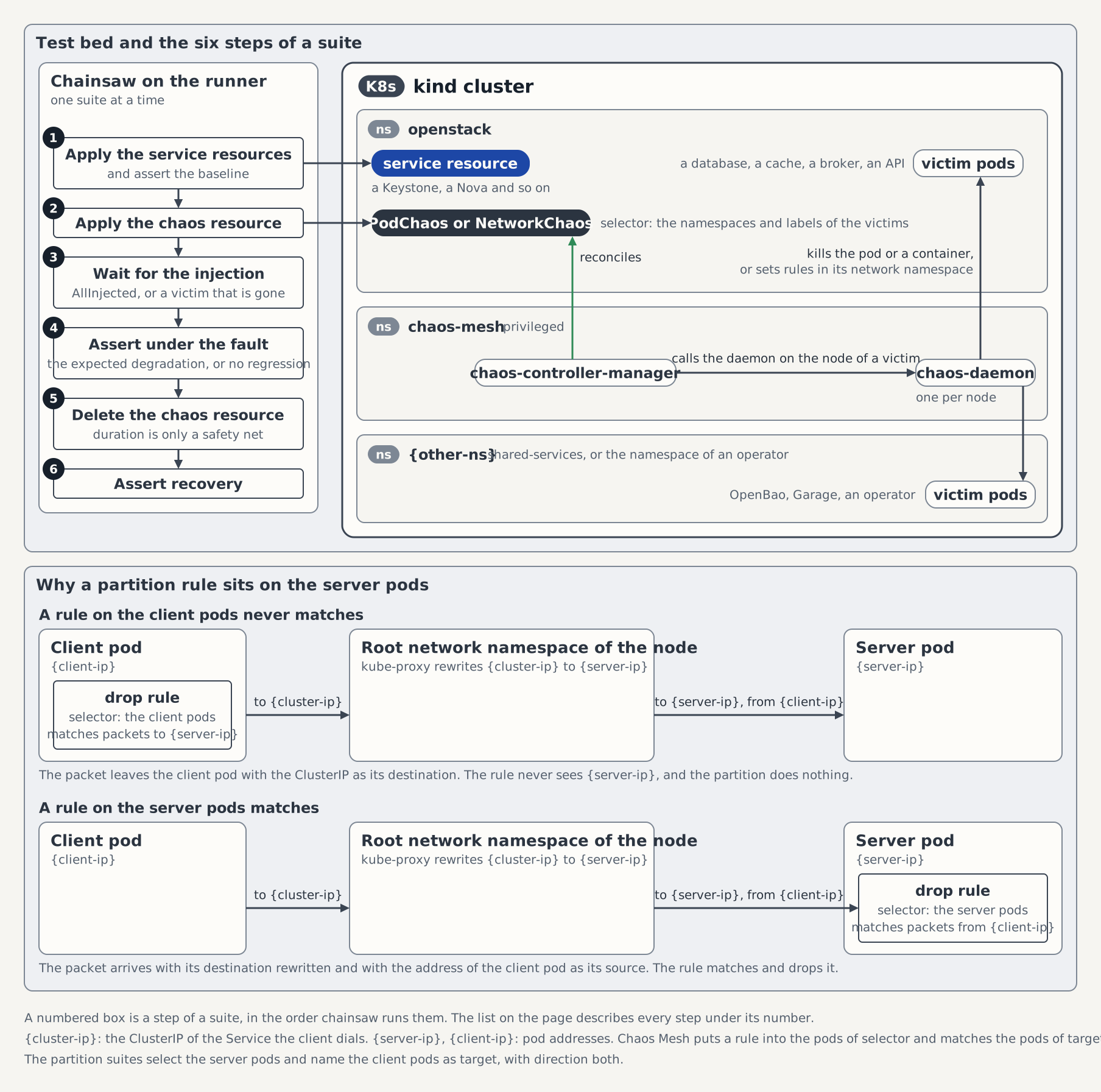
- Apply the service resources. The suite applies the resources of the service under test and asserts the baseline,
Ready=Truewith reasonAllReady. - Apply the chaos resource. A
PodChaosor aNetworkChaos. It lives inopenstack, or in the namespace of the operator it kills in the eight operator suites of the other services. The suites of thecontrolplanematrix entry apply theirs into their own namespace. Itsselectornames the victims by namespace and label.chaos-controller-managerpicks them and calls thechaos-daemonon their node, which kills the pod or a container, or sets rules in the network namespace of the pod. - Wait for the injection. The
NetworkChaossuites, the six Keystone outage suites,ovn-southbound-outageandkeystone-federationrunkubectl wait --for=condition=AllInjectedon the chaos resource. So do the suites that hold a component down withpod-failureacross an event, and they wait for the victim pods atReady=falseafter it: Chaos Mesh sets the condition when it patches the pod spec, seconds before the kubelet stops the running container. The otherPodChaossuites prove the kill on the victim, by a pod UID that is gone or a ready replica count that drops, or read it from the condition of step 4. - Assert under the fault. Either the degradation the suite expects (a condition turns
False, a write fails closed) or that nothing regresses (Ready=Trueholds, no container restarts). - Delete the chaos resource. Chaos Mesh lifts the fault. The
durationof the resource is a safety net for a run that never reaches the delete.cronjob-rotation-failureand the IdP outage ofkeystone-federationlet adurationof 60 seconds end the fault. - Assert recovery. The conditions return to
True, and where a write failed, a fresh write succeeds.
deletion-stuck-finalizer, cinder-nfs-outage and eso-down take the same steps without a chaos resource: step 2 scales a Deployment to zero, and step 5 scales it back. openbao-sealed seals OpenBao in step 2 and unseals it in step 5, and openbao-tenant-policy-narrowed narrows a policy and writes the captured one back. The suites of the first four matrix entries run in the namespace openstack. The five of the controlplane entry each bring up a ControlPlane in a short namespace of their own, chaos-korc-out and its siblings. The c5c3-operator names the DB-credential client certificate of a plane <cp>-keystone-db-openbao-client.<namespace>.svc, and cert-manager refuses a commonName over 64 bytes, so a plane name and a namespace that chainsaw generates do not fit together. Test Suite Inventory lists every suite with its scenario, its service resource and its assertions.
Prerequisites
All 58 test suites require the infrastructure stack to be deployed and healthy. The suites that apply a chaos resource require Chaos Mesh as well.
Run WITH_CHAOS_MESH=true make deploy-infra first
Chaos Mesh is opt-in in the kind Quick Start — the default make deploy-infra flow leaves the chaos-mesh namespace absent. Run WITH_CHAOS_MESH=true make deploy-infra before make e2e-chaos, or make e2e-chaos will fail its preflight check (chaos-mesh is not installed). See the Enabling Chaos Mesh tip in Quick Start (Extended) for the rationale. The suites run against the kind stack only; Chaos Mesh on the metal-stack lab is described in Lab Chaos Mesh.
| Prerequisite | Details |
|---|---|
| Infrastructure stack | Deployed via WITH_CHAOS_MESH=true make deploy-infra (opt-in path; see Infrastructure E2E Deployment) |
| Chaos Mesh | Installed in chaos-mesh namespace by the kind-only opt-in overlay at deploy/kind/chaos-mesh/; CI sets WITH_CHAOS_MESH=true on every matrix entry of the job |
| Keystone operator | Deployed to the cluster with CRDs installed |
| ESO ExternalSecrets | keystone-admin, keystone-db synced in openstack namespace |
| MariaDB instance | openstack-db MariaDB CR Ready in openstack namespace |
| Memcached instance | openstack-memcached Memcached CR Ready in openstack namespace |
| OpenBao instance | Running in shared-services namespace |
| ControlPlane stack | For the controlplane matrix entry: WITH_CONTROLPLANE=true CONTROLPLANE_OPERATORS=external on the infrastructure bring-up, K-ORC from hack/ci-deploy-korc.sh and the c5c3-operator in c5c3-system |
Running the Tests
# Run all chaos E2E tests
make e2e-chaos

# Run with chainsaw directly (equivalent)
chainsaw test --config tests/e2e-chaos/chainsaw-config.yaml tests/e2e-chaos/

# Run a specific scenario
chainsaw test --config tests/e2e-chaos/chainsaw-config.yaml tests/e2e-chaos/mariadb-pod-kill/
Chainsaw Configuration
Chaos tests use a separate configuration at tests/e2e-chaos/chainsaw-config.yaml with settings tuned for fault injection scenarios:
| Setting | Chaos | Happy-Path | Rationale |
|---|---|---|---|
timeouts.assert | 300s | 120s | Recovery requires multiple reconciliation cycles and pod restart time |
timeouts.cleanup | 120s | 3m | Chaos Mesh CRs need time to finalize and release faults; the happy-path value is higher because finalizer-driven Keystone deletion under parallel: 4 can take longer |
execution.parallel | 1 | 4 | Chaos tests mutate shared infrastructure pod availability; serial execution prevents cross-test interference |
execution.failFast | true | true | Stop on first failure for faster feedback |
report.name | chainsaw-chaos-report | chainsaw-report | Distinct JUnit report artifact |
Most suites restate the assert timeout of 5 minutes (5m) at the spec level. mariadb-network-partition raises it to 8m, the six suites on the Nova stack raise single asserts to 8m, and deletion-stuck-finalizer and ovn-southbound-outage set no suite-level timeout.
Workload and Consistency Harness
tests/e2e-chaos/lib/ holds a workload that sends OpenStack traffic through the fault of a suite, and the checks that read the state of OpenStack after it. lib/workload.py is the workload: one Python process that uses the standard library only. lib/workload.sh is what a suite calls. It starts the workload in a kubectl run pod on ghcr.io/c5c3/tempest:2026.1 (CHAOS_WORKLOAD_IMAGE overrides the image), marks the fault window on the pod clock, and judges the records against the error budget in the suite header. The directory holds no chainsaw-test.yaml, so make e2e-chaos does not run it as a suite.
Forty-six suites start a workload: the fifteen pod and network suites that send no OpenStack traffic of their own, nova-placement-outage, which runs it after its partition as the proof run of the server, network and image streams, the eighteen dependency-fault suites of #1389, from glance-keystone-outage to neutron-metadata-agent-pod-kill, and twelve of the thirteen platform suites of #1390, from cert-manager-outage to rabbitmq-operator-cascading-failure. The last two groups run it through their fault. deletion-stuck-finalizer and c5c3-operator-pod-kill start none and say why in a # Chaos workload: none line. The Workload line of each suite section below names its streams and its budget.
Streams
Each stream is one thread that runs cycles one second apart until the stop file exists. Every HTTP call has a 15-second timeout. The streams that need a token issue a project-scoped token for the bootstrap admin, whose password start reads from the keystone-admin Secret, and issue a new one once when a call answers 401. CHAOS_WORKLOAD_ADMIN_SECRET names another Secret in the suite's namespace: a managed ControlPlane creates the admin password as <cp>-keystone-admin-credentials, and the suites of the controlplane matrix entry read that one.
| Stream | Options | Operations of one cycle |
|---|---|---|
token | --keystone | issue, validate |
http | --http | get; any final status below 400 counts as an answer, Glance's 300 included |
network | --neutron, --keystone | create-network, create-port, delete-port, delete-network |
server | --nova, --image-ref, --flavor, --keystone | create (microversion 2.37, "networks": "none"), active (300 s), delete, gone (120 s) |
volume | --cinder, optionally --keystone | create, available, attach-create, attach-update, attach-complete, in-use, detach, detached, delete, gone |
image | --glance, --keystone | create (raw, bare), upload (1 MiB of zero bytes), active, delete |
placement | --placement, --keystone | create-rp (no microversion, so a 201 with the provider in Location), list-rp (by name, the one provider it created), delete-rp |
secret | --barbican, --keystone | create-secret (a passphrase whose payload is its name), read-payload (Accept: text/plain, the payload byte for byte), delete-secret |
The volume stream drives the attachments API at microversions 3.27 and 3.44, which cinder 28.0.0 defines for it. Without --keystone it sends the token admin:admin that the noauth Cinder of the chaos suites accepts. Barbican writes secret_ref under its host_href, so the secret stream keeps the uuid of the reference and its own --barbican root. A failed operation abandons the rest of its cycle, and the stream then deletes what that cycle created, newest first, with one cleanup-<kind> record per resource, so a fault cannot fill a quota of the admin project. Resources are named chaos-wl-<id>-<stream>-<n>, and a stream prints READY <stream> after its first cycle in which every operation succeeded.
Two run options apply to every stream. --resolve HOST:ADDR, which may repeat, makes a lookup of HOST return the address ADDR with the port of the URL; every other name resolves as before. urllib still sends HOST in the Host header and as the TLS server name, so a Gateway listener that matches the hostname routes the request. The suites behind Gateway openstack-gw pass --keystone https://keystone.127-0-0-1.nip.io/v3 --resolve keystone.127-0-0-1.nip.io:<ClusterIP of the proxy Service>. The value splits on its first colon; an empty HOST, an empty ADDR or an ADDR that is no IP address exits 2 with usage: --resolve wants HOST:ADDR before any request. --insecure-tls skips the certificate check of HTTPS endpoints. The kind listener certificates come from selfsigned-cluster-issuer, so without it every record through a listener reads ok: false and code: null, with CERTIFICATE_VERIFY_FAILED in msg.
Records
Every operation writes one JSON line to the pod log:
{"t": 1791987267.893, "s": "token", "op": "issue", "ok": true, "code": 201, "ms": 42, "msg": ""}t is the start of the operation on the pod clock. code is the HTTP status, or null when the request got no answer at all, such as a refused connection or a timeout, and msg then holds the exception. A wait that the stop file interrupts writes no record.
Once the stop file exists, every stream finishes or abandons its current operation. A sweep then deletes every resource named chaos-wl-<id>- and writes sweep-<kind> records. A consistency check for each service the workload used prints CONSISTENCY-OK <check> or CONSISTENCY-FAIL <check>: <detail>, and the process prints DONE last.
workload.py evaluate judges the log on the runner. The fault window runs from the fault-start mark to the fault-end mark plus the recovery time of the budget. A failed record falls inside it when its operation ended (t plus ms) at or after fault-start and began at or before the deadline, so an operation the fault caught in flight counts against the budget. The run fails in five cases:
- a failed record falls outside the window, which every failed sweep record does;
- more failed records fall inside the window than the budget allows;
- a stream has no ok record after the recovery deadline;
- a
CONSISTENCY-FAILline is present; DONEis missing.
A failed record that comes before the READY line of its stream happened while the service was still coming up, because start waits for READY. Evaluate reports it apart and does not judge it. A run without marks has no window, so one failed record after READY fails it. Evaluate prints a summary line per stream and up to ten offending records, and exits 0 on a pass, 1 on a violation and 2 on an input error:
stream token: 63 ok, 0 failed in window (budget 0), 0 outside; observed failures=0 recovery=0.0sBudget line
A suite that starts a workload carries one budget line in its header comment, with the measurement in the line under it:
# Chaos budget: failures=0 recovery=0s
# Chaos budget measured: 2026-10-14, kind, failures 0/0/0, recovery 0/0/0 s
failures is the number of failed records the fault window may hold. recovery is the time after fault-end in which a failure still counts against that number; after it, every stream has to answer again and no failure is allowed. Every consistency finding fails the run. verify refuses a header without a budget line, with two of them, or with one that does not match ^# Chaos budget: failures=([0-9]+) recovery=([0-9]+)s$.
Budgets are measured on kind. Run the suite three times with chainsaw test --config tests/e2e-chaos/chainsaw-config.yaml tests/e2e-chaos/<suite>, set failures to twice the largest in-window count and recovery to the largest observed recovery plus 30 seconds, rounded up to ten seconds, and record the three observations in the measured line. A measured line whose environment reads estimate carries an estimate of the fault window that no run has measured yet, which is where the eighteen suites of #1389 start; three runs replace it. The budget is zero where the fault does not touch the request path of the stream: the ten operator pod kills, cronjob-rotation-failure, openbao-pod-kill, nova-placement-outage, neutron-metadata-agent-pod-kill, and eight platform suites of #1390: cert-manager-outage, eso-down, eso-pod-kill, openbao-sealed, openbao-tenant-policy-narrowed, envoy-gateway-outage, korc-provisioning-outage and korc-network-partition. A failure in one of them is a defect to find, and raising the budget does not fix it.
Consistency checks
The workload checks each service it used. A check re-reads for up to 120 seconds before it reports a failure, so a transition still in flight can finish:
| Check | Fails on |
|---|---|
servers | a server in BUILD or ERROR, or one named with the prefix, in GET /servers/detail?all_tenants=1 |
volumes | a volume in a transitional status such as creating, attaching, reserved or deleting (the full list is in lib/workload.py), or one named with the prefix |
images | an image in saving or queued, or one named with the prefix, on every page of GET /v2/images |
networks | a network or a port named with the prefix |
resource-providers | a resource provider named with the prefix in GET /resource_providers |
secrets | a secret named with the prefix on every page of GET /v1/secrets |
verify runs two more checks outside the pod when the suite asks for them:
--placement-audit <deployment>runsnova-manage --config-dir /etc/nova/nova.conf.d placement audit --verbosein thenova-apicontainer, which carries[placement]and both database connections. Exit 0 passes. Exit 3 means orphaned allocations and printsCONSISTENCY-FAIL placement-audit. Any other code fails with the code and the output.--ovn-db-sync <neutron>creates a Job from the<neutron>-ovn-db-syncCronJob, waits up to ten minutes for it (CHAOS_WORKLOAD_DB_SYNC_SECONDS), and fails on every log line that reports a difference between Neutron and the OVN Northbound database, as worded in neutron 28.0.1. In log mode the utility exits 0 either way, so the log is the verdict, and a log without theNeutron OVN DB sync completedline fails as well. The CronJob exists only when the Neutron CR setsspec.ovnDBSync, and{syncMode: log, suspend: true}keeps it from running on its own whileOVNDBSyncReadystaysTrue. A CronJob in repair mode fails the check before any Job runs, because repair rewrites the database it reports on. Repair OVN Drift with db-sync walks through the same Job by hand.
Adopting the harness
A suite calls ../lib/workload.sh from its own directory, with <id> set to the directory name. Every call sets timeout:, because the chaos configuration gives a script 30 seconds:
| Call | Where it goes | timeout: |
|---|---|---|
start <id> -- <run options> | after the baseline Ready assertion, with stop <id> in the cleanup: of that step | 6m |
mark <id> fault-start | right before the chaos resource is applied, as a script of its own or inside the script that runs kubectl apply | 1m |
mark <id> fault-end | right after the Chainsaw delete of the chaos resource | 1m |
verify <id> with --placement-audit and --ovn-db-sync as needed | in a step after the last recovery or reconcile assertion | 15m, 25m in the suites on the Nova stack |
dump <id> | in the catch: of every step from start to verify | 1m |
The pod is named chaos-wl-<id> and carries the label app.kubernetes.io/name=chaos-workload, which no chaos selector matches. It runs as the image's non-root user with a 256 MiB memory limit. start waits up to 300 seconds for READY on every stream (CHAOS_WORKLOAD_READY_SECONDS). verify waits until the pod clock passes fault-end plus the recovery time plus 30 seconds, or 30 seconds without marks, creates the stop file and waits up to 420 seconds for DONE (CHAOS_WORKLOAD_DONE_SECONDS). dump and stop always exit 0. A local run pulls the Tempest image from GHCR unless kind load docker-image put it on the node.
CI Trigger Policy
Chaos tests run as a separate e2e-chaos GitHub Actions job in the CI workflow. The job is path-filtered, and its five matrix entries gate differently. The pod entry is blocking; the network, ovn, nova and controlplane entries are not (see below). See CI Workflow: e2e-chaos for full job documentation.
Path filter (tests_chaos): Only changes under tests/e2e-chaos/** trigger the job.
A Go code change does not. The pod and network entries alone cost about 62 runner minutes between them, and a change to an operator is exercised by that operator's own e2e job; the chaos suites test recovery behaviour, which is what the tests_chaos filter watches. Apply the ci:chaos label to run them against a pull request that changes something else.
Trigger conditions:
| Event | Runs when |
|---|---|
Push to main or a v* tag | Never; the job runs on pull_request events only |
| Pull request | A suite under tests/e2e-chaos/** changed, or the ci:chaos label is applied |
Dependencies: The job depends on changes, lint, shellcheck, test, test-integration, verify-codegen, chainsaw-lint, build-e2e-images and e2e-operator. It only runs if build-e2e-images succeeded and no dependency failed or was cancelled.
Gating per matrix entry (continue-on-error: ${{ matrix.suite == 'network' || matrix.suite == 'ovn' || matrix.suite == 'nova' || matrix.suite == 'controlplane' }}): The pod entry is blocking: a failure in any PodChaos suite (operator restart, PDB, rotation) fails the build. The network, ovn, nova and controlplane entries stay non-blocking, because the ip_set/sch_netem kernel-module dependency their NetworkChaos partitions carry remains prone to environment flakiness; their failures are visible but do not block merges. In the controlplane entry that partition is korc-network-partition. The expression names the four non-blocking entries instead of negating the blocking one, so a sixth entry gates merges until it is argued out of that. The ci:chaos PR label runs every entry on demand for pre-validation. run-chaos still works as an alias for it.
Matrix entries and what they carry: the pod entry runs the PodChaos suites of the keystone stack, the Keystone outage suites of Glance, Placement and Barbican, horizon-dashboard-pod-kill, and the eight platform suites of #1390 that need only the standalone stack, from cert-manager-outage to mariadb-operator-cascading-failure. It deploys the horizon, glance, placement and barbican operators beside keystone. The network entry runs the NetworkChaos suites and every suite that needs the neutron, cinder or ovn operators: the four Neutron suites (neutron-mariadb-outage, neutron-broker-outage, neutron-keystone-outage, neutron-operator-pod-kill), ovn-operator-pod-kill, the database outages of Glance, Placement, Barbican and Cinder, and memcached-network-partition. It therefore deploys the neutron-operator, the ovn-operator and the placement-operator alongside keystone, the last for placement-mariadb-outage. The seven Cinder suites (cinder-operator-pod-kill, cinder-broker-outage, cinder-nfs-outage, cinder-keystone-outage, cinder-mariadb-outage, cinder-volume-pod-kill, cinder-broker-pod-kill) run in that entry alone, so it deploys the cinder-operator into cinder-system as well and sets WITH_NFS=true and WITH_MESSAGING=true on the infrastructure bring-up: each of the seven attaches an NFS backend the operator mounts as an inline CSI volume, five of them take a vhost on the shared broker, and the two broker suites bring a RabbitmqCluster of their own. Several of them run there for the Cinder stack of the entry, and their fault class would not put them there, so they inherit a continue-on-error the gate below justifies with a kernel-module dependency they do not have: cinder-operator-pod-kill, cinder-volume-pod-kill and cinder-broker-pod-kill inject a PodChaos kill, the class the blocking entry exists for, cinder-keystone-outage injects a pod-failure, and cinder-nfs-outage writes no chaos-mesh CR at all. Each is the only automated check on the invariant it pins, and a regression in one goes red in an entry that reports green. Moving them to the pod entry means taking the Cinder stack, the NFS export and the broker there with them, which the blocking entry's stack and its 120-minute wall have not been sized for; that move is tracked as a follow-up. The same holds for the PodChaos suites of the entry that need the neutron-operator or the ovn-operator. A Dump diagnostic info (network leg) step dumps the seven operator namespaces of the entry with OPERATOR_ONLY=1, so a failed operator kill there keeps the operator logs in the job log. The ovn entry is the third one, on the self-hosted runners as well and continue-on-error like the network one. It sets WITH_OVN_KERNEL_MODULES=true so hack/deploy-infra.sh modprobes openvswitch and geneve on the host (the chassis DaemonSets cannot start without them), deploys the ovn-operator alone, and runs ovn-southbound-outage. It is separate from the network entry because it builds a datapath on the node itself: its probe pods own /run/openvswitch and /run/netns, which no other suite may hold at the same time.
The nova entry is the fourth, on the self-hosted runners and continue-on-error like the other two. It carries the heaviest stack in the job: each of its six suites (nova-broker-outage, nova-mariadb-outage, nova-placement-outage, nova-keystone-outage, nova-operator-pod-kill, neutron-metadata-agent-pod-kill) brings up a Keystone, and all but nova-mariadb-outage add an OVNCentral, a Neutron, a Placement, a Glance and a fake-driver compute behind the Nova. On top of the keystone stack it deploys the placement, ovn, neutron and nova operators, and it sets WITH_MESSAGING=true: every Nova process dials the bus, five of the six suites take a vhost on the shared broker, and nova-broker-outage brings a RabbitmqCluster of its own, because its fault severs a whole broker. It also sets WITH_OVN_KERNEL_MODULES=true: neutron-metadata-agent-pod-kill runs an OVNChassis and a metadata agent on the node, and the chassis DaemonSets need the openvswitch and geneve modules. The suites run in a matrix entry of their own because their stack does not fit beside the suites of the network entry.
The controlplane entry is the fifth, on the self-hosted runners and continue-on-error like the other three. Its five suites (korc-provisioning-outage, korc-network-partition, controlplane-keystone-degraded, c5c3-operator-pod-kill, rabbitmq-operator-cascading-failure) each bring up a Keystone-only ControlPlane in a namespace of its own through tests/e2e-chaos/lib/controlplane.sh. The entry sets WITH_CONTROLPLANE=true and CONTROLPLANE_OPERATORS=external on the infrastructure bring-up, the environment of the e2e-controlplane job: the infrastructure overlay comes without the standalone MariaDB, Memcached and shim ExternalSecrets, and the Flux ControlPlane stack is suspended. On top of the keystone stack it loads c5c3-operator:dev, deploys K-ORC with hack/ci-deploy-korc.sh after the Placement CRD the c5c3-operator's cache needs, and deploys the c5c3-operator into c5c3-system at the chart default of two replicas. A Dump diagnostic info (controlplane leg) step dumps the c5c3-operator and 500 lines of the K-ORC log.
Every entry but ovn loads ghcr.io/c5c3/tempest:2026.1 with the keystone stack, the image the workload pod runs on.
Timeout: 150 minutes for the nova entry, 135 for network, 120 for pod, 100 for controlplane and 45 for ovn, 550 minutes in all, to accommodate serial test execution and longer recovery assertion windows. The author of #1390 accepted that sum on 2026-10-16. Run 38903206716 took 62, 125, 11 and 130 minutes on pod, network, ovn and nova. The eight platform suites of #1390 add about 5 minutes each to pod, and the controlplane entry needs about 15 minutes for its bring-up and 8 to 12 for each of its five suites.
Test Suite Inventory
| Suite | Scenario ID | CR Name | Test Pattern | Condition Assertions |
|---|---|---|---|---|
| mariadb-pod-kill | SC-CHAOS-001 | keystone-chaos-db | Degradation and recovery | DatabaseReady=False → DatabaseReady=True, Ready=True |
| memcached-pod-kill | SC-CHAOS-002 | keystone-chaos-mc | No-regression | All 6 conditions remain True during outage |
| openbao-pod-kill | SC-CHAOS-003 | keystone-chaos-bao | Degradation and recovery | SecretsReady=False → SecretsReady=True, Ready=True |
| operator-pod-crash | SC-CHAOS-004 | keystone-chaos-op | Operator self-recovery (no-regression) | At least one pre-chaos operator pod UID gone, operator Deployment readyReplicas back to spec.replicas, CR Ready=True before and after |
| cronjob-rotation-failure | SC-CHAOS-005 | keystone-chaos-cron | Workload fault tolerance | FernetKeysReady=True maintained, Ready=True maintained |
| mariadb-network-partition | SC-CHAOS-006 | keystone-chaos-net-part | Degradation and recovery (NetworkChaos) | DeploymentReady=False, Ready=False → DeploymentReady=True, Ready=True |
| mariadb-network-latency | SC-CHAOS-007 | keystone-chaos-net-lat | Latency tolerance (no-regression) | Ready=True maintained, operator restartCount=0 |
| api-pod-kill-pdb | SC-CHAOS-008 | keystone-chaos-api | PDB availability guarantee | PDB minAvailable: 1, DeploymentReady=True maintained, Ready=True maintained |
| operator-pod-kill | SC-CHAOS-009 | keystone-chaos-opk | Operator pod kill (all) with failover reconciliation | All 6 conditions True maintained, replica patch reconciled by new leader |
| deletion-stuck-finalizer | SC-CHAOS-010 | keystone-chaos-stuck | Deletion with a downed dependency operator | Keystone CR removed, FinalizingDatabase/DatabaseFinalized emitted, MariaDB CRs Terminating → removed after recovery |
| keystone-federation | — | keystone-chaos-fed | Federation sidecar container-kill + IdP outage (fail-closed) | Sidecar restartCount gated recovery, Ready=True restored, federated auth recovers; during IdP outage federated auth non-2xx while password auth stays 201 |
| ovn-southbound-outage | — | ovn-sb-chaos | Southbound database outage (datapath no-regression) | Ping across the datapath answers under the fault, chassis containers stay at restartCount: 0, SouthboundReady=True and chassis Ready=True/AllReady restored after it |
| neutron-mariadb-outage | — | neutron-db-chaos | Database partition (fail-closed write) | NeutronAPIReady=True/APIHealthy and DeploymentReady=True/DeploymentReady maintained, POST /v2.0/networks non-2xx during the partition and 201 after it |
| neutron-broker-outage | — | neutron-broker-chaos | Message-bus partition (no-regression) | Ready=True/AllReady maintained, POST /v2.0/networks answers 201 throughout, rabbitmqctl list_connections empty before, during and after |
| cinder-operator-pod-kill | — | cinder-chaos-op | Operator self-recovery | Every pre-chaos operator and workload pod UID snapshotted, PodChaos mode: one replaces one operator pod, a workload pod restart fails the suite, a replica patch afterwards reaches the API Deployment |
| cinder-broker-outage | — | cinder-broker-chaos | Message-bus partition (degrade and recover) | SchedulerReady=False/WaitingForScheduler and VolumeServicesReady=False/WaitingForVolumeServices within 180 s, /healthcheck 200 and API restartCount 0 throughout, POST /v3/volumes unanswered within 20 s (BLOCKED-OK), the blocked create settling to available after the partition (RECOVERED-OK) |
| cinder-nfs-outage | — | cinder-nfs-chaos | Storage outage (fail-closed create) | Ready=True/AllReady maintained, a create ending in error within 240 s (FAILCLOSED-OK), a lock held through the outage writing again within 180 s of the server's return (LOCK-KEPT-OK), a post-recovery create reaching available within 240 s (RECOVERED-OK) |
| nova-broker-outage | — | nova-broker-chaos | Message-bus partition (degrade and recover) | SchedulerReady=False/WaitingForScheduler, ConductorReady=False/WaitingForConductor and Ready=False/NotAllReady within 180 s, the API container ready at restartCount 0 throughout, a server create unanswered within 45 s while GET / answers 200 (BLOCKED-OK), the two conditions True again within 120 s of the lift and the stalled create reaching ACTIVE (RECOVERED-OK) |
| nova-mariadb-outage | — | nova-db-chaos | Database partition (fail-closed read) | DeploymentReady, NovaAPIReady, SchedulerReady and ConductorReady all True maintained, a Keystone token still obtainable, GET /v2.1/servers answering 5xx or timing out and never 4xx (FAILCLOSED-OK), the same list answering an empty array before and after (LIST-OK) |
| nova-placement-outage | — | nova-placement-chaos | Scheduling outage (fail-closed build) | SchedulerReady=True/SchedulerReady, NovaAPIReady=True/APIHealthy and Ready=True/AllReady maintained, GET /, a server list and a 202 on create all answered under the fault, two builds reaching ERROR within 150 s each, the first on the baseline's connection and the second on a fresh one, with faults that report an unplaced build and the scheduler log showing three new Placement connections and no reset one (FAILCLOSED-OK), a fresh create reaching ACTIVE after the lift (RECOVERED-OK) |
| horizon-memcached-pod-kill | — | horizon-chaos-mc | No-regression | Ready=True/AllReady at baseline, after Memcached has recovered and after the PodChaos is deleted, every dashboard container at restartCount 0 |
| horizon-operator-pod-kill | — | horizon-chaos-op | Operator self-recovery | Every pre-chaos operator pod UID snapshotted, PodChaos mode: one replaces one operator pod, operator readyReplicas back at spec.replicas, a replica patch afterwards reaches Deployment horizon-chaos-op (availableReplicas: 2, updatedReplicas: 2), Ready=True/AllReady |
| glance-operator-pod-kill | — | glance-chaos-op | Operator self-recovery | Every pre-chaos operator and workload pod UID snapshotted, PodChaos mode: one replaces one operator pod, a missing workload pod UID fails the suite, a replica patch afterwards reaches Deployment glance-chaos-op (availableReplicas: 2, updatedReplicas: 2), Ready=True/AllReady |
| placement-operator-pod-kill | — | placement-chaos-op | Operator self-recovery | Every pre-chaos operator and workload pod UID snapshotted, PodChaos mode: one replaces one operator pod, a missing workload pod UID fails the suite, a replica patch afterwards reaches Deployment placement-chaos-op (availableReplicas: 2, updatedReplicas: 2), Ready=True/AllReady |
| barbican-operator-pod-kill | — | barbican-chaos-op | Operator self-recovery | SecretStoresReady=True/AllStoresProjected and Ready=True/AllReady at baseline, every pre-chaos operator and workload pod UID snapshotted, PodChaos mode: one replaces one operator pod, a missing workload pod UID fails the suite, a replica patch afterwards reaches Deployment barbican-chaos-op (availableReplicas: 2, updatedReplicas: 2), Ready=True/AllReady |
| glance-garage-outage | — | glance-garage-chaos | Object-store partition (fail-closed write) | BackendsReady=True/AllBackendsProjected at baseline, Ready=True/AllReady maintained, GET /healthcheck 200 under the partition, PUT /v2/images/{id}/file never 2xx under the partition (FAILCLOSED-OK), the image not active after the partition (STAYED-FAILED-OK), a fresh upload reaching active (WRITE-OK) |
| barbican-openbao-outage | — | barbican-bao-outage | Secret-store partition (fail-closed write) | BarbicanAPIReady=True/APIHealthy maintained, GET /healthcheck 200 before and after the failed write, a Keystone token still obtainable, POST /v1/secrets answering 5xx or timing out and never 2xx or 4xx (FAILCLOSED-OK), no secret of that name returning the payload after the partition (STAYED-FAILED-OK), a fresh secret read back with its payload (WRITE-OK) |
| glance-keystone-outage | — | glance-ks-outage | Keystone outage (fail-closed token validation) | TOKEN-ISSUED before the PodChaos, then FAILCLOSED-OK: a token issued before the outage and never shown to Glance gets 401 on GET /v2/images; Keystone DeploymentReady=False and Glance Ready=True/AllReady under the fault; Keystone back at Ready=True/AllReady and a fresh token answered 200 (RECOVERY-OK) |
| placement-keystone-outage | — | placement-ks-outage | Keystone outage (fail-closed token validation) | TOKEN-ISSUED before the PodChaos, then FAILCLOSED-OK: a token issued before the outage and never shown to Placement gets 503 on GET /resource_providers; Keystone DeploymentReady=False and Placement Ready=True/AllReady under the fault; Keystone back at Ready=True/AllReady and a fresh token answered 200 (RECOVERY-OK) |
| barbican-keystone-outage | — | barbican-ks-outage | Keystone outage (fail-closed token validation) | TOKEN-ISSUED before the PodChaos, then FAILCLOSED-OK: a token issued before the outage and never shown to Barbican gets 503 on GET /v1/secrets; Keystone DeploymentReady=False and Barbican Ready=True/AllReady under the fault; Keystone back at Ready=True/AllReady and a fresh token answered 200 (RECOVERY-OK) |
| neutron-keystone-outage | — | neutron-ks-outage | Keystone outage (fail-closed token validation) | TOKEN-ISSUED before the PodChaos, then FAILCLOSED-OK: a token issued before the outage and never shown to Neutron gets 503 on GET /v2.0/networks; Keystone DeploymentReady=False and Neutron Ready=True/AllReady under the fault; Keystone back at Ready=True/AllReady and a fresh token answered 200 (RECOVERY-OK) |
| cinder-keystone-outage | — | cinder-ks-outage | Keystone outage (fail-closed token validation) | TOKEN-ISSUED before the PodChaos, then FAILCLOSED-OK: a token issued before the outage and never shown to Cinder gets 503 on GET /v3/{project_id}/volumes; Keystone DeploymentReady=False and Cinder Ready=True/AllReady under the fault; Keystone back at Ready=True/AllReady and a fresh token answered 200 (RECOVERY-OK) |
| nova-keystone-outage | — | nova-ks-chaos | Keystone outage (fail-closed token validation) | TOKEN-ISSUED before the PodChaos, then FAILCLOSED-OK: a token issued before the outage and never shown to Nova gets 503 on GET /v2.1/servers; Keystone DeploymentReady=False and Nova Ready=True/AllReady, NovaAPIReady=True/APIHealthy, SchedulerReady=True and ConductorReady=True under the fault; Keystone back at Ready=True/AllReady and a fresh token answered 200 (RECOVERY-OK); placement audit and OVN db-sync comparison after the workload |
| glance-mariadb-outage | — | glance-db-chaos | Database partition (fail-closed write) | Ready=True/AllReady maintained, GET /healthcheck 200 under the partition, POST /v2/images named db-outage-failclosed answering 5xx or timing out and never 2xx or 4xx (FAILCLOSED-OK), the listing by that name empty after the partition and a fresh image answering 201 (RECOVERY-OK) |
| placement-mariadb-outage | — | placement-db-chaos | Database partition (fail-closed write) | Ready=True/AllReady maintained, GET / 200 under the partition, POST /resource_providers named db-outage-failclosed answering 5xx or timing out and never 2xx or 4xx (FAILCLOSED-OK), the listing by that name empty after the partition and a fresh provider answering 201 (RECOVERY-OK) |
| barbican-mariadb-outage | — | barbican-db-chaos | Database partition (fail-closed write) | BarbicanAPIReady=True/APIHealthy maintained, GET /healthcheck 200 under the partition, POST /v1/secrets named db-outage-failclosed answering 5xx or timing out and never 2xx or 4xx (FAILCLOSED-OK), the listing by that name empty after the partition and a fresh secret answering 201 (RECOVERY-OK) |
| cinder-mariadb-outage | — | cinder-db-chaos | Database partition (fail-closed write) | Ready=True/AllReady maintained, GET /healthcheck 200 under the partition, POST /v3/volumes named db-outage-failclosed answering 5xx or timing out and never 2xx or 4xx (FAILCLOSED-OK), the listing by that name empty after the partition and a fresh volume reaching available within 240 s (RECOVERY-OK) |
| neutron-operator-pod-kill | — | neutron-chaos-op | Operator self-recovery | Every pre-chaos operator and workload pod UID snapshotted (app.kubernetes.io/instance=neutron-chaos-op), PodChaos mode: one replaces one operator pod, a missing workload pod UID fails the suite, a replica patch afterwards reaches Deployment neutron-chaos-op (availableReplicas: 2, updatedReplicas: 2), Ready=True/AllReady, workload budget zero |
| ovn-operator-pod-kill | — | ovn-chaos-op | Operator self-recovery | Every pre-chaos operator and workload pod UID snapshotted (app.kubernetes.io/instance=ovn-chaos-op and neutron-ovn-chaos-op), PodChaos mode: one replaces one operator pod, a missing workload pod UID fails the suite, a replica patch afterwards reaches Deployment ovn-chaos-op-northd (availableReplicas: 2, updatedReplicas: 2), Ready=True/AllReady, workload budget zero |
| nova-operator-pod-kill | — | nova-chaos-op | Operator self-recovery | Every pre-chaos operator and workload pod UID snapshotted (app.kubernetes.io/instance=nova-chaos-op), PodChaos mode: one replaces one operator pod, a missing workload pod UID fails the suite, a replica patch afterwards reaches Deployment nova-chaos-op (availableReplicas: 2, updatedReplicas: 2), Ready=True/AllReady, workload budget zero |
| cinder-volume-pod-kill | — | cinder-volume-kill | Volume-service kill mid-attach (state left behind) | A volume of the stream seen reserved or attaching (VOLUME-ATTACHING) before the PodChaos, the volume pod UID replaced and the Deployment available again, VolumeServicesReady=True/AllVolumeServicesReady and Ready=True/AllReady within 5 minutes, verify with CONSISTENCY-OK volumes and no failed sweep-* record |
| cinder-broker-pod-kill | — | cinder-broker-kill | Broker pod kill (degrade and recover) | The broker pod UID replaced and the new server pod Ready within 300 s, SchedulerReady=True/SchedulerReady, VolumeServicesReady=True/AllVolumeServicesReady and Ready=True/AllReady within 5 minutes, the API container at restartCount 0 (API-UP-OK), verify with CONSISTENCY-OK volumes |
| memcached-network-partition | — | keystone-chaos-mc-part | No-regression (NetworkChaos) | Ready and all five sub-conditions True on every read for 120 s under AllInjected, Ready=True/AllReady after the partition |
| horizon-dashboard-pod-kill | — | horizon-chaos-dash | Dashboard pod kill (no-regression) | Ready=True/AllReady with two replicas at baseline, one of the two pre-chaos dashboard pod UIDs gone, Deployment horizon-chaos-dash back at readyReplicas: 2, Ready=True/AllReady after the kill |
| neutron-metadata-agent-pod-kill | — | nova-meta-chaos-agent | Metadata agent pod kill (data path) | BOOT-OK, then METADATA-OK with the server's uuid from a network namespace on the node, the agent pod UID replaced and no metadata answer before the new agent container started (METADATA-DOWN-OK), the agent pod Ready again with the CR at Ready=True/AllReady and numberReady: 1, the metadata answering with the uuid within 180 s (METADATA-RECOVERED-OK), workload budget zero with a passing placement audit and db-sync comparison, no netns, OVS port, server, network or node label left |
| cert-manager-outage | — | keystone-chaos-cm | Controller outage across a forced renewal | HELD-OK: Certificate keystone-nip-io-tls at its baseline status.revision with Issuing=True, and the leaf of its Secret and the leaf the listener serves unchanged for 120 s; RENEWED-OK: revision R0 + 1 without Issuing within 300 s of the lift and the listener serving the new leaf within 120 s; Ready=True/AllReady throughout, workload budget zero |
| eso-down | — | keystone-chaos-eso-fresh | ESO controller at zero (fail-closed provisioning) | FAILCLOSED-OK: for 90 s with the controller at zero, a fresh Keystone holds SecretsReady=False/WaitingForDBCredentials, never reads Ready=True and has no Secret eso-down-db, while keystone-chaos-eso stays Ready=True; after the scale-up both ExternalSecrets Ready=True/SecretSynced and the fresh Keystone at Ready=True/AllReady within 10 minutes, workload budget zero |
| eso-pod-kill | — | keystone-chaos-esokill | ESO controller pod kill | Every pre-kill controller pod UID gone and readyReplicas back at spec.replicas, the Keystone at SecretsReady=True and Ready=True/AllReady, RESYNC-OK: a forced sync of eso-kill-probe with a refreshTime at or after the request and Ready=True/SecretSynced within 180 s, workload budget zero |
| openbao-sealed | — | keystone-chaos-seal | OpenBao sealed in place | openbao-cluster-store Ready=False, the Keystone at SecretsReady=False/SecretStoreNotReady and Ready=False/NotAllReady, SEALED-IN-PLACE-OK: openbao-0 with its pod UID and restartCount unchanged; after unseal-openbao.sh the store and the Keystone Ready=True within 5 minutes, workload budget zero |
| openbao-tenant-policy-narrowed | — | keystone-chaos-policy | Tenant policy narrowed (fail-closed sync) | DENIED-OK: a forced sync of policy-narrowed-db at Ready=False/SecretSyncedError within 120 s, with permission denied or 403 in its condition or an event, its Secret at the same resourceVersion and the Keystone at Ready=True; policy eso-tenant restored byte for byte, policy-narrowed-db and keystone-db synced again within 120 s, workload budget zero |
| envoy-gateway-outage | — | keystone-chaos-eg | Gateway controller outage (configuration plane) | UNPROGRAMMED-OK: for 90 s a route added under the fault carries no Accepted=True and GET /v3 through placement.127-0-0-1.nip.io gets no 200; PROGRAMMED-OK: Accepted=True and a 200 within 180 s of the lift; Ready=True/AllReady throughout, workload budget zero |
| envoy-proxy-pod-kill | — | keystone-chaos-proxy | Gateway proxy pod kill (data plane) | Every pre-kill proxy pod UID gone, the proxy Deployment back at readyReplicas == spec.replicas, Ready=True/AllReady, the token stream through the listener within its measured budget |
| mariadb-operator-cascading-failure | — | keystone-chaos-cascade | Dependency outage through two restarted operators | OPERATORS-BACK with every pre-kill pod of the mariadb-operator and the keystone-operator replaced; within 120 s mariadb/openstack-db Ready=False, the Keystone at DatabaseReady=False/ClusterNotReady and Ready=False, then 60 s without Ready=True (COLD-CACHE-OK); Ready=True/AllReady after the lift, the token stream within its measured budget |
| rabbitmq-operator-cascading-failure | — | cp-rmq-cascade | Broker outage through two restarted operators | OPERATORS-BACK with every pre-kill pod of the rabbitmq-cluster-operator and the c5c3-operator replaced; within 120 s the RabbitmqCluster at AllReplicasReady=False, the ControlPlane at InfrastructureReady=False/WaitingForMessaging and Ready=False/NotAllReady, then 60 s without Ready=True (COLD-CACHE-OK); AllReplicasReady=True and Ready=True/AllReady after the lift, the token stream within its measured budget |
| korc-provisioning-outage | — | cp-korc-out | K-ORC outage across a ControlPlane's provisioning | INJECTED at DBCredentialsReady, AC-SEEN while K-ORC is down, BLIND-OK: KORCReady=False/WaitingForApplicationCredential with neither Ready nor CatalogReady True for 90 s; after the lift KORCReady=True/ApplicationCredentialMinted, CatalogReady=True/CatalogRegistered and Ready=True/AllReady, NO-DUPLICATE-OK: one application credential of the reported name in Keystone, every K-ORC CR Available=True with a status.id, workload budget zero |
| controlplane-keystone-degraded | — | cp-ks-degraded | ControlPlane over a degraded Keystone | Within 300 s the Keystone CR Ready=False, the ControlPlane at KeystoneReady=False/WaitingForKeystone and Ready=False/NotAllReady with status.services keystone ready: false; NO-MASK-OK: 60 s without the ControlPlane at Ready=True over a Keystone that is not; Ready=True/AllReady after the lift, the token stream within its measured budget |
| korc-network-partition | — | korc-part | K-ORC partitioned from a ControlPlane's Keystone (NetworkChaos) | PARTITIONED-OK: for 120 s the KeystoneService korc-part not Ready=True and its Project child service-korc-part without Available=True; korc-part at Ready=True/AllReady within 900 s of the lift and the ControlPlane at Ready=True/AllReady; NO-DUPLICATE-OK: one project, one service of type korcpart and two endpoints in Keystone, workload budget zero |
| c5c3-operator-pod-kill | — | cp-c5c3-kill | c5c3-operator pod kill during provisioning | The kill before DBCredentialsReady with no Keystone CR yet, every pre-kill operator pod UID gone and readyReplicas back, the plane at Ready=True/AllReady after the database tenant is onboarded, OWNED-ONCE-OK: MariaDB and Memcached with their pre-kill UIDs and exactly one Keystone, MariaDB, Memcached and ApplicationCredential, each owned by cp-c5c3-kill |
Coverage Notes
Components without a fault suite
Every platform component under the OpenStack services has a fault suite except Flux. The FluxInstance has no spec.sync (deploy/flux-system/fluxinstance.yaml), and the operators under test are installed by helm with their HelmReleases suspended (deploy/kind/base/kustomization.yaml). No HelmRelease enables drift detection, so a killed Flux is on no request path and leaves no state for a suite to judge. A restarted helm-controller, on the other hand, reconciles every HelmRelease and can upgrade a platform chart within its semver range in the middle of a run, which would turn the fault of the next suite into a chart upgrade.
Status left by a dead dependency operator
The operators read the readiness of a dependency off the status its own operator writes. IsClusterReady reads the MariaDB CR alone (internal/common/database/flow.go), and the ControlPlane reads AllReplicasReady off the RabbitmqCluster alone (operators/c5c3/internal/controller/reconcile_infrastructure.go). While the mariadb-operator or the rabbitmq-cluster-operator stays down, nothing rewrites those CRs, and every consumer keeps the last status the operator wrote: a Keystone keeps DatabaseReady=True on a database that is gone. The two cascade suites, mariadb-operator-cascading-failure and rabbitmq-operator-cascading-failure, therefore kill the dependency's operator together with the consuming operator while they hold the dependency down, and assert what the restarted operators report. No operator reads the readiness of a database or a broker itself, and changing that is a product change outside the chaos suites.
Test Suite Details
mariadb-pod-kill
File: tests/e2e-chaos/mariadb-pod-kill/chainsaw-test.yaml
Scenario: SC-CHAOS-001
Purpose: Validates that the Keystone operator detects a MariaDB outage, transitions DatabaseReady to False, and recovers autonomously when the StatefulSet restarts the killed pod.
Steps:
| # | Action | Type | Details |
|---|---|---|---|
| 1 | Apply Keystone CR | apply | Applies 00-keystone-cr.yaml: Keystone CR keystone-chaos-db with database keystone_chaos_db |
| 2 | Assert baseline Ready=True | assert (5m) | Ready=True with reason AllReady, which confirms healthy state before fault injection. workload.sh start then starts the workload and waits for READY. |
| 3 | Inject PodChaos | apply | Applies 01-podchaos.yaml: PodChaos kill-mariadb targeting app.kubernetes.io/name: mariadb in openstack. workload.sh mark fault-start runs right before it. |
| 4 | Assert degradation | assert (5m) | DatabaseReady=False — operator detects MariaDB is unavailable |
| 5 | Delete PodChaos | delete | Removes PodChaos kill-mariadb to lift the fault. workload.sh mark fault-end runs right after it. |
| 6 | Assert recovery | assert (5m) | DatabaseReady=True and Ready=True with reason AllReady |
| 7 | Judge the workload | script (15m) | workload.sh verify waits out the recovery window, stops the workload and judges its records and consistency checks against the budget |
Fixtures: 00-keystone-cr.yaml, 01-podchaos.yaml
Workload: the token stream against keystone-chaos-db, started in step 2 and judged in step 7 against failures=36 recovery=50s. Every step from 2 to 7 also dumps the workload in its catch block.
Catch blocks: Steps 2, 4, and 6 include catch blocks dumping Keystone CR status, MariaDB pod status, Chaos Mesh experiment status, operator logs (including --previous for crash loop detection), and namespace events.
memcached-pod-kill
File: tests/e2e-chaos/memcached-pod-kill/chainsaw-test.yaml
Scenario: SC-CHAOS-002
Purpose: Validates that the Keystone operator maintains Ready=True when a Memcached pod is killed. Cache failures are treated as performance degradation only — no sub-condition should regress.
Key difference from MariaDB: Memcached failure should not set Ready=False. The test asserts that all 6 conditions remain True while Memcached is down.
Steps:
| # | Action | Type | Details |
|---|---|---|---|
| 1 | Apply Keystone CR | apply | Applies 00-keystone-cr.yaml: Keystone CR keystone-chaos-mc with database keystone_chaos_mc |
| 2 | Assert baseline Ready=True | assert (5m) | Ready=True with reason AllReady. workload.sh start then starts the workload and waits for READY. |
| 3 | Inject PodChaos | apply | Applies 01-podchaos.yaml: PodChaos kill-memcached targeting app.kubernetes.io/name: memcached in openstack. workload.sh mark fault-start runs right before it. |
| 4 | Verify chaos effect and assert no-regression | script (150s) + assert (5m) | Reads desired replica count from Deployment .spec.replicas, polls Memcached Deployment readyReplicas to confirm chaos took effect (drop below desired replicas) and recovery completed (return to desired replicas), then asserts all 6 conditions: SecretsReady=True, FernetKeysReady=True, DatabaseReady=True, DeploymentReady=True, BootstrapReady=True, Ready=True (AllReady) |
| 5 | Delete PodChaos | delete | Removes PodChaos kill-memcached to allow recovery. workload.sh mark fault-end runs right after it. |
| 6 | Assert Ready=True after recovery | assert (5m) | Ready=True with reason AllReady |
| 7 | Judge the workload | script (15m) | workload.sh verify waits out the recovery window, stops the workload and judges its records and consistency checks against the budget |
Fixtures: 00-keystone-cr.yaml, 01-podchaos.yaml
Workload: the token stream against keystone-chaos-mc, started in step 2 and judged in step 7 against failures=190 recovery=150s. Every step from 2 to 7 also dumps the workload in its catch block.
Catch blocks: Steps 2, 4, and 6 include catch blocks dumping Memcached pod status, Chaos Mesh experiment status, Keystone CR status, pod logs (including --previous), and namespace events.
Design note: Step 4 uses Deployment-level readyReplicas polling instead of Pod-level kubectl wait with label selectors. The original kubectl wait approach raced with pod deletion — when Chaos Mesh deletes a pod, the watch errors with NotFound because it resolves the label selector once and watches the specific pod object; it never re-resolves onto the replacement pod. Deployment-level polling watches the persistent Deployment object and is resilient to pod replacements, matching the pattern used by operator-pod-crash and api-pod-kill-pdb.
openbao-pod-kill
File: tests/e2e-chaos/openbao-pod-kill/chainsaw-test.yaml
Scenario: SC-CHAOS-003
Purpose: Validates that the Keystone operator detects an OpenBao outage via ESO ExternalSecret sync failures, transitions SecretsReady to False, and recovers when OpenBao returns and ESO resumes syncing.
Cross-namespace targeting: OpenBao runs in the shared-services namespace. The PodChaos CR is created in openstack and targets shared-services via selector.namespaces, which the cluster-wide RBAC of Chaos Mesh allows.
Steps:
| # | Action | Type | Details |
|---|---|---|---|
| 1 | Apply Keystone CR | apply | Applies 00-keystone-cr.yaml: Keystone CR keystone-chaos-bao with database keystone_chaos_bao |
| 2 | Assert baseline | assert (5m) | SecretsReady=True and Ready=True with reason AllReady. workload.sh start then starts the workload and waits for READY. |
| 3 | Inject PodChaos | apply | Applies 01-podchaos.yaml: PodChaos kill-openbao targeting app.kubernetes.io/name: openbao in shared-services. workload.sh mark fault-start runs right before it. |
| 4 | Assert degradation | assert (5m) | SecretsReady=False — ESO cannot reach OpenBao |
| 5 | Delete PodChaos | delete | Removes PodChaos kill-openbao to lift the fault. workload.sh mark fault-end runs right after it. |
| 6 | Re-unseal OpenBao | script (180s) | Runs ../unseal-openbao.sh: the single-replica OpenBao of the kind stack restarts sealed and has no auto-unseal, so the helper unseals openbao-0 with the keys from Secret openbao-init-keys in shared-services |
| 7 | Assert recovery | assert (5m) | SecretsReady=True and Ready=True with reason AllReady |
| 8 | Judge the workload | script (15m) | workload.sh verify waits out the recovery window, stops the workload and judges its records and consistency checks against the budget |
Fixtures: 00-keystone-cr.yaml, 01-podchaos.yaml; step 6 runs the shared helper tests/e2e-chaos/unseal-openbao.sh
Workload: the token stream against keystone-chaos-bao, started in step 2 and judged in step 8 against failures=0 recovery=0s. Every step from 2 to 8 also dumps the workload in its catch block.
Catch blocks: Step 2 calls diagnostics.sh baseline, which dumps Keystone CR status, the logs of all pods in openstack, OpenBao pod status (in shared-services), and namespace events. Steps 4, 6, and 7 call diagnostics.sh chaos with --eso, which dumps Keystone CR status, OpenBao pod status (in shared-services), Chaos Mesh experiment status, ESO ExternalSecret conditions (via jsonpath='{.status.conditions}'), operator logs (including --previous), and namespace events.
operator-pod-crash
File: tests/e2e-chaos/operator-pod-crash/chainsaw-test.yaml
Scenario: SC-CHAOS-004
Purpose: Validates that the Keystone operator self-recovers after its own pod is killed mid-reconcile. The Deployment controller restarts the operator pod, controller-runtime re-registers watches, and the reconcile loop re-runs all sub-reconcilers idempotently. The Keystone CR should maintain Ready=True throughout because the operator crash is invisible to the CR's status conditions.
Steps:
| # | Action | Type | Details |
|---|---|---|---|
| 1 | Apply Keystone CR | apply | Applies 00-keystone-cr.yaml: Keystone CR keystone-chaos-op with database keystone_chaos_op |
| 2 | Assert baseline Ready=True | assert (5m) | Ready=True with reason AllReady, which confirms healthy state before fault injection. workload.sh start then starts the workload and waits for READY. |
| 3 | Inject chaos and verify pod replacement | script (270s) | Snapshots operator pod UIDs, applies 01-podchaos.yaml (PodChaos kill-operator, mode: one, targets app.kubernetes.io/name: keystone-operator in keystone-system; the PodChaos CR itself is created in the test's openstack namespace), waits until at least one pre-chaos UID is gone, then waits until Deployment readyReplicas equals .spec.replicas. The script runs workload.sh mark fault-start right before the apply. |
| 4 | Delete PodChaos | delete | Removes PodChaos kill-operator to clean up. workload.sh mark fault-end runs right after it. |
| 5 | Assert Ready=True after re-reconciliation | assert (5m) | Ready=True with reason AllReady — no sub-condition stuck in False state |
| 6 | Judge the workload | script (15m) | workload.sh verify waits out the recovery window, stops the workload and judges its records and consistency checks against the budget |
Fixtures: 00-keystone-cr.yaml, 01-podchaos.yaml
Workload: the token stream against keystone-chaos-op, started in step 2 and judged in step 6 against failures=0 recovery=0s. Every step from 2 to 6 also dumps the workload in its catch block.
Catch blocks: Step 2 calls diagnostics.sh baseline. Steps 3 and 5 call diagnostics.sh chaos with --dep-label=app.kubernetes.io/name=keystone-operator --dep-ns=keystone-system.
Design note: Step 3 uses identity-based tracking (pod UIDs) instead of a fixed sleep or a readyReplicas-drop poll. With mode: one and gracePeriod: 0, the kill, reschedule and ready cycle can complete faster than the 2-second poll observes, so a poll for a transient drop can see readyReplicas at the desired count throughout. Snapshotting the UIDs before applying the PodChaos and waiting until at least one of them is gone confirms the kill took effect regardless of timing. The apply and the wait share one script so the snapshot and the wait share state. SC-CHAOS-009 uses the same pattern.
cronjob-rotation-failure
File: tests/e2e-chaos/cronjob-rotation-failure/chainsaw-test.yaml
Scenario: SC-CHAOS-005
Purpose: Validates that the Keystone operator maintains FernetKeysReady=True and Ready=True when a manually triggered fernet rotation Job's pods are killed by PodChaos. The operator's reconcileFernetKeys() checks Secret and CronJob existence — not individual Job run outcomes — so a failed rotation Job should not degrade the CR status.
Key difference from dependency kills: This scenario targets workload pods (Job pods created by a CronJob) instead of infrastructure dependency pods. The PodChaos CR is applied before the Job is created (Step 3 before Step 4) so Chaos Mesh intercepts the Job's pods on creation.
Steps:
| # | Action | Type | Details |
|---|---|---|---|
| 1 | Apply Keystone CR | apply | Applies 00-keystone-cr.yaml: Keystone CR keystone-chaos-cron with database keystone_chaos_cron |
| 2 | Assert baseline Ready=True | assert (5m) | Ready=True with reason AllReady. workload.sh start then starts the workload and waits for READY. |
| 3 | Inject PodChaos | apply | Applies 01-podchaos.yaml: PodChaos fail-cronjob targeting job-name: chaos-cron-test in openstack with pod-failure action and 60s duration. workload.sh mark fault-start runs right before it. |
| 4 | Trigger fernet rotation Job | script | Runs kubectl create job chaos-cron-test --from=cronjob/keystone-chaos-cron-fernet-rotate |
| 5 | Assert FernetKeysReady=True and Ready=True maintained | assert (5m) | FernetKeysReady=True and Ready=True with reason AllReady — no condition cascade from CronJob failure |
| 6 | Delete PodChaos | delete | Removes PodChaos fail-cronjob to lift the fault. workload.sh mark fault-end runs right after it. |
| 7 | Assert Ready=True after cleanup | assert (5m) | Ready=True with reason AllReady — CronJob remains correctly configured |
| 8 | Judge the workload | script (15m) | workload.sh verify waits out the recovery window, stops the workload and judges its records and consistency checks against the budget |
Fixtures: 00-keystone-cr.yaml, 01-podchaos.yaml
Workload: the token stream against keystone-chaos-cron, started in step 2 and judged in step 8 against failures=0 recovery=0s. Every step from 2 to 8 also dumps the workload in its catch block.
Catch blocks: Step 2 calls diagnostics.sh baseline. Step 4 catches with CronJob status. Step 5 catches with Job status, job pod logs (job-name=chaos-cron-test), and diagnostics.sh chaos. Step 7 catches with diagnostics.sh chaos.
Design note: The PodChaos uses pod-failure action (not pod-kill) with mode: all and 60s duration. This injects sustained failures into all pods matching job-name=chaos-cron-test, simulating a scenario where every rotation attempt fails for the full duration. The mode: all ensures every pod spawned by the targeted Job is affected.
mariadb-network-partition
File: tests/e2e-chaos/mariadb-network-partition/chainsaw-test.yaml
Scenario: SC-CHAOS-006
Purpose: Validates that a keystone↔MariaDB network partition is surfaced and recovers autonomously. The partition is enforced on the MariaDB (server) side so it severs the ClusterIP-routed connection keystone actually uses; the MariaDB cluster CR stays Ready and the operator cannot see the fault from its own vantage point. Detection happens at the keystone API pods instead: their database-aware readiness probe fails while they cannot reach MariaDB, the pods are depooled, the Deployment drops below its desired ready replicas, and the operator reports DeploymentReady=False / Ready=False. Lifting the partition restores readiness and the CR returns to Ready=True.
Steps:
| # | Action | Type | Details |
|---|---|---|---|
| 1 | Apply Keystone CR | apply | Applies 00-keystone-cr.yaml: Keystone CR keystone-chaos-net-part with database keystone_chaos_net_part |
| 2 | Assert baseline Ready=True | assert (8m) | Ready=True with reason AllReady, which confirms healthy state before fault injection. workload.sh start then starts the workload and waits for READY. |
| 3 | Inject NetworkChaos | apply | Applies 01-networkchaos.yaml: NetworkChaos partition-mariadb severing keystone↔MariaDB traffic at the MariaDB pods in openstack. workload.sh mark fault-start runs right before it. |
| 4 | Assert NetworkChaos injection active | script (60s) | kubectl wait until NetworkChaos partition-mariadb reports AllInjected — confirms fault is active before checking effects |
| 5 | Assert degradation | assert (8m) | DeploymentReady=False and Ready=False — keystone pods fail the database-aware readiness probe and are depooled. DatabaseReady stays True (the operator still sees the cluster CR as Ready) |
| 6 | Delete NetworkChaos | delete | Removes NetworkChaos partition-mariadb to lift the partition. workload.sh mark fault-end runs right after it. |
| 7 | Assert recovery | assert (8m) | DeploymentReady=True and Ready=True with reason AllReady |
| 8 | Judge the workload | script (15m) | workload.sh verify waits out the recovery window, stops the workload and judges its records and consistency checks against the budget |
Fixtures: 00-keystone-cr.yaml, 01-networkchaos.yaml
Workload: the token stream against keystone-chaos-net-part, started in step 2 and judged in step 8 against failures=12 recovery=30s. Every step from 2 to 8 also dumps the workload in its catch block.
Catch blocks: Steps 2, 4, 5, and 7 include catch blocks. Step 4 dumps the NetworkChaos CR status for injection diagnosis. All catch blocks use diagnostics.sh with appropriate mode (baseline/chaos) and --dep-label=app.kubernetes.io/name=mariadb.
Design notes:
- Uses
NetworkChaoswithaction: partitioninstead ofPodChaoswithaction: pod-kill, simulating a network failure without killing the MariaDB pod. - The chaos is applied on the MariaDB pods (
selector) and drops traffic to/from the keystone API pods (target,direction: both). It must be enforced on the server side: keystone connects to the ClusterIP Serviceopenstack-db.openstack.svc:3306, and a client-side rule would match MariaDB pod IPs while the packet still carries the Service ClusterIP (kube-proxy DNATs ClusterIP→pod IP later, in the node root namespace), so it would never match. Dropping at the MariaDB side works because the packet is already DNATed and carries the keystone pod source IP there — the same reason NetworkPolicies match Service-routed traffic by client pod IP. - Because the MariaDB cluster CR stays
Readyunder a keystone-only partition, detection cannot come from the operator's view of the cluster — it comes from the keystone API pods' database-aware readiness probe (a TCP connect to the configured DB endpoint, run from inside the pod). The probe's connect timeout is sized above the latency scenario's ~12s handshake and below an unbounded partition, so a reachable-but-slow database keeps the Pod Ready while a partitioned one depools it. The complementary full-outage case (cluster CR goes NotReady) is covered bymariadb-pod-kill. duration: 600sis a safety net for auto-expiry if the test does not explicitly delete the CR; step 6 lifts the partition explicitly. It must be longer than the assert window, because an equal duration self-heals at the exact deadline, re-pooling the Deployment and flippingDeploymentReadyback toTruein the same instant the detect assertion times out. This test therefore overrides the default assert timeout to8m, because end-to-end detection (readiness-probe failures plus the operator observing the Deployment drop below its ready replicas) runs close to 5m and the default window left no margin.- Step 4 verifies
AllInjected=Truebefore checking the degradation to prevent vacuous test passes when the Chaos Mesh selector doesn't match.
mariadb-network-latency
File: tests/e2e-chaos/mariadb-network-latency/chainsaw-test.yaml
Scenario: SC-CHAOS-007
Purpose: Validates that a Keystone whose API pods see 10s latency (2s jitter) towards MariaDB keeps Ready=True, and that the operator pods do not restart meanwhile.
Steps:
| # | Action | Type | Details |
|---|---|---|---|
| 1 | Apply Keystone CR | apply | Applies 00-keystone-cr.yaml: Keystone CR keystone-chaos-net-lat with database keystone_chaos_net_lat |
| 2 | Assert baseline Ready=True | assert (5m) | Ready=True with reason AllReady, which confirms healthy state before fault injection. workload.sh start then starts the workload and waits for READY. |
| 3 | Inject NetworkChaos | apply | Applies 01-networkchaos.yaml: NetworkChaos latency-mariadb injecting 10s latency with 2s jitter on keystone→mariadb traffic. workload.sh mark fault-start runs right before it. |
| 4 | Assert operator tolerates latency | script (120s) + assert (5m) | Waits for NetworkChaos AllInjected=True via kubectl wait, allows one reconciliation cycle (15s), then verifies operator pod restartCount remains 0 for all pods by container name (manager); asserts Ready=True maintained |
| 5 | Delete NetworkChaos | delete | Removes NetworkChaos latency-mariadb to lift the latency. workload.sh mark fault-end runs right after it. |
| 6 | Assert Ready=True persists | assert (5m) | Ready=True with reason AllReady, which confirms no delayed degradation after latency removal |
| 7 | Judge the workload | script (15m) | workload.sh verify waits out the recovery window, stops the workload and judges its records and consistency checks against the budget |
Fixtures: 00-keystone-cr.yaml, 01-networkchaos.yaml
Workload: the token stream against keystone-chaos-net-lat, started in step 2 and judged in step 7 against failures=0 recovery=30s. Every step from 2 to 7 also dumps the workload in its catch block.
Catch blocks: Steps 2, 4, and 6 include catch blocks using diagnostics.sh with appropriate mode (baseline/chaos) and --dep-label=app.kubernetes.io/name=mariadb.
Design notes:
- Uses
NetworkChaoswithaction: delayinstead ofPodChaos. Injects 10s latency with 2s jitter at 100% correlation, simulating degraded network conditions without full outage. - The test verifies no-regression (Ready=True maintained) instead of degradation-recovery, because the Keystone API pods should tolerate the latency towards MariaDB.
duration: 180sacts as a safety net for auto-expiry.- Step 4 uses
kubectl wait --for=condition=AllInjectedto confirm injection is active before checking operator stability, replacing a fixed sleep for determinism. - Restart count is checked by container name (
manager) instead of by array index to avoid false negatives if container ordering changes.
api-pod-kill-pdb
File: tests/e2e-chaos/api-pod-kill-pdb/chainsaw-test.yaml
Scenario: SC-CHAOS-008
Purpose: Validates that the Keystone operator creates a PodDisruptionBudget with minAvailable: 1 for Keystone API pods when replicas > 1, and that at least one API pod remains available during a pod kill. The Keystone CR should maintain DeploymentReady=True and Ready=True throughout the disruption.
Key difference from other pod kills: This scenario kills a Keystone API pod (managed by the operator itself) instead of an external dependency pod. It uses replicas: 3 in the CR to trigger PDB creation via buildPodDisruptionBudget(), and includes an explicit PDB assertion step and a script-based availability check.
Steps:
| # | Action | Type | Details |
|---|---|---|---|
| 1 | Apply Keystone CR (replicas: 3) | apply | Applies 00-keystone-cr.yaml: Keystone CR keystone-chaos-api with database keystone_chaos_api, replicas: 3 |
| 2 | Assert baseline Ready=True | assert (5m) | Ready=True with reason AllReady. workload.sh start then starts the workload and waits for READY. |
| 3 | Assert PDB exists | assert (5m) | PDB keystone-chaos-api with spec.minAvailable: 1 (apiVersion: policy/v1) |
| 4 | Inject PodChaos | apply | Applies 01-podchaos.yaml: PodChaos kill-keystone-api targeting app.kubernetes.io/name: keystone AND app.kubernetes.io/instance: keystone-chaos-api in openstack (the PodChaos resource name retains its historical kill-keystone-api label as a chaos-test identifier; the chaos still targets the bare-name keystone-chaos-api Pods). workload.sh mark fault-start runs right before it. |
| 5 | Verify PDB enforcement and assert conditions | script (120s) + assert (5m) | Script polls until readyReplicas < 3 (kill took effect), then asserts availableReplicas >= 1; Chainsaw asserts DeploymentReady=True and Ready=True with reason AllReady |
| 6 | Delete PodChaos | delete | Removes PodChaos kill-keystone-api to clean up. workload.sh mark fault-end runs right after it. |
| 7 | Assert Ready=True after recovery | assert (5m) | Ready=True with reason AllReady — full replica count restored |
| 8 | Judge the workload | script (15m) | workload.sh verify waits out the recovery window, stops the workload and judges its records and consistency checks against the budget |
Fixtures: 00-keystone-cr.yaml, 01-podchaos.yaml
Workload: the token stream against keystone-chaos-api, started in step 2 and judged in step 8 against failures=0 recovery=30s. Every step from 2 to 8 also dumps the workload in its catch block.
Catch blocks: Step 2 calls diagnostics.sh baseline. Step 3 catches with PDB describe. Steps 5 and 7 catch with diagnostics.sh chaos using --dep-label=app.kubernetes.io/name=keystone,app.kubernetes.io/instance=keystone-chaos-api.
Design note: Step 5 uses a script step to poll Deployment status because Chainsaw's wait with a label selector waits for ALL matching pods, which does not work when the goal is to verify that NOT ALL pods are down. The script polls readyReplicas < 3 (confirming the kill took effect) then asserts availableReplicas >= 1. The PDB name follows the naming convention subResourceName(keystone) = {cr-name} (bare CR name), so for CR keystone-chaos-api, the PDB is keystone-chaos-api.
operator-pod-kill
File: tests/e2e-chaos/operator-pod-kill/chainsaw-test.yaml
Scenario: SC-CHAOS-009
Purpose: Validates that the Keystone operator recovers after ALL operator pods are killed simultaneously (mode: all), forcing the Deployment controller to restart every pod and trigger leader re-election. After recovery, a spec change (replica patch 1→2) verifies the new leader can actively reconcile — proving operational capability beyond just running.
Key difference from operator-pod-crash (SC-CHAOS-004): SC-CHAOS-004 uses mode: one, killing a single operator pod while leaving other replicas running. SC-CHAOS-009 uses mode: all, killing every operator pod simultaneously. SC-CHAOS-004 does not verify post-failover reconciliation capability; SC-CHAOS-009 patches spec.deployment.replicas after recovery to confirm the new leader processes spec changes end-to-end.
Steps:
| # | Action | Type | Details |
|---|---|---|---|
| 1 | Apply Keystone CR | apply | Applies 00-keystone-cr.yaml: Keystone CR keystone-chaos-opk with database keystone_chaos_opk |
| 2 | Assert baseline Ready=True | assert (5m) | Ready=True with reason AllReady, which confirms healthy state before chaos injection. workload.sh start then starts the workload and waits for READY. |
| 3 | Inject chaos and verify pod replacement | script (270s) | Snapshots operator pod UIDs, applies 01-podchaos.yaml (PodChaos kill-operator-all, mode: all, targets app.kubernetes.io/name: keystone-operator in keystone-system), waits until none of the pre-chaos UIDs remain, then waits until Deployment readyReplicas equals .spec.replicas. The script runs workload.sh mark fault-start right before the apply. |
| 4 | Delete PodChaos | delete | Removes PodChaos kill-operator-all to lift the fault. workload.sh mark fault-end runs right after it. |
| 5 | Assert Ready=True after failover | assert (5m) | All 6 conditions: SecretsReady=True, FernetKeysReady=True, DatabaseReady=True, DeploymentReady=True, BootstrapReady=True, Ready=True (AllReady) |
| 6 | Patch replicas 1→2 | patch | Applies 02-patch-replicas.yaml: patches spec.deployment.replicas to 2 |
| 7 | Assert replica patch and Ready=True | assert (5m) | Deployment keystone-chaos-opk has replicas: 2 and availableReplicas: 2; Ready=True with reason AllReady |
| 8 | Judge the workload | script (15m) | workload.sh verify waits out the recovery window, stops the workload and judges its records and consistency checks against the budget |
Fixtures: 00-keystone-cr.yaml, 01-podchaos.yaml, 02-patch-replicas.yaml
Workload: the token stream against keystone-chaos-opk, started in step 2 and judged in step 8 against failures=0 recovery=0s. Every step from 2 to 8 also dumps the workload in its catch block.
Catch blocks: Step 2 calls diagnostics.sh baseline. Steps 3, 5, and 7 call diagnostics.sh chaos with --dep-label=app.kubernetes.io/name=keystone-operator --dep-ns=keystone-system.
Design notes:
The operator pod runs in the
keystone-systemNamespace (see Infrastructure Manifests › Keystone Operator); the operator-managed Keystone workload remains inopenstack. The PodChaosselector.namespacestargetskeystone-systemaccordingly.Step 5 asserts all 6 individual conditions (not just the aggregate Ready) to verify that no sub-condition was stuck in a stale state after the operator restart and leader re-election.
The replica patch in Step 6 is the critical differentiator from SC-CHAOS-004: it proves the new leader actively processes spec changes, beyond the operator pod running.
Step 3 uses identity-based tracking (pod UIDs) instead of
readyReplicas-drop polling. Withmode: allandgracePeriod: 0, the kill+reschedule+ready cycle can complete faster than the first poll observes, so a previous implementation sawreadyReplicas=2throughout and reported "kill did not take effect". Snapshotting UIDs before applying PodChaos and waiting for each of them to disappear is race-free — it proves replacement happened regardless of timing. The apply and wait share one script because chainsaw steps cannot pass state between each other.
deletion-stuck-finalizer
File: tests/e2e-chaos/deletion-stuck-finalizer/chainsaw-test.yaml
Scenario: SC-CHAOS-010
Purpose: Validates the documented single-pass finalizer behaviour when a Keystone CR is deleted while the mariadb-operator controller is down. deletion-cleanup only covers a healthy mariadb-operator; this suite scales the mariadb-operator controller to 0, deletes the CR, and asserts the CR is still removed (the finalizer does not wait), the finalizing events are emitted, and the MariaDB CRs sit in Terminating until the controller is scaled back up and processes their finalizers.
Like cinder-nfs-outage, this suite injects the fault with kubectl scale instead of a Chaos Mesh CR, so it needs no Chaos Mesh installation.
Steps:
| # | Action | Type | Details |
|---|---|---|---|
| 1 | Apply Keystone CR | apply | Applies 00-keystone-cr.yaml: Keystone CR keystone-chaos-stuck with database keystone_chaos_stuck |
| 2 | Assert baseline Ready=True | assert (5m) | Ready=True with reason AllReady, which confirms healthy state before scaling the controller down |
| 3 | Scale mariadb-operator controller to 0 | script (90s) | Stashes .spec.replicas on the Deployment via a chaos.cobaltcore.c5c3.io/orig-replicas annotation, scales deployment/mariadb-operator in mariadb-system to 0, and waits for readyReplicas=0 (only the controller — the mariadb-operator-webhook Deployment stays up so DELETE is still admitted) |
| 4 | Delete the Keystone CR | delete (2m) | The single-pass finalizer must remove the CR even with the controller down; a regression that waited for the MariaDB CRs would wedge here |
| 5 | Assert stuck-finalizer state | error + script + assert (5m) | Keystone CR gone; FinalizingDatabase and DatabaseFinalized events present; MariaDB Database/User/Grant (all keystone-chaos-stuck) still present with deletionTimestamp set |
| 6 | Scale mariadb-operator controller back up | script (120s) | Restores the controller to the stashed replica count, clears the annotation, and waits for the rollout to complete |
| 7 | Assert deletion completes | error (5m) | With the controller processing finalizers again, all three MariaDB CRs are removed |
Fixtures: 00-keystone-cr.yaml
Workload: none. The Keystone under test is being deleted, so no service is left to send traffic to.
Catch blocks: Steps 1–2 call diagnostics.sh baseline. Steps 3, 4, 5, and 7 call diagnostics.sh chaos with --dep-label=app.kubernetes.io/name=mariadb-operator --dep-ns=mariadb-system --log-label=app.kubernetes.io/name=keystone-operator. Steps 3–5 additionally restore the mariadb-operator controller from the stashed annotation in their catch blocks so a mid-test failure never leaves the operator wedged for later suites.
Design notes:
- Only the mariadb-operator controller Deployment is scaled to 0. The separate
mariadb-operator-webhookDeployment stays up, so the apiserver still admits the DELETE calls the keystone finalizer issues against the MariaDB CRs. - The original replica count is stashed on the Deployment as an annotation instead of a temp file, because Chainsaw steps cannot pass state between each other.
- Step 5 asserts the old state (MariaDB CRs present + Terminating) before Step 7 asserts the new state (removed), following the assert-absence-of-old-state pattern.
keystone-federation
File: tests/e2e-chaos/keystone-federation/chainsaw-test.yaml
Scenario: none (the architecture chaos catalog entry ships with the identity-backends implementation chapter)
Purpose: Two scenarios against a federated Keystone (2 replicas, in-suite Keycloak IdP with an mod_auth_openidc sidecar in every pod). First, the repository's first container-kill: Chaos Mesh kills the federation-proxy container in one pod (containerNames on PodChaos); kubelet restarts it in place, so recovery is gated on the named container's restartCount before asserting readyReplicas, Ready=True, and a working federated bearer flow. Second, a bounded IdP outage (pod-failure on Keycloak): federated login with a bearer the sidecar has not introspected yet must fail closed (non-2xx — the introspection path cannot validate it) while password auth through the very same proxy keeps answering 201; after the outage the federated flow recovers.
Steps:
| # | Action | Type | Details |
|---|---|---|---|
| 1 | Fixture + federated Keystone | apply + assert (5m) | Keycloak fixture ready, Keystone Ready=True, backend Ready=True, sidecar rollout complete (updatedReplicas == replicas) |
| 2 | Baseline federated auth | script (120s) | ROPC bearer from Keycloak, federated auth through the sidecar answers 201 |
| 3 | Kill the sidecar container | apply + script (120s) | PodChaos container-kill, containerNames: [federation-proxy], mode: one; the script waits for AllInjected=True and deletes and re-applies the experiment up to three times when it is not injected |
| 4 | Restart observed + recovery | script (210s) + assert + script (120s) | federation-proxy restartCount >= 1 (the kill is provably observed), readyReplicas back to desired, Ready=True/AllReady, federated bearer auth answers 201 again |
| 5 | Delete container-kill chaos | delete | Removes PodChaos kill-federation-proxy |
| 6 | IdP outage fails closed | script (150s) | Fetches a bearer BEFORE applying a bounded (60s) pod-failure on Keycloak inline, waits until Keycloak's introspection listener refuses connections from the pod, then asserts the first federated auth with that bearer is non-2xx while password auth via the proxy stays 201 |
| 7 | Outage ends, federation recovers | delete + assert + script (240s) | Keycloak available again; the full ROPC + federated-auth flow retried until 201 |
Fixtures: 00-keycloak.yaml (single-realm Keycloak with a self-signed https listener for the introspection endpoint), 01-keystone-cr.yaml (replicas 2, federation proxy image), 02-backend-cr.yaml (explicit endpoints, introspection with tlsVerify: false), 03-container-kill.yaml
Catch blocks: every step but step 5, the delete, calls ../diagnostics.sh with the Keycloak dependency label; steps 3, 4, 6 and 7 add the keystone instance log label.
Design note: the IdP-outage chaos is applied inline from the step-6 script (not a fixture apply) so the probe bearer token is provably fetched before the IdP disappears; the chaos carries a bounded duration so the fixture heals itself even if the test is interrupted before the explicit delete. mod_auth_openidc caches an introspection result until the bearer's exp, so the script presents the bearer only after Keycloak's introspection listener refuses connections: a bearer introspected while Keycloak was still shutting down would authenticate through the whole outage.
ovn-southbound-outage
File: tests/e2e-chaos/ovn-southbound-outage/chainsaw-test.yaml
Scenario: none
Purpose: A PodChaos pod-failure fails every Southbound member of the suite's OVNCentral while the chassis on the node keeps running. The suite pins the property that makes an OVN dataplane survivable: a chassis forwards on the flows it has already programmed, so losing the Southbound database costs it new logical state and not the traffic it is carrying. The datapath is a real one, built the way tests/e2e-ovn-overlay/geneve-datapath/ builds its own: an internal OVS port on br-int carrying external_ids:iface-id, moved into a network namespace that configures the MAC and IP the logical port advertises. Both ports sit on the one chassis, so the ping crosses br-int and nothing else. The Open vSwitch DaemonSet stays ready throughout; the ovn-controller one goes unready by design while the database is away (see the design notes).
Steps:
| # | Action | Type | Details |
|---|---|---|---|
| 1 | Label the node | script | Labels the first node openstack.c5c3.io/chassis=true; the step cleanup removes the label again |
| 2 | Control plane | apply + assert (5m) | ovn-sb-chaos (one member per database, one northd, backup suspended) reaches Ready=True/AllReady and publishes clientSecretName: ovn-sb-chaos-client |
| 3 | Chassis | apply + assert (5m) | ovn-sb-chaos-chassis reaches Ready=True/AllReady with numberReady: 1 |
| 4 | Logical model | script (6m) | A probe pod runs ovn-nbctl over the client certificate and creates chaos-sw with lsp-1 (10.98.0.1) and lsp-2 (10.98.0.2); sentinel NB-SETUP-OK. The step cleanup deletes the switch |
| 5 | Datapath | script (6m) | A privileged hostNetwork pod on the node binds chaos-p1 in netns chaos-1 and chaos-p2 in chaos-2. The step cleanup removes all three namespaces, their OVS ports and every probe pod |
| 6 | Baseline ping | script (6m) | ip netns exec chaos-1 ping -c 3 -W 2 10.98.0.2 answers; sentinel PING-OK |
| 7 | Inject PodChaos | apply + script | PodChaos/sb-outage (pod-failure, mode: all, duration: 900s) on the sb component, then kubectl wait --for=condition=AllInjected |
| 8 | Assert under the fault | script + assert | ovn-sbctl --timeout=5 list Chassis fails on a connection error (SB-DOWN-OK), the same ping still answers (PING-OK), the OVS DaemonSet keeps numberReady: 1, the ovn-controller DaemonSet keeps currentNumberScheduled: 1, and every chassis container reports restartCount: 0 |
| 9 | Lift the fault | script + assert (5m) | Deletes the PodChaos; SouthboundReady=True/StatefulSetReady, the ovn-controller DaemonSet back to numberReady: 1, and the OVNChassis back to Ready=True/AllReady |
| 10 | Assert post-fault programming | script | lsp-3 is added (NB-PORT3-OK), chaos-p3 is bound in netns chaos-3, chaos-1 reaches 10.98.0.3 (PING-OK), and find Chassis hostname=<node> returns one row (CHASSIS-OK) |
Fixtures: 01-ovncentral-cr.yaml, 02-ovnchassis-cr.yaml, 03-podchaos.yaml, 04-probe-scripts.yaml (the shell the probe pods run, mounted at /probe; its common.sh key holds the client certificate arguments, the retryable-error vocabulary and the retry_nbctl loop the other scripts source).
Catch blocks: every step from 2 on calls ../diagnostics.sh with --cr-kind=ovncentral or --cr-kind=ovnchassis and adds the chassis pod logs (--all-containers), kubectl get podchaos -o yaml, the ovs-vsctl show of the datapath pod, and the namespace events.
Design notes:
pod-failureinstead ofpod-kill: the StatefulSet replaces a killed pod within seconds.pod-failureswaps the container for a pause image, so the member stays scheduled, serves nothing, and leaves the member Service without an endpoint for the whole window.- The
ovn-sbctlprobe of step 8 is the control for everything beside it. A ping that keeps answering says nothing if the database might still be up. That probe runs once with no retry loop and accepts a connection-level failure alone: a TLS error or an unclassified non-zero exit fails the suite, because neither is evidence of the outage. - Under the fault the suite asserts the ovn-controller DaemonSet scheduled and leaves its readiness out. Its readiness probe is the Southbound connection itself (
ovn-appctl connection-status | grep -q connectedinoperators/ovn/internal/controller/reconcile_controller.go), and the operator means it that way: a chassis that cannot reach the database serves stale flows and must not count as a node a rollout may move on from. The suite's claim is that split. The chassis is marked unready and keeps forwarding, and step 9 asserts readiness returns once ovn-controller reconnects. restartCount: 0on every chassis container separates "kept forwarding" from "recovered by restarting". Neither DaemonSet declares a liveness probe, so an unready ovn-controller is never restarted by the kubelet; a container that had exited and come back would have re-programmedbr-intfrom scratch.lsp-3is written only after the fault is lifted, so reaching10.98.0.3needs northd to translate the port and ovn-controller to claim and program it after rejoining the database it lost.duration: 900sis a safety net for an interrupted run. The two probes that need the fault run first, and step 9 lifts it explicitly. Like thedurationof the two NeutronNetworkChaosfixtures, it has to outlast everything asserted under it: step 8 grants its probes 4m and 6m and then runs two DaemonSet asserts inside the 300s assert window, and a fault that expires in the middle of that lets ovn-controller reconnect and answer the ping the suite reads as proof that the datapath forwards without the database.- Probe pods take their image from the Northbound StatefulSet, so no fixture spells the OVN tag the operator resolved, and every probe reads its verdict from the pod log after a terminal phase. An attached
kubectl run -istream can miss a sentinel written before the attach is established.
neutron-mariadb-outage
File: tests/e2e-chaos/neutron-mariadb-outage/chainsaw-test.yaml
Scenario: none
Purpose: A NetworkChaos partition severs neutron-api from MariaDB, enforced on the MariaDB (server) side for the reason mariadb-network-partition documents. The suite pins the fail-closed contract of a partitioned database: a write that cannot reach it must not answer 2xx, and the record it would have created must be absent once the database is back. The counterpart is pinned in the same window: all three Neutron container probes GET the API root, which serves the version document without a token and without touching a table, so NeutronAPIReady and DeploymentReady stay True and the pod stays pooled while database-backed requests fail. That is the difference from mariadb-network-partition, where keystone's database-aware readiness probe depools the pods and DeploymentReady goes False.
Steps:
| # | Action | Type | Details |
|---|---|---|---|
| 1 | Apply Keystone CR | apply + assert (5m) | keystone-neutron-outage (database keystone_neutron_outage) reaches Ready=True/AllReady; the probes authenticate against it |
| 2 | Apply the service stack | apply + assert (5m) | Broker Secret, neutron-db-chaos-ovn and neutron-db-chaos (database neutron_db_chaos, one API replica, one worker); both CRs reach Ready=True/AllReady |
| 3 | Baseline write | script (5m) | A python probe on the neutron image takes a project-scoped admin token and POST /v2.0/networks answers 201; sentinel WRITE-OK |
| 4 | Inject NetworkChaos | apply | partition-mariadb-neutron (action: partition, direction: both, duration: 600s) drops traffic between the MariaDB pods and the API pods of this CR. The step cleanup deletes it |
| 5 | Assert injection active | script (60s) | kubectl wait networkchaos/partition-mariadb-neutron --for=condition=AllInjected |
| 6 | Assert fail-closed | script (5m) + assert | GET / stays 200, a token is still obtainable, and a POST named db-outage-failclosed returns 5xx or times out within 90s and never 2xx (FAILCLOSED-OK); NeutronAPIReady=True/APIHealthy and DeploymentReady=True/DeploymentReady |
| 7 | Lift the partition | delete | Removes the NetworkChaos |
| 8 | Assert recovery | script (5m) | GET /v2.0/networks?name=db-outage-failclosed returns an empty list and a fresh POST answers 201; sentinel RECOVERY-OK |
Fixtures: 00-keystone-cr.yaml, 01-messaging-secret.yaml, 02-ovncentral-cr.yaml, 03-neutron-cr.yaml, 04-networkchaos.yaml.
Catch blocks: every assert step calls ../diagnostics.sh with --cr-kind=neutron and --dep-label=app.kubernetes.io/name=mariadb, and adds the OVNCentral or Keystone CR dump, kubectl get networkchaos -o yaml, and the neutron-operator logs from neutron-system. diagnostics.sh ends every run with the namespace events.
Design notes:
- A 4xx during the partition fails the suite. The subject is the database write path, and a regression in the auth pipeline (a wrong
serviceUser, a misrendered[keystone_authtoken]) would turn every write into a 401 that could otherwise pass for proof. - The fail-closed
POSTis attempted once, bounded at 90 seconds. A retry could create a second network under the same name and blur what step 8 reads. - Step 8 exists because a timeout only proves the client gave up. The request could still have been completed by the uWSGI worker it was parked in, and listing by name once the database is reachable again is what separates the two outcomes.
- The recovery probe retries a 5xx for up to two minutes. The SQLAlchemy pool holds connections that died inside the partition and hands them out once more before it reconnects. A 4xx stays fatal there.
- The target is narrowed to
app.kubernetes.io/component: api. The worker pods and the db-sync Job pods carry the same name and instance labels and reach the same database, so partitioning them would widen the fault past what the suite asserts.
neutron-broker-outage
File: tests/e2e-chaos/neutron-broker-outage/chainsaw-test.yaml
Scenario: none
Purpose: A NetworkChaos partition severs Neutron from its RabbitMQ cluster, enforced on the broker side. The suite pins the finding that makes the outage a non-event: a pure-OVN Neutron never opens a broker connection at all. The operator renders rpc_workers = 0 and the noop notification driver, so the transport URL it builds from the RabbitmqCluster's default-user Secret is configuration nothing dials. The API keeps answering 201 to network creations throughout, the CR stays Ready, and rabbitmqctl list_connections on the broker is empty before, during and after the fault.
Steps:
| # | Action | Type | Details |
|---|---|---|---|
| 1 | Apply Keystone CR | apply + assert (5m) | keystone-neutron-broker (database keystone_neutron_broker) reaches Ready=True/AllReady |
| 2 | Bring up the broker | apply + script (11m) | RabbitmqCluster/neutron-chaos-rabbitmq (replicas: 1) waited on AllReplicasReady, the condition the RabbitMQ Cluster Operator does set |
| 3 | Apply the service stack | apply + assert (5m) | neutron-broker-ovn and neutron-broker-chaos (managed messaging via messaging.clusterRef, database neutron_broker_chaos) reach Ready=True/AllReady |
| 4 | Baseline | script (5m) + script (2m) | An authenticated POST /v2.0/networks answers 201 (WRITE-OK), and rabbitmqctl list_connections on neutron-chaos-rabbitmq-server-0 lists no connection (NO-CONN-OK) |
| 5 | Inject NetworkChaos | apply + script (60s) | partition-rabbitmq-neutron (direction: both, duration: 600s) between the broker pods and every pod of this Neutron, then kubectl wait --for=condition=AllInjected. The step cleanup deletes it |
| 6 | Assert no regression | script (5m) + assert + script (2m) | A POST still answers 201, the CR stays Ready=True/AllReady, and the connection list is still empty |
| 7 | Lift the partition | delete + script (2m) | Removes the NetworkChaos, waits 30 seconds for a reconnect that must not happen, and reads the connection list once more |
| 8 | Tear the broker down | script (8m) | Deletes the Neutron CR and waits for its pods, then deletes the RabbitmqCluster and waits for neutron-chaos-rabbitmq-server-0 to disappear |
Fixtures: 00-keystone-cr.yaml, 01-rabbitmqcluster.yaml, 02-ovncentral-cr.yaml, 03-neutron-cr.yaml, 04-networkchaos.yaml.
Catch blocks: the assert steps call ../diagnostics.sh with --cr-kind=neutron and --dep-label=app.kubernetes.io/name=neutron-chaos-rabbitmq, and add kubectl get rabbitmqcluster -o yaml, the broker pod logs, the rabbitmq-cluster-operator logs from rabbitmq-system, and the NetworkChaos dump.
Design notes:
- The CR uses managed messaging (
messaging.clusterRef), which is the mode the fault is about. The brownfieldsecretRefmode the other Neutron suites use points at a host that never resolves and could not tell a partition from a typo. - The empty connection list carries the suite. A test that only showed "the partition changed nothing" would pass just as well against a Neutron whose transport URL pointed at the wrong host; the broker's own accounting is what rules that out.
kubectl execinto the broker keeps working under the fault. The drop rule matches the neutron pod IPs, and the exec arrives from the kubelet.- The target carries no component key, so API and worker pods are both cut off. Sparing the workers would leave the half of the deployment meant to consume RPC still connected.
- Step 8 tears the bus down through the RabbitmqCluster delete itself, inside the suite. The broker pod carries the RabbitMQ Cluster Operator's default
terminationGracePeriodSecondsof 604800 (seven days, so its preStop drain can finish), and the operator's own delete path is what labels the podskipPreStopChecksand releases the finalizer.tests/e2e/c5c3/messaging/documents the same teardown. The delete uses foreground propagation: with background propagation the operator's deletion path can re-create the broker under the same name (rabbitmq/cluster-operator#1864). The Cinder and Nova broker suites tear their bus down the same way. - The RabbitmqCluster fixture sets
replicas: 1and leaves image, resources and persistence at the operator's defaults, the way the ControlPlane projection (ensureRabbitMQ) leaves them.
cinder-operator-pod-kill
File: tests/e2e-chaos/cinder-operator-pod-kill/chainsaw-test.yaml
Scenario: none
Purpose: A PodChaos kills one of the two cinder-operator pods. The operator is a control-plane component: the API, the scheduler and the volume service it deployed keep running while it is gone, and they keep running while it comes back. The suite states that as pod identity. Every workload pod UID is snapshotted before the kill and compared after the recovery, so a restart anywhere in the deployment fails the test instead of passing as "still Ready". The second half is the other side of the contract: a replica count patched after the recovery has to reach the API Deployment, which nothing but a working control loop does.
Steps:
| # | Action | Type | Details |
|---|---|---|---|
| 1 | Give the suite its vhost, then apply the CRs | script (2m) + apply + assert (5m) | ../../e2e/cinder/broker-vhost.sh create cinder-chaos-op cinder-chaos-op-messaging openstack, then 00-cinder-cr.yaml (cinder-chaos-op) and 01-cinderbackend-cr.yaml (chaos-op-nfs1) reach Ready=True/AllReady. The step cleanup deletes the vhost. workload.sh start then starts the workload and waits for READY. |
| 2 | Inject chaos and verify one operator pod was replaced | script (270s) | Three phases in one script, so the snapshot and the polls share state: read spec.replicas off the cinder-operator Deployment, snapshot the operator pod UIDs in cinder-system and the workload pod UIDs in openstack, apply 02-podchaos.yaml, wait up to 120 s for at least one pre-chaos operator UID to disappear, wait up to 120 s for readyReplicas to return to the desired count, then compare the workload UIDs against the snapshot. The script runs workload.sh mark fault-start right before the apply. |
| 3 | Delete PodChaos | delete | Removes PodChaos/kill-cinder-operator from cinder-system. workload.sh mark fault-end runs right after it. |
| 4 | Prove the recovered operator reconciles a spec change | patch + assert (5m) | 03-patch-scale.yaml takes the API to two replicas; Deployment cinder-chaos-op reaches availableReplicas: 2 and updatedReplicas: 2, and the CR stays Ready=True/AllReady |
| 5 | Judge the workload | script (15m) | workload.sh verify waits out the recovery window, stops the workload and judges its records and consistency checks against the budget |
Fixtures: 00-cinder-cr.yaml, 01-cinderbackend-cr.yaml, 02-podchaos.yaml, 03-patch-scale.yaml.
Workload: the noauth volume stream against cinder-chaos-op, started in step 1 and judged in step 5 against failures=0 recovery=0s. Every step from 1 to 5 also dumps the workload in its catch block.
Catch blocks: a shared YAML anchor calls ../diagnostics.sh chaos cinder-chaos-op with --cr-kind=cinder, --dep-label=app.kubernetes.io/name=cinder-operator and --dep-ns=cinder-system, dumps the CinderBackend, and lists the CR's Deployments, pods and pod logs.
Design notes:
- The snapshot covers every pre-chaos operator pod UID. Recording only
.items[0]is racy: the operator runs two replicas andPodChaos mode: onepicks its victim at random, so the recorded pod outlives the kill in about half the runs and the old-pod-gone poll fails spuriously.glance-operator-pod-killrecords the same reasoning. - The workload snapshot is the operational-independence half. The instance label covers all four pods the CR owns: the API, the scheduler, the volume service of
chaos-op-nfs1, and the completed db-sync Job pod, which stays listed because the migration Job carries nottlSecondsAfterFinished. A UID that changed means an operator kill disturbed a data-plane pod, so the step fails with both UID lists printed. set -euo pipefailis omitted in step 2 on purpose. The polling loops use${VAR:-0}defaults that would abort underset -ewhen kubectl returns empty output, and every loop exit condition is checked explicitly instead.
cinder-broker-outage
File: tests/e2e-chaos/cinder-broker-outage/chainsaw-test.yaml
Scenario: none
Purpose: A NetworkChaos partition severs Cinder from its RabbitMQ cluster, enforced on the broker side. The suite pins that the three processes react differently, each the way its role demands. The scheduler and the volume service take their readiness off the broker socket and go NotReady, so the CR reports SchedulerReady=False/WaitingForScheduler, VolumeServicesReady=False/WaitingForVolumeServices and Ready=False. The API keeps its ready container and never restarts, because its readiness is /healthcheck, which the bus does not reach into. A POST /v3/volumes under the partition does not answer at all: a create casts to the scheduler, and oslo.messaging retries that publish for as long as the broker is unreachable, so the request hangs instead of reporting a success the deployment cannot deliver. After the partition is lifted both processes reconnect on their own and the blocked create settles like any other.
Steps:
| # | Action | Type | Details |
|---|---|---|---|
| 1 | Bring up the broker | apply + script (11m) | 00-rabbitmqcluster.yaml creates cinder-chaos-rabbitmq (replicas: 1), waited on AllReplicasReady for up to 600 s, the condition the RabbitMQ Cluster Operator does set |
| 2 | Apply the Cinder CR and its backend, assert Ready | apply + assert (5m) | 01-cinder-cr.yaml (cinder-broker-chaos) and 02-cinderbackend-cr.yaml (broker-chaos-nfs1) reach Ready=True/AllReady |
| 3 | Baseline | script (8m) + script (2m) | A probe pod waits until GET /v3/scheduler-stats/get_pools lists the broker-chaos-nfs1 backend, then creates a volume through to available (WRITE-OK), then the scheduler, the volume service and the API are each read for a ready container (BASELINE-READY-OK) |
| 4 | Inject NetworkChaos to partition the broker | apply + script (60s) | 03-networkchaos.yaml creates partition-broker-cinder (action: partition, direction: both, duration: 600s), then kubectl wait --for=condition=AllInjected. The step cleanup deletes it |
| 5 | Under the partition | script (5m) + assert + script (2m) + script (5m) | The scheduler and volume containers are polled to ready=false within 180 s; the CR reports the two waiting reasons and Ready=False; the API container reads ready=true at restartCount 0 (API-UP-OK); a probe gets 200 from /healthcheck while POST /v3/volumes does not answer within CREATE_TIMEOUT = 20 seconds (BLOCKED-OK) |
| 6 | Lift the partition and let the deployment recover itself | delete + script (5m) + assert + script (8m) | Both containers are ready again within 120 s, the three conditions return to SchedulerReady, AllVolumeServicesReady and AllReady, and a probe creates a volume that reaches available and then waits until every volume the suite created is available, the blocked one included (RECOVERED-OK) |
| 7 | Tear the broker down through its own operator | script (8m) | Deletes the Cinder CR and waits out its pods, then deletes the RabbitmqCluster and waits for cinder-chaos-rabbitmq-server-0 to disappear |
Fixtures: 00-rabbitmqcluster.yaml, 01-cinder-cr.yaml, 02-cinderbackend-cr.yaml, 03-networkchaos.yaml.
Catch blocks: a shared anchor calls ../diagnostics.sh chaos cinder-broker-chaos with --cr-kind=cinder, --dep-label=app.kubernetes.io/name=cinder-operator, --dep-ns=cinder-system and --log-label=app.kubernetes.io/instance=cinder-broker-chaos, dumps the CinderBackend, lists the CR's pods with their logs and the cinder-broker-probe-* pod logs, and adds kubectl get networkchaos,rabbitmqcluster -o yaml.
Design notes:
- The suite brings its own broker,
cinder-chaos-rabbitmq, instead of taking a vhost on the kind-onlyshared-rabbitmq. The fault severs a whole broker, and doing that to the shared one would take the rest of the matrix entry with it. partition-broker-cinderselects the broker pods (app.kubernetes.io/name=cinder-chaos-rabbitmq) and targets every pod of this Cinder with no component key. A client-side rule would match broker pod IPs while the packet still carries the Service ClusterIP, because kube-proxy DNATs later in the node's root namespace, so it would never match Service-routed traffic. Sparing one of the three processes would leave that part of the claim untested.- The conditions take up to 180 s to flip, and they cannot be faster.
cinder-amqp-readylooks for a socket ESTABLISHED to the broker port, and a partition drops packets without a FIN or an RST, so the socket stays ESTABLISHED until the client itself closes it. What closes it is oslo.messaging's heartbeat, which gives up afterheartbeat_timeout_threshold(60 s by default, and the operator renders no override). The probe then needs two failures at its 5 s period, so 180 s covers that roughly 70 s worst case and stays inside the 600 s the NetworkChaos runs for. CREATE_TIMEOUT = 20is the client-side cap on the blocked create: long enough that a slow but working API is not mistaken for a blocked one, short enough that the probe reports while the partition is still up. Neither a 202 nor an error status may come back, since both would be the deployment reporting on a request it cannot carry out, so a socket timeout is the only outcome that passes.BLOCKED-OKrecords it.RECOVERED-OKcarries two claims: the post-partition create reachedavailable, and nothing the suite asked for is stranded. The create that blocked left a row increating, and the API worker still retrying its cast publishes it once the broker is reachable, so a row that stays increatingis a request the deployment accepted and then dropped.- The NetworkChaos
durationis longer than the Chainsaw assert window. An equal duration self-heals at the deadline itself, restoring broker connectivity in the same instant an assertion is still reading the state under the fault.
cinder-nfs-outage
File: tests/e2e-chaos/cinder-nfs-outage/chainsaw-test.yaml
Scenario: none
Purpose: The NFS export disappears under a running Cinder. The write path fails closed while everything above it keeps serving: a create ends in error because the kernel client gives up on the soft mount and the volume service gets EIO, /healthcheck still answers 200, and the cinder-volume container is neither replaced nor restarted. After the server is back, a process that held a POSIX lock on a file of the share through the whole outage writes through it again, a fresh create reaches available with its file on the share, and every volume the suite asked for deletes.
Steps:
| # | Action | Type | Details |
|---|---|---|---|
| 1 | Give the suite its vhost, then apply the CRs | script (2m) + apply + assert (5m) | ../../e2e/cinder/broker-vhost.sh create cinder-nfs-chaos cinder-nfs-chaos-messaging openstack, then 00-cinder-cr.yaml (cinder-nfs-chaos) and 01-cinderbackend-cr.yaml (nfs-chaos-nfs1). Every sub-condition and Ready=True/AllReady are asserted, with status.volumeServices carrying the host identity step 4 looks the heartbeat row up by |
| 2 | Baseline | script (8m) + script (3m) | A probe pod waits until GET /v3/scheduler-stats/get_pools lists the nfs-chaos-nfs1 backend, then creates a volume through to available within 120 s, and its file is stat'ed on the share. Then the lock holder cinder-nfs-chaos-probe-lock of 02-lock-holder-pod.yaml starts and has to write its third ok line within 120 s (LOCK-HELD-OK). The step cleanup, which runs at the end of the test, deletes the holder and removes its file /exports/volumes/chaos-lock-holder.img from the export |
| 3 | Take the export away | script (4m) | Stashes the cinder-volume pod UID and restart count as an annotation on its own Deployment, scales deploy/nfs-server to 0, and waits until the Service has no endpoint address and no pod left (OUTAGE-OK). The step cleanup scales the server back to 1 |
| 4 | Under the outage | script (9m) + assert + script (2m) | A probe gets 200 from /healthcheck, then a create is accepted and has to reach error within 240 s (FAILCLOSED-OK); the registry row is printed as HEARTBEAT-STATE, which the step reports without gating on it. The CR still reports VolumeServicesReady=True/AllVolumeServicesReady and Ready=True/AllReady, and the recorded pod identity is compared against the live one |
| 5 | Bring the export back and let the deployment recover | script (5m) + script (5m) + script (9m) + script (6m) | The server is scaled back to 1 and rolled out; the lock holder's log has to grow by three ok lines within 180 s, with no error line and the pod Running, and the holder is deleted (LOCK-KEPT-OK); a fresh create reaches available within SETTLE_SECONDS = 240 with its file on the share (RECOVERED-OK); a third probe deletes the three volumes the suite is responsible for and waits for each to answer 404 (CLEANUP-OK) |
| 6 | Tear the deployment down | script (8m) | Deletes the Cinder CR and waits out its pods, then deletes the CinderBackend |
Fixtures: 00-cinder-cr.yaml, 01-cinderbackend-cr.yaml, 02-lock-holder-pod.yaml. The suite writes no chaos-mesh CR of its own.
Catch blocks: a shared anchor calls ../diagnostics.sh chaos cinder-nfs-chaos with --cr-kind=cinder, --dep-label=app.kubernetes.io/name=nfs-server, --dep-ns=openstack and --log-label=app.kubernetes.io/instance=cinder-nfs-chaos, dumps the CinderBackend, the NFS server's Deployment, pods and EndpointSlices, the Cinder pods with their logs, the cinder-nfs-chaos-probe-* logs, and the cinder-operator logs from cinder-system.
Design notes:
- The outage is a scale-down of
deploy/nfs-serverinstead of aNetworkChaospartition. The share is mounted by thecsi-nfs-nodeDaemonSet, which runs withhostNetwork: true, so the kernel NFS client sends from the node's network namespace and an iptables rule keyed on thecinder-volumepod IP never matches a single mount packet. Removing the endpoint the client dials works instead, which is whatdeletion-stuck-finalizerdoes to the mariadb-operator in thepodmatrix entry. - Recovery takes longer than the fault. The restarted server comes up in its NFSv4 grace period, up to 90 s in which it serves reclaims alone, and the client retries through it without telling the application. The post-recovery create therefore gets 240 s where the baseline gets 120 s.
- The lock holder checks that the restarted server lets its clients reclaim. It is a bare Pod that takes a POSIX lock on a file of the share, as QEMU does on an attached volume, and writes and fsyncs through the locked descriptor every 2 seconds, one log line per write. The mount is
hard, as Nova's is, so a write blocks while the server is away. A server that restarts without its NFSv4 client records refuses the reclaim, the client marks the lock lost, and every later write fails with EIO: the check fails withFAIL: the lock holder lost its lock:and the firsterror errno=5line. Neither a create nor a CR shows that failure. The check reads the cluster throughkubectlalone, andtests/unit/ci/cinder_nfs_outage_lock_check_test.shruns it against a stub. - The pod identity is recorded as a UID and a restart count together. A restart count read on its own falls back to 0 on a replaced pod, which is the value a pod that never restarted reports.
- The suite's preamble records a product gap, and step 4 asserts it: the CR stays
Ready=True/AllReadythrough the outage while every create fails. The mount is not something the operator reads, the volume service's readiness is the broker socket, and no mount probe and noBackendsHealthycondition exist, so a reader of the CR alone cannot see this outage. The assertion pins today's behavior and makes no claim about the wanted one, so a mount probe or aBackendsHealthycondition added later changes this suite with it. Until then the gap is on the operational side too, as a troubleshooting row in Attach an NFS Backend to Cinder.
nova-broker-outage
File: tests/e2e-chaos/nova-broker-outage/chainsaw-test.yaml
Scenario: none
Purpose: The message bus disappears under a running Nova. The scheduler and the conductor take their readiness off the broker socket, so both go NotReady and the CR reports Ready=False/NotAllReady, while the API keeps its ready container and never restarts: both of its probes GET the version document. A server create written during the outage does not answer at all, and its build request is listed BUILD out of the API database. Once the partition is lifted both processes reconnect on their own, the stalled create finishes, and a fresh one reaches ACTIVE.
Steps:
| # | Action | Type | Details |
|---|---|---|---|
| 1 | Bring up the broker | apply + script (11m) | 00-rabbitmqcluster.yaml (nova-chaos-rabbitmq), polled for AllReplicasReady=True for up to 600 s, since the RabbitMQ Cluster Operator publishes no Ready condition |
| 2 | Bring up Keystone | apply + assert (8m) | keystone-nova-broker-chaos Ready, because the catalog Job, the four sibling CRs and the Nova all authenticate against it |
| 3 | Register the four services in the catalog | script (6m) + assert | 02-catalog-setup-job.yaml, succeeded: 1 |
| 4 | Bring up the four services the boot path depends on | apply + assert (8m) | The Neutron transport-URL Secret, nova-broker-chaos-ovn, neutron-nova-broker-chaos, placement-nova-broker-chaos, glance-nova-broker-chaos and glance-nova-broker-chaos-s3 |
| 5 | Seed the image the servers boot from | script (6m) + assert | 09-image-seed-job.yaml, succeeded: 1 |
| 6 | Apply the Nova CR and assert its conditions | apply + assert (8m) | nova-broker-chaos with the sixteen conditions the suite asserts True beside Ready (fifteen *Ready sub-conditions and ExtraConfigHealthy; VPAReady is not among them) and Ready=True/AllReady, the baseline the partition phase is read against |
| 7 | Start the fake compute and map it into cell1 | apply + assert + script (3m) | 12-fake-compute.yaml available, then ../../e2e/nova/discover-hosts.sh nova-broker-chaos |
| 8 | Baseline | script (11m) + script (2m) | 14-baseline-job.yaml boots a server end to end (BASELINE-OK) and prints how long the create call took; the scheduler, conductor and API containers are recorded ready (BASELINE-READY-OK) |
| 9 | Inject NetworkChaos to partition the broker | apply + script (60s) | 13-networkchaos.yaml (partition-rabbitmq-nova), waited for AllInjected. The step cleanup deletes it |
| 10 | Under the partition | script (5m) + assert + script (2m) + script (4m) | Both bus consumers report ready=false within 180 s; the CR reads SchedulerReady=False/WaitingForScheduler, ConductorReady=False/WaitingForConductor, Ready=False/NotAllReady; the API container is still ready at restartCount 0 (API-UP-OK); 15-blocked-job.yaml gets 200 from GET / and no answer from a create inside 45 s, then lists the build request as BUILD (BLOCKED-OK) |
| 11 | Lift the partition and let the deployment recover | delete + script (3m) + assert + script (13m) | Both consumers are ready again within 120 s, the two conditions and Ready read True, and 16-recovered-job.yaml finds the stalled server ACTIVE and creates a second one (RECOVERED-OK) |
| 12 | Tear the broker down through its own operator | script (12m) | The compute and the three Jobs first, then the Nova and its pods, then the RabbitmqCluster and its broker pod |
Fixtures: 00-rabbitmqcluster.yaml, 01-keystone-cr.yaml, 02-catalog-setup-job.yaml, 03-messaging-secret.yaml, 04-ovncentral-cr.yaml, 05-neutron-cr.yaml, 06-placement-cr.yaml, 07-glance-cr.yaml, 08-glancebackend-cr.yaml, 09-image-seed-job.yaml, 10-metadata-secret.yaml, 11-nova-cr.yaml, 12-fake-compute.yaml, 13-networkchaos.yaml, 14-baseline-job.yaml, 15-blocked-job.yaml, 16-recovered-job.yaml
Catch blocks: a shared anchor calls ../diagnostics.sh chaos nova-broker-chaos with --cr-kind=nova, --dep-label=app.kubernetes.io/name=nova-chaos-rabbitmq, --dep-ns=openstack and --log-label=app.kubernetes.io/instance=nova-broker-chaos, dumps the NetworkChaos and RabbitmqCluster objects, the Keystone, OVNCentral, Neutron, Placement, Glance and GlanceBackend CRs, the fake compute and the five Job logs, and the operator logs from nova-system, keystone-system, ovn-system, neutron-system, placement-system, glance-system and rabbitmq-system.
Design notes:
- The readiness flip gets 180 seconds instead of one probe period. A partition drops packets without a FIN or an RST, so the socket
nova-amqp-readyreads stays ESTABLISHED until the client closes it; the probe documents that blind spot atimages/nova/nova-amqp-ready:29-33. What closes the socket is oslo.messaging's heartbeat, which gives up afterheartbeat_timeout_threshold(60 s by default, with no operator override), and the probe then needs one more failure at its 5-second period. - The drop rule is installed on the broker pods and targets the Nova pods. Nova dials a ClusterIP, and kube-proxy only DNATs it to a pod IP in the node's root namespace, after the packet has left the client pod, so a client-side rule would never match a Service-routed packet.
- The blocked create is capped at
timeout 45. The baseline Job prints the same call taking well under 20 seconds on a healthy bus, so a create that answers inside 45 has answered and did not stall. The worker outlasts the stall becausespec.api.uwsgi.harakiriis nil by default, which leaves the flag off the uWSGI command entirely, so nothing kills the blocked request and the cast goes out once the broker is back. - The suite brings its own broker instead of taking a vhost on the kind-only
shared-rabbitmq: the fault severs a whole broker, and doing that to the shared one would take the rest of the matrix entry with it. On a broker of its own the Nova uses managed messaging, which is the mode the fault is about.
nova-mariadb-outage
File: tests/e2e-chaos/nova-mariadb-outage/chainsaw-test.yaml
Scenario: none
Purpose: The databases disappear under the Nova API. The outage fails requests closed while the process stays healthy: GET / still answers 200 and a Keystone token is still obtainable, while one GET /v2.1/servers ends in a 5xx or a bounded timeout and never in a 4xx or a listing. The four workload conditions stay True throughout, which is the contract: both API probes GET the version document, which renders without touching a table, so the pod stays pooled and only the database-backed requests fail.
Steps:
| # | Action | Type | Details |
|---|---|---|---|
| 1 | Give the suite its vhost and bring up Keystone | script (2m) + apply + assert (5m) | ../../e2e/cinder/broker-vhost.sh create nova-db-chaos nova-db-chaos-messaging openstack, then keystone-nova-db-chaos Ready. The step cleanup deletes the vhost at the end of the test |
| 2 | Register the compute service in the catalog | script (6m) + assert | 01-catalog-setup-job.yaml, succeeded: 1 |
| 3 | Apply the Nova CR and assert its conditions | apply + assert (8m) | nova-db-chaos with NovaAPIReady=True/APIHealthy, SchedulerReady, ConductorReady and Ready=True/AllReady, the three the partition phase reads again |
| 4 | Baseline | script (6m) | 05-list-job.yaml lists zero servers through openstacksdk (the openstack CLI needs an image endpoint this suite's catalog does not have), which reads the API database and the cell it points at (LIST-OK) |
| 5 | Inject NetworkChaos to partition MariaDB traffic | apply + script (60s) | 04-networkchaos.yaml (partition-mariadb-nova), waited for AllInjected. The step cleanup deletes it |
| 6 | Under the partition | script (5m) + assert | 06-failclosed-job.yaml gets 200 from GET /, mints a token, watches GET /v2.1/servers fail, and gets 200 from GET / again afterwards (FAILCLOSED-OK); DeploymentReady, NovaAPIReady, SchedulerReady and ConductorReady all still True |
| 7 | Delete NetworkChaos to lift the partition | delete | partition-mariadb-nova removed |
| 8 | Recovery | script (6m) | The same 05-list-job.yaml answers an empty list again within the 120 s it polls, with no pod restart and no operator action in between |
| 9 | Tear the deployment down | script (8m) | Deletes the three Jobs best-effort, then the Nova CR, and waits its pods out |
Fixtures: 00-keystone-cr.yaml, 01-catalog-setup-job.yaml, 02-metadata-secret.yaml, 03-nova-cr.yaml, 04-networkchaos.yaml, 05-list-job.yaml, 06-failclosed-job.yaml
Catch blocks: a shared anchor calls ../diagnostics.sh chaos nova-db-chaos with --cr-kind=nova, --dep-label=app.kubernetes.io/name=mariadb, --dep-ns=openstack and --log-label=app.kubernetes.io/instance=nova-db-chaos, dumps the NetworkChaos objects, the Keystone CR, the three Job logs, and the operator logs from nova-system and keystone-system, plus the events of the openstack namespace.
Design notes:
- The partition targets the API pods of this Nova alone. The scheduler, the conductor, the metadata API and the console proxy hold database connections of their own, and leaving them outside the fault is what lets the suite assert they stay Ready while the request path fails. A partition of all five would prove the outage failed requests closed and say nothing about what survived it.
- The drop rule is installed on the MariaDB pods and targets the Nova API pods, for the same reason the broker suite installs its rule server-side: a packet still carries the Service ClusterIP when it leaves the client pod, so a client-side rule keyed on MariaDB pod IPs would never match.
- The failing read is one attempt bounded at 90 seconds, without a retry loop. A retry would blur which attempt the verdict came from, and the bound keeps the probe inside the 600 s the NetworkChaos runs for.
- There is no Placement, no Neutron, no Glance and no compute here. A list of zero servers is the smallest request that reaches both nova schemas, and a deployment with nothing else in it leaves one possible cause for a list that fails.
nova-placement-outage
File: tests/e2e-chaos/nova-placement-outage/chainsaw-test.yaml
Scenario: none
Purpose: Placement disappears under the scheduler. The claim has two halves: a Placement outage fails scheduling, and it fails nothing else. GET / answers, a server list answers, and a create is accepted with the 202 it answers on a healthy cluster, because none of those paths calls Placement. Two accepted builds then reach ERROR with a fault reporting an unplaced build, while the CR stays Ready=True/AllReady: the scheduler takes its readiness from the broker socket and never from its Placement client. s-fail-warm meets the Placement connection the baseline left established and s-fail-cold a fresh one, the two states a real partition meets. The operator's 60-second [placement] timeout bounds each attempt in both states, and the scheduler's own log proves which connection each build met.
Steps:
| # | Action | Type | Details |
|---|---|---|---|
| 1 | Give the suite its vhost | script (2m) | ../../e2e/cinder/broker-vhost.sh create nova-placement-chaos nova-placement-chaos-messaging openstack. The step cleanup deletes the vhost at the end of the test |
| 2 | Bring up Keystone | apply + assert (8m) | keystone-nova-placement-chaos Ready |
| 3 | Register the four services in the catalog | script (6m) + assert | 02-catalog-setup-job.yaml, succeeded: 1 |
| 4 | Bring up the four services the boot path depends on | apply + assert (8m) | The Neutron transport-URL Secret, nova-placement-chaos-ovn, neutron-nova-placement-chaos, placement-nova-placement-chaos, glance-nova-placement-chaos and glance-nova-placement-chaos-s3 |
| 5 | Seed the image the servers boot from | script (6m) + assert | 09-image-seed-job.yaml, succeeded: 1 |
| 6 | Apply the Nova CR and assert its conditions | apply + assert (8m) | nova-placement-chaos with the sixteen conditions the suite asserts True beside Ready (fifteen *Ready sub-conditions and ExtraConfigHealthy; VPAReady is not among them) and Ready=True/AllReady. The CR runs one scheduler worker and logs urllib3's connection pool at DEBUG |
| 7 | Start the fake compute and map it into cell1 | apply + assert + script (3m) | 12-fake-compute.yaml available, then ../../e2e/nova/discover-hosts.sh nova-placement-chaos |
| 8 | Baseline | script (11m) | 14-baseline-job.yaml boots a server to ACTIVE, which means the scheduler reached Placement for candidates and claimed the host it picked (BASELINE-OK). The scheduler log then holds a Starting new HTTP connection for the Placement host: the connection the warm build meets, and the proof that urllib3's DEBUG records reach the log |
| 9 | Inject NetworkChaos to partition Placement | apply + script (60s) | 13-networkchaos.yaml (partition-placement-nova), waited for AllInjected. The step cleanup deletes it |
| 10 | Under the partition | script (8m) + assert | 15-failclosed-job.yaml proves the serving half and the failing half in one pod: GET /, a server list, then two builds, s-fail-warm and s-fail-cold, each accepted with 202 and ending in ERROR inside 150 s with a fault that reports an unplaced build, read by server id (FAILCLOSED-OK). The scheduler log since the Job started then holds three Starting new HTTP connection lines for the Placement host (the warm build's retry and both attempts of the cold build) and no Resetting dropped connection. The CR still reads SchedulerReady, NovaAPIReady and Ready True |
| 11 | Lift the partition and schedule again | delete + script (13m) | 16-recovered-job.yaml creates a fresh server that reaches ACTIVE with no pod restart and no operator action, then deletes the two ERROR servers (RECOVERED-OK). Then workload.sh start starts the workload streams. |
| 12 | Judge the workload, audit Placement, compare OVN | script (25m) | workload.sh verify judges the streams without fault marks, then runs the placement audit against nova-placement-chaos and one log-mode run of the neutron-nova-placement-chaos-ovn-db-sync CronJob |
| 13 | Tear the deployment down | script (10m) | Deletes the compute and the three Jobs best-effort, then the Nova CR, and waits its pods out |
Fixtures: 01-keystone-cr.yaml, 02-catalog-setup-job.yaml, 03-messaging-secret.yaml, 04-ovncentral-cr.yaml, 05-neutron-cr.yaml, 06-placement-cr.yaml, 07-glance-cr.yaml, 08-glancebackend-cr.yaml, 09-image-seed-job.yaml, 10-metadata-secret.yaml, 11-nova-cr.yaml, 12-fake-compute.yaml, 13-networkchaos.yaml, 14-baseline-job.yaml, 15-failclosed-job.yaml, 16-recovered-job.yaml
Workload: the token, network, server and image streams against the Keystone, Neutron, Nova and Glance of the suite, started in step 11 after the partition is lifted and judged in step 12 against failures=0 recovery=0s as a run without fault marks. The single scheduler worker leaves no room for other builds during the partition. 05-neutron-cr.yaml sets spec.ovnDBSync to {syncMode: log, suspend: true} for the database comparison, and the shared catch anchor dumps the workload.
Catch blocks: a shared anchor calls ../diagnostics.sh chaos nova-placement-chaos with --cr-kind=nova, --dep-label=app.kubernetes.io/instance=placement-nova-placement-chaos, --dep-ns=openstack and --log-label=app.kubernetes.io/instance=nova-placement-chaos, dumps the NetworkChaos objects, the Keystone, OVNCentral, Neutron, Placement, Glance and GlanceBackend CRs, the fake compute and the five Job logs, and the operator logs from nova-system, keystone-system, ovn-system, neutron-system, placement-system and glance-system.
Design notes:
- A partition meets the scheduler in one of two connection states. Its urllib3 pool may hold an established keep-alive connection to Placement: a request written on it waits for an answer while the kernel retransmits, about 15 minutes on Linux defaults. A fresh connection sends a SYN the partition drops. The operator renders
[placement] timeout = 60, which keystoneauth applies as both the connect and the read timeout, so each attempt fails after 60 seconds in both states. openstacksdk retries a timed-out request once after 0.5 seconds (connect_retries=1inProxy.request, which[placement]cannot override), so a build fails after about 121 seconds. That is why the fail-closed Job gives each build 150 seconds and why the NetworkChaos runs for 600. - The first build meets the warm connection because Placement's uWSGI router closes an idle keep-alive connection only after 60 seconds (
--http-timeout), and the partition drops that close once it is in place. The scheduler's own TCP keepalive (keystoneauth sets 60 seconds idle, then four probes 15 seconds apart) aborts the cut-off connection about 120 seconds after the baseline's last Placement request. The connection is therefore warm while the partition lands inside 60 seconds of that request and the first build reaches the scheduler inside 120. urllib3 discards a connection that timed out, so the first build's retry and both attempts of the second build open fresh ones. The scheduler runs one worker: with two, the RPC server hands a build to whichever worker is free, and the suite could not say which state a build met. - The scheduler log is the evidence. The warm build's first attempt logs no connection line, and every later attempt logs one
Starting new HTTP connection: three in all. When either timer closed the connection first, the first build logsResetting dropped connectionand reconnects on the old connection object, so the count stays three and the check fails on the reset. The step then prints the injection time and every Placement line the scheduler logged, whose timestamps say which timer fired. A gap under 60 seconds in the fail-closed Job's log rules both out. - The partition is scoped to the scheduler pods. The API never calls Placement and the conductor only relays to the scheduler over the bus, so cutting all five workloads off would leave nothing serving to read the second half of the claim against. The fake compute is outside the target for the same reason: it reports its inventory into Placement, and cutting that at the same time would put a second failure under one verdict.
- The rule is installed on the Placement pods and targets the scheduler pods, the same server-side placement the other two Nova suites use, because a client-side rule never matches Service-routed traffic.
- The fault is matched on
No valid hostorallocation_candidates. The first is what the conductor writes when the scheduler returns no candidate. Under a drop rule the scheduler's Placement request ends in aConnectTimeoutinstead, which reaches the conductor as aRemoteError; nova records that under its class name and keeps the request that timed out in the fault details. Connect and read timeouts both becomeConnectTimeout, so the two builds fail the same way. - The fault is read by server id.
openstack server show <name>resolves a name through the server list, and nova's list path reads faults from the schema the API's[database]connection names (the cell), while a buried build and its fault live in cell0. OnlyGET /servers/<id>targets the mapped cell.
horizon-memcached-pod-kill
File: tests/e2e-chaos/horizon-memcached-pod-kill/chainsaw-test.yaml
Purpose: A PodChaos kills one Memcached pod under a Horizon. Horizon keeps its sessions in signed cookies, so Memcached only backs the Django cache. Losing it lowers the cache hit rate. It logs no user out and changes no condition. The suite therefore asserts recovery without a restart: Ready stays True and no dashboard container restarts.
Steps:
| # | Action | Type | Details |
|---|---|---|---|
| 1 | Apply Horizon CR | apply | Applies 00-horizon-cr.yaml: Horizon CR horizon-chaos-mc with one replica and cache clusterRef openstack-memcached |
| 2 | Assert baseline Ready=True | assert (5m) | Ready=True with reason AllReady. workload.sh start then starts the workload and waits for READY. |
| 3 | Inject PodChaos | apply | Applies 01-podchaos.yaml: PodChaos kill-memcached-horizon (action: pod-kill, mode: one, gracePeriod: 0) targeting app.kubernetes.io/name: memcached in openstack. workload.sh mark fault-start runs right before it. |
| 4 | Verify the kill took effect and Memcached recovered | script (150s) + assert (5m) | Reads .spec.replicas of Deployment openstack-memcached, polls readyReplicas up to 15 times at 2 s until it drops below that count, then up to 45 times at 2 s until it equals that count again. Then asserts Ready=True with reason AllReady |
| 5 | Delete PodChaos | delete | Removes PodChaos kill-memcached-horizon. workload.sh mark fault-end runs right after it. |
| 6 | Assert Ready held and zero dashboard pod restarts | assert (5m) + script | Ready=True with reason AllReady. The script reads the restartCount of every container in the pods labelled app.kubernetes.io/name=horizon,app.kubernetes.io/instance=horizon-chaos-mc and fails when one of them is not 0 |
| 7 | Judge the workload | script (15m) | workload.sh verify waits out the recovery window, stops the workload and judges its records and consistency checks against the budget |
Fixtures: 00-horizon-cr.yaml, 01-podchaos.yaml
Workload: the http stream against http://horizon-chaos-mc.openstack.svc:8080/auth/login/, started in step 2 and judged in step 7 against failures=148 recovery=130s. Every step from 2 to 7 also dumps the workload in its catch block.
Catch blocks: Step 2 calls ../diagnostics.sh baseline horizon-chaos-mc --cr-kind=horizon. Steps 4 and 6 call ../diagnostics.sh chaos horizon-chaos-mc --cr-kind=horizon with --dep-label=app.kubernetes.io/name=memcached. Steps 1, 3 and 5 have no catch block.
Design notes:
- The suite asserts no degraded condition. A degraded condition would need a cache-health probe, and the operator has none. Recovery without a restart is the contract the suite can observe.
- Step 4 polls the Deployment's
readyReplicas. Akubectl waiton single Pods errors withNotFoundwhen Chaos Mesh deletes the Pod (issue #214), and Deployment-level polling is not affected by a Pod replacement. - Step 4 first requires
readyReplicasto drop below the desired count. Without that check the recovery loop would pass even if the PodChaos selector matched no pod. - The 150s script timeout covers a worst case of 120 s (15 polls and 45 polls at 2 s) with a 30 s margin.
- The step 4 script omits
set -euo pipefail. Its polling loop uses the default${READY:-0}, which would fail underset -ewhen kubectl returns empty output. - Step 6 checks the restart count of every dashboard pod.
horizon-operator-pod-kill
File: tests/e2e-chaos/horizon-operator-pod-kill/chainsaw-test.yaml
Purpose: A PodChaos kills one horizon-operator pod. The operator runs two replicas. The suite proves the kill by pod identity: it snapshots every operator pod UID before the fault and waits until at least one of them is gone. It then proves that the recovered operator reconciles. A replica count patched after the recovery has to reach the Deployment of the CR.
Steps:
| # | Action | Type | Details |
|---|---|---|---|
| 1 | Apply Horizon CR and wait for baseline Ready | apply + assert (5m) | Applies 00-horizon-cr.yaml: Horizon CR horizon-chaos-op with one replica, which reaches Ready=True/AllReady. workload.sh start then starts the workload and waits for READY. |
| 2 | Inject chaos and verify one operator pod was replaced | script (270s) | One script, so the snapshot and the polls share state: reads .spec.replicas of Deployment horizon-operator in horizon-system, snapshots the operator pod UIDs, applies 01-podchaos.yaml (PodChaos kill-horizon-operator, action: pod-kill, mode: one, gracePeriod: 0, targeting app.kubernetes.io/name: horizon-operator in horizon-system), waits up to 120 s for at least one pre-chaos UID to disappear, then waits up to 120 s for readyReplicas to equal the desired count. The script runs workload.sh mark fault-start right before the apply. |
| 3 | Delete PodChaos | delete | Removes PodChaos kill-horizon-operator from horizon-system. workload.sh mark fault-end runs right after it. |
| 4 | Prove the recovered operator reconciles a spec change | patch + assert (5m) | Applies 02-patch-scale.yaml: sets spec.deployment.replicas to 2. Deployment horizon-chaos-op reaches replicas: 2, availableReplicas: 2 and updatedReplicas: 2, and the CR is Ready=True/AllReady |
| 5 | Judge the workload | script (15m) | workload.sh verify waits out the recovery window, stops the workload and judges its records and consistency checks against the budget |
Fixtures: 00-horizon-cr.yaml, 01-podchaos.yaml, 02-patch-scale.yaml
Workload: the http stream against http://horizon-chaos-op.openstack.svc:8080/auth/login/, started in step 1 and judged in step 5 against failures=0 recovery=0s. Every step from 1 to 5 also dumps the workload in its catch block.
Catch blocks: Step 1 calls ../diagnostics.sh baseline horizon-chaos-op --cr-kind=horizon. Steps 2 and 4 call ../diagnostics.sh chaos horizon-chaos-op --cr-kind=horizon with --dep-label=app.kubernetes.io/name=horizon-operator and --dep-ns=horizon-system. Step 3 has no catch block.
Design notes:
- The snapshot covers every pre-chaos operator pod UID. Recording only
.items[0]is racy:PodChaos mode: onepicks its victim at random among the two replicas, so the recorded pod stays alive in about half the runs and the poll for its disappearance fails spuriously. - "At least one pre-chaos UID is gone" proves the kill whichever pod Chaos Mesh picked.
- Step 2 reads the desired replica count from the Deployment, so the test stays valid if the operator replica count changes.
- The first poll skips an iteration in which kubectl returns no UIDs. An empty list would otherwise count as "no pre-chaos UID present".
- The 270s script timeout covers a worst case of 240 s (two phases of 60 polls at 2 s) with a 30 s margin.
- The script omits
set -euo pipefail. The polling loops use${VAR:-0}defaults that would fail underset -ewhen kubectl returns empty output, and the script checks every loop exit condition itself.
glance-operator-pod-kill
File: tests/e2e-chaos/glance-operator-pod-kill/chainsaw-test.yaml
Purpose: A PodChaos kills one glance-operator pod. The operator is a control-plane component, so the kill must not disturb the running Glance pods. The suite states that as pod identity: it snapshots the UIDs of the pods that carry the instance label of the CR before the kill, and it fails if one of those UIDs is missing after the operator has recovered. A replica count patched afterwards has to reach the Deployment of the CR, which shows that the recovered operator reconciles spec changes.
Steps:
| # | Action | Type | Details |
|---|---|---|---|
| 1 | Apply Glance CR and default store, wait for baseline Ready | apply + assert (5m) | Applies 00-glance-cr.yaml: Glance CR glance-chaos-op with database glance_chaos_op and one replica. Applies 01-glance-backend.yaml: GlanceBackend glance-chaos-op-s3 (type: S3, isDefault: true, bucket glance-images). The CR reaches Ready=True/AllReady. workload.sh start then starts the workload and waits for READY. |
| 2 | Inject chaos and verify one operator pod was replaced | script (270s) | One script, so the snapshots and the polls share state: reads .spec.replicas of Deployment glance-operator in glance-system, snapshots the operator pod UIDs and the UIDs of the pods labelled app.kubernetes.io/instance=glance-chaos-op in openstack, applies 02-podchaos.yaml (PodChaos kill-glance-operator, action: pod-kill, mode: one, gracePeriod: 0, targeting app.kubernetes.io/name: glance-operator in glance-system), waits up to 120 s for at least one pre-chaos operator UID to disappear, waits up to 120 s for readyReplicas to equal the desired count, then fails if a pre-chaos workload UID is missing. The script runs workload.sh mark fault-start right before the apply. |
| 3 | Delete PodChaos | delete | Removes PodChaos kill-glance-operator from glance-system. workload.sh mark fault-end runs right after it. |
| 4 | Prove the recovered operator reconciles a spec change | patch + assert (5m) | Applies 03-patch-scale.yaml: sets spec.deployment.replicas to 2. Deployment glance-chaos-op reaches replicas: 2, availableReplicas: 2 and updatedReplicas: 2, and the CR is Ready=True/AllReady |
| 5 | Judge the workload | script (15m) | workload.sh verify waits out the recovery window, stops the workload and judges its records and consistency checks against the budget |
Fixtures: 00-glance-cr.yaml, 01-glance-backend.yaml, 02-podchaos.yaml, 03-patch-scale.yaml
Workload: the http stream against http://glance-chaos-op.openstack.svc:9292/healthcheck, started in step 1 and judged in step 5 against failures=0 recovery=0s. Every step from 1 to 5 also dumps the workload in its catch block.
Catch blocks: Step 1 calls ../diagnostics.sh baseline glance-chaos-op --cr-kind=glance. Steps 2 and 4 call ../diagnostics.sh chaos glance-chaos-op --cr-kind=glance with --dep-label=app.kubernetes.io/name=glance-operator and --dep-ns=glance-system. Step 3 has no catch block.
Design notes:
- glance-api registers no store without a default backend and cannot go Ready, so step 1 applies
01-glance-backend.yamltogether with the CR. The backend points at the in-cluster Garage S3 endpoint and takes its credentials from the Secretgarage-s3-credentials. - The snapshot covers every pre-chaos operator pod UID. Recording only
.items[0]is racy:PodChaos mode: onepicks its victim at random among the two replicas, so the recorded pod stays alive in about half the runs and the poll for its disappearance fails spuriously. - The workload comparison is the operational-independence half of the contract. A pre-chaos workload UID that is gone means the operator kill disturbed a Glance pod, and the step fails with both UID lists printed.
- The script sets
REPLACED=0before the first poll. Every iteration can skip on an empty UID list, and an unsetREPLACEDwould turn the guard after the loop into an "integer expression expected" error that theifreads as false. The script would then continue to the second poll without failing. - The 270s script timeout covers a worst case of 240 s (two phases of 60 polls at 2 s) with a 30 s margin. The workload comparison is two kubectl reads without polling.
- The script omits
set -euo pipefail. The polling loops use${VAR:-0}defaults that would fail underset -ewhen kubectl returns empty output, and the script checks every loop exit condition itself.
placement-operator-pod-kill
File: tests/e2e-chaos/placement-operator-pod-kill/chainsaw-test.yaml
Purpose: A PodChaos kills one placement-operator pod. The operator is a control-plane component, so the kill must not disturb the running Placement pods. The suite snapshots the UIDs of the pods that carry the instance label of the CR before the kill, and it fails if one of those UIDs is missing after the operator has recovered. A replica count patched afterwards has to reach the Deployment of the CR, which shows that the recovered operator reconciles spec changes.
Steps:
| # | Action | Type | Details |
|---|---|---|---|
| 1 | Apply Placement CR and wait for baseline Ready | apply + assert (5m) | Applies 00-placement-cr.yaml: Placement CR placement-chaos-op with database placement_chaos_op and one replica, which reaches Ready=True/AllReady. workload.sh start then starts the workload and waits for READY. |
| 2 | Inject chaos and verify one operator pod was replaced | script (270s) | One script, so the snapshots and the polls share state: reads .spec.replicas of Deployment placement-operator in placement-system, snapshots the operator pod UIDs and the UIDs of the pods labelled app.kubernetes.io/instance=placement-chaos-op in openstack, applies 01-podchaos.yaml (PodChaos kill-placement-operator, action: pod-kill, mode: one, gracePeriod: 0, targeting app.kubernetes.io/name: placement-operator in placement-system), waits up to 120 s for at least one pre-chaos operator UID to disappear, waits up to 120 s for readyReplicas to equal the desired count, then fails if a pre-chaos workload UID is missing. The script runs workload.sh mark fault-start right before the apply. |
| 3 | Delete PodChaos | delete | Removes PodChaos kill-placement-operator from placement-system. workload.sh mark fault-end runs right after it. |
| 4 | Prove the recovered operator reconciles a spec change | patch + assert (5m) | Applies 02-patch-scale.yaml: sets spec.deployment.replicas to 2. Deployment placement-chaos-op reaches replicas: 2, availableReplicas: 2 and updatedReplicas: 2, and the CR is Ready=True/AllReady |
| 5 | Judge the workload | script (15m) | workload.sh verify waits out the recovery window, stops the workload and judges its records and consistency checks against the budget |
Fixtures: 00-placement-cr.yaml, 01-podchaos.yaml, 02-patch-scale.yaml
Workload: the http stream against http://placement-chaos-op.openstack.svc:8778/, started in step 1 and judged in step 5 against failures=0 recovery=0s. Every step from 1 to 5 also dumps the workload in its catch block.
Catch blocks: Step 1 calls ../diagnostics.sh baseline placement-chaos-op and steps 2 and 4 call ../diagnostics.sh chaos placement-chaos-op, all three with --cr-kind=placement, --dep-label=app.kubernetes.io/name=placement-operator and --dep-ns=placement-system. Step 3 has no catch block.
Design notes:
- Placement has no store backend, so the CR is the only object the suite needs before the baseline.
- The snapshot covers every pre-chaos operator pod UID. Recording only
.items[0]is racy:PodChaos mode: onepicks its victim at random among the two replicas, so the recorded pod stays alive in about half the runs and the poll for its disappearance fails spuriously. - The workload comparison is the operational-independence half of the contract. A pre-chaos workload UID that is gone means the operator kill disturbed a Placement pod, and the step fails with both UID lists printed.
- The script sets
REPLACED=0before the first poll, for the reasonglance-operator-pod-killgives. - The 270s script timeout covers a worst case of 240 s (two phases of 60 polls at 2 s) with a 30 s margin. The workload comparison is two kubectl reads without polling.
- The script omits
set -euo pipefail. The polling loops use${VAR:-0}defaults that would fail underset -ewhen kubectl returns empty output, and the script checks every loop exit condition itself.
barbican-operator-pod-kill
File: tests/e2e-chaos/barbican-operator-pod-kill/chainsaw-test.yaml
Purpose: A PodChaos kills one barbican-operator pod. The operator is a control-plane component, so the kill must not disturb the running Barbican pods. The suite snapshots the UIDs of the pods that carry the instance label of the CR before the kill, and it fails if one of those UIDs is missing after the operator has recovered. A replica count patched afterwards has to reach the Deployment of the CR, which shows that the recovered operator reconciles spec changes.
Steps:
| # | Action | Type | Details |
|---|---|---|---|
| 1 | Apply Barbican CR and store, wait for baseline Ready | apply + assert (5m) | Applies 00-barbican-cr.yaml: Barbican CR barbican-chaos-op with database barbican_chaos_opkill and one replica. Applies 01-barbican-secretstore.yaml: BarbicanSecretStore barbican-chaos-op-store (type: OpenBao, isDefault: true, instanceRef openbao-instance). The CR reaches SecretStoresReady=True/AllStoresProjected and Ready=True/AllReady. workload.sh start then starts the workload and waits for READY. |
| 2 | Inject chaos and verify one operator pod was replaced | script (270s) | One script, so the snapshots and the polls share state: reads .spec.replicas of Deployment barbican-operator in barbican-system, snapshots the operator pod UIDs and the UIDs of the pods labelled app.kubernetes.io/instance=barbican-chaos-op in openstack, applies 02-podchaos.yaml (PodChaos kill-barbican-operator, action: pod-kill, mode: one, gracePeriod: 0, targeting app.kubernetes.io/name: barbican-operator in barbican-system), waits up to 120 s for at least one pre-chaos operator UID to disappear, waits up to 120 s for readyReplicas to equal the desired count, then fails if a pre-chaos workload UID is missing. The script runs workload.sh mark fault-start right before the apply. |
| 3 | Delete PodChaos | delete | Removes PodChaos kill-barbican-operator from barbican-system. workload.sh mark fault-end runs right after it. |
| 4 | Prove the recovered operator reconciles a spec change | patch + assert (5m) | Applies 03-patch-scale.yaml: sets spec.deployment.replicas to 2. Deployment barbican-chaos-op reaches replicas: 2, availableReplicas: 2 and updatedReplicas: 2, and the CR is Ready=True/AllReady |
| 5 | Judge the workload | script (15m) | workload.sh verify waits out the recovery window, stops the workload and judges its records and consistency checks against the budget |
Fixtures: 00-barbican-cr.yaml, 01-barbican-secretstore.yaml, 02-podchaos.yaml, 03-patch-scale.yaml
Workload: the http stream against http://barbican-chaos-op.openstack.svc:9311/healthcheck, started in step 1 and judged in step 5 against failures=0 recovery=0s. Every step from 1 to 5 also dumps the workload in its catch block.
Catch blocks: Step 1 calls ../diagnostics.sh baseline barbican-chaos-op and steps 2 and 4 call ../diagnostics.sh chaos barbican-chaos-op, all three with --cr-kind=barbican, --dep-label=app.kubernetes.io/name=barbican-operator and --dep-ns=barbican-system. Step 1 also dumps the BarbicanSecretStore barbican-chaos-op-store as YAML. Step 3 has no catch block.
Design notes:
- Barbican resolves its secret store when the process starts, so step 1 applies a default store together with the CR. A Barbican without a credential-ready default store reports
SecretStoresReady=Falsewith reasonNoDefaultSecretStoreand renders no config. - The store runs in managed mode.
instanceRefnames the OpenBaoClusteropenbao-instancein the same namespace, and the server URL, the CA Secretopenbao-instance-tls-caand the provisioner ServiceAccount follow from that name. - The single-default rule is scoped to
spec.barbicanRef, so this store does not collide with the default stores that other suites attach to their own Barbicans. - The suite runs without a Keystone. The CRD requires
keystoneEndpointand the operator renders it into[keystone_authtoken], but nothing in the suite authenticates: the readiness probe requests/healthcheck, which is routed outside the authtoken pipeline.barbican-openbao-outageis the suite that authenticates. - The workload snapshot selects by the instance label alone, so it also holds the completed db-sync and schema-check Job pods. Neither Job carries a TTL, so both pods stay until the end of the run and only a real deletion changes their UIDs.
- The snapshot covers every pre-chaos operator pod UID, and the script sets
REPLACED=0before the first poll, both for the reasonsglance-operator-pod-killgives. - The 270s script timeout covers a worst case of 240 s (two phases of 60 polls at 2 s) with a 30 s margin. The workload comparison is two kubectl reads without polling.
glance-garage-outage
File: tests/e2e-chaos/glance-garage-outage/chainsaw-test.yaml
Purpose: A NetworkChaos partition severs glance-api from Garage, the S3 store behind the default image backend. The suite proves that the image write path fails closed while the API and the CR stay up. An upload during the partition must not answer 2xx, and the image must still be non-active once Garage is reachable again. In the same window GET /healthcheck answers 200 and the CR stays Ready=True: Glance readiness requests /healthcheck, which the oslo middleware serves without touching S3, so the storage outage is invisible to readiness. That is the contrast with mariadb-network-partition, where the readiness probe is database-aware and a MariaDB partition turns Ready to False.
Steps:
| # | Action | Type | Details |
|---|---|---|---|
| 1 | Apply the Glance CR and default S3 store | apply + assert (5m) | Applies 00-glance-cr.yaml: Glance CR glance-garage-chaos with database glance_garage_chaos, one replica and spec.apiServer.uwsgi.harakiri: 20. Applies 01-glancebackend-cr.yaml: GlanceBackend glance-garage-chaos-s3 (type: S3, isDefault: true, host http://garage.shared-services.svc.cluster.local:3900, bucket glance-images). The CR reaches BackendsReady=True/AllBackendsProjected and Ready=True/AllReady |
| 2 | Baseline write | script (5m) | Pod glance-garage-baseline-probe on image ghcr.io/c5c3/glance:2026.1 runs a python client against http://glance-garage-chaos.openstack.svc:9292: POST /v2/images creates garage-baseline-probe, PUT /v2/images/{id}/file uploads a payload to the default store, and GET /v2/images/{id} must report status active. The step reads the sentinel WRITE-OK from the pod log |
| 3 | Inject NetworkChaos | apply | Applies 02-networkchaos.yaml: NetworkChaos partition-garage (action: partition, mode: all, direction: both, duration: "600s") |
| 4 | Assert injection active | script (60s) | kubectl wait networkchaos/partition-garage -n openstack --for=condition=AllInjected --timeout=60s |
| 5 | Assert fail-closed | script (5m) + assert (5m) | Pod glance-garage-failclosed-probe: GET /healthcheck answers 200, POST /v2/images still creates the record garage-outage-failclosed, and one PUT /v2/images/{id}/file bounded at 90 seconds must not answer 2xx. A non-2xx status, a timeout and a connection error all pass. Sentinel FAILCLOSED-OK. Then asserts Ready=True/AllReady on the CR |
| 6 | Lift the partition | delete | Removes NetworkChaos partition-garage |
| 7 | Assert the failed write stayed failed | script (3m) | Pod glance-garage-failclosed-verify: GET /v2/images?name=garage-outage-failclosed must list the image, and no listed image may have status active. Sentinel STAYED-FAILED-OK |
| 8 | Assert recovery | script (5m) | Pod glance-garage-recovery-probe: creates garage-recovery-probe, uploads a payload, and the image must report status active. Sentinel WRITE-OK |
Fixtures: 00-glance-cr.yaml, 01-glancebackend-cr.yaml, 02-networkchaos.yaml
Catch blocks: Steps 1 and 2 call ../diagnostics.sh baseline glance-garage-chaos --cr-kind=glance. Steps 4 to 8 call ../diagnostics.sh chaos glance-garage-chaos --cr-kind=glance with --dep-label=app.kubernetes.io/name=glance-operator, --dep-ns=glance-system and --log-label=app.kubernetes.io/instance=glance-garage-chaos. Steps 4, 5 and 6 also dump the NetworkChaos as YAML. Steps 5, 6 and 8 also list the Garage storage pods in shared-services. Step 3 has no catch block.
Design notes:
02-networkchaos.yamlnames the Garage storage pods asselector(garage.rajsingh.info/cluster: garageandgarage.rajsingh.info/tier: storageinshared-services) and the Glance pods astarget(app.kubernetes.io/name: glanceandapp.kubernetes.io/instance: glance-garage-chaosinopenstack), withdirection: bothandduration: "600s".- The rule is enforced on the Garage (server) side because glance-api connects to the ClusterIP Service
garage.shared-services.svc.cluster.local:3900, never to a Garage pod IP. Chaos Mesh installs its drop rule in the network namespace of theselectorpods and matches thetargetpods by pod IP. A rule on the glance-api side would match Garage pod IPs while the packet still carries the Service ClusterIP, because kube-proxy translates the ClusterIP to a pod IP later, in the root namespace of the node. That rule would never match. On the Garage side the packet is already translated and carries the glance-api pod IP as its source. - The
selectorlabel pair is the selector the cluster-level S3 API Service uses for its backends, so the partition severs the traffic that the Service routes. The namespace of the NetworkChaos object does not limit the selection: Chaos Mesh selects cluster-wide. durationis a safety net in case the test does not delete the object. Step 6 deletes it. The fixture sets 600s because the value has to exceed the 5m assert window: with an equal value Chaos Mesh would restore the connection while step 5 is still probing, and a failingPUTcould turn into a success.- Step 4 uses
kubectl waitbecausestatus.conditionsof a NetworkChaos is a fixed list of four items (Selected,AllInjected,AllRecovered,Paused), and the list merge of a Chainsaw resource assert rejects a shorter expected list. - Creating the image record in step 5 is a database-only write, which the partition does not affect. It gives the probe an image id to upload to.
- Step 7 exists because a timeout in step 5 only proves that the client gave up. The store client of Glance could still have completed the upload through its own retries. A fail-closed upload leaves the record
queued,savingorkilled, andactivewould mean the data arrived after the probe stopped waiting. - The Glance CR sets
spec.apiServer.uwsgi.harakiri: 20so that step 7 can hold. Under uWSGI (2026.1 and later) the HTTP router closes the client connection after its own socket timeout (--http-timeout, 60 seconds by default, which the operator does not set), while the worker keeps retrying the S3 write. Step 5 ends on that disconnect, step 6 lifts the partition with the write still in flight, the next boto attempt connects, and the image turnsactive. The 20-second cap kills the worker before the router gives up on the client, so no write reaches the recovered state. The value has to stay below the webhook's bound ofterminationGracePeriodSeconds - preStopSleepSeconds(25 at the deployment defaults). - Every probe takes its verdict from the pod log.
kubectl run -icarries only what the container writes after the attach is established, so a fast probe could reach its sentinel before the capture starts. The probe pod therefore runs without--rm, and a trap deletes it. - Each probe step polls for the pod phase
SucceededorFailed. A failed probe ends inFailed, and waiting only forSucceededwould use up the step timeout and lose the log. The sentinel is the verdict, the phase is not. - The suite runs without a Keystone, and three settings in
00-glance-cr.yamltogether open the API to requests without a token.allow_anonymous_access=trueadmits the request. Theunauthenticated-contextmiddleware replaces the anonymous context, which is read-only and would make every write answer 403 before any policy check.policyOverridessets the image API rules to@, the always-allow value of oslo.policy, because the CRD forbids an empty rule value.
barbican-openbao-outage
File: tests/e2e-chaos/barbican-openbao-outage/chainsaw-test.yaml
Purpose: A NetworkChaos partition severs barbican-api from OpenBao, the store behind the default secret store. The suite proves that the secret write path fails closed while the API stays up. A POST /v1/secrets during the partition must answer 5xx or time out, and no secret of that name may return the payload once OpenBao is reachable again. In the same window GET /healthcheck answers 200 and BarbicanAPIReady stays True: the healthcheck app is routed outside the authtoken pipeline and touches neither the database nor the store, so only secret traffic fails. Barbican has no anonymous mode and the secret path needs a project-scoped token, so the suite brings its own Keystone and every probe takes a token as the bootstrap admin first.
Steps:
| # | Action | Type | Details |
|---|---|---|---|
| 1 | Apply Keystone CR | apply + assert (5m) | Applies 00-keystone-cr.yaml: Keystone CR keystone-barbican-outage with database keystone_barbican_outage and one replica, which reaches Ready=True/AllReady. The probes take their tokens from it |
| 2 | Apply the Barbican CR and its default store | apply + assert (5m) | Applies 01-barbican-cr.yaml: Barbican CR barbican-bao-outage with database barbican_bao_outage and two replicas. Applies 02-barbican-secretstore.yaml: BarbicanSecretStore barbican-bao-outage-store (type: OpenBao, isDefault: true, instanceRef openbao-instance). The CR reaches SecretStoresReady=True/AllStoresProjected and Ready=True/AllReady, and the store reaches Ready=True/AllReady |
| 3 | Baseline round trip | script (5m) | Pod barbican-bao-baseline-probe on image ghcr.io/c5c3/barbican:2026.1 runs a python client: it takes a project-scoped admin token from Keystone, POST /v1/secrets stores bao-outage-baseline with a payload, and GET /v1/secrets/{uuid}/payload must return the same payload. The step reads the sentinel WRITE-OK from the pod log |
| 4 | Inject NetworkChaos | apply | Applies 03-networkchaos.yaml: NetworkChaos partition-openbao-barbican (action: partition, mode: all, direction: both, duration: "600s") |
| 5 | Assert injection active | script (60s) | kubectl wait networkchaos/partition-openbao-barbican -n openstack --for=condition=AllInjected --timeout=60s |
| 6 | Assert fail-closed | script (5m) + assert (5m) | Pod barbican-bao-failclosed-probe: GET /healthcheck answers 200, a Keystone token is still obtainable, and one POST /v1/secrets named bao-outage-failclosed, bounded at 90 seconds, must fail as a store outage fails. A 2xx or a 4xx fails the probe. A 5xx, a timeout and a connection error pass. A second GET /healthcheck answers 200. Sentinel FAILCLOSED-OK. Then asserts BarbicanAPIReady=True/APIHealthy on the CR |
| 7 | Lift the partition | delete | Removes NetworkChaos partition-openbao-barbican |
| 8 | Assert the failed write stayed failed | script (3m) | Pod barbican-bao-failclosed-verify: lists GET /v1/secrets?name=bao-outage-failclosed and requests the payload of every listed secret. An empty list passes, an HTTP error on the payload passes, and a payload equal to bao-outage-failclosed-payload fails the step. Sentinel STAYED-FAILED-OK |
| 9 | Assert recovery | script (5m) | Pod barbican-bao-recovery-probe: stores bao-outage-recovery and must read its payload back unchanged. Sentinel WRITE-OK |
Fixtures: 00-keystone-cr.yaml, 01-barbican-cr.yaml, 02-barbican-secretstore.yaml, 03-networkchaos.yaml
Catch blocks: Step 1 calls ../diagnostics.sh baseline keystone-barbican-outage. Steps 2 and 3 call ../diagnostics.sh baseline barbican-bao-outage and steps 5 to 9 call ../diagnostics.sh chaos barbican-bao-outage, all with --cr-kind=barbican, --dep-label=app.kubernetes.io/name=openbao and --dep-ns=openstack. The chaos calls add --log-label=app.kubernetes.io/instance=barbican-bao-outage. Step 2 also dumps the BarbicanSecretStore as YAML. Steps 5, 6 and 7 also dump the NetworkChaos as YAML. Steps 6 and 9 also list the OpenBao pods in openstack. Step 4 has no catch block.
Design notes:
03-networkchaos.yamlnames the OpenBao pods asselector(app.kubernetes.io/name: openbaoandopenbao.org/cluster: openbao-instanceinopenstack) and the Barbican API pods astarget(app.kubernetes.io/name: barbican,app.kubernetes.io/instance: barbican-bao-outageandapp.kubernetes.io/component: apiinopenstack), withdirection: bothandduration: "600s".- The rule is enforced on the OpenBao (server) side because barbican-api connects to no OpenBao pod IP. The managed store derives its server URL from the instance name, so the vault plugin connects to the ClusterIP Service
openbao-instance.openstack.svc. Chaos Mesh installs its drop rule in the network namespace of theselectorpods and matches thetargetpods by pod IP. A rule on the barbican-api side would match OpenBao pod IPs while the packet still carries the Service ClusterIP, because kube-proxy translates the ClusterIP to a pod IP later, in the root namespace of the node. That rule would never match. On the OpenBao side the packet is already translated and carries the barbican-api pod IP as its source. - The
selectoruses the name label and the cluster label only. The pod template also setsopenbao.org/workload-poolandopenbao.org/revision, and both change with the workload generation. The two labels are enough: the management OpenBao runs inshared-services, andopenbao-instanceis the only OpenBaoCluster inopenstack. - The
targetis narrowed toapp.kubernetes.io/component: api. barbican-api is the only workload of this Barbican that talks to the secret store. The db-sync, schema-check and db-clean pods carry the same name and instance labels but reach only MariaDB, so a partition on them would widen the fault past what the suite asserts. durationis a safety net in case the test does not delete the object. Step 7 deletes it. The fixture sets 600s because the value has to exceed the 5m assert window: with an equal value Chaos Mesh would restore the connection while step 6 is still probing, and a failing write could turn into a success.- A 4xx during the partition fails the suite. The subject is the store, and a regression in the auth pipeline (a wrong
serviceUser, a misrendered[keystone_authtoken]) would turn every write into a 401 that could otherwise pass for proof. - The fail-closed
POSTis attempted once. A retry could create a second secret under the same name and blur what step 8 reads. - Step 6 asserts
BarbicanAPIReadyand leaves the aggregateReadycondition out. The store controller revalidates its AppRole credentials against OpenBao on its own schedule, soCredentialsReadymay change inside the window. - The Barbican CR runs two replicas. The fail-closed probe leaves one uWSGI worker waiting on a request that drops into the partition, and the suite asserts that
/healthcheckkeeps answering meanwhile. With one replica (two uWSGI processes) the waiting worker would be half the capacity that serves health traffic. - Step 5 uses
kubectl waitbecausestatus.conditionsof a NetworkChaos is a fixed list of four items (Selected,AllInjected,AllRecovered,Paused), and the list merge of a Chainsaw resource assert rejects a shorter expected list. Asserting the negative conditions would be worse: Chaos Mesh writes all four asFalsebefore the selector has run, so aSelected=Falseassertion passes on an experiment that injected nothing. - Step 8 exists because a timeout in step 6 only proves that the client gave up. The vault plugin could still have completed the write through its own retries. An empty list means the
POSTcreated no row. A row without a readable payload is the other accepted outcome: Barbican creates the metadata before it hands the payload to the plugin, so a store failure can leave the record behind. - Every probe takes its verdict from the pod log, for the reason
glance-garage-outagegives. The bootstrap admin password reaches the probe pod as the environment variableOS_PASSWORD, read from the Secretkeystone-admin.
glance-keystone-outage
File: tests/e2e-chaos/glance-keystone-outage/chainsaw-test.yaml
Scenario: none
Purpose: A PodChaos pod-failure takes the API pods of the suite's own Keystone away while Glance keeps running. The suite pins how Glance treats a token it cannot validate: a token issued before the outage, and never shown to Glance until then, gets 401 on GET /v2/images. Glance alone passes delay_auth_decision = true into its paste pipeline, so keystonemiddleware marks the token invalid when Keystone is unreachable, and Glance's ContextMiddleware rejects the unconfirmed identity. The Keystone CR reports DeploymentReady=False in the same window, and the Glance CR stays Ready=True/AllReady, because no Glance condition watches Keystone. Once the outage is lifted a fresh token gets 200 from the same request.
Steps:
| # | Action | Type | Details |
|---|---|---|---|
| 1 | Apply Keystone CR | apply + assert (5m) | keystone-glance-ks-outage (database keystone_glance_ks_outage) reaches Ready=True/AllReady |
| 2 | Apply Glance and its store | apply + assert (5m) + script (6m) | glance-ks-outage (database glance_ks_outage, keystoneEndpoint at the suite's Keystone, no anonymous access) and glance-ks-outage-s3 reach Ready=True/AllReady. workload.sh start then starts the workload and waits for READY |
| 3 | Take Keystone away | script (8m) + assert (5m) | Pod glance-ks-outage-failclosed-probe on ghcr.io/c5c3/tempest:2026.1 issues a token T1 and prints TOKEN-ISSUED. The script then runs workload.sh mark fault-start, applies 03-podchaos.yaml and waits for AllInjected. The probe waits up to 180 s until Keystone has refused every connection for 6 s and sends GET /v2/images with T1 once: 401 prints FAILCLOSED-OK, a 2xx fails, and any other answer is retried every 5 s for up to 120 s. The asserts read DeploymentReady False on the Keystone CR and Ready=True/AllReady on the Glance CR. The step cleanup deletes the PodChaos |
| 4 | Lift the outage | delete + script (1m) | Removes PodChaos/fail-keystone-glance, then workload.sh mark fault-end |
| 5 | Assert recovery | assert (5m) + script (7m) | The Keystone CR is back at Ready=True/AllReady. Pod glance-ks-outage-recovery-probe issues a fresh token and repeats the request, retrying a 401 or a 503 every 5 s for up to 180 s, until a 200 prints RECOVERY-OK |
| 6 | Judge the workload | script (15m) | workload.sh verify waits out the recovery window, stops the workload and judges its records and consistency checks against the budget |
Fixtures: 00-keystone-cr.yaml, 01-glance-cr.yaml, 02-glancebackend-cr.yaml, 03-podchaos.yaml.
Workload: the token and image streams against keystone-glance-ks-outage and glance-ks-outage, started in step 2 and judged in step 6 against failures=400 recovery=150s, an estimate no run has measured yet. The suite runs in the pod matrix entry. The token stream fails from the injection until Keystone answers again, and the image stream fails once Glance needs a token it has not cached. Every step from 2 to 6 dumps the workload in its catch block.
Catch blocks: step 1 calls ../diagnostics.sh baseline keystone-glance-ks-outage. The later steps share a YAML anchor that calls ../diagnostics.sh chaos glance-ks-outage with --cr-kind=glance and --dep-label=app.kubernetes.io/instance=keystone-glance-ks-outage, dumps the Keystone CR, the pod logs of the Glance CR and of the glance-operator, and every PodChaos, and dumps the workload.
Design notes:
pod-failureswaps the keystone container for a pause image. The pod stays scheduled, its readiness probe on/v3fails, the Service loses its endpoint, and every connection is refused at once, which gives the probe a bounded answer. ANetworkChaospartition would leave every validation waiting out its TCP connect retries instead: the operators set nohttp_connect_timeoutin[keystone_authtoken], and keystonemiddleware has no default for it. The same refusal needs no kernel module, so the suite runs in the blockingpodentry.- The probe uses a token the service has never seen. keystonemiddleware caches a validated token for
token_cache_time(300 s by default) in the shared Memcached, so a token the workload presented before the outage can keep working through it. - The script reads
TOKEN-ISSUEDfrom the log of the running probe before it applies thePodChaos, so the probe runspython3 -u: a buffered stdout would hold the line until the pod ends. - The selector is
app.kubernetes.io/name: keystoneandapp.kubernetes.io/component: apiwith the instance label of the suite's Keystone. The trust-flush and key-rotation CronJob pods carry another component, the Keystone Job pods carry no name label, and every other Keystone in the namespace carries another instance label. - The probe takes Keystone for gone once every GET has been refused for 6 seconds. A timeout, a reset or a single refusal does not count: a Keystone that is slow under load, or still serving through its termination grace period, would validate the token.
- The Glance CR sets none of the anonymous-access settings
glance-garage-outageneeds in an entry without a Keystone, because they would let through the request this suite proves is refused.
placement-keystone-outage
File: tests/e2e-chaos/placement-keystone-outage/chainsaw-test.yaml
Scenario: none
Purpose: A PodChaos pod-failure takes the API pods of the suite's own Keystone away while Placement keeps running. The suite pins how Placement treats a token it cannot validate: a token issued before the outage, and never shown to Placement until then, gets 503 on GET /resource_providers. keystonemiddleware cannot reach Keystone to validate it and answers HTTPServiceUnavailable. The Keystone CR reports DeploymentReady=False in the same window, and the Placement CR stays Ready=True/AllReady, because no Placement condition watches Keystone. Once the outage is lifted a fresh token gets 200 from the same request.
Steps:
| # | Action | Type | Details |
|---|---|---|---|
| 1 | Apply Keystone CR | apply + assert (5m) | keystone-placement-ks-outage (database keystone_placement_ks_outage) reaches Ready=True/AllReady |
| 2 | Apply Placement | apply + assert (5m) + script (6m) | placement-ks-outage (database placement_ks_outage, keystoneEndpoint at the suite's Keystone) reaches Ready=True/AllReady. workload.sh start then starts the workload and waits for READY |
| 3 | Take Keystone away | script (8m) + assert (5m) | Pod placement-ks-outage-failclosed-probe on ghcr.io/c5c3/tempest:2026.1 issues a token T1 and prints TOKEN-ISSUED. The script then runs workload.sh mark fault-start, applies 02-podchaos.yaml and waits for AllInjected. The probe waits up to 180 s until Keystone has refused every connection for 6 s and sends GET /resource_providers with T1 once: 503 prints FAILCLOSED-OK, a 2xx fails, and any other answer is retried every 5 s for up to 120 s. The asserts read DeploymentReady False on the Keystone CR and Ready=True/AllReady on the Placement CR. The step cleanup deletes the PodChaos |
| 4 | Lift the outage | delete + script (1m) | Removes PodChaos/fail-keystone-placement, then workload.sh mark fault-end |
| 5 | Assert recovery | assert (5m) + script (7m) | The Keystone CR is back at Ready=True/AllReady. Pod placement-ks-outage-recovery-probe issues a fresh token and repeats the request, retrying a 401 or a 503 every 5 s for up to 180 s, until a 200 prints RECOVERY-OK |
| 6 | Judge the workload | script (15m) | workload.sh verify waits out the recovery window, stops the workload and judges its records and consistency checks against the budget |
Fixtures: 00-keystone-cr.yaml, 01-placement-cr.yaml, 02-podchaos.yaml.
Workload: the token and placement streams against keystone-placement-ks-outage and placement-ks-outage, started in step 2 and judged in step 6 against failures=400 recovery=150s, an estimate no run has measured yet. The suite runs in the pod matrix entry. The token stream fails from the injection until Keystone answers again, and the placement stream fails once Placement needs a token it has not cached. Every step from 2 to 6 dumps the workload in its catch block.
Catch blocks: step 1 calls ../diagnostics.sh baseline keystone-placement-ks-outage. The later steps share a YAML anchor that calls ../diagnostics.sh chaos placement-ks-outage with --cr-kind=placement and --dep-label=app.kubernetes.io/instance=keystone-placement-ks-outage, dumps the Keystone CR, the pod logs of the Placement CR and of the placement-operator, and every PodChaos, and dumps the workload.
Design notes:
- The
PodChaos, the token the service has never seen and the unbuffered probe followglance-keystone-outage, which gives the reasons.
barbican-keystone-outage
File: tests/e2e-chaos/barbican-keystone-outage/chainsaw-test.yaml
Scenario: none
Purpose: A PodChaos pod-failure takes the API pods of the suite's own Keystone away while Barbican keeps running. The suite pins how Barbican treats a token it cannot validate: a token issued before the outage, and never shown to Barbican until then, gets 503 on GET /v1/secrets. keystonemiddleware cannot reach Keystone to validate it and answers HTTPServiceUnavailable. The Keystone CR reports DeploymentReady=False in the same window, and the Barbican CR stays Ready=True/AllReady, because no Barbican condition watches Keystone. Once the outage is lifted a fresh token gets 200 from the same request.
Steps:
| # | Action | Type | Details |
|---|---|---|---|
| 1 | Apply Keystone CR | apply + assert (5m) | keystone-barbican-ks-outage (database keystone_barbican_ks_outage) reaches Ready=True/AllReady |
| 2 | Apply Barbican and its store | apply + assert (5m) + script (6m) | barbican-ks-outage (database barbican_ks_outage, one replica) and the store barbican-ks-outage-store on openbao-instance reach Ready=True/AllReady, the CR with SecretStoresReady=True/AllStoresProjected. workload.sh start then starts the workload and waits for READY |
| 3 | Take Keystone away | script (8m) + assert (5m) | Pod barbican-ks-outage-failclosed-probe on ghcr.io/c5c3/tempest:2026.1 issues a token T1 and prints TOKEN-ISSUED. The script then runs workload.sh mark fault-start, applies 03-podchaos.yaml and waits for AllInjected. The probe waits up to 180 s until Keystone has refused every connection for 6 s and sends GET /v1/secrets with T1 once: 503 prints FAILCLOSED-OK, a 2xx fails, and any other answer is retried every 5 s for up to 120 s. The asserts read DeploymentReady False on the Keystone CR and Ready=True/AllReady on the Barbican CR. The step cleanup deletes the PodChaos |
| 4 | Lift the outage | delete + script (1m) | Removes PodChaos/fail-keystone-barbican, then workload.sh mark fault-end |
| 5 | Assert recovery | assert (5m) + script (7m) | The Keystone CR is back at Ready=True/AllReady. Pod barbican-ks-outage-recovery-probe issues a fresh token and repeats the request, retrying a 401 or a 503 every 5 s for up to 180 s, until a 200 prints RECOVERY-OK |
| 6 | Judge the workload | script (15m) | workload.sh verify waits out the recovery window, stops the workload and judges its records and consistency checks against the budget |
Fixtures: 00-keystone-cr.yaml, 01-barbican-cr.yaml, 02-barbican-secretstore.yaml, 03-podchaos.yaml.
Workload: the token and secret streams against keystone-barbican-ks-outage and barbican-ks-outage, started in step 2 and judged in step 6 against failures=400 recovery=150s, an estimate no run has measured yet. The suite runs in the pod matrix entry. The token stream fails from the injection until Keystone answers again, and the secret stream fails once Barbican needs a token it has not cached. Every step from 2 to 6 dumps the workload in its catch block.
Catch blocks: step 1 calls ../diagnostics.sh baseline keystone-barbican-ks-outage. The later steps share a YAML anchor that calls ../diagnostics.sh chaos barbican-ks-outage with --cr-kind=barbican and --dep-label=app.kubernetes.io/instance=keystone-barbican-ks-outage, dumps the Keystone CR, the pod logs of the Barbican CR and of the barbican-operator, and every PodChaos, and dumps the workload.
Design notes:
- The Barbican CR runs one replica, where
barbican-openbao-outageruns two to keep/healthcheckserved beside a worker that waits on its partition. A request whose token cannot be validated is answered at once. - The
PodChaos, the token the service has never seen and the unbuffered probe followglance-keystone-outage, which gives the reasons.
neutron-keystone-outage
File: tests/e2e-chaos/neutron-keystone-outage/chainsaw-test.yaml
Scenario: none
Purpose: A PodChaos pod-failure takes the API pods of the suite's own Keystone away while Neutron keeps running. The suite pins how Neutron treats a token it cannot validate: a token issued before the outage, and never shown to Neutron until then, gets 503 on GET /v2.0/networks. keystonemiddleware cannot reach Keystone to validate it and answers HTTPServiceUnavailable. The Keystone CR reports DeploymentReady=False in the same window, and the Neutron CR stays Ready=True/AllReady, because no Neutron condition watches Keystone. Once the outage is lifted a fresh token gets 200 from the same request.
Steps:
| # | Action | Type | Details |
|---|---|---|---|
| 1 | Apply Keystone CR | apply + assert (5m) | keystone-neutron-ks-outage (database keystone_neutron_ks_outage) reaches Ready=True/AllReady |
| 2 | Apply the OVN control plane and Neutron | apply + assert (5m) + script (6m) | The broker Secret neutron-ks-outage-messaging, neutron-ks-outage-ovn and neutron-ks-outage (database neutron_ks_outage) reach Ready=True/AllReady. workload.sh start then starts the workload and waits for READY |
| 3 | Take Keystone away | script (8m) + assert (5m) | Pod neutron-ks-outage-failclosed-probe on ghcr.io/c5c3/tempest:2026.1 issues a token T1 and prints TOKEN-ISSUED. The script then runs workload.sh mark fault-start, applies 04-podchaos.yaml and waits for AllInjected. The probe waits up to 180 s until Keystone has refused every connection for 6 s and sends GET /v2.0/networks with T1 once: 503 prints FAILCLOSED-OK, a 2xx fails, and any other answer is retried every 5 s for up to 120 s. The asserts read DeploymentReady False on the Keystone CR and Ready=True/AllReady on the Neutron CR. The step cleanup deletes the PodChaos |
| 4 | Lift the outage | delete + script (1m) | Removes PodChaos/fail-keystone-neutron, then workload.sh mark fault-end |
| 5 | Assert recovery | assert (5m) + script (7m) | The Keystone CR is back at Ready=True/AllReady. Pod neutron-ks-outage-recovery-probe issues a fresh token and repeats the request, retrying a 401 or a 503 every 5 s for up to 180 s, until a 200 prints RECOVERY-OK |
| 6 | Judge the workload | script (15m) | workload.sh verify waits out the recovery window, stops the workload and judges its records and consistency checks against the budget |
Fixtures: 00-keystone-cr.yaml, 01-messaging-secret.yaml, 02-ovncentral-cr.yaml, 03-neutron-cr.yaml, 04-podchaos.yaml.
Workload: the token and network streams against keystone-neutron-ks-outage and neutron-ks-outage, started in step 2 and judged in step 6 against failures=400 recovery=150s, an estimate no run has measured yet. The suite runs in the network matrix entry. The token stream fails from the injection until Keystone answers again, and the network stream fails once Neutron needs a token it has not cached. Every step from 2 to 6 dumps the workload in its catch block.
Catch blocks: step 1 calls ../diagnostics.sh baseline keystone-neutron-ks-outage. The later steps share a YAML anchor that calls ../diagnostics.sh chaos neutron-ks-outage with --cr-kind=neutron and --dep-label=app.kubernetes.io/instance=keystone-neutron-ks-outage, dumps the Keystone CR, the pod logs of the Neutron CR and of the neutron-operator, and every PodChaos, and dumps the workload.
Design notes:
- The stack is the one of
neutron-mariadb-outageunder new names: a broker Secret whose host never resolves, a single-member OVNCentral and one API replica. - The
PodChaos, the token the service has never seen and the unbuffered probe followglance-keystone-outage, which gives the reasons.
cinder-keystone-outage
File: tests/e2e-chaos/cinder-keystone-outage/chainsaw-test.yaml
Scenario: none
Purpose: A PodChaos pod-failure takes the API pods of the suite's own Keystone away while Cinder keeps running. The suite pins how Cinder treats a token it cannot validate: a token issued before the outage, and never shown to Cinder until then, gets 503 on GET /v3/{project_id}/volumes. keystonemiddleware cannot reach Keystone to validate it and answers HTTPServiceUnavailable. The probe reads the project id off the body of T1. The Keystone CR reports DeploymentReady=False in the same window, and the Cinder CR stays Ready=True/AllReady, because no Cinder condition watches Keystone. Once the outage is lifted a fresh token gets 200 from the same request.
Steps:
| # | Action | Type | Details |
|---|---|---|---|
| 1 | Apply Keystone CR | apply + assert (5m) | keystone-cinder-ks-outage (database keystone_cinder_ks_outage) reaches Ready=True/AllReady |
| 2 | Give the suite its vhost, apply Cinder | script (2m) + apply + assert (5m) + script (6m) | ../../e2e/cinder/broker-vhost.sh create cinder-ks-outage cinder-ks-outage-messaging openstack, then cinder-ks-outage (database cinder_ks_outage, keystoneEndpoint and serviceUser set) and the NFS backend ks-outage-nfs1 reach Ready=True/AllReady. The step cleanup deletes the vhost. workload.sh start then starts the workload and waits for READY |
| 3 | Take Keystone away | script (8m) + assert (5m) | Pod cinder-ks-outage-failclosed-probe on ghcr.io/c5c3/tempest:2026.1 issues a token T1 and prints TOKEN-ISSUED. The script then runs workload.sh mark fault-start, applies 03-podchaos.yaml and waits for AllInjected. The probe waits up to 180 s until Keystone has refused every connection for 6 s and sends GET /v3/{project_id}/volumes with T1 once: 503 prints FAILCLOSED-OK, a 2xx fails, and any other answer is retried every 5 s for up to 120 s. The asserts read DeploymentReady False on the Keystone CR and Ready=True/AllReady on the Cinder CR. The step cleanup deletes the PodChaos |
| 4 | Lift the outage | delete + script (1m) | Removes PodChaos/fail-keystone-cinder, then workload.sh mark fault-end |
| 5 | Assert recovery | assert (5m) + script (7m) | The Keystone CR is back at Ready=True/AllReady. Pod cinder-ks-outage-recovery-probe issues a fresh token and repeats the request, retrying a 401 or a 503 every 5 s for up to 180 s, until a 200 prints RECOVERY-OK |
| 6 | Judge the workload | script (15m) | workload.sh verify waits out the recovery window, stops the workload and judges its records and consistency checks against the budget |
Fixtures: 00-keystone-cr.yaml, 01-cinder-cr.yaml, 02-cinderbackend-cr.yaml, 03-podchaos.yaml.
Workload: the token and volume streams against keystone-cinder-ks-outage and cinder-ks-outage, started in step 2 and judged in step 6 against failures=400 recovery=150s, an estimate no run has measured yet. The suite runs in the network matrix entry. The token stream fails from the injection until Keystone answers again, and the volume stream fails once Cinder needs a token it has not cached. Every step from 2 to 6 dumps the workload in its catch block.
Catch blocks: step 1 calls ../diagnostics.sh baseline keystone-cinder-ks-outage. The later steps share a YAML anchor that calls ../diagnostics.sh chaos cinder-ks-outage with --cr-kind=cinder and --dep-label=app.kubernetes.io/instance=keystone-cinder-ks-outage, dumps the Keystone CR, the pod logs of the Cinder CR and of the cinder-operator, and every PodChaos, and dumps the workload.
Design notes:
- This is the first chaos suite with an authenticated Cinder.
keystoneEndpointandserviceUserare set together, as the pairing rule on the spec requires; without them the API rendersauth_strategy = noauthand validates nothing the outage could break. With--keystonethe volume stream uses the/v3/{project_id}paths. - The
PodChaos, the token the service has never seen and the unbuffered probe followglance-keystone-outage, which gives the reasons.
nova-keystone-outage
File: tests/e2e-chaos/nova-keystone-outage/chainsaw-test.yaml
Scenario: none
Purpose: A PodChaos pod-failure takes the API pods of the suite's own Keystone away under a full Nova deployment. A token issued before the outage, and never shown to Nova until then, gets 503 on GET /v2.1/servers: keystonemiddleware cannot reach Keystone to validate it and answers HTTPServiceUnavailable. The Keystone CR reports DeploymentReady=False in the same window, while the Nova CR stays Ready=True/AllReady with NovaAPIReady=True/APIHealthy, SchedulerReady=True and ConductorReady=True. The API's probes send no token, and the scheduler and the conductor take their readiness off the broker socket, so the outage does not reach the conditions. After the outage a fresh token lists the servers with 200, and the workload's verify audits Placement and compares the Neutron and OVN databases.
Steps:
| # | Action | Type | Details |
|---|---|---|---|
| 1 | Give the suite its vhost | script (2m) | ../../e2e/cinder/broker-vhost.sh create nova-ks-chaos nova-ks-chaos-messaging openstack; the step cleanup deletes the vhost |
| 2 | Bring up Keystone | apply + assert (8m) | keystone-nova-ks-chaos reaches Ready=True/AllReady |
| 3 | Register the four services | script (6m) | Job nova-ks-chaos-catalog-setup writes the public and internal endpoints of compute, placement, image and network |
| 4 | Bring up the four services | apply + assert (8m each) | nova-ks-chaos-ovn, neutron-nova-ks-chaos (with spec.ovnDBSync: {syncMode: log, suspend: true}), placement-nova-ks-chaos, glance-nova-ks-chaos and glance-nova-ks-chaos-s3 reach Ready=True/AllReady |
| 5 | Seed the image | script (6m) | Job nova-ks-chaos-image-seed uploads image 4e0a0000-0000-4000-8000-000000000008 |
| 6 | Apply the Nova CR | apply + assert (8m) | nova-ks-chaos reaches its conditions and Ready=True/AllReady |
| 7 | Start the fake compute | apply + assert (5m) + script (3m) | nova-ks-chaos-fake-compute becomes available and ../../e2e/nova/discover-hosts.sh maps fake-1 into cell1 |
| 8 | Seed the flavor | script (6m) | Job nova-ks-chaos-flavor-seed creates m1.nano and waits for the compute service to report up |
| 9 | Start the workload | script (6m) | workload.sh start with the token, network, server and image streams |
| 10 | Take Keystone away | script (8m) + assert (5m) | The probe of glance-keystone-outage against GET /v2.1/servers with an expected 503, around workload.sh mark fault-start and 14-podchaos.yaml; the asserts read DeploymentReady False on the Keystone CR and the four conditions above on the Nova CR. The step cleanup deletes the PodChaos |
| 11 | Lift the outage | delete + script (1m) | Removes PodChaos/fail-keystone-nova, then workload.sh mark fault-end |
| 12 | Assert recovery | assert (5m) + script (7m) | The Keystone CR is back at Ready=True/AllReady, and a fresh token gets 200 from GET /v2.1/servers within 180 s (RECOVERY-OK) |
| 13 | Judge the workload | script (25m) | workload.sh verify --placement-audit nova-ks-chaos --ovn-db-sync neutron-nova-ks-chaos |
| 14 | Tear the deployment down | script (10m) | Deletes the fake compute and the three Jobs, then the Nova CR, and waits up to 180 s for its pods |
Fixtures: 01-keystone-cr.yaml to 12-fake-compute.yaml, the stack of nova-placement-outage with every nova-placement-chaos renamed to nova-ks-chaos, then 13-flavor-seed-job.yaml and 14-podchaos.yaml.
Workload: the token, network, server and image streams against the suite's Keystone, Neutron, Nova and Glance, started in step 9 and judged in step 13 against failures=500 recovery=180s, an estimate no run has measured yet. The suite runs in the nova matrix entry. The token stream fails from the injection until Keystone answers again. The other streams fail once a service on their path needs a token it has not cached, a build included: the scheduler's Placement call and the compute's image download present tokens of their own.
Catch blocks: a shared YAML anchor calls ../diagnostics.sh chaos nova-ks-chaos with --cr-kind=nova, --dep-label=app.kubernetes.io/instance=keystone-nova-ks-chaos and --log-label=app.kubernetes.io/instance=nova-ks-chaos, dumps every PodChaos, the Keystone, OVNCentral, Neutron, Placement, Glance and GlanceBackend CRs, the fake compute and Job logs, the logs of the six operators and the events, and dumps the workload.
Design notes:
- The
PodChaos, the token the service has never seen and the unbuffered probe followglance-keystone-outage, which gives the reasons. The service tokens Nova presents to Placement, Neutron and Glance are cached the same way. - The stack has no baseline Job, so step 8 seeds
m1.nanofor the server stream and waits for the compute. The scheduler keeps its one worker and the urllib3 connection logs ofnova-placement-outage; here the logs show when each Nova workload reconnected to Keystone.
glance-mariadb-outage
File: tests/e2e-chaos/glance-mariadb-outage/chainsaw-test.yaml
Scenario: none
Purpose: A NetworkChaos partition severs the Glance API pods from MariaDB, enforced on the MariaDB (server) side for the reason mariadb-network-partition documents. The suite pins the fail-closed contract of a partitioned database: a write that cannot reach it must not answer 2xx, and the record it would have created must be absent once the database is back. The readiness probe GETs /healthcheck, which touches no table, and the operator's database condition reads the MariaDB CRs, which the partition leaves alone, so Ready=True/AllReady holds while database-backed requests fail.
Steps:
| # | Action | Type | Details |
|---|---|---|---|
| 1 | Apply Keystone CR | apply + assert (5m) | keystone-glance-db-chaos (database keystone_glance_db_chaos) reaches Ready=True/AllReady; the probes and the workload authenticate against it |
| 2 | Apply Glance and its store | apply + assert (5m) + script (6m) | glance-db-chaos (database glance_db_chaos, harakiri: 20) and glance-db-chaos-s3 reach Ready=True/AllReady; workload.sh start waits for READY |
| 3 | Inject NetworkChaos | script (1m) + apply + script (2m) | workload.sh mark fault-start, then 03-networkchaos.yaml: partition-mariadb-glance (direction: both, duration: "600s") between the MariaDB pods and the API pods of glance-db-chaos, then kubectl wait --for=condition=AllInjected. The step cleanup deletes it |
| 4 | Assert fail-closed | script (5m) + assert (5m) | Pod glance-db-chaos-failclosed-probe: GET /healthcheck answers 200, a token is still obtainable from keystone-glance-db-chaos, and one POST /v2/images with {"name": "db-outage-failclosed", "disk_format": "raw", "container_format": "bare"}, bounded at 90 s, answers 5xx or times out. A 2xx or a 4xx fails the probe. A second GET /healthcheck answers 200 (FAILCLOSED-OK). The assert reads Ready=True/AllReady on the CR |
| 5 | Lift the partition | delete + script (1m) | Removes NetworkChaos/partition-mariadb-glance, then workload.sh mark fault-end |
| 6 | Assert recovery | script (6m) | Pod glance-db-chaos-recovery-probe: GET /v2/images?name=db-outage-failclosed lists nothing, and a fresh image answers 201; the probe deletes what it created (RECOVERY-OK) |
| 7 | Judge the workload | script (15m) | workload.sh verify waits out the recovery window, stops the workload and judges its records and consistency checks against the budget |
Fixtures: 00-keystone-cr.yaml, 01-glance-cr.yaml, 02-glancebackend-cr.yaml, 03-networkchaos.yaml.
Workload: the token and image streams against keystone-glance-db-chaos and glance-db-chaos, started before the partition and judged at the end against failures=40 recovery=90s, an estimate no run has measured yet. The suite runs in the network matrix entry. The streams through the partitioned API fail about once every 16 seconds while it lasts, because a request that reaches the database waits until the workload's 15-second timeout. Every step from the workload start to verify dumps the workload in its catch block.
Catch blocks: a shared YAML anchor calls ../diagnostics.sh chaos glance-db-chaos with --cr-kind=glance, --dep-label=app.kubernetes.io/name=mariadb and --log-label=app.kubernetes.io/instance=glance-db-chaos, dumps every NetworkChaos and the operator logs, and dumps the workload.
Design notes:
- A 4xx during the partition fails the suite, for the reason
neutron-mariadb-outagegives: an auth-pipeline regression would otherwise pass for proof. The write is attempted once, so a retry cannot store a second record under the same name. - The recovery listing by name separates a write that failed from one the client gave up on while the worker completed it. The listing retries a 5xx for up to two minutes, because the SQLAlchemy pool hands out a connection that died in the partition once more before it reconnects.
- The CR sets
harakiri: 20on its uWSGI server. A request that reaches the database waits on a dead connection for as long as TCP retransmits, and the workload sends one about every 16 seconds; without a bound both workers of the pod would wait, and the readiness probe would find no free worker. The bound also ends the fail-closed write before the partition is lifted, so it cannot complete afterwards.glance-garage-outagebounds its upload the same way. - The target is narrowed to
app.kubernetes.io/component: api. The Job pods carry the same name and instance labels and reach the same database, so partitioning them would widen the fault past what the suite asserts. - A Glance image record without data stays
queued, which theimagescheck of the workload reports, so the recovery probe deletes the image it created.
placement-mariadb-outage
File: tests/e2e-chaos/placement-mariadb-outage/chainsaw-test.yaml
Scenario: none
Purpose: A NetworkChaos partition severs the Placement API pods from MariaDB, enforced on the MariaDB (server) side for the reason mariadb-network-partition documents. The suite pins the fail-closed contract of a partitioned database: a write that cannot reach it must not answer 2xx, and the record it would have created must be absent once the database is back. The readiness probe GETs /, which touches no table, and the operator's database condition reads the MariaDB CRs, which the partition leaves alone, so Ready=True/AllReady holds while database-backed requests fail.
Steps:
| # | Action | Type | Details |
|---|---|---|---|
| 1 | Apply Keystone CR | apply + assert (5m) | keystone-placement-db-chaos (database keystone_placement_db_chaos) reaches Ready=True/AllReady; the probes and the workload authenticate against it |
| 2 | Apply Placement | apply + assert (5m) + script (6m) | placement-db-chaos (database placement_db_chaos, extraConfig with connection_parameters: read_timeout=10&write_timeout=10 under placement_database) reaches Ready=True/AllReady; workload.sh start waits for READY |
| 3 | Inject NetworkChaos | script (1m) + apply + script (2m) | workload.sh mark fault-start, then 02-networkchaos.yaml: partition-mariadb-placement (direction: both, duration: "600s") between the MariaDB pods and the API pods of placement-db-chaos, then kubectl wait --for=condition=AllInjected. The step cleanup deletes it |
| 4 | Assert fail-closed | script (5m) + assert (5m) | Pod placement-db-chaos-failclosed-probe: GET / answers 200, a token is still obtainable from keystone-placement-db-chaos, and one POST /resource_providers with {"name": "db-outage-failclosed"}, bounded at 90 s, answers 5xx or times out. A 2xx or a 4xx fails the probe. A second GET / answers 200 (FAILCLOSED-OK). The assert reads Ready=True/AllReady on the CR |
| 5 | Lift the partition | delete + script (1m) | Removes NetworkChaos/partition-mariadb-placement, then workload.sh mark fault-end |
| 6 | Assert recovery | script (6m) | Pod placement-db-chaos-recovery-probe: GET /resource_providers?name=db-outage-failclosed lists nothing, and a fresh provider answers 201; the probe deletes what it created (RECOVERY-OK). Placement keeps provider names unique, so the probe deletes every provider named db-outage-recovered before the write, and a 409 on a retried write clears the name and writes once more |
| 7 | Judge the workload | script (15m) | workload.sh verify waits out the recovery window, stops the workload and judges its records and consistency checks against the budget |
Fixtures: 00-keystone-cr.yaml, 01-placement-cr.yaml, 02-networkchaos.yaml.
Workload: the token and placement streams against keystone-placement-db-chaos and placement-db-chaos, started before the partition and judged at the end against failures=40 recovery=90s, an estimate no run has measured yet. The suite runs in the network matrix entry. The streams through the partitioned API fail about once every 16 seconds while it lasts, because a request that reaches the database waits until the workload's 15-second timeout or the socket timeouts of the CR, whichever ends first. Every step from the workload start to verify dumps the workload in its catch block.
Catch blocks: a shared YAML anchor calls ../diagnostics.sh chaos placement-db-chaos with --cr-kind=placement, --dep-label=app.kubernetes.io/name=mariadb and --log-label=app.kubernetes.io/instance=placement-db-chaos, dumps every NetworkChaos and the operator logs, and dumps the workload.
Design notes:
- The suite runs in the
networkmatrix entry, so that entry loads and deploys the placement-operator as thepodentry does. - The 4xx rule, the single bounded write, the listing by name and the narrowed target follow
glance-mariadb-outage, which gives the reasons. - The bound on a request that reaches the dead database is not
harakiribut the socket timeoutsbarbican-mariadb-outageuses, set in[placement_database] connection_parameters. Placement reads the database while it loads (it syncs the traits and resource classes), so a workerharakirikilled hangs the same way a Barbican worker does, and the liveness probe restarts the container until the partition ends.
barbican-mariadb-outage
File: tests/e2e-chaos/barbican-mariadb-outage/chainsaw-test.yaml
Scenario: none
Purpose: A NetworkChaos partition severs the Barbican API pods from MariaDB, enforced on the MariaDB (server) side for the reason mariadb-network-partition documents. The suite pins the fail-closed contract of a partitioned database: a write that cannot reach it must not answer 2xx, and the record it would have created must be absent once the database is back. The readiness probe GETs /healthcheck, which touches no table, and the operator's database condition reads the MariaDB CRs, which the partition leaves alone, so BarbicanAPIReady=True/APIHealthy holds while database-backed requests fail.
Steps:
| # | Action | Type | Details |
|---|---|---|---|
| 1 | Apply Keystone CR | apply + assert (5m) | keystone-barbican-db-chaos (database keystone_barbican_db_chaos) reaches Ready=True/AllReady; the probes and the workload authenticate against it |
| 2 | Apply Barbican and its store | apply + assert (5m) + script (6m) | barbican-db-chaos (database barbican_db_chaos, extraConfig with connection_parameters: read_timeout=10&write_timeout=10 under database) and barbican-db-chaos-store reach Ready=True/AllReady, the CR with SecretStoresReady=True/AllStoresProjected; workload.sh start waits for READY |
| 3 | Inject NetworkChaos | script (1m) + apply + script (2m) | workload.sh mark fault-start, then 03-networkchaos.yaml: partition-mariadb-barbican (direction: both, duration: "600s") between the MariaDB pods and the API pods of barbican-db-chaos, then kubectl wait --for=condition=AllInjected. The step cleanup deletes it |
| 4 | Assert fail-closed | script (5m) + assert (5m) | Pod barbican-db-chaos-failclosed-probe: GET /healthcheck answers 200, a token is still obtainable from keystone-barbican-db-chaos, and one POST /v1/secrets with {"name": "db-outage-failclosed", "payload": "x", "payload_content_type": "text/plain"}, bounded at 90 s, answers 5xx or times out. A 2xx or a 4xx fails the probe. A second GET /healthcheck answers 200 (FAILCLOSED-OK). The assert reads BarbicanAPIReady=True/APIHealthy on the CR |
| 5 | Lift the partition | delete + script (1m) | Removes NetworkChaos/partition-mariadb-barbican, then workload.sh mark fault-end |
| 6 | Assert recovery | script (6m) | Pod barbican-db-chaos-recovery-probe: GET /v1/secrets?name=db-outage-failclosed lists nothing, and a fresh secret answers 201; the probe deletes what it created (RECOVERY-OK) |
| 7 | Judge the workload | script (15m) | workload.sh verify waits out the recovery window, stops the workload and judges its records and consistency checks against the budget |
Fixtures: 00-keystone-cr.yaml, 01-barbican-cr.yaml, 02-barbican-secretstore.yaml, 03-networkchaos.yaml.
Workload: the token and secret streams against keystone-barbican-db-chaos and barbican-db-chaos, started before the partition and judged at the end against failures=40 recovery=90s, an estimate no run has measured yet. The suite runs in the network matrix entry. The streams through the partitioned API fail about once every 16 seconds while it lasts, because a request that reaches the database waits until the workload's 15-second timeout or the socket timeouts of the CR, whichever ends first. Every step from the workload start to verify dumps the workload in its catch block.
Catch blocks: a shared YAML anchor calls ../diagnostics.sh chaos barbican-db-chaos with --cr-kind=barbican, --dep-label=app.kubernetes.io/name=mariadb and --log-label=app.kubernetes.io/instance=barbican-db-chaos, dumps every NetworkChaos and the operator logs, and dumps the workload.
Design notes:
- The assert under the partition reads
BarbicanAPIReadyand leaves the aggregateReadyout, for the reasonbarbican-openbao-outagegives: the store controller revalidates its AppRole credentials against OpenBao on its own schedule. - The 4xx rule, the single bounded write, the listing by name and the narrowed target follow
glance-mariadb-outage, which gives the reasons. - The bound on a request that reaches the dead database is not
harakiribut pymysql'sread_timeoutandwrite_timeout, which oslo.db appends to the DSN from[database] connection_parameters. uWSGI respawns a workerharakirikilled, the worker loads the application again (--lazy-apps), and barbican connects to the database while it loads, with the operator'smax_retries = -1. Under the partition that worker never comes back, the liveness probe restarts the container, and the new one hangs the same way until the partition ends. With the socket timeouts a request on a dead connection ends in a 500 within about 20 seconds and the worker lives on.
cinder-mariadb-outage
File: tests/e2e-chaos/cinder-mariadb-outage/chainsaw-test.yaml
Scenario: none
Purpose: A NetworkChaos partition severs the Cinder API pods from MariaDB, enforced on the MariaDB (server) side for the reason mariadb-network-partition documents. The suite pins the fail-closed contract of a partitioned database: a write that cannot reach it must not answer 2xx, and the record it would have created must be absent once the database is back. The readiness probe GETs /healthcheck, which touches no table, and the operator's database condition reads the MariaDB CRs, which the partition leaves alone, so Ready=True/AllReady holds while database-backed requests fail.
Steps:
| # | Action | Type | Details |
|---|---|---|---|
| 1 | Give the suite its vhost, then apply the CRs | script (2m) + apply + assert (5m) + script (6m) | ../../e2e/cinder/broker-vhost.sh create cinder-db-chaos cinder-db-chaos-messaging openstack, then cinder-db-chaos (database cinder_db_chaos, noauth, extraConfig with connection_parameters: read_timeout=10&write_timeout=10 under database) and the NFS backend db-chaos-nfs1 reach Ready=True/AllReady; workload.sh start waits for READY. The step cleanup deletes the vhost |
| 2 | Inject NetworkChaos | script (1m) + apply + script (2m) | workload.sh mark fault-start, then 02-networkchaos.yaml: partition-mariadb-cinder (direction: both, duration: "600s") between the MariaDB pods and the API pods of cinder-db-chaos, then kubectl wait --for=condition=AllInjected. The step cleanup deletes it |
| 3 | Assert fail-closed | script (5m) + assert (5m) | Pod cinder-db-chaos-failclosed-probe: GET /healthcheck answers 200, and one POST /v3/volumes with {"volume": {"name": "db-outage-failclosed", "size": 1}}, bounded at 90 s, answers 5xx or times out. A 2xx or a 4xx fails the probe. A second GET /healthcheck answers 200 (FAILCLOSED-OK). The assert reads Ready=True/AllReady on the CR |
| 4 | Lift the partition | delete + script (1m) | Removes NetworkChaos/partition-mariadb-cinder, then workload.sh mark fault-end |
| 5 | Assert recovery | script (8m) | Pod cinder-db-chaos-recovery-probe: GET /v3/volumes/detail?all_tenants=1&name=db-outage-failclosed lists nothing, and a fresh volume reaches available within 240 s; the probe deletes what it created (RECOVERY-OK) |
| 6 | Judge the workload | script (15m) | workload.sh verify waits out the recovery window, stops the workload and judges its records and consistency checks against the budget |
Fixtures: 00-cinder-cr.yaml, 01-cinderbackend-cr.yaml, 02-networkchaos.yaml.
Workload: the noauth volume stream against cinder-db-chaos, started before the partition and judged at the end against failures=40 recovery=90s, an estimate no run has measured yet. The suite runs in the network matrix entry. The streams through the partitioned API fail about once every 16 seconds while it lasts, because a request that reaches the database waits until the workload's 15-second timeout or the socket timeouts of the CR, whichever ends first. Every step from the workload start to verify dumps the workload in its catch block.
Catch blocks: a shared YAML anchor calls ../diagnostics.sh chaos cinder-db-chaos with --cr-kind=cinder, --dep-label=app.kubernetes.io/name=mariadb and --log-label=app.kubernetes.io/instance=cinder-db-chaos, dumps every NetworkChaos and the operator logs, and dumps the workload.
Design notes:
- The Cinder runs
auth_strategy = noauth, ascinder-operator-pod-killdoes, and every request carries the tokenadmin:admin, because Keystone is not the subject of this suite. - The scheduler and the volume service keep their database. The target is the API alone, so a write fails on one request path with one verdict.
- The 4xx rule, the single bounded write, the listing by name and the narrowed target follow
glance-mariadb-outage, which gives the reasons. - The bound on a request that reaches the dead database is not
harakiribut the socket timeoutsbarbican-mariadb-outageuses, set in[database] connection_parameters. Cinder reads the database while it loads (the RPC clients of its volume API read the minimum service versions), so a workerharakirikilled hangs the same way a Barbican worker does, and the liveness probe restarts the container until the partition ends.
neutron-operator-pod-kill
File: tests/e2e-chaos/neutron-operator-pod-kill/chainsaw-test.yaml
Scenario: none
Purpose: A PodChaos kills one of the two neutron-operator pods. The operator is a control-plane component: the API and the RPC workers it deployed keep running while it is gone and while it comes back. The suite states that as pod identity: every workload pod UID of neutron-chaos-op is snapshotted before the kill and compared after the recovery. A replica count patched after the recovery then has to reach the API Deployment, which proves the recovered operator reconciles.
Steps:
| # | Action | Type | Details |
|---|---|---|---|
| 1 | Apply Keystone CR | apply + assert (5m) | keystone-neutron-chaos-op reaches Ready=True/AllReady |
| 2 | Apply the OVN control plane and Neutron | apply + assert (5m) + script (6m) | The broker Secret, neutron-chaos-op-ovn and neutron-chaos-op (one API replica) reach Ready=True/AllReady; workload.sh start waits for READY |
| 3 | Inject chaos and verify one operator pod was replaced | script (270s) | Three phases in one script, so the snapshot and the polls share state: read spec.replicas off the neutron-operator Deployment, snapshot the operator pod UIDs in neutron-system and the pod UIDs of app.kubernetes.io/instance=neutron-chaos-op in openstack, run workload.sh mark fault-start, apply 04-podchaos.yaml, wait up to 120 s for at least one pre-chaos operator UID to disappear, wait up to 120 s for readyReplicas to return to the desired count, then compare the workload UIDs against the snapshot. The step cleanup deletes the PodChaos |
| 4 | Delete PodChaos | delete + script (1m) | Removes PodChaos/kill-neutron-operator from neutron-system, then workload.sh mark fault-end |
| 5 | Prove the recovered operator reconciles a spec change | patch + assert (5m) | 05-patch-scale.yaml takes spec.deployment.replicas to 2; Deployment neutron-chaos-op reaches availableReplicas: 2 and updatedReplicas: 2, and the CR is at Ready=True/AllReady |
| 6 | Judge the workload | script (15m) | workload.sh verify against failures=0 recovery=0s |
Fixtures: 00-keystone-cr.yaml, 01-messaging-secret.yaml, 02-ovncentral-cr.yaml, 03-neutron-cr.yaml, 04-podchaos.yaml, 05-patch-scale.yaml.
Workload: the token and network streams against keystone-neutron-chaos-op and neutron-chaos-op, started in step 2 and judged in step 6 against failures=0 recovery=0s. The suite runs in the network matrix entry. The operator is on no request path of the streams, so a failed record is a defect to find. Every step from 2 to 6 dumps the workload in its catch block.
Catch blocks: a shared YAML anchor calls ../diagnostics.sh chaos neutron-chaos-op with --cr-kind=neutron, --dep-label=app.kubernetes.io/name=neutron-operator and --dep-ns=neutron-system, dumps the OVNCentral and the Neutron, lists their Deployments and pods, dumps the Neutron pod logs, and dumps the workload.
Design notes:
- The snapshot covers every pre-chaos operator pod UID, for the reason
cinder-operator-pod-killgives:PodChaos mode: onepicks its victim at random, so a recorded single pod outlives the kill in about half the runs. set -euo pipefailis omitted in the kill script on purpose, as incinder-operator-pod-kill: the polling loops use${VAR:-0}defaults and check every exit condition explicitly.
ovn-operator-pod-kill
File: tests/e2e-chaos/ovn-operator-pod-kill/chainsaw-test.yaml
Scenario: none
Purpose: A PodChaos kills one of the two ovn-operator pods. The Northbound and Southbound members and northd of ovn-chaos-op keep running while it is gone, and so does the Neutron that programs them: every network the workload creates is written to the Northbound database through neutron-ovn-chaos-op, so the stream proves the OVN control plane serves without its operator. The pod UIDs of both CRs are snapshotted before the kill and compared after the recovery, and a northd replica count patched afterwards has to reach the northd Deployment.
Steps:
| # | Action | Type | Details |
|---|---|---|---|
| 1 | Apply Keystone CR | apply + assert (5m) | keystone-ovn-chaos-op reaches Ready=True/AllReady |
| 2 | Apply the OVN control plane and Neutron | apply + assert (5m) + script (6m) | The broker Secret, ovn-chaos-op (one northd replica) and neutron-ovn-chaos-op reach Ready=True/AllReady; workload.sh start waits for READY |
| 3 | Inject chaos and verify one operator pod was replaced | script (270s) | Three phases in one script, so the snapshot and the polls share state: read spec.replicas off the ovn-operator Deployment, snapshot the operator pod UIDs in ovn-system and the pod UIDs of app.kubernetes.io/instance=ovn-chaos-op (nb, sb, northd) and of app.kubernetes.io/instance=neutron-ovn-chaos-op in openstack, run workload.sh mark fault-start, apply 04-podchaos.yaml, wait up to 120 s for at least one pre-chaos operator UID to disappear, wait up to 120 s for readyReplicas to return to the desired count, then compare the workload UIDs against the snapshot. The step cleanup deletes the PodChaos |
| 4 | Delete PodChaos | delete + script (1m) | Removes PodChaos/kill-ovn-operator from ovn-system, then workload.sh mark fault-end |
| 5 | Prove the recovered operator reconciles a spec change | patch + assert (5m) | 05-patch-scale.yaml takes spec.northd.deployment.replicas to 2; Deployment ovn-chaos-op-northd reaches availableReplicas: 2 and updatedReplicas: 2, and the OVNCentral is at Ready=True/AllReady |
| 6 | Judge the workload | script (15m) | workload.sh verify against failures=0 recovery=0s |
Fixtures: 00-keystone-cr.yaml, 01-messaging-secret.yaml, 02-ovncentral-cr.yaml, 03-neutron-cr.yaml, 04-podchaos.yaml, 05-patch-scale.yaml.
Workload: the token and network streams against keystone-ovn-chaos-op and neutron-ovn-chaos-op, started in step 2 and judged in step 6 against failures=0 recovery=0s. The suite runs in the network matrix entry, where the neutron-operator and the ovn-operator are both deployed. Every step from 2 to 6 dumps the workload in its catch block.
Catch blocks: a shared YAML anchor calls ../diagnostics.sh chaos ovn-chaos-op with --cr-kind=ovncentral, --dep-label=app.kubernetes.io/name=ovn-operator and --dep-ns=ovn-system, dumps the OVNCentral and the Neutron, lists their Deployments, StatefulSets and pods, dumps the Neutron pod logs, and dumps the workload.
Design notes:
- The snapshot covers every pre-chaos operator pod UID, for the reason
cinder-operator-pod-killgives:PodChaos mode: onepicks its victim at random, so a recorded single pod outlives the kill in about half the runs. set -euo pipefailis omitted in the kill script on purpose, as incinder-operator-pod-kill: the polling loops use${VAR:-0}defaults and check every exit condition explicitly.- The OVNCentral backup CronJob is suspended, so no Job pod joins the instance label inside the window. A new pod would pass the comparison, which looks only for the snapshotted UIDs, and would still blur the dump.
nova-operator-pod-kill
File: tests/e2e-chaos/nova-operator-pod-kill/chainsaw-test.yaml
Scenario: none
Purpose: A PodChaos kills one of the two nova-operator pods under a full Nova deployment. The API, the scheduler, the conductor, the metadata API and the console proxy keep running while it is gone, and so does the fake compute beside them. Every pod UID with the instance label nova-chaos-op is snapshotted before the kill and compared after the recovery, and an API replica count patched afterwards has to reach the API Deployment.
Steps:
| # | Action | Type | Details |
|---|---|---|---|
| 1 to 8 | Bring up the stack | as nova-keystone-outage | The vhost, keystone-nova-chaos-op, the catalog Job, the four services, the seed image 4e0a0000-0000-4000-8000-000000000009, the Nova CR nova-chaos-op with one API replica, the fake compute mapped into cell1 and the m1.nano flavor |
| 9 | Start the workload | script (6m) | workload.sh start with the token, network, server and image streams |
| 10 | Inject chaos and verify one operator pod was replaced | script (270s) | Three phases in one script, so the snapshot and the polls share state: read spec.replicas off the nova-operator Deployment, snapshot the operator pod UIDs in nova-system and the pod UIDs of app.kubernetes.io/instance=nova-chaos-op in openstack, the fake compute among them, run workload.sh mark fault-start, apply 14-podchaos.yaml, wait up to 120 s for at least one pre-chaos operator UID to disappear, wait up to 120 s for readyReplicas to return to the desired count, then compare the workload UIDs against the snapshot. The step cleanup deletes the PodChaos |
| 11 | Delete PodChaos | delete + script (1m) | Removes PodChaos/kill-nova-operator from nova-system, then workload.sh mark fault-end |
| 12 | Prove the recovered operator reconciles a spec change | patch + assert (5m) | 15-patch-scale.yaml takes spec.api.deployment.replicas to 2; the API Deployment nova-chaos-op reaches availableReplicas: 2 and updatedReplicas: 2, and the CR is at Ready=True/AllReady |
| 13 | Judge the workload | script (25m) | workload.sh verify --placement-audit nova-chaos-op --ovn-db-sync neutron-nova-chaos-op against failures=0 recovery=0s |
| 14 | Tear the deployment down | script (10m) | Deletes the fake compute and the three Jobs, then the Nova CR, and waits up to 180 s for its pods |
Fixtures: 01-keystone-cr.yaml to 12-fake-compute.yaml, the stack of nova-placement-outage with every nova-placement-chaos renamed to nova-chaos-op, then 13-flavor-seed-job.yaml, 14-podchaos.yaml and 15-patch-scale.yaml.
Workload: the token, network, server and image streams against the suite's Keystone, Neutron, Nova and Glance, started in step 9 and judged in step 13 against failures=0 recovery=0s, with the placement audit and the OVN db-sync comparison. The suite runs in the nova matrix entry. The operator is on no request path of the streams, so a failed record is a defect to find.
Catch blocks: the shared YAML anchor of nova-keystone-outage, with --dep-label=app.kubernetes.io/name=nova-operator and --dep-ns=nova-system.
Design notes:
- The snapshot covers every pre-chaos operator pod UID, for the reason
cinder-operator-pod-killgives:PodChaos mode: onepicks its victim at random, so a recorded single pod outlives the kill in about half the runs. set -euo pipefailis omitted in the kill script on purpose, as incinder-operator-pod-kill: the polling loops use${VAR:-0}defaults and check every exit condition explicitly.- The fake compute carries the instance label
nova-chaos-op, so the snapshot counts it. It is outside the operator's reach as well and must not restart either.
cinder-volume-pod-kill
File: tests/e2e-chaos/cinder-volume-pod-kill/chainsaw-test.yaml
Scenario: none
Purpose: A PodChaos kills the volume service of the one backend while the workload's volume stream attaches a volume. A volume service lost in the middle of a request is the fault that leaves state behind: cinder 28.0.0 init_host resets creating and downloading volumes to error and resumes deleting ones, and it leaves a reserved volume as it is. The verdict is the harness's. The failed cycle and its cleanup-volume record fall in the fault window and are budgeted, the sweep then deletes the attachments and the volumes the kill left behind, and the volumes check requires nothing transitional to remain.
Steps:
| # | Action | Type | Details |
|---|---|---|---|
| 1 | Give the suite its vhost, apply the CRs | script (2m) + apply + assert (5m) + script (6m) | ../../e2e/cinder/broker-vhost.sh create cinder-volume-kill cinder-volume-kill-messaging openstack, then cinder-volume-kill (database cinder_volume_kill, noauth) and vol-kill-nfs1 reach Ready=True/AllReady; workload.sh start waits for READY. The step cleanup deletes the vhost |
| 2 | Kill the volume service while a volume attaches | script (8m) | Snapshot the UID of the pod with app.kubernetes.io/component=volume-vol-kill-nfs1, then workload.sh mark fault-start. kubectl exec into the workload pod polls GET /v3/volumes/detail?all_tenants=1 every second for up to 240 s until a volume named chaos-wl-cinder-volume-pod-kill- is reserved or attaching after a listing that showed none (VOLUME-ATTACHING <id>, or FAIL: no attach observed in 240s), so the attach the kill meets started inside the fault window. Then 02-podchaos.yaml, the old UID gone within 120 s and Deployment cinder-volume-kill-volume-vol-kill-nfs1 available with a new pod within 300 s. The step cleanup deletes the PodChaos |
| 3 | Delete PodChaos | delete + script (1m) | Removes PodChaos/kill-cinder-volume, then workload.sh mark fault-end |
| 4 | The volume service is back | assert (5m) | VolumeServicesReady=True/AllVolumeServicesReady and Ready=True/AllReady |
| 5 | Judge the workload | script (15m) | workload.sh verify: the budget, the sweep and CONSISTENCY-OK volumes |
Fixtures: 00-cinder-cr.yaml, 01-cinderbackend-cr.yaml, 02-podchaos.yaml.
Workload: the noauth volume stream against cinder-volume-kill, started in step 1 and judged in step 5 against failures=40 recovery=210s, an estimate no run has measured yet. The suite runs in the network matrix entry. The cycle the kill meets fails, and so does every cycle whose create or attach needs the volume service before the new pod has started. Every step from 1 to 5 dumps the workload in its catch block.
Catch blocks: a shared YAML anchor calls ../diagnostics.sh chaos cinder-volume-kill with --cr-kind=cinder and --dep-label=app.kubernetes.io/name=cinder-operator, dumps the CinderBackend, the Deployments, pods and pod logs of the CR and every PodChaos, and dumps the workload.
Design notes:
- The UID is read before the attach poll, so the
PodChaosfollows the sighting with no read in between. The window of an attach is short, so the kill meets the attach itself or the cycle right after it. - A volume that Cinder cannot clear through the attachments API alone fails the sweep outside the window, and the suite with it. That is a finding to file against the operator or upstream, and raising the budget does not fix it.
- The selector carries the component
volume-vol-kill-nfs1, so the API and the scheduler stay up and the fault reaches the volume service of one backend.
cinder-broker-pod-kill
File: tests/e2e-chaos/cinder-broker-pod-kill/chainsaw-test.yaml
Scenario: none
Purpose: A PodChaos kills the one pod of the RabbitmqCluster a Cinder uses in managed messaging mode. The StatefulSet creates the pod again and the broker comes back on its own volume. A killed broker closes its connections, so oslo.messaging in the scheduler and the volume service sees the loss at once and reconnects to the new pod, where the partition of cinder-broker-outage leaves the socket open until the heartbeat gives up. The suite pins that the two bus consumers recover on their own, so SchedulerReady and VolumeServicesReady return to True, and that the API, whose probes never touch the bus, does not restart.
Steps:
| # | Action | Type | Details |
|---|---|---|---|
| 1 | Bring up the broker | apply + script (11m) | RabbitmqCluster/cinder-broker-kill-rabbitmq (replicas: 1) waited on AllReplicasReady |
| 2 | Apply the Cinder CR and its backend | apply + assert (5m) + script (6m) | cinder-broker-kill (managed messaging via messaging.clusterRef, database cinder_broker_kill, noauth) and broker-kill-nfs1 reach Ready=True/AllReady; workload.sh start waits for READY |
| 3 | Kill the broker pod | script (8m) | Snapshot the UID of cinder-broker-kill-rabbitmq-server-0, workload.sh mark fault-start, apply 03-podchaos.yaml (pod-kill, mode: all, gracePeriod: 0), wait up to 120 s for the UID to change and up to 300 s for the new pod to be Ready. The step cleanup deletes the PodChaos |
| 4 | Delete PodChaos | delete + script (1m) | Removes PodChaos/kill-cinder-broker, then workload.sh mark fault-end |
| 5 | The bus consumers reconnect | assert (5m) + script (2m) | SchedulerReady=True/SchedulerReady, VolumeServicesReady=True/AllVolumeServicesReady and Ready=True/AllReady; the API container is ready at restartCount 0 (API-UP-OK) |
| 6 | Judge the workload | script (15m) | workload.sh verify |
| 7 | Tear the broker down | script (8m) | Deletes the Cinder CR and waits for its pods, then deletes the RabbitmqCluster with foreground propagation and waits for its pod |
Fixtures: 00-rabbitmqcluster.yaml, 01-cinder-cr.yaml, 02-cinderbackend-cr.yaml, 03-podchaos.yaml.
Workload: the noauth volume stream against cinder-broker-kill, started in step 2 and judged in step 6 against failures=20 recovery=210s, an estimate no run has measured yet. The suite runs in the network matrix entry. A create whose cast meets the missing broker does not reach available within the stream's 120 seconds. Every step from 2 to 6 dumps the workload in its catch block.
Catch blocks: a shared YAML anchor calls ../diagnostics.sh chaos cinder-broker-kill with --cr-kind=cinder, dumps the CinderBackend, the Deployments, pods and pod logs of the CR, every PodChaos and the RabbitmqCluster, describes the broker pod, and dumps the workload. Step 1 dumps the RabbitmqCluster, the broker pod and the rabbitmq-cluster-operator logs.
Design notes:
- The broker is a RabbitmqCluster of its own. Killing the kind-only shared-rabbitmq would take every other suite of the entry down with it.
gracePeriod: 0matters: the broker pod carries the operator's defaultterminationGracePeriodSecondsof 604800 seconds, and a graceful delete would run its preStop drain instead of losing the broker.- The operator renders quorum queues, which are durable, so the queues of the scheduler and the volume service outlive the pod on the broker's volume.
- Step 7 tears the bus down through the RabbitmqCluster delete with foreground propagation, for the reasons
neutron-broker-outagegives.
memcached-network-partition
File: tests/e2e-chaos/memcached-network-partition/chainsaw-test.yaml
Scenario: none
Purpose: A NetworkChaos partition severs the API pods of one Keystone from the shared Memcached, enforced on the Memcached (server) side for the reason mariadb-network-partition documents. memcached-pod-kill kills the cache, which closes every connection at once; under a partition every cache call waits out oslo.cache's socket_timeout of 1 second until the client marks the server dead for memcache_dead_retry (300 seconds). Keystone's [cache] sets memcache_servers alone, so those defaults apply. The suite pins that the cache is a performance dependency: Ready and every sub-condition stay True for 120 seconds under the partition, while a TCP connect from the Keystone API pod to Memcached times out. It also records what the token stream sees, either answers through the partition once the server is marked dead or failures as after a Memcached kill.
Steps:
| # | Action | Type | Details |
|---|---|---|---|
| 1 | Apply Keystone CR | apply | keystone-chaos-mc-part (database keystone_chaos_mc_part) |
| 2 | Assert baseline Ready=True | assert (5m) + script (6m) | Ready=True/AllReady; workload.sh start with the token stream |
| 3 | Inject NetworkChaos | script (1m) + apply + script (2m) | workload.sh mark fault-start, then partition-memcached (direction: both, duration: "600s") between the app.kubernetes.io/name: memcached pods and the API pods of keystone-chaos-mc-part, then kubectl wait --for=condition=AllInjected. The step cleanup deletes it |
| 4 | Hold the partition for 120 s | script (4m) | A TCP connect from the Keystone API pod to openstack-memcached:11211 has to time out after 3 s (PARTITION-EFFECTIVE-OK). Then reads the CR every 10 seconds, twelve times, and fails on the first of SecretsReady, FernetKeysReady, DatabaseReady, DeploymentReady, BootstrapReady and Ready that is not True |
| 5 | Lift the partition | delete + script (1m) | Removes NetworkChaos/partition-memcached, then workload.sh mark fault-end |
| 6 | Assert recovery | assert (5m) + script (3m) | Ready=True/AllReady, then the connect of step 4 succeeds within 20 tries 3 s apart (PARTITION-LIFTED-OK) |
| 7 | Judge the workload | script (15m) | workload.sh verify |
Fixtures: 00-keystone-cr.yaml, 01-networkchaos.yaml.
Workload: the token stream against keystone-chaos-mc-part, started in step 2 and judged in step 7 against failures=500 recovery=180s, an estimate that assumes a failure in every cycle of the window. No run has measured it yet, and the measured line will carry which of the two outcomes the stream saw. The suite runs in the network matrix entry. Every step from 2 to 7 dumps the workload in its catch block.
Catch blocks: step 2 calls ../diagnostics.sh baseline keystone-chaos-mc-part. Steps 3, 4 and 6 call ../diagnostics.sh chaos keystone-chaos-mc-part with --dep-label=app.kubernetes.io/name=memcached and --log-label=app.kubernetes.io/instance=keystone-chaos-mc-part, and step 3 dumps the NetworkChaos as YAML.
Design notes:
- A single Chainsaw assert passes on its first read, so step 4 reads the conditions every 10 seconds for the whole 120 seconds. A condition that turns
Falsefor one reconcile fails the step. - Conditions that stay
Trueread the same with no fault at all, so step 4 first proves the partition reached the cache path: the connect goes to the address Keystone's[cache]names, from the API pod the partition targets, and only a timeout counts. - The target carries the instance label of this suite's Keystone. Every other client of
openstack-memcachedkeeps its cache.
horizon-dashboard-pod-kill
File: tests/e2e-chaos/horizon-dashboard-pod-kill/chainsaw-test.yaml
Scenario: none
Purpose: A PodChaos kills one of the two dashboard pods of horizon-chaos-dash. The dashboard pods were never faulted directly: horizon-memcached-pod-kill kills the cache and horizon-operator-pod-kill the operator. With two replicas the Service keeps an endpoint through the kill, so the login page keeps answering apart from the few requests the Service hands the dying endpoint, and the Deployment replaces the pod with no operator action.
Steps:
| # | Action | Type | Details |
|---|---|---|---|
| 1 | Apply Horizon CR | apply | horizon-chaos-dash with spec.deployment.replicas: 2 |
| 2 | Assert baseline Ready=True | assert (5m) + assert (5m) + script (6m) | Ready=True/AllReady and Deployment horizon-chaos-dash at readyReplicas: 2; workload.sh start with the http stream |
| 3 | Kill one dashboard pod | script (6m) | Snapshot both dashboard pod UIDs, workload.sh mark fault-start, apply 01-podchaos.yaml (pod-kill, mode: one, gracePeriod: 0, labels app.kubernetes.io/name: horizon, app.kubernetes.io/instance: horizon-chaos-dash, app.kubernetes.io/component: api), wait up to 120 s for one UID to disappear and up to 300 s for readyReplicas: 2. The step cleanup deletes the PodChaos |
| 4 | Delete PodChaos | delete + script (1m) | Removes PodChaos/kill-horizon-dashboard, then workload.sh mark fault-end |
| 5 | Assert recovery | assert (5m) | Ready=True/AllReady |
| 6 | Judge the workload | script (15m) | workload.sh verify |
Fixtures: 00-horizon-cr.yaml, 01-podchaos.yaml.
Workload: the http stream against http://horizon-chaos-dash.openstack.svc:8080/auth/login/, as the two sibling Horizon suites run it, started in step 2 and judged in step 6 against failures=20 recovery=60s, an estimate no run has measured yet. The suite runs in the pod matrix entry. Every step from 2 to 6 dumps the workload in its catch block.
Catch blocks: step 2 calls ../diagnostics.sh baseline horizon-chaos-dash --cr-kind=horizon; steps 3 and 5 call ../diagnostics.sh chaos horizon-chaos-dash with --cr-kind=horizon and --dep-label=app.kubernetes.io/instance=horizon-chaos-dash.
Design notes:
- Both pre-chaos UIDs are snapshotted and one of them has to disappear, because
mode: onepicks its victim at random. - No login stream POSTs credentials to the dashboard. The
httpstream reads the login page, which needs neither a session nor Keystone.
neutron-metadata-agent-pod-kill
File: tests/e2e-chaos/neutron-metadata-agent-pod-kill/chainsaw-test.yaml
Scenario: none
Purpose: A PodChaos kills the pod of a NeutronMetadataAgent while a booted server reads its metadata. The suite boots meta-chaos-vm with a port on a network of its own, backs that port with an OVS interface in a network namespace on the node the way a hypervisor plugs a guest, and reads the metadata from 169.254.169.254 the way the guest would: through the agent's ovnmeta- namespace, its haproxy and the Nova metadata API. The haproxy processes die with the agent's container, so the metadata path fails while the agent is gone. The new pod of the DaemonSet provisions the network again on its first sync, and the server reads its metadata once more.
Steps:
| # | Action | Type | Details |
|---|---|---|---|
| 1 | Label the node and take a vhost | script (1m) + script (2m) | Labels the first node openstack.c5c3.io/chassis=true and runs ../../e2e/cinder/broker-vhost.sh create nova-meta-chaos nova-meta-chaos-messaging openstack. The step cleanups delete the vhost and remove the label from every node |
| 2 to 8 | Bring up the stack | as nova-keystone-outage | The stack of nova-placement-outage renamed to nova-meta-chaos, with the seed image 4e0a0000-0000-4000-8000-00000000000a; the fake compute registers under the node's name and ../../e2e/nova/discover-hosts.sh maps that host |
| 9 | Bring up the chassis and the agent | apply + assert (5m) | nova-meta-chaos-chassis reaches Ready=True/AllReady with desiredNumberScheduled: 1 and numberReady: 1, then nova-meta-chaos-agent reaches Ready=True/AllReady with numberReady: 1. The probe scripts ConfigMap is applied beside them |
| 10 | Start the workload | script (6m) | workload.sh start with the token and server streams |
| 11 | Boot meta-chaos-vm | script (11m) | Job nova-meta-chaos-boot creates meta-chaos-net with meta-chaos-subnet (10.99.0.0/24) and boots meta-chaos-vm on it, ACTIVE within 150 s (BOOT-OK). The script copies the port id, MAC and address, the metadata port's address and the server id onto the Job as chaos.c5c3.io/ annotations. The step cleanup deletes the server and the network through the API when the teardown did not run |
| 12 | Plug the port and read the metadata | script (8m) | The step waits for br-int and adds metavif to it with external_ids:iface-id of the port through the chassis pod, then probe pod nova-meta-chaos-plug moves it into meta-chaos-ns with the port's MAC and address, routes 169.254.169.254 through the metadata port, and GETs meta_data.json every 5 s for up to 180 s until it names the server (METADATA-OK). The step cleanup deletes metavif and meta-chaos-ns through the chassis and agent pods, deletes the probe pods, and fails when either is left |
| 13 | Kill the agent | script (8m) | Snapshot the agent pod UID and start probe pod nova-meta-chaos-probe-down, which arms on its first metadata answer (PROBE-ARMED) and then GETs every 2 s. Once armed: workload.sh mark fault-start, apply 17-podchaos.yaml (pod-kill, mode: all, gracePeriod: 0), wait up to 120 s for the UID to go, then create /tmp/kill-applied in the probe pod. A failed GET counts only when it started after that marker existed, and answers before the first counted failure are the old agent's; the probe stops at the first answer after it, 30 s after it, or 60 s after arming when no GET failed. At least one GET has to fail, and an answer before the new agent container started fails the step (METADATA-DOWN-OK). The step cleanup deletes the PodChaos |
| 14 | The agent is back | script (6m) + assert (5m) | The DaemonSet pod is Ready within 300 s; the CR is at Ready=True/AllReady with numberReady: 1 |
| 15 | Read the metadata again | delete + script (1m) + script (7m) | Removes PodChaos/kill-metadata-agent, workload.sh mark fault-end, then probe pod nova-meta-chaos-probe-up GETs every 5 s for up to 180 s until the metadata names the server (METADATA-RECOVERED-OK) |
| 16 | Judge the workload | script (25m) | workload.sh verify --placement-audit nova-meta-chaos --ovn-db-sync neutron-nova-meta-chaos against failures=0 recovery=0s |
| 17 | Tear the deployment down | script (10m) | Deletes meta-chaos-vm and meta-chaos-net through the API and fails when either is left, then the fake compute, the four Jobs and the Nova CR |
Fixtures: 01-keystone-cr.yaml to 12-fake-compute.yaml, the stack of nova-placement-outage renamed to nova-meta-chaos, then 13-flavor-seed-job.yaml, 14-ovnchassis-cr.yaml, 15-neutronmetadataagent-cr.yaml, 16-boot-job.yaml, 17-podchaos.yaml and 18-probe-scripts.yaml, plus the helper probe-lib.sh the scripts source.
Workload: the token and server streams against the suite's Keystone and Nova, started in step 10 and judged in step 16 against failures=0 recovery=0s, with the placement audit and the OVN db-sync comparison. The suite runs in the nova matrix entry. The agent is on no boot path of the fake driver, so a failed server cycle is a defect to find.
Catch blocks: the shared YAML anchor of nova-keystone-outage, with --dep-label=app.kubernetes.io/instance=nova-meta-chaos-agent, plus the OVNChassis and the NeutronMetadataAgent, the chassis and agent pods with the agent logs and its network namespaces, and the logs of the three probe pods.
Design notes:
- The fake compute registers under the node's name. Neutron binds a port only to a host with a live chassis, and the chassis registers under the node name, so a compute named
fake-1would leave the port ofmeta-chaos-vmunbound and the boot inERROR.tests/tempest/nova-2026-1/11-fake-compute.yamldoes the same. - The plug routes
169.254.169.254through the address of the network'snetwork:distributedport, the classless route OVN's DHCP hands a guest. The agent's namespace owns169.254.169.254behind that port. - The down probe ends its window at the start of the new agent's container. The DaemonSet replaces the pod within seconds, and the new agent provisions the network on its first sync, so a probe that demanded 30 seconds of failures would race that sync. So would a probe started after the kill, whose first GET could come after the new agent's sync and find no failure, which is why the probe arms before the
PodChaosgoes in. The claim it keeps is the one that matters: no answer arrives while no agent runs. - The armed probe GETs the old agent until the kill lands, so a failed GET counts only when it started after the script created
/tmp/kill-appliedin the probe pod, which the script does once the old pod's UID is gone. A transient failure on the old agent followed by its answer would otherwise read as an answer while no agent ran. - The probe pods run on the neutron image, which carries
python3andiproute2, and do the namespace work; the OVN image carries nopython3. The step plugsmetavifthrough the chassis pod, as the step cleanup andtests/e2e/neutron/metadata-agent/do. The probe pods run withhostNetwork, privileged and as root, with/run/netnsfrom the host, the shapeovn-southbound-outageuses, which is whyspec.concurrentisfalse. - The nova matrix entry loads the
openvswitchandgenevemodules on the host (WITH_OVN_KERNEL_MODULES), which the chassis DaemonSets need.
cert-manager-outage
File: tests/e2e-chaos/cert-manager-outage/chainsaw-test.yaml
Scenario: none
Purpose: A PodChaos pod-failure holds the cert-manager controller down while a renewal of openstack/keystone-nip-io-tls is requested. That Certificate backs listener https of Gateway openstack-gw. The request is what cmctl renew writes: an Issuing=True condition with reason ManuallyTriggered, added through the status subresource, since no runner carries cmctl. The suite pins that nothing renews without the controller, and that the controller finishes the renewal once it is back, up to the leaf the listener serves.
Steps:
| # | Action | Type | Details |
|---|---|---|---|
| 1 | Keystone behind the Gateway | apply + assert (5m) + script (1m) + script (6m) | keystone-chaos-cm (database keystone_chaos_cm, spec.gateway on openstack-gw) reaches HTTPRouteReady=True and Ready=True/AllReady; the selector of the PodChaos matches the one controller pod; workload.sh start through the listener |
| 2 | Record the baseline | script (2m) | status.revision, and the SHA-256 of the leaf in Secret keystone-nip-io-tls and of the leaf the listener serves, read from the workload pod with SNI keystone.127-0-0-1.nip.io. The two leaves have to match. The three values go into ConfigMap cert-manager-outage-state, which the step cleanup deletes |
| 3 | Hold the controller down, request the renewal | script (1m) + apply + script (5m) | workload.sh mark fault-start, fail-cert-manager (mode: all, duration: "600s"), kubectl wait --for=condition=AllInjected, the controller pod at Ready=false, then the Issuing=True condition |
| 4 | Nothing renews | script (3m) | For 120 s, every 10 s: the revision unchanged, Issuing=True, both leaves at their baseline, the Keystone at Ready=True (HELD-OK) |
| 5 | Lift the fault | delete + script (1m) | Removes PodChaos/fail-cert-manager, then workload.sh mark fault-end |
| 6 | The controller renews | script (7m) + assert (5m) | Within 300 s the Certificate is Ready=True at revision R0 + 1 with no Issuing condition and the Secret holds a new leaf; within 120 s of that the listener serves it (RENEWED-OK). The Keystone stays at Ready=True/AllReady |
| 7 | Judge the workload | script (15m) | workload.sh verify against failures=0 recovery=0s |
Fixtures: 00-keystone-cr.yaml, 01-podchaos.yaml, and probe-lib.sh, the helpers the scripts source: the two leaf hashes and the baseline values, with the ClusterIP of the proxy from lib/gateway.sh.
Workload: the token stream against keystone-chaos-cm through the listener, with --keystone https://keystone.127-0-0-1.nip.io/v3, --resolve to the ClusterIP of the proxy Service and --insecure-tls for the self-signed leaf. Started in step 1 and judged in step 7 against failures=0 recovery=0s. The suite runs in the pod matrix entry. cert-manager is on no request path, and the listener keeps serving the leaf it holds.
Catch blocks: ../diagnostics.sh with --dep-ns=cert-manager and --dep-label=app.kubernetes.io/name=cert-manager, the Certificate and its CertificateRequests as YAML with the controller log, and the workload dump. Steps 3 to 5 delete the PodChaos first.
Design notes:
- Chaos Mesh sets
AllInjectedwhen it patches the pod spec, a few seconds before the kubelet stops the running controller. The suite waits for the controller pod atReady=falsebefore it writes the request, so a controller that still runs cannot finish the renewal inside the held window. - cainjector and the webhook are Deployments of their own with other
app.kubernetes.io/namevalues. Admission keeps working, so the status patch is accepted while the controller is down. - The renewal replaces the certificate of the shared listener. No other suite pins that certificate: the Gateway suites read whatever leaf the listener serves.
eso-down
File: tests/e2e-chaos/eso-down/chainsaw-test.yaml
Scenario: none
Purpose: The ESO controller, Deployment external-secrets, is scaled to zero, and two ExternalSecrets and a Keystone that reads them are applied while it is. ESO writes the status of its stores itself, so openbao-cluster-store keeps its last Ready=True, and the credential gate of the keystone-operator (reconcile_secrets.go) is what has to hold the fresh Keystone. The suite pins that this Keystone fails closed with ESO gone and comes up once ESO is back, while a Keystone that was Ready before keeps serving.
Steps:
| # | Action | Type | Details |
|---|---|---|---|
| 1 | Baseline, selector guard and workload | apply + assert (5m) + script (1m) + script (6m) | keystone-chaos-eso (database keystone_chaos_eso) reaches Ready=True/AllReady; every pod that app.kubernetes.io/name=external-secrets selects belongs to a ReplicaSet of Deployment external-secrets; workload.sh start |
| 2 | Scale the controller to zero | script (3m) | Writes spec.replicas into the annotation chaos.cobaltcore.c5c3.io/orig-replicas, runs workload.sh mark fault-start and kubectl scale --replicas=0, and waits for the controller pods to be deleted |
| 3 | Apply the fresh Keystone | apply | 01-externalsecrets.yaml and 02-keystone-fresh-cr.yaml |
| 4 | The fresh Keystone fails closed | script (3m) | Waits up to 60 s for the first SecretsReady=False/WaitingForDBCredentials. Then for 90 s, every 5 s: no Ready=True, that condition unchanged, no Secret eso-down-db, and keystone-chaos-eso at Ready=True (FAILCLOSED-OK) |
| 5 | Scale the controller back | script (4m) | The count from the annotation, the annotation removed, kubectl rollout status, then workload.sh mark fault-end |
| 6 | Assert recovery | assert (5m) + assert (10m) + assert (5m) | Both ExternalSecrets at Ready=True/SecretSynced, keystone-chaos-eso-fresh at Ready=True/AllReady after its db_sync and bootstrap, keystone-chaos-eso at Ready=True/AllReady |
| 7 | Judge the workload | script (15m) | workload.sh verify against failures=0 recovery=0s |
Fixtures: 00-keystone-cr.yaml; 01-externalsecrets.yaml with eso-down-db (the store and the two remote refs of keystone-db) and eso-down-admin (those of keystone-admin), each with refreshInterval: 1h and creationPolicy: Owner; 02-keystone-fresh-cr.yaml with Memcached eso-down-cache and Keystone keystone-chaos-eso-fresh (database keystone_chaos_eso_fresh) on the two Secrets.
Workload: the token stream against keystone-chaos-eso, started in step 1 and judged in step 7 against failures=0 recovery=0s. The suite runs in the pod matrix entry. ESO is on no request path of a Keystone that already has its Secrets.
Catch blocks: steps 2 to 5 scale the controller back to the count in the annotation first, the restore deletion-stuck-finalizer uses. Every catch calls ../diagnostics.sh chaos keystone-chaos-eso-fresh with --dep-ns=external-secrets, --dep-label=app.kubernetes.io/name=external-secrets and --eso, and dumps the workload.
Design notes:
- The fresh Keystone runs on a Memcached of its own. Keystone caches the lookup of a user or a project by name under a key that carries no instance identity. With both Keystones on
openstack-memcached,keystone-chaos-esoresolved its admin project to the id the fresh Keystone had cached at bootstrap, and answered 404 to the workload in a kind run. Thetests/e2e/novasuites keep their Keystones apart the same way. - Step 4 starts its window once the operator has written the condition for the first time. A read before the first reconcile of the new CR finds no condition at all.
- The webhook and the cert-controller of ESO are Deployments of their own, so the ExternalSecrets of step 3 are admitted while the controller is at zero.
eso-pod-kill
File: tests/e2e-chaos/eso-pod-kill/chainsaw-test.yaml
Scenario: none
Purpose: A PodChaos pod-kill with mode: all kills every pod of the ESO controller at once. eso-down holds the controller away for a window; this suite pins the restart: the new pod has to take the controller's work up again, so a forced sync after the kill has to reach OpenBao and write its result.
Steps:
| # | Action | Type | Details |
|---|---|---|---|
| 1 | Baseline, selector guard and workload | apply + assert (5m) + script (1m) + script (6m) | keystone-chaos-esokill (database keystone_chaos_esokill) reaches Ready=True/AllReady and ExternalSecret eso-kill-probe Ready=True; the selector guard of eso-down; workload.sh start |
| 2 | Kill every controller pod | script (4m) | One script, so the snapshot and the wait share state: reads spec.replicas, snapshots the controller pod UIDs, runs workload.sh mark fault-start, applies 02-podchaos.yaml, then wait_replaced of lib/pods.sh waits up to 180 s until no pre-kill UID is left and readyReplicas is back at spec.replicas |
| 3 | Lift the fault | delete + script (1m) + assert (5m) | Removes PodChaos/kill-eso, runs workload.sh mark fault-end, and asserts the Keystone at SecretsReady=True and Ready=True/AllReady |
| 4 | The restarted controller syncs | script (4m) | Takes the time T, sets force-sync=T on eso-kill-probe, and within 180 s requires a status.refreshTime at or after T with Ready=True/SecretSynced (RESYNC-OK) |
| 5 | Judge the workload | script (15m) | workload.sh verify against failures=0 recovery=0s |
Fixtures: 00-keystone-cr.yaml, 01-externalsecret.yaml (eso-kill-probe: the store and the remote ref of keystone-admin, into a Secret of its own name), 02-podchaos.yaml (kill-eso, mode: all, gracePeriod: 0).
Workload: the token stream against keystone-chaos-esokill, started in step 1 and judged in step 5 against failures=0 recovery=0s. The suite runs in the pod matrix entry. ESO is on no request path of a Keystone that already has its Secrets.
Catch blocks: ../diagnostics.sh chaos keystone-chaos-esokill with --dep-ns=external-secrets, --dep-label=app.kubernetes.io/name=external-secrets and --eso, and the workload dump. Steps 2 and 3 delete the PodChaos first.
Design notes:
mode: allreplaces every pod, so step 2 waits until no pre-kill UID is left, where the operator kill suites withmode: onewait for one UID to go.- The probe ExternalSecret writes a Secret no Keystone reads, so the forced sync changes nothing the workload depends on.
openbao-sealed
File: tests/e2e-chaos/openbao-sealed/chainsaw-test.yaml
Scenario: none
Purpose: bao operator seal seals the shared openbao-0 in shared-services where it runs. openbao-pod-kill kills that pod, and the new pod starts sealed; this suite keeps the pod and changes only its seal, and the pod UID and the restartCount it records tell the two apart. The suite pins that the seal reaches the stores and the Keystone as SecretStoreNotReady, and that an unseal brings both back.
Steps:
| # | Action | Type | Details |
|---|---|---|---|
| 1 | Baseline and workload | apply + assert (5m) + script (6m) | keystone-chaos-seal (database keystone_chaos_seal) reaches SecretsReady=True and Ready=True/AllReady; workload.sh start |
| 2 | Seal in place | script (2m) | Records the UID and the restartCount of openbao-0 in ConfigMap openbao-sealed-state, runs workload.sh mark fault-start, pipes the root token from Secret openbao-init-keys into bao operator seal on stdin, requires bao status to report sealed: true, and waits for the pod at Ready=false |
| 3 | The seal is reported | assert (6m) + assert (5m) + script (1m) | openbao-cluster-store at Ready=False; the Keystone at SecretsReady=False/SecretStoreNotReady and Ready=False/NotAllReady; the pod UID and restartCount of openbao-0 unchanged (SEALED-IN-PLACE-OK) |
| 4 | Unseal | script (6m) + script (1m) | ../unseal-openbao.sh, then workload.sh mark fault-end |
| 5 | Assert recovery | assert (5m) | The store at Ready=True, the Keystone at SecretsReady=True and Ready=True/AllReady |
| 6 | Judge the workload | script (15m) | workload.sh verify against failures=0 recovery=0s |
Fixtures: 00-keystone-cr.yaml.
Workload: the token stream against keystone-chaos-seal, started in step 1 and judged in step 6 against failures=0 recovery=0s. The suite runs in the pod matrix entry. The Keystone API keeps serving tokens from its synced Secrets while its CR reports Ready=False, and the zero budget states that contract.
Catch blocks: steps 2 and 3 unseal first, then every catch calls ../diagnostics.sh chaos keystone-chaos-seal with --dep-ns=shared-services, --dep-label=app.kubernetes.io/name=openbao and --eso, and dumps the workload.
Design notes:
unseal-openbao.shskips a pod that reads Ready, and the readiness probe ofopenbao-0needs about ten seconds to see a seal. Step 2 therefore waits forReady=false, and the unseal of the catch blocks waits for it too whenbao statusreports the pod sealed.- The root token goes to the pod on stdin, as
unseal-openbao.shhands over its key shares, so it appears in no argv and no file. - ESO validates
openbao-cluster-storeat its controller's own interval, since the store sets none, so the first assert of step 3 may wait for that validation.
openbao-tenant-policy-narrowed
File: tests/e2e-chaos/openbao-tenant-policy-narrowed/chainsaw-test.yaml
Scenario: none
Purpose: OpenBao policy eso-tenant, the identity every per-tenant SecretStore authenticates as since #605, loses the one stanza that grants read on the caller's own Keystone subtree, kv-v2/data/openstack/keystone/<namespace>/*. The suite pins that a sync under the narrowed policy fails closed: ESO reports the denial, keeps the Secret it wrote before, and the Keystone that reads it keeps running.
Steps:
| # | Action | Type | Details |
|---|---|---|---|
| 1 | A synced credential, a Keystone on it, the workload | apply + assert (5m) + apply + assert (5m) + script (6m) | policy-narrowed-db at Ready=True/SecretSynced; keystone-chaos-policy (database keystone_chaos_policy) on it at Ready=True/AllReady; workload.sh start |
| 2 | Capture, then narrow | script (3m) | Reads bao policy read eso-tenant into ConfigMap policy-narrowed-orig (key policy.hcl), drops the one stanza whose path line names kv-v2/data/openstack/keystone/ with the namespace template and ends /*" { (any other count fails the step), runs workload.sh mark fault-start, writes the narrowed text and requires the policy to read back as that text |
| 3 | A sync is denied | script (4m) | Sets force-sync on policy-narrowed-db. Within 120 s its Ready reads False/SecretSyncedError with permission denied or 403 in the condition or an event; on every read of the 120 s Secret policy-narrowed-db keeps its resourceVersion and the Keystone Ready=True (DENIED-OK) |
| 4 | Restore the capture | script (2m) | Writes the captured text back, compares bao policy read with it byte for byte, then workload.sh mark fault-end |
| 5 | Both credentials sync again | script (4m) | Sets force-sync on policy-narrowed-db and on the kind stack's keystone-db; both reach Ready=True/SecretSynced with a refreshTime at or after the request within 120 s |
| 6 | Judge the workload | script (15m) | workload.sh verify against failures=0 recovery=0s |
Fixtures: 00-externalsecret.yaml (policy-narrowed-db: the tenant store and the two remote refs of keystone-db), 01-keystone-cr.yaml, and probe-lib.sh with the narrowing and the restore, on the root-token call into openbao-0 of lib/openbao.sh.
Workload: the token stream against keystone-chaos-policy, started in step 1 and judged in step 6 against failures=0 recovery=0s. The suite runs in the pod matrix entry. The credentials of the Keystone are already in its Secrets.
Catch blocks: steps 2 to 4 write the capture back first when the ConfigMap exists. Every catch calls ../diagnostics.sh chaos keystone-chaos-policy with --dep-ns=shared-services, --dep-label=app.kubernetes.io/name=openbao and --eso; steps 3 and 5 dump both ExternalSecrets and their events. The cleanup of step 2 runs at the end of the test: it compares the live policy with the capture, writes the capture back when they differ, and deletes the ConfigMap only once the policy reads back as the capture. Otherwise it fails and keeps the ConfigMap.
Design notes:
setup-policies.shsubstitutes the accessor of the auth mount when it writes the policy, so the file indeploy/openbao/policies/differs from what OpenBao holds. The suite captures the live text and writes that back.- The root token is the first line of the stdin of each
baocall intoopenbao-0, and the policy text follows it. The token appears in no argv and no file, and no token is staged in the pod. - ESO's default
deletionPolicy,Retain, keeps the Secret when a sync fails. The step 3 check onresourceVersionpins that the denied sync wrote nothing.
envoy-gateway-outage
File: tests/e2e-chaos/envoy-gateway-outage/chainsaw-test.yaml
Scenario: none
Purpose: A PodChaos pod-failure holds the Envoy Gateway controller down, the pods labelled control-plane: envoy-gateway that HelmRelease envoy-gateway-system/envoy-gateway runs. The controller is the configuration plane of every Gateway; the proxy it rolled out is the data plane, which envoy-proxy-pod-kill kills. The suite pins that a route added under the fault waits for the controller, while the proxy keeps serving the configuration it holds.
Steps:
| # | Action | Type | Details |
|---|---|---|---|
| 1 | Keystone behind the Gateway | apply + assert (5m) + script (6m) | keystone-chaos-eg (database keystone_chaos_eg, spec.gateway on openstack-gw) reaches HTTPRouteReady=True and Ready=True/AllReady; workload.sh start through the listener |
| 2 | Hold the controller down, add a route | script (1m) + apply + script (5m) + apply | workload.sh mark fault-start, fail-envoy-gateway (mode: all, duration: "600s"), kubectl wait --for=condition=AllInjected, the controller pod at Ready=false, then HTTPRoute chaos-eg-late |
| 3 | Nothing programs the route | script (3m) | For 90 s, every 10 s: chaos-eg-late carries no parent condition Accepted=True, and GET /v3 from the workload pod to the proxy with SNI and Host placement.127-0-0-1.nip.io gets no 200; a 404 or a failed handshake both count (UNPROGRAMMED-OK) |
| 4 | Lift the fault | delete + script (1m) | Removes PodChaos/fail-envoy-gateway, then workload.sh mark fault-end |
| 5 | The controller programs the route | script (7m) + assert (5m) | kubectl rollout status of the controller, then within 180 s Accepted=True on the route and a 200 to the same GET (PROGRAMMED-OK); the Keystone stays at Ready=True/AllReady |
| 6 | Judge the workload | script (15m) | workload.sh verify against failures=0 recovery=0s |
Fixtures: 00-keystone-cr.yaml, 01-podchaos.yaml, 02-httproute.yaml (chaos-eg-late on listener https-placement, every path to Service keystone-chaos-eg port 5000), and probe-lib.sh with the route's Accepted status and the GET through the placement hostname, with the address of the proxy from lib/gateway.sh.
Workload: the token stream against keystone-chaos-eg through listener https of openstack-gw, with the run options of cert-manager-outage. Started in step 1 and judged in step 6 against failures=0 recovery=0s. The suite runs in the pod matrix entry. The controller is on no request path: the proxy keeps the configuration it was given before the fault.
Catch blocks: ../diagnostics.sh chaos keystone-chaos-eg with --dep-ns=envoy-gateway-system and --dep-label=control-plane=envoy-gateway, the HTTPRoutes as YAML with the controller log, and the workload dump. Steps 2 to 4 delete the PodChaos first.
Design notes:
- Listener
https-placementservesplacement.127-0-0-1.nip.io, and no chaos suite attaches a route to it otherwise. Under the fault it answered 404 in the kind runs: the proxy has the listener and no route for it. - The route sends every path to the suite's Keystone, so the 200 of step 5 needs no Placement.
envoy-proxy-pod-kill
File: tests/e2e-chaos/envoy-proxy-pod-kill/chainsaw-test.yaml
Scenario: none
Purpose: A PodChaos pod-kill with mode: all kills every Envoy proxy pod of Gateway openstack-gw, the data plane that envoy-gateway-outage leaves running. EnvoyProxy envoy-nodeport sets no replica count, so the proxy runs the upstream default of one replica, and the listener refuses connections until the new pod is Ready. The suite measures what that costs the client traffic.
Steps:
| # | Action | Type | Details |
|---|---|---|---|
| 1 | Keystone behind the Gateway, selector guard, workload | apply + assert (5m) + script (1m) + script (6m) | keystone-chaos-proxy (database keystone_chaos_proxy, spec.gateway on openstack-gw) reaches HTTPRouteReady=True and Ready=True/AllReady; label gateway.envoyproxy.io/owning-gateway-name=openstack-gw selects at least one pod and no pod labelled control-plane: envoy-gateway; workload.sh start through the listener |
| 2 | Kill every proxy pod | script (5m) | One script, so the snapshot and the wait share state: snapshots the proxy pod UIDs, runs workload.sh mark fault-start, applies 01-podchaos.yaml, then wait_replaced of lib/pods.sh waits up to 240 s until no pre-kill UID is left and the proxy Deployment (same label) is at readyReplicas == spec.replicas |
| 3 | Lift the fault | delete + script (1m) | Removes PodChaos/kill-envoy-proxy, then workload.sh mark fault-end |
| 4 | Assert the Keystone | assert (5m) | Ready=True/AllReady |
| 5 | Judge the workload | script (15m) | workload.sh verify against the measured budget |
Fixtures: 00-keystone-cr.yaml, 01-podchaos.yaml (kill-envoy-proxy, mode: all, gracePeriod: 0).
Workload: the token stream against keystone-chaos-proxy through listener https, with the run options of cert-manager-outage. The ClusterIP of the proxy Service is not deleted with the pods, so --resolve keeps pointing at the new one. Started in step 1 and judged in step 5 against failures=20 recovery=30s, twice the ten failed records each of three kind runs saw while no proxy pod was Ready, all of them before the lift. The suite runs in the pod matrix entry.
Catch blocks: ../diagnostics.sh chaos keystone-chaos-proxy with --dep-ns=envoy-gateway-system and --dep-label=gateway.envoyproxy.io/owning-gateway-name=openstack-gw, and the workload dump. Steps 2 and 3 delete the PodChaos first.
Design notes:
- The proxy Deployment is named after a hash of the Gateway, so step 2 finds it by the label the proxy Service selects on, the selector
hack/deploy-infra.shuses. - The failed records of the window are connections the listener refused while no proxy pod was Ready; the token issue and the validation fail alike.
mariadb-operator-cascading-failure
File: tests/e2e-chaos/mariadb-operator-cascading-failure/chainsaw-test.yaml
Scenario: none
Purpose: The shared MariaDB openstack-db is held down with a PodChaospod-failure while the mariadb-operator and the keystone-operator are pod-killed together, in one kubectl apply. The mariadb-operator writes the status of the MariaDB CR and the keystone-operator reads it, so the suite pins that both restarted operators report the outage they come back to: no status from before the restart passes for the current state. Status left by a dead dependency operator gives the limit this suite records.
Steps:
| # | Action | Type | Details |
|---|---|---|---|
| 1 | Baseline and workload | apply + assert (5m) + script (6m) | keystone-chaos-cascade (database keystone_chaos_cascade) reaches Ready=True/AllReady; workload.sh start |
| 2 | Hold MariaDB down, kill both operators | script (6m) | Snapshots the pod UIDs of both operators, runs workload.sh mark fault-start, applies 01-podchaos-mariadb.yaml and 02-podchaos-operators.yaml in one call, waits for AllInjected on cascade-fail-mariadb and the MariaDB pod at Ready=false, then until neither Deployment has a pre-kill UID and both are at readyReplicas == spec.replicas. Prints OPERATORS-BACK <epoch> and writes it onto the MariaDB PodChaos |
| 3 | The restarted operators report the outage | script (5m) | Within 120 s of OPERATORS-BACK: mariadb/openstack-db Ready=False, the Keystone at DatabaseReady=False/ClusterNotReady and Ready=False. Then for 60 s, every 5 s, neither reads Ready=True (COLD-CACHE-OK) |
| 4 | Lift the faults | script (2m) | Deletes the three PodChaos, then workload.sh mark fault-end |
| 5 | Assert recovery | assert (5m) | MariaDB Ready=True, the Keystone at DatabaseReady=True and Ready=True/AllReady |
| 6 | Judge the workload | script (15m) | workload.sh verify against the measured budget |
Fixtures: 00-keystone-cr.yaml; 01-podchaos-mariadb.yaml (cascade-fail-mariadb, pod-failure on app.kubernetes.io/name: mariadb, duration: "600s"); 02-podchaos-operators.yaml (cascade-kill-mariadb-operator in mariadb-system and cascade-kill-keystone-operator in keystone-system, both pod-kill, mode: all, gracePeriod: 0).
Workload: the token stream against keystone-chaos-cascade, started in step 1 and judged in step 6 against failures=156 recovery=70s, measured in three kind runs: 70, 78 and 71 failed records, the last 30, 36 and 28 seconds after the lift. The suite runs in the pod matrix entry. A token issue needs the database, so every cycle of the outage fails.
Catch blocks: steps 2 to 4 delete the three PodChaos first. Every catch calls ../diagnostics.sh chaos keystone-chaos-cascade with --dep-label=app.kubernetes.io/name=mariadb and --log-label=app.kubernetes.io/name=keystone-operator, dumps the MariaDB CR, the pods and logs of both operators, and the workload.
Design notes:
- The database is held with
pod-failure.mariadb-pod-killmeasured a killed MariaDB back in 19 to 20 s, before the operators, which would leave nothing to report. - The webhooks and cert-controllers of both operators are Deployments of their own with other
app.kubernetes.io/namevalues, so admission keeps working through the restart.
rabbitmq-operator-cascading-failure
File: tests/e2e-chaos/rabbitmq-operator-cascading-failure/chainsaw-test.yaml
Scenario: none
Purpose: The broker of ControlPlane cp-rmq-cascade, RabbitmqCluster cp-rmq-cascade-rabbitmq, is held down with a PodChaos pod-failure while the rabbitmq-cluster-operator and the c5c3-operator are pod-killed together, in one kubectl apply. The first writes the status of the RabbitmqCluster and the second reads AllReplicasReady off it for InfrastructureReady; no other consumer reads a broker's readiness. The suite pins that both restarted operators report the outage they come back to. Status left by a dead dependency operator gives the limit it records.
Steps:
| # | Action | Type | Details |
|---|---|---|---|
| 1 | Bring the plane up with its broker, start the workload | script (40m) + script (6m) | cp_bring_up of lib/controlplane.sh to Ready=True/AllReady; workload.sh start against cp-rmq-cascade-keystone. The step cleanup deletes the ControlPlane |
| 2 | Hold the broker down, kill both operators | script (6m) | Snapshots the pod UIDs of both operators, runs workload.sh mark fault-start, applies the three PodChaos in one call, waits for AllInjected on cascade-fail-broker and the broker pod at Ready=false, then until both Deployments have no pre-kill UID and are at readyReplicas == spec.replicas. Prints OPERATORS-BACK <epoch> and writes it onto the broker PodChaos |
| 3 | The restarted operators report the outage | script (5m) | Within 120 s of OPERATORS-BACK: AllReplicasReady=False, the ControlPlane at InfrastructureReady=False/WaitingForMessaging and Ready=False/NotAllReady. Then for 60 s the ControlPlane never reads Ready=True (COLD-CACHE-OK) |
| 4 | Lift the faults | script (2m) | Deletes the three PodChaos, then workload.sh mark fault-end |
| 5 | Assert recovery | script (12m) | AllReplicasReady=True and the ControlPlane at Ready=True/AllReady within 10 minutes |
| 6 | Judge the workload | script (15m) | workload.sh verify against the measured budget |
Fixtures: 00-controlplane-cr.yaml (cp-rmq-cascade with infrastructure.messaging.clusterRef.name: cp-rmq-cascade-rabbitmq), 01-podchaos-broker.yaml (cascade-fail-broker, duration: "600s"), 02-podchaos-operators.yaml (cascade-kill-rmq-operator in rabbitmq-system and cascade-kill-c5c3-operator in c5c3-system, both pod-kill, mode: all, gracePeriod: 0).
Workload: the token stream against cp-rmq-cascade-keystone, with the admin password from cp-rmq-cascade-keystone-admin-credentials. Started in step 1 and judged in step 6 against failures=0 recovery=30s: the plane's Keystone runs no service on the broker, and three kind runs failed no record. The suite runs in the controlplane matrix entry, in its own namespace, chaos-rmq-cascade.
Catch blocks: steps 2 to 4 delete the three PodChaos first. Every catch calls cp_dump of lib/controlplane.sh, dumps the RabbitmqCluster, the pods of rabbitmq-system and the rabbitmq-cluster-operator log, and dumps the workload.
Design notes:
- The plane runs no service on the broker. A bus is shared by nature, so a declared
messagingblock provisions it, as intests/e2e/c5c3/messaging. The messaging suite never waits forReady, so step 1 is the first to take such a plane toReady=True/AllReady; it did so in about two minutes on kind. Minimalsizes the broker at one replica, so thepod-failuretakes all of it.
korc-provisioning-outage
File: tests/e2e-chaos/korc-provisioning-outage/chainsaw-test.yaml
Scenario: none
Purpose: A PodChaos pod-failure holds K-ORC (orc-controller-manager in orc-system) down across the K-ORC phase of a ControlPlane's provisioning. The c5c3-operator creates the admin ApplicationCredential CR in the pass that turns KeystoneReady True, and it reports KORCReady from the Available condition K-ORC writes on that CR. The suite pins that the plane reports no credential that nobody created, and that the credential exists once in Keystone after K-ORC returns.
Steps:
| # | Action | Type | Details |
|---|---|---|---|
| 1 | Bring-up to DBCredentialsReady, hold K-ORC, see the CR | script (40m) | lib/controlplane.sh: seed, apply cp-korc-out, infrastructure, database tenant. Requires that no CR cp-korc-out-admin-app-credential exists, applies 01-podchaos.yaml, waits for AllInjected and the K-ORC pod at Ready=false (INJECTED <epoch>), then polls every 5 s for up to 900 s for the CR (AC-SEEN <epoch>). The step cleanup deletes the ControlPlane, bounded at 12 minutes |
| 2 | Start the workload | assert (5m) + script (6m) + script (1m) | KeystoneReady=True; workload.sh start against cp-korc-out-keystone; workload.sh mark fault-start |
| 3 | The blind window | script (3m) | For 90 s, every 5 s: fail-korc still at desiredPhase Run, KORCReady=False/WaitingForApplicationCredential, Ready and CatalogReady not True (BLIND-OK) |
| 4 | Lift the fault | script (5m) | Deletes the PodChaos, runs workload.sh mark fault-end and kubectl rollout status of K-ORC |
| 5 | The plane converges | script (20m) | KORCReady=True/ApplicationCredentialMinted, AdminCredentialReady=True, CatalogReady=True/CatalogRegistered, Ready=True/AllReady |
| 6 | One credential in Keystone | script (6m) | 02-admin-job.yaml with the CR's status.resource.name lists the application credentials of admin through Secret cp-korc-out-admin-password-cloud; the name appears once (NO-DUPLICATE-OK). Every K-ORC CR of the namespace carries Available=True and a status.id |
| 7 | Judge the workload | script (15m) | workload.sh verify against failures=0 recovery=0s |
Fixtures: 00-controlplane-cr.yaml (the Keystone-only plane of tests/e2e/c5c3/keystone-service as cp-korc-out), 01-podchaos.yaml (fail-korc, duration: "1800s"), 02-admin-job.yaml.
Workload: the token stream against cp-korc-out-keystone, with the admin password from cp-korc-out-keystone-admin-credentials (CHAOS_WORKLOAD_ADMIN_SECRET). Started in step 2 and judged in step 7 against failures=0 recovery=0s. The suite runs in the controlplane matrix entry, in its own namespace, chaos-korc-out. K-ORC is on no request path of a token.
Catch blocks: steps 1 to 4 delete the PodChaos first. Every catch calls cp_dump of lib/controlplane.sh, which runs ../diagnostics.sh chaos for the ControlPlane against orc-system and c5c3-system and dumps the K-ORC objects and both controller logs, and dumps the workload.
Design notes:
- K-ORC is held from
DBCredentialsReady, before the CR exists. A K-ORC that runs creates the credential within seconds of the CR, so a fault applied when the CR appears loses that race in most runs, and the blind window would come and go with it. - The risk the suite looks for: K-ORC records
status.idonly after Keystone answers, so an outage between the call and the answer leaves a credential K-ORC does not know of. On restart K-ORC has to adopt it or fail on Keystone's per-user name uniqueness. That instant cannot be timed from outside; the duplicate check of step 6 sees either outcome. - After the plane is Ready, a dead K-ORC changes no condition:
KORCReadyreads the lastAvailableK-ORC wrote. That is why the fault spans the provisioning.
controlplane-keystone-degraded
File: tests/e2e-chaos/controlplane-keystone-degraded/chainsaw-test.yaml
Scenario: none
Purpose: A PodChaos pod-failure holds the API pods of cp-ks-degraded-keystone, the Keystone of ControlPlane cp-ks-degraded, down. reconcileKeystone mirrors the child's aggregate Ready through ProjectChild (reconcile_keystone.go), and Ready aggregates every sub-condition. The suite pins that the ControlPlane never reports itself Ready over a Keystone that is not.
Steps:
| # | Action | Type | Details |
|---|---|---|---|
| 1 | Bring the plane up, start the workload | script (40m) + script (6m) | cp_bring_up of lib/controlplane.sh to Ready=True/AllReady; workload.sh start against cp-ks-degraded-keystone. The step cleanup deletes the ControlPlane |
| 2 | Hold the Keystone API down | script (5m) | workload.sh mark fault-start, 01-podchaos.yaml, kubectl wait --for=condition=AllInjected, the API pods at Ready=false |
| 3 | The plane reports it | script (6m) | Within 300 s: the Keystone Ready=False, the ControlPlane at KeystoneReady=False/WaitingForKeystone and Ready=False/NotAllReady, and status.services[?name=='keystone'].ready at false. Then for 60 s, every 5 s, the ControlPlane never reads Ready=True while the Keystone does not (NO-MASK-OK) |
| 4 | Lift the fault | script (2m) | Deletes the PodChaos, then workload.sh mark fault-end |
| 5 | Assert recovery | assert (5m) + assert (5m) | The Keystone Ready=True; the ControlPlane at KeystoneReady=True and Ready=True/AllReady |
| 6 | Judge the workload | script (15m) | workload.sh verify against the measured budget |
Fixtures: 00-controlplane-cr.yaml (cp-ks-degraded), 01-podchaos.yaml (fail-cp-keystone, the three API labels of cp-ks-degraded-keystone, duration: "600s").
Workload: the token stream against cp-ks-degraded-keystone, the Keystone the fault takes, with the admin password from cp-ks-degraded-keystone-admin-credentials. Started in step 1 and judged in step 6 against failures=214 recovery=70s, measured in three kind runs: 107, 106 and 106 failed records, the last 39, 37 and 37 seconds after the lift. The suite runs in the controlplane matrix entry, in its own namespace, chaos-ks-degraded.
Catch blocks: steps 2 to 4 delete the PodChaos first. Every catch calls cp_dump of lib/controlplane.sh and dumps the Keystone CR and the workload.
Design notes:
- A MariaDB partition under the plane's Keystone, the example of #550, does not reach the plane's status:
DatabaseReadyreads the MariaDB CR, and the partition leaves that CR unchanged. Holding the API pods down is the fault that reaches the plane's conditions. - No unit test covers
WaitingForKeystone;reconcile_keystone_test.gocovers theTruepath. This suite is the one place that reason is asserted.
korc-network-partition
File: tests/e2e-chaos/korc-network-partition/chainsaw-test.yaml
Scenario: none
Purpose: A NetworkChaos partition severs K-ORC from the Keystone API pods of ControlPlane cp-korc-part, and a KeystoneService is applied under it: one project created for it, a user, a role assignment, a service and two endpoints, each a K-ORC child. The suite pins that the registration reports nothing K-ORC could not create, converges once the partition is lifted, and leaves each row once in Keystone.
Steps:
| # | Action | Type | Details |
|---|---|---|---|
| 1 | Bring the plane up, start the workload | script (40m) + script (6m) | cp_bring_up of lib/controlplane.sh to Ready=True/AllReady; workload.sh start against cp-korc-part-keystone. The step cleanup deletes the registration, then the ControlPlane |
| 2 | Partition K-ORC, register a service | script (3m) | workload.sh mark fault-start, 02-networkchaos.yaml, kubectl wait --for=condition=AllInjected, then 01-keystoneservice.yaml |
| 3 | Nothing reports a row K-ORC could not create | script (4m) | For 120 s, every 10 s: korc-part not Ready=True, and the Project child whose spec.resource.name is service-korc-part without Available=True (PARTITIONED-OK) |
| 4 | Lift the partition | script (2m) | Deletes the NetworkChaos, then workload.sh mark fault-end |
| 5 | The registration converges | script (20m) | korc-part at Ready=True within 900 s, then korc-part and cp-korc-part at Ready=True/AllReady |
| 6 | One row each in Keystone | script (6m) | 03-admin-job.yaml through Secret cp-korc-part-admin-password-cloud: one project service-korc-part, one service of type korcpart, two endpoints of it, one public and one internal (NO-DUPLICATE-OK) |
| 7 | Judge the workload | script (15m) | workload.sh verify against failures=0 recovery=0s |
Fixtures: 00-controlplane-cr.yaml (cp-korc-part), 01-keystoneservice.yaml (korc-part, service type korcpart, project service-korc-part with create: true, role service), 02-networkchaos.yaml (partition-korc, direction: both, duration: "600s"), 03-admin-job.yaml.
Workload: the token stream against cp-korc-part-keystone, with the admin password from cp-korc-part-keystone-admin-credentials. Started in step 1 and judged in step 7 against failures=0 recovery=0s. The suite runs in the controlplane matrix entry, in its own namespace, chaos-korc-part. The partition matches the source address of the K-ORC pods, so the workload pod keeps its traffic.
Catch blocks: steps 2 to 4 delete the NetworkChaos first. Every catch calls cp_dump of lib/controlplane.sh and dumps the KeystoneService and the workload.
Design notes:
- The partition sits on the Keystone (server) side for the reason
mariadb-network-partitiongives: by the time a packet reaches a Keystone pod it carries the K-ORC pod's own address, while a rule in the K-ORC pod would match pod addresses on packets that still carry the Service ClusterIP. - Under the partition the registration waits at
ProbingForCollisionin the kind runs: the c5c3-operator first imports the project and the service by name to see whether they exist, and K-ORC cannot answer that without Keystone. The managed children come after the lift, and the duplicate check of step 6 counts what they created. - The c5c3-operator clears a K-ORC
Progressing/InvalidConfigurationlatch whose message names a connection failure, on a 30-s jittered backoff (korc_unlatch.go). Thekeystone-servicesuite drives that latch with a status patch only, and this suite drives the K-ORC traffic itself. - The partition is a
NetworkChaoson thesch_netemandip_setkernel modules, which keeps thecontrolplanematrix entry non-blocking.
c5c3-operator-pod-kill
File: tests/e2e-chaos/c5c3-operator-pod-kill/chainsaw-test.yaml
Scenario: none
Purpose: A PodChaos pod-kill with mode: all kills every c5c3-operator pod while ControlPlane cp-c5c3-kill provisions: its infrastructure is up and its blocking prefix waits at DBCredentialsReady, which stays False until the suite runs setup-database-tenant.sh after the kill. The Keystone child does not exist yet. The suite pins that the new leader carries the provisioning on from the objects alone and creates nothing twice.
Steps:
| # | Action | Type | Details |
|---|---|---|---|
| 1 | Seed, apply, infrastructure | script (25m) | lib/controlplane.sh: seed, apply cp-c5c3-kill, wait for InfrastructureReady and mariadb/openstack-db. The step cleanup deletes the ControlPlane |
| 2 | Kill every operator pod | script (6m) | Requires DBCredentialsReady not True and no Keystone CR, records the UIDs of mariadb/openstack-db and memcacheds.memcached.c5c3.io/openstack-memcached in ConfigMap c5c3-kill-state, snapshots the operator pod UIDs, applies 01-podchaos.yaml, and waits up to 240 s until no pre-kill UID is left and readyReplicas == spec.replicas |
| 3 | The new leader carries on | script (35m) | Deletes the PodChaos, onboards the database tenant, then waits for the Keystone and the tail to Ready=True/AllReady |
| 4 | Nothing was created twice | script (2m) | The MariaDB and Memcached UIDs equal the recorded ones; the namespace holds one Keystone, one MariaDB, one Memcached and one ApplicationCredential, each with an ownerReference to ControlPlane cp-c5c3-kill (OWNED-ONCE-OK) |
Fixtures: 00-controlplane-cr.yaml (cp-c5c3-kill), 01-podchaos.yaml (kill-c5c3-operator, mode: all, gracePeriod: 0).
Workload: none. The kill comes while the ControlPlane provisions, before its Keystone serves a token, which the suite header records in its # Chaos workload: none line. The suite runs in the controlplane matrix entry, in its own namespace, chaos-c5c3-kill.
Catch blocks: steps 2 and 3 delete the PodChaos first. Every catch calls cp_dump of lib/controlplane.sh.
Design notes:
- The matrix entry deploys the c5c3-operator at the chart default of two replicas (
operators/c5c3/helm/c5c3-operator/values.yaml), andmode: allkills both, so no standby carries the reconcile through. - The webhooks of the ControlPlane, KeystoneService and SizingProfile kinds are
failurePolicy: Fail, so writes to those kinds are refused while no operator pod runs. The suite writes none in that window: the state it carries between steps goes into a ConfigMap.
Test Patterns
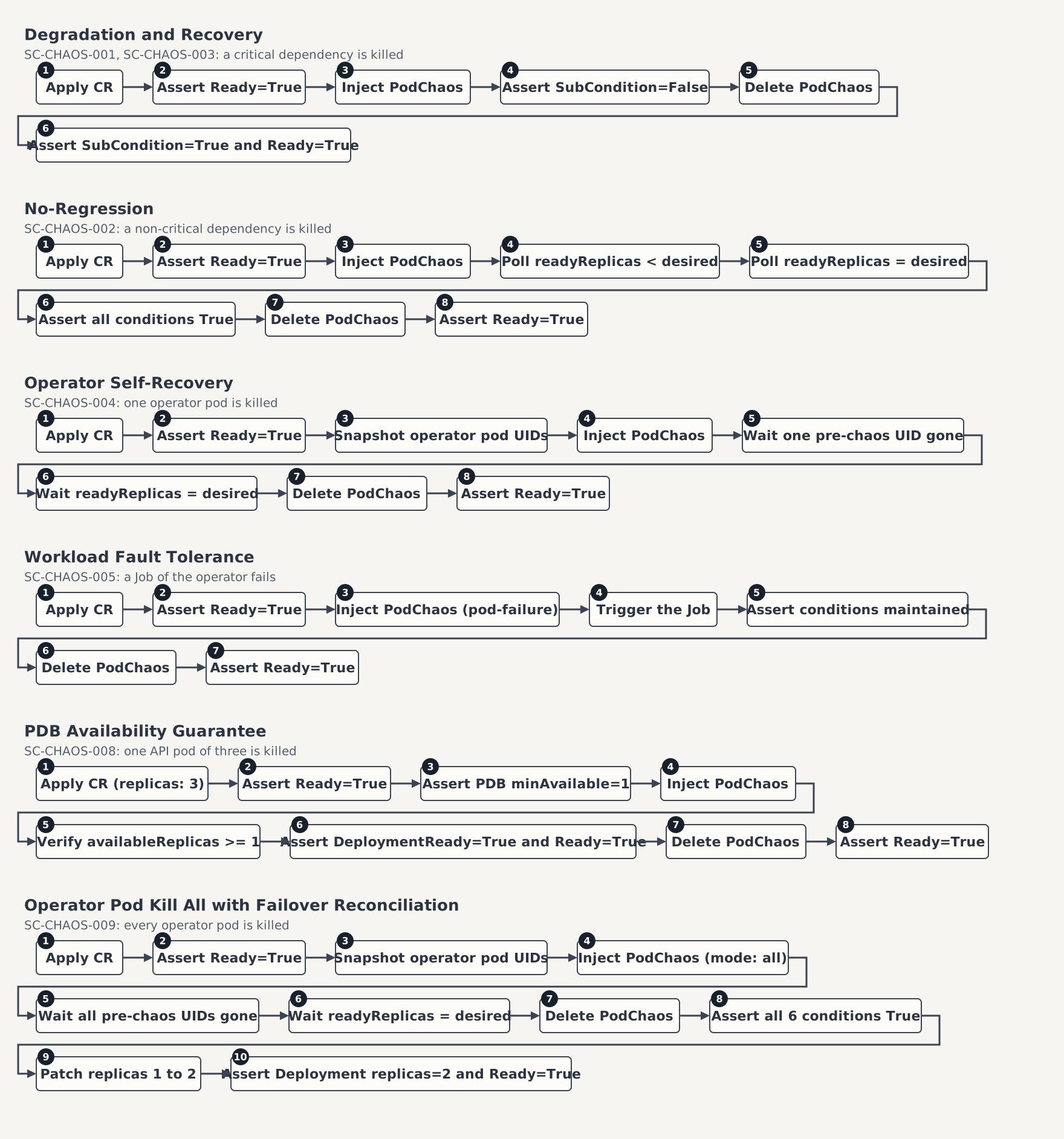
The figure draws the six patterns as numbered chains. Each section below names the suites that use a pattern and lists its steps.
Degradation and Recovery (SC-CHAOS-001, SC-CHAOS-003)
Used when the killed dependency is critical and the operator must detect the outage via a sub-condition transition.
- Apply Keystone CR and assert
Ready=True(baseline) - Apply PodChaos to kill a critical dependency pod
- Assert the corresponding sub-condition transitions to
False - Delete PodChaos to lift the fault (pod restarts via StatefulSet/Deployment controller)
- Assert full recovery: sub-condition returns to
True,Ready=True
No-Regression (SC-CHAOS-002)
Used when the killed dependency is non-critical and the operator must maintain Ready=True despite the outage.
- Apply Keystone CR and assert
Ready=True(baseline) - Apply PodChaos to kill a non-critical dependency pod
- Poll the dependency Deployment until
readyReplicasdrops belowspec.replicas(confirms chaos took effect) - Poll until
readyReplicasequalsspec.replicasagain (confirms recovery) - Assert all 6 conditions remain
True— no regression - Delete PodChaos and assert
Ready=Trueafter recovery
Operator Self-Recovery (SC-CHAOS-004)
Used when the operator's own pod is killed and the Deployment controller restarts it. The CR conditions should remain stable because the operator crash is invisible to the Keystone CR — the Deployment controller handles pod restart, and controller-runtime re-registers watches and resumes reconciliation.
- Apply Keystone CR and assert
Ready=True(baseline) - Snapshot the operator pod UIDs and apply PodChaos to kill one operator pod
- Wait until at least one pre-chaos UID is gone (confirms kill took effect)
- Wait until the operator Deployment
readyReplicasequalsspec.replicas(Deployment controller restarted it) - Delete PodChaos and assert
Ready=Trueafter re-reconciliation
Workload Fault Tolerance (SC-CHAOS-005)
Used when a workload spawned by the operator (CronJob/Job) fails but the operator should remain healthy because it checks resource existence and ignores Job run outcomes.
- Apply Keystone CR and assert
Ready=True(baseline) - Apply PodChaos with
pod-failureaction before creating the Job - Create a manual Job from the CronJob (triggers fault injection on Job pods)
- Assert
FernetKeysReady=TrueandReady=True— no condition cascade - Delete PodChaos and assert
Ready=Trueafter cleanup
PDB Availability Guarantee (SC-CHAOS-008)
Used when the operator creates a PodDisruptionBudget and the test verifies that minimum availability is maintained during a pod kill. Requires replicas > 1 to trigger PDB creation.
- Apply Keystone CR with
replicas: 3and assertReady=True(baseline) - Assert PDB exists with
minAvailable: 1 - Apply PodChaos to kill one API pod (
mode: one) - Poll until
readyReplicas < 3(kill took effect), assertavailableReplicas >= 1 - Assert
DeploymentReady=TrueandReady=True— no condition regression - Delete PodChaos and assert
Ready=Trueafter full replica count restored
Operator Pod Kill All with Failover Reconciliation (SC-CHAOS-009)
Used when ALL operator pods are killed simultaneously (mode: all), forcing the Deployment controller to restart all pods and trigger leader re-election. After recovery, a spec change (replica patch) verifies the new leader can actively reconcile — proving operational capability beyond just running.
- Apply Keystone CR and assert
Ready=True(baseline) - Snapshot the operator pod UIDs and apply PodChaos with
mode: allto kill every operator pod - Wait until none of the pre-chaos UIDs remain (kill confirmed), then poll operator Deployment
readyReplicasuntil it equalsspec.replicas(recovered) - Delete PodChaos to lift the fault
- Assert all 6 conditions remain
True— operator restart is invisible to CR status - Patch
spec.deployment.replicasfrom 1 to 2 - Assert Deployment has
replicas: 2andavailableReplicas: 2, andReady=True
PodChaos CRD Pattern
Phase 1 scenarios (SC-CHAOS-001 through SC-CHAOS-003), SC-CHAOS-004/SC-CHAOS-008, and SC-CHAOS-009 use the pod-kill action. SC-CHAOS-005 uses pod-failure for sustained fault injection. SC-CHAOS-009 uses mode: all (unlike all other pod-kill scenarios which use mode: one) to kill every operator pod simultaneously.
Standard pod-kill pattern
apiVersion: chaos-mesh.org/v1alpha1
kind: PodChaos
metadata:
  name: kill-<target>
  namespace: openstack
spec:
  action: pod-kill
  mode: one
  selector:
    namespaces:
    - <target-namespace>         # openstack or shared-services
    labelSelectors:
      app.kubernetes.io/name: <target>  # mariadb, memcached, openbao
gracePeriod: 0| Field | Value | Rationale |
|---|---|---|
action | pod-kill | One-shot kill — no duration needed |
mode | one | Kills exactly one matching pod |
gracePeriod | 0 | Immediate kill (no graceful shutdown) |
namespace | openstack | CR lives in openstack even for cross-namespace targeting |
selector.namespaces | varies | openstack for MariaDB/Memcached, shared-services for OpenBao |
pod-failure action (SC-CHAOS-005)
SC-CHAOS-005 uses pod-failure instead of pod-kill to inject sustained failures into Job pods for a configurable duration. This simulates a scenario where every rotation attempt fails continuously, which a single kill-and-restart cycle cannot show.
spec:
  action: pod-failure
  mode: all
  duration: "60s"
  selector:
    labelSelectors:
job-name: chaos-cron-test # Kubernetes auto-label on Job pods| Field | Value | Rationale |
|---|---|---|
action | pod-failure | Sustained failure for the full duration (not one-shot kill) |
mode | all | Every pod spawned by the targeted Job is affected |
duration | 60s | Failure window long enough to span at least one reconciliation cycle |
selector.labelSelectors | job-name: chaos-cron-test | Targets pods created by the manual Job (Kubernetes auto-assigns this label) |
Multi-label selector (SC-CHAOS-008)
SC-CHAOS-008 uses two label selectors to target only the Keystone API pods belonging to a specific CR instance, avoiding interference with other Keystone deployments in the namespace.
spec:
  action: pod-kill
  mode: one
  selector:
    labelSelectors:
      app.kubernetes.io/name: keystone               # service type
      app.kubernetes.io/instance: keystone-chaos-api  # CR instance
Both labels must match for a pod to be selected. This ensures only the keystone-chaos-api API Deployment's pods are targeted, and neither the operator pod nor the API pods of other CR instances are.
mode: all pod-kill (SC-CHAOS-009)
SC-CHAOS-009 uses mode: all instead of mode: one to kill every matching operator pod simultaneously. This forces the Deployment controller to restart all pods (not just one) and triggers a full leader re-election cycle.
spec:
  action: pod-kill
  mode: all
  selector:
    namespaces:
    - keystone-system
    labelSelectors:
      app.kubernetes.io/name: keystone-operator
gracePeriod: 0| Field | Value | Rationale |
|---|---|---|
mode | all | Kills every operator pod — unlike SC-CHAOS-004 (mode: one) which leaves other replicas running |
selector.namespaces | keystone-system | Operator controller runs in keystone-system; the operator-managed Keystone workload stays in openstack |
Fault cleanup
The test explicitly deletes the PodChaos CR before asserting recovery. This ensures the fault is lifted before the recovery assertion window begins.
Keystone CR Fixtures
Each scenario uses a unique CR name and database name to enable parallel execution:
| Scenario | CR Name | Database | Replicas |
|---|---|---|---|
| SC-CHAOS-001 | keystone-chaos-db | keystone_chaos_db | 1 |
| SC-CHAOS-002 | keystone-chaos-mc | keystone_chaos_mc | 1 |
| SC-CHAOS-003 | keystone-chaos-bao | keystone_chaos_bao | 1 |
| SC-CHAOS-004 | keystone-chaos-op | keystone_chaos_op | 1 |
| SC-CHAOS-005 | keystone-chaos-cron | keystone_chaos_cron | 1 |
| SC-CHAOS-006 | keystone-chaos-net-part | keystone_chaos_net_part | 1 |
| SC-CHAOS-007 | keystone-chaos-net-lat | keystone_chaos_net_lat | 1 |
| SC-CHAOS-008 | keystone-chaos-api | keystone_chaos_api | 3 |
| SC-CHAOS-009 | keystone-chaos-opk | keystone_chaos_opk | 1 |
All fixtures share the same base spec: clusterRef for database and memcached, fernet rotation "0 0 * * 0" with maxActiveKeys: 3, bootstrap adminUser: admin. Most use replicas: 1. SC-CHAOS-008 uses replicas: 3 to trigger PDB creation via buildPodDisruptionBudget() which requires replicas > 1.
Catch Block Diagnostics
Every assert step includes a catch: block that collects diagnostic information when the assertion fails. The information collected varies by scenario:
| Diagnostic | MariaDB (001) | Memcached (002) | OpenBao (003) | Operator (004) | CronJob (005) | Net Partition (006) | Net Latency (007) | API PDB (008) | Pod Kill (009) |
|---|---|---|---|---|---|---|---|---|---|
diagnostics.sh | Steps 2, 4, 6 | Steps 2, 4, 6 | Steps 2, 4, 6, 7 | Steps 2, 3, 5 | Steps 2, 5, 7 | Steps 2, 4, 5, 7 | Steps 2, 4, 6 | Steps 2, 5, 7 | Steps 2, 3, 5, 7 |
| Target pod status | Steps 4, 6 | Steps 4, 6 | Steps 2, 4, 6, 7 | Steps 3, 5 | Steps 5, 7 | Steps 2, 4, 5, 7 | Steps 2, 4, 6 | Steps 5, 7 | Steps 3, 5, 7 |
| Chaos Mesh experiment status | Steps 4, 6 | Steps 4, 6 | Steps 4, 6, 7 | Steps 3, 5 | Steps 5, 7 | Steps 4, 5, 7 | Steps 4, 6 | Steps 5, 7 | Steps 3, 5, 7 |
| NetworkChaos CR status | — | — | — | — | — | Step 4 | — | — | — |
Operator logs (--previous) | Steps 4, 6 | — | Steps 4, 6, 7 | Steps 3, 5 | — | Steps 4, 5, 7 | Steps 4, 6 | — | Steps 3, 5, 7 |
Target pod logs (--previous) | — | Steps 4, 6 | — | — | Steps 5, 7 | — | — | Steps 5, 7 | — |
| ESO ExternalSecret conditions | — | — | Steps 4, 6, 7 | — | — | — | — | — | — |
| All pod logs | Step 2 | Step 2 | Step 2 | Step 2 | Step 2 | Step 2 | Step 2 | Step 2 | Step 2 |
| Namespace events | Steps 2, 4, 6 | Steps 2, 4, 6 | Steps 2, 4, 6, 7 | Steps 2, 3, 5 | Steps 2, 5, 7 | Steps 2, 4, 5, 7 | Steps 2, 4, 6 | Steps 2, 5, 7 | Steps 2, 3, 5, 7 |
| CronJob/Job status | — | — | — | — | Steps 4, 5 | — | — | — | — |
| Job pod logs | — | — | — | — | Step 5 | — | — | — | — |
| PDB describe | — | — | — | — | — | — | — | Step 3 | — |
All nine scenarios call diagnostics.sh in their catch blocks (it collects CR status, pod status, logs, and events). SC-CHAOS-003 passes --eso in Steps 4, 6, and 7. SC-CHAOS-006 also dumps the NetworkChaos CR status in Step 4 to confirm fault injection state. SC-CHAOS-005 also collects CronJob/Job-specific diagnostics in Steps 4 and 5, and SC-CHAOS-008 describes the PDB in Step 3.
The forty-six suites that start a workload also call ../lib/workload.sh dump <id> in the catch block of every step from start to verify. It prints the phase of the workload pod, its two fault marks and the last 200 lines of its log.
File Layout
tests/e2e-chaos/
├── chainsaw-config.yaml              Chaos-specific Chainsaw configuration
├── diagnostics.sh                    Shared diagnostic collection script
├── README.md                         Quick-start documentation
├── unseal-openbao.sh                 Re-unseals openbao-0 after a chaos pod-kill
├── api-pod-kill-pdb/                 SC-CHAOS-008: PDB availability guarantee
│   ├── 00-keystone-cr.yaml           Keystone CR fixture (keystone-chaos-api, replicas: 3)
│   ├── 01-podchaos.yaml              PodChaos targeting keystone API pods (multi-label)
│   └── chainsaw-test.yaml            Test: PDB minAvailable=1, availability maintained
├── barbican-keystone-outage/         Keystone outage under the Barbican API
│   ├── 00-keystone-cr.yaml           Keystone keystone-barbican-ks-outage, the one the outage takes
│   ├── 01-barbican-cr.yaml           Barbican barbican-ks-outage
│   ├── 02-barbican-secretstore.yaml  BarbicanSecretStore barbican-ks-outage-store
│   ├── 03-podchaos.yaml              PodChaos pod-failure on the Keystone API pods
│   └── chainsaw-test.yaml            Test: an unvalidated token gets 503, then 200 after the outage
├── barbican-mariadb-outage/          Database partition under the Barbican API
│   ├── 00-keystone-cr.yaml           Keystone keystone-barbican-db-chaos
│   ├── 01-barbican-cr.yaml           Barbican barbican-db-chaos with database socket timeouts
│   ├── 02-barbican-secretstore.yaml  BarbicanSecretStore barbican-db-chaos-store
│   ├── 03-networkchaos.yaml          NetworkChaos severing barbican-api↔MariaDB traffic (server-side)
│   └── chainsaw-test.yaml            Test: the write fails closed, the API stays up
├── barbican-openbao-outage/          Secret-store partition under the Barbican API
│   ├── 00-keystone-cr.yaml           Keystone keystone-barbican-outage
│   ├── 01-barbican-cr.yaml           Barbican CR barbican-bao-outage, two replicas
│   ├── 02-barbican-secretstore.yaml  Default OpenBao store barbican-bao-outage-store
│   ├── 03-networkchaos.yaml          NetworkChaos severing barbican-api↔OpenBao traffic (server-side)
│   └── chainsaw-test.yaml            Test: BarbicanAPIReady maintained, the write fails closed
├── barbican-operator-pod-kill/       barbican-operator pod kill
│   ├── 00-barbican-cr.yaml           Barbican CR fixture (barbican-chaos-op)
│   ├── 01-barbican-secretstore.yaml  Default OpenBao store barbican-chaos-op-store
│   ├── 02-podchaos.yaml              PodChaos targeting barbican-operator in barbican-system
│   ├── 03-patch-scale.yaml           Patch replicas 1→2 after the operator pod kill
│   └── chainsaw-test.yaml            Test: one operator pod replaced, workload UIDs kept, replica patch
├── c5c3-operator-pod-kill/           c5c3-operator pod kill during a provisioning
│   ├── 00-controlplane-cr.yaml       ControlPlane cp-c5c3-kill, Keystone only
│   ├── 01-podchaos.yaml              PodChaos pod-kill of every c5c3-operator pod
│   └── chainsaw-test.yaml            Test: the plane converges, nothing created twice
├── cert-manager-outage/              cert-manager controller outage across a forced renewal
│   ├── 00-keystone-cr.yaml           Keystone keystone-chaos-cm behind openstack-gw
│   ├── 01-podchaos.yaml              PodChaos pod-failure on the cert-manager controller
│   ├── chainsaw-test.yaml            Test: nothing renews while held, the new leaf served after
│   └── probe-lib.sh                  Helpers the scripts source: proxy address, leaf hashes
├── cinder-broker-outage/             Message-bus partition under a Cinder
│   ├── 00-rabbitmqcluster.yaml       The broker of this suite (cinder-chaos-rabbitmq)
│   ├── 01-cinder-cr.yaml             Cinder CR cinder-broker-chaos
│   ├── 02-cinderbackend-cr.yaml      NFS backend broker-chaos-nfs1
│   ├── 03-networkchaos.yaml          NetworkChaos severing cinder↔broker traffic (server-side)
│   └── chainsaw-test.yaml            Test: scheduler and volume service NotReady → recovery
├── cinder-broker-pod-kill/           Broker pod kill under a Cinder
│   ├── 00-rabbitmqcluster.yaml       RabbitmqCluster cinder-broker-kill-rabbitmq
│   ├── 01-cinder-cr.yaml             Cinder cinder-broker-kill, managed messaging, noauth
│   ├── 02-cinderbackend-cr.yaml      NFS backend broker-kill-nfs1
│   ├── 03-podchaos.yaml              PodChaos pod-kill of the broker pod
│   └── chainsaw-test.yaml            Test: the bus consumers reconnect, the API never restarts
├── cinder-keystone-outage/           Keystone outage under an authenticated Cinder
│   ├── 00-keystone-cr.yaml           Keystone keystone-cinder-ks-outage
│   ├── 01-cinder-cr.yaml             Cinder cinder-ks-outage with keystoneEndpoint and serviceUser
│   ├── 02-cinderbackend-cr.yaml      NFS backend ks-outage-nfs1
│   ├── 03-podchaos.yaml              PodChaos pod-failure on the Keystone API pods
│   └── chainsaw-test.yaml            Test: an unvalidated token gets 503, then 200 after the outage
├── cinder-mariadb-outage/            Database partition under the Cinder API
│   ├── 00-cinder-cr.yaml             Cinder cinder-db-chaos, noauth, database socket timeouts
│   ├── 01-cinderbackend-cr.yaml      NFS backend db-chaos-nfs1
│   ├── 02-networkchaos.yaml          NetworkChaos severing cinder-api↔MariaDB traffic (server-side)
│   └── chainsaw-test.yaml            Test: the write fails closed, the API stays up
├── cinder-nfs-outage/                NFS export outage under a Cinder
│   ├── 00-cinder-cr.yaml             Cinder CR cinder-nfs-chaos
│   ├── 01-cinderbackend-cr.yaml      NFS backend nfs-chaos-nfs1
│   ├── 02-lock-holder-pod.yaml       Lock holder Pod cinder-nfs-chaos-probe-lock
│   └── chainsaw-test.yaml            Test: Ready maintained, the create fails closed
├── cinder-operator-pod-kill/         cinder-operator pod kill
│   ├── 00-cinder-cr.yaml             Cinder CR cinder-chaos-op
│   ├── 01-cinderbackend-cr.yaml      NFS backend chaos-op-nfs1
│   ├── 02-podchaos.yaml              PodChaos targeting cinder-operator in cinder-system
│   ├── 03-patch-scale.yaml           Patch API replicas to 2 after the operator pod kill
│   └── chainsaw-test.yaml            Test: one operator pod replaced, workload UIDs kept, replica patch
├── cinder-volume-pod-kill/           Volume-service kill in the middle of an attach
│   ├── 00-cinder-cr.yaml             Cinder cinder-volume-kill, noauth
│   ├── 01-cinderbackend-cr.yaml      NFS backend vol-kill-nfs1
│   ├── 02-podchaos.yaml              PodChaos pod-kill of the volume service of vol-kill-nfs1
│   └── chainsaw-test.yaml            Test: killed mid-attach, the sweep leaves nothing transitional
├── controlplane-keystone-degraded/   ControlPlane over a degraded Keystone
│   ├── 00-controlplane-cr.yaml       ControlPlane cp-ks-degraded, Keystone only
│   ├── 01-podchaos.yaml              PodChaos pod-failure on the plane Keystone API pods
│   └── chainsaw-test.yaml            Test: the plane reports the Keystone, never masks it
├── cronjob-rotation-failure/         SC-CHAOS-005: CronJob fault tolerance
│   ├── 00-keystone-cr.yaml           Keystone CR fixture (keystone-chaos-cron)
│   ├── 01-podchaos.yaml              PodChaos pod-failure targeting job pods
│   └── chainsaw-test.yaml            Test: FernetKeysReady=True maintained
├── deletion-stuck-finalizer/         SC-CHAOS-010: Deletion with mariadb-operator down
│   ├── 00-keystone-cr.yaml           Keystone CR fixture (keystone-chaos-stuck)
│   └── chainsaw-test.yaml            Test: scale mariadb-operator to 0, delete CR, assert stuck → recovery
├── envoy-gateway-outage/             Envoy Gateway controller outage
│   ├── 00-keystone-cr.yaml           Keystone keystone-chaos-eg behind openstack-gw
│   ├── 01-podchaos.yaml              PodChaos pod-failure on the Envoy Gateway controller
│   ├── 02-httproute.yaml             HTTPRoute chaos-eg-late, added under the fault
│   ├── chainsaw-test.yaml            Test: the late route waits for the controller
│   └── probe-lib.sh                  Helpers the scripts source: route status, GET through the proxy
├── envoy-proxy-pod-kill/             Envoy proxy pod kill under Gateway traffic
│   ├── 00-keystone-cr.yaml           Keystone keystone-chaos-proxy behind openstack-gw
│   ├── 01-podchaos.yaml              PodChaos pod-kill of every proxy pod of openstack-gw
│   └── chainsaw-test.yaml            Test: every proxy pod replaced, the stream within its budget
├── eso-down/                         ESO controller at zero under a fresh Keystone
│   ├── 00-keystone-cr.yaml           Keystone keystone-chaos-eso, Ready before the fault
│   ├── 01-externalsecrets.yaml       ExternalSecrets eso-down-db and eso-down-admin
│   ├── 02-keystone-fresh-cr.yaml     Memcached eso-down-cache, Keystone keystone-chaos-eso-fresh
│   └── chainsaw-test.yaml            Test: the fresh Keystone fails closed, then comes up
├── eso-pod-kill/                     ESO controller pod kill
│   ├── 00-keystone-cr.yaml           Keystone keystone-chaos-esokill
│   ├── 01-externalsecret.yaml        ExternalSecret eso-kill-probe, synced again after the kill
│   ├── 02-podchaos.yaml              PodChaos pod-kill of every ESO controller pod
│   └── chainsaw-test.yaml            Test: every controller pod replaced, a forced sync succeeds
├── glance-garage-outage/             Garage S3 partition under the Glance API
│   ├── 00-glance-cr.yaml             Glance CR glance-garage-chaos, API open without a token
│   ├── 01-glancebackend-cr.yaml      Default S3 store glance-garage-chaos-s3
│   ├── 02-networkchaos.yaml          NetworkChaos severing glance-api↔Garage traffic (server-side)
│   └── chainsaw-test.yaml            Test: Ready maintained, the upload fails closed
├── glance-keystone-outage/           Keystone outage under the Glance API
│   ├── 00-keystone-cr.yaml           Keystone keystone-glance-ks-outage, the one the outage takes
│   ├── 01-glance-cr.yaml             Glance glance-ks-outage, no anonymous access
│   ├── 02-glancebackend-cr.yaml      S3 backend glance-ks-outage-s3
│   ├── 03-podchaos.yaml              PodChaos pod-failure on the Keystone API pods
│   └── chainsaw-test.yaml            Test: an unvalidated token gets 401, then 200 after the outage
├── glance-mariadb-outage/            Database partition under the Glance API
│   ├── 00-keystone-cr.yaml           Keystone keystone-glance-db-chaos
│   ├── 01-glance-cr.yaml             Glance glance-db-chaos with harakiri: 20
│   ├── 02-glancebackend-cr.yaml      S3 backend glance-db-chaos-s3
│   ├── 03-networkchaos.yaml          NetworkChaos severing glance-api↔MariaDB traffic (server-side)
│   └── chainsaw-test.yaml            Test: the write fails closed, the API stays up
├── glance-operator-pod-kill/         glance-operator pod kill
│   ├── 00-glance-cr.yaml             Glance CR fixture (glance-chaos-op)
│   ├── 01-glance-backend.yaml        Default S3 store glance-chaos-op-s3
│   ├── 02-podchaos.yaml              PodChaos targeting glance-operator in glance-system
│   ├── 03-patch-scale.yaml           Patch replicas 1→2 after the operator pod kill
│   └── chainsaw-test.yaml            Test: one operator pod replaced, workload UIDs kept, replica patch
├── horizon-dashboard-pod-kill/       Dashboard pod kill under a Horizon
│   ├── 00-horizon-cr.yaml            Horizon CR fixture (horizon-chaos-dash, replicas: 2)
│   ├── 01-podchaos.yaml              PodChaos killing one of the two dashboard pods
│   └── chainsaw-test.yaml            Test: one pod replaced, readyReplicas 2, Ready=True
├── horizon-memcached-pod-kill/       Memcached pod kill under a Horizon
│   ├── 00-horizon-cr.yaml            Horizon CR fixture (horizon-chaos-mc)
│   ├── 01-podchaos.yaml              PodChaos targeting memcached in openstack
│   └── chainsaw-test.yaml            Test: Ready=True maintained, no dashboard restart
├── horizon-operator-pod-kill/        horizon-operator pod kill
│   ├── 00-horizon-cr.yaml            Horizon CR fixture (horizon-chaos-op)
│   ├── 01-podchaos.yaml              PodChaos targeting horizon-operator in horizon-system
│   ├── 02-patch-scale.yaml           Patch replicas 1→2 after the operator pod kill
│   └── chainsaw-test.yaml            Test: one operator pod replaced, replica patch
├── keystone-federation/              Federation sidecar kill and IdP outage
│   ├── 00-keycloak.yaml              In-suite Keycloak (keycloak-chaos) importing one realm
│   ├── 01-keystone-cr.yaml           Keystone CR fixture (keystone-chaos-fed, replicas: 2)
│   ├── 02-backend-cr.yaml            OIDC KeystoneIdentityBackend keycloak-chaos
│   ├── 03-container-kill.yaml        PodChaos container-kill on federation-proxy in one pod
│   └── chainsaw-test.yaml            Test: sidecar restart → recovery, IdP outage fails closed
├── korc-network-partition/           K-ORC partitioned from a ControlPlane Keystone
│   ├── 00-controlplane-cr.yaml       ControlPlane cp-korc-part, Keystone only
│   ├── 01-keystoneservice.yaml       KeystoneService korc-part, applied under the partition
│   ├── 02-networkchaos.yaml          NetworkChaos severing K-ORC from the Keystone API pods
│   ├── 03-admin-job.yaml             One project, service and endpoint pair (NO-DUPLICATE-OK)
│   └── chainsaw-test.yaml            Test: nothing reported under the partition, one row each after
├── korc-provisioning-outage/         K-ORC outage across a ControlPlane provisioning
│   ├── 00-controlplane-cr.yaml       ControlPlane cp-korc-out, Keystone only
│   ├── 01-podchaos.yaml              PodChaos pod-failure on K-ORC
│   ├── 02-admin-job.yaml             The admin application credentials (NO-DUPLICATE-OK)
│   └── chainsaw-test.yaml            Test: the blind window, then one credential in Keystone
├── lib/                              Shared helpers of the suites, no suite
│   ├── controlplane.sh               ControlPlane bring-up, waits, @NS@ fixtures, teardown and dump (controlplane entry)
│   ├── gateway.sh                    The ClusterIP of the proxy of Gateway openstack-gw
│   ├── openbao.sh                    The root token and the bao calls into openbao-0
│   ├── pods.sh                       The UID-gated wait for the replaced pods of a Deployment
│   ├── workload.py                   The workload streams (run) and the verdict (evaluate)
│   └── workload.sh                   start, mark, verify, dump and stop, called by the suites
├── mariadb-network-latency/          SC-CHAOS-007: MariaDB network latency
│   ├── 00-keystone-cr.yaml           Keystone CR fixture (keystone-chaos-net-lat)
│   ├── 01-networkchaos.yaml          NetworkChaos injecting 10s latency on keystone→mariadb
│   └── chainsaw-test.yaml            Test: Ready=True maintained, no crash-loop
├── mariadb-network-partition/        SC-CHAOS-006: MariaDB network partition
│   ├── 00-keystone-cr.yaml           Keystone CR fixture (keystone-chaos-net-part)
│   ├── 01-networkchaos.yaml          NetworkChaos severing keystone↔mariadb traffic (server-side)
│   └── chainsaw-test.yaml            Test: DeploymentReady=False → recovery
├── mariadb-operator-cascading-failure/ MariaDB outage through two restarted operators
│   ├── 00-keystone-cr.yaml           Keystone keystone-chaos-cascade
│   ├── 01-podchaos-mariadb.yaml      PodChaos pod-failure on openstack-db
│   ├── 02-podchaos-operators.yaml    PodChaos pod-kill of the mariadb- and keystone-operator
│   └── chainsaw-test.yaml            Test: the restarted operators report the outage
├── mariadb-pod-kill/                 SC-CHAOS-001: MariaDB pod kill
│   ├── 00-keystone-cr.yaml           Keystone CR fixture (keystone-chaos-db)
│   ├── 01-podchaos.yaml              PodChaos targeting mariadb in openstack
│   └── chainsaw-test.yaml            Test: DatabaseReady=False → recovery
├── memcached-network-partition/      Memcached partition under a Keystone
│   ├── 00-keystone-cr.yaml           Keystone CR fixture (keystone-chaos-mc-part)
│   ├── 01-networkchaos.yaml          NetworkChaos severing keystone↔Memcached traffic (server-side)
│   └── chainsaw-test.yaml            Test: Ready and every sub-condition True for 120 s
├── memcached-pod-kill/               SC-CHAOS-002: Memcached pod kill
│   ├── 00-keystone-cr.yaml           Keystone CR fixture (keystone-chaos-mc)
│   ├── 01-podchaos.yaml              PodChaos targeting memcached in openstack
│   └── chainsaw-test.yaml            Test: Ready=True maintained (no regression)
├── neutron-broker-outage/            Message-bus partition under the Neutron API
│   ├── 00-keystone-cr.yaml           Keystone keystone-neutron-broker
│   ├── 01-rabbitmqcluster.yaml       The broker of this suite (neutron-chaos-rabbitmq)
│   ├── 02-ovncentral-cr.yaml         OVNCentral neutron-broker-ovn
│   ├── 03-neutron-cr.yaml            Neutron CR neutron-broker-chaos
│   ├── 04-networkchaos.yaml          NetworkChaos severing neutron↔broker traffic (server-side)
│   └── chainsaw-test.yaml            Test: Ready maintained, no broker connection at any point
├── neutron-keystone-outage/          Keystone outage under the Neutron API
│   ├── 00-keystone-cr.yaml           Keystone keystone-neutron-ks-outage
│   ├── 01-messaging-secret.yaml      Transport URL that never resolves
│   ├── 02-ovncentral-cr.yaml         OVNCentral neutron-ks-outage-ovn
│   ├── 03-neutron-cr.yaml            Neutron neutron-ks-outage
│   ├── 04-podchaos.yaml              PodChaos pod-failure on the Keystone API pods
│   └── chainsaw-test.yaml            Test: an unvalidated token gets 503, then 200 after the outage
├── neutron-mariadb-outage/           Database partition under the Neutron API
│   ├── 00-keystone-cr.yaml           Keystone keystone-neutron-outage
│   ├── 01-messaging-secret.yaml      Transport URL Secret neutron-db-chaos-messaging
│   ├── 02-ovncentral-cr.yaml         OVNCentral neutron-db-chaos-ovn
│   ├── 03-neutron-cr.yaml            Neutron CR neutron-db-chaos
│   ├── 04-networkchaos.yaml          NetworkChaos severing neutron-api↔MariaDB traffic (server-side)
│   └── chainsaw-test.yaml            Test: two conditions maintained, the write fails closed
├── neutron-metadata-agent-pod-kill/  Metadata agent pod kill under a booted server
│   ├── 01-… to 12-*.yaml             The nova-placement-outage stack as nova-meta-chaos, host = node
│   ├── 13-flavor-seed-job.yaml       The flavor m1.nano, and the compute up
│   ├── 14-ovnchassis-cr.yaml         OVNChassis nova-meta-chaos-chassis
│   ├── 15-neutronmetadataagent-cr.yaml NeutronMetadataAgent nova-meta-chaos-agent
│   ├── 16-boot-job.yaml              meta-chaos-vm with a port on meta-chaos-net (BOOT-OK)
│   ├── 17-podchaos.yaml              PodChaos pod-kill of the agent pod
│   ├── 18-probe-scripts.yaml         ConfigMap of the scripts the probe pods run
│   ├── chainsaw-test.yaml            Test: metadata down with the agent, back with the new pod
│   └── probe-lib.sh                  Helpers the scripts source: probe pods, OpenStack cleanup
├── neutron-operator-pod-kill/        neutron-operator pod kill
│   ├── 00-keystone-cr.yaml           Keystone keystone-neutron-chaos-op
│   ├── 01-messaging-secret.yaml      Transport URL that never resolves
│   ├── 02-ovncentral-cr.yaml         OVNCentral neutron-chaos-op-ovn
│   ├── 03-neutron-cr.yaml            Neutron neutron-chaos-op (one API replica)
│   ├── 04-podchaos.yaml              PodChaos targeting neutron-operator in neutron-system
│   ├── 05-patch-scale.yaml           Patch replicas 1→2 after the operator pod kill
│   └── chainsaw-test.yaml            Test: one operator pod replaced, workload UIDs kept, replica patch
├── nova-broker-outage/               Message-bus partition under a Nova
│   ├── 00-rabbitmqcluster.yaml       The broker of this suite (nova-chaos-rabbitmq)
│   ├── 01-keystone-cr.yaml           Keystone keystone-nova-broker-chaos
│   ├── 02-catalog-setup-job.yaml     Compute, placement, image and network catalog rows
│   ├── 03-messaging-secret.yaml      Transport URL for the Neutron beside the Nova
│   ├── 04-ovncentral-cr.yaml         OVNCentral nova-broker-chaos-ovn
│   ├── 05-neutron-cr.yaml            Neutron neutron-nova-broker-chaos
│   ├── 06-placement-cr.yaml          Placement placement-nova-broker-chaos
│   ├── 07-glance-cr.yaml             Glance glance-nova-broker-chaos
│   ├── 08-glancebackend-cr.yaml      S3 backend glance-nova-broker-chaos-s3
│   ├── 09-image-seed-job.yaml        The image the servers boot from
│   ├── 10-metadata-secret.yaml       The metadata shared secret
│   ├── 11-nova-cr.yaml               Nova CR nova-broker-chaos on managed messaging
│   ├── 12-fake-compute.yaml          nova-compute on the fake driver, host fake-1
│   ├── 13-networkchaos.yaml          NetworkChaos severing nova↔broker traffic (server-side)
│   ├── 14-baseline-job.yaml          A server boots on a healthy bus (BASELINE-OK)
│   ├── 15-blocked-job.yaml           GET / serves while a create stalls (BLOCKED-OK)
│   ├── 16-recovered-job.yaml         The stalled create finishes, a new one runs (RECOVERED-OK)
│   └── chainsaw-test.yaml            Test: both bus consumers NotReady → recovery
├── nova-keystone-outage/             Keystone outage under a Nova deployment
│   ├── 01-… to 12-*.yaml             The nova-placement-outage stack as nova-ks-chaos
│   ├── 13-flavor-seed-job.yaml       The flavor m1.nano, and the compute up
│   ├── 14-podchaos.yaml              PodChaos pod-failure on the Keystone API pods
│   └── chainsaw-test.yaml            Test: an unvalidated token gets 503, Nova stays Ready
├── nova-mariadb-outage/              Database partition under the Nova API
│   ├── 00-keystone-cr.yaml           Keystone keystone-nova-db-chaos
│   ├── 01-catalog-setup-job.yaml     The compute catalog row
│   ├── 02-metadata-secret.yaml       The metadata shared secret
│   ├── 03-nova-cr.yaml               Nova CR nova-db-chaos
│   ├── 04-networkchaos.yaml          NetworkChaos severing nova-api↔MariaDB traffic (server-side)
│   ├── 05-list-job.yaml              The server list before and after the fault (LIST-OK)
│   ├── 06-failclosed-job.yaml        GET / serves while the read fails (FAILCLOSED-OK)
│   └── chainsaw-test.yaml            Test: four conditions maintained, the read fails closed
├── nova-operator-pod-kill/           nova-operator pod kill
│   ├── 01-… to 12-*.yaml             The nova-placement-outage stack as nova-chaos-op
│   ├── 13-flavor-seed-job.yaml       The flavor m1.nano, and the compute up
│   ├── 14-podchaos.yaml              PodChaos targeting nova-operator in nova-system
│   ├── 15-patch-scale.yaml           Patch API replicas 1→2 after the operator pod kill
│   └── chainsaw-test.yaml            Test: one operator pod replaced, workload UIDs kept, replica patch
├── nova-placement-outage/            Placement partition under the scheduler
│   ├── 01-keystone-cr.yaml           Keystone keystone-nova-placement-chaos
│   ├── 02-catalog-setup-job.yaml     Compute, placement, image and network catalog rows
│   ├── 03-messaging-secret.yaml      Transport URL for the Neutron beside the Nova
│   ├── 04-ovncentral-cr.yaml         OVNCentral nova-placement-chaos-ovn
│   ├── 05-neutron-cr.yaml            Neutron neutron-nova-placement-chaos
│   ├── 06-placement-cr.yaml          Placement placement-nova-placement-chaos
│   ├── 07-glance-cr.yaml             Glance glance-nova-placement-chaos
│   ├── 08-glancebackend-cr.yaml      S3 backend glance-nova-placement-chaos-s3
│   ├── 09-image-seed-job.yaml        The image the servers boot from
│   ├── 10-metadata-secret.yaml       The metadata shared secret
│   ├── 11-nova-cr.yaml               Nova CR nova-placement-chaos on a shared-broker vhost
│   ├── 12-fake-compute.yaml          nova-compute on the fake driver, host fake-1
│   ├── 13-networkchaos.yaml          NetworkChaos severing scheduler↔Placement traffic (server-side)
│   ├── 14-baseline-job.yaml          A server boots through a reachable Placement (BASELINE-OK)
│   ├── 15-failclosed-job.yaml        The build ends in ERROR, nothing else fails (FAILCLOSED-OK)
│   ├── 16-recovered-job.yaml         The scheduler places servers again (RECOVERED-OK)
│   └── chainsaw-test.yaml            Test: Ready maintained, the build fails closed
├── openbao-pod-kill/                 SC-CHAOS-003: OpenBao pod kill
│   ├── 00-keystone-cr.yaml           Keystone CR fixture (keystone-chaos-bao)
│   ├── 01-podchaos.yaml              PodChaos targeting openbao in shared-services
│   └── chainsaw-test.yaml            Test: SecretsReady=False → recovery
├── openbao-sealed/                   OpenBao sealed in place
│   ├── 00-keystone-cr.yaml           Keystone keystone-chaos-seal
│   └── chainsaw-test.yaml            Test: SecretStoreNotReady under the seal, recovery after the unseal
├── openbao-tenant-policy-narrowed/   OpenBao policy eso-tenant narrowed
│   ├── 00-externalsecret.yaml        ExternalSecret policy-narrowed-db on the tenant store
│   ├── 01-keystone-cr.yaml           Keystone keystone-chaos-policy on that Secret
│   ├── chainsaw-test.yaml            Test: the sync is denied, the Secret and the Keystone stay
│   └── probe-lib.sh                  Helpers the scripts source: bao as root, narrow, restore
├── operator-pod-crash/               SC-CHAOS-004: Operator self-recovery
│   ├── 00-keystone-cr.yaml           Keystone CR fixture (keystone-chaos-op)
│   ├── 01-podchaos.yaml              PodChaos targeting keystone-operator in keystone-system
│   └── chainsaw-test.yaml            Test: Ready=True maintained after operator restart
├── operator-pod-kill/                SC-CHAOS-009: Operator pod kill all + failover
│   ├── 00-keystone-cr.yaml           Keystone CR fixture (keystone-chaos-opk)
│   ├── 01-podchaos.yaml              PodChaos targeting keystone-operator (mode: all)
│   ├── 02-patch-replicas.yaml        Patch replicas 1→2 for post-failover reconciliation
│   └── chainsaw-test.yaml            Test: Leader re-election, conditions maintained, replica patch
├── ovn-operator-pod-kill/            ovn-operator pod kill
│   ├── 00-keystone-cr.yaml           Keystone keystone-ovn-chaos-op
│   ├── 01-messaging-secret.yaml      Transport URL that never resolves
│   ├── 02-ovncentral-cr.yaml         OVNCentral ovn-chaos-op (one northd replica)
│   ├── 03-neutron-cr.yaml            Neutron neutron-ovn-chaos-op
│   ├── 04-podchaos.yaml              PodChaos targeting ovn-operator in ovn-system
│   ├── 05-patch-scale.yaml           Patch northd replicas 1→2 after the operator pod kill
│   └── chainsaw-test.yaml            Test: one operator pod replaced, workload UIDs kept, replica patch
├── ovn-southbound-outage/            Southbound database outage under a chassis
│   ├── 01-ovncentral-cr.yaml         OVNCentral ovn-sb-chaos
│   ├── 02-ovnchassis-cr.yaml         OVNChassis ovn-sb-chaos-chassis
│   ├── 03-podchaos.yaml              PodChaos pod-failure on every Southbound member
│   ├── 04-probe-scripts.yaml         ConfigMap of the scripts the probe Pods run
│   └── chainsaw-test.yaml            Test: ping answers under the fault, chassis recovers
├── placement-keystone-outage/        Keystone outage under the Placement API
│   ├── 00-keystone-cr.yaml           Keystone keystone-placement-ks-outage
│   ├── 01-placement-cr.yaml          Placement placement-ks-outage
│   ├── 02-podchaos.yaml              PodChaos pod-failure on the Keystone API pods
│   └── chainsaw-test.yaml            Test: an unvalidated token gets 503, then 200 after the outage
├── placement-mariadb-outage/         Database partition under the Placement API
│   ├── 00-keystone-cr.yaml           Keystone keystone-placement-db-chaos
│   ├── 01-placement-cr.yaml          Placement placement-db-chaos with database socket timeouts
│   ├── 02-networkchaos.yaml          NetworkChaos severing placement-api↔MariaDB traffic (server-side)
│   └── chainsaw-test.yaml            Test: the write fails closed, the API stays up
├── placement-operator-pod-kill/      placement-operator pod kill
│   ├── 00-placement-cr.yaml          Placement CR fixture (placement-chaos-op)
│   ├── 01-podchaos.yaml              PodChaos targeting placement-operator in placement-system
│   ├── 02-patch-scale.yaml           Patch replicas 1→2 after the operator pod kill
│   └── chainsaw-test.yaml            Test: one operator pod replaced, workload UIDs kept, replica patch
└── rabbitmq-operator-cascading-failure/ Broker outage through two restarted operators
    ├── 00-controlplane-cr.yaml       ControlPlane cp-rmq-cascade with a managed broker
    ├── 01-podchaos-broker.yaml       PodChaos pod-failure on the plane broker
    ├── 02-podchaos-operators.yaml    PodChaos pod-kill of the rabbitmq- and c5c3-operator
    └── chainsaw-test.yaml            Test: the restarted operators report the outage
Adding New Scenarios
- Create a new directory:
tests/e2e-chaos/<target>-<fault-type>/ - Add
00-keystone-cr.yamlwith a unique CR name and database name - Add
01-<chaos-type>.yamlwith the appropriate Chaos Mesh CRD - Add
chainsaw-test.yamlfollowing the degradation/recovery or no-regression pattern - Include catch blocks with diagnostic output on every assert step
- To send OpenStack traffic through the fault, call
../lib/workload.shas Adopting the harness describes, put the measured# Chaos budget:line in the header, and adddumpto the catch blocks - For a suite that needs a ControlPlane of its own, add
00-controlplane-cr.yamlin place of the Keystone CR and set a short fixedspec.namespace: the plane name and the namespace share 32 characters, because cert-manager caps the commonName of the plane's DB client certificate at 64 bytes. Source../lib/controlplane.shforcp_bring_up,cp_teardownandcp_dump, start the workload withCHAOS_WORKLOAD_ADMIN_SECRET=<cp>-keystone-admin-credentials, and add the directory to thecontrolplaneentry in.github/workflows/ci.yamland toCONTROLPLANE_SUITESintests/unit/ci/controlplane_chaos_matrix_test.sh - All files must include the
SPDX-License-Identifier: Apache-2.0header
Related Resources
- Keystone E2E Test Suites: Happy-path E2E tests
- Keystone Reconciler Architecture: Sub-reconciler contracts and condition semantics
- Infrastructure E2E Deployment: Infrastructure stack deployment
tests/e2e-chaos/chainsaw-config.yaml: Chaos-specific Chainsaw configurationtests/e2e-chaos/README.md: Quick-start guide