How-to: Filter web-download Image Imports
A web-download import hands Glance a URI and lets the API pod fetch it, which makes that pod an HTTP client inside the cluster network on behalf of whoever submitted the URI. spec.importFiltering decides which URIs it accepts before a single byte is fetched. This guide covers reading the filter a deployment actually runs, widening it for a mirror that is not HTTPS on port 443, pinning imports to the mirrors they are supposed to use, and what the filter still cannot see.
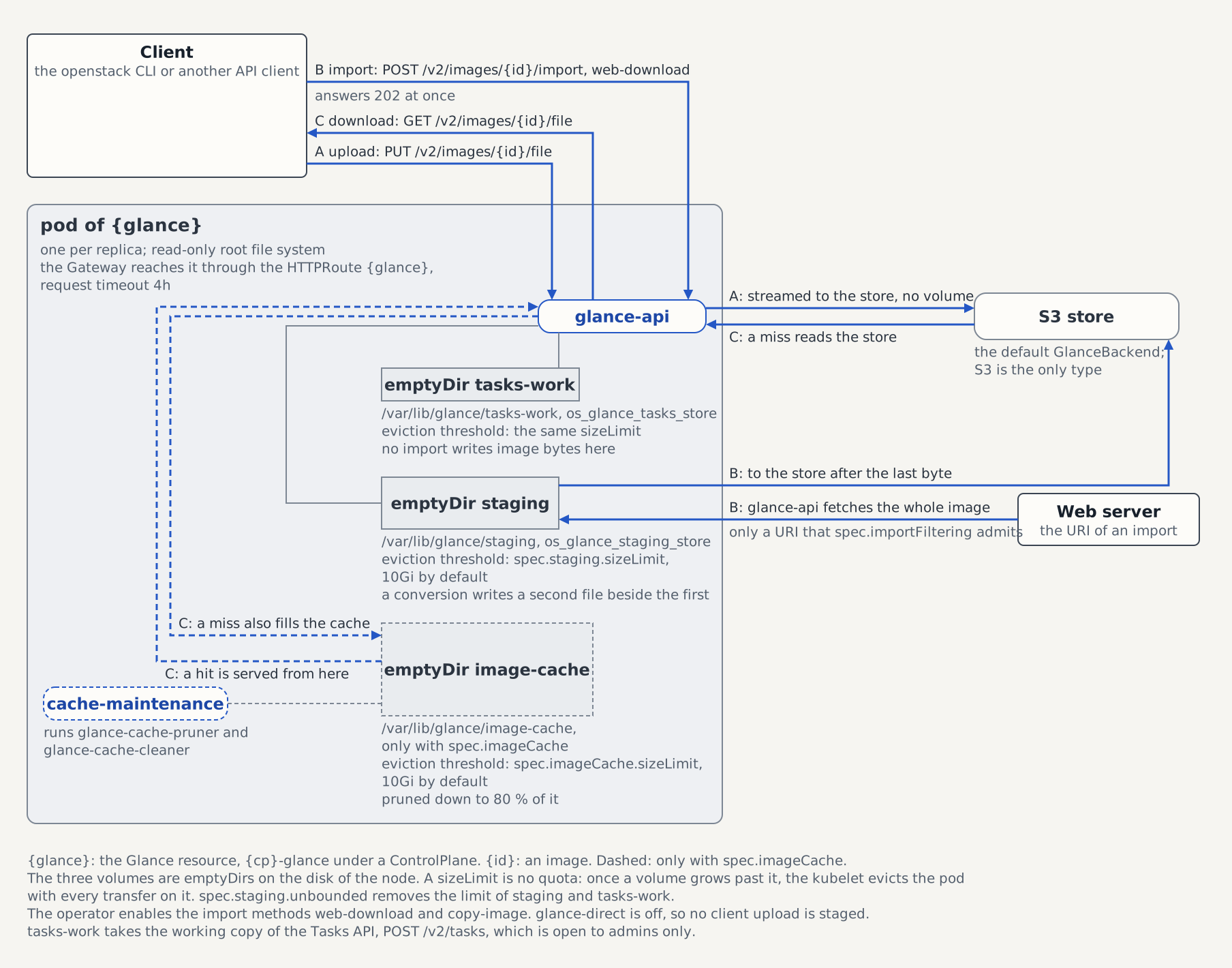
The figure shows where the filter acts: on path B, before the pod fetches the URI onto its staging volume.
Prerequisites
Devstack
This guide is written against the Quick Start (ControlPlane) devstack. Stand it up first:
KIND_HOST_PORT=8443 WITH_CONTROLPLANE=true make deploy-infraFollow that tutorial through to its final Verify step, so the projected controlplane-glance Glance child is Ready in the openstack namespace, its default S3 store is attached, and the image API answers on https://glance.127-0-0-1.nip.io:8443. Every resource name below is one that devstack produces.
- The
OS_*environment variables from the tutorial's token-issue step, so theopenstackclient reaches the ControlPlane's Keystone. - Outbound connectivity from the cluster to whichever mirror the verification step imports from. The devstack sets no per-CR
spec.networkPolicy, so pod egress is unrestricted; on a deployment that sets one, see Containing what a widened filter can reach.
What the default filter allows
The operator renders all six [import_filtering_opts] options on every reconcile, so the effective filter is always readable from the config the pods mounted:
kubectl get cm -n openstack "$(kubectl get deploy controlplane-glance -n openstack \
  -o 'jsonpath={.spec.template.spec.volumes[?(@.name=="config")].configMap.name}')" \
  -o 'jsonpath={.data.glance-api\.conf}' | grep -A6 '^\[import_filtering_opts\]'
With importFiltering unset — the devstack's state — that is the operator's restrictive default:
[import_filtering_opts]
allowed_hosts = []
allowed_ports = [443]
allowed_schemes = [https]
disallowed_hosts = [localhost,127.0.0.1,0.0.0.0,::1,169.254.169.254,kubernetes,kubernetes.default,kubernetes.default.svc,kubernetes.default.svc.cluster.local]
disallowed_ports = []
disallowed_schemes = []
Three properties of how Glance reads those lists decide what a change to them buys:
An allow-list disables its deny-list. Glance evaluates one half of each allow/deny pair: whenever the allow-list is non-empty it ignores the matching deny-list entirely. Setting both halves of one pair is therefore rejected at admission rather than silently half-applied, and a deny-list only becomes authoritative once its sibling allow-list is explicitly emptied — see Making a deny-list authoritative.
The port pin only bites on URIs that spell the port out. Glance checks the port it parsed from the URI, and a URI without one carries no port to check — no default is derived from the scheme. So https://mirror.example.com/img.raw passes the [443] pin, https://mirror.example.com:8443/img.raw does not, and the scheme pin is what actually keeps an import off plaintext transport.
A host must resolve, and encoded spellings are refused. Before matching, Glance normalizes the host: an IP literal is canonicalized, a decimal, hex, or shorthand encoding of one is refused outright, and a name is accepted only if it resolves as an absolute FQDN. That last point matters in-cluster — the lookup appends a trailing dot, which defeats the pod's resolv.conf search list, so an in-cluster mirror must be named in full (garage.shared-services.svc.cluster.local, not garage).
A submitted URI the filter refuses never reaches the fetch: the import call returns 400 with Glance's own message naming the URI, before any staging space is claimed.
Pin imports to a known mirror
The tightest posture names the mirrors imports may use and refuses every other host. It is a ControlPlane knob, projected onto the Glance child:
kubectl patch controlplane controlplane -n openstack --type merge \
  -p '{"spec":{"services":{"glance":{"importFiltering":{"allowedHosts":["mirror.example.com"]}}}}}'
kubectl rollout status deploy/controlplane-glance -n openstack
Substitute the mirrors the deployment imports from; the list holds up to 64 entries, each spelled exactly as an import URI would spell it.
Set the filter on the ControlPlane, never on the projected child
The controlplane-glance Glance CR is projected by the c5c3-operator, so a spec.importFiltering you patch onto the child is reverted on the next reconcile. The projection is unconditional in the other direction too: clearing services.glance.importFiltering on the ControlPlane removes the child's field, which restores the operator defaults on the next rollout and is how you revert this guide:
kubectl patch controlplane controlplane -n openstack --type merge \
  -p '{"spec":{"services":{"glance":{"importFiltering":null}}}}'
Read back what the pods got. The host allow-list is now populated and the denylist is gone, because Glance would ignore it anyway:
allowed_hosts = [mirror.example.com]
disallowed_hosts = []
Changing the filter rewrites the content-hashed config ConfigMap, and the new hash rolls the Deployment — one rollout per change. Confirm the service is healthy again on the ControlPlane's per-service condition; its aggregate Ready also covers every other service, so it answers a different question:
kubectl get controlplane controlplane -n openstack \
  -o jsonpath='{.status.conditions[?(@.type=="GlanceReady")].status}{" "}{.status.conditions[?(@.type=="GlanceReady")].reason}{"\n"}'
Allow a mirror that serves plaintext HTTP
A mirror on http:// or off port 443 needs both halves widened, since scheme and port are filtered independently:
kubectl patch controlplane controlplane -n openstack --type merge \
  -p '{"spec":{"services":{"glance":{"importFiltering":{"allowedSchemes":["http","https"],"allowedPorts":[80,443]}}}}}'
Admission accepts that and warns on it, once per widened list:
Warning: spec.services.glance.importFiltering.allowedSchemes is set to [http https], widening
the operator default [https]. The scheme and port pin is the primary web-download control — the
link-local metadata endpoint answers on http/80 — and once widened only the host denylist
remains, which matches literally: alternate spellings of the same address (an integer or
IPv4-mapped form, a raw ClusterIP, a trailing-dot FQDN) are not covered. Confine the reachable
endpoints with spec.networkPolicy.additionalEgress, or pin allowedHosts to the mirrors imports
are supposed to use.
The warning is the whole point of the two knobs being separate: disallowedHosts survives the widening — an unset field keeps resolving to the operator baseline, and an entry you add is unioned onto it rather than replacing it — but it is now the only control left, and it matches host strings literally. Pair a widened allow-list with allowedHosts, an egress restriction, or both.
Making a deny-list authoritative
disallowedSchemes and disallowedPorts are inert on their own: Glance evaluates a deny-list only while the matching allow-list is empty, and an unset allow-list resolves to a non-empty operator default. Admission warns rather than rejects, because the shape is legal, only ineffective:
Warning: spec.services.glance.importFiltering.disallowedSchemes is set while
spec.services.glance.importFiltering.allowedSchemes is unset and therefore resolves to the
operator default [https]. Glance evaluates a deny-list only while the matching allow-list is
empty, so this list is inert; set spec.services.glance.importFiltering.allowedSchemes to an
explicitly empty list ([]) to make the deny-list authoritative.
The empty-list opt-out the warning names does not survive the ControlPlane, though: the lists serialize with omitempty, so an explicitly empty one reaches the Glance child as unset and resolves straight back to the operator default. The projection can only ever land more restrictively than asked, never less — which means this shape is expressible on a Glance CR you own, and only there. See Standalone Glance, without a ControlPlane.
disallowedHosts is the exception: allowedHosts has no operator default, so a host deny-list on its own is authoritative and needs no opt-out.
Verification
With the OS_* variables exported, create one image record and hand it URIs the filter should refuse. A rejected import leaves the record queued, so the same record serves every attempt:
openstack --insecure image create --disk-format qcow2 --container-format bare filter-demoThe devstack's Garage object store answers on plaintext HTTP on port 3900, which is exactly what the default posture is there to refuse:
openstack --insecure image import --method web-download \
  --uri http://garage.shared-services.svc.cluster.local:3900/glance-images/demo.img filter-demo
URI for web-download does not pass filtering: http://garage.shared-services.svc.cluster.local:3900/glance-images/demo.imgThe call fails synchronously with 400 — a filter rejection, not a network or mirror fault. The link-local metadata endpoint and the in-cluster API server are refused by the host denylist even when the scheme and port pass:
openstack --insecure image import --method web-download \
  --uri https://169.254.169.254/latest/meta-data/ filter-demo
openstack --insecure image import --method web-download \
  --uri https://kubernetes.default.svc.cluster.local/version filter-demo
An HTTPS mirror on port 443 is accepted, and the call returns at once while the API pod stages the download:
openstack --insecure image import --method web-download \
  --uri https://download.cirros-cloud.net/0.6.3/cirros-0.6.3-x86_64-disk.img filter-demo
for _ in $(seq 60); do
  [ "$(openstack --insecure image show filter-demo -f value -c status)" = active ] && break
  sleep 5
done
openstack --insecure image show filter-demo -f value -c status -c size
The status reaches active. Redirects along the way are re-checked against the same six lists, so a mirror that redirects into a denied host fails the import asynchronously — the record does not reach active and the failure surfaces on the import task, not as the synchronous 400 above.
Clean up:
openstack --insecure image delete filter-demoContaining what a widened filter can reach
Host matching is literal string membership. Glance supports no CIDR ranges, no wildcards, and no resolution-based blocking, so the denylist covers the spellings it lists and nothing else: a raw ClusterIP, a trailing-dot FQDN, an IPv4-mapped IPv6 form, or an in-cluster HTTPS service whose name is absent all reach their endpoint under a name no list can enumerate. Two controls hold where the denylist cannot:
allowedHoststurns the question around — an allow-list refuses every host it does not name, including the spellings nobody thought to deny.spec.networkPolicy.additionalEgressbounds where the API pods may connect at all. The auto-derived egress opens the ports of DNS, the database, the cache and the S3 backends, to any destination. A per-CR NetworkPolicy without an explicit rule therefore blocks aweb-downloadmirror on any other port, and lets one on those ports through. See Enable the Glance Operator NetworkPolicy.
Neither of these is reachable through spec.extraConfig: all six [import_filtering_opts] keys are operator-owned and rejected at admission when set there, because an override would skip the exclusivity rules and the warnings above and leave an audit reading spec.importFiltering with the restrictive default while the rendered config says otherwise.
Standalone Glance, without a ControlPlane
Without a ControlPlane nothing projects the Glance child, so the same block sits on the Glance CR you own — including the explicitly empty allow-list the projection cannot carry:
apiVersion: glance.openstack.c5c3.io/v1alpha1
kind: Glance
metadata:
  name: glance
  namespace: openstack
spec:
  importFiltering:
    allowedSchemes: []          # opt out of the https pin …
    disallowedSchemes: [http]   # … so this deny-list is what applies
Everything else in this guide is unchanged: the operator resolves unset fields at render time, renders all six keys into glance-api.conf, and rolls the Deployment once per filter change. Removing the block again restores the operator defaults.
See also
- Glance CRD API Reference — the full
ImportFilteringSpeccontract, how every unset field resolves, and the upgrade note for a deployment that ran before the operator rendered this group. - ControlPlane CRD API Reference —
services.glance.importFilteringand the rest of the projected Glance surface. - Enable the Glance Operator NetworkPolicy — the egress layer a widened filter should be paired with.
- Large Image Uploads through the Gateway — the staging bound an accepted import consumes while it downloads.
Tested by
The restrictive default posture a CR without spec.importFiltering renders, and the admission rules that keep the block honest — the three mutually exclusive allow/deny pairs, the item bounds, the host INI guard, and the rejection of the six keys through extraConfig — are asserted end-to-end on the CI e2e kind cluster by these chainsaw suites:
chainsaw test --test-dir tests/e2e/glance/basic-deployment
chainsaw test --test-dir tests/e2e/glance/invalid-cr
A widened filter is exercised by the Glance Tempest legs instead, which run the upstream tempest.api.image import tests against a Glance that opts back into plaintext HTTP on port 80 — the only place CI imports over a widened filter.
The widened filter the Tempest leg applies
The leg isolates its Glance from the parallel suite pool, so the CR name (glance-tempest-2026-1) and its database and Keystone endpoint are the leg's own rather than the controlplane-glance devstack names used above. Its disallowedHosts stays unset, so the operator's host denylist keeps applying behind the widened scheme and port:
apiVersion: glance.openstack.c5c3.io/v1alpha1
kind: Glance
metadata:
  name: glance-tempest-2026-1
  namespace: openstack
spec:
  openStackRelease: "2026.1"
  deployment:
    replicas: 1
    # Mirror 00-keystone-cr.yaml: the operator sets no CPU limit, so this
    # block exists for its memory. tempest.api.image is upload/download-heavy
    # on the data path, so the glance-api pod keeps a 1Gi limit.
    resources:
      requests:
        cpu: 100m
        memory: 256Mi
      limits:
        memory: 1Gi
  # 2026.1 launches Glance under uWSGI, so this pod's request capacity is
  # replicas × processes. The webhook default (2) is below the stestr worker
  # count ci-run-tempest.sh runs (TEMPEST_CONCURRENCY, default 4), and the
  # port-forward pins every worker to this single pod, so raise the process
  # count to match rather than the replica count.
  apiServer:
    uwsgi:
      processes: 4
  image:
    repository: ghcr.io/c5c3/glance
    tag: "2026.1"
  database:
    clusterRef:
      name: openstack-db
    database: glance_tempest_2026_1
    secretRef:
      name: glance-db
  cache:
    clusterRef:
      name: openstack-memcached
  # The positive tempest.api.image web-download imports fetch tempest's built-in
  # default CONF.image.http_image, an http:// URL on port 80, which the
  # operator's HTTPS-only default filter would reject synchronously. This leg
  # therefore opts back into http and port 80. disallowedHosts stays unset, so
  # the default host denylist remains active, and the negative bad-URL test
  # keeps its existing asynchronous-failure outcome under tempest 46.3.0.
  importFiltering:
    allowedSchemes: [http, https]
    allowedPorts: [80, 443]
  keystoneEndpoint: http://keystone-glance-tempest-2026-1.openstack.svc.cluster.local:5000/v3
  serviceUser:
    username: admin
    projectName: admin
    userDomainName: Default
    projectDomainName: Default
    secretRef:
      name: keystone-admin
      key: password