How-to: Large Image Uploads through the Gateway
A stock cloud image is measured in gibibytes, and moving one through a public Gateway takes minutes to hours. This guide covers what has to hold for such a transfer to finish: how to size the node-local staging bound that image imports consume, what a deployment sees when an import breaches it, and which gateway properties the upload path depends on.
Prerequisites
Devstack
This guide is written against the Quick Start (ControlPlane) devstack. Stand it up first:
KIND_HOST_PORT=8443 WITH_CONTROLPLANE=true make deploy-infraFollow that tutorial through to its final Verify step, so the projected controlplane-glance Glance child is Ready in the openstack namespace, its default S3 store is attached, and the image API answers on https://glance.127-0-0-1.nip.io:8443. Every resource name below is one that devstack produces.
- The
OS_*environment variables from the tutorial's token-issue step, so theopenstackclient reaches the ControlPlane's Keystone.
How image bytes reach the store
Two paths lead into the backing store, and only one of them touches local disk.
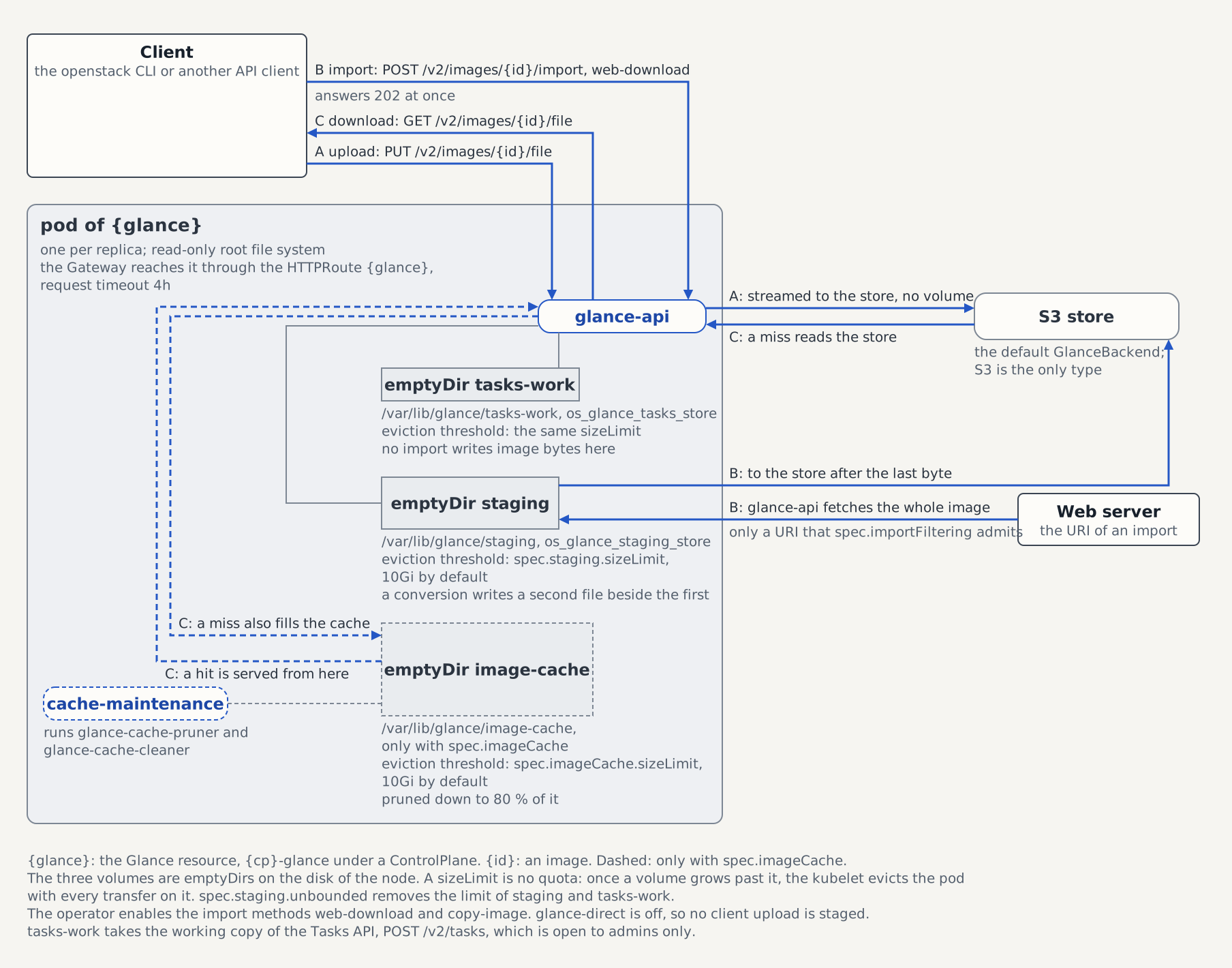
A client upload (PUT /v2/images/{id}/file, what openstack image create --file issues) streams the request body through the gateway straight into the store. Nothing is staged on the API pod, so its size is bounded by the client's patience and by the gateway.
A web-download import (POST /v2/images/{id}/import) hands Glance a URI and returns 202 at once. The API pod then fetches the whole image onto its staging volume, the reserved os_glance_staging_store, and moves it into the backing store only after the last byte has arrived. A second volume, tasks-work, backs the reserved os_glance_tasks_store, to which no import writes image bytes. Both are emptyDirs on the node filesystem, and spec.staging.sizeLimit bounds each of them. The operator enables web-download and copy-image only, so a client upload never stages.
The figure shows both paths as A and B, and the download through the image cache as C. The bound of the next section is the eviction threshold on the volume staging.
Sizing the staging bound
The bound is a ControlPlane knob, projected onto the Glance child:
kubectl patch controlplane controlplane -n openstack --type merge \
  -p '{"spec":{"services":{"glance":{"staging":{"sizeLimit":"40Gi"}}}}}'
kubectl rollout status deploy/controlplane-glance -n openstack
Set the bound on the ControlPlane, never on the projected child
The controlplane-glance Glance CR is projected by the c5c3-operator, so a spec.staging you patch onto the child is reverted on the next reconcile. The projection is unconditional in the other direction too: clearing services.glance.staging on the ControlPlane removes the child's field, and the glance operator's own default of 10Gi applies again.
Read back what the pods actually got. The value lands on both scratch volumes:
kubectl get deploy controlplane-glance -n openstack -o jsonpath='staging={.spec.template.spec.volumes[?(@.name=="staging")].emptyDir.sizeLimit}{"\n"}tasks-work={.spec.template.spec.volumes[?(@.name=="tasks-work")].emptyDir.sizeLimit}{"\n"}'staging=40Gi
tasks-work=40GiThree properties decide the number:
- Both volumes carry it. One glance-api pod is expected to occupy at most twice the configured limit, so
40Gibudgets 80Gi per replica. - Concurrent imports share it, and breaching it evicts the pod. An
emptyDiris per pod, and nothing accounts per import: two imports scheduled onto the same replica draw from one 40Gi volume, and when their combined staging usage crosses the bound the kubelet evicts the pod, killing both — and every other transfer in flight on that replica. Size for the concurrency the deployment expects, not for its largest single image. - Conversion needs headroom. An import plugin that converts the downloaded image writes the converted copy alongside the original before replacing it, so a converting import can occupy roughly twice its image size in staging.
The operator's default of 10Gi covers the stock distribution cloud images with room to convert. Raise it for a deployment that imports disk images built for databases or appliances, where a single qcow2 can exceed that on its own.
The bound applies retroactively on operator upgrade
A Glance that predates this block ran with unbounded scratch volumes. Upgrading the operator stamps the resolved 10Gi onto the existing Deployment, rolls the pods — killing any in-flight import — and then evicts the pod on an import that used to succeed above 10Gi.
You cannot decide this in advance. staging reaches the ControlPlane schema in the same chart version that introduces the bound, so either patch on this page names a field the pre-upgrade CRD does not have: the API server prunes it, the request succeeds having stored nothing, and kubectl patch carries no --validate flag to turn that silence into an error. Quiesce the imports you care about, upgrade, then patch once the field exists — which rolls the pods a second time, onto the value you chose.
Opting out means unbounded, which renders both scratch volumes with no sizeLimit at all — the shape the pods had before the block existed:
kubectl patch controlplane controlplane -n openstack --type merge \
  -p '{"spec":{"services":{"glance":{"staging":{"sizeLimit":null,"unbounded":true}}}}}'
It is the escape hatch, not the recommendation. An unbounded volume puts nothing between one runaway web-download import and the node's disk, and once that disk fills the kubelet evicts across every pod on the node rather than only the Glance ones. Setting it together with sizeLimit is rejected at admission, which is why the patch above clears the one while setting the other.
What the bound does not do
It is not a filesystem quota. emptyDir.sizeLimit is an eviction threshold the kubelet evaluates on its periodic local-storage housekeeping pass (~10 s), so peak usage is the bound plus whatever the writer appends within one pass — an import pulling at local-disk line rate overshoots by that much, and one that finishes inside a single pass is never noticed at all. Leave headroom on the node for the overshoot.
It is not a scheduling reservation either. The operator derives no resources.requests.ephemeral-storage from it, so the scheduler does not know what a glance-api pod may claim, and replicas — or pods from separate Glance CRs — co-schedule freely. Four pods at the default may legitimately reach 80 GiB of scratch on one node, and once the node crosses its eviction threshold the kubelet ranks and evicts across every pod on it, not only the Glance ones. Size nodes against replicas × 2 × sizeLimit. To make the scheduler account for it, add ephemeral-storage to spec.deployment.resources.requests. The operator fills the CPU and memory defaults per resource, so they stay beside it.
Finally, it does not meter tenants. It caps how much local disk the imports on one pod may consume before the kubelet steps in, and says nothing about how many images a project may create or how much it may keep in the backend. Those are Glance quotas.
When an import breaches the bound
Glance knows nothing about the bound and keeps writing. The kubelet notices on its next local-storage housekeeping pass, and the sequence from there is fixed:
- local-storage eviction evicts the glance-api pod;
- the in-flight import dies with it, so its image never reaches
active; - the Deployment replaces the pod and the API recovers without operator or human intervention.
The eviction is visible on the pod and in the event stream:
kubectl get pods -n openstack -l app.kubernetes.io/instance=controlplane-glance \
  -o 'custom-columns=NAME:.metadata.name,PHASE:.status.phase,REASON:.status.reason'
kubectl get events -n openstack --field-selector reason=Evicted
The image record survives in a non-active status. Delete it, then retry with a larger bound or a smaller image; nothing about the failed import is retried automatically.
Two things are worth knowing before relying on this. An eviction takes the whole pod, so a well-behaved import that happened to run on the same replica dies with the oversized one. And with a single replica the API is briefly unreachable while the replacement pod starts, which is one more reason to run more than one.
Gateway requirements for the upload path
The route timeout is raised to four hours. The glance operator renders timeouts.request: "4h" on the HTTPRoute it manages, so a conforming implementation lets a transfer run far longer than its default allows:
kubectl get httproute controlplane-glance -n openstack \
  -o jsonpath='{.spec.rules[0].timeouts.request}{"\n"}'
No CR field configures this, on the Glance CR or on the ControlPlane. The implementation default (15 s on Envoy Gateway) truncates legitimate image transfers, which is why the identity and dashboard routes keep it and this one does not.
The bound is raised, never removed. "0s" is the Gateway API spelling of a disabled timeout, and the operator deliberately does not use it: the route matches a bare / prefix, so it covers every Glance path, and the route timeout is then the only request-duration cap in front of the API. A stream idle timeout does not substitute for it — it resets on every byte, so a client trickling one byte at a time never goes idle. Four hours clears any legitimate transfer while still capping how long one stalled request holds its worker.
The route timeout bounds duration, not concurrency
It is no defense against a saturated worker pool, and nothing else the operator renders is either. A glance-api pod serves processes × threads concurrent requests — two by default (--processes 2 --threads 1, with uWSGI harakiri off unless spec.apiServer.uwsgi.harakiri is set) — so a three-replica deployment has six request slots for the whole API. Requests that keep trickling occupy a slot for the full four hours, and while every slot is occupied, unrelated calls such as an image list queue behind them. Six concurrent multi-gibibyte uploads over slow links do this as readily as a client abusing it deliberately.
Size against it rather than against the deadline. Widening the pool is the lever the CRs expose: spec.sizing.glance.api.replicas, .processes and .threads on the ControlPlane (from 2026.1 the counts land in the child's spec.apiServer.uwsgi; below it the process count lands in spec.apiServer.workers), and spec.apiServer.uwsgi processes and threads on a standalone Glance. Shedding the excess instead of queueing it is a Gateway concern: on Envoy Gateway a BackendTrafficPolicy caps concurrent requests per backend. That policy belongs to the Gateway infrastructure and is not rendered by this operator.
The stanza only survives if the cluster's Gateway API CRDs know the field. It entered the HTTPRoute schema after the versions the stack shipped earlier, so hack/deploy-infra.sh pins v1.6.2 of the standard channel; an older CRD prunes timeouts silently, and the transfer is then cut at the implementation default with nothing logged.
A listener must match the hostname. spec.gateway.hostname routes only if the Gateway terminates TLS for that SNI hostname. The kind stack's Gateway openstack-gw carries one listener per hostname, each with its own cert-manager Certificate, including https-glance-upload for glance-upload.127-0-0-1.nip.io — a hostname reserved for the large-upload end-to-end suite so it cannot race the Quick Start smoke suite's route. Check that the listener a hostname needs is programmed before blaming the upload:
kubectl get gateway openstack-gw -n openstack \
  -o jsonpath='{range .status.listeners[*]}{.name}{"\t"}{.conditions[?(@.type=="Programmed")].status}{"\n"}{end}'
Body-size limits belong to the gateway stack. Envoy Gateway caps no request body by default, so a multi-gibibyte PUT reaches Glance intact. Other stacks disagree: an NGINX-based ingress defaults to a 1 MiB body and answers 413 within the first megabyte of an image. Fronting Glance with such a stack means raising that limit there — raise it to the largest image the deployment accepts rather than removing it, so the gateway keeps a ceiling on what one request may push at the API. The operator writes no annotation for it, and spec.gateway.annotations is passed through to the HTTPRoute verbatim, so whichever key that stack reads is yours to set.
Imports need an egress path. A web-download import makes the API pod an HTTP client of whatever URI it is handed, which is a second surface next to the upload path. spec.importFiltering decides which URIs are admissible (HTTPS on port 443 by default), and the per-CR NetworkPolicy decides where the pod may connect at all — its auto-derived egress opens the ports of DNS, the database, the cache and the S3 backends, to any destination, so a mirror on another port needs an explicit additionalEgress rule. See Enable the Glance Operator NetworkPolicy for both layers.
Verification
With the OS_* variables exported, push an image large enough to outlive any default route timeout. 512 MiB is what the end-to-end suite uses:
dd if=/dev/urandom of=/tmp/large.img bs=1M count=512
time openstack --insecure image create --disk-format raw --container-format bare \
  --file /tmp/large.img large-image
openstack --insecure image show large-image -f value -c status -c size
The status is active and the size is 536870912. A truncated transfer surfaces as a client-side error from the gateway, or as an image stuck in queued.
Imports take the staging path. Create the record, then hand Glance a URI:
openstack --insecure image create --disk-format raw --container-format bare big-import
openstack --insecure image import --method web-download \
  --uri https://mirror.example.com/cloud-image.raw big-import
The call returns immediately and the image reaches active once the download and the move into the store have finished. Watch openstack image show big-import -f value -c status for the transition. A synchronous 400 at import time comes from the URI filter, before any bytes are staged — see Filter web-download Image Imports.
Clean up:
openstack --insecure image delete large-image big-import
rm -f /tmp/large.img
Standalone Glance, without a ControlPlane
Without a ControlPlane nothing projects the Glance child, so the same knob sits on the Glance CR you own:
apiVersion: glance.openstack.c5c3.io/v1alpha1
kind: Glance
metadata:
  name: glance
  namespace: openstack
spec:
  staging:
    sizeLimit: 40Gi
Everything else in this guide is unchanged: the operator resolves an unset field to 10Gi, stamps the resolved value on both scratch volumes, and renders the same four-hour route timeout on the HTTPRoute it creates from spec.gateway.
See also
- Glance CRD API Reference — the full
StagingSpeccontract and its admission rules. - ControlPlane CRD API Reference —
services.glance.stagingand the rest of the projected Glance surface. - Keystone CRD API Reference — the shared HTTPRoute mapping, including the route timeout, which only the Glance operator sets.
- Infrastructure Manifests — the kind stack's
https-glance-uploadlistener and its certificate.
Tested by
The upload path, the staged (glance-direct) upload that fills the bounded staging volume, and the eviction that contains an oversized one are asserted end-to-end on the CI e2e kind cluster by this chainsaw suite:
chainsaw test --test-dir tests/e2e/glance/gateway-large-upload