BarbicanSecretStore CRD
Reference documentation for the BarbicanSecretStore Custom Resource Definition. One CR attaches to a Barbican CR via spec.barbicanRef and describes the backend the secret material itself is written to. Phase 1 ships type: OpenBao, driven by barbican's vault secret-store plugin.
The attachment is inverted: the store points at the Barbican, so a store is added or replaced without editing the Barbican CR. A dedicated controller owns the store lifecycle, the AppRole credentials and the per-store conditions, while the barbican-side sub-reconciler aggregates the attached, credential-ready stores into the rendered barbican.conf and promotes the one marked isDefault to global_default. For that controller topology see Barbican Reconciler Architecture.
The CRD is generated from operators/barbican/api/v1alpha1/barbicansecretstore_types.go; the webhook lives in barbicansecretstore_webhook.go and the controllers in operators/barbican/internal/controller/barbicansecretstore_controller.go and reconcile_secretstores.go.
API Group and Version
| Field | Value |
|---|---|
| Group | barbican.openstack.c5c3.io |
| Version | v1alpha1 |
| Kind | BarbicanSecretStore |
| List Kind | BarbicanSecretStoreList |
| Scope | Namespaced |
Printer columns: kubectl get barbicansecretstores shows Ready (.status.conditions[?(@.type=='Ready')].status), Type (.spec.type), Default (.spec.isDefault), Barbican (.spec.barbicanRef.name), and Age.
Example
apiVersion: barbican.openstack.c5c3.io/v1alpha1
kind: BarbicanSecretStore
metadata:
  name: openbao-primary
  namespace: openstack
spec:
  barbicanRef:
    name: barbican
  type: OpenBao
  isDefault: true
  openBao:
    instanceRef:
      name: openbao-instance
status:
  conditions:
  - type: CredentialsReady
    status: "True"
    reason: CredentialsAvailable
  - type: ProvisioningReady
    status: "True"
    reason: Provisioned
  - type: ConfigProjected
    status: "True"
    reason: ConfigProjected
  - type: Ready
    status: "True"
    reason: AllReady
The metadata.name (openbao-primary) becomes the store identifier: it is the suffix of the [secretstore:openbao-primary] section barbican reads and one entry of the [secretstore] stores_lookup_suffix list.
Spec
BarbicanSecretStoreSpec
Three schema-level CEL rules hold even when the webhook is down: barbicanRef and type are immutable (UPDATE transition rules), and the type/openBao union rule (self.type == 'OpenBao') == has(self.openBao) requires one store block matching spec.type and no other.
| Field | Type | Required | Default | Description |
|---|---|---|---|---|
barbicanRef | BarbicanRefSpec | Yes | — | Names the Barbican CR in the same namespace. Immutable (CEL transition rule): re-pointing a store would leave the old deployment with a store nothing manages anymore and race the projection on the new one. Delete and recreate instead. The Barbican need not exist at admission time (GitOps ordering); a dangling reference surfaces as Ready=False. |
type | BarbicanSecretStoreType | Yes | — | Store plugin; the enum holds one value, OpenBao. A brownfield HashiCorp Vault server attaches under the same value: the plugin talks the KV v2 API, which OpenBao and Vault both serve, so the two are interchangeable from barbican's side. Immutable, and for a harder reason than barbicanRef: material already written through a store cannot be read back through a different plugin. |
openBao | *OpenBaoStoreSpec | When type: OpenBao | — | The OpenBao-backed store. Required when type is OpenBao and forbidden otherwise (union rule). |
isDefault | bool | No | false | Marks this store the Barbican global default (global_default in its [secretstore:<name>] section). Mutable. One attached, credential-ready store must carry it and no more than one; the barbican-side sub-reconciler and a sibling-uniqueness webhook both enforce that. |
extraOptions | map[string]string | No | — | Free-form [vault_plugin] options not covered by the typed fields, keyed by bare option name. The entries merge into the process-global section every OpenBao store on the same Barbican shares. MaxProperties=32, and a CEL rule bounds each key at 256 and each value at 1024 characters. See the denylist. |
BarbicanRefSpec
| Field | Type | Required | Description |
|---|---|---|---|
name | string | Yes | The referenced Barbican CR's name (MinLength=1). |
SecretNameRefSpec
Unlike commonv1.SecretRefSpec, this reference carries no key field: the data keys are fixed by contract, so there is nothing to select.
| Field | Type | Required | Description |
|---|---|---|---|
name | string | Yes | The referenced Secret's name (MinLength=1). |
InstanceRefSpec
Kept apart from SecretNameRefSpec so the generated schema describes what the name addresses: the OpenBao instance the operator provisions against, not a Secret.
| Field | Type | Required | Description |
|---|---|---|---|
name | string | Yes | The referenced OpenBaoCluster's name (MinLength=1). |
OpenBaoStoreSpec
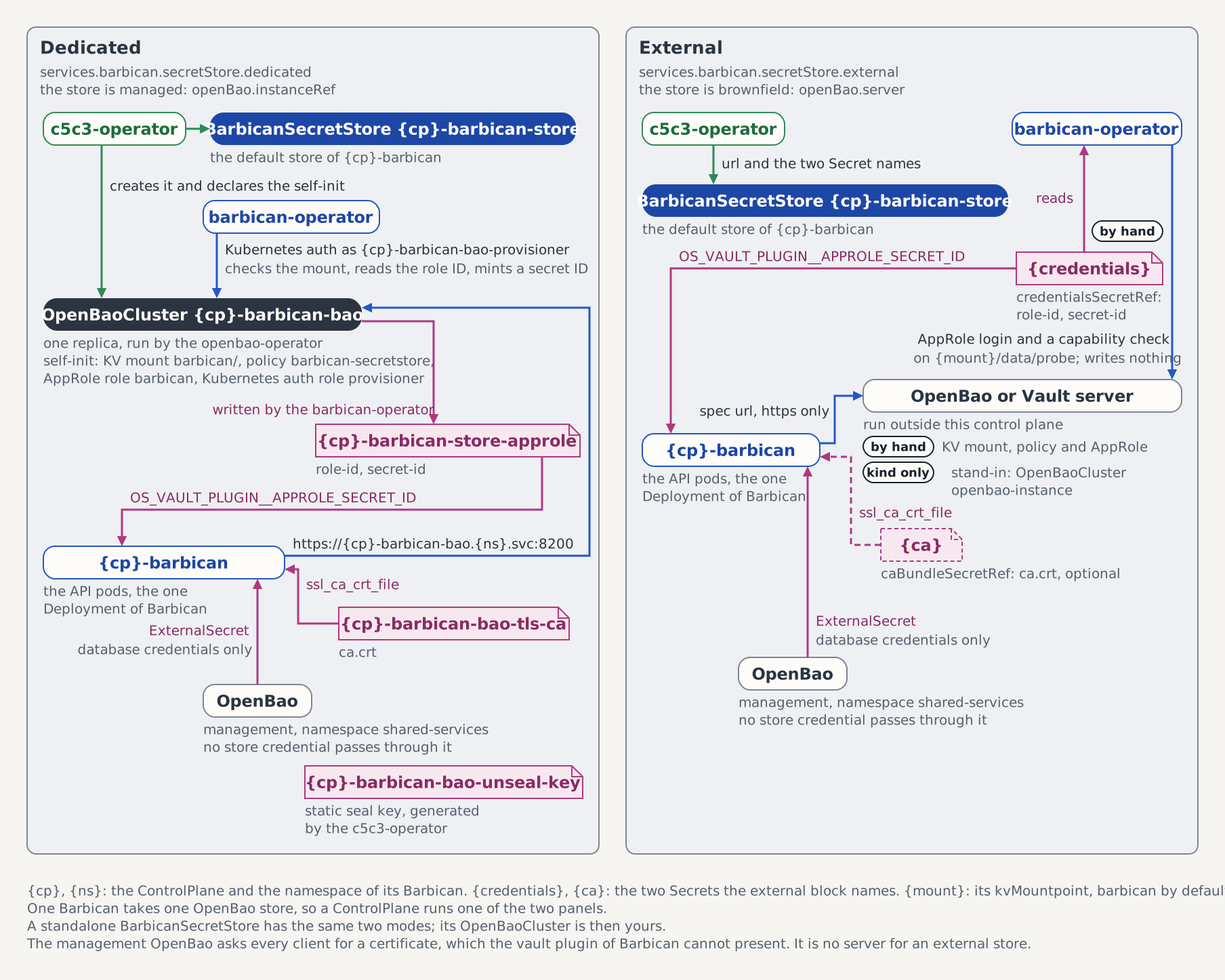
Two modes, selected by which of instanceRef and server is set. Managed mode points at an OpenBaoCluster this cluster runs: the operator mints the AppRole secret ID at runtime and checks that the KV mount exists. The mount, the policy and the AppRole role come from the self-init of the instance. Brownfield mode points at an OpenBao or HashiCorp Vault server elsewhere and is validate-only, the same read-only posture K-ORC takes with unmanaged imports: the operator reads the referenced Secrets and renders the configuration, and never creates a mount, a policy, an AppRole, or secret material on that server.
The figure shows both modes for the store a ControlPlane projects, which calls them dedicated and external.
| Field | Type | Required | Default | Description |
|---|---|---|---|---|
instanceRef | *InstanceRefSpec | Managed mode | — | The OpenBaoCluster (openbao.org/v1alpha1) in this store's namespace to provision against. Everything else is derived from that name by convention: the server URL https://<instance>.<namespace>.svc:8200, the CA Secret <instance>-tls-ca, and the provisioner ServiceAccount <instance>-provisioner the operator mints a bound token for. |
server | *OpenBaoServerSpec | Brownfield mode | — | An OpenBao or Vault server provisioned outside this operator. |
kvMountpoint | string (MinLength=1) | No | barbican | The path the KV v2 engine holding barbican's material is mounted at. A managed store is pinned to the default; a brownfield store names whatever mount its server provides. The default only fills an absent field, so the MinLength guard is what rejects an explicitly empty path. |
namespace | string | No | — | Scopes every request to an OpenBao/Vault namespace (the enterprise-style multi-tenancy header). Brownfield only. It also scopes the operator's own login and capability read, since the AppRole lives in that namespace. |
Three further CEL rules shape the block:
| Rule | Message |
|---|---|
has(self.instanceRef) != has(self.server) | exactly one of instanceRef or server must be set |
!has(self.instanceRef) || (self.kvMountpoint == 'barbican' && !has(self.namespace)) | managed stores (instanceRef) must keep kvMountpoint barbican and leave namespace unset: the self-init contract provisions only the barbican/ mount at the root namespace |
self.kvMountpoint == oldSelf.kvMountpoint | kvMountpoint is immutable: the secret material already written under the old mount is not reachable under a new one |
A fourth, has(self.instanceRef) == has(oldSelf.instanceRef), freezes the mode itself: switching between a managed instance and a brownfield server re-points the plugin at a different server entirely. Delete and recreate the store.
OpenBaoServerSpec
Both Secret references resolve in the store's namespace.
| Field | Type | Required | Description |
|---|---|---|---|
url | string | Yes | The server's API base URL. MinLength=1 and pattern ^https://. TLS is mandatory: the operator's own AppRole login and every secret barbican stores travel this URL, and a plaintext scheme would also make a supplied caBundleSecretRef a no-op, leaving a CR that looks TLS-configured and is not. The webhook re-checks the prefix. |
caBundleSecretRef | *SecretNameRefSpec | No | The Secret holding the PEM CA bundle that authenticates the server, under the fixed data key ca.crt. Omit it when the server presents a certificate the pods already trust through their system store; the rendered config then omits ssl_ca_crt_file, and no bundle is mounted. |
credentialsSecretRef | SecretNameRefSpec | Yes | The Secret holding the AppRole credentials barbican authenticates with, under the fixed data keys role-id and secret-id. The AppRole is created on the server outside this operator, which only reads the Secret. |
Credentials data-key contract. Both modes read the same keys, pinned by contract and not selectable per CR (the constants live at the top of barbicansecretstore_types.go):
| Data key | Where it goes |
|---|---|
role-id | Rendered as [vault_plugin] approle_role_id |
secret-id | Injected as the OS_VAULT_PLUGIN__APPROLE_SECRET_ID env var, never written to the config file |
ca.crt | Mounted into the API pods; the mount path is what [vault_plugin] ssl_ca_crt_file points at |
extraOptions Denylist
The validating webhook rejects extraOptions keys the projection owns, so the escape hatch cannot contradict the typed spec. Every key must first match ^[A-Za-z0-9_]+$ (letters, digits, underscore); vault plugin option names are snake_case, so that is the full legitimate charset, and the pattern runs before the exact-match denylist so an embedded newline or a denylist-evading trailing space cannot slip through. Values carrying a newline or carriage return are rejected as an INI-injection guard.
| Group | Rejected keys |
|---|---|
| Derived from the typed store spec | vault_url, use_ssl, ssl_ca_crt_file, approle_role_id, approle_secret_id, root_token_id, kv_mountpoint, namespace |
| Structural secret-store wiring | secret_store_plugin, crypto_plugin, global_default |
The renderer consults the same predicate when it merges extraOptions into the plugin section. An exists check alone would only cover the keys the operator wrote this pass, which leaves the four it never writes (root_token_id, approle_secret_id, crypto_plugin, and ssl_ca_crt_file on a store with no CA bundle) free to pass through on a CR that reached etcd without the webhook. root_token_id is the one that matters: the plugin prefers a root token over AppRole authentication, so it would defeat the mount-scoped AppRole the managed store is built on.
Separately, a store's metadata.name becomes its [secretstore:<name>] section suffix, and barbican resolves that suffix against the flat section namespace of one config file. The webhook therefore rejects a name colliding with a reserved section: default (matched case-insensitively, which covers the upstream DEFAULT), database, keystone_authtoken, secretstore, vault_plugin, queue, oslo_policy, oslo_middleware, and healthcheck.
Default-Store Semantics
One attached, credential-ready store must be marked isDefault, and no more than one. Two gates enforce it:
- Admission (sibling uniqueness). When a store under validation sets
isDefault, the webhook lists its namespace siblings (an uncached read), filters to the samespec.barbicanRef.name, skips self andTerminatingsiblings, and rejects if another default already exists. A second rule with the same shape rejects a secondOpenBao-typed sibling whether or not it is the default, because the[vault_plugin]section is process-global. - Reconcile (the counting rule). The barbican-side sub-reconciler counts the credential-ready defaults. Zero or more than one is an invalid projection: it sets
SecretStoresReady=False / NoDefaultSecretStore, re-renders nothing, and the config step retains the last-good Secret the live Deployment mounts. More than one credential-ready OpenBao store lands on the same path underMultipleOpenBaoStores.
Replacing the default store re-renders the config Secret: unlike the Glance backends split, barbican keeps the default marker inside the per-store section (global_default) of the one document, so the content hash changes and the pods roll.
Deleting a store is not a no-op for the data behind it. Barbican resolves every stored secret through the secret_stores row naming the store it was written to, so once a [secretstore:<name>] section is gone, every secret written under it stops resolving. Nothing else says so: no finalizer holds the store CR (with a parent on a target cluster it carries one that only removes its credentials Secret there), its deletion is not validated, and the parent re-renders as soon as the remaining stores form a valid projection. The SecretStoreDetached Warning event fires on the pass that de-projects the store and names that consequence.
Conditions
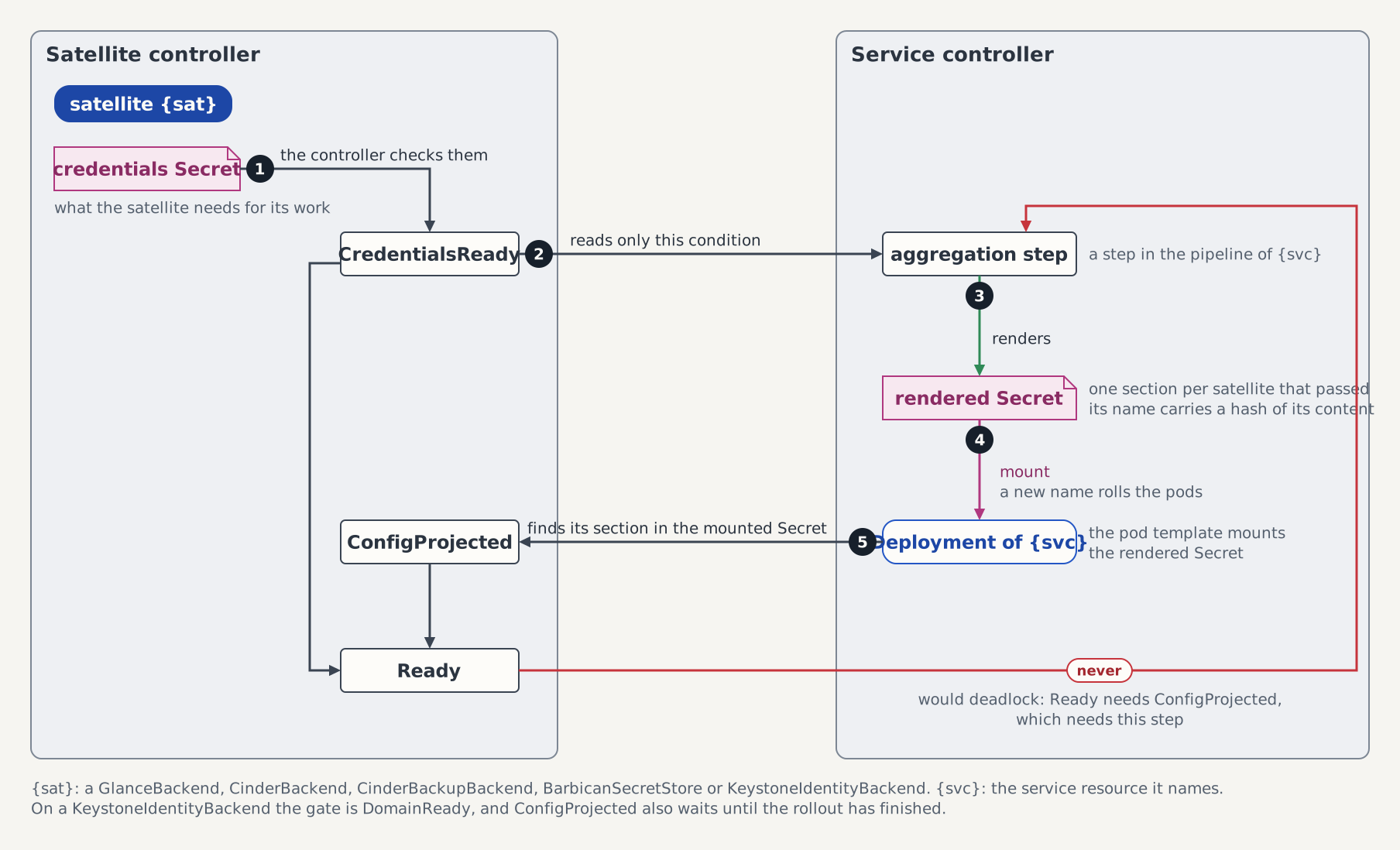
The BarbicanSecretStoreReconciler is the single writer of this status. The barbican-side sub-reconciler reads CredentialsReady alone (never the aggregate Ready, which also requires ConfigProjected and would deadlock, since ConfigProjected only turns True after the projection lands) and writes the aggregated SecretStoresReady condition onto the Barbican CR instead.
The figure draws that order. A store the operator provisions sets ProvisioningReady before step 1, and the step does not read it. The handshake lists the five steps and what differs per kind.
| Type | Owner | Status | Reason | Meaning |
|---|---|---|---|---|
CredentialsReady | BarbicanSecretStore | True | CredentialsAvailable | The credentials in hand are accepted by the server: a managed store's minted pair passed a login probe, a brownfield store's referenced pair logged in and holds the create, read, update, delete, list capabilities on the mount's data path |
CredentialsReady | BarbicanSecretStore | False | WaitingForCredentials | The referenced Secret does not carry a non-empty role-id, secret-id, or ca.crt yet |
CredentialsReady | BarbicanSecretStore | False | InvalidCredentials | The server rejects the credentials. A managed store re-mints once, at most once per ten minutes, and reports the rejection in between |
CredentialsReady | BarbicanSecretStore | False | InsufficientCapabilities | The AppRole policy does not grant all five capabilities on the probe path |
CredentialsReady | BarbicanSecretStore | False | OpenBaoUnreachable | The server did not answer, or the client could not be built |
CredentialsReady | BarbicanSecretStore | False | WaitingForParent | No Barbican of the name in spec.barbicanRef exists, so which cluster this store's credentials belong on is unknown. The store waits and requeues after 15 seconds rather than minting an AppRole secret ID against the management cluster |
CredentialsReady | BarbicanSecretStore | False | TargetClusterUnavailable | The parent Barbican's spec.targetClusterRef names a target cluster that is not registered or no longer resolves. The message carries the resolver's error, the store requeues after 15 seconds, and nothing is created on any cluster. See Target Clusters |
ProvisioningReady | BarbicanSecretStore | True | Provisioned | The referenced OpenBaoCluster is Available and carries the barbican KV mount and the barbican AppRole |
ProvisioningReady | BarbicanSecretStore | False | InstanceNotFound | No OpenBaoCluster of that name exists in the store's namespace |
ProvisioningReady | BarbicanSecretStore | False | WaitingForInstance | The instance is not Available yet, or its provisioner ServiceAccount does not exist |
ProvisioningReady | BarbicanSecretStore | False | WaitingForInstanceTLS | The <instance>-tls-ca Secret does not carry the ca.crt trust bundle yet |
ProvisioningReady | BarbicanSecretStore | False | InstanceNotProvisioned | The instance is up but the self-init requests (barbican_kv, approle_auth, barbican_approle_role) did not run: the mount or the AppRole is missing |
ProvisioningReady | BarbicanSecretStore | False | ProvisioningDenied | The operator may not mint a bound token for the provisioner ServiceAccount, or OpenBao answered 403. The TokenRequest grant is namespace- and account-scoped by design and is rendered per rbac.secretStoreNamespaces key, so an unlisted namespace lands here |
ConfigProjected | BarbicanSecretStore | True | ConfigProjected | The parent Barbican Deployment mounts a barbican.conf carrying this store's [secretstore:<name>] section |
ConfigProjected | BarbicanSecretStore | False | WaitingForProjection | The projection has not landed in the Deployment yet |
Ready | BarbicanSecretStore | True | AllReady | Every sub-condition of the store's mode is True |
Ready | BarbicanSecretStore | False | NotAllReady | At least one is not |
SecretStoresReady | Barbican | True | AllStoresProjected | Every attached store is credential-ready and projected, with a valid default |
SecretStoresReady | Barbican | False | NoDefaultSecretStore | Zero or more than one credential-ready store is marked isDefault; last-good config is retained |
SecretStoresReady | Barbican | False | MultipleOpenBaoStores | More than one credential-ready store is of type OpenBao; the reconcile-time backstop for a store that bypassed admission |
SecretStoresReady | Barbican | False | WaitingForSecretStores | The default store passed its own credential gate, but its credentials Secret could not be read this pass, or an assembled option carried a control character |
ProvisioningReady is managed-mode only. A brownfield store has no instance this operator provisions, so the condition is removed from the status on every pass and the aggregate is derived from the remaining two, which keeps a store that used to name an instanceRef from waiting on a condition nothing sets.
Per-store fault isolation. When the default store's credentials Secret cannot be read, or an assembled [vault_plugin] value carries a control character, the barbican-side step keeps the last-good configuration, emits a BarbicanSecretStoreSkipped Warning event on the Barbican CR, and waits for the store watch. None of the waiting states returns an error or a requeue: a store's status flip re-enqueues the parent.
Immutability and Validation Summary
Schema-layer rules (CEL and kubebuilder markers, enforced even when the webhook is down): the barbicanRef and type transition rules, the type/openBao union, the OpenBao type enum, the instanceRef/server union, the managed mount-and-namespace pin, the kvMountpoint and mode transition rules, the ^https:// URL pattern, the MinLength guards on every reference name, and the extraOptions MaxProperties and key/value length bounds.
Webhook rules (defense in depth plus what CEL cannot express): the union re-checks, the https:// prefix re-check, the reserved-section collision guard on metadata.name, the extraOptions key pattern and denylist, the INI-injection guard on extraOptions values, the single-default sibling check, and the single-OpenBao-store sibling check. The kvMountpoint default (barbican) is materialized by the defaulting webhook for callers that bypass it.
metadata.name is bounded at 55 characters, checked on create only for the reason the Barbican CRD gives for its own bound: the operator derives the AppRole credentials Secret by appending -approle, and a Secret name is capped at the 63 characters of a DNS label, so MaxBarbicanSecretStoreNameLength = 63 − len("-approle").
Chainsaw E2E Tests
The managed flow (an OpenBaoCluster in the suite, the minted -approle Secret, and the rendered store section) lives in tests/e2e/barbican/secretstore-managed. The brownfield flow, where the AppRole is seeded outside the operator and the store is validate-only, lives in tests/e2e/barbican/secretstore-brownfield. Clearing the default, which keeps the last-good config, and replacing the store by a new default one, which re-renders global_default, lives in tests/e2e/barbican/default-secretstore-switch. The detach path lives in tests/e2e/barbican/deletion-cleanup. The rejection corpus lives in tests/e2e/barbican/invalid-barbicansecretstore-cr and covers the union rules, the managed-mode pins, the reserved names, the name bound, the extraOptions guards, the transition rules, and both sibling rules.
Retained Artefacts
A managed store's AppRole credentials live in a Secret named after the store, <store>-approle, carrying role-id and secret-id under the contract keys. With a parent on the management cluster the operator writes it with a controller owner reference to the store CR, so Kubernetes garbage collection reclaims it when the store is deleted. With a parent that names spec.targetClusterRef the Secret lives on that cluster and carries ownership labels, and the store's remote-children finalizer deletes it. No finalizer revokes the AppRole, and that is the design: the AppRole itself is shared instance state the self-init contract owns rather than state of this CR, so revoking it on delete would break every other store on the same instance. Deleting a store detaches it and nothing more.
Two annotations on that Secret carry the re-mint timer:
| Annotation | Value |
|---|---|
barbican.c5c3.io/secret-id-minted-at | RFC 3339 timestamp of the mint |
barbican.c5c3.io/secret-id-ttl-seconds | The TTL the server returned; 0 means the secret ID does not expire |
They are the only record there is. OpenBao hands a secret ID out once and offers no read-back, so the operator re-mints at two thirds of the recorded TTL and verifies the credentials in hand with a login probe otherwise. A brownfield store's Secrets are referenced, never written: the operator reads role-id, secret-id, and (when caBundleSecretRef is set) ca.crt, and leaves their lifecycle to whoever created them.