Migrate Placement DB to Dynamic Credentials
This guide takes a managed-mode ControlPlane from a long-lived static Placement database credential to dynamic, engine-issued credentials, without database downtime. It is the operator-facing side of the OpenBao MariaDB database secrets engine wired for the Placement service DB user.
What changes
- Before: the Placement DB password is a long-lived value materialised from an OpenBao KV path (
openstack/placement/{namespace}/{name}/db) into the{name}-placement-db-credentialsSecret. Nothing seeds that path, so on the static branch an operator writes it and rotates it by hand. - After: the c5c3 operator projects a per-ControlPlane
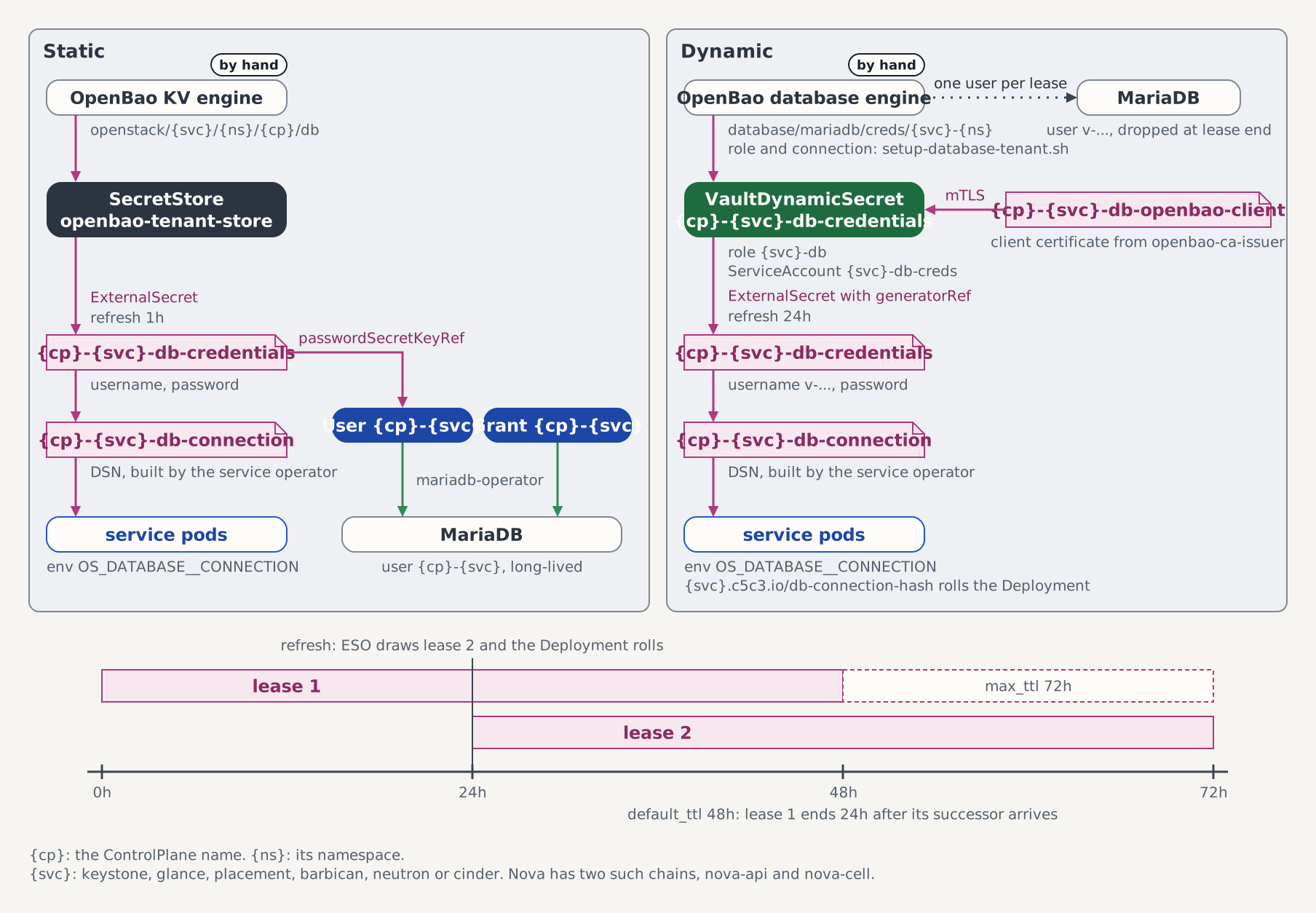
VaultDynamicSecretgenerator that reads short-lived credentials from the OpenBao database engine (database/mariadb/creds/placement-{namespace}, where{namespace}is the Placement service namespace, the ControlPlane's own namespace unless Placement runs in a dedicated one). The External Secrets Operator re-issues a fresh lease before the previous one expires and materialises the current username and password into the same Secret. No long-lived static DB password remains at rest.
The engine issues an ephemeral MySQL user per lease (for example v-kube-...) with ALL PRIVILEGES on the Placement database and drops it at lease end.
The figure shows both chains. {svc} stands for placement here, and {cp} is controlplane on the devstack.
Prerequisites
Devstack
This guide is written against the Quick Start (ControlPlane) devstack. Stand it up first:
KIND_HOST_PORT=8443 WITH_CONTROLPLANE=true make deploy-infraFollow that tutorial through to its final Verify step. On this devstack the ControlPlane is controlplane in openstack, so its projected Placement is controlplane-placement and its DB-credential Secret is controlplane-placement-db-credentials. Those are the names the migration below manages.
- The ControlPlane declares
spec.services.placement. Without it the operator projects no Placement child and no DB credential of either kind. - The OpenBao
databasesecrets engine is mounted atdatabase/mariadb(thesetup-secret-engines.shbootstrap step). A greenfield cluster already has it; on a brownfield cluster, re-apply the bootstrap scripts (see below). - cert-manager and its
openbao-ca-issuerClusterIssuer are installed. They issue the per-ControlPlane mTLS client certificate the generator presents to the OpenBao listener. - The External Secrets Operator can request ServiceAccount tokens (
serviceaccounts/tokencreate) so the generator can authenticate to OpenBao as theplacement-db-credsServiceAccount.
Migration steps
1. Re-apply the OpenBao bootstrap on brownfield clusters
The database engine mount, the placement-db Kubernetes-auth role, and the placement-db-dynamic policy are written by the (idempotent) bootstrap scripts. Re-apply them so a cluster provisioned before Placement was onboarded picks them up:
# From the repo root, with BAO_TOKEN exported (the OpenBao root token).
bash deploy/openbao/bootstrap/setup-secret-engines.sh
bash deploy/openbao/bootstrap/setup-auth.sh
bash deploy/openbao/bootstrap/setup-policies.sh
make deploy-infra runs these for you on a fresh kind cluster.
2. Onboard the per-tenant database-engine role
The engine role for a tenant only exists once its MariaDB is Ready and setup-database-tenant.sh has configured the connection and role against it:
# BAO_TOKEN must be exported; <namespace>/<controlplane> identify the tenant.
bash deploy/openbao/bootstrap/setup-database-tenant.sh <namespace> <controlplane>
When the ControlPlane declares spec.services.placement on the shared managed database, the script provisions the Placement leg:
database/mariadb/config/placement-<placement-namespace>, the connection to the tenant's MariaDB, authenticated as root.database/mariadb/roles/placement-<placement-namespace>, the role that issues short-lived users on theplacementschema (default_ttl48h,max_ttl72h by default; override withDB_CREDS_DEFAULT_TTL/DB_CREDS_MAX_TTL).
When Placement lives in a dedicated service namespace, that namespace's MariaDB must be Ready first: the script resolves that namespace's root secret and fails loudly otherwise. A ControlPlane whose Placement declares a dedicated database is skipped, because a dedicated Placement database is Static-only. The c5c3 admission webhook enforces the same rule from the other side and rejects spec.services.placement.databaseCredentialsMode: Dynamic on a Placement that declares dedicatedBackingServices.database.
make deploy-infra WITH_CONTROLPLANE=true WITH_CONTROLPLANE_CR=true runs this automatically for the bundled ControlPlane after its MariaDB becomes Ready.
3. (Optional) Stage the cutover with databaseCredentialsMode: Static
Dynamic is the default effective mode for a managed ControlPlane on the shared database. To keep Placement on a static credential, for example while Keystone and Glance already run Dynamic, pin the per-service override so the blast radius stays on Placement:
spec:
  services:
    placement:
      databaseCredentialsMode: Static
The shared spec.infrastructure.database.credentialsMode: Static opts out ControlPlane-wide instead; the per-service override scopes the opt-out to Placement alone. Nothing seeds the static KV path, so while staging you must write kv-v2/openstack/placement/<namespace>/<controlplane>/db (username, password) by hand, with username set to the Placement child's name (<controlplane>-placement), which is the login the operator's MariaDB User/Grant provisions. Remove the override (or set it to Dynamic) to cut over.
4. Upgrade the operators and observe the cutover
Upgrade the c5c3 and placement operators to a build that includes the dynamic engine wiring. On the next reconcile the c5c3 operator projects the generator, ServiceAccount, and Certificate, and the ExternalSecret switches to drawing from the generator.
On a cluster that ran the static path, delete the materialised credential Secret once so the engine-issued value is the only thing that can ever be read from it:
kubectl delete secret <controlplane>-placement-db-credentials -n <namespace>The ExternalSecret is updated in place (same name, same target Secret), so until ESO's first generator-backed sync lands the Secret still holds whatever the previous static sync wrote. Deleting it forces ESO to re-materialise from the generator immediately instead of at the next refresh.
You do not have to get this right for Placement to stay up: the c5c3 operator will not project credentialsMode: Dynamic onto the Placement child until that ExternalSecret reports Ready and the Secret behind it carries an engine-issued username. While either is outstanding, PlacementReady is False with reason WaitingForPlacementDBCredential, the running child keeps its current mode, and the message names either the database/mariadb/creds/placement-<namespace> path from step 2 or the stale username it found. A ControlPlane stuck on the path message has not been onboarded; re-run step 2. One stuck on the username message is waiting for the sync this deletion shortcuts.
Watch for:
- The
controlplane-placement-db-credentialsExternalSecret spec changing from staticdata[].remoteReftodataFrom[].sourceRef.generatorRef(kindVaultDynamicSecret). - The materialised Secret's
usernamebecoming an engine-issued login rather thancontrolplane-placement. - A Placement Deployment rollout: the operator stamps a
placement.c5c3.io/db-connection-hashpod-template annotation, so a rotated credential rolls the Deployment. The DSN travels in theOS_PLACEMENT_DATABASE__CONNECTIONenvironment variable, which only takes effect on a Pod restart.
The engine's GRANT overlaps the pre-existing operator-provisioned User and Grant from the static deployment, so Placement keeps serving throughout. The rolling restart, protected by the Placement PodDisruptionBudget, moves it onto an engine-issued login without a gap in the API.
5. Retire the static credential
Once the ControlPlane reports PlacementReady=True on the dynamic path:
Delete the leftover static MariaDB
UserandGrantCRs (they carry the long-lived<controlplane>-placementlogin the engine no longer uses):bashkubectl delete user,grant <placement-cr-name> -n <namespace> --ignore-not-foundRemove the retired static KV secret, if step 3 ever seeded it:
bash# Inside the OpenBao pod, or with a bao client configured for it. bao kv metadata delete kv-v2/openstack/placement/<namespace>/<controlplane>/db
Rollback
To revert to the static credential, set the mode back to Static (the per-service spec.services.placement.databaseCredentialsMode override, or the shared spec.infrastructure.database.credentialsMode), re-seed the KV path (step 3), and let the next Static-mode reconcile re-create the User/Grant. Roll back the operators if you also need to remove the generator objects.
Operational considerations
- Rotation churn against lease headroom: the DSN is consumed via an environment variable, so a rotated engine credential only takes effect on a Pod restart and Placement rolls each time the ExternalSecret re-issues the credential. Every refresh is a new credential; there is no stable value to renew in place. The defaults balance two concerns: the 24h refresh interval keeps the roll cadence to at most once a day, while the 48h
default_ttlleaves a 24h gap (default_ttlminus refresh) in which to roll the pods before the previous, still-in-use lease is revoked. RaiseDB_CREDS_DEFAULT_TTL/DB_CREDS_MAX_TTL(and the operator's refresh interval) to trade churn against lease headroom. The PodDisruptionBudget and the surge-before-remove rollout strategy keep each roll zero-downtime. - Auth-token TTL bounds the lease: OpenBao revokes a dynamic-secret lease together with the auth token that minted it, so the effective credential lifetime is
min(lease TTL, minting token TTL). Theplacement-dbauth role therefore pinstoken_ttlandtoken_max_ttlto 72h, theDB_CREDS_MAX_TTLdefault. When raisingDB_CREDS_*beyond that, raise the role's TTLs in lockstep. A shorter token silently drops the ephemeral MySQL user under a running Placement long before the advertised lease end. - No per-user connection cap on the dynamic path. In Static mode the operator sizes the MariaDB
UserCR'smax_user_connectionsfor the CR's topology, counting two connections per uWSGI thread across the API pods and the rollout surge, plus headroom for the db-sync Job. The engine'sCREATE USERstatement sets no cap, so once Placement runs on an engine-issued login the server's ownmax_connectionsis the only bound. - Revocation semantics: revoking a lease runs
DROP USER, which rejects new connections. Already-open sessions of a dropped user may persist until they disconnect. - ESO or OpenBao outage longer than the lease: the materialised credential expires before a refresh lands. Running Pods keep pooled connections, but new connections fail until ESO recovers. This surfaces through the Placement child's own database readiness and, ControlPlane-side, as
PlacementReady=False.
See also
- OpenBao Bootstrap reference — engines, auth roles, policies, and secret paths.
- ControlPlane reconciler reference — the
reconcilePlacementDB-credential projection flow. - Placement CRD API Reference —
spec.database.credentialsModeand the fields the ControlPlane projects onto the child. - Migrate Glance DB to Dynamic Credentials — the sibling migration for the Glance service DB user.
Tested by
The dynamic, engine-issued per-ControlPlane database credential this guide migrates to (the projected Dynamic mode, the VaultDynamicSecret, the generator-backed controlplane-placement-db-credentials ExternalSecret, and the transient engine-issued login) is asserted on the live CI e2e kind cluster by this chainsaw suite:
chainsaw test --test-dir tests/e2e/c5c3/full-controlplane-keystone