Placement Reconciler Architecture
The Placement controller runs the shared table-driven pipeline (internal/common/reconcile) with ten sub-reconcilers. Every step is instrumented under the placement_operator metrics prefix, and the first step to return a non-zero result or an error short-circuits the chain. Conditions and the requeue are persisted on every exit path through the shared status skeleton, which also skips the write when a pass left status unchanged.
Two Prometheus vectors cover the pipeline (placement_operator_reconcile_duration_seconds, placement_operator_reconcile_errors_total, the latter labelled by sub_reconciler and condition_type), and two per-CR collectors cover the schema migration (placement_operator_db_sync_total, labelled by placement, namespace, and the terminal result, and placement_operator_db_sync_duration_seconds, labelled by placement and namespace). There are no purge collectors: placement projects no recurring maintenance Job. Every series carrying a CR's name and namespace is dropped when that CR's finalizer completes.
Pipeline
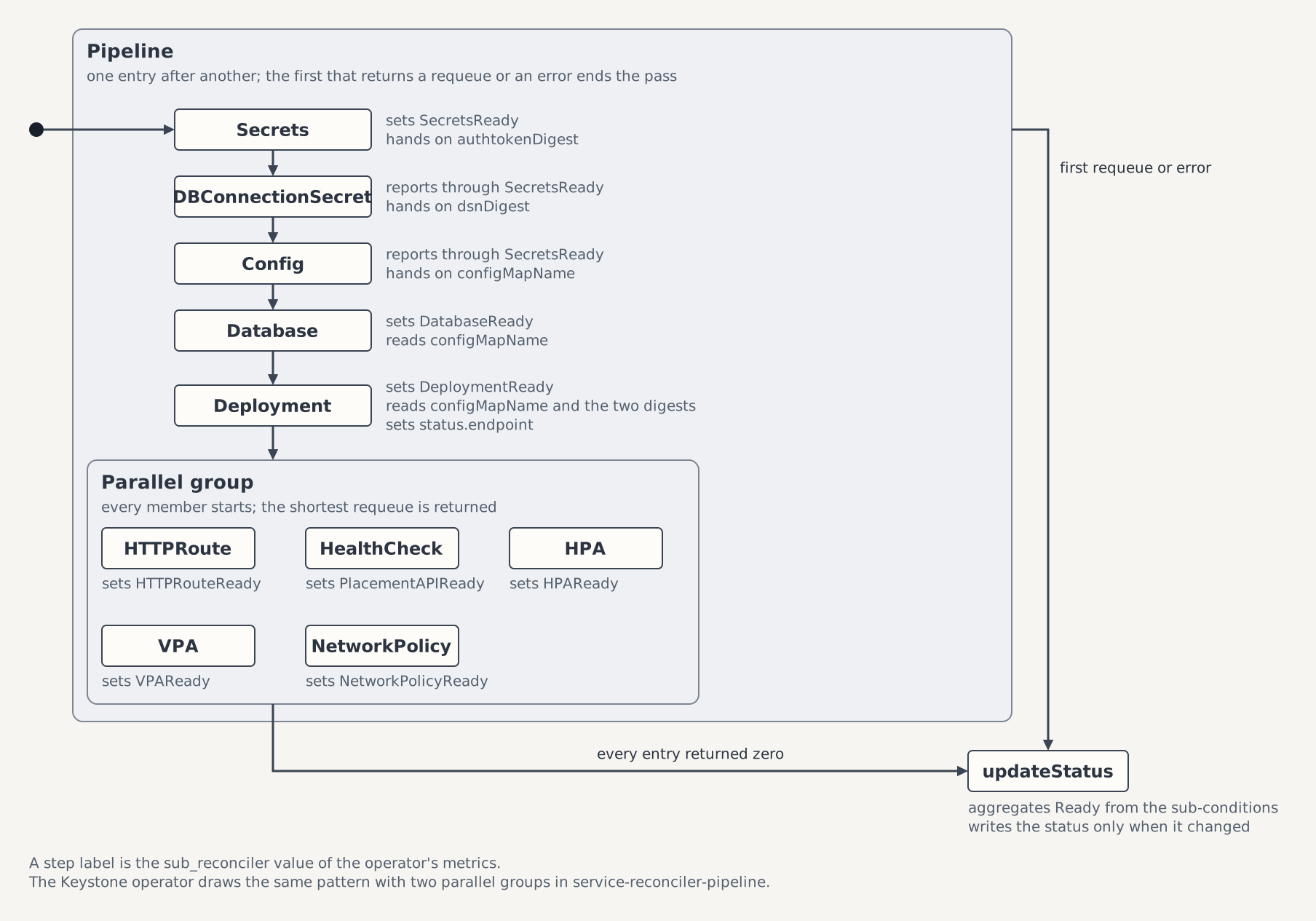
The figure draws the pattern the Keystone operator set: a lane of steps that ends the pass at the first requeue or error, and a group whose members all run. Reconciliation Flow describes that pattern in full. The table lists what each step does.
| Step | What it does | Condition |
|---|---|---|
| Secrets | Gates on the selected secret store (spec.secretStoreRef, default openbao-cluster-store), then the ESO-synced database and service-user credential Secrets; digests the service-user password for the rollout annotation | SecretsReady |
| DBConnectionSecret | Materializes the pymysql DSN into the derived {name}-db-connection Secret and digests it; reports through SecretsReady | SecretsReady |
| Config | Renders placement.conf (plus policy.yaml / logging.conf when applicable) into an immutable content-addressed ConfigMap and prunes the history down to three, and records the ExtraConfigHealthy guard. Reports through SecretsReady (failure reason ConfigError) | SecretsReady |
| Database | Provisions the schema (MariaDB cluster gate, Database/User/Grant in managed mode), gates the requested release against the installed one, runs the {name}-db-sync Job, and promotes installedRelease | DatabaseReady |
| Deployment | Ensures the API Deployment, Service (port 8778), and PDB, narrows the Service selector to the API component once the rollout has converged, and stamps status.endpoint | DeploymentReady |
| HTTPRoute | Full spec.gateway lifecycle; reflects the Gateway's Accepted condition. It renders no request timeout, since placement answers short JSON requests and the gateway implementation's default is the right cap | HTTPRouteReady |
| HealthCheck | HTTP GET of the cluster-local / version document through the shared TTL probe cache | PlacementAPIReady |
| HPA | Creates/deletes the HorizontalPodAutoscaler | HPAReady |
| VPA | reconcileVPA applies or removes the VerticalPodAutoscaler of the API Deployment through the shared VPA flow; reports VPANotInstalled for an opt-in on a cluster without the VPA | VPAReady |
| NetworkPolicy | Creates/deletes the NetworkPolicy (auto-derived DNS/database/Keystone/cache egress); refuses an empty ingress list (fail-closed) | NetworkPolicyReady |
DBConnectionSecret and Config reuse SecretsReady instead of a dedicated ConfigReady condition, the same mapping the sibling operators use: both produce Secret and ConfigMap artefacts that gate the same downstream graph, so a distinct sub_reconciler label on the error counter disambiguates them during triage while the status contract stays minimal.
The five members of the parallel group have no inter-dependency once the Deployment and Service exist. Each works on its own copy of the CR, sets one condition type, and always sets it, so a cluster without Gateway API or without autoscaling still resolves the aggregate through the NotRequired reasons.
Conditions
The aggregate Ready condition is True (reason AllReady) when all eight sub-conditions are True, and False (NotAllReady) otherwise.
| Type | True reasons | False reasons |
|---|---|---|
SecretsReady | SecretsAvailable | TargetClusterUnavailable, SecretStoreNotReady, ClusterSecretStoreUnsupported, WaitingForDBCredentials, WaitingForServiceUserCredentials, ConfigError |
DatabaseReady | DatabaseSynced | ClusterNotReady, WaitingForDatabase, DBSyncInProgress, DBSyncFailed, VersionParseError, DowngradeNotSupported, UpgradePathInvalid, ImageReleaseMismatch |
DeploymentReady | DeploymentReady | WaitingForDeployment |
PlacementAPIReady | APIHealthy | APIUnhealthy, EndpointNotReady, HealthCheckTimeout, ConnectionFailed, HealthCheckFailed |
HPAReady | HPAReady, HPANotRequired | — (errors propagate) |
VPAReady | VPAReady, VPANotRequired | VPANotInstalled, CapabilityProbeFailed, VPAError |
NetworkPolicyReady | NetworkPolicyReady, NetworkPolicyNotRequired | — (errors propagate) |
HTTPRouteReady | HTTPRouteAccepted, HTTPRouteNotRequired | HTTPRouteNotAccepted, GatewayAPINotInstalled, CapabilityProbeFailed |
TargetClusterUnavailable is set ahead of every sub-reconciler, when spec.targetClusterRef names a target cluster that is not registered or no longer resolves. The message carries the resolver's error, the CR requeues after 15 seconds and acquires no finalizer, and nothing is created on any cluster. See Target Clusters.
One further condition is set and never aggregated. ExtraConfigHealthy reports whether spec.extraConfig overrides an operator-owned key: True with reason NoOwnedKeysOverridden, False with reason OwnedKeysOverridden and a message naming each overridden key. It stays out of the sub-condition list on purpose, so an override that the operator honors reports itself without holding Ready down. The three overrides that would already have done their damage by the time a condition could report them are refused at admission instead; see Defaulting and validation.
Launch mode
There is one launch mode. Placement never shipped an eventlet server, so spec.openStackRelease selects nothing here and two CRs differing only in their release render byte-identical config files.
The container command is uwsgi --http :8778, followed by --http-keepalive (and --http-keepalive-timeout <n> when httpKeepAliveTimeout is set), --log-master, --log-format with the request-line format the sibling operators share, --wsgi-file /var/lib/openstack/bin/placement-api, --master, --lazy-apps, --need-app, --processes, --threads, and --harakiri <n> when harakiri is set. Keep-alive is on by default and an explicit httpKeepAlive: false drops both flags; --harakiri appears only when the field is set.
The WSGI entry file is written by the operator's Placement image, because 15.0.0 (2026.1) declares no WSGI script and 16.0.0 (2026.2) declares only placement-manage and placement-status under [project.scripts]. The config location travels in the OS_PLACEMENT_CONFIG_DIR=/etc/placement environment variable: the entry calls init_application() with no arguments and placement's _get_config_files loads $OS_PLACEMENT_CONFIG_DIR/placement.conf, one file, with no directory scan and no sys.argv parsing. That is why the command carries no --pyargv, and why the config ConfigMap is mounted as the whole /etc/placement directory: its other data keys (policy.yaml, logging.conf) are invisible to the config loader and are reached through the options that name them. The placement-manage and placement-status CLIs read neither the environment variable nor a config directory, so the db-sync Job passes --config-file /etc/placement/placement.conf on each of its three commands.
Database
The Database step runs the shared provisioning flow first: a MariaDB cluster gate and Database/User/Grant in managed mode, a no-op in brownfield, and no User/Grant under credentialsMode: Dynamic, where an external engine issues the credential.
The migration is a single {name}-db-sync Job running three commands under /bin/sh -eu -c:
placement-manage --config-file /etc/placement/placement.conf db sync && \
placement-manage --config-file /etc/placement/placement.conf db online_data_migrations && \
{ placement-status --config-file /etc/placement/placement.conf upgrade check || [ $? -eq 1 ]; }
db sync applies every pending schema migration, db online_data_migrations moves the rows the new schema expects, and placement-status upgrade check validates the result. The brace group scopes the exit-1 tolerance to the check alone: placement-status exits 1 for warnings, an outcome the Job must not fail on, and 2 for errors, which fails the group and, under sh -e, the Job. The two placement-manage commands run outside the group, so their failures stay fatal.
Because db sync applies all pending migrations in one idempotent pass and the upgrade check inside the script already validates the migrated schema, the Job set carries no schema-check command (SchemaCheckCommand: nil). Unlike Keystone, SchemaDriftDetected never fires for Placement.
A release transition is a spec.openStackRelease bump with the image in lockstep. There is no phase machine: the release gate validates the requested release against status.installedRelease before any Job runs, and rejects an unparseable release on either side (VersionParseError), a downgrade (DowngradeNotSupported), and a jump of more than one release (UpgradePathInvalid). Each rejection sets DatabaseReady=False with the shared reason, raises a Warning event, and returns an error so the controller backs off. An accepted bump stamps status.targetRelease, the db-sync Job runs on the new image, the Deployment rolls onto it, and the sync flow promotes status.installedRelease on Job success, at which point targetRelease is cleared and status.installedImage records the image that ran the migration. The second panel of the figure under Phase Transitions draws this single pass beside the phase machine it does without.
Two guards keep the release marker honest, one per pinning style. A tag-pinned image whose tag names a different release than spec.openStackRelease sets DatabaseReady=False / ImageReleaseMismatch and requeues, since the Job would run the wrong placement-manage binary. A release bump that leaves spec.image untouched is refused under the same reason, because the Job's pod template would be identical, the shared flow would short-circuit on the already-completed Job, and installedRelease would advance off a run of the previous release's binary. The second guard compares status.installedImage, so it covers a digest-pinned image the first one cannot read.
Connection cap
The operator sets the MariaDB User's max_user_connections to a cap sized for the CR's own topology. It owns the field and applies the computed figure on every reconcile, so a value edited on the User by hand is reset; the cap rises only with the counts in the formula below. The mariadb-operator default of 10 is too small for the default fleet: three pods of two processes peak at 12 connections under load, and at 16 during a rollout. The process that opens the connection past the cap gets MySQL error 1226: at start-up its pod crash-loops, and under load the request answers HTTP 500 and the Nova scheduling call behind it fails.
(apiPods + 1) x uwsgiProcesses x uwsgiThreads x 2 + 2The default topology sizes to 18. apiPods is the autoscaling ceiling when an HPA owns the count, and the + 1 beside it is the rolling-update surge. Each request thread counts twice because a request can hold a second connection behind its first. Measured on the ghcr.io/c5c3/placement 2025.2 and 2026.1 images, a single-threaded process peaked at 2 connections, a 4-thread process at 6, and an 8-thread process at 9. The trailing + 2 is the {name}-db-sync Job, whose three commands run in sequence and hold up to two connections. Placement renders no CronJob.
Requeue semantics
| Interval | Used by |
|---|---|
| 10s | Deployment readiness polling, HTTPRoute acceptance, health-check retry |
| 15s | ESO secret-gate polling (Secrets, DBConnectionSecret) |
| 30s | MariaDB and db-sync database wait, and the finalizer hold while the MariaDB CRs tear down |
| 30s TTL | Health-probe cache (a passing / probe is reused within the TTL) |
Rotation and deletion
- Credential rotation happens at the OpenBao source. The service-user password (consumed via
OS_KEYSTONE_AUTHTOKEN__PASSWORD) and the assembled DSN (consumed viaOS_PLACEMENT_DATABASE__CONNECTION) are both env-var-delivered, so a restart is required for a rotation to take effect. The Secrets and DBConnectionSecret steps digest each value into a pod-template annotation,placement.c5c3.io/authtoken-hashandplacement.c5c3.io/db-connection-hash, so a changed digest rolls the Deployment. Each annotation is omitted while its digest is empty, which is what the requeue and error paths upstream produce, so a short-circuited pass causes no spurious rollout. - Deletion runs the
placement.openstack.c5c3.io/finalizer. It issues Delete on the MariaDBDatabase/User/GrantCRs before the owner-ref chain disappears, emittingFinalizingDatabasewhile cleanup remains andDatabaseFinalizedwhen the finalizer is released. Whether cleanup remains is observed before the Delete, since a Delete flipsDeletionTimestampand a post-Delete check would always report nothing live and release immediately. Every other owned resource is namespace-scoped with a controller owner reference, so Kubernetes garbage collection reclaims it. Releasing the finalizer also drops the CR's metric series and evicts its health-probe cache entry. A CR whose target cluster was deregistered in the meantime cannot reach any of it: the finalizer is released against no cleanup at all, aRemoteChildrenAbandonedWarning names what stays behind, and the CR leaves etcd instead of hanging in Terminating. See Target Clusters.
Watches
The Placement controller Owns its Deployment, Service, ConfigMap, Secret, PodDisruptionBudget, HorizontalPodAutoscaler, NetworkPolicy, and, for the db-sync migration, Job. The HTTPRoute is added to the Owns set only when the Gateway API CRD is installed on the management cluster, probed at setup through the RESTMapper; without it spec.gateway surfaces HTTPRouteReady=False / GatewayAPINotInstalled instead of failing the controller at start with an unknown kind. That setup probe answers for CRs without a spec.targetClusterRef; a CR that names a target cluster has the kind probed against that cluster's RESTMapper on every pass, so the verdict follows the cluster its children land on. The CR's own status-only updates are filtered out, so a status write does not re-wake the controller.
Beyond the owned set it watches:
- Secrets, mapped to the Placement CRs that reference them. The
spec.secretRefs.namefield index holds the deduplicated union ofspec.serviceUser.secretRef.nameandspec.database.secretRef.name, so a Secret event resolves in one lookup instead of listing every Placement in the namespace. ESO-managed Secrets are owned by the ExternalSecret controller, so an owner-reference watch alone would never match them. - MariaDB clusters referenced by
spec.database.clusterRef, so an upstream database outage reflects inDatabaseReadywithout waiting for the periodic requeue. - Both the cluster-scoped
ClusterSecretStoreand the namespacedSecretStorea Placement can select, so a store-backend outage reflects inSecretsReadyas soon as ESO flips the store's Ready condition. A Placement that omitsspec.secretStoreRefresolves to the shared cluster store, so the default fan-out is preserved while a Placement pinned to a namespaced store is woken only by its own. TheClusterSecretStoreleg is not registered when the operator runs with--namespace.