Neutron Reconciler Architecture
The neutron-operator runs two controllers over the shared table-driven pipeline (internal/common/reconcile): NeutronReconciler with fifteen sub-reconcilers and NeutronMetadataAgentReconciler with five. In both, the first step to return a non-zero result or an error short-circuits the chain, and every exit path persists the conditions and the requeue through the shared status skeleton, which skips the write when a pass left status unchanged.
Every step is instrumented under the neutron_operator metrics prefix. Two vectors cover both pipelines, because one instrumenter serves both kinds: neutron_operator_reconcile_duration_seconds, labelled by sub_reconciler, and neutron_operator_reconcile_errors_total, labelled by sub_reconciler and condition_type. Four per-CR collectors cover the two Job families (operators/neutron/internal/metrics/collectors.go): neutron_operator_db_sync_total, labelled by neutron, namespace and the terminal result, and neutron_operator_db_sync_duration_seconds, labelled by neutron and namespace, for the migration Jobs; neutron_operator_ovn_db_sync_total and neutron_operator_ovn_db_sync_duration_seconds, with the same two label sets, for the runs of the ovn-db-sync CronJob. The db-sync pair carries no phase label, so the steady-state db-sync Job and the three upgrade-phase Jobs feed the same series; each phase keeps its own dedupe annotation, so a run is counted once.
All four series are dropped for a CR's name and namespace on the pass that releases the Neutron finalizer, which also evicts that CR's health-probe cache entry, so a deleted CR leaks neither a time series nor a cached probe. A NeutronMetadataAgent has nothing to drop: only a Neutron owns a schema and a sync CronJob, and the two pipeline vectors carry no CR name.
Pipelines
Neutron
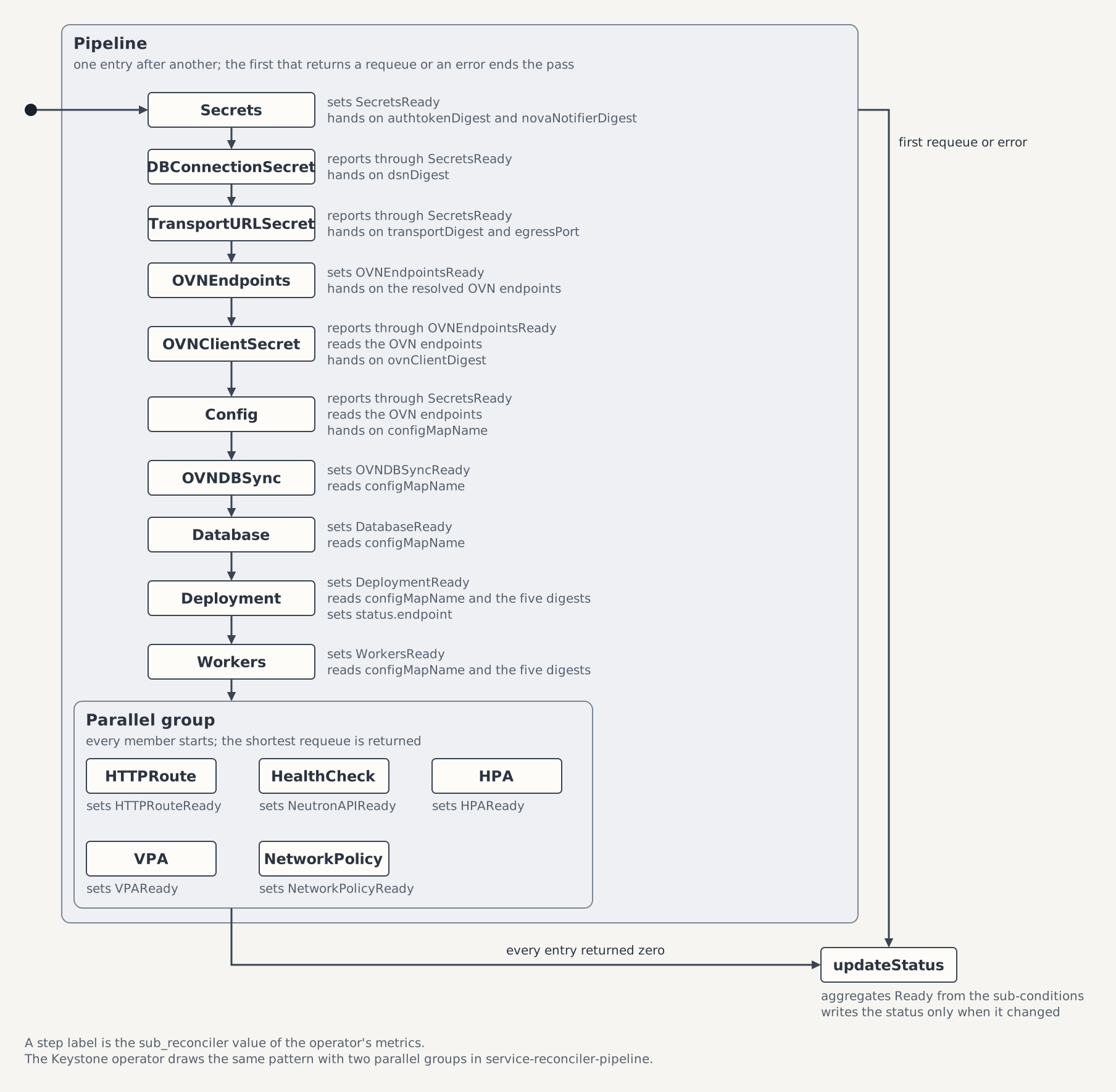
The figure draws the pattern the Keystone operator set: a lane of steps that ends the pass at the first requeue or error, and a group whose members all run. Reconciliation Flow describes that pattern in full. The table lists what each step does.
| Step | What it does | Condition |
|---|---|---|
| Secrets | Gates on the External Secrets store the CR selects, then the database and service-user credential Secrets and, while spec.nova is set, the Nova notifier Secret, and digests the passwords the pods read from their environment | SecretsReady |
| DBConnectionSecret | Materialises the pymysql DSN into the derived {name}-db-connection Secret and digests it. Reports through SecretsReady | SecretsReady |
| TransportURLSecret | Materialises the rabbit:// URL into {name}-transport-url, digests it, and returns the broker port the network policy opens. Reports through SecretsReady | SecretsReady |
| OVNEndpoints | Resolves the Northbound and Southbound addresses off the OVNCentral named by spec.ovn.centralRef | OVNEndpointsReady |
| OVNClientSecret | Mirrors the client identity that central published into {name}-ovn-client and digests it. Reports through OVNEndpointsReady | OVNEndpointsReady |
| Config | Renders neutron.conf, ml2_conf.ini and uwsgi.ini into an immutable content-addressed ConfigMap, prunes the history to three, and records the ExtraConfigHealthy guard. Reports failures through SecretsReady | SecretsReady |
| OVNDBSync | Projects or removes the {name}-ovn-db-sync CronJob and reports on the newest terminal run | OVNDBSyncReady |
| Database | Provisions the schema, gates the requested release against the installed one, and runs the migration Jobs against the rendered config | DatabaseReady |
| Deployment | Ensures the API Deployment, its Service and the PodDisruptionBudget, and stamps status.endpoint | DeploymentReady |
| Workers | Ensures the {name}-periodic-workers and {name}-ovn-maintenance-worker Deployments | WorkersReady |
| HTTPRoute | Full spec.gateway lifecycle; reflects the Gateway's Accepted condition | HTTPRouteReady |
| HealthCheck | HTTP GET of the cluster-local API root through the shared TTL probe cache | NeutronAPIReady |
| HPA | Creates or removes the HorizontalPodAutoscaler | HPAReady |
| VPA | reconcileVPA applies or removes the VerticalPodAutoscalers of the API and the two worker Deployments through the shared VPA flow | VPAReady |
| NetworkPolicy | Creates or removes the NetworkPolicy, with the auto-derived egress set; refuses an empty ingress list | NetworkPolicyReady |
The three Secret steps come first, because everything behind them mounts what they write: the derived DSN and transport URL are what the pods and the migration Jobs source their credentials from, and the rendered config carries a placeholder in their place. A CR carrying spec.nova takes a third credential gate in the first step, over the Secret the notifier password lives in (WaitingForNovaNotifierCredentials), and the step digests that password beside the service-user one. Both are consumed as oslo.config environment overrides rather than mounted, so they take effect only on a pod restart. Each digest rides a pod-template annotation of its own, neutron.c5c3.io/authtoken-hash and neutron.c5c3.io/nova-notifier-hash, so a rotation of either at the OpenBao source rolls the pods and the annotation that changed names the password that rotated. A CR without the block carries no notifier digest and no second annotation. The two OVN steps follow, and the config step waits behind both: the [ovn] section is parameterised by the two resolved addresses, and it names the three files of the mirrored client identity.
OVNDBSync runs ahead of Database rather than in the parallel group behind it. The pipeline short-circuits at the Database step for as long as a migration Job runs, so a step placed behind it would not be reached to report on the schedule during the one window that changes it. Its only input is the rendered config the CronJob mounts. Database itself comes before Deployment, so the API pods start once the schema they query exists, and Workers after Deployment, sharing its five digests.
Once the Deployment and the Service are in place, the last five steps read none of each other's output and run as a parallel group. Each member works on its own copy of the CR and always sets its one condition type, so a cluster without a gateway, an autoscaler or a network policy still resolves the aggregate through the NotRequired reasons. RunParallelGroup merges the conditions and the metadata off a member's copy and nothing else; no member of this group writes any other status field, so there is nothing to copy back by hand.
NeutronMetadataAgent
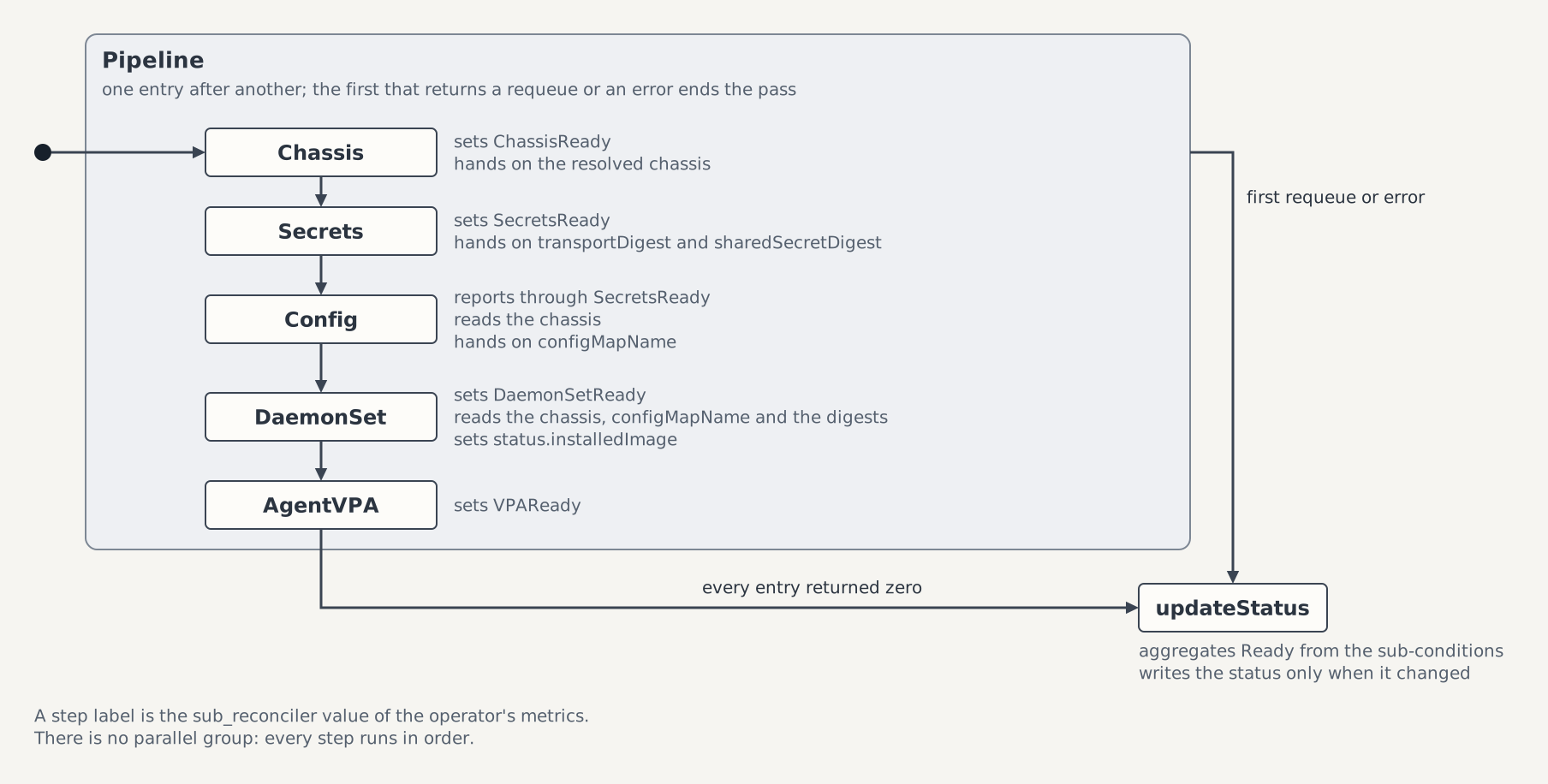
The figure draws the steps in call order. The table lists what each one does.
| Step | What it does | Condition |
|---|---|---|
| Chassis | Resolves the OVNChassis into its node selector and tolerations, and that chassis's OVNCentral into the Southbound address and the client Secret name | ChassisReady |
| Secrets | Gates on the Nova metadata shared secret and the Nova metadata CA bundle, digests the shared secret, and, under spec.messaging, materialises {name}-transport-url and digests it | SecretsReady |
| Config | Renders neutron_ovn_metadata_agent.ini into an immutable content-addressed ConfigMap and prunes the history to three. Reports failures through SecretsReady | SecretsReady |
| DaemonSet | Projects the {name}-metadata-agent DaemonSet onto the chassis's nodes, mirrors its node counters into status, and stamps status.installedImage | DaemonSetReady |
| AgentVPA | Applies or removes the VerticalPodAutoscaler of the DaemonSet through the shared VPA flow | VPAReady |
The chassis is the first gate: the nodes it selects, its central's Southbound address and that central's client Secret parameterise every later step, so an agent whose chassis has not resolved projects nothing at all. The credentials come next, because the rendered file is a function of the messaging block and the DaemonSet mounts the Secrets, and the config before the DaemonSet that mounts it. The resolved chassis, the two digests and the ConfigMap name are threaded from the steps that produce them to the steps that consume them through a closure, so the hand-off stays inside one pass and not on the reconciler, where it would be shared by every CR reconciled concurrently.
Conditions
Each aggregate Ready is True with reason AllReady when every sub-condition of that kind is True, and False with NotAllReady otherwise. A Neutron aggregates eleven, a NeutronMetadataAgent four.
| Type | Kind | True reasons | False reasons |
|---|---|---|---|
SecretsReady | Neutron | SecretsAvailable | SecretStoreNotReady, ClusterSecretStoreUnsupported, WaitingForDBCredentials, WaitingForServiceUserCredentials, WaitingForNovaNotifierCredentials, WaitingForMessagingCredentials, ConfigError, TargetClusterUnavailable |
OVNEndpointsReady | Neutron | OVNEndpointsResolved | OVNCentralNotFound, OVNCentralReadError, OVNEndpointsPending, OVNClientSecretPending, OVNClientSecretIncomplete, OVNClientSecretReadError, OVNClientSecretMirrorFailed, TargetClusterUnavailable |
DatabaseReady | Neutron | DatabaseSynced | ClusterNotReady, WaitingForDatabase, WaitingForConfig, DBSyncInProgress, DBSyncFailed, VersionParseError, DowngradeNotSupported, UpgradePathInvalid, ImageReleaseMismatch, UpgradeTargetChanged, ExpandInProgress, ExpandFailed, MigrateInProgress, MigrateFailed, ContractInProgress, ContractFailed, UpgradeRollingUpdate |
OVNDBSyncReady | Neutron | OVNDBSyncNotRequired, OVNDBSyncScheduled, OVNDBSyncSuspended | OVNDBSyncJobFailed |
DeploymentReady | Neutron | DeploymentReady | WaitingForDeployment |
WorkersReady | Neutron | WorkersReady | WaitingForWorkers |
HTTPRouteReady | Neutron | HTTPRouteAccepted, HTTPRouteNotRequired | HTTPRouteNotAccepted, GatewayAPINotInstalled, CapabilityProbeFailed |
NeutronAPIReady | Neutron | APIHealthy | APIUnhealthy, EndpointNotReady, HealthCheckTimeout, ConnectionFailed, HealthCheckFailed |
HPAReady | Neutron | HPAReady, HPANotRequired | none (errors propagate) |
VPAReady | Neutron | VPAReady, VPANotRequired | VPANotInstalled, CapabilityProbeFailed, VPAError |
NetworkPolicyReady | Neutron | NetworkPolicyReady, NetworkPolicyNotRequired | none (errors propagate) |
ChassisReady | NeutronMetadataAgent | ChassisResolved | ChassisNotFound, ChassisReadError, ChassisOnAnotherCluster, ChassisNotReady, CentralNotFound, CentralReadError, CentralNotExternallyReachable, CentralNotReady, TargetClusterUnavailable |
SecretsReady | NeutronMetadataAgent | SecretsAvailable | WaitingForNovaSharedSecret, WaitingForNovaMetadataCA, WaitingForMessagingCredentials, ConfigError |
DaemonSetReady | NeutronMetadataAgent | DaemonSetReady | DaemonSetProgressing, DaemonSetError |
VPAReady | NeutronMetadataAgent | VPAReady, VPANotRequired | VPANotInstalled, CapabilityProbeFailed, VPAError |
TargetClusterUnavailable is set ahead of every sub-reconciler, when spec.targetClusterRef names a cluster that is not registered or no longer resolves. It lands on the first condition of that CR's pipeline, SecretsReady on a Neutron and ChassisReady on a NeutronMetadataAgent, so it holds down the condition the rest of the graph waits behind. The message carries the resolver's error, the CR requeues after 15 seconds and acquires no finalizer, and nothing is created on any cluster. A deleting CR waiting for its target cluster to come back reports the same reason on the same condition. See Target Clusters.
ExtraConfigHealthy is set beside these on every pass that renders a config, on both kinds, and reports the honored overrides of operator-owned keys. It stays out of the Ready aggregation, so an override the operator honors reports itself without holding the CR unready.
One map attributes an error to its condition type for the condition_type label. It serves both pipelines, because both reconcilers run in one binary under the same metrics prefix (instrumentation.go):
var subReconcilerConditionTypes = map[string]string{
	"Secrets":            "SecretsReady",
	"DBConnectionSecret": "SecretsReady",
	"TransportURLSecret": "SecretsReady",
	"Config":             "SecretsReady",
	"OVNEndpoints":       "OVNEndpointsReady",
	"OVNClientSecret":    "OVNEndpointsReady",
	"Database":           "DatabaseReady",
	"OVNDBSync":          "OVNDBSyncReady",
	"Deployment":         "DeploymentReady",
	"Workers":            "WorkersReady",
	"HTTPRoute":          "HTTPRouteReady",
	"HealthCheck":        "NeutronAPIReady",
	"HPA":                "HPAReady",
	"VPA":                "VPAReady",
	"NetworkPolicy":      "NetworkPolicyReady",

	"Chassis":   "ChassisReady",
	"DaemonSet": "DaemonSetReady",
	"AgentVPA":  "VPAReady",
}
Eighteen keys cover twenty sub-reconcilers. Secrets and Config appear once, because both pipelines run a step of that name and both drive SecretsReady. Four steps share SecretsReady and two share OVNEndpointsReady: all of them produce artefacts the same downstream graph mounts, so collapsing them under one condition keeps the status contract small while the sub_reconciler label on the error counter still separates them during triage.
A sub_reconciler name that reaches the instrumenter without a key here resolves to UNKNOWN. An empty label would collapse two series into one; UNKNOWN makes the drift visible in alerts.
Sub-reconcilers
reconcileSecrets
File: operators/neutron/internal/controller/reconcile_secrets.go
Purpose: Gate on the credentials the Neutron pods consume: the External Secrets store the CR selects through spec.secretStoreRef, then the database credentials Secret and the service-user password Secret. The store is checked first, so an outage of the secret backend surfaces even while the per-ExternalSecret caches still report their last successful sync. The step ends by digesting the service-user password for the pod-template annotation the deployment and worker steps stamp: the password reaches the process as OS_KEYSTONE_AUTHTOKEN__PASSWORD, so a rotation at the source takes effect on a pod restart and on nothing else.
Condition Contract:
| Status | Reason | Message | RequeueAfter |
|---|---|---|---|
False | SecretStoreNotReady | "<kind> "<name>" is not ready; upstream secret backend unreachable", naming the selected ClusterSecretStore or SecretStore | RequeueSecretPolling |
False | ClusterSecretStoreUnsupported | "ClusterSecretStore "<name>" cannot be read by a namespace-scoped operator; set spec.secretStoreRef to a SecretStore in namespace "<namespace>"". Set only when the operator runs with --namespace and the effective store is a ClusterSecretStore; the store is not read | RequeueSecretPolling |
False | WaitingForDBCredentials | The gate's attribution of the miss: "Database credentials ExternalSecret <ns>/<name> not found yet", "Waiting for ESO to sync database credentials from OpenBao", or "Database credentials Secret exists but is missing expected keys" | RequeueSecretPolling |
False | WaitingForServiceUserCredentials | The same three attributions against the service-user Secret and its configured key | RequeueSecretPolling |
True | SecretsAvailable | none | none |
Error handling: A backend read error is returned without a condition, so the controller falls back on its own rate limiter. One class is recorded first and then returned: a namespace the target cluster's cache refuses, which every pass fails on identically until the registration or the CR moves, and which would otherwise live only in the operator's log.
reconcileDBConnectionSecret
File: operators/neutron/internal/controller/reconcile_dbconnection_secret.go
Purpose: Derive the pymysql DSN from the upstream credentials Secret and write it to {name}-db-connection, through the shared database.ReconcileConnectionSecret. Every neutron process and every migration Job reads it as OS_DATABASE__CONNECTION, which is why [database] connection in the rendered file is a placeholder URL. With spec.database.tls enabled the DSN carries ssl_ca, ssl_cert and ssl_key paths under /etc/neutron-db-tls/, the directory the workloads and the Jobs project the keypair at, so the key bytes never pass through the operator process. The step returns the DSN's digest for the rollout annotation.
Condition Contract:
| Status | Reason | Message | RequeueAfter |
|---|---|---|---|
False | WaitingForDBCredentials | "Upstream database credentials Secret <ns>/<name> not found", or "… missing key <key>" | RequeueSecretPolling |
Error handling: A failed read of the upstream Secret is returned. No derived Secret is written with empty credentials. The step sets no True arm: reconcileSecrets ahead of it already reported SecretsAvailable on the same condition, and the digest is empty on every path that wrote nothing, which keeps the annotation off the pod template on a short-circuited pass.
reconcileTransportURLSecret
File: operators/neutron/internal/controller/reconcile_messaging.go
Purpose: Materialise the rabbit:// transport URL into {name}-transport-url and return the two values later steps read off it: the URL's digest for the rollout annotation, and the broker's TCP port, which the network-policy step opens as an egress peer. Managed mode reads the RabbitmqCluster's default-user Secret, brownfield mode the Secret spec.messaging.secretRef names. Nothing in this deployment dials the broker, and the URL is required all the same: config.init calls n_rpc.init in every neutron process, so the value has to parse.
Condition Contract:
| Status | Reason | Message | RequeueAfter |
|---|---|---|---|
False | WaitingForMessagingCredentials | The managed RabbitmqCluster has published no default-user Secret yet, or the brownfield Secret carries no transport URL under its key | RequeueSecretPolling |
Error handling: A failed read or write is returned, and the port and the digest are both zero on the waiting path, where the network-policy step then omits the messaging rule. The port falls back to 5672 for a URL that names none, so the derived rule always carries one port. The shared helper reads and writes in the CR's own namespace through the CR's own children client, which is why a placed Neutron whose bus runs on the management cluster has to use spec.messaging.secretRef.
reconcileOVNEndpoints
File: operators/neutron/internal/controller/reconcile_ovn.go
Purpose: Resolve the Northbound and Southbound addresses of the OVNCentral named by spec.ovn.centralRef. The central is read through the management-cluster client, because both CRs live there whatever cluster their children land on, and the ref carries a namespace: the OVN control plane commonly lives in the privileged networking namespace while the Neutron API lives with the rest of the control plane. Which pair of published addresses applies follows from where the two CRs project their children. Inside one cluster each database is reached at its internalDbAddress; across a cluster boundary only the dbAddress published on node ports is routable. Both fields are written by the central's own endpoint step, documented under OVN Reconciler Architecture.
OVN coupling. Both steps of this file write OVNEndpointsReady, and these are all of their arms:
| Step | Status | Reason | Message | RequeueAfter |
|---|---|---|---|---|
| OVNEndpoints | False | OVNCentralNotFound | "OVNCentral <ns>/<name> does not exist; the ML2/OVN mechanism driver stays unconfigured until it does" | 15s |
| OVNEndpoints | False | OVNCentralReadError | "reading OVNCentral <ns>/<name>: <error>" | none (error returned) |
| OVNEndpoints | False | OVNEndpointsPending | "Waiting for OVNCentral <ns>/<name> to publish its Northbound and Southbound addresses", when both CRs project onto the same cluster | 15s |
| OVNEndpoints | False | OVNEndpointsPending | Names the cluster each of the two CRs projects onto and asks for spec.northbound.externallyReachable and spec.southbound.externallyReachable on the central, when they project onto different ones | 15s |
| OVNEndpoints | False | OVNEndpointsPending | "Waiting for OVNCentral <ns>/<name> to publish its client Secret; the databases accept no connection without a client certificate" | 15s |
| OVNClientSecret | False | TargetClusterUnavailable | The resolver's error for the central's own target cluster | 15s |
| OVNClientSecret | False | OVNClientSecretPending | "Waiting for the OVN client Secret <ns>/<name> the OVNCentral publishes" | 15s |
| OVNClientSecret | False | OVNClientSecretReadError | "reading OVN client Secret <ns>/<name>: <error>" | none (error returned) |
| OVNClientSecret | False | OVNClientSecretIncomplete | "OVN client Secret <ns>/<name> carries no <key> yet", naming tls.crt, tls.key or ca.crt | 15s |
| OVNClientSecret | False | OVNClientSecretMirrorFailed | The wrapped error of claiming, creating, reading or updating {name}-ovn-client | none (error returned) |
| OVNEndpoints | True | OVNEndpointsResolved | "The ML2/OVN mechanism driver connects to OVNCentral <ns>/<name> at <nb> (Northbound) and <sb> (Southbound)" | none |
Error handling: A missing OVNCentral polls and leaves the pass successful: a Neutron applied before its central is an ordinary ordering of two objects in one manifest. A failed read is returned so the controller backs off. The cross-cluster message is the one arm that names a field to edit, because from another cluster the Service addresses resolve nowhere and only the node ports do.
reconcileOVNClientSecret
File: operators/neutron/internal/controller/reconcile_ovn.go
Purpose: Mirror the client identity the OVNCentral publishes into the namespace the Neutron pods run in, as {name}-ovn-client, and return the SHA-256 digest of its three values so the deployment and worker steps roll the pods when the certificate is reissued. The mirror exists because the source is not reachable where the pods are: it lives in the central's namespace, and on a placed Neutron even on another cluster. The source is read live through the central's own children client, so an ownership decision is never made on a cache that has not caught up; the copy is written through this Neutron's children client, which is what makes it mountable.
Condition Contract: the five arms the OVN coupling table above lists under this step, TargetClusterUnavailable, OVNClientSecretPending, OVNClientSecretReadError, OVNClientSecretIncomplete and OVNClientSecretMirrorFailed. Each of them overwrites OVNEndpointsReady, the condition the endpoint step left True: a resolved address the pods cannot authenticate against is no usable endpoint.
Error handling: An unresolvable target cluster and an absent source Secret poll without an error, since the central publishes the Secret name in its status before cert-manager has issued the certificate. A failed read and a failed write are returned. The mirror is repaired to carry the three source values and nothing else: a stale certificate left behind by a reissue would authenticate against nothing, and an extra key would survive in a Secret the operator owns. The digest hashes the entries in sorted key order, length-prefixed, so a value that ends where the next one begins cannot collide with the pair that swaps that boundary.
reconcileConfig
File: operators/neutron/internal/controller/reconcile_config.go
Purpose: Render neutron.conf, ml2_conf.ini and uwsgi.ini into one immutable, content-addressed ConfigMap, plus logging.conf under spec.logging.format: json, and return its name to the steps that mount it. The section name routes each option to the file its consumer reads, and the routing covers spec.extraConfig too, so a user override lands there as well. The step keeps no last-good artefact: the two OVN steps ahead of it short-circuit the pipeline while the addresses or the client identity are unresolved, so no pass renders against an incomplete projection. See Rendered defaults.
Condition Contract:
| Status | Reason | Message | RequeueAfter |
|---|---|---|---|
False | ConfigError | "creating config ConfigMap: <error>", or "pruning config ConfigMaps: <error>" | none (error returned) |
Error handling: Both failures flip SecretsReady to False before the error is returned, so the aggregate cannot stay stale-True at the new generation. There is no True arm: the Secrets step owns it. Pruning keeps three historical ConfigMaps beside the current one, which is what a rollback reads. The ExtraConfigHealthy guard runs at the top of the step and raises the ExtraConfigOwnedKeyOverride Warning on the transition into False and whenever the overridden-key set changes. See Controller Events.
reconcileOVNDBSync
File: operators/neutron/internal/controller/reconcile_ovndbsync.go
Purpose: Project or remove the {name}-ovn-db-sync CronJob and report on the newest run that reached a terminal state. Run visibility is derived from the Jobs on the cluster: the CronJob controller spawns one Job per firing and prunes them by history limit, so the step lists the Jobs carrying this CR's sync component labels, keeps the ones this CronJob controls, and reads the newest terminal one. schedule and syncMode are resolved here at reconcile time, so an unset field keeps tracking the operator default across upgrades. See ovnDBSync.
Condition Contract:
| Status | Reason | Message | RequeueAfter |
|---|---|---|---|
True | OVNDBSyncNotRequired | "No OVN database synchronisation is scheduled: spec.ovnDBSync is unset" | none |
True | OVNDBSyncSuspended | The schedule and the mode that apply when resumed, plus the last failed run when there was one | none |
False | OVNDBSyncJobFailed | Names the failed Job and the "Could not retrieve schema from <address>" line that tells an unreachable Northbound from drift | none |
True | OVNDBSyncScheduled | "OVN database synchronisation scheduled "<schedule>" in "<mode>" mode" | none |
Error handling: A failed delete, apply or Job listing returns the wrapped error and sets no condition, so OVNDBSyncReady stays absent or stale, the aggregate stays False, and the pipeline attributes the error to this step. Suspension outranks a failed run: a suspended CronJob spawns no successor to supersede the failure, so an OVNDBSyncJobFailed arm winning there would pin the aggregate Ready down until someone deleted the Job by hand. Every terminal run feeds the ovn-db-sync metric pair and, on failure, a Warning, both deduped on the Job UID through an annotation on the CR.
reconcileDatabase
File: operators/neutron/internal/controller/reconcile_database.go
Purpose: Provision the schema, gate the requested OpenStack release against the installed one, and run the migration Jobs against the rendered config. The shared provisioning flow runs first: the MariaDB cluster gate plus Database/User/Grant in managed mode, a no-op in brownfield, and no User/Grant under credentialsMode: Dynamic. The SQL user's max_user_connections cap is sized from the CR's own topology, because every neutron process pools up to five connections (oslo.db's max_pool_size default) and a cap below the fleet's demand crash-loops the last pods to start or, under load, turns into HTTP 500 responses.
The WaitingForConfig gate. An empty ConfigMap name means the OVN endpoints are still unresolved and nothing has been rendered. The migration Jobs mount that ConfigMap as their whole /etc/neutron, so an empty name would render a volume the API server rejects and every pass would fail on the Job create. The step reports WaitingForConfig and requeues after RequeueDatabaseWait (30 s).
The release gate. gateReleaseTransition validates a change of spec.openStackRelease against status.installedRelease before the upgrade flow is entered. A fresh install and a patch bump pass through. An unparseable release on either side, a downgrade and a jump of more than one release are refused, each with the shared reason, a Warning event and a returned error. The gate adds the one rule the shared flow cannot know about: a release bump that leaves spec.image at the reference recorded in status.installedImage migrates nothing, so the phase Jobs would short-circuit on their own completed runs and installedRelease would advance off the previous release's binary. Its message names both readings of that state, because the recovery differs. The tag-side counterpart, checkImageReleaseMismatch, compares a tag-pinned spec.image against spec.openStackRelease on every pass and requeues without an event.
The phase Jobs. An accepted bump walks the shared expand-migrate-contract machine: {name}-db-expand runs neutron-db-manage upgrade --expand, {name}-db-migrate runs neutron-db-manage current, and {name}-db-contract runs neutron-db-manage upgrade --contract, each with a backoff limit of 4 and each built from spec.image. Neutron's alembic tree splits into an expand and a contract branch with no data-migration command between them, so the migrate phase prints the revision each branch sits at and exits 0, which keeps the phase readable in the Job log. Between migrate and contract the flow parks in RollingUpdate and waits for the deployment step's neutronDeploymentRolledOut check, so the contract Jobs drop nothing the old pods still read. Fresh installs and patch bumps stay on the single-pass {name}-db-sync Job, which runs neutron-db-manage upgrade head; there is no schema-check Job, because that upgrade is idempotent and a second read-only run would assert nothing. Phase Transitions draws the machine with its failure states and the abort.
Condition Contract:
| Status | Reason | Message | RequeueAfter |
|---|---|---|---|
False | ClusterNotReady | "MariaDB cluster "<name>" is not ready" | RequeueDatabaseWait |
False | WaitingForDatabase | "MariaDB Database CR is not ready", or "MariaDB User or Grant CR is not ready" | RequeueDatabaseWait |
False | WaitingForConfig | "Waiting for the resolved OVN endpoints and the rendered config before provisioning the database schema" | RequeueDatabaseWait |
False | ImageReleaseMismatch | The tag-versus-release disagreement, or the release bump that leaves spec.image unchanged | RequeueDatabaseWait on the tag check; none on the gate (error returned) |
False | VersionParseError, DowngradeNotSupported, UpgradePathInvalid | The rule that refused the transition, with both release strings | none (error returned) |
False | DBSyncInProgress | "db_sync job is running" | RequeueDatabaseWait |
False | DBSyncFailed | "db_sync job failed: <error>" | none (error returned) |
False | ExpandInProgress, MigrateInProgress, ContractInProgress | "<Phase> phase running: <from> → <to>" | RequeueUpgradeWait |
False | ExpandFailed, MigrateFailed, ContractFailed | "<Phase> job <name> failed: <error>" | none (error returned) |
False | UpgradeRollingUpdate | "Migrate complete, waiting for Deployment rollout: <from> → <to>" | none, the deployment step drives it |
False | UpgradeTargetChanged | "Spec release changed to <r> during active upgrade <from> → <to>; complete or roll back the current upgrade first" | none (error returned) |
True | DatabaseSynced | "Database schema is up to date (revision verified)", or "(upgraded <from> → <to>)" | none |
Error handling: Every refused release transition and every failed Job returns an error, so the controller backs off; a re-run would fail the same way. The wait states return no error and pace themselves on the two 30 s intervals. Reverting spec.openStackRelease to the installed release stays reachable mid-upgrade, because it is the shared flow's abort trigger and the image check is skipped for it; a wedged upgrade can always be unstuck that way.
reconcileDeployment
File: operators/neutron/internal/controller/reconcile_deployment.go
Purpose: Ensure the API Deployment, its Service on port 9696 and the PodDisruptionBudget, and stamp status.endpoint with the cluster-local Service URL once the Deployment is available. status.endpoint is that URL whether or not spec.gateway is set, since it reports API readiness rather than the ingress path.
The launch command. The neutron image ships no neutron-server binary and no entry script, so the API container runs uwsgi --http :9696 … --module neutron.wsgi.api, with the shared deployment.BuildUWSGICommand emitting the process, thread, keep-alive and harakiri parameters, and a trailing --ini /etc/neutron/uwsgi.ini. That file carries start-time = %t, which uWSGI expands while it reads it; rendering the same marker on the command line would pass the literal %t and kill neutron on int('%t').
From 2026.2 on, neutron-server ignores that marker. Neutron 29.0.0 records its WSGI start time and its first-worker election in files under tempfile.gettempdir(), named after the PID of the uWSGI master. The root filesystem is read-only, so the API pod of such a release mounts an emptyDir at /tmp; without it the OVN mechanism driver fails its post-fork initialization and the API answers no request. The command also carries --hook-asap "exec:rm -f /tmp/neutron_start_time* /tmp/neutron_first_worker*". The emptyDir outlives a container restart and the master has the same PID in every container, so a container that replaces a killed one would otherwise read the old start time, and its workers would collide in the OVN hash ring with the rows the killed workers left behind. Below 2026.2 the pod renders neither the volume nor the hook.
Config delivery. A uWSGI-imported application has no argv to carry --config-file, so the API container names its files in the environment instead: OS_NEUTRON_CONFIG_DIR is /etc/neutron, the mount point of the rendered ConfigMap, and OS_NEUTRON_CONFIG_FILES is neutron.conf;ml2_conf.ini. Those are the same two files, in the same order, that the worker Deployments, the migration Jobs and the ovn-db-sync CronJob pass as --config-file arguments through neutronCommand. The three credentials travel beside them as oslo.config overrides (OS_DATABASE__CONNECTION, OS_DEFAULT__TRANSPORT_URL, OS_KEYSTONE_AUTHTOKEN__PASSWORD), so none of them enters the rendered document.
The rolled-out gate. neutronDeploymentRolledOut is stricter than the surge-tolerant readiness the shared ensure helper reports: it requires the deployment controller to have observed the latest generation and every replica to be updated, ready and counted, with no surge or old-template pod left. The readiness signal turns true as soon as the first new-image pod is ready while old-image pods still serve, and the contract phase drops what those pods still read, so the RollingUpdate to Contracting flip waits for this stricter check. Only that phase is gated on it; a steady-state rollout keeps the surge-tolerant readiness.
Condition Contract:
| Status | Reason | Message | RequeueAfter |
|---|---|---|---|
False | WaitingForDeployment | "Neutron API deployment is not yet available" | RequeueDeploymentPolling |
False | WaitingForDeployment | "Waiting for the upgraded image to finish rolling out before contracting the database schema" | RequeueDeploymentPolling |
True | DeploymentReady | "Neutron API deployment is available" | RequeueNextPass on the pass that flips the upgrade phase; none otherwise |
Error handling: A failed apply of the Deployment, the Service or the PDB is returned with no condition, so the aggregate stays down on the stale condition while the pipeline attributes the error to this step. The endpoint is not stamped on the pass that flips RollingUpdate to Contracting: that pass requeues immediately so the contract Job starts on the next one. The four content digests are stamped only when non-empty, so a short-circuited upstream pass rolls no pods.
reconcileWorkers
File: operators/neutron/internal/controller/reconcile_workers.go
Purpose: Ensure the two Deployments running the neutron processes that serve no HTTP: {name}-periodic-workers for the recurring maintenance tasks of the ML2 plugin, and {name}-ovn-maintenance-worker, which reconciles the Northbound model against the Neutron database. Both carry the same config mount, the same OVN client identity and the same four digests as the API pods, and differ in what they leave out: no ports, no probes, no Service, no HPA and no PodDisruptionBudget. No client dials them, so a readiness gate would report nothing a client acts on, and an eviction costs a delayed maintenance pass. There is no third Deployment for neutron-rpc-server: nothing here consumes RPC, and the rendered config sets both worker counts to zero to match.
Condition Contract:
| Status | Reason | Message | RequeueAfter |
|---|---|---|---|
False | WaitingForWorkers | "Waiting for the periodic-workers and ovn-maintenance-worker Deployments to become available" | RequeueDeploymentPolling |
True | WorkersReady | "The periodic-workers and ovn-maintenance-worker Deployments are available" | none |
Error handling: A failed apply names the Deployment in the wrapped error and returns it. Both Deployments are applied before readiness is judged, so a cluster starting from nothing creates both on its first pass. Judging readiness between the two applies would cost one polling interval per Deployment. Readiness is the conjunction of the two: one worker down holds WorkersReady False while DeploymentReady stays True, which is what separates an API that serves reads from one that serves nothing.
reconcileHTTPRoute
File: operators/neutron/internal/controller/reconcile_httproute.go
Purpose: Drive the spec.gateway lifecycle through the shared route flow: an HTTPRoute attached to the parent Gateway, matching the configured hostname with a path-prefix match, and forwarding to the {name} Service on port 9696. Removing the block deletes the route. The route renders no request timeout, since neutron answers short JSON requests and the gateway implementation's default is the right cap. Whether the cluster serves the kind is probed at setup for a local CR and against the target cluster's RESTMapper for a placed one, so the verdict follows the cluster the children land on.
Condition Contract:
| Status | Reason | Message | RequeueAfter |
|---|---|---|---|
False | CapabilityProbeFailed | "Probing the target cluster for the HTTPRoute kind failed: <error>" | none |
True | HTTPRouteNotRequired | spec.gateway is unset, so any previous route was deleted | none |
False | GatewayAPINotInstalled | The cluster the children land on does not serve the HTTPRoute kind while spec.gateway is set | none |
False | HTTPRouteNotAccepted | "HTTPRoute not yet accepted by Gateway" | RequeueDeploymentPolling |
True | HTTPRouteAccepted | "HTTPRoute accepted by Gateway" | none |
Error handling: A failed apply or delete is returned. A cluster without Gateway API is reported on the condition. Failing the controller at start with an unknown kind would take down every controller in the binary.
reconcileHealthCheck
File: operators/neutron/internal/controller/reconcile_healthcheck.go
Purpose: GET the cluster-local API root and report the result. / is the version document, which the API answers without a token and without touching the database, so a 2xx there means the WSGI application is serving. The probe target is always the in-cluster Service URL, independent of spec.gateway. A successful probe is cached for 30 seconds per CR, keyed on the CR's UID and the endpoint, so a steady-state pass fires no synchronous GET. A placed Neutron is probed through the target API server's service proxy, because its Service URL resolves on that cluster and nowhere else.
Condition Contract:
| Status | Reason | Message | RequeueAfter |
|---|---|---|---|
False | EndpointNotReady | "endpoint not yet configured" while status.endpoint is unset, or "endpoint not resolvable" for a DNS error | RequeueHealthCheck |
False | HealthCheckTimeout | "health check timed out" | RequeueHealthCheck |
False | ConnectionFailed | "connection failed: <error>" | RequeueHealthCheck |
False | HealthCheckFailed | "health check failed: <error>" | RequeueHealthCheck |
False | APIUnhealthy | "Neutron API returned HTTP <code>", plus an excerpt of the body when there is one | RequeueHealthCheck |
True | APIHealthy | "Neutron API is responding at <url>" | none |
Error handling: Every network error requeues without an error return, so a restarting API paces the retry on the 10 s interval. A cancelled parent context is the one exception and propagates unchanged: it means a peer of the parallel group failed, and an aborted probe is no signal about the API. A probe error and a non-2xx both evict the cache, so a recovery is seen on the next pass and no stale success masks it.
reconcileHPA
File: operators/neutron/internal/controller/reconcile_hpa.go
Purpose: Create or remove the HorizontalPodAutoscaler for the API Deployment through the shared HPA flow. An unset spec.autoscaling.minReplicas resolves to the effective spec.deployment.replicas. The two worker Deployments are never autoscaled: they consume a maintenance queue, so there is no request rate for an HPA to track.
Condition Contract:
| Status | Reason | Message | RequeueAfter |
|---|---|---|---|
True | HPANotRequired | "Autoscaling is not configured" | none |
True | HPAReady | "HorizontalPodAutoscaler is configured" | none |
Error handling: A failed apply or delete is returned with no condition. Both arms are True, so a cluster without autoscaling still resolves the aggregate.
reconcileVPA
File: operators/neutron/internal/controller/reconcile_vpa.go
Purpose: Apply or remove the VerticalPodAutoscalers of a Neutron through the shared deployment.ReconcileVPAs flow. The targets are the API Deployment, fed by spec.deployment.verticalAutoscaling, and the {name}-periodic-workers and {name}-ovn-maintenance-worker Deployments, both fed by spec.workers.deployment.verticalAutoscaling. The NeutronMetadataAgent runs the same flow as its AgentVPA step, with its DaemonSet as the one target, fed by spec.verticalAutoscaling. The flow is the one keystone's reconcileVPA describes: a cluster without the kind is left untouched, and a serving one gets one VPA per opted-in workload, while every other VPA carrying the CR's labels is deleted.
Condition Contract:
| Status | Reason | Message | RequeueAfter |
|---|---|---|---|
True | VPANotRequired | "no workload opts into vertical autoscaling" | none |
True | VPAReady | "VerticalPodAutoscalers are configured: <names>" | none |
False | VPANotInstalled | names autoscaling.k8s.io/v1 VerticalPodAutoscaler and the opted-in workloads | none |
False | CapabilityProbeFailed | the probe error | backoff |
False | VPAError | the failed list, apply or delete | backoff |
reconcileNetworkPolicy
File: operators/neutron/internal/controller/reconcile_networkpolicy.go
Purpose: Create or remove the NetworkPolicy for this CR's pods. Ingress is TCP 9696 from the listed sources, plus the Gateway's namespace while spec.gateway is set and the operator's own namespace so its health check reaches the API. The pod selector carries no component key, so one policy covers the API pods, both worker Deployments and the ovn-db-sync Job pods: all of them read the same database and dial the same two OVN databases, and a per-component split would duplicate every rule and let the copies drift.
Egress rule order. The auto-derived rules are emitted in a fixed order, and spec.networkPolicy.additionalEgress is appended after them:
| Order | Rule | Emitted when |
|---|---|---|
| 1 | DNS, UDP and TCP 53 | Always |
| 2 | The database port from spec.database | Always |
| 3 | The Keystone endpoint's port | Always |
| 4 | The cache port from spec.cache | The cache spec yields a port |
| 5 | One port per distinct published OVN member address | The OVNCentral has published its addresses |
| 6 | The broker port of the transport URL | The messaging step materialised a URL |
Rules 3 to 6 are port-only, with the destination unrestricted: a Keystone URL, a broker and an OVN member can each name a Service in another namespace or a host outside the cluster, so there is no selector to write. The OVN addresses are comma-separated ovsdb connection strings, which the helper rewrites to tcp://<host>:<port> before the shared builder parses, deduplicates and sorts the ports out of them, so two members on the same port open one port. Without rule 3 the API answers 503 on every authenticated request while both readiness signals keep passing, because both target the unauthenticated version document.
Condition Contract:
| Status | Reason | Message | RequeueAfter |
|---|---|---|---|
True | NetworkPolicyNotRequired | "Network isolation is not configured" | none |
True | NetworkPolicyReady | "NetworkPolicy is configured" | none |
Error handling: A failed apply or delete is returned. An empty ingress list fails closed with an error and no policy: an ingress rule with no peers admits every source, which is the opposite of what the field asks for. The CRD and the webhook reject that spec too; the guard here catches an object that reached etcd past them.
reconcileChassis
File: operators/neutron/internal/controller/reconcile_chassis.go
Purpose: Resolve the OVNChassis this agent runs alongside and the OVNCentral that chassis attaches to, into the four values the later steps are parameterised by: the node selector and the tolerations the DaemonSet inherits, the Southbound address the agent reads the port bindings of its own node from, and the name of the client Secret its pods mount. Both CRs are read through the management-cluster client in the agent's own namespace, since spec.chassisRef is namespace-local and every CR of this control plane is written on the management cluster. The selector and the tolerations are deep-copied, so the rendered DaemonSet shares no field with the CR it was rendered from. For the nodes the chassis itself programs see OVNChassis CRD.
The agent has to share the chassis's cluster, but the central may project onto another one. The Southbound address is status.southbound.internalDbAddress when the chassis and the central share a cluster, and status.southbound.dbAddress when they do not. The Secret name comes from the chassis's status.clientSecretName: the central's own Secret on the central's cluster, the copy the chassis writes onto its own cluster otherwise. On a shared cluster the central's status.clientSecretName names the same Secret and stands in while the chassis has not published the field, which is the state of a chassis last reconciled by an ovn-operator older than the field or held at its central's upgrade gate. Across clusters it is not read.
Condition Contract:
| Status | Reason | Message | RequeueAfter |
|---|---|---|---|
False | ChassisNotFound | "OVNChassis <name> does not exist in namespace <ns>; the agent stays unprojected until it does" | RequeueSecretPolling |
False | ChassisReadError | "reading OVNChassis <ns>/<name>: <error>" | none (error returned) |
False | ChassisOnAnotherCluster | Names the cluster each of the two CRs projects onto and why both have to agree | none |
False | CentralNotFound | "OVNCentral <name>, which OVNChassis <name> attaches to, does not exist in namespace <ns>" | RequeueSecretPolling |
False | CentralReadError | "reading OVNCentral <ns>/<name>: <error>" | none (error returned) |
False | CentralNotExternallyReachable | "OVNCentral <name>, which OVNChassis <name> attaches to, projects onto <cluster> while the chassis and this agent project onto <cluster>, so the agent reads it at the address published outside its cluster; set spec.southbound.externallyReachable on the OVNCentral to true to publish it" | none |
False | CentralNotReady | "Waiting for OVNCentral <name> to publish its Southbound address", with " outside its cluster" appended across clusters | RequeueSecretPolling |
False | ChassisNotReady | "Waiting for OVNChassis <name> to publish the client Secret its pods mount" | RequeueSecretPolling |
True | ChassisResolved | "The agent runs on the nodes of OVNChassis <name> and reads OVNCentral <name> at <address>", naming the selected address | none |
Error handling: A missing chassis or central polls and leaves the pass successful, the same ordering argument the OVN endpoint step makes. A failed read is returned. A chassis/agent cluster mismatch sets the condition and returns neither an error nor a requeue: the agent shares the chassis's nodes and mounts the Secret the chassis publishes, neither of which crosses a cluster boundary, and both refs are immutable, so only deleting and reapplying one of the two CRs repairs it. An unpublished central across clusters is reported the same way, without a requeue, since the fix is an edit to the central and the OVNCentral watch delivers it. A chassis without a published Secret name polls: the OVNChassis watch carries no generation predicate, so the status flip wakes the agent too. The checks cannot move into the webhook, because spec.chassisRef may name a chassis that does not exist at admission time.
reconcileAgentSecrets
File: operators/neutron/internal/controller/reconcile_agent_secrets.go
Purpose: Gate on the credentials the agent pods consume and return the digests of the transport URL and the shared secret for the DaemonSet's pod-template annotations. Both blocks it gates on are optional: an agent without spec.novaMetadata proxies nowhere, and one without spec.messaging opens no broker connection, so a CR that sets neither reaches SecretsAvailable without reading anything. Inside spec.novaMetadata one GateCredentials call checks the shared secret first and the CA bundle caBundleSecretRef names second, each only while it is referenced. The shared secret reaches the process as OS_DEFAULT__METADATA_PROXY_SHARED_SECRET and the transport URL as OS_DEFAULT__TRANSPORT_URL, so neither enters the ConfigMap every agent pod mounts. The kubelet resolves both only when a container starts, so the DaemonSet carries their digests as neutron.c5c3.io/metadata-secret-hash and neutron.c5c3.io/transport-url-hash, and a rotated value rolls the pods.
Condition Contract:
| Status | Reason | Message | RequeueAfter |
|---|---|---|---|
False | WaitingForNovaSharedSecret | The gate's attribution: the ExternalSecret is absent, it has not synced, or the Secret is missing the configured key | RequeueSecretPolling |
False | WaitingForNovaMetadataCA | The same attribution for the CA bundle, under the noun Nova metadata CA bundle (key "<key>"), so the message names the key the gate checks | RequeueSecretPolling |
False | WaitingForMessagingCredentials | The managed RabbitmqCluster has published no default-user Secret yet, or the brownfield Secret carries no transport URL | RequeueSecretPolling |
True | SecretsAvailable | none | none |
Error handling: A backend read error is returned. The gate and the container environment resolve the shared secret's data key through one function, so a pod never sources a key the gate did not check, and the gate and the DaemonSet's CA volume resolve the bundle's key the same way (agentNovaMetadataCAKey, ca.crt for an empty key). Nova rejects an unsigned request when it carries a secret of its own, so the gate holds False until the shared secret exists. A wait on either returns before the Config and DaemonSet steps run, so no pod is started with a volume that never mounts.
reconcileAgentConfig
File: operators/neutron/internal/controller/reconcile_agent_config.go
Purpose: Render neutron_ovn_metadata_agent.ini into one immutable, content-addressed ConfigMap, plus logging.conf under spec.logging.format: json, and return its name to the DaemonSet step. The rendered [ovs] ovsdb_connection is the local socket unix:/run/openvswitch/db.sock the chassis pods create on the node, and the [ovn] section carries the Southbound address the chassis step resolved together with the three files of the mounted client keypair. [agent] root_helper is env, the command the agent starts privsep-helper with, the program that runs each of its privsep daemons as root. Its oslo default, sudo, replaces PATH with sudo's secure_path, which lacks /var/lib/openstack/bin, where the image installs privsep-helper. The container already runs as uid 0, so sudo has no privilege to add. The per-context helper_command keys are not rendered, because root_helper prefixes the helper of every privsep context. While spec.novaMetadata.caBundleSecretRef is set, [DEFAULT] auth_ca_cert names the mounted bundle, /etc/nova-metadata-ca/ca.crt.
Condition Contract:
| Status | Reason | Message | RequeueAfter |
|---|---|---|---|
False | ConfigError | "creating config ConfigMap: <error>", or "pruning config ConfigMaps: <error>" | none (error returned) |
Error handling: As reconcileConfig on the Neutron side: both failures flip SecretsReady to False before the error is returned, there is no True arm, and three historical ConfigMaps are retained. The ExtraConfigHealthy guard runs against MetadataAgentOwnedConfigKeys, the agent's own ownership registry, which is separate from the Neutron one because the two kinds render different files.
reconcileDaemonSet
File: operators/neutron/internal/controller/reconcile_daemonset.go
Purpose: Project the {name}-metadata-agent DaemonSet onto the nodes the chassis selects, mirror desiredNumberScheduled and numberReady into status, and stamp status.installedImage. The pod runs with hostNetwork: true and mounts /run/openvswitch and /run/netns from the host, the second with bidirectional mount propagation so the namespaces the agent creates are visible to the node. The wait-for-chassis init container reads external_ids:system-id from the local Open vSwitch database and waits until the Southbound database holds a Chassis_Private row of that name, the row the agent registers in: both workloads select the same nodes and nothing orders the two DaemonSets, so the gate is per node. Readiness is the metadata proxy socket, tested with test -S /var/lib/neutron/metadata_proxy. While spec.novaMetadata.caBundleSecretRef is set, the nova-metadata-ca Secret volume projects the configured key as ca.crt, mode 0444, read-only at /etc/nova-metadata-ca on the agent container alone. Neutron reads the file on every proxied request, so a rotated bundle rolls no pod. See Node contract.
Condition Contract:
| Status | Reason | Message | RequeueAfter |
|---|---|---|---|
False | DaemonSetError | "ensuring metadata-agent DaemonSet: <error>" | none (error returned) |
False | DaemonSetProgressing | "Waiting for the metadata-agent DaemonSet: <n> of <m> nodes run a ready pod" | RequeueDeploymentPolling |
True | DaemonSetReady | "The metadata-agent DaemonSet runs a ready pod on <m> nodes" | none |
Error handling: A failed apply or read sets DaemonSetError and returns the error. The node counters are mirrored before the readiness branch, so a progressing DaemonSet still reports what it has. status.installedImage is stamped on the ready arm alone, so a rollout that has reached no node leaves the previous value in place, and that is what tells the two apart. Readiness is judged against the live object after the apply, since the counters live on the status subresource the apply strips out.
Requeue semantics
| Constant | Value | Used by |
|---|---|---|
RequeueSecretPolling (internal/common/reconcile/intervals.go) | 15s | The secret-store and credential gates on both kinds, the derived DSN and transport-URL waits, every polling arm of the two OVN steps and of the chassis step, and the target-cluster hold on both controllers |
RequeueDeploymentPolling (internal/common/reconcile/intervals.go) | 10s | Deployment and DaemonSet readiness polling: the API Deployment, the two workers, the metadata-agent DaemonSet, and the wait for a Gateway to accept the route |
RequeueHealthCheck (internal/common/healthcheck/healthcheck.go) | 10s | Every not-ready outcome of the API probe. The probe itself is bounded by a 10s timeout, and a success is reused for 30s from the shared cache |
RequeueDatabaseWait (requeue_intervals.go) | 30s | The MariaDB cluster and CR gates, the WaitingForConfig gate, the db-sync Job wait, the tag-side image check, and the finalizer hold while the MariaDB CRs tear down |
RequeueUpgradeWait (requeue_intervals.go) | 30s | The expand, migrate and contract Job waits |
RequeueNextPass (internal/common/reconcile/intervals.go) | 1s | The single pass after a finalizer was added, and the pass that flips the upgrade phase from RollingUpdate to Contracting |
None of the wait states reaches the workqueue as an error, so these intervals are what paces the retries. A returned error goes on the controller's own backoff instead, capped at 30 seconds by the shared rate limiter (bootstrap.TypedControllerOptions).
Watches
Both controllers filter their CR's status-only updates through watch.CRUpdatePredicate, so a status write does not re-wake the controller, and both turn the multicluster builder's cluster-not-found wrapper off: an unresolvable target cluster is surfaced as TargetClusterUnavailable and requeued, where the wrapper would swallow it as a successful reconcile.
The Neutron controller registers two field indexes on the local field indexer. spec.secretRefs.name holds the deduplicated union of spec.database.secretRef.name, spec.serviceUser.secretRef.name, spec.messaging.secretRef.name and, while the block is set, spec.nova.serviceUser.secretRef.name; the notifier Secret carries no Neutron owner reference, so without its entry a rotated notifier password would wake nothing. spec.ovn.centralRef holds <namespace>/<name>, because the ref carries a namespace and a bare name would collide across namespaces. Both indexes stay local: they are indexes on a CR kind, which no target cluster holds, and registering them on the fleet would fail the engagement of every target cluster.
It Owns its Deployment, Service, ConfigMap, Secret, Job, CronJob, PodDisruptionBudget, HorizontalPodAutoscaler and NetworkPolicy. The HTTPRoute joins that set only when the Gateway API kind is present on the management cluster, probed at setup through the RESTMapper. Beyond the owned set it watches:
- Secrets, over three legs. The CRs that reference the Secret by name, resolved through the
spec.secretRefs.nameindex; the CRs that own it through an OwnerReference, which covers the three derived Secrets; and the CRs driving anOVNCentralthat published this Secret as its client identity. The third leg crosses namespaces, because the central and the CRs waiting on its certificate are rarely in the same one. The results are unioned by name, so a Secret matching several legs yields one request. ESO-managed Secrets are owned by the ExternalSecret controller, so an owner-reference watch alone would never match them. - MariaDB clusters named by
spec.database.clusterRef, so an upstream database outage reflects inDatabaseReadywithout waiting for the periodic requeue. - Both the cluster-scoped
ClusterSecretStoreand the namespacedSecretStoreaNeutroncan select, so a backend outage reflects inSecretsReadyas soon as ESO flips the store's Ready condition. A CR that omitsspec.secretStoreRefresolves to the shared cluster store, so the default fan-out is preserved while a CR pinned to a namespaced store is woken only by its own. TheClusterSecretStoreleg is not registered when the operator runs with--namespace. - OVNCentral, mapped through the
spec.ovn.centralRefindex to everyNeutrondriving it, listed cluster-wide because the ref is not namespace-bound. The leg carries no generation predicate: what the Neutrons wait on are the central's status flips, the two addresses being published and the client Secret being named, and those leave the generation untouched. It needs no remote counterpart, since the central lives on the management cluster whatever cluster the children land on.
The NeutronMetadataAgent controller Owns its DaemonSet, ConfigMap and Secret, and registers three indexes: spec.secretRefs.name and spec.chassisRef.name on the agent, and spec.centralRef.name on the OVNChassis its second OVN leg hops over. That third index goes on this manager's own cache, so the ovn-operator that owns the kind neither has to register it nor conflicts with it. The controller adds three watches:
- Secrets, over the two shared legs alone: the agents that name a Secret in
spec.novaMetadata.sharedSecretRef,spec.novaMetadata.caBundleSecretReforspec.messaging.secretRef, and the agents that own the derived transport-URL Secret. Both are namespace-scoped, as an agent only ever references Secrets beside itself. - OVNChassis, mapped through the
spec.chassisRef.nameindex to the agents in that namespace. It carries no generation predicate, so the chassis publishingstatus.clientSecretNamewakes them. - OVNCentral, mapped in two hops: the
OVNChassisin the central's namespace whosespec.centralRefnames it, then the agents indexed under each of those. The hop is what makes the leg necessary at all. An agent names a chassis and not a central, while the Southbound address its pods cannot start without lives on the central's status. Both hops resolve through a field index, so the leg copies the chassis it needs. A namespace-wide list would copy every chassis there, each carrying one status entry per node it selects.
Both controllers watch their children a second time on the clusters a CR can project onto (AddRemoteChildWatches), and register their input watches on both sides through AddInputWatch. An owner reference does not cross a cluster boundary, so the ownership labels are what map a remote child back to its CR. Legs on a target cluster are engaged on all of them, so they drop the events belonging to a CR that projects somewhere else. The remote child kinds are also the kinds each deletion sweeps by ownership label: for a Neutron the three Deployments, the Service, the ConfigMaps, the Secrets, the Jobs and the CronJob, the PodDisruptionBudget, the HorizontalPodAutoscaler, the NetworkPolicy, the HTTPRoute and the three MariaDB CRs; for a NeutronMetadataAgent the DaemonSet, the ConfigMaps and the derived Secret. A kind missing from either list is a kind that keeps running after its CR is gone.
Before that sweep, the deletion pass of a placed NeutronMetadataAgent reaps the metadata shared-secret copies the ControlPlane delivered (reapMetadataSharedSecretMirrors, reconcile_agent_mirrors.go). It lists the Secrets in the agent's namespace on its target cluster that carry neutron.openstack.c5c3.io/metadata-shared-secret-mirror: "true", through the target's uncached reader, and deletes each one that no other live agent in that namespace on the same cluster names in spec.novaMetadata.sharedSecretRef. Each deletion records a Normal MetadataSharedSecretMirrorReaped event. A failed list or delete returns the error and keeps the remote-children finalizer, so the next pass retries. The reap is skipped for a target abandoned past the window, whose children client is nil, and for a local agent, which carries no such finalizer and gets no copy.