NeutronMetadataAgent CRD
neutronmetadataagents.neutron.openstack.c5c3.io/v1alpha1, kind NeutronMetadataAgent. The CRD is generated from operators/neutron/api/v1alpha1/neutronmetadataagent_types.go; the defaulting and validating webhooks live in operators/neutron/api/v1alpha1/neutronmetadataagent_webhook.go.
One CR describes one neutron-ovn-metadata-agent DaemonSet. It runs on the nodes an OVNChassis selects, reads the local Open vSwitch database the chassis pods create, and answers the 169.254.169.254 requests the instances on that node make. What it serves comes out of the OVN Southbound database: the agent watches the port bindings of its own node and builds one metadata proxy per network from them.
The kind is separate from Neutron because it belongs in the chassis's namespace. spec.chassisRef is namespace-local, the pods mount the chassis's runtime directory and the client Secret the chassis's OVNCentral publishes, and neither crosses a namespace. That namespace runs a privileged, host-network workload, which the Neutron API Deployment's namespace does not; see Target Clusters.
kubectl get neutronmetadataagents prints Ready (.status.conditions[?(@.type=='Ready')].status), Desired (.status.desiredNumberScheduled), Ready pods (.status.numberReady), and Age.
Spec
| Field | Type | Required | Default | Description |
|---|---|---|---|---|
openStackRelease | string (Pattern ^\d{4}\.[12]$) | yes | none | The OpenStack release this agent runs. It selects the option catalog spec.extraConfig is validated against and nothing else: the agent installs no schema and tracks no installed release. The [12] minor class keeps the CRD pattern, the webhook and release.ParseRelease in agreement, so a non-cadence minor is rejected at every layer. The validating webhook rejects a value below 2026.1, the oldest supported release, on create and on change, and warns on an unchanged one. |
image | commonv1.ImageSpec | yes | none | The Neutron container image the agent runs from. Required with no operator-resolved fallback: the agent is deployed next to an OVNChassis whose image this operator does not resolve, so there is no tested pairing to fall back on |
chassisRef | OVNChassisRef | yes | none | The OVNChassis this agent runs alongside. It supplies the node selector, the tolerations, the client Secret its pods mount (status.clientSecretName) and, through that chassis's OVNCentral, the Southbound address. Immutable, enforced by a CEL transition rule and by the webhook |
messaging | commonv1.MessagingSpec pointer | no | nil | The RabbitMQ connection. Optional, because the agent opens no RPC and no notification connection of its own. It exists so a deployment can give the agent the same bus configuration the API pods carry: config.init calls n_rpc.init unconditionally, which parses oslo.messaging's default rabbit:// URL without dialing it. When set, the agent gets the same OS_DEFAULT__TRANSPORT_URL override the API pods get, and the [oslo_messaging_rabbit] section is rendered |
novaMetadata | NovaMetadataSpec pointer | no | nil | The Nova metadata API the agent proxies to. A nil block renders none of its four keys and the oslo defaults apply, which is what an agent standing beside a control plane that runs no compute service wants |
metadataWorkers | *int32 (Minimum=0) | no | operator-resolved 4 | Rendered as [DEFAULT] metadata_workers. On every supported release it sizes the thread pool the agent serves metadata requests from, and 0 serves them one at a time in the main process, which is upstream's ML2/OVN default. The count does not follow the node's CPU count. The default is resolved when the config is rendered and never written into the CR |
resources | corev1.ResourceRequirements | no | {} | Requests and limits for the init container and the agent container, applied to both. The operator never writes defaults into this field; it resolves them per resource when it renders the pod: a CPU the block names neither as request nor as limit gets a 230m request and no limit, and a memory it names neither way gets 2Gi as both request and limit, which fits 32 networks on the node (see CPU sizing, Memory sizing and the resource defaults). A resource the block names is used as written, and anything else it sets is kept. A CR that names none still lands in the Burstable QoS class instead of BestEffort. Before the per-resource rule, the operator rendered a block that named anything as written, so a block that names only CPU gains a memory request and limit on the upgrade |
verticalAutoscaling | *VerticalAutoscalingSpec | no | nil | Opts the agent DaemonSet ({name}-metadata-agent) into a VerticalPodAutoscaler that controls the requests of its containers; see VerticalAutoscalingSpec. On a cluster without the VPA, VPAReady turns False with reason VPANotInstalled. |
logging | *LoggingSpec | no | text / INFO / debug: false | oslo.log derivation: format (text or json), level, debug, perLoggerLevels. Materialized by the defaulting webhook. The json format ships a logging.conf in the config ConfigMap and points [DEFAULT] log_config_append at it |
targetClusterRef | *commonv1.TargetClusterRefSpec | no | nil (the local cluster) | The registered target cluster the DaemonSet, the config ConfigMaps and the transport-URL Secret are created on. The CR itself, its status and its finalizer stay on the management cluster. Immutable, enforced by two CEL transition rules and by the webhook. It has to name the same cluster the referenced OVNChassis names. The chassis's OVNCentral may project onto another cluster, which then has to publish its Southbound database with externallyReachable |
extraConfig | map[string]map[string]string | no | nil | Free-form INI sections for neutron_ovn_metadata_agent.ini options with no dedicated field. The render-time merge is operator defaults < extraConfig, so a user value wins. An override of an operator-owned key is honored and reported through the ExtraConfigHealthy condition and an ExtraConfigOwnedKeyOverride Warning event, except for the six keys the webhook refuses outright. Option names are checked at admission against the per-release catalog embedded in the operator |
LoggingSpec is a Go alias of the shared commonv1 definition, which carries the per-field godoc and the validation markers.
OVNChassisRef
| Field | Type | Required | Default | Description |
|---|---|---|---|---|
name | string (MinLength=1) | yes | none | The OVNChassis's name. There is no namespace field: the reference is resolved in this CR's own namespace, because the agent mounts the chassis's runtime directory and the Secret holding its Southbound client certificate |
NovaMetadataSpec
The agent terminates the instance's request to 169.254.169.254 and forwards it to the Nova metadata API with the instance identity attached, signed with the shared secret both sides carry.
| Field | Type | Required | Default | Description |
|---|---|---|---|---|
host | string | no | "" (the oslo default) | The address of the Nova metadata API, rendered as [DEFAULT] nova_metadata_host. An empty value omits the key |
port | int32 (Minimum=1, Maximum=65535) | no | 8775, filled by the defaulting webhook | The port the Nova metadata API listens on, rendered as [DEFAULT] nova_metadata_port. 8775 is nova-api-metadata's own default |
protocol | string (Enum=http;https) | no | http, filled by the defaulting webhook | The scheme the agent forwards the instance's request with. https is rendered as [DEFAULT] nova_metadata_protocol; http is nova_metadata_protocol's own default and omits the key, so the webhook filling it into an agent stored before the field existed does not change that agent's config and roll its DaemonSet. http is what an agent reaching a co-located metadata API uses. A compute cluster reached through the gateway is addressed over TLS, so an agent proxying to one sets https |
sharedSecretRef | *commonv1.SecretRefSpec | no | nil; key webhook-defaulted to shared_secret | The Secret holding the value the agent signs forwarded requests with. Nova rejects an unsigned request when it carries a secret of its own, so the two values have to match. The value reaches the process as OS_DEFAULT__METADATA_PROXY_SHARED_SECRET and never enters the rendered ConfigMap; its digest rides the pod template as neutron.c5c3.io/metadata-secret-hash, so a changed value rolls the pods. The Secret a ControlPlane generates for its compute service ({controlplane.Name}-nova-metadata-secret) carries the value under shared_secret, so naming that Secret alone is enough. An agent on a compute cluster names the copy the ControlPlane delivers there instead, {controlplane.Name}-nova-metadata-agent-secret (see On a compute cluster) |
caBundleSecretRef | *commonv1.SecretRefSpec | no | nil; key webhook-defaulted to ca.crt | A Secret in the agent's namespace, on the cluster its pods run on, holding the PEM bundle that signs the Nova metadata API's certificate: for an agent on a compute cluster, the issuer of the metadata Gateway listener's certificate. The operator mounts it into the agent container and renders its path as [DEFAULT] auth_ca_cert = /etc/nova-metadata-ca/ca.crt. Requires protocol: https. Without it, an https agent verifies the certificate against the image's default CA bundle |
The path of a request
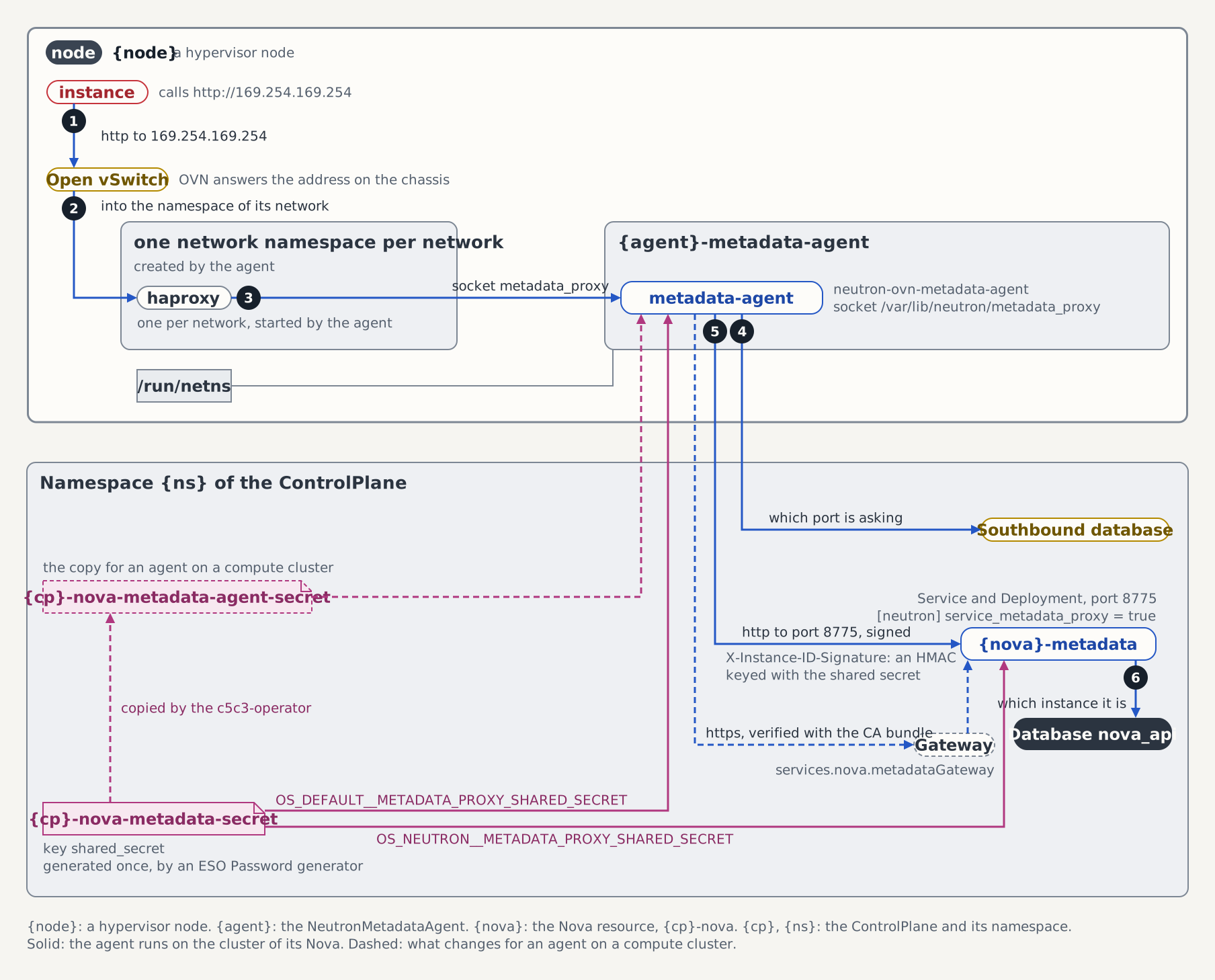
The figure follows a request from an instance to the Nova metadata API. Its numbers are the hops below.
- The instance calls
http://169.254.169.254. Neutron runs with[ovn] ovn_metadata_enabled = true, so OVN answers that address on the chassis of the instance's node. - Open vSwitch hands the request to a haproxy in a network namespace of its own. The agent creates one namespace per network under
/run/netnsand starts one haproxy in each, which is why its container is privileged and mounts/run/netnswith bidirectional propagation. - haproxy passes the request to the agent over the socket
/var/lib/neutron/metadata_proxy. The readiness probe of the agent tests for that socket. - The agent finds the port that is asking. It reads the local Open vSwitch database (
[ovs] ovsdb_connection) and the Southbound database ([ovn] ovn_sb_connection). - The agent forwards the request to
nova_metadata_hostonnova_metadata_portand signs it with the shared secret. Nova checks the headerX-Instance-ID-Signatureagainst an HMAC keyed with the same value. - The metadata API runs with
[neutron] service_metadata_proxy = true. It verifies the signature and resolves the instance from the mappings in the API database, which is why one metadata front end serves every cell.
The shared secret reaches both ends as an environment variable and never enters a ConfigMap: OS_DEFAULT__METADATA_PROXY_SHARED_SECRET on the agent, OS_NEUTRON__METADATA_PROXY_SHARED_SECRET on the metadata pods. Under a ControlPlane both read {controlplane.Name}-nova-metadata-secret, which an External Secrets Password generator fills once. The dashed parts of the figure are the two differences of an agent on a compute cluster, which the next section covers.
On a compute cluster
An agent whose pods run on a compute cluster reaches the Nova metadata API of its ControlPlane through the metadata Gateway (services.nova.metadataGateway). Its own spec wires it:
spec:
  targetClusterRef:
    name: compute-a
  novaMetadata:
    host: nova-metadata.example.com   # services.nova.metadataGateway.hostname
    port: 443                         # the Gateway listener's port
    protocol: https
    caBundleSecretRef:
      name: nova-metadata-ca          # signs the listener's certificate
    sharedSecretRef:
      name: controlplane-nova-metadata-agent-secret   # {controlplane.Name}-nova-metadata-agent-secret
The agent lives in the ControlPlane's OVN central namespace: its chassisRef is namespace-local, and so is that chassis's centralRef. For every cluster an agent there names {controlplane.Name}-nova-metadata-agent-secret on, the ControlPlane writes that Secret into the same namespace on that cluster (see The generated metadata shared secret). It carries a single key, shared_secret, the value the compute contract carries as metadata_proxy_shared_secret, so neither the bus URL nor the service password of the contract reaches the privileged namespace. Beside the ControlPlane's ownership labels it carries neutron.openstack.c5c3.io/metadata-shared-secret-mirror: "true" (MetadataSharedSecretMirrorLabel). A local agent gets no copy; in the Nova namespace it names the generated Secret directly.
The ControlPlane never deletes a copy. The teardown of a placed agent does, before it releases its finalizer: it lists the labelled Secrets in its namespace on its cluster and deletes each one that no other live agent in that namespace on the same cluster names in sharedSecretRef, with a Normal MetadataSharedSecretMirrorReaped event per deletion. A Secret without the label is left alone. An agent re-pointed at another Secret leaves its copy behind until the next agent teardown in that namespace on that cluster.
The CA bundle is not delivered. The ControlPlane names only the Gateway's parentRef and hostname and does not manage its certificate, so the deployment places the bundle in the agent's namespace, for example with trust-manager.
Memory sizing
The metadata-agent container holds more than the agent process. The agent starts its privsep daemons beside itself, and for every network with a port bound on its node it starts one haproxy in the same container. Its working set grows with the networks on the node, so the figure a single-process service gets does not fit it.
A CR that names no memory gets 2Gi as request and limit, on the agent container and on the wait-for-chassis init container. The figure covers 32 networks on the node. Sizing Calibration describes the measurement and the rule behind it. A node that binds more networks needs a larger memory value in spec.resources, set as request and as limit.
An agent at its limit shows OOMKilled as the last state of the metadata-agent container. A restart does not help. The new process provisions every network of the node again and is killed at the same point, so the instances on that node get no metadata until the limit is raised.
Upgrading the operator changes the pod template of every agent whose CR names no memory. The DaemonSet replaces its pods one node at a time, and each new pod needs 2Gi of memory that no other pod on its node has requested. A LimitRange whose max memory lies below 2Gi rejects the pods, and the DaemonSet reports FailedCreate events.
CPU sizing
A CR that names no CPU gets a request of 230m and no CPU limit, on the agent container and on the wait-for-chassis init container. The agent idles at 1 to 2 millicores, also with 32 networks on its node. It works when a server boots there: it provisions the server's network and answers the metadata requests of the boot. On the metal-stack lab one boot on a new network took 11 seconds of CPU time, and the minute in which 31 servers booted on one node averaged 198m. The request covers that minute with 15 % headroom. Sizing Calibration describes the session and the rule behind the figure.
The request is the share the agent gets while every CPU of its node is busy. Without a CPU limit a burst above it is not throttled; on a busy node it takes longer. The minute in which 32 servers of one node were hard-rebooted together averaged 357m. A node on which that many servers start at once, as after a reboot of the host, can name a larger CPU request in spec.resources.
Upgrading the operator changes the pod template of every agent whose CR names no CPU, so the DaemonSet replaces its pods one node at a time. A CR that names a CPU request or limit keeps it.
Defaulting and validation
The mutating webhook does three things. It materializes spec.logging and its baseline (text / INFO / debug: false) so no reconciler dereferences a nil pointer. Inside a present spec.novaMetadata it fills a zero port with 8775, an empty protocol with http, an empty sharedSecretRef.key with shared_secret, and an empty caBundleSecretRef.key with ca.crt. A nil spec.novaMetadata stays nil, because the agent then renders none of those keys.
Three defaults are resolved at reconcile time and never written into the stored CR: of the container resources, the CPU request and the memory fall back to the agent's own figures (see CPU sizing and Memory sizing), a spec.messaging.secretRef without a key reads transport_url, and an unset spec.metadataWorkers renders metadata_workers = 4 (DefaultMetadataWorkers).
Schema-layer rules
These hold even when the webhook is down.
| Message | Where it comes from |
|---|---|
targetClusterRef is immutable | Two CEL transition rules on NeutronMetadataAgentSpec, one for adding or removing the ref and one for renaming it |
chassisRef is immutable | A third transition rule on the same spec. An agent re-pointed at another chassis lands on another set of nodes, whose local Open vSwitch databases carry none of the ports it was answering for |
exactly one of image.tag or image.digest must be set | Inherited from commonv1.ImageSpec on spec.image |
exactly one of clusterRef or secretRef must be set | Inherited from commonv1.MessagingSpec on spec.messaging |
caBundleSecretRef requires protocol https | A CEL rule on NovaMetadataSpec, !has(self.caBundleSecretRef) || (has(self.protocol) && self.protocol == 'https'). The agent verifies the Nova metadata API's certificate only over TLS, so a bundle beside http would be mounted and never read |
The three transition rules are evaluated on UPDATE only. Beside them the schema carries the ordinary field markers: the ^\d{4}\.[12]$ pattern on spec.openStackRelease, MinLength=1 on spec.chassisRef.name, the Minimum=1 / Maximum=65535 pair on spec.novaMetadata.port, the http/https enum on spec.novaMetadata.protocol, and Minimum=0 on spec.metadataWorkers.
Webhook rules
The validating webhook accumulates every violation into one admission response. Most rules repeat a schema-layer check so the invariant survives an object that reached etcd through a bypass; the extraConfig rules have no schema counterpart at all.
The name bound, the chassis and the Nova metadata block:
| Message | Trigger |
|---|---|
name must be at most %d characters: it is the app.kubernetes.io/instance label value on every child and Kubernetes caps label values at %d characters | metadata.name longer than MaxNeutronMetadataAgentNameLength. Both arguments are that bound, 63. Enforced on create alone |
chassisRef.name must be set (the OVNChassis this agent runs alongside) | spec.chassisRef.name is empty. The chassis is what puts the agent on a node and gives it the local Open vSwitch database to read |
chassisRef is immutable | An update renames spec.chassisRef.name, the webhook-layer twin of the CEL rule |
port must be between 1 and 65535 | spec.novaMetadata.port outside the range. The defaulting webhook fills a zero with 8775, so this fires only for an object that bypassed it |
protocol must be http or https | spec.novaMetadata.protocol is neither. An empty value is admitted and left to the defaulting webhook, which fills http, and to the renderer, which omits the key for http and an empty value alike; the enum marker refuses anything else at the schema layer already |
sharedSecretRef.name must be set when spec.novaMetadata.sharedSecretRef is configured | The ref is present with an empty name |
caBundleSecretRef.name must be set when spec.novaMetadata.caBundleSecretRef is configured | The CA ref is present with an empty name |
caBundleSecretRef requires protocol https: the agent verifies the Nova metadata API's certificate only over TLS | The CA ref is present and spec.novaMetadata.protocol is not https, including an empty protocol. The webhook-layer twin of the CEL rule |
metadataWorkers must be non-negative | spec.metadataWorkers is set below 0, mirroring the Minimum=0 marker |
Image, messaging and the target cluster, through the shared helpers:
| Message | Trigger |
|---|---|
repository must be set | spec.image.repository is empty |
exactly one of image.tag or image.digest must be set | Both or neither are set on spec.image, re-checked outside the schema |
exactly one of clusterRef or secretRef must be set | A present spec.messaging names both modes or neither. The block is optional here, so the check runs only once it is set |
target cluster name must be set | spec.targetClusterRef is present with an empty name |
targetClusterRef is immutable (adding or removing it after creation is not permitted) | An update adds or drops the ref. Both strand the children already created on the previously selected cluster |
targetClusterRef is immutable (the children already exist on the previously named cluster) | An update renames the ref |
Control characters. Both values below are written into the rendered INI verbatim, so a newline would inject a whole config line past the (section, key)-keyed ownership and catalog gates:
| Message | Applies to |
|---|---|
value must not contain a newline or carriage return: it is rendered verbatim into neutron_ovn_metadata_agent.ini, so a newline injects arbitrary config lines | spec.chassisRef.name, which is resolved into the [ovs] and [ovn] connection strings, and spec.novaMetadata.host, which is rendered as a [DEFAULT] option |
Logging, through the shared logging validator:
| Message | Trigger |
|---|---|
field.NotSupported on spec.logging.format | A format outside text and json |
field.NotSupported on spec.logging.level | A level outside DEBUG, INFO, WARNING, ERROR, CRITICAL |
logger name must not be empty | A perLoggerLevels entry keyed on the empty string |
logger name must not contain a newline or carriage return: it is rendered verbatim into neutron_ovn_metadata_agent.ini, so a newline injects arbitrary config lines | A logger name with a control character. The name renders into the [DEFAULT] default_log_levels CSV |
level must be one of DEBUG, INFO, WARNING, ERROR, CRITICAL | A perLoggerLevels value outside the set |
The release floor, which has no schema counterpart. The CRD pattern admits any release of the YYYY.N cadence, and the floor moves with the operator version:
| Message | Trigger |
|---|---|
must be 2026.1 or later: this operator version no longer supports OpenStack releases below 2026.1 | spec.openStackRelease names a release below 2026.1, the oldest this operator version supports, on create or when an update changes it. A change from one release below the floor to another is rejected too |
An update that keeps a stored value below the floor is admitted with a warning, so an unrelated edit never blocks the resource:
spec.openStackRelease %q is below 2026.1, the oldest OpenStack release this operator version supports; the unchanged value is admitted, but the operator renders the 2026.1 configuration for it. Set spec.openStackRelease to 2026.1 or later.spec.extraConfig is a preserve-unknown-fields map CEL cannot constrain, so every guard on it is the webhook's alone:
| Message | Trigger |
|---|---|
extraConfig section name must not be empty | A section keyed on the empty string, which would render a nameless [] header |
extraConfig section name must not contain a newline or carriage return | A control character in a section name |
extraConfig key must not be empty | An option keyed on the empty string, which would render a bare = value line |
extraConfig key and value must not contain a newline or carriage return: the rendered INI writes them verbatim, so a newline injects arbitrary config lines | A control character in an option key or value |
%s is managed via %s and must not be set in extraConfig (%s) | An override of a Rejected owned key. The arguments are the key, the field or computation that owns it, and its impact; the parenthesis is dropped for an entry with no impact text |
no such option in the neutron %s option catalog | An option name the release catalog does not know. The argument is the catalog's release |
no such section in the neutron %s option catalog | A section name the release catalog does not know |
Both kinds share one catalog, the flat union of neutron.conf, ml2_conf.ini and neutron_ovn_metadata_agent.ini with no per-file provenance. A section that belongs to the API process therefore passes here, and oslo.config ignores it at runtime. Owned keys are exempt from the scan, so an operator-owned key never doubles as an unknown option. The check re-runs on update only when spec.extraConfig or spec.openStackRelease changed.
The same check produces four admission warnings:
spec.extraConfig was not validated against an option catalog: spec.openStackRelease does not name an OpenStack release
spec.extraConfig was not validated against an option catalog: no catalog for release %q is embedded in this operator build
spec.extraConfig [%s] %s: deprecated option in neutron %s, replaced by %s
spec.extraConfig [%s] %s: deprecated option in neutron %s with no replacement
The first two are the fail-open paths: an unresolvable release skips the option check and raises one warning.
Rejected owned keys
config_ownership.go keeps a registry per kind, and MetadataAgentOwnedConfigKeys is the agent's. It is separate from the Neutron registry because the two kinds render different files: the agent's [ovn] section carries only the Southbound half, and its [DEFAULT] carries the Nova metadata keys the API never writes. Six of its entries are refused in spec.extraConfig outright:
| Key | Owned by | Why the override is refused |
|---|---|---|
[DEFAULT] metadata_proxy_shared_secret | spec.novaMetadata.sharedSecretRef | The shared secret is env-injected from the referenced Secret, so a file override is ignored at runtime and copies credential material into the rendered ConfigMap |
[ovs] ovsdb_connection | spec.chassisRef | The agent reads the local Open vSwitch database over the socket the chassis pods share; another address points it at a node whose ports it is not answering for |
[ovn] ovn_sb_connection | spec.chassisRef | The connection string is the Southbound address the OVNCentral the referenced chassis registers with publishes for the chassis's cluster: the internal one on the central's cluster, the node-port one from another; another address points the agent at a logical model it does not serve |
[ovn] ovn_sb_private_key | operator-computed | The operator mounts the client keypair the chassis publishes in status.clientSecretName, signed by the OVNCentral issuer; another path names a file the pod does not carry, and the connection falls back to no client identity |
[ovn] ovn_sb_certificate | operator-computed | The certificate half of the same keypair |
[ovn] ovn_sb_ca_cert | operator-computed | The CA bundle verifies the database endpoint; another path either fails the handshake or trusts a server the operator did not provision |
Every other entry in the registry is honored and reported: [DEFAULT]state_path, debug, nova_metadata_host, nova_metadata_port, nova_metadata_protocol, auth_ca_cert and metadata_workers, [agent] root_helper, the [oslo_messaging_notifications] driver, the five [oslo_messaging_rabbit] keys, and [oslo_concurrency] lock_path. The broker keys are registered unconditionally although they render only while spec.messaging is set: the registry records that a key is not the user's to set, not that it is currently rendered.
nova_metadata_protocol joined the registry with spec.novaMetadata.protocol. Before that spec.extraConfig was the only way to set it, so an agent that sets it there reports ExtraConfigHealthy=False with an ExtraConfigOwnedKeyOverride Warning event after the upgrade, although its rendered config does not change. Move the value to spec.novaMetadata.protocol and drop the entry from spec.extraConfig.
auth_ca_cert joined the registry the same way, with spec.novaMetadata.caBundleSecretRef. Before that an extraConfig value named a file the pod does not carry. An agent that sets it there keeps its value, because extraConfig is merged last, and reports ExtraConfigHealthy=False with an ExtraConfigOwnedKeyOverride Warning event. Move the bundle into a Secret, name it in spec.novaMetadata.caBundleSecretRef and drop the entry from spec.extraConfig. nova_metadata_insecure has no typed field and stays an ordinary spec.extraConfig key.
metadata_workers joined the registry the same way, with spec.metadataWorkers. An agent that sets it in spec.extraConfig keeps its value, because extraConfig is merged last, and reports ExtraConfigHealthy=False naming [DEFAULT] metadata_workers. Move the value to spec.metadataWorkers and drop the entry from spec.extraConfig to clear the condition.
[agent] root_helper joined the registry with the operator default env and has no typed field. An agent whose spec.extraConfig sets no root_helper in [agent] gets a new config ConfigMap at the operator upgrade, and its DaemonSet rolls once on every node. An agent that carries root_helper: env there renders the same bytes and does not roll. It reports ExtraConfigHealthy=False with an ExtraConfigOwnedKeyOverride Warning event until the entry is removed from spec.extraConfig, and removing it does not roll the DaemonSet either. Any other value, for a custom image that needs another helper, is honored and reported the same way.
Keep the root_helper: env entry until a rollback to an operator release without this default is ruled out. That release renders no root_helper, so the agent falls back to sudo, finds no privsep-helper and provisions no network. While the entry is set, a rollback still renders root_helper = env.
Status
| Field | Type | Description |
|---|---|---|
conditions | []metav1.Condition | List-map keyed by type; see Conditions |
observedGeneration | int64 | The .metadata.generation the controller last reconciled |
installedImage | string | The image reference the running DaemonSet was projected from, recorded once the DaemonSet reports a ready pod on every node it schedules. A rollout that has reached no node leaves the previous value in place, which is what tells the two apart |
desiredNumberScheduled | int32 | How many nodes the DaemonSet should run on, mirrored from the DaemonSet status |
numberReady | int32 | How many of those nodes have a ready agent pod |
Conditions
Four sub-reconcilers each own one condition type, and every one of the four is set on every pass: the agent runs no optional step. The aggregate Ready is True only when all four are. For the pipeline that sets them see Reconciler Architecture.
| Type | Status | Reason | Meaning |
|---|---|---|---|
ChassisReady | True | ChassisResolved | The OVNChassis resolved, its OVNCentral published the Southbound address for the chassis's cluster, and the chassis published the client Secret its pods mount. The message names the chassis, the central and the address |
ChassisReady | False | ChassisNotFound | No OVNChassis of that name in this CR's namespace. An agent applied before its chassis is an ordinary ordering of two objects in one manifest, so this polls |
ChassisReady | False | ChassisReadError | Reading the OVNChassis failed |
ChassisReady | False | ChassisOnAnotherCluster | The two CRs name different target clusters. The agent shares the chassis's nodes and mounts the Secret the chassis publishes, and neither a node nor a Secret crosses a cluster boundary. No requeue: both refs are immutable, so only deleting and reapplying one of the two can repair it |
ChassisReady | False | ChassisNotReady | The chassis has not published status.clientSecretName yet, and nothing stands in for it. It is set by the chassis's client-Secret step. On the central's cluster the central's own status.clientSecretName stands in, so only a chassis on another cluster, or a central that has not named its Secret either, leaves the agent here. Polls |
ChassisReady | False | CentralNotFound | The OVNCentral the chassis attaches to does not exist in this namespace |
ChassisReady | False | CentralReadError | Reading the OVNCentral failed |
ChassisReady | False | CentralNotExternallyReachable | The central projects onto another cluster than the chassis and does not set spec.southbound.externallyReachable. The message names both clusters and the field. No requeue: the fix is an edit to the central |
ChassisReady | False | CentralNotReady | The central has published no Southbound address for the chassis's cluster yet: the internal one on the same cluster, the one outside its cluster otherwise |
ChassisReady | False | TargetClusterUnavailable | spec.targetClusterRef names a cluster that does not resolve. This is the pipeline's first gate, so the failure lands on the condition the rest of the graph waits behind. A deleting CR waiting for its target cluster to come back reports the same reason here |
SecretsReady | True | SecretsAvailable | Every credential the agent needs is there. A CR that sets none of spec.novaMetadata.sharedSecretRef, spec.novaMetadata.caBundleSecretRef and spec.messaging reaches this without reading anything |
SecretsReady | False | WaitingForNovaSharedSecret | The Secret named by spec.novaMetadata.sharedSecretRef is missing, or carries no value under the configured key. The message distinguishes a missing ExternalSecret from one that has not synced and from a Secret missing keys |
SecretsReady | False | WaitingForNovaMetadataCA | The Secret named by spec.novaMetadata.caBundleSecretRef is missing, or carries no value under the configured key, which the message names. It is gated after the shared secret. The Config and DaemonSet steps wait, so no pod is started with a volume that never mounts |
SecretsReady | False | WaitingForMessagingCredentials | The managed RabbitmqCluster has published no default-user Secret yet, or the brownfield Secret carries no transport URL |
SecretsReady | False | ConfigError | Rendering or pruning the config ConfigMap failed. Config artefacts gate the same downstream step as the credentials, so they share this condition and there is no separate one for them |
DaemonSetReady | True | DaemonSetReady | The DaemonSet runs a ready pod on every node it schedules. The message counts the nodes |
DaemonSetReady | False | DaemonSetProgressing | Fewer nodes run a ready pod than the DaemonSet schedules. The message counts both |
DaemonSetReady | False | DaemonSetError | The DaemonSet could not be applied or read |
Ready | True | AllReady | All four sub-conditions are True |
Ready | False | NotAllReady | At least one is not |
VPAReady | True | VPAReady | The VerticalPodAutoscaler of every opted-in workload is applied; the message names them. See VerticalAutoscalingSpec |
VPAReady | True | VPANotRequired | No workload opts in (spec.verticalAutoscaling unset); a VPA the CR created before is deleted |
VPAReady | False | VPANotInstalled | A workload opts in, but the cluster the children land on does not serve autoscaling.k8s.io/v1 VerticalPodAutoscaler. Nothing is created, and the other conditions still converge |
VPAReady | False | CapabilityProbeFailed | The target cluster the CR names could not be probed for the kind |
VPAReady | False | VPAError | Listing, applying or deleting a VPA failed; the message carries the error |
ExtraConfigHealthy is set beside these on every pass that renders a config, reporting the honored overrides of operator-owned keys. It is informational and stays out of the Ready aggregation.
Sub-Resource Naming Convention
Every child takes the CR name plus a component suffix. For a NeutronMetadataAgent named {name}:
| Resource | Name | Notes |
|---|---|---|
| DaemonSet | {name}-metadata-agent | The neutron-ovn-metadata-agent container plus the wait-for-chassis init container, on the nodes the referenced OVNChassis selects. The suffix is also the app.kubernetes.io/component label value and the container name |
| ConfigMap | {name}-config-<hash> | Immutable, content-addressed neutron_ovn_metadata_agent.ini, plus logging.conf for spec.logging.format: json; 3 historical retained |
| Secret | {name}-transport-url | The derived rabbit:// URL, written only while spec.messaging is set and consumed through OS_DEFAULT__TRANSPORT_URL |
The app.kubernetes.io/name label on every child is neutronmetadataagent, the kind in lower case, which is what keeps these children apart from the ones a Neutron of the same name projects into the same namespace. The pod selector narrows that label set by the component, so the DaemonSet selects its own pods and not the chassis pods sharing the node.
metadata.name is bounded at 63 characters, because it is the app.kubernetes.io/instance label value on every child and the owner-name label value on the children of a placed CR. Kubernetes caps a label value at 63.
Node contract
The agent picks no nodes of its own. spec.nodeSelector and spec.tolerations of the referenced OVNChassis are copied verbatim onto the DaemonSet, so the agent lands on the set of nodes the chassis programs and nowhere else. Both are deep-copied, and spec.chassisRef is resolved in the CR's own namespace through the management-cluster client, since every CR of this control plane is written there whatever cluster the children land on.
The figure shows the agent's pod beside the three other pods of such a node. Its init container is the only one that waits for the chassis to be registered in the Southbound database.
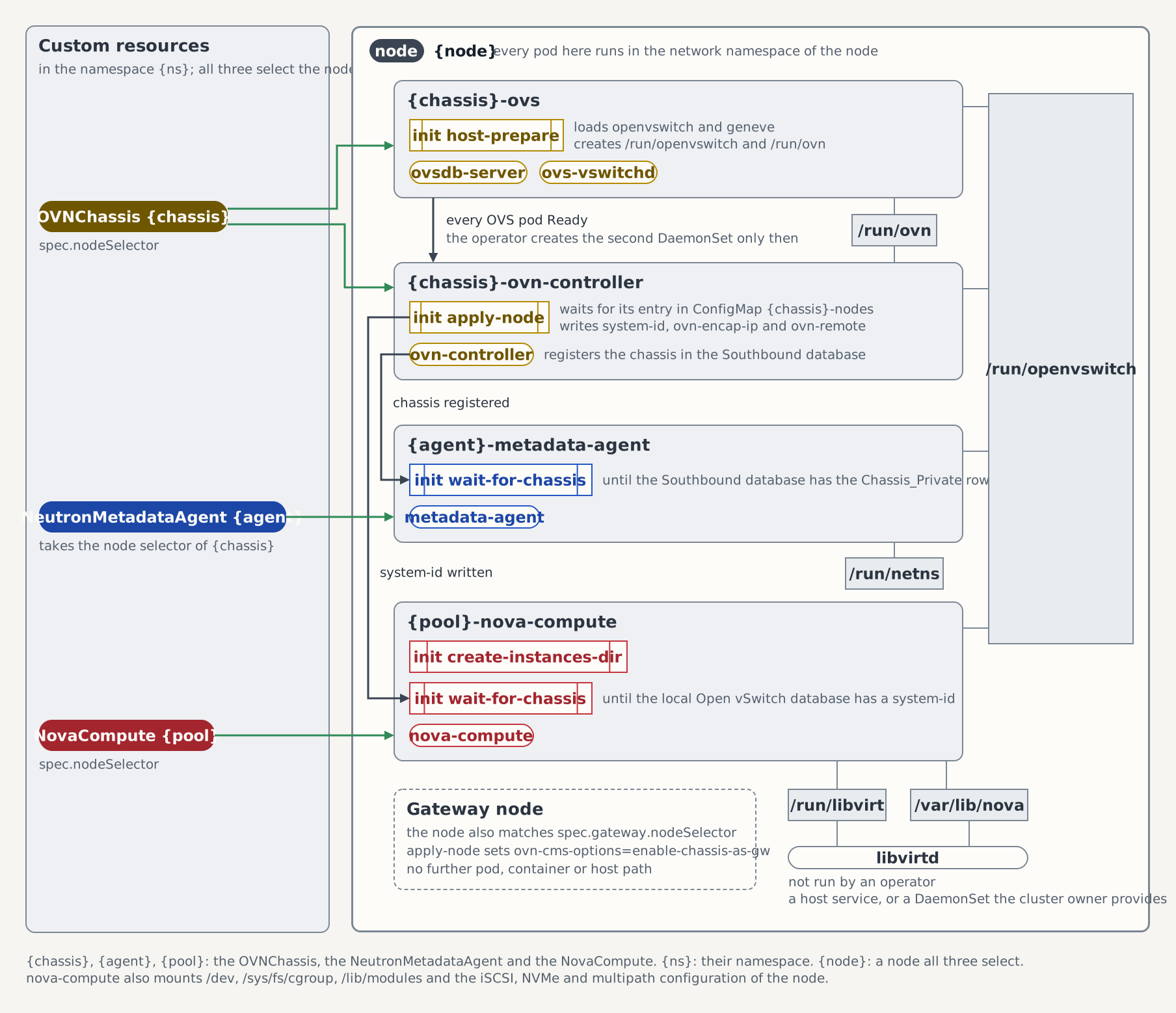
The pod runs with hostNetwork: true: it answers the 169.254.169.254 requests arriving on the node's own interfaces. Two host paths are mounted, both DirectoryOrCreate so a node that has never run Open vSwitch still starts:
| Path | Mount | Why it is a host path |
|---|---|---|
/run/openvswitch | read-write, on the init container and the agent container | The local Open vSwitch database socket the chassis pods create. It is what the agent reads its node's port bindings from, and an emptyDir would leave it reading nothing |
/run/netns | read-write with Bidirectional mount propagation | The network namespaces the agent creates. Bidirectional propagation is what makes them visible to the node, which is how the datapath reaches the proxies running inside them |
With spec.novaMetadata.caBundleSecretRef set, the agent container mounts the named Secret read-only at /etc/nova-metadata-ca, mode 0444, projecting the configured key as ca.crt. The init container sends no request to the Nova metadata API and does not get this mount. The path lies outside the read-only /etc/neutron config mount. Neutron opens the file on every proxied request and the volume has no subPath, so a rotated bundle reaches the running pods without a rollout.
The agent container runs privileged and pinned to uid 0, with runAsNonRoot: false. It creates network namespaces, moves interfaces into them and starts a haproxy per network through privsep, which the Restricted profile denies and no named capability covers. The operator renders [agent] root_helper = env, so the agent starts privsep-helper as the container's own user, and privsep-helper needs uid 0 for the capabilities it keeps. The image's own unprivileged user does not work either. The pod-level security context carries the seccomp profile and nothing else: no fsGroup, because it would be applied to the host directories the pod mounts, where the ownership is the node's business. The wait-for-chassis init container runs under the Restricted profile.
That init container is the same-node gate. The agent reads external_ids:system-id from the local Open vSwitch database once, at start, and takes it as its chassis name. It then writes its registration into the Chassis_Private row of that name in the Southbound database and retries for as long as the row is missing, with its proxy socket open and the pod Ready. The chassis's host-prepare init container creates /run/openvswitch/conf.db only when the file is missing, so on a node whose database outlived an earlier OVNChassis the system-id is that chassis's old id until the new chassis's apply-node init container writes the new one. An agent started in between never registers, and the servers on its node get no metadata.
The gate waits for the registration the agent depends on. Every 2 seconds it reads the local system-id again and decides:
| State | Log line | Outcome |
|---|---|---|
No UUID-shaped system-id in the local database (socket missing, query failed, key absent, value not a UUID) | waiting for the chassis to write its system-id into the local Open vSwitch database | wait |
A system-id without a Chassis_Private row of that name (the id is stale, ovn-controller has not registered it yet, or the Southbound query failed) | waiting for chassis <id> to register in the Southbound database | wait |
A system-id and its Chassis_Private row | chassis <id> is registered in the Southbound database | exit 0 |
On a reused database the gate waits in the second state on the old id and passes on the new one. It prints a message only when the message changes, so a pod held in Init:0/1 logs the id it waits for without a line every 2 seconds. While a pod is held there, the DaemonSet step reports DaemonSetReady=False with reason DaemonSetProgressing. A Southbound fault that persists (a wrong address, an unreadable key, a rejected certificate) logs the same second line, because the gate discards the errors of its queries.
The init container carries OVN_SB_CONNECTION, the Southbound address the agent's [ovn] ovn_sb_connection gets, and mounts the ovn-tls client Secret read-only at /etc/ovn/tls beside /run/openvswitch. It queries the Southbound database with --no-leader-only, as the agent's own connection does, so a leader election does not hold it. An empty OVN_SB_CONNECTION is a rendering fault no wait repairs: the gate prints OVN_SB_CONNECTION is not set on stderr and exits 1.
Both workloads select the same nodes and nothing orders the two DaemonSets, so the gate is per node rather than per cluster. The queries go through ovsdb-client because the neutron image ships the OVS Python client without the ovs-vsctl binary.
Readiness is the metadata proxy socket, tested with test -S /var/lib/neutron/metadata_proxy after a 5 s initial delay, every 5 s, with a 5 s timeout. An agent that has not opened that socket answers no instance and must not count as a node the rollout may move on from.
There is no liveness probe. An agent that lost its Southbound connection keeps serving the proxies it already created, and a restart would drop them for a fault the readiness probe already reports.
Example
apiVersion: neutron.openstack.c5c3.io/v1alpha1
kind: NeutronMetadataAgent
metadata:
  name: neutron-agent
  namespace: openstack
spec:
  openStackRelease: "2026.1"
  image:
    repository: ghcr.io/c5c3/neutron
    tag: "2026.1"
  chassisRef:
    name: neutron-agent-chassis
This is the fixture the metadata-agent suite applies (tests/e2e/neutron/metadata-agent/03-neutronmetadataagent-cr.yaml). It leaves spec.messaging out, which is what gives the suite's "no transport_url line" assertion something to check, and spec.novaMetadata too, since Nova is not onboarded onto this operator. Without either block the CR references no Secret at all, the path SecretsReady=True with reason SecretsAvailable covers.