Cinder Reconciler Architecture
The Cinder controller runs the shared table-driven pipeline (internal/common/reconcile) with twelve sequential sub-reconcilers and a parallel group of five. Every step is instrumented under the cinder_operator metrics prefix, and the first step to return a non-zero result or an error short-circuits the chain. Conditions and the requeue are persisted on every exit path through the shared status skeleton.
Two Prometheus vectors cover the pipeline (cinder_operator_reconcile_duration_seconds, cinder_operator_reconcile_errors_total, the latter labelled by sub_reconciler and condition_type). Three per-CR collector pairs cover the Jobs: cinder_operator_db_sync_total and cinder_operator_db_sync_duration_seconds for the schema migrations, cinder_operator_db_purge_* for the recurring purge, and cinder_operator_service_remove_* for a backend detach. Each pair is labelled by cinder and namespace, and the counters carry the terminal result. The Grafana dashboard operators/cinder/dashboards/cinder-operator.json reads them under the uid cinder-operator.
Two more controllers run beside it, one per satellite kind. Each is the single writer of its own CR's status and creates nothing.
Pipeline
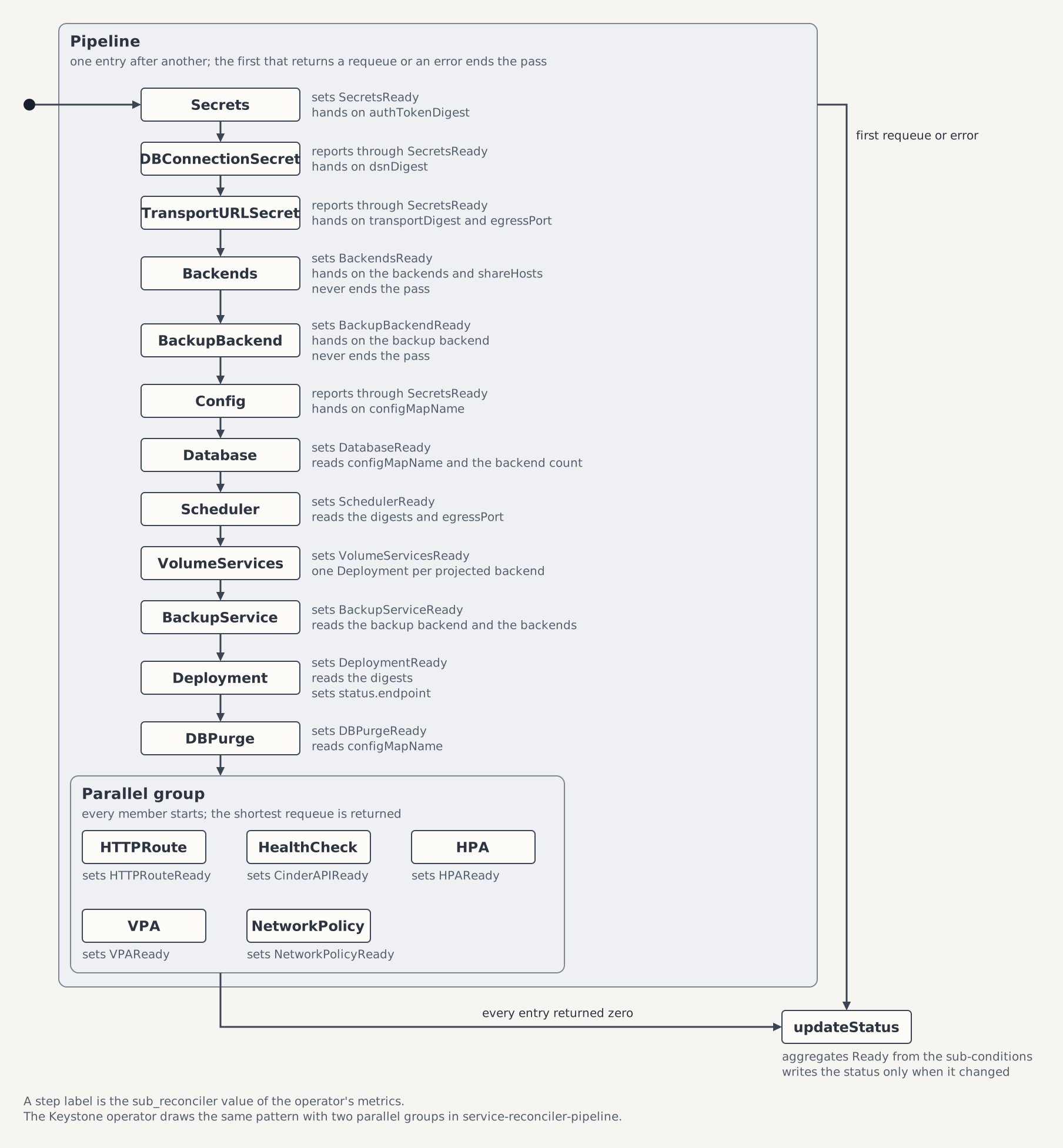
The figure draws the pattern the Keystone operator set: a lane of steps that ends the pass at the first requeue or error, and a group whose members all run. Reconciliation Flow describes that pattern in full. The table lists what each step does.
| Step | What it does | Condition |
|---|---|---|
| Secrets | Gates on the selected secret store (spec.secretStoreRef, default openbao-cluster-store), then the ESO-synced database and service-user credential Secrets; digests the service-user password for the rollout annotation | SecretsReady |
| DBConnectionSecret | Materializes the pymysql DSN into the derived {name}-db-connection Secret and digests it; reports through SecretsReady | SecretsReady |
| TransportURLSecret | Materializes the rabbit:// URL into the derived {name}-transport-url Secret, digests it, and resolves the broker port the NetworkPolicy member opens; reports through SecretsReady | SecretsReady |
| Backends | Renders every attached, credential-ready CinderBackend into its own content-hashed Secret and sweeps the base names nothing projects anymore. Waiting states never short-circuit the pipeline: a Cinder without backends still converges, and a backend's status flip re-enqueues through the watch | BackendsReady |
| BackupBackend | Renders the single attached, credential-ready CinderBackupBackend, under the same never-short-circuit contract | BackupBackendReady |
| Config | Renders cinder.conf and scheduler.conf (plus logging.ini and policy.yaml when applicable) into an immutable content-addressed ConfigMap, and maintains the informational ExtraConfigHealthy condition. A section carrying a control character is not re-rendered: the step returns the artefacts the live API Deployment currently mounts, so the running pods keep their last-good config. Failures report through SecretsReady with the reason ConfigError | SecretsReady |
| Database | Provisions and migrates the schema (MariaDB gate, Database/User/Grant, one cinder-manage db sync Job); a release bump instead runs the expand-migrate-contract flow; promotes installedRelease; sizes the SQL user's connection cap | DatabaseReady |
| Scheduler | Ensures the {name}-scheduler Deployment. No Service, no PodDisruptionBudget, no autoscaling: the scheduler takes its work off the bus | SchedulerReady |
| VolumeServices | Ensures one {name}-volume-{backend} Deployment per projected backend, deletes the Deployments of backends that left, reports status.volumeServices, and drives the detach of the backends that are being deleted | VolumeServicesReady |
| BackupService | Ensures the {name}-backup Deployment, or deletes it when no backup target is projected. It mounts every NFS volume backend's export and projects every RBD volume backend's keyring as well, because a backup reads the source volume itself | BackupServiceReady |
| Deployment | Ensures the API Deployment, its Service (port 8776) and the PDB, and stamps status.endpoint. Mid-upgrade it flips the RollingUpdate phase to Contracting once the rollout has fully converged | DeploymentReady |
| DBPurge | Projects the {name}-db-purge CronJob and reports the newest terminal run it spawned. It runs before the parallel group rather than inside it, because it needs only the rendered config the Config step produced | DBPurgeReady |
| HTTPRoute | Full spec.gateway lifecycle; reflects the Gateway's Accepted condition | HTTPRouteReady |
| HealthCheck | HTTP GET of the cluster-local /healthcheck through the shared TTL probe cache | CinderAPIReady |
| HPA | Creates and deletes the HorizontalPodAutoscaler of the API Deployment | HPAReady |
| VPA | reconcileVPA applies or removes the VerticalPodAutoscalers of the API, scheduler, volume and backup Deployments through the shared VPA flow; a detached backend or a removed backup target loses its VPA with its Deployment | VPAReady |
| NetworkPolicy | Creates and deletes the NetworkPolicy (auto-derived egress, including the broker port, one rule for the NFS exports and one rule for the networks the RBD backends name); refuses an empty ingress list (fail-closed) | NetworkPolicyReady |
DBConnectionSecret, TransportURLSecret and Config reuse SecretsReady rather than a dedicated ConfigReady condition: all three produce artefacts that gate the same downstream graph, so a distinct sub_reconciler label on the error counter disambiguates them during triage while the status contract stays minimal.
The five members of the parallel group have no inter-dependency. Each operates on its own copy of the CR and sets exactly one condition, and the group merges the conditions back before the status write.
Conditions
The aggregate Ready is True (reason AllReady) exactly when all fourteen sub-conditions are True; otherwise False (NotAllReady). ExtraConfigHealthy is deliberately outside the aggregate: it reports on an overlay the user owns and must not depool a Cinder whose API serves fine.
| Type | True reasons | False reasons |
|---|---|---|
SecretsReady | SecretsAvailable | TargetClusterUnavailable, SecretStoreNotReady, ClusterSecretStoreUnsupported, WaitingForDBCredentials, WaitingForServiceUserCredentials, WaitingForMessagingCredentials, ConfigError |
BackendsReady | AllBackendsProjected, NoBackends | WaitingForBackends |
BackupBackendReady | BackupBackendProjected, NoBackupBackend | WaitingForBackupBackend, MultipleBackupBackends |
DatabaseReady | DatabaseSynced | ClusterNotReady, WaitingForDatabase, WaitingForConfig, ImageReleaseMismatch, DBSyncFailed, DBSyncInProgress, VersionParseError, DowngradeNotSupported, UpgradePathInvalid, UpgradeTargetChanged, ExpandInProgress, MigrateInProgress, UpgradeRollingUpdate, ContractInProgress, ExpandFailed, MigrateFailed, ContractFailed |
SchedulerReady | SchedulerReady | WaitingForScheduler |
VolumeServicesReady | AllVolumeServicesReady | NoBackends, WaitingForVolumeServices, ServiceRemoveJobFailed |
BackupServiceReady | BackupServiceReady, BackupNotConfigured | WaitingForBackupService |
DeploymentReady | DeploymentReady | WaitingForDeployment |
CinderAPIReady | APIHealthy | APIUnhealthy, EndpointNotReady, HealthCheckTimeout, ConnectionFailed, HealthCheckFailed |
HPAReady | HPAReady, HPANotRequired | errors propagate |
VPAReady | VPAReady, VPANotRequired | VPANotInstalled, CapabilityProbeFailed, VPAError |
NetworkPolicyReady | NetworkPolicyReady, NetworkPolicyNotRequired | errors propagate |
HTTPRouteReady | HTTPRouteAccepted, HTTPRouteNotRequired | HTTPRouteNotAccepted, GatewayAPINotInstalled, CapabilityProbeFailed |
DBPurgeReady | DBPurgeScheduled, DBPurgeSuspended | DBPurgeJobFailed |
ExtraConfigHealthy | NoOwnedKeysOverridden | OwnedKeysOverridden |
Three of those True reasons describe an absence rather than a success. NoBackends and NoBackupBackend say that no storage is attached, which is a posture and not a fault: the API and the scheduler run either way. BackupNotConfigured is the workload side of the second one. DBPurgeSuspended is the fourth of its kind: a paused purge is an operator's decision, so the condition stays True while the metric simply stops incrementing.
TargetClusterUnavailable is set ahead of every sub-reconciler, when spec.targetClusterRef names a target cluster that is not registered or no longer resolves. The CR requeues after 15 seconds and acquires no finalizer, and nothing is created on any cluster. An attached satellite reports the same reason on its own CredentialsReady. See Target Clusters.
The two satellite controllers set CredentialsReady, ConfigProjected and their own aggregate Ready. Their vocabulary lives with the kinds: CinderBackend and CinderBackupBackend.
Database
The Database step runs the shared provisioning flow first: a MariaDB cluster gate and Database/User/Grant in managed mode, a no-op in brownfield. It then waits for a rendered config, because the migration Jobs mount the config ConfigMap as their whole config directory and an empty name would render a volume the API server rejects (DatabaseReady=False, reason WaitingForConfig).
Before either path advances release tracking, the step compares a tag-pinned spec.image against spec.openStackRelease. The two fields are deliberately separate, so that a digest-pinned image still resolves a schema, and nothing else enforces that they agree: an image whose tag names a different release would run the wrong cinder-manage binary against a schema already at its own head, and the phase Jobs would exit 0 as no-ops while installedRelease was promoted to a release the pods do not run. A mismatch sets DatabaseReady=False under ImageReleaseMismatch and requeues. A digest-pinned image and an unparseable tag carry no comparable release and are left to the explicit spec.openStackRelease declaration; a patch suffix such as 2026.1-p1 still matches 2026.1.
Steady state is a single {name}-db-sync Job running cinder-manage db sync, which applies every pending alembic revision in one idempotent pass. There is no schema-check Job, so SchemaDriftDetected never fires for Cinder. installedRelease is promoted on Job success.
Connection cap
The MariaDB User is created with a max_user_connections cap sized for the CR's own topology, because the mariadb-operator default of 10 is exceeded by the default topology before a single request is served, and a cap below the fleet's steady state does not degrade gracefully: the last processes to start fail their pool with MySQL error 1226 and crash-loop their pod.
(apiPods + 1) x uwsgiProcesses x uwsgiThreads x 2
  + 2 x (schedulerReplicas + volumeDeployments + 1)
  + 2
apiPods is the autoscaling ceiling when an HPA owns the count, and the + 1 beside it is the rolling-update surge. Each API worker process holds two pooled connections: the request-serving session, plus the one oslo.db's pool keeps open behind it. The second line is the single-writer services, each with the same pair: every scheduler pod, every cinder-volume Deployment, and the one backup service (the + 1 inside the parenthesis). The trailing + 2 is headroom for a migration Job overlapping the fleet.
Release upgrade
A spec.openStackRelease bump with the image in lockstep dispatches to the shared expand-migrate-contract flow (internal/common/database), the same phase machine Keystone and Glance run. The step validates the path against installedRelease and rejects a downgrade or a non-sequential jump (VersionParseError, DowngradeNotSupported, UpgradePathInvalid), then walks four phases.
| Phase | What runs | Job |
|---|---|---|
Expanding | cinder-manage db sync. Cinder has no separate expand verb, and the sync is the same idempotent upgrade-to-head the steady state runs | {name}-db-expand |
Migrating | cinder-status upgrade check, which reports readiness for the target release | {name}-db-migrate |
RollingUpdate | No Job. The scheduler, the volume services, the backup service and the API roll onto the new image, in that order, because that is the order the pipeline ensures them in. Each step requeues until its Deployments have fully converged, so a later phase never runs against a process still on the old image | |
Contracting | cinder-manage db online_data_migrations, the backfill the new schema needs, which the completed rollout makes safe | {name}-db-contract |
The upgrade check's exit code is a severity rather than a success flag: 0 is clean, 1 carries warnings, and 2 means a check failed, which for a Cinder is typically a volume whose service_uuid is still NULL and which the service backfills on its own. None of the three may wedge an upgrade, so the phase Job normalises 0, 1 and 2 to a zero exit and lets anything else fail. The real code travels in the pod's termination message, which the operator turns into an UpgradeCheckCompleted or UpgradeCheckWarnings event.
The message is read off the migrate Job's pod that succeeded, because the Job runs each retry as a pod of its own and a failed attempt with exit 3 or more sits beside the retry that completed. A Job without a succeeded pod is read off its newest one. Only pods carrying the Job's UID count, so a pod that an earlier migrate Job of the same name left behind is never read. The pods are listed through the uncached API reader of the cluster that holds them. The operator reads one pod's message once per Job and never watches pods, and a read through the cached client would start an informer over every pod of the cluster that the operator's get/list RBAC does not allow to watch. A pod the operator cannot read, or a target cluster that does not resolve, leaves the event saying the exit code is unavailable.
installedRelease is promoted only after the contract phase completes. That promotion changes the cinder.c5c3.io/installed-release pod annotation, which rolls the scheduler, the volume services and the backup service once more. Each of them caches the RPC version its peers announced at startup, and the cache pins the wire format for the life of the process, so the second roll is what drops it. The API carries no such annotation: it rolled during RollingUpdate and came up holding the new minimum.
The operator-facing walkthrough of the same flow, with the pre-flight checks and the abort recipe, is Cinder Upgrade Flow.
Volume services and the detach sequence
The VolumeServices step projects one Deployment per backend rather than one Deployment serving all of them. A cinder-volume owns its backend through a host identity, so a process serving two backends could not be restarted for one of them alone, and a backend whose export is unreachable would take its siblings down with it.
A deleted CinderBackend is held by the cinder.openstack.c5c3.io/service-remove finalizer, and this step releases it, one backend per pass, in name order:
- The volume Deployment is deleted. The pass returns here rather than continuing, because a running
cinder-volumereports itself back into the service registry every few seconds and an entry removed underneath it would come back. - Once a later pass finds the Deployment gone, the
{name}-{backend}-service-removeJob runscinder-manage service remove cinder-volume {name}@{backend}against the same database and with the same environment the volume service ran with. Exit code 2 is tolerated. - The backend's projection Secrets are swept whole, with no rollback history: they name an export this Cinder no longer serves.
- The finalizer is released, a
ServiceRemovedevent is emitted on the Cinder, and the run feeds thecinder_operator_service_remove_*pair once per (backend, Job UID) tuple.
A failed Job stops at step 2 and keeps the finalizer: VolumeServicesReady=False under ServiceRemoveJobFailed names the Job, and deleting that Job retries the removal once the cause is understood.
DBPurge
The DBPurge step runs sequentially, before the parallel group: it needs only the rendered config the Config step produced. It projects the {name}-db-purge CronJob on every pass with the settings effectiveDBPurge resolves, and it takes its run visibility from the Jobs the CronJob spawned instead of from the CronJob object. It lists the Jobs carrying the Cinder's common labels and reports on the newest that reached a terminal state.
The command is cinder-manage db purge <retentionDays>, and the age is its whole argument list. Neither 27.0.0 nor 28.0.0 accepts a --max_rows cap, so there is no per-invocation bound to set. The purge issues one unbounded DELETE … WHERE deleted IS TRUE AND deleted_at < <age> per table, all of them in a single transaction. spec.dbPurge.retentionDays is therefore the only lever on how much one run deletes; spec.dbPurge.schedule moves when a run fires and nothing else, so it is no help against a backlog a single run cannot finish.
Two CronJob settings bound what that costs. ConcurrencyPolicy: Forbid keeps a run that outlasts its interval from being overtaken by the next firing, which is what a first pass over a long backlog invites. activeDeadlineSeconds: 3600 catches a run that wedges instead of failing: an unschedulable pod, or a cinder-manage blocked on a database lock. Either reaches a terminal Failed state within the hour and surfaces as DBPurgeReady=False under DBPurgeJobFailed with a matching Warning event, instead of leaving the condition reporting a purge that never happened. A later successful run flips it back to True. A CronJob suspended through spec.dbPurge.suspend keeps DBPurgeReady at True under its own reason DBPurgeSuspended, because nothing else would report it: a suspended CronJob never fires, so no run fails and no event follows.
The hour is sized for a steady state that deletes a day of rows, which makes a brownfield backlog the case the deadline is least forgiving of: a first pass that runs past it is terminated mid-transaction, the database rolls the whole thing back, and the next firing spends another hour on the same rows. Walk such a backlog down instead of leaving it to a retention window a single run cannot reach the end of. Suspend the CronJob, raise spec.dbPurge.retentionDays past the age of the oldest soft-deleted row so the first run finds nothing to delete, unsuspend, and lower it a step at a time, letting one run succeed at each step before taking the next. spec.dbPurge.suspend exists for exactly this pass.
The purge is also what finally removes the registry rows a detach leaves behind. cinder-manage service remove flips the backend's services row to deleted=1, and no other code path deletes it.
See DBPurgeSpec for the settings and the defaults they resolve to: 30 days of retention, daily at 1 0 * * *, not suspended.
Requeue semantics
| Interval | Constant | Used by |
|---|---|---|
| 1s | RequeueNextPass | After a finalizer add, and after the RollingUpdate to Contracting flip |
| 10s | RequeueDeploymentPolling | Deployment readiness polling, the rollout wait of every workload step, and each stage of a detach |
| 15s | RequeueSecretPolling | The secret-store and credential gates, the derived-Secret steps, an unresolvable target cluster, and the satellite controllers' projection backstop |
| 30s | RequeueDatabaseWait | The MariaDB gate, the db-sync wait, and the config wait |
| 30s | RequeueUpgradeWait | The expand, migrate and contract phase Jobs |
| 10s / 30s TTL | health-check retry, probe cache | A failed /healthcheck probe retries; a passing one is reused within the TTL |
Watches and indexes
The Cinder controller Owns its Deployment, Service, ConfigMap, Secret, PodDisruptionBudget, HorizontalPodAutoscaler, NetworkPolicy, Job and CronJob. The CronJob is in that list for its status.active: the list changes as each spawned run starts and finishes, which is what wakes the reconcile that refreshes DBPurgeReady. The HTTPRoute joins the set only when the Gateway API CRD is installed on the management cluster; otherwise spec.gateway surfaces HTTPRouteReady=False / GatewayAPINotInstalled instead of crashing the controller. A CR that names a target cluster has the kind probed against that cluster's RESTMapper on every pass, and the same children are watched once more on the clusters a CR can project onto, by ownership label rather than by owner reference.
Beyond the owned set it watches:
- Secrets, mapped to the Cinder CRs that reference them by name through the
spec.secretRefs.namefield index (the union ofspec.database.secretRef.name,spec.serviceUser.secretRef.nameandspec.messaging.secretRef.name) or own them through an owner reference, and to the parent Cinder of everyCinderBackendwhose key Secret they are, through the CinderBackendspec.secretRefs.namefield index (spec.rbd.keySecretRef.name), and to the parent Cinder of theCinderBackupBackendwhose key Secret they are, through the CinderBackupBackendspec.secretRefs.namefield index (spec.rbd.keySecretRef.name). A Secret an RBD backend references therefore enqueues the backend's parent, so a rotated key re-renders the backend's Secret and rolls its volume service and the backup service; a Secret an RBD backup target references re-renders the target's Secret and rolls the backup service. A Secret several legs match yields one request. - MariaDB clusters referenced by
spec.database.clusterRef, so an upstream database outage reflects inDatabaseReadywithout waiting for a periodic requeue. - Both the cluster-scoped
ClusterSecretStoreand the namespacedSecretStorea Cinder can select, so a store-backend outage reflects inSecretsReady. TheClusterSecretStoreleg is not registered when the operator runs with--namespace. CinderBackendandCinderBackupBackend, mapped to their parent through the twospec.cinderRef.namefield indexes, with no generation predicate: the status flip toCredentialsReady=Trueand the deletion timestamp are the signals. Both legs stay local, because a satellite is a management-plane CR and lives nowhere else.
The Cinder reconciler registers all four field indexes at setup, so it has to be set up before the two satellite controllers. Each satellite controller in turn watches its parent Cinder with no generation predicate: the rendered section landing in a Deployment is the wake signal its ConfigProjected gate waits on.
Rotation and deletion
Credential rotation happens at the OpenBao source. The service-user password, the assembled DSN and the transport URL are all environment-delivered, so a restart is required for a rotation to take effect. The three credential steps digest each value into a pod-template annotation (cinder.c5c3.io/authtoken-hash, cinder.c5c3.io/db-connection-hash, cinder.c5c3.io/transport-url-hash), so a changed digest rolls the workloads that carry it.
Deletion runs the cinder.openstack.c5c3.io/finalizer. It issues Delete on the MariaDB Database/User/Grant CRs before the owner-ref chain disappears, emitting FinalizingDatabase while cleanup remains and DatabaseFinalized when the finalizer is released, then drops the per-CR metrics and evicts the health probe cache. Every other owned resource is namespace-scoped with a controller owner reference, so Kubernetes garbage collection reclaims it. A CR whose target cluster was deregistered in the meantime cannot reach any of it: the finalizer is released against no cleanup at all, a RemoteChildrenAbandoned Warning names what stays behind, and the CR leaves etcd instead of hanging in Terminating.
Deleting a Cinder does not unregister its volume services. The registry lives in the database that is being torn down, so a CinderBackend whose parent is already gone releases its finalizer unconditionally and records a ServiceRemoveSkipped event.