Cinder CRD
cinders.cinder.openstack.c5c3.io/v1alpha1, kind Cinder. The CRD is generated from operators/cinder/api/v1alpha1/cinder_types.go; the validating and defaulting webhooks live in operators/cinder/api/v1alpha1/cinder_webhook.go. The Helm chart ships a synced copy (make sync-crds / make verify-crd-sync).
One Cinder CR describes the block-storage service: its OpenStack release, container image, the database, cache and message-bus connections, the Keystone integration, and the pod-level knobs of its Deployments. Storage is not part of this spec. Volume backends attach through CinderBackend CRs and the backup driver through a CinderBackupBackend.
kubectl get cinders shows Ready (.status.conditions[?(@.type=='Ready')].status), Release (.status.installedRelease), Endpoint (.status.endpoint) and Age.
Spec
| Field | Type | Required | Description |
|---|---|---|---|
openStackRelease | string | yes | The OpenStack release the operator deploys and drives; pattern ^\d{4}\.[12]$ (the YYYY.N cadence, N in {1,2}). It governs install and upgrade tracking: status.installedRelease is promoted to it after a successful migration. Kept separate from the image tag so a digest-pinned image still resolves a schema. The validating webhook rejects a value below 2026.1, the oldest supported release, on create and on change, and warns on an unchanged one. |
image | ImageSpec | yes | The container image every process runs: API, scheduler, volume, backup, and the migration, purge and service-remove Jobs. Exactly one of tag or digest (shared CEL rule, re-checked by the webhook) |
database | DatabaseSpec | yes | MariaDB connection. Exactly one of clusterRef (managed) or host (brownfield); credentialsMode (Static | Dynamic, where Dynamic requires clusterRef), secretRef, and optional tls. The rules are inherited from commonv1.DatabaseSpec |
cache | CacheSpec | yes | Memcached. Exactly one of clusterRef (managed) or servers (brownfield). It backs [keystone_authtoken] memcached_servers. The [coordination] lock backend is the tooz file driver below /var/lib/cinder, not Memcached |
messaging | MessagingSpec | yes | The RabbitMQ connection. Required rather than optional: every volume request travels the bus, so a Cinder without a broker accepts requests nothing acts on. Exactly one of clusterRef (managed) or secretRef (brownfield), plus optional tls |
api | CinderAPISpec | no | The API Deployment's pod-level block and its uWSGI parameters |
scheduler | CinderSchedulerSpec | no | The scheduler Deployment's pod-level block |
volume | CinderVolumeSpec | no | The pod-level block every cinder-volume Deployment runs with |
backup | CinderBackupSpec | no | The backup Deployment's pod-level block |
jobs | *JobSpec | no | Sizes, prioritizes and places the pods of the db-sync Job, the db-expand, db-migrate and db-contract upgrade phases, the db-purge CronJob, and the volume-service removal Jobs. A field left unset falls back to spec.api.deployment; unset resources default to a 70m CPU request and 368Mi memory as request and limit |
keystoneEndpoint | string | no | The Keystone auth URL rendered as [keystone_authtoken] auth_url; pattern ^https?://, and the webhook also requires a parseable URL with a host. Cinder validates a token on every request server-side, so it must be reachable from inside the cluster. Required together with serviceUser (CEL rule); omitting both deploys the service without the Keystone integration, which renders auth_strategy = noauth |
keystonePublicEndpoint | string | no | The browser-facing Keystone base URL rendered as www_authenticate_uri, the address a 401 points unauthenticated clients at. When empty the operator falls back to keystoneEndpoint at render time (EffectiveKeystonePublicEndpoint), correct only when the internal and public URLs coincide |
serviceUser | ServiceUserSpec | no | The Keystone service account and the Secret holding its password. Required exactly when keystoneEndpoint is set |
region | string | no | The Keystone region (region_name in both identity sections); omitted when empty, and Cinder then uses the catalog's default region |
glanceEndpoint | string | no | The image service create volume from image reads through ([DEFAULT] glance_api_servers); pattern ^https?://. Omitted when empty, and Cinder resolves Glance from the Keystone catalog, which a Keystone-free deployment cannot do. The operator renders glance_api_servers and no [glance] service-to-service credentials, so cinder logs WARNING cinder.image.glance … a dedicated [glance] section is required on every image fetch at both 27.0.0 and 28.0.0; the warning is expected and harmless, and the credentials are a follow-up |
keyManager | KeyManagerSpec | no | The castellan key manager volume-encryption keys live in. Setting it requires keystoneEndpoint (CEL rule), because castellan authenticates with the same credentials |
internalTenant | InternalTenantSpec | no | The Keystone project and user Cinder owns its internal volumes as. The image-volume cache needs it: a cached volume belongs to the deployment rather than to the tenant whose request populated it |
dbPurge | DBPurgeSpec | no | The recurring purge of the rows Cinder only soft-deletes. A nil block resolves exactly like an empty one: 30 days of retention, daily at 1 0 * * *, not suspended |
gateway | GatewaySpec | no | External exposure through a Gateway API HTTPRoute on port 8776; requires hostname and parentRef.name. Setting it requires keystoneEndpoint (CEL rule): without it the API renders auth_strategy = noauth, so a Gateway would publish every volume operation unauthenticated |
networkPolicy | NetworkPolicySpec | no | Ingress restricted to TCP 8776 from the listed sources; egress auto-derived (DNS, database, cache, Keystone, Glance, Barbican, the broker port, the NFS exports, and the Ceph monitor and OSD ports towards the networks the RBD backends name). At least one ingress source is required (fail-closed) |
autoscaling | AutoscalingSpec | no | HPA bounds, CPU/memory utilization targets and scaling behavior. It reaches the API Deployment alone |
logging | LoggingSpec | no | oslo.log derivation: format (text/json), level, debug, perLoggerLevels. Materialized by the defaulting webhook to text/INFO/debug: false |
policyOverrides | PolicySpec | no | Custom oslo.policy rules. A CEL rule requires at least one of rules or configMapRef; when set, the operator renders policy.yaml and wires [oslo_policy] policy_file |
extraConfig | map[string]map[string]string | no | Free-form INI sections for options with no dedicated field. See extraConfig |
secretStoreRef | SecretStoreRefSpec | no | Selects the External Secrets store SecretsReady is resolved against: kind (ClusterSecretStore | SecretStore, default ClusterSecretStore) and a required name. When omitted the shared cluster-scoped openbao-cluster-store is used |
targetClusterRef | TargetClusterRefSpec | no | Names the registered target cluster that receives this Cinder's children: the Deployments, the ConfigMaps, the Secrets, the Jobs and the database CRs. The CR itself does not move, and neither do its status, its finalizers or the webhooks that admit it. An attached satellite carries no ref of its own and follows this one. Immutable (two CEL transition rules, mirrored by the webhook): adding, removing or renaming it strands the children on the previously selected cluster; delete and recreate instead. See Target Clusters |
CinderAPISpec
The API is the only Deployment that scales horizontally.
| Field | Type | Required | Default | Description |
|---|---|---|---|---|
deployment | DeploymentSpec | no | replicas: 3 | Pod-level knobs: replicas, resources (resolved per resource when the pod is rendered: 70m CPU request, no CPU limit, and memory sized from spec.api.uwsgi, 720Mi as request and limit at its defaults, see the resource defaults), terminationGracePeriodSeconds (30), preStopSleepSeconds (5), strategy, topologySpreadConstraints, priorityClassName, and the node placement nodeSelector, tolerations and affinity (see NodePlacementSpec). It is also the fallback of spec.jobs |
deployment.verticalAutoscaling | *VerticalAutoscalingSpec | no | nil | Opts the Cinder API Deployment into a VerticalPodAutoscaler that controls the requests of its containers; see VerticalAutoscalingSpec. Rejected beside spec.autoscaling, which scales the same Deployment. On a cluster without the VPA, VPAReady turns False with reason VPANotInstalled. |
uwsgi | UWSGISpec | no | materialized | uWSGI parameters: processes (2), threads (1), httpKeepAlive (true), harakiri and httpKeepAliveTimeout (both omitted when unset). The defaulting webhook materializes the block, so the API always runs with the documented values |
CinderSchedulerSpec
| Field | Type | Required | Default | Description |
|---|---|---|---|---|
deployment | DeploymentSpec | no | replicas: 1 | The same pod-level knobs, node placement included. cinder-scheduler runs one single-threaded process, so a block that names no memory renders 368Mi as memory request and limit. Schedulers are peers that hold no state between requests, so the count may be raised; every pod registers under the one {name}-scheduler identity |
deployment.verticalAutoscaling | *VerticalAutoscalingSpec | no | nil | Opts the scheduler Deployment into a VerticalPodAutoscaler that controls the requests of its containers; see VerticalAutoscalingSpec. On a cluster without the VPA, VPAReady turns False with reason VPANotInstalled. |
The one-replica default is applied by the defaulting webhook and reaches the absent block only. commonv1.DeploymentSpec.Replicas carries +kubebuilder:default=3, which the API server materializes as soon as the CR carries a deployment object at all, before any mutating webhook runs.
CinderVolumeSpec
| Field | Type | Required | Default | Description |
|---|---|---|---|---|
deployment | DeploymentSpec | no | replicas: 1, strategy.type: Recreate | The pod-level knobs every cinder-volume Deployment shares, node placement included. The operator projects one Deployment per attached backend and applies this block to all of them, which is why topologySpreadConstraints is rejected here (see Defaulting and validation). Each cinder-volume runs one single-threaded process, so a block that names no memory renders 368Mi as memory request and limit |
deployment.verticalAutoscaling | *VerticalAutoscalingSpec | no | nil | Opts every cinder-volume Deployment, one VPA per projected backend into a VerticalPodAutoscaler that controls the requests of its containers; see VerticalAutoscalingSpec. On a cluster without the VPA, VPAReady turns False with reason VPANotInstalled. |
Two CEL rules on CinderSpec pin this block: replicas must be 1 and strategy.type must be Recreate. A cinder-volume owns its backend through a host identity rather than through a lock, so a second process under that identity, or the surge pod of a rolling update overlapping the outgoing one, has the same volume state open twice, which the NFS drivers refuse. Because the schema default of 3 lands on any present block before the webhook runs, a CR that spells out spec.volume.deployment at all has to spell out replicas: 1 beside whatever else it sets, or admission rejects it.
CinderBackupSpec
| Field | Type | Required | Default | Description |
|---|---|---|---|---|
deployment | DeploymentSpec | no | replicas: 1, strategy.type: Recreate, memory 2Gi | The pod-level knobs of the backup Deployment, node placement included |
deployment.verticalAutoscaling | *VerticalAutoscalingSpec | no | nil | Opts the backup Deployment while a backup target is projected into a VerticalPodAutoscaler that controls the requests of its containers; see VerticalAutoscalingSpec. On a cluster without the VPA, VPAReady turns False with reason VPANotInstalled. |
The same two CEL rules apply, with the same consequence for a present block. When the block names no memory, the reconciler renders a fixed 2Gi as memory request and limit, beside the 70m CPU request and no CPU limit every container gets. The figure follows the chunk size: a backup reads the volume in chunks of spec.fileSize bytes and compresses each chunk in memory, so under a 512Mi limit the process is killed mid-backup and the restarted service begins the volume again. A resource the block names is used as written.
The backup container also runs with MALLOC_ARENA_MAX=2. The chunked driver hands every chunk through eventlet's native thread pool (the read, the SHA pass, the object write and the MD5 each land on whichever pool thread is free), and glibc gives each allocating thread its own malloc arena, where the freed chunk buffers stay. With the default arena count the process grows by about the chunk size per operation: measured on the 2025.2 image against a 1 GiB volume with the default 50 MiB chunk, 176 MiB after one backup and 893 MiB after four backup-and-restore rounds, and in CI it reached the 2Gi limit over a suite of them and was killed mid-backup. With two arenas the same rounds hold at 206 to 252 MiB.
ServiceUserSpec
The identity fields are webhook-defaulted, so a minimal block need only supply the password Secret reference.
| Field | Type | Required | Default | Description |
|---|---|---|---|---|
username | string | no | cinder | Keystone username (username in both identity sections) |
projectName | string | no | service | The project the service user scopes to |
userDomainName | string | no | Default | The domain the service user lives in |
projectDomainName | string | no | Default | The domain the service project lives in |
secretRef | SecretRefSpec | yes | key to password | The Secret holding the service-user password. The value is injected as OS_KEYSTONE_AUTHTOKEN__PASSWORD, OS_SERVICE_USER__PASSWORD and OS_NOVA__PASSWORD, never rendered into config |
KeyManagerSpec
A union rule enforces exactly one key-manager block matching type.
| Field | Type | Required | Default | Description |
|---|---|---|---|---|
type | KeyManagerType | yes | Barbican when the block is present and the field empty | The castellan key manager; Barbican is the only value (enum) |
barbican.endpoint | string | yes with type: Barbican | The Barbican API endpoint ([barbican] barbican_endpoint); MinLength=1, pattern ^https?://, and the webhook requires a parseable URL with a host |
InternalTenantSpec
Both fields are IDs, not names. Cinder passes them to the volume API without resolving them through Keystone, so a name reaches the backend as a project that does not exist.
| Field | Type | Required | Description |
|---|---|---|---|
projectID | string | yes | The Keystone project ID internal volumes are created in (MinLength=1) |
userID | string | yes | The Keystone user ID internal volumes are created as (MinLength=1) |
DBPurgeSpec
Cinder never hard-deletes on its own: deleting a volume, a snapshot or a backup flips its row to deleted, so the tables grow for the lifetime of the deployment. The operator projects a CronJob running cinder-manage db purge <days> on every Cinder, whether or not the block is set.
| Field | Type | Required | Default | Description |
|---|---|---|---|---|
retentionDays | *int32 (Minimum=1) | no | 30 | How long a soft-deleted row survives. Lowering it applies retroactively at the next firing, so the validating webhook warns on a reduction |
schedule | string | no | 1 0 * * * | The cron expression the CronJob runs on. Checked by the webhook against the cron grammar, the one rule with no CRD-schema counterpart: a regex that accepts a descriptor like @daily alongside 5-field expressions would also accept invalid ones |
suspend | bool | no | false | Pauses the CronJob without deleting it. DBPurgeReady stays True under the reason DBPurgeSuspended |
The settings are resolved at reconcile time rather than written back into the CR, so a field left unset keeps tracking the operator default across upgrades.
extraConfig
spec.extraConfig is the escape hatch for options with no dedicated field. The render-time merge is operator defaults < extraConfig, so a user value wins. Overrides of operator-owned keys are honored and reported through the ExtraConfigHealthy condition and an ExtraConfigOwnedKeyOverride Warning event, with one group of exceptions: the keys below are rejected at admission, because honoring them does the damage before any condition could report it.
| Section | Rejected keys | Why |
|---|---|---|
[DEFAULT] | auth_strategy, api_paste_config | Both select the WSGI pipeline, and keystone is the only pipeline that runs keystonemiddleware: an override can serve the whole API unauthenticated |
[DEFAULT] | transport_url | Env-injected via OS_DEFAULT__TRANSPORT_URL, so a file value is inert at runtime and only copies the broker credentials into the rendered config |
[database] | connection | Env-injected via OS_DATABASE__CONNECTION, same reasoning |
[keystone_authtoken] | password | Env-injected via OS_KEYSTONE_AUTHTOKEN__PASSWORD, same reasoning |
[service_user] | password | Env-injected via OS_SERVICE_USER__PASSWORD, same reasoning |
[nova] | password | Env-injected via OS_NOVA__PASSWORD, same reasoning |
[cinder_sys_admin], [privsep_osbrick] | helper_command, capabilities | The helper command is what the service runs as root, and the capability set bounds what that helper may do |
Option names are validated at admission against a per-release option catalog embedded in the operator (the release comes from spec.openStackRelease; a release with no embedded catalog skips the check with an admission warning). An unknown section or option is rejected with the section and key named, so an arbitrary backend-named section is refused: backend options belong to the CinderBackend CR. A deprecated-but-accepted option is admitted with a warning naming its replacement. Values are checked for one thing, a newline or carriage return in a section name, key or value, because the rendered INI writes each verbatim and a newline injects further config lines past the ownership and catalog gates. The two privsep sections appear in no catalog, since oslo.privsep registers a context's section at run time.
Defaulting and validation
The defaulting webhook resolves the three non-API replica counts to one before the shared DeploymentSpec defaults run, materializes spec.api.uwsgi and spec.logging, sets the Recreate strategy on the volume and backup blocks when they carry none, fills the cache backend, and materializes the ServiceUserSpec identity defaults. It leaves spec.dbPurge and every resources block untouched, because those fields are resolved at reconcile time.
The validating webhook accumulates every violation into one admission response. It repeats the schema-layer rules as defense in depth (image tag/digest XOR, the database, cache and messaging mutual-exclusivity rules, the Dynamic-requires-clusterRef rule, the secret-store-ref shape, the replica floor, the autoscaling bounds including the implicit minReplicas default from spec.api.deployment.replicas and a non-zero spec.api.deployment.resources request for each utilization target, the network-policy ingress source, the gateway hostname and parentRef, the four single-writer rules, the key-manager union and the internalTenant IDs) and adds the rules CEL cannot express: the URL shape of every endpoint field, the cron grammar of spec.dbPurge.schedule, the logging enums including the per-logger-level map, the graceful-termination arithmetic (preStopSleepSeconds < terminationGracePeriodSeconds, and harakiri strictly inside the drain window), the request-versus-limit ordering, the PriorityClass lookup, the topology-spread selector, the node selector label grammar and the toleration rules on each of the four deployment blocks, the spec.jobs block (requests within limits, an existing priority class, and its node placement), and the extraConfig guards.
Each block's topology-spread selector is measured against the pod selector of the Deployment that block configures: app.kubernetes.io/component narrows the API, scheduler and backup selectors, so a constraint on those blocks has to carry the component too. spec.volume.deployment takes no constraint at all — one Deployment is projected per attached backend, each pinned to a single replica and selected by its own volume-<backend> component, so every selector matching all of them matches the API, scheduler and backup pods too, and a constraint here would spread each volume pod against pods it does not control. An empty list is still accepted there, because it selects nothing and only switches the operator's injected zone and hostname defaults off.
Two rules produce warnings rather than rejections: a reduced spec.dbPurge.retentionDays, because the rows the next run removes do not come back, and an imageVolumeCache enabled on a backend whose Cinder sets no spec.internalTenant.
metadata.name is bounded at 43 characters on create. The {name}-db-purge CronJob is the child with the tightest budget: Kubernetes caps a CronJob name at 52 characters, because its controller appends an 11-character timestamp suffix to every Job it spawns. The bound applies on create only, since metadata.name is immutable and an update rule could only reject a CR an earlier operator version already admitted, including the finalizer-removal update that completes its deletion. Such a grandfathered CR still reconciles: the operator collapses the overflowing tail onto a content-stable hash and names the CronJob {truncated}-{hash}-db-purge.
The validating webhook also holds spec.openStackRelease to a release floor, a rule with no schema counterpart because the floor moves with the operator version. A value below 2026.1, the oldest OpenStack release this operator version supports, is rejected on create and whenever an update changes it, with must be 2026.1 or later: this operator version no longer supports OpenStack releases below 2026.1. An update that keeps a stored value below the floor is admitted with a warning, so an unrelated edit never blocks the resource: spec.openStackRelease "2025.2" is below 2026.1, the oldest OpenStack release this operator version supports; the unchanged value is admitted, but the operator renders the 2026.1 configuration for it. Set spec.openStackRelease to 2026.1 or later.
Rendered configuration
cinder.conf is byte-identical across the supported releases, so a release bump never rotates the ConfigMap for a configuration change that is not there. This is the full document for a Cinder with the Keystone integration, an untouched spec.logging, and no key manager:
[DEFAULT]
api_paste_config = /var/lib/openstack/etc/cinder/api-paste.ini
auth_strategy = keystone
debug = false
host = cinder
image_conversion_dir = /var/lib/cinder/conversion
resource_query_filters_file = /var/lib/openstack/etc/cinder/resource_filters.json
state_path = /var/lib/cinder
use_stderr = true

[cinder_sys_admin]
capabilities =
helper_command = privsep-helper --config-dir /etc/cinder/cinder.conf.d

[coordination]
backend_url = file:///var/lib/cinder/coordination

[database]
connection = mysql+pymysql://placeholder

[keystone_authtoken]
auth_type = password
auth_url = http://keystone.openstack.svc:5000
memcached_servers = mc:11211
project_domain_name = Default
project_name = service
region_name = RegionOne
user_domain_name = Default
username = cinder
www_authenticate_uri = http://keystone.openstack.svc:5000

[nova]
auth_type = password
auth_url = http://keystone.openstack.svc:5000
interface = internal
project_domain_name = Default
project_name = service
region_name = RegionOne
user_domain_name = Default
username = cinder

[oslo_concurrency]
lock_path = /var/lib/cinder/tmp

[oslo_messaging_notifications]
driver = noop

[oslo_messaging_rabbit]
rabbit_quorum_queue = true
rabbit_transient_quorum_queue = true
use_queue_manager = true

[privsep_osbrick]
capabilities =
helper_command = privsep-helper --config-dir /etc/cinder/cinder.conf.d

[service_user]
auth_type = password
auth_url = http://keystone.openstack.svc:5000
project_domain_name = Default
project_name = service
region_name = RegionOne
send_service_user_token = true
user_domain_name = Default
username = cinder
The two capabilities keys are rendered with an empty value, which oslo reads as the empty set. Rendering them rather than omitting them is what makes them the operator's to own, and a golden test pins both lines byte for byte. A Cinder without spec.keystoneEndpoint renders the same document minus [keystone_authtoken], [service_user] and [nova], with auth_strategy = noauth. That pipeline takes the project from the request URL and validates no token, which is why a CEL rule refuses to pair it with spec.gateway: it is a shape for in-cluster suites, not one to publish. The privsep sections stay: the volume and backup services need their helper whether or not an identity service exists.
Neither password is in the file. [keystone_authtoken] password and [service_user] password are never emitted, and [database] connection carries the placeholder mysql+pymysql://placeholder so oslo.config parses the file before the environment override applies. transport_url is absent for the same reason.
The conditional sections and keys:
| Rendered | When |
|---|---|
[DEFAULT] glance_api_servers | spec.glanceEndpoint is set |
[DEFAULT] cinder_internal_tenant_project_id / cinder_internal_tenant_user_id | spec.internalTenant is set |
[DEFAULT] default_log_levels | spec.logging.perLoggerLevels is non-empty |
[DEFAULT] log_config_append | spec.logging.format is json; the file logging.ini is rendered beside cinder.conf |
[keystone_authtoken] region_name, [service_user] region_name | spec.region is set |
[key_manager] backend, [barbican] barbican_endpoint / barbican_endpoint_type / auth_endpoint | spec.keyManager is set |
[oslo_messaging_rabbit] ssl / ssl_ca_file | spec.messaging.tls is set |
[oslo_policy] policy_file | spec.policyOverrides renders a non-empty policy.yaml |
[DEFAULT] enabled_backends is deliberately absent from cinder.conf. Each cinder-volume gets a per-backend overlay naming the single backend it serves, so the key never belongs in the document the API and the scheduler read.
scheduler.conf is the whole scheduler overlay:
[DEFAULT]
host = cinder-scheduler
Every scheduler pod renders the same identity however many replicas run. Schedulers are peers that hold no state, so a per-pod identity would fill the service registry with entries no volume is keyed by.
Config directories and mounts
oslo.config reads every file in a --config-dir, so each process is given the shared directory plus the overlays it alone may see.
| Path | Content | Read by |
|---|---|---|
/etc/cinder/cinder.conf.d | cinder.conf, plus logging.ini and policy.yaml when rendered | All four processes and every Job |
/etc/cinder/scheduler.conf.d | scheduler.conf | The scheduler pods |
/etc/cinder/backends.conf.d | backend.conf, and {backend}.shares for an NFS backend | The backend's cinder-volume |
/etc/cinder/volume.conf.d | volume.conf, the enabled_backends overlay | The backend's cinder-volume |
/etc/cinder/backup.conf.d | backup.conf | The backup pod |
/var/lib/cinder | [DEFAULT] state_path, an emptyDir; conversion and tmp live below it | All four processes |
/etc/ceph | <cluster>.conf and <cluster>.client.<user>.keyring, read-only | The cinder-volume of an RBD backend, and the backup pod (every RBD volume backend's keyring, plus the target's <cluster>.conf and keyring when the target is RBD) |
/var/lib/cinder/mnt/<md5> | One volume backend's NFS export | That backend's cinder-volume, and the backup pod |
/var/lib/cinder/backup_mount/<md5> | The backup target's NFS export | The backup pod, when the target is NFS |
/tmp | Writable scratch beside the read-only root filesystem | All four processes |
/etc/cinder-db-tls/ | ca.crt, tls.crt, tls.key | Only while spec.database.tls is enabled |
/etc/rabbitmq-ca | ca.crt, the file ssl_ca_file names | Only while spec.messaging.tls is set |
The figure shows the two NFS rows of the table: which pod mounts which export.
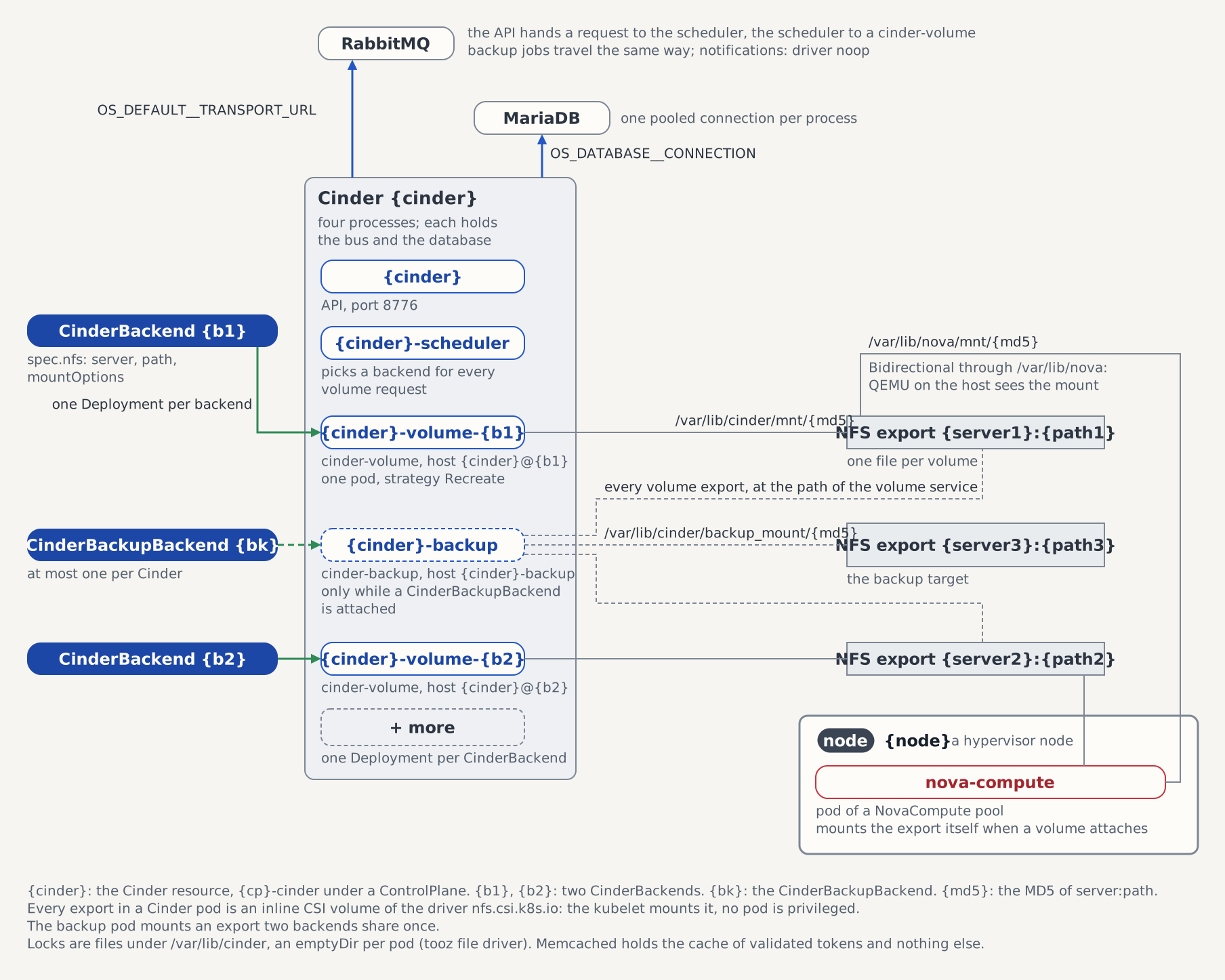
An RBD backend mounts no export: its cinder-volume reaches the Ceph cluster over the network, so the figure shows the NFS shape alone. An RBD backup target mounts no export either; the backup pod reads its Ceph files from /etc/ceph.
The migration and service-remove Jobs mount the whole config ConfigMap at /etc/cinder/cinder.conf.d. The one extra file they see is scheduler.conf, whose host identity cinder-manage never consults. The four workloads and the purge CronJob mount every key except that one, so no pod registers under the scheduler's identity.
BuildWorkload stamps fsGroup: 42424 on every pod it builds, and kubelet's ownership pass walks every file under a mounted volume at each pod start. On an NFS export holding a fleet's volumes, that pass is an unbounded recursive chown over the network, and it overwrites the ownership the storage administrator set. The volume and backup Deployments therefore carry fsGroupChangePolicy: OnRootMismatch (withFSGroupChangePolicy in reconcile_volumeservices.go, applied again in reconcile_backupservice.go), so kubelet checks the export's root and leaves it alone when the group already matches.
The launch commands:
| Process | Command |
|---|---|
| API | uwsgi --http :8776 … --module cinder.wsgi.api:application … --pyargv "--config-dir /etc/cinder/cinder.conf.d" |
| Scheduler | cinder-scheduler --config-dir /etc/cinder/cinder.conf.d --config-dir /etc/cinder/scheduler.conf.d |
| Volume | cinder-volume --config-dir /etc/cinder/cinder.conf.d --config-dir /etc/cinder/backends.conf.d --config-dir /etc/cinder/volume.conf.d |
| Backup | cinder-backup --config-dir /etc/cinder/cinder.conf.d --config-dir /etc/cinder/backup.conf.d |
The API is launched with --module because the image ships no WSGI entry script, and cinder's entry point reads CONF(sys.argv[1:]), which is why the config directory travels in --pyargv.
Environment overrides
Every credential reaches the processes as an oslo.config OS_<GROUP>__<OPTION> environment override sourced from a Secret, so none of them is written into the ConfigMap the pods mount.
| Variable | Source | Overrides |
|---|---|---|
OS_DATABASE__CONNECTION | {name}-db-connection | [database] connection |
OS_DEFAULT__TRANSPORT_URL | {name}-transport-url | [DEFAULT] transport_url |
OS_KEYSTONE_AUTHTOKEN__PASSWORD | spec.serviceUser.secretRef | [keystone_authtoken] password |
OS_SERVICE_USER__PASSWORD | spec.serviceUser.secretRef | [service_user] password |
OS_NOVA__PASSWORD | spec.serviceUser.secretRef | [nova] password |
The migration Jobs carry the same five. They read neither the bus nor Keystone, but an override is inert without the section that consumes it, and one environment for every process is what keeps a Job from migrating a different database than the API serves. The three bus processes also carry CINDER_AMQP_PORT, the broker port their readiness probe checks.
Each value is digested into a pod-template annotation, so a rotation at the OpenBao source rolls the pods that consume it: cinder.c5c3.io/db-connection-hash, cinder.c5c3.io/authtoken-hash and cinder.c5c3.io/transport-url-hash. The scheduler, volume and backup pods carry one more, cinder.c5c3.io/installed-release.
Status
| Field | Description |
|---|---|
conditions | List-map keyed by type; see the reconciler reference for the vocabulary |
observedGeneration | The .metadata.generation last reconciled |
endpoint | The Cinder API URL: https://{gateway.hostname}/ when a gateway is set, otherwise the cluster-local Service URL |
installedRelease | The OpenStack release whose schema is currently installed, promoted to spec.openStackRelease after the upgrade completes (or after the first db sync on a fresh install) |
targetRelease | The release being upgraded to during an active transition. Set when the upgrade initiates, cleared on completion or abort |
upgradePhase | The current phase during an active release upgrade (Expanding, Migrating, RollingUpdate, Contracting); empty when no upgrade is in flight |
volumeServices | One entry per attached backend: backend and the host identity its cinder-volume registers under. It reports what the operator configured, not what Cinder reports back, so an entry appears as soon as the Deployment is projected |
Sub-Resource Naming Convention
Operator-managed sub-resources of the API (Deployment, Service, PodDisruptionBudget, HorizontalPodAutoscaler, NetworkPolicy, HTTPRoute) use the bare CR name with no suffix, matching the keystone convention. A Cinder named cinder in the openstack namespace is therefore reachable in-cluster at cinder.openstack.svc.cluster.local:8776, the port every OpenStack client and catalog entry assumes.
The other children carry a suffix, and the ones a backend contributes carry its name:
| Resource | Name | Notes |
|---|---|---|
| Config ConfigMap | {name}-config-<hash> | Immutable, content-hashed cinder.conf and scheduler.conf; 3 historical retained |
| Backend Secret | {name}-backend-{backend}-<hash> | Immutable, content-hashed backend.conf, shares, volume.conf; 3 historical retained |
| Backup Secret | {name}-backup-{backupBackend}-<hash> | Immutable, content-hashed backup.conf; 3 historical retained |
| DB-connection Secret | {name}-db-connection | Derived pymysql DSN, stable name |
| Transport-URL Secret | {name}-transport-url | Derived rabbit:// URL, stable name |
| DB-sync Job | {name}-db-sync | cinder-manage db sync |
| Upgrade Jobs | {name}-db-expand, {name}-db-migrate, {name}-db-contract | The three release-upgrade phases |
| DB-purge CronJob | {name}-db-purge | cinder-manage db purge <days> |
| Scheduler Deployment | {name}-scheduler | Also the [DEFAULT] host of every scheduler pod |
| Volume Deployment | {name}-volume-{backend} | One per attached CinderBackend |
| Backup Deployment | {name}-backup | Only while a backup backend is projected |
| Service-remove Job | {name}-{backend}-service-remove | Runs once while a backend detaches |
Two of those names are contracts with cinder rather than with Kubernetes. The volume service of a backend registers as {name}@{backend}, which is the identity every volume it creates is keyed by, and the operator reports it in status.volumeServices. Every scheduler pod registers as {name}-scheduler, one registry row for the whole Deployment.
The mount path is a contract with os-brick. A backend's export is mounted at /var/lib/cinder/mnt/<md5 of "server:path">, the hex MD5 the remotefs driver derives, because cinder resolves the provider location of every volume to that path and a mount anywhere else leaves the volumes it holds unreachable. For the export nfs-server.openstack.svc.cluster.local:/volumes the directory is:
/var/lib/cinder/mnt/6f3cb55ed3b423dbb7791aaf3783754fThe backup target is mounted the same way below /var/lib/cinder/backup_mount/.
metadata.name is capped at 43 characters, which is what the 52-character CronJob cap leaves once -db-purge is appended. The satellite names have their own budget: metadata.name plus spec.cinderRef.name of a CinderBackend may not exceed 47 characters, because the service-remove Job's name is copied into a label value Kubernetes caps at 63.
Example
apiVersion: cinder.openstack.c5c3.io/v1alpha1
kind: Cinder
metadata:
  name: cinder
  namespace: openstack
spec:
  openStackRelease: "2026.1"
  image:
    repository: ghcr.io/c5c3/cinder
    tag: "2026.1"
  api:
    deployment:
      replicas: 3
  database:
    clusterRef:
      name: openstack-mariadb
    database: cinder
    secretRef:
      name: cinder-db
  cache:
    clusterRef:
      name: openstack-memcached
  messaging:
    clusterRef:
      name: openstack-rabbitmq
  keystoneEndpoint: http://keystone.openstack.svc.cluster.local:5000/v3
  serviceUser:
    secretRef:
      name: cinder-keystone
  glanceEndpoint: http://glance.openstack.svc.cluster.local:9292