CinderBackend CRD API Reference
Reference documentation for the CinderBackend Custom Resource Definition. One CR attaches to a Cinder CR via spec.cinderRef and describes one volume backend: an NFS export (type: NFS) or a pool in a Ceph cluster (type: RBD).
The attachment is inverted: the backend points at the Cinder, so backends are added and removed without editing the Cinder CR. A dedicated controller owns the backend's own conditions, while the cinder-side sub-reconciler renders every attached, credential-ready backend into its own Secret and projects one cinder-volume Deployment for it. For that controller topology see Cinder Reconciler Architecture.
There is no default backend to elect. A volume type selects its backend by name, so the backends a Cinder serves are peers and an empty set is a valid state.
The CRD is generated from operators/cinder/api/v1alpha1/cinderbackend_types.go; the webhook lives in cinderbackend_webhook.go and the controllers in operators/cinder/internal/controller/cinderbackend_controller.go and reconcile_backends.go.
API Group and Version
| Field | Value |
|---|---|
| Group | cinder.openstack.c5c3.io |
| Version | v1alpha1 |
| Kind | CinderBackend |
| List Kind | CinderBackendList |
| Scope | Namespaced |
kubectl get cinderbackends shows Ready (.status.conditions[?(@.type=='Ready')].status), Type (.spec.type), Cinder (.spec.cinderRef.name), and Age.
Example
apiVersion: cinder.openstack.c5c3.io/v1alpha1
kind: CinderBackend
metadata:
  name: nfs-a
  namespace: openstack
spec:
  cinderRef:
    name: cinder
  type: NFS
  nfs:
    server: nfs-server.openstack.svc.cluster.local
    path: /volumes
status:
  conditions:
  - type: CredentialsReady
    status: "True"
    reason: CredentialsNotRequired
  - type: ConfigProjected
    status: "True"
    reason: ConfigProjected
  - type: Ready
    status: "True"
    reason: AllReady
The metadata.name (nfs-a) becomes three things at once: the [nfs-a] section of the rendered backend configuration, the volume_backend_name a volume type schedules against, and the second half of the cinder@nfs-a host identity every volume on this backend is keyed by.
An RBD backend names the Ceph pool, the cephx user, the monitors, the networks the Ceph cluster answers on, and the Secret that holds the user's key:
apiVersion: cinder.openstack.c5c3.io/v1alpha1
kind: CinderBackend
metadata:
  name: rbd-a
  namespace: openstack
spec:
  cinderRef:
    name: cinder
  type: RBD
  rbd:
    pool: volumes
    user: cinder
    monitors:
    - rook-ceph-mon-a.rook-ceph.svc.cluster.local
    networks:
    - 10.244.0.0/16
    - 10.96.0.0/12
    keySecretRef:
      name: ceph-client-cinder
status:
  conditions:
  - type: CredentialsReady
    status: "True"
    reason: CredentialsAvailable
  - type: ConfigProjected
    status: "True"
    reason: ConfigProjected
  - type: Ready
    status: "True"
    reason: AllReady
Spec
CinderBackendSpec
Three schema-level CEL rules hold even when the webhook is down: cinderRef and type are immutable (UPDATE transition rules), and the union rule (self.type == 'NFS') == has(self.nfs) && (self.type == 'RBD') == has(self.rbd) enforces exactly one backend block matching spec.type.
| Field | Type | Required | Default | Description |
|---|---|---|---|---|
cinderRef | CinderRefSpec | Yes | Names the Cinder CR in the same namespace (name, MinLength=1). Immutable: re-pointing a backend would strand the volumes the old deployment created under a host identity nothing serves. The Cinder need not exist at admission time (GitOps ordering); a dangling reference surfaces as Ready=False. | |
type | CinderBackendType | Yes | The volume driver, NFS or RBD (enum). Immutable, because the volumes already on the backend were created by the driver that is being replaced. | |
nfs | NFSBackendSpec | When type: NFS | The NFS export (union rule). | |
rbd | RBDBackendSpec | When type: RBD | The Ceph pool, the cephx user, the monitors, the networks and the key Secret (union rule). | |
imageVolumeCache | ImageVolumeCacheSpec | No | Turns on the per-backend image-volume cache. | |
extraOptions | map[string]string | No | Free-form [<name>] section options not covered by the typed fields, keyed by bare option name. MaxProperties=32, and a CEL rule bounds each key at 256 and each value at 1024 characters. See the denylist. |
NFSBackendSpec
| Field | Type | Required | Default | Rendered option | Description |
|---|---|---|---|---|---|
server | string | Yes | nfs_shares_config (first half) | The NFS server, a hostname or an IP address. It reaches the mount command verbatim, so the pattern ^[A-Za-z0-9.-]+$ admits only what a hostname or an IPv4 address carries; MinLength=1 | |
path | string | Yes | nfs_shares_config (second half) | The absolute export path on the server; pattern ^/[!-~]*$, printable ASCII only. The exclusion is what keeps the shares file one export long and that export intact: the operator writes server:path into it verbatim, and the driver strips the line it reads back and cuts it at the first space. It is an allowlist because a schema pattern compiles with RE2, whose \s is the five ASCII characters, while the driver strips the full Unicode whitespace set — so a pasted U+00A0 would resolve to a different export there than the one mounted here | |
mountOptions | string | No | nfsvers=4.1,soft,timeo=30,retrans=2 | nfs_mount_options | The comma-separated option string the export is mounted with; pattern ^[^\n\r]*$ for the same reason. Keep the mount soft: a hard mount blocks the cinder-volume process on an unreachable server instead of failing the request |
RBDBackendSpec
The operator creates neither the pool nor the user: both exist on the Ceph cluster before the backend is applied. Every value below reaches a file, a command line or a NetworkPolicy verbatim, so each pattern is an allowlist. The validating webhook repeats each rule and adds the two a pattern cannot express (see the validation summary).
| Field | Type | Required | Default | Rendered option | Description |
|---|---|---|---|---|---|
pool | string | Yes | rbd_pool | The pool that keeps the volumes as RBD images. MinLength=1, MaxLength=64, pattern ^[A-Za-z0-9._-]+$ | |
user | string | Yes | rbd_user | The cephx user without its client. prefix, such as cinder; a CEL rule rejects client.cinder. The value is also the --id the Ceph tools receive, the [client.<user>] section of the keyring and part of the keyring's file name. MinLength=1, MaxLength=64, pattern ^[A-Za-z0-9._-]+$ | |
monitors | []string | Yes | mon_host in ceph.conf | The monitor addresses, each a hostname or an IPv4 address with an optional :port, joined with commas in list order. A bare address is tried on the msgr2 port 3300 and then on the msgr1 port 6789. IPv6 literals are not admitted. 1 to 16 items of 1 to 253 characters matching ^[A-Za-z0-9.-]+(:[0-9]{1,5})?$; the webhook also requires a port between 1 and 65535 | |
networks | []string | Yes | The ipBlock peers of the Ceph egress rule | The IPv4 CIDRs the monitors and the OSDs answer on. For a Rook cluster in the same Kubernetes cluster that is the pod network and, because Rook advertises each monitor through a Service, the service network. The field is required so a backend admitted on a Cinder without spec.networkPolicy keeps its egress when the policy is enabled later. 1 to 16 items matching ^([0-9]{1,3}\.){3}[0-9]{1,3}/[0-9]{1,2}$; the webhook also requires the canonical form with the host bits zero, such as 10.128.0.0/22 for 10.128.0.1/22, because the API server refuses any other form in an ipBlock | |
clusterName | string | No | ceph | rbd_cluster_name | The Ceph cluster name. It is the --cluster argument of the Ceph tools and names the projected files /etc/ceph/<cluster>.conf and /etc/ceph/<cluster>.client.<user>.keyring. MaxLength=63, pattern ^[A-Za-z0-9_-]+$ |
keySecretRef | SecretNameRefSpec | Yes | The keyring | Names the Secret that holds the key (name, a DNS-1123 subdomain of at most 253 characters). See The key Secret | |
secretUUID | string | No | rbd_secret_uuid, only when set | The UUID of the libvirt secret the hypervisors look the key up by, in lowercase 8-4-4-4-12 form. Left unset, the driver uses the FSID it reads from the cluster at start. The libvirt secret on the hypervisors has to carry the same UUID either way |
The key Secret
The key Secret lives in the backend's namespace on the cluster the parent Cinder's spec.targetClusterRef names, which is where the volume pods run. Without a target cluster that is the management cluster. The Secret carries the raw cephx key, as ceph auth get-key client.<user> prints it, under one data key: userKey. Rook's CephClient writes that key into the Secret rook-ceph-client-<name> it produces, so such a Secret works unchanged once it is in the namespace. A hand-made one is a single command:
ceph auth get-key client.cinder |
  kubectl -n openstack create secret generic ceph-client-cinder --from-file=userKey=/dev/stdin
The pipe keeps the key off the kubectl command line, which other users of the host can read.
The operator never learns where the key came from, so a Rook-produced Secret, an External Secrets Operator sync and the command above all satisfy the contract. CredentialsReady stays False while the Secret, its userKey or a usable value is missing; the messages are listed under Conditions.
The key is copied into the backend's content-hashed projection Secret. Replacing it changes that Secret's name, and the backend's cinder-volume rolls with the Recreate strategy. Volume operations in flight during the roll fail and are retried by their callers. The previous key stays in up to three retained projection Secrets, which is harmless because Ceph no longer accepts it.
Rotate with kubectl patch on the Secret, or let Rook rewrite its own Secret in place. Never delete and recreate the Secret to rotate it. While the Secret is gone, CredentialsReady turns False within the 15-second poll of the backend controller, the Cinder stops the backend's volume service, and its projection Secrets are swept. The volume service and its projection come back once the Secret is there again. A patch that leaves userKey empty or not a cephx key has the same effect: the Cinder skips the backend rather than project a keyring Ceph would refuse.
ImageVolumeCacheSpec
The cache trades backend capacity for create volume from image latency: the first volume created from an image is kept, and later requests clone it on the backend instead of pulling the image through Glance again.
| Field | Type | Required | Default | Rendered option | Description |
|---|---|---|---|---|---|
enabled | bool | Yes | false | image_volume_cache_enabled | Turns the cache on. It is a field rather than the presence of the block, so the bounds can be configured in a CR that keeps the cache off |
maxSizeGB | *int32 (Minimum=1) | No | image_volume_cache_max_size_gb | Caps the total size of the cached image volumes; unset means no size bound | |
maxCount | *int32 (Minimum=1) | No | image_volume_cache_max_count | Caps the number of cached image volumes; unset means no count bound |
Whichever bound is reached first evicts the least recently used entry. Leaving both unset caches without a bound, which fits a backend with capacity to spare.
The cached volumes belong to the deployment rather than to the tenant whose request populated the cache, so cinder creates them as the project and user spec.internalTenant names on the parent Cinder. Enabling the cache on a backend whose Cinder sets no internalTenant is admitted with an admission warning rather than rejected: the two CRs are applied independently, so GitOps ordering may present the backend first. Until the block is added, the cache stays inactive.
extraOptions Denylist
The validating webhook rejects extraOptions keys the projection owns, so the escape hatch cannot silently contradict the typed spec. Every key must first match ^[A-Za-z0-9_]+$; the pattern runs before the denylist, so an embedded newline or a denylist-evading trailing space cannot slip through. Values carrying a newline or carriage return are rejected as an INI-injection guard.
The denylist is selected by spec.type: the keys every backend renders apply to both types, and each driver's own keys only to its type, so nfs_mount_options is free on an RBD backend.
| Group | Rejected keys |
|---|---|
| Every type, rendered from typed fields | volume_driver, image_volume_cache_enabled, image_volume_cache_max_size_gb, image_volume_cache_max_count |
| Every type, operator-owned | volume_backend_name, backend_host |
| NFS, rendered from typed fields | nfs_shares_config, nfs_mount_options |
| NFS, operator-owned | nfs_mount_point_base, nas_secure_file_operations, nas_secure_file_permissions, nfs_snapshot_support, nfs_sparsed_volumes, nfs_qcow2_volumes |
| RBD, rendered from typed fields | rbd_pool, rbd_user, rbd_cluster_name, rbd_secret_uuid |
| RBD, operator-owned | rbd_ceph_conf, rbd_keyring_conf |
rbd_keyring_conf is no option cinder registers since OSSN-0085, but the driver still reads it for cinderlib; the operator projects the keyring into /etc/ceph instead.
A key that passes both gates is merged into the rendered section without overriding an operator key, and the renderer drops every key the type's denylist names. The denylist normally keeps the two disjoint; the merge is the fail-closed backstop for a CR written past admission, and it keeps rbd_keyring_conf out of a section that renders no key of that name.
Name rules
metadata.name becomes a cinder.conf section, so the webhook rejects a name cinder or the operator already uses:
default(compared case-insensitively) names the[DEFAULT]section, which would make the backend's options service-wide ones.- Any section name one of the embedded option catalogs enumerates, such as
databaseorkeystone_authtoken, collides with a section the rendered configuration already carries. - A name containing
@or#is refused: cinder reads them as the separators of a service identity (<cinder>@<backend>) and of a pool within it (<host>#<pool>).
metadata.name plus spec.cinderRef.name may not exceed 47 characters together. Detaching the backend runs a <cinder>-<name>-service-remove Job whose name is copied into a label value, and Kubernetes caps a label value at 63 characters. The budget is shared rather than per-name because either name may be the long one. It is enforced on create only: both names are immutable, so an update rule could only reject a CR an earlier operator version already admitted, including the finalizer-removal update that completes its deletion.
metadata.name may not exceed 35 characters on its own either. The same detach records the Job's terminal state under the annotation key cobaltcore.c5c3.io/last-service-remove-<name>-job-uid on the Cinder, and Kubernetes caps an annotation key's name part at 63 characters. The two bounds measure different things — a short Cinder name buys room under the shared budget but none here — and this one is enforced on create only for the same reason.
Rendered backend section
Every credential-ready backend renders into a [<name>] section of its own backend.conf. The keys the operator writes for nfs-a on a Cinder named cinder:
[nfs-a]
backend_host = cinder
nas_secure_file_operations = true
nas_secure_file_permissions = true
nfs_mount_options = nfsvers=4.1,soft,timeo=30,retrans=2
nfs_mount_point_base = /var/lib/cinder/mnt
nfs_qcow2_volumes = false
nfs_shares_config = /etc/cinder/backends.conf.d/nfs-a.shares
nfs_snapshot_support = false
nfs_sparsed_volumes = true
volume_backend_name = nfs-a
volume_driver = cinder.volume.drivers.nfs.NfsDriver
backend_host is the Cinder's name, not the backend's: cinder appends @<backend> itself, so the rendered value is the half the operator owns. The three image_volume_cache_* keys follow when the cache is enabled.
Five caveats come with the NFS driver:
- Snapshots are off.
nfs_snapshot_support = falseis rendered on every backend, so a volume on an NFS backend cannot be snapshotted, and neither can the operations built on snapshots. - The export's permissions do not separate projects. Both
nas_secure_*keys aretrue, which is what lets the driver run its file operations as the service user rather than through a root helper the image has no sudoers entry for (decision D3 of issue #979). Every volume file on the export is then owned by that one identity, so a cloned volume is as readable as its source within the export's permission model. Project isolation is the API's, not the filesystem's. - Active/active is refused. A
cinder-volumeowns its backend through its host identity, and the NFS drivers refuse two processes holding the same volume state, sospec.volume.deploymentis pinned at one replica on theRecreatestrategy (see CinderVolumeSpec). - A clone is world-readable. Cloning a volume runs through the driver's internal temporary snapshot and ends in
_set_rw_permissions_for_all, so the cloned file carries mode666where a created volume's carries660. The export itself is mode0770, which keeps the difference inside the service group. - Uploading a volume that was itself created from an image fails. Glance rejects the request at both 27.0.0 and 28.0.0 with
400 Unable to set 'properties' to {}. Reason: {} is not of type 'string'. A volume that was not created from an image uploads.
An RBD backend rbd-a on the same Cinder renders:
[rbd-a]
backend_host = cinder
rbd_ceph_conf = /etc/ceph/ceph.conf
rbd_cluster_name = ceph
rbd_pool = volumes
rbd_user = cinder
volume_backend_name = rbd-a
volume_driver = cinder.volume.drivers.rbd.RBDDriver
rbd_secret_uuid follows when spec.rbd.secretUUID is set, and the cache keys and the extraOptions follow as for NFS. The same Secret carries the Ceph client configuration, ceph.conf:
[global]
mon_host = rook-ceph-mon-a.rook-ceph.svc.cluster.local
keyring = /etc/ceph/ceph.client.cinder.keyring
log_file = /dev/null
admin_socket = /tmp/$cluster-$name.$pid.$cctid.asok
and the keyring, whose key line carries the trimmed userKey of the key Secret:
[client.cinder]
	key = AQDHlkVoYx3QKRAAk9m6j4QzG8w2yK0hfr9c6g==
log_file and admin_socket replace two defaults the service user cannot honour, because it can write neither /var/log/ceph nor /var/run/ceph. The dollar signs are Ceph metavariables, which librados expands per process.
Four caveats come with the RBD driver:
- The driver connects to the cluster during its setup. When the monitors do not answer, the volume service logs
Error connecting to ceph cluster.andFailed to initialize driver., still connects to the broker and passes its readiness probe, and serves no volume. It does not repeat the setup on its own: delete its pod once the monitors answer, and the Deployment starts a new one. rbd_secret_uuiddefaults to the FSID the driver reads at start. The libvirt secret on the hypervisors has to carry the same UUID, whether it is set here or left to that default. The lab's libvirt DaemonSet defines090e4a3c-6c20-4e74-82dc-1a70382babe8(Lab hypervisors), so a lab backend setssecretUUIDto it.rbd_exclusive_cinder_poolstays at its default,true: the driver reports the capacity it provisioned from cinder's own volume records and does not list the pool. Two backends on one pool, or a pool shared with other users, each count only their own volumes, so the over-subscription check sees less provisioned capacity than the pool holds. Setrbd_exclusive_cinder_pool: "false"inextraOptionsfor a shared pool.cinder-backupreads a volume on an RBD backend through os-brick with the backend's own user, so the backup pod carries the backend's keyring at/etc/ceph/<cluster>.client.<user>.keyringbeside the backup target's files (Ceph files in the backup pod). A replaced key rolls the backup pod as well as the volume service.
Detaching a backend
The controller holds a deleted CinderBackend with the finalizer cinder.openstack.c5c3.io/service-remove, and the cinder-side step is what releases it. A running cinder-volume reports itself into the service registry every few seconds, so an entry removed while the process still runs comes back. The order is therefore fixed: the volume Deployment is deleted, a later pass finds it gone and runs the <cinder>-<name>-service-remove Job, the projected Secrets are swept, and only then is the finalizer released. The Deployment is deleted with foreground propagation, so the API server keeps it until its pods have exited, and the Job never starts beside a terminating cinder-volume. While that runs, the backend reports Ready=False under the reason Detaching.
The Job runs cinder-manage service remove cinder-volume <cinder>@<name>. Exit code 2 is "host not found", which is the state of a backend whose cinder-volume never registered, so the script normalises it to success and lets every other code fail the Job. The removed services row is only soft-deleted: GET /v3/os-services stops listing it as soon as the Job succeeds, but the row stays in the table until the next db purge sweeps it, and a backend that is attached again registers under a new row id. A failed Job keeps the finalizer: the registry entry is still there, and deleting the Job is what retries the removal once the cause is understood. The parent then reports VolumeServicesReady=False under ServiceRemoveJobFailed.
A backend whose parent Cinder is already gone is released unconditionally, with a ServiceRemoveSkipped event: the registry lives in that Cinder's database, so there is no row left to remove.
Conditions
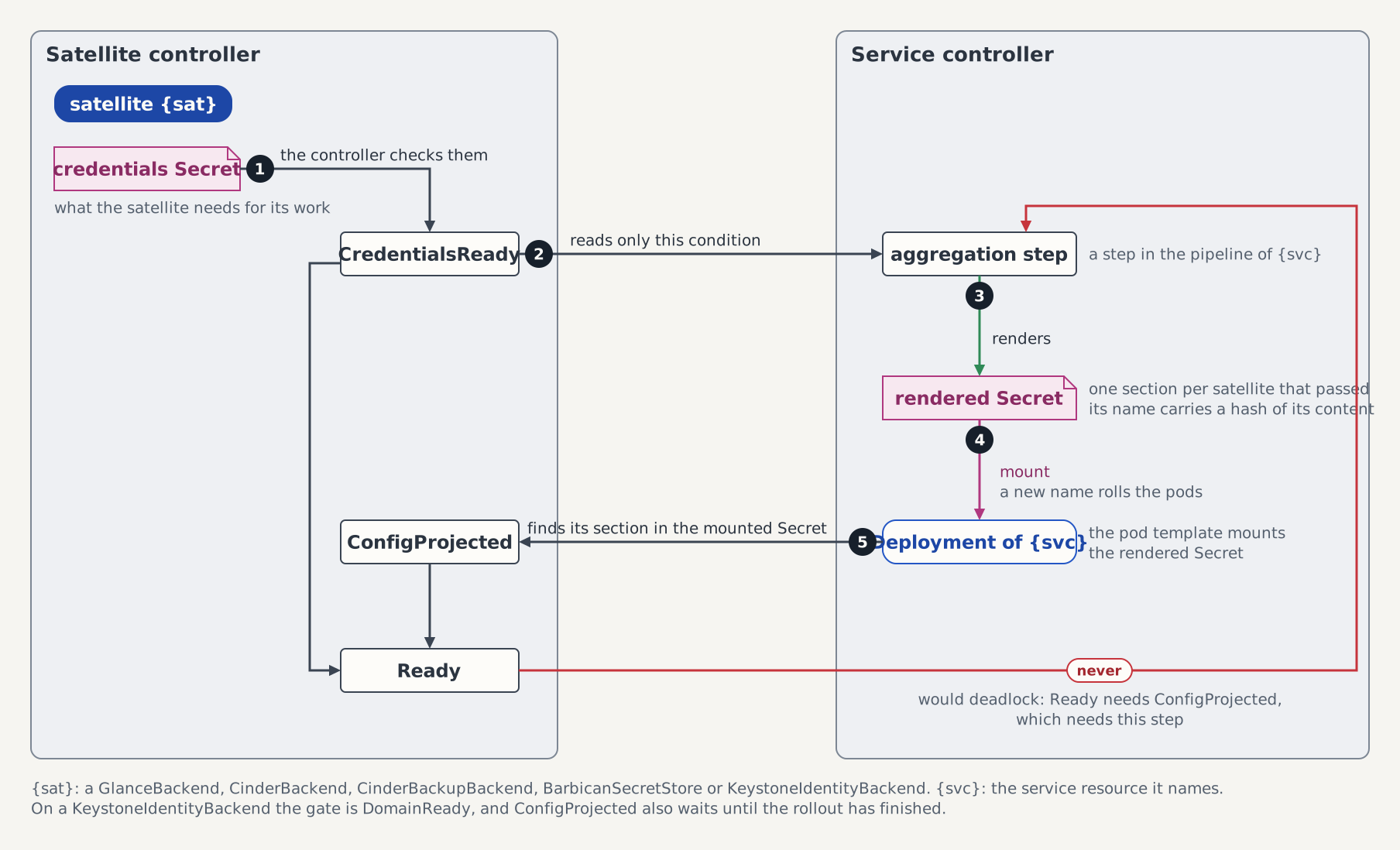
The dedicated CinderBackendReconciler is the single writer of this status. The cinder-side sub-reconciler only reads CredentialsReady, which gates the projection, and writes the aggregated BackendsReady condition onto the Cinder CR instead.
The figure shows the order the two conditions turn True in. An NFS CinderBackend passes step 1 without a credential, an RBD one once its key Secret carries a usable userKey, and step 5 looks at the volume Deployment of this backend. The handshake lists the five steps and what differs per kind.
| Type | Owner | Status | Reason | Meaning |
|---|---|---|---|---|
CredentialsReady | CinderBackend | True | CredentialsNotRequired | An NFS backend: the export is mounted with the pod's own identity, so there is no credential to resolve. The condition is still reported, because the cinder-side projection gates on it and an absent one reads as not ready. |
CredentialsReady | CinderBackend | True | CredentialsAvailable | An RBD backend whose key Secret carries a cephx key under userKey: RBD key Secret "<name>" carries the userKey data key. |
CredentialsReady | CinderBackend | False | WaitingForCredentials | An RBD backend whose key is not usable yet. The message names the cause: RBD key ExternalSecret <ns>/<name> not found yet (neither the Secret nor an ExternalSecret of that name exists), waiting for the RBD key Secret to carry the userKey data key (an ExternalSecret has not synced yet), RBD key Secret exists but is missing expected keys (the Secret has no userKey), Secret "<name>" carries an empty userKey, or Secret "<name>" carries a userKey that is not a cephx key (base64 expected). A CR written past admission without spec.rbd reads spec.rbd is not set; no RBD key to resolve. The backend requeues after 15 seconds, and ConfigProjected is not observed again until the gate is True, so Ready follows CredentialsReady. |
CredentialsReady | CinderBackend | False | WaitingForParent | No Cinder of the name in spec.cinderRef exists, so which cluster this backend's volume service runs on is unknown. The backend requeues after 15 seconds. |
CredentialsReady | CinderBackend | False | TargetClusterUnavailable | The parent Cinder's spec.targetClusterRef names a target cluster that is not registered or no longer resolves. The message carries the resolver's error, the backend requeues after 15 seconds, and nothing is created on any cluster. See Target Clusters. |
ConfigProjected | CinderBackend | True | ConfigProjected | This backend's cinder-volume Deployment mounts a backend.conf carrying its [<name>] section. |
ConfigProjected | CinderBackend | False | WaitingForProjection | The projection has not landed in the Deployment yet, or the parent Cinder no longer exists and the standing claim is stale. |
Ready | CinderBackend | True | AllReady | Both sub-conditions are True. |
Ready | CinderBackend | False | NotAllReady | At least one sub-condition is not True. |
Ready | CinderBackend | False | Detaching | The CR is being deleted and waits for the parent to run the service-remove Job. |
BackendsReady | Cinder | True | AllBackendsProjected | Every attached backend is credential-ready and projected. |
BackendsReady | Cinder | True | NoBackends | No CinderBackend is attached. It is True rather than False: a Cinder without volume backends serves its API and its scheduler, and attaching storage is a separate act. |
BackendsReady | Cinder | False | WaitingForBackends | At least one attached backend is pending, either not yet credential-ready or skipped for a per-backend fault. The ready subset is still projected, and the message names what is missing. |
status.observedGeneration carries the metadata.generation of the last spec the controller observed (cinderbackend_types.go), so a status reported against an older spec is distinguishable from a current one.
A backend that carries no spec.nfs or spec.rbd block matching its type, whose rendered files carry a control character, or whose RBD key Secret vanished between its gate and the render is skipped: the cinder-side step emits a CinderBackendSkipped Warning event on the Cinder CR and keeps projecting the healthy siblings, so one bad backend never fails the whole aggregation. The CinderBackend controller itself emits one event, ServiceRemoveSkipped; the rest of its contract is carried by the conditions above.
Retained Artefacts
One backend's projection lives in a content-hashed <cinder>-backend-<name>-<hash> Secret owned by the parent Cinder. Up to 3 historical copies are retained for fast rollback, and all of them are collected with the Cinder CR. Each backend gets its own base name rather than sharing one Secret with its siblings, so a change to one backend does not roll the pods of the others.
| Data key | Content | Mounted at |
|---|---|---|
backend.conf | The [<name>] section above | /etc/cinder/backends.conf.d/backend.conf |
shares | One line, server:path, the export list the driver reads | /etc/cinder/backends.conf.d/<name>.shares |
volume.conf | [DEFAULT] enabled_backends = <name>, the overlay naming the single backend this process serves | /etc/cinder/volume.conf.d/volume.conf |
ceph.conf | The Ceph client configuration above | /etc/ceph/<cluster>.conf |
keyring | The keyring of client.<user> | /etc/ceph/<cluster>.client.<user>.keyring |
An NFS backend's Secret carries backend.conf, shares and volume.conf; an RBD backend's carries backend.conf, volume.conf, ceph.conf and keyring. The shares key is mounted under the backend's own name, which is the path nfs_shares_config points at, so the file is readable in a process that serves one backend. The two Ceph files are mounted read-only at /etc/ceph under the names librados and the Ceph tools look for.
A backend that detached, was renamed or was skipped keeps no Deployment, so its base name is swept whole rather than retained: nothing mounts those Secrets anymore, and each of them names an export the Cinder no longer serves.
Immutability and Validation Summary
Schema-layer rules (CEL and kubebuilder markers, enforced even when the webhook is down): the cinderRef and type transition rules, the two-sided union of type with nfs and rbd, the NFS/RBD type enum, the server pattern and MinLength, the absolute-path and printable-ASCII pattern on path, the newline pattern on mountOptions, the mountOptions default, the patterns and bounds of pool, user, monitors, networks, clusterName, keySecretRef.name and secretUUID, the CEL rule against the client. prefix on user, the clusterName default, the two image-volume-cache minimums, and the extraOptions MaxProperties and key/value length bounds.
Webhook rules (defense in depth plus the rules CEL cannot express): the union re-check of both blocks, the reserved-name collision guard and the @/# guard on metadata.name, the combined 47-character name budget and the 35-character bound on metadata.name alone, the printable-ASCII guard on path and the newline guard on mountOptions, the client. prefix twin on user, the newline guard on pool, user, clusterName and every monitor, a monitor port between 1 and 65535, a canonical IPv4 CIDR per network, the DNS-1123 check on keySecretRef.name, the extraOptions key charset, the per-type denylist and the INI-injection guard, and the image-volume-cache warning. The defaulting webhook fills the mountOptions and clusterName defaults for callers that bypass the schema.
Chainsaw E2E Tests
The rejection corpus lives in tests/e2e/cinder/invalid-cinderbackend-cr: the union rule, the reserved name, a relative export path, an export path carrying a newline, both extraOptions guards, the cinderRef transition rule, and the two name bounds. The RBD entries add both halves of the union with the rbd block, the client. prefix, an empty monitor list, a network that is no CIDR, a key Secret name that is no DNS-1123 subdomain, rbd_keyring_conf in extraOptions on an RBD backend, and the type transition rule as an update from NFS to RBD.
The rbd-backend suite proves the gate, the projection, the mounts, the Ceph egress rule and the roll on a replaced key on a kind cluster that runs no Ceph.