Nova Operator
The Nova operator runs the OpenStack compute control plane: the compute API under uWSGI, the metadata API, the scheduler, the conductor, and the noVNC console proxy. Two kinds live in nova.openstack.c5c3.io/v1alpha1. One Nova CR describes the whole control plane, and one NovaCompute CR runs nova-compute on one node pool of a compute cluster.
A nova-compute joins the control plane over the message bus. What the Nova publishes for it is the compute contract: a rendered nova.conf fragment and the bus credentials, in the Secret status.computeConfigSecretRef names. A NovaCompute mounts that contract on the nodes its selector matches, keeps the host aggregates their onboarding needs, and drains a node that leaves the pool before its pod goes.
Processes
Five long-running processes carry the service.
| Process | Workload | What it does |
|---|---|---|
uWSGI on nova.wsgi.osapi_compute | the {name} Deployment | The compute API on port 8774 |
uWSGI on nova.wsgi.metadata | the {name}-metadata Deployment | The metadata API on port 8775, which the Neutron metadata agent proxies an instance's call to 169.254.169.254 to |
nova-scheduler | the {name}-scheduler Deployment | Picks a host for every instance the conductor asks it about |
nova-conductor | the {name}-conductor Deployment | The one process that reaches the cell database on behalf of a compute node |
nova-novncproxy | the {name}-novncproxy Deployment | Bridges a browser's noVNC session to the VNC server of the hypervisor an instance runs on, on port 6080 |
The figure shows the five Deployments with the connections each holds. nova-compute is not among them: it runs as a NovaCompute pool, and the bus is its only connection.
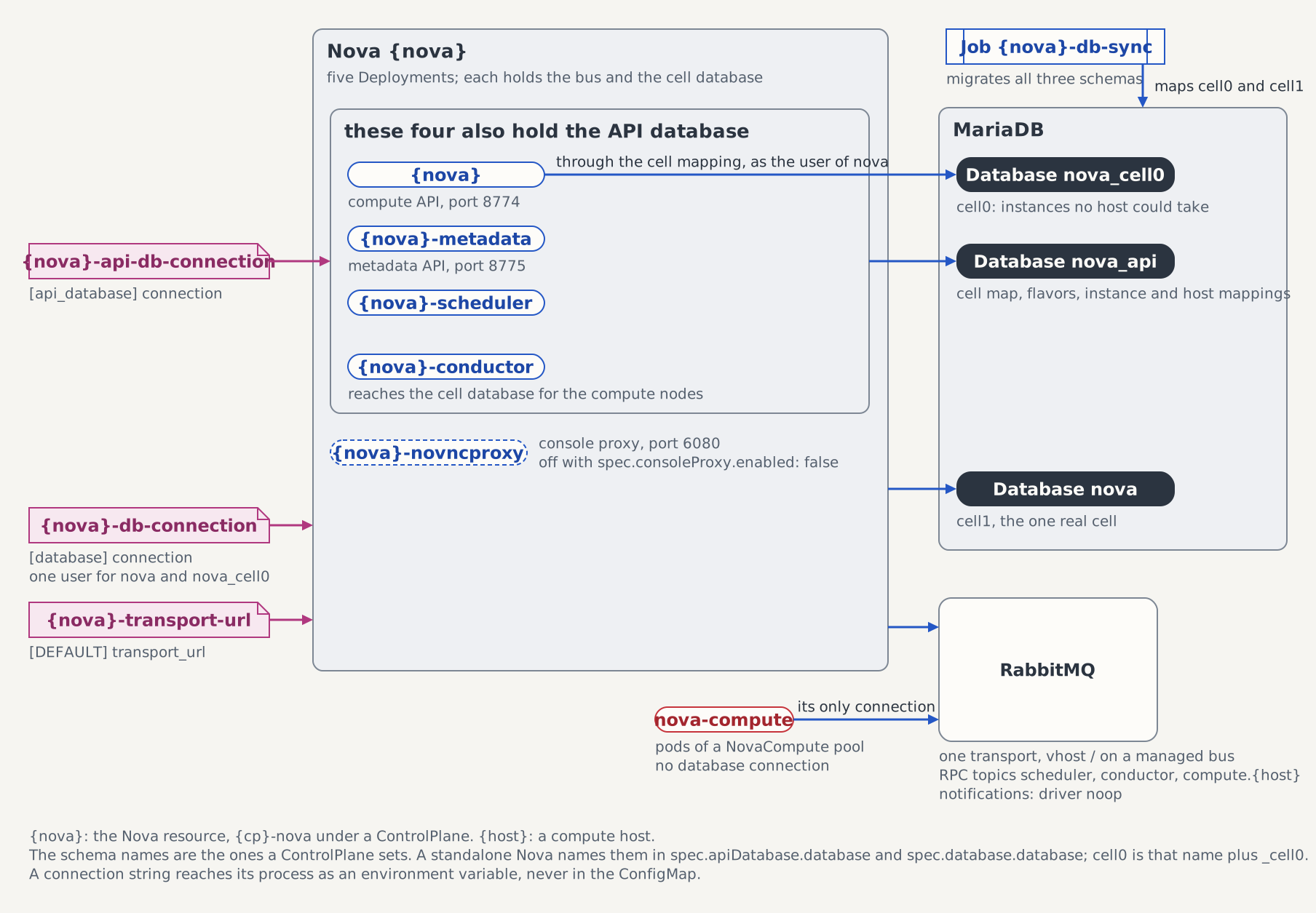
No [DEFAULT] host is rendered, so every replica registers under its own pod name. That is what lets the scheduler and the conductor run more than one pod: each holds a service record of its own, while a shared identity would collapse the fleet into a single row. It is also what picks the one scheduler that runs the periodic host discovery, [scheduler] discover_hosts_in_cells_interval (300 seconds), the pass that maps a newly registered compute node into the cell.
The scheduler and the conductor serve no HTTP port. Their readiness probe is nova-amqp-ready, which reports whether a process of the container holds a socket established to the broker port (see Container Images). The console proxy is probed with a GET of /vnc_lite.html, the client page it serves itself.
Design decisions
The decision record lives in meta issue #1014. These are the entries this operator implements, together with the choices the CRD carries.
- Two database blocks, never one.
spec.apiDatabaseholds the global tables (the cell map, the flavors, the instance mappings) andspec.databasethe per-cell instance state. Each runs its own migrations, so a CR pointing both at one schema would install two migration histories into it: a CEL rule refuses it, and a second rule keeps the two on the samecredentialsMode. - The cells are mapped by the
{name}-db-syncJob, from templates rather than from assembled URLs.cell_v2 map_cell0andcell_v2 create_cellare handed{scheme}://{username}:{password}@{hostname}:{port}/…placeholders that nova expands from the connection it already runs with, so the operator never assembles a URL carrying a password.create_cellis guarded by anawkovercell_v2 list_cellsthat looks for a cell namedcell1or one mapped onto the cell schema: a secondcreate_cellneither fails nor updates the existing row, it maps a second cell onto the same schema, and from then on an instance boots into whichever of the two the scheduler was handed. - One service user, five client sections.
spec.serviceUserauthenticates the token middleware and every outgoing call, and[placement],[neutron]and[cinder]each carry a password of their own through an environment override.[glance]and[barbican]carry none: nova reads an image and a volume-encryption key with the token of the request it is serving, and[service_user] send_service_user_token = truesends nova's own token alongside it, so a long boot outlives the user token's expiry. - The compute contract is a Secret, not a CRD.
{name}-compute-configcarries thenova.conffragment a compute node reads, the transport URL, the service-user password, the metadata shared secret and the cell name. TheNovaComputekind is its consumer, and anova-computerunning anywhere else can mount the same Secret. - One
NovaComputeper node pool, with a required node selector (#1013, #1061). Leaving the pool is the drain: the pool disables the node's service once, never migrates an instance and never enables a service, and deletes the service once Nova reports the host empty and the pod is gone. - The console proxy takes a hostname of its own. The console URL the API hands a browser is
https://<host>/vnc_lite.html?path=%3Ftoken%3D<token>, so the page and the WebSocket that follows it both open on/with nothing but a query string to tell them apart. A path prefix under the API's hostname cannot separate them, which is whyspec.consoleProxy.gatewayis a third gateway block instead of a path on the first. - Instance lifecycle notifications are dropped at the source (
[oslo_messaging_notifications] driver = noop) on the control plane and in the compute fragment alike, because nothing in this deployment consumes them. - The metadata shared secret never reaches the rendered config. It arrives at the metadata pods as
OS_NEUTRON__METADATA_PROXY_SHARED_SECRET, sourced fromspec.metadata.sharedSecretRef, and[neutron] metadata_proxy_shared_secretis rejected inspec.extraConfig: a file value is inert at runtime and would only copy the value a proxied request's signature is verified with into the ConfigMap every pod mounts.
Owned resources
The figure under Owned Resources of the Keystone operator draws the baseline this list follows: serving objects, config and Secrets, Jobs and CronJobs.
For a Nova named {name}:
| Resource | Name | Purpose |
|---|---|---|
| Deployment | {name} | The API pods, uWSGI on port 8774 |
| Service | {name} | ClusterIP in front of the API pods on port 8774 |
| PodDisruptionBudget | {name} | minAvailable: 1 above a lower replica bound of one, maxUnavailable: 1 at one (the bound is the HPA's minReplicas while spec.autoscaling is set); selects the API component and excludes Job pods |
| HorizontalPodAutoscaler | {name} | Only while spec.autoscaling is set; the API is the only autoscaled Deployment |
| NetworkPolicy | {name} | Only while spec.networkPolicy is set; one policy covers all five workloads and the Job pods |
| NetworkPolicy | {name}-novncproxy | Only while spec.networkPolicy is set and the console proxy is enabled; the proxy's egress to the hypervisors' VNC ports |
| HTTPRoute | {name}, {name}-metadata, {name}-console | One per gateway block that is set |
| Deployment / Service | {name}-metadata | The metadata API on port 8775 |
| Deployment | {name}-scheduler, {name}-conductor | The two bus processes |
| Deployment / Service | {name}-novncproxy | The console proxy on port 6080, only while it is enabled |
| ConfigMap | {name}-config-<hash> | Immutable, content-addressed nova.conf and the four role overlays, plus logging.ini under json logging; 3 historical retained |
| Secret | {name}-api-db-connection, {name}-db-connection | The two derived pymysql DSNs |
| Secret | {name}-transport-url | The derived rabbit:// URL |
| Secret | {name}-compute-config | The compute contract, updated in place under a stable name |
| Secret | {name}-remote-compute-config | The remote compute contract, only while spec.remoteCompute is set |
| Job | {name}-db-sync | Both schema migrations and the cell mapping |
| Job | {name}-db-expand, {name}-db-migrate, {name}-db-contract | The three release-upgrade phases |
| CronJob | {name}-db-archive | The recurring nova-manage db archive_deleted_rows |
MariaDB Database / User / Grant | {name}-api, {name} | Managed mode only (spec.apiDatabase.clusterRef / spec.database.clusterRef); a brownfield database is left alone |
MariaDB Database / Grant | {name}-{database}-cell0 | cell0, an additional schema on the cell block's user |
Reference pages
- Nova CRD: the
spec/statuscontract, the rendered configuration, the compute contract, and the validation rules - NovaCompute CRD: the node pool that runs
nova-compute, its node phases, the node contract and the drain - Controller Events: the Kubernetes events the two controllers emit
- Reconciler Architecture: the sub-reconciler pipeline, conditions, and requeue semantics
- Upgrade Flow: the expand-migrate-contract phases, the pre-flight exit codes, the cell0 contract pass, and the abort recipe
- Cells: cell0 and cell1, the template URLs, host discovery and unmapping, and why one CR maps a single real cell