OpenBao Bootstrap Procedure
Reference documentation for the OpenBao deployment and bootstrap procedure. OpenBao is deployed as a 3-replica HA Raft cluster via FluxCD HelmRelease into the shared-services namespace, then initialized and configured through a sequence of idempotent bootstrap scripts. The scripts provision secret engines, authentication backends, least-privilege policies, and initial credentials required by downstream services.
Architecture Overview
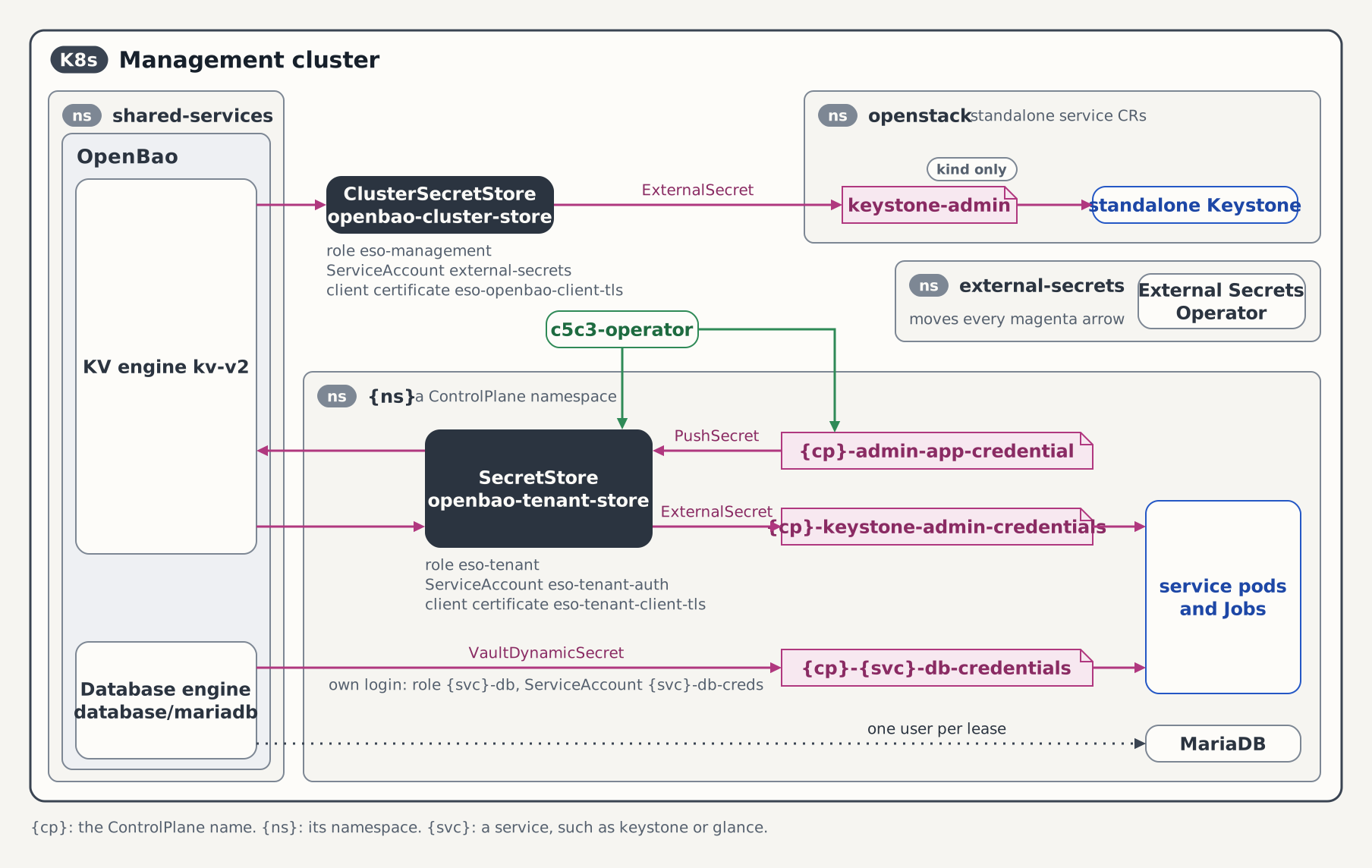
OpenBao runs as three Raft peers, openbao-0 to openbao-2, in shared-services and serves TLS from the openbao-tls Secret. The figure shows how secrets leave and enter it.
| Store | Kind | OpenBao login | Serves |
|---|---|---|---|
openbao-cluster-store | ClusterSecretStore (deploy/eso/clustersecretstore.yaml) | Mount kubernetes/management, role eso-management, ServiceAccount external-secrets, client certificate eso-openbao-client-tls | The namespaces openstack and shared-services: standalone service CRs and the static ExternalSecrets of the kind overlay (keystone-admin, mariadb-root-password) |
openbao-tenant-store | SecretStore, one per ControlPlane namespace, created by reconcileESOTenantStore | Mount kubernetes/management, role eso-tenant, ServiceAccount eso-tenant-auth, client certificate eso-tenant-client-tls | The ExternalSecrets and PushSecrets of one ControlPlane and its children, such as {cp}-keystone-admin-credentials and {cp}-keystone-db-credentials in Static mode |
The production stack (deploy/eso/, included by deploy/flux-system/) ships no ExternalSecret resources — its kustomization renders only clustersecretstore.yaml. The per-ControlPlane admin and database ExternalSecrets are operator-projected, and the standalone keystone-admin, mariadb-root-password, and keystone-db ExternalSecrets survive only as kind overlay shims (deploy/kind/infrastructure/).
The {cp}-keystone-admin-credentials ExternalSecret is created per-ControlPlane by the c5c3 operator's reconcileAdminPassword sub-reconciler (default controlplane-keystone-admin-credentials), reading the per-ControlPlane remote path bootstrap/{ns}/{name}-keystone/admin. Likewise the {cp}-keystone-db-credentials ExternalSecret is not a static deploy-time resource; it is created per-ControlPlane by the operator's reconcileDBCredentials sub-reconciler (default controlplane-keystone-db-credentials). In the default Dynamic mode it draws engine-issued credentials through a VaultDynamicSecret generator. In Static mode it reads the KV path openstack/keystone/{ns}/{name}/db. Standalone Keystone instances (no ControlPlane CR) instead reference a Secret named keystone-db; the kind overlay ships a keystone-db ExternalSecret pinned to the default identity's path (deploy/kind/infrastructure/keystone-db-externalsecret.yaml), while the production stack ships none.
Prerequisites
The following must be in place before running the bootstrap scripts:
| Prerequisite | Details |
|---|---|
| Kubernetes cluster | Management cluster with kubectl access configured |
| FluxCD | source-controller and helm-controller installed |
| cert-manager | Deployed and healthy (CRDs installed, webhook ready) |
| Base manifests | kubectl apply -k deploy/flux-system/ completed successfully |
| Infrastructure manifests | kubectl apply -k deploy/flux-system/infrastructure/ completed (includes openbao-tls Certificate) |
| OpenBao pods | All 3 replicas (openbao-0, openbao-1, openbao-2) running in shared-services namespace |
| CLI tools | kubectl, jq available on the operator workstation; openssl available inside the OpenBao pod (used for in-pod password generation) |
Verification commands:
# Confirm all 3 OpenBao pods are Running
kubectl get pods -n shared-services -l app.kubernetes.io/name=openbao

# Confirm TLS certificate is ready
kubectl get certificate openbao-tls -n shared-services

# Confirm cert-manager ClusterIssuer exists
kubectl get clusterissuer selfsigned-cluster-issuer
Directory Layout
deploy/
├── openbao/
│   ├── bootstrap/
│   │   ├── common.sh                   Shared functions (log, bao_exec) sourced by all scripts
│   │   ├── init-unseal.sh              Initialize and unseal the cluster
│   │   ├── setup-secret-engines.sh     Enable KV v2 (kv-v2/, barbican/), PKI, and MariaDB database engines
│   │   ├── setup-database-tenant.sh     Provision a per-ControlPlane DB engine connection + role
│   │   ├── setup-eso-tenant.sh          Provision a per-ControlPlane ESO identity (SA + mTLS cert + namespaced SecretStore)
│   │   ├── setup-auth.sh              Configure Kubernetes and AppRole auth
│   │   ├── setup-policies.sh           Apply all HCL access control policies
│   │   └── write-bootstrap-secrets.sh  Generate and seed initial credentials
│   └── policies/
│       ├── eso-management.hcl          ESO policy for management cluster
│       ├── eso-control-plane.hcl       ESO policy for control-plane cluster
│       ├── eso-hypervisor.hcl          ESO policy for hypervisor cluster
│       ├── eso-storage.hcl             ESO policy for storage cluster
│       ├── eso-tenant.hcl              Per-tenant ESO identity (namespace-templated Keystone key/bootstrap access)
│       ├── push-ceph-keys.hcl          PushSecret policy for Ceph keys
│       ├── read-ceph-keys.hcl          ExternalSecret read policy for Ceph keys
│       ├── ci-cd-provisioner.hcl       CI/CD pipeline provisioning policy
│       ├── keystone-db-dynamic.hcl     Per-tenant dynamic DB credential read policy
│       ├── glance-db-dynamic.hcl       Per-tenant dynamic Glance DB credential read policy
│       ├── placement-db-dynamic.hcl    Per-tenant dynamic Placement DB credential read policy
│       ├── neutron-db-dynamic.hcl      Per-tenant dynamic Neutron DB credential read policy
│       ├── cinder-db-dynamic.hcl       Per-tenant dynamic Cinder DB credential read policy
│       ├── nova-api-db-dynamic.hcl     Per-tenant dynamic Nova API DB credential read policy
│       ├── nova-cell-db-dynamic.hcl    Per-tenant dynamic Nova cell DB credential read policy
│       ├── order-db-dynamic.hcl        Per-namespace dynamic credential read policy of the MariaDBDatabase orders
│       ├── c5c3-operator.hcl           The c5c3-operator's own policy: order roles and their lease revocation
│       ├── barbican-secretstore.hcl    Barbican secret-store policy on the KV v2 mount barbican/
│       └── pki-issuer.hcl             cert-manager PKI issuing policy
├── eso/
│   ├── kustomization.yaml              Kustomize entrypoint (renders ONLY the ClusterSecretStore)
│   └── clustersecretstore.yaml         ClusterSecretStore for OpenBao
├── kind/
│   └── infrastructure/                 kind-overlay-only shims (standalone flows)
│       ├── keystone-admin-externalsecret.yaml        Secret keystone-admin
│       ├── mariadb-root-password-externalsecret.yaml Secret mariadb-root-password
│       ├── keystone-db-externalsecret.yaml           Secret keystone-db
│       ├── placement-db-externalsecret.yaml          Secret placement-db
│       ├── neutron-db-externalsecret.yaml            Secret neutron-db
│       ├── cinder-db-externalsecret.yaml             Secret cinder-db
│       ├── nova-api-db-externalsecret.yaml           Secret nova-api-db
│       ├── nova-db-externalsecret.yaml               Secret nova-db
│       └── placement-nip-io-tls-certificate.yaml     Certificate placement-nip-io-tls
└── flux-system/
    ├── releases/
    │   └── openbao.yaml                HelmRelease for OpenBao HA cluster
    └── infrastructure/
        └── openbao-tls-cert.yaml       cert-manager Certificate for TLS
Note: The static deploy/eso/externalsecrets/ directory has been removed. The production ESO kustomization now renders only clustersecretstore.yaml, so the production stack ships no ExternalSecret resources. The per-ControlPlane admin and database ExternalSecrets are projected by the c5c3 operator, and the keystone-admin, mariadb-root-password, and keystone-db ExternalSecrets survive only as kind overlay shims under deploy/kind/infrastructure/.
Note: The flat OpenBao path openstack/keystone/db is no longer seeded — Keystone database credentials live at per-control-plane paths openstack/keystone/{ns}/{name}/db, and the production deploy stack ships no keystone-db ExternalSecret. For each ControlPlane CR the c5c3 operator's reconcileDBCredentials sub-reconciler creates an ExternalSecret named {controlplane.Name}-keystone-db-credentials reading that ControlPlane's own path. For standalone Keystone instances the kind overlay additionally ships a keystone-db ExternalSecret pinned to the default identity's path (deploy/kind/infrastructure/keystone-db-externalsecret.yaml); outside kind a standalone instance has to materialise the Secret itself.
Script Execution Order
The bootstrap scripts must be executed in the following order. Each script depends on the successful completion of the previous step:

Dependency rationale:
init-unseal.shmust run first because OpenBao is sealed after initial deployment and all subsequent operations require an unsealed vault with a root token.setup-secret-engines.shenables the KV v2 engine thatwrite-bootstrap-secrets.shwrites to, so engines must exist before secrets can be written.setup-auth.shcreates the auth mounts and roles thatsetup-policies.shlinks policies to, though technically policies can be written before auth configuration.setup-policies.shmust run beforewrite-bootstrap-secrets.shto ensure access control is in place before credentials are seeded.
Environment Setup
All bootstrap scripts execute bao CLI commands inside the openbao-0 pod via kubectl exec. No direct network connection to OpenBao is required from the operator workstation.
Required Environment Variables
| Variable | Required By | Description |
|---|---|---|
BAO_TOKEN | All scripts except init-unseal.sh | Root token obtained from init-unseal.sh output |
The init-unseal.sh script does not require BAO_TOKEN — it produces the root token as output. All subsequent scripts require the root token to be set as BAO_TOKEN in the shell environment.
Internal Script Variables
Each script sets the following variables internally via kubectl exec environment injection:
| Variable | Value | Purpose |
|---|---|---|
BAO_ADDR | https://127.0.0.1:8200 | OpenBao API address (pod-local loopback) |
VAULT_CACERT | /openbao/tls/ca.crt | CA certificate path for TLS verification |
VAULT_CLIENT_CERT | /openbao/client-tls/tls.crt | Client certificate the in-pod bao CLI presents on every API call. Required because tls_require_and_verify_client_cert = true is enabled on the listener; without it the TLS handshake fails before any application-layer auth runs. |
VAULT_CLIENT_KEY | /openbao/client-tls/tls.key | Matching private key for VAULT_CLIENT_CERT. Both files are mounted from the openbao-client-tls Secret at /openbao/client-tls. |
Defaults are set in deploy/openbao/bootstrap/common.sh and forwarded by every bao-invoking wrapper (bao_exec, bao_exec_stdin in common.sh, the private kube_exec and kube_exec_stdin in init-unseal.sh, and openbao_kube_exec and openbao_kube_exec_stdin in hack/deploy-infra.sh). The _stdin variants add kubectl exec -i so secret material — an unseal share, a policy body — is piped in rather than passed as an argument, where it would land both in the API server's audit log (as a command= query parameter) and in /proc/<pid>/cmdline inside the container. Operators wishing to run bao from outside the pod must export both vars to a copy of the client keypair extracted from the openbao-client-tls Secret.
Running the Full Bootstrap
# Step 1: Initialize and unseal (produces root token)
cd deploy/openbao/bootstrap
./init-unseal.sh

# Retrieve the root token from the Kubernetes Secret
export BAO_TOKEN=$(kubectl get secret openbao-init-keys -n shared-services \
  -o jsonpath='{.data.init-output}' | base64 -d | jq -r '.root_token')

# Step 2-5: Run remaining scripts in order
./setup-secret-engines.sh
./setup-auth.sh
./setup-policies.sh
./write-bootstrap-secrets.sh
Note: For a kind-only walkthrough that uses the same
BAO_TOKENextraction to open the OpenBao web UI, see Quick Start (Extended) — Step 4b: Open the OpenBao UI . The UI is disabled in the production flux-system overlay.
Script Reference
init-unseal.sh
Purpose: Initialize OpenBao with Shamir secret sharing and unseal all 3 replicas.
File: deploy/openbao/bootstrap/init-unseal.sh
| Parameter | Value |
|---|---|
| Key shares | 5 |
| Key threshold | 3 |
| Output format | JSON |
| Target pods | openbao-0, openbao-1, openbao-2 |
| Namespace | shared-services |
Behavior:
- Checks if OpenBao is already initialized by running
bao status -format=jsononopenbao-0and parsing theinitializedfield from the JSON output. - If not initialized: runs
bao operator init -key-shares=5 -key-threshold=3 -format=jsonand stores the full JSON output (containing unseal keys and root token) as a Kubernetes Secretopenbao-init-keysin theshared-servicesnamespace. - If already initialized: retrieves existing unseal keys from the
openbao-init-keysSecret. - Iterates over all 3 pods (
openbao-0,openbao-1,openbao-2) and unseals each by providing 3 unseal keys (meeting the threshold). - Skips unsealing for pods that are already unsealed.
Idempotency: Runs bao status -format=json on openbao-0 (ignoring the exit code via || true) and uses jq -e '.initialized == true' to reliably distinguish an uninitialized cluster from an initialized-but-sealed one (both return exit code 2). If already initialized and unsealed, the script logs a message and exits cleanly.
Output: The openbao-init-keys Kubernetes Secret contains:
| Key | Description |
|---|---|
init-output | Full JSON output from bao operator init including unseal_keys_b64 array and root_token |
Production security: After bootstrap is complete and the cluster is verified operational, the openbao-init-keys Secret should be exported to secure offline storage (e.g., hardware security module, air-gapped backup) and deleted from the cluster. The unseal keys and root token stored in this Secret grant full control over the vault — leaving them in-cluster increases the blast radius of a Kubernetes namespace compromise. Re-sealing and unsealing after pod restarts requires the exported keys, so ensure they are recoverable before deletion.
setup-secret-engines.sh
Purpose: Enable the KV version 2, PKI, and MariaDB database secret engines, plus the Barbican KV v2 mount.
File: deploy/openbao/bootstrap/setup-secret-engines.sh
Requires: BAO_TOKEN environment variable.
| Engine | Mount Path | Configuration |
|---|---|---|
| KV v2 | kv-v2/ | version=2 |
| PKI | pki/ | max-lease-ttl=87600h (10 years) |
| database | database/mariadb/ | mount only; per-tenant connections/roles are added later by setup-database-tenant.sh |
| KV v2 | barbican/ | version=2, enabled by enable_barbican_kv; the mount for the Barbican brownfield secret-store leg, where Barbican attaches to this shared instance instead of a dedicated one |
Idempotency: Before enabling each engine, the script checks bao secrets list -format=json for the mount path. If the path already exists, the engine enable is skipped with a log message.
Database engine: the database engine is only mounted here — no connection or role is written, because the managed MariaDB instances do not exist at bootstrap time. Each managed ControlPlane's connection and per-tenant role are provisioned later by setup-database-tenant.sh once its MariaDB is Ready. The engine issues short-lived, auto-revoked Keystone service-DB credentials at database/mariadb/creds/keystone-{namespace} (keyed on the namespace alone — one ControlPlane per namespace makes it a unique, collision-free tenant key).
Barbican mount: enable_barbican_kv enables a second KV v2 engine at barbican/, the path Barbican's vault_plugin reads and writes through castellan. It is the brownfield half of the Barbican secret store: the same mount name, policy name, and AppRole role name that the proving OpenBaoCluster self-initializes on a dedicated instance, so the two only differ in which instance Barbican points at. Like every other engine here the enable is guarded by a bao secrets list check.
setup-database-tenant.sh
Purpose: Provision the per-tenant database engine connection and role for one managed ControlPlane's per-service DB users: Keystone always, and each SERVICE_TENANTS service when the ControlPlane declares it on the shared managed database.
File: deploy/openbao/bootstrap/setup-database-tenant.sh
Requires: BAO_TOKEN environment variable; the tenant's MariaDB must be Ready.
Usage: setup-database-tenant.sh <namespace> <controlplane>
It resolves each leg's MariaDB name, schema list, and root credential from the live ControlPlane and MariaDB CRs, then writes one connection+role pair per leg. The Keystone leg is always provisioned, on the schema from spec.infrastructure.database.database (default keystone):
| Object | Path |
|---|---|
| Connection | database/mariadb/config/keystone-{namespace} |
| Role | database/mariadb/roles/keystone-{namespace} |
The optional legs come from the SERVICE_TENANTS table in the script, one row per engine role, as three space-separated fields:
| Field | Meaning |
|---|---|
<role> | The first half of the role name <role>-{namespace}, and of the auth-role and policy names in setup-auth.sh and deploy/openbao/policies/<role>-db-dynamic.hcl |
<spec-service> | The spec.services.<name> block that gates the leg |
<schemas> | The comma-separated schema list the role grants on |
Two rules skip a leg, both keyed on <spec-service>: the live ControlPlane declares no such block, or the block declares a dedicated database (spec.services.<spec-service>.dedicatedBackingServices.database), which is Static-only and has no engine role. A service that owns two engine roles is two rows gated on the same block, so a skip removes both.
Every optional leg writes the same pair of objects under its own <role>:
| Object | Path |
|---|---|
| Connection | database/mariadb/config/<role>-{namespace} |
| Role | database/mariadb/roles/<role>-{namespace} |
A role's creation_statements create one short-lived MySQL user and grant it ALL PRIVILEGES on every schema of the row's list: one GRANT per element, in list order, inside the one creation_statements value. revocation_statements drop the user at lease end.
{namespace} is that service's own namespace, taken from spec.services.<spec-service>.namespace.name and defaulting to the ControlPlane's own. Each leg is keyed and root-resolved in that namespace independently of Keystone, against the MariaDB named by spec.infrastructure.database.clusterRef.name (default openstack-db). The role names stay in sync with dbDynamicRoleFor in operators/c5c3/internal/controller/reconcile_dbcredentials.go for Keystone, and with <svc>DBDynamicRoleFor in reconcile_<svc>_dbcredentials.go for every SERVICE_TENANTS row.
The Keystone connection also admits the database-engine roles the c5c3-operator writes for the ControlPlane's MariaDBDatabase orders. provision_service_tenant takes an optional fifth argument whose value is appended to the connection's allowed_roles; the Keystone call passes order.{controlplane namespace}.*, so the connection reads allowed_roles=keystone-{namespace},order.{controlplane namespace}.*. OpenBao matches each entry as a glob, so one entry admits every order of the ControlPlane's namespace. The SERVICE_TENANTS rows pass nothing and their connections admit their own role alone. The script never writes an order role itself. A deployment onboarded before the order kind existed re-runs the script once before its first database order; until then the operator's role write is refused.
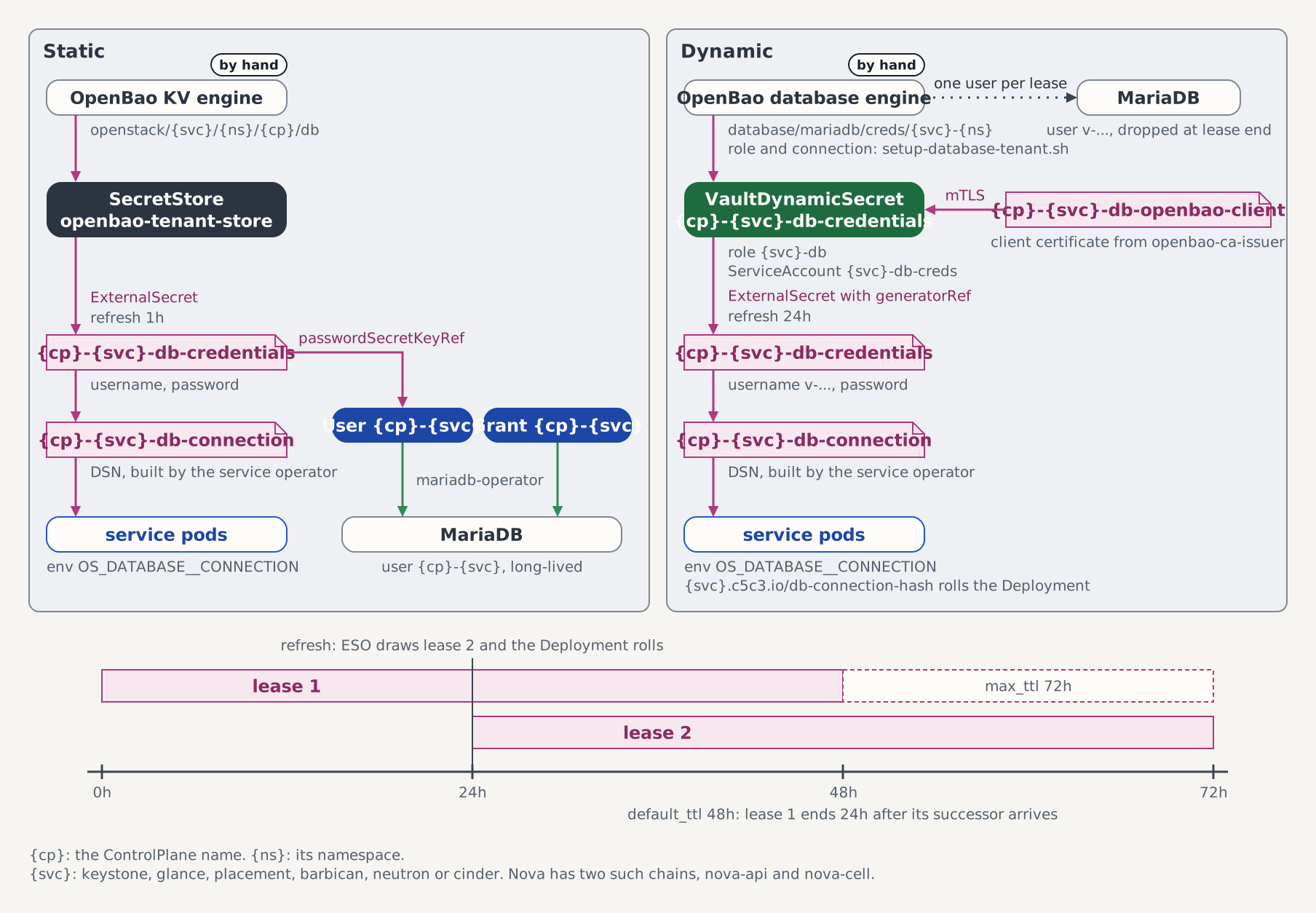
default_ttl (48h) and max_ttl (72h) are tunable via DB_CREDS_DEFAULT_TTL / DB_CREDS_MAX_TTL; default_ttl stays a full day above the operator's ExternalSecret refresh interval (24h), so the operator has a wide window to roll pods onto a fresh credential before the previous, still-in-use lease is revoked: long enough that a stalled rollout pages on-call before it can become an outage. Config and role writes are upserts, so re-running is idempotent. OpenBao runs creation_statements only when it issues a credential, so a schema added to an existing row reaches only the leases issued after the re-run: force a refresh of the service's DB-credential ExternalSecret (a fresh force-sync annotation) before the operator's db-sync Job needs the new grant.
The figure places the role this script writes in the Dynamic chain and compares that chain with the Static one.
setup-eso-tenant.sh
Purpose: Provision the in-cluster half of a standalone (non-ControlPlane) Keystone/Horizon namespace's per-tenant OpenBao identity — the objects that let that namespace's ExternalSecrets and PushSecrets reach OpenBao as the eso-tenant role instead of the shared cluster identity. It is the manual onboarding path for standalone CRs; a ControlPlane of any mode (Managed or External) never needs it, because the c5c3 operator provisions the same ServiceAccount, Certificate, and SecretStore itself and defaults the control plane onto the store (reconcileESOTenantStore). It is the ESO counterpart to setup-database-tenant.sh.
File: deploy/openbao/bootstrap/setup-eso-tenant.sh
Requires: kubectl access to the tenant's cluster; cert-manager and the openbao-ca-issuer ClusterIssuer. It does not talk to OpenBao directly — the OpenBao side (the eso-tenant role and policy) is created once at bootstrap by setup-auth.sh / setup-policies.sh.
Usage: setup-eso-tenant.sh <namespace>
It fails loudly when the namespace is absent, then idempotently applies into the tenant namespace:
| Object | Name | Purpose |
|---|---|---|
| ServiceAccount | eso-tenant-auth | the identity the SecretStore presents to OpenBao |
| Certificate (cert-manager) | eso-tenant-client-tls | the mTLS client certificate (issued by ClusterIssuer openbao-ca-issuer); its Secret carries tls.crt/tls.key and ca.crt |
| SecretStore | openbao-tenant-store | the namespaced store selected via spec.secretStoreRef |
The SecretStore authenticates as the eso-tenant role with the eso-tenant-auth ServiceAccount and sources its client cert, key, and CA from the eso-tenant-client-tls Secret (same namespace). After the SecretStore reports Ready, set the standalone Keystone/Horizon CR's spec.secretStoreRef to {kind: SecretStore, name: openbao-tenant-store} to route it through the per-tenant identity. On a cluster bootstrapped before this feature, re-run setup-auth.sh / setup-policies.sh first so the eso-tenant role and policy exist — otherwise ESO's pushes 403 and FernetKeysReady / CredentialKeysReady degrade. Setting spec.secretStoreRef on a ControlPlane is the opt-out override for a self-managed store, not an onboarding step. See the multi-tenant deployment guide for the full procedure.
setup-auth.sh
Purpose: Configure Kubernetes authentication for 4 cluster contexts and AppRole authentication for CI/CD pipelines and the Barbican secret store.
File: deploy/openbao/bootstrap/setup-auth.sh
Requires: BAO_TOKEN environment variable.
Kubernetes Auth Mounts
| Mount Path | Cluster | ESO Role | Bound SA | Bound NS | Policy | TTL | Max TTL |
|---|---|---|---|---|---|---|---|
kubernetes/management | Management | eso-management | external-secrets | external-secrets | eso-management | 1h | 4h |
kubernetes/control-plane | Control Plane | eso-control-plane | external-secrets | external-secrets | eso-control-plane | 1h | 4h |
kubernetes/hypervisor | Hypervisor | eso-hypervisor | external-secrets | external-secrets | eso-hypervisor | 1h | 4h |
kubernetes/storage | Storage | eso-storage | external-secrets | external-secrets | eso-storage | 1h | 4h |
Each Kubernetes auth mount creates a role named eso-<cluster> that binds to the external-secrets service account in the external-secrets namespace. The role is linked to the corresponding eso-<cluster> policy.
The management mount additionally carries a keystone-db, a glance-db, a placement-db, a neutron-db, a cinder-db, a nova-api-db, and a nova-cell-db role, each bound to a fixed per-ControlPlane ServiceAccount (keystone-db-creds / glance-db-creds / placement-db-creds / neutron-db-creds / cinder-db-creds / nova-api-db-creds / nova-cell-db-creds, any namespace) and linked to its own dynamic-credential policy (keystone-db-dynamic / glance-db-dynamic / placement-db-dynamic / neutron-db-dynamic / cinder-db-dynamic / nova-api-db-dynamic / nova-cell-db-dynamic). The c5c3 operator's per-ControlPlane VaultDynamicSecret generators authenticate with them to read short-lived DB credentials at database/mariadb/creds/keystone-{namespace}, database/mariadb/creds/glance-{namespace}, database/mariadb/creds/placement-{namespace}, database/mariadb/creds/neutron-{namespace}, database/mariadb/creds/cinder-{namespace}, database/mariadb/creds/nova-api-{namespace}, and database/mariadb/creds/nova-cell-{namespace} respectively. All seven roles deliberately bind namespaces="*" so any ControlPlane namespace may authenticate; the fixed SA name is what tells them apart (a glance-db-creds token can never read a Keystone creds path, or vice versa), and cross-tenant isolation is enforced by each policy, which templates the readable path to the caller's own service_account_namespace (an exact match — a token minted in one namespace cannot read another namespace's path).
Two further roles serve the MariaDBDatabase orders. order-db is the generators' role, bound to the order-db-creds ServiceAccount the c5c3-operator projects into a ControlPlane's namespace, in any namespace, and to the order-db-dynamic policy, with 72h tokens for the reason the table below gives. c5c3-operator is the operator's own identity, bound to its one ServiceAccount in its one namespace (c5c3-operator in c5c3-system, overridable with C5C3_OPERATOR_SERVICE_ACCOUNT and C5C3_OPERATOR_NAMESPACE) and to the c5c3-operator policy. Its token creates no lease, so its TTL is 15 minutes, and the operator revokes it after each use. A deployment brought up before the order kind existed re-runs setup-auth.sh and setup-policies.sh once before its first database order.
The two Nova roles stay dormant until a ControlPlane projects a Nova: without a nova-api-db-creds or a nova-cell-db-creds ServiceAccount nothing authenticates against them. Their VaultDynamicSecret generators are built in operators/c5c3/internal/controller/reconcile_nova_dbcredentials.go, which derives the two per-tenant engine role names with novaAPIDBDynamicRoleFor and novaCellDBDynamicRoleFor. The cell role is called nova-cell-db; the shorter name nova-db is unavailable because the per-tenant engine role name is <role>-<namespace> and no role name may be a hyphen-prefix of another (a role nova in namespace api-x and a role nova-api in namespace x would both flatten to nova-api-x).
Unlike the eso-<cluster> roles, the keystone-db, glance-db, placement-db, neutron-db, cinder-db, nova-api-db, and nova-cell-db token TTLs are pinned to the database engine's max_ttl (DB_CREDS_MAX_TTL, 72h): OpenBao revokes a dynamic-secret lease together with the auth token that minted it, so a token shorter than the lease silently caps the effective credential lifetime at the token's — with an eso-style 1h token, every issued DB credential died after ~1h while the ExternalSecret refresh only re-mints every 24h, dropping the ephemeral MySQL user under a running service. The longer-lived token is bounded by the read-only keystone-db-dynamic / glance-db-dynamic / placement-db-dynamic / neutron-db-dynamic / cinder-db-dynamic / nova-api-db-dynamic / nova-cell-db-dynamic policy.
| Mount Path | Role | Bound SA | Bound NS | Policy | TTL | Max TTL |
|---|---|---|---|---|---|---|
kubernetes/management | keystone-db | keystone-db-creds | * | keystone-db-dynamic | 72h | 72h |
kubernetes/management | glance-db | glance-db-creds | * | glance-db-dynamic | 72h | 72h |
kubernetes/management | placement-db | placement-db-creds | * | placement-db-dynamic | 72h | 72h |
kubernetes/management | neutron-db | neutron-db-creds | * | neutron-db-dynamic | 72h | 72h |
kubernetes/management | cinder-db | cinder-db-creds | * | cinder-db-dynamic | 72h | 72h |
kubernetes/management | nova-api-db | nova-api-db-creds | * | nova-api-db-dynamic | 72h | 72h |
kubernetes/management | nova-cell-db | nova-cell-db-creds | * | nova-cell-db-dynamic | 72h | 72h |
kubernetes/management | order-db | order-db-creds | * | order-db-dynamic | 72h | 72h |
kubernetes/management | c5c3-operator | c5c3-operator | c5c3-system | c5c3-operator | 15m | 15m |
kubernetes/management | eso-tenant | eso-tenant-auth | * | eso-tenant | 1h | 4h |
kubernetes/management | push-ceph-keys | ceph-keys-push | rook-ceph | push-ceph-keys | 1h | 4h |
kubernetes/management | read-ceph-keys | ceph-keys-read | openstack | read-ceph-keys | 1h | 4h |
The management mount also carries an eso-tenant role — the per-ControlPlane ESO identity a namespaced SecretStore (created per tenant by setup-eso-tenant.sh) authenticates with. Like keystone-db it binds namespaces="*" with a fixed SA name (eso-tenant-auth); the cross-tenant boundary is enforced by the eso-tenant policy, which templates every readable and writable path to the caller's own service_account_namespace, so a tenant token confined by it can only reach its own namespace's Keystone key and bootstrap material. token_max_ttl=4h caps renewal so a leaked tenant token cannot be renewed indefinitely.
The push-ceph-keys and read-ceph-keys roles carry the Ceph key hand-off of the metal-stack lab (Lab Ceph). The PushSecrets in rook-ceph authenticate as ceph-keys-push and write the client keys Rook generates to kv-v2/data/ceph/client-cinder and kv-v2/data/ceph/client-cinder-backup; the ExternalSecrets in openstack authenticate as ceph-keys-read and read them back. Each role binds one ServiceAccount in one namespace. The read role binds openstack and not *: the Ceph paths are not namespace-templated (eso-hypervisor expects the flat ceph/client-nova), so a wildcard would give every tenant namespace every Ceph key. Both roles are written on every bootstrap and stay unused on a cluster without the lab's Ceph overlay.
Note: The management cluster mount is fully configured — the script explicitly writes auth/kubernetes/management/config with the in-cluster Kubernetes API endpoint and CA certificate. This requires the OpenBao service account to have the system:auth-delegator ClusterRole (created by the Helm chart when server.authDelegator.enabled=true, the default). The control-plane, hypervisor, and storage cluster mounts have roles created but their Kubernetes host and CA configuration is deferred until those clusters are provisioned.
AppRole Auth
| Mount Path | Role | Policy | Token TTL | Max TTL | Secret ID TTL |
|---|---|---|---|---|---|
approle/ | provisioner | ci-cd-provisioner | 1h | 4h | 8760h (1 year) |
approle/ | barbican | barbican-secretstore | 1h | 4h | 720h (30 days) |
The barbican role is the identity Barbican's vault_plugin logs in with on the brownfield leg. Minting a secret ID stays out of bootstrap: for a managed deployment that is runtime work owned by the barbican-operator, and the brownfield e2e mints one at test time with the root-token bao exec it already has.
A secret ID carries no use count and no CIDR bound, so secret_id_ttl is the only thing that bounds a leaked one. On the barbican role it is 30 days rather than the year the older provisioner role uses, matching the barbican role of the proving instance (OpenBao Proving Instance).
Re-minting the barbican secret ID. Nothing re-mints the secret ID automatically yet — that becomes runtime work of the barbican-operator. Until then the 30-day TTL is a fuse on a hand-minted credential, and it burns silently: Barbican's vault_plugin holds one process-global AppRole session, so an expired secret ID surfaces as every secret-store operation failing at once, with no metric that warns ahead of it. Re-mint before the 30 days elapse, and after any Barbican deployment that has been running against a hand-minted credential for a month:
# BAO_TOKEN must be exported first — see Running the Full Bootstrap above.
cd deploy/openbao/bootstrap
source ./common.sh

# The role ID is stable across re-mints; only the secret ID rotates.
bao_exec bao read -field=role_id auth/approle/role/barbican/role-id

# Mint a fresh secret ID straight into the Secret the deployment reads it from.
# Replace <secret> and <namespace> with the Secret backing
# vault_plugin.approle_secret_id. -force is required because the write carries
# no data.
kubectl create secret generic <secret> \
  --namespace <namespace> \
  --from-literal=approle_secret_id="$(bao_exec bao write \
    -field=secret_id -force auth/approle/role/barbican/secret-id)" \
  --dry-run=client -o yaml | kubectl apply -f -
The secret ID stays inside that pipeline on purpose. bao_exec is a kubectl exec, so printing the credential first would put it in the terminal's scrollback, in a recorded session, or — if the procedure is ever wrapped in automation — in job logs that outlive the 30-day TTL by a wide margin and are readable by everyone with access to them. The credential carries no use count and no CIDR bound, so that TTL is the only thing bounding a leaked copy.
Restart the Barbican API pods afterwards: the plugin reads the credential once at process start.
To see how much of the fuse is left, list the role's live secret-ID accessors and look one up — the response carries its expiration_time:
bao_exec bao list auth/approle/role/barbican/secret-id

bao_exec bao write auth/approle/role/barbican/secret-id-accessor/lookup \
  secret_id_accessor=<accessor-from-the-list-above>
Destroy the accessor of the credential the restarted pods no longer use, so a copy of the old secret ID cannot log in for the rest of its 30 days:
bao_exec bao write auth/approle/role/barbican/secret-id-accessor/destroy \
  secret_id_accessor=<accessor-of-the-replaced-secret-id>
secret_id_num_uses is deliberately left unset on the role. castellan's Vault key manager re-logs in whenever its cached token ages out (token_ttl is 1h), so a use cap would expire the credential mid-operation rather than bound it.
Idempotency: Before enabling each auth method, the script checks bao auth list -format=json for the mount path. If the path already exists, the auth enable is skipped. Role creation uses bao write which is an upsert operation (creates or updates).
setup-policies.sh
Purpose: Apply all HCL access control policies from the policies/ directory.
File: deploy/openbao/bootstrap/setup-policies.sh
Requires: BAO_TOKEN environment variable.
The script iterates over all .hcl files in deploy/openbao/policies/ and applies each one via bao policy write <name> - (reading from stdin). The policy name is derived from the filename without the .hcl extension. Because the loop globs *.hcl, adding a new policy file (such as eso-tenant.hcl) needs no script change. The KUBERNETES_MANAGEMENT_ACCESSOR placeholder in the templated policies is substituted with the live kubernetes/management auth-mount accessor at apply time.
Eight policies are namespace-templated rather than statically scoped, so a single policy backs every tenant while confining each token to its own namespace:
keystone-db-dynamic— read on the caller's own dynamic Keystone DB-credential path.glance-db-dynamic— read on the caller's own dynamic Glance DB-credential path.placement-db-dynamic— read on the caller's own dynamic Placement DB-credential path.neutron-db-dynamic— read on the caller's own dynamic Neutron DB-credential path.cinder-db-dynamic— read on the caller's own dynamic Cinder DB-credential path.nova-api-db-dynamic— read on the caller's own dynamic Nova API DB-credential path.nova-cell-db-dynamic— read on the caller's own dynamic Nova cell DB-credential path.eso-tenant— the per-ControlPlane ESO identity and the sole write path for per-ControlPlane Keystone key material: read on the caller's ownopenstack/keystone/{ns}/*andbootstrap/{ns}/*subtrees, and create/update/read/delete on that namespace's fernet-keys, credential-keys, admin bootstrap, admin application-credential, and service-account backup paths. Every path is scoped to the caller's ownservice_account_namespace, so a tenant token cannot touch another tenant's Keystone key material. It deliberately grants noinfrastructure/*access — the static infrastructure ExternalSecrets stay on the shared cluster store.
Idempotency: bao policy write is an upsert operation — it creates a new policy or overwrites an existing one with the same name. Re-running with the same policy content is inherently idempotent.
write-bootstrap-secrets.sh
Purpose: Generate cryptographically secure passwords and seed initial credentials into the KV v2 secret engine.
File: deploy/openbao/bootstrap/write-bootstrap-secrets.sh
Requires: BAO_TOKEN environment variable.
| KV v2 Path | Secret Keys | Description |
|---|---|---|
kv-v2/bootstrap/<namespace>/<keystone>/admin | password | Keystone admin user password, scoped per Managed-mode ControlPlane. One entry per KORC_CONTROLPLANES identity; the default openstack/controlplane seeds kv-v2/bootstrap/openstack/controlplane-keystone/admin. |
kv-v2/bootstrap/<namespace>/<horizon>/secret-key | secret-key | Horizon Django SECRET_KEY, scoped per Managed-mode ControlPlane. One entry per KORC_CONTROLPLANES identity; the default seeds kv-v2/bootstrap/openstack/controlplane-horizon/secret-key, read by the kind-only horizon-secret-key ExternalSecret. |
kv-v2/infrastructure/mariadb | root-password | MariaDB root password |
kv-v2/bootstrap/openstack/garage/admin-token | token | Garage Admin API token — the operator authenticates to Garage's Admin API with it. Read by the kind-only garage-admin-token ExternalSecret in shared-services (GarageCluster.spec.admin.adminTokenSecretRef). Seeded unconditionally (Garage is base infrastructure, not per-ControlPlane). The openstack path segment names the consuming tenant, not the workload's namespace: Garage itself runs in shared-services. |
kv-v2/bootstrap/openstack/garage/s3-credentials | access-key-id, secret-access-key | Garage S3 key pair, imported by the GarageKey (not minted by the operator). access-key-id is GK-prefixed (@generate-gk), as Garage requires. Read by two kind-only garage-s3-credentials ExternalSecrets on this one path: the copy in shared-services feeds the GarageKey import, the copy in openstack serves the Glance consumers, which resolve credentialsSecretRef in their own namespace. |
kv-v2/bootstrap/openstack/openbao-instance/unseal-key | key | Static unseal key of the proving OpenBaoCluster (kind-only). Seeded unconditionally and never rotated: write_secret_if_missing guards the seed side and the consuming ExternalSecret's refreshPolicy: CreatedOnce guards the other, because a static seal whose key material changes seals the instance permanently. |
kv-v2/openstack/keystone/openstack/standalone/db | username, password | Static Keystone DB credential for standalone (non-ControlPlane) Keystone demos only (username is keystone), read by the kind-only keystone-db ExternalSecret. Brownfield-only. |
Mode note: KORC_CONTROLPLANES lists Managed-mode ControlPlane identities only. An External-mode ControlPlane (spec.services.keystone.mode: External) is never seeded here — its admin password is owned out-of-band in the user-supplied passwordSecretRef Secret, the c5c3 operator's reconcileAdminPassword short-circuits without reading any bootstrap path, and services.horizon is rejected in External mode. Listing an External identity would write a generated admin password that nothing reads. See OpenBao paths per ControlPlane mode.
Retired (#439): the stage-(a) per-ControlPlane static DB seed kv-v2/openstack/keystone/{ns}/{name}/db is no longer written. Managed-mode ControlPlanes now draw short-lived, engine-issued credentials from the MariaDB database engine (database/mariadb/creds/keystone-{ns}), so no long-lived static DB password is seeded at rest. Only the single standalone credential above remains.
Password generation: Each password is generated inside the OpenBao pod using openssl rand -base64 32 via sh -c within kubectl exec, producing a 32-byte (256-bit) cryptographically secure random value encoded as base64 (44 characters). Generating passwords inside the pod prevents cleartext passwords from appearing in host /proc/<pid>/cmdline process argument lists.
Generated-value markers: A key whose value is the marker @generate is replaced with a freshly generated random value in-pod (as above). The @generate-gk marker is a variant for Garage S3 access-key IDs: it emits the literal prefix GK followed by 24 hex characters (12 random bytes), the format Garage's key import requires. Both markers keep the cleartext off the host process argument list.
Security: Generated passwords are never echoed to stdout or stderr and never appear as command-line arguments visible to host process listings. The script outputs only status messages (e.g., Writing kv-v2/bootstrap/openstack/controlplane-keystone/admin... or Skipping kv-v2/bootstrap/openstack/controlplane-keystone/admin (already exists)).
Idempotency: Before writing each secret, the script checks bao kv get for the path. If the secret already exists, the write is skipped to prevent overwriting existing credentials. This is critical — overwriting would create a mismatch between the credentials stored in OpenBao and those already provisioned to consuming services.
ESO PushSecret adoption marker: After seeding, the script stamps custom_metadata.managed-by=external-secrets onto the per-ControlPlane admin paths via bao kv metadata put. ESO refuses to push to a pre-existing secret whose metadata lacks this marker (it fails with "secret not managed by external-secrets"), so without the stamp the scheduled admin-password rotation backup PushSecret (per-CR RemoteKey bootstrap/{namespace}/{keystone}/admin) could never mirror a rotated password back into OpenBao. The stamp runs unconditionally — it also adopts paths a prior deploy created without the marker — and bao kv metadata put touches only metadata, leaving the stored password versions untouched.
HCL Access Control Policies
Twenty HCL policies enforce least-privilege access for each consumer type. All policy paths under the KV v2 engine include the data/ prefix, which is required by the OpenBao/Vault KV v2 API for read and write operations.
ESO Policies (Read-Only)
These policies grant the External Secrets Operator read-only access to pull secrets from OpenBao into Kubernetes Secrets.
| Policy | Paths | Capabilities |
|---|---|---|
eso-management | kv-v2/data/bootstrap/*, kv-v2/data/infrastructure/* | read |
eso-control-plane | kv-v2/data/bootstrap/*, kv-v2/data/infrastructure/*, kv-v2/data/ceph/* | read |
eso-hypervisor | kv-v2/data/ceph/client-nova, kv-v2/data/openstack/nova/compute-* | read |
eso-storage | kv-v2/data/ceph/* | read, create, update |
Note: eso-storage is the only ESO policy with write capabilities. This allows the Ceph cluster to write its own keys back to OpenBao via PushSecret.
Note: eso-hypervisor has the narrowest scope — it can only access the specific Ceph client key for Nova and Nova compute configuration, not broader secret paths.
Operational Policies
| Policy | Paths | Capabilities | Purpose |
|---|---|---|---|
eso-tenant | kv-v2/{data,metadata}/openstack/keystone/{ns}/… (fernet-keys, credential-keys, admin app-credential, service-accounts), kv-v2/{data,metadata}/openstack/rabbitmq/{ns}/+/credentials and kv-v2/{data,metadata}/bootstrap/{ns}/…/admin, plus read on kv-v2/data/openstack/keystone/{ns}/* and kv-v2/data/bootstrap/{ns}/* | create, update, read, delete | Per-tenant sole write path for per-ControlPlane Keystone key material (fernet/credential-key backups, admin bootstrap, admin Application Credential, service-account passwords) and the broker credentials of RabbitMQVhost orders. Every path is namespace-templated to the caller's own service_account_namespace (bound to the eso-tenant role), so a tenant token cannot reach another tenant's key material. |
push-ceph-keys | kv-v2/data/ceph/*, kv-v2/metadata/ceph/* | create, update, read | PushSecret for Ceph client keys, bound to the push-ceph-keys role. ESO writes and reads the custom metadata of every KV v2 secret it pushes, so the push needs the metadata path too. |
read-ceph-keys | kv-v2/data/ceph/* | read | ExternalSecret read of the Ceph client keys, bound to the read-ceph-keys role (ServiceAccount ceph-keys-read in openstack) |
ci-cd-provisioner | kv-v2/data/* (create/update/read), kv-v2/metadata/* (read/list) | create, update, read, list | CI/CD pipeline secret provisioning |
pki-issuer | pki/issue/*, pki/sign/* | create, update | cert-manager PKI certificate issuing |
barbican-secretstore | barbican/data/* (plus barbican/metadata/* without delete) | create, read, update, delete, list | Barbican's secret store on the shared instance, bound to the barbican AppRole role. The consumer is Barbican's vault_plugin via castellan, which speaks the Vault-compatible HTTP API that OpenBao keeps compatible. No delete on metadata/: in KV v2 that verb permanently destroys every version of a secret, the only in-store recovery path tenant key material has, while castellan deletes through data/* where the delete is a recoverable soft delete. Same grants as the barbican-secretstore policy the proving OpenBaoCluster self-initializes. |
keystone-db-dynamic | database/mariadb/creds/keystone-{{identity.entity.aliases.KUBERNETES_MANAGEMENT_ACCESSOR.metadata.service_account_namespace}} | read | Per-tenant dynamic Keystone DB credential reads (bound to the keystone-db role). The path is scoped by ACL identity templating to the caller's own service-account namespace (exact match, no wildcard), so a token minted in one namespace cannot read another tenant's creds path. Read-only: a dynamic engine has no static password to push, so the deferred push-keystone-db.hcl is unnecessary and not created (#439). |
glance-db-dynamic | database/mariadb/creds/glance-{{identity.entity.aliases.KUBERNETES_MANAGEMENT_ACCESSOR.metadata.service_account_namespace}} | read | Per-tenant dynamic Glance DB credential reads (bound to the glance-db role) — the Glance analogue of keystone-db-dynamic, and fully keystone-independent. The path is scoped by ACL identity templating to the caller's own service-account namespace (exact match, no wildcard), so a token minted in one namespace cannot read another tenant's creds path. Read-only: a dynamic engine has no static password to push. |
placement-db-dynamic | database/mariadb/creds/placement-{{identity.entity.aliases.KUBERNETES_MANAGEMENT_ACCESSOR.metadata.service_account_namespace}} | read | Per-tenant dynamic Placement DB credential reads (bound to the placement-db role), on the same terms as the Glance policy. The path is scoped by ACL identity templating to the caller's own service-account namespace (exact match, no wildcard). The placement-db-creds SA name is what keeps a Placement generator off a Keystone creds path when both services share a namespace. Read-only: a dynamic engine has no static password to push. |
neutron-db-dynamic | database/mariadb/creds/neutron-{{identity.entity.aliases.KUBERNETES_MANAGEMENT_ACCESSOR.metadata.service_account_namespace}} | read | Per-tenant dynamic Neutron DB credential reads (bound to the neutron-db role), on the same terms as the Placement policy. The path is scoped by ACL identity templating to the caller's own service-account namespace (exact match, no wildcard). The neutron-db-creds SA name is what keeps a Neutron generator off a Keystone creds path when both services share a namespace. Read-only: a dynamic engine has no static password to push. |
cinder-db-dynamic | database/mariadb/creds/cinder-{{identity.entity.aliases.KUBERNETES_MANAGEMENT_ACCESSOR.metadata.service_account_namespace}} | read | Per-tenant dynamic Cinder DB credential reads (bound to the cinder-db role), on the same terms as the Neutron policy. The path is scoped by ACL identity templating to the caller's own service-account namespace (exact match, no wildcard). The cinder-db-creds SA name is what keeps a Cinder generator off a Keystone or a Neutron creds path when those services share a namespace. Read-only: a dynamic engine has no static password to push. |
nova-api-db-dynamic | database/mariadb/creds/nova-api-{{identity.entity.aliases.KUBERNETES_MANAGEMENT_ACCESSOR.metadata.service_account_namespace}} | read | Per-tenant dynamic Nova API DB credential reads (bound to the nova-api-db role), on the same terms as the Cinder policy. The path is scoped by ACL identity templating to the caller's own service-account namespace (exact match, no wildcard). The nova-api-db-creds SA name is what keeps the Nova API generator off the cell creds path, and off every other service's path, when those services share a namespace. Read-only: a dynamic engine has no static password to push. |
nova-cell-db-dynamic | database/mariadb/creds/nova-cell-{{identity.entity.aliases.KUBERNETES_MANAGEMENT_ACCESSOR.metadata.service_account_namespace}} | read | Per-tenant dynamic Nova cell DB credential reads (bound to the nova-cell-db role), covering the cell database and its nova_cell0 schema on the same terms as the Nova API policy. The nova-cell-db-creds SA name keeps the cell generator off the API creds path, and the role name nova-cell is prefix-free against nova-api, so the two creds paths never coincide in any namespace. Read-only: a dynamic engine has no static password to push. |
order-db-dynamic | database/mariadb/creds/order.{{identity.entity.aliases.KUBERNETES_MANAGEMENT_ACCESSOR.metadata.service_account_namespace}}.* | read | Dynamic credential reads of the MariaDBDatabase orders (bound to the order-db role). The operator names each order role order.{controlplane namespace}.{order}, with dots as the separators: a namespace cannot contain a dot, so the templated segment matches the caller's own namespace and no namespace that merely starts with it. Read-only. |
c5c3-operator | database/mariadb/roles/order.*, sys/leases/revoke-prefix/database/mariadb/creds/order.* | create, read, update, delete on the roles; update, sudo on the revocation | The c5c3-operator's own identity (bound to the c5c3-operator role). It writes and deletes the order roles and revokes their leases on an order's teardown; revoke-prefix is root-protected and needs sudo. Nothing under database/mariadb/config is granted, so the MariaDB root password stays with setup-database-tenant.sh. |
Note: ci-cd-provisioner intentionally lacks delete capability. The CI/CD pipeline can create, update, and read secrets but cannot delete them, preventing accidental secret removal during automated deployments.
Note: push-ceph-keys and eso-tenant include read capability so that ESO's PushSecret controller can check the current remote value during reconciliation and only write when the secret has actually changed.
Note: eso-tenant carries the per-ControlPlane grants for the c5c3 operator's admin Application Credential (kv-v2/{data,metadata}/openstack/keystone/{ns}/+/admin/app-credential) and its declarative service-account passwords (kv-v2/{data,metadata}/openstack/keystone/{ns}/+/service-accounts/+), with delete on the data leaves so the DeletionPolicy: Delete PushSecrets can purge the KV leaf on teardown. It carries the backup of every RabbitMQVhost order on the same terms (kv-v2/{data,metadata}/openstack/rabbitmq/{ns}/+/credentials, no delete on the metadata leaf). These paths are namespace-templated — {ns} resolves to the caller's own service_account_namespace — so a tenant's PushSecret cannot write another tenant's KV leaf. See the infrastructure manifests reference.
Secret Paths
All secrets are stored under the kv-v2/ mount point (KV version 2 engine).
Bootstrap Secrets
| Path | Keys | Provisioned By | Consumed By |
|---|---|---|---|
kv-v2/bootstrap/<namespace>/<keystone>/admin | password | write-bootstrap-secrets.sh (per Managed-mode ControlPlane; default .../openstack/controlplane-keystone/admin) | Operator-created ExternalSecret {controlplane.Name}-keystone-admin-credentials (default controlplane-keystone-admin-credentials); on kind additionally the overlay's keystone-admin ExternalSecret (default identity) |
kv-v2/bootstrap/<namespace>/<horizon>/secret-key | secret-key | write-bootstrap-secrets.sh (per Managed-mode ControlPlane; default .../openstack/controlplane-horizon/secret-key) | On kind the overlay's horizon-secret-key ExternalSecret (default identity); per-CR ExternalSecrets in test namespaces |
kv-v2/infrastructure/mariadb | root-password | write-bootstrap-secrets.sh | On kind the overlay's mariadb-root-password ExternalSecret; in production a non-kind Flux MariaDB baseline provides the mariadb-root-password Secret itself |
kv-v2/bootstrap/openstack/garage/admin-token | token | write-bootstrap-secrets.sh (unconditional; Garage is base infra) | The kind overlay's garage-admin-token ExternalSecret in shared-services → GarageCluster.spec.admin.adminTokenSecretRef |
kv-v2/bootstrap/openstack/garage/s3-credentials | access-key-id (GK-prefixed), secret-access-key | write-bootstrap-secrets.sh (unconditional) | The kind overlay's garage-s3-credentials ExternalSecret in shared-services → GarageKey.spec.importKey.secretRef, plus a second copy in openstack for the Glance consumers |
kv-v2/bootstrap/openstack/openbao-instance/unseal-key | key | write-bootstrap-secrets.sh (unconditional) | The kind overlay's openbao-instance-unseal-key ExternalSecret (refreshPolicy: CreatedOnce) → the Secret the openbao-operator mounts as the proving instance's static seal. Never rotated |
kv-v2/openstack/keystone/openstack/standalone/db | username, password | write-bootstrap-secrets.sh (standalone/brownfield only) | The kind overlay's keystone-db ExternalSecret, serving standalone (non-ControlPlane) Keystone demos |
Note: The stage-(a) per-ControlPlane static path openstack/keystone/{ns}/{name}/db (c5c3 operator helper dbCredentialRemoteKeyFor) is no longer seeded (#439): managed-mode ControlPlanes draw short-lived, engine-issued credentials from database/mariadb/creds/keystone-{ns} instead. The static path derivation is retained only for the credentialsMode: Static opt-out (brownfield migration), whose KV path must then be seeded manually — see docs/guides/keystone/migrate-keystone-db-to-dynamic-credentials.md.
OpenBao paths per ControlPlane mode
Which OpenBao paths exist for a ControlPlane depends on its Keystone identity mode (spec.services.keystone.mode). Seeding is a Managed-mode concern only; an External-mode ControlPlane wraps a pre-existing Keystone whose credentials were never minted by this operator, so no seeding script runs for it. In both modes the per-tenant openbao-tenant-store SecretStore the c5c3 operator provisions for the ControlPlane (reconcileESOTenantStore) is what reaches these paths, authenticating as the namespace-templated eso-tenant identity.
Both modes — created on demand by ESO, never seeded. ESO's first PushSecret CREATES the KV leaf and stamps custom_metadata.managed-by=external-secrets itself (the managed-by guard only rejects a pre-existing leaf lacking that marker, so a first push to a never-seeded path always succeeds):
Path (under the kv-v2 mount) | Written by | Read back by |
|---|---|---|
openstack/keystone/{ns}/{cp}/admin/app-credential | c5c3 operator admin-AC backup PushSecret (adminAppCredentialRemoteKeyFor, DeletionPolicy: Delete) | per-CR k-orc-clouds-yaml ExternalSecret (ensureKORCCloudsYAMLExternalSecret) |
openstack/keystone/{ns}/{name}/service-accounts/credentials | c5c3 operator per-registration backup PushSecret (keystoneServiceRemoteKeyFor, one per KeystoneService CR — {ns}/{name} is that CR's) | the matching per-registration ExternalSecret |
openstack/rabbitmq/{ns}/{name}-{hash}-vhost/credentials | c5c3 operator backup PushSecret of a RabbitMQVhost order (rabbitMQVhostRemoteKeyFor, DeletionPolicy: Delete; {ns} is the ControlPlane's namespace, {name} the order's) | nothing: OpenBao is the store of record, and the delivered Secret is written from the source Secret |
Managed mode additionally — seeded and/or backed up because the operator owns the Keystone lifecycle:
Path (under the kv-v2 mount) | Provisioned |
|---|---|
bootstrap/{ns}/{cp}-keystone/admin | seeded by write-bootstrap-secrets.sh (ESO-adoption-marked), later overwritten by the keystone-operator Model B rotation PushSecret |
bootstrap/{ns}/{cp}-horizon/secret-key | seeded by write-bootstrap-secrets.sh |
openstack/keystone/{ns}/{cp}-keystone/fernet-keys | keystone-operator backup PushSecret (reconcile_fernet.go) |
openstack/keystone/{ns}/{cp}-keystone/credential-keys | keystone-operator backup PushSecret (reconcile_credential.go) |
database/mariadb/creds/keystone-{ns} (database engine, not KV) | dynamic, short-lived leases issued by the database engine role provisioned by setup-database-tenant.sh |
External mode — no seeding script runs for the ControlPlane and no bootstrap path is created for it. The only OpenBao-side prerequisites are the one-time cluster bootstrap:
- the secret engines (
setup-secret-engines.sh), - the
eso-tenantKubernetes-auth role (setup-auth.sh), - the templated
eso-tenantpolicy (setup-policies.sh),
plus the infra-stack openbao-ca-issuer ClusterIssuer that signs the tenant store's mTLS client certificate. Neither setup-eso-tenant.sh nor setup-database-tenant.sh is needed: the c5c3 operator provisions the per-tenant store itself, and an External-mode ControlPlane has no managed database. The app-credential and declared service-account paths above are still created on the operator's first push, exactly as in Managed mode.
ESO Integration
The ClusterSecretStore openbao-cluster-store connects the External Secrets Operator to OpenBao. ExternalSecret resources reference this store to pull secrets into Kubernetes.
Note: The shared openbao-cluster-store is now namespace-restricted. Its spec.conditions (deploy/eso/clustersecretstore.yaml) limit which namespaces may reference it to openstack and shared-services. The first hosts the static infrastructure ExternalSecrets listed below; the second hosts the Garage ones that sit next to the object store. Per-ControlPlane Keystone key material is no longer read or written through this shared store; each ControlPlane uses its own namespaced openbao-tenant-store (backed by the per-tenant eso-tenant identity, provisioned by setup-eso-tenant.sh). The exact allowed namespace is deployment-specific.
| ExternalSecret | Namespace | Remote Path | Remote Property | K8s Secret Name | K8s Secret Key |
|---|---|---|---|---|---|
{controlplane.Name}-keystone-admin-credentials | openstack | bootstrap/{ns}/{name}-keystone/admin (default bootstrap/openstack/controlplane-keystone/admin) | password | {controlplane.Name}-keystone-admin-credentials | password |
{controlplane.Name}-keystone-db-credentials | openstack | Dynamic (default): generator-backed via VaultDynamicSecret reading database/mariadb/creds/keystone-{ns} (no KV remote path); Static opt-out: openstack/keystone/{ns}/{name}/db | username, password | {controlplane.Name}-keystone-db-credentials | username, password |
{controlplane.Name}-glance-db-credentials | openstack | Dynamic (default): generator-backed via VaultDynamicSecret reading database/mariadb/creds/glance-{ns} (no KV remote path); Static opt-out: openstack/glance/{ns}/{name}/db | username, password | {controlplane.Name}-glance-db-credentials | username, password |
{controlplane.Name}-placement-db-credentials | openstack | Dynamic (default): generator-backed via VaultDynamicSecret reading database/mariadb/creds/placement-{ns} (no KV remote path); Static opt-out: openstack/placement/{ns}/{name}/db | username, password | {controlplane.Name}-placement-db-credentials | username, password |
{controlplane.Name}-neutron-db-credentials | openstack | Dynamic (default): generator-backed via VaultDynamicSecret reading database/mariadb/creds/neutron-{ns} (no KV remote path); Static opt-out: openstack/neutron/{ns}/{name}/db | username, password | {controlplane.Name}-neutron-db-credentials | username, password |
{controlplane.Name}-cinder-db-credentials | openstack | Dynamic (default): generator-backed via VaultDynamicSecret reading database/mariadb/creds/cinder-{ns} (no KV remote path); Static opt-out: openstack/cinder/{ns}/{name}/db | username, password | {controlplane.Name}-cinder-db-credentials | username, password |
keystone-admin (kind only) | openstack | bootstrap/openstack/controlplane-keystone/admin | password | keystone-admin | password |
mariadb-root-password (kind only) | openstack | infrastructure/mariadb | root-password | mariadb-root-password | password |
keystone-db (kind only) | openstack | openstack/keystone/openstack/standalone/db | username, password | keystone-db | username, password |
neutron-db (kind only) | openstack | openstack/neutron/openstack/standalone/db | username, password | neutron-db | username, password |
cinder-db (kind only) | openstack | openstack/cinder/openstack/standalone/db | username, password | cinder-db | username, password |
nova-api-db (kind only) | openstack | openstack/nova/openstack/standalone/api-db | username, password | nova-api-db | username, password |
nova-db (kind only) | openstack | openstack/nova/openstack/standalone/db | username, password | nova-db | username, password |
Note: The static deploy/eso/externalsecrets/ directory has been removed, so the production stack ships no ExternalSecret resources — its ESO kustomization renders only clustersecretstore.yaml. The admin and database ExternalSecrets are now projected per-ControlPlane by the c5c3 operator: the {controlplane.Name}-keystone-admin-credentials ExternalSecret by the reconcileAdminPassword sub-reconciler (remote key bootstrap/{ns}/{name}-keystone/admin), and the {controlplane.Name}-keystone-db-credentials ExternalSecret by the reconcileDBCredentials sub-reconciler (Dynamic default: backed by a VaultDynamicSecret generator reading database/mariadb/creds/keystone-{ns}; Static opt-out: KV remote key openstack/keystone/{ns}/{name}/db, seeded manually). Neither the flat database path openstack/keystone/db nor the stage-(a) per-ControlPlane static path is seeded anymore.
Note: The keystone-admin, mariadb-root-password, and keystone-db ExternalSecrets survive only as kind-overlay-only resources under deploy/kind/infrastructure/ (keystone-admin-externalsecret.yaml, mariadb-root-password-externalsecret.yaml, keystone-db-externalsecret.yaml). They keep the standalone flows — the Quick Start and the keystone/infrastructure e2e, tempest, and chaos suites that reference plain Secret names — working, and are not deployed in production. Outside kind, a standalone Keystone instance has to materialise the keystone-admin and keystone-db Secrets itself, and a non-kind Flux MariaDB baseline is expected to provide the mariadb-root-password Secret itself.
Note: The ExternalSecret remoteRef.key is the path under the store's mount path. The ClusterSecretStore already sets path: kv-v2, so ExternalSecrets use infrastructure/mariadb (not kv-v2/infrastructure/mariadb).
Note: The mariadb-root-password ExternalSecret maps the OpenBao key root-password to the Kubernetes Secret key password. The MariaDB CR references this Secret with rootPasswordSecretKeyRef.key: password, which reads the exact key specified — the MariaDB CRD uses a standard SecretKeySelector with no key remapping.
OpenBao HelmRelease
File: deploy/flux-system/releases/openbao.yaml
| Property | Value |
|---|---|
| Target namespace | shared-services |
| Chart | openbao |
| Version constraint | >=0.5.0 <1.0.0 |
| Source | openbao HelmRepository |
| Dependencies | cert-manager in cert-manager namespace |
HA Raft Configuration
| Setting | Value |
|---|---|
| Replicas | 3 |
| Storage backend | Raft |
| Raft data path | /openbao/data |
| PVC size | 10Gi |
| PVC storage class | local-path |
| Leader election | Automatic via Raft consensus |
All 3 replicas are configured with retry_join stanzas pointing to each other's headless service DNS names (openbao-0.openbao-internal, openbao-1.openbao-internal, openbao-2.openbao-internal), enabling automatic cluster formation at startup.
TLS Configuration
| Setting | Value |
|---|---|
| TLS certificate | /openbao/tls/tls.crt |
| TLS key | /openbao/tls/tls.key |
| Listener address | [::]:8200 (dual-stack) |
| Cluster address | [::]:8201 |
| TLS disabled | false |
| Certificate source | openbao-tls Secret (cert-manager) |
| Certificate duration | 8760h (1 year) |
| Renewal window | 720h (30 days before expiry) |
tls_client_ca_file | /openbao/tls/ca.crt — CA the listener uses to verify presented client certs. The file resolves to the openbao-ca CA bundle because the server cert (openbao-tls) and every client cert are signed by the same openbao-ca-issuer (see below) |
tls_require_and_verify_client_cert | true — every TLS handshake on :8200 must present a valid client cert; the listener rejects any connection that does not, before any application-layer auth (Kubernetes JWT, AppRole, root token) runs |
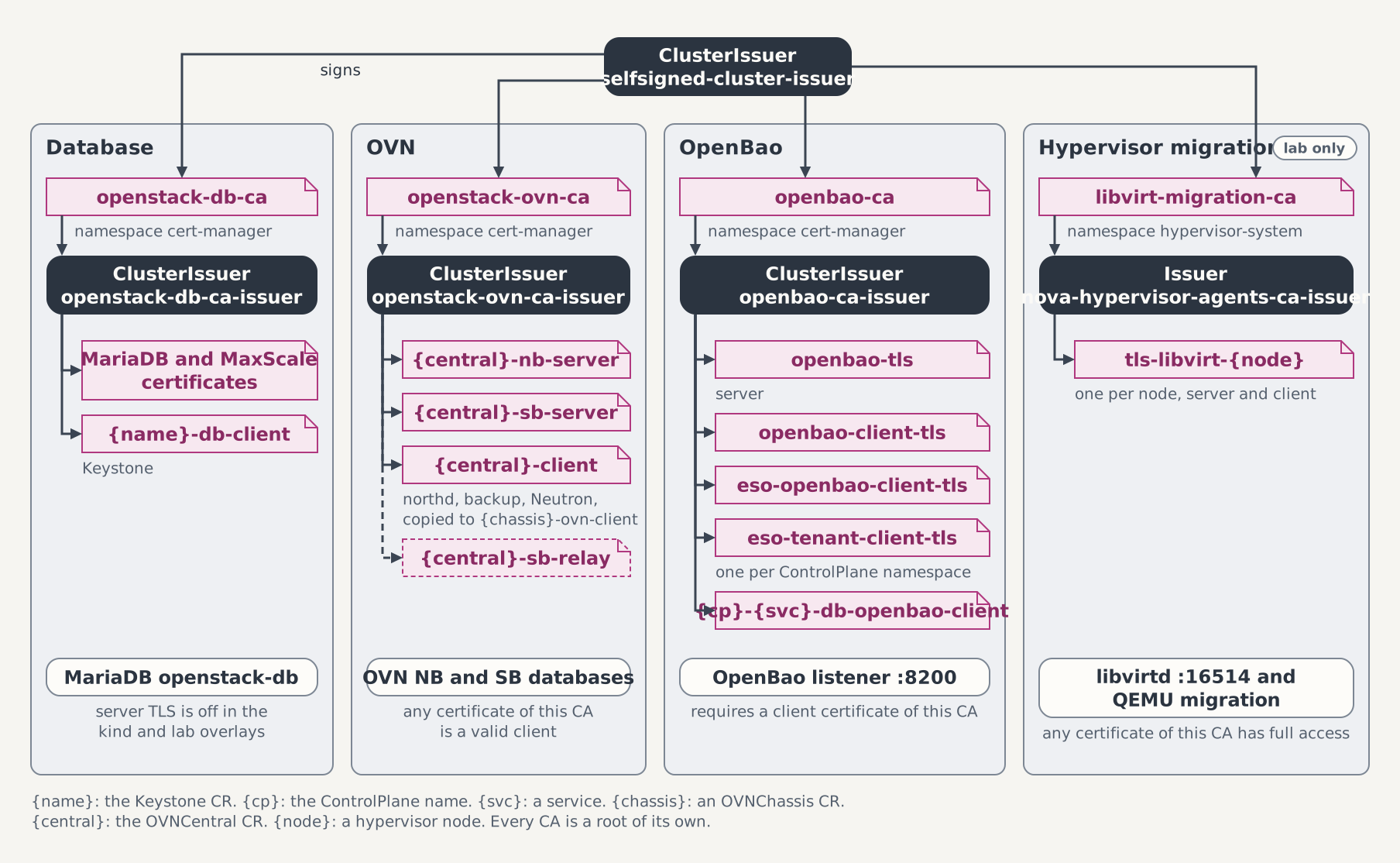
The TLS certificate is issued by the openbao-ca-issuer (a CA-type ClusterIssuer) via a cert-manager Certificate resource at deploy/flux-system/infrastructure/openbao-tls-cert.yaml. The CA keypair itself is bootstrapped by selfsigned-cluster-issuer in deploy/flux-system/infrastructure/openbao-ca-issuer.yaml — a SelfSigned issuer cannot sign leaves for a separate trust chain, so the openbao trust domain owns its own CA (mirrors the openstack-db-ca precedent).
The figure shows the OpenBao trust domain beside the other three.
Client certificates. Two additional cert-manager.io/v1 Certificates issue client-auth keypairs from the same openbao-ca-issuer, both declared in deploy/flux-system/infrastructure/openbao-client-tls-cert.yaml:
| Certificate | Secret | Consumer | Mount / Reference |
|---|---|---|---|
openbao-client-tls | openbao-client-tls (namespace shared-services) | OpenBao pods themselves — Raft retry_join peer auth + in-pod bao exec via bootstrap/*.sh | StatefulSet volume client-tls mounted read-only at /openbao/client-tls, distinct from the server-cert mount at /openbao/tls |
eso-openbao-client-tls | eso-openbao-client-tls (namespace shared-services) | External Secrets Operator ClusterSecretStore/openbao-cluster-store | spec.provider.vault.tls.certSecretRef / keySecretRef (deploy/eso/clustersecretstore.yaml); Kubernetes-token auth.kubernetes block is unchanged — mTLS is purely a transport-layer admission gate |
Both client Certificates carry usages: ["client auth"] and share the openbao-tls duration / renewBefore so server and client rotation cadences align. The commonName / dnsNames on the client certs are identifiers only — the OpenBao listener does not verify SANs on client auth, only the issuing CA.
Certificate SANs:
| SAN | Type | Cert | Usages | Purpose |
|---|---|---|---|---|
openbao-0.openbao-internal | DNS | openbao-tls (server) | not set | StatefulSet pod 0 |
openbao-1.openbao-internal | DNS | openbao-tls (server) | not set | StatefulSet pod 1 |
openbao-2.openbao-internal | DNS | openbao-tls (server) | not set | StatefulSet pod 2 |
openbao.shared-services.svc | DNS | openbao-tls (server) | not set | Kubernetes Service endpoint |
127.0.0.1 | IP | openbao-tls (server) | not set | Pod-local loopback (bootstrap scripts, bao_exec) |
::1 | IP | openbao-tls (server) | not set | IPv6 loopback |
openbao-client.shared-services.svc | DNS | openbao-client-tls | client auth | Identifier only; presented by OpenBao pods on Raft retry_join and in-pod bao exec. SANs are not verified by the listener for client auth — chain-to-CA is. |
eso-openbao-client.shared-services.svc | DNS | eso-openbao-client-tls | client auth | Identifier only; presented by ESO ClusterSecretStore/openbao-cluster-store on every Vault call. SANs are not verified. |
openbao-tls sets no usages field, so cert-manager's default key usages apply.
Resource Limits
| Resource | Request | Limit |
|---|---|---|
| Memory | 256Mi | 512Mi |
| CPU | 250m | — |
Disabled Features
| Feature | Value | Reason |
|---|---|---|
injector.enabled | false | Secrets are managed via ESO, not sidecar injection |
ui | false | No web UI required for headless secret management |
Idempotency Guarantees
All bootstrap scripts are designed to be safely re-run without side effects. This table summarizes the idempotency mechanism for each script:
| Script | Guard Mechanism | Behavior on Re-run |
|---|---|---|
init-unseal.sh | bao status -format=json JSON parsing | Skips initialization if already initialized; skips unseal for already-unsealed pods |
setup-secret-engines.sh | bao secrets list path check | Skips engine enable if mount path already exists |
setup-auth.sh | bao auth list path check | Skips auth enable if mount path already exists; role write is upsert |
setup-policies.sh | bao policy write upsert semantics | Overwrites existing policy with same content (no-op if unchanged) |
write-bootstrap-secrets.sh | bao kv get existence check | Skips secret write if path already contains data |
Critical invariant: write-bootstrap-secrets.sh never overwrites existing secrets. This prevents credential rotation from being accidentally triggered by a re-run. To rotate credentials, existing secrets must be explicitly deleted first.
Error Handling
All scripts use set -euo pipefail for strict error handling:
| Flag | Behavior |
|---|---|
-e | Exit immediately on any command failure |
-u | Treat unset variables as errors |
-o pipefail | Propagate failures through pipes (not just the last command) |
Scripts log timestamped status messages to stdout using ISO 8601 format. Error messages from bao CLI commands are propagated to stderr by kubectl exec.
Troubleshooting
OpenBao pods not starting
Verify the TLS certificate Secret exists and is populated:
kubectl get secret openbao-tls -n shared-services -o jsonpath='{.data.tls\.crt}' | wc -cIf the Secret is empty or missing, check cert-manager logs:
kubectl logs -n cert-manager -l app.kubernetes.io/name=cert-managerUnseal keys lost
If the openbao-init-keys Secret is deleted, the unseal keys cannot be recovered. OpenBao must be completely redeployed (delete PVCs, delete pods, re-run init):
kubectl delete pvc -n shared-services -l app.kubernetes.io/name=openbao
kubectl delete pods -n shared-services -l app.kubernetes.io/name=openbao
# Wait for pods to restart, then re-run init-unseal.sh
Script fails with "permission denied"
Ensure scripts have execute permissions:
chmod +x deploy/openbao/bootstrap/*.shExternalSecrets stuck in "SecretSyncedError"
Verify the store is healthy. For a ControlPlane on the default shared store, check the ClusterSecretStore; for one switched to a per-tenant identity via spec.secretStoreRef: {kind: SecretStore, name: openbao-tenant-store}, check the namespaced SecretStore in the tenant's namespace instead:
# Default (shared) store:
kubectl get clustersecretstore openbao-cluster-store -o jsonpath='{.status.conditions}'

# Per-tenant store (in the ControlPlane's namespace):
kubectl get secretstore openbao-tenant-store -n <namespace> -o jsonpath='{.status.conditions}'
For a per-tenant store, a 403/permission-denied on push usually means the eso-tenant role or the eso-tenant policy is missing — re-run setup-auth.sh and setup-policies.sh (bootstrap predating this feature does not create them).
Common causes:
- OpenBao is sealed (re-run
init-unseal.sh) - ESO service account missing (verify
external-secretsSA exists inexternal-secretsnamespace) - TLS trust failure (verify
openbao-tlsSecret containsca.crtkey) - Missing client certificate: verify the
eso-openbao-client-tlsSecret exists inshared-servicesand theClusterSecretStorespec.provider.vault.tls.certSecretRef/keySecretRefpoint at it. Withtls_require_and_verify_client_cert = trueon the listener, an absent or mis-referenced client cert appears as a generic TLS handshake error in the ESO controller log (remote error: tls: bad certificateor similar), not as an HTTP 401/403.
Verify mTLS enforcement
Confirm the listener rejects a client that does not present a valid certificate. The probe runs entirely inside the pod (so the CA bundle is on the filesystem and reaches the loopback listener) and exits non-zero on success, because the handshake must fail:
# Expected output ends with:
#   curl: (35) ... alert certificate required        OR
#   curl: (56) ... tls: certificate required         OR
#   exit code 35/56 from curl with no body returned.
# Exit code MUST be non-zero. A 200 OK from this command would indicate that
# tls_require_and_verify_client_cert is NOT being enforced and is a P0 incident.
kubectl exec -n shared-services openbao-0 -- \
  sh -c 'curl --cacert /openbao/tls/ca.crt -sS -o /dev/null \
             -w "http_code=%{http_code}\n" \
             https://127.0.0.1:8200/v1/sys/health; echo "exit=$?"'
Then confirm the same call succeeds with the client cert (this is what bao_exec does on every reconcile):
# Expected: http_code=200 (or 429 if standby), exit=0.
kubectl exec -n shared-services openbao-0 -- \
  sh -c 'curl --cacert /openbao/tls/ca.crt \
             --cert   /openbao/client-tls/tls.crt \
             --key    /openbao/client-tls/tls.key \
             -sS -o /dev/null -w "http_code=%{http_code}\n" \
             https://127.0.0.1:8200/v1/sys/health; echo "exit=$?"'
If the first command unexpectedly returns http_code=200, the listener is not enforcing client-cert auth — re-check deploy/flux-system/releases/openbao.yaml for tls_client_ca_file and tls_require_and_verify_client_cert = true, and that the HelmRelease has reconciled (kubectl get helmrelease openbao -n shared-services).
Related Resources
- Infrastructure Manifests — FluxCD base deployment
deploy/flux-system/releases/openbao.yaml— OpenBao HelmReleasedeploy/flux-system/infrastructure/openbao-tls-cert.yaml— server TLS Certificatedeploy/flux-system/infrastructure/openbao-client-tls-cert.yaml— client TLS Certificatesdeploy/eso/clustersecretstore.yaml— ClusterSecretStore configuration (now uses client-cert mTLS); the only resource the production ESO kustomization rendersdeploy/kind/infrastructure/— kind-overlay-only ExternalSecret shims (keystone-admin,mariadb-root-password,keystone-db)